Part One of the Wilson v. Reliable Street Inc., et al. series —
Record Retaliation:
How False Allegations of Stalking, Harassment, Racism, and Other Misconduct Entered an Iowa Government Record—Creating a Foreseeable Legal and Political Threat to My Safety, Reputation, and Life’s Work
By Sondra Wilson | Updated September 8, 2026
New to this case? This article is Part One of an eight-part series. For the current appellate status, why the case matters statewide, and a roadmap to the complete series, begin with the Wilson v. Reliable Street Inc., et al. landing page.
Article One:
The Events That Led to the Lawsuit
Record Retaliation is the factual beginning of Wilson v. Reliable Street Inc., et al series.
It reconstructs the relationships, agreements, cooperative projects, and contemporaneous communications that existed before an abrupt rupture on March 31, 2022, when I was unexpectedly barred from Reliable Street and Lockwood Café.
The decision was communicated to me by Sharon Stewart, the co-owner of Lockwood Café and vice president of Reliable Street Inc., and Lyndsay Nissen, president of Reliable Street Inc.
Before that day, the documentary record presented throughout this article shows months of collaboration, friendship, affection, appreciation, permission, and delegated responsibility between myself and the various community members from this space who later were named as defendants in the lawsuit.
After March 31, that history began to be described very differently.
The article culminates on August 3, 2022, when the Iowa Civil Rights Commission ("ICRC") administratively closed the civil-rights complaint I had filed and issued a Preliminary Case Review summarizing what respondents had told the agency.
For the first time, I learned that the record being built against me included allegations that I had been stalking and harassing Willa Colville, along with accusations of racism, inappropriate comments, obsessive behavior, and other serious misconduct which never occurred. The danger created by these allegations and characterizations would later become a central reason I filed suit. That case is ongoing.
But the ICRC’s review did not allow me to see the respondents’ actual statements or the documents submitted in support of them. I could see the ICRC's narrative, which included hearsay statements that made it impossible to determine who said what. For example, I could not yet determine whether Colville herself had accused me of stalking and harassment, whether another respondent had attributed that allegation to her, or how the Commission had assembled the narrative. The ICRC's withholding of the file is discussed in part two of this series, Iowa's Civil-Rights Trap, and the case file itself, which was shown to greatly escalate the severity of the threat against me, is unpacked in part three, Political Sabotage.
As you read the contemporaneous record leading up to March 31, as presented in this article, keep the following question in mind:
Does this look like a relationship in which I had been stalking, harassing, threatening, or knowingly violating the boundaries of these people?
When the contemporaneous communications presented here are later compared with:
(1) what Nissen and Stewart told me on March 31,
(2) the respondents’ statements and supporting materials submitted to the ICRC, and
(3) later statements carried into defendants’ court filings,
a stark contrast emerges. The contemporaneous communications directly conflict with important factual assertions that later appeared in the ICRC record and defendants' court filings. Those conflicts became central to my defamation and related claims.
But again, this case was never merely about "they said mean things about me": it was the severity of the threat these allegations imposed, especially in light of the altered, selectively presented, and disputed documentary materials examined in Part Three. I had to file the lawsuit to clear my name so that the defendants' statements and misleading documentation could not be used to harm me or my political work in the future.
Table of Contents
I. 2019–March 2022 — The Civil-Rights and Political Context Surrounding the Allegations
Why accusations about a transgender woman “violating a woman's space” carried particular significance during a period of escalating political conflict over transgender healthcare, athletics, and women's spaces.
II. Spring 2021–March 31, 2022 — The Community Relationship That Would Later Be Reframed
The open mic, flier, garden, prairie, friendships, approvals, delegated responsibilities, and contemporaneous communications showing how I understood the relationships before the rupture.
III. March 31, 2022 — The Sudden Rupture
How I was unexpectedly barred without being told what specific conduct I had supposedly committed, abruptly ending both my community involvement and the garden and prairie arrangements.
IV. March 31–April 7, 2022 — I Tried to Understand What I Had Been Accused Of
My immediate self-questioning, attempts to obtain an explanation, communications with the people involved, and the April 4 / April 7 exchange that would later become important.
V. April 10–22, 2022 — From Self-Doubt to Seeking Civil-Rights Review
How outside advice, my review of the contemporaneous record, the failed mediation effort, and concern about unequal treatment led me to file an ICRC complaint.
VI. August 3, 2022 — The Preliminary Case Review Escalated Everything
How the ICRC's closure revealed allegations of stalking, harassment, racism, obsessive behavior, and other serious misconduct while still withholding the respondents' complete statements and supporting materials.
At a Glance Timeline
2019 — Good holds Iowa Medicaid cannot categorically exclude medically necessary gender-affirming surgery.
Nov. 19, 2021 — Judge Kelly rules Iowa’s renewed exclusion unconstitutional.
Mar. 3, 2022 — Gov. Reynolds signs H.F. 2416; public rhetoric increasingly frames transgender women as males in women’s spaces.
Mar. 31, 2022 — I am unexpectedly barred from Reliable Street and Lockwood Café.
Apr. 1–12, 2022 — I try to understand the accusation, review the record, and request mediation.
Apr. 22, 2022 — I file a complaint with the Iowa Civil Rights Commission.
Aug. 3, 2022 — The ICRC administratively closes the complaint and issues a Preliminary Case Review revealing much more severe allegations.
I. The Civil-Rights and Political Context
Surrounding the Allegations
The Reliable Street and Lockwood Café case did not begin with conflict. It began with months of friendship, trust, collaborative work, and project arrangements that were openly discussed, approved, and carried out with the knowledge of people responsible for the property.
That history mattered to me for reasons extending far beyond the projects themselves.
As described in my Intersex in Iowa series, I had spent years experiencing homelessness, displacement, harassment, sexual assault, violence, robbery, and other severely traumatic experiences—including being held at gunpoint—as well as public humiliation, arrests, and even an off-the-record warning from an officer to leave the state for my safety on account of being a transgender woman.
Iowa has an extremely disturbing historical record when it comes to severely harming LGBT+ people without substantive due process or any sign of remorse.
And this is not an issue that is merely secluded to the far past. Before the events described in this article unfolded, from Fall 2021 through March 31, 2022—when relationships with the defendants appeared positive, safe, and supportive—recent events happening at the state level had already severely impacted me.
Following seventeen years of homelessness, caused in large part by hostile acts of aggression toward me in direct relation to my transgender status, I was extremely relieved when, in 2019, the Iowa Supreme Court held that Iowa Medicaid could not categorically exclude medically necessary gender-affirming surgery in a manner that violated the Iowa Civil Rights Act’s prohibition against gender-identity discrimination. Good v. Iowa Department of Human Services, 924 N.W.2d 853, 862–63 (Iowa 2019). [1]
Less than two months later, on April 27, 2019, Iowa's Republican-controlled Legislature passed HF766, which included a rider (“Division XX”), creating a new statutory exclusion from government-funded transition-related surgery. [2] The section reads:
“This section shall not require any state or local government unit or tax-supported district to provide for sex reassignment surgery or any other cosmetic, reconstructive, or plastic surgery procedure related to transsexualism, hermaphroditism, gender identity disorder, or body dysmorphic disorder.”
2019 Iowa Acts ch. 85, § 93 (H.F. 766, div. XX), codified at Iowa Code § 216.7(3).
Within weeks, on May 31, 2019, the ACLU of Iowa filed suit on behalf of Aiden Vasquez, Mika Covington, and One Iowa seeking to block the new law. The Iowa Court of Appeals later dismissed that first action on procedural grounds because the plaintiffs had not yet actually been denied Medicaid coverage.
After Vasquez and Covington pursued the administrative process and coverage was denied, the ACLU filed a new lawsuit in April 2021 challenging Iowa’s continued refusal to cover medically necessary gender-affirming surgery. [3]
When I returned to Iowa following years of homelessness, I hoped that the circumstances underlying the officer's 2009 warning had finally passed. I wanted to be closer to my parents in their later years, and returning to college through financial aid gave me a new start in an Iowa that seemed substantially more accepting of transgender people than the one I had left.
As political candidates, media figures, and state officials increasingly made transgender identity a subject of public controversy, what I had hoped had passed began returning to the state and national spotlight.
The renewed Medicaid exclusion meant that the treatment I had hoped Good would finally make accessible remained uncertain and, in practice, beyond my reach for years. The Good ruling had felt like a light at the end of a trauma-inducing tunnel; the subsequent political and legal reversal made that hope uncertain again.
It was also during this period that I began gathering research which would later form the basis for the Popularizing Discrimination section of Wilson v. State of Iowa and Kim Reynolds for Iowa.
On November 19, 2021, Polk County District Judge William P. Kelly ruled in favor of Aiden Vasquez and Mika Covington. He held that Iowa Code § 216.7(3) violated the Equal Protection Clause of the Iowa Constitution, and he likewise found the continuing Medicaid regulation discriminatory and unconstitutional. [4]
Judge Kelly concluded that there was “no rational basis” for excluding transgender Medicaid recipients from coverage of medically necessary gender-affirming surgical procedures.
The ruling mattered directly to me because I was also attempting to obtain medically necessary gender-affirming care through Iowa Medicaid.
The State did not simply accept the result.
It pursued appellate review, which directly impacted my own medical treatment.
Shortly afterward, my doctor informed me that my upcoming surgery consultations had to be canceled. She told me that coverage had been halted while the State pursued appellate review and that we would have to await the Iowa Supreme Court's decision. I have not located the administrative directive or other record that would independently establish precisely how that interruption in coverage occurred. What I can independently document is that, on December 17, 2021, the Iowa Attorney General's Office filed DHS's appeal from Judge Kelly's ruling. My July 2024 Amended Petition in Wilson v. State of Iowa and Kim Reynolds for Iowa also memorialized what my doctor had told me and the resulting cancellation of my consultations.
By March 2022, the Debate Had Shifted From Healthcare to Women's Spaces
At the same time, the public debate surrounding transgender people was expanding beyond healthcare and into questions about whether transgender women should be regarded as women at all in sex-separated settings.
On March 3, 2022, Governor Kim Reynolds signed House File 2416, restricting participation by transgender girls and women in female school and college athletics. In announcing the law, Reynolds did not describe the issue merely as a disagreement about athletic eligibility. She framed transgender female athletes as “males” competing against females:
“Forcing females to compete against males is the opposite of inclusivity and it’s absolutely unfair.”
The Governor also stated that “natural physical advantages males have over females” could not be overcome by talent, training, or effort. [5]
On the underlying sports-policy question, I did not then—and do not now—fit neatly within either side of the political messaging surrounding this issue. Having gone through male puberty, I recognize that physical differences can matter in competitive athletics. At the same time, I strongly reject using legitimate questions about competitive fairness as a justification for portraying transgender women generally as deceptive men, intruders, threats, or predators.
I explain that distinction in greater detail in my Policy Statement on Transgender-Related Topics. There, I support protecting sex-classified athletic categories where biological differences materially affect performance while also insisting that transgender women should not be defamed or dehumanized in the process.
That distinction matters here because even well-intentioned efforts on the other side of the debate sometimes flattened difficult policy questions into slogans, leaving transgender women like me associated with positions we did not necessarily hold. My concern was not only with one political faction. It was with an increasingly polarized debate in which transgender women were being spoken about as symbols rather than treated as individuals with differing views, experiences, and circumstances.
But the cultural significance here is different from the policy question.
In the same month, the controversy surrounding University of Pennsylvania swimmer Lia Thomas became one of the most visible national disputes involving transgender women. On March 15, 2022, ESPN described Thomas as being at the “epicenter of debate” over fairness and inclusion and noted that the controversy had spread through the media and into statehouses across the country. ESPN also reported disputes involving not only competition, but locker-room access and whether Thomas should be regarded as belonging in the women’s category at all. [6]
By then, the language surrounding transgender women was increasingly moving beyond statements such as “I disagree with this policy” and toward a broader reframing:
transgender women were being described as males entering spaces belonging to women.
After Thomas won the NCAA 500-yard freestyle on March 17, Florida Governor Ron DeSantis publicly described the NCAA as “allowing men to compete in women's sports” and accused it of “perpetuating a fraud.” [7]
The broader public argument increasingly used language describing transgender women as male competitors entering or displacing women from female athletic categories. The point is not that every concern about transgender participation in women’s athletics was illegitimate or motivated by hostility. I agree on the fairness issue.
The point is that a legitimate policy dispute was increasingly being expressed through a much broader social frame in which transgender women themselves were characterized as males invading, displacing, or threatening women.
Less than two weeks after Thomas won the NCAA championship—and only four weeks after Iowa enacted H.F. 2416—I was unexpectedly barred from Reliable Street and told that a woman believed I had “violated her space.”
The chronology matters because the accusation entered an information environment in which strikingly similar language was already being used to portray transgender women as intruders into spaces belonging to women. For people who had not seen the months of friendship, approval, delegated responsibility, and cooperative work documented here, that cultural frame created an obvious risk that the accusation would be understood through existing stereotypes about transgender women.
Why “Violated a Woman's Space” Carried More Than Its Literal Meaning
None of this is included merely to describe the political climate in which the Reliable Street dispute occurred.
The immediate relevance is that the dispute unfolded during a period in which transgender healthcare, identity, athletics, and women’s spaces had become increasingly charged political subjects. That context affected how I understood the accusation that I had “violated a woman’s space.”
That cultural and political context cannot reasonably be extracted from the history of this case without changing the meaning of the events themselves. It helps explain why particular accusations carried the force they did and why I regarded some of the later allegations and developments as threatening.
In evidentiary terms, this material functions as background evidence: it supplies the political and cultural context necessary to understand why particular accusations carried the force they did, how people outside the underlying relationships might interpret them, and why the later allegations created such a serious threat to me. [8] The documented conduct in this case cannot be fairly evaluated as though it occurred in a political and institutional vacuum.
With that context established, the Reliable Street story can begin.
II. Spring 2021-March 31, 2022:
The Community Relationship That Would Later Be Reframed
And then I met a community in Ames, Iowa, that I thought was different.
Spring-Fall 2021:
I Thought I Had Found a Safe Community
For much of my adult life, safety and belonging felt temporary—something that could disappear as soon as another person learned who I was or decided that I did not belong.
Reliable Street and Lockwood Café initially seemed different. They presented themselves as LGBT+-inclusive, community-centered spaces, and the relationships I formed there appeared to confirm that promise.
That impression was consistent with Lockwood Café’s broader public reputation. In February 2023, the Iowa State Daily identified Lockwood Café as one of several Ames establishments regarded by students as LGBTQ+-friendly community spaces, noting its pride flags, welcoming messages, and inclusive media.[9]
The article was published after the events described here, so I do not offer it as proof of what any individual person believed or intended in 2021–22. Its significance is that it independently documents the kind of public identity the space projected—the same identity that had contributed to my understanding that I had found somewhere safe and accepting.
While living only a few blocks away, it was the only café in walking distance, so my boyfriend and I would visit there regularly. The staff was kind and talkative, and my interactions with the people there repeatedly made me feel welcomed and appreciated. As a person living with severe PTSD from the experiences described in the Intersex in Iowa series, finding a community where I felt safe and accepted meant a great deal to me.
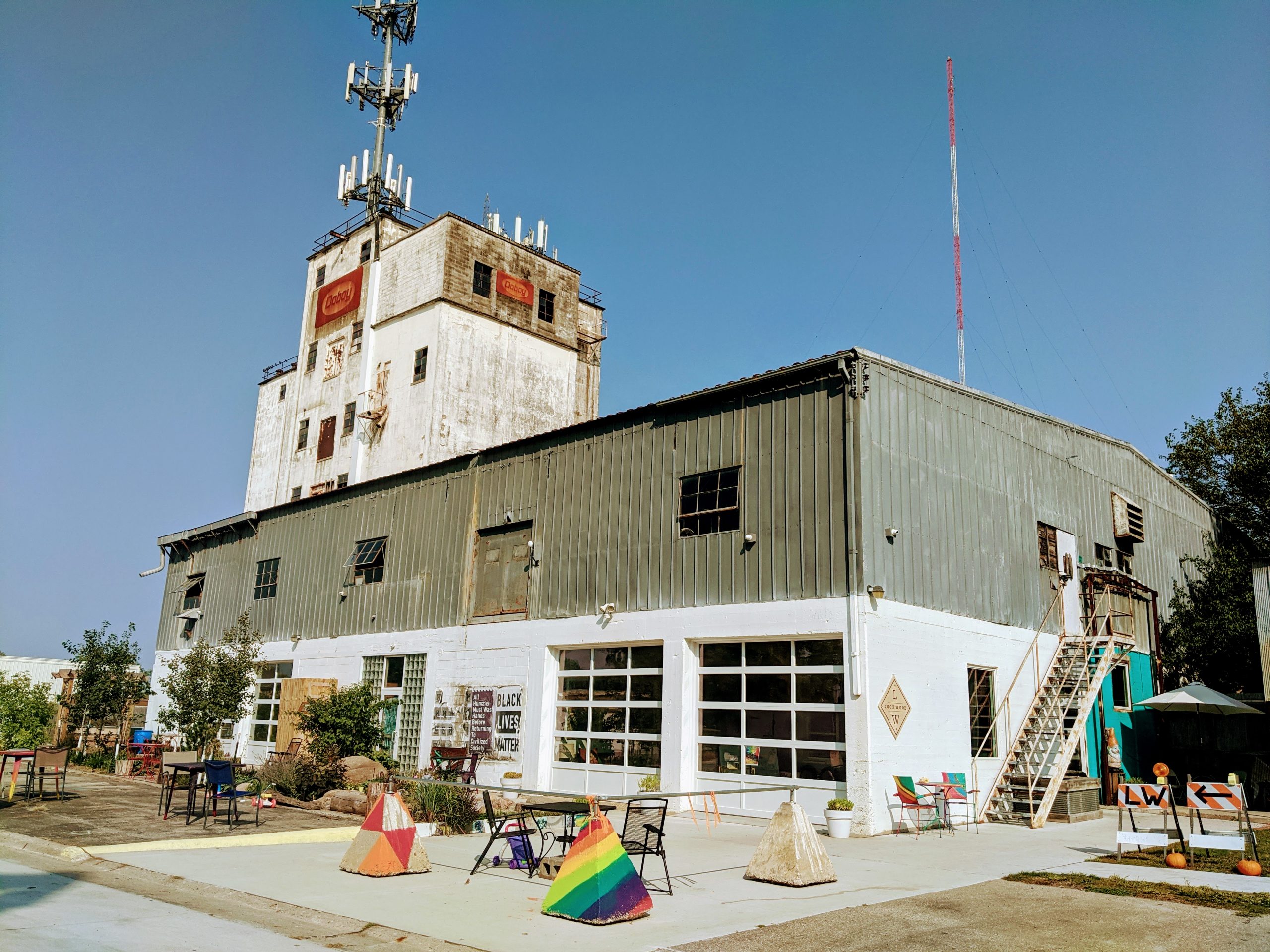
Above: Reliable Street and Lockwood Café in Ames, Iowa, the community space at the center of the events that later gave rise to Wilson v. Reliable Street Inc., et al., Story County No. LACV053674. Photograph originally published by the Iowa State University College of Design. Used for commentary and public-interest reporting. [10]
September 14, 2021-March 23, 2022:
The Open Mic and Flier Agreement That Would Later Be Reframed
One of the clearest ways to understand my relationship with Reliable Street before March 31, 2022 is to follow the contemporaneous communications and events as they occurred.
I attended my first open mic at the property on September 14, 2021. I had heard about the event through Lockwood Café staff, who knew I was an artist and musician. At the time, because the open mic was held in the outdoor dining area and the Reliable Street name had not been announced to me, I initially understood it to be a Lockwood Café event.
That night I met Lyndsay Nissen, who emceed the open mic. During the event, Lyndsay asked whether anyone in the audience would be willing to help set up and tear down future open mics. I volunteered, and she gave me her telephone number so we could coordinate.
For approximately the next six months, I regularly arrived early on Tuesday nights to help set up and stayed afterward to help put things back in order. Another regular attendee, Travis Lala, often helped as well. When Lyndsay could not attend, she sometimes asked us to help run the event in her absence.
The relationship was also friendly. Lyndsay and I would often talk before and after the open mic, and her messages to me repeatedly included expressions of gratitude, enthusiasm, smiley faces, hearts, and other signs of warmth. Over time, I came to believe we were friends.
On September 21, 2021, after attendance at one of the early open mics had been low, I offered another way to help. I wrote:
“YAY open mic!! Lmk of you want help setting up.”
A few minutes later, I added:
“Also I could make a flyer for the open mic if you like. I'm pretty good at that sort of thing.”
Lyndsay responded:
“Awesome!”
In the same conversation, Lyndsay told me that she was sick and would not be able to run the open mic that evening. She then wrote:
“I know! I wish I'd been able to show y'all how to set it up all ready so someone else could just run it”
The exchange is important because it shows both parts of the relationship at the time: I expressly asked whether she wanted me to make a flier, and she welcomed the idea; at the same time, she was discussing teaching other participants and me how to operate the open mic when she could not be there.
On September 29, I sent Lyndsay the first draft and wrote:
“Flyer emailed to you”
She responded four minutes later:
“Yay! Thank you!”
The following day, September 30, I again asked whether she wanted anything changed:
“If you want a simpler flyer without the history stuff just lmk I'll stop bugging you lol just checking in on case you want it changed.”
After she had an opportunity to look at it, Lyndsay replied:
“I like it!”
She then identified a correction:
“The only thing is, it's not Lockwood cafes event”
“It's our non profit”
“Reliable Street Inc”
I made the requested change.
On October 4, 2021, Reliable Street posted the corrected promotional flier on its official Facebook page under the heading “Reliable Street Inc presents.”
Lyndsay had therefore reviewed the flier, requested a specific correction, and Reliable Street then publicly used the corrected version to promote its own event.
The friendliness and appreciation continued.
After the October 12 open mic, Lyndsay wrote:
“Wow. That was something else. So intimate and sweet. Thank you for continuously affirming that we're gonna make this amazing. It's so nice to have another person who believes”
The next day, October 13, I was still working on the promotional material. I wrote:
“I redid the flyer 8 can send you. Do you want your phone number on the pull tabs or no?”
After I emailed the revision, Lyndsay responded:
“Awesome! Yeah I think people like the pull tabs”
A few minutes later, after reviewing it, she wrote:
“It looks great!”
On October 21 and 22, I then told Lyndsay that I was distributing the fliers around Ames. Her responses included:
“Yes!!!!”
and:
“Awesome!”
On October 22, I specifically wrote:
“Plastered the rest of downtown and Campustown. Got some of west Ames today. Hopefully we get some turnout. Enjoy ur night”
I then added:
“Gave a bunch to students that are going to ‘hang it in their dorm’”
Lyndsay replied:
“Awesome!”
Lyndsay therefore knew I was distributing the approved flier throughout Ames and continued encouraging the effort.
The relationship remained warm after the flier work was finished.
On November 11, I wrote to Lyndsay:
“You're wonderful. I really appreciate the sweet intro you gave me Tuesday. It meant a lot. I forgot to say that.”
She responded:
“Awwwww. I meant it”
These exchanges mattered to me because they did not feel like polite communications between strangers. They reflected appreciation, encouragement, and a relationship I reasonably understood as friendly.
By February 2022, my role in the open mic had also progressed beyond simply arriving early to help move things around.
On February 8, Lyndsay expected to be traveling during the event. She wrote to Willa Colville and me:
“Hey you two! I'll probably be in the air tonight during open mic so I hope it all goes smooth. Thank you again for always being so amazing and helpful!!!”
The following day, after I suggested ways to keep performances moving so that everyone would have an opportunity to play, Lyndsay responded:
“Yeah with more regulars coming we probably have to start making it more structured. Thanks for the feedback and caring about making it a good experience for everyone”
That exchange shows the continuity of the arrangement. Months after the flier was created, Lyndsay was still trusting me to help with the event and thanking me for contributing to its success.
The same tone continued almost until the relationship abruptly ended.
On the night of March 22, 2022, after another open mic, I apologized because I had needed to leave before everything was put away:
“Sorry to slip out when you were somewhere - they said they'd put the rest away. Woke up early and need to wake early tomorrow so going sideways. Thanks for a fun night at always!!”
At 12:51 a.m. on March 23, Lyndsay responded with three heart emojis.
Only days later, everything would change.
By then, the pattern was well established. For approximately six months, my participation had been requested, coordinated, relied upon, and repeatedly met with appreciation.
Nothing in these communications warned me that my participation in the open mic, my assistance with its operation, or my creation and distribution of the flier was being regarded as unwanted.
The contemporaneous communications I received conveyed the opposite.
Read the Source Material — With One Warning
Readers who want to examine the underlying communications themselves may read Exhibit B — Open Mic and Flier Agreements.
A note about the exhibits: Several exhibits linked below were assembled later for litigation and contain both contemporaneous communications and materials that enter the story later. Readers who want to experience the evidence chronologically may prefer to continue through the article before opening the complete exhibits.
September 2021-March 22:
The Garden and Prairie Agreements
That Would Later Be Reframed
Evidence of the communications in this section may be found in Exhibit C — Garden and Prairie Agreements.
This section shows that my involvement in the garden and prairie projects was expressly approved, coordinated, and encouraged—not unilateral, unauthorized, or intrusive.
The collaboration extended beyond the open mic into two related projects: restoring and helping manage the community garden, and developing native tallgrass prairie around it.
My involvement began with the existing community garden.
During my visits to Lockwood Café, I had noticed that the garden needed substantial attention. I told Sharon Stewart that I would be happy to help. She and other people at the property already knew that I had experience with gardening, native plants, ethnobotany, and related work.
According to the firsthand account I later set forth in my June 17, 2024 Amended Petition, Sharon subsequently approached me after speaking with Lyndsay Nissen and asked whether I would help manage the garden alongside the Ames High School group Students Helping to End Poverty and Hunger, or SHEPH. Sharon also offered me a 50% discount at Lockwood Café as part of the arrangement and told me to coordinate with Lyndsay and SHEPH president Emily Poag.
On September 21, 2021, I followed up directly with Lyndsay. I wrote:
“Also Sharon talked to me about gardening. We can talk whenever about that. I'm pretty hopeful about that. I was in the woods all the time in California but haven't had easy access to wilderness/nature time since I got back. If that works out for you I'm actually pretty stoked about adding it to my routine.”
Lyndsay replied:
“That would be amazing”
The exchange is preserved in Exhibit C and documents both Sharon's earlier approach and Lyndsay's express approval of my involvement.
As the garden arrangement developed, a second idea emerged.
The area surrounding the garden contained tall weeds, and I believed replacing some of that growth with native tallgrass prairie could complement the garden, help suppress future weeds, and fit the environmental and community character of the property. Before doing so, I discussed the idea with people involved in the space and prepared a written proposal.
On October 20, 2021, I asked Willa Colville whether she wanted to help research and review it. I wrote:
“Not sure if you want to be a prairie research buddy? No worries if not - I have some great links but want to take relevant DIY info into a Google Doc to make step by step and pricing the seeds easy.”
Willa responded:
“I would love to help!! I am very passionate about the prairie, but I am still learning :)”
Later that evening, after receiving the proposal, she wrote:
“It looks great :)”
That was not merely casual conversation about an idea. Willa agreed to help research the project, received the written proposal, reviewed it, and positively evaluated it before I sought final approval from Lyndsay.
On October 21, I then sent the proposal to Lyndsay:
“Sent you an email about putting prairie next to the garden. It's a Google Doc. Thought it would save time in case you don't have time to meet.”
Lyndsay responded:
“Yay!”
and then:
“I'm pretty free tomorrow?”
The proposal therefore was not something I developed privately and implemented without anyone's knowledge. I sent it directly to Lyndsay for discussion and approval.
My June 2024 Amended Petition recounts that after discussing the proposal, Lyndsay gave me the okay to proceed on October 27. She also sent me older site plans created by SHEPH so that the location of the existing garden and surrounding areas could be properly understood and measured.
That same day, the communications show that I was already asking Lyndsay for clarification before beginning work. I wrote:
“Lmk when you send the file so i can get started.”
After she sent the plans, I replied:
“Thank you! Looks like this red area is the current garden:”
and we exchanged images identifying the areas on the property.
I then told Willa:
“Got a YES on the prairie!!”
She responded:
“Yay, congratulations!! Let me know what all I can help with :)”
When I asked whether she could help determine the square footage of the areas that would be seeded, she replied:
“Oh that is awesome! And I am free tomorrow after 11:30 so we could do it then.”
Willa and I then worked together on measurements. The project therefore moved from proposal, to review, to approval, to collaborative on-site planning.
I also continued asking permission when I was unsure whether a particular action was authorized.
On October 31, for example, I sent Lyndsay a photograph of markers in the project area and asked:
“I assume I can pull these pink flags up?”
Lyndsay responded:
“I think those were my pathway markers but yeah”
That exchange may seem small, but it reflects how I understood my role: I was not treating the property as mine to alter however I wanted. When I encountered something whose purpose I did not know, I asked.
The same was true of my communications.
During the fall, I sent Lyndsay photographs showing the cleanup underway and wrote:
“Getting it cleaned up. Long way to go but having fun.”
I then expressly added:
“Lmk if you want me to stop texting you all this stuff.”
She did not tell me to stop.
She responded:
“Nice!”
and:
“Thank you!”
That mattered to my reliance on the arrangement. I was affirmatively checking whether the project updates themselves were welcome, and the response I received was appreciation.
The work also became increasingly integrated into the activities of other people connected with the property.
Sharon asked me to make signage to help organize the garden. After I sent her a photograph of the completed sign and thanked her for the idea, Sharon responded:
“Perfect!!”
I also researched winter composting at Sharon's request, including contacting an Iowa State University composting specialist and exploring whether a greenhouse arrangement could serve both Lockwood Café's composting needs and SHEPH's spring growing needs.
Other volunteers helped with physical work as well. I coordinated transportation of wood chips and mulch for pathways and weed suppression. Willa, her father, her boyfriend, Travis Lala, and other volunteers assisted at different points. Lyndsay participated in discussions about obtaining a trailer to haul mulch.
I kept a shared project record documenting progress and the contributions of other volunteers and sent it to Lyndsay so she could remain informed and provide direction. At a December meeting involving SHEPH members and other people interested in helping, we discussed creating a shared task system so people could see what needed to be done, claim tasks they had time for, and document their contributions.
By January 2022, the arrangement had become even more explicit.
On January 14, SHEPH president Emily Poag circulated the students' preliminary plans for the coming growing season and expressly invited input from the people involved in the project.
Six days later, on January 20, an Ames High School student contacted Lyndsay about becoming involved in the community garden.
Lyndsay responded:
“Awesome! I'm going to put you in touch with Emily Poag from SHEPH and Sondra Wilson. They are taking the lead on the community garden this upcoming season.”
That statement is significant because it was not made to me. Lyndsay was describing my role to an independent third party.
By that point, she was not merely permitting me to perform occasional volunteer tasks. She was telling another person that Emily and I were “taking the lead” on the garden for the coming season.
The description became even more direct the following month.
On February 18, 2022, another Ames High School student contacted Lyndsay about bringing a group to work with the community garden. Lyndsay forwarded the message to Emily and me and wrote:
“I've forwarded this to the folks in charge of the garden this year. Emily from SHEPH and Sondra our friend and neighbor. I'm sure they would be happy to collaborate with you on the project Elizabeth. Take care!”
In January, I was “taking the lead.”
By February, Lyndsay was telling outside participants that Emily and I were the people “in charge of the garden this year.”
That same day, February 18, another exchange further defined what I understood I was authorized to do for the garden. I told Lyndsay and Willa:
“I ordered seed potatoes and huitlacoche spores for the garden and had them sent to my parents' place in Ankeny. Wondering if I can use Reliable Street or Willa's address in case I order something for the garden in the future.”
Lyndsay responded:
“Yeah 4625 Reliable St Ames, IA 50014”
I replied:
“Wonderful thank you”
That exchange mattered to my reliance on the arrangement. I expressly told Lyndsay that I was purchasing garden materials and asked where future garden orders could be sent. Rather than telling me not to make purchases, she gave me Reliable Street's mailing address for that purpose. This will become very important later.
This occurred on the same day Lyndsay described Emily and me to an outside participant as the people “in charge of the garden this year.”
Again, my reliance was not based on one vague conversation months earlier. The arrangement was continuing through repeated communications about what I was doing, what I could do, where materials could be sent, and who was responsible for the project.
The promised Lockwood Café discount was also still being honored.
On March 4, Austin Stewart contacted me because he realized he had forgotten to apply it:
“So I just realized that I forgot to give you 50% off … Next time you come in let them know that I am buying your meal.”
Later in the same exchange he wrote:
“We appreciate all you do and I feel bad when I forget to enter the discount!”
That communication came from Lockwood Café's co-owner and connected the continuing discount with appreciation for the work I was performing.
The prairie project likewise continued moving toward implementation.
When an unexpected financial problem temporarily affected my ability to cover the prairie seed cost, I told Lyndsay to hold off on ordering the seeds.
She responded:
“Reliable can just pay for the seeds”
I told her that I had not intended to place the cost on her or the organization and explained that others wanted to help contribute.
The following day, March 17, the friendship and the prairie project intersected again.
As described in the previous section, Willa and I were contributing toward the prairie seed purchase. I sent her Lyndsay's Venmo information so she could send her share of the money.
Willa responded:
“Love you <3”
The message caught me somewhat by surprise because it was simply in response to my sending her the payment information. I did not understand it as romantic. I understood it as another affectionate expression from someone I believed was my friend.
The context is important: this was not an isolated personal message detached from everything else we were doing. It occurred while Willa and I were jointly contributing money toward the prairie project we had been working on together.
By then, substantial work had already been performed in reliance on the two arrangements. I had coordinated volunteers, researched prairie safety and maintenance, helped develop plans with SHEPH, created shared systems for organizing tasks, researched composting and greenhouse possibilities, arranged materials, and helped haul and install approximately six truckloads of mulch. Other people participated throughout that process. The work was visible, documented, and repeatedly communicated to people responsible for the property.
In the Amended Petition, I later described these as two oral agreements: the garden agreement, under which I would help restore and manage the community garden alongside SHEPH, and the prairie agreement, under which I would restore native tallgrass prairie around the garden. My understanding was that both were intended to continue through the 2022 growing season, with the possibility that the relationship could continue beyond that period.
Whatever legal label is ultimately applied to those arrangements, my reliance on them did not rest upon one ambiguous conversation.
It accumulated over months.
March 2022:
The Unresolved Question Was How to Pay for What the Garden Still Needed
By March 2022, the garden and prairie projects had developed into an ongoing course of conduct involving express approval, repeated permission-seeking, delegated responsibility, representations to third parties that I was helping lead the garden, collaborative planning and labor, purchases and deliveries made with the organization's knowledge, and shared financial commitments.
What had not been worked out in detail at the beginning was how every supply expense would be paid.
As I later explained in my June 17, 2024 Amended Petition (D0020), Sharon, Lyndsay, and I had not discussed the full range of future supply costs when the garden arrangement began. As spring approached, however, it became clear that the project needed more than the students could reasonably afford: deteriorated hoses and buckets needed replacement, lumber was needed to complete the mulch paths, basic tools were missing, and other materials were needed before spring planting. D0020, filed June 17, 2024, ¶¶50–51.
The immediate problem was timing. SHEPH's ordinary funding process required supplies to be requested well in advance, while some of the work needed to be completed before the students began spring planting. In D0020, I recorded that Emily had told me SHEPH had only about $100 available, and I did not feel comfortable expecting high-school students to cover the additional costs.
Some purchases were already being made openly and with the knowledge of people involved in the project. Lyndsay had previously given me Reliable Street's address after I told her I was purchasing garden materials. Austin Stewart had directed me toward a particular product for the rain-catchment system. Receipts and grant information were being posted to the shared project server, including documentation needed for possible reimbursement through the City of Ames prairie program.
One of the larger immediate expenses involved additional 4-by-4 lumber needed to finish the mulch framework. Willa and her father had previously donated some lumber, but more was needed. I asked the group whether anyone knew of a cheap or free source. When nobody did, I purchased the remaining lumber and kept the receipts, with the understanding that some costs associated with the prairie could potentially be reimbursed through the City grant after installation. In D0020, I explained that I was willing to donate what I had already purchased; the remaining issue was how to handle future needs that I could not continue paying for myself.
By March 25, I was trying to get everyone together to make that decision collectively.
The garden group discussed the supply problem in the shared Discord server. Willa participated in that discussion and suggested that, depending upon what could be reimbursed, Reliable Street might need to cover some expenses or “we will need to have a fundraiser.”
Willa likewise remembered the prairie finances as something that had previously been discussed with Lyndsay:
“When we met with Lyndsay in regards to the prairie, I was under the impression that she would cover expenses. I may have misinterpreted that.”
Whatever the precise financial arrangement ultimately was, that contemporaneous statement is significant: I was not the only participant who understood the prairie project as involving prior discussion with Lyndsay about funding.
That discussion also shows what I was—and was not—asking for. I was not insisting that somebody reimburse every dollar I had already spent. When the group discussed the problem on March 25, I wrote:
“If a fundraiser of sorts could happen I'm happy to pay for some it was just more than I would have like to pay and I outspent my budget. That's on me. The results will be worth it.”
And when Emily confirmed that SHEPH had less than approximately $100 remaining, I later wrote:
“I'd like to get bamboo for the cucumber tipis, but don't want to dip into your funds when you only have $100. Hopefully can figure something out.”
In other words, the immediate problem was not simply recovering my own past spending. The project was approaching spring planting, additional materials were still needed, and I was trying to find a funding plan that did not place those costs on high-school students.
I first raised the problem with Lyndsay. When that did not resolve it, I spoke with Austin. Then, on March 30, I asked Sharon whether we might hold something like a plant sale or donation jar to help SHEPH meet the remaining garden expenses.
Sharon responded by arranging a meeting between herself, Lyndsay, and me for the following day.
In 2024, within my Amended Petition (D0020), I described my understanding this way: Sharon acknowledged that I had done substantial work and arranged the meeting so I could give them a tour of what had been done and show what was still needed. I expected that we would either discuss Reliable Street purchasing some of the remaining materials or brainstorm ways to help the students raise the funds.
I was excited about that meeting.
I thought I was finally going to show Sharon and Lyndsay the work I was proud of, identify what remained unfinished, and make a group decision about how to fund the final push into spring planting.
That financial history will become important later.
At the time, I understood these discussions as an ordinary effort to solve a practical problem inside projects I had been asked to help manage: spring supplies were needed, SHEPH had limited funds, I had already contributed money and labor, other people had contributed materials and money, and we needed to decide collectively what came next.
I did not yet know that these same purchases, funding discussions, and project responsibilities would later be presented to the Iowa Civil Rights Commission in an almost inverted form—as evidence that I had acted without authorization, pushed myself into projects that were not mine, and improperly sought money from other people.
The later characterization will be examined when it enters the chronology. For now, the important question is what the contemporaneous record showed before March 31.
September 2021-March 25, 2022:
Colville Led Me to Believe She Was a Friend
and Continued Reinforcing That Relationship
Evidence of the communications in this section may be found in Exhibit D — Correspondence Between Sondra Wilson and Willa Colville.
Willa Colville has already appeared in this story because she participated in the garden and prairie projects. But my relationship with her was not, as I understood it at the time, limited to volunteer work.
Willa expressly told me that she considered us friends. Her communications continued reinforcing that relationship for months.
I first came to know Willa through Lockwood Café. We had initially interacted while she was working there, but on September 18, 2021, Lyndsay invited me to perform at an LGBT+-friendly event, and Willa and I had an opportunity to talk at length outside the ordinary café setting.
We discovered that we had several interests in common, including gardening, Iowa's native prairie, plants, and music. Willa watched me perform and told me that she liked my music.
After that, we talked regularly when I visited Lockwood Café. She would say hello and come over to talk with me. We occasionally spoke on the phone and exchanged text messages over the following months. That friendship also became intertwined with the garden and prairie projects already described above.
Because of what was happening at the state and national level—the increasingly hostile political discourse surrounding transgender people—I also valued what I understood as Willa's genuine concern for what I was going through. She knew about the political fight over gender-affirming healthcare, how deeply it affected me, and how painful it was that my efforts to obtain surgery kept being delayed or disrupted. Given my earlier experiences and the years I had spent without a stable sense of safety or belonging, that kind of friendship and concern carried real emotional weight.
By November 22, 2021, Willa put that understanding into words herself.
During a personal conversation, she wrote:
“I consider us friends and I wanna be there for you in any way.”
She also explained that she had been going through difficulties of her own and had not been very present, adding that she usually kept things to herself because she did not want to be an emotional burden.
Around the same time, Willa also invited me to a Friendsgiving potluck at Lockwood Café scheduled for November 29.
It was another interaction that reinforced my understanding that I was not merely someone she tolerated while working. I was being included socially and personally in the community around the café.
On December 17, 2021, Willa initiated another exchange:
“Hey will you be around Lockwood at all today?”
I responded that I had not planned to be there but could come by and asked what was going on.
She replied:
“Haha sorry I just wanted to buy your artwork!”
The same tone continued into 2022.
On February 15, Willa wrote after hearing one of my songs:
“Oh yes I think I heard you sing that one! I love all your songs Goodnight Sondra”
The following day, while we were talking about music, I was conscious that I had been sending several links and did not want to overwhelm her. I checked whether the communication was welcome.
Rather than asking me to stop, Willa encouraged it:
“Billy Joel is one of my all time favorites! Definitely send me your faves :)”
I sent several songs, and we continued talking about the music.
That detail is important to my understanding of the relationship at the time. I was not simply assuming that repeated messages were welcome; I was checking whether they were welcome, and she encouraged me to keep sharing.
A friend of mine had recently died, and I was grieving. Music was part of how I was processing that loss, and I appreciated the new friendship.
On February 22, I checked in because I thought she seemed upset. I wrote:
“Hey Willa I hope you're okay. I was hurting today and it felt really bad to see you hurting or upset too. Here of you need to talk or not. Care about my friend.”
Willa responded:
“I appreciate you so much”
She explained that it had been a stressful day but things were improving, and added:
“I'll see you at open mic?”
On March 8, 2022, Willa wrote:
“I don't think I'll make it to open mic tonight. Record your song so I can listen!! Please.”
I replied:
“Okay! Thanks Willa have a delicious evening :)”
This was happening in March 2022, after months in which she had expressly called me a friend and only weeks after she had encouraged me to keep sending music and told me “I appreciate you so much.”
Then, on March 16, only weeks later, we were still communicating warmly about the garden.
I asked her about cucumber varieties because I was preparing to buy seeds.
Willa responded with the information she could provide, then added:
“I am pretty exhausted tbh, I appreciate you a lot. I'm sorry I've been so distant”
I replied:
“No need to apologize. Thanks for letting me know what's going on.”
That exchange did not read to me as rejection. It read as a friend apologizing for being distant because she was exhausted—and me reassuring her that she did not need to apologize.
The following day, March 17, the friendship and the prairie project intersected again.
As described in the previous section, Willa wanted to contribute toward the prairie seed purchase. I sent her Lyndsay's Venmo information so she could make the payment.
Willa responded:
“Love you <3”
That was the last documented exchange in Exhibit D before the end of this period.
Those communications were not the only signs of warmth. Lockwood Café employees, including Willa, also wrote friendly messages, nicknames, and affirmations on my to-go containers—some of which I cut out and saved because they meant something to me.
Taken individually, any one of these interactions might seem ordinary. Taken together, those communications formed the relationship that existed as it was communicated to me.
I did not merely assume Willa was my friend. She told me that she considered us friends, and for months afterward her communications and conduct continued to reinforce that understanding.
The significance of these communications is not that friendship prevented Willa from later changing her feelings or setting a boundary. It is that no such change or boundary was communicated to me during the period described here.
December 2021-March 2022:
My Relationship to Martinez That Would Later Be Reframed
Evidence of the communications in this section may be found in Exhibit E — Statements and Submitted Materials Pertaining to Denise Martinez.
Later defendant Denise Martinez also worked at Lockwood Café and participated, to a lesser extent, in some of the community activities and garden discussions described above.
Our interactions before March 31 were friendly.
On December 29, 2021, Denise initiated a Facebook conversation with me:
“Hi Friend!! I can’t wait for Lockwood to be open again. I miss seeing everyone”
That message reflected the tone of our interactions as I understood them at the time.
On January 10, 2022, another exchange showed the same familiarity. Denise mentioned that she would get something for me when she went to the “Mexican store,” accompanied by heart emojis (oddly enough, this exchange would later be reframed, in case you're wondering why I included it).
Later that evening, I realized that I had hugged her and worried afterward that, because of the pandemic, I might have made her uncomfortable. I wrote:
“Hey really sorry I hugged you. Forgot we were in a pandemic prolly made you uncomfortable”
Denise responded:
“Don’t worry!! I wasn’t uncomfortable ❤️ I’m ok with hug from people I know!!”
That exchange mattered to me because I had specifically checked whether I had crossed a boundary, and she expressly reassured me that I had not. We had been talking at length, and I had considered our relationship a budding friendship, so that was all it was—just forgetting we were in a pandemic, and reacting to the situation in the way that seemed appropriate.
Denise had also expressed interest in gardening and related subjects. On January 14, I contacted her because a high-school student involved with the garden wanted help learning about indoor sprouting. I asked whether Denise might be willing to talk with her and sent the student's contact information.
Denise responded:
“Oh shit hey yeah I can help sorry it took me so long to answer. I saw your message when I was at work and I forgot to answer 😂”
and then:
“I’ll message her tomorrow morning!! Hopefully I can help ❤️”
When I told her that Willa was arranging a time for everyone to meet, Denise replied:
“Awesome!! I’m excited to help out”
By the end of January, I was trying to create shared communication spaces so that everyone interested in the garden could participate without information having to be relayed through separate text-message chains.
On January 31, I sent Denise an invitation to a community garden Discord server I created for this purpose:
“Here Denise - this is going to work better for the garden group I think”
Denise responded:
“Awesome I’ll join rn!”
She joined the server and participated in garden discussions there.
That same day, I also invited Denise to a separate Discord server I had created for people interested in helping organize LGBT+ events around Ames. She again responded positively:
“Oh awesome! I’ll join rn”
After she joined, I explained that I had created different server roles, including “LGBT+ Community” and “Community Ally,” and asked whether she wanted either one. We were planning an upcoming Valentine's Day event inside Lockwood Cafe and Reliable Street, so everyone in the community was pretty excited.
Denise asked:
“Uhh idk. Is LGBT+ for people that are part of the community? Cause I’m Bi if that counts!”
I responded:
“that counts. that’s what the B is for!”
Denise replied:
“Oh shit you right I was just confused 💀”
I then wrote:
“np glad ur here. I’m stoked about this cuz there’s SO MANY LGBT+ people around Ames and this could be the beginning of a nexus.”
The garden conversations continued into February.
On February 4, for example, I asked Denise whether her family had experience using soap and water or other methods for controlling garden pests. Denise answered the question and explained what her family generally did with their plants.
On February 17, while discussing plans for corn in the shared garden Discord server, I asked Denise about huitlacoche, an edible fungus that grows naturally on corn and is especially well known as an ingredient in Mexican cuisine.
The question did not arise out of nowhere. About a month earlier, on January 10, Denise herself had casually referred to going to the “Mexican store,” using heart emojis in the exchange. We had also been discussing gardening, plants, food, and cultural traditions. I knew very little about Denise's specific family heritage beyond what she had shared with me, and we had not known each other for very long.
During the February 17 garden discussion, I wrote:
“the best enchilada I ever had was made with huitlacoche. Have you had it or does your family grow it?”
Denise responded:
“I don’t really eat enchiladas 😂 it mainly a food eaten in Mexico. My family is from El Salvador which is in Central America 😂😂”
Her response surprised me somewhat because I had not intended to say that Denise or her family were Mexican.
Although I knew huitlacoche was used in Mexico, I did not understand it only to be used there. She had previously mentioned her indigenous heritage which she didn't know much about, and I assumed that huitlacoche was used by more than one indigenous culture in Mexico and further south. But when Denise explained that her family was from El Salvador and apparently understood my question differently, I responded:
“Ah lol okie. I love them. Sorry I’m white af ... and am still learning 🤖”
Denise replied:
“You’re good lol. Actually my mom thinks they’re gross lol”
This brief exchange—which ended with Denise reassuring me, “You’re good lol”—would later be reframed as evidence of inappropriate comments concerning national origin.
Denise did not have as much time to work physically in the garden as some of the other people involved, and she told me that more than once. I understood that and continued trying to include her in ways that fit her schedule—asking for her input, inviting her to shared discussions, and letting her participate when she had time.
In mid-March, after Lyndsay mentioned generally that Denise had been “feeling unheard” and wanted to be included more, I reached out to Denise again rather than dismissing the concern. I did, however, think this was odd, because she had told me she didn't have time.
But because I wanted to honor what Lyndsay had told me—and certainly did not want Denise to feel excluded—I messaged her:
“Hey Denise how are you? Imma be in the garden this week if you want to help or hang.”
Denise later responded that she would not be able to help much because she had a lot going on and might have to leave the country for a while.
I replied:
“No worries.”
I also asked whether she was okay and made sure she had my telephone number.
From my perspective at the time, that was an ordinary attempt to check in with someone I knew through Lockwood Café and the garden project. This was all the context I had for what was to come.
When I Had Reason to Check a Boundary, I Asked—and Was Reassured
There is a pattern worth noting in these communications. I did not repeatedly ask these people whether I was bothering them or seek constant reassurance about boundaries. At different points, when a particular interaction gave me a reason to check, I made a single, direct inquiry: I asked Lyndsay whether she wanted me to stop sending project updates; I checked whether Willa wanted me to keep sending music; and I apologized to Denise after a hug because I worried the pandemic might have made it unwelcome. In each instance, the response I received was reassuring or encouraging.
Those communications are important because they show that when I had reason to wonder whether something was welcome, I asked. Nothing in the answers I received told me that I was repeatedly crossing boundaries or that my presence had become unwanted.
Fall 2021-March 2022:
Esker's Communications Gave Me No Warning of Misconduct Concerns
Evidence of the communications in this section may be found in Exhibit F — Esker's Statement to the ICRC.
My interactions with later defendant Charlie Esker were less frequent than my interactions with Willa Colville, Denise Martinez, or Lyndsay Nissen, but they were consistently friendly.
I first came to know Charlie through the community surrounding Reliable Street. Charlie was an artist whose work was regularly exhibited in the Reliable Street gallery, and I first remember interacting with them while helping set up art exhibitions there, including events connected with the Transgender Day of Remembrance and the Queer Renaissance show.
Charlie was also a close friend of Willa Colville. I frequently saw Charlie, Willa, and their friend Eli together at Lockwood Café, Reliable Street events, and open mics. They were always friendly toward me, and Charlie and the others occasionally invited me to local drag performances which I never attended, partly due to personal finances.
Our most substantial collaboration came in early 2022, when Charlie, Willa, Eli, and I helped organize a Valentine's Day “Singles Mingle” event at Reliable Street and Lockwood Café. Most of my direct communications with Charlie during this period concerned planning that event. We worked together amicably, and the friendly tone continued afterward.
On March 16, 2022, approximately two weeks before I was barred from the property, Charlie contacted me about a performance they had done with Eli and wrote:
“Yesss! Eli and I performed last week Wana see the vids????”
They then joked with me about another upcoming performance.
It was an ordinary, friendly exchange between people who knew each other through the same community. There was no warning in it that Charlie believed they had personally witnessed serious misconduct by me or regarded my presence around Reliable Street or Lockwood Café as a problem.
That was the relationship as I knew it before March 31.
March 29, 2022:
Two Days Before the Rupture,
I Told the Community About My Earlier False Assault Case
Two days before I was barred from Reliable Street and Lockwood Café, I stood at the Tuesday-night open mic and told an abbreviated version of a painful story from my past.
In 2009, while visiting Ames, I had been arrested after a Culver's manager accused me of pushing and kicking her. I have always maintained that I never touched her. At trial, one of the manager's own witnesses testified that he had seen the incident and that I did not touch her, yet I was convicted.
Afterward, an officer approached me outside the courtroom and warned me “off the record” that, based on what he was hearing “behind the scenes,” I should leave Iowa for my safety. I took the warning seriously and spent years afraid to return. My testimony for that case is being compiled here.
On Tuesday, March 29, 2022, I shared an abbreviated version of that experience at Reliable Street's open mic and performed the same song I had played during the 2009 Culver's incident.
After months of involvement at Reliable Street and Lockwood Café, I felt safe enough to share something deeply personal about the false accusation, criminal record, and discrimination that had affected my life.
I did not yet know everything that the old court files contained. I had not examined those dockets in years, and in some respects I still misunderstood what the official record said.
But people present that evening now knew something important about me:
I already had an assault conviction on my record arising from an incident I maintained had been falsely reported.
Two days later, I was told that a complaint had been made that I was making people uncomfortable and had “violated a woman's personal space.” Only during the ensuing conversation, after I mentioned Willa, was I told that “more than one person” had complained.
At the time, I did not know whether the timing was related.
But I did not forget it.
On March 30, the day before the meeting, my boyfriend and I moved into a new apartment approximately a block from Reliable Street.
The timing mattered emotionally. We were excited. I was helping lead the garden, working on the prairie, participating in open mic and community events, and had just moved close enough to remain deeply involved.
So when I went to meet Sharon and Lyndsay the next afternoon, I was not preparing myself for conflict.
I was proud of what I had done and expecting to talk about what came next.
III. March 31, 2022:
The Sudden Rupture
The March 31 meeting was the meeting Sharon had arranged the day before after I asked about ideas for funding the remaining garden supplies.
I went into it believing I was about to give Sharon and Lyndsay a tour of the work, show them what was still needed, and discuss how we would pay for it.
Instead, as we began walking toward the garden, Lyndsay told me that this was a “difficult conversation.”
The meeting took place on March 31, 2022—Transgender Day of Visibility.
I had no idea what was about to happen.
The Meeting Was Not About the Garden
As we began walking toward the garden and prairie area, Lyndsay told me that the meeting was not really about giving a tour. She and Sharon said that a complaint had been made about me involving “making people feel uncomfortable” and “violating a woman's personal space.”
I immediately tried to understand what they were talking about.
When I asked what I had actually done, they would not identify the person or give me a specific incident, saying they needed to “protect the identity of the person who complained.” Lyndsay eventually disclosed one accusation: “Bombarding people with text messages.”
I told her that the people I texted most were her and Willa, and that neither set of messages gave me any reason to think my communications were unwanted.
When I said Willa's name, Sharon then told me: “There was actually more than one person who complained.”
That change immediately stood out to me. The conversation had begun with “the person who complained.” Only after I mentioned Willa did the explanation change to “more than one person.”
More than two years later, in my June 17, 2024 Amended Petition (D0020), I gave the court the same account:
“After I said the name ‘Willa’, Sharon said, ‘There was actually more than one person who complained.’ This seemed odd to me because when they introduced the topic, they only indicated one person, but when I mentioned Willa they both switched the story to ‘more than one’.”
The same pleading records that immediately beforehand I had asked for a specific action I was accused of, was told they needed to “protect the identity of the person who complained,” and was then told that one complaint involved “Bombarding people with text messages.”
At the time, I did not know what to make of that change. I did not know whether there had always been multiple complaints, whether different concerns were being combined together, whether Sharon and Lyndsay were trying to protect particular identities, or whether the explanation I was receiving accurately reflected what had actually been said behind closed doors.
I knew only that I was being punished before I had been told enough to understand the accusation.
The phrase “violated a woman's personal space” struck me as especially serious.
Given the political environment described earlier in this article, I did not hear that simply as, someone found you annoying, or someone wanted more distance. To me, it carried a far more damaging implication: that I, a transgender woman, had somehow acted threateningly or improperly toward another woman.
I immediately tried to understand what they were talking about.
I asked what I had actually done.
I was not given a specific incident.
I was not shown a complaint.
I was not told what words I had supposedly used, what boundary I had supposedly crossed, or what conduct I should have recognized as unwelcome.
I was told, in substance, that giving me more detail might reveal the identity of the person or people who had complained.
But I did not need anyone's identity in order to understand the accusation.
I needed to know what I had supposedly done.
I remember trying to think through my recent interactions on the spot. Nothing came to mind. As the communications in the preceding sections show, the people around me had continued interacting with me warmly almost until the moment everything changed.
The Decision Had Already Been Made
Whatever explanation I could offer did not change the result.
I was told that I could no longer participate in the garden or prairie projects and could no longer come to Reliable Street, Lockwood Café, or the events taking place there.
The arrangements I had spent months working under ended immediately.
The distinguishing feature of the meeting, from my perspective, was therefore not merely that someone had complained about me.
It was the order in which things happened:
Punishment came first. Specific explanation never did.
I was removed from the projects and community before I had been told enough to meaningfully understand the accusation, much less respond to it.
Only years later would I see Lyndsay's own description to the Iowa Civil Rights Commission acknowledging that their March 31 explanation had intentionally been “rather broad.” In that later statement, she wrote that she and Sharon had already decided to remove me and were trying to protect the identities of the employees who had spoken to them.
I did not know any of that on March 31.
I only knew that a community where I had been trusted with responsibilities, welcomed socially, thanked repeatedly, and described publicly as one of the people helping lead the garden had abruptly expelled me based on an accusation I could not understand.
I left crying.
The Harm Did Not End at the Property Line
Being barred from the property also created an immediate reputational problem.
My involvement there had been visible.
People had seen me at the open mics. They had seen me working in the garden. Students and volunteers had been directed to me because I was helping lead the project. I had been involved in events, promotional work, planning, prairie restoration, and the broader community surrounding Reliable Street and Lockwood Café.
Suddenly, I was gone.
If someone asked why, there was no neutral explanation I could give.
I had been removed after initially being told that a complaint involved making people uncomfortable and “violating a woman's personal space”; only after I mentioned Willa was I told that “more than one person” had complained.
That put me in an impossible position.
Remaining silent allowed people to imagine the worst.
Trying to explain what happened risked sounding defensive about an accusation I could not even identify.
My later June 17, 2024 Amended Petition, D0020, described exactly that concern: people familiar with my visible role would naturally notice my disappearance, and I worried that the unexplained removal itself would generate damaging assumptions.
March 31-April 1, 2022:
I Began Questioning Myself
Only hours after the meeting, I wrote Lyndsay.
My message shows how uncertain I was about what had happened. I told her:
“I am not going to keep texting you, but it's in the back of my head wondering if I texted you too much...”
I even wondered whether I had become overenthusiastic after finally finding people I considered friends:
“I think I got excited about making friends and overwatered the relationship (overtexted).”
And I apologized in case I had unknowingly crossed a line:
“I just want to apologize to you in case I did make you feel uncomfortable or upset or hurt or pushed by me.”
I ended:
“I'm really sad. I feel like I'm losing almost all my friends at once with this.”
Lyndsay responded the next morning. She confirmed that the decision was that I could no longer come onto the property and again recommended that I read about boundaries and active listening. But she also told me:
“I know your intentions are good. Your true friends will still be there for you.”
That exchange matters because it captures my state of mind within hours of the meeting and before I began contacting other people about what had happened. I was not reacting as someone who had already decided that everyone was lying or who was seeking retaliation. I was questioning myself, trying to determine whether I had unknowingly crossed a boundary, expressly saying I would stop contacting Lyndsay, and apologizing in case my communications had been unwelcome.
IV. April 1-7, 2022:
I Tried to Understand What I Had Been Accused Of
April 1, 2022:
The Responses I Received Deepened My Concern
During those first days, I also searched online for guidance about what a person should do when confronted with an accusation of harassment they believed might be false or based on a misunderstanding.
I remember consulting an article titled How to Defend Yourself Against False Harassment Charges by David Bloxberg. [11] The article advised someone facing a disputed harassment accusation to remain calm, consider whether they might inadvertently have offended someone, collect their own evidence and notes, identify witnesses, cooperate with any investigation, avoid retaliation, and consider obtaining legal advice.
That advice influenced how I approached the situation. I reviewed my communications. I thought carefully about my recent interactions. I asked people I regarded as friends whether I had unknowingly made them uncomfortable. And because I still did not know who had complained or precisely what I had been accused of, I tried to communicate cautiously rather than confront anyone.
I did not tell people that I knew who was responsible or pretend that I understood the allegations. I told them that I had been barred based on serious accusations that had not been explained to me, and that I was trying to understand what had happened.
One of the most important responses came from Emily Poag, president of SHEPH. She wrote:
“that's very strange because I certainly didn't and I'm fairly sure none of the rest of SHEPH leaders felt uncomfortable with you, we all really appreciated your expertise.”
She then asked whether my exclusion meant that I could not even return to help with the spring planting.
That response mattered because SHEPH had worked directly with me on the garden. My involvement had not been peripheral. If my conduct in the project had broadly become intolerable or made people uncomfortable, Emily's response gave no indication of it. Instead, the president of one of the principal groups involved in the garden appeared surprised by what had happened. Exhibit C-15 preserves that response.
April 1-4:
Trying to Understand What I Had Done
In the days after March 31, I was doing two things at once.
I was trying to determine whether I had unknowingly hurt someone, and I was trying to preserve relationships with people I believed were my friends before an unexplained accusation defined me for them.
I did not know what Sharon and Lyndsay had told other people. I did not know what the complainant or complainants had said about me. I did not know whether people were hearing merely that someone felt uncomfortable around me or something much more serious. All I knew was that I had been abruptly removed from a highly visible role after being told that women felt “unsafe” around me and that I had “violated a woman's space.”
My concern about reputation was not something I reconstructed years later. In the June 17, 2024 Amended Petition (D0020) I described what I had been thinking during those first days: people familiar with the garden and prairie projects would inevitably notice my disappearance, and I feared that an explanation for my removal would circulate before I even knew what the accusation was. I also recorded that I contacted friends and acquaintances from the space, explained that I had been barred based on allegations that had not been communicated to me, and let people who still wanted to remain in contact know they were welcome to reach out. D0020, filed June 17, 2024, ¶¶ 88–90.
That was the context in which I wrote Willa.
I was not writing from certainty that she had accused me. I was writing from uncertainty about whether she had, fear about what people might now believe, concern that I might somehow have hurt someone without realizing it, and a desire to preserve a friendship if the situation was capable of being understood or repaired.
The Accusation Followed Me Home
What happened did not remain an abstract disagreement about whether I could use a garden.
I was devastated and confused.
The words I had been given—unsafe, crossed boundaries, women who were uncomfortable—carried implications far more serious than anything anyone had previously said to me.
Yet I had no concrete act to examine.
No one told me that I had touched someone improperly.
No one identified a threatening statement.
No one told me that someone had asked me to stop contacting them and that I had refused.
No one identified a particular conversation, encounter, message, or boundary that I should have understood I had crossed.
So I did what I think many people would do after being confronted with an accusation they could not understand:
I began going back through my relationships in my head.
I thought about my conversations.
I thought about the people I texted.
I thought about whether I had talked too much, misunderstood someone's friendliness, missed a social cue, or unknowingly made somebody uncomfortable.
The accusation also entered my home.
My boyfriend and I were both distraught. We had moved into our new apartment only the day before, believing we were beginning a hopeful new chapter near this community. Instead, almost immediately, our attention became consumed by trying to understand what had just happened and what people might now believe about me.
I also understood how my sudden disappearance would look.
People knew me there. They had seen me performing, working in the garden, organizing projects, talking with café employees, and participating in events.
Now I had been abruptly barred.
I could imagine the question:
What did Sondra do?
And I had no answer.
April 1, 2022:
I Began Asking Whether My Friends Still Felt Safe Around Me
That was the state of mind in which I contacted several people from the community.
I was not telling them that I knew who had complained.
I did not.
I was trying to determine whether I had unknowingly hurt someone—and whether people I considered friends had suddenly become afraid of me.
When I contacted Charlie Esker on April 1, I explained exactly how uncertain I was:
“I was told by Sharon and Lyndsay not to come around Reliable/Lockwood anymore because some people felt ‘unsafe’ and like I'd ‘crossed boundaries’. I really don't know who and the only person I can think of is Willa cuz I texted her quite a bit and haven't heard from her in a week. Just trying to process and find out who still wants me around and who is feeling that way about me.”
I then added:
“If you dint feel that way about me I could really use a phone call but I'll stop contacting you in case.”
That last sentence matters.
I was frightened enough by what I had been told that I was already trying to avoid accidentally making the situation worse. I did not know whether Charlie was uncomfortable with me either, so I expressly offered to stop contacting them.
Charlie responded:
“I am not really involved in any of that, but I also do not know if us having a personal relationship is best right now.”
That answer gave me almost no information about what I had supposedly done.
But it showed me that something was already spreading beyond the March 31 meeting.
Someone with whom I had recently communicated warmly was now uncertain whether even having a personal relationship with me was appropriate.
That frightened me.
And because Charlie was close with Willa, it made me wonder whether Willa might somehow be involved.
By then, several separate clues were beginning to point in the same direction. On March 31, Sharon had changed the explanation from one protected complainant to “more than one” immediately after I mentioned Willa. Lyndsay had identified “bombarding people with text messages” as one of the complaints. Now Charlie—one of Willa's close friends—was suddenly unsure whether maintaining a personal relationship with me was appropriate.
But those clues conflicted with the evidence I actually possessed: Willa's own communications with me. Nothing in them told me that she regarded my messages, presence, or friendship as unwanted.
Charlie's response did not tell me what I had supposedly done. But it showed me that the accusation was already affecting relationships before I even understood its substance.
That distinction will matter later. I was trying to understand an accusation whose source and substance had been concealed from me. The record would eventually characterize that effort very differently.
Why I Did Not Immediately Contact Colville
There was another reason I had not immediately interpreted Willa's silence as rejection.
I knew she was sick.
On March 23, I had written:
“I miss youuuuuuu.”
Willa replied:
“I miss you too, sadly I have pneumonia so I won't be at LW this week :(”
I responded by wishing her well and offering to drop something from the store outside her door if she needed it.
And on March 25—six days before I was barred—Willa was still participating with me in the garden group's discussion about how to fund the remaining spring expenses.
Nothing in those exchanges told me that she wanted me out of her life.
Nothing told me that she believed I had been violating her.
Nothing told me that I should understand her illness or reduced communication as an attempt to escape me.
That is why I did not immediately contact her after March 31.
She had told me she had pneumonia. I knew she was sick. And after what had happened to me, I was frightened that reaching out carelessly could itself be interpreted as a boundary violation.
So I spent several days thinking.
I went back through our text messages, which didn't indicate she was upset, so at this point I really didn't think she complained.
But Charlie's response changed the picture. Combined with Sharon's March 31 reaction when I mentioned Willa and Lyndsay's reference to “bombarding people with text messages,” it gave me a concrete reason to wonder whether Willa was involved—even though her own communications still gave me no explanation for why.
April 4, 2022:
I Informed Colville I Was Barred From the Property,
and Checked-In In Case I Had Inadvertently Said Something That Made Her Uncomfortable
On April 4, I sent Willa a Discord message.
It was written before I knew whether she had complained and before she had ever told me that I had violated a boundary.
I began:
“Dear Willa,
As I'm sure you've heard, last Thursday I was told not to return to the Reliable/Lockwood property because ‘multiple people’ feel ‘unsafe’ around me because I ‘crossed boundaries’. It was pretty vague and I really have had no clue who said those things, there were a couple things that made me concerned I may have upset you.”
I explained why I had begun wondering whether she might be involved. Nissen had mentioned “bombarding with text messages”, Esker's response had made me uneasy, and I had not heard from Willa.
But I also told her explicitly that her own messages had not led me to believe she was trying to push me away:
“The only people I really text more than others are Lyndsay and you, but after looking through yours and my texts, your responses didn't indicate it was you (neither do her's).”
I then explained:
“I've been reluctant to text you because I haven't heard from you and frankly I never wanted to nor want to invade your space or make you or anyone feel that way. It absolutely breaks my heart and just hurts a lot, but I've honestly considered you a real friend and I hope you're open to talking through some of it or at least letting me explain because I believe I honestly misunderstood something you said a couple weeks ago which may have caused the abrasive feelings (if indeed you feel this way, which again I'm speculating).”
I also explained why I had believed the March 31 meeting concerned the garden.
My April 4 message also confirms the expectation described earlier. Referring to the meeting I thought I was attending, I wrote:
“I was really excited showing them what had been done because I'm really proud of it.”
Then I described the moment everything changed:
“We walked about halfway to the garden, however, and I was told this was a ‘difficult conversation’. That is when they described the complaints against me and gave me my art that was hanging in the gallery. I was told not to come back on the property.”
Most importantly, I tried to identify what I might have misunderstood.
I told Willa that I remembered her saying she was overwhelmed and overworked, and I wondered whether I had mistaken that for temporary exhaustion when she had actually been trying to tell me she needed distance.
I wrote:
“Although I continued to message you things about the garden and whatnot, looking back on it I'm wondering if you were trying to tell me that you were stepping back from the garden more long-term … If I was coming in too much or texting too much or you needed space and wanted to keep it in the Discord group—I was not made aware of that and frankly I wish someone(s) had been more straightforward with me about any of this.”
And I apologized in case I had misunderstood:
“I've felt so welcomed and loved when I came in I really had no idea people were feeling this way, and if you were trying to tell me you needed more space than I gave then I sincerely apologize.”
I ended by explaining what frightened me most:
“Although I really don't know who else may have felt this way (Sharon and Lyndsey said ‘multiple people’), I feel really misjudged if people feel unsafe around me. I don't know what to say but that really hurts me and my reputation.”
And then:
“Please help me understand.”
That was my message.
It was not written after Colville instructed me to stop contacting her.
It was not written in defiance of an expressed boundary.
It was written before I knew whether she was even one of the complainants, while I was trying to understand an accusation that Sharon and Lyndsay had left vague.
Remember that chronology. It will matter later.
April 7:
Colville's Response Changed What I Understood the Accusation to Be
Three days later, Willa responded.
For the first time, I received something approaching an explanation from one of the people involved.
She wrote:
“I am not going into detail because I still do not feel comfortable discussing this with you. For months, you have violated my personal space and not respected my boundaries.”
She continued:
“I did not know what to do because I didn't feel comfortable approaching you. So I said something to Sharon.”
And then she wrote something that immediately stood out to me:
“I admit that the situation could've been handled better. If I had said something sooner, maybe things we be different but it is what it is.”
That was devastating to read.
It also fundamentally changed my understanding of what had happened.
Until that point, I knew only that people supposedly felt “unsafe” and believed I had “crossed boundaries.”
Now someone I had considered a friend was telling me that, for months, I had “violated” her personal space and failed to respect her boundaries.
The distinction mattered enormously to me.
A person can become uncomfortable with a friendship.
A person can want less communication.
A person can decide they no longer want someone in their life.
She had every right to do any of those things.
But saying that I had been violating her personal space “for months” characterized my own conduct as repeatedly wrongful.
As I reflected on that message, the distinction became clearer to me. Willa may genuinely have felt uncomfortable, but she had never communicated that discomfort to me. What I now knew was that she had said something to Sharon, and Sharon and Lyndsay had already acted by barring me. I still did not know what words Willa had used, what Sharon and Lyndsay had been told, or how the accusation had been characterized before it reached me.
Only weeks earlier, Willa had told me:
“I appreciate you a lot. I'm sorry I've been so distant.”
She had responded to prairie-payment information with:
“Love you <3”
On March 22, she had continued communicating with me about the prairie.
On March 23:
“I miss you too, sadly I have pneumonia so I won't be at LW this week :(”
And on March 25 she was still participating in the garden group's spring-funding discussion.
Nothing in those recent communications prepared me for an accusation that I had been violating her for months. And in the political environment described earlier, framing a transgender woman as someone who had violated a female employee's boundaries carried severe social consequences.
I had already experienced enough violence to understand that reputational accusations could create physical danger as well. I began asking myself a frightening question: what if someone attacked me because of what they had heard?
And Colville's April 7 message itself acknowledged that she had not approached me about the problem and that
“If I had said something sooner, maybe things [would] be different.”
That became central to how I understood what had happened.
The problem was never that Colville was required to remain my friend. She was not. The problem was that I had already been punished and removed from an entire community for supposedly violating boundaries that, by her own account, she had not told me I was crossing.
That distinction became even more serious because the accusation was no longer private.
By the time I finally learned from Colville that she had accused me, Stewart and Nissen had already acted on it.
Esker ended our relationship.
By then, I had already been removed from the garden, prairie project, café, gallery, open mic, and the larger community surrounding them. Some relationships immediately changed or disappeared altogether. The broader social and artistic consequences of that exclusion became substantial and are discussed below.
And I was never told any specific act or interaction constituted the alleged months of “violations.”
I went back through the messages again, but was not relying on the written record alone. I replayed our interactions in my memory.
I thought through conversations, visits, phone calls, the garden work, the open mics, the times Colville and I had spent together, and anything I might have said or done that another person could reasonably have experienced as intrusive or inappropriate.
For days, I was deeply concerned that I might have done something wrong without realizing it.
But after several days of reflection, the explanation I had been given still did not add up. I remember the moment I began to understand the experience as gaslighting: I was being asked, in effect, to accept that I had spent months violating boundaries that had never been communicated to me, despite contemporaneous messages and interactions that had repeatedly conveyed friendship, approval, and appreciation.
What made the experience especially difficult was that the consequences were not confined to a friendship ending. I had spent approximately six months contributing substantial labor, time, planning, materials, and money to projects I had been expressly encouraged to help lead. Then those arrangements ended abruptly at the same moment I was excluded from the surrounding community under serious allegations I was not given enough information to meaningfully answer.
If the relationships or project arrangements were no longer working, that could have been communicated directly. I was not claiming that anyone was obligated to remain my friend or continue an arrangement that genuinely was not working. But after approximately six months of work under arrangements I understood would continue through the growing season, a respectful ending required more than abruptly telling me to leave under a harmful accusation you are given no context for.
At minimum, there could have been a conversation about what had happened, what would become of the projects and expenses, and how to end the relationship without unnecessarily damaging my reputation. Instead, I left without that conversation, without completing the work I had expected to use in my portfolio, and under allegations concerning women's safety and personal boundaries that were already affecting my standing in the community.
That combination—not merely the ending of a friendship or volunteer project—is what made the experience feel profoundly unfair to me.
And that context and realization will become crucial later.
Remember the chronology on how these two messages took place:
April 4 — I contacted Colville while I still did not know whether she was the complainant, trying to understand what I had supposedly done.
April 7 — Colville disclosed that she had complained to Sharon and told me for the first time that she believed I had been violating her personal space and boundaries “for months,” while acknowledging, “If I had said something sooner, maybe things [would] be different.”
That order will later matter.
V. April 10-22, 2022:
From Self-Doubt to Seeking Civil-Rights Review
Around April 10:
I Researched How to Respond to False Accusations of Sexual Harassment in the Workplace
By April 10, I had moved from
"It looks like I'm being gaslighted"
to
"I was wrongfully accused of conduct that sounds like sexual harassment. Instead of communicated her discomfort or building internal resentment I was never made aware of, she framed me as predatorial, and harmed my reputation in the community."
One of the first places I contacted the Better Business Bureau because I had previously seen it help another business develop a nondiscrimination policy after a bad experience. The BBB intake specialist told me that what I was describing sounded like something I should take to the Iowa Civil Rights Commission.
I also contacted local defamation attorneys. Several similarly directed me toward the ICRC because, in their view, the circumstances I was describing sounded like discrimination.
Those conversations caused me to reconsider the March 31 meeting from a different perspective.
The issue was not merely whether someone had complained about me. The issue was how the complaint had been treated.
Sharon and Lyndsay had acted on an accusation serious enough to remove me, terminate the garden and prairie agreements, exclude me from premises, and damage my relationships—without approaching me first, telling me any specific conduct I was accused of, and without asking me any questions, fairly investigating, or giving me any meaningful opportunity to respond or take corrective action.
As I reviewed what had happened, I began to understand the March 31 decision as unequal treatment rather than merely an interpersonal misunderstanding. The gender context made that treatment especially significant: I was a transgender woman accused of “violating a woman's space” during a period when transgender women were increasingly being portrayed publicly as men intruding into women's spaces.
That was the discrimination I began preparing to report.
What I Was Beginning to Understand About the Harm
The following sections describe how I began understanding the possible legal significance of what had happened. They reflect my lay understanding at the time and the conclusions I was beginning to explore—not findings that had yet been made by a court.
What mattered first was the underlying conduct.
On Defamation
There is a crucial distinction between the statements “I feel uncomfortable around Sondra” and “Sondra violated my personal space for months.”
The first is primarily a statement about the speaker's own internal experience. A person can feel uncomfortable, anxious, resentful, intimidated, overwhelmed, or simply no longer interested in a friendship without the other person necessarily knowing about it or having committed misconduct.
The second formulation is materially different.
It attributes wrongful conduct to the other person.
That distinction mattered enormously to me because I was never disputing Willa's right to feel however she felt. She may have privately become uncomfortable with me. She may have wanted greater distance. She may have developed resentment that she did not communicate.
What I disputed was the characterization that I had knowingly or repeatedly violated her.
Neither the contemporaneous communications I reviewed nor the firsthand interactions led me to believe or know about a boundary being established or ignored. Immediately before the rupture, those communications continued to include friendship, affection, shared project planning, and participation in the garden and prairie work. Exhibit D preserves examples including “I appreciate you a lot,” “Love you <3,” and other friendly communications shortly before March 31.
Willa's April 7 message itself would later acknowledge that she had not approached me about the concern beforehand.
That distinction is central to my defamation claim as I understood it:
A person's private discomfort is not defamatory merely because I disagree with it. The potential defamatory injury arose from factual descriptions of my behavior communicated to other people—descriptions serious enough that Sharon and Lyndsay removed me from the property before telling me what conduct I had supposedly committed.
At the time, however, I did not know exactly what Willa had told them.
That uncertainty remains important.
I knew the characterization Sharon and Lyndsay conveyed to me: women felt unsafe and I had supposedly “violated a woman's space.” I did not yet know the words used behind closed doors, whether those words came directly from Willa or were amplified or reframed by others, or whether the version given to me accurately reflected the underlying complaint.
Multiple Scenarios Possible That Only Discovery Might Reveal
At that stage, several materially different factual scenarios remained possible.
Willa might have expressed genuine discomfort in language that Sharon and Lyndsay later intensified. She might have made a factual accusation that I disputed. Sharon or Lyndsay might have paraphrased what they heard inaccurately. Multiple people's accounts might have been blended together. Or the explanation given to me on March 31 might not have accurately reflected the underlying conversations at all.
I could not determine which scenario was true because the defendants had not told me what had actually been said.
That was one reason discovery later became indispensable: who said what, to whom, when, in what words, and with what documents could not reliably be reconstructed from the vague explanation I was given on March 31.
Discrimination — Preferential Treatment and a Presumption of Guilt
The discrimination I reported was not simply that a woman had complained about me. It was the unequal way the complaint was handled.
Sharon and Lyndsay acted on an accusation serious enough to remove me from the property, terminate my participation in the garden and prairie projects, and separate me from a community in which I had spent months building relationships—without first asking me what had happened, identifying any specific act I was accused of, fairly investigating the accusation with me, or giving me a meaningful opportunity to respond.
The complainant's account was acted upon.
Mine was not even sought until after the punishment had already been imposed.
That is the discrimination experience I reported to the Iowa Civil Rights Commission: preferential treatment for a non-transgender woman, a presumption of guilt against me, and materially different treatment of the transgender woman accused of violating another woman's space.
My contemporaneous ICRC questionnaire stated it directly:
“Instead owners presumed my guilt; a non-transgender [woman] was given unfair and preferential treatment, and I was discriminated against.”
I also explained that a non-transgender woman in comparable circumstances would have been asked what happened and, if some correction were actually needed, given an opportunity to address it rather than being presumed guilty and immediately excluded.
My original April 22 complaint likewise identified:
“unequal treatment – a female who complained was believed and I was treated like a predator based on typical prejudices people have against transgender women, ‘men invading womens' spaces’.”
Under sex, I wrote that the complainant had received:
“preferential treatment during the investigation, with a presumption of guilt against me.”
Under gender identity, I wrote that I had been:
“treated unfairly in their investigation of the complaints, with a presumption of guilt based on typical prejudices many transgender women face.”
That framing was also consistent with what I had already told Reliable Street and Lockwood Café before filing the ICRC complaint. In my April 12 mediation letter, I explained the basic unfairness this way:
“The problem isn't that I didn't listen; the problem is I was not communicated with. I was then talked about instead of with.”
The distinction matters. I did not go to the ICRC asking it to tell me whether I had experienced unequal treatment. I reported the unequal treatment that had already occurred and asked the civil-rights agency to act on it.
At the time, I did not know everything that had been said privately before March 31. I also did not know whether there really was a second complainant. My original complaint expressly recorded that uncertainty, identifying a “Jane Doe” because Sharon and Lyndsay had claimed there was “more than one complainant,” while I had seen no evidence of a second complaint.
But that uncertainty about the hidden communications did not change what I personally experienced: I was punished first, without being given the accusation in a form I could meaningfully answer, while the other side's undisclosed account was credited and acted upon.
Why Ida B. Wells's Warning About Accusation and Presumption of Guilt Resonated With Me
The following year, while studying U.S. history at DMACC, I encountered language from Ida B. Wells-Barnett that gave me a historical framework for something about this experience that had been difficult to articulate.
Wells was writing about the incomparably more brutal history of racial lynching in the United States. In Lynch Law in America (1900), she described an “unwritten law” under which:
“for certain crimes or alleged crimes no negro shall be allowed a trial”
and documented how accusations involving white women could function as triggers for punishment without meaningful investigation or due process.
The connection I drew was procedural: accusation, social hierarchy, presumption of guilt, punishment first, factual examination afterward—or not at all.
That pattern resonated with what I had already reported to the Iowa Civil Rights Commission in 2022.
In my contemporaneous questionnaire, I wrote:
“Instead owners presumed my guilt; a non-transgender [woman] was given unfair and preferential treatment, and I was discriminated against.”
My original complaint described the same experience even more starkly:
“unequal treatment – a female who complained was believed and I was treated like a predator based on typical prejudices people have against transgender women, ‘men invading womens' spaces’.”
Wells's writing helped me recognize the broader civil-rights principle in what I had experienced: socially powerful stereotypes cannot be allowed to substitute for factual examination. An accusation may justify examining the facts. It cannot itself become the verdict.
In Fall 2023, while taking U.S. History Since 1877 at Des Moines Area Community College, I wrote a paper about Wells and later published it as Her Story Can Change the World. The paper examines her use of courts, journalism, and documentary evidence to challenge systems in which accusation and social prejudice had displaced ordinary factual process.
Wells remains an inspiration to me, but admiration after the fact cannot erase the suffering she was forced to endure while living. Too often, society celebrates courageous people only after failing to stand beside them when doing so carried a cost.
The Silence and Estrangement from the Community Became Part of the Harm
Reliable Street and Lockwood Café were not obscure businesses whose internal disputes would have been invisible to everyone else. They were prominent community spaces, especially within Ames's arts and LGBT+ communities. Lockwood publicly displayed Pride and Black Lives Matter messages and was later identified by the Iowa State Daily as one of the Ames establishments students regarded as an LGBTQ+-friendly community space.
That public reputation affected the meaning of my exclusion.
If a transgender woman is suddenly barred from a community known publicly for inclusion—after months of visible participation in its open mic, garden, prairie work, events, and friendships—people are likely to wonder why.
And the explanation circulating around my removal was not something minor. I was being associated with an accusation that I had made women feel unsafe and had violated a woman's space.
Who were people going to believe?
From the outside, Reliable Street and Lockwood Café had tremendous credibility. They presented themselves as welcoming, progressive, LGBT+-friendly community institutions. I was the person who had suddenly disappeared from the space.
That imbalance mattered. I knew the months of communications reproduced in this article. Most people around us did not.
The result was a kind of reputational shadow. I did not need someone to publish an accusation in a newspaper for the damage to begin. My absence was visible. The reason being given for it was severe. And defending myself publicly risked appearing to attack a popular local community that many of the same people I knew loved and trusted.
Silence therefore did not feel neutral to me.
Some people remained friends. Others quietly disappeared from my life.
There were people from that community whom I simply never heard from again. With others, relationships that had previously felt warm became brief, distant, or guarded. No one had to formally announce that they were disassociating from me for the change to be unmistakable.
The problem was larger than one café or one property. Reliable Street and Lockwood Café sat inside a network of friendships, musicians, artists, performers, businesses, and community events that substantially overlapped. Many of the people I knew through that space continued performing in bands, attending events, exhibiting art, socializing together, and participating in other connected venues.
Some friends were also financially, professionally, or socially tied to people and businesses within that community. That made the pressure to remain uninvolved very real. I had longtime friends tell me they were afraid of what could happen to them if they publicly supported me or became involved.
For me, that meant the exclusion functioned as more than being barred from one address. It substantially cut me off from the local arts community I had been participating in.
I am a longtime musician and artist myself. Open mics, performances, exhibitions, friendships with other artists, and the informal network surrounding those events were not incidental to my life. They were part of how I participated in the community.
After March 31, attending the same events meant potentially walking into rooms filled with people who knew that I had been barred but did not know the underlying facts. By then, I was associated with accusations involving women's safety and personal boundaries. Later, after seeing the August 3 Preliminary Case Review, I learned that the official narrative had escalated to stalking, harassment, obsessive behavior, racism, and other serious misconduct.
I stopped attending many of those spaces because I was afraid for my safety.
That decision itself deepened the isolation. The less visible I became, the easier it was for other people to know only that I had once been deeply involved in the community and then suddenly was not.
That is what social stigma looked like in practice.
A line commonly attributed to Martin Luther King Jr. resonated with me at the time:
“In the end, we will remember not the words of our enemies, but the silence of our friends.”
What mattered to me was the principle behind it: when a person's reputation is being destroyed, the silence of people who know enough to question the accusation can help the accusation harden into accepted truth.
Ida B. Wells also wrote about another kind of silence that stayed with me: the failure of institutions publicly associated with morality and philanthropy to intervene when injustice was occurring around them.
In 1900, speaking about the vastly more horrific reality of lynching, Wells observed:
“Although lynchings have steadily increased in number and barbarity during the last twenty years, there has been no single effort put forth by the many moral and philanthropic forces of the country to put a stop to this wholesale slaughter.”
What resonated with me was the institutional question beneath her words: what happens when people and organizations publicly associated with justice, inclusion, or protection see someone in serious distress and simply turn away?
That question would become even more important as I began seeking help outside Reliable Street. Part Two, Iowa's Civil-Rights Trap, follows what happened when I turned to civil-rights organizations, attorneys, government agencies, and other institutions trying to find someone willing and able to examine the facts.
Why This Hurt Differently From the Violence I Had Survived
I was already living with diagnosed PTSD when this happened. By then I had survived years of homelessness, physical attacks, robbery, sexual violence, being held at gunpoint, arrests, and repeated experiences of being treated as unsafe or disposable because I was transgender.
Yet the emotional injury from this experience was different.
Physical violence came from people I generally understood to be dangerous or hostile. What happened here came from people and a community I had come to trust.
I had expressly been told I was a friend. I had been thanked, invited, encouraged, trusted with responsibilities, included in events, and reassured in the very communications reproduced throughout this article.
Then, without ever being given a specific act I could meaningfully answer, I was abruptly removed under an accusation involving women's safety and boundaries.
There was no real closure.
I was not told, “Here is what happened, here is what you did, and here is why the relationship is ending.” I was left trying to reconstruct the accusation from fragments while watching friendships disappear and my place in the community collapse around me.
That was devastating precisely because I had believed I was safe there.
Of all the forms of harm I had endured, being led to believe I had finally found friends and community—and then experiencing that trust collapse under accusations I could not even identify—was among the most painful.
The Agreements Also Created Financial and Reliance-Based Harm
Separate from the discrimination and reputational harm, the March 31 exclusion abruptly ended garden and prairie arrangements under which I had spent approximately six months performing labor, purchasing materials, coordinating volunteers, and structuring my time around responsibilities that had repeatedly been approved and confirmed.
Those facts later became the basis for claims including promissory estoppel and unjust enrichment. In simple terms, the first concerned the work and expenditures I undertook in reliance on arrangements I expected to continue through the 2022 growing season; the second concerned the labor, improvements, materials, planning, and other value that remained after I was excluded.
There was not an agreement that I would be paid wages for the hours I spent on these projects. The arrangement, as I understood it, was that I would help lead and develop the garden and prairie through the 2022 growing season. That distinction matters.
The agreement I accepted was essentially this: help restore and manage the garden and prairie through the 2022 growing season, with the 50% Lockwood Café discount as part of the arrangement.
That arrangement also carried obvious nonfinancial benefits. If I successfully helped complete the work, I would have a finished project I could document in a portfolio, experience I could point to professionally, relationships with people who had seen my work firsthand, and something positive in the community that I could be proud of. The fact that those benefits were not spelled out as separate promises does not make them imaginary. They were ordinary and foreseeable benefits of completing a substantial project I had been asked to help lead through the 2022 growing season.
What I actually received was something very different:
“Spend approximately six months restoring the property, organizing volunteers, purchasing materials, and helping develop the projects—and then be barred before the growing season under allegations that damage your standing in the community, prevent you from completing the work, and substantially destroy the professional and reputational value you reasonably expected to receive from it.”
Had that been the arrangement presented to me at the outset, I would not have accepted it—especially knowing that I had not committed the misconduct for which I was ultimately being blamed.
Part Three, Political Sabotage, examines my claims of promissory estoppel and unjust enrichment in detail through Exhibit C, including the contemporaneous evidence of the Garden and Prairie Agreements, the later attempt to recast that work as unauthorized and obsessive, the district court's dismissal of the claims before discovery, and why I am asking that they be reopened.
But in April 2022, I was not trying to turn any of this into years of litigation. I was still trying to resolve what had happened through conversation and mediation.
April 12:
I Asked Reliable Street and Lockwood Café for Mediation
I still did not want a lawsuit.
I wanted to talk.
On April 12, 2022, I sent a written request for mediation to Lockwood Café and Reliable Street, directed to Sharon and Lyndsay.
The letter laid out my understanding of the garden arrangement, the work I had performed, the abrupt manner in which I had been removed, Willa's subsequent disclosure that she had complained, the messages that appeared inconsistent with what I had been told, the effect on my reputation, and my concern about the way complaints were being handled.
Most importantly, I proposed a way forward.
I wrote:
“Looking back I cannot think of a single instance where I violated anyone's space there, including Willa's, but I assure you if I was ever told anything I would have backed off immediately and stopped doing whatever she or others didn't feel comfortable with.”
I pointed to the contradiction I was struggling to understand:
“The problem isn't that I didn't listen; the problem is I was not communicated with. I was then talked about instead of with.”
I also explained why the consequences extended beyond hurt feelings:
“I have worked diligently, volunteering countless hours for Reliable and Lockwood.”
I had hoped the garden and prairie work could become part of a portfolio showing prospective employers or landowners the kind of restoration work I was capable of doing. Instead, I wrote that I was leaving the situation with my reputation attached to the statement:
“I was asked to leave because women complained I made them feel unsafe and I was violating their space.”
Then I proposed mediation:
“If you want to talk through any of this, I would like at least 2 community members who are mutual friends to be present so that things can be talked through and all sides are heard, and resolution can be fair.”
What I was asking for was not litigation. I was asking for a conversation. If someone had genuinely become uncomfortable, I was prepared to hear that and move on. But I wanted the people involved to understand that the manner in which the relationship had ended had done far more than hurt my feelings. I had invested months of work in projects I expected to continue through the growing season, lost the opportunity to complete work I hoped to use professionally, and left a community where I had been visibly involved under an accusation serious enough to damage my standing with other people. Mediation offered an opportunity to talk through that harm, correct misunderstandings, and—if the facts warranted it—acknowledge that the situation had been handled unfairly and apologize.
I also asked them to develop a fairer protocol for handling serious complaints in the future.
I attached contemporaneous evidence, including Emily's response and some of Willa's recent messages, because I wanted Sharon and Lyndsay to see why I genuinely did not understand how the situation they described could be reconciled with the communications I had received.
They did not respond.
The documentary record collected in Exhibit A shows the April 12 mediation request, a final follow-up on April 18, and then my April 22 complaint to the Iowa Civil Rights Commission.
Why I Could Not Simply Walk Away
By then, the danger had moved beyond embarrassment, exclusion, or the loss of a community. I was concerned about what false allegations could do to my safety, reputation, and future if they continued spreading without being challenged.
Only two days before I was barred, I had publicly told the Reliable Street community about the 2009 assault prosecution that I maintain arose from a false accusation.
People in that community therefore knew that an assault conviction already existed on my record.
Now I was suddenly being characterized as a transgender woman who had “violated a woman's space.”
I did not know what was being said behind my back, how widely it was being repeated, whether additional accusations were being developed, or whether someone might eventually attempt to involve police or the courts.
That created a serious threat to my safety.
I knew from firsthand experience what could happen when an accusation entered the legal system before I had a meaningful opportunity to defend myself. A new allegation, combined with the existence of the earlier assault conviction, could make a portrayal of me as threatening or dangerous especially damaging to people who did not know the history of that conviction.
I was particularly concerned that accusations circulating among multiple people could become mutually reinforcing and eventually enter a criminal complaint, civil action, affidavit, police report, or other formal proceeding.
I did not yet know all of the legal terminology. But I knew the practical danger of being falsely accused again.
That was why simply walking away was not a safe or realistic option.
I had spent years building work that depended heavily upon trust, credibility, and relationships. Even in 2022, long before I became a candidate for governor, Wild Willpower already represented years of work I intended to continue for the rest of my life.
That concern was especially serious in the political climate described earlier in this article. The characterization that a transgender woman had “violated a woman's space” aligned with one of the most damaging stereotypes being used politically against transgender women.
And politics was not the only cultural force shaping how such an accusation could be understood.
There was also a broader cultural reason I understood the accusation as dangerous. These events occurred in the aftermath of the #MeToo movement, when allegations that a person had made women feel unsafe or violated their boundaries appropriately carried serious weight. I supported that change: people who experience harassment or abuse should be able to report it without automatically being dismissed or humiliated. But greater seriousness also makes factual accuracy and fair investigation more important, not less.
Combined with the political framing described earlier—of transgender women as males intruding into women’s spaces—an allegation that I had made women feel “unsafe” and “violated a woman's space” acquired a meaning far beyond the underlying interpersonal dispute.
That was another reason I needed to determine exactly what had been alleged, preserve the contemporaneous record, and seek a fair factual examination.
April 22, 2022:
I Filed a Complaint With the Iowa Civil Rights Commission
After my mediation request went unanswered, I followed through on the advice I had already received. The BBB and several attorneys had directed me toward the Iowa Civil Rights Commission, and on April 22, 2022, I filed my complaint.
I had not begun by trying to sue anyone. I had begun by asking what happened, examining my own conduct, seeking outside advice, preserving the contemporaneous record, and asking the people involved to mediate. When those efforts failed, I turned to the civil-rights process.
The complaint was directed against Reliable Street Inc., Lockwood Café, and Love Club LLC.
Love Club mattered because I had only discovered its existence after I was barred from the property. When I searched the county assessor’s records, I learned that Love Club LLC was the registered owner of 4625 Reliable Street, where the labor and physical improvement described in this article had occurred.
My complaint stated:
“Finally, it was not until after all this that I found out the property is owned by LOVE CLUB LLC – a business I had never heard of. I did not know I was performing free labor on behalf of a for-profit business.”
At that point, I also did not know which legal entity had actually made or authorized the March 31 decision. Sharon and Lyndsay communicated the exclusion, but Reliable Street Inc., Lockwood Café, and Love Club LLC had overlapping relationships to the property and its operations. Knowing who told me I was barred was not necessarily the same thing as knowing which entity made the decision, who authorized it, or what information the decisionmaker relied upon. Those were among the facts that later required discovery.
Love Club LLC later became a defendant in my proposed unjust-enrichment claim in the Second Amended Petition and Revised Second Amended Petition filed in 2026. As the ownership and benefit issues became clearer, I sought to plead that claim against the entity that owned the property where the labor and improvements had occurred.
I also explained why I believed the March 31 decision and the way the complaints were handled warranted civil-rights review.
I wrote that, instead of asking me what had happened or allowing me to respond:
“the owners kicked me off the property and told me not to return.”
and that:
“the businesses’ unfair and discriminatory handling of the complaint(s) … gave no opportunity for me to show my perspective or evidence I believe clearly exonerates me.”
I specifically connected that unequal treatment to my transgender status:
“I believe their actions were based on typical prejudices transgender women face.”
My complaint was therefore not based simply on the fact that someone had criticized me or said she felt uncomfortable.
The discrimination issue was how that accusation was handled.
I had apparently been complained about, presumed guilty, then punished. I was not told what specific conduct supposedly justified the decision. I was not shown a complaint, nor was I given an opportunity to present the communications I possessed before the punishment occurred.
My comparator was a non-transgender woman accused under comparable circumstances: she would have been questioned, told what she was accused of, and given some opportunity to respond rather than simply being presumed guilty and excluded.
The complaint included records that directly called the emerging narrative into question: months of cooperative communications, positive feedback, friendship, delegated responsibilities, and messages inconsistent with the suggestion that I had knowingly spent months violating communicated boundaries.
That was the discrimination I reported to the ICRC: I had been presumed guilty and treated differently as a transgender woman accused of violating another woman's space.
By then, I had already withdrawn from much of the local arts and social scene because I did not know what people had been told and did not feel safe walking into spaces where those accusations might be circulating. The Preliminary Case Review did not relieve that fear. It revealed that the narrative was substantially more severe than anything I had been told on March 31.
VI. August 3, 2022:
The ICRC's Preliminary Case Review Escalated Everything
On August 3, 2022, the Iowa Civil Rights Commission sent me two documents:
— its Notice of Administrative Closure; and
— the accompanying Preliminary Case Review.
The closure letter informed me that my complaint had been administratively closed and that the Commission would take no further action unless I successfully requested reconsideration within thirty days.
But the closure itself was not what alarmed me most.
It was what I learned from the Preliminary Case Review.
For the first time, I could see the outline of the narrative that had been submitted in response to my complaint.
And it was far more severe than anything Sharon Stewart or Lyndsay Nissen had disclosed to me on March 31.
What Had Begun as "You Made People Uncomfortable" Had Become Something Much More Serious
The Review summarized Nissen's position by saying that I had regularly “corner[ed] her” about the garden, performed work without consulting others, and that the prairie had become an “obsession.”
It said that I continued to push for “more control of the project,” that I did not listen to others, and that I “bull-dozed them.”
Then the narrative escalated.
The Review stated that I had become “obsessed” with Willa Colville “to the extent that Complainant was stalking and harassing her.”
It said other employees had reported that I made racist comments and “inappropriate comments about employees' sexual identities.”
It described a text exchange as one in which I supposedly “wrongly identifies and asks questions about the employee's national origin.”
And it introduced yet another person—a patron—to whom the Review attributed claims that I had made racially insensitive comments, harassed café staff, solicited money from employees, patrons, and high-school students, and harassed him by repeatedly texting and calling him.
I was stunned.
This was no longer simply:
Someone felt uncomfortable.
It was an emerging character portrait:
obsessive; controlling; intrusive; racist; sexually inappropriate; stalking; harassing; and repeatedly bothering members of the community.
That was exactly the kind of escalation I had been afraid of.
The Preliminary Case Review Turned My Fear Into a Concrete Legal Threat
My concern about my reputation did not begin on August 3.
It had begun the moment I was publicly removed from a community in which I had played a visible role after being told that women said I had made them feel unsafe and “violated a woman's space.”
Only two days before that removal, I had stood at Reliable Street's open mic and told the community about the earlier assault prosecution that I maintained had resulted from a false accusation.
I already knew that an assault conviction existed on my record.
So when I read the Preliminary Case Review and saw multiple accusations now converging around a portrayal of me as threatening, obsessive, stalking, harassing, racist, and inappropriate toward others, a fear I had struggled to articulate became much more concrete.
I became concerned that I was watching a narrative develop that could eventually place me into another defensive legal posture—and that the old assault record could be used socially, politically, or legally to make the new portrayal seem more believable to people who did not know what had actually happened in 2009.
I did not yet possess the complete ICRC file.
I therefore could not determine who had originated each allegation, who had repeated it, what exact evidence had been submitted, or whether the accounts had been coordinated. I could not reliably distinguish firsthand testimony from hearsay; an employee's words from a manager's characterization of them; a complete conversation from a selected excerpt; or one person's allegation from another person's repetition of it.
But I could already see multiple allegations converging into a mutually reinforcing portrayal of me as obsessive, intrusive, threatening, and unsafe.
And I still could not see who had supplied the underlying facts from which that portrayal had been built.
The ICRC Said It Was Not Judging Credibility —
Then Treated the Respondents’ Narrative as Legitimate, Supported, and Undisputed
There was a structural contradiction in the Preliminary Case Review that I could not reconcile.
The Commission expressly stated that:
“the ICRC does not evaluate credibility at the screening stage”
and explained that screening asked only whether the available information created a reasonable possibility of a probable-cause determination sufficient to warrant further investigation.
That distinction was critical. The screening stage was not supposed to be a trial. It was the gateway to investigation.
Yet the Commission then treated sharply conflicting accounts as though no material factual dispute existed.
When I filed my complaint, the dispute I was asking the Commission to examine was substantially narrower than the accusations I was about to encounter in its Preliminary Case Review.
I had told the Commission that Sharon and Lyndsay removed me after saying that people felt “uncomfortable,” later “unsafe,” and that I had been “violating their personal boundaries.” Willa had subsequently told me that she believed I had violated her personal space and failed to respect her boundaries “for months.”
I disputed those accusations and had provided contemporaneous communications explaining why. I also alleged that the way the complaints had been handled was discriminatory: I had been punished before being told any specific conduct, before my account was meaningfully sought, and without an opportunity to correct conduct I did not know anyone considered objectionable. My questionnaire expressly stated that I believed a non-transgender woman in the same position would have been questioned and given some benefit of the doubt rather than simply presumed guilty.
I had also explained why the word “uncomfortable” concerned me. In my questionnaire, I described two earlier experiences in which that same word had been used in circumstances I believed involved anti-transgender discrimination. I therefore asked the Commission to examine whether gender-identity bias had affected how the complaints against me were received and handled.
The Preliminary Case Review, however, introduced allegations far beyond what I had understood when I filed.
For the first time, I learned that the respondents' account included accusations involving stalking, harassment, racist comments, inappropriate comments concerning employees' sexual identities, and other serious misconduct. Those allegations later became part of what I attempted to challenge in my appeal.
Yet even as the Review introduced that substantially more severe narrative, it concluded:
“Respondent provided legitimate, nondiscriminatory reason and supported with admissible evidence: YES.”
It further concluded:
“Complainant does not show pretext through falsity.”
And on the final page it marked:
MATERIAL DISPUTED FACTS — No
MATERIAL CREDIBILITY DETERMINATIONS TO BE MADE — No
before recommending:
Administratively Close.
Those findings are difficult to square with the Commission's own statement that it was not resolving credibility.
I had disputed the accusations. I had submitted contemporaneous communications documenting facts inconsistent with important portions of the respondents’ narrative. And the respondents were presenting a materially different account of the same relationships, agreements, communications, and conduct.
If two sides give materially incompatible accounts of the same events, and the agency accepts one side's explanation as legitimate and supported while finding no material factual dispute, the practical effect is difficult to distinguish from resolving those conflicts against the complainant.
That was especially consequential here because I had never been given the respondents’ underlying statements and exhibits.
Now I was also confronting new allegations of stalking, harassment, racism, and inappropriate comments that I knew were false as descriptions of my own conduct—but I still lacked the underlying statements and documents necessary to determine who had made those allegations, exactly what each person had said, or how the Commission had assembled them into its narrative.
The contemporaneous communications I had already submitted to the ICRC documented concrete factual conflicts with important parts of the respondents’ narrative. The Commission therefore was not confronting one unsupported allegation against another. It had before it written communications created before the dispute that materially conflicted with the later account it accepted as legitimate and supported.
The problem became even clearer when I tried to determine what evidence had actually produced those conclusions.
I Could See Their Narrative — but Not the Evidence Used to Build It
The Preliminary Case Review gave me enough information to understand that something far more serious had been submitted against me.
But it did not simply tell me what particular people had said.
Instead, it presented a consolidated narrative attributed broadly to the respondents, employees, and patrons—while withholding the underlying statements and documents from which that narrative had been assembled.
That made the document extraordinarily difficult to evaluate.
The Review first described Lyndsay Nissen's account of my garden and prairie work in language that bore little resemblance to the months of approval, collaboration, permission-seeking, and project planning documented earlier in this article.
It stated that Nissen alleged I would:
“corner her regularly to talk about the garden and her ideas for it.”
It said that after the prairie proposal:
“Complainant soon came up with the idea of a prairie”
and portrayed the subsequent work as something I began pursuing despite other people already having a plan.
It then said I:
“continued to push for more control of the project.”
The Review further summarized Nissen as saying that I did not listen to the people involved and that I:
“bull-dozed them.”
It characterized my communications about the projects as excessive and portrayed the funding discussions described earlier in this article as increasingly inappropriate.
That alone was difficult to reconcile with the record I possessed.
The reader has already seen Lyndsay tell an outside participant that Emily Poag and I were:
“taking the lead on the community garden this upcoming season.”
and, a month later:
“I've forwarded this to the folks in charge of the garden this year. Emily from SHEPH and Sondra our friend and neighbor.”
The reader has also seen me explicitly tell Lyndsay that I was ordering garden materials and ask whether I could use Reliable Street's address for future purchases—and Lyndsay respond by giving me the address.
So when I read a government document describing the same period as though I had been forcing myself into the project, refusing to listen, and pushing for control, I already had concrete reasons to question what I was reading.
But then the Review became much more serious.
It stated that I had been:
“stalking and harassing an employee”
and that:
“3 other employees shared that Complainant had also made racist comments and inappropriate comments about employees' sexual identities and national origin.”
It said that:
“The private text messages and statements from employees and patrons who express these sentiments and those comments were provided.”
And it introduced another allegation involving a patron, stating that I had:
“harassed him by texting and calling him and numerous others in the community, multiple times a day.”
Those sentences changed the nature of what I believed I was confronting.
I had gone to the Iowa Civil Rights Commission complaining that I had been removed after being told broadly that people felt “uncomfortable,” later “unsafe,” and that I had violated personal boundaries.
Now an official State document was telling me that the respondents had supplied information portraying me as someone who stalked and harassed an employee, made racist comments, made inappropriate comments about employees' sexual identities and national origin, harassed staff and patrons, and repeatedly called and texted people throughout the community.
And yet the document did not tell me who most of these people were.
Who was “an employee”?
Which “3 other employees” supposedly made these reports?
Which employee was associated with which allegation?
Who was the patron?
What did each person actually say?
Were these firsthand statements?
Were they paraphrases?
Were some of them being reported through Lyndsay or Sharon?
Were different people's accounts being combined?
I could not tell.
That blindness mattered enormously because some of the people described anonymously in the Review were people whose contemporaneous communications I still possessed.
I would later learn that Denise Martinez was among the employees whose communications had become part of the administrative record. But the Preliminary Case Review did not identify her by name or tell me which allegations, if any, were attributed specifically to her.
The reader has already seen what my communications with Denise actually looked like before March 31.
When I worried that a hug might have made her uncomfortable, Denise expressly responded:
“Don't worry!! I wasn't uncomfortable ❤️ I'm ok with hug from people I know!!”
When I invited her to participate in the garden Discord, she replied:
“Awesome I'll join rn!”
When I asked whether she wanted to help with the garden, she wrote:
“I'm excited to help out.”
And when a brief misunderstanding arose during a discussion of huitlacoche and her family's background, Denise corrected me, I apologized, and she responded:
“You're good lol.”
Those were the communications I knew.
Yet the Preliminary Case Review was now telling me that unnamed employees had reported “racist comments” and “inappropriate comments about employees' sexual identities and national origin.”
I could not even tell from the Review whether Denise was one of those employees.
That is what made the document so difficult to answer.
The same problem existed with Willa.
Only a few months earlier, Willa had told me directly that:
“For months, you have violated my personal space and not respected my boundaries.”
She also told me that she had not felt comfortable approaching me and therefore:
“I said something to Sharon.”
That was serious, and I disputed her characterization.
But her April 7 message to me did not accuse me of stalking her.
It did not accuse me of following her.
It did not say she hid from me at work.
It did not say I repeatedly appeared wherever she was.
It did not use the word “harassment.”
Yet the Preliminary Case Review now said I had been:
“stalking and harassing an employee.”
From the Review alone, I had no way to know where that characterization came from.
Did Willa tell Sharon that I had stalked and harassed her?
Did Willa describe other conduct that Sharon or Lyndsay interpreted that way?
Did Sharon relay something to Lyndsay?
Did Lyndsay add her own characterization?
Did the ICRC investigator compress several statements into that wording?
Or had multiple people's allegations been combined?
I could not tell.
And when I eventually obtained the underlying file, I learned why that question had mattered so much.
Lyndsay Nissen's actual statement went substantially further than anything Willa had written to me.
Nissen wrote that I had become:
“quite frankly obsessed with this woman.”
She alleged that the employee:
“would watch for Sondra and if she saw her coming, she would hide in the kitchen until Sondra left.”
Nissen then wrote:
“We had no idea the extent to which Sondra had been stalking and harassing her.”
That later-disclosed statement illustrates precisely what I could not determine on August 3.
Were those facts things Willa had actually reported to Nissen?
Were they Nissen's characterization of what Willa told her?
Were some of them Nissen's own observations or inferences?
And where, exactly, had the words “stalking and harassing” originated?
The Preliminary Case Review gave me no way to answer those questions.
The same problem extended throughout the document.
I could not reliably distinguish:
firsthand testimony from hearsay;
an employee's actual words from management's characterization of them;
a complete conversation from a selected excerpt;
one person's allegation from another person's repetition of it;
or even, in some instances, which person had supposedly made the allegation at all.
That distinction was not academic.
It determined whether I was dealing with one person's firsthand accusation, another person's interpretation of it, several mutually reinforcing accounts, or a narrative that had changed as it passed from one person to another.
I could identify some allegations as false or seriously misleading from my own firsthand knowledge and from the contemporaneous communications already in my possession.
But I could not yet reconstruct the chain.
I could not determine:
Who originated each allegation?
What exactly did that person say?
What did management add or paraphrase?
What evidence accompanied the allegation?
What portion of any conversation had been provided?
What context was missing?
And how had all of those separate statements and documents been transformed into the narrative appearing in the Preliminary Case Review?
The Commission's own materials show that the Tier One determination was based upon statements and documentation submitted by the respondents, but those underlying materials were not provided to me at the time.
I therefore confronted a peculiar and frightening situation.
The State had shown me the accusations.
It had not shown me the evidence necessary to determine who had actually made them.
And on the next page of the Review, after presenting allegations of stalking, harassment, racism, inappropriate comments concerning employees' identities and national origin, and repeated unwanted communications, the Commission concluded:
MATERIAL DISPUTED FACTS — No
and:
MATERIAL CREDIBILITY DETERMINATIONS TO BE MADE — No
before recommending:
Administratively Close.
I could see the accusations. I still could not see the record behind them.
Then I Looked at the Top of the Closure Letter
There was another detail that affected me personally.
At the top of the State of Iowa's August 3 closure letter, beneath the Iowa Civil Rights Commission logo, were the words:
KIM REYNOLDS, GOVERNOR
ADAM GREGG, LT. GOVERNOR
Governor Reynolds' name appearing there did not prove that she had personally reviewed my complaint, directed the investigator, or influenced the decision. I did not have evidence of that, and I do not claim that the letter itself established personal involvement.
But seeing her name on the document mattered to me because of everything that had already happened at the state level.
As described earlier in this article, by August 2022 I had watched Iowa's government defend restrictions on medically necessary gender-affirming healthcare and had watched political rhetoric increasingly portray transgender women not simply as people with whom politicians disagreed, but as males intruding into women's spaces.
Now I was a transgender woman who had gone to the State's civil-rights agency after being expelled under the allegation that I had “violated a woman's space.”
And the agency had closed my complaint while preserving a respondents' narrative portraying me as stalking, harassing, racist, intrusive, and unsafe.
The thought that came to me was stark:
Transgender people were not being protected from being framed as threats. The framing itself appeared to be receiving the protection.
That was my reaction to the institutional contradiction I believed I was seeing—not proof that Governor Reynolds personally participated in my particular case.
But it intensified my concern that I could not simply trust the system to recognize what was happening and correct it for me.
The Record Had Become More Dangerous Than the Original Accusation
What frightened me was no longer merely what people at Reliable Street might believe about me.
The accusations now existed inside an official government record.
And the narrative had a self-reinforcing quality that made defending myself unusually dangerous.
Once I had been characterized as “obsessive,” stalking, harassing, and unwilling to respect boundaries, the actions I would naturally have to take to disprove that characterization could themselves be interpreted through it.
Asking questions could look like refusing to let go.
Contacting people who had witnessed events could look intrusive.
Requesting records could look obsessive.
Repeatedly asking institutions to examine the evidence could be characterized as fixation.
Yet doing none of those things would mean leaving the accusations substantially unanswered.
The narrative created the need to defend myself, while making the act of defending myself susceptible to being used as evidence for the narrative.
To an outsider, legitimate efforts to clear my name could therefore be misread as confirmation of the very characterization I was trying to disprove.
That was why simply walking away was no longer a realistic option.
Why the Government Record Created a Serious Threat to My Safety
The problem was not only reputational. The record now created a serious threat to my safety.
The Preliminary Case Review placed allegations of stalking and harassment into an official government file. Those terms correspond to conduct addressed by Iowa criminal law: harassment under Iowa Code § 708.7 and stalking under Iowa Code § 708.11.
I had not been charged with either crime. But allegations portraying me as having committed criminal conduct now existed in an official government record.
ICRC records were treated as confidential in important respects, but confidentiality did not mean they could never become legally consequential. Chapter 11 of the Iowa Administrative Code, rule 161—11.9(2)(h) permitted confidential records to be disclosed:
“in response to a court order or subpoena.”
That mattered to me because a later litigant, investigator, prosecutor, or other authorized party could obtain material from the file through lawful process.
The danger was therefore not that the ICRC itself had criminally charged me. It had not. The danger was that allegations of criminal conduct now existed in an official record that could become relevant in later legal proceedings.
For me, this was not merely an abstract concern about reputation. The allegations had entered a government record that could become legally consequential, while I still lacked access to the underlying statements and evidence needed to determine exactly who had accused me of what.
That was one reason I believed simply walking away was no longer safe. Leaving the allegations unanswered would not establish that they were false, erase them from the record, or guarantee that I would never have to defend against them later.
The Government Record Also Created Political Leverage Against Me
By August 2022, the danger was not confined to the possibility of another legal proceeding.
My life's work was already public and political.
I had founded Wild Willpower years earlier and had spent years developing civic, political, educational, environmental, and human-rights work that depended upon credibility and public trust. People at Reliable Street and Lockwood Café knew that this work mattered deeply to me. They knew about my political interests, my advocacy, the civil-rights research I was developing, and the public work I intended to continue.
I was also already contemplating running for public office.
Wild Willpower also represented more than my own reputation. People I loved had encouraged, supported, and invested in that work long before it became what it is today. Some of them are no longer alive. I did not want the work we had built—or the values they believed I stood for—to someday be defined by a government record portraying me as someone who stalked, harassed, violated, or endangered other people. Clearing my name therefore mattered not only to my future, but to the legacy of work and relationships I hoped would outlive me.
That made the contents of the ICRC record exceptionally dangerous. Accusations that I stalked and harassed a woman, made racist statements, violated women's boundaries, behaved obsessively, and repeatedly harassed people were capable of destroying the credibility upon which my political and civic work depended.
By then those accusations were no longer merely circulating socially. They existed in an official State of Iowa record.
And confidentiality did not make that record permanently unreachable. The rules governing ICRC records permitted disclosure through lawful mechanisms including a court order or subpoena.
That meant the record could later become relevant in litigation, an investigation, another governmental proceeding, or any circumstance in which someone lawfully obtained it. Once disclosed, the existence of an official government file containing those accusations could be extraordinarily damaging to a person engaged in public life.
That was the political leverage.
The threat did not depend upon someone already having used the file against me. The danger existed because the material was there, because it was serious, because it was preserved by the government, and because circumstances existed under which other people could later obtain it.
In politics, reputation and timing matter. An accusation does not have to result in a criminal conviction to destroy public trust. A document portraying a candidate or public advocate as a stalker, harasser, racist, or danger to women can inflict enormous damage before the person has any realistic opportunity to reconstruct years of communications and prove the portrayal false.
Political attacks based on damaging allegations are an ordinary and foreseeable feature of public life. The important point here is narrower and documentary: I now knew that an official government file existed containing accusations capable of being used in exactly that kind of reputational attack.
I therefore faced an ongoing problem: leaving the record unanswered meant allowing a potentially devastating source of legal and political leverage to remain intact.
That is why “nothing happened afterward” would never have answered the danger I was confronting. I did not have the luxury of waiting until the file surfaced at the worst possible moment and then beginning from scratch to reconstruct what had actually happened.
I needed to preserve the contemporaneous record while it still existed, determine who had made the accusations and how they had been assembled, and clear my name before those accusations could be used to define me publicly or legally.
Those circumstances eventually produced two intertwined reasons for filing suit: I needed to clear my name from allegations of stalking, harassment, and other serious misconduct, and I sought relief for the approximately six months of labor, expenditures, and reliance associated with the garden and prairie arrangements that ended abruptly on March 31.
Why I Could Not Fully Reconstruct the Record in August 2022
When the Iowa Civil Rights Commission issued its Preliminary Case Review on August 3, 2022, I had only thirty days to seek reconsideration.
More importantly, I did not possess the respondents' complete submissions.
I could see the allegations summarized in the Review, but I could not compare those summaries against the complete statements, screenshots, documents, and other materials from which they had been drawn.
That distinction matters.
I could dispute allegations based upon my own firsthand knowledge and the communications already in my possession. But I could not perform the kind of documentary reconstruction presented later in this series because I did not yet have the complete record necessary to determine who said what, what documents accompanied those statements, what context may have been omitted, or how the Commission's narrative had been assembled.
The complete ICRC file was eventually released to me on October 11, 2023.
By then, however, obtaining the file created another urgent procedural problem: the right-to-sue deadline was approaching. I had only weeks to continue looking for counsel, begin understanding a complicated administrative record, determine what claims might exist, and decide whether litigation was necessary before the deadline expired.
The detailed comparison of the respondents' submissions against the original communications is therefore presented separately in Political Sabotage.
Record Retaliation stops where my knowledge stopped on August 3, 2022: I could see what I was being accused of, but I could not yet see how those accusations had been constructed.
A Note About the Court Record
The contemporaneous communications presented in this article have been submitted as part of my efforts to develop the evidentiary record in Wilson v. Reliable Street Inc., et al., but the case did not proceed through the discovery and fact-finding process I repeatedly sought.
No court has yet conducted the full documentary comparison presented in this series.
The purpose of publishing these materials is not to substitute this article for judicial fact-finding. It is to preserve and present the underlying record so readers can see the evidence that existed before the later allegations were made. Questions involving private communications, authorship, intent, coordination, and motive remain among the matters I have sought discovery to examine.
Part Three, Political Sabotage, explains this distinction in greater detail when it compares the respondents’ ICRC submissions directly against the contemporaneous record presented here.
Continue the Record
To follow what happened next in the order I experienced it, continue to Iowa's Civil-Rights Trap. That installment documents my attempt to appeal the ICRC closure without access to the respondents’ underlying statements or supporting documents; my efforts to find legal representation; my EEOC filing; my attempts to obtain help from law enforcement, prosecutors, and the Iowa Office of Ombudsman; and the procedural problem I faced when the complete case file was finally released with only a short period remaining to file in court.
To go directly to the evidence behind the accusations, continue to Political Sabotage. That installment opens the ICRC file itself and compares the respondents’ firsthand statements and supporting submissions against the contemporaneous communications presented in this article—including disputed statements, out-of-context messages, chronology problems, and a document whose presentation altered the apparent timing of communications.
Part One shows what happened before the accusations were formalized. Part Two follows my attempt to obtain help without access to the underlying record. Part Three opens that record and tests the accusations against the evidence.
Endnotes
[1] Good v. Iowa Department of Human Services, 924 N.W.2d 853, 862–63 (Iowa 2019).
[2] 2019 Iowa Acts ch. 85, § 93, H.F. 766, div. XX; codified at Iowa Code § 216.7(3).
[3]: ACLU of Iowa, “A Timeline of Litigation for Coverage of Gender-Affirming Transgender Surgery in Iowa”; see also ACLU of Iowa, petition filed May 31, 2019 on behalf of Mika Covington, Aiden Vasquez, and One Iowa, Inc.; Petition for Judicial Review filed Apr. 22, 2021.
[4]: Stephen Gruber-Miller, “Iowa Can’t Block Medicaid Coverage for Gender Confirmation Surgery, Judge Rules,” The Des Moines Register, Nov. 22, 2021.
[5] Iowa H.F. 2416, 89th Gen. Assemb. (2022), signed Mar. 3, 2022; Office of Governor Kim Reynolds, “Gov. Reynolds Signs Bill Protecting Girls’ Sports in Iowa,” Mar. 3, 2022. Reynolds stated that “Forcing females to compete against males is the opposite of inclusivity and it’s absolutely unfair.”
[6] Katie Barnes, “Lia Thomas controversy surrounds NCAA swimming championships, incites national debate,” ESPN, Mar. 15, 2022. ESPN described Thomas as being at the “epicenter” of a national debate involving fairness, inclusion, collegiate participation rules, locker-room concerns, and state legislation affecting transgender athletes.
[7] ESPN News Services, “Florida Governor Ron DeSantis calls Lia Thomas' NCAA women's swimming title 'a fraud,'” ESPN, Mar. 23, 2022. DeSantis stated: “By allowing men to compete in women's sports, the NCAA is destroying opportunities for women, making a mockery of its championships, and perpetuating a fraud.”
[8] Bryan A. Garner ed., Black’s Law Dictionary, Deluxe 10th ed. (West 2014), definition of “background evidence".
[9]: Reese Copich, “Students Share the Importance of Queer Spaces in Ames,” Iowa State Daily, Feb. 8, 2023. The article identifies Lockwood Café, Big Wigs, and Dog-Eared Books as Ames establishments regarded by students as LGBTQ+-friendly community spaces, citing their pride flags, welcoming messages, and inclusive media.
[10]: Image Credit / Fair-Use Notice: Photograph of Reliable Street and Lockwood Café, originally published by the Iowa State University College of Design in “Creativity, community and coffee: Reliable Street, Lockwood Cafe continue to build connections during pandemic,” September 30, 2020. Original source: Iowa State University College of Design. Used here for purposes of identification, commentary, criticism, newsworthy public-interest discussion, and documentation concerning Wilson v. Reliable Street Inc., et al. and related matters of public concern. The photograph is reproduced and, in the article’s preview graphic, incorporated into a substantially modified editorial composition. Use is asserted as fair use under 17 U.S.C. § 107. No affiliation with or endorsement by Iowa State University is implied.
[11]: “How to Defend Yourself Against False Harassment Charges,” Inspired eLearning, Sept. 13, 2021, archived Apr. 8, 2022 by the Internet Archive's Wayback Machine.