
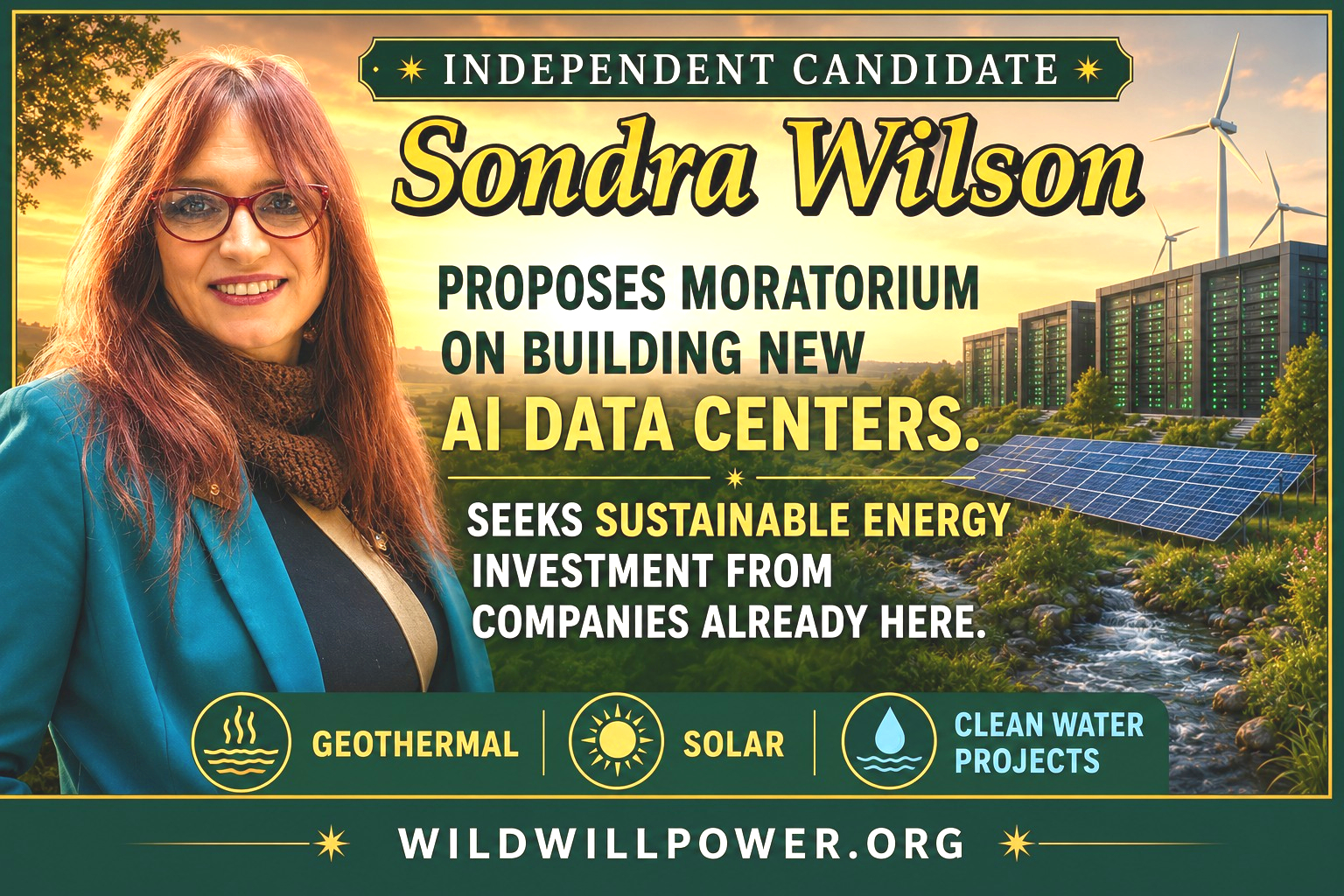
by Sondra Wilson. Independent Candidate for Iowa Governor.
AI Data Centers, Clean Energy, and Iowa's Future
Iowa is already home to numerous large data centers and expanding technology campuses, including operating or planned facilities associated with several of the world’s largest technology companies.¹ These facilities support cloud computing, communications, research, commerce, artificial intelligence, and countless digital services used by Iowans every day.
Artificial intelligence can produce extraordinary public benefits when it is developed responsibly and directed toward meaningful purposes. Researchers are exploring ways AI may assist with medical diagnosis, cancer research, environmental monitoring, agriculture, accessibility, education, and other areas of public importance.²
Wild Willpower does not oppose technological progress. We believe, however, that innovation must remain accountable to the people, communities, and natural resources that make it possible.
The Environmental and Community Costs of Rapid Expansion
The rapid construction of hyperscale and AI-intensive data centers presents serious environmental, infrastructure, public-health, and quality-of-life challenges. Depending on their scale and computing load, these facilities can require extraordinary amounts of electricity and may also consume substantial quantities of water.³
Large data centers may also generate continuous mechanical noise from cooling towers, chillers, ventilation systems, transformers, pumps, rooftop equipment, and related electrical infrastructure. Backup generators and emergency power systems can create additional intermittent noise and air pollution.⁴
Because data centers operate twenty-four hours a day, noise that may appear moderate during a brief daytime measurement can become substantially more disruptive when experienced continuously, particularly at night. Low-frequency and tonal noise may remain perceptible beyond facility boundaries, while vibration may also require evaluation where site conditions or community complaints indicate a potential problem.⁵
Without adequate planning and enforceable standards, rapid data-center expansion can place additional pressure on Iowa’s:
- electrical grid;
- groundwater and municipal water systems;
- agricultural land;
- rivers, wetlands, and watersheds;
- residential utility customers;
- neighboring homes, farms, schools, and communities;
- public health and quality of life;
- local roads and infrastructure; and
- long-term environmental resilience.⁶
Iowa’s land, water, energy resources, and rural communities are not unlimited. Protecting them is essential to ensuring that future generations inherit the same natural beauty, agricultural productivity, peaceful communities, and ecological resilience that Iowans value today.
A Moratorium on New Hyperscale Data Centers
Wild Willpower supports a moratorium lasting no fewer than five years on permits, zoning approvals, utility commitments, and public incentives for new hyperscale data centers and major expansions of existing data-center campuses.
The moratorium should not expire automatically merely because the five-year minimum period has elapsed. It should continue until Iowa has completed the necessary independent studies, adopted comprehensive and enforceable protections, established transparent monitoring systems, and demonstrated that those protections can be meaningfully enforced.
The purpose of the moratorium is not to give lawmakers a short deadline for producing nominal or hastily assembled regulations. Iowa should not resume large-scale development merely because legislation bearing the title of “data-center standards” has been enacted. The relevant question is whether the state has developed protections that are scientifically grounded, independently reviewed, adequately funded, enforceable in practice, and sufficient to protect water supplies, ratepayers, neighboring communities, agricultural land, public health, and the electrical grid.⁷
The moratorium should apply to projects exceeding clearly defined thresholds for electrical demand, water consumption, land use, or computing capacity. It should not prevent universities, hospitals, small businesses, public institutions, or independent researchers from maintaining computing infrastructure that falls below the moratorium’s defined energy, water, land-use, and computing-capacity thresholds.
The moratorium is not intended to permanently prohibit data centers. Rather, it would give Iowa time to:
-
measure the actual energy and water demands of existing facilities;
-
determine how expansion may affect groundwater, municipal water supplies, and watersheds;
-
evaluate effects on electrical-grid reliability and residential utility rates;
-
examine the ecological and agricultural consequences of large developments;
-
establish enforceable standards for cooling, water conservation, energy sourcing, and land use;
-
determine whether tax exemptions and public incentives are producing adequate public benefits;⁸
-
require greater transparency concerning resource use, employment, infrastructure costs, and environmental impacts;
-
establish baseline measurements of existing community noise before additional facilities are approved;
-
evaluate continuous, nighttime, low-frequency, tonal, and vibration-related noise;
-
determine appropriate separation distances between large data centers and homes, farms, schools, hospitals, parks, and other sensitive locations;
-
assess cumulative impacts when multiple data centers, substations, transmission lines, or generating facilities are concentrated in one region;
-
develop independent monitoring and complaint-response systems; and
-
ensure that affected residents have meaningful administrative and legal remedies when standards are violated.
During the moratorium, Iowa should develop a comprehensive regulatory framework for future projects rather than continuing to approve developments without a clear understanding of their cumulative effects.
The moratorium should be lifted only after an independent public review—conducted by qualified experts and subject to public notice, disclosure, and comment—determines that Iowa has:
- completed statewide and regional resource-impact studies;
- established reliable baseline data;
- adopted binding water, energy, noise, land-use, and ratepayer protections;
- created independent monitoring and public-reporting systems;
- provided agencies with sufficient staff, expertise, and funding for enforcement;
- established meaningful penalties and remedies for violations;
- demonstrated that the standards cannot be satisfied merely through corporate self-reporting, vague sustainability pledges, or unenforceable agreements; and
- demonstrated compliance over a meaningful monitoring period rather than relying solely on projected performance.
Legislative enactment alone should not automatically terminate the moratorium.
Transparency and Corporate Responsibility
Corporations seeking to operate large data centers in Iowa should be required to disclose their projected and actual:⁹
-
annual electricity consumption;
-
peak electrical demand;
-
direct and indirect water use;
-
cooling technologies;
-
backup-generator emissions;
-
land and infrastructure requirements;
-
tax exemptions and public incentives received;
-
permanent jobs created;
-
effects on local utility systems and ratepayers;
-
exterior sound levels;
-
low-frequency and tonal-noise measurements;
-
locations and operating schedules of cooling equipment, transformers, and generators;
-
results of independent acoustic modeling;
-
anticipated nighttime noise at nearby homes and properties;
-
vibration and low-frequency sound assessments where warranted;
-
generator-testing schedules and emergency operating history; and
-
complaints received and corrective measures taken.
Companies should also be required to demonstrate that their operations will not shift disproportionate infrastructure costs onto residents, small businesses, farmers, or local governments.¹⁰
Future projects should be considered only when they demonstrate responsible water use, reliable energy planning, protection of neighboring communities, meaningful public benefits, and compliance with binding environmental, acoustic, land-use, and community-benefit standards.
Approval should not depend primarily on studies controlled by the project developer. Applicants should pay the reasonable costs of independent review, but qualified experts selected by public agencies should conduct or supervise that review.
Noise Pollution and Community Protection
The continuous operation of large data centers creates a form of community impact that is easily underestimated during the permitting process. Cooling fans, chillers, pumps, transformers, ventilation systems, electrical substations, and backup generators may create a persistent mechanical hum or drone that continues throughout the day and night.¹¹
Noise should not be dismissed merely because it falls below a conventional maximum-decibel limit. Persistent low-frequency or tonal noise may remain disturbing at levels that appear modest on an ordinary meter, particularly in rural areas where natural background sound is low.¹²
Noise evaluations should not rely exclusively on short daytime measurements or a single overall decibel reading. Reviews should account for nighttime conditions, existing rural background sound, duration, frequency, tonal characteristics, vibration, weather conditions, and the cumulative effects of multiple pieces of equipment operating continuously.
A sound level that may be ordinary in an industrial district can represent a substantial intrusion in a quiet rural or residential community. Standards should therefore evaluate not only an absolute maximum but also the increase above preexisting ambient sound levels.
Before a new data center or major expansion is approved, Iowa should require:
- independent acoustic modeling based on the facility’s maximum reasonably anticipated operation;
- baseline monitoring at nearby homes, farms, schools, parks, and property boundaries;
- separate daytime and nighttime limits;
- measurement protocols that do not conceal recurring peaks, tonal sound, or nighttime disturbances through long-term averaging;
- evaluation of low-frequency, tonal, impulsive, and vibration-related effects;
- minimum setbacks or protective sound buffers;
- sound barriers, equipment enclosures, silencers, and other mitigation measures;
- limitations on routine generator testing during nighttime hours;
- continuous post-construction monitoring where nearby communities may be affected;
- publicly accessible monitoring results;
- a clear complaint and investigation process;
- mandatory corrective action when noise exceeds permitted limits, substantially increases sound above established baseline conditions, or creates a verified continuing disturbance; and
- meaningful penalties when operators fail to correct violations.
Standards should also address cumulative noise from data centers, electrical substations, transmission equipment, backup generation, and associated industrial development rather than evaluating each component in isolation.
Local communities should retain authority to adopt stronger protections when local geography, population density, agricultural activity, or existing land use requires them.
Investment in Iowa’s Sustainable Infrastructure
Technology companies that benefit from Iowa’s land, water, workforce, infrastructure, and public incentives should contribute directly to the state’s long-term sustainability.
Depending on the facility’s impacts and the needs of affected communities, these investments may include:
-
geothermal heating and cooling systems;
-
responsibly sited solar and wind generation;
-
electrical-grid modernization;
-
energy storage;
-
water-conservation technology;
-
watershed restoration;
-
clean-water initiatives;
-
agricultural resilience;
-
brownfield redevelopment; and
-
research into advanced low-water cooling and energy-efficient computing systems.
Corporate sustainability commitments should be enforceable, independently measured, and connected to the communities and watersheds most affected by data-center development.
Iowa should not accept vague promises or distant carbon offsets as substitutes for measurable improvements within the state.
Geothermal Energy: An Underused Opportunity
Iowa’s energy conversations frequently center on wind, solar, nuclear energy, pipelines, ethanol, and biofuels. Geothermal heating and cooling deserve substantially greater consideration in Iowa’s energy discussions.
Many people associate geothermal energy exclusively with volcanic regions such as Iceland or Yellowstone. In reality, ground-source geothermal systems use the relatively stable temperature beneath the earth’s surface to provide efficient heating and cooling throughout the year. They do not require volcanoes, geysers, or naturally occurring underground steam.¹³
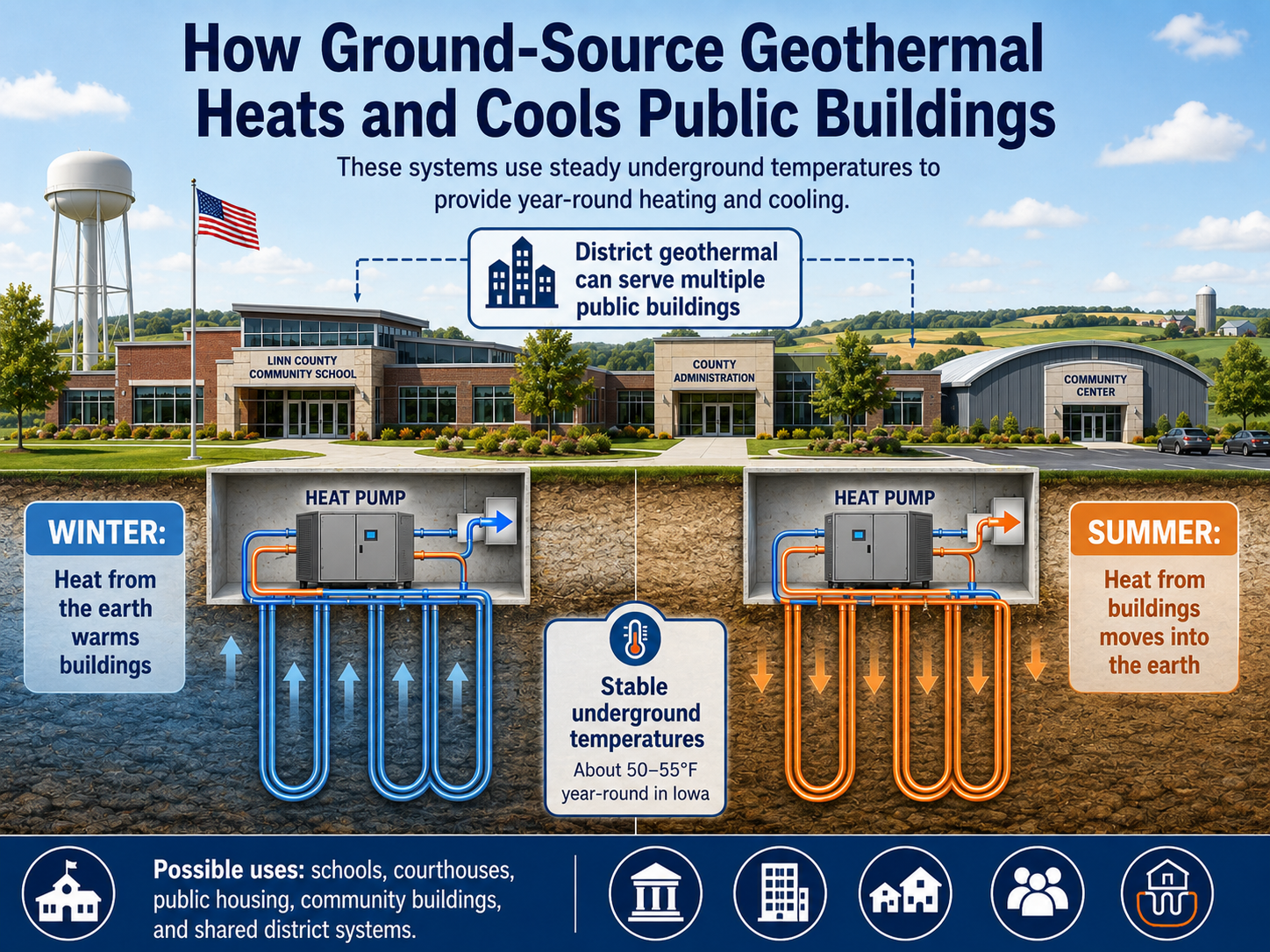
Iowa should expand the use of:
-
ground-source heat pumps for homes, schools, public buildings, and businesses;
-
district geothermal systems serving multiple buildings or neighborhoods;
-
geothermal systems incorporated into new housing and public-infrastructure projects; and
-
research into advanced closed-loop geothermal technologies.
Geothermal systems are not intended to replace every existing energy source. They can, however, become an important part of a diversified long-term energy strategy.
Because the ground-loop infrastructure is buried and properly designed systems do not require conventional outdoor air-source condenser units, ground-source geothermal systems can reduce exterior mechanical noise and visual disruption. They may also reduce peak heating and cooling demands when appropriately designed and integrated into buildings.¹⁴
State and local governments should evaluate geothermal systems whenever schools, courthouses, public housing, government buildings, and other major facilities are constructed or renovated.
An Iowa Data-Center Public Benefit Fund
Artificial-intelligence development builds upon decades of publicly supported research, education, communications infrastructure, computing advances, and human-created data. Large data centers also depend upon physical resources supplied by the communities in which they operate, including land, water, electricity, roads, public institutions, tax incentives, and utility infrastructure.¹⁵
When private development derives extraordinary value from public knowledge and public resources, the public should share meaningfully in the resulting benefits.¹⁶ At the state level, Iowa’s contribution to that value is most directly reflected in the land, water, energy, infrastructure, public incentives, and community resources that make large-scale data-center operations possible.
Wild Willpower therefore supports the creation of an Iowa Data-Center Public Benefit Fund. After the moratorium is lifted, qualifying hyperscale data centers, major campus expansions, and existing facilities receiving substantial continuing tax benefits, public subsidies, preferential utility arrangements, or publicly financed infrastructure support should be required to make ongoing contributions to this independently administered fund.
How the Fund Would Be Financed
Funding mechanisms may include:
-
annual impact fees based on electrical demand, water consumption, land use, and computing capacity;
-
other dedicated fees or assessments authorized by law based on qualifying data-center activity;
-
payments connected to public tax incentives and infrastructure commitments;
-
recapture of a portion of qualifying tax exemptions, credits, or public subsidies;
-
penalties collected for environmental, utility, noise, disclosure, or permitting violations; and
-
negotiated contributions contained in binding community-benefit agreements.
The fund should not allow companies to purchase permission to pollute, create excessive noise, overdraw water supplies, shift grid costs to ratepayers, or violate environmental protections. Required contributions would supplement—not replace—compliance with all environmental, land-use, utility, restoration, and community-protection standards.
How the Fund Would Benefit Iowans
Fund revenues should support measurable public benefits in Iowa, including:
-
residential utility-rate relief and energy-efficiency assistance;
-
drinking-water and wastewater infrastructure;
-
watershed, wetland, and groundwater restoration;
-
independent environmental and acoustic monitoring;
-
geothermal heating and cooling for schools and public buildings;
-
grid modernization and community energy resilience;
-
assistance for communities directly affected by large data-center development;
-
workforce training and economic-transition assistance related to AI-driven displacement;
-
public education, libraries, and technological access;
-
independent research into AI safety, environmental effects, and public-interest uses; and
-
annual dividends to Iowa residents if fund revenues and long-term financial conditions make such payments sustainable.
A portion of the fund should be invested for long-term growth so that the benefits do not disappear when individual facilities close, technologies change, or corporate investment moves elsewhere.
Environmental restoration, ratepayer protection, independent monitoring, affected-community assistance, and long-term reserves should be funded before any individual dividend is distributed.
Fund revenues should be held in a dedicated account and should not be transferred to the general fund or used for purposes unrelated to the fund’s statutory mission. A substantial portion of revenues generated by an individual facility should be reserved for the communities, utility systems, and watersheds directly affected by that facility, while the remainder may support statewide resilience and public-benefit programs.
The fund should be governed transparently by an independent public board that includes representatives of affected communities, workers, environmental and public-health experts, ratepayers, agricultural interests, educators, tribal communities, and local governments. Data-center corporations should not control the board or determine how their required contributions are spent.
All revenues, investments, administrative expenses, grants, contracts, and distributions should be publicly reported and subject to regular independent audits.
This proposal reflects a basic principle: technological development should not privatize its profits while transferring its environmental, infrastructure, labor, and community costs to the public. If Iowa’s resources help generate extraordinary private wealth, part of that wealth should remain in Iowa and strengthen the lives of its people.
Clean Water and Ecological Restoration
Water use is among the most pressing concerns associated with large data centers. Iowa already faces serious water-quality challenges resulting from nutrient pollution, soil erosion, aging infrastructure, industrial contamination, and other long-term pressures.¹⁷
Additional demand from industrial cooling systems must not be allowed to compound these problems without careful review.¹⁸
Corporations operating large technology campuses in Iowa should help fund projects that directly improve local water quality, restore ecosystems, conserve groundwater, and modernize water infrastructure.
One avenue for this work would be partnership with the proposed Civilian Restoration Corps, or CRC.¹⁹ The CRC would coordinate public-service projects involving:
-
watershed and wetland restoration;
-
erosion control;
-
soil regeneration;
-
habitat restoration;
-
water-quality monitoring;
-
urban and rural infrastructure improvements;
-
invasive-species management; and
-
long-term ecological stewardship.
Partnerships between technology companies, local communities, educational institutions, conservation organizations, and the CRC could ensure that corporate investment produces lasting public and environmental benefits.
Research and Demonstration Projects
Iowa should support carefully designed research and demonstration projects involving emerging environmental technologies, including mycoremediation and other biologically based approaches to water treatment, ecological restoration, and sustainable energy production.
Wild Willpower’s proposed MycoFuel Engineers™ initiative is developed separately within the broader Civilian Restoration Corps framework.²⁰ Readers may review the proposed Crop Diversity and Energy Sovereignty Act or learn more in Reclaiming Iowa: The Path Forward.
These emerging approaches should be evaluated through transparent pilot programs examining their effectiveness, safety, costs, scalability, emissions, and ecological consequences before statewide implementation.
Standards for Future Data-Center Development
Following the moratorium and statewide review, future hyperscale data-center projects should be considered only after Iowa has adopted strong, enforceable, and independently verifiable standards.
The existence of regulations on paper should not be treated as proof that Iowa is prepared to resume development. Before the moratorium is lifted, the state should demonstrate that its agencies possess the scientific expertise, staffing, monitoring equipment, funding, inspection authority, and enforcement mechanisms necessary to administer those standards effectively.²¹
These standards should include:
-
minimal-water or closed-loop cooling wherever technically feasible;
-
protection of drinking-water supplies and agricultural wells;
-
independently verified water-use and energy-use reporting;
-
sufficient new energy generation and grid investment to support projected demand;
-
protection against shifting infrastructure costs to residential ratepayers;
-
responsible land-use and siting requirements;
-
binding restoration or community-benefit agreements;
-
transparent disclosure of tax incentives;
-
emergency plans for droughts and grid instability;
- enforceable permitting, monitoring, and mitigation requirements for backup generators and other facility-related air emissions;
-
meaningful consultation with affected communities before approval;
-
minimum setbacks from homes, schools, hospitals, parks, and other sensitive locations;
-
independent acoustic-impact studies completed before approval;
-
enforceable daytime, nighttime, low-frequency, and tonal-noise limits;
-
continuous or periodic post-construction noise monitoring;
-
protection against substantial increases above preexisting rural or residential background sound;
-
equipment enclosures, sound barriers, silencers, and other best-available noise-control measures;
-
restrictions on nighttime generator testing and unnecessary idling;
-
public access to noise-monitoring and violation records;
-
binding procedures for investigating community complaints; and
-
authority to require operational changes, equipment replacement, or temporary curtailment when violations persist.
Requirements imposed directly on data-center developers should bear a reasonable relationship to the resources they consume, the infrastructure they require, and the environmental or community burdens they create. Water conservation, grid investment, noise mitigation, ratepayer protection, environmental monitoring, and restoration of directly affected lands or watersheds should therefore be mandatory components of responsible development.
Broader investments—such as geothermal installations in public buildings, workforce programs, brownfield redevelopment, and regional ecological-restoration projects—may be incorporated into negotiated community-benefit agreements or statewide corporate-partnership programs.
Experimental environmental technologies should remain independently evaluated research and demonstration initiatives. Participation may be encouraged, but approval of a data-center project should not depend upon a corporation endorsing any particular experimental technology.
A Sustainable Path Forward
Iowa’s relationship with technology companies should be symbiotic, responsible, and sustainable.
Technological innovation should strengthen Iowa rather than drain its resources. Corporations should not be permitted to consume vast quantities of electricity and water, receive extensive public incentives, and leave communities responsible for the long-term environmental and infrastructure costs.
Wild Willpower supports responsible artificial intelligence, scientific research, and technological development. We also believe that innovation must be transparent, environmentally sustainable, and accountable to the public.
Iowa should welcome technological progress—but only when its costs are honestly measured, its benefits are broadly shared, and its growth does not compromise the land, water, communities, and natural resources upon which future generations will depend.
Until Iowa completes an independent assessment of existing facilities, establishes enforceable protections, creates reliable monitoring and public-reporting systems, and demonstrates the capacity to administer them effectively, a moratorium on new hyperscale data centers and major campus expansions is prudent and necessary.
Endnotes
1. Google, “Iowa—Google Data Center Location”; Angela Major, “Microsoft Built Five Data Center Campuses in This Iowa City. Then Residents’ Water Bills Went Up”; and Inside Climate News, “Clean Energy Brought Data Centers to Iowa.”
2. National Institutes of Health, “NIH Researchers Develop AI Tool with Potential to More Precisely Match Cancer Drugs to Patients,” April 18, 2024; U.S. Department of Agriculture, USDA AI Strategy, 2025; U.S. Environmental Protection Agency, “AI Use Case Inventory,” updated May 4, 2026; and U.S. Department of Education, “U.S. Department of Education Issues Guidance on Artificial Intelligence Use in Schools,” July 22, 2025.
3. Arman Shehabi et al., 2024 United States Data Center Energy Usage Report; U.S. Department of Energy, “DOE Releases New Report Evaluating Increase in Electricity Demand from Data Centers”; and Yuelin Han et al., “Small Bottle, Big Pipe.”
4. Environmental and Energy Study Institute, “Communities Are Raising Noise Pollution Concerns About Data Centers”; U.S. Environmental Protection Agency, “Clean Air Act Resources for Data Centers.”
5. Environmental and Energy Study Institute, “Communities Are Raising Noise Pollution Concerns About Data Centers”; World Health Organization, “Guidance on Environmental Noise”; and World Health Organization Regional Office for Europe, Environmental Noise Guidelines for the European Region.
6. Shehabi et al., 2024 United States Data Center Energy Usage Report; Han et al., “Small Bottle, Big Pipe”; Major, “Microsoft Built Five Data Center Campuses”; and Iowa Department of Natural Resources, “2024 305(b) Assessment Summary.”
7. Iowa General Assembly, House File 2690; U.S. Department of Energy, “Clean Energy Resources to Meet Data Center Electricity Demand”; and Shehabi et al. House File 2690 is cited as evidence of legislative attention to water reporting and utility tariffs, not as support for Wild Willpower’s proposed five-year moratorium.
8. Iowa Department of Revenue, “Data Center Sales and Use Tax Incentives”; Inside Climate News, “Clean Energy Brought Data Centers to Iowa.”
9. Iowa General Assembly, House File 2690; Han et al., “Small Bottle, Big Pipe”; and Shehabi et al. The complete disclosure framework is Wild Willpower’s proposal.
10. Major, “Microsoft Built Five Data Center Campuses”; Iowa General Assembly, House File 2690; and U.S. Department of Energy, “Clean Energy Resources to Meet Data Center Electricity Demand.”
11. Environmental and Energy Study Institute, “Communities Are Raising Noise Pollution Concerns About Data Centers.”
12. World Health Organization, “Guidance on Environmental Noise”; World Health Organization Regional Office for Europe, Environmental Noise Guidelines for the European Region; and Environmental and Energy Study Institute. WHO addresses environmental noise generally; EESI discusses data-center-specific noise concerns.
13. U.S. Department of Energy, “Geothermal Heat Pumps”; U.S. Department of Energy, “Geothermal Heating and Cooling.”
14. U.S. Department of Energy, “Geothermal Heat Pumps”; U.S. Department of Energy, “Geothermal Heating and Cooling.”
15. Iowa Department of Revenue, “Data Center Sales and Use Tax Incentives”; Shehabi et al.; and Han et al.
16. Bernie Sanders, “Sanders Introduces Legislation to Create $7 Trillion AI Sovereign Wealth Fund.” Sanders proposes a federal stock-based fund; Wild Willpower proposes an Iowa fund using different state-level mechanisms.
17. Iowa Department of Natural Resources, “2024 305(b) Assessment Summary”; Iowa Department of Natural Resources, “Iowa DNR Seeks Public Input on Roadmap for Water Quality Improvements”; and U.S. Environmental Protection Agency, “EPA Takes Action on Iowa’s 2024 List of Impaired Waters.”
18. Han et al., “Small Bottle, Big Pipe”; Major, “Microsoft Built Five Data Center Campuses”; and Shehabi et al.
19. Sondra Wilson, Reclaiming Iowa: The Path Forward; Wild Willpower, Crop Diversity and Energy Sovereignty Act.
20. Wild Willpower, Crop Diversity and Energy Sovereignty Act; Wilson, Reclaiming Iowa: The Path Forward.
21. Iowa General Assembly, House File 2690; Shehabi et al.; Han et al.; Environmental and Energy Study Institute; and Iowa Department of Natural Resources, “2024 305(b) Assessment Summary.”
Bibliography
Environmental and Energy Study Institute. “Communities Are Raising Noise Pollution Concerns About Data Centers.” March 23, 2026.
Google. “Iowa—Google Data Center Location.” Accessed July 19, 2026.
Han, Yuelin, Pengfei Li, Adam Wierman, and Shaolei Ren. “Small Bottle, Big Pipe: Quantifying and Addressing the Impact of Data Centers on Public Water Systems.” March 2026.
Inside Climate News. “Clean Energy Brought Data Centers to Iowa. The Big Beautiful Bill Could Change That.” July 28, 2025.
Iowa Department of Natural Resources. “2024 305(b) Assessment Summary.” Iowa’s Water Quality Assessment Database. 2024.
Iowa Department of Natural Resources. “Iowa DNR Seeks Public Input on Roadmap for Water Quality Improvements.” February 17, 2026.
Iowa Department of Revenue. “Data Center Sales and Use Tax Incentives.” Updated November 3, 2025.
Iowa General Assembly. House File 2690: An Act Relating to Water and Energy Use for Data Centers, Including Reporting and Tariff Requirements. 91st General Assembly, 2026.
National Institutes of Health. “NIH Researchers Develop AI Tool with Potential to More Precisely Match Cancer Drugs to Patients.” April 18, 2024.
Major, Angela. “Microsoft Built Five Data Center Campuses in This Iowa City. Then Residents’ Water Bills Went Up.” Wisconsin Public Radio, May 15, 2025.
Sanders, Bernie. “Sanders Introduces Legislation to Create $7 Trillion AI Sovereign Wealth Fund.” Office of U.S. Senator Bernie Sanders, June 18, 2026.
Shehabi, Arman, Sarah Josephine Smith, Alex Hubbard, Alexander Newkirk, Nuoa Lei, Md AbuBakar Siddik, Billie Holecek, Jonathan G. Koomey, Eric R. Masanet, and Dale A. Sartor. 2024 United States Data Center Energy Usage Report. Lawrence Berkeley National Laboratory, December 19, 2024.
U.S. Department of Agriculture. USDA AI Strategy. 2025.
U.S. Department of Education. “U.S. Department of Education Issues Guidance on Artificial Intelligence Use in Schools.” July 22, 2025.
U.S. Department of Energy. “Clean Energy Resources to Meet Data Center Electricity Demand.”
U.S. Department of Energy. “Data Centers and Servers.”
U.S. Department of Energy. “DOE Releases New Report Evaluating Increase in Electricity Demand from Data Centers.” December 20, 2024.
U.S. Department of Energy. “Geothermal Heat Pumps.” Office of Geothermal. Accessed July 19, 2026.
U.S. Department of Energy. “Geothermal Heating and Cooling.” Office of Geothermal. Accessed July 19, 2026.
U.S. Environmental Protection Agency. “AI Use Case Inventory.” Updated May 4, 2026.
U.S. Environmental Protection Agency. “Clean Air Act Resources for Data Centers.” Updated January 23, 2026.
U.S. Environmental Protection Agency. “Clean Air Act Title IV—Noise Pollution.” Updated 2026.
U.S. Environmental Protection Agency. “EPA Takes Action on Iowa’s 2024 List of Impaired Waters.” November 13, 2024.
U.S. Environmental Protection Agency. “Summary of the Noise Control Act.” Updated 2026.
Wild Willpower. Crop Diversity and Energy Sovereignty Act. May 2026.
Wilson, Sondra. Reclaiming Iowa: The Path Forward. Forthcoming, 2026.
World Health Organization. “Guidance on Environmental Noise.” Compendium of WHO and Other United Nations Guidance on Health and Environment. Accessed July 19, 2026.
World Health Organization Regional Office for Europe. Environmental Noise Guidelines for the European Region. Copenhagen: World Health Organization, 2018.