Iowa's Broken Judiciary Part One:
Procedural Bombardment
Six misleading attacks.
A judge required to recuse—who ruled anyway.
An undue financial burden.
A buried record.
By Sondra Wilson | Updated August 1, 2026

This page describes Phase 1 of the court proceedings described in Iowa's Broken Judiciary: Court-Assisted Abuse-of-Process in Wilson v. Reliable Street Inc., et al.
Phase 1 documents the beginning of the defendants’ coordinated procedural strategy to derail the case, prevent discovery, and violate my right to due process and a fair trial, and the first judicial rulings that amplified it.
It covers the period from the filing of my petition through the defendants’ February 29 procedural bombardment and my March 15 omnibus resistance. This phase shows how the defendants used early procedural complexity to overwhelm a self‑represented litigant and how the court’s initial rulings later enabled that strategy to escalate.
Executive Summary
Defendants answered my two-page petition with twenty-seven pages of coordinated procedural demands while I was studying abroad through Des Moines Area Community College. In two filings submitted five minutes apart, they challenged service, sought transfer to Story County at my expense, demanded dismissal of every claim before discovery, alternatively demanded that I recast and substantially expand the petition, and repeated the same accusations I had sued over in the first place.
Their venue motion contained a categorical misstatement of Iowa law. Defendants asserted that no exception under Iowa Code chapter 616 applied, even though § 616.18 permits an action arising from injury or damage to be brought where one defendant resides or where the injury or damage was sustained. Their own motion acknowledged that one named defendant resided in Polk County, and my claims concerned allegedly false statements and altered materials submitted into an Iowa Civil Rights Commission proceeding there.
I responded with a seventeen-page omnibus filing addressing eight separate disputes. I requested a limited continuance, offered to amend and cure any arguable service defect, explained that essential facts remained within defendants’ possession and required discovery, and asked Judge Samantha Gronewald to resolve disqualification before ruling on anything else. I cited the judicial-conduct rule stating that a judge “shall disqualify” herself whenever her impartiality might reasonably be questioned.
I contend that the judicial-disqualification rule required Judge Gronewald to recuse before deciding any contested issue. She denied recusal and ruled on venue the same day.
Approximately nine hours later, Judge Gronewald denied recusal in one sentence and granted transfer “for the reasons stated within” defendants’ motion. Four days afterward, the defendants who had challenged service accepted it, joined the remaining motions, resisted my request for time, and sought to enlarge the transfer order to impose the filing fee, attorney fees, and costs against me. When I sought reconsideration, the court preserved the transfer and assigned the transfer filing fee to me.
The consequences extended beyond the docket. Defendants used my ability to file emergency responses from London as supposed proof that I needed no continuance, even though my professors had granted extensions and the litigation was displacing the Honors project that had been the principal reason for my trip. I ultimately did not complete that project.
When the case reached Story County, the unresolved dismissal, recasting, specificity, amendment, continuance, and estoppel disputes remained pending. The entire Polk County history was then compressed into a single 144-page docket entry, making the sequence harder for later judges, readers, and the public to reconstruct.
Part One therefore documents more than ordinary procedural disagreement. It shows how six coordinated attacks, a refusal to disqualify before ruling, a transfer based on misstated law, added financial burden, and a buried record combined to move the case farther from discovery and farther from a decision on its merits.
Legal-Accountability Question
Defendants’ categorical venue assertion also raises a serious question under Iowa Rule of Civil Procedure 1.413, which requires an attorney’s signed filing to be supported by existing law or a good-faith argument for changing it after reasonable inquiry, and prohibits filings made to harass, cause unnecessary delay, or needlessly increase litigation costs.
In This Part
The Polk County Record
How the separately filed documents became one 144-page Story County docket entry.
December 5, 2023–February 22, 2024 — Filing and Service
The original petition, service attempts, and returns.
February 29, 2024 — Procedural Bombardment
Six coordinated attacks: service, venue, dismissal, recasting, specificity, and renewed accusations.
March 15, 2024 — My Omnibus Response
Eight motions and resistances seeking recusal, time, amendment, discovery, and preservation of the case.
March 15–April 2, 2024 — Court-Assisted Escalation
Same-day recusal and venue rulings, defendants’ strategic reversal, reconsideration, and transfer costs.
The Continuing Recusal Dispute
How the issue carried into the related Reynolds case and ended with Judge Gronewald’s July 9 recusal from that proceeding.
The Educational and Procedural Harm
How emergency litigation displaced the Honors project and how defendants used those emergency responses against me.
Where Part One Left the Case
The transfer to Story County, unresolved motions, assigned fee, and buried record.
A Note About the Polk County Record
The filings described in this phase were originally entered separately in Polk County case number LACL157381. When the case was transferred to Story County, however, the entire Polk County record was transmitted as a single 144-page certified binder and filed under one Story County docket entry: D0001.
As a result, the individual filings, orders, and procedural disputes from this phase no longer appear as separate entries in the current docket. Instead, they are embedded—sometimes with overlapping or repeated material—inside one large document that must be searched page by page. In practical terms, this buried the complexity of what occurred in Polk County. It also obscured several rulings and unresolved burdens that I believe were unjustly imposed upon me. Those issues did not disappear after the transfer; instead, the defendants later drew selectively from this compressed record when it supported their arguments, while the full history remained difficult for incoming judges and other readers to reconstruct.
To make this phase understandable, each timeline entry below links to the original Polk County filing as it appeared when filed. I also provide its corresponding page numbers within Story County D0001, so readers can locate the same document in the docket as it exists today. The complete transferred record—in effect, the entire official record of Phase One—may be viewed here: Polk County Certified Record—Story County D0001, 144 pages.
Dec. 5, 2023-Feb. 22, 2024
I Filed a Petition and Served Process
Before Leaving for DMACC's London Abroad Program
Dec. 5, 2023 — Plaintiff’s Original Petition
Current docket location: D0001, pp. 143–144
I commenced the action in Polk County District Court against Reliable Street Inc., Lockwood Café, Lyndsay Nissen, Sharon Stewart, Willa Colville, Denise Martinez, and Charlie Esker. The two-page petition identified the central events, the claims I understood at the time, and the relief sought.
Feb. 9–22, 2024 — Original Notices Served and Returns Filed
Current docket location: D0001, pp. 134–142. The individual notices and returns are not separately linked here, but each appears within this page range.
On February 9, 2024, Story County Sheriff’s Deputy Jason Grubbs delivered the original notices and petitions to Lyndsay Nissen at 4625 Reliable Street. The returns identified Nissen as Reliable Street Inc.’s president and recorded service upon Reliable Street Inc. and Nissen, together with substitute service for Lockwood Café, Sharon Stewart, Willa Colville, Denise Martinez, and Charlie Esker. The completed returns were filed in Polk County on February 22.
Reliable Street and Lockwood Café operated in adjoining, interconnected spaces within the same building. Lockwood used the café area, while Reliable Street’s gallery occupied the adjacent room, separated in part by a curtain or open passage. Thus, Lockwood Café’s papers were delivered at the shared business premises to the president of Reliable Street.
Feb. 29, 2024
Defendants Bombarded Me with Filings, Misstated Iowa Venue Law,
Carried the False Narrative I was Suing Over Into the Proceedings,
and Tried to Shut Down the Case Before It Could Enter Discovery
On February 29, 2024, attorney Paul Esker filed two coordinated documents only five minutes apart on behalf of all seven defendants. Together, the filings totaled twenty-seven pages in response to my two-page petition, placed five separate procedural requests before the court simultaneously, and repeated the reputation-damaging accusations at the center of the lawsuit.
Rather than answering the substance of my allegations, defendants challenged service, sought to transfer the action to Story County at my expense, demanded dismissal before discovery, alternatively demanded that I restructure and substantially expand the petition, and repeated the same accusations I had sued over in the first place.
The Two Coordinated Filings
Reliable Street Inc. and Nissen’s Motions to (1) Change Venue, (2) Dismiss, (3) Recast, and (4) Require a More Specific Statement
Current docket location: D0001, pp. 112–133
Lockwood Café, Sharon Stewart, Willa Colville, Denise Martinez, and Charlie Esker’s Motion to Quash Service and Conditional Joinder
Current docket location: D0001, pp. 107–111
The first filing sought four different forms of relief. The second challenged service on five defendants while announcing that, if the service challenge failed, those defendants would join every motion in the first filing.
What Each Filing Asked the Court to Do
1. Motion to Quash Insufficient Service of Process
Despite Actual Notice, Shared Counsel, and a Coordinated Defense
A motion to quash service asks the court to rule that one or more defendants were not legally brought into the case because the original notice and petition were not properly delivered.
Here, Lockwood Café, Stewart, Colville, Martinez, and Esker argued that service through Lyndsay Nissen at 4625 Reliable Street was legally insufficient. They asserted that the address was not the individual defendants’ residence and that Nissen was not authorized to accept service for Lockwood Café.
Yet the filing itself demonstrated unmistakable actual notice and coordination. All five defendants had retained the same attorney representing Reliable Street and Nissen. Their motion was filed only five minutes after the first filing, and they announced that if service was upheld, they would join the motions to transfer, dismiss, recast, and require a more specific statement.
The filing stated:
“If service upon them is deemed to be sufficient, Defendants Lockwood Café, Sharon Stewart, Willa Colville, Denise Martinez, and Charlie Esker join the following Motions filed by Defendants Reliable Street Inc. and Lyndsay Nissen: (I) Motion To Change Venue; (II) Motion To Dismiss; (III) Alternative Motion To Recast; (IV) Alternative Motion For A More Specific Statement.”
p. 1; D0001, p. 107.
In practical terms, they argued that they were not properly before the court while simultaneously coordinating a unified defense and positioning themselves to seek every other form of relief requested that day.
2. Motion to Change Venue
Based on the False Premise That Polk County Was the “Wrong County”
A motion to transfer venue asks the court to move a case from the county where it was filed to another county that the moving party claims is legally proper.
Reliable Street and Nissen argued that the case belonged in Story County because most defendants lived or operated there.
They asserted:
“The location of the office of the Iowa Civil Rights Commission has no bearing on the question of venue.”
p. 4, ¶ 20; D0001, p. 115.
They further stated:
“No exception contained in Iowa Code § 616 is applicable.”
p. 4, ¶ 21; D0001, p. 115.
They requested that the case be transferred at my expense and sought transfer costs, compensation, and attorney fees under Iowa Rule of Civil Procedure 1.808(1), which permits a court, when an action was filed in the “wrong county,” to assess:
“reasonable compensation for defendant’s trouble and expense, including attorney’s fees, in attending the wrong county.”
Filing p. 4, ¶ 24; D0001, p. 115.
Defendants’ attorney categorically asserted that no Chapter 616 exception applied. But Iowa law expressly permits an action arising from injury or damage to be brought either where one of the defendants resides or where the injury or damage is sustained.
Statutory Authority:
Iowa Code § 616.18: An action arising from injury or damage may be brought where one defendant resides or where the injury or damage is sustained.
My claims concerned allegedly false statements, altered materials, and fraudulent representations submitted into an ICRC proceeding in Polk County, and defendants’ own filing acknowledged that Charlie Esker—a named defendant—resided there. Polk County therefore was not the “wrong county.” Defendants nevertheless invoked the rule governing an action filed in the “wrong county” and demanded transfer, compensation, attorney fees, and costs against me.
The venue issue is examined more fully later in this phase.
3. Motion to Dismiss for Failure to State a Claim
Seeking to Eliminate Every Claim Before Discovery
A motion to dismiss for failure to state a claim asks the court to end a claim based only on the petition’s alleged legal deficiencies—before evidence is received and ordinarily before discovery occurs.
Defendants argued that my petition did not assign each claim to particular defendants or separately allege detailed facts supporting every element of discrimination, fraud, promissory estoppel, and defamation.
“The Petition does not make clear which Defendants are the subject of each claim.”
p. 7, ¶ 37; D0001, p. 118.
They asked the court to dismiss the petition “in its entirety.”
Their request for complete dismissal was repeated throughout the filing. They separately concluded that each of the four identified claims should be dismissed against all seven defendants. They then requested dismissal of the petition in its entirety and introduced both alternative motions with the phrase:
“If Plaintiff’s petition is not dismissed in its entirety…”
The phrase “dismissed in its entirety,” or its grammatical equivalent, appeared three times. The motion also contained four separate conclusions demanding that each identified claim be dismissed as to all seven defendants. Taken together, the filing contained three express demands for dismissal “in its entirety” and four additional claim-by-claim conclusions seeking dismissal against all seven defendants.
For example:
“Taking the foregoing together, any claim for discrimination should be dismissed as to all seven named Defendants.”
p. 10, ¶ 50; D0001, p. 121.
“Taking the foregoing together, any claim for fraud should be dismissed as to all seven named Defendants.”
p. 12, ¶ 61; D0001, p. 123.
“Taking the foregoing together, any claim for promissory estoppel should be dismissed as to all seven named Defendants.”
p. 14, ¶ 73; D0001, p. 125.
“Taking the foregoing together, any claim for defamation should be dismissed as to all seven named Defendants.”
p. 18, ¶ 89; D0001, p. 129.
“Defendants Reliable Street Inc. and Lyndsay Nissen respectfully request the Court enter an Order dismissing the Petition in its entirety…”
Filing pp. 18–19, request for relief following ¶ 89; D0001, pp. 129–130.
And the repeated condition introducing both alternatives:
“If Plaintiff’s petition is not dismissed in its entirety…”
p. 19, ¶ 90, and p. 20, ¶ 93; D0001, pp. 130–131.
The second filing then conditionally joined the dismissal request both at its beginning and again in its concluding paragraph.
4. Alternative Motion to Recast
Requiring a Structural Rewrite if Dismissal Was Denied
A motion to recast concerns the organization and format of a pleading. It asks the court to require the party to rewrite the document into a more formal structure, generally using numbered paragraphs and separate counts.
Defendants requested recasting only if the court declined to dismiss the petition in its entirety:
“If Plaintiff’s petition is not dismissed in its entirety, Defendants Reliable Street Inc. and Lyndsay Nissen respectfully move for the Pleading to be recast…”
p. 19, ¶ 90; D0001, p. 130.
They argued:
“The Petition does not comply with Iowa Rule of Civil Procedure 1.412 at least insofar as it does not contain numbered paragraphs and the paragraphs are not limited as far as practicable to a statement of a single set of circumstances.”
p. 19, ¶ 92; D0001, p. 130.
This request did not challenge whether the underlying events were true. It challenged how the petition was organized.
Nevertheless, recasting added another distinct procedural issue that I had to research and address while studying abroad.
5. Alternative Motion for a More Specific Statement
Demanding Details That Discovery Was Needed to Uncover
A motion for a more specific statement is intended for a pleading that is allegedly so vague or ambiguous that the opposing party cannot reasonably respond. Its purpose is to make the pleading answerable—not to require the plaintiff to prove the entire case before discovery.
Their filing acknowledged:
“A party may move for more specific statement of any matter not pleaded with specific definiteness to enable the party to plead to it, and for no other purpose.”
p. 20, ¶ 94; D0001, p. 131.
Defendants’ own motion then quoted the governing fair-notice standard:
“A petition complies with the ‘fair notice’ requirement if it informs the defendant of the incident giving rise to the claim and of the claim’s general nature.”
p. 20, ¶ 95; D0001, p. 131.
Defendants nevertheless asserted:
“The petition does not state which causes of action are applicable to particular defendants.”
p. 20, ¶ 97; D0001, p. 131.
“The petition does not provide sufficient detail regarding the purported ‘agreement’ between Plaintiff and Defendant Reliable Street, including (1) when it was made, (2) whether it was oral or written, (3) the terms of the alleged agreement, or (4) the nature of the alleged breach…”
p. 21, ¶ 98; D0001, p. 132.
“The petition does not make any allegations of any conduct on the part of Defendant Nissen, except for one mention of an alleged act undertaken by her, on behalf of Defendant Reliable Street.”
p. 21, ¶ 99; D0001, p. 132.
Defendants thus quoted the ordinary fair-notice standard and immediately demanded substantially more than a general account of the incident and claims.
They necessarily knew their own conduct and the agreement underlying the lawsuit because they had participated in those events. But information identifying the precise conduct, knowledge, communications, and role of each individual defendant remained within their possession. I could not truthfully allege facts that were unavailable to me before discovery.
6. Accusations Repeated Within the Filings
Carrying the False, Defamatory Narrative I am Suing for into a Second Government Record
The filings did not merely raise procedural objections. They also carried into the judicial record the same false, reputation-damaging narrative that formed part of the lawsuit.
Defendants opened their filing by calling the action:
“the latest in a string of unsubstantiated claims pursued by Plaintiff.”
p. 1, ¶ 1; D0001, p. 112.
They further asserted:
“Defendants … have been subject to years of harassing conduct by Plaintiff, both inside and outside of the legal system.”
p. 2, ¶ 7; D0001, p. 113.
These statements were not incidental. I had filed the lawsuit in substantial part because I alleged that defendants had already placed false and highly damaging accusations into the ICRC record. Their February 29 filings carried the same narrative into a second government record before discovery, fact-finding, or trial had occurred.
Why This Filing Mattered
Although defendants placed most of their requests into one consolidated filing, each request arose under a different rule and required me to research and resist it separately.
Viewed together, these filings did not operate merely as requests for clarification. They created multiple independent paths to quash service, relocate the action, dismiss every claim, or compel extensive rewriting before discovery.
Together, the filings created a procedural choke point: any one of several rulings could disrupt, relocate, dismiss, or force a substantial rewrite of the case before discovery revealed information held by defendants.
The defendants responded to my two-page petition with twenty-seven pages of coordinated procedural demands. They challenged service despite actual notice, sought transfer and costs, repeatedly demanded dismissal of the entire action before discovery, alternatively demanded that I restructure and substantially expand the petition, and repeated the accusations at the center of the lawsuit.
At the time, I was enrolled in DMACC’s London study-abroad program and attempting to complete the Honors project that had been the primary reason for traveling overseas.
The practical effect was not simply clarification. The filings multiplied the legal questions I had to research under short deadlines, created several alternative routes to dismissing or relocating the case before the defendants’ records and testimony could be examined, and forced me to divert substantial time from a once-in-a-lifetime academic experience into emergency litigation.
The next entry shows how I attempted to answer all five procedural demands while studying abroad—and how the court ruled on recusal and venue the same day I filed that response.
March 15, 2024
I Filed Eight Motions and Resistances to Preserve the Case
Plaintiff’s Motion to (1) Recuse, (2) Continue, (3) Estop, and (4) Amend, and Resistances to (1) Quashing Service, (2) Changing Venue, (3) Recasting, and (4) Dismissal
Current docket location: D0001, pp. 56–72
The defendants’ February 29 filings forced me into an immediate and compressed response cycle. Within the short resistance period—and while studying abroad in London—I had to research and answer disputes involving service, venue, dismissal, pleading format, factual specificity, recusal, amendment, and the defendants’ continued repetition of accusations against me.
I therefore filed one seventeen-page omnibus document containing eight motions and resistances:
1. a motion asking Judge Samantha Gronewald to recuse herself;
2. a motion to continue the proceedings;
3. a resistance to the motion to quash service;
4. a resistance to the requested venue transfer;
5. a motion to stop the defendants from continuing to repeat statements I alleged were false;
6. a resistance to the motion to recast;
7. a motion for leave to amend the petition; and
8. a resistance to dismissal for failure to state a claim.
This was not an attempt to complicate the case. It was my effort to answer, in one filing, the numerous procedural disputes the defendants had placed before the court simultaneously—and to preserve the action long enough for its evidence to be examined.
1. Motion to Recuse
Seeking Disqualification Before Any Other Ruling Because of the Judge’s Assignment to My Related Case Against the Governor Who Appointed Her
Before asking the court to decide service, venue, amendment, dismissal, or any other pending issue, I asked Judge Samantha Gronewald to determine whether she was disqualified from presiding.
At the time, Judge Gronewald had also been assigned to my separate civil action, Wilson v. State of Iowa and Kim Reynolds for Iowa, Polk County case no. LACL157953. That action named Kim Reynolds for Iowa and the State of Iowa as defendants and expressly alleged civil-rights violations, defamation affecting transgender Iowans, unjust enrichment, violations of 18 U.S.C. §§ 241 and 242, and violations of Iowa’s Ongoing Criminal Conduct Act.
The related lawsuit was a civil action seeking damages and injunctive relief, but it also alleged conduct prohibited by identified federal and state criminal laws. Iowa Code § 706A.3 expressly authorizes an aggrieved person to bring a civil proceeding to prevent, restrain, or remedy violations of Iowa’s Ongoing Criminal Conduct Act.
My March 15 filing connected those circumstances directly. I wrote:
“Governor Reynolds has performed multiple acts of defamation and rights violations [against] transgender Iowans.”
Filing p. 8, ¶ 19; D0001, p. 63.
I then identified the related case:
“On 2–8–2024 I filed a Petition to commence a civil action for case # LACL157953 against Defendants Governor Kim Reynolds and Kim Reynolds for Iowa.”
Filing p. 9, ¶ 20; D0001, p. 64.
I also stated:
“Governor Kim Reynolds appointed Her Honorable Judge Samantha Gronewald in December 2017.”
Filing p. 9, ¶ 21; D0001, p. 64.
The issue was not merely that Governor Reynolds had appointed Judge Gronewald at some point in the past. Judge Gronewald was presiding over this action while also assigned to my related lawsuit challenging alleged conduct by Reynolds-related and state defendants—including serious civil-rights violations and reputational harms involving transgender Iowans.
Additional public context: A 2018 Des Moines Register report identified Governor Reynolds as the official who appointed Judge Gronewald and reported that Gronewald had contributed to Republican candidates over a period of years. I did not cite that article in my March 15 filing, but it provides additional context for the appearance-of-impartiality concern I had already placed before the court.
I expressly stated:
“I question Judge Samantha Gronewald’s impartiality with regard to this action.”
Filing p. 9, ¶ 22; D0001, p. 64.
I then quoted the governing judicial-disqualification rule:
“A judge shall disqualify himself or herself in any proceeding in which the judge’s impartiality might reasonably be questioned."
Filing p. 9, ¶ 23; D0001, p. 64.
Judicial-Conduct Authority
Iowa Code of Judicial Conduct rule 51:2.11(A): A judge must disqualify herself from a proceeding when her impartiality might reasonably be questioned.
I also quoted the accompanying comment, which makes clear that disqualification is not confined to the rule’s specifically enumerated examples:
“a judge is disqualified whenever the judge’s impartiality might reasonably be questioned, regardless of whether any of the specific provisions of paragraphs (A)(1) through (6) apply.”
Filing p. 9, ¶ 24; D0001, p. 64.
Most importantly, I did not ask Judge Gronewald to consider recusal alongside the parties’ remaining motions or after ruling on them. I expressly asked that disqualification be resolved first:
“prior to any other motions made by myself or Defendants are decided on by the Court, I respectfully request that you recuse yourself from this action.”
Filing p. 9, request following ¶ 24; D0001, p. 64.
The opening page of my filing made the requested sequence equally explicit. After presenting the motion to recuse, I introduced the remaining relief with the words:
“After that motion is resolved and a new judge is assigned to this case…”
Filing p. 1; D0001, p. 56.
Thus, I did not merely list recusal first among eight requests. I asked Judge Gronewald to resolve disqualification before any motion from either side was decided and stated that the remaining proceedings should continue only after a new judge had been assigned.
The disqualification issue therefore went directly to who had authority to decide everything that followed. I had identified the related case, the appointing relationship, the serious nature of my allegations against Reynolds-related and state defendants, and the governing objective standard. That standard did not require proof that the judge consciously intended to favor one side; it required disqualification when the judge’s impartiality might reasonably be questioned.
Later that same day, Judge Gronewald denied recusal and immediately exercised judicial authority over another contested matter by granting defendants’ venue motion “for the reasons stated within the motion.”
The disqualification issue did not end with the March 15 order. I later pursued reconsideration, filed complaints with the Iowa Judicial Qualifications Commission, and renewed the issue in the related Reynolds case. That later history is addressed below.
The next entry examines the same-day recusal and venue rulings—and the burdens that followed.
2. Motion to Continue
Requesting a Limited Extension to Protect My Education and Allow Procedural Defects to Be Cured
I also asked for a continuance because I was enrolled in DMACC’s London study-abroad program and would not return to Iowa until approximately May 2. My opening request explained that I was:
“currently studying abroad this semester with Des Moines Area Community College”
and asked that the case be continued:
“preferably no sooner than May 15, 2024”
Filing p. 1; D0001, p. 56.
The request was tied to concrete tasks. I needed time to amend the petition, research the defendants’ motions, arrange any corrected service, and continue my college coursework. I was not asking for the case to remain dormant indefinitely; I proposed a specific period extending only slightly beyond my return.
My filing explained that the Iowa Civil Rights Commission had left me with an unusually compressed period in which to begin the lawsuit. I wrote:
“The Iowa Civil Rights Commission did not provide me with a sufficient amount of time to review evidence submitted to them … before having to file this lawsuit.”
Filing p. 10, ¶ 27; D0001, p. 65.
I further explained:
“I was rushed, and as a result was not provided a sufficient amount of time to fully review the Iowa Rules of Civil Procedure.”
Filing p. 10, ¶ 27; D0001, p. 65.
That statement is important. I did not insist that every procedural choice I made was beyond correction. I explained the circumstances, acted in good faith, and asked the court for time to cure any deficiency rather than allow a technical dispute to destroy the action.
Procedural Authority:
Iowa Rule of Civil Procedure 1.911(1): “A continuance may be allowed for any cause not growing out of the fault or negligence of the movant, which satisfies the court that substantial justice will be more nearly obtained.”
Filing p. 11, ¶ 34; D0001, p. 66.
My request fit that standard. It identified a specific and limited period, explained that I was overseas for an academic program, and described the concrete work that needed to be completed. I asked for time to amend, cure any service defect, research the defendants’ numerous motions, and continue the coursework and Honors project that had brought me abroad—not for an indefinite suspension of the case.
3. Resistance to the Motion to Quash Insufficient Service of Process
Showing the Shared Address and Offering to Cure Any Arguable Defect
The defendants’ own motion acknowledged that Reliable Street and Lockwood Café operated in the same building. I attached screenshots showing that both publicly listed 4625 Reliable Street as their address and wrote:
“Reliable Street Inc. and Lockwood Cafe appear to have been appropriately served at their addresses by Story County Sheriff’s Deputy Jason Grubbs on 2–9–2024.”
Filing p. 5; D0001, p. 60.
I also showed that the defendants’ description of the organizations’ leadership was incomplete. Although their motion described Sharon Stewart only as the owner and operator of Lockwood Café, Reliable Street’s own response to the ICRC identified:
“Lyndsay Nissen, President of Reliable Street INC. Sharon Stewart Vice President of Reliable Street INC.”
Filing p. 6; D0001, p. 61.
This evidence showed that Reliable Street, Lockwood Café, Nissen, and Stewart were more interconnected than the motion to quash suggested.
At the same time, I acknowledged that I lacked the individual defendants’ residential addresses and might need to complete service differently. I offered to serve them by publication or at addresses they voluntarily provided. My goal was not to evade the rules; it was to correct any arguable defect and move the case forward.
4. Resistance to the Motion to Change Venue
Identifying the Polk County Conduct and the Risk of Prejudice in Story County
The defendants argued that all relevant conduct occurred in Story County. I responded that the action concerned:
“the fraudulent document that was filed with the Iowa Civil Rights Commission by Sharon Stewart on behalf of Lockwood Cafe”;
Filing p. 3; D0001, p. 58.
and:
“various libelous statements made against me… within documentation submitted to the Iowa Civil Rights Commission by Sharon Stewart, Lyndsay Nissen, and Charlie Esker.”
Filing p. 3; D0001, p. 58.
I later explained more directly:
“acts of libel and the fraudulent document were submitted within Polk County to the Iowa Civil Rights Commission. The majority and more severe injurious acts against me, with regard to this action, occurred in Polk County.”
Filing p. 8, ¶ 15; D0001, p. 63.
Venue Argument Placed Before the Court:
The allegedly false statements and altered document were submitted into the ICRC proceeding in Polk County, while the proposed transferee county raised documented prejudice concerns.
Thus, my venue argument was not based merely on the physical location of an agency office. I alleged that actionable statements and materials had been transmitted into the ICRC proceeding in Polk County, where they entered a government record and caused additional injury.
I also raised serious concerns about being transferred into Story County because of prior experiences involving Story County officials and courts—matters I was simultaneously litigating in Wilson v. State of Iowa and Kim Reynolds for Iowa.
5. Motion to Amend Petition and Resistance to Recasting
Proposing a Practical Alternative to Dismissal or a Forced Rewrite
At the beginning of my filing, I proposed a practical solution. Instead of dismissing the action or forcing a separate recasting process, I proposed an amended petition that would:
conform its formatting to Iowa Rule of Civil Procedure 1.412;
Filing p. 2; D0001, p. 57.
include more specific statements in response to defendants’ motion; and
p. 2; D0001, p. 57.
state certain claims more explicitly, except where the requested details depended upon discovery.
p. 2; D0001, p. 57.
I also asked for enough time to serve the amended petition and notices where necessary. I told the defendants that any of them could avoid service by publication by simply providing:
“an appropriate address for which service of process may be delivered”
Filing p. 2; D0001, p. 57.
In other words, I did not refuse to clarify or correct anything the court found deficient. I proposed amendment, renewed service where necessary, and eventual discovery—the least drastic means of preserving the action while addressing the defendants’ stated concerns.
6. Resistance to the Motion to Dismiss
Warning that Dismissal Would Prevent Discovery and Evidence
My filing directly addressed the practical effect of the dismissal arguments within defendants’ twenty-two-page consolidated motion.
I wrote that the dismissal arguments appeared designed:
“to prevent this civil action from moving forward into the discovery process”;
“to bury me in tedious legal research which cannot reasonably be performed within the brief ten day time limit allowed to respond to a motion”; and
“to further injustices against me already performed by all Defendants via disallowing due process to occur.”
Filing p. 4; D0001, p. 59.
This was my contemporaneous assessment—not a conclusion invented after years of litigation. I recognized at the outset that the procedural attacks could prevent the case from reaching the stage where documents, interrogatories, and testimony would reveal the defendants’ respective roles.
I therefore told the court:
“I object to Defendants’ multiple requests to dismiss this action in its entirety, as they are attempts to deny me due process and disallow evidence and testimony to be presented.”
“It would create a miscarriage of justice to dismiss this case during this early phase of the action.”
Filing pp. 16–17; D0001, pp. 71–72.
7. Motion to Estop
Trying to Stop the Same Accusations from Being Repeated in Court
My filing also sought to prevent the defendants from continuing to place into the court record statements I alleged were false. I moved to estop them from reasserting statements made within:
“filings submitted to the Iowa Civil Rights Commission” and “Defendants’ Motions filed on 2–29–2024.”
Filing p. 3; D0001, p. 58.
I specifically disputed their assertion that they had endured “years” of harassment. I wrote:
“I did not know the Defendants for ‘years’, nor did I ever harass any of them.”
Filing p. 7, ¶ 14; D0001, p. 62.
This was not peripheral to the litigation. The defendants’ repetition of those accusations required me to defend my character at the same time I was attempting to research service, venue, pleading rules, amendment, and dismissal.
Why This Filing Mattered
My March 15 filing shows that I did not ignore the defendants’ motions or refuse to correct potential defects. I proposed amendment, renewed service where necessary, a limited continuance, and eventual discovery. I identified the Polk County conduct underlying substantial portions of the action, documented my concerns about transfer to Story County, invoked the judicial disqualification rule, and warned that dismissal would prevent evidence and testimony from being examined.
Most importantly, I identified the danger before the court ruled. I wrote that the procedural demands appeared designed to prevent discovery, bury me in legal research, and deny me a meaningful opportunity to present evidence.
Later that same day, Judge Gronewald denied recusal and granted defendants’ venue motion “for the reasons stated within the motion.” The next entry examines those orders and the point at which the defendants’ procedural strategy became court-assisted.
March 15-April 2, 2024
The Court Granted Transfer Based on Misstated Law, Defendants Used the Ruling to Further the Retaliation I Alleged, and Reconsideration was Rejected
The March 15 filing described above placed eight motions and resistances before the court, including a request that Judge Samantha Gronewald resolve disqualification before ruling on anything else.
What followed was a rapid chain of rulings and filings. Judge Gronewald denied recusal and granted defendants’ venue motion later that same day. Four days afterward, defendants abandoned their service challenge, accepted service, joined the remaining motions, resisted my request for time, and sought to enlarge the transfer order to impose costs and attorney fees against me. When I sought reconsideration, the court preserved the transfer and assigned its filing fee to me.
March 15 — Same-Day Orders
A Seventeen-Page Filing Followed Hours Later by a Brief Ruling
Plaintiff’s Omnibus Motions and Resistances — discussed above
Filed March 15, 2024, at 8:23 a.m.; D0001, pp. 88–104.
Judge Gronewald's Order Denying Recusal and Granting Change of Venue
Entered March 15, 2024, at 5:45 p.m.; D0001, pp. 85–87.
Approximately nine hours after I filed a seventeen-page document addressing eight separate procedural disputes, Judge Gronewald entered an order denying my motion to recuse and granting defendants’ motion to transfer the action to Story County.
The order denied recusal in a single sentence:
“The Court finds that recusal is not warranted and the Motion is denied.”
Order p. 1; D0001, p. 85.
The court then granted transfer:
“Defendants’ Motion to Change Venue is granted for the reasons stated within the motion.”
Order p. 1; D0001, p. 85.
That language was consequential. As explained above, defendants’ motion categorically asserted that no Iowa Code chapter 616 exception applied—even though Iowa Code § 616.18 permitted venue where one defendant resided or where the injury or damage was sustained.
The court did not independently identify the controlling venue law, address § 616.18, or explain why defendants’ categorical assertion was correct. It did not merely omit a lengthy venue analysis. It granted transfer expressly “for the reasons stated within” a motion that categorically declared no chapter 616 exception applicable, without addressing § 616.18 or the Polk County facts I had placed before it.
The order also stated that the remaining issues would be decided after transfer:
“All other pending motions shall be resolved by the court in Story County.”
Order p. 1; D0001, p. 85.
Thus, Judge Gronewald denied the request that she recuse before deciding anything else, immediately ruled for defendants on venue, and sent the unresolved disputes—including dismissal, recasting, amendment, specificity, continuance, and estoppel—to another county.
The timing and brevity raise a serious question about how fully my filing was considered. I cannot know what review occurred outside the written record. The record does show that a seventeen-page filing addressing eight issues was followed within hours by an order denying recusal in one sentence and granting transfer solely “for the reasons stated within” defendants’ motion.
March 19 — Strategic Reversal and Escalation
Defendants Accepted Service, Joined the Remaining Motions, Intensified Filing Pressure Caused by Feb. 29 Bombardment, and Sought Transfer Expenses
Defendants’ Acceptance of Service
Filed March 19, 2024, at 3:47 p.m.; D0001, pp. 83–84.
Defendants’ Response to Plaintiff’s Omnibus Motion and Reply in Support of Motion to Dismiss
Filed March 19, 2024, at 8:24 p.m.; D0001, pp. 75–79.
Defendants’ Motion to Enlarge Order Granting Change of Venue
Filed March 19, 2024, at 8:24 p.m.; D0001, pp. 80–82.
Four days after obtaining transfer, the five defendants who had challenged service abandoned that dispute and accepted service.
Their response stated:
“Defendants Lockwood Café, Sharon Stewart, Willa Colville, Denise Martinez, and Charlie Esker have now accepted service, and hereby join the Motions filed by Defendants Reliable Street Inc. and Lyndsay Nissen on February 29.”
Response p. 1, ¶ 2; D0001, p. 77.
The sequence permits a reasonable inference that the transfer ruling changed defendants’ strategic priorities. Before transfer, they sought to quash service. After transfer had been granted, they accepted service and joined the remaining requests to dismiss, recast, and require greater specificity.
They also resisted my motion to continue. Although I had explained that I was studying abroad, had requested a limited period, and needed time to protect my coursework while responding to numerous procedural demands, defendants argued:
“Plaintiff has demonstrated an ability to ably file documents from London.”
and:
“Plaintiff is not entitled to a carte blanche extension of court deadlines because she now finds the lawsuit that she filed to be inconvenient.”
Response p. 2, ¶¶ 14–15; D0001, p. 78.
That argument converted the sacrifices required to meet emergency deadlines into supposed proof that no additional time was needed.
My ability to file from London did not show an absence of hardship. It showed that my professors had allowed extensions, that I was diverting time away from my coursework, and that the Honors discipline project that had been a primary reason for the trip was being displaced by emergency legal research and writing.
The procedural pressure became self-validating: every response I completed by sacrificing my education was used as evidence that I could absorb still more litigation.
Defendants also filed a motion asking the court to enlarge its venue order. They again invoked Iowa Rule of Civil Procedure 1.808(1)—quoting it twice within the motion—and argued that I had filed the action in the “wrong county.” They requested that the court assign to me:
the $40 transfer-processing fee;
$478 in attorney fees; and
$41 charged for ICRC records.
Motion to Enlarge ¶¶ 2, 8–11; D0001, pp. 80–81.
The venue ruling therefore became the foundation for a new attempt to impose financial consequences against me—even though the transfer had been granted based on a motion containing the categorical legal misstatement examined earlier.
I viewed this as a continuation of the retaliation underlying the lawsuit: after I filed a civil-rights action challenging false and damaging statements, defendants sought not only to relocate and dismiss the case, but also to make me pay expenses arising from that relocation.
April 1 - 2 — Reconsideration Rejected
The Court Preserved the Transfer and Assigned Its Filing Fee to Plaintiff
Plaintiff’s Motion to Reconsider Orders on Recusal and Venue; Resistance to Dismissal and Defendants’ Motion to Enlarge
Filed April 1, 2024, at 9:46 a.m.; D0001, pp. 20–31.
The transferred record contains duplicate or near-duplicate versions of this filing. Only the clearest copy needs to be linked.
Order Denying Reconsideration and Ruling on Transfer Expenses
Entered April 2, 2024, at 12:17 p.m.; D0001, pp. 5–7.
I asked the court to reconsider both March 15 rulings. I renewed the argument that Judge Gronewald should not have decided venue after I had placed disqualification before her, challenged the transfer, resisted dismissal, and opposed defendants’ effort to impose costs and attorney fees.
I also documented the educational harm caused by the litigation. I explained that my professors had granted extensions so I could complete the court filings, that I was falling behind, and that I needed to return immediately to my homework and Honors discipline project after filing.
The court denied reconsideration:
“Plaintiff’s 4/1/2024 and 4/2/2024 Motions appear to be nearly identical to each other and seek reconsideration of the Court’s 3/15/2024 Order. Plaintiff’s 4/1/2024 and 4/2/2024 Motions are DENIED.”
Order p. 1; D0001, p. 5.
The court did not grant every form of financial relief defendants requested. It denied the requested $478 in attorney fees and $41 in costs at that time. But it assigned the transfer filing fee to me:
“Defendants’ Motion is GRANTED to the extent the transfer filing fee shall be assigned to Plaintiff, however, payment of the same shall be waived at this time.”
Order p. 1; D0001, p. 5.
The order further provided:
“Payment of the transfer filing fee shall be due along with the other court costs, if any, assigned at the conclusion of this matter.”
Order p. 1; D0001, p. 5.
And although the court denied defendants’ attorney-fee request at that time, it left the issue open:
“Nothing contained herein shall preclude Defendants from seeking recovery of their attorney fees, if appropriate, at a later date.”
Order p. 1; D0001, p. 5.
The result was that the transfer remained in place, reconsideration was rejected, and I was left responsible for the filing fee generated by moving the action out of a county I maintain was legally proper.
Although the Reliable Street case was then transferred out of Judge Gronewald’s courtroom, the underlying disqualification dispute continued in my related case against the State of Iowa and Kim Reynolds for Iowa.
The Recusal Dispute Continued in the Related Reynolds Case
My objection to Judge Gronewald’s participation did not end with the March 15 ruling or the denial of reconsideration in Wilson v. Reliable Street.
On March 31, 2024, I filed a complaint concerning Judge Gronewald with the Iowa Judicial Qualifications Commission ("IJQC") based on her refusal to recuse in the Reliable Street case, and her same-day venue ruling.
The issue then continued in my separate but related Polk County case, Wilson v. State of Iowa and Kim Reynolds for Iowa, where the State of Iowa and Governor Reynolds’s campaign committee, "KIM REYNOLDS FOR IOWA", were named defendants.
On May 28, I filed a motion asking Judge Gronewald to recuse from the Reynolds case. She denied the motion on June 19. On June 20, I filed a second complaint (scroll down to view second complaint) with the IJQC—this one concerning her refusal to recuse from the Reynolds case. On July 1, I filed a motion asking her to reconsider that denial and set out the history of my recusal requests and complaints in both proceedings.
On July 9, Judge Gronewald entered an order recusing herself from the Reynolds case and directing court administration to assign another judicial officer.
The July 9 order did not explain why she recused. I therefore cannot establish from the written order whether either judicial-conduct complaint or the July 1 reconsideration motion caused that decision. The chronology is nevertheless significant: I moved for recusal in each case, sought reconsideration after each denial, and filed a judicial-conduct complaint concerning each refusal. Judge Gronewald ultimately stepped aside from the Reynolds case.
That later recusal did not undo the venue ruling she had already entered in Wilson v. Reliable Street after denying my original request for disqualification. Nor did it return the case to Polk County, remove the transfer fee assigned to me, or restore the time and educational opportunity consumed by the resulting proceedings.
Defendants Used My Emergency Responses as "Proof" That I Needed No Continuance
At the time, I was studying abroad in London through Des Moines Area Community College and working on an Honors discipline project—the principal academic reason for the trip. I had informed the court that I would return to Iowa in early May and requested a limited continuance so I could complete my coursework and address the litigation upon my return.
Defendants treated my emergency filings as evidence against me. Because I had managed to file documents from London, they argued that I had demonstrated the ability to continue litigating from there. Their response expressly stated that I was not entitled to an extension merely because the lawsuit had become “inconvenient.”
But the filings showed the opposite of what defendants claimed. My professors had granted extensions so I could meet the litigation deadlines. I was falling behind in my coursework, and the project I had traveled overseas to complete was being displaced by legal research and writing.
My later filing documented that harm while it was occurring. The eventual consequence was greater than the record could yet show: I did not complete the Honors project that had been the primary reason for traveling to London.
A once-in-a-lifetime academic opportunity was consumed by responding to procedural motions seeking to relocate or end the case before discovery. I regard that lost educational opportunity as one of the concrete harms caused by the defendants’ litigation strategy.
Iowa Law Did Not Require a Fully Proven Case in the Opening Petition
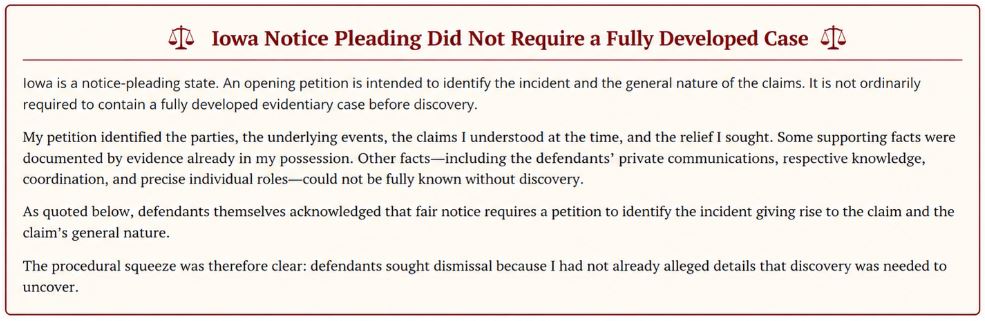
Iowa is a notice-pleading state. A petition must provide fair notice of the incident giving rise to the claim and the claim’s general nature. It ordinarily does not need to plead every ultimate fact supporting every element.
In Rees v. City of Shenandoah, the Iowa Supreme Court explained:
“Under notice pleading, nearly every case will survive a motion to dismiss.”
“The petition need not allege ultimate facts that support each element of the cause of action.”
“A petition complies with the ‘fair notice’ requirement if it informs the defendant of the incident giving rise to the claim and of the claim’s general nature.”
682 N.W.2d 77, 79 (Iowa 2004).
My two-page petition identified the underlying incident, the defendants, the claims I understood at the time, and the relief requested. Some clarification could properly be supplied through amendment, and I offered to amend.
Other information—including defendants’ private communications, their respective knowledge, and each person’s precise role—could only be developed through discovery.
Defendants nevertheless demanded a defendant-by-defendant account of every claim, detailed agreement terms, and facts concerning conduct and communications that had not yet been disclosed.
Their demands therefore did more than seek clarification. They attempted to impose a level of factual development Iowa notice pleading did not require and forced me, while studying abroad, to research dismissal standards, service, venue, recusal, amendment, pleading form, factual specificity, and discovery under compressed deadlines.
The February 29 obstruction originated with defendants. The rulings beginning March 15 gave that strategy judicial force: the action was transferred based on the reasons stated in a legally misstated motion, the remaining disputes were carried into Story County, and the transfer fee was ultimately assigned to me.
Where Phase One Left the Case
By the time the case reached Story County:
- the venue had changed;
- the transfer filing fee had been assigned to me;
- the complete Polk County record had been compressed into one 144-page docket entry;
- the dismissal, recasting, specificity, amendment, continuance, and estoppel disputes remained unresolved; and
- defendants had accepted service and joined their remaining procedural motions.
The litigation had also caused a consequence the docket could not fully capture. The time intended for my DMACC Honors project had been diverted into emergency filings, and my ability to complete those filings was then used against me as proof that I needed no continuance.
I ultimately did not complete the project that had been the principal reason for traveling to London.
Part Two begins when Judge Currie inherited those unresolved disputes, announced that one hearing would address them, and directed the parties to disclose whether they intended to present evidence.
Next Article: