
Reform Four of Our Justice Reform Plan:
Strengthen Civil Rights Protections
Rights Mean Little Without a Fair Process to Enforce Them
By Sondra Wilson | Updated August 10, 2026
This is one of several reforms within Justice Across Iowa.

These reforms grew from my firsthand experience with Iowa’s civil-rights enforcement system, documented in Iowa’s Civil-Rights Trap. But the problems I encountered are not concerns I identified alone.
In December 2022, the Iowa Advisory Committee to the U.S. Commission on Civil Rights issued a report examining the Iowa Civil Rights Commission’s screening and administrative-closure process. The Committee specifically examined whether complainants were given a meaningful opportunity to view, respond to, and question adverse evidence before their cases were closed.
Among other findings, the Committee concluded that withholding a respondent’s asserted reason for an adverse action can deprive a complainant of a credible opportunity to rebut that explanation. It recommended that the Commission require verified or certified submissions and provide complainants with the respondent’s asserted reasons and supporting documents before considering administrative closure.
Read the two records together:
Examining Employment Discrimination and Administrative Closures → — the 2022 report of the Iowa Advisory Committee to the U.S. Commission on Civil Rights.
The reforms below are intended to address those structural problems.
Civil-Rights Protections That Exist Only on Paper
This experience is one reason my justice-reform platform calls for a stronger, more transparent, and more accountable civil-rights process in Iowa.
Civil-rights agencies should not function as record-making machines for respondents while complainants are denied timely access to the materials being used against them. Complainants should receive meaningful access to their case files, adequate time to challenge an administrative closure, trauma-informed procedures, and a genuine opportunity to contest false or misleading submissions before those submissions harden into government records.
Court accessibility matters for the same reason.
When a low-income discrimination complainant cannot afford counsel, cannot obtain assistance from legal-aid organizations, cannot promptly access the complete agency file, and cannot obtain discovery before the respondent’s statements are declared absolutely privileged, civil-rights protections may exist on paper while failing almost entirely in practice.
A right without a meaningful and accessible remedy is not a real right.
Five Reforms to Strengthen Civil Rights
These reforms are designed to make Iowa’s civil-rights system more transparent, more balanced, and more usable by ordinary people. A strong enforcement process should help uncover what happened, give both sides a fair opportunity to respond, and provide meaningful avenues for correction and relief when the process fails.
Here are five concrete reforms.
1. Require the Commission to provide the case file when it closes or initially determines a case.
One of the most serious defects in the current process is that complainants may receive the agency’s evaluation or closure explanation without receiving the actual case file at the same time.
That matters because an agency evaluation may summarize what one party said about another person. For example, the evaluation may state that “the owner said the employee reported X.” But without the underlying file, the complainant may not know whether the owner made a false statement, whether the employee made a false statement, whether the agency misunderstood the evidence, or whether relevant documents were omitted.
A complainant might be told the employer claimed “performance issues,” but without the file, they cannot see whether the employer’s documents contradict themselves. They cannot know whether key evidence was ignored. They cannot meaningfully explain what the agency got wrong.
Under the current process, a complainant who wants a right-to-sue letter may then receive access to an electronic copy of the complaint file. But the problem is that requesting a right-to-sue letter also changes the procedural posture of the case. When the right-to-sue letter is issued, the Office administratively closes the complaint and takes no further action. A lawsuit must then be filed within 90 days of the date the right-to-sue letter is issued.
That is not a minor inconvenience. It means the evidence-access mechanism is tied to a procedural trigger that can end the agency process and start a strict lawsuit deadline.
In practical terms, a complainant may be told to find a private attorney while still lacking the actual evidence an attorney would need to evaluate the case. Attorneys want to see documents, timelines, exhibits, statements, and proof. If the agency closes a case but withholds the file until a right-to-sue request is made, the process puts complainants in a procedural trap: seek the evidence and trigger the deadline, or avoid the deadline and remain without the evidence.
As Governor, I would work to reform this process so that each party receives the case file at the time the Commission closes, screens out, or initially determines the case. People should not have to trigger a lawsuit clock simply to see the evidence used in their own civil-rights case.
2. Allow 60 days instead of 30 days to appeal an administrative closure or adverse determination.
A strict 30-day appeal deadline is too short for many civil-rights complainants, especially when the case involves a large record, conflicting statements, trauma, retaliation, or newly discovered evidence.
After a complainant receives an agency closure or adverse determination, they may need time to compare documents, identify contradictions, organize exhibits, consult an attorney, request records, review statements, and explain why the decision was wrong. Thirty days may be enough for a lawyer with staff, but it is often not enough for an ordinary Iowan navigating the process alone.
This becomes even more serious when the opposing party has submitted false, misleading, altered, or defamatory information into agency records. Retaliation is prohibited by the Iowa Civil Rights Act, but complainants need a meaningful process to challenge retaliatory falsehoods when they are used to defeat a civil-rights complaint. When this happens, the complainant is forced into a second burden: not only proving the original discrimination or retaliation, but also disproving each false narrative used to justify dismissal.
That is unpaid labor, and it disproportionately burdens people already facing discrimination. It causes distress. It consumes time. And it can prevent valid claims from being heard on the merits.
For that reason, Iowa should extend the appeal period from 30 days to 60 days. A civil-rights enforcement system should be designed to find the truth, not to rush unrepresented complainants through procedural deadlines before they can meaningfully respond.
3. Require enforceable consequences for knowingly false statements, altered evidence, and material deception submitted to the Commission.
Once complainants receive the case file and have enough time to review it, the next question becomes unavoidable: what happens if the file shows that a party knowingly submitted false statements, altered evidence, or material deception to the Commission?
Iowa should create clear, enforceable consequences for knowingly submitting materially false statements, altered evidence, or deceptive records to the Commission.
This reform should be drafted carefully. It should not criminalize ordinary disagreement, imperfect memory, factual disputes, legal argument, or a party’s good-faith defense. But it should apply where a person knowingly submits materially false information, alters records, conceals material context, or uses deceptive evidence to defeat a civil-rights complaint.
Iowa law already recognizes fraudulent practices in certain circumstances involving false entries or alterations in public, business, corporate, partnership, or nonprofit records. Iowa’s administrative rules have also recognized that false, fraudulent, or material misrepresentations provided to the Commission may justify reopening an administratively closed case file. But civil-rights complainants need more than theoretical remedies. They need clear enforcement mechanisms.
A civil-rights agency cannot function if parties are allowed to treat the administrative process as a consequence-free zone for deception. If respondents can submit knowingly false narratives, altered records, or defamatory claims into agency records without meaningful consequences, then the process itself becomes vulnerable to abuse.
As Governor, I would work to improve the efficacy of the Iowa Civil Rights Act by requiring sworn or certified submissions in contested matters and by creating enforceable civil, administrative, and criminal consequences for knowingly submitting materially false statements or altered evidence to the Commission.
These first three reforms work together: access to evidence, time to review it, and consequences for deception form the foundation of any credible civil-rights process.
4. Amend the Iowa Civil Rights Act to protect volunteers, interns, and contractors.
The first three reforms address what happens when a person is already inside the civil-rights process. But Iowa also needs to address who is protected enough to enter that process in the first place.
The Iowa Civil Rights Act prohibits discrimination in areas including employment, housing, credit, education, and public accommodations. But as currently written, the Act does not clearly protect every person who contributes labor, services, or community work outside a traditional employee relationship. Volunteers, nonprofit volunteers, interns, unpaid workers, gig workers, and independent contractors may fall into gaps that ordinary Iowans would not expect.
Iowa should close that gap directly, because it allows discrimination to flourish in nonprofits, gig platforms, community organizations, internships, and informal work arrangements where people contribute labor but lack traditional employee status.
Civil-rights protection should not depend on whether a person receives a W-2, a 1099, a stipend, a discount, internship credit, or no formal compensation at all. If an organization invites people to participate, work, serve, train, perform, volunteer, or contribute labor, Iowa law should provide clear protection against discrimination and retaliation in that relationship.
Although constitutional protections may apply in some circumstances, Iowans should not have to depend on uncertain judicial interpretation to know whether they are protected. The Iowa Civil Rights Act should be amended directly and clearly.
5. Replace at-will employment with a for-cause employment standard.
Finally, Iowa must address the broader employment-law framework that makes discrimination easier to hide.
Iowa should end at-will employment and move toward a for-cause employment standard. At-will employment generally means that an employer may terminate an employee at any time, for almost any reason, or for no stated reason at all, so long as the reason is not illegal. In practice, that rule leaves many workers at the mercy of vague, shifting, or pretextual explanations. Ending at-will employment is also an economic-justice reform, because vague pretexts disproportionately harm workers with the least power.
This matters for civil-rights enforcement because discrimination is often hidden behind a supposedly neutral explanation. An employer accused of discrimination may claim that the worker was fired for “attitude,” “fit,” “performance,” “restructuring,” or some other vague reason. A for-cause standard would not eliminate every abusive practice, but it would make it harder for employers to hide discrimination behind “any excuse under the sun.”
A civil-rights system cannot uncover discrimination if the employment framework allows employers to end someone’s job under any vague pretext. Iowa’s civil-rights laws cannot be fully effective if the surrounding employment-law framework makes it too easy to disguise unlawful discrimination as ordinary managerial discretion.
Taken together, these reforms address the structural weaknesses that prevent Iowans from enforcing their rights.
VI. Government Power and the Duty to Provide a Remedy
When "Rolling Back Rights" Conceals What Government Actually Did
Political language often conceals the moral and legal character of government action.
Reporters and officials may say that Iowa “rolled back,” “narrowed,” “revised,” or “removed” civil-rights protections. Legislatively, those phrases describe what happened to words inside the Iowa Code. But they can obscure what happened to the people who depended upon those words.
A “rollback” is not experienced as typography. It is experienced when a person loses a state-law remedy against discrimination in employment, housing, credit, education, or public accommodations. It is experienced when conduct that could previously be challenged becomes more difficult—or impossible—to remedy under state law.
Iowa’s government may call that an amendment. The person placed outside the protection of the law may reasonably experience it as a deprivation.
Federal civil-rights law uses much less comfortable language. Title 18 identifies conspiracy against rights and willful deprivation of rights under color of law as federal crimes. Section 241 addresses agreements to injure, threaten, oppress, or intimidate people in the exercise of federally secured rights. Section 242 addresses willful deprivations of federal rights by people acting under color of law. [23]
Federal civil law separately provides potential remedies. Section 1983 creates a civil action for deprivations of federally secured rights under color of state law. Section 1985 addresses specified conspiracies interfering with civil rights, and subsection 1985(3) provides a potential right of action for an injured person when its elements are satisfied. Section 1986 addresses certain failures to prevent a wrong actionable under section 1985. [24]
A right of action means that the law authorizes an injured person to bring a civil case seeking a judicial remedy. It does not ensure that the person will win or eliminate the difficulty of identifying defendants, completing service, pleading every necessary element, overcoming immunity arguments, financing litigation, and preserving the case through appeal.
Why Are These Laws Not Being Enforced?
I am not raising these statutes as decorative historical language. I am asking why they are not being investigated and enforced when public officials knowingly use governmental authority against a politically targeted class whose rights have repeatedly been recognized by courts.
The history matters.
In Good v. Iowa Department of Human Services, the Iowa Supreme Court held that Iowa Medicaid’s categorical exclusion of medically necessary gender-affirming surgery violated the Iowa Civil Rights Act. [25] After the legislature attempted to restore the exclusion through House File 766, Polk County District Court Judge William Kelly again ruled against the State’s categorical denial. Contemporary reporting described his 2021 ruling as finding the exclusion discriminatory and unconstitutional.
The Reynolds administration expressly acknowledged the ruling and its legal significance. A spokesperson said the governor was disappointed, disagreed with the decision, and was reviewing it with the administration’s legal team while exploring other options. [26]
Years later, after Iowa removed gender identity from the Iowa Civil Rights Act, Governor Reynolds directly connected the legislation to public payment for gender-affirming surgery, stating that the prior protection had forced taxpayers to pay for such care and that this was unacceptable to her and, in her characterization, to most Iowans. [27]
This was therefore not a situation in which public officials had never been alerted to the civil-rights and constitutional issues. The Iowa Supreme Court had ruled. A district court had ruled again. The administration had consulted its legal team. Transgender Iowans and civil-rights organizations had repeatedly described the resulting injuries.
The government proceeded anyway.
Ordinary citizens are repeatedly told that ignorance of the law is no excuse. That principle cannot operate only downward. Legislators, governors, judges, and government attorneys take constitutional oaths, wield extraordinary power, employ legal counsel, and possess resources unavailable to most citizens. Public authority should carry a greater responsibility to know the constitutional limits of that authority—not a lesser one.
I contend that the continuing governmental campaign against transgender Iowans warrants investigation under federal civil-rights law. [30] It did not consist of one isolated vote. It included years of public messaging, repeated attempts to overcome adverse rulings, legislative coordination, restrictions upon medically necessary care, the removal of an existing civil-rights classification, and the narrowing of remedies available to the targeted class.
Whether specific officials violated criminal statutes must be determined through investigation, evidence, lawful charging decisions, and adjudication. But the absence of an investigation does not establish that no violation occurred. Nor should the respectable terminology of legislation prevent scrutiny of whether governmental authority was intentionally used to deprive citizens of rights protected by superior law.
A vote is an exercise of public power. It is not an exemption from law.
What Iowa Says It Cannot Afford—and What Politics Can Raise
The financial justification also deserves public scrutiny.
My medically necessary surgery was expected to cost approximately $30,000. Governor Reynolds publicly framed taxpayer payment for gender-affirming surgery as unacceptable.
Meanwhile, political campaigns raise and expend millions of dollars shaping public opinion, defining political enemies, purchasing advertising, and influencing which citizens receive the concern or hostility of government. But the disparity exposes a question of scale and public priorities.
During the 2022 election cycle, Kim Reynolds for Iowa reportedly raised more than $6 million. The campaign entered the final weeks of the election with approximately $2.5 million still available after spending more than $5 million during the preceding reporting period. [28]
These campaign funds could not legally have been transferred into Medicaid or used to pay my medical expenses. The comparison concerns political scale and priorities: millions of dollars could circulate through a political operation while approximately $30,000 in medically necessary care was characterized as an unacceptable burden.
Money circulates abundantly around the injured person while the injured person is told that her care costs too much.
In Wilson v. State of Iowa and Kim Reynolds for Iowa, I alleged that Kim Reynolds for Iowa obtained political and financial benefit from campaign messaging that portrayed transgender people as a threat or legitimate target of governmental action. I asserted unjust enrichment against the campaign committee. [29] That claim was dismissed on threshold legal grounds before the factual allegations underlying it were resolved through discovery or a public jury trial.
Dismissal is not the same as a jury finding that the underlying events did not occur.
A Government of Laws—Not a Government of Excuses
John Adams described republican government as “a government of laws and not of men.” Chief Justice John Marshall later connected that principle directly to the availability of a remedy, explaining in Marbury v. Madison that government ceases to deserve that description when the laws provide no remedy for the violation of a legal right. [31]
If public officials claim they did not understand the civil-rights implications of their actions, that answer reinforces the structural failure documented throughout this article. Iowa places people in positions of enormous governmental power without ensuring that either those officials or the citizens electing them possess a practical understanding of constitutional rights, civil-rights enforcement, governmental liability, and the legal restraints upon majority rule.
Yet the injured citizen is subjected to the opposite expectation. She must discover the correct statutes, identify every proper defendant, finance service of process, plead every element, overcome immunity doctrines, preserve every issue, and proceed with the competence of an attorney—often without representation.
A government of laws cannot impose professional-level legal knowledge upon the powerless while treating legal ignorance as an informal defense for the powerful.
The law must operate upward as well as downward.
A right does not become less real because government found a procedural means to remove its remedy. A deprivation does not cease to be a deprivation because it was accomplished by amending a codebook. And public officials do not cease to be governed by law merely because they possess the power to write it.
An Injury to the Least Is an Injury to All
Inside Iowa’s Capitol, above the place where our laws are made, previous generations left us this message:
“The ideal state—that in which an injury done to the least of its citizens is an injury done to all.”
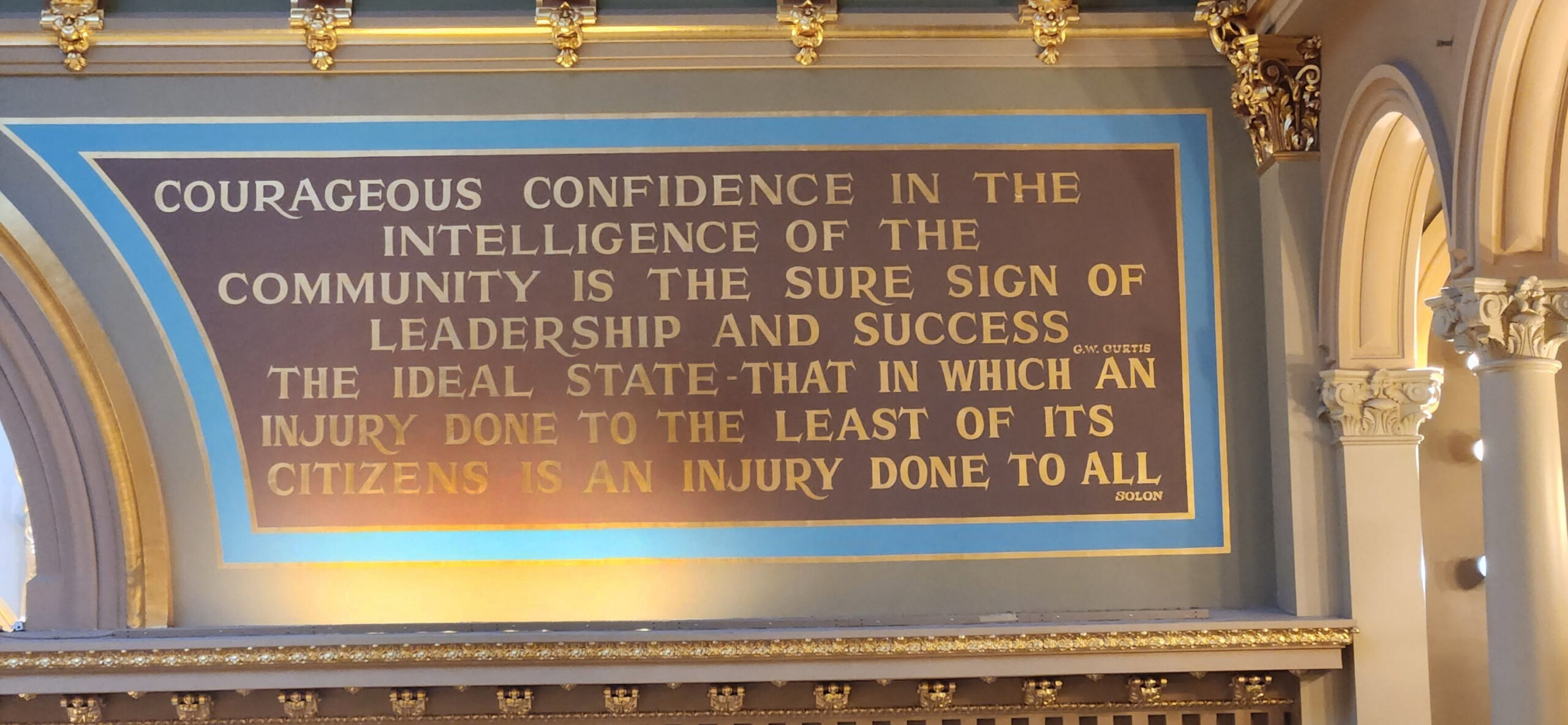
A promise written inside Iowa’s Capitol. Above the rotunda, a quotation attributed to Solon declares: “The ideal state—that in which an injury done to the least of its citizens is an injury done to all.” The inscription challenges every generation of Iowans to decide whether those words are merely decorative—or whether they still define the moral purpose of our state. Photograph by Sondra Wilson.
Those words are attributed to Solon. But they belong now to Iowa. They have watched legislators, governors, judges, advocates, schoolchildren, visitors, and generations of citizens pass beneath them.
We did not place them there. We inherited them.
The question is whether we still mean them.
Transgender Iowans are a small minority. That makes it easy for a political majority to decide that our medical care costs too much, our existence creates inconvenience, our civil-rights protections obstruct another political goal, or our suffering is an acceptable price for electoral advantage.
But the measure of a state is not how generously it treats the powerful, the popular, or the people whose lives the majority already understands. The measure is whether injury to the least protected person is recognized as an injury to the whole community.
My medically necessary surgery was expected to cost approximately $30,000. In the world of state budgets, litigation, election spending, and institutional administration, that is not an extraordinary amount. To the person whose body, health, and future depend upon it, it can mean everything.
We routinely move enormous sums through political campaigns and public institutions while telling some of Iowa’s poorest and most frequently harassed citizens that their essential care is an unreasonable burden. Money passes over their heads while they absorb the consequences of political messages spoken by people with the greatest power and public reach.
Governor Reynolds described Senate File 418 as protecting women and girls and as necessary to preserve other policies distinguishing people by sex. That is her stated justification. But the law also removed gender identity from Iowa’s civil-rights code, ending state protections upon which transgender Iowans had relied for nearly two decades. Both realities should be stated plainly so Iowans can judge them.
I ask my fellow Iowans to consider this not as an accusation shouted from outside our community, but as a moment of moral clarity spoken from within it—by one of those citizens the inscription calls “the least.”
I am speaking while injured. I am asking the majority to look directly at what its government has done and decide whether the promise written inside our Capitol applies to me too.
Jesus illustrated the same test through the Good Samaritan. The wounded traveler was not rescued by the religious authorities who saw him. The priest and the Levite passed by on the other side. The person who stopped was the outsider—the one willing to see an injured human being rather than a category, conflict, inconvenience, or doctrinal excuse.
The Samaritan did not first ask whether helping the injured person would be politically popular. He did not demand that the wounded man prove his social worth. He saw suffering, drew near, treated the wounds, carried the burden, and paid for the care.
That is the moral choice before Iowa.
We may preserve beautiful words above the Capitol rotunda while passing beneath them unchanged. We may describe the removal of civil rights as a “rollback,” the denial of medical care as a budgetary choice, and the abandonment of an injured minority as ordinary politics.
Or we may decide that the promise inherited from earlier Iowans still binds us:
An injury done to the least of Iowa’s citizens is an injury done to all.
I am not asking Iowa to abandon faith, law, fiscal responsibility, women, families, or judicial independence.
I am asking whether Iowa’s faith, laws, public resources, and institutions are large enough to include the wounded person lying beside the road.
Additional reforms will examine expanding early and virtual mediation so more complaints have an opportunity for voluntary resolution before they are administratively closed.
Related Policy
For my broader position on restoring durable civil-rights protections for transgender Iowans—including the relationship between statutory protections, administrative enforcement, healthcare, schools, and public institutions—read:
Detailed Policy Statement on Transgender-Related Public Topics →
Iowa Has Led the Nation Before
In 1868, Alexander Clark challenged racial segregation in Muscatine’s public schools and prevailed in Clark v. Board of School Directors, decades before Brown v. Board of Education. His case is part of Iowa’s civil-rights history and a reminder that Iowa has led the nation before.
We should aspire to that kind of leadership again—not only by declaring rights, but by building institutions capable of enforcing them.
Watch: The Alexander Clark story →
Conclusion
The Iowa Civil Rights Act is only as strong as the process used to enforce it. If Iowans bring evidence of discrimination, retaliation, or civil-rights violations to the State and are turned away without meaningful investigation, without access to the file, without enough time to appeal, and without consequences for deception, then the law exists more strongly on paper than in practice.
Iowa can fix this.
A fair civil-rights system strengthens Iowa’s workforce, protects vulnerable communities, and restores trust in government. We can strengthen civil-rights enforcement by requiring timely access to case files, giving complainants a meaningful appeal period, enforcing consequences against parties who knowingly deceive the Commission, extending protection to volunteers, interns, and contractors, and replacing at-will employment with a for-cause standard.
Civil rights should not depend on wealth, legal sophistication, or a person’s ability to survive procedural traps. The Iowa Civil Rights Act should protect Iowans in practice, not merely in theory.
Sources and Further Reading
Google Reviews for the Iowa Civil Rights Commission / Iowa Office of Civil Rights. Accessed Sept. 22, 2025. Public review scores can change and should be rechecked before publication.
Grundmeier, Lucas. “Iowa Should Stop Tilting the Scales in Civil Rights Cases.” Des Moines Register, May 14, 2023.
Iowa Administrative Code. Rule 161—3.50(2), as reflected in ARC 7312C, Civil Rights Commission [161].
Iowa Code. Chapter 216, “Civil Rights.”
Iowa Code. Section 714.8, “Fraudulent Practices Defined.”
Iowa Office of Civil Rights. “Iowa Civil Rights Act.”
Iowa Office of Civil Rights. “Outline of Complaint Process.”
Iowa Office of Civil Rights. “Right to Sue Letter FAQ.”
Tugade, F. Amanda. “Why 60% of Iowa Workers’ Civil Rights Complaints Aren’t Investigated; Why Process Is So Difficult.” Des Moines Register, May 8, 2023.