
Ida B. Wells-Barnett
National Whistleblower in a Nation Offtrack
A Timeline of Courage, Investigation, and Resistance
By Sondra Wilson | Updated September 28, 2026
Part of Wild Willpower’s America’s North Star Series — profiles of Americans whose lives helped illuminate the country’s path across different eras, cultures, and movements.

July 16, 1862:
Born Into Slavery in Holly Springs, Mississippi
Ida Bell Wells was born during the Civil War to James and Elizabeth Wells, both of whom had been enslaved. After emancipation, her parents became active participants in the opportunities opened during Reconstruction. Her father worked as a carpenter and was involved with the Freedmen’s Aid Society and Rust College; education became an important part of the Wells household.[1] She and her siblings studied at Asbury Methodist Episcopal Church, later known as Rust College, and even her mother attended school there to learn to read.
1878:
Yellow Fever Takes Her Parents and a Sibling
A yellow-fever epidemic struck Holly Springs when Wells was sixteen. Both of her parents and one of her siblings died. With five younger siblings still depending on her, Wells became a schoolteacher.[1]
This part of her life is easy to pass over, but it matters: Wells was confronting extraordinary responsibility long before she became a nationally known activist.
1884:
Wells Refuses to Leave a First-Class Railroad Car
While traveling on the Chesapeake, Ohio & Southwestern Railroad, Wells purchased a first-class ticket but was ordered out of the ladies’ car and told to move to another car. She refused. Railroad employees physically removed her.[1][2]
Her surviving testimony shows how deliberate that refusal was:
“Directly the conductor returned to me and said that I would have to go to the coach in front, that I was in the wrong car. That he had the rear car for white people alone, and that colored people must ride in the forward coach. To this I replied, that I would not ride in the forward car, that I had a seat and intended to keep it. He said to me that he would treat me like a lady, but that I must go into the other car, and I replied, that if he wished to treat me like a lady, he would leave me alone.
When we reached Fraziers, the first station, the train stopped and the conductor again came to me and said he would again ask me politely to go into the other car, and I refused to do so. He then took hold of me to carry me to the other car. I resisted him—holding on to my seat when he called for help, and two white passengers helped him to carry me out. I resisted all the time, and never consented to go.
My dress was torn in the struggle, one sleeve was almost torn off. Everybody in the car seemed to sympathize with the conductor, and were against me.”
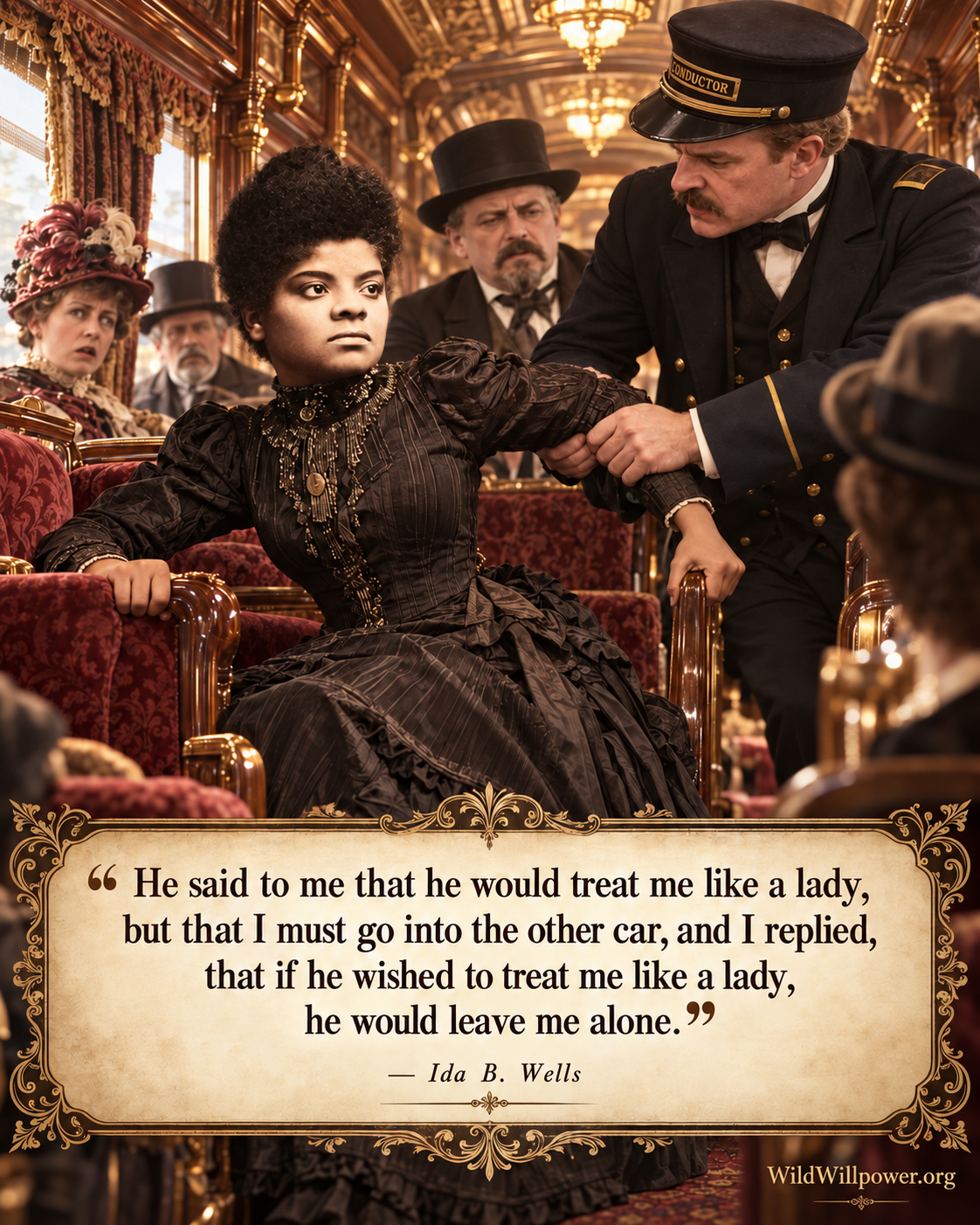
She sued the railroad and initially prevailed in the trial court, receiving damages. The Tennessee Supreme Court later reversed the judgment.[1]
This was seventy-one years before Rosa Parks became nationally known for refusing to surrender her seat under segregation.
Late 1880s:
"Iola" Becomes a Journalist
Wells’s journalism began while she was still teaching. She participated in a lyceum organized by Black teachers, whose meetings included readings from a local newspaper, the Evening Star. When its editor moved away, Wells took over his duties. She was subsequently invited to contribute to the religious newspaper Living Way, and an account she wrote about her railroad lawsuit was reprinted by newspapers beyond Memphis.
Her work soon circulated far beyond Memphis; Wells contributed to numerous Black newspapers around the country and, in 1889, was elected secretary of the National Press Association.
Writing under the pen name “Iola,” Wells increasingly addressed racial inequality and political conditions in the South. By 1889 she had become a co-owner and editor of the Memphis Free Speech and Headlight and was emerging as a prominent voice in the Black press.[1][3]
Her growing reputation eventually earned her the nickname “Princess of the Press.” [11]
1891:
Fired from Teaching after Criticizing Segregated Schools
While still working as a teacher in Memphis, Wells publicly criticized the inferior conditions imposed upon Black students. Her criticism cost her her teaching position, after which journalism became her principal occupation.[1]
1892:
The Year That Changed Wells's Life
March 1892:
Thomas Moss, Calvin McDowell, and Henry Stewart are Lynched
Wells’s friend Thomas Moss, along with Calvin McDowell and Henry Stewart, operated the People’s Grocery in Memphis. The successful Black-owned business competed with a nearby white-owned grocery.
Following escalating conflict surrounding the store, the three men were arrested. A white mob removed them from jail and lynched them before they could receive a trial.[1]
The murders transformed Wells’s work. Rather than accepting the explanations routinely published to justify lynching, she began investigating the claims for herself.[4]
Spring 1892:
Wells Investigates the Stories Used to Justify Lynching
Wells examined individual cases, newspaper reports, accusations, and available evidence. Her journalism challenged one of the most powerful narratives of the era: that lynching was principally an extrajudicial response to Black men sexually assaulting white women.
She found cases in which the publicly circulated accusation did not survive scrutiny. Her research increasingly showed that allegations of sexual violence were only one of several explanations offered for lynching—and that economic competition, political participation, resistance to racial subordination, and consensual interracial relationships could lie behind the violence.
That investigative method would become central to her life’s work.
May 1892:
Her Editorial Provokes Explicit Threats
After Wells published an editorial questioning prevailing claims about interracial relationships and alleged rape, white Memphis newspapers responded with extraordinarily violent rhetoric.
Four days later, on May 25, the Daily Commercial wrote:
“The fact that a black scoundrel [Ida B. Wells] is allowed to live and utter such loathsome and repulsive calumnies is a volume of evidence as to the wonderful patience of Southern Whites. But we've had enough of it.”
The Evening Scimitar went further:
“Patience under such circumstances is not a virtue. If the Negroes themselves do not apply the remedy without delay it will be the duty of those whom he has attacked to tie the wretch who utters these calumnies to a stake at the intersection of Main and Madison Sts., brand him in the forehead with a hot iron and perform upon him a surgical operation with a pair of tailor's shears.”
Soon afterward, a white mob ransacked the offices of the Free Speech and destroyed the building and its contents. Wells happened to be away from Memphis and was warned that returning could cost her life. She never again made Memphis her home.[1]
This was not merely criticism of a journalist. The publication itself was physically destroyed after the journalist challenged the prevailing account of racial violence.

Above: Historical reconstruction based on surviving accounts of the destruction of the Memphis Free Speech office in May 1892. Certain visual details are interpretive where the historical record is incomplete.
1892:
Wells Refuses to Be Silenced
Forced from Memphis, Wells continued writing from the North and expanded her investigation.
The destruction of her newspaper did not end the investigation. It widened it.
Her work increasingly treated lynching not as a collection of isolated atrocities but as a system that could be studied, documented, compared, and exposed.
October 5, 1892:
Wells Speaks at Lyric Hall in New York
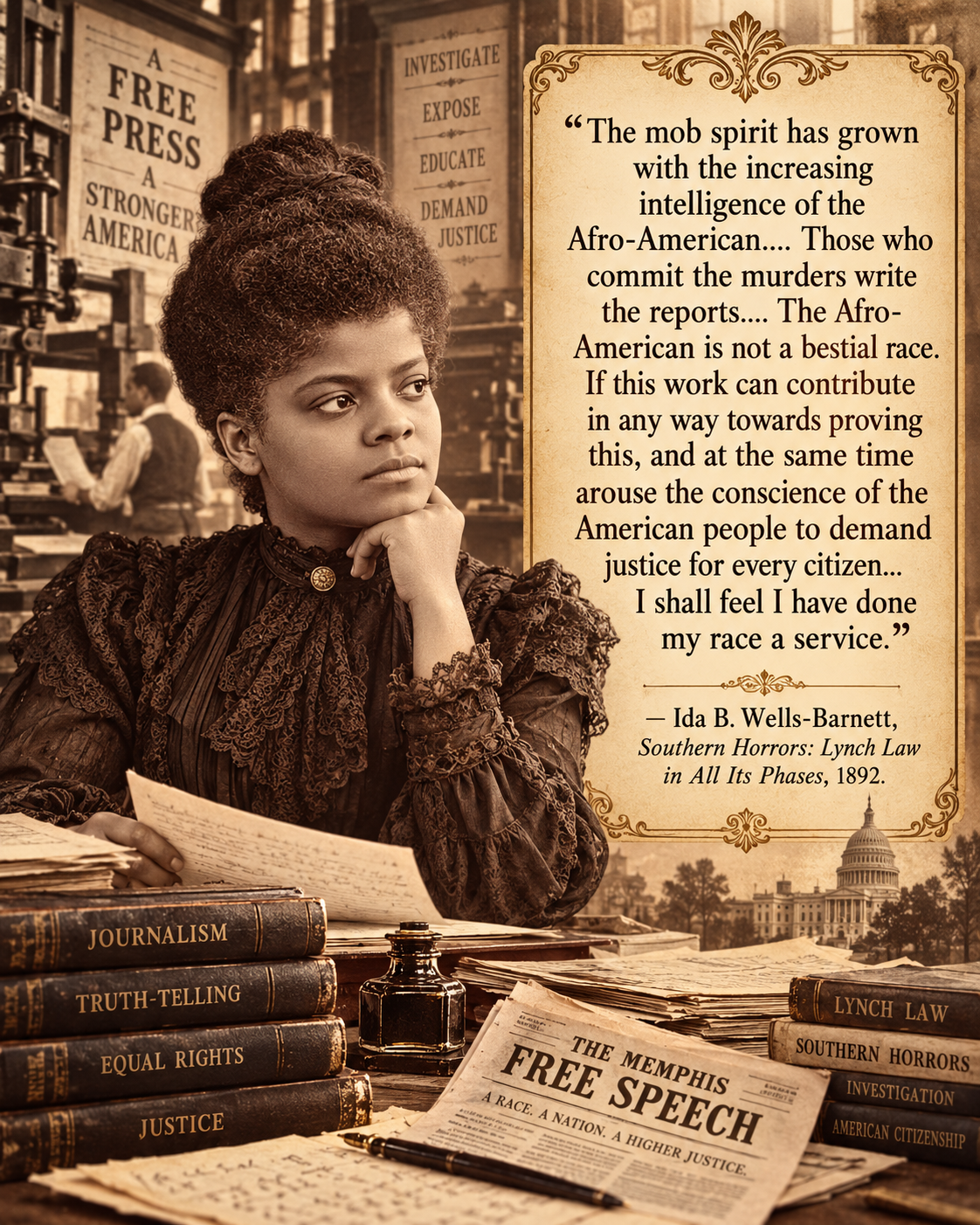
After months of investigation, Wells addressed a gathering of Black women at Lyric Hall in New York City. The event helped finance publication of her first major anti-lynching pamphlet, Southern Horrors: Lynch Law in All Its Phases.[5]
1892:
Southern Horrors is Published
In Southern Horrors, Wells brought together reports, cases, arguments, and her analysis of the rationales offered for lynching.[5]
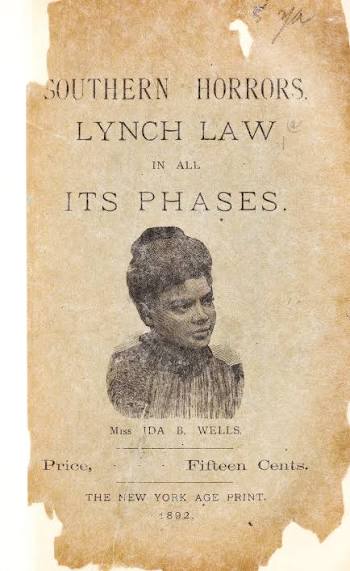
One passage captures perhaps the central problem she identified:
“The mob spirit has grown with the increasing intelligence of the Afro-American....
Those who commit the murders write the reports....
The Afro-American is not a bestial race. If this work can contribute in any way towards proving this, and at the same time arouse the conscience of the American people to demand justice for every citizen, and punishment by law for the lawless, I shall feel I have done my race a service. Other considerations are of minor importance.”
That sentence is worth lingering over. Wells was identifying an information problem as well as a violence problem: the people or communities responsible for violence could also exercise tremendous influence over how the violence was described to everyone else.
She therefore treated documentation itself as a form of resistance.
1893-1894:
Wells Takes the Anti-Lynching Campaign Overseas
Wells traveled through Britain, speaking publicly about lynching in the United States and challenging American representations of racial violence abroad. Her international campaign helped generate anti-lynching activism in Britain, including the formation of an anti-lynching committee in London.[3][6]
Her strategy was remarkable for the period: when institutions inside the United States failed to act, she brought American racial violence before an international audience.
1895:
A Red Record Turns Individual Atrocities into Documented Evidence
Wells published A Red Record: Tabulated Statistics and Alleged Causes of Lynchings in the United States.
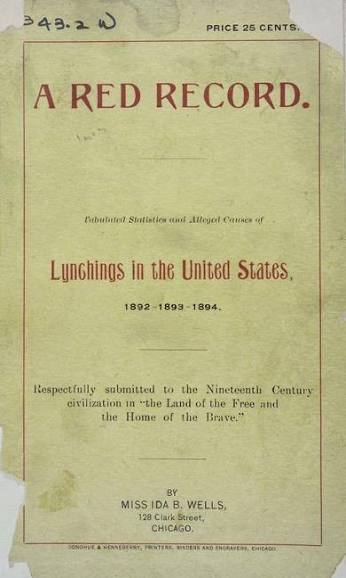
Rather than relying only on moral condemnation, she compiled reports and statistics concerning lynchings in 1892, 1893, and 1894 and examined the alleged reasons given for them.[7]
Her evidence also challenged the idea that lynching was simply punishment for crime, documenting how racial violence operated alongside struggles over economic, social, and political power.
Wells paired statistics with specific incidents involving denial of legal process, arbitrary targeting, and the killing of people whose supposed crimes had never been established in court.
That makes A Red Record something more than an activist pamphlet.
It is an early example of investigative civil-rights data journalism.
June 27, 1895:
Marries Ferdinand L. Barnett
Wells married Chicago attorney, journalist, and newspaper publisher Ferdinand Barnett. She became known as Ida B. Wells-Barnett, though she continued using Wells professionally and remained independently active as a journalist, organizer, and lecturer.[1][3]
They eventually had four children.
1896:
Organizing Black Women Nationally
Wells participated in the rapidly developing Black women’s club movement and helped organize institutions through which Black women could pursue civil rights, women’s rights, education, and political participation.[1][3]
Her activism increasingly demonstrated something that later civil-rights movements would make unmistakable: racial equality, women’s political rights, economic opportunity, and protection from violence could not easily be separated from one another.
1898:
Takes the Anti-Lynching Campaign to the White House
Wells brought her campaign directly to the federal government and appealed to President William McKinley for federal action against lynching.[1]
The appeal reflected a recurring problem she confronted throughout her life: local authorities could be unwilling or unable to protect Black citizens, while the federal government frequently declined to intervene.
1899:
Wells Tells the Nation to "Consider the Facts"
While investigating lynchings in Georgia, Wells described how Black citizens in Chicago employed a detective to investigate what had actually happened. She compared the resulting findings with accounts published in the Southern press and submitted the evidence to the judgment of the public.
Her conclusion would become a fitting statement of the method that defined much of her career:
“Truth is mighty and will prevail.”[10]
1900:
"Lynch Law in America"
By the turn of the century, Wells was explicitly describing lynching as the replacement of legal process by an unofficial system of accusation and punishment.
She wrote:
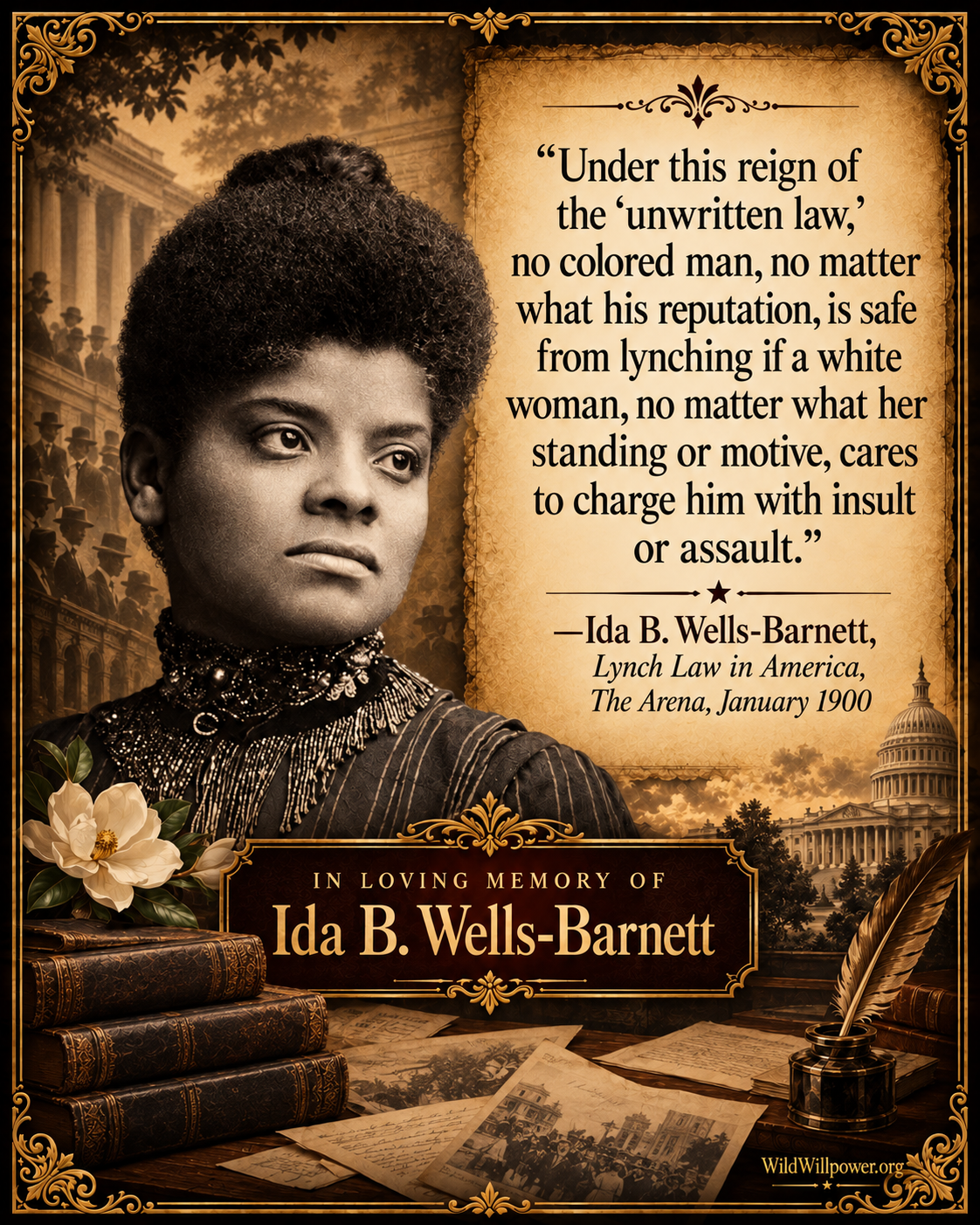
“Again the aid of the ‘unwritten law’ is invoked, and again it comes to the rescue. During the last ten years a new statute has been added to the ‘unwritten law.’ This statute proclaims that for certain crimes or alleged crimes no negro shall be allowed a trial; that no white woman shall be compelled to charge an assault under oath or to submit any such charge to the investigation of a court of law. The result is that many men have been put to death whose innocence was afterward established; and to-day, under this reign of the ‘unwritten law,’ no colored man, no matter what his reputation, is safe from lynching if a white woman, no matter what her standing or motive, cares to charge him with insult or assault.”
Her argument was not simply that lynching was cruel. It was also:
Accusation is not proof.
Punishment without investigation is not justice.
1900:
Wells Condemns Nation's Failure to Act
Wells’s indictment eventually extended far beyond the mobs themselves. For years she had investigated lynchings, appealed to public opinion, carried the issue overseas, organized anti-lynching efforts, and even taken her case to the White House. Yet she watched many of the nation’s churches, moral reformers, civic leaders, and philanthropic institutions remain conspicuously silent. What disturbed her was not simply that help had failed to arrive: America had repeatedly demonstrated its willingness to condemn injustice elsewhere in the world while tolerating mob violence at home.
Wells made that contrast explicit. She pointed to the nation’s outspoken concern for the “Armenian Christian, the Russian Jew, the Irish Home Ruler, the native women of India, the Siberian exile, and the Cuban patriot,” then asked why the United States would not confront injustice within its own borders. Her criticism was not of those humanitarian causes, but of a national moral conscience capable of mobilizing for suffering elsewhere while remaining conspicuously quiet about lynching at home. [12]
Near the conclusion of Lynch Law in America, she wrote:
“Although lynchings have steadily increased in number and barbarity during the last twenty years, there has been no single effort put forth by the many moral and philanthropic forces of the country to put a stop to this wholesale slaughter. Indeed, the silence and seeming condonation grow more marked as the years go by.”
— Ida B. Wells-Barnett, Lynch Law in America, January 1900 [12]
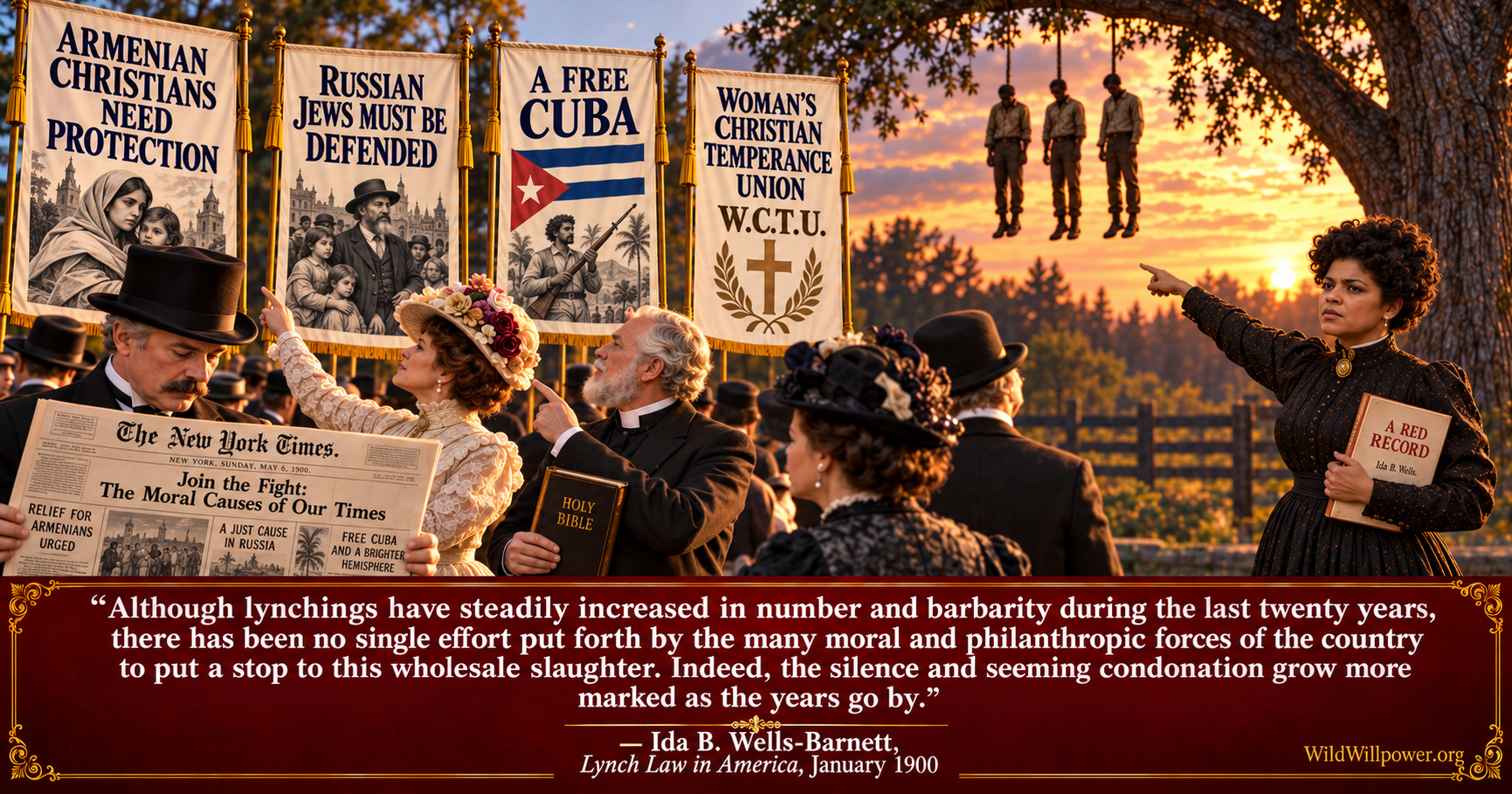
For Wells, silence was not neutral. When institutions possessing moral authority refused to challenge an injustice occurring in public view, their silence helped permit it to continue.
1900:
Wells Fights an Effort to Segregate Chicago Schools
When the Chicago Tribune published a series of articles promoting separate schools for Black and white children, Wells objected that the people most directly affected—Black Chicagoans—were not being heard. She sought a meeting with the paper, confronted its arguments directly, and enlisted allies including social reformer Jane Addams to oppose the effort.
While discussing what could be done, Wells expressed a principle that characterized much of her life’s work:
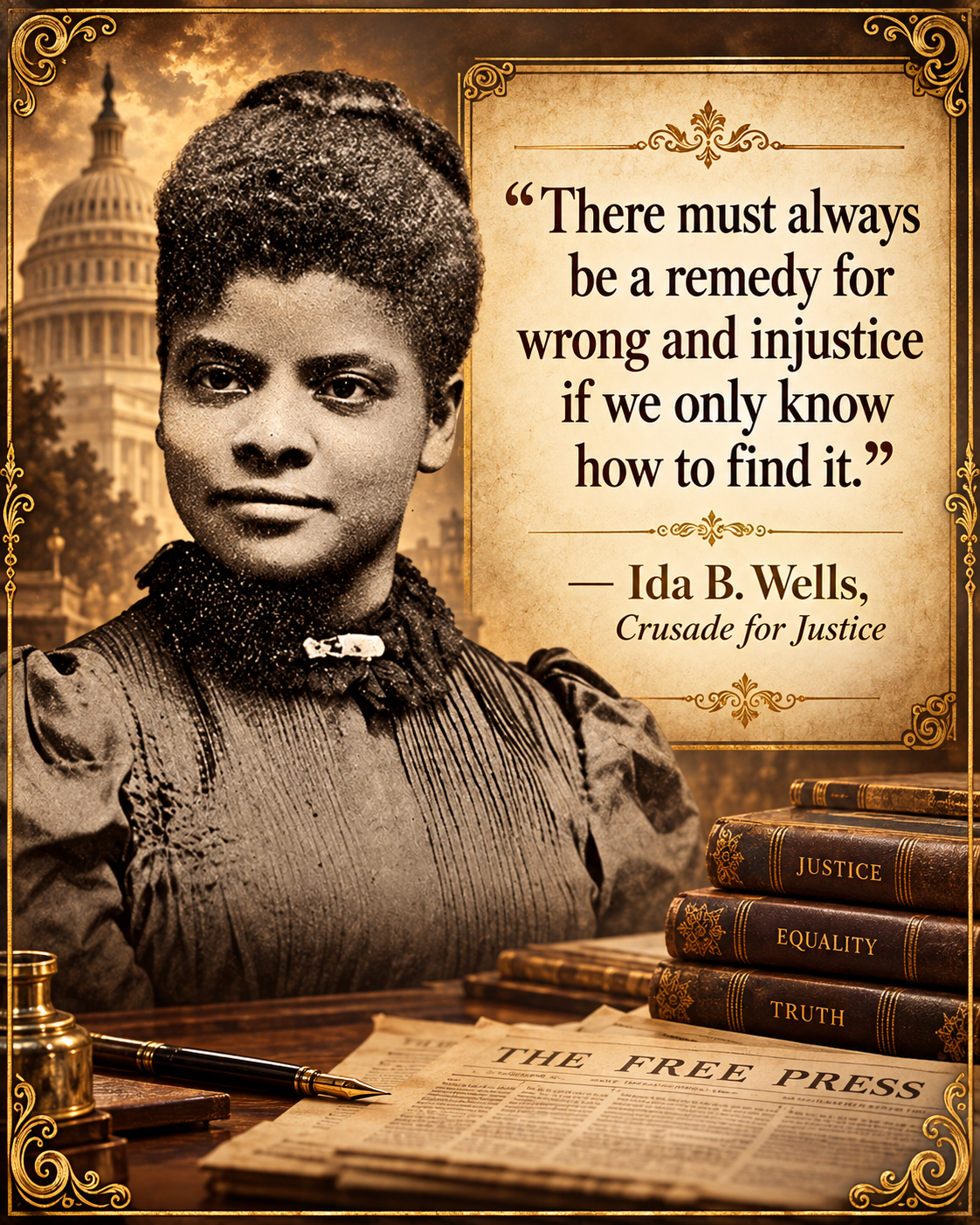
“There must always be a remedy for wrong and injustice if we only know how to find it.”
— Ida B. Wells, Crusade for Justice [13]
1908-1909:
Springfield Violence and the Movement That Becomes the NAACP
After deadly racial violence in Springfield, Illinois, civil-rights advocates organized a national response. Wells participated in the 1909 conference associated with the organization that became the National Association for the Advancement of Colored People.[1]
She is commonly recognized as one of the NAACP’s founders, although her relationship with the young organization soon became strained because she believed it was not sufficiently oriented toward direct action.[1]
The organization would eventually become one of the central institutions of the twentieth-century American civil-rights movement.
1910:
Wells Connects Voting Rights to the Protection of Human Life
For Wells, disenfranchisement was not merely about exclusion from elections. She argued that when a population was stripped of political power, those responsible for violence against it had less reason to fear electoral, legal, or official accountability.
She wrote:
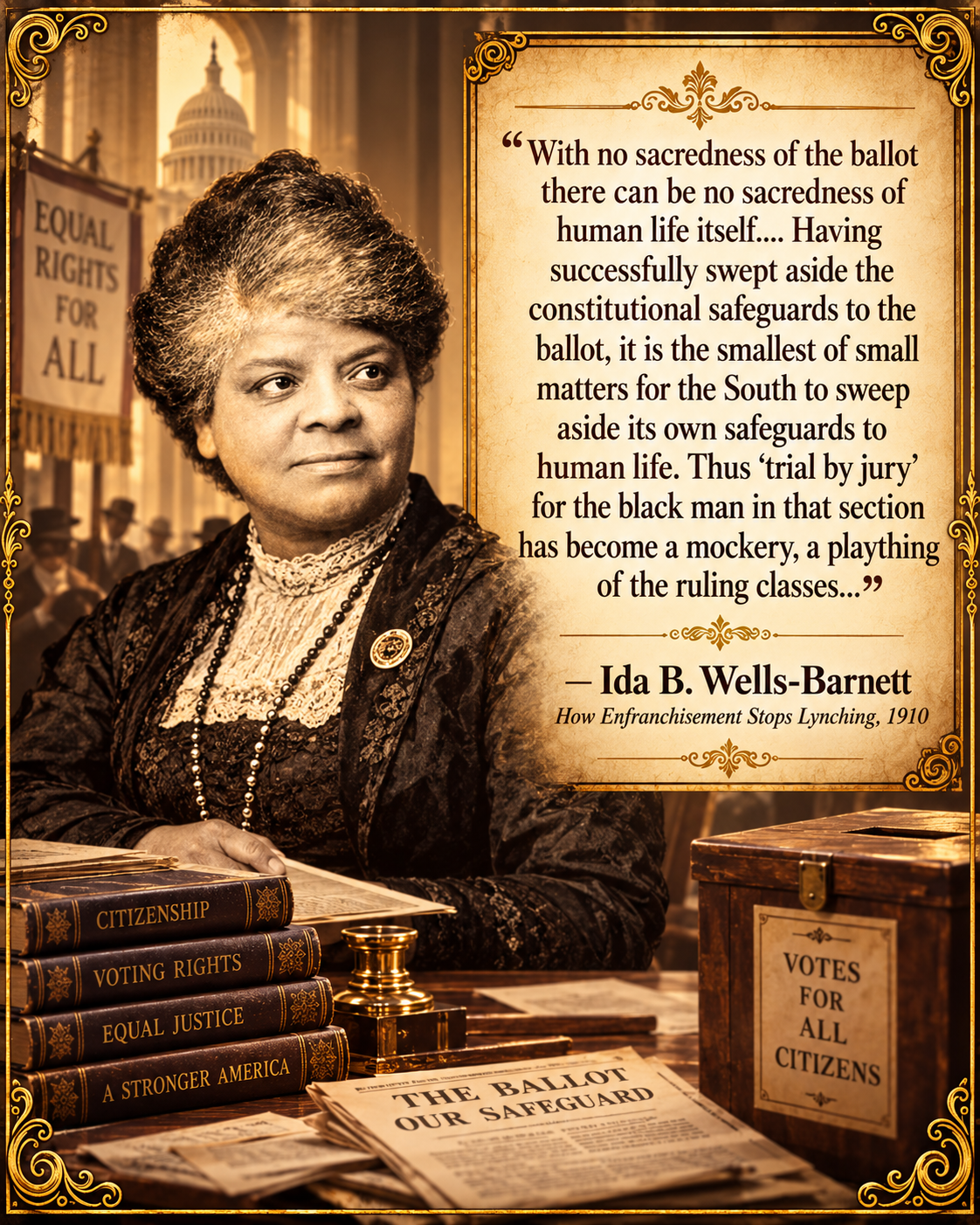
“With no sacredness of the ballot there can be no sacredness of human life itself.... Having successfully swept aside the constitutional safeguards to the ballot, it is the smallest of small matters for the South to sweep aside its own safeguards to human life. Thus ‘trial by jury’ for the black man in that section has become a mockery, a plaything of the ruling classes...”
— Ida B. Wells-Barnett, How Enfranchisement Stops Lynching, 1910 [14]
January 1913:
Helps Establish the Alpha Suffrage Club
Wells founded Chicago’s Alpha Suffrage Club, one of the first organizations in Chicago centered specifically on securing political power and voting rights for Black women.[8]
The organization put into practice an argument Wells had already made explicitly: political power and physical safety were inseparable.
March 3, 1913:
Refuses Segregation at the National Suffrage Procession
Thousands of women gathered in Washington, D.C., for the Woman Suffrage Procession on the eve of Woodrow Wilson’s inauguration.[9]
Black women faced pressure to march separately from white delegations.
Wells refused.
Rather than accepting placement at the rear, she waited along the parade route and stepped into the Illinois delegation as it passed, marching alongside the white women from her state.[8]
Nearly thirty years after being physically removed from a railroad car, Wells was still refusing instructions that required her to accept segregation.
That parallel deserves to be visible in any timeline of her life.
1910s-1920s:
Continues Organizing, Writing, and Challenging Discrimination
Wells remained involved in women’s suffrage, racial justice, political organizing, and community affairs in Chicago. Her independence sometimes placed her at odds not only with white institutions but also with established Black civil-rights organizations.
She was never simply the representative of one movement or institution.
1930:
Runs for the Illinois State Senate
At approximately sixty-eight years old, Wells ran for a seat in the Illinois State Senate.[3]
She did not win, but the campaign was a fitting late chapter in a life spent insisting that people denied political power should seek and exercise it themselves.
March 25, 1931:
Ida B. Wells-Barnett Dies in Chicago
Wells died in Chicago at age sixty-eight.[1]
She had lived long enough to see anti-lynching activism become a national movement, but not long enough to see lynching comprehensively outlawed by federal statute or the major victories of the mid-twentieth-century Civil Rights Movement.
The institutional and investigative methods she helped develop, however, lived on.
The Pattern Across Her Life
Seen chronologically, Wells’s life reveals something that a conventional list of accomplishments can obscure:
1884: She experiences discrimination → refuses compliance → goes to court.
1891: She documents inequality in education → loses her teaching job.
1892: Her friends are lynched → she investigates the public explanation.
1892: She publishes what she finds → receives threats → her newspaper is destroyed.
1892 onward: She continues investigating anyway.
1895: She begins systematically tabulating the evidence.
1898: She takes that evidence to the federal government.
1900: She condemns institutional silence → insists that injustice must have a remedy.
1910: She connects disenfranchisement → weakened legal protection → danger to human life.
1913: She is told to accept segregation again → refuses again.
The connective tissue is not simply that Ida B. Wells was “an activist.”
It is that she repeatedly encountered systems that demanded acquiescence, examined how those systems justified themselves, documented the contradictions, and then made the evidence public.
In 1899, while documenting a series of Georgia lynchings, Wells described how Black citizens in Chicago hired a detective to investigate what had actually happened. She placed the accounts published by Southern newspapers alongside the findings of that investigation and challenged the country to examine the evidence for itself.
And so it is fitting to return to Wells’s own challenge to the nation: consider the facts.
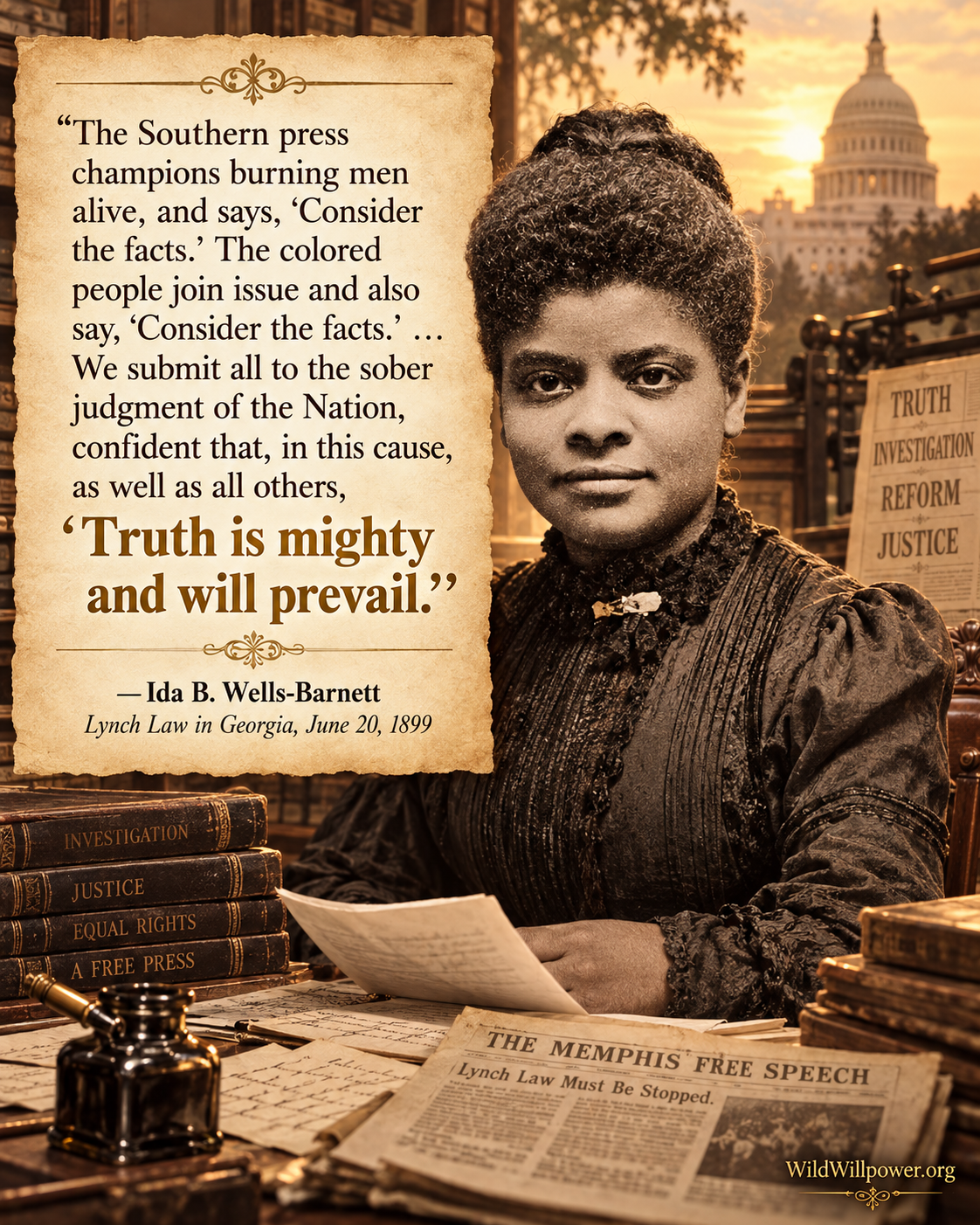
“The Southern press champions burning men alive, and says, ‘Consider the facts.’ The colored people join issue and also say, ‘Consider the facts.’ The colored people of Chicago employed a detective to go to Georgia, and his report in this pamphlet gives the facts. We give here the details of the lynching as they were reported in the Southern papers, then follows the report of the true facts as to the cause of the lynchings, as learned by the investigation. We submit all to the sober judgment of the Nation, confident that, in this cause, as well as all others,
‘Truth is mighty and will prevail.’”[10]
— Ida B. Wells-Barnett, Lynch Law in Georgia, June 20, 1899
Explore more profiles in Wild Willpower’s America’s North Star Series.
Endnotes
[1] National Park Service, “Ida B. Wells.” NPS records Wells’s July 16, 1862 birth; childhood in Holly Springs; loss of her parents during the 1878 yellow-fever epidemic; teaching career; 1884 railroad confrontation and lawsuit; journalism; 1892 anti-lynching investigation and destruction of her newspaper office; 1898 White House campaign; NAACP involvement; suffrage activism; and March 25, 1931 death.
[2] Wells’s surviving testimony concerning the railroad confrontation describes her ticket, her refusal to move, the conductor’s attempt to remove her, assistance from other passengers, her torn clothing, and her continued refusal to enter the other coach. The testimony is reproduced in Her Story Can Change the World.
[3] National Women’s History Museum, “Ida B. Wells-Barnett.” The museum documents Wells’s early journalism under the name “Iola,” her work with the Free Speech, the People’s Grocery lynching, her anti-lynching investigations, international speaking tours, marriage to Ferdinand Barnett, suffrage organizing, and later political campaigns.
[4] National Park Service, “Ida B. Wells,” discussing the lynching of Thomas Moss, Calvin McDowell, and Henry Stewart following conflict surrounding the People’s Grocery and Wells’s subsequent investigation of lynching.
[5] New York Public Library, Schomburg Center for Research in Black Culture, Southern Horrors: Lynch Law in All Its Phases. NYPL records Wells’s October 5, 1892 Lyric Hall address, her months of investigation, destruction of her newspaper office, and publication of Southern Horrors shortly afterward.
[6] Library of Congress, “Ida B. Wells: Topics in Chronicling America.” LOC’s chronology identifies Wells’s 1893–1894 European speaking campaign and her continuing newspaper work concerning racial discrimination and lynching.
[7] Library of Congress, Geographical Data from Ida B. Wells’ Tabulated Statistics of Lynchings in 1893 and 1894, describing the source text of A Red Record: Tabulated Statistics and Alleged Causes of Lynchings in the United States, 1892–1893–1894, published in 1895.
[8] National Park Service, “A Noble Endeavor: Ida B. Wells-Barnett and Suffrage.” NPS documents Wells’s creation of the Alpha Suffrage Club and her participation in the March 3, 1913 suffrage procession after objections to integrated marching.
[9] Library of Congress, official program and historical materials for the Woman Suffrage Procession, Washington, D.C., March 3, 1913. LOC estimates that roughly 5,000–8,000 marchers participated in the national demonstration.
[10] Ida B. Wells-Barnett, Lynch Law in Georgia: A Six-Weeks’ Record in the Center of Southern Civilization, as Faithfully Chronicled by the “Atlanta Journal” and the “Atlanta Constitution”, Chicago, June 20, 1899. Wells explains that Black citizens of Chicago employed a detective to investigate the Georgia lynchings, compares the resulting findings with accounts published in Southern newspapers, and submits both to “the sober judgment of the Nation.” Library of Congress, African American Perspectives Collection.
[11] Library of Congress, Newspaper Journalism Primary Source Set, identifying an 1889 newspaper article stating, “Miss Ida B. Wells (Iola) has been called the ‘Princess of the Press…’” See also National Women’s History Museum, “Ida B. Wells-Barnett,” noting that Wells’s journalism earned her national recognition and the nicknames “Princess of the Press” and “The Brilliant Iola.”
[12] Ida B. Wells-Barnett, “Lynch Law in America,” The Arena, January 1900. This source contains both the “unwritten law” passage and Wells’s statement that “there has been no single effort put forth by the many moral and philanthropic forces of the country to put a stop to this wholesale slaughter.”
[13] Ida B. Wells, Crusade for Justice: The Autobiography of Ida B. Wells, discussing her opposition to efforts to promote segregated schools in Chicago and her statement, “There must always be a remedy for wrong and injustice if we only know how to find it.” See also WTTW Chicago, “Remedy for Injustice: How Ida B. Wells Fought for Equal Education.”
[14] Ida B. Wells-Barnett, “How Enfranchisement Stops Lynching,” 1910, arguing that disenfranchisement weakened legal and political protections and stating, “With no sacredness of the ballot there can be no sacredness of human life itself.”
[15] Historical Images, Reconstructions, and AI-Assisted Artwork. This page includes a combination of historical photographs and AI-assisted visual reconstructions created with OpenAI’s ChatGPT image-generation tools. AI-assisted images are used for educational, historical, and expressive purposes to help modern audiences visualize documented events and preserve the memory of Ida B. Wells-Barnett’s life and work. They should not be understood as authentic photographs of reconstructed events. Where possible, visual depictions were informed by primary-source writings, surviving photographs, period clothing, architecture, transportation, printing technology, and other historical references. Because the surviving record does not preserve every visual detail of these events, some elements are necessarily interpretive. Quotations appearing within the graphics are identified by source elsewhere on this page or in the accompanying endnotes.