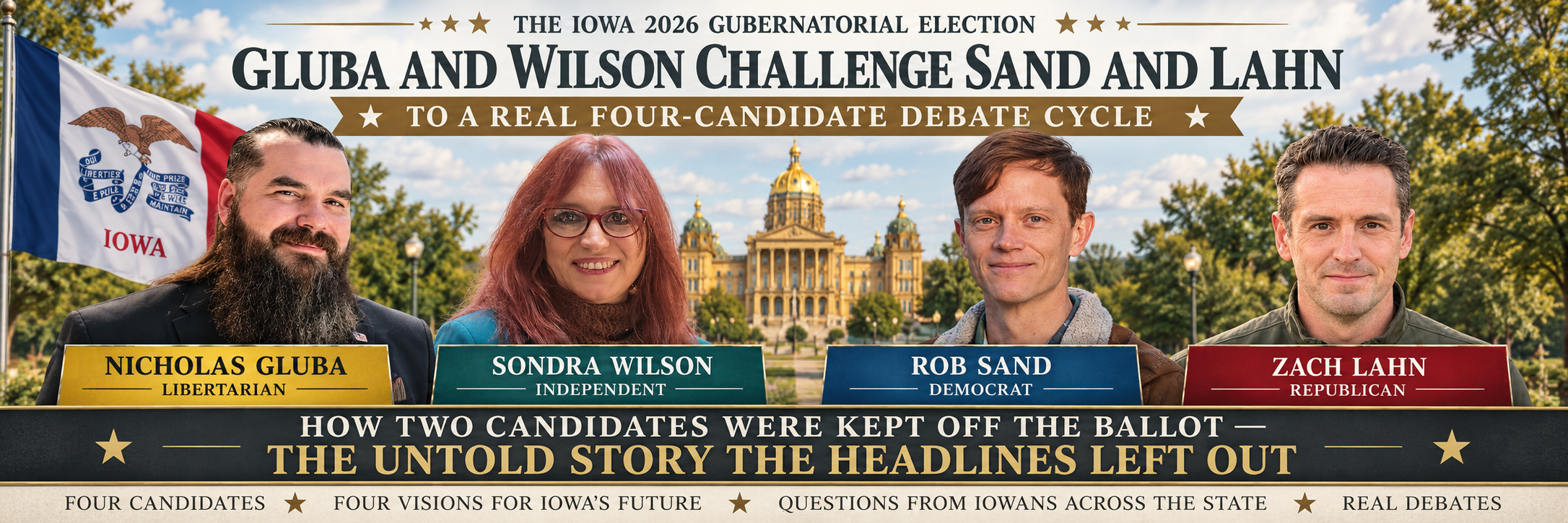
Sondra Wilson
Independent Candidate for Iowa Governor
"Heal the Heartland; Heal the World"
Updated August 22, 2026
Hello! My name is Sondra Wilson. I am an independent candidate for Iowa Governor from Nevada, Iowa, and the founder of Wild Willpower.
My campaign is built around a four-pillar plan for infrastructure and economic development, education, healthcare, and justice reform—a long-term Full System Upgrade for Iowa.
This campaign was not built around political theater. It grew from lived experience, years of research, public-interest work, survival, and an effort to develop practical reforms. I believe Iowa can become a state where ordinary people understand their rights, public officials are accountable, healthcare is treated as a public necessity, communities have the infrastructure they need to thrive, and innovation is used to reduce unnecessary hardship.
I Am Currently in the Iowa Supreme Court
Seeking Relief Because My Campaign Was Derailed By Outside Actors
I was not defeated by voters.
I was kept off the ballot before voters had the opportunity to decide.
During Iowa's 2026 signature-gathering period, litigation arising from an earlier civil-rights dispute repeatedly consumed time that otherwise would have been available for petition circulation and campaign outreach. I sought additional time before Iowa's June 2 deadline expired, after the Secretary of State's Office told me that any different deadline would require a court order.
That became Wilson v. Pate, which is now before the Iowa Supreme Court. The underlying events that generated those litigation burdens are documented separately in Record Retaliation.
Read My Four-Pillar Platform for Iowa
Follow Wilson v. Pate — My Ballot-Access Case
Read Record Retaliation — The Underlying Story
My backstory below is still unfinished. I will return to complete it when time permits; for now, my attention is focused on the pending court proceedings and the articles documenting the events currently affecting my campaign.
My Backstory
I am from Nevada, Iowa, and graduated as Class President in 2000. My life since then has included periods of travel, homelessness, political organizing, wilderness education, writing, civil-rights advocacy, and experiences that eventually shaped both Wild Willpower and my campaign for Iowa Governor.
This section is still being written. The portions below currently focus on several formative events that later became relevant to my civil-rights work and litigation. I will return to complete the missing years and transitions when time permits.
In 2010 I began developing Wild Willpower PAC as a 501(c)3 nonprofit, but eventually began re-organizing it as a new type of political action committee called a civil PAC. The goal was to perform publicly -beneficial political activities, and to fund grassroots efforts made by regular citizens to help promote sustainable living and human rights, while also assisting Native American teachers around the country to broadcast traditional wild living skills ethnobotanical skills passed down through their tribes.
This work was inspired by U.S. Army Veteran and wilderness survival skills instructor Richard Lonewolf, who taught these skills to military units, college and university students, Boy Scouts of America (now recognized as Scouting America), and many others throughout most of his adult career. View his credentials or a recent endorsement letter. In 2017 we finished writing an extensive publication which took years to produce, More Valuable Than Gold.
and begun developing my political and public-interest work, accusations and disputed materials entered an Iowa civil-rights record following my complaint against Reliable Street Inc., Lockwood Café, and related parties. I contend that the resulting record threatened my reputation and political work and ultimately forced me into years of litigation to obtain evidence, challenge the allegations, and clear my name.
That underlying history is now documented in a a series that tracks and separately in Record Retaliation — Wilson v. Reliable Street Inc., et al., Case One in this series.
This article does not repeat that factual record.
Instead, Election Interference begins with its consequence: by 2026, the litigation arising from those earlier events was still generating mandatory filings, hearings, discovery disputes, briefing obligations, and other court-imposed work during the same narrow period in which Iowa required me to gather thousands of signatures for ballot access.
I sought additional time before the June 2 deadline expired.
What followed became another litigation battle.
The district court first denied relief because I had not identified sufficient legal authority. After I supplied additional authority and sought leave to amend, the court reached a different ground and characterized the underlying litigation burden as arising from litigation I had chosen to initiate. I then submitted additional materials explaining why I disputed that characterization. The case eventually reached the Iowa Supreme Court, where threshold disputes over appellate timeliness and mootness overtook the underlying ballot-access question. The appeal was dismissed on August 12 as untimely, and I have now moved to set that dismissal aside and reinstate the appeal.
The underlying ballot-access dispute still has not been adjudicated on its merits.
Election Interference therefore asks a different question from Political Sabotage:
What happens when the legal process required to address earlier political and reputational harm consumes the limited election period—and the process of seeking relief consumes still more of it?
This article presents the filings in chronological order, then explains why I contend the cumulative effect amounted to election interference.
First off, thank you for taking the time to read this important article which—above all else—speaks to the lack of integrity in Iowa elections, administrations, and once-renown judiciary. If you care about the integrity of our state and the wellbeing of future generations—if you want real solutions—not just critique—I urge you to read this series in its entirety. I could speak for a very long time about the lack of integrity and corruption I have witnessed firsthand, however the full series performs a much better job of providing real documentation that allows the record to speak for itself.
Before we begin, please let me share a bit about myself. My name is Sondra Wilson. I'm 44 years old and grew up in Nevada, Iowa. After graduating high school in 2000—long before the so-called culture wars that dominated these past few election cycles—I sought medical care for a condition I had which I had no explanation or context for when I was young: I was intersex.
Although born a boy, during puberty I developed secondary sexual characteristics typical of females, including breasts and other physiological traits that didn't neatly fit me into the "male" or "female" categories. This happened without medical intervention. Thus, it was either natural or, perhaps, caused by chemical interference I might never become aware of.
Being raised in a Christian (Methodist) household, I was taught—not by my parents or church, but rather, through interactions with other Christians of various denominations, that homosexuality was sinful and thus morally wrong. The story of Sodom and Gomorrah, or the verses condemning homosexuality, as found in Book of Leviticus, were commonly cited back in the 80s and 90s, by Christian peers of various denominations.
“‘Do not have sexual relations with a man as one does with a woman; that is detestable." (18:22)
“‘If a man has sexual relations with a man as one does with a woman, both of them have done what is detestable. They are to be put to death; their blood will be on their own heads." (20:13)
Slurs such as fag or faggot or, or the derogatory use of the term gay, were common at the time as well. Being raised among boys in that era, I used the terms myself in the same derogatory way. Not with intentional malice, but rather, because it was common jargon. Comedians and sitcoms of the era exacerbated this problem by making slurs appear humorous. Like others, I participated in these types of "jokes" without realizing the harm I was causing, and without letting on that I was increasingly coping with my own sexuality. Talking about it with anyone was out of the question, and as the thoughts continued, it became a hidden part of my life I tried to suppress. But, just as a caterpillar cannot stop its natural state from spinning itself into a cocoon or chrysalis, I was unable to stop what was happening to me mentally, emotionally, and physiologically.
Thus, as I entered into middle and then high school, I felt deep shame about my body and my thoughts. I hid them both, wearing tight shirts with loose shirts over the top, while working out regularly in hopes my breasts would go away. Music and art became the focus of my life: painting, drawing, and listening to a wide variety of music superseded my focus on school, essentially becoming one of the most important parts of my life: the parts that brought me joy. That is the backdrop for the major turning point about to come.
September 11, 2001
The attacks on September 11th were a major wakeup call to me, but not int he way most people might think. I was awakened by my friends and roommates, who were severely alarmed, "Planes just flew into the Twin Towers in New York! It's all over the news!!" We went into the living room, affixed to the television as the news unfolded.
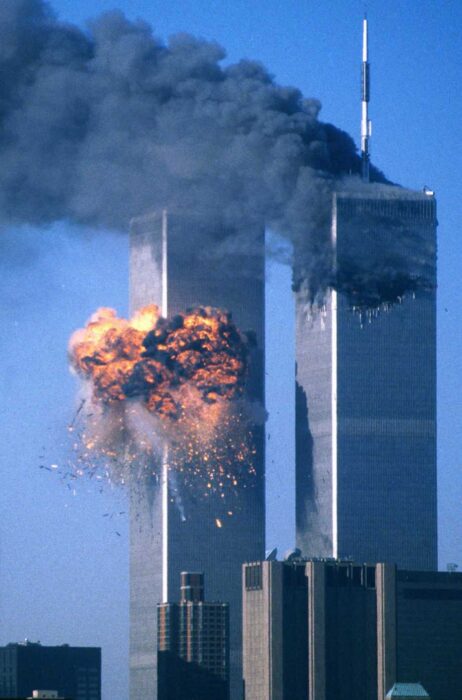
The World Trade Center burns during the September 11, 2001 terrorist attacks in New York City, moments after the second hijacked airplane struck the South Tower. The attacks killed nearly 3,000 people and profoundly changed American life. [1]
As news unfolded, we also learned about the third plane that struck the Pentagon, and the fourth plane, that struck down in Stonycreek Township, Pennsylvania, after passengers banded together and fought against the terrorists, preventing it from striking its target, the U.S. Capitol.
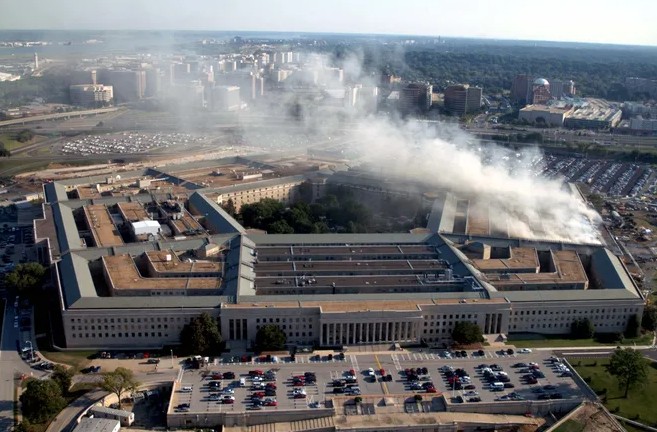
Smoke rises from the Pentagon in Arlington, Virginia, after hijacked American Airlines Flight 77 struck the building during the September 11, 2001 terrorist attacks. [2]
I was young, and perhaps naive about the world, but when President Bush stood at Ground Zero days after the attacks, and called for revenge, I became morally torn. Reconciling between my Christian faith, and the teachings of Jesus to "turn the other cheek", turned this situation into a moral dilemma. Why did they attack? What's going on? Aren't we even going to try to extend an olive branch and make peace?
The songs I listened to during that part of my life, which had deeply impacted me, left me feeling like our nation could do more—that we could at least try for peace before resorting to revenge. Songs such Imagine and Give Peace a Chance by John Lennon, Masters of War and The Times They Are A-Changin' by Bob Dylan, For What It's Worth by Buffalo Springfield, Vietnam Song by Country Joe & the Fish, Aquarius by The Fifth Dimension, and 7 O' Clock News by Simon & Garfunkel are just a few songs that had a profound influence on me. There is a story of what happened to me while listening to the song Perfect Sense by Roger Waters around this time, but I do not wish to digress from the purpose of this article.
It was around this time that I learned that transgender people exist, and that medical care was available. And so again, I felt divided: on one hand, I deeply wanted to seek medical care while I was young enough to have good results, but on the other hand, medically transitioning was in direct opposition to what I believed to be part of the Christian faith.
And it was around this time that I had a deeply transformative spiritual experience in the wilderness just outside of Nevada, Iowa, that changed the trajectory of my life. Although I did not understand that it was essentially an unguided shamanic awakening, later in life, as I learned more about and reflected upon what happened, that is now what I believe it was. For me, I experienced the most powerful connection with God and the Holy Spirit that I had ever felt, but to the outside world, when I described what happened, my experience was dismissed as "a psychotic episode" or a hallucination. I was, however, sober, and I know what happened. When I left the woods, I certainly looked crazy to the outside world. In fact, immediately afterward I was admitted to the psyche ward, but upon my release, I began preparing for what I needed to do.
After becoming estranged from the world following the social stigma put onto me by my diagnosis, I gave away my possessions, bought a guitar off e-bay, and began hitchhiking the country on a quest to learn how to live in the wilderness, while writing songs for world peace along the way. Again, I'm skipping over a lot of content, but those parts will need to be written another day.
Hitchhiking the country—for me—felt like letting a fly out of a jar
began developing Wild Willpower in 2010
The events documented in Intersex in Iowa began in 2006, long before my current campaign and long before Wilson v. Pate. They later became part of Wilson v. State of Iowa and Kim Reynolds for Iowa, the civil-rights and state-accountability case I filed in 2024.
I was a young intersex Iowan undergoing gender-transition-related medical treatment. I had not yet legally changed my name or the sex designation on my records, and I was living in a period just before Iowa added gender identity to the Iowa Civil Rights Act.
On May 22, 2006, Ames police approached me while I was playing guitar outside a Kum & Go. After running my identifying information and learning that my legal records still reflected the name “Alexander,” Officer Marshall returned with a markedly different demeanor. I told him I was transgender. He then arrested me for trespassing. His partner, Officer Rivera, later told me during transport that people were not normally arrested for playing guitar there and that the arrest had been Marshall's idea. At the jail, a female jailer reacted to the story by describing Marshall as hostile toward people with an “alternative lifestyle.” I entered not-guilty pleas to trespassing and interference with official acts.
On July 21, 2006, I returned to court and used the women's restroom across the hall from the courtroom. Officer Marshall was waiting when I came out and arrested me again, this time for trespassing in the women's restroom. While I was jailed, an attorney I trusted told me the situation was unprecedented and presented me with what I understood to be a settlement involving an apology and $1,500. I accepted.
I later left Iowa, but returned in 2009. While petitioning and street performing, I stopped at a Culver's with a woman interested in my petition. Her partner became angry over the political subject I was petitioning about. A manager later grabbed my guitar during the confrontation. I pulled the guitar away and left. About a block away, police arrested me for allegedly pushing and kicking the manager. I never touched her. At trial, a witness produced by the accuser testified that he saw what happened and that I never touched her. Judge Van Marel convicted me anyway.
After the proceeding, an officer warned me privately to leave Iowa for my own safety, telling me that if I knew what he was hearing “behind the scenes,” I would leave. I believed him. I left my home state and remained afraid to return for years.
Those events contributed to years of homelessness, instability, violence, harassment, and fear. I eventually returned to Iowa around 2019, hoping whatever had been happening years earlier had finally passed and that I could rebuild my life.
Then, in 2022, the Reliable Street dispute forced me back into the old records.
After I spoke publicly at Reliable Street about what had happened to me in 2006–2009, I was barred from the property two days later. I subsequently filed a complaint with the Iowa Civil Rights Commission. When I learned what had been submitted against me in that proceeding—including accusations of stalking and harassment—I realized the old criminal record could be used to reinforce those accusations.
So in November 2022, I ordered the old court files.
That is when I discovered that the attorney who had told me he was helping me in 2006 had changed my pleas from “not guilty” to “guilty” without my knowledge or consent and had described me as a man in filings I had never seen.
The records also showed something else I had not known during the 2009 assault prosecution: that the same attorney had previously raised a question about whether Judge Van Marel should recuse himself because of Van Marel's connection to Officer Marshall's actions. Yet Van Marel later presided over the 2009 assault case and convicted me despite testimony from the accuser's own witness that I never touched her.
Those discoveries fundamentally changed my understanding of what had happened to me.
They became part of Wilson v. State of Iowa and Kim Reynolds for Iowa, the lawsuit I filed in 2024 seeking accountability for the accumulated civil-rights injuries and state failures. But the underlying factual record never received a jury trial. The case was disposed of through procedural defenses, immunity doctrines, service issues, and other threshold rulings before those facts were fully adjudicated on their merits.
That is why Intersex in Iowa matters to the larger Iowa's Broken Judiciary story.
It is not simply an account of what happened to me almost twenty years ago. It shows the beginning of a much longer pattern: arrests, prosecution, undisclosed court actions, years of displacement, later discovery of records I had never seen, and then another court case in which I sought substantive review of those facts but never received a jury determination on them.
The underlying facts did not disappear merely because the courts never gave them full due process.