
Wilson v. Pate, No. EQCE092993
Election Interference:
One Reynolds-Appointed Judge Kept Iowa's Only Independent Candidate Off the Ballot
The District Court Proceedings: May 19-June 22, 2026
By Sondra Wilson | Updated September 25, 2026
This page documents the Polk County District Court proceedings in Wilson v. Pate from May 19 through June 22, 2026. I filed the case before Iowa’s June 2 ballot-access deadline, asking for additional time to complete the same signature requirements after ongoing litigation substantially consumed the petition period.
I was asking for the kind of narrowly tailored ballot-access relief that has been granted to other candidates when extraordinary circumstances interfered with signature gathering. I presented the case law, but Judge Beattie misrepresented the severe burdens I had described—caused by people who had attacked my reputation through false allegations bolstered by a document I contend was materially altered—as ordinary, foreseeable, and voluntarily undertaken.
I did not voluntarily choose to sabotage my own political work. I filed suit to prove what happened and clear my name because I had no practical alternative. Allegations of stalking, harassment, racism, anti-LGBT+ conduct, and other serious misconduct are exactly the kinds of accusations that can destroy a candidate’s reputation and derail a campaign.
For the larger story connecting this case to Wilson v. Reliable Street Inc., et al., the 2026 election, and the related documentary articles, return to Behind the Headlines.
On This Page
May 19 — Secretary of State Says a Different Deadline Requires a Court Order
May 26 — Mandatory Reliable Street Hearing
May 27–28 — Emergency Petition for Additional Time
May 28 — First District Court Denial
June 1 — I Filed a Motion to Reconsider, a Motion for Leave to Amend, and a Proposed Second Amended Petition
June 5 — Court Reaches the “Ordinary, Foreseeable, and Voluntary” Issue
June 17 — Expanded Factual Record Submitted
June 22 — Court Reconsiders and Leaves the Result Unchanged
Continue to the Iowa Supreme Court Proceedings →
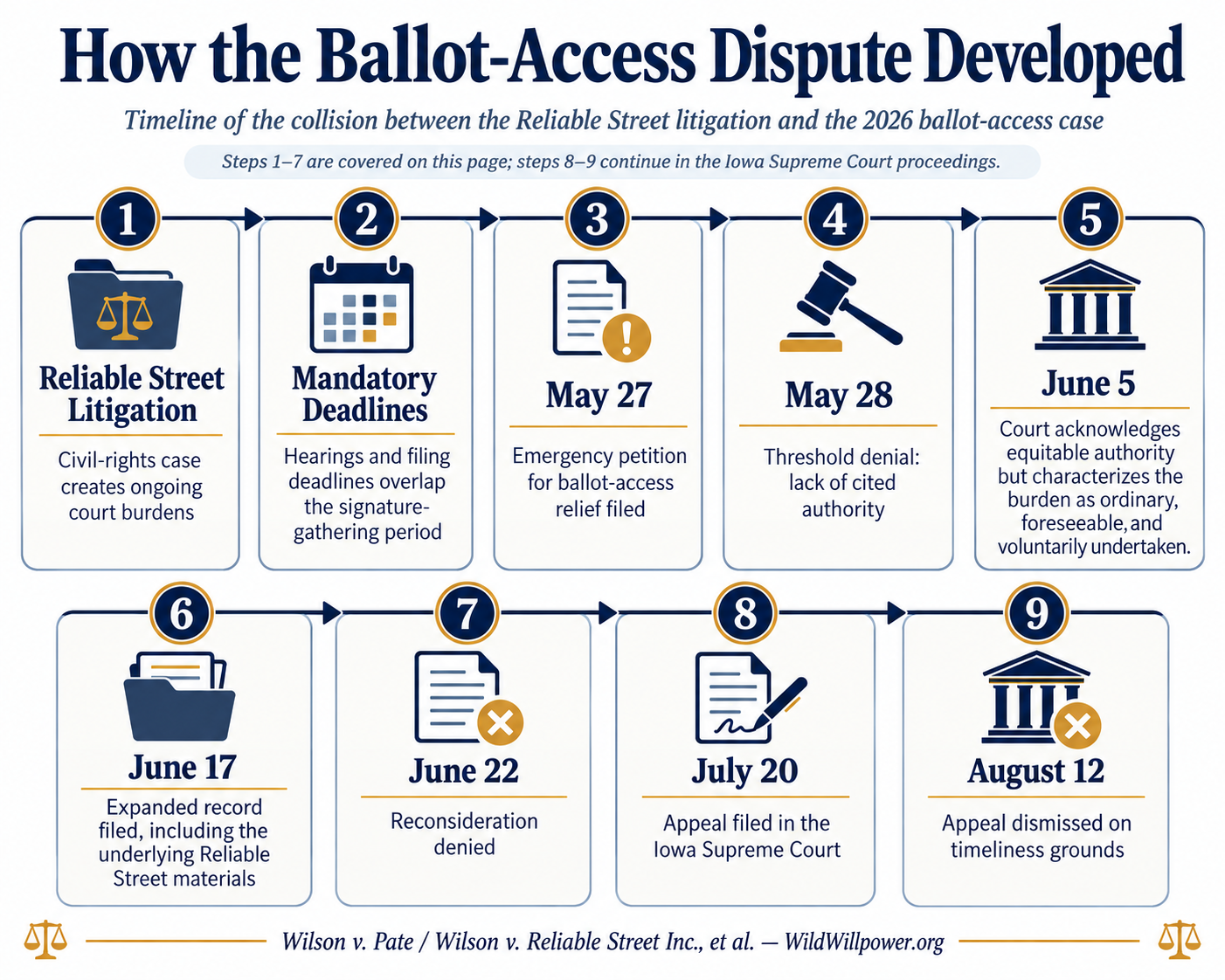
Diagram: How the Reliable Street litigation collided with the ballot-access period and developed into Wilson v. Pate and the Iowa Supreme Court appeal. This article covers steps 1–7; steps 8–9 continue in the separate Iowa Supreme Court Proceedings article.
May 19, 2026:
The Secretary of State Told Me That Any Extension Would Require a Court Order
With Iowa’s June 2 ballot-access deadline approaching, I contacted the Iowa Secretary of State’s Office on May 19 to ask whether there was any administrative procedure available to preserve my access to the 2026 general-election ballot.
At that point, I had collected approximately 1,000 signatures, but ongoing litigation in Wilson v. Reliable Street Inc., et al. had repeatedly consumed time that otherwise would have been available for petition circulation. Another hearing in that case was scheduled for May 26, only one week before Iowa’s filing deadline.
I wrote:
“I am writing as an independent candidate for Governor of Iowa seeking ballot access for the 2026 general election.”
I explained that I understood independent and nonparty candidates were required to submit their nomination papers by June 2 and asked for:
“urgent written guidance regarding any available administrative remedy, cure process, extension procedure, emergency review process, or other mechanism that may preserve ballot access where extraordinary circumstances have materially burdened a candidate’s petition circulation.”
I also explained what had happened during the signature-gathering period:
“I have made a good-faith effort to comply with Iowa’s ballot-access requirements and have already gathered approximately 1,000 signatures. However, during the filing period, I have been substantially burdened by ongoing litigation connected to political activity involving Wild Willpower PAC, including repeated filings, discovery disputes, and an upcoming discovery hearing.”
And:
“These proceedings have significantly diverted time and resources from petition circulation during the limited ballot-access period....”
The Secretary of State’s Office responded that same day.
Its answer was direct:
“There is no legal mechanism prescribed by Iowa statute allowing for an extension or partial submission of candidate paperwork. This would come down to a court ruling instructing our office differently from the process laid out in Chapter 44....”
That response matters for a simple reason:
I did not wait until after the June 2 deadline to seek relief. I sought guidance in advance, and the State agency responsible for administering ballot access told me that any different deadline would require a court order.
So I followed that guidance and went to court before the deadline.
May 26, 2026:
Mandatory Hearing Held In Story County
One week later, on May 26, a hearing was held in Wilson v. Reliable Street Inc., et al. Preparing for that hearing consumed substantial time during the final week before Iowa’s June 2 ballot-access deadline.
The underlying litigation and the “outside actors” issue are documented separately in the Reliable Street collection and in Incentivizing Interference.
I sought relief before the June 2 deadline, while an extension could still have preserved a path to the ballot. The district-court proceedings then unfolded in three stages: an initial May 28 threshold denial; a June 5 ruling addressing the nature of the underlying litigation burden; and a June 22 ruling after I submitted an expanded factual record.
May 27-28:
I Filed and Corrected My Emergency Petition for a Ballot-Access Deadline Extension
On May 27, I filed an Emergency Petition for Equitable Extension of the Ballot-Access Deadline (D0001).
I requested equitable relief:
"[I]n the form of a limited extension to the June 2, 2026, ballot-access deadline due to extraordinary litigation burdens arising from ongoing legal proceedings, including numerous filing deadlines and hearings during the active signature-gathering period,"
And requested:
"[A]lternative and equitable deadline to be set for July 15, 2026."
I also requested expedited consideration because the particular deadline I was requesting was necessarily time-sensitive:
“Absent expedited consideration, the relief requested herein may become moot before the Court has an opportunity to rule.”
At that point, “the relief requested herein” was the requested extension to July 15. That distinction becomes important later when the requested date changes as additional litigation consumes more time.
On page 2 I provided the reason for my request:
"In 2022, materially false and misleading allegations and documents were entered into an administrative
record, including documents that I know were falsified or materially altered in a manner that
damaged my reputation and adversely affected my campaign activities.
In December 2023, I filed suit pro se seeking to challenge those allegations, establish the authenticity of the
underlying evidence, and clear my name. The litigation for case no. LACV053674 remains ongoing, and trial is currently scheduled for August 4, 2026.
I did not ask to waive Iowa's ballot-access requirements or reduce the number of required signatures. I asked for additional time—from June 2 to July 15—to finish satisfying them.
The petition explained that ongoing litigation in Wilson v. Reliable Street Inc., et al. had imposed repeated hearings, filing deadlines, discovery work, and other court obligations during the same period in which I was required to gather signatures. I told the court that those obligations
“directly took away from time needed to gather signatures and work on my campaign.”
I provided the following table which showed the deadlines, and how they had adversely impacted my campaign:
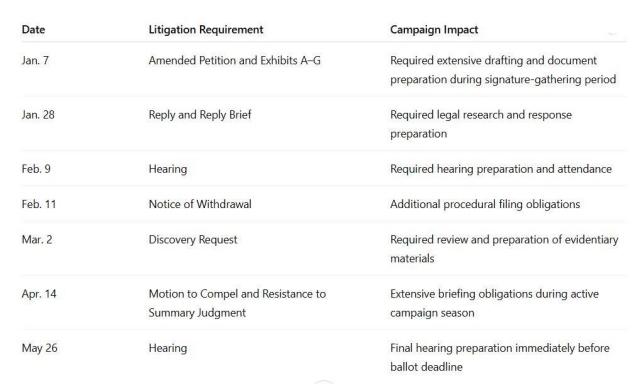
The next morning, at 9:17 a.m. on May 28, I filed a corrected Emergency Petition (D0002) clarifying that the litigation burden was not over. Additional filings were still coming before the August trial, and I specifically explained that, following direction from Judge Doyle who was overseeing that case, I was in the process of drafting an amended petition and anticipated further filings as the litigation continued.
“I am requesting a July 15 deadline... to ensure ongoing litigation does not continue to interfere.”
May 28:
District Court Denies Relief at the Threshold, Finding No Identified Legal Basis
At 10:51 a.m., Judge Scott J. Beattie issued an order denying relief (D0003). The order identified the petition as having been filed May 27, although my revised petition had already been filed that morning.
Regardless, the court did not reach the factual and equitable circumstances underlying my request.
Instead, Judge Beattie wrote:
“Plaintiff has not articulated a legal basis for the relief she seeks.”
He continued:
“She points to no statute, rule, or decision authorizing a court to extend the ballot-access deadline that the General Assembly has fixed by statute.
Absent some legal basis for displacing the deadline, the Court has no ground on which to grant the requested extension, however diligent Plaintiff's efforts may have been.”
And although the court acknowledged that I had contacted the Secretary of State and had been told there was no administrative extension mechanism, Judge Beattie concluded that invocation of the district court's general equitable powers, standing alone, did not supply sufficient authority to alter a statutory deadline.
Instead, it stopped at a threshold question:
“Because Plaintiff has not identified a legal basis for an equitable extension.... the Petition fails at the threshold.
The Court does not reach the remaining considerations.”
That was the first procedural detour. I had gone to the Secretary of State, been told that a different deadline would require a court ruling, and then gone to court before the deadline expired. Rather than reaching the remaining facts and equitable circumstances I had presented, the court stopped at whether I had supplied enough legal authority for the court to grant the requested relief.
June 1:
I Filed a Motion to Reconsider, a Motion for Leave to Amend, and an Amended Petition
The May 28 order had stopped at a threshold issue: the court concluded that I had not identified a sufficient legal basis for granting an equitable extension and expressly stated that it would “not reach the remaining considerations.”
So on June 1, I filed three related documents that each served different purposes:
Motion to Reconsider
My Motion to Reconsider (D0006) asked the court to reconsider its May 28 ruling, stating:
“The Court’s May 28, 2026 Order concluded that Plaintiff had not articulated a legal basis for the equitable relief requested. Plaintiff respectfully submits that additional Iowa authority concerning equitable tolling, supervisory authority, and extraordinary circumstances was not previously presented.”
In the reconsideration motion, I relied on three authorities—Rivas v. Brownell, Mormann v. Iowa Workforce Development, and Esshaki v. Whitmer—in support of my argument that equitable relief was legally available. I summarized their combined significance this way:
“[T]hey collectively demonstrate that Iowa courts possess equitable and supervisory authority to provide narrowly tailored relief where extraordinary circumstances outside a diligent party’s control substantially interfere with timely compliance and where rigid enforcement would result in substantial injustice.”
I tied my motion to reconsider to the proposed Second Amended Petition:
“Plaintiff respectfully requests that the Court reconsider its May 28, 2026 Order, permit filing of the attached Second Amended Petition incorporating the authorities identified herein, and grant such other relief as the Court deems just and equitable.”
Motion for Leave to Amend and Proposed Second Amended Petition
My Motion for Leave to Amend (D0004) asked the court for leave to file the attached proposed Second Amended Petition (D0005), which incorporated additional Iowa authority, expanded the factual record, and changed the requested extension from July 15 to July 23 because additional time had passed since my May 27 petition was filed.
The Motion for Leave to Amend explained why I was seeking amendment:
“Amendment is appropriate because the Court’s May 28, 2026 Order identified a deficiency concerning the legal basis for the equitable relief requested, and the proposed Second Amended Petition incorporates additional Iowa authorities and clarifying allegations directly addressing that issue.”
It further stated that permitting amendment would allow the court to evaluate the request “on a more complete legal record.”
My motion for leave to amend was made under Iowa Rule of Civil Procedure 1.402(4), which provides:
“Leave to amend, including leave to amend to conform to the proof, shall be freely given when justice so requires.”
The proposed amended petition also supplied additional information concerning the nature of the Reliable Street case and the litigation burdens I said had interfered with ballot access:
“In December 2023, Plaintiff filed civil litigation arising from disputes and allegations that Plaintiff contends damaged her reputation and substantially interfered with her political and campaign activities.... That litigation remains ongoing and has involved substantial filing obligations, discovery requirements, motion practice, and hearings during the 2026 signature-gathering period.
Since January 1 this year, I have had multiple court-imposed filing deadlines and hearings associated with this case. Each has required a significant amount of preparation. These obligations directly took away from time needed to gather signatures and work on my campaign.
Plaintiff is currently preparing a renewed motion for leave to amend and proposed second amended petition in that matter in compliance with the Court’s April 22 order ... and anticipates additional motion practice and briefing obligations as litigation continues.
Plaintiff also reasonably anticipates additional briefing obligations associated with anticipated resistance to the present petition and related motions, including preparation of a reply and reply brief pursuant to the Iowa Rules of Civil Procedure.
These obligations were not discretionary campaign activities, but court-imposed litigation requirements carrying mandatory filing deadlines and hearing obligations.”
And—importantly for the mootness issue the Iowa Supreme Court would later raise—the proposed Second Amended Petition no longer requested July 15. I expressly changed the requested extension to July 23.
“Additional filings and briefing obligations remain pending prior to the August 4, 2026 trial in case no. LACV053674. Plaintiff therefore requests an alternative and equitable deadline to be set for July 23, 2026, in order to account for ongoing court-imposed litigation obligations, anticipated briefing associated with this matter, and additional filings necessary prior to the August 4, 2026 trial in case no. LACV053674.”
The proposed amended petition incorporated those three authorities and expanded the legal argument with additional constitutional and equitable authority. In the proposed petition, I relied on the following authorities and propositions:
Rivas v. Brownell, 18 N.W.3d 211 (Iowa 2025) — held that “addressing extraordinary roadblocks to the exercise of legal rights through tolling statutes of limitations falls within the judicial power and the Iowa Supreme Court’s supervisory and administrative authority.” I also cited its recognition that “equitable exceptions to limitations statutes are common in Iowa.”
Mormann v. Iowa Workforce Development, 913 N.W.2d 554 (Iowa 2018) — additional Iowa authority supporting that proposition concerning equitable exceptions to statutory deadlines.
Tying these together, I wrote:
"Iowa courts recognize that statutory deadlines are not categorically immune from equitable modification under extraordinary circumstances."
I also cited Esshaki v. Whitmer, 455 F. Supp. 3d 367 (E.D. Mich. 2020) for the proposition that courts addressing ballot-access restrictions have recognized that
“extraordinary external circumstances may justify modification of ballot-access requirements where strict enforcement would impose severe and unjustified burdens despite demonstrated diligence.”
My proposed amended petition explained that in Esshaki, candidates who had exercised diligence in signature gathering were nevertheless prevented from timely compliance by extraordinary external restrictions, and that the court therefore granted narrowly tailored relief modifying ballot-access requirements.
I also cited Anderson v. Celebrezze, 460 U.S. 780 (1983) and Burdick v. Takushi, 504 U.S. 428 (1992) together for the constitutional ballot-access framework:
“Federal constitutional ballot-access doctrine likewise requires courts to weigh the character and magnitude of burdens imposed on ballot access against the state interests asserted to justify those burdens.”
I also cited Moser v. Thorp Sales Corp., 312 N.W.2d 881 (Iowa 1981) and In re Estate of Young, 273 N.W.2d 388 (Iowa 1978) together for this proposition:
“Iowa courts have long recognized the broad equitable authority of courts to prevent unjust and excessively harsh outcomes under extraordinary circumstances.
Plaintiff respectfully submits that these longstanding equitable principles further support the Court’s authority to provide narrowly tailored relief where extraordinary external circumstances materially interfered with timely compliance despite demonstrated diligence.”
And once again, I made clear that I was not asking the court to abolish or disregard Iowa's ballot-access requirements:
“Plaintiff does not seek invalidation of Iowa Code chapter 44, nor generalized judicial authority to disregard election deadlines.
Plaintiff does not seek waiver of ballot-access requirements, but only a temporary equitable extension sufficient to complete the signature-gathering process.”
My WHEREFORE clause, at the end of the proposed amended petition, expressly requested the new July 23 deadline:
“WHEREFORE, Plaintiff respectfully requests:
a. Equitable extension of the ballot-access deadline to July 23, 2026;
b. Expedited consideration and hearing due to the imminence of the June 2, 2026 statutory deadline;
c. Such other and further relief as the Court deems just and equitable.”
The district court never adjudicated my separately filed June 1 Motion for Leave to Amend (D0004) or its accompanying proposed Second Amended Petition (D0005). Neither the June 5 nor June 22 order addressed that motion or disposed of the proposed amendment. This omission subsequently became an important issue in the Iowa Supreme Court proceedings.
June 5:
Court Acknowledged Equitable Authority —
Then Characterized My Litigation Burdens as Ordinary, Foreseeable, and Voluntary
My May 27 petition had already explained that the underlying litigation arose from allegations and records I contended were false or materially altered, that those allegations had damaged my reputation and adversely affected my campaign activities, and that I had filed suit seeking to challenge those allegations, establish the authenticity of the evidence, and clear my name.
My June 1 proposed amended petition expanded substantially on those facts, added additional legal authority, and changed the requested deadline from July 15 to July 23.
But Judge Beattie’s June 5 ORDER DENYING MOTION TO RECONSIDER did not mention my separately filed Motion for Leave to Amend or proposed amended petition. It did not state whether leave was granted or denied. It did not mention the July 23 deadline. And although the proposed amended petition cited Anderson, Burdick, Moser, and In re Estate of Young in addition to Rivas, Mormann, and Esshaki, the June 5 order discussed only the three authorities contained in my Motion to Reconsider.
The order stated:
“This matter comes before the Court on Plaintiff’s Motion to Reconsider under Iowa Rule of Civil Procedure 1.904(2), filed June 1, 2026.”
Judge Beattie then acknowledged:
“The Court begins by acknowledging a premise in Plaintiff’s motion that is well-founded: Iowa courts possess equitable and supervisory authority to address extraordinary roadblocks to the exercise of legal rights.”
“The Court does not dispute that equitable power of this kind exists.”
He concluded, however, that Rivas and Mormann concerned statutes of limitations rather than election deadlines and therefore did not establish that those equitable principles applied “with equal force” to Iowa’s statutory ballot-access deadline.
He also recognized that Esshaki was closer to the subject matter because it involved extraordinary outside circumstances interfering with candidates’ ability to gather signatures.
That does not mean my circumstances were legally identical to the extraordinary circumstances presented in Esshaki. They were not. My narrower argument was that extraordinary outside interference with a candidate's ability to qualify for the ballot is not a concept courts have never recognized or remedied.
The question I was asking Judge Beattie to decide was whether comparable equitable relief could even be considered when a candidate presented evidence that extraordinary litigation burdens and alleged outside interference had consumed the same signature-gathering period.
Then the ruling went further.
Rather than stopping at the legal-authority issue addressed on May 28, Judge Beattie made a new determination about the nature and cause of the litigation burden itself. In my view, that determination was not merely incomplete; it was factually inaccurate. It replaced the circumstances I had actually described—outside interference, court-imposed litigation obligations, and an ongoing effort to clear my name from serious allegations placed into government records—with a different narrative: that I had simply chosen litigation as another competing obligation during the signature-gathering period.
The order stated:
“The burdens Plaintiff identifies did not arise from any external condition imposed on her. They arose from litigation she herself initiated.
The filing deadlines and hearings she identifies as interfering with her signature gathering are the ordinary and foreseeable demands of the litigation she chose to bring.
The coexistence of a pending lawsuit and an approaching statutory deadline is not an extraordinary external circumstance.
the Petition asks the Court to extend a statutory ballot-access deadline because Plaintiff was occupied with other matters during the signature-gathering period.
The equitable power of this Court exists to address genuine injustice, not to relieve a party from the consequences of competing obligations she voluntarily undertook.”
That characterization did not come from an argument advanced by the Secretary of State in the district court. The Secretary of State had not appeared in the case at that point. The “ordinary, foreseeable, and voluntarily undertaken” characterization originated in Judge Beattie’s June 5 ruling itself.
That distinction is important because the court was not resolving a factual dispute between my account and an opposing account presented by the Secretary of State. It introduced a new characterization of the circumstances I had described, and that characterization became the basis for denying the relief I was seeking to preserve my path to the ballot.
Whether the June 5 ruling legally “modified” the May 28 ruling later became central to the appellate-timeliness dispute; that issue is documented in the Iowa Supreme Court Proceedings.
The New Determination Created a New Litigation Burden
Judge Beattie’s new characterization changed what I now had to prove if I was going to challenge the basis on which relief had just been denied.
The question was no longer simply whether litigation obligations had consumed my signature-gathering time. To challenge the conclusion that those burdens were ordinary, foreseeable, and voluntarily undertaken, I now had to place substantial portions of the underlying factual record from Wilson v. Reliable Street Inc., et al. before the ballot-access court and explain why that litigation existed, why I believed it had become necessary, and why I disputed the premise that its burdens were merely self-created.
That meant showing why I contended false and materially misleading records had harmed my reputation and threatened my campaign; why I believed the litigation had become necessary; and why I alleged that certain defendants’ filings in Wilson v. Reliable Street Inc., et al. constituted abuse of process, substantially increasing the duration, complexity, and burden of that litigation.
Those issues had not yet been finally adjudicated in Wilson v. Reliable Street Inc., et al. Yet the June 5 ruling made the nature and cause of that separate litigation relevant to the ballot-access case.
That dramatically expanded what otherwise could have remained a much narrower ballot-access case: whether I should receive additional time to complete Iowa’s existing requirements in light of the litigation burdens, severity of the matter, and outside interference I had described.
Instead of using that time to gather signatures, speak with voters, share my platform, and manage the ongoing Reliable Street litigation, I now had to devote still more time to explaining the underlying dispute inside Wilson v. Pate itself.
That new characterization required an answer.
My June 17 filing was the answer.
June 17:
I Submitted an Expanded Factual Record Challenging the June 5 Characterization
On June 17, I filed my Motion to Reconsider Based Upon Subsequently Filed Evidence and Clarification of the Factual Record and attached the materials I had repeatedly told the court I was still under obligation to complete in Wilson v. Reliable Street Inc., et al.
Those materials included my 62-page Revised Second Amended Petition in Wilson v. Reliable Street Inc., et al. (Story County No. LACV053674)—the underlying civil action in which I alleged misconduct, including abuse of process and interference with my political activities—and seven organized exhibits documenting the administrative record, contemporaneous communications, underlying allegations, disputed and allegedly altered materials, and the multi-year procedural history of that litigation.
I attached these materials to Wilson v. Pate because they directly concerned the factual premise Judge Beattie had introduced in his June 5 ruling: that the litigation burdens interfering with my campaign were merely ordinary, foreseeable, and voluntarily undertaken. The attachments were intended to demonstrate why I disputed that characterization, not to ask the Polk County court to adjudicate the separate Reliable Street defendants' liability.
My June 17 motion began by addressing Judge Beattie’s June 5 characterization directly:
“The newly filed materials demonstrate that Plaintiff’s litigation was not discretionary, recreational, or analogous to an unrelated personal project.”
Instead:
“Plaintiff alleges that the litigation was reasonably necessary to address allegations Plaintiff contends were false, defamatory, selectively excerpted, altered, or otherwise misleading, and which had been submitted to the Iowa Civil Rights Commission and incorporated into an official administrative record.”
I then identified the seriousness of those allegations:
“The newly filed materials further show that these allegations accused Plaintiff of stalking, harassment, racist or culturally insensitive conduct, anti-LGBT+ comments, unauthorized conduct, and other serious misconduct.”
And I explained why I did not regard litigation addressing those allegations as an optional use of my time:
“Plaintiff’s litigation was therefore undertaken to obtain judicial adjudication concerning the truth or falsity of those allegations and to address continuing reputational, professional, educational, advocacy-related, publishing-related, and political harms arising from their incorporation into governmental records.”
My filing went further. Because I had already announced my candidacy for Governor, I explained that leaving those accusations unresolved created a practical problem during the election itself:
“[T]he allegations at issue, if left unadjudicated, posed a continuing threat to Plaintiff's reputation, candidacy, and ability to participate meaningfully in the electoral process, thereby creating a practical necessity to pursue judicial relief during the same period in which ballot-access requirements had to be satisfied....”
The Completed Filing Also Showed Why the Burden Was Not “Ordinary”
I did not simply characterize the litigation as unusually burdensome. I submitted the completed materials themselves.
My motion explained that the case involved five individual defendants, three entity defendants, multiple categories of alleged misconduct, extensive communications involving numerous people, and hundreds of pages of documentary material that had to be collected, organized, compared, and analyzed under court deadlines.
I summarized the distinction this way:
“The burden on Plaintiff’s campaign therefore did not arise merely from the existence of litigation. Plaintiff contends that it arose from the underlying allegations, their incorporation into governmental records, and the need to seek judicial review while simultaneously complying with ballot-access requirements.”
And:
“Collectively, these obligations constituted a continuous series of court-imposed deadlines that directly overlapped with the statutory signature-gathering period.”
Then I expressly challenged the characterization Judge Beattie had made twelve days earlier:
“[T]he completed record now before the Court demonstrates that the litigation burdens at issue cannot fairly be characterized as self-created in the sense contemplated by the Court’s prior ruling.”
Rather:
“Plaintiff contends that those burdens arose from the underlying allegations, their incorporation into administrative records, and the resulting administrative and judicial proceedings, rather than from a freely chosen alternative use of Plaintiff’s time.”
I Was Not Asking Judge Beattie to Decide the Reliable Street Case
My June 17 filing expressly said:
“Plaintiff attaches the completed Revised Second Amended Petition and Exhibits A–G not for the purpose of requesting adjudication of the merits of Case No. LACV053674 in this proceeding, but to provide the Court with the completed record that was unavailable at the time of the Court’s June 5 ruling.”
I then stated that the materials were offered to show:
“(a) the nature and seriousness of the allegations Plaintiff sought to adjudicate, (b) Plaintiff’s contention that those allegations continued to affect her reputation and political activities during the 2026 election cycle, and (c) the substantial time and litigation obligations associated with preparing and filing the completed materials during the ballot-access period.”
And finally:
“They are offered solely to illustrate the nature, complexity, and scope of the court-imposed obligations that remained pending during the statutory signature-gathering period.”
Materials Submitted With the June 17 Filing
The filing included the Revised Second Amended Petition and seven organized exhibits. They are preserved here so readers can inspect the materials that were actually before the district court. For clarity, Attachment A is the Revised Second Amended Petition; Attachments B–H are the seven supporting exhibits.
Attachment A — Revised Second Amended Petition from Wilson v. Reliable Street Inc., et al. (LACV053674)
Attachment B — ICRC Correspondence and Administrative Record
Attachment C — Open Mic and Flier Agreements
Attachment D — Garden and Prairie Agreements
Attachment E — Stalking and Harassment Allegations / Document I Allege Was Materially Altered
Attachment F — Racism and Anti-LGBT+ Allegations / Statements I Allege Were Presented Out of Context
Attachment G — Esker ICRC Statement
Attachment H — Abuse-of-Process Timeline
The substance of these materials, and why I contend they undermined the characterization of the litigation as “ordinary,” “foreseeable,” or “self-created,” is examined in Incentivizing Interference and the Reliable Street documentary collection.
June 22:
The Court Reviewed My Expanded Factual Record, Reconsidered the June 5 Ruling,
and Declined to Change the Result
On June 22, Judge Beattie issued another order addressing my June 17 filing.
The order began:
“Plaintiff asks the Court to reconsider its June 5, 2026 Order.”
The court stated that it had reviewed my motion, affidavit, and supporting materials and had “again reconsidered” its prior ruling, but declined to change the result.
On June 22, Judge Beattie issued D0009, titled ORDER DENYING SECOND MOTION TO RECONSIDER.
The order expressly identified the matter before the Court as my June 17 Motion to Reconsider Based Upon Subsequently Filed Evidence and Clarification of Factual Record.
It stated:
“The Court has again reconsidered its prior ruling. Having done so, the Court declines to alter it.”
The operative disposition was equally specific:
“IT IS THEREFORE ORDERED that Plaintiff's Motion to Reconsider is DENIED.”
The order did not mention, address, or dispose of my separately filed June 1 Motion for Leave to Amend (D0004) or proposed Second Amended Petition (D0005).
That was significant because the June 17 filing had placed a substantially expanded factual record before the court. I had submitted the completed Reliable Street materials not to ask Judge Beattie to adjudicate that separate case, but to explain why I disputed his June 5 characterization of the resulting litigation burden as ordinary, foreseeable, voluntarily undertaken, or effectively “self-created.”
The June 22 order did not explain why that expanded record failed to alter the analysis.
It did not address the distinction I had drawn between voluntarily initiating litigation and allegedly being subjected to abuse of process and court-imposed obligations within that litigation. It did not explain why the serious disputed allegations contained in governmental records, their potential consequences for a statewide candidate, or the time required to comply with hearings, filing deadlines, discovery obligations, and court-directed amendment work should still be treated as ordinary competing commitments.
The result remained the same, and the June 5 characterization remained in place.
The Reliable Street Record Was Only Beginning to Come Into View
At that point, the Reliable Street record had not yet been converted into the public documentary collection now available on this website.
I was still attempting to keep up simultaneously with court filings, campaign obligations, and the work of reconstructing a fragmented multi-year record. The June 17 Revised Second Amended Petition and supporting exhibits represented the most complete organized presentation of that material I had assembled at the time.
The later documentary articles developed as I continued reconstructing the record and as the consequences of the litigation became relevant to the ballot-access dispute. Those articles now allow readers to examine in much greater detail the underlying events, procedural history, and abuse-of-process allegations that I was attempting to place before Judge Beattie in June.
The June 22 Order Later Became Important to the Appellate-Deadline Dispute
The June 22 order was titled “ORDER DENYING SECOND MOTION TO RECONSIDER.” But the legal significance of the ruling later became part of a separate appellate question: what had the court actually reconsidered and decided, regardless of the caption placed on the order?
Under my reading of Iowa's appellate rules, the June 22 ruling restarted the 30-day appeal period because my June 17 motion was directed at a modification first made in the June 5 ruling.
My position was that the sequence mattered:
May 28: the court denied relief at the threshold and expressly said it did “not reach the remaining considerations.”
June 5: the court then reached those previously undecided considerations and, for the first time, characterized the litigation burden as ordinary, foreseeable, and voluntarily undertaken.
June 17: I filed a motion directed specifically at that new determination and submitted an expanded factual record addressing it.
June 22: the court stated that it had reviewed those materials and had “again reconsidered” the June 5 ruling, but declined to alter the result.
I therefore treated June 22 as the ruling from which the 30-day appeal period ran.
Iowa appellate decisions later became important to that argument because they caution against determining the legal effect of a filing or ruling solely from its title.
In Turner v. CCRC of Cedar Rapids, LLC, No. 20-0973, 2021 WL 3076742, at *2 (Iowa Ct. App. July 21, 2021), the Iowa Court of Appeals explained:
“The caption on a filing does not determine its legal significance, and we look to the filing’s ‘content to determine its real nature.’”
And in In re Marriage of Waller and Kill, No. 25-0899 (Iowa Ct. App. June 10, 2026), the district court had expressly stated that a first reconsideration motion was “denied.” The Court of Appeals nevertheless examined the substance of the ruling rather than stopping at that label:
“But in determining whether there was a modification, we look at the content of the ruling.”
The Court of Appeals concluded that a modification had occurred because the later ruling introduced material that was not contained in the original ruling.
I contend the June 5 ruling in Wilson v. Pate presents the same kind of issue: the ultimate disposition remained a denial, but the adjudicative basis changed because the court decided a material issue that the May 28 ruling had expressly declined to reach.
Whether that constituted a “modification” under Iowa's appellate rules—and whether my June 17 filing was directed only at that modification—later became central to the Iowa Supreme Court's timeliness inquiry.
That appellate dispute is documented separately in the Wilson v. Pate Iowa Supreme Court Proceedings.
Continue the Record
← Behind the Headlines: Election and Case Roadmap
Next: Wilson v. Pate — Iowa Supreme Court Proceedings →
Related Analysis: “Incentivizing Interference” — Why I Dispute the “Ordinary, Foreseeable, and Voluntary” Characterization →