
Wild Willpower's Official Platform:
Justice Across Iowa:
A comprehensive plan to make Iowa's justice system
understandable, accessible, transparent, and accountable to the people.
By Sondra Wilson | Updated August 10, 2026
Most Iowans do not expect to become personally involved in a court case—and avoiding court is often the ideal outcome.
Families, neighbors, businesses, employees, agencies, and community organizations frequently resolve disagreements through conversation, negotiation, mediation, insurance claims, administrative processes, or voluntary agreements. Whenever people can reach a fair resolution without enduring the expense, uncertainty, delay, and strain of litigation, they should generally be encouraged to do so.
But some injuries cannot be resolved informally.
A landlord may refuse to correct dangerous conditions. An employer may deny discrimination or retaliation. An insurance company may refuse a valid claim. A business may conceal complex fraud. A government agency may deny benefits, withhold records, or invoke its own procedures against the person seeking relief.
And sometimes one party possesses the money, records, institutional authority, or professional representation necessary to prevent any meaningful voluntary resolution.
When that happens, telling the injured person to “find a lawyer” may sound practical.
For millions of Americans, it is not.
The Justice Gap Begins Before the Courthouse
The Legal Services Corporation reports that low-income Americans receive no or insufficient legal help for 92 percent of their substantial civil legal problems.[1] Published billing data places the average Iowa lawyer rate at roughly $252 per hour.[5]
Many working Iowans therefore fall into a justice gap: unable to afford sustained private representation, yet still responsible for meeting every deadline and procedural requirement when a serious legal problem arises.
When counsel is unavailable, the underlying injury does not disappear. The person must either abandon a potentially valid right—or enter a professionally designed legal system alone.
Some cases are straightforward enough that official forms, guided procedures, or limited assistance can be sufficient.
The greatest danger arises in more complicated cases involving civil-rights violations, concealed facts, fraud, coordinated institutional conduct, or alleged governmental abuse. In those cases, the person most in need of the courts may also be the person least able to purchase access to them.
The decisive battle may never occur before a jury.
Instead, a person with a potentially meritorious claim may confront pleading challenges, service disputes, jurisdictional arguments, immunity doctrines, privilege claims, discovery conflicts, evidentiary restrictions, shortened deadlines, and demands for factual specificity before the opposing side has disclosed the information necessary to provide it.
That is not an abstract concern.
It is part of the record documented in the Iowa's Broken Judiciary series.
The experiences detailed within the series taught me something important:
Courts should exist to create justice from unjust situations—not to create procedural traps that prevent ordinary people from obtaining redress for harms they have suffered.
Popular Sovereignty:
Iowa's Constitutional Path to Reform
Many people have become resigned to the belief that the courts are corrupt, the system is immovable, and ordinary people are powerless to change it.
I reject that resignation.
As Abraham Lincoln declared:
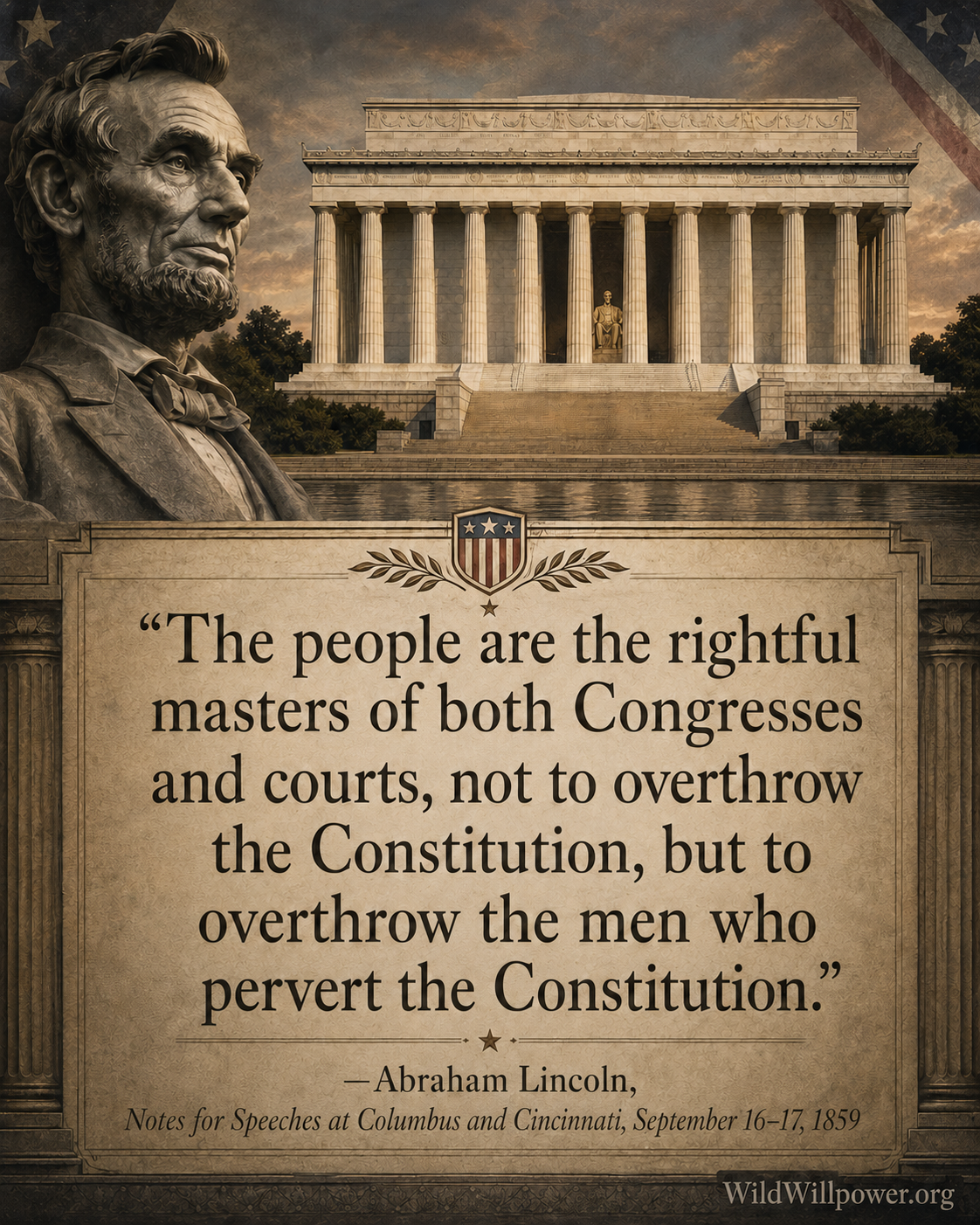
“The people are the rightful masters of both Congresses and courts, not to overthrow the Constitution, but to overthrow the men who pervert the Constitution.”
—Abraham Lincoln, Notes for Speeches at Columbus and Cincinnati, September 16–17, 1859. [2]
But how can people remain the rightful masters of a system that has become so complex that they can no longer meaningfully understand or use it?
Iowa does not have to remain resigned to a system in which government may create an injury, control relevant records, supply the defense, invoke immunity, and leave the injured person without a meaningful remedy.
Our constitutional system recognizes the people as the original source of legitimate governmental power.
The Iowa Constitution begins with an extraordinary declaration:
“All political power is inherent in the people.”
It continues:
“Government is instituted for the protection, security, and benefit of the people, and they have the right, at all times, to alter or reform the same, whenever the public good may require it.”
—Iowa Constitution, article I, section 2.[3]
The people are not outsiders asking the legal system for permission to improve it.
They are the constitutional source from which its legitimate authority originates.
The answer to systemic injustice is therefore not resignation.
It is informed, peaceful, democratic action.
Governmental power carries governmental responsibility.
Five Major Reforms—And the Institutions to Carry Them Forward
Justice Across Iowa is built around five major reforms to make Iowa's legal system more understandable, accessible, fair, and accountable.
But reform does not end with changing statutes or court procedures.
This plan also proposes one new public institution—the Public Intelligence Agency—to fill major gaps in government oversight, anti-corruption investigations, scam prevention, cybersecurity, public legal education, and citizen access to meaningful investigation.
And it includes the American Accreditation Registrar, an independent professional institution designed to expand competition, public-service opportunities, legal education, professional independence, and justice-oriented participation within the legal profession.
Together, these pieces form a larger structure:
Five reforms change the rules.
The Public Intelligence Agency helps government investigate, prevent, educate, and enforce.
The American Accreditation Registrar helps build the professional community capable of sustaining reform.
And now, the reforms.
I. The Five Major Reforms

The following reforms are built around one simple principle:
Justice must become understandable, accessible, transparent, and accountable to the people.
That means simplifying unnecessarily confusing procedures.
It means making public law genuinely accessible to the public.
It means teaching young people enough practical law to enter adulthood prepared to protect themselves.
It means creating safeguards when attorneys make life-altering decisions in a client's name.
It means ensuring that civil-rights processes do not hide critical records from the people whose rights depend upon them.
And it means restoring meaningful accountability when governmental doctrines prevent serious allegations of unlawful conduct from ever being heard on their merits.
The reforms below are a starting point.
They are not the final word.
They are an invitation to build a justice system worthy of its name, and they are only the beginning. The following reforms will continued to be updated as time allows, and new information comes forth.
First Reform—Simplify the Justice System:
The Justice Accessibility Act
Make Iowa courts understandable and realistically usable by the people they serve
The Justice Accessibility Act would:
- create a plain-English public map of Iowa procedure;
- build a comprehensive searchable archive of controlling Iowa and U.S. Supreme Court decisions;
- expand forms, notices, navigators, and guided filing assistance; and
- provide reasonable opportunities to correct harmless procedural errors before potentially valid rights are permanently lost.
It also confronts the contradiction between permitting people to represent themselves while expecting them to navigate procedures developed and routinely used by trained legal professionals.
Read the Justice Accessibility Act →
Click the below image to read this proposal.

Second Reform—Prepare Students for the Real World:
Teach Practical Law to High-School Seniors
History classes teach students how our institutions developed, and civics teaches how government is structured. Practical law should complete that education by showing young Iowans how the system actually works. Wild Willpower proposes bringing attorneys and other legal professionals out from behind their desks and into Iowa classrooms to teach business, civil, criminal, constitutional, and administrative law—including how to read legal documents, preserve evidence, communicate effectively with officers and public officials, and file an effective complaint or petition when something goes wrong. Closely connected to Wild Willpower’s Education Plan, the Justice Accessibility Act, and the firsthand experiences documented in Iowa’s Broken Judiciary, this reform would expand legal literacy, create meaningful public-service opportunities, and prepare students to enter adulthood with practical tools they can actually use.
Read the Plan: Teach Practical Law to High-School Seniors →
Click the below image to read this proposal.

Third Reform—The Attorney-Client "Right to Review"
No Lawyer May Change a Plea or File a Material Representation
Without the Client's Informed, Written Approval
At first, requiring clients to review and approve major legal filings may sound like a small procedural safeguard. The firsthand story behind this reform, however, shows why it is far more important than many people realize. After an attorney changed my pleas from “not guilty” to “guilty” without my knowledge or consent—and the change remained undiscovered for sixteen years—I learned how difficult it can be to establish what happened when no signed authorization exists. Wild Willpower’s proposal would require attorneys to clearly explain and obtain informed written approval before changing a plea, waiving a trial or appeal, accepting a settlement, dismissing a case with prejudice, or filing other material representations in a client’s name.
No person should discover years later that a lawyer made a life-altering decision for them without documented consent.
Read the full Attorney-Client “Right to Review” proposal →
Click the below image to read this proposal.

Fourth Reform—A Civil-Rights Process That Does Not Hide the Record
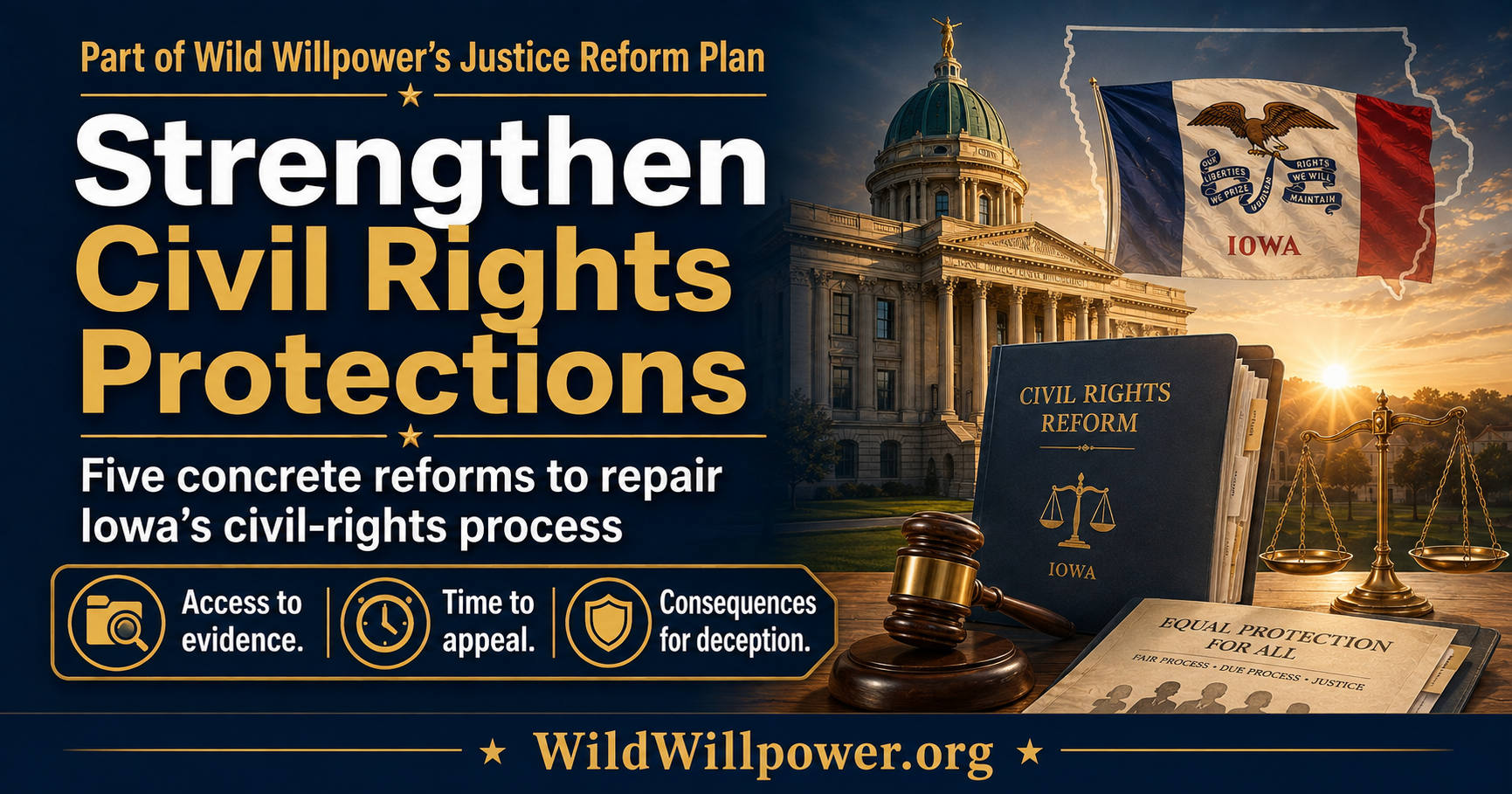
Strengthen Civil-Rights Protections
Iowa should once again aspire to be a national leader in civil-rights protection.
But a civil-rights law is only as strong as the process available to enforce it. People who bring discrimination or retaliation complaints to the State should be able to see the evidence, understand the decision, challenge false information, and preserve their right to seek judicial relief.
Wild Willpower proposes five concrete reforms:
- Require the Iowa Office of Civil Rights to provide the complete case file when a complaint is closed, screened out, or initially determined—rather than forcing complainants to trigger a right-to-sue deadline merely to obtain the evidence in their own case.
- Extend the period for appealing an administrative closure or adverse determination from 30 days to 60 days, giving ordinary Iowans a realistic opportunity to review records, identify contradictions, obtain advice, organize evidence, and prepare a meaningful challenge.
- Create enforceable consequences for knowingly submitting materially false statements, altered evidence, or deceptive records during a civil-rights proceeding, while protecting good-faith disagreement, imperfect memory, and legitimate legal advocacy.
- Expand the Iowa Civil Rights Act to clearly protect volunteers, interns, independent contractors, gig workers, and others who contribute labor or services outside a traditional employee relationship.
- Replace at-will employment with a for-cause employment standard, making it harder to conceal unlawful discrimination behind vague or shifting explanations for terminating a worker.
These reforms work together. People need access to the evidence, enough time to examine it, consequences when the process is deliberately deceived, clear protection under the law, and employment rules that make unlawful discrimination harder to disguise.
The goal is not merely to create more civil-rights rules on paper. It is to create a system in which an Iowan who experiences discrimination has a realistic opportunity to prove what happened and obtain meaningful relief.
Civil rights should protect Iowans in practice—not merely in theory.
Read: Strengthen Civil Rights Protections →
Click the below image to read this proposal.
Fifth Reform—A Government of Laws, Not of Men
Abolish Government Immunity Doctrines
A Government of Law
A constitutional republic should not place government officials categorically beyond accountability when unlawful conduct causes serious injury.
Many doctrines limiting governmental liability developed through statutes and judicial decisions that most citizens never encounter until the government invokes them against a claim.
Justice Across Iowa proposes a fundamental reassessment of doctrines that prevent citizens from obtaining a remedy for alleged malicious, corrupt, knowingly unconstitutional, fraudulent, or deliberately abusive governmental conduct.
The objective is not to punish good-faith public service.
It is to restore a basic principle:
The government must serve the people.
Where government causes an actionable injury, citizens should not be forced through a maze of capacity distinctions, service requirements, overlapping immunities, and procedural traps merely to determine whether anyone can be required to answer for what occurred.
This reform will examine how Iowa can provide meaningful accountability while preserving legitimate protections necessary for independent governmental decision-making.
No government worthy of public trust should require immunity from the law in order to function.
Read: Abolish Government Immunity Doctrines →
Click the below image to read this proposal.

Institutions That Help Put Reform Into Practice
Justice Across Iowa includes statutory reforms, but lasting reform also requires institutions capable of carrying the work forward.
Public Intelligence Agency
Intelligence for the Public — Not About the Public
The proposed Public Intelligence Agency (PIA) would support public-integrity investigations, anti-fraud initiatives, government-accountability research, public-record analysis, and referrals to agencies with appropriate enforcement authority.
Among its proposed initiatives are stronger protections against sophisticated scams, improved government oversight, and research into financial schemes that shift unlawful costs onto ordinary taxpayers.
Explore the Public Intelligence Agency →

American Accreditation Registrar
A Justice-Oriented Professional Community
A competing professional association created as an alternative to the Iowa State Bar Association and American Bar Association—giving legal professionals a justice-centered institutional home focused on public legal education, constitutional accountability, professional independence, access to justice, and the development of alternative legal-education and credentialing pathways.
Explore the American Accreditation Registrar →

From Experience to Reform
I spent years developing the legal self-help website ReUniteTheStates.org, including transcribing thousands of legal terms onto a publicly accessible resource.
I did that because I came to understand something that now lies at the heart of Justice Across Iowa:
The law cannot meaningfully belong to the people if the people cannot understand it.
Every time we recite the Pledge of Allegiance, we reaffirm a promise:
“Liberty and justice for all.”
Simplifying Iowa's justice system will not prevent every injustice.
No reform can.
But Iowa can give ordinary people a meaningful opportunity to:
- understand the process;
- preserve their rights;
- locate the governing law;
- present their evidence;
- obtain necessary records;
- correct good-faith mistakes;
- challenge governmental wrongdoing;
- and speak the same institutional language as the courts.
Having a legitimate grievance should not depend upon also possessing the money, education, professional vocabulary, and procedural knowledge necessary to convert that grievance into a legally perfect filing.
Justice should not exist only for people who can afford to purchase professional access to it.
Justice must become understandable, accessible, transparent, and accountable to the people.
Join the Conversation
If you are an Iowan who has encountered an inaccessible court process, administrative breakdown, procedural trap, unfair legal doctrine, governmental accountability problem, civil-rights failure, or another barrier that deserves examination, your experience may help identify reforms that this plan has not yet addressed.
Justice Across Iowa should continue developing through public evidence, professional criticism, firsthand experience, and democratic debate.
The people are not spectators in their government.
They are its source of authority.
To share your story and suggest a reform, email WildWillpowerPAC@gmail.com.
Join Sondra On Social Media
Follow my Facebook, Instagram, BlueSky, X, and LinkedIn accounts.
If you see a proposal that you believe deservespublic attention, share it and explain why.
This is a grassroots effort to place concrete rforms before the people of Iowa.
References
[1]: Legal Services Corporation. (retrieved July 20, 2025). The Justice Gap: The Unmet Civil Legal Needs of Low-income Americans. https://justicegap.lsc.gov/.
[2]: Abraham Lincoln. Notes for Speeches at Columbus and Cincinnati, September 16–17, 1859, in The Papers and Writings of Abraham Lincoln, vol. 5, Constitutional Edition, edited by Arthur Brooks Lapsley. New York: G. P. Putnam’s Sons, 1906.
[3] Iowa Constitution, article I, section 2, “Political Power.”
[4]: Clio. (retrieved July 20, 2025). How much should I charge as a lawyer in Iowa? https://www.clio.com/resources/legal-trends/compare-lawyer-rates/ia/.
Join Sondra On Social Media
Follow my Facebook, Instagram, BlueSky, X (formerly Twitter), and LinkedIn accounts— See a post you like? Please share it with a few words of why you believe in it, write #Sondra4Governor and #WildWillpower to help spread the word faster. This is a grassroots campaign: if every Iowan who wants a better future is posting this, they can’t ignore us! Please help my campaign bust through and get noticed.
