
Two Courthouses; Three Judges:
The Wilson v. Reliable Street Inc., et al. District Court Proceedings
Parts Four-Seven: December 2023-August 2026
Updated September 23, 2026
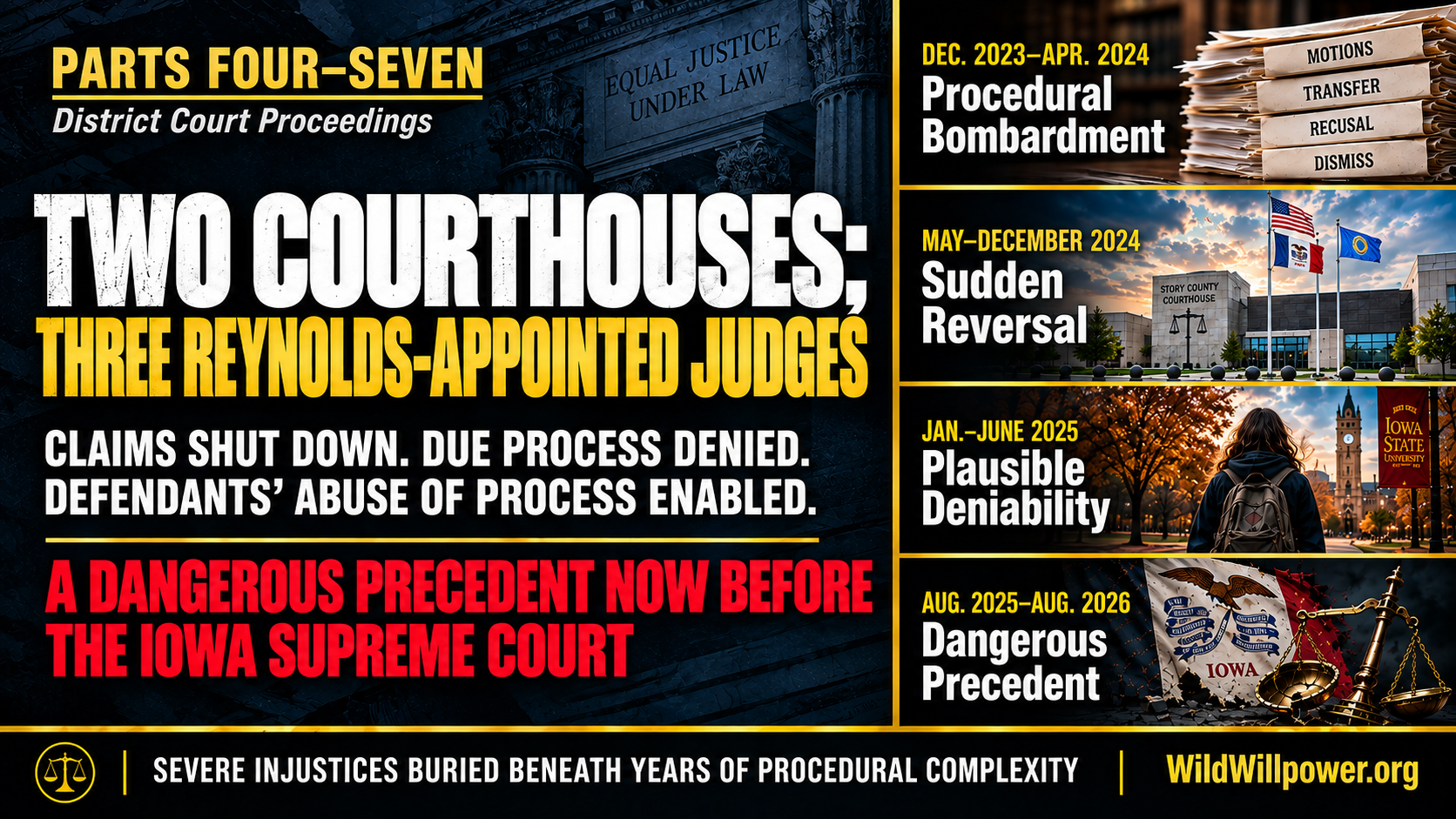
How the Lawsuit Became a Fight to Reach Discovery and a Jury
Before Wilson v. Reliable Street Inc., et al. became an appellate case, it moved through two courthouses, three district-court judges, repeated pleading and recusal disputes, two attempted amended petitions, an aborted evidentiary process, and finally a discovery-and-jury-trial schedule that never reached a jury.
Parts One through Three explain why I filed suit.
Parts Four through Seven document what happened after I did.
Part Four, Procedural Bombardment, begins with five same-day motions, a contested judicial recusal, transfer from Polk County to Story County, and the compression of the Polk County proceedings into a single 144-page docket entry.
Part Five, Sudden Reversal, documents how Judge Currie initially directed the parties to prepare for evidence, how I organized and disclosed dozens of exhibits in reliance on those directions, how defendants then objected to the evidentiary process, and how most of my claims were dismissed with prejudice before discovery occurred.
Part Six, Plausible Deniability, follows the case to its third judge, where defendants aggressively reframed the preceding procedural history, my remaining reconsideration window was consumed by defensive filings, and a nonextendable deadline immediately before finals ended my opportunity to challenge the October 4 dismissals.
Part Seven, Dangerous Precedent, documents what happened after the surviving defamation claim was finally placed on a discovery-and-jury-trial track: I sought the electronic evidence needed to determine who created and altered the falsified ICRC document, defendants argued that discovery could not matter because their submissions were absolutely privileged, Judge Doyle denied my reconstructed amended pleading, and then granted summary judgment on the final surviving claim.
Together, these four articles document a district-court process in which the central evidence I had been trying to reach since 2023 was never fully developed through discovery and never placed before a jury.
The final district-court ruling went further. It held that statements submitted during the investigative stage of an Iowa Civil Rights Commission complaint are protected by absolute privilege, even though the court acknowledged that no Iowa appellate court had directly decided that precise question.
I am now challenging those rulings on appeal.
A note on terminology: Throughout this page, I refer to the June 28, 2022 ICRC submission examined in Political Sabotage as the falsified document. Part Three lays out the documentary basis for my conclusion that the material was altered and rearranged in a manner that created a false record. Defendants did not concede that characterization; during discovery they acknowledged creating, editing, formatting, compiling, and revising the submission while denying that it had been improperly altered or rearranged. Their later privilege argument was broader: they maintained that discovery into the document-preparation process could not change the legal result if absolute privilege applied.
Part Four:
Procedural Bombardment
December 5, 2023-April 2, 2024
How five same-day motions, a contested judicial recusal, a venue transfer granted on misrepresented Iowa law, and the fragmentation of the Polk County record reshaped the case before discovery ever began
Procedural Bombardment begins where Political Sabotage ends: at the courthouse.
On December 5, 2023—with the Right-to-Sue deadline expiring only 55 days after I finally received the complete ICRC file—I filed a short, two-page petition in Polk County District Court to preserve my claims.
I was representing myself. I had only recently obtained the evidence that substantially changed my understanding of what had happened. I still did not have access to the defendants' private communications, document histories, or other information necessary to determine precisely who knew what, who communicated with whom, who prepared or transmitted particular materials, and what role each person played.
Those were among the factual questions I expected discovery to answer.
Instead, before discovery began, the case became consumed by procedural warfare.
On February 29, 2024, defendants responded to my two-page petition with five procedural motions placed before the court within a five-minute period: a motion to change venue, motion to dismiss, alternative motion to recast, alternative motion for a more specific statement, and motion to quash service.
The dismissal, recasting, and specificity demands attacked the petition from different directions. Defendants demanded substantially greater defendant-by-defendant factual detail and argued that the claims should otherwise be dismissed or rewritten—even though Iowa is a notice-pleading state. Iowa courts have repeatedly held that a petition does not have to plead the ultimate facts supporting every element of a cause of action; it must provide sufficient factual allegations to give defendants fair notice of the incident and general nature of the claim.
That distinction was critical. Some of the information defendants demanded concerned matters they knew but I could not yet know without discovery: their private communications, individual knowledge, intent, authorship, transmission of documents, and respective roles in the conduct I was challenging. The defendants were effectively demanding a level of factual development that I contend Iowa's ordinary notice-pleading standard did not require before discovery.
The service dispute added another simultaneous front. A Story County Sheriff's deputy had physically delivered the original notices and petitions at the defendants' shared business address on February 9, personally serving Reliable Street president Lyndsay Nissen and recording substitute service for the remaining defendants. The technical legal sufficiency of that substitute service could be disputed—but there was no meaningful question that the lawsuit had reached them, because twenty days later their attorney appeared and moved to quash it.
The venue motion was more troubling.
Defendants did not merely argue that Story County was another permissible venue. Their motion invoked the rule governing an “Action brought in wrong county,” told the court that “No exception contained in Iowa Code § 616 is applicable,” and sought transfer at my expense.
But Iowa Code § 616.18 expressly provided that an action arising from injury or damage could be brought where one defendant resided or where the injury or damage was sustained. Defendants' own filing acknowledged that a named defendant resided in Polk County.
I therefore maintain that Polk County was not the legally “wrong county” defendants represented it to be.
The Recusal Dispute
At the same time, a second serious issue had emerged.
Judge Samantha Gronewald had been assigned not only to Wilson v. Reliable Street Inc., et al., but also to a directly related case I had filed on February 8, 2024: Wilson v. State of Iowa and Kim Reynolds for Iowa.
That second lawsuit named Kim Reynolds for Iowa, Governor Reynolds's registered campaign committee, as a defendant and alleged defamation, unjust enrichment, and other injuries involving the treatment of transgender Iowans. Iowa Ethics records confirm that “Kim Reynolds for Iowa” is Reynolds's gubernatorial campaign committee.
Governor Kim Reynolds had also appointed Judge Gronewald to the district court in December 2017. The Iowa Judicial Branch confirms the December 2017 appointment date, and contemporary reporting identifies Reynolds as the appointing governor.
I therefore filed a motion on March 15, 2024, asking Judge Gronewald to recuse before deciding the defendants' motions.
My motion relied on Iowa Code of Judicial Conduct Rule 51:2.11:
“A judge shall disqualify himself or herself in any proceeding in which the judge's impartiality might reasonably be questioned.”
The comments to that rule also state that a judge should disclose information the parties might reasonably consider relevant to possible disqualification. Iowa appellate decisions recognize both the rule's appearance-of-impartiality language and the substantial burden placed upon the party seeking recusal.
I later discovered additional campaign-finance information concerning contributions by Judge Gronewald and her husband that I had not known when I filed the original recusal motion. That information had not been disclosed on the record before she ruled. My Procedural Bombardment article examines why I believe the totality of those circumstances required disqualification.
But the immediate procedural sequence is undisputed.
At 8:23 a.m. on March 15, I filed a seventeen-page document addressing eight different motions and resistances and expressly asked that recusal be resolved first.
At 5:45 p.m. that same day, Judge Gronewald denied recusal in one sentence and immediately granted defendants' venue motion “for the reasons stated within the motion.” The order did not separately address § 616.18 and sent every remaining unresolved motion to Story County.
After Winning Transfer, Defendants Changed Their Position on Service
Four days later, something significant happened.
The five defendants who had just asked the court to quash service accepted service, joined the remaining motions to dismiss, recast, and require greater specificity, resisted my request for additional time, and filed a motion to enlarge the venue order.
That sequence matters: challenge service → obtain transfer → accept service → join the remaining motions.
Defendants also argued that because I had managed to prepare emergency filings while studying abroad, I had demonstrated the ability to continue litigating from London. But my ability to file those documents did not mean the litigation was causing no harm. My professors were granting extensions while I diverted time from the Honors research project that had been one of the primary reasons for the trip. I ultimately did not complete that project.
The same transfer ruling was then used to seek money from me.
Defendants asked that I be charged the $40 transfer-processing fee, $478 in attorney fees, and $41 in ICRC-record expenses on the theory that I had filed in the “wrong county.” On April 2, Judge Gronewald denied the requested attorney fees and $41 expense at that time, but assigned the transfer filing fee to me and expressly left open the possibility of defendants seeking attorney fees later.
Then the Polk County Record Was Buried—and Part of It Appears to Be Missing
When the case reached Story County, another problem was created.
The individual Polk County motions, resistances, exhibits, and orders did not arrive on the Story County docket as a clear sequence of separate entries.
Instead, the entire Polk County proceeding was compressed into a single 144-page certified document filed as D0001.
What had originally been a chronology of separate filings became one enormous docket entry that had to be searched page by page. Orders, competing filings, duplicate material, recusal arguments, service disputes, and the venue controversy were no longer independently visible from the Story County docket itself.
In practical terms, this was the first major fragmentation of the case history.
And while reconstructing that record, I found something even more troubling:
Exhibit B to my motion seeking reconsideration of the recusal ruling does not appear in the 144-page certified record transmitted to Story County.
Exhibit B was my complaint to the Iowa Judicial Qualifications Commission concerning Judge Gronewald's refusal to recuse and her subsequent ruling in the case.
That distinction matters. The recusal controversy was not merely buried among 144 pages of transferred documents. A document directly relevant to that controversy appears to be absent from the transferred record altogether.
What Not to Miss
— Five procedural demands arrived essentially at once. Before discovery began, I suddenly had to research dismissal, pleading sufficiency, recasting, service, venue, judicial recusal, amendment, and related procedural rules while representing myself overseas.
— Iowa notice pleading did not ordinarily require proof of every element in the opening petition. Some of the defendant-specific information being demanded was precisely the information discovery was supposed to uncover.
— The service challenge later disappeared after defendants obtained the venue transfer. Five defendants first sought to quash service; four days after transfer was granted, they accepted service and joined the other motions.
— The venue motion said no Chapter 616 exception applied even though § 616.18 was in that very chapter. The court nevertheless granted transfer expressly “for the reasons stated within” defendants' motion.
— I asked Judge Gronewald to decide recusal before anything else. She denied recusal and granted transfer the same day.
— My emergency responses were then used against my request for time. The fact that I managed to file from London while my professors granted academic extensions was cited as evidence that I did not need a continuance.
— The transfer ruling became the basis for seeking money from me. Defendants sought the transfer fee, attorney fees, and ICRC-related costs; the court ultimately assigned the transfer filing fee to me while leaving the attorney-fee question open.
— The Polk County history was compressed into D0001. Separate filings and orders became one 144-page Story County docket entry, substantially obscuring the sequence of what had happened.
— One important exhibit now appears to be missing entirely. Exhibit B—the Judicial Qualifications Commission complaint attached to my reconsideration filing—does not appear in the transferred 144-page record.
Key Dates
December 5, 2023 — I file the original two-page petition in Polk County to preserve the action before the Right-to-Sue deadline expires.
February 8, 2024 — I file the directly related Wilson v. State of Iowa and Kim Reynolds for Iowa.
February 9 — I leave for DMACC's London Abroad program; Story County Sheriff's Deputy Jason Grubbs delivers the original notices and petitions at 4625 Reliable Street.
February 29 — Defendants place five procedural motions before the court within a five-minute period.
March 15 — I file seventeen pages of motions and resistances, including a request that Judge Gronewald recuse before deciding anything else. Approximately nine hours later, she denies recusal and grants transfer to Story County.
March 19 — The defendants who challenged service accept it, join the remaining motions, resist my continuance request, and seek to enlarge the transfer order to impose expenses against me.
March 31 — I file a complaint concerning Judge Gronewald with the Iowa Judicial Qualifications Commission.
April 1–2 — I seek reconsideration. The court leaves the transfer intact, denies most of defendants' requested expenses at that time, assigns the transfer filing fee to me, and leaves open a later attorney-fee request.
Why Part Four Matters
Part Three ends with unanswered evidentiary questions: Who prepared the falsified materials? Who knew it had been altered? Who communicated with whom? How was the ICRC record assembled?
Part Four shows why those questions were not immediately answered through discovery.
Instead of moving directly toward evidence, the opening months of the lawsuit became dominated by service, venue, pleading sufficiency, recusal, amendment, continuance, costs, and the survival of the lawsuit itself.
By the time Wilson v. Reliable Street reached its second courthouse, the case had already been fundamentally reshaped: venue had changed; the transfer fee had been assigned to me; numerous substantive and procedural motions remained unresolved; defendants had accepted service and joined their remaining motions; my study-abroad work had been disrupted; and the complete Polk County procedural history had been buried inside one 144-page docket entry.
And now, as I reconstruct the record for appeal, Exhibit B shows that the problem may be more serious than compression alone: part of the record I submitted in Polk County appears not to have made it into the certified Story County record at all.
That is the condition in which the case arrived before its second judge.
Read Part Four — Procedural Bombardment →

Part Five:
Sudden Reversal
May-December 2024
How the court invited an evidentiary presentation, I disclosed and organized dozens of exhibits, defendants then objected to evidence being presented—and most of my claims were dismissed with prejudice before discovery ever occurred
Sudden Reversal begins where Procedural Bombardment ends.
When Judge Bethany Currie inherited Wilson v. Reliable Street Inc., et al. after its transfer to Story County, she did not receive a clean docket or a case ready for trial.
She inherited the 144-page compressed Polk County record, defendants' unresolved motions to dismiss, recast, and require a more specific statement, and my own motions seeking amendment, additional time, and an opportunity to reach discovery. I had also repeatedly explained that some of the facts defendants were demanding—authorship, private communications, knowledge, coordination, motive, malice, and the individual roles of different defendants—were information I could not truthfully know without discovery.
What happened next was a sudden reversal in how the court told me to prepare the case.
The Court Told the Parties to Prepare for Evidence
On May 16, 2024, Judge Currie announced that she would hold one combined hearing to address the numerous pending motions and expressly asked the parties whether they intended to offer evidence so that:
“sufficient time may be set aside.”
Defendants responded the next day:
“Defendants do not intend to offer any further evidence at the hearing.”
I responded on May 24 that I intended to present at least thirty exhibits and estimated that I would need at least an hour to do so.
Four days later, Judge Currie reinforced that understanding.
Her May 28 order stated that the substance of the pending motions would wait until after the hearing so the parties could:
“present whatever evidence they believe is appropriate to do so at this stage of the case”
and make their legal arguments.
The order expressly contemplated “30 exhibits” being admitted and “extensive testimony,” and stated that the hearing might be held in person so the evidence could be presented “in a commonsense fashion.”
I relied on those orders.
I Spent the Continuances Doing What the Court Had Directed Me to Do
Over the following weeks, I worked to answer defendants' pleading demands while simultaneously organizing the evidence I understood I would be presenting.
The continuances during this period were not periods of inactivity. My filings repeatedly reported what I was doing: rewriting the petition, responding to defendants' demand for greater factual specificity, organizing exhibits, and preparing for the hearing the court had described.
By June 17, that work produced a 64-page Amended Petition identifying Exhibits A–Q and explaining what the evidentiary folders contained. Approximately seventy sub-exhibits had ultimately been organized into nineteen folders.
The amended petition expressly told the court:
“This Amended Petition, in context with the evidence, will demonstrate to the court why it would create injustice to rule in favor of Defendants' Motions to Dismiss....”
And I specifically explained the dividing line between the facts I could already establish and those that remained inside defendants' exclusive knowledge.
For example, concerning the falsified document submitted to the ICRC, I wrote that I could identify the document, the people connected to its submission, and possible explanations for its creation—but that “there is no way for me to know, with the evidence before me, which Defendant(s) had knowledge” without depositions and discovery.
In other words, I was not asking discovery to manufacture a case out of nothing. I had a substantial documentary record. What I lacked were facts that could only be learned from the people whose private communications, knowledge, motives, and actions were themselves part of the dispute.
Then Defendants Filed a New Motion to Dismiss
After I disclosed the structure of my evidence, defendant-specific allegations, agreements, falsified and misleading documents, and the factual questions I believed discovery still needed to answer, defendants filed a new twenty-one-page motion to dismiss on July 5.
That filing came approximately eighteen days after the amended petition.
My full article compares their February and July motions claim by claim. The significance is not merely that defendants renewed dismissal. Their February filings had demanded that I disclose substantially more information; after I did so through the amended petition, their July motion could respond to the much more detailed factual roadmap I had now supplied.
That was precisely the danger I had previously warned about: one side was being compelled to disclose what it knew while discovery had not yet required the other side to disclose what it knew.
The Evidentiary Process Was Then Withdrawn
There was one intervening order that matters.
On June 17, Judge Currie reminded the parties that the upcoming proceeding was not a trial and stated that the court anticipated the parties would “likely only need to present legal arguments, not testimony.”
I did not understand that statement to revoke the earlier evidentiary process. It did not say exhibits were prohibited, that no evidence could be offered, or that the May orders had been rescinded. And on July 19, Judge Currie specifically instructed me to familiarize myself with Chapter 5—Evidence before the hearing.
I therefore continued preparing the exhibits.
Then defendants objected.
After the substance and organization of my evidence had already been disclosed, defendants argued that evidence should not be presented during the dismissal hearing.
On August 9, Judge Currie agreed and ruled:
“There should be no reason for the Court to receive evidence at a hearing on a motion to dismiss.”
The hearing was reduced to one hour of legal argument.
The sequence was now stark:
The court asked whether evidence would be presented.
Defendants said no.
I said yes—and disclosed that I had dozens of exhibits.
The court told me the parties could present whatever evidence was appropriate and expressly contemplated thirty admitted exhibits and extensive testimony.
I spent weeks organizing that evidence and incorporated its structure into my amended petition.
Defendants then objected to the evidentiary process.
The court reversed course and excluded the evidence.
Discovery Itself Was Then Characterized as "Harassment"
At the August hearing, defendants went further.
With the evidentiary presentation removed, they characterized my attempts to obtain documents, depositions, and other discovery as part of continued “harassment.”
Yet at that point:
No witness had been examined.
No exhibit had been admitted.
No deposition had occurred.
No interrogatory answers had been received.
Less than two months later, most of my claims would be dismissed with prejudice.
October 4:
The Court Refused the Evidence—Then Replaced the Facts With Its Own
On October 4, 2024, Judge Currie issued D0036.
She expressly stated that the exhibits referenced throughout my amended petition would not be considered in deciding the motion to dismiss, citing the rule that courts ordinarily do not consider facts outside the pleadings at that stage.
She then dismissed every claim except one written-defamation claim, with most of the dismissed claims terminated with prejudice—before discovery had occurred.
But the ruling did something I contend is fundamentally difficult to reconcile with its refusal to consider evidence.
After saying that outside evidence could not be considered, the order supplied explanations concerning defendants' private thoughts, motives, feelings, and reasons for their conduct.
Judge Currie wrote that defendants:
“may have maintained excitement in their responsive text messages to her even if they were not quite as positive about all of Sondra's involvement in reality.”
She then stated:
“In an apparent effort to spare Sondra's feelings, they were not entirely truthful with her.”
The order characterized me as “merely a volunteer” and supplied an explanation for the eventual exclusion: “Sharon supported her employees.”
Those were not facts established through depositions, testimony, admitted exhibits, interrogatories, or discovery.
They were explanations concerning subjects I had repeatedly identified as precisely the subjects discovery was needed to determine.
That is the central contradiction documented in Sudden Reversal: the court said it could not consider my outside evidence, yet the dismissal ruling itself resolved competing factual inferences concerning defendants' private feelings, motive, credibility, intent, and the actual nature of our relationships.
"With Prejudice" Made the Ruling Far More Consequential
Had the court simply concluded that portions of my self-represented June 2024 pleading needed to be clarified, reorganized, or pleaded differently, those problems potentially could have been corrected.
Instead, most claims were dismissed with prejudice.
That transformed what might otherwise have been curable pleading deficiencies into a continuing barrier against later presenting the fuller factual and legal theories that discovery and amendment were supposed to develop.
I later attempted to do exactly that: reorganizing claims, separating the Garden and Prairie Agreements from ordinary volunteer work, pleading contractual and equitable theories more clearly, adding abuse-of-process and conspiracy allegations, and directly attaching the reconstructed evidentiary record.
But by then, the October 4 dismissals were themselves being used to argue that those fuller claims were already foreclosed.
Then the Case Entered Settlement—and the Reconsideration Clock Was Interrupted
The October 4 order did not end my effort to challenge the dismissals.
While I was preparing to seek reconsideration, defendants' attorney contacted me about participating in settlement conferences.
I agreed—but only on the condition that the deadline for challenging the October 4 dismissals be extended while settlement was attempted.
Defendants agreed.
Judge Currie then supervised the settlement process, the relevant deadlines were stayed, and the conferences ultimately failed to resolve the case.
Because Judge Currie had participated in the settlement process, she thereafter recused, and the case was reassigned to Judge Angela Doyle.
That transition becomes critical in Part Six.
The orders had stayed and later restarted the reconsideration deadline. But after reassignment, the procedural history surrounding that deadline itself became disputed, forcing me to reconstruct yet another part of the case record while the finite period for challenging the October 4 dismissals continued to run. The Sudden Reversal article identifies that deadline dispute as the bridge into Plausible Deniability.
What Not to Miss
— The court initiated the evidentiary process. Judge Currie did not merely tolerate my request to present exhibits. She asked both sides whether they intended to offer evidence so sufficient time could be reserved, then expressly contemplated thirty admitted exhibits and extensive testimony.
— Defendants initially said they had no additional evidence to present. I disclosed that I had at least thirty exhibits. Only later—after my amended petition disclosed the organization and substance of that evidentiary record—did defendants object to evidence being presented.
— The continuances were being used to do the work the court had directed. I repeatedly documented progress while rewriting the petition and organizing the evidentiary record. Those same continuances would later be reframed as evidence of “delay.”
— The amended petition identified what I knew and what only discovery could reveal. I did not pretend to know who created the disputed document or which defendants possessed particular knowledge. I expressly identified competing possibilities and said discovery was needed to determine the truth.
— The court ultimately refused to consider the exhibits—but supplied explanations concerning defendants' motives anyway. That distinction lies at the heart of my challenge to the October 4 ruling.
— No discovery occurred before the with-prejudice dismissals. No depositions, interrogatory answers, admitted exhibits, or witness examinations had developed the private-state-of-mind facts the court's ruling nevertheless discussed.
— “With prejudice” changed everything. The ruling did not merely require me to fix a pleading. It became a substantive barrier against later developing and pleading the fuller claims that the missing discovery could support.
— Settlement interrupted the reconsideration process. I agreed to settlement discussions on the express condition that the deadline to challenge the dismissals be extended. The deadline was stayed; settlement failed; Judge Currie recused; and the case moved to Judge Doyle—with the reconsideration clock becoming one of the central disputes in Part Six.
Key Dates
May 16, 2024 — Judge Currie schedules a combined hearing and directs the parties to state whether they intend to present evidence so that sufficient time can be reserved.
May 17 — Defendants state that they do not intend to present further evidence.
May 24 — I tell the court I intend to present at least thirty exhibits.
May 28 — Judge Currie states that substantive issues will wait until after the hearing, where the parties may present whatever evidence is appropriate, and expressly discusses thirty admitted exhibits and extensive testimony.
June 17 — I file the completed 64-page Amended Petition, identifying Exhibits A–Q and repeatedly explaining which facts I could establish and which required discovery.
July 5 — After receiving the detailed amended petition and exhibit roadmap, defendants file a new twenty-one-page motion to dismiss.
July 19 — Judge Currie directs me to familiarize myself with the Rules of Evidence before the hearing.
August 3–9 — Defendants object to the evidentiary process; Judge Currie rules that there is “no reason” to receive evidence at a motion-to-dismiss hearing and restricts the hearing to legal argument.
August 12 — The hearing proceeds without admitted exhibits or witnesses; defendants characterize my efforts to obtain discovery as harassment.
October 4 — Judge Currie refuses to consider the referenced exhibits and dismisses every claim except one written-defamation claim, most with prejudice, before discovery has occurred.
Fall–Winter 2024 — While I prepare to challenge the dismissals, defendants invite me into settlement conferences. I agree on the condition that the reconsideration deadline be extended. The deadline is stayed; settlement ultimately fails; Judge Currie recuses after participating in the conferences; and the case is reassigned to Judge Angela Doyle.
Why Part Five Matters
Part Four showed how Wilson v. Reliable Street became consumed by procedural disputes before it ever reached discovery.
Part Five shows something different: I was told to prepare the evidence.
The court asked whether evidence would be offered. I disclosed that I had dozens of exhibits. The court told the parties they could present whatever evidence was appropriate and expressly contemplated admitted exhibits and testimony. I relied on those instructions, spent weeks organizing the record, and disclosed the structure and substance of that evidence through a detailed amended petition.
Only afterward did defendants object to the evidentiary process—and only afterward did the court reverse course.
The evidence was excluded. Discovery never occurred. Most claims were nevertheless dismissed with prejudice.
And the dismissal ruling did not merely determine whether the words in my petition satisfied pleading rules. It supplied explanations concerning what defendants privately felt, why they communicated positively with me, why they later acted differently, and whether discriminatory or other wrongful motives existed—the very factual questions I had been saying from the beginning could not be resolved without discovery.
That is why I call this phase Sudden Reversal.
And the consequences did not end on October 4.
When settlement proceedings interrupted my effort to challenge the dismissals, the reconsideration deadline was stayed and later restarted. Once the case was reassigned to a third judge, the next fight became whether that procedural history itself would even be recognized.
That is where Part Six begins.
Part Five — Sudden Reversal →

Part Six:
Plausible Deniability
January-June 2025
How defendants reframed the procedural record, defensive filings consumed the remaining reconsideration window, and a nonextendable deadline immediately before finals ended my opportunity to challenge dismissals entered before discovery
Plausible Deniability begins after the failed settlement process and Judge Currie's recusal.
Judge Angela Doyle became the third district-court judge to inherit Wilson v. Reliable Street Inc., et al. By then, the case contained a transferred and compressed Polk County record, overlapping motions, stayed and restarted deadlines, an evidentiary process that had first been established and later withdrawn, claims dismissed with prejudice before discovery, and one surviving libel claim.
I was now attempting to do two related things: challenge Judge Currie's October 4 dismissals and rebuild the pleading so the evidence could actually be considered.
That second task had become necessary because Judge Currie's dismissal order cited Rucker v. Taylor for the rule that courts generally do not consider facts outside the pleadings on a motion to dismiss. The exhibits I had spent months organizing had been referenced throughout my June 2024 petition—but they had not been physically attached to it, because I had been preparing them for the evidentiary process the court had previously told me to expect.
So the evidence now had to be reorganized and reformatted into attachments to a new pleading.
January 3:
I Asked for Time to Repair the Pleading and Challenge the Dismissals
On January 3, 2025, before the reconsideration deadline expired, I asked Judge Doyle for additional time while I prepared a more conventional Second Amended Petition and the corresponding challenge to Judge Currie's October 4 ruling.
I explained that the June petition had become unnecessarily cumbersome, that I had learned from the October ruling that the pleading needed to be organized differently, and that I was actively reconstructing it around separately stated claims, their elements, and their supporting evidence.
I did not ask for an indefinite delay. I told the court I had begun drafting the replacement pleading on January 1 and initially requested until January 20 to finish it.
The evidentiary problem was substantial. I later explained that I needed to reorganize more than sixty exhibits that had previously been referenced but not attached, consolidating them into approximately seven usable attachments. I expressly tied that work to the October 4 ruling:
“The Court alerted Petitioner that exhibits were not considered with regard to the determinations found within the Oct. 4 order.”
I was therefore not simply rewriting prose. I was trying to rebuild the pleading and evidentiary architecture of the case so that the material excluded from consideration the first time could be properly presented.
Judge Doyle's First Ruling Revealed That She Was Unfamiliar With the Complex Docket History
On January 13, Judge Doyle permitted amendment but denied additional time to seek reconsideration on the ground that more than fifteen days had passed since the October 4 dismissal.
There was a serious problem with that calculation.
The parties had jointly entered settlement proceedings after the October ruling and asked the court to stay the relevant deadlines. The settlement process failed, and a later order restarted the reconsideration period on December 23. My January 3 request had therefore been filed before the resulting January 7 deadline expired.
Judge Doyle's first ruling did not account for those intervening orders.
I now had to divert time away from the Second Amended Petition and the substantive challenge to Judge Currie's dismissals simply to reconstruct a deadline history already contained in the docket.
The court eventually agreed with that reconstruction. Judge Doyle later recognized that the reconsideration period had restarted on December 23 and that my January 3 request had been timely.
But the January 13 ruling had revealed something important to me: the newly assigned judge did not yet have the complete procedural history incorporated into her understanding of the case.
Defendants knew that history because they had participated in it.
And that informational asymmetry became extremely consequential.
A Second Procedural Bombardment Began
On January 23, defendants filed an Answer and resistance that did far more than address the remaining libel claim.
They asserted defenses including litigation privilege, estoppel, unclean hands, failure to mitigate, and comparative fault, and requested that costs be assessed against me. Their accompanying resistance then presented the preceding litigation to the newly assigned judge as a:
“yearslong pattern of delay and obfuscation”
and described my earlier extensions as a “string of Continuances.”
That characterization stripped the continuances from the reasons they had actually been requested.
Several of those 2024 extensions had been used to answer defendants' own February 29 motions to dismiss, recast, and require a more specific statement while simultaneously organizing the evidence Judge Currie had instructed me to prepare. My contemporaneous filings had repeatedly documented the work being completed and even attached unfinished drafts so the court could see my progress.
Yet before a judge who had not personally presided over those events, defendants now characterized the resulting time as proof that I had been obstructing the litigation.
They also alleged that my prosecution of the lawsuit had caused “substantial stress,” “mental distress,” and “substantial expenses.”
I describe that pattern in the full article as DARVO—Deny, Attack, and Reverse Victim and Offender—not as a diagnosis of any defendant, but as a descriptive term for what I contend the filings were doing: my attempt to challenge an alleged false portrayal of me as an aggressor was itself increasingly being used to construct another portrayal of me as the source of harm.
Correcting the Record Cost Another Forty-Six Pages
I could not safely leave that narrative unanswered.
Judge Doyle's first deadline ruling had already demonstrated that important portions of the inherited procedural history were not necessarily being reconstructed automatically before rulings were entered.
So on January 30, I filed a 46-page response reconstructing the earlier docket: why the continuances occurred, what work was performed during them, what defendants' own motions had required me to do, how the settlement stays affected the deadline, and why my January 3 request had been timely.
But every hour spent correcting that record came from the same finite period I needed to:
reorganize more than sixty exhibits, rewrite the petition, research the dismissed claims, and complete the substantive motion asking the court to reconsider the October 4 dismissals.
I warned the court about exactly that problem.
On January 30, I explained that I could respond quickly only because it was the first week of my five-class semester at Iowa State University and warned that additional filings would consume the time I needed for the amendment.
I specifically wrote that the deadline I was proposing assumed there were “no further delays caused by filings she must respond to.”
The mechanism was becoming self-reinforcing:
defense filings created responsive work → responsive work consumed drafting time → lost drafting time required extensions → extensions were cited as proof of delay → accusations of delay required still more responsive work.
Then the Legal and Personal Environment Changed Around Me
This was not occurring during an ordinary semester.
In February 2025, Iowa lawmakers passed Senate File 418, which removed gender identity from portions of the Iowa Civil Rights Act; Governor Kim Reynolds signed it February 28, and it became effective July 1.
At the federal level, President Trump had issued Executive Order 14168 on January 20 directing the executive branch to define sex as not including gender identity.
Those developments were personally consequential to me. My article documents that my scheduled gender-affirming medical care was disrupted during the same period and that I became heavily involved in legal research, public organizing, and related federal civil-rights litigation. I placed those circumstances before the court as part of explaining why I needed a finite deadline after the semester, rather than another short extension during it.
On March 14, Judge Doyle finally corrected the earlier deadline error. She recognized that my January 3 request had been timely and gave me until March 28 to seek reconsideration.
But correcting the deadline did not restore the weeks already consumed reconstructing it and answering defendants' new characterization of the case.
After Defendants Forced Me Into Defensive Posturing Until Late in the Semester,
I Requested to Respond Fifteen Days After My ISU Semester Was Over
By late March, I was no longer asking the court simply for “more time.”
I proposed an objective endpoint:
“until at least 15 days after the final day of the Iowa State University school semester”
so I could complete the required filing without inflicting further damage on my academic work.
The significance of that request is that it was finite, measurable, and directly tied to the problem I had repeatedly warned the court about.
Judge Doyle's April 14 order accurately stated what I had requested:
“Plaintiff requests a filing deadline of fifteen days after the final day of the Iowa State University school semester.”
But that is not the deadline she imposed.
Instead, the court stated:
“The Motion to Continue … is GRANTED. Plaintiff shall file a motion to reconsider the Dismissal Order on or before April 29, 2025. No further extensions of the filing deadline for a motion to reconsider will be granted.”
April 29 fell immediately before final examinations.
That distinction is central to the title Plausible Deniability.
On paper, my request for additional time had been “GRANTED.”
In practical effect, the court put the final, nonextendable deadline inside the exact academic period I had repeatedly asked it to avoid.
And the order was entered after the court had already been told that I was carrying five classes, that additional responsive filings were consuming the drafting period, that academic harm had already occurred, and that I was specifically requesting a post-semester deadline to prevent further harm.
April 29:
The Reconsideration Window Closed
The conflict I had warned about finally became unsustainable.
I did not complete the substantive motion asking the court to reconsider Judge Currie's October 4 dismissals before the nonextendable April 29 deadline.
I ultimately withdrew from two classes and accepted a reduced grade in another.
So the result was not that I simply chose school instead of litigation. I lost ground in both.
The academic damage occurred, and the opportunity to obtain substantive reconsideration of claims dismissed with prejudice before discovery expired anyway.
On April 29 itself, I was also pursuing emergency relief in my related federal civil-rights case and contemporaneously told that court that Judge Doyle had set the Reliable Street deadline “just before finals at ISU, instead of after the semester as I indicated to the court was needed.”
That matters because the conflict was documented while it was happening, not reconstructed months later.
Judge Doyle Refused to Disqualify Herself from the Proceedings
After the deadline expired and the academic damage became concrete, I asked Judge Doyle to recuse under Iowa Code of Judicial Conduct Rule 51:2.11.
By then, my concern was no longer based on one isolated ruling. I was looking at the cumulative sequence:
the original deadline error;
the defendants' reconstruction of the inherited record;
the time required for me to correct it;
my repeated warnings that the semester and responsive filings were consuming the reconsideration period;
my specific request for time after the semester;
and the court's decision to impose a nonextendable April 29 deadline anyway.
I was also aware that Judge Doyle had been appointed to the district court by Governor Kim Reynolds in 2018. That appointment was part of the factual context I considered, particularly because I was simultaneously challenging state actions affecting transgender rights. The appointment itself does not establish judicial bias, and the full article expressly treats it as one circumstance within the larger appearance-of-impartiality question rather than proof of Judge Doyle's private political views.
Judge Doyle held a hearing on June 9 and denied recusal on June 11.
Her ruling stated:
“Speculation is not enough, but speculation is all Plaintiff has in this case.”
She concluded that I had not offered evidence showing that her impartiality might reasonably be questioned and that reasonable people with knowledge of all the facts would not question it.
That is where the title Plausible Deniability takes on its second meaning.
I do not claim that the public record proves what Judge Doyle privately intended.
The record cannot tell us whether the April 29 result arose from mistake, failure to examine the record, indifference to the consequences, or deliberate choice.
What the record can establish is the sequence: the court knew what deadline I requested; knew why I requested it; acknowledged that request in its own order; selected April 29 instead; barred further extensions; and the warned-about collision occurred.
That is precisely the distinction my article makes.
The recusal question is therefore not whether I can prove what was privately happening in the judge's mind. Rule 51:2.11 uses an objective standard—whether impartiality “might reasonably be questioned.”
Judge Doyle concluded it could not.
I continue to challenge that conclusion.
One Procedural Door Remained Open
The April 29 deadline ended my opportunity to obtain reconsideration of the October 4 ruling.
It did not, however, end my ability to seek permission to amend the petition.
That distinction is critically important to Part Seven.
Judge Doyle had expressly ruled on March 14:
“The Court finds Plaintiff is permitted to file a motion for leave to amend under Rule 1.402(4). Rule 1.402(4) does not set forth any date-specific filing deadlines.”
She further stated that the court would decide whether amendment should be permitted “if and when the motion for leave to amend and the proposed second amended petition are filed.”
And even in the April 14 order imposing the final reconsideration deadline, Judge Doyle again separately stated:
“Plaintiff is permitted to file a motion for leave to amend under Iowa Rule of Civil Procedure 1.402(4).”
Her June 11 recusal ruling made the distinction even more explicit:
“Contrary to Plaintiff's assertion, no specific filing deadline was imposed by the Court for Plaintiff's filing of a motion for leave to amend her petition under Iowa Rule of Civil Procedure 1.402(4).”
So by the end of Part Six, the procedural posture was unusually clear:
Reconsideration → gone.
Leave to amend → still available, with no date-specific deadline imposed by the court.
That remaining procedural doorway becomes the subject of Part Seven.
What Not to Miss
— My January 3 request was timely. Judge Doyle initially calculated from the October 4 dismissal without accounting for the settlement stays, but later reconstructed the record and agreed that the deadline had restarted December 23 and that I had acted before it expired.
— The Second Amended Petition was being rebuilt because of what I learned from the October dismissal. More than sixty previously referenced exhibits were being reorganized into approximately seven attachments so the evidence would no longer exist outside the pleading in the manner Judge Currie's order had refused to consider.
— Defendants' “yearslong pattern of delay and obfuscation” characterization omitted why many of those continuances existed. Contemporaneous filings showed that several extensions had been spent responding to defendants' own pleading demands and organizing evidence under Judge Currie's directions.
— Correcting that narrative itself consumed the reconsideration period. My January 30 response required forty-six pages reconstructing proceedings the newly assigned judge had not personally witnessed.
— I warned about the feedback loop before the deadline crisis occurred. I told the court that additional filings requiring immediate responses would displace work on the amended petition and that my ability to respond quickly would collapse as my five-class semester intensified.
— I did not request an indefinite extension. I asked for a concrete date: at least fifteen days after the semester ended.
— Judge Doyle's own order proves she understood that request. She recited it accurately, then selected April 29 instead and prohibited any further extension.
— The consequences were concrete. I missed the reconsideration deadline, withdrew from two classes, and accepted a reduced grade in another.
— The recusal ruling did not merely say I had failed to prove actual bias. Judge Doyle wrote: “Speculation is not enough, but speculation is all Plaintiff has in this case.” I continue to dispute whether that analysis properly applied Rule 51:2.11's objective appearance-of-impartiality standard.
— Missing reconsideration did not extinguish amendment. Judge Doyle repeatedly and expressly distinguished the two procedures and confirmed that Rule 1.402(4) contained no date-specific deadline for my motion seeking leave to amend.
Key Dates
January 3, 2025 — Before the restarted reconsideration period expired, I request additional time while rebuilding the petition and supporting attachments.
January 13 — Judge Doyle initially treats reconsideration as untimely without accounting for the settlement-related stays, while permitting amendment and telling me I may request additional time.
January 20–21 — I reconstruct the stayed-deadline history and ask for sufficient time to finish the amended pleading around a five-class semester.
January 23 — Defendants file their Answer and resistance, characterizing my prior filings as a “yearslong pattern of delay and obfuscation.”
January 30 — I file a 46-page response reconstructing the procedural history and separately explain that more than sixty exhibits are being reorganized into approximately seven attachments.
February 27–28 — The Iowa Legislature passes SF 418 and Governor Reynolds signs it; the legislation removes gender identity from portions of the Iowa Civil Rights Act effective July 1.
March 14 — Judge Doyle corrects the deadline history, recognizes my January 3 request as timely, and gives me until March 28 to seek reconsideration.
March 28 — With the academic semester, related civil-rights work, medical disruption, and continued litigation converging, I request a deadline at least fifteen days after the semester ends.
April 14 — Judge Doyle accurately recites that request but instead sets April 29, immediately before finals, and orders that no further reconsideration extensions will be granted.
April 29–30 — The reconsideration deadline expires. I do not complete the substantive motion. I document the conflict contemporaneously, ultimately withdraw from two classes, accept a reduced grade in another, and move for Judge Doyle's recusal.
June 9–11 — Judge Doyle hears and denies the recusal motion, concluding in part: “Speculation is not enough, but speculation is all Plaintiff has in this case.”
Why Part Six Matters
Part Five ended with most of my claims dismissed with prejudice before discovery.
Part Six explains how the limited opportunity to challenge those dismissals disappeared.
The reconsideration period did not simply expire while nothing was happening.
I spent part of it correcting a deadline calculation the court later acknowledged was wrong. I spent another part responding to defendants' attempt to reframe the preceding year as a history of obstruction and delay. I repeatedly warned that those defensive filings were consuming the same time I needed to reconstruct the pleading and evidence. Then, when I asked for one finite safeguard—fifteen days after my semester ended—the court acknowledged exactly what I had requested but imposed a final, nonextendable deadline immediately before finals instead.
The warned-about collision occurred.
I lost the opportunity to seek substantive reconsideration. I also suffered the academic damage I had asked the court to help me avoid.
That is why I call this phase Plausible Deniability.
The title does not require me to pretend I can prove Judge Doyle's private motive. I cannot. The public record leaves multiple possible explanations for the decisions that were made.
What it does document is what the court knew, what I repeatedly warned would happen, what relief I specifically requested, what deadline the court selected instead, and what happened afterward.
And critically, the case was not over.
Judge Doyle's own orders repeatedly said that the separate Rule 1.402(4) process remained available and that no date-specific deadline had been imposed for seeking leave to amend.
That was the procedural doorway still open when Part Six ended.
What happened when I eventually walked through it becomes the subject of Part Seven.
Read Part Six — Sudden Reversal →
Part Seven:
Dangerous Precedent
August 2025-August 2026
How a case finally headed toward discovery and a jury trial was terminated through two same-day rulings—one preventing my reconstructed claims and evidence from becoming operative, and another holding that statements submitted during an ICRC investigation are absolutely privileged even if false or malicious
Plausible Deniability ended with one procedural avenue closed and another expressly left open.
I had lost the opportunity to obtain reconsideration of Judge Currie's October 4, 2024 dismissals. But Judge Doyle had repeatedly stated that I remained permitted to seek leave to file a new amended petition under Iowa Rule of Civil Procedure 1.402(4).
Meanwhile, the one written-defamation claim that survived the October 2024 dismissal remained alive.
And during the second half of 2025, something finally happened that had not occurred during the first two years of litigation:
the case began moving toward discovery and a jury trial.
The Court Put the Surviving Claim on a Discovery-and-Trial Track
In fall 2025, the court ordered the parties to begin preparing the surviving case for trial.
The parties were required to develop a formal Trial Scheduling and Discovery Plan, exchange initial disclosures, preserve discoverable information, and address electronically stored evidence. The discovery framework specifically contemplated disputes involving electronic files and preserved the ability to seek native files or metadata where authenticity or completeness became important.
One of the central factual disputes in my case involved an electronic document submitted to the Iowa Civil Rights Commission whose presentation differed from the original communications in my possession.
By December 26, the court had approved the discovery plan and scheduled a four-day jury trial beginning August 4, 2026. The order incorporated the parties' discovery plan directly into the court's scheduling order.
For the first time, the case appeared poised to reach the stage where the parties would actually have to exchange evidence and where a jury could eventually hear disputed facts.
January 6:
I Used the Amendment Procedure the Court Had Told Me Remained Available
At the same time, I completed the pleading I had been trying to reconstruct since early 2025.
On January 6, 2026, I filed a proposed 115-page Second Amended Petition, supported by extensive documentary exhibits.
It attempted to do what the earlier pleading had not: organize the factual record, distinguish the defendants' alleged roles, attach evidence directly to the pleading structure, identify claims separately, and incorporate conduct that had occurred during the litigation itself.
The proposed pleading included causes of action for promissory estoppel, defamation, unjust enrichment, retaliation, fraudulent misrepresentation to a government agency, abuse of process, civil conspiracy, and tortious interference with contractual and prospective relations, among others. It expressly demanded a jury trial.
The tortious-interference count alleged that the litigation and alleged retaliatory record-building had interfered with academic and contractual relationships, including my DMACC Honors work, London Abroad obligations, and Iowa State coursework.
The abuse-of-process claim went directly to the procedural history reconstructed throughout Parts Four through Six. I alleged that motions, service challenges, venue proceedings, fee requests, pleading challenges, discovery objections, and other court processes had been used for collateral purposes beyond obtaining an adjudication of the actual factual dispute.
I was asking for those allegations—and the underlying procedural record—to finally be evaluated on their merits.
The Court Rejected the January Petition—but Expressly Left the Door Open to Try Again
Defendants opposed the amendment and identified citation problems in one of the attached procedural-history exhibits.
Judge Doyle agreed that the January filing contained serious problems. Her April 22 order cited its length, inaccurate or unrelated case citations, and citations she concluded appeared to be AI-generated “hallucinations.” She denied leave to file that version of the Second Amended Petition.
But that ruling did not say amendment was permanently foreclosed.
Quite the opposite.
Judge Doyle expressly denied the motion without prejudice and told me what a renewed filing needed to do:
it had to comply with Rules 1.402 and 1.413, be “concise, accurate, and the product of Plaintiff's reasonable inquiry,” and include a red-lined comparison showing the changes from the operative pleading.
The court had identified defects and expressly provided a procedural route for curing them.
So I went back and rebuilt the petition again.
At the Same Time, Discovery Reached the Falsified Document
While the amendment dispute continued, discovery had begun on the surviving defamation claim.
On March 2, 2026, I served focused discovery requests concerning the June 28, 2022 submission to the Iowa Civil Rights Commission.
I requested, among other things:
- drafts and final versions of the submission;
- native electronic files;
- metadata and revision history;
- authorship information;
- communications concerning preparation of the submission; and
- information showing how the disputed material was assembled, modified, transmitted, and approved.
My purpose was straightforward: I wanted to determine who created the disputed presentation, who altered or assembled it, what each defendant knew about it, and what the native electronic record would reveal.
Those facts potentially bore on authorship, falsity, knowledge, malice, sequencing, and credibility.
My April motion to compel documented that defendants acknowledged that Stewart and Nissen had “created, edited, formatted, compiled, and revised” the submission, while also denying that it had been modified, rearranged, selectively compiled, or otherwise altered. I argued that native files and metadata were necessary to resolve that factual dispute.
So by spring 2026, discovery was no longer hypothetical.
The precise evidentiary questions I had been saying since 2024 required discovery were finally being asked.
Then Defendants Argued That Discovery Could Not Matter
On April 6, 2026, defendants moved for summary judgment.
Their primary argument was much broader than saying the challenged statements were true.
They argued that statements submitted to the Iowa Civil Rights Commission were protected by absolute litigation privilege because the ICRC process should be treated as judicial or quasi-judicial.
And they explained exactly what they believed that rule would mean:
“The dispositive feature of the absolute privilege is that it bars recovery even if the plaintiff can prove the statements were false, made with actual malice, and caused serious harm.”
If absolute privilege applied, then according to defendants, the very evidence I was trying to obtain—drafts, metadata, revision history, internal communications, authorship, and state of mind—could not change the legal result.
Their April 27 filing stated the position even more explicitly:
“No discovery, no amendment of the pleading, and no characterization of Defendants' internal document-preparation process can change the legal character of the Iowa Civil Rights Commission proceeding in which those statements were made.”
So the dispute was no longer simply:
Were the statements false?
It became:
Does Iowa law provide absolute immunity for them even if they were false, knowingly false, malicious, and seriously harmful?
That Is the "Dangerous Precedent"
Defendants' theory depended upon classifying the ICRC investigative process as sufficiently quasi-judicial to receive the same kind of absolute protection Iowa gives certain statements made in judicial proceedings.
I disputed that classification, especially as applied to the preliminary investigative stage before any contested-case hearing.
My position was—and remains—that good-faith participation in civil-rights investigations can be protected without creating categorical immunity for knowingly false or malicious submissions.
A qualified privilege can protect legitimate participation while still allowing accountability where a plaintiff proves malice or knowing falsity.
Absolute privilege is radically different.
If it applies, truth, falsity, malice, and resulting harm cease to determine liability for the defamation claim.
That is why I call this installment Dangerous Precedent.
The issue reaches beyond whether I ultimately prove every factual allegation in this case.
It raises a structural question about Iowa's civil-rights system:
Can a person accused of discrimination place allegedly false or malicious accusations into the government's civil-rights investigation, materially affect the record created against the complainant, and then invoke absolute privilege to prevent defamation liability arising from those submissions?
I contend that such a rule could transform a process intended to protect civil-rights complainants into a potential vehicle for retaliation against them.
I Opposed Summary Judgment and Asked the Court to Compel Discovery
On April 14, I opposed summary judgment and moved to compel the requested discovery.
I explained that the outstanding materials went directly to:
authorship, alteration, accuracy, falsity, metadata, document history, communications, and preparation of the disputed submission.
I also invoked Iowa Rule of Civil Procedure 1.981(6), arguing that summary judgment should not be entered before I had a fair opportunity to obtain facts controlled by the opposing parties that were necessary to resist it.
Defendants responded that the discovery was unnecessary precisely because absolute privilege was a legal question.
In other words:
I argued that discovery was needed to determine what happened.
Defendants argued that, under absolute privilege, what discovery revealed could not change the result.
April 22:
The Original Second Amended Petition Was not Allowed to Become Operative
While that privilege and discovery fight was unfolding, Judge Doyle ruled on the January amendment request.
On April 22, she confirmed that the January Second Amended Petition had not become the operative pleading. The operative petition remained the June 17, 2024 pleading, with only its single libel claim surviving the earlier dismissals.
But again, the amendment ruling was without prejudice.
Judge Doyle explicitly permitted me to file a renewed motion with a corrected proposed petition that was concise, accurate, supported by reasonable inquiry, and accompanied by a red-lined comparison.
I followed those directions.
June 15: I Filed the Revised Second Amended Petition
On June 15, 2026, I filed a substantially rewritten 62-page Revised Second Amended Petition.
It was dramatically shorter than the January version and reorganized the claims and factual allegations.
Among the claims it sought to place before the court were:
breach of the Garden and Prairie Agreements; promissory estoppel; unjust enrichment; defamation; false-light invasion of privacy; discrimination; ICRA retaliation; conspiracy; declaratory relief; and abuse of process.
The revised pleading again alleged that Defendants had used venue proceedings, service challenges, fee requests, dismissal motions, pleading proceedings, discovery objections, summary judgment, and related processes for purposes extending beyond adjudication of the underlying factual dispute.
And it again demanded a jury trial:
“Plaintiff demands trial by jury on all issues so triable.”
So by June, two procedural paths were sitting before the same court:
Would the reconstructed case be allowed to become operative?
And:
Would the surviving libel claim reach discovery and a jury—or be eliminated through absolute privilege?
July 15:
Two Same-Day Orders Closed Both Paths
On July 15, 2026, Judge Doyle answered both questions.
In one order, she denied leave to file the Revised Second Amended Petition, leaving the June 2024 petition—and therefore only the surviving libel claim—as the operative pleading.
In a second order entered the same day, she granted defendants' motion for summary judgment on that final claim.
The first ruling prevented the reconstructed claims and evidence-supported pleading from becoming operative.
The second then decided the case from the narrowed 2024 pleading that remained.
My July 30 consolidated motion described the result this way: the amendment ruling preserved the old pleading; the summary-judgment ruling then treated the case as containing only the one surviving claim, applied absolute litigation privilege to it, and dismissed the entire case with prejudice.
The Court Adopted the Absolute-Privilege Rule Despite Acknowledging an Unresolved Iowa Question
The summary-judgment ruling acknowledged something especially significant:
“No Iowa appellate court has directly addressed whether statements made in direct response to an ICRC investigation, as opposed to statements made in formal ICRC contested case hearings, are absolutely privileged.”
Nevertheless, Judge Doyle concluded that the ICRC proceedings were quasi-judicial and held:
“statements made in direct response to an ICRC investigation are absolutely privileged under Iowa law.”
She further explained that absolute privilege turns on the nature of the proceeding rather than:
“the content or truth of those statements.”
Summary judgment followed.
The jury trial never occurred.
The disputed discovery was never completed.
And the drafts, metadata, native files, revision history, and internal communications I had sought were never used to test the allegations before a jury.
The Final District-Court Challenge
I did not leave those rulings unchallenged.
On July 30, I filed a consolidated Rule 1.904 motion asking Judge Doyle to reconsider both July 15 orders together.
I asked the court to address, among other questions:
whether the preliminary ICRC screening process truly qualifies as quasi-judicial for purposes of absolute privilege;
whether qualified privilege would adequately protect good-faith agency participation;
whether absolute privilege extends to allegedly altered or selectively assembled evidence;
whether discovery into authorship, metadata, motive, communications, and document preparation should have occurred;
and whether my abuse-of-process allegations had been properly evaluated.
My accompanying memorandum argued that absolute privilege should not allow alleged fabrication, alteration, sequencing, or manipulation of evidence to disappear merely because the resulting material was later transmitted to an administrative agency.
Judge Doyle denied reconsideration on August 11, 2026.
That ended the district-court phase of Wilson v. Reliable Street Inc., et al.
What Not to Miss
— The case really was moving toward a jury. This was not a dormant case with discovery theoretically available. A discovery plan had been approved and a four-day jury trial had been scheduled.
— The electronic evidence mattered from the beginning of the discovery plan. Native electronic files and metadata were specifically relevant because the dispute involved the preparation and presentation of electronic communications.
— My March discovery requests were narrowly directed at the disputed ICRC submission. I sought drafts, native files, metadata, revision history, authorship, and communications showing how that particular document was prepared.
— Defendants did not merely argue that the statements were truthful. Their central legal position was that absolute privilege defeated the claim even if falsity, actual malice, and serious harm could be proven.
— The district court acknowledged that no Iowa appellate court had directly decided this precise ICRC-investigation question. It nevertheless extended absolute privilege to statements made in direct response to an ICRC investigation.
— The January amendment was denied because the court found serious drafting and citation defects—but the denial was expressly without prejudice. Judge Doyle gave specific instructions for a renewed filing.
— I then submitted a substantially revised pleading. The June 15 version was reduced to 62 pages, reorganized the claims, retained the documentary theory of the case, pleaded abuse of process expressly, and demanded a jury trial.
— Two different procedural paths closed on the same day. July 15 brought both denial of leave to amend and summary judgment on the only claim the court still regarded as operative.
— No jury ever decided whether the challenged statements were false. Once the court applied absolute privilege, the surviving defamation claim was barred as a matter of law.
Key Dates
October–December 2025 — The surviving claim moves onto an active discovery-and-trial track. The parties are ordered to create a discovery plan addressing initial disclosures and electronically stored evidence.
December 26 — The court approves the discovery plan and sets a four-day jury trial beginning August 4, 2026.
January 6, 2026 — I file the proposed 115-page Second Amended Petition with supporting exhibits, seeking to reconstruct the broader claims and add allegations arising during the litigation itself.
March 2 — I serve discovery seeking drafts, native files, metadata, revision history, authorship, and communications concerning the June 28, 2022 ICRC submission.
April 6 — Defendants move for summary judgment based principally on absolute litigation privilege.
April 14 — I resist summary judgment, move to compel discovery, invoke Rule 1.981(6), and ask the court to clarify the operative pleading.
April 22 — Judge Doyle denies leave to file the January Second Amended Petition but does so without prejudice, expressly allowing a renewed filing that is concise, accurate, based on reasonable inquiry, and accompanied by a red-line comparison.
June 15 — I file the 62-page Revised Second Amended Petition and again seek leave to amend.
July 15 — Judge Doyle enters two dispositive orders: denying leave to amend and granting defendants summary judgment under absolute litigation privilege.
July 30 — I file a consolidated motion seeking reconsideration of both rulings and submit an extensive legal challenge to extending absolute privilege to the preliminary ICRC process.
August 11 — Judge Doyle denies reconsideration.
September 9 — I file Notice of Appeal, moving the dispute from the district court to appellate review.
Why Part Seven Matters
Parts Four through Six repeatedly raised the same unresolved question:
Would this case ever reach discovery and a jury, or would procedural rulings end it first?
By the beginning of 2026, it finally appeared that the answer would be discovery and trial.
A discovery plan existed. Electronic evidence was expressly contemplated. Initial disclosures were underway. A four-day jury trial had been scheduled.
I then asked for the evidence I had been saying for years was necessary to answer the central factual questions:
Who created the falsified submission??
Who altered or assembled it?
Who knew what it contained?
What did the native electronic record show?
Were defendants' later allegations consistent with their contemporaneous communications?
Before those questions were answered, defendants raised a legal doctrine that—if applicable—made many of those factual questions irrelevant to the surviving defamation claim.
Their position was explicit: absolute privilege defeats liability even if the statements were false, malicious, and seriously harmful.
The district court accepted that argument.
And it did so while acknowledging that Iowa's appellate courts had never directly decided whether responses made during the ICRC's investigative stage receive absolute privilege.
That is the precedent now being challenged.
I contend that if this ruling stands, it creates a dangerous structural problem for Iowa's civil-rights system: a complainant may ask the government for protection, respondents may place damaging accusations into the investigative record, and even proof of knowing falsity or malice may be legally incapable of supporting a defamation remedy if absolute privilege applies.
Whether Iowa law actually requires that result is now an appellate question.
And because the July 15 amendment ruling simultaneously prevented the reconstructed pleading from becoming operative, the appeal is not merely about privilege.
It is also about whether the case should have reached discovery, whether amendment should have been permitted, whether the alleged abuse of process and related claims should have been heard, and whether disputed factual questions should ever have reached the jury that had already been scheduled to hear the case.
Read Part Seven — Dangerous Precedent →

The District-Court Proceedings End Here. The Consequences Did Not.
On August 11, 2026, Judge Doyle denied my final request for reconsideration. On September 9, I filed my Notice of Appeal.
That ended this chapter of the case—but the effects of these proceedings had already spread far beyond Wilson v. Reliable Street Inc., et al.
During the 2026 gubernatorial ballot-access period, I was simultaneously trying to conduct discovery, compel production of the falsified ICRC document's electronic history, defend against summary judgment, rebuild the claims Judge Currie had dismissed, prepare for an approaching jury trial, and meet Iowa's requirements for qualifying for the ballot.
Those events became a separate legal and political story.
Rather than bury that election chronology inside an already enormous civil-rights record, I have separated it into the Election Impact collection.
One page explains the election story itself: Behind the Headlines: Political Sabotage and Lack of Statutory Safeguards Kept Sondra Wilson Off the Ballot.
The second follows the resulting ballot-access litigation: Wilson v. Pate / Election Interference—the case in which I asked the courts for additional time after these civil-rights proceedings collided with the period available to gather signatures.
That collection asks a different question from Parts Four through Seven.
The district-court series asks what happened to my civil-rights claims once they entered Iowa's courts.
The election series asks what happened when the burden of those proceedings collided with my attempt to reach Iowa voters in the 2026 gubernatorial election.
Continue to Election Impact →
Explore the Rest of the Case
← Main Case Page: The Last Ongoing Transgender Civil Rights Case in Iowa

← Parts One-Three: Before the Lawsuit

Section incoming:
Issue Analyses → Standalone examinations of the major legal questions raised by the case