
Iowa's Broken Judiciary Prologue:
Before the Culture War
Iowa's Dark History of Persecuting LGBT+ People, 1838-2006.
By Sondra Wilson | Updated July 22, 2026

This article provides crucial historical context for the transgender-related civil rights cases I am currently litigating.
Long before today’s political rhetoric about “culture wars,” Iowa had already developed legal, medical, criminal, and administrative systems capable of punishing people whose bodies, intimate relationships, dress, or gender expression departed from prevailing social norms.
The title of this article uses the term LGBT+ people as familiar modern shorthand, but the historical record is more complicated.¹ Many of the people described here would not have used that terminology, and institutions often blurred homosexuality, gender nonconformity, intersex variation, consensual adult conduct, disability, and psychiatric diagnosis under hostile classifications such as pervert, degenerate, invert, transvestite, and sexual psychopath.² Those labels were not merely insults. They were used by courts, police, prisons, hospitals, legislatures, and administrative agencies to identify people considered diseased, dangerous, immoral, or undeserving of ordinary legal protection.
Official records must therefore be read carefully. Transsexual and gender-nonconforming people were often recorded according to their assigned sex, described by names they no longer used, or classified as homosexual, mentally ill, or sexually deviant. At the same time, this article does not assign modern identities to people when the surviving evidence does not establish how they understood themselves.
What follows is not a claim that everyone subjected to these systems shared the same identity. It is a documented history of Iowa’s power to surveil, criminalize, confine, sterilize, exclude, and abandon people whose bodies, intimate lives, or public presentation violated the expectations of their time.
This history concerns LGBT+ people, bodily variation, gender expression, and consensual adult conduct. It does not concern abuse, coercion, exploitation of children, or other conduct involving victims.
1838–1908:
The Development of Iowa's Sodomy Laws
When Iowa Territory was created in 1838, it inherited Wisconsin Territory’s sodomy prohibition. In 1840, however, the territorial legislature abolished the inherited law, and Iowa’s first criminal code did not recreate the offense. In Estes v. Carter (1860), the Iowa Supreme Court confirmed that sodomy was not punishable merely as a common-law crime.³
The legislature reversed course in 1892, making sodomy punishable by one to ten years in the penitentiary. In 1902, lawmakers broadened the offense to include oral and anal sex. Iowa courts soon began applying the expanded law, and in 1907 the legislature grouped sodomy with murder, treason, and incest when denying certain defendants access to the more lenient state reformatory.⁴–⁶
These laws concerned prohibited conduct rather than identities as understood today. They nevertheless helped create a legal culture in which perceived sexual difference invited surveillance, imprisonment, and extraordinary moral condemnation.
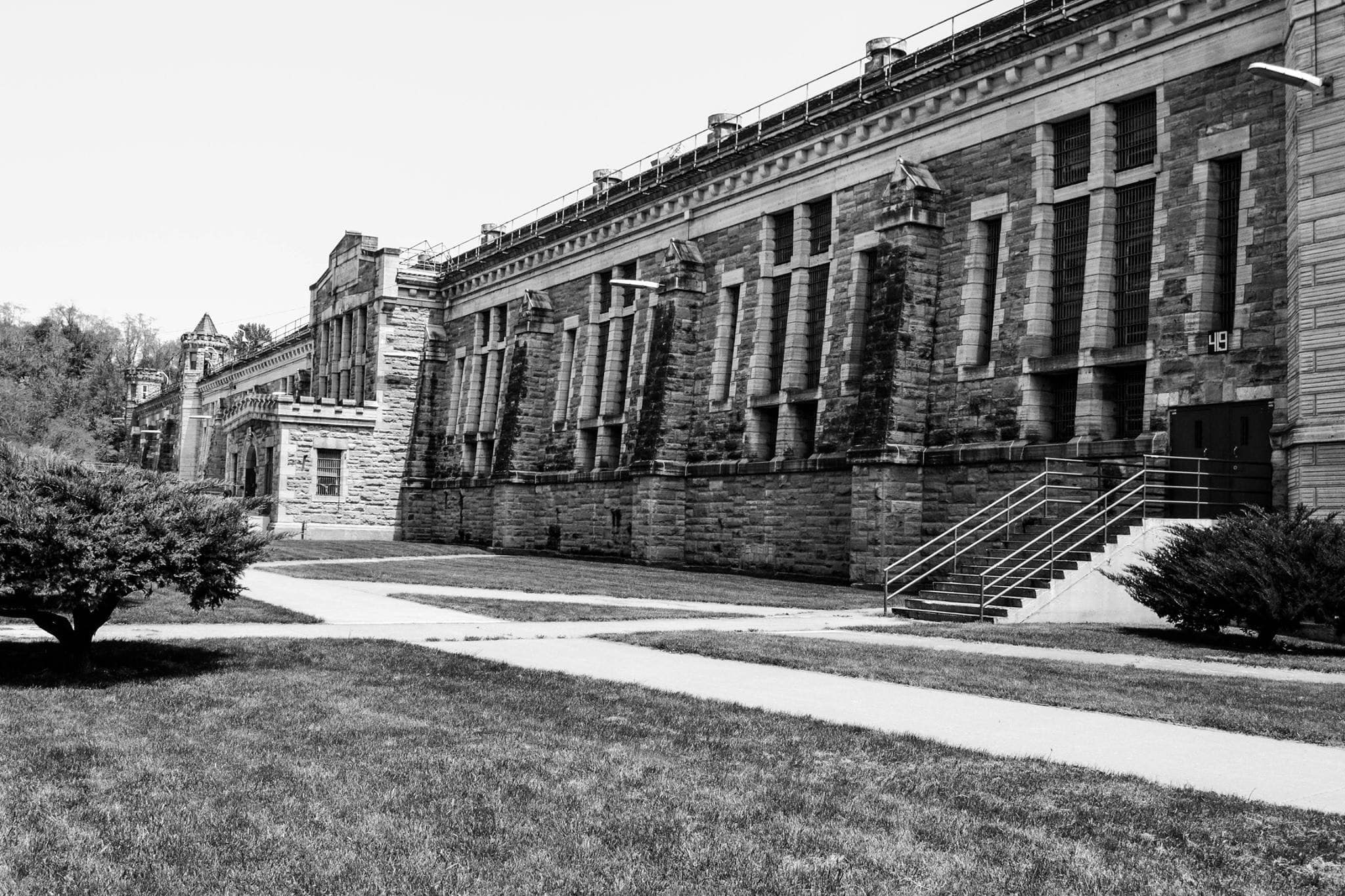
Above: Iowa State Penitentiary at Fort Madison. Criminal punishment formed part of a larger system in which legal, psychiatric, and eugenic judgments frequently overlapped.
Published opinions reveal only the small number of cases that reached Iowa’s highest court. The broader history remains scattered across local court files, police records, prison registers, psychiatric reports, and newspapers.
1911–1977:
Iowa Authorizes the Sterilization of the “Unfit”
In 1911, Iowa authorized the sterilization of certain people confined in public institutions, including those described as “moral or sexual perverts.”⁷
The first recorded operation occurred in 1912. The man subjected to it had previously been imprisoned for sodomy and was diagnosed with “sexual perversion with dementia praecox.”⁸ His case is one of the clearest surviving examples of Iowa’s criminal, psychiatric, and eugenic systems operating upon the same person.
The legislature expanded the law in 1913, expressly grouping “moral and sexual perverts” with people labeled criminal, “feeble-minded,” mentally ill, addicted, diseased, or “degenerate.” Although a federal court struck down that version for allowing sterilization without a hearing, Iowa enacted replacement laws, and later statutes continued to target people classified as “moral degenerates” or “sexual perverts.”⁹–¹⁰
By 1948, Iowa had sterilized 891 people. The surviving totals do not identify how many were selected specifically because of perceived sexual or moral deviance, but the statutes establish that such classifications were an express basis for state reproductive control. Iowa’s mandatory eugenic-sterilization law remained in force until 1977.¹¹
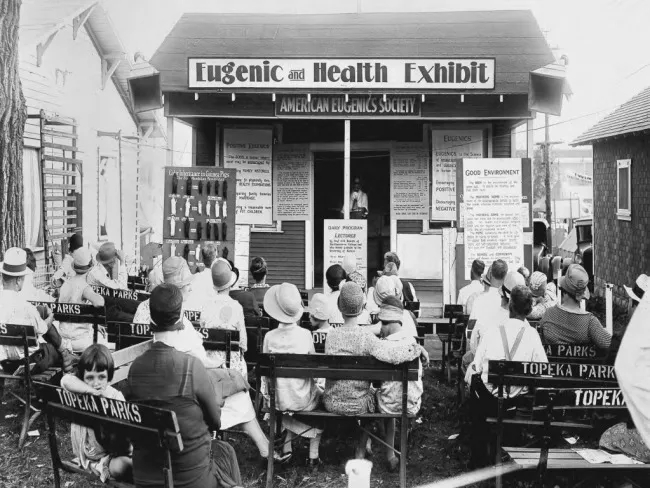
Above: “Eugenic and Health Exhibit,” American Eugenics Society, c. 1920s. Public exhibitions taught Americans that criminality, poverty, disability, and sexual “degeneracy” were hereditary threats. Iowa’s sterilization statutes belonged to this broader movement and expressly permitted state action against people classified as sexually or morally deviant.
1955:
The Sioux City Roundup:
Confinement Without Conviction
Following the brutal murders of two children in Sioux City in 1954, public fear and outrage intensified into a broader panic over homosexuality and supposed sexual deviance. That panic reflected a wider national climate in which homosexuality was widely portrayed by police, psychiatrists, lawmakers, and the press as a hidden social danger linked to criminality and threats against children.
In 1955, police arrested twenty men whom authorities never claimed had any connection to the murders.
Under an Iowa law that classified homosexual men alongside child molesters and violent sexual offenders as potential “sexual psychopaths,” the men were committed to a state mental institution until officials considered them “cured.” They were not convicted of the child murders that triggered the panic, nor were they accused of participating in them. Their homosexuality—or the authorities’ perception of it—became the basis for their confinement.
Journalist Neil Miller later reconstructed the roundup through interviews with formerly incarcerated men, law-enforcement officials, attorneys, hospital staff, and relatives of the victims. His account describes an institution in which confined men supplied inexpensive labor and where shock treatment was among the therapies used.¹²
The roundup collapsed consensual adult relationships into the same institutional category as abuse and violent crime. The result was not protection from crime. It was the confinement of people who had not been connected to the crimes used to justify the panic.
Surviving accounts describe those detained as homosexual men, although historical classifications do not necessarily capture how every individual understood themselves.
What the record establishes is disturbing enough: once officials classified a disfavored population as inherently immoral, diseased, or dangerous, the state could remove people from public life without showing that they had committed the crimes that produced the panic.
1965–1983:
A Civil‑Rights Law That Did Not Protect Transgender Iowans
Iowa enacted its Civil Rights Act in 1965. Gender identity was not among its protected categories. For years, that omission remained largely invisible because no transgender plaintiff had yet forced the state’s institutions to say publicly whether the law protected her.
Audra Sommers eventually did.
April 22–25, 1980:
Audra Sommers Is Hired, Questioned, and Fired
On April 22, 1980, Audra Sommers began clerical work for Budget Marketing in Des Moines. She worked for approximately three days without any reported performance problem. After a former acquaintance recognized her, the company questioned her about what the Iowa Supreme Court later called her “sexual status,” told her she could not use the women’s restroom, and terminated her employment.¹³
Sommers filed complaints alleging sex and disability discrimination. The Iowa Civil Rights Commission refused to investigate, ruling that it lacked jurisdiction. A district court agreed. Sommers appealed to the Iowa Supreme Court.
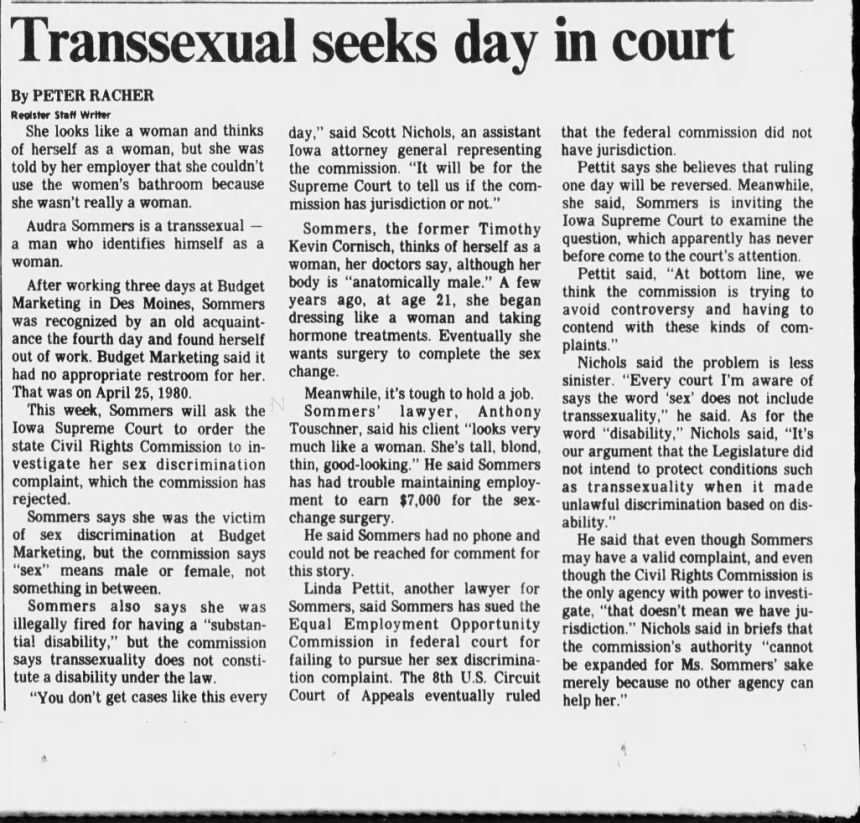
Above: “Transsexual Seeks Day in Court,” Des Moines Register, 1983. Audra Sommers asked the Iowa Supreme Court to require the Iowa Civil Rights Commission to hear her discrimination complaint. The Commission argued that the statutory word “sex” did not encompass transsexuality and that it therefore lacked authority to investigate her complaint.
July 20, 1983:
Iowa’s Highest Court Recognizes the Harm and Denies a Remedy
On July 20, 1983, the Iowa Supreme Court affirmed the Commission’s refusal to hear Sommers’s complaint. It held that the Civil Rights Act’s prohibition against discrimination because of “sex” did not encompass what the opinion called “transsexuality,” and that Sommers did not qualify under the disability provisions then in effect.¹⁴
The Court did not deny that discrimination had occurred. Instead, it wrote:
“While we do not approve of such discrimination, we do not believe it is prohibited by the Iowa Civil Rights Act.”¹⁵
The Court acknowledged the discrimination while holding that the statute provided no remedy. The result was not neutrality. Iowa recognized the injustice while drawing its legal protection around Sommers rather than extending it to her. Sommers—and other transgender Iowans situated like her—were therefore left without a statewide civil-rights remedy, not because the harm was invisible, but because the law had drawn its protective boundary around them.
1983–1996:
The Legal Void and the Missing Record
Sommers established that Iowa’s Civil Rights Act did not protect transgender people. For the next twenty-four years, no express statewide protection filled that void.
The scarcity of published cases from this period should not be mistaken for an absence of discrimination. People excluded from legal protection were also less likely to obtain counsel, receive a hearing, or produce the kinds of records that survive in legal history.
1996–2006:
Protection Depended on Where a Person Lived or Worked
In 1996, Iowa City and the University of Iowa adopted protections based on gender identity—more than a decade before the state legislature acted.¹⁶ In 1999, Governor Tom Vilsack issued an executive order extending similar protection to executive-branch employees. Twenty-three Republican legislators challenged the order, and a Polk County district judge ruled against it in December 2000, concluding that the governor had exceeded his authority by effectively adding protections not enacted by the legislature.¹⁷
The result was a patchwork. A transgender person might receive protection through a particular city, university, or employer while remaining legally unprotected elsewhere in the state.
From the Hidden Record to a Firsthand Account
Statutes and appellate opinions survive. Many of the people processed beneath them do not.
A person can be misclassified in government records, arrested under false pretenses, wrongly convicted, denied an appeal through procedural traps and corrupt longstanding precedent, and severely harmed behind closed courtroom doors—without the real story ever coming to light.
What survives instead is the official version: the charge, the docket entry, the judgment, the institutional file.
A record that makes the state’s victim look exactly as the state portrayed them: not as the person harmed, but as the predator.
What remains is the more comfortable—and false—institutional record. A record that protects local police, courts, attorneys, and predatory administrations from accountability and allows them to remain in power.
When I returned to Iowa in 2006—less than one year before Iowa added gender identity to its Civil Rights Act¹⁸—I had already spent years undergoing medical treatment and living my life as Alexandra.
But my older Iowa records did not reflect who I was, and I knew nothing of the state’s long history of persecuting LGBT+ people described above.
That discrepancy became the opening through which police, courts, attorneys, and institutions began rewriting my life in their own language.
False arrests. False information entered into government records. Plea agreements made behind closed doors without my knowledge or consent.
I did not yet know it, but I had just entered the next chapter of Iowa’s hidden history.
And the beginning of my fight for justice.
Next Section: Intersex in Iowa: Sondra Wilson's Backstory.
Endnotes (Chicago Manual Style)
¹ John F. Oliven, Sexual Hygiene and Pathology: A Manual for the Physician and the Professions, 2nd ed. (Philadelphia: J. B. Lippincott, 1965), 514; Joanne Meyerowitz, How Sex Changed: A History of Transsexuality in the United States (Cambridge: Harvard University Press, 2002), 118–19.
² See Jonathan Ned Katz, The Invention of Heterosexuality (Chicago: University of Chicago Press, 1995), 78–110.
³ Estes v. Carter, 10 Iowa 400 (1860).
⁴ Iowa Acts 1902, ch. 28.
⁵ State v. Todd, 110 Iowa 631, 82 N.W. 322 (1900); State v. McGruder, 125 Iowa 741, 101 N.W. 646 (1904); State v. Gage, 139 Iowa 401, 116 N.W. 596 (1908).
⁶ Iowa Acts 1907, ch. 152.
⁷ Iowa Acts 1911, ch. 129.
⁸ See Paul A. Lombardo, Three Generations, No Imbeciles: Eugenics, the Supreme Court, and Buck v. Bell (Baltimore: Johns Hopkins University Press, 2008), 104.
⁹ Iowa Acts 1913, ch. 175.
¹⁰ Iowa Acts 1929, ch. 266.
¹¹ “Report of the State Board of Control,” 1948; Iowa Acts 1977, ch. 77; In re Guardianship of Matejski, 419 N.W.2d 576, 578 (Iowa 1988).
¹² Neil Miller, Sex-Crime Panic: A Journey to the Paranoid Heart of the 1950s (Los Angeles: Alyson Books, 2002), publisher’s synopsis reproduced on Amazon, accessed July 21, 2026.
¹³ Sommers v. Iowa Civil Rights Commission, 337 N.W.2d 470 (Iowa 1983).
¹⁴ Ibid.
¹⁵ Ibid., 473.
¹⁶ University of Iowa, “Timeline of LGBTQ+ History,” Office of Diversity, Equity, and Inclusion.
¹⁷ “Judge Shoots Down Governor’s Executive Order on Gays,” Radio Iowa, December 8, 2000.
¹⁸ Iowa Acts 2007, SF 427.