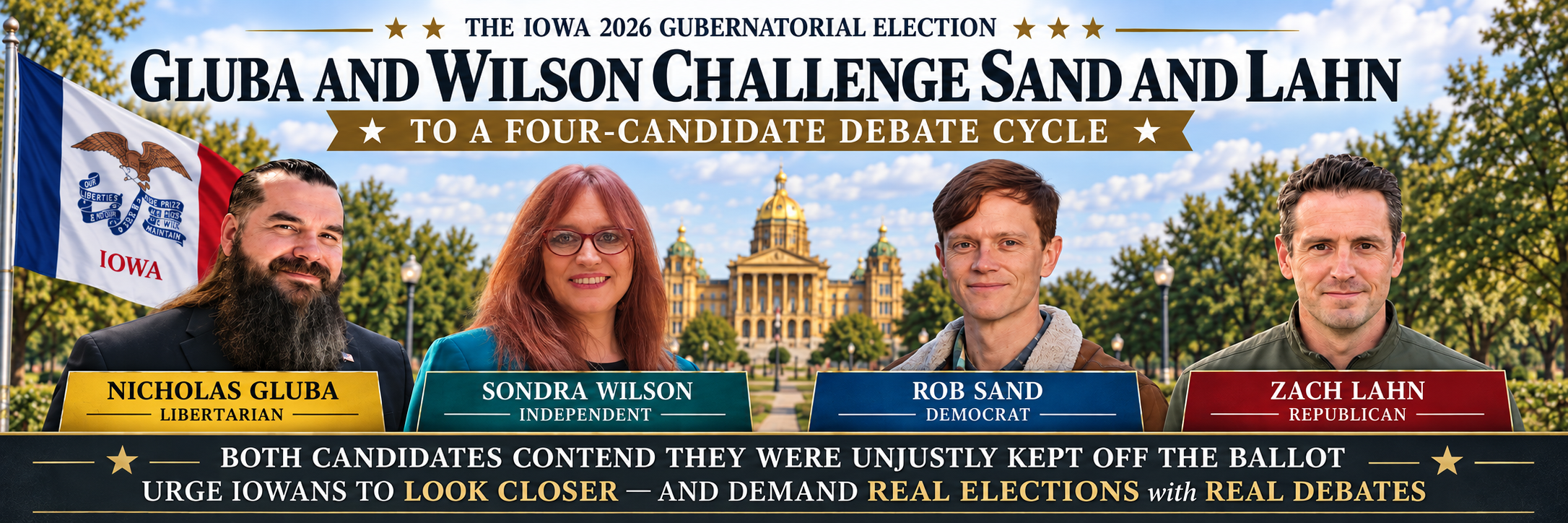
Two Candidates Wrongfully Kept Off the Ballot Ask Iowans to Stand Up
Libertarian Nicholas Gluba and Independent Sondra Wilson
Urge Iowans to Demand a Fair 2026 Gubernatorial Election
By Sondra Wilson | Updated September 18, 2026
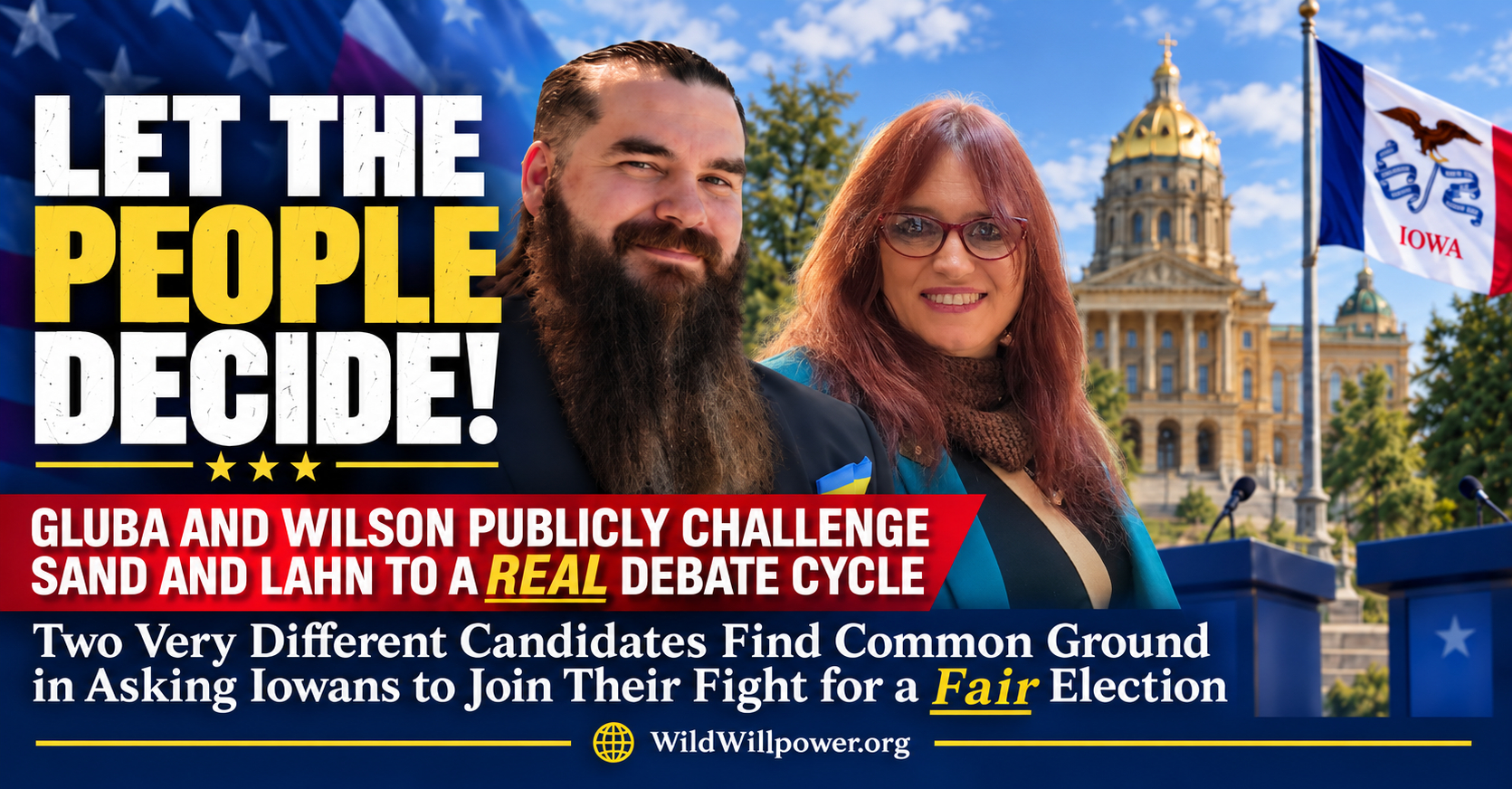
Two Very Different Candidates Find Common Ground
in a Fight for Iowa's Election Integrity
Many Iowans saw the headlines.
They saw that Nicholas Gluba and his original running mate, Jules Cutler, were removed from the ballot by an all-Republican State Objection Panel. The court later upheld that decision even though Judge Joseph Seidlin expressly disagreed with the Panel’s finding concerning whether Cutler attempted to submit the required affidavit.
Others recall Teodora Mitov interviewing Wilson about her unique platform on WHO News, only to notice that she later completely disappeared from the campaign cycle.
Now, both candidates are urging Iowans to look "beyond the headlines" and learn the real stories. They're also pointing to what they argue are the mechanisms through which independent and third-party voices are systematically squeezed out of the political conversation.
The Real Reason Nicholas Gluba Was Kept Off the Ballot
The Real Reason Sondra Wilson Was Kept Off the Ballot
Wilson and Gluba reiterate that this is not a story about two candidates simply failing to meet Iowa's ballot-access requirements. They argue that is the misleading narrative Iowans have been given—and they are asking voters to look at what actually happened.
The candidates hold starkly different political philosophies, platforms, and visions for Iowa. Yet they have united around a singular premise: that Iowa's statutorily-regulated election structure allows for intentional political sabotage to remain unchecked, while providing no relief to campaigns that become derailed by such means: Iowa voters pay the price for Iowa's poorly-designed election framework.
Wilson noted:
"A poorly-designed statutory framework that fails to adequately safeguard Iowa's elections against outside interference is what allowed both of our campaigns to be derailed. But that framework cannot prevent Iowans from looking at what really happened and demanding a real election with all the candidates.
When the letter of the law produces injustice, the spirit of the law needs to prevail."
September 17:
Formal Four-Candidate Debate Challenge Delivered to Rob Sand and Zach Lahn
On September 17, Gluba and Wilson formally delivered their joint debate challenge to the Sand and Lahn campaigns, with representatives of the Republican Party of Iowa, Iowa Democratic Party, and Libertarian Party of Iowa copied on the email.
The email included a joint-statement from their campaigns, and a link to an online petition Iowans are signing to demand a "real" election cycle.
As Wilson puts it:
"Iowans will have a 4-candidate debate cycle, or Iowans will have a fake election. There is no in between.
Doesn't matter who you plan to vote for, or which party you prefer.
The bigger issue is Iowa's election integrity. It is far more important than party loyalty."
The email also included a separate statement from Wilson urging Sand and Lahn to examine Nicholas Gluba's case more closely. In that statement, Wilson argues that Gluba was wrongfully excluded from the ballot and describes his treatment as “disgraceful,” particularly given his service in the U.S. Marine Corps.
Wilson's statement urges both campaigns to stand up for something more important than partisan divides, noting:
"Nicholas Gluba is a United States Marine Corps veteran who stood up to protect the rights and safety of every Iowan.
Now it is time for Iowans to stand up for Nicholas Gluba."
How Ballot Exclusion Turned Into a Debate Challenge
Days prior to the joint-statement, Wilson posted a statement on Facebook addressing what she claims were derogatory statements made by Democratic candidate Rob Sand about transgender Iowans. She then emailed a copy to the Sand campaign and Democratic Party of Iowa.

Wilson responded:

Wilson, who is also the founder of Wild Willpower, contacted Gluba, who previously told her about how he and Cutler were kept off the ballot.
They compared their experiences, concluded that both campaigns had been unjustly excluded from the ballot, and reached a point of agreement despite their substantial political differences:
a handful of officials possessed the power to prevent their names from appearing on the ballot, but Iowa voters can examine what really happened, hear from all four candidates, evaluate their platforms, and vote accordingly.

Both candidates are hopeful that the Lahn and Sand campaigns—and the major parties—will put election integrity ahead of partisan politics.
Gluba and Wilson are asking Iowans to help by signing the petition, sharing this page, and contacting candidates, political parties, journalists, media organizations, civic groups, universities, and prospective debate hosts to request a four-candidate debate cycle.
State Officials Have Been Moving the Goalposts:
A Growing Threat to Iowa Elections
Within the past five years, Iowa state officials have enacted several changes that made important ballot-access and party-recognition requirements more demanding for independent candidates, nonparty political organizations, and emerging political parties.
2021-2022:
Republican Lawmakers More Than Doubled Petition Requirements
Before 2022, candidates for governor and other statewide offices seeking nomination by petition were required to obtain at least 1,500 signatures from eligible electors residing in at least 10 counties. [1]
Beginning with elections held in 2022, Iowa increased the requirement for candidates for governor, president, and U.S. Senate to 3,500 signatures, including at least 100 signatures from each of 19 counties.[2]
The changes were enacted through Senate File 413, a broad election bill passed in 2021. The Iowa Senate approved SF 413 by a vote of 30–18, and the Iowa House approved it 57–37.[3] The legislation was advanced by Iowa's Republican legislative majority and signed by Republican Gov. Kim Reynolds.[4]
2021-2022:
Nonparty Convention Requirements Increased
Iowa provides another route to nomination through conventions or caucuses conducted by nonparty political organizations, or NPPOs.
Before the 2021 changes took effect, a statewide nomination through that process required participation by at least 250 eligible electors, including at least one elector from each of 25 counties.[5]
Beginning with elections held in 2022, Iowa doubled the statewide attendance requirement to 500 eligible electors, while retaining the 25-county geographic requirement.[6]
These changes were also enacted through SF 413.
2025-2026
Political-Party Status Became Harder to Retain
For years, Iowa's statutory definition of a political party looked to whether its candidate for president or governor received at least 2 percent of the statewide vote at the last preceding applicable general election.[7]
That changed through House File 954, enacted in 2025.
Iowa law now looks to the last three preceding general elections when determining whether a political organization satisfies the statutory vote threshold for recognized political-party status.[8]
The partisan division on HF 954 was especially clear. The Iowa House passed the bill 65–31. According to the official House roll call, all 65 yes votes came from Republican representatives and all 31 no votes came from Democratic representatives.[9] The Iowa Senate subsequently passed the bill 32–15.[10]
HF 954 as originally introduced went even further, proposing to increase the party-recognition threshold itself from 2 percent to 10 percent. That proposal was removed before final passage; the enacted law instead adopted the three-election requirement.[11]
For Wilson and Gluba, this makes their exclusion especially consequential, which is part of the reason they're asking Iowans to *look closer* at their cases, because there is more to their cases than the initial headlines conveyed.
Republican Legislative Majorities Enacted These Changes
The legislative record does not support describing these statutory changes simply as something that Iowa's two major parties enacted together.
The major restrictions discussed above were enacted during Republican control of the Iowa Legislature, generally over Democratic opposition.[12]
Sign & Share the Petition to Demand a Real Gubernatorial Election
Iowans deserve the opportunity to hear from all four candidates.
If you support a real four-candidate debate cycle for Iowa’s 2026 gubernatorial election, please sign and share the petition:

Please share the petition with friends, family, journalists, civic groups, universities, community organizations, prospective debate hosts, and others across Iowa.
Help Spread the Word
Please share this page on social media, by email, and with Iowa journalists, civic organizations, universities, political parties, candidates, and prospective debate hosts.
Copy and paste:
Iowans deserve to hear from all four gubernatorial candidates in 2026. Nicholas Gluba and Sondra Wilson are challenging Rob Sand and Zach Lahn to participate in a real four-candidate debate cycle.
Read the candidates’ stories, sign the petition, and help let Iowans decide:
This Page Will Continue to Be Updated
This page and the associated links will continue to be updated as the 2026 campaign progresses, additional information becomes available, and the public debate challenge develops.
Thank you for supporting open debate, informed voters, and fair elections in Iowa.
Endnotes
[1] Iowa Code § 45.1 (2021), requiring at least 1,500 signatures and signatures from eligible electors residing in at least 10 counties for applicable statewide nominations by petition.
[2] Iowa Code § 45.1 (2022); 2021 Iowa Acts, SF 413. Beginning with the 2022 election cycle, applicable statewide candidates were required to obtain at least 3,500 signatures, including at least 100 signatures from each of at least 19 counties.
[3] Iowa Legislature, Bill History for SF 413, 89th General Assembly. SF 413 passed the Iowa Senate 30–18 on February 23, 2021, and the Iowa House 57–37 on February 24, 2021.
[4] Iowa Legislature, SF 413 Bill History. The bill was reported enrolled and signed by Gov. Kim Reynolds on March 8, 2021.
[5] Iowa Code ch. 44 (2020), requiring at least 250 eligible electors for the applicable statewide nonparty nominating convention or caucus, including representation from at least 25 counties.
[6] Iowa Code ch. 44 (2022); 2021 Iowa Acts, SF 413. The statewide participation requirement increased to 500 eligible electors while retaining the 25-county geographic requirement.
[7] Iowa Code § 43.2 prior to the 2025 amendment, defining political-party status by reference to the applicable presidential or gubernatorial candidate's performance in the last preceding general election.
[8] Iowa Code § 43.2 (2026); 2025 Iowa Acts, HF 954. The law now refers to the applicable vote threshold across the last three preceding general elections.
[9] Iowa House Voting Report, HF 954, March 25, 2025. The official roll call records 65 Republican representatives voting yes and 31 Democratic representatives voting no; four members were absent or not voting.
[10] Iowa Legislature, Bill History for HF 954, 91st General Assembly. HF 954 passed the Iowa Senate 32–15 on April 7, 2025, after passing the House 65–31.
[11] HF 954 as introduced proposed increasing the party-recognition vote threshold from 2 percent to 10 percent. The enrolled version did not enact that proposal and instead adopted the three-election requirement.
[12] SF 413 passed 30–18 in the Senate and 57–37 in the House in 2021. HF 954 passed 65–31 in the House and 32–15 in the Senate in 2025; the official House roll call on HF 954 shows Republicans supplying all 65 affirmative votes and Democrats all 31 negative votes.
First Amendment Political Speech / Image Credits / Fair Use Notice
This page, the associated petition, and the accompanying graphics are published in connection with First Amendment-protected political speech, petitioning activity, election commentary, candidate identification, and public-interest discussion concerning Iowa’s 2026 gubernatorial election.
Third-party reference photographs are incorporated into new editorial and political graphics for purposes of identifying candidates and facilitating public discussion concerning an ongoing election. The use of third-party photographs is asserted in good faith as fair use in accordance with 17 U.S.C. § 107. The U.S. Copyright Office describes fair use as a longstanding component of American copyright law and maintains a Fair Use Index documenting judicial decisions applying the doctrine.
Image reference credits:
- Nicholas Gluba: Iowa Public Radio, “Libertarian Gluba joins race for Iowa 1st District,” published June 18, 2024.
- Sondra Wilson: Photograph courtesy of Sondra Wilson for Iowa Governor.
- Rob Sand: Leadership Now Project, Rob Sand candidate profile.
- Zach Lahn: Iowa Public Radio, “Republican Zach Lahn launches campaign for Iowa governor,” published November 6, 2025.
No endorsement by the original photographers, publishers, or depicted candidates is implied. Copyright in the original photographs remains with the respective photographers and/or rights holders.