
This article continues from May 22, 2006 — Arrested Under False Pretenses in Ames, Iowa: part of the Iowa's Dark History series.
Firsthand testimony by Sondra Wilson. Updated 7/20/2024.
_________________________
On July 21, 2006, I went to the District Courthouse in Ames, IA, for the trial regarding the false arrest that happened on May 22. I was facing trespassing charges for playing a guitar off to the side of the building at the Kum & Go in west Ames, and an "interfering with official acts" charge caused by Officer Marshall writing false information about me into an affidavit within the arrest report. I was not aware, at the time, that I was facing the interfering charge, however I had pled not guilty to the trespassing charge during the arraignment, as you can see from the records posted in the previous article.
Before entering the court to face trial, I used the restroom located across the hall.
It did not cross my mind that I was doing anything wrong at all. Being transgender was not a political topic like it is today,
When I exited, Officer Blake Marshall arrested me again.
This time, I was charged with trespassing for using the women’s restroom.
According to the incident report / records summary, Officer Marshall was waiting for trial to begin when he was told that I was in the women’s restroom outside the courtroom. The summary stated that I was “currently a male who is attempting to become a female” and was still listed as male on my driver’s license. It also stated that Judge Steven Van Marel was aware of the situation and directed Officer Marshall to arrest me on a trespass charge. This is shown here, in the Incident Description:
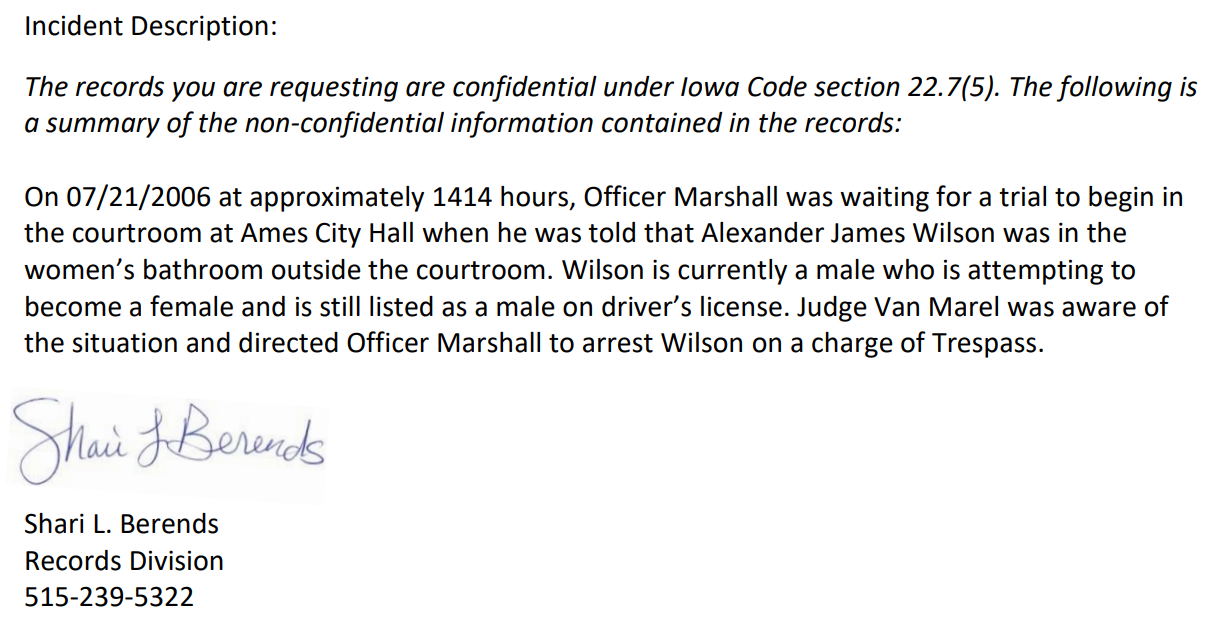
At the time, I did not know Judge Van Marel had directed Officer Marshall to arrest me. I did not learn that until many years later, after I obtained the police records and court dockets in 2022.
What the Report Left Out
The incident summary relied on Iowa records that still listed me under my former name and male sex marker.
But that was not the whole story.
By that time, my California records recognized my name as Alexandra and my sex as female. I was also undergoing gender-related medical treatment and had been using women’s restrooms for years without incident.
That context mattered.
Instead of treating the situation with care, discretion, or common sense, officials relied on outdated Iowa records and treated my use of the women’s restroom as a crime.
The report did not acknowledge my California identification records, my medical treatment, my statements to officials, or the fact that I was trying to live consistently as a woman.
To me, those omissions are central to the injustice.
The Records Iowa Refused to Reconcile
Some people may argue that Iowa’s records came first, and that California should have deferred to Iowa instead of the other way around.
But that misses the point.
By July 2006, officials were not looking at a simple situation. They were looking at conflicting government records involving a young transgender woman who had sought medical care, was living as female, and had documents from another state recognizing her name as Alexandra and her sex as female.
Iowa officials did not need to pretend the conflict did not exist. They could have documented both sets of records. They could have acknowledged that I had informed them I was transgender and undergoing medical treatment. They could have used discretion. They could have treated the matter as a records conflict requiring care, not as a crime.
In my view, the constitutional issue was not simply whether California’s records automatically defeated Iowa’s older records. The issue was that Iowa officials treated only Iowa’s outdated record as real, omitted the rest of the context, and used that one-sided record to justify arresting me for using the women’s restroom.
Whether understood through the Full Faith and Credit Clause, due process, equal protection, or basic fairness, the government should not criminalize a person by ignoring the very records and facts that explain the situation.
Young, Vulnerable, and Unprepared for the Legal System
I did not understand the legal system in 2006.
I did not know what a docket was. I did not know how to challenge a police report. I did not know how to correct court records. I did not know how to protect myself from official documents that misgendered me, omitted important context, and framed me as a trespasser for using the restroom.
I was young, transgender, medically vulnerable, and already dealing with housing instability. I had been living primarily in California, where I was able to receive gender-related medical care, and I had hitchhiked back to Iowa to visit family and friends.
Some people in my life supported me. Others did not.
But I was not prepared for police, judges, court filings, criminal charges, and public records that would follow me for years.
I did the best I could with the knowledge, support, and resources I had.
Temporary Relief
After I was arrested, I called my family from jail. My father, concerned about what had happened, helped connect me with attorney Gordon Allen.
Mr. Allen came to meet with me.
As I understood it at the time, he helped arrange temporary relief from the City of Ames: a public apology letter and a $1,500 check.
I believed the apology letter and check meant the City of Ames had recognized that I had been treated unfairly.
I also understood Mr. Allen to be telling me that this kind of case was unprecedented. He told me that the letter could help establish a precedent so that, if this happened to another transgender person in the future, that person might be in a stronger position to sue.
At the time, I accepted that arrangement because I trusted the attorney who had come to help me. I believed the situation had been resolved in a way that acknowledged I had been wronged.
For many years, I thought of this painful experience as a partial victory.
A Law Changed Soon After
The apology letter was not enough for me.
Soon afterward, I hitchhiked to the Iowa State Capitol because I wanted lawmakers to understand that transgender people needed explicit legal protection.
The representative who came to speak with me was Beth Wessel-Kroeschell.
I gave her a copy of the apology letter and explained what had happened. She told me the timing was remarkable because she was preparing to present legislation to add gender identity and sexual orientation to the Iowa Civil Rights Act.
Soon after, Iowa became one of the first states to explicitly protect transgender people from discrimination.
For years, I believed this meant something good had come from what happened to me. I believed my experience had helped show why legal protections were necessary.
What I Did Not Know Then
Years later, in 2022, after returning to Iowa and obtaining the court dockets, I discovered something that changed how I understood the entire situation.
The records showed that my not-guilty pleas had been changed to guilty as part of a plea arrangement.
I maintain that I did not knowingly authorize or consent to those plea changes.
That discovery devastated me.
For years, I believed the City of Ames’s apology letter and check meant the City had acknowledged wrongdoing. Instead, the court record still made it appear that I had been guilty.
I later submitted records requests to the City of Ames and Story County seeking records of the apology letter, the check, and the contents of the plea arrangement referenced in the court filings. As I understand the responses, the government did not have records preserving that context. That issue is explained more fully here: November 2022 — The Pleas I Did Not Know Had Been Changed.
I later filed a complaint with the Iowa Supreme Court Attorney Disciplinary Board regarding the attorney who had represented me. The Board’s response confirms that I alleged guilty pleas had been entered without my knowledge or consent, although the Board dismissed the complaint because it could not independently verify the old conversation after so many years.
I explain that discovery in more detail here: November 2022 — The Pleas I Did Not Know Had Been Changed.
Why This Matters
This incident was not just about one restroom.
It was about what happens when government officials rely on outdated records while ignoring a transgender person’s medical reality, lawful documents from another state, and basic human dignity.
It was about being treated as a legal problem instead of a person.
It was about being young, frightened, and unprepared for a system that had the power to arrest me, misgender me, charge me, record me falsely, and leave consequences attached to my name for years.
This incident also became connected to later events. In 2009, Judge Steven Van Marel presided over another case against me after I was falsely accused of assaulting a manager at Culver’s Restaurant. At the time of that trial, I did not know he had directed Officer Marshall to arrest me during the 2006 restroom incident. If I had known, I would have asked him to recuse himself.
That later case is explained here: March 30, 2009 — The False Assault Charge That Helped Drive Me Out of Iowa.
Together, these events became part of a larger chain of arrests, disputed reports, plea records, courtroom decisions, and warnings that shaped the years that followed.
Return to: 2006–2009: Early Iowa Arrests, False Records, and the Road to Homelessness
Before I went into the courtroom at the District Courthouse in Ames, IA to face the above trial, I went to the restroom located just across the hall. While exiting, again Officer Marshall arrested me: this time for "trespassing into the women's restroom". Although I'd been using the women's restroom for years without issue, Officer Marshall and Judge Steven Van Marel ordered Officer Marshall to arrest me. I was not aware of Judge Van Marel's involvement in this incident until November 2022. Judge Van Marel and Officer Marshall only referred to my Iowa records while willfully ignoring and omitting my California records, statements, and medical condition within their filings with the state. For example, here is what was written for this the incident report:
Underlying issues:
I really didn't know anything about the legal system back in 2006 because they didn't teach anything about it in high school. I felt scared, intimidated, and not looked out for or cared for by these elders because of the way they treated me. I had no clue how to handle this legal predicament myself. Additionally, I had lost support from the vast majority of my friends and family after deciding to seek medical treatment to transition. I was in a vulnerable position (and still am) at that time in my life.
The state ought to have honored the Full Faith and Credit Clause of the Constitution instead of doubling down on old, outdated records. Officials should have used common sense and actually listened to me when I told them I was transgender - they should have included it in their filings. They should have been compassionate in their discretion; instead they abused their power and bullied me.
Part Three - "Temporary Relief":
When I called my family from jail to tell them I was arrested for going into the women's restroom. My dad, concerned for my situation, connected me with an attorney an attorney, Gordon Allen, who came and met me.
Mr. Allen told me that I could not sue the City of Ames because this type of case was unprecedented, but the City of Ames did agree to issue me a public letter of apology and $1500. He said that if this type of issue ever happened in the future, this letter would help set a precedent: the next person would be able to sue. He asked if this was agreeable, and I said yes. Here is a copy of the letter and the check:
Apology letter from the City of Ames (Iowa)
It would not be until years later - in 2022 - that I discovered Mr. Allen changed all three of my "not guilty" pleas to "guilty" without my knowledge or consent. I'll get back to that issue below.
Part Four - A Law Changed; Hope Arrives!!
Soon afterward, I hitchhiked to Iowa's state capitol to find a Representative to speak with. To me - the letter of apology was not enough: I wanted legislation passed to protect transgender people in the future.
The congress member who came to meet me was Beth Wessel-Kroeschell. We both remember the conversation well because Beth told me it was peculiar that I would show up on this particular day because on the following day she was scheduled to present to Congress to propose adding gender identity and sexual orientation to the list of protected classes within the Iowa Civil Rights Act! What were the odds of me showing up one day beforehand?!
I gave her a copy of the apology letter, and soon after watched on the news that the State of Iowa became the ninth state to explicitly protect transgender people against discrimination. Thank you, Beth!!
Part Five - "An Upsetting Discovery":
Sixteen years have passed since I was arrested for the license discrepancy and for "trespassing" into the restroom. Since that time, I have always thought of my experience as a "win" until recently. On November 3, 2022 - following a separate injustice involving local nonprofit Reliable Street - I ordered a copy of the docket for every injustice I've experienced here in Ames in hopes to get the records for this series of injustices set straight.
It was then - after looking what was written in the docket - that I learned Mr. Allen changed two of my pleas for the above cases from "NOT GUILTY" to "GUILTY" as part of a plea agreement I was not informed about (which I never would have consented to). I was under the impression that the City of Ames issued the apology letter and check to me because they realized I was treated unfairly. Now - more than a decade later - I have learned that the State of Iowa has absolutely no record I was wronged! I asked Mr. Allen for a copy of any documentation I may have signed wherein I consented to changing my pleas, however he said there are none. Although he told me that I verbally consented, I absolutely would not have. Here is a copy of the docket for this case where you can see that Mr. Allen changed my not guilty pleas to guilty.
While I do sincerely appreciate Mr. Allen helping to arrange the apology letter and preventing me from spending additional time in jail for crimes I had been falsely accused of, acknowledgement that the State was at fault should have been entered into the state record. Additionally, he should not have changed my pleas! I need to get these charges stricken from my record.
Iowa has no records of the apology letter:
I performed a records request with Story County and the City of Ames. The State of Iowa has no records of the apology letter or the check that was issued, nor do they have any record regarding contents of the "plea agreement" Mr. Allen referenced in his filings. The state has it incorrectly recorded that I was a male trespassing into the women's restroom. Although this does fit many peoples' political narrative, it is extremely offensive and is a major reason transgender women are so often mistreated in society today. I have contacted the City of Ames as well. They, too, have no records related to the apology letter or check. It is as if they were just scraps of paper given to me to get me to walk away happy while allowing the State of Iowa to maintain an anti-transgender political position. Here are copies of the records requests:
Records Request to City of Ames
Records Request to Story County
Notice: Although the emails from these two local governments include disclaimers warning me that the messages are confidential - I do not consent. I am exercising my First Amendment right to record public officials, and to disseminate such material.
Part Six - "Another Huge Injustice":
It was not until after reading the docket (on Nov. 4 this year) that I discovered Judge Steven Van Marel ordered Officer Marshall to arrest me for "trespassing" into the restroom. This is very disturbing, because he judged a separate case three years later - in 2009 - wherein he unjustly charged me with "assault" even though evidence indicated the truth: that I did not touch the accuser! Even the accuser's own witness stated that he saw the entire thing and that I didn't touch her, but Judge Van Marel ruled against me regardless. Now that I have learned how he was involved in me being arrested years earlier, I believe he ought to have recused himself from that case. Instead I have this assault charge on my record which should never have been put there. To me this shows hard evidence that the two City of Ames employees who warned me I "may be in danger" from "other local officials" who were "upset" about the restroom issue - told the truth. Read about this case, as well as a second related case, here:
Following an unjust ruling, officer warns Ames resident to "leave the state" for her safety (2009)
Limitations Period - still a valid case:
Some people have said these instances "happened too long ago", however the discovery rule and the doctrine of equitable tolling extend limitations periods in cases wherein the fraud was not discovered until after the victim discovered the evidence.
Seeking attorney and donations:
I am a victim of color of law crimes, malicious prosecutions, and fraud, and I am willing and wanting to testify to everything written above. I also possess additional evidence for all these cases.
I will be pursuing pecuniary damages and equitable remedies from the State of Iowa. Equitable remedies are described here: https://wildwillpower.org/cases-in-progress/iowa-cases
The fact that I was warned by more than one City of Ames official that my life may be in danger, and was literally homeless for more than a decade (includes a great deal of suffering) as a result of these injustices, needs to be accounted for. I'm not sure how else to do this other than make the information public and try to find legal representation (state or federal attorney - please help). I believe there are grounds to sue the State of Iowa for the following:
- negligence - not teaching anything about criminal or civil law in public schools, leaving people who are falsely accused of crimes or torts defenseless and at the mercy of essentially unsupervised courts.
- neglect - failure to provide medical coverage or rights protections for transgender patients despite the American Medical Association's assessments and recommendations.
- defamation - Kim Reynold's defamatory comments against a specific class of persons, designed to mislead a large number of voters into believing
- reckless endangerment - between lack of medical coverage, exclusion from activities, and defamatory comments, the State of Iowa has turned away from transgender patients despite their extremely high poverty, suicide rates, and murders., thereby exacerbating problems for transgender patients throughout the state.
Thank you for caring enough to read all this!
Image Source: “Joan Halifax Quote.” A, https://www.azquotes.com/quote/921518. Wild Willpower's use protected by Fair Use.