
Iowa's Broken Judiciary Part Four:
Dangerous Precedent
District Court Sides with Ames, Iowa Businesses' Argument
that they Cannot Be Held Liable for Deceiving Civil Rights Investigators
By Sondra Wilson | Updated August 1, 2026

After the April 2025 deadline dispute, I reached a point of exhaustion. I turned much of my remaining capacity toward recovering, completing school, and rebuilding a gubernatorial campaign that had fallen far behind. The case remained unresolved, however, and the sole surviving libel claim was still pending.
How a Case Set for Discovery and Jury Trial Was Terminated Before Either Occurred
By the beginning of 2026, Wilson v. Reliable Street Inc., et al. had returned to an active trial track. The court had approved a discovery plan, set initial-disclosure deadlines, and scheduled a four-day jury trial for August 4.
What followed was not ordinary preparation for a single surviving claim. I was required to reorganize a multi-defendant case, file hundreds of pages of pleadings and exhibits, litigate the scope and timing of discovery, respond to demands for sanctions, resist summary judgment, prepare for two hearings, complete a revised pleading after the first was rejected, and research whether Iowa law truly grants absolute immunity to allegedly false or manipulated submissions made during the preliminary phase of a civil-rights investigation.
Those obligations overlapped directly with Iowa’s ballot-access period. They also continued after the statutory deadline, ultimately producing two July 15 orders that denied amendment, granted summary judgment, and dismissed the case before the disputed discovery was produced or a jury heard the facts.
This installment documents how the surviving claim moved toward discovery and trial—and how an expansive absolute-privilege theory instead ended the case before either occurred.
This page is scheduled to be finished on 8-12-2026. Please check back soon. Thank you for your interest.
This article also documents how the defendants argued that even if they did submit knowingly false, malicious, and misleading, re-arranged communications to the Iowa Civil Rights Commission, that they had "absolute privilege" to do so because, in their filings, they classified Iowa's Civil-Rights process as a "quasi-judicial proceeding" even though, during the Tier One phase of the Commission's process, I was not permitted to view their submissions through discovery, cross-examine the respondents, or other access other procedural remedies typical of a court proceeding.
Although the parties agreed to a discovery plan, and Judge Doyle ordered it so Jan. 2.
After after I made my first discovery requests, the defendants refused to comply, arguing that my discovery requests were moot because absolute privilege would protect them anyway, and that my remaining libel claim ought be dismissed as a result.
So,
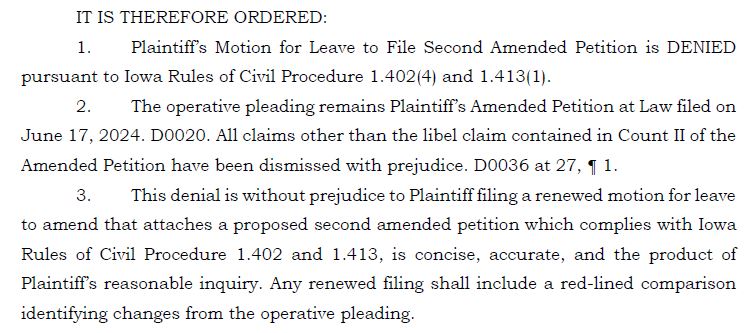
1. Plaintiff’s Motion for Leave to File Second Amended Petition is DENIED
pursuant to Iowa Rules of Civil Procedure 1.402(4) and 1.413(1).
2. The operative pleading remains Plaintiff’s Amended Petition at Law filed on
June 17, 2024. D0020. All claims other than the libel claim contained in Count II of the
Amended Petition have been dismissed with prejudice. D0036 at 27, ¶ 1.
3. This denial is without prejudice to Plaintiff filing a renewed motion for leave
to amend that attaches a proposed second amended petition which complies with Iowa
Rules of Civil Procedure 1.402 and 1.413, is concise, accurate, and the product of
Plaintiff’s reasonable inquiry. Any renewed filing shall include a red-lined comparison
identifying changes from the operative pleading.
Executive Summary
Dangerous Precedent addresses the ruling that eliminated the sole surviving libel claim under an expansive theory of absolute privilege. The defendants argued—and the district court accepted—that statements submitted during an Iowa Civil Rights Commission investigation were part of a quasi-judicial proceeding and therefore could not support liability even if knowingly false, malicious, or materially misleading. I contend, however, that even if Iowa courts classify some or all of the Iowa Office of Civil Rights process as quasi-judicial, that label should not automatically trigger absolute privilege. In Mills v. Denny, 245 Iowa 584, 588–93, 63 N.W.2d 222, 224–27 (1954), the Iowa Supreme Court held that absolute privilege must remain within “narrow and well-defined limits,” examined whether the particular proceeding actually required complete immunity, and concluded that qualified privilege adequately protected good-faith participation without eliminating accountability for malice. My unfiled memorandum further relies upon Stega v. New York Downtown Hospital, 31 N.Y.3d 661, 670–73, 107 N.E.3d 543, 550–52 (2018), which rejected absolute privilege for statements made during a preliminary agency investigation where the person defamed lacked notice, meaningful participation, judicial review, or another effective mechanism for challenging the accusations.
The case is also not limited to the words contained in the final ICRC submission. I contend that the prior modification and misleading arrangement of documents, coordination among defendants, and alleged acts of civil conspiracy undertaken before the submission should not be collapsed into one defamation claim or automatically immunized because the resulting materials were later delivered to an agency. Those acts should be evaluated on their own merits under a more fully developed pleading, including the civil-conspiracy and related claims partially set out in my Revised Second Amended Petition, for which the court denied leave to amend. My argument is that the privilege should not extend to separate wrongful acts used to create, alter, rearrange, or misleadingly present documentary evidence—particularly where the complainant received no contemporaneous hearing, cross-examination, authentication process, or meaningful opportunity to inspect and challenge the complete submissions before administrative closure.
If the recent dispositive rulings are not reconsidered and reversed, this broad privilege theory could undermine both the integrity of the Iowa Office of Civil Rights and the purpose of the Iowa Civil Rights Act. Allowing complainants or respondents knowingly to place false accusations, manipulated evidence, or materially misleading narratives into any phase of the civil-rights process without meaningful accountability would transform the agency from a mechanism for investigating discrimination into a possible mechanism for retaliating against those who report it. Respondents could allegedly conspire to construct a false narrative, use it to shape the government record and defeat the complaint, prevent discovery into how the materials were created, and then claim complete immunity because the final product entered a civil-rights proceeding. Qualified privilege can protect honest, relevant participation; absolute privilege should not create an immunity zone for the alleged corruption of the truth-seeking process itself.
Reaching those rulings required far more than responding to one motion. Between January and July 2026, I prepared two proposed amended petitions, seven major exhibit groups, replies and supporting briefs, written discovery, a motion to compel, a resistance to summary judgment, a second set of discovery requests, a motion to continue trial and extend discovery, a fifty-three-page memorandum challenging absolute privilege, and a consolidated motion asking the court to reconsider both final rulings. The docket entries alone do not convey the amount of factual reconstruction, exhibit comparison, legal research, and document preparation required. This article does.
Table of Contents
I. The Case Returned to an Active Discovery-and-Trial Track
- August 1, 2025 — Rule 1.944 Notice
- October–December 2025 — Trial Scheduling and Discovery Planning
- December 26 — Four-Day Jury Trial Set
- January 2, 2026 — Initial Disclosures Set for March 1
II. Rebuilding the Pleading and Documentary Record
- January 6–7 — Second Amended Petition and Exhibits A–G
- What the Filing Required
- January 20 — Defendants Sought Denial, Sanctions, and a Status Conference
- January 27–28 — Reply and Reply Brief
- February 9 — Hearing
- February 11 — Limited Withdrawal of Four Citations
III. Discovery Began as the Campaign Entered Its Critical Window: Defendants Ar
- March 2 — First Set of Discovery Requests
- Why the Requested Evidence Mattered
- April 1 — Defendants’ Objections
- April 6 — Motion for Summary Judgment
- April 14 — Resistance, Motion to Compel, and Rule 1.981(6) Request
- April 27 — Defendants’ Reply and Resistance to Compel
IV. The Court Narrowed the Pleading While Summary Judgment Remained Pending
- April 22 — Amendment Ruling and New Instructions
- May 2 — Motion to Continue
- May 6 — Continuance Denied
- May 26 — Hearing on Discovery and Summary Judgment
- The May 26 Hearing Occurred One Week Before the Ballot Deadline
V. Rebuilding the Case Again
- June 15 — Revised Second Amended Petition and Exhibits A–G
- What Changed From the January Filing
- June 15 — Defendants’ Resistance
- June 22 — Reply and Reply Brief
- June 24–25 — Second Discovery Requests, Continuance Request, and Corrections
VI. Two July 15 Orders Ended the Case Before Discovery or Trial
- July 15 — Leave to Amend Denied
- July 15 — Summary Judgment Granted
- Why the Two Orders Must Be Read Together
- What Evidence Had Still Not Been Produced
- What the Court’s Privilege Rule Means
VII. The Research and Reconsideration Burden Continued After Dismissal
- July 15–30 — Completing the Absolute-Privilege Memorandum
- July 30 — Consolidated Motion to Reconsider
- July 31 — Filing the Memorandum and Additional Article Exhibit
- Why the Docket Entries Understate the Work
VIII. The Dangerous Precedent
- Absolute Privilege Versus Qualified Privilege
- Preliminary Screening Was Not a Trial
- Discovery Into Document Creation Still Mattered
- Separate Pre-Submission Conduct Should Not Disappear Into Privilege
- What This Could Mean for Future Civil-Rights Complainants
IX. From Litigation Burden to Ballot-Access Harm
- What the Ballot Petition Identified at the Time
- What Happened After the Petition Was Filed
- Why the Burden Was Not a Voluntary Scheduling Conflict
- The Record the District Court Had Not Yet Seen on June 5
X. What Happens Next
- Reconsideration
- Appellate Review
- Public Examination of the Record
I. The Case Returned to an Active Discovery-and-Trial Track
August-December 2025:
The Dormant-Looking Case Was Returning to an Active Trial Track
After the April 2025 deadline dispute, I did not immediately complete the amended pleading I had attempted to prepare throughout the spring. I had reached a point of exhaustion and shifted much of my limited capacity toward recovery, school, and rebuilding my campaign for governor, which had fallen substantially behind.
The case itself had not been resolved. The October 2024 dismissal had left one libel claim pending, and I still intended to present a reorganized pleading and documentary record addressing the factual and procedural problems that had prevented the broader claims from developing.
August 1, 2025 — The Clerk Issued a Rule 1.944 Dismissal Notice
Clerk's Rule 1.944 Dismissal Notice
Filed August 1, 2025; D0068.
The clerk issued an automated notice stating that the case would be subject to dismissal on January 1, 2026 unless it was tried or an appropriate order was entered. The notice expressly warned that merely setting a trial or trial-setting conference after December 31 would not, by itself, prevent dismissal.
The notice therefore forced the unresolved case back onto an active procedural track.
October 13 — Trial-Setting Orders
D0070 — Other Order: District court administrator directed to schedule a trial-setting conference.
D0071 — Order for Trial Scheduling Conference: Conference set for October 28, 2025, at 11:00 a.m.
On October 13, the court entered D0070 directing the district court administrator to schedule a trial-setting conference. Later that day, D0071 set the conference for October 28, 2025.
The court directed the district court administrator to schedule a conference for the purpose of assigning the case for trial.
Later that day, the court issued notice that the conference would occur on October 28. The notice required participation, warned that a firm trial date would be established, and directed the parties to submit a trial-scheduling and discovery plan.
December 3, 2025 — The Court Ordered the Parties to Develop a Discovery PLan
Order Re Discovery Plan
Entered December 3, 2025; D0072.
The court found that the parties had not yet conducted the discovery conference required by Iowa Rule of Civil Procedure 1.507 or filed the required Trial Scheduling and Discovery Plan.
The order explained that the parties were jointly responsible for discussing the claims and defenses, initial disclosures, preservation of evidence, electronically stored information, privilege, discovery limits, and any other orders needed to manage the case. It required the parties to confer no later than December 24 and to file a written discovery plan within seven days afterward.
This order did more than place the case on a trial calendar. It required the parties to begin defining how discovery would occur in a case where discovery had never meaningfully begun.
December 4-22 — The Parties Negotiated the Discovery Plan
The day after the order, defense counsel contacted me to arrange the required discovery conference. I explained that my semester ended December 15, that I was completing the Second Amended Petition, and that I intended to file it after finals.
The parties initially scheduled a telephone conference for December 19. Defense counsel circulated a draft plan shortly before the scheduled call. I identified two immediate problems:
1. The draft stated that the amount in controversy did not exceed $10,000; and
2. It indicated that no discovery of electronically stored information was expected.
I objected because electronic communications were central to the case and because the relief sought exceeded $10,000. I also proposed that discovery begin with electronic documents and communications, with depositions occurring after the documentary record was developed.
Defense counsel agreed to correct the amount-in-controversy designation and revise the electronically stored information provision. The parties also agreed that the plan could preserve the right to request native files or metadata where relevance, authenticity, or completeness justified it.
The principal unresolved issue became the initial-disclosures deadline.
The Parties Agreed on Electronic Evidence but Disagreed About Timing
The final plan reflected several areas of agreement:
— the amount in controversy exceeded $10,000;
— the case would be tried to a jury;
— electronic evidence was expected;
— ordinary productions could be made in PDF format;
— documents would be Bates-numbered;
— the parties could request native files or metadata upon a showing of good cause;
— discovery requests and responses could be served by email; and
— settlement proceedings could be requested later.
The filed plan expressly marked that the parties had been unable to agree upon the timing of initial disclosures and directed the court to Attachment A. The form also recorded that the parties had conferred about electronically stored information and reached the agreement stated in the attachment.
That distinction matters. The parties did not disagree about whether discovery should occur. They disagreed about when initial disclosures should begin and how discovery should be sequenced around the forthcoming amended pleading.
December 23 — I Filed the Joint Plan and Documented the Unresolved Dispute
Trial Scheduling and Discovery Plan and Attachments
Filed December 23, 2025; D0073.
Attachment A stated both positions:
- Defendants requested initial disclosures by February 1, 2026.
- I requested that disclosures begin May 30, after the spring semester and after the proposed amended pleading and expected responsive motions could be resolved.
I explained that beginning disclosures before the operative pleading was settled could create duplication, require disclosures concerning claims that might not govern the case, and force simultaneous work on amendment, responsive motions, and discovery.
I also proposed phased discovery beginning with document production focused on electronic communications, followed by depositions after the documentary record was complete. The parties did not reach agreement on that sequencing proposal.
The email record shows that defense counsel specifically suggested checking the box indicating disagreement, attaching both sides’ positions, and including the email exchange so the court could see how the dispute developed. He later authorized me to file the plan on behalf of both parties so long as the earlier attachment was also included.
December 26 — The Court Set a Four-Day Jury Trial
Order Setting Trial and Approving Discovery Plan
Entered December 26, 2025; D0074.
The court approved the filed discovery plan and set a four-day jury trial for August 4, 2026.
The case had therefore moved from a Rule 1.944 dismissal notice to an active trial track with an approved discovery framework. But one of the most important scheduling questions—when initial disclosures would begin—remained unresolved.
December 29, 2025-January 2, 2026 — The Court Resolved the Immediate Scheduling Dispute
Defendants then filed D0075 asking the court to impose their proposed February 1 deadline.
I filed D0076 asking the court to continue the case on the active docket under Rule 1.944.
On January 2, the court entered:
- D0077, continuing the case under Rule 1.944; and
- D0078, setting the initial-disclosures deadline for March 1, 2026.
The court therefore adopted neither side’s requested date. It selected a deadline between defendants’ February 1 proposal and my May 30 proposal.
December 26 — The Case Was Set for a Four-Day Jury Trial
Judge Doyle's Order Setting Trial and Approving Discovery Plan
Entered December 26, 2025; D0074.
The court set a four-day jury trial for August 4, 2026 and approved the parties’ trial-scheduling and discovery plan. The order formally returned the surviving claim to an active path toward discovery and trial.
December 29-30 — The Parties Immediately Disputed the Discovery Schedule
The scheduling order did not resolve the parties’ disagreement over when initial disclosures should occur.
Defendants requested a February 1, 2026 deadline. Their motion again characterized my prosecution of the case as “minimal-to-nonexistent,” cited the prior continuances, invoked the rule that self-represented litigants must perform with the same competence as attorneys, and referenced the unpaid $519 venue-related fee award.
On December 30, I separately moved to ensure that the case remained on the active docket under Rule 1.944. I explained that the matter had not been abandoned, that a jury trial had been scheduled, that a discovery plan had been approved, and that active litigation concerning disclosures was already underway.
The case had therefore moved quickly from apparent dormancy to a scheduled jury trial, an active discovery dispute, and renewed pressure to define the operative pleading.
The December filings also show that I had not abandoned either amendment or discovery. Before the court set the March 1 deadline, I had told defense counsel that the Second Amended Petition was nearly complete, objected to excluding electronic evidence from the discovery plan, preserved the right to seek native files and metadata, and proposed that document discovery occur before depositions. The same categories of evidence would later become central when defendants argued that absolute privilege made discovery into authorship, drafting history, metadata, accuracy, and document preparation legally irrelevant.
II. Rebuilding the Pleading and Documentary Record
January 6-7, 2026 — I Filed a 115-Page Proposed Petition and More Than 400 Pages of Supporting Materials
Plaintiff's motion for leave to amend and Second Amended Petition
D0079–D0080
At the beginning of January, I filed the proposed Second Amended Petition and seven major exhibit groups. According to defendants’ later resistance, the combined filings exceeded 412 pages and included a 115-page proposed amended petition.
The volume did not arise from a desire to make the case larger for its own sake. The October 4 ruling had stated that referenced exhibits were not before the court and therefore could not be considered. The January filing attempted to correct that problem by integrating the factual allegations with the documentary record, organizing the materials by subject, and explaining which defendants were alleged to have participated in which events.
The proposed pleading also attempted to distinguish between claims dismissed in 2024 and claims I contended arose from later conduct, newly matured injuries, and a materially developed factual record. The filing therefore served several functions at once:
- reorganizing the remaining libel claim;
- incorporating documents previously referenced but not formally attached;
- identifying later-occurring conduct;
- separating the alleged roles of multiple defendants;
- preserving claims I contended had never been adjudicated on a complete record; and
- preparing the case for discovery and the August jury trial.
That work required more than writing a long petition. It required locating, comparing, labeling, and cross-referencing hundreds of pages of administrative records, communications, prior filings, and procedural documents.
What the Filing Required
The January submission was the result of the unfinished amendment work documented in Part Three: Plausible Deniability. Throughout 2025, I had explained that I was attempting to reorganize more than sixty exhibits into a coherent set of attachments. The January 2026 filing was the first completed version of that larger documentary project.
The filing attempted to correct a recurring structural problem in the case: allegations had repeatedly been evaluated without the complete record I believed supported them, while—as documented in Part Two: Sudden Reversal—facts controlled by defendants had been treated as missing from my pleadings before discovery occurred.
The amendment was therefore not merely an effort to add words. It was an effort to create a record that could be understood and tested.
What the Proposed Claims Meant—and What Evidence Supported Them
The proposed Second Amended Petition organized the case into ten causes of action. The legal labels can obscure what I was actually alleging, so the following explains them in ordinary language.
The exhibits were not separate from the pleading. They were organized so readers and the court could compare later accusations with the administrative record, contemporaneous communications, project agreements, and procedural history. Because many documents supported more than one claim, I link only the principal exhibits below rather than repeating every possible connection.
Agreements, Labor, and the Benefits Defendants Retained
Promissory Estoppel: Promises and Arrangements I Relied Upon
Promissory estoppel generally applies when someone makes a promise or representation, another person reasonably relies upon it, and that reliance causes harm when the promise is withdrawn or denied.
I alleged that defendants authorized and encouraged my work on the garden, prairie, open-mic events, and promotional materials; that I relied on those arrangements by contributing labor, planning, money, research, and coordination; and that defendants later denied or recharacterized the arrangements after retaining the benefits.
The strongest supporting record was Exhibit C — The Garden and Prairie Agreements, which included communications by the acting President of Reliable Street Inc. stating that I was “taking the lead” and was “in charge of the garden” along with the President of a local high school gardening club. Exhibit B — The Open-Mic and Flier Record documented similar authorization and approval involving event responsibilities and promotional materials.
The petition divided this allegation into two promissory-estoppel counts addressing distinct arrangements.
Unjust Enrichment: Keeping the Benefit of Another Person’s Work
Unjust enrichment concerns circumstances in which someone receives and retains a benefit that fairness may require them to repay or compensate.
I alleged that defendants retained the benefit of my landscaping, restoration work, planning, event promotion, project development, and other contributions while later denying or minimizing the agreements under which that work had been performed.
The principal supporting records were Exhibits B and C, which documented requests, approvals, responsibilities, labor, project coordination, and expressions of appreciation. The petition itself identified both exhibits as supporting the unjust-enrichment count.
Tortious Interference: Disrupting Existing or Expected Relationships
Tortious interference generally concerns intentional and improper conduct that disrupts an existing agreement or a reasonably expected business, professional, or economic relationship.
I alleged that defendants’ conduct interfered with the garden and prairie arrangements, my collaborative relationships, my community and professional opportunities, and other prospective relationships affected by the accusations and exclusion.
The relevant factual foundation appeared throughout Exhibits B and C, which documented the underlying collaborations, and in the later exhibits documenting the allegations I contended disrupted those relationships.
Reputation and the Government Record
Defamation: Allegedly False Statements That Damaged My Reputation
Defamation concerns false statements presented as fact that harm another person’s reputation.
I alleged that defendants made or transmitted accusations portraying me as stalking, harassing, racist, invasive, dishonest, or otherwise dangerous, and that—as documented in Part One: Iowa's Civil Rights Trap—those accusations entered the Iowa Civil Rights Commission record and later affected my personal, professional, civic, and political life.
The principal supporting materials were:
- Exhibit A — The ICRC Administrative Record, showing the statements submitted and the agency process;
- Exhibit D — The Colville Allegations and Contemporaneous Communications;
- Exhibit E— The Martinez-Related Allegations; and
- Exhibit F — Esker's ICRC Statement.
Those exhibits placed the accusations beside communications and contextual records I contended contradicted or materially undermined them.
Fraudulent Representations to a Government Agency
This claim alleged more than ordinary disagreement or advocacy. I contended that materially false or misleading representations were knowingly submitted to the Iowa Civil Rights Commission and affected the agency record and disposition of my complaint.
Exhibit A documented what entered the ICRC proceeding. Exhibits B through F were intended to permit comparison between the later submissions and the contemporaneous communications, agreements, and surrounding context. The petition expressly identified those exhibits as supporting the fraudulent-misrepresentation theory.
Civil Rights and Retaliation
Retaliation Under the Iowa Civil Rights Act
Retaliation generally occurs when someone suffers adverse action because they complained of discrimination, sought civil-rights protection, or participated in a protected process.
I alleged that after I sought mediation and filed an ICRC complaint, defendants escalated their conduct by submitting accusations, changing the characterization of my earlier participation, and later using administrative and judicial processes in ways I contended were retaliatory.
Exhibit A documented my mediation request, complaint, defendants’ submissions, the agency closure, appeal, and right-to-sue process. The remaining exhibits documented the alleged shift between the contemporaneous record and the narrative advanced after I sought civil-rights relief.
Violation of the Equality Clause of the Iowa Constitution
I alleged that defendants denied me equal treatment because I am a transgender woman.
The discrimination claim was inseparable from the original slander claim documented in my Original Petition that commenced the action in December 2023, as documented in Part One: Procedural Bombardment, and later in my Amended Petition, as documented in Part Two: Sudden Reversal.
I alleged that Willa Colville and Denise Martinez made false oral accusations about me to Sharon Stewart and Lyndsay Nissen; that Stewart and Nissen accepted those accusations without giving me meaningful notice, identifying the alleged conduct, investigating fairly, or allowing me to respond; and that they immediately imposed severe punishment by barring me from the property, ending my ongoing work, and severing relationships I had spent months building.
The accusations were not merely entered into a government record later, as documented in Part One: Iowa's Civil Rights Trap. I alleged that they caused the original exclusion itself. That is what led me to file a complaint with the Iowa Civil Rights Commission in the first place.
At the March 31 meeting described in the Amended Petition and in this new Second Amended Petition, Stewart and Nissen told me that complaints had been made about my making people uncomfortable and violating a woman’s personal space. When I asked what I had supposedly done, they refused to provide the details or identify the complainants. They then barred me from the premises and from the events and community relationships connected to Reliable Street and Lockwood Café. Judge Currie's October 4 ruling—which I strongly disagree with but never got to respond to due to events documented in Part Three: Plausible Deniability, recounted that sequence. To this day, I still have no idea what I was accused of or why I was accused of whatever it was that I was accused of. It really came from out of the blue. Frankly, I still believe it was fabricated from the beginning, which is why I have needed to have the opportunity to have a discovery phase and due process, and find out what a jury trial has to say about this. Was I treated unequally? Was I discriminated against? If young women in this society are taught that they can just accuse somebody of something like that, and authorities will take action against whoever she points at, then what kind of society do we live in? That very much damaged my reputation and caused severe distress, but now I'm getting back into the defamation claim that shouldn't have gotten dismissed. Let's continue.
I alleged that Colville and Martinez were treated as presumptively credible while I was treated as presumptively guilty. Stewart and Nissen accepted the accusations and imposed the maximum practical punishment available to them without first allowing me to know the case against me or answer it.
When a nontransgender woman accuses a transgender woman of predatory, invasive, stalking, or boundary-violating behavior, and the decision-makers automatically credit the accuser and punish the transgender woman without a fair inquiry, that differential treatment cannot be separated from gender identity.
The accusations carried a particularly destructive meaning because they echoed a longstanding stereotype used against transgender women: that we are really men, that we pose a threat to women, and that our presence in women’s or community spaces is inherently suspicious. For a transsexual woman, being falsely portrayed as stalking women, violating women’s personal space, or disregarding women’s boundaries is not an ordinary reputational injury. It directly activates the political and social rhetoric used to exclude transgender women from employment, public accommodations, medical care, bathrooms, education, athletics, and civic life.
I alleged that the consequences were immediate:
- my work and ongoing projects ended;
- I was barred from the premises;
- I was excluded from events and relationships connected to the local arts community;
- my reputation was damaged among people with whom I had worked and socialized; and
- the accusations later entered the ICRC record, where they acquired an official and continuing existence.
The original defamation claim therefore concerned the alleged oral statements that caused my exclusion. The later libel claim concerned written statements submitted to the Iowa Civil Rights Commission. They were related, but they were not the same claim.
That distinction matters because Judge Currie dismissed the original oral-defamation claim with prejudice. Only the later written libel claim survived. The court therefore permanently dismissed the claim arising from the accusations that allegedly caused my expulsion before discovery occurred and before a jury heard whether Colville and Martinez made the accusations, whether they were false, what Stewart and Nissen knew, and why those accusations were accepted without a fair process.
The proposed petition and Exhibits D and E attempted to restore the factual record necessary to examine those events. The exhibits placed the stalking, harassment, racism, and anti-LGBT+ accusations beside contemporaneous communications I alleged contradicted them. Exhibit D documented communications in which Colville described us as friends, invited me to events, requested contact and assistance, expressed appreciation, and wrote “Love you <3” shortly before the exclusion. Exhibit E placed the Martinez-related accusations beside communications and context I alleged materially undermined the later characterization.
Discovery was essential to determine:
- what Colville and Martinez actually said before March 31;
- whether they made the accusations attributed to them;
- whether their accounts changed over time;
- what Nissen and Stewart were told;
- what internal discussions occurred;
- whether anyone examined contrary evidence;
- why I was not given an opportunity to respond;
- how similarly situated nontransgender patrons, workers, volunteers, or collaborators were treated; and
- whether anti-transgender assumptions influenced the decision to presume guilt and impose exclusion.
None of that discovery occurred before the claims were dismissed.
No jury heard the original slander allegation. No jury determined whether Colville or Martinez made false accusations. No jury determined whether Nissen and Stewart discriminated by automatically accepting those accusations and punishing me because I am transgender. The dismissal with prejudice prevented those factual questions from reaching the ordinary fact-finding process.
This claim became even more important after Iowa removed “gender identity” from major portions of the Iowa Civil Rights Act in February 2025, as documented in Part Three: Plausible Deniability. That legislative act did not erase protections governing conduct that occurred while gender identity remained expressly protected. But it demonstrated why constitutional equality cannot depend entirely upon whether a temporary legislative majority chooses to retain a protected class in an ordinary statute.
Iowa’s constitutional equality guarantee is older than the Iowa Civil Rights Act. Reopening the claim was therefore not merely an effort to revisit an old pleading. It was an effort to obtain factual adjudication of an alleged act of anti-transgender discrimination and to preserve the constitutional question whether Iowa’s equality guarantee protects transgender people when statutory remedies are narrowed or removed.
The court never adjudicated that claim on a developed factual record. Denying leave prevented the original slander, the alleged presumption of guilt, the unequal process, the comparator evidence, and the discriminatory motive from being investigated, presented to a jury, preserved, and reviewed.
Alleged Coordination and Misuse of Process
Civil Conspiracy: Coordinated Participation in an Underlying Wrong
Civil conspiracy does not mean that people merely agreed with one another. It generally concerns coordinated action through which multiple people participate in an underlying unlawful or tortious act.
I alleged that several defendants coordinated the creation, transmission, adoption, or reinforcement of a shared narrative concerning my conduct, and that their statements should be examined together rather than as unrelated individual events.
The petition linked this theory across Exhibits A through G, particularly the ICRC submissions, the overlapping allegations concerning Colville and Martinez, Esker’s supporting statement, and the later procedural record.
Abuse of Process: Using Legal Procedure for an Allegedly Improper Purpose
Abuse of process does not simply mean that a party filed motions or defended a lawsuit. It concerns the alleged use of legal procedure for a purpose other than the one the procedure was designed to serve.
I alleged that defendants used service challenges, venue litigation, pleading demands, dismissal requests, evidentiary disputes, and later procedural narratives not merely to resolve legitimate legal questions, but to burden the case, prevent discovery, preserve the accusations against me, and avoid factual adjudication.
The principal supporting record was Exhibit G — The Procedural Record, which organized the litigation from pre-suit enforcement efforts through the Polk and Story County proceedings, including the service and venue disputes, the transferred record, the withdrawn evidentiary process, dismissals, and later deadline conflicts. The petition also linked Exhibits A and D to this theory because they documented the administrative record and allegations that later carried into judicial proceedings.
Whether those events legally amounted to abuse of process had not been adjudicated on the merits.
What This Structure Was Designed to Accomplish
The proposed petition did not ask the court to treat the exhibits as an undifferentiated pile of documents. It placed an exhibit index and relevance summary near the beginning so the factual allegations, legal counts, and documentary record could be read together.
The petition explained that the exhibits were “not supplementary” but central to verifying the allegations, resolving factual disputes, and evaluating whether the claims were legally sufficient. It also identified which exhibits supported which counts.
The filing was therefore extensive because the dispute involved multiple defendants, several collaborative projects, an administrative proceeding, years of communications, and a procedural history spread across two counties and multiple judicial assignments.
The volume later became a central part of defendants’ opposition. From my perspective, however, its size reflected the problem I had struggled with since 2024: the court had demanded clearer defendant-specific facts while declining to consider referenced evidence, and defendants controlled other essential information that could be obtained only through discovery.
January 20 — Defendants Sought Denial, Sanctions, and a Status Conference
Defendants’ Resistance to Motion to Amend and Request for Status Conference
Filed January 20, 2026; D0081–D0082.
Defendants argued that the proposed pleading attempted to revive claims dismissed with prejudice and improperly add Love Club LLC. They also identified four inaccurate or unrelated case citations in Exhibit G, suggested that the errors may have resulted from artificial-intelligence hallucinations, and stated that the court could dismiss the case or impose sanctions—although they asked instead for denial of amendment and a status conference.
They wrote:
“The Court would be within its authority to dismiss this action in its entirety as a sanction for the latest filings, and/or award attorneys’ fees to Defendants.”
That quotation is important because it shows that the attempted amendment immediately generated another threat of total dismissal and fees.
Placeholder points:
- defendants opposed amendment;
- raised citation errors;
- invoked possible dismissal and sanctions;
- required immediate review and response.
January 27 — l Argued That Amendment Was the Rule, Not the Exception
Plaintiff's Reply and Reply Brief
D0085–D0086
Placeholder points:
- explain page counts;
- identify research performed;
- explain why two filings were necessary;
- identify what other work was interrupted.
I filed both a reply and a supporting brief.
“Iowa Rule of Civil Procedure 1.402(4) provides that leave to amend ‘shall be freely given when justice so requires.’”
“The Second Amended Petition responds directly to that posture by attaching and organizing documentary evidence previously referenced and refining the legal framing of Plaintiff’s claims.”
“The volume of the amended pleading reflects the evidentiary record itself, not an attempt to evade procedural limits.”
“Denying leave would entrench procedural fragmentation and elevate procedural form over substantive adjudication.”
Those filings argued that the new pleading clarified surviving claims, incorporated exhibits previously referenced but not considered, and included later-occurring conduct and newly matured injuries.
February 9 — Hearing
D0087
I do not have a transcript I am prepared to rely upon for a detailed reconstruction of the hearing. My recollection is that the discussion focused heavily on the citation errors, the duration and volume of the litigation, and defendants’ contention that the case should end. Because that recollection is not presently supported by a transcript I have independently verified, I do not rely upon it as a factual account here.
February 11 — I Withdrew the Challenged Citations
Plaintiff's Limited Notice of Withdrawal
D0088
Use this carefully:
I reviewed the challenged authorities, withdrew the four citations rather than defending material I could not verify, and clarified that the remaining factual and documentary record was unaffected.
The court scheduled a February 9 hearing on the motion for leave to amend.
After reviewing defendants’ citation objections, you filed a limited notice expressly withdrawing four challenged citations and stating that you did not rely upon them for any claim or legal argument. You also clarified that no other portion of Exhibit G was affected.
I did not defend citations that I could not verify. On February 11, I filed a limited notice withdrawing the four authorities defendants had challenged, expressly disclaimed reliance upon them, and attempted to ensure that the court record accurately reflected the correction.
III. Discovery Began as the Campaign Entered Its Critical Window:
Defendants Argue The Dangerous Precedent
March 2 — I Sent the Defendants the First Set of Discovery Requests
Plaintiff's first set of discovery requests
D0091
The docket screenshot and later filings support this date, even though it appears attached through the April 14 filing. The article should explain the actual requests, not merely say “discovery.” Relevant categories included authorship, drafts, native files, metadata, revision history, communications, chronology, transmission, and reliance.
April 6 — Defendants Filed Motion for Summary Judgement, Arguing "Absolute Privilege" for Submissions Sent to Iowa Civil Rights Commission
Defendants' Motion for Summary Judgement and Facts Supporting
D0089-D0090
This should be one of the article’s turning points:
Before producing the disputed document-creation evidence, defendants asked the court to terminate the remaining claim as a matter of law.
Then quote their core theory from the memorandum and describe what it meant.
April 14 — I Filed a Motion to Compel for Discovery and a Resistance to Motion for Summary Judgement; Sought Clarification
D0091
Emphasize that this was not one simple motion. The docket shows:
- omnibus motion to compel and clarify;
- resistance to summary judgment;
- Attachment A: first discovery requests;
- Attachment B: defendants’ objections.
That is a significant drafting and evidentiary event.
IV. The Court Narrowed The Pleading
While Summary Judgement Remained Pending
April 22 — Multiple Orders
Judge Doyle's Order
D0092–D0095
Separate these carefully:
- pretrial conference order;
- May 26 hearing order;
- clarification that the 2024 amended petition remained operative;
- broader order addressing numerous items.
This is where the article should show that amendment, discovery, summary judgment, and trial preparation were all active simultaneously.
Apr. 26, 2026 — Defendants filed a motion for summary judgment, arguing that my libel claim should be dismissed immediately, and that there should be no trial. They argued that their statements to the Iowa Civil Rights Commission were protected by "absolute privilege" because the ICRC is a quasi‑judicial tribunal. , stating, “[Absolute privilege] applies regardless of whether the statement was false… or made with ill will.” They further argue that the ICRC is a quasi‑judicial tribunal, writing in the same filing that “The ICRC satisfies every criterion for a judicial proceeding… [and] is the hallmark of a quasi‑judicial proceeding.” Because of this, they insist that my discovery requests are irrelevant. As they put it: “No discovery… could change the legal character of the Iowa Civil Rights Commission proceeding.” (see motion for summary judgment, D0089).
Motion for Summary Judgment they filed in April (D0089. 4/6/26) . The reasoning they gave is that they contend that their statements to the Iowa Civil Rights Commission were protected by "absolute privilege" even if knowingly false, stating, “[Absolute privilege] applies regardless of whether the statement was false… or made with ill will.” They further argue that the ICRC is a quasi‑judicial tribunal, writing in the same filing that “The ICRC satisfies every criterion for a judicial proceeding… [and] is the hallmark of a quasi‑judicial proceeding.” Because of this, they insist that my discovery requests are irrelevant. As they put it: “No discovery… could change the legal character of the Iowa Civil Rights Commission proceeding.”
April 27 — Reply and Resistance to Compel
D0096
Explain that defendants argued no discovery could alter the legal character of the ICRC proceeding. That became the reason you needed the major privilege memorandum.
V. Rebuilding the Case Again
May 2-6 — Continuance Requested and Denied
D0097, D0099
This matters for burden because the court denied a request to shift the May 26 hearing even though the ballot deadline was June 2.
May 26 — Hearing
D0098
The hearing occurred seven days before the statutory ballot deadline and after I had already redirected campaign time toward hearing preparation and emergency ballot-access litigation.
June 15 — Revised Second Amended Petition
D0100–D0103
This is another major burden marker:
- revised petition;
- revised Exhibit A–G;
- summary of major amendments;
- response to April 22 instructions;
- substantial restructuring after the January filing.
June 15 — Defendants' Resistance
D0104
Placeholder for the new arguments and requested disposition.
June 22 — Reply and Reply Brief
D0105–D0106
Document the cited authorities, drafting length, and why both were required.
June 24-25 — Second Discovery and Scheduled Filings
D0107–D0108
The screenshot shows:
- omnibus motion;
- second discovery requests;
- email correspondence;
- cited authority;
- clerical corrections.
This is strong evidence that the case remained actively burdensome after the ballot deadline and while the Pate reconsideration process was unfolding.
June 24, 2026 — (see second set of discovery requests, D0107)
1.) Denied my motion for leave to amend (D0110) — In Iowa civil cases, a Motion for Leave to Amend is a request asking the judge for permission to change a pleading, such as a complaint, petition, or answer. Under Iowa law, "leave to amend... shall be freely given when justice so requires"
Exhibit A — Correspondence and Filings Before the Iowa Civil Rights Commission (ICRC)
Exhibit B — Open Mic and Flier Agreements and Related Communications
Exhibit C — Garden and Prairie Agreements and Related Communications
Exhibit D — Allegations of Stalking and Harassment: Statements v. Contemporaneous Communications
Exhibit E — Allegations Concerning Defendant Martinez and Contextual Communications
Exhibit F — Statement by Defendant Esker and Contradictory Prior Communications
Exhibit G — Litigation Conduct and Continuing Damages (2023-2026)
2.) Granted Defendants' motion for summary judgment (D0111) —
Although I was in the nearly finished drafting a memorandum which cited several cases I believe will prevent this case from setting a devastating and wholly unjust precedent,
VI. Two July 15 Orders Ended the Case Before Discovery or Trial
July 15 — Two Dispositive Orders
D0110–D0111
Treat these as one procedural turning point:
One order prevented the revised claims and reorganized record from becoming operative. The second then treated the narrowed 2024 pleading as containing only the surviving libel claim, applied absolute privilege, and dismissed the case.
That relationship is already stated clearly in the consolidated motion.
July 16 — Defendants' Resistance to Various Filings
D0109
This may belong before the July 15 rulings chronologically only if the timestamp/order sequence is verified. The screenshot shows July 16, so describe it afterward unless the document itself clarifies what it addressed.
7 — RConsolidated Reconsideration Record
July 30–31 — Consolidated Reconsideration Record
D0112–D0113
This deserves a dedicated section, not a closing footnote.
The docket shows that D0112 included:
- the consolidated Rule 1.904 motion;
- the supplemental privilege memorandum;
- the main Iowa’s Broken Judiciary article;
- Iowa’s Civil Rights Trap;
- Procedural Bombardment.
D0113 added Plausible Deniability because of file-size limits.
The July 30 filing was not a short request to “try again.” It required me to review two interdependent final orders, complete a fifty-three-page memorandum addressing a major common-law immunity doctrine, reconstruct the amendment and discovery history, explain why the two rulings had to be reconsidered together, and organize multiple public-facing record summaries as exhibits. The consolidated motion itself was fourteen pages; the incorporated memorandum exceeded fifty pages.
A burden section that should appear near the end
What the Earlier Ballot-Access Timeline Could Not Yet Show
When I filed the amended ballot-extension petition, I identified the deadlines then visible: the January amended pleading, January replies, February hearing and corrective notice, March discovery, April summary-judgment resistance and motion to compel, and May 26 hearing. I also explained that additional amendment, briefing, and pretrial obligations remained pending.
That chart was accurate, but necessarily incomplete. It could not yet show the full work that followed:
- rebuilding the petition and seven exhibit groups a second time;
- responding to a renewed resistance to amendment;
- filing a reply and separate reply brief;
- serving a second set of discovery requests;
- seeking additional time and a revised schedule;
- receiving two dispositive rulings on the same day;
- completing a fifty-three-page memorandum challenging absolute privilege;
- drafting a consolidated Rule 1.904 motion;
- and organizing the procedural record for reconsideration and appeal.
The litigation burden was therefore not limited to seven entries on a calendar. Each entry represented research, factual reconstruction, exhibit review, drafting, formatting, service, and the risk that silence or delay would be treated as abandonment, waiver, or proof of the very “delay” narrative I was attempting to correct.
This case is bigger than me
This case raises a basic civil-rights question Iowa needs to confront: when a complainant alleges that a business intentionally deceived the Iowa Civil Rights Commission to get a discrimination complaint dismissed, what remedy should exist?
If the answer is no, then what is the remedy? What happens when false statements, altered documents, selective excerpts, or misleading records are submitted to the agency responsible for protecting civil rights? What happens when the person who filed the complaint never receives a meaningful chance to review and rebut those materials before the case is closed?
I was an honors student. I have spent roughly fifteen years studying law, legal systems, civil rights, and public accountability. I still have struggled to navigate this case without representation because the facts, procedures, documents, privileges, deadlines, and institutional barriers are complex.
So what happens to people with fewer resources, less education, less time, less documentation, or less ability to fight back?
How many discrimination complainants go to the Iowa Civil Rights Commission for help, only to have their cases shaped by records they never get a fair chance to challenge? How many stories are never heard because the person harmed does not have the money, training, stability, or support needed to spend years fighting through court?
That is why this case matters. It could help create a stronger precedent for civil rights in Iowa — one that says administrative records cannot be manipulated without consequence and that people who seek civil-rights protection must have a meaningful opportunity to confront the evidence used against them.
Or it could create a dangerous precedent.
If courts treat allegedly false or misleading ICRC submissions as untouchable simply because they were submitted during an administrative process, then the civil-rights system becomes vulnerable to abuse. Businesses could learn that the easiest way to defeat a discrimination complaint is to control the record before the complainant ever sees it — even when the complainant later alleges that the record was false, distorted, or incomplete.
That should concern every Iowan.
However, I requested the trial to be set to a later date (D0107, 6/24/26) because:
1. Defendants have refused to comply with discovery requests. Evidence that is essential toward proving my allegations is being withheld by the defendants. I filed a Motion to Compel Discovery (D0091, 4/14/26). In other words, I am requesting the court to order the defendants to comply with my pretrial discovery requests. This is discussed in detail below.
2. On June 15, I filed a Motion for Leave to Amend and Revised Second Amended Petition (D0102, D0100). A motion for leave to amend is a formal request that the court allows you to amend your petition due to some improvement or clarification that makes it a more accurate, well-pled filing. If the court grants my motion, the Revised Second Amended Petition will become the operative pleading. Currently, the Amended Petition (D0020, 10/4/24) is the operative pleading, however, as noted by Judge Currie when she dismissed all of my claims except for defamation (10/4/24, D0036),
Sondra referenced several exhibits [that] are apparently saved in a Google Doc folder. The Court does not have access to the exhibits and does not consider them in addressing the motion to dismiss. See Rucker v. Taylor, 828 N.W.2d 595, 598 (Iowa 2013) (“[D]istrict courts generally do not consider facts outside the pleadings in evaluating a motion to dismiss.”).
I believe that several of my claims would not have been dismissed, had the court been able to view these exhibits. Also, after the ruling a legal professional indicated that my Amended Petition was not well-pleaded, and that if it were formatted as a more standard pleading, several of my claims would have likely moved forward. That is why I requested the court to allow the Revised Second Amended Pleading to become the operative pleadings (current petition recognized by the court as active). Right now they consider my previous petition "operative". Pursuant to Iowa Rule of Civil Procedure 1.402, courts grant these motions "freely... when justice so requires." I argue that justice requires the court to grant leave to amend.
My Motion for Leave to Amend, Revised Second Amended Petition, and Exhibits A-G are presented here, and then the defendants' arguments against allowing this case to move to trial are presented below.
Defendants' Arguments
Defendants filed a Resistance (D0104, 6/15/26), urging the court to deny my Motion for Leave to Amend, and arguing that:
1. My Amended Petition that was largely dismissed (except for one of my libel claims) ought to remain the operative pleadings,
Discovery was still unresolved
The unfairness did not stop there.
In the Reliable/Lockwood case, defendants sought summary judgment while discovery remained unresolved. I served written discovery on March 2, 2026. Defendants objected and, according to my motion, produced no responsive documents. I filed a motion to compel on April 14. A hearing was held on May 26, but no ruling had issued when I moved to continue trial and extend discovery.
The discovery I sought was not random.
It went to the heart of the case: authorship, preparation, transmission, chronology, reliance, republication, truth or falsity, damages, and the scope of any asserted privilege.
In other words, I was being forced to defend against summary judgment while still seeking the very discovery needed to test who prepared the submissions, how they were edited or transmitted, what chronology was presented, who relied on what, and whether the allegations were true or false.
The Reliable/Lockwood case remains active. Trial is currently scheduled for August 4, 2026, but the case is not in a stable trial posture. Defendants have moved for summary judgment. I have moved to compel discovery. My renewed request to file the Revised Second Amended Petition remains part of the procedural dispute. I have also asked the court to continue trial, extend discovery, defer summary judgment until discovery is completed, and hold a status conference or enter a revised scheduling order.
That matters because this is not merely old litigation I chose to keep alive. It is an active case involving unresolved discovery, disputed pleadings, summary-judgment pressure, and a pending trial date — all of which overlapped with the same period when Iowa required me to gather signatures for ballot access.
That is the legal environment I was navigating while also trying to qualify for the ballot.
These are not abstract legal theories. They arise from lived consequences: lost civil‑rights protections, lost medical care, false public‑record damage, years of litigation, and the loss of ballot access.
The defendants are asking the court to prevent my revised claims from moving forward and to dismiss the one remaining defamation claim without a trial.
In their Defendants’ Resistance to Plaintiff’s Renewed Motion to Amend (D0104, June 15, 2026), they ask the court to deny my renewed request to amend the petition. They also ask the court to grant their pending motion for summary judgment, enter judgment in their favor on the remaining defamation claim, and dismiss the case entirely.
Their central argument appears in their Defendants’ Statement of Material Facts and Memorandum of Authorities in Support of Summary Judgment (D0090, April 6, 2026). They contend that statements submitted to the Iowa Civil Rights Commission are protected by absolute privilege because the Commission’s process qualifies as a judicial or quasi-judicial proceeding.
Absolute privilege is a legal protection that can prevent a person from recovering damages for statements made during certain official proceedings, even when those statements are alleged to be false or malicious. The defendants state:
“The absolute privilege is distinct from the qualified or conditional privilege: it applies regardless of whether the statement was false, regardless of whether it was made with ill will, and regardless of whether it caused serious harm.”
— Defendants’ Statement of Material Facts and Memorandum of Authorities in Support of Summary Judgment (D0090, April 6, 2026), p. 5.
The defendants argue that the Iowa Civil Rights Commission functions like a court for purposes of this doctrine. They write:
“The ICRC satisfies every criterion for a judicial proceeding.”
They further state that the Commission’s investigative and adjudicative structure is “the hallmark of a quasi-judicial proceeding.”
— Defendants’ Statement of Material Facts and Memorandum of Authorities in Support of Summary Judgment (D0090, April 6, 2026), p. 6.
Based on that argument, the defendants contend that the truth or falsity of their submissions—and their reasons for making them—would not affect the outcome. They state:
“The dispositive feature of the absolute privilege is that it bars recovery even if the plaintiff can prove the statements were false, made with actual malice, and caused serious harm.”
They therefore ask the court to grant summary judgment before further discovery takes place.
— Defendants’ Statement of Material Facts and Memorandum of Authorities in Support of Summary Judgment (D0090, April 6, 2026), p. 8.
The defendants repeat this position in their Defendants’ Reply in Support of Motion for Summary Judgment and Resistance to Motion to Compel (D0093, April 27, 2026). They argue that discovery into the authorship, drafting history, metadata, accuracy, or selective compilation of the documents would make no legal difference because, in their view, the privilege applies to the submissions automatically if the Commission proceeding was quasi-judicial.
They state:
“No discovery, no amendment of the pleading, and no characterization of Defendants’ internal document-preparation process can change the legal character of the Iowa Civil Rights Commission proceeding in which those statements were made.”
— Defendants’ Reply in Support of Motion for Summary Judgment and Resistance to Motion to Compel (D0093, April 27, 2026), p. 2.
And later:
“It does not turn on whether the submission was accurate or selectively compiled—the privilege protects inaccurate and even malicious statements in quasi-judicial proceedings.”
— Defendants’ Reply in Support of Motion for Summary Judgment and Resistance to Motion to Compel (D0093, April 27, 2026), p. 4.
Defendants’ Statement of Material Facts and Memorandum in Support (D0090),
Page in making. Please check back soon. everything below is being edited.
To make sense of all this, we need to back the story up, and explain how things got to this point. Why don't the defendants want to share discovery?
This Case Could Destroy Civil Rights Protections in Iowa
summary-judgment argument is that statements submitted during an Iowa Civil Rights Commission investigation are protected by absolute privilege, even when the person making the statements allegedly knew they were false.
They argue that this presents a question of law rather than fact. For that reason, they contend that the court does not need to determine:
-
- Who actually wrote or edited the disputed documents.
- Whether drafts or earlier versions exist.
- Whether the documents were altered.
- Whether relevant information was deliberately omitted.
- What communications occurred while the documents were being prepared.
The defendants also argue that my discovery requests are irrelevant, burdensome, and harassing. In their Reply in Support of Summary Judgment and Resistance to Motion to Compel (D0094, 4/27/26), they state that no discovery concerning their internal document-preparation process could change whether their statements are legally privileged.
The defendants argue that the court should deny my Renewed Motion for Leave to Amend, and that my my previous Amended Petition (D0020, 6/17/24).
They contend that my Revised Second Amended Petition improperly attempts to revive claims the court dismissed in 2024. They therefore ask the court to:
- Deny leave to amend.
- Grant their Motion for Summary Judgment (D0089, 4/6/26).
- Dismiss the entire case.
My Rebuttal
I contend that the court should not grant summary judgment before I have been allowed to obtain evidence directly relevant to the disputed documents.
My Motion to Compel (D0091, 4/14/26) asks the defendants to produce basic information concerning the preparation of the documents submitted to the Iowa Civil Rights Commission, including:
- The identity of each person who wrote or edited the documents.
- Drafts and earlier versions.
- Native electronic files.
- Metadata and revision histories.
- Communications concerning the preparation and submission of the documents.
These requests are not based on speculation. The documents contain disputed statements, disputed chronology, apparent omissions, and information attributed to multiple defendants. The requested evidence may show who created the statements, how they changed, and whether the final submissions accurately reflected the underlying information.
The defendants are asking the court to rule that their statements are absolutely protected while simultaneously refusing to produce evidence showing how those statements were created.
I contend that this would allow a person responding to a civil-rights investigation to submit false or misleading information, prevent the opposing party from examining how it was produced, and then avoid accountability merely because the information was submitted to a government agency.
That is the dangerous precedent at the center of this case.
My Argument
The Four Petitions That Have Been Filed
Original Petition
Amended Petition
Second Amended Petition
Revised Second Amended Petition
Motion for Leave to Amend, Revised Amended Petition, and Exhibits A-G
(Proposed filings — not yet accepted by the Court)
What These Filings Are In January 2026, I filed a Second Amended Petition along with a Motion for Leave to Amend. The Court denied that request on April 22, 2026, ruling that the filing was too long, contained defects, and did not comply with Iowa’s pleading rules. The Court also clarified that the June 17, 2024 Amended Petition remains the operative pleading, and that all claims except written defamation (Libel II) remain dismissed with prejudice.
On June 25, 2026, I filed a Revised Second Amended Petition together with a Renewed Motion for Leave to Amend (D0102, D0100). This new filing was created specifically to cure the defects the Court identified in April.
What the Revised Petition Does The Revised Second Amended Petition:
-
-
reorganizes the factual record chronologically,
-
shortens the pleading from 115 pages to ~62,
-
removes unverified citations,
-
consolidates overlapping claims,
-
incorporates Exhibits A–G directly into the factual narrative, and
-
clarifies claims based on conduct occurring after the original petition was filed.
-
It presents a clearer, evidence‑supported account of the agreements, communications, administrative proceedings, and alleged misrepresentations from 2021–2026.
Why Amendment Is Being Requested The Court dismissed most of my claims in October 2024 because the exhibits referenced in my Amended Petition were not before the Court. The Revised Second Amended Petition corrects that problem by presenting the full factual record in an organized, properly supported format.
Under Iowa R. Civ. P. 1.402(4), courts “freely” grant leave to amend when justice requires. I contend that justice requires allowing the revised petition to become operative so the Court can evaluate the claims on a complete record rather than on the incomplete pleading filed in 2024.
Why These Filings Matter This entry helps readers understand:
-
-
What was filed: a motion + a reorganized petition.
-
Why it was filed: to correct defects and present the full factual record.
-
What happened: the January version was denied; the June version was filed to comply with the Court’s instructions.
-
What is pending: the Court must decide whether to accept the revised petition or, as Defendants request, deny amendment and instead grant summary judgment.
-
Operative Petition
Read: Plaintiff’s Reply Brief in Support of Renewed Motion for Leave to File Revised Second Amended Petition
Read: Plaintiff’s Reply in Support of Renewed Motion for Leave to File Revised Second Amended Petition
If the court accepts the argument Defendants have recently presented to the court, this case will set a dangerous precedent for all protected classes under the Iowa Civil Rights Act. This article presents my understanding of where the the case currently stands, what led up to this situation, and
case could establish a dangerous precedent for civil-rights complainants in Iowa. The defendants argue that statements and materials submitted to the Iowa Civil Rights Commission are absolutely protected from liability, while also opposing discovery into how the disputed materials were created, edited, arranged, and submitted.
If the court accepts that position, respondents could potentially use false or manipulated materials to shape a civil-rights record, defeat a complaint, and then prevent meaningful scrutiny of what occurred.
The outcome will also profoundly affect my safety, financial stability, reputation, public work, and future. I am representing myself because I have been unable to find or afford counsel. I am urgently seeking an attorney or experienced legal professional who can represent me, provide limited-scope assistance, consult, review filings, or help with discovery and appellate strategy.
Anyone who may be able to assist or provide a qualified referral may contact me at Sondra.Wilson7777@gmail.com.
This article explains the live dispute in Wilson v. Reliable Street Inc., et al. Trial is currently scheduled for August 4, 2026. I have asked the court to continue the trial, extend discovery, and resolve the pending discovery (D0107) dispute because the defendants have not produced materials I requested that bear directly on key facts in the case.
This article presents my firsthand testimony, court filings, documents and communications in my possession which the court has not yet, and may or may not choose to accept, and my sincere understanding of what occurred, and where the case stands now. Some of the materials presented here have been filed with the court. Others were submitted as part of my proposed Revised Second Amended Petition (D0101) and accompanying exhibits, which the court has not yet accepted as the operative pleading. Additional materials I have requested through discovery have not been produced.
It is therefore possible that some of the evidence published in this article will never be formally admitted into evidence or considered by the court. If the court accepts the defendants’ position that the remaining claim should be dismissed as absolutely privileged before discovery is completed, the defendants may never be required to produce the drafts, native files, metadata, revision history, and communications that I believe would confirm key parts of this account.
This article is not written as a neutral report by an outside journalist. It is my firsthand testimony, supported by the documents currently available to me and presented so readers can examine them directly. The defendants dispute many of the facts described here, and the court has not entered a final judgment determining the truth of the parties’ competing accounts.
Several of my claims were previously dismissed. I believe they were wrongly dismissed before the court considered the complete exhibit-supported account, and I intend to seek appellate review if necessary. My renewed request to amend remains pending, so the court may never accept or rule on several of the claims and exhibits discussed in this article.
I cannot predict how the court will rule. I have encountered procedural barriers, highly technical rules, and legal doctrines that, in my experience, have repeatedly prevented the case from reaching the full facts of what happened. A court ruling may ultimately turn on pleading requirements, privilege, procedure, or other legal doctrines rather than a determination that the events described here did or did not occur.
That is one reason I am publishing the supporting materials directly. Regardless of which evidence the court ultimately accepts, readers can examine the available communications, filings, timelines, and exhibits and reach their own conclusions.
I believe many Iowans will agree that ordinary people should not lose access to justice because they cannot afford an attorney, cannot obtain evidence controlled by the opposing party, or fail to navigate rules so complex that the underlying facts are never meaningfully heard.
Dangerous precedent — The defendants have put forth a dangerous argument which, if the court accepts, would create a dangerous precedent. Thus, this case is bigger than me, and I suspect many other Iowans will want to know about it, and make sure that this case is not lost as a result of my inexperience. I need help, and thus far have been been unable to find (or afford) counsel. If anyone can help, please contact me at Sondra.Wilson7777@gmail.com.
Personal Safety — Defendants have already requested the court to assign their attorney's fees to me. If the court sides with the defendants' arguments and assigns approximately four years of attorney's fees to me, I would be required to pay tens of thousands of dollars to a group of people who used me for labor that I was not paid for, discriminated against me under false pretenses, and harmed my reputation, then lodged false, severely damaging accusations against me into government records. Although the Iowa Civil Rights Act explicitly prohibits retaliation, it doesn't define what the defendants did as retaliation within the Iowa Code, therefore the court might not interpret it that way. Regardless, if
The case Wilson v. Reliable Street Inc., et al. asks a dangerous question for civil rights in Iowa:
Can businesses submit false statements, misleading narratives, or altered documents to a civil‑rights investigator — have those materials shape official government records — and then avoid accountability by claiming those submissions are absolutely protected?
That is the issue now before the Iowa District Court for Story County.
Note: This article explains the live court dispute. For the longer article, which tells the backstory on how this case reached this point, read:
How Iowa's Civil Rights Process Harms The People It Was Designed to Protect:
An exposé on the Iowa Office of Civil Rights, Broken Judiciary, and What's Really Going on with the Reliable/Lockwood Case
That procedural history matters because the defendants now argue that the earlier dismissal should permanently narrow the case, even though the court has still never examined the full exhibit-supported record.
My position is straightforward: the dismissed claims should not have been dismissed without the court seeing the evidence. My Revised Second Amended Petition now places that record before the court in organized form, with more than one hundred exhibits showing communications, timelines, agreements, exclusions, agency submissions, and factual context that were not previously examined.
The court has not yet accepted that Revised Second Amended Petition. My Motion for Leave to Amend is still pending. That means the underlying facts and exhibits have not yet been fully examined.
Meanwhile, the defendants are asking the court to keep the case narrowed to the single remaining defamation claim — and then dismiss that claim too.Read: Defendants’ Motion for Summary Judgment
Read: Defendants’ Statement of Facts and Memorandum in Support of Summary Judgment
I have also asked the court to resolve the pending motion for leave to amend before summary judgment, compel discovery, continue trial, and extend discovery so the case is not decided before the disputed documents and communications are produced.
Read: Plaintiff’s Resistance to Summary Judgment and Motion to Compel Discovery
The defendants oppose that discovery. They argue that absolute privilege makes the disputed facts irrelevant. In effect, they are asking the court to decide the case before I receive the drafts, metadata, native files, revision history, and communications that could show how the June 28, 2022 submission was created, edited, arranged, and used.
Read: Defendants’ Reply in Support of Summary Judgment and Resistance to Motion to Compel
That is the danger at the center of this case: if respondents can submit false or manipulated materials to a civil-rights agency, shape the government record, defeat the complaint, and then block discovery by claiming absolute privilege, civil-rights complainants are placed in a trap the law was never meant to create.
What the defendants argue
The defendants are not simply arguing that I am wrong. They argue that the court should end the last remaining claim before discovery because the statements they submitted to the Iowa Civil Rights Commission are protected by “absolute litigation privilege.”
In plain language: They claim that the statements and materials they submitted to the Civil Rights Commission — even if false, harmful, misleading, or damaging — cannot support a defamation claim.
They argue the privilege applies to judicial and “quasi‑judicial” proceedings, and that an Iowa Civil Rights Commission investigation qualifies. Under their theory, the privilege applies even if the statements were inaccurate, malicious, or damaging.
They also oppose my Motion to Compel Discovery. They are resisting production of draft versions, native files, metadata, revision history, and communications about preparing the June 28, 2022 submission.
So their position is not only that the case should be dismissed. Their position is that I should not receive the discovery needed to show how the disputed materials were created, edited, arranged, submitted, and used.
Why absolute privilege requires a closer, context-specific look
There is an important reason the defendants’ absolute-privilege argument should not automatically end this case.
In my reply brief, I cited Mills v. Denny, 245 Iowa 584, 588–89, 63 N.W.2d 222, 224–25 (1954), an Iowa Supreme Court case explaining that whether privilege is absolute or qualified depends on the occasion and circumstances involved. In other words, privilege should not be applied mechanically simply because a statement was connected to an official proceeding. The context matters.
That matters here because the defendants are not merely asking for protection for ordinary participation in a civil-rights investigation. They are asking the court to apply absolute privilege even where I allege that respondents created or relied on a false factual record, selectively compiled or altered documents, reversed chronology, omitted contrary communications, and caused the civil-rights agency to rely on a distorted record.
My argument is that this goes beyond protecting candid participation in an administrative process. It would turn a doctrine meant to protect truth-seeking into a shield for alleged corruption of the truth-seeking process itself.
I am not asking the court to punish someone simply for responding to an Iowa Civil Rights Commission complaint. I am asking the court to recognize that absolute privilege should not become categorical immunity for allegedly false, altered, misleading, selectively excerpted, or chronologically distorted submissions that defeat a civil-rights complaint before the complainant ever receives a fair chance to challenge the record.
Civil-rights law is supposed to protect people who report discrimination and retaliation. That protection becomes hollow if respondents can lodge false statements, misleading narratives, or altered documents into government records — and then claim those materials are absolutely immune from accountability.
That creates an implicit threat against every civil-rights complainant:
File a complaint, and the people you complained about may be able to place damaging accusations about you into official records — accusations that shape the investigation, deny you remedies, follow you into future proceedings, harm your reputation, and remain shielded from accountability because they were submitted inside the civil-rights process.
The Iowa Civil Rights Act was not designed to create an immunity zone where respondents can allegedly manipulate the administrative record, cause the complainant to lose civil-rights remedies, and then avoid discovery because the manipulation occurred inside the civil-rights process.
The Revised Second Amended Petition alleges that these materials were incorporated into administrative and judicial records, contributed to the denial of administrative remedies, harmed my reputation, and continue to create future risk because those records remain capable of being cited, relied upon, repeated, or republished.
So the issue is not simply whether I disagree with what the defendants said.
The issue is whether civil-rights respondents can use the government complaint process itself to distort the record, defeat the complaint, and then avoid discovery by invoking absolute privilege.
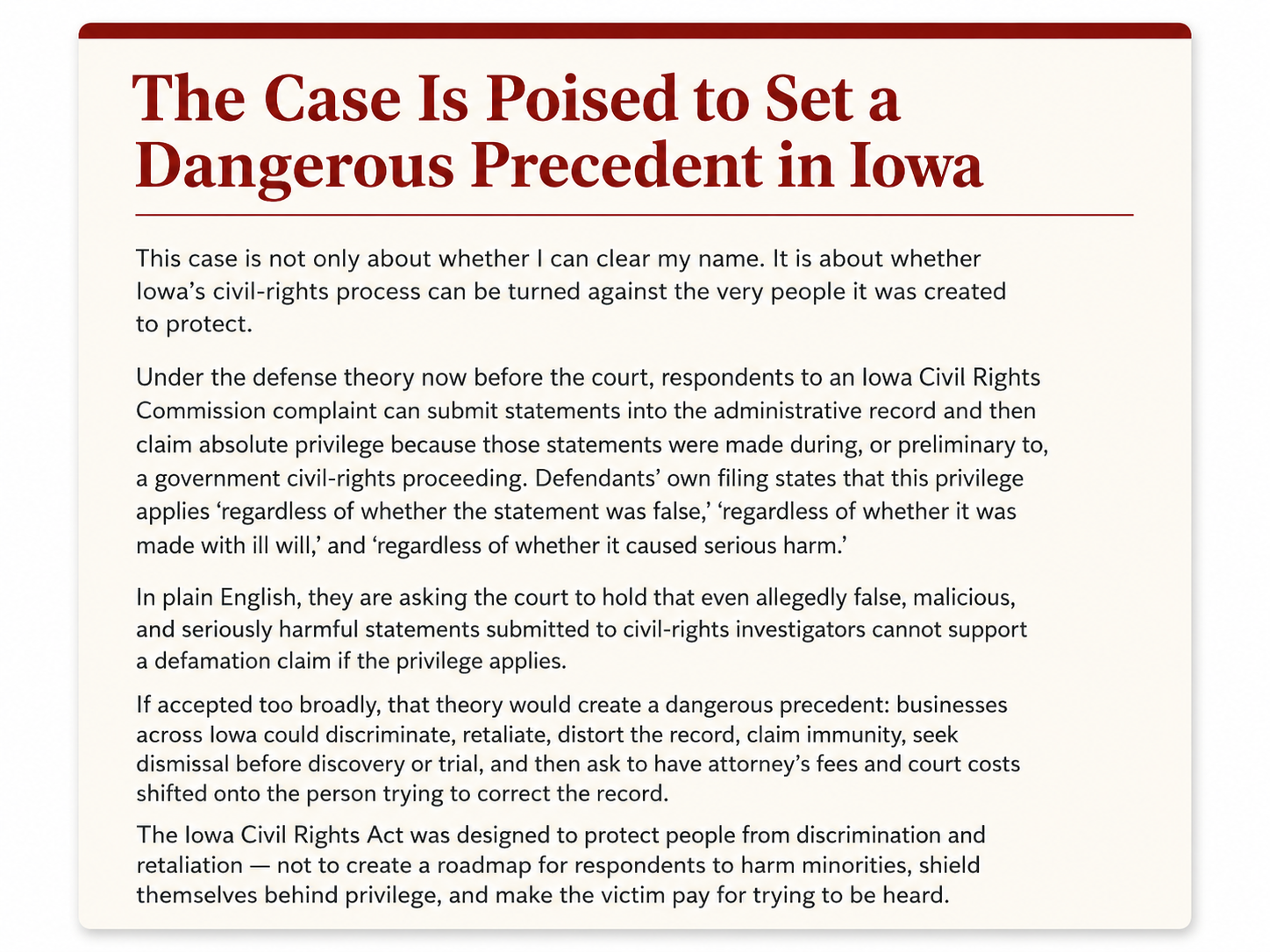
Why discovery matters
Discovery is the part of a lawsuit where parties must turn over documents, drafts, metadata, communications, and sworn answers. It is how courts determine what actually happened instead of relying only on one side’s description of events.
In this case, discovery matters because the dispute is not only about what the defendants said. It is also about how the documents and statements were prepared, edited, arranged, and submitted.
I filed a Motion to Compel Discovery because the defendants have refused to produce key materials, including:
-
draft versions
-
native files
-
metadata
-
revision history
-
communications about the June 28 submission
These materials could show who created the documents, how they were edited, whether communications were rearranged, whether screenshots or written materials were altered or selectively excerpted, and whether the final submission accurately reflected the underlying communications.
The defendants argue discovery is irrelevant because, in their view, the only question is whether the Civil Rights Commission process was “quasi‑judicial.” Under their theory, even deliberately false or manipulated submissions would be absolutely privileged.
That is why this case is so dangerous.
If the court accepts that argument before discovery, then the people accused of shaping the government record through false or manipulated materials may never have to produce the drafts, metadata, communications, or revision history that could show what happened.
Why this case matters beyond me
Civil-rights agencies exist to investigate discrimination and retaliation complaints and protect the public from unlawful discrimination. But if respondents can submit false or manipulated materials, have those materials shape official records, and then claim total immunity, the process becomes dangerous for the very people it was created to protect.
This spring — while finishing a full‑time semester and running an independent campaign for Governor of Iowa — I compiled and filed a Revised Second Amended Petition with more than one hundred exhibits. These exhibits show the communications, timelines, agreements, exclusions, agency submissions, and factual context that the court has never fully examined.
I am representing myself because I have not been able to obtain civil‑rights counsel. I am doing my best as a pro se litigant to keep my mouth above water in a case I cannot afford to lose — not only because of the continuing harm to my own reputation, safety, campaign, and future, but because of what this ruling could mean for minorities and civil‑rights complainants across Iowa.
The defendants argue that all claims except one were already dismissed with prejudice, and that the remaining libel claim should now be dismissed on summary judgment.
Summary judgment allows a court to end a claim without trial if there is no genuine factual dispute. But here, the missing facts concern the very documents and communications discovery is supposed to uncover.
The core question
So the question before the court is not only about me.
Will Iowa courts apply privilege in a careful, context-specific way that protects honest participation in civil-rights proceedings while allowing discovery into allegedly false, misleading, or altered submissions — or will respondents be able to shield those submissions from scrutiny by invoking absolute privilege?
If the defendants’ argument is accepted broadly, it could create a dangerous precedent: civil‑rights complainants could be harmed by official records shaped by manipulated materials, while the people who submitted those materials claim they cannot be held liable because the deception occurred inside the civil‑rights process.
This case urgently needs attention from civil‑rights lawyers, defamation lawyers, legal scholars, journalists, and Iowans who care about whether civil‑rights investigations can still be trusted.
________________________________________________________________________________________________________
To understand how Iowa’s civil-rights process failed before this lawsuit became necessary, read:
Iowa Is Failing the People Civil Rights Law Was Meant to Protect.
References
Ballantine’s Law Dictionary Legal Assistant Edition
by Jack Ballantine (James Arthur 1871-1949). Doctored by Jack G. Handler, J.D. © 1994 Delmar by Thomson Learning. ISBN 0-8273-4874-6.
[1]: Motion for Summary Judgment, Black’s Law Dictionary 1842 (10th ed. 2014) (defining a motion for summary judgment as “[a] request that the court enter judgment without a trial because there is no genuine issue of material fact to be decided by a fact-finder—that is, because the evidence is legally insufficient to support a verdict in the nonmovant’s favor”).
[1]: See Discovery Abuse, Black’s Law Dictionary [page number] (10th ed. 2014) (defining discovery abuse as “[t]he failure to respond adequately to proper discovery requests”).
Additional Reliable/Lockwood Case Materials: Current Procedural Posture
The following documents provide additional context for where the Reliable/Lockwood case currently stands. Trial is presently scheduled for August 4, 2026, but multiple issues remain pending, including Defendants’ motion for summary judgment, my motion to compel discovery, my renewed request to file the Revised Second Amended Petition, and my request to continue trial and extend discovery.
I am including these materials because they show why the case remains active, why discovery matters, and why the litigation continued to impose major burdens during the ballot-access period.
Defendants’ Motion for Summary Judgment
Link to PDF: https://wildwillpower.org/wp-content/uploads/2026/06/4-6-26-DEF-Mot-for-Summary-Judgment-2.pdf
Defendants ask the court to enter summary judgment on the remaining libel claim, arguing that statements submitted to the Iowa Civil Rights Commission are protected by litigation privilege and that the claim should be dismissed as a matter of law.
Defendants’ Statement of Material Facts and Memorandum in Support of Summary Judgment
Link to PDF: https://wildwillpower.org/wp-content/uploads/2026/06/4-6-26-DEF-Facts-in-Support-of-Summary-Judgment.pdf
This filing sets out Defendants’ factual and legal arguments in support of summary judgment, including their position that the ICRC submissions were privileged, true, conditionally privileged, and not capable of supporting damages.
Plaintiff’s Resistance to Summary Judgment, Motion to Compel Discovery, and Motion to Clarify Operative Pleading
Link to PDF: https://wildwillpower.org/wp-content/uploads/2026/06/4-14-Mot-to-Compel.pdf
In this filing, I opposed summary judgment, asked the court to compel discovery, and requested clarification of the operative pleading. I argued that Defendants were seeking summary judgment while withholding discovery concerning authorship, alteration, metadata, communications, chronology, transmission, truth or falsity, republication, damages, and privilege.
Defendants’ Reply in Support of Summary Judgment and Resistance to Motion to Compel
Link to PDF: https://wildwillpower.org/wp-content/uploads/2026/06/4-27-26-Reply-in-Support-of-MSJ-and-Resistance-to-Compel.pdf
Defendants responded that further discovery was unnecessary because, in their view, the privilege issue is a legal question and the alleged publication occurred within the ICRC proceeding. They also resisted my motion to compel and argued that additional discovery would not change the legal character of the ICRC submissions.
Plaintiff’s Reply and Reply Brief in Support of Renewed Motion for Leave to File Revised Second Amended Petition
Link to Reply: https://wildwillpower.org/wp-content/uploads/2026/06/Plaintiffs-Reply-to-Resistance-to-Mot-to-Leave-to-Amend.pdf
Link to Reply Brief: https://wildwillpower.org/wp-content/uploads/2026/06/Plaintiffs-Reply-Brief-to-Resistance-to-Mot-to-Leave-to-Amend.pdf
These filings respond to Defendants’ resistance to my renewed request to file the Revised Second Amended Petition. I argued that the revised pleading was shorter, reorganized, exhibit-supported, responsive to the court’s April 22 order, and necessary to place the factual record before the court in a usable form before summary judgment or trial.
Plaintiff’s Motion to Continue Trial, Extend Discovery, Defer Summary Judgment, and Request Status Conference
Link to PDF: https://wildwillpower.org/wp-content/uploads/2026/06/Plaintiffs-Mot-to-Continue-Trial-and-Extend-Discovery.pdf
This filing asks the court to continue the August 4, 2026 trial date, extend discovery and pretrial deadlines, defer summary judgment until discovery is completed, and hold a status conference or enter a revised scheduling order. I argued that the case is not trial-ready while discovery, summary judgment, the operative pleading, and the motion to compel remain unresolved.