
Iowa's Broken Judiciary Part Three:
Plausible Deniability
How a fragmented docket, a false delay narrative,
nd a nominally granted continuance preserved the dismissals before discovery.
By Sondra Wilson | Updated August 1, 2026
How a New Judicial Assignment Allowed the Procedural Record to Be Reframed
The court formally granted me additional time. In practice, however, it placed the deadline immediately before final examinations—rather than at least fifteen days after the semester, as I had requested and explained was necessary.
That result cannot be understood in isolation. Judge Angela Doyle had inherited a fragmented procedural record containing transferred filings, stayed deadlines, overlapping motions, a withdrawn evidentiary process, and dismissals entered before discovery. Her first ruling concerning reconsideration failed to account for the orders that had stayed and restarted the deadline.
Once that gap became apparent, defendants attempted to replace the actual chronology with a narrative of “delay and obfuscation.” I was then forced to divert the limited time granted for amendment into reconstructing the docket, answering their accusations, and protecting claims that had already been dismissed with prejudice.
This installment examines how incomplete knowledge of a complicated docket, strategic reframing by opposing counsel, and relief that existed more clearly on paper than in practice combined to preserve the October 4 dismissals.
Executive Summary
After Judge Bethany Currie dismissed most of my claims with prejudice before discovery, the parties jointly obtained a stay so they could pursue settlement and preserve the opportunity to seek reconsideration afterward.
While that process was underway, Judge Angela Doyle inherited the case. Her first order concerning reconsideration calculated the deadline from the October 4 dismissal without addressing the later orders that had stayed and restarted it. I was therefore required to reconstruct the procedural history already contained in the docket.
The court later corrected that error, expressly finding that the deadline had restarted on December 23 and that my January 3 extension request was timely. But correcting the deadline did not restore the time already diverted into reconstructing the docket and answering defendants’ new procedural narrative.
At the same time, Judge Doyle granted leave to prepare a reorganized amended petition and expressly invited me to request additional time. I had begun restructuring the claims and organizing more than sixty exhibits. Defendants then accused me of a “yearslong pattern of delay and obfuscation,” forcing me to file a forty-six-page response so that their characterization would not become the court’s working history.
I repeatedly informed the court that I was carrying a full-time Iowa State University course load and that additional litigation demands were consuming the time available to complete the amendment.
My full-time enrollment was tied to a two-year tuition award I had earned through the 2023 Coca-Cola Academic Team, so simply suspending school would have jeopardized the educational opportunity the scholarship provided.
Judge Doyle nominally granted additional time—but set the deadline for April 29, immediately before final examinations. The ruling therefore did not provide the relief requested. It intensified the conflict, contributed to my withdrawal from two courses and acceptance of a reduced grade in another, and left the dismissals entered before discovery intact.
Part Three examines how a fragmented docket created informational asymmetry, how defendants used that asymmetry to reframe the chronology, and how procedural relief can preserve plausible deniability while producing the opposite of meaningful accommodation.
Table of Contents
I. The Stayed Deadlines and the New Judicial Assignment
Oct. 9, 2024 — The Parties Jointly Requested Settlement Proceedings and a Stay of All Deadlines
Dec. 4 — Judge Doyle Was Appointed to Inherit the Case
II. The Attempt to Reorganize the Case
January 3, 2025 — I Sought to Simplify the Pleading and Organize the Supporting Attachments
January 13 — The First Sign That the Stayed-Deadline History Had Not Been Reconstructed
January 20–21 — I Reconstructed the Stayed-Deadline History
January 23 — Defendants Resumed Litigation Against the Earlier Pleading
III. The “Delay and Obfuscation” Narrative
January 30 — Defendants’ “Delay and Obfuscation” Narrative Forced a Forty-Six-Page Response
I Warned the Court That the Available Window Would Soon Close
My Full-Time Enrollment Was Not Optional in Any Practical Sense
The Reply Was Necessary Because Silence Carried Its Own Risk
D0052 Also Showed That the Attachments Were Already Being Built
January 30 — I Separately Explained the Work Still Required
The Procedural Trap Was Now in Place
IV. Iowa’s February 2025 Civil-Rights Crisis
February 24–28 — Iowa Removed Gender-Identity Protections as My Own Medical Care Was Disrupted
March 14 — The Court Corrected the Deadline History and Set March 28
March 18 — I Asked Defendants for Grace Before Seeking More Time
The Defendants Treated the Resulting Request as Another Instance of Delay
V. The Request to Finish After the Semester
March 28–April 4 — My Request to Finish the Semester Was Reframed as “Dilatory Prosecution”
March 31 — The Public Action and the Federal Filings Went Forward
April 4 — Defendants Recast the Request as a Seventh Delay
The Continuances Were Counted; Their Causes Were Not
April 14 — The Court Granted the Motion but Rejected the Requested Accommodation
The Formal Grant Produced the Opposite of Meaningful Accommodation
VI. The Deadline’s Consequences
The Deadline Produced the Harm I Had Warned About
April 30 — The Pressure Produced an Escalated Filing
The Narrative Then Became Self-Confirming
The Pressure Produced the Reaction That Could Then Be Used to Justify More Pressure
The Procedural Record Became the Dispute
Next: Part Four — Dangerous Precedent
Bibliography
The October 4 dismissal did not immediately return the case to ordinary litigation. Instead, the parties jointly agreed to pause the deadlines and attempt settlement.
I. The Stayed Deadlines and the New Judicial Assignment
October 9, 2024 — The Parties Jointly Requested Settlement Proceedings and a Stay of All Deadlines
Joint Motion for Settlement Conference and Joint Motion to Stay Deadlines
Filed October 9, 2024; D0037.
The parties jointly requested a court-sponsored settlement conference and asked that all deadlines be stayed while settlement efforts were underway. The motion specifically requested that, if settlement was unsuccessful, either party would have fifteen days from the settlement conference to seek reconsideration of the October ruling and defendants would have twenty days to answer the surviving claim.
The parties therefore proceeded on the shared understanding that the reconsideration and answer deadlines had been suspended—not abandoned—and would restart only after the settlement process ended.
Because settlement communications are confidential, I do not discuss the parties’ negotiations, proposals, or positions in this article. The relevant procedural fact is that the settlement process did not resolve the case and the stayed deadlines eventually resumed.
While the settlement process was underway, the case was reassigned.
December 4 — Judge Doyle Was Appointed to Inherit the Case
Amended Order Appointing Presiding Judge
Entered December 4, 2024; D0042.
On December 4, Judge Angela Doyle was appointed to replace Judge Bethany Currie and to handle all aspects of the case through final disposition.
Judge Doyle therefore inherited a case already containing:
- a transferred Polk County record;
- multiple overlapping motions;
- an evidentiary process that had first been established and later withdrawn;
- a partially dismissed amended petition;
- stayed deadlines arising from settlement proceedings;
- and one surviving libel claim.
That history was not simple, and it was not contained in a single filing.
II. The Attempt to Reorganize the Case
January 3, 2025 — I Sought to Simplify the Pleading and Organize the Supporting Attachments
Motions for Leave to Amend Petition and to Continue
Filed January 3, 2025; D0043.
After reviewing the October 4 ruling, I began drafting a more conventional amended petition. On January 3, I requested leave to amend and additional time to complete both the new pleading and the supporting attachments.
I explained that the June 2024 petition had become overly long and cumbersome because I had attempted, without counsel, to respond simultaneously to defendants’ motions to dismiss, recast, and require a more specific statement. I told the court that a reorganized pleading would identify individual counts, address the elements more clearly, distinguish defendants’ respective roles, and reduce the burden on the newly assigned judge.
I also expressly recognized the difficulty facing Judge Doyle:
“There are a great deal of documents for her to review prior to issuing an order in response to my upcoming motion to reconsider.”
I explained that information contained in defendants’ later filings had clarified facts I did not know when the earlier petition was drafted. I requested permission to reorganize the claims, address the identified defects, and attach the supporting record in a more usable form.
I had already begun drafting the replacement petition on January 1. The request was therefore not for an indefinite postponement. It was an effort to cure the deficiencies identified in the October 4 ruling and make the record easier for the newly assigned court to evaluate.
January 13 — The First Sign That the Stayed-Deadline History Had Not Been Reconstructed
Order Regarding Motions for Leave to Amend Petition and to Continue
Entered January 13, 2025; D0044.
Judge Doyle granted leave to amend and ordered that the amended petition be filed by January 20. The order expressly stated that, if I needed additional time, I could file another motion identifying the extension requested.
But the same order denied additional time to seek reconsideration. It reasoned that the October 4 dismissal had been entered more than fifteen days earlier and that Rule 1.904 did not itself provide for an extension of that period.
The order did not address the intervening deadline stays arising from the parties’ joint settlement request and the subsequent orders governing when the deadlines would restart.
That omission was significant. The issue was not merely that Judge Doyle reached a legal conclusion with which I disagreed. The ruling appeared to calculate timeliness directly from the October dismissal without accounting for the later procedural orders that had stayed and restarted the deadline.
Judge Doyle’s January 13 order initially treated reconsideration as untimely by measuring from the October 4 dismissal. The court later reconstructed the settlement-related orders, recognized that the deadline had restarted on December 23, found that my January 3 request was timely, and granted reconsideration of the January 13 ruling.
I therefore had to divert time away from drafting the amended petition and organizing the attachments in order to reconstruct a deadline history already contained in the record.
January 20-21 — I Reconstructed the Stayed-Deadline History
Petitioner’s Motion to Continue, Motion to Reconsider, Second Motion to Reconsider, and Motion to Vacate
Filed January 21, 2025; D0046.
I filed the original omnibus motion on January 20 and a corrected version the following day. The court later considered the January 21 filing, D0046.
I explained that Judge Currie’s October 9, October 28, and December 2 orders had stayed and later restarted the reconsideration deadline. I stated that the December 2 order caused the fifteen-day period to begin running on December 23, producing a January 7 deadline, and that my January 3 request had been filed before that date.
I also explained that compiling the attachments and addressing the elements of the claims was taking longer than anticipated. Rather than using that time to complete the court-authorized amended petition, I was now required to explain why the January 13 ruling did not account for the deadline orders already contained in the file.
This is where the dynamic documented in Part Three began to take shape.
Judge Doyle had inherited a fragmented record. Defendants and their counsel had participated in that history and knew that the deadlines had been stayed at the parties’ joint request. The January 13 order revealed that the newly assigned court had not yet accounted for that portion of the procedural record.
The asymmetry was now clear. Defendants knew the stayed-deadline history and quoted the order that established it, while the newly assigned court had initially ruled without accounting for that history. I was left to reconstruct the docket and defend against a narrative that treated the resulting procedural work as delay.
January 23 — Defendants Resumed Litigation Against the Earlier Pleading
Defendants’ Answer to Plaintiff’s Amended Petition
Filed January 23, 2025; D0047.
Two days after I filed the motions reconstructing the deadline history, defendants answered the June 17, 2024 amended petition. They emphasized that it remained the operative petition and that all claims other than Count II had been dismissed with prejudice.
Their answer denied most of the surviving allegations, asserted litigation privilege, estoppel, unclean hands, failure to mitigate, comparative fault, and other defenses, and requested dismissal with costs assessed against me.
The significance was larger than the filing of an ordinary answer.
Judge Doyle had just granted me leave to replace the cumbersome petition and had expressly invited me to request more time if necessary. Yet before I could complete that court-authorized work, the litigation accelerated around the earlier pleading.
I now had to evaluate defendants’ answer and affirmative defenses while simultaneously attempting to:
- correct the deadline ruling;
- complete the amended petition;
- reorganize the claims;
- assemble the attachments;
- and preserve claims dismissed “with prejudice.”
The process became self-reinforcing: each filing that required an immediate response consumed time that otherwise would have been used to complete the very amended petition defendants later characterized as delayed.
III. The “Delay and Obfuscation” Narrative
January 30 — Defendants' "Delay and Obfuscation" Narrative Forced a Forty-Six-Page Response
Petitioner’s Reply to Resistance and Motion to Strike
Filed January 30, 2025; D0052.
Defendants’ January 23 resistance did not merely oppose the requested extension. It accused me of a:
“yearslong pattern of delay and obfuscation, which has prevented efficient administration of this case.”
The same resistance quoted the December 2 order stating:
“All deadlines from entry of the Court’s Order filed October 9, 2024, shall begin to run on Monday, December 23, 2024.”
Defendants therefore accused me of prolonged delay while simultaneously citing the order confirming that the reconsideration deadline had been stayed and restarted. Their filing demonstrated that they knew the deadline history the newly assigned court had initially overlooked.
Leaving that characterization unanswered risked allowing it to become the court’s working account of the case. I therefore had to reconstruct the procedural history again—this time not merely to correct the deadline, but to answer defendants’ portrayal of the entire litigation.
I had sought additional time to simplify the pleading, organize more than sixty exhibits into usable attachments, address the elements of each claim, and prepare a corresponding motion to reconsider. Instead, substantial portions of that time now had to be redirected into rebutting defendants’ account of the procedural history.
I therefore filed a forty-six-page reply, motion to strike, and supporting appendices reconstructing the history defendants had compressed into the words “delay and obfuscation.”
The filing addressed, among other matters:
- defendants’ February 2024 challenges to service, pleading form, and specificity;
- my overseas academic obligations and contemporaneous requests for time;
- the successive drafts and progress reports filed during May and June;
- the settlement-related deadline stays;
- the January 3 motion filed before the restarted reconsideration deadline;
- defendants’ effort to limit any further amendment to the single surviving claim;
- and the evidence I was already organizing into attachments.
The filing also included partial versions of two planned attachments. Those materials were not abstract promises of evidence. They included communications, screenshots, the disputed ICRC submission, and supporting analysis that I was still assembling into a more coherent evidentiary record.
The immediate result was that time set aside for completing the amended petition had to be redirected into correcting defendants’ characterization of the procedural history.
I Warned the Court That the Available Window Would Soon Close
The January 30 filing expressly alerted the court that my ability to respond quickly was temporary:
“Petitioner was able to respond to D0048 promptly only because it is the first week of classes at Iowa State University, and there is little homework due during the first week.”
I further explained that I was carrying a full-time course load and would thereafter have to work on the amended petition and attachments between class time, reading assignments, and homework.
That warning later became important.
I was not telling the court after the fact that school had unexpectedly prevented me from meeting a deadline. I was explaining in advance that the beginning of the semester provided only a brief period in which I could answer a major new filing quickly, and that continued motion practice would consume the limited time available for the amendment.
I also stated that March 31 appeared reasonable only:
“assuming there are no further delays caused by filings she must respond to.”
The risk was therefore identified contemporaneously: additional accusations and procedural demands would displace the work needed to finish the amended petition and supporting attachments.
My Full-Time Enrollment Was Not Optional in Any Practical Sense
My enrollment at Iowa State University was not a casual activity that I could simply place on hold without serious consequences.
In 2023, I was selected for the Coca-Cola Academic Team through a competitive Phi Theta Kappa scholarship application completed while I attended DMACC. The award provided two years of tuition at Iowa State University. Banner News reported that I was one of seven DMACC students selected from the 150 Coca-Cola Scholars chosen internationally that year.
Maintaining the scholarship required me to attend Iowa State full-time. Pausing school to devote myself exclusively to litigation would therefore have placed the scholarship—and the educational opportunity it created—at risk.
That context matters because the competing obligations were not self-created in the simplistic sense later suggested. I was attempting to preserve both a time-limited educational award earned through academic achievement and legal claims that had been dismissed before discovery. Abandoning either carried lasting consequences.
When I asked for enough time to complete the reconsideration filing after the semester, I was not placing ordinary coursework ahead of the litigation. I was asking for a deadline that would allow me to comply with the court while preserving the scholarship-supported education I had worked to earn.
The Reply Was Necessary Because Silence Carried Its Own Risk
A self-represented litigant facing a false procedural narrative has no cost-free option.
If I ignored the accusation, defendants could point to an unrebutted assertion that I had engaged in years of obstruction. If I responded, the response itself consumed the time needed to complete the filing defendants claimed I was delaying.
That is the self-reinforcing structure documented in this part:
Defendants characterized the time required to answer their filings as plaintiff-created delay, while each new accusation required another response that further reduced the time available to complete the court-authorized amendment.
The pressure did not arise from the existence of one ordinary resistance. It arose from the breadth of the narrative defendants placed before a newly assigned judge who had already issued an order without accounting for the intervening deadline stays.
Once the January 13 order revealed that important portions of the earlier record had not yet been incorporated into the court’s understanding, defendants’ accusations carried increased practical danger. A claim of “delay and obfuscation” could become persuasive unless I reconstructed the chronology filing by filing.
D0052 Also Showed That the Attachments Were Already Being Built
The appendices attached to D0052 are important because they rebut the later suggestion that the proposed amendment and exhibits were merely hypothetical or had not meaningfully begun.
The filing identified:
- Appendix B, an unfinished attachment concerning the disputed submission to the Iowa Civil Rights Commission;
- Appendix C, an unfinished attachment concerning statements attributed to Lyndsay Nissen;
- and Appendix D, my class schedule for the semester.
The document explained that those appendices were examples of the materials being prepared for submission with the new amended petition.
The filing therefore accomplished two things at once. It rebutted defendants’ procedural narrative, and it showed the court tangible portions of the evidentiary organization already underway.
But accomplishing that required filing forty-six pages that would not otherwise have been necessary to complete the amended petition itself.
January 30 — I Separately Explained the Work Still Required
Reply Brief in Support of Petitioner’s January 20, 2025 Omnibus Motion
Filed January 30, 2025; D0053.
In a separate reply brief filed the same day, I explained why the requested extension was necessary.
I identified three central burdens:
1. the complexity of the claims and the number of defendants involved;
2. the need to reorganize more than sixty referenced exhibits into approximately seven attachments; and
3. the beginning of a full-time semester at Iowa State University.
I further explained that the October 4 ruling had stated that the referenced exhibits were not considered, and that I was attempting to correct that problem by incorporating the evidence into formal attachments accompanying a more conventionally organized petition.
The filing also previewed legal arguments I intended to develop more fully, including retaliation, conspiracy, constitutional equality, and the basis for reconsidering dismissals entered “with prejudice.”
This was not inactivity. It was a documented work plan.
The Procedural Trap Was Now in Place
By the end of January, the following conditions existed simultaneously:
- Judge Doyle had granted leave to amend and invited a request for more time;
- I had begun reorganizing the petition and more than sixty exhibits;
- the January 13 order had required me to correct the court’s understanding of the stayed deadline;
- defendants had filed an answer against the earlier pleading;
- defendants had filed a resistance accusing me of a “yearslong pattern of delay and obfuscation”;
- I had been forced to answer that characterization through a forty-six-page filing and a separate reply brief; and
- I had warned the court that my full-time semester would sharply reduce the time available after the opening weeks.
The later missed or extended deadline therefore cannot be understood in isolation.
It arose from a documented sequence in which the time authorized for amendment was repeatedly diverted into responding to new filings, correcting the inherited procedural record, protecting against fee and cost exposure, and preventing defendants’ accusations from becoming the only account before the newly assigned court.
IV. Iowa’s February 2025 Civil-Rights Crisis
February 24-28:
Iowa Removed Gender-Identity Protections as
My Own Medical Care Was Disrupted
The pressure documented above did not unfold in an ordinary semester. Between February 24 and 28, 2025, Iowa’s political environment for transgender people changed abruptly.
On February 27, the Iowa House and Senate passed Senate File 418, removing “gender identity” from the protected classifications contained in major portions of the Iowa Civil Rights Act. Hundreds of opponents filled the Iowa State Capitol rotunda while the chambers debated and passed the measure. The legislation affected protections involving employment, housing, education, public accommodations, and other areas of civil life.
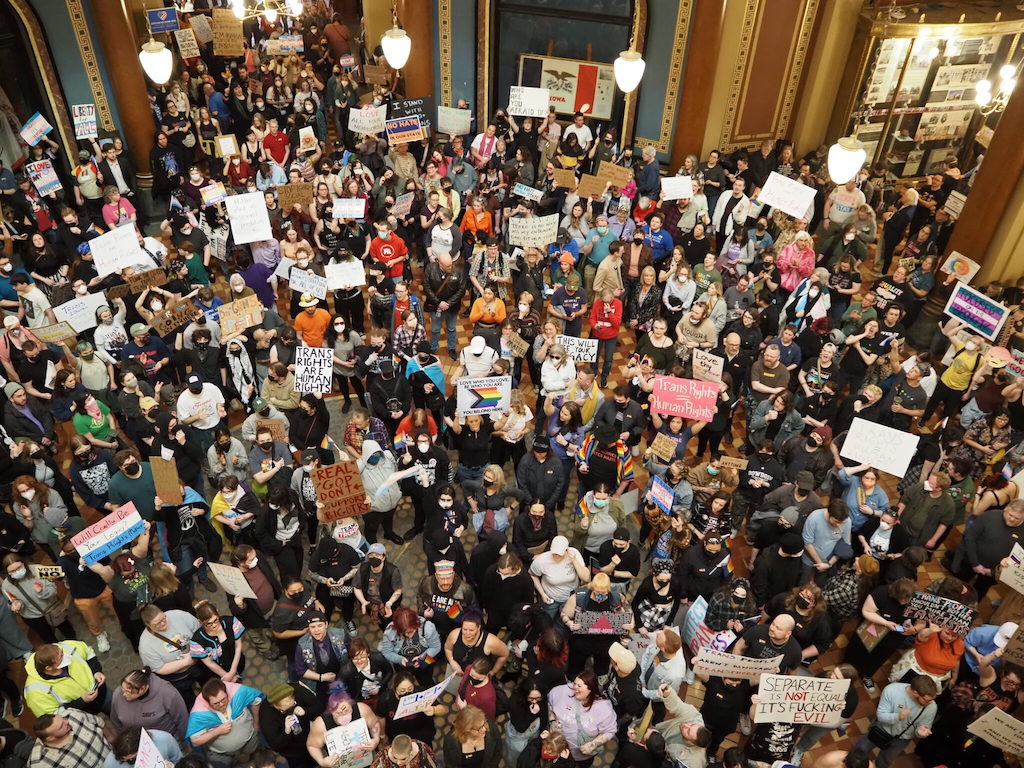
Hundreds of Iowans filled the State Capitol rotunda on February 27, 2025, protesting Senate File 418 as lawmakers voted to remove gender identity from the Iowa Civil Rights Act. Photo by Robin Opsahl, Iowa Capital Dispatch; republished by Stateline.
Governor Kim Reynolds signed the bill on February 28. In her public statement, she expressly connected the legislation to gender-affirming medical care, stating that the Civil Rights Code had:
“forced Iowa taxpayers to pay for gender reassignment surgeries.”
She immediately added:
“That is unacceptable to me, and it is unacceptable to most Iowans.”
Those words were not abstract to me. I had been preparing for medically necessary gender-affirming surgery, and my scheduled procedure was canceled amid the removal of protections and the accompanying changes affecting access to care. The cancellation intensified trauma that was already directly connected to the subject matter of my civil-rights litigation.
At the same time, transgender Iowans were watching the legislature remove protections that had existed since 2007 while hundreds of people crowded the Capitol in protest. The political message was unmistakable: the state was not merely debating a technical amendment. Iowa was becoming the first state to remove an existing protected class from its civil-rights law.
I responded publicly and legally. I worked on organizing students, distributing materials, contacting agencies and law-enforcement offices, and preparing broader filings addressing what I believed the legislation meant for transgender Iowans. That work displaced the time I had intended to use for the amended petition and motion to reconsider.
March 14 — The Court Corrected the Deadline History and Set March 28
Order Regarding Plaintiff’s January 21 Motions and Motion to Strike
Entered March 14, 2025; D0056.
The court later reconstructed the settlement-related deadline orders and agreed that my January 3 request had been timely. It recognized that the reconsideration deadline had restarted on December 23, 2024, and would ordinarily have expired on January 7, 2025.
The court therefore granted reconsideration of its January 13 timeliness ruling and allowed me until March 28 to file a motion seeking reconsideration of the October 4 dismissal.
The ruling corrected the legal deadline, but it did not restore the time already consumed by reconstructing the procedural history, answering defendants’ “delay and obfuscation” accusation, and preparing the forty-six-page response and supporting materials.
It also distinguished between the motion to reconsider and any proposed further amendment. The court stated that reconsideration of the October 4 ruling had to be based on the petition and record that existed when that ruling was entered, while permission for a future amended petition would depend on the proposed amendment itself.
The March 28 deadline therefore became the next point of pressure: I still had to prepare the reconsideration motion while continuing to develop the proposed pleading and documentary record under a full-time academic schedule.
V. The Request to Finish After the Semester
March 18 — I Asked Defendants for Grace Before Seeking More Time
Before filing another motion to extend the deadline, I attempted to address the problem directly with defendants’ counsel.
I had reason to believe that the request might be received sympathetically. In materials submitted to the Iowa Civil Rights Commission, Defendant Charlie Esker identified themself as a transgender Ames resident and described Reliable Street and Lockwood Café as supporters of the queer community. Esker called Reliable Street “a safe space for all people,” cited its trans vigil, Pride events, queer performances, and queer singles event, and described the surrounding community as one that “welcomes everyone with open arms.”
The businesses’ own submissions used similar language. Lyndsay Nissen described Reliable Street as “a very inclusive, fun, welcoming community” and stated that I had initially been welcomed “with open arms.”
Against that background, I believed defendants and their counsel might understand the gravity of Iowa’s removal of protections from transgender people even while continuing to contest my lawsuit. My March 18 email was therefore not merely a procedural communication. It was an appeal to the inclusive and LGBTQ-supportive values defendants themselves had invoked.
On March 18, I emailed attorney Paul Esker under the subject line:
“A request for grace.”
I explained that Iowa had removed gender identity as a protected class, that many students were frightened, and that my immediate attention had shifted toward preparing a criminal civil-rights complaint, a related civil petition, and a March 31 Government Accountability Call to Action.
I told him:
“I would like to request a motion to continue until after the semester is over.”
I then asked that his clients not resist the anticipated motion:
“Between this urgent work to protect the safety of many Iowans and future generations, I request your clients to please not file a resistance to a motion to continue, and instead to have grace and solidarity in what needs to be done now so that I can focus on making this Call to Action successful.”
I also warned:
“It would detract from more pressing matters if I need to respond to a resistance.”
The email is significant because it shows that I identified the impending conflict before filing the March 28 motion. I did not simply miss a deadline and explain afterward. Eleven days before the deadline, I disclosed the broader civil-rights emergency, explained the work I was undertaking, stated that I intended to seek an extension through the end of the semester, and warned that opposition would itself consume more of the time required for both matters.
Defendants did not respond to the private request.
Their silence did not prevent me from making the formal request to the court.
March 28 — April 4: My Request to Finish the Semester Was Reframed as "Dilatory Prosecution"
Motion to Continue
Filed March 28, 2025; D0058.
On March 28, I filed the motion I had identified in advance.
I requested an extension:
“until at least 15 days after the final day of the Iowa State University school semester, so that I will have sufficient time to work on the necessary documents in a manner that will not detract from my studies any further.”
The motion explained that the events between February 24 and 28 had caused severe fear, distress, trauma, and loss of sleep. It described my work organizing the March 31 public action, preparing federal civil-rights filings, distributing flyers, contacting agencies and law-enforcement offices, and attempting to protect transgender Iowans affected by the removal of civil-rights protections.
I again asked defendants not to resist:
“Additionally, presuming the Respondents in this action feel the same sense of dire concern pertaining to the Call to Action, I request all Respondents and their Counsel not to resist this motion, in consideration for the circumstances at large.”
The motion was accompanied by documents showing that the March 31 action was not hypothetical. I had circulated more than five hundred physical flyers, sent mass communications to law-enforcement agencies and other institutions, prepared materials for public distribution, and documented copies sent to Donald Trump and Kim Reynolds.
I also informed the court that the stress had already caused me to drop ECON 1020.
The request was therefore specific and limited. I was not asking for an indefinite postponement. I was asking for a deadline tied to an objectively identifiable event: fifteen days after the end of the semester.
March 31 — The Public Action and the Federal Filings Went Forward
The public action I had described to defendants’ counsel and the court was not merely planned. It went forward.
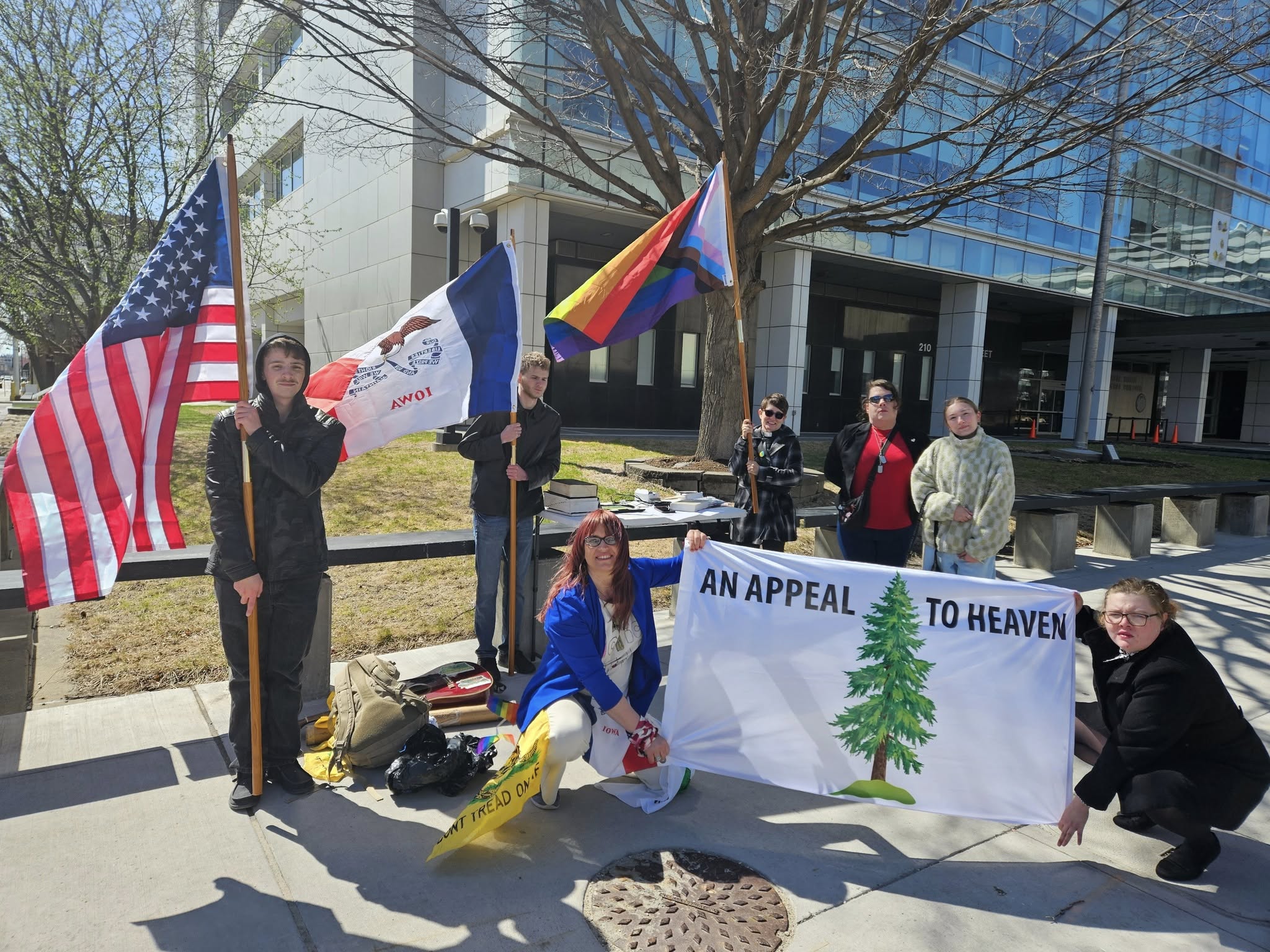
March 31, 2025 — Outside the U.S. Attorney’s Office in Des Moines after the filing action. I had invited hundreds of Iowans to participate in a quiet, orderly submission of civil-rights complaints. A small group ultimately joined me, signed the filings for which they qualified, and stood with me as the complaints were submitted.
March 31 was Transgender Day of Visibility. While nonprofit organizations, churches, student groups, and community organizations across Iowa were holding rallies, celebrations, informational booths, and other public events, I attempted to organize a different kind of observance: a quiet Government Accountability Call to Action centered on the invocation and enforcement of existing civil-rights law.
The plan invited concerned Iowans to line up outside the U.S. Attorney’s Office in Des Moines, submit civil-rights complaints to federal authorities, and then proceed peacefully to the federal courthouse for the filing of a related civil action.
The action was deliberately designed to be calm and difficult to mischaracterize. It did not call for masks, chanting, confrontation, or disruption. Participants were asked to remain quiet and respectful. If approached by law-enforcement officers, they were to thank the officers for protecting the public and respecting our right to seek due process.
I contacted churches, nonprofit organizations, attorneys, student groups, clergy, veterans, law-enforcement agencies, and advocates throughout Iowa. Many people and organizations expressed support for transgender Iowans, and I appreciated that support. But only a small group ultimately appeared for the filing action.
Those who did appear should not be treated as incidental to what happened.
Several participants joined in signing and submitting the criminal civil-rights complaint. The related civil petition was signed by people who alleged that they had themselves experienced injury and wished to seek relief through the federal action. The case was therefore filed by multiple plaintiffs, not by me alone.
I remain deeply grateful to the people who came. They appeared during a frightening and uncertain period, placed their names on legal documents, and stood beside me when the much larger action I had envisioned did not materialize. Their participation mattered, and this record should preserve that fact.
At that moment, I believed public visibility was not enough by itself. Iowa had removed gender identity from its civil-rights law, my medically necessary care had again been disrupted, and the legal consequences were already unfolding. We needed strong factual records, carefully prepared filings, qualified attorneys, and ordinary people willing to invoke the institutions responsible for enforcing federal rights.
I had been searching for assistance with federal provisions addressing coordinated interference with protected rights and deprivations committed under color of law. Among the attorneys, organizations, officials, and advocates I contacted, I could not find anyone prepared to assemble and pursue the combined criminal and civil framework I believed warranted official review.
I therefore undertook most of the research, drafting, outreach, and organization necessary to construct the record, while the people who appeared contributed their own participation, signatures, allegations, and support.
On March 31, several of us submitted the criminal civil-rights complaint to the U.S. Attorney’s Office. A related civil petition was also filed in the United States District Court for the Southern District of Iowa by plaintiffs who alleged that they had been harmed. The civil action became Wilson v. Trump et al., case no. 4:25-cv-00116-SHL-WPK.
The two filings were related but distinct.
The criminal complaint asked federal prosecuting authorities to investigate alleged violations, including conspiracy against rights and deprivation of rights under color of law. The civil petition attempted to preserve civil claims arising from the same broader factual record.
We were not privately prosecuting anyone. Private citizens do not control federal criminal prosecution. The criminal submission documented facts, identified statutes we believed warranted official review, and placed the allegations before authorities possessing enforcement power. The civil petition separately attempted to invoke available civil remedies on behalf of the people who signed it and alleged personal injury.
The federal civil action was later dismissed at initial review. The court explained, among other matters, that a self-represented litigant could pursue her own claims but could not represent other people or a proposed class without licensed counsel. The filings, court orders, underlying factual record, and later legal developments are documented on the Wilson v. Trump et al., Case No. 4:25-cv-00116-SHL-WPK case hub.
Those later developments do not change what March 31 establishes about the chronology of this case.
I had identified the competing obligations in advance. I disclosed them privately to defendants’ counsel, described them formally to the court, documented the public action, requested a defined accommodation, and attempted to avoid unnecessary motion practice. My March 18 email specifically explained that I was preparing both the criminal complaint and civil petition, contacting law schools, and seeking the presence of clergy, veterans, and law-enforcement agencies.
The action went forward, and I will always be grateful to the people who joined it. But most of the legal research, drafting, public outreach, organization, and filing burden remained concentrated on me while I was attending Iowa State University full time and attempting to protect claims that had already been dismissed with prejudice.
The request for time was not unexplained.
April 4 — Defendants Recast the Request as a Seventh Delay
Defendants’ Resistance to Plaintiff’s Seventh Motion to Continue
Filed April 4, 2025; D0059.
Defendants did not respond to my March 18 private appeal for grace. After I filed the formal motion, however, they opposed it.
Their resistance framed the request primarily through the number of prior continuances.
They called the March 28 filing my:
“seventh Motion to Continue.”
They described the requested period as:
“another long extension.”
They argued that I was seeking permission to file for reconsideration more than two hundred days after the October ruling and stated that my “dilatory prosecution” had caused stress, mental distress, and expense for the defendants.
They asked the court to deny the motion. Alternatively, they argued that any extension should be limited to fifteen days and that I should be expressly advised that no further continuances would be granted.
The resistance did not meaningfully address my March 18 appeal for grace, the removal of gender-identity protections, the cancellation of my medical care, the March 31 public action and federal filings, my reported trauma, or the inclusive and LGBTQ-supportive values defendants had previously invoked.
Defendants were legally entitled to oppose the extension. But their framing once again converted the consequence into the cause.
The request did not arise simply because I preferred a later deadline. It followed:
- the need to correct the newly assigned court’s initial misunderstanding of the stayed deadline;
- the forty-six-page filing required to rebut defendants’ “delay and obfuscation” narrative;
- the reorganization of more than sixty exhibits;
- a full-time academic semester tied to a tuition award;
- the cancellation of medically necessary care;
- Iowa’s removal of gender-identity protections; and
- the preparation of a documented public civil-rights action and related federal filings.
Once those circumstances were omitted, the remaining history could be presented as a simple number:
seven continuances.
The number was easy to repeat. The underlying history was not.
The Continuances Were Counted; Their Causes Were Not
Part Two: Sudden Reversal documented that the earlier extensions were accompanied by contemporaneous proof of progress: partial drafts, repeated updates, organized evidence, and a completed sixty-four-page amended petition filed approximately one month after the initial May request.
By April 2025, defendants were recasting the existence of those continuances as proof of a personal pattern of delay.
Periods previously documented as active drafting, exhibit organization, overseas coursework, full-time enrollment, responses to defense motions, correction of the court’s deadline error, and work arising from a statewide civil-rights crisis were compressed into a single accusation:
delay.
That compression removed the reasons the extensions had been necessary while preserving the extensions themselves as evidence against me.
It also recreated the same impossible choice I had encountered before.
If I left the characterization unanswered, it could become the court’s working account of the case.
If I responded, the response would consume more of the limited time available to complete the motion to reconsider and proposed amended petition.
The procedural burden created the need for additional time. The resulting request for time was then presented as evidence that the burden had been self-created.
In that way, the narrative became circular: defendants’ filings and the fragmented docket consumed the time available for the required work, while the resulting incompleteness of that work was used to support the accusation that I had delayed the case.
April 14 — The Court Granted the Motion but Rejected the Requested Accommodation
Order
Entered April 14, 2025; D0060.
The court accurately summarized my request as seeking a deadline:
“fifteen days after the final day of the Iowa State University school semester.”
It nevertheless selected a different period.
The court relied on the ordinary fifteen-day period for motions to reconsider and ruled:
“The Motion to Continue … is GRANTED. Plaintiff shall file a motion to reconsider the Dismissal Order on or before April 29, 2025. No further extensions of the filing deadline for a motion to reconsider will be granted.”
The ruling therefore granted an extension in formal terms but did not grant the accommodation I had requested.
Instead of placing the deadline after the semester, it placed the deadline fifteen days after the order—immediately before final examinations.
The distinction matters.
I had not merely asked for “more time.” I had identified the academic conflict and requested a specific form of relief: enough time after the semester to complete the filing without further damaging my education.
The court acknowledged the request but selected a deadline during the very period I had explained was unworkable.
Defendants had asked that, if any extension were allowed, it be limited to fifteen days and accompanied by an express prohibition against further continuances.
That is substantially the relief the court selected.
The Formal Grant Produced the Opposite of Meaningful Accomodation
On paper, the record states that my motion was “GRANTED.”
In practice, the ruling rejected the central substance of the request.
I had asked for time after the semester. The court gave me time before finals.
I had explained that continued litigation during the semester was already harming my coursework. The court selected a deadline at the semester’s most demanding point.
I had warned that further responsive litigation would divert time from the filing itself. Defendants filed a resistance, and the court adopted the fifteen-day alternative they proposed.
The order therefore created plausible deniability.
It could be described as a ruling in my favor because the motion was formally granted.
But the relief actually provided did not solve the problem identified in the motion. It intensified it.
VI. The Deadline's Consequences
The April 29 deadline forced me to choose between preserving claims dismissed with prejudice and completing the semester successfully.
Maintaining full-time enrollment was a condition of the tuition award that enabled me to attend Iowa State University. Pausing school was not a cost-free option. Neither was abandoning the motion to reconsider.
By April 30, the pressure had become unsustainable.
I ultimately withdrew from two classes and accepted a reduced grade in another.
Meanwhile, the dismissals entered before discovery remained intact.
April 30 — The Pressure Produced an Escalated Filing
Notice of Federal Motions to Stay and Joinder, Notice of Federal Criminal Charges, and Notice and Motion Regarding Recusal
Filed April 30, 2025; D0064.
The April 30 filing reflected how far the pressure had escalated.
I accused defendants and the court of intentional interference, described the April 29 deadline as an effort to sabotage my semester, sought recusal, and attempted to connect the state-court proceedings to the newly filed federal action.
The language was forceful and, in places, broader than what I could then prove.
But the filing cannot fairly be understood without the procedural buildup that preceded it.
For months, I had:
- requested enough time to reorganize a complex pleading and more than sixty exhibits;
- warned that a full-time semester would sharply limit the time available;
- explained that new defense filings would divert the drafting period;
- been required to correct the court’s initial misunderstanding of the stayed deadline;
- answered accusations of “delay and obfuscation” through extensive filings;
- privately requested grace before filing another continuance;
- disclosed the statewide civil-rights crisis and March 31 public action;
- formally requested fifteen days after the semester;
- and then received a deadline immediately before finals.
By April 30, I had reached a breaking point.
That does not mean every legal conclusion in the filing was correct. It means the filing was the foreseeable product of cumulative procedural pressure, academic harm, fear of permanently losing dismissed claims, continuing medical and political trauma, and the repeated experience of having the causes of delay omitted while the resulting continuances were used against me.
The court later summarized the filing as accusing Judge Doyle of abuse of discretion and interference arising from the April 29 deadline.
The Narrative Then Became Self-Confirming
Defendants’ filings created pressure that required responses.
Those responses consumed the time needed to complete the amendment and reconsideration filing.
The resulting need for more time was then cited as additional proof that I was delaying the case.
Once the April 30 filing became part of the record, its distressed and accusatory language could also be detached from the sequence that produced it and used to portray me as unreasonable, obstructive, or unstable.
That is how the narrative became self-confirming.
The more pressure I experienced, the more urgently I responded.
The more urgently I responded, the easier it became to present the response as proof that the original portrayal had been correct.
The Procedural Record Became the Dispute
By this stage, the controversy was no longer limited to the underlying civil-rights, defamation, contract, and fraud claims.
The parties were also litigating what the procedural history itself meant.
The January 13 order initially failed to account for the stayed-deadline history. I reconstructed it. The court later agreed that my January 3 request had been timely.
Defendants nevertheless portrayed the case as a prolonged pattern of delay, requiring me to reconstruct the history again in detail.
The March 18 request for grace received no response.
The March 28 formal motion then became a “seventh Motion to Continue.”
The April 14 order formally granted relief while rejecting the accommodation actually requested.
The April 30 response to that pressure then became another event capable of being isolated from its causes.
The result was self-reinforcing: the time required to correct the record and defend against the procedural narrative was unavailable for completing the amended petition, while the incompleteness of that petition became further support for the claim that I had delayed the case.
That is the plausible deniability documented in Part Three.
The court granted more time.
But it did so in a manner that preserved the dismissals, intensified the academic conflict, and allowed every resulting consequence to be attributed back to me.
Part Four: Dangerous Precedent

Bibliography
Loew, Alex. “Four Area DMACC Students Awarded to 2023 Coca-Cola Academic Team.” Banner News, April 4, 2023. https://bannernews.org/2023/04/04/four-area-dmacc-students-awarded-to-2023-coca-cola-academic-team/.
Opsahl, Robin. “Hundreds Protest as Legislature Votes to Remove Gender Identity from Iowa Civil Rights Act.” Iowa Capital Dispatch, February 27, 2025. Republished by Stateline, February 28, 2025. https://stateline.org/2025/02/28/hundreds-protest-as-legislature-votes-to-remove-gender-identity-from-iowa-civil-rights-act/.