
Part Two of the Wilson v. Reliable Street Inc., et al series.
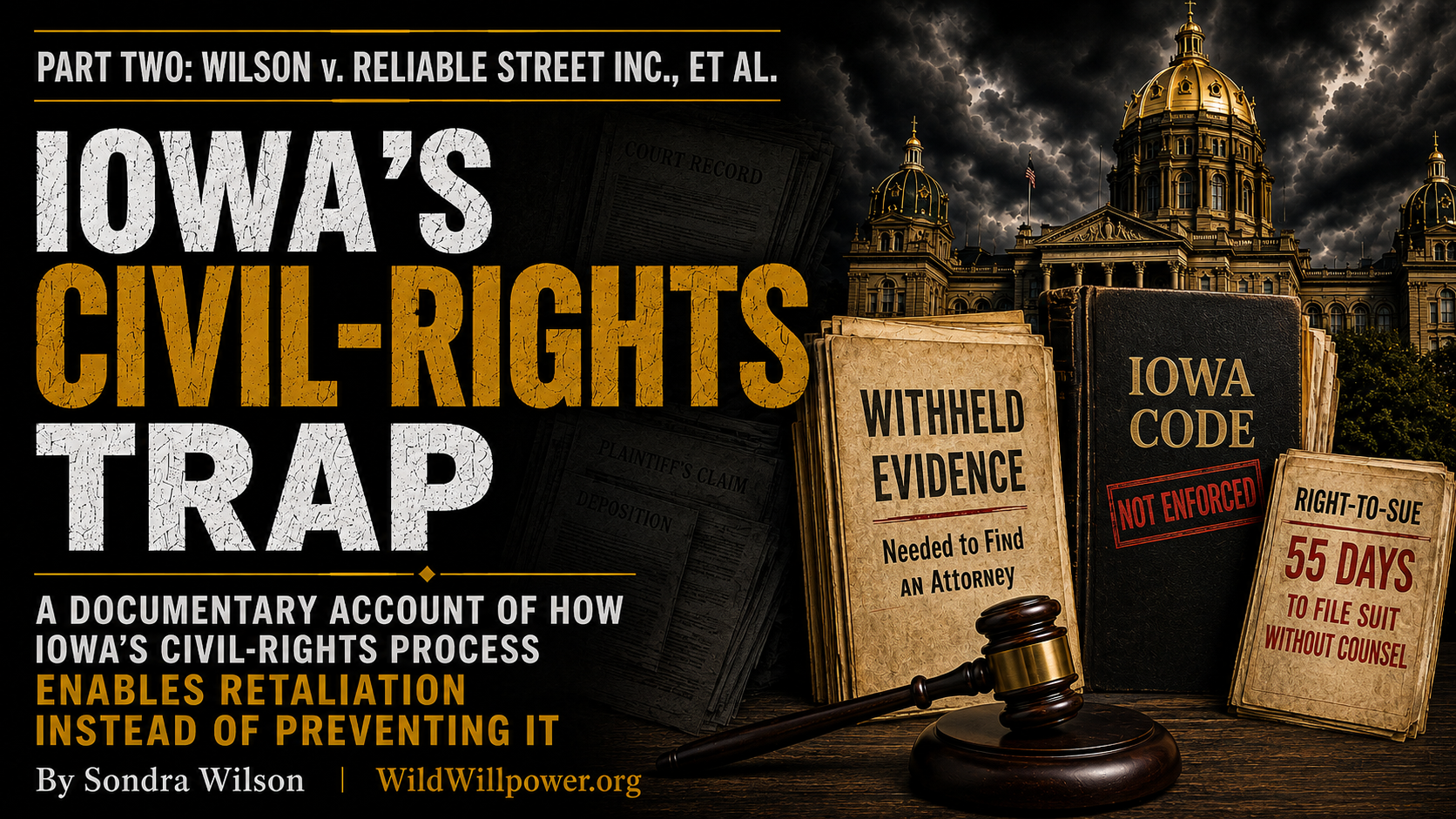
Iowa's Civil-Rights Trap —
A Firsthand Documentary Account of How Iowa’s Civil-Rights Process
Enabled Retaliation Instead of Preventing It.
By Sondra Wilson | Updated September 4, 2026
New to this case? This article is Part Two of an eight-part series. For the current appellate status, why the case matters statewide, and a roadmap to the complete series, begin with the Wilson v. Reliable Street Inc., et al. landing page.
The Trap Began With the Iowa Civil Rights Commission —
But It Did Not End There
Part One, Record Retaliation, documents how a private dispute became a civil-rights complaint—and how the Iowa Civil Rights Commission's ("ICRC") August 3, 2022 Preliminary Case Review transformed that dispute into something considerably more dangerous.
The Review preserved allegations portraying me as obsessive, stalking, harassing, intrusive, racist, controlling, and unwilling to respect other people's boundaries. I objected to that fabricated, completely rewritten narrative that the respondents appeared to have made about me. Record Retaliation lays out the contemporaneous communications between myself and the individuals who would later be named as defendants in Wilson v. Reliable Street Inc., et al.
But there was a fundamental problem with the ICRC's review:
I could see what I was being accused of. The review was only a description of what the respondents wrote, while referencing documentation they had submitted alongside the statements. I did not have access to their actual statements accusing me of crimes and misconduct, or the referenced documentation used to reinforce the new narrative.
Those accusations were now contained in a government record and remained capable of being used to bring up false criminal charges and civil claims against me. The accusations could later be subpoenaed and used against me in another legal proceeding, creating an ongoing threat to my safety and reputation.
Simply walking away was not a safe option.
The accusations remained inside a government record that could potentially become relevant in later legal proceedings. If they resurfaced months or years later, memories could fade, communications could be lost, and my failure to preserve and challenge the record while the evidence was still available could make defending myself far more difficult.
I therefore had a practical reason to act while the evidence was still fresh: preserve the contemporaneous record, obtain the underlying submissions, determine who had accused me of what, and clear my name before the allegations acquired even greater institutional weight.
That necessity created another problem:
The harder I worked to obtain the evidence and challenge the accusations, the easier those same efforts could themselves be reframed through the narrative that I was obsessive, intrusive, harassing, or unwilling to let things go.
The accusation therefore created the need to pursue the underlying case file the ICRC referenced in its review—and the very act of pursuing that record could itself be interpreted through the defendants' dangerous and false characterizations of me.
I searched for private counsel and legal aid, to no avail.
I went to the Iowa Office of Ombudsman, which uncovered that the public-facing process described on the ICRC's website was directly contradicted and undermined by what the ICRC is required to do by the courts.
When I pursued review through the EEOC, its process was tied to the same ICRC record I was disputing and did not allow me to add new information to correct what I believed was wrong with that underlying record.
I also attempted to file a complaint with law enforcement agencies in order to open up an investigation for violation of Iowa Code § 714.8(4), Fraudulent Practices. The statute provides that a person commits a fraudulent practice when the person:
“Makes any entry in or alteration of any public records, or any records of any corporation, partnership, or other business enterprise or nonprofit enterprise, knowing the same to be false.”
I was led in a circle among the Ames Police Department, the Story County Attorney's Office, the Iowa Attorney General's Office, and Des Moines Police, and no agency ultimately investigated and resolved the underlying factual dispute I was trying to report.
I kept looking for an institution with both the authority and the practical ability to bring the evidence together, determine what had happened, and address the severe, continuing threat to my safety.
None did.
During this pursuit, a procedural contradiction within the ICRC's process remained at the center.
On September 30, 2022, I asked the ICRC for the underlying case file because:
“I would like to review that and show it to an attorney.”
The Commission responded:
“Unfortunately unless you request the Right To Sue you are not entitled to the complete file....
If you desire the complete case file you will need to request the RTS. BUT you absolutely do not want to request the RTS until you speak with an attorney.”
The practical circle was extraordinary:
Get an attorney before requesting right-to-sue.
Give the attorney enough information to meaningfully evaluate the case.
But the complete file needed to evaluate the case will not be released until right-to-sue is requested.
And requesting right-to-sue ends the administrative process and starts the clock toward litigation.
That is the right-to-sue Catch-22 at the center of Iowa's Civil-Rights Trap. This article places the record of my pursuit to find help, which ultimately landed in my requesting the Right-to-Sue Letter and case file in fall 2023.
And when I finally received the complete file, I discovered evidence that raised far more serious and complex issues than the Preliminary Case Review had disclosed—including concrete evidence of fraud, defamation, conspiracy, and other matters I had no idea how to effectively prove in court without counsel.
Yet the ICRC's statutorily regulated process—created by laws enacted through Iowa's legislative and executive branches—left me with only fifty-five days to understand that newly revealed record, determine what claims it supported, and file in court without an attorney before the deadline expired.
The summarized recount detailed above is what this article lays out, with documentation proving that these interactions actually took place in the manner I have described them.
The ICRC's Harmful Process Had Already Drawn Independent Scrutiny
My experience does not stand entirely alone.
In December 2022, the Iowa Advisory Committee to the U.S. Commission on Civil Rights issued a blistering report examining administrative closures and the Iowa Civil Rights Commission's complaint-screening process. Among other subjects, the Committee examined whether the process developed an accurate record, whether complainants could see and respond to adverse evidence, and whether the process comported with traditional notions of due process.
The Committee recommended, among other reforms, that respondents' asserted reasons and supporting documents be shared with complainants before administrative closure and that complainants be given an opportunity to respond.
That report did not examine everything documented in this article. Its mandate was narrower.
What this article adds is the firsthand chronology of what can happen after the administrative door closes.
Where does an unrepresented person go next?
Who can obtain the evidence?
Who can determine whether a government record contains false or misleading information?
Which agency has jurisdiction?
What happens when one institution sends the person to another?
What happens while multiple filing deadlines continue running?
And what happens when the final available avenue is court—but the person reaches the courthouse without counsel, under severe time pressure, still trying to reconstruct the record that brought her there?
That is the civil-rights trap documented below.
Table of Contents
I. Before the Chronology: Why Iowa’s Civil-Rights Process Is Harder to Navigate Than It Looks
II. Aug. 3–Sept. 30, 2022: The ICRC Closes the Case and the Administrative Trap Begins
III. Sept. 9, 2022–Apr. 15, 2023: Finding Legal Representation in Iowa — “Water, Water Everywhere, and Not a Drop to Drink”
IV. Sept. 20, 2022–Jan. 9, 2023: The EEOC Reviews the Same Incomplete Record
V. Oct. 24, 2022–Apr. 9, 2023: I Try to Obtain Enforcement of Iowa Code § 714.8(4) — and Am Sent Through a Jurisdictional Circle
VI. Late Oct. 2022–Nov. 2023: The Reliable Street Accusations Cause Me to Reopen Another Government Record
VII. Nov. 15, 2022–Jan. 18, 2023: The Ombudsman Reveals the Gap Between the Public Standard and the Legal Framework
VIII. Sept.–Oct. 11, 2023: I Finally Trigger the Process That Releases the Complete File
IX. July 2023–Feb. 8, 2024: I Invoke Iowa’s Formal Tort-Claim Process
X. What This Experience Became: Wild Willpower’s Official Justice Reform Platform
Endnotes
I. Before the Chronology:
Why Iowa’s Civil-Rights Process Is Harder to Navigate Than It Looks
The Law Assumes Knowledge Many People Do Not Have
By the time this occurred, I had already spent years studying law on my own.
That was not because I expected to become an attorney. It began much earlier as a form of self-protection.
After repeated experiences in which discrimination, harassment, police encounters, court records, employment consequences, and other legal problems had appeared to be directly connected to my transgender status—due to slurs and context present in many of the instances, enough so that I began to recognize telltale signs—I came to believe that another serious legal problem was not a matter of if, but when. I could not assume that I would always have an attorney available when that happened.
So I studied.
Beginning around 2011, through a Wild Willpower project called ReUniteTheStates.org, I began transcribing and organizing legal definitions, doctrines, statutes, and related case law for public access and for my own future reference. Over the years, that project grew into a substantial legal self-help archive.
The purpose was preventative: to make legal knowledge available before a person was already frightened, injured, under deadline, or trying to learn an unfamiliar system while simultaneously defending herself.
By the time the Reliable Street dispute reached the ICRC, I therefore knew more legal terminology than many ordinary complainants would reasonably be expected to know. I understood, for example, the exhaustion-of-remedies doctrine: the general principle that where legislation creates an administrative remedy, a person may be required to pursue that administrative process before asking a court to intervene.
That background affected how I approached the Reliable Street dispute.
Before filing with the ICRC, I asked Reliable Street and Lockwood Café for mediation.
I showed them communications supporting my position.
I tried to explain why the accusations and exclusion carried consequences beyond an ordinary interpersonal disagreement, particularly for a transgender woman in an increasingly hostile political environment.
When those efforts failed, I turned to the civil-rights agency.
And when that process failed to resolve the record, I did not go directly from disappointment to a lawsuit.
I kept looking for other available remedies.
As it became increasingly clear that I might ultimately have to proceed without counsel, I also began preparing for that possibility.
Before I requested the right-to-sue letter, I began breaking Iowa's court rules into a more usable research system for myself—organizing procedural materials into folders and step-by-step reference materials so that I could find them quickly if I was forced into court alone.
I made that work publicly available through Wild Willpower's Google Drive, because the problem I was encountering was larger than my own case: the rules technically existed, but that did not mean an ordinary person could easily locate the right rule, understand how it interacted with the others, and know what to do next.
In other words, I was already preparing for litigation while still trying desperately to avoid having to litigate.
That fact matters when considering the fifty-five days that eventually remained. I did not spend those fifty-five days beginning from zero. I had already spent years studying law and had begun organizing Iowa procedure in advance.
Even with that preparation, fifty-five days was not enough time to calmly reconstruct a concealed evidentiary record, determine the claims it supported, and convert that evidence into a multi-defendant lawsuit without counsel.
That history matters because most people encountering a civil-rights crisis are not expected to arrive already knowing terms like administrative remedy, exhaustion, judicial review, right-to-sue, probable cause, limitations period, jurisdiction, or preservation of claims.
The Advisory Committee itself documented this accessibility problem: legal advocates reported that closure letters were difficult for people without legal backgrounds to understand, and the percentage of screened-out complainants who went on to request right-to-sue letters was described as minuscule.
The Des Moines Register later reported that nearly 60 percent of Iowa workplace-discrimination complaints were administratively closed and that lawyers and advocates described the process as especially difficult for people without representation. Its editorial board likewise argued that the system placed too much burden on complainants and singled out the practice of requiring workers to rebut explanations they had not been allowed to see.
My concern is what happens to the person who never learns what I eventually learned.
What if she receives an administrative closure, assumes the State investigated and rejected her claim, and stops?
What if she never learns that a right-to-sue letter exists?
What if she does not know that another agency may possess jurisdiction?
What if she does not know what an Ombudsman is?
What if she does not know that an administrative remedy may have to be exhausted before judicial relief becomes available?
What if she cannot afford the attorney who would ordinarily explain all of this?
A civil-rights remedy cannot be measured only by whether an option technically exists somewhere in a statute, rule, website, or case.
It also has to be measured by whether an ordinary person can realistically discover, understand, and use that option in time.
The Records Do Not Simply Disappear
This section explains why serious unresolved allegations inside a government record can remain dangerous long after an administrative closure.
The Commission's rules treated complaint files as confidential in important respects, but confidentiality did not mean that the information could never leave the agency or never become legally consequential.
The rules provided mechanisms by which confidential information could, where lawful, be disclosed to another government agency for civil or criminal law-enforcement activity, in response to a court order or subpoena, or as information indicating an apparent violation of law.
They also contemplated later litigation and administrative proceedings. The records rules expressly recognized litigation files containing pleadings, depositions, discovery materials, witness information, investigation materials and other records, and stated that access to records compiled in anticipation of litigation would be governed by applicable statutes, discovery rules, privileges, and other law.
And once a case advanced to a contested proceeding, Iowa's rules provided for discovery, subpoenas, compelled production of documents, and testimony.
These rules establish another important consequence of allowing serious disputed accusations to remain unresolved inside an administrative record.
The record can become a continuing source of legal and reputational leverage.
A complainant may not initially realize that danger. In that sense, the risk can remain latent.
But once the complainant understands that the allegations may later be disclosed through authorized government sharing, a subpoena, discovery, a court proceeding, or another lawful process, the danger is no longer merely latent.
The unresolved record itself can function as an implicit future threat: information the complainant knows may someday be retrieved and used to support another accusation, legal claim, investigation, or characterization—even though the underlying allegations were never fully investigated when they entered the file.
That does not mean respondents are automatically entitled to use confidential agency records however they wish, nor does it mean every retained allegation will eventually surface.
It means something narrower but important:
A serious accusation can remain available within the machinery of government and legal process after the agency declines to resolve whether it is true.
For the person accused, that creates more than a theoretical risk. It creates pressure to challenge the record while the evidence is still available—because leaving it unanswered may give the accusation greater leverage if it resurfaces later.
The asymmetry is that the accusations can remain available for future legal use while the person most endangered by them may initially be denied access to the underlying material necessary to rebut them.
In a situation involving an existing harmful record, institutional nonaction is not always consequence-free.
If one party has already succeeded in placing damaging information into a government record, maintaining the status quo leaves that information in place while shifting the burden onto the person challenging it to locate some other forum capable of examining whether it is true.
The legal significance of institutional nonaction can depend on what an actor knew, why the actor failed to act, and whether other communications or coordination existed outside the record presently available to me. Those are questions that may require discovery.
What the existing record establishes here is the consequence: serious disputed allegations remained inside a government file while I lacked access to the underlying material needed to fully examine and rebut them.
An accusation can be serious enough to remain inside a government record even when the agency declines to investigate it fully—while the complainant may be denied access to the very underlying material needed to refute it until much later.
That is not merely an inconvenience.
In the wrong circumstances, it can affect reputation, future litigation, employment, public life, personal safety, or how later authorities interpret another accusation.
That possibility was especially frightening to me because I already knew firsthand, from the 2006–2009 experiences described elsewhere in this series, how much power a police report, court filing, criminal docket, or government characterization can acquire once it exists.
This Is a Case Study — but Not an Academic Exercise
This article can reasonably be read as a case study.
It traces one complainant through the ICRC process, appeal, legal-assistance search, EEOC, Ombudsman, police, prosecutors, Attorney General, right-to-sue process, and State tort-claim system.
But I am not reconstructing it merely to produce an academic case study.
I am doing it for survival, safety, public accountability, and reform.
The government records discussed here continue to affect my life and active litigation.
At the same time, I believe documenting the process can serve a broader public purpose: showing Iowans what these systems look like from the position of the person who actually has to navigate them.
The Advisory Committee studied the structure.
The journalists documented patterns.
This article documents what it can feel like when those structures and patterns converge in one person's life—and what happens after the administrative closure when that person refuses to stop looking for a remedy.
I hope those records reinforce one another.
And I hope this firsthand account adds information that statistics alone cannot capture: the fear, lost time, financial barriers, uncertainty, reputational consequences, jurisdictional confusion, and enormous amount of legal knowledge a person may have to acquire merely to keep seeking an answer.
Taxpayers Ought to Get What They Are Told They Are Paying For
Iowa taxpayers funded a civil-rights enforcement system publicly presented as a mechanism for investigating and resolving discrimination complaints.
If substantial numbers of complainants are screened out without investigation, cannot see the opposing information used at screening, misunderstand closure as a merits determination, or cannot realistically navigate the path from closure to court, then the question is not only whether individual complainants have been harmed.
It is whether the public is receiving the accessible civil-rights enforcement system it reasonably understands itself to be funding.
That question does not require assuming that every administrative closure is improper or that every complainant should prevail. A screening system necessarily has to distinguish cases warranting further investigation from those that do not.
But if taxpayers are funding a civil-rights enforcement system, they have an interest in knowing what that system actually provides, what it does not provide, how often cases are investigated, what evidence complainants are permitted to see, and what practical path remains when a case is screened out.
Transparency about those limitations is part of accountability to the public that funds the system.
Why I Am Reconstructing This Record Now
I am not writing this history from a safe distance after everything has been resolved.
It has not been resolved.
As I write this in August 2026, I am still fighting to obtain meaningful review in Wilson v. Reliable Street Inc., et al. while simultaneously pursuing Wilson v. Pate, the ballot-access case that arose after years of litigation consumed much of the limited period in which I was required to qualify for Iowa's gubernatorial ballot.
My current appellate deadline in the Reliable Street case is approaching on September 10, 2026.
For months, much of my life has revolved around reconstructing this record: locating correspondence, reviewing filings, organizing exhibits, comparing government records with contemporaneous communications, tracing procedural decisions, and preserving what happened for appellate and public review.
That burden did not begin in 2026. Throughout much of the underlying proceedings, I was simultaneously trying to preserve an education I had worked hard to earn. I had received a two-year scholarship and remained responsible for substantial academic obligations while the administrative and later judicial deadlines continued to accumulate. The litigation and related proceedings extended through my schooling into spring 2025.
That matters because the procedural record can make each deadline look isolated. In lived experience, they were layered on top of coursework, exams, travel, financial limits, campaign work, and the continuing emotional burden of trying to clear my name.
Many nights I work until three, four, five, or six in the morning and begin again after too little sleep.
I am doing this because the stakes never became historical.
My reputation remains affected.
My safety remains affected.
My life's work remains affected.
My campaign is now affected.
And after years of administrative proceedings and litigation, the underlying factual dispute I tried to have investigated in 2022 still has not received the kind of examination I was seeking from the beginning: obtain the underlying records, compare them with the contemporaneous evidence, determine who created and submitted the disputed representations, and establish what actually happened.
Throughout the litigation, I have repeatedly sought discovery and attempted to place my evidentiary exhibits before the court. Some claims were decided without discovery into the underlying materials, and exhibits I sought to use never became part of the operative claims in the way I was attempting to present them.
I am now reconstructing the fullest documentary history I can—not because going through these records is easy, but because I believe the record must be preserved, understood, and subjected to scrutiny.
I am still living with what this record did.
Going back through it is not detached historical research. It means repeatedly returning to events that remain a serious source of trauma while simultaneously trying to preserve legal rights that I believe are still in danger of being lost.
But this is no longer only about me.
No Iowan should have to spend years being redirected among institutions while a serious government record remains unresolved.
And the political consequences have become larger.
During the years this case has remained unresolved, public rhetoric concerning transgender people has intensified, and Iowa has removed gender identity from the protections of the Iowa Civil Rights Act. For people whose lives are not directly affected, changes like that can remain abstract.
I hope this record makes them less abstract.
I want Iowans to understand what it means in real life when a person is falsely portrayed through serious accusations, knows that contemporaneous evidence contradicts the record, turns to a civil-rights system for protection, but cannot obtain the complete evidence, cannot find affordable legal assistance, cannot obtain a factual investigation through the other institutions she approaches, and eventually enters years of litigation trying to clear the record herself.
For months, I have also been trying to keep my gubernatorial campaign alive so that I can present a different future to Iowa—including an alternative to political rhetoric that has increasingly treated transgender people as problems to be legislated against rather than Iowans whose lives, safety, families, careers, and rights deserve the same serious consideration as anyone else's.
I hope telling this story can help create something better than another political argument.
I hope it can create understanding.
I hope it can create compassion.
And I hope it can help build a willingness to change where Iowa is heading.
This is not only a record of what happened in 2022. It is a record I am still fighting to have fully examined in 2026—and one I am publishing because I do not believe it should be allowed to disappear beneath years of procedure.
II. August 3-Sept. 30, 2022:
The ICRC Closes the Case and the Administrative Trap Begins
This part surrounding my appeal can be verified via the email thread between the ICRC and me, and the links attached within the section, which show the source documents (e.g. appeal, denial letter).
Additional evidentiary documentation is linked below.
August-September 2022:
I Had Thirty Days to Appeal a Decision Based on Evidence I was Not Allowed to See
With the threat now lodged into the record, the ICRC's appeal process only allowed thirty days to rebut a series of extremely serious accusations against me — threats that could easily be later turned into allegations of crimes.
But I was being required to challenge the Commission's decision without being allowed to examine the firsthand statements or messages referenced, but not shown, in the ICRC's Preliminary Case Review.
That problem shaped the appeal from the beginning.
September 2, 2022:
I Asked the Commission About the Deadline Before it Expired
On September 2, I emailed the Commission because I was finishing my appeal and was concerned about the thirty-day deadline.
I wrote:
“I nearly have a request for appeal typed up and ready to send to you. Tomorrow will be one month since I received the packet from you, so I should be within the 30 day time limit....”
I also explained why preparing the appeal had been difficult:
“This has just been emotionally difficult to write about and relive all this, so it hasn't been something easy to get down on paper because it has been such a traumatic experience.”
The Commission responded that same afternoon:
“Yes, go ahead and email it. The 30 days is a strict 30 days so make sure you have it emailed to us by tomorrow.”
That communication matters because “tomorrow” was September 3. The Commission affirmatively told me on September 2 that I could submit the appeal by the following day.
September 3, 2022:
I Filed the Appeal
I followed that instruction.
The Commission's own later denial order confirms that I submitted my request for reopening by email on Saturday, September 3, 2022.
My appeal was not a generic request asking the agency simply to reconsider.
I went allegation by allegation through the Preliminary Case Review and explained why the accusations were false, using the facts and communications available to me at the time.
For example, the review said that Lyndsay Nissen alleged I would “corner her regularly” to discuss the garden. I responded that Sharon Stewart had repeatedly directed me to speak with Nissen because Nissen had the final say on property matters, and that Nissen had never indicated that those discussions were unwelcome.
When the review characterized the prairie project as something I undertook without consulting anyone and said it had become an “obsession,” I responded that Nissen and Stewart had asked me to take a leadership role, that I had submitted a prairie proposal, and that Nissen had approved it before I began clearing the site.
The appeal also confronted one of the most damaging accusations directly:
“I never stalked nor harassed Colville.”
I explained that I believed this accusation was particularly dangerous because it invoked a stereotype frequently directed against transgender women.
I similarly denied accusations that I had made racist or inappropriate comments concerning employees' sexual identities. But the limitations of the appeal were obvious from my own words. When the Preliminary Case Review referred to a particular text message, I wrote:
“I need more context (not sure what text this is)”
because I had not been given the underlying materials necessary to know exactly what the Commission was referring to.
That sentence captures the problem better than any later description could:
I was appealing accusations contained in a government decision while telling the government, in the appeal itself, that I did not even know which underlying document it was talking about.
The Appeal Shows That I Already Understood the Reputational Danger
The closing paragraphs are especially important in hindsight.
I wrote:
“I really don't anticipate ICRC to take further action on this, however with Nissen, Esker, and others making abusive, false statements against me on the record, I felt it is necessary to file this appeal to refute their awful statements.”
I also wrote:
“I really thought Nissen would just reimburse me for my time following the original filing—I had hoped for a mediator to be provided by ICRC, but I absolutely did not expect Nissen and related parties to file a string of lies and bullying within their statements.”
And I ended with a statement that, read years later, is difficult to separate from everything that followed:
“Now on your end it just probably looks like my word against theirs. I don't expect to find justice for how I was treated.”
Those words were written in September 2022—not after years of litigation and not after I began reconstructing this record for publication.
They show that I already understood the danger: serious false accusations had been placed into a government record, and I was trying to preserve and organize contemporaneous evidence disproving them.
The appeal also shows that I was already responding to allegations attributed to both Lyndsay Nissen and Charlie Esker. I did not yet possess their complete submissions, but I could see from the Preliminary Case Review that their accounts reinforced a common portrayal of me as obsessive, intrusive, harassing, and unwilling to respect boundaries. My appeal expressly identified both Nissen and Esker as making false statements and explained why I believed it was necessary to place my rebuttal into the record.
At the same time, I did not regard every respondent identically. My contemporaneous and later writings reflect that I initially viewed Sharon Stewart as someone who may have been caught in the middle while responding to complaints from employees.
What I still lacked was the complete file necessary to determine precisely who had originated each accusation, what each person had actually submitted, and how the different accounts related to one another.
That distinction matters because Political Sabotage examines what I learned later, once the complete submissions could finally be compared against the contemporaneous record.
September 19, 2022:
The Commission Denied the Appeal as One Day Late
The Commission did not initially reach any of those factual disputes.
Instead, on September 19, it issued a Summary Order and Notice Denying Reopening.
The order stated that the thirty-day period had expired on September 2, 2022, and that, to be timely, my request had to have been emailed by 4:30 p.m. that day.
Because my appeal was sent September 3, the Commission concluded:
“Complainant's request for reopening was received after the deadline of September 2, 2022.”
and therefore:
“Complainant's Request for Reopening is untimely and must be summarily denied.”
The order then denied the application without addressing the substance of the appeal.
There was an immediate problem with that decision.
The Commission itself had told me on September 2 to send the appeal “by tomorrow.”
I had done exactly that.
September 21-22, 2022:
I Pointed Out the Contradiction
After receiving the denial, I wrote back to the Commission on September 21.
I explained:
“I emailed you about the deadline ahead of time, and was told to email it by Sept. 3 and it would be fine, however today I received a letter denying my appeal because they said it was due the 2nd.”
I continued:
“I really wish I had been told this or I wouldn't have waited the extra day.”
And I specifically challenged the fairness of denying the appeal on that basis:
“I feel my appeal should not have been denied based on being late, when I was told by ICRC that the deadline was the third.”
The next morning, an ICRC employee responded:
“Thank you for letting us know, Sondra. I understand. We review your request.”
The contemporaneous email thread therefore documents something important: I had not simply missed a deadline and later asked for leniency. Before filing, I asked the Commission about the deadline; the Commission told me September 3 was acceptable; I filed September 3; the Commission later denied the filing because it said September 2 was the actual deadline; and when I produced the Commission's own communication, it agreed to revisit the issue.
September 28, 2022:
I Was Still Trying to Build the Evidentiary Record
By September 28, I understood that the Commission was looking back at the matter.
I emailed them and wrote:
“I appreciate that you are looking back into this.”
But I was still attempting to assemble evidence myself.
I told the Commission that I had been organizing text messages involving Nissen and Colville so the agency could compare the allegations with the actual communications. I specifically asked it to examine those records because they contradicted the stalking-and-harassment narratives.
I also explained the practical burden:
“I want you to know that between keeping up with homework and having the emotional burden of being accused of many immoral things, the 30 day time limit for filing the appeal felt unmanageable.”
And:
“I've been attempting to organize evidence in a way I think will make it simpler on your end to review facts.”
Again, this was happening while I still lacked the complete file.
September 30, 2022:
I Asked to See the Evidence
Two days later, on September 30, 2022, I directly requested the underlying case records.
My email explained exactly what I wanted:
“I would like to perform a records request from the ICRC please; I am particularly interested in seeing the evidence and statements adverse parties submitted to support their claims.”
I explained why:
“I can't imagine what is being taken out of context to support their claims, but I would like to review that and show it to an attorney.”
That request is important because it shows I was not asking for records years later after litigation had begun.
I asked for the evidence in September 2022—while I was still attempting to challenge the Commission's administrative decision.
The Commission's response created the next part of the trap.
It told me:
“Unfortunately unless you request the Right To Sue you are not entitled to the complete file, meaning you can only receive what was sent to you or received from you.”
Then came an extraordinary warning:
“If you desire the complete case file you will need to request the RTS. BUT you absolutely do not want to request the RTS until you speak with an attorney.”
The Commission therefore told me, in the same communication:
I could not obtain the complete evidence unless I requested a right-to-sue letter—but I “absolutely” should not request the right-to-sue letter until I had spoken with an attorney.
That became a central practical problem for the next year.
The Trap Was Now Visible
By the end of September 2022, the situation was already circular:
1. The Commission had closed my discrimination complaint without investigation.
2. Its decision summarized serious accusations against me.
3. I tried to appeal.
4. I was required to answer those accusations without possessing the complete submissions behind them.
5. I asked about the deadline before it expired and followed the date the Commission gave me.
6. My appeal was nevertheless initially denied as one day late.
7. After I pointed out the Commission's own contradictory instruction, it agreed to revisit the issue.
8. I then expressly requested the adverse evidence so I could evaluate it and show it to an attorney.
9. The Commission told me I could not receive the complete file unless I requested a right-to-sue letter.
10. The Commission simultaneously warned that I “absolutely” should not request that letter until I had spoken with an attorney.
And requesting that letter would eventually begin a new, much shorter litigation clock.
That is why the later fifty-five-day problem did not begin in October 2023.
Its structure was already in place in September 2022.
Why the Thirty-Day Appeal Was Not Meaningfully Accessible
Taken together, the record shows why the nominal thirty-day appeal period did not provide a meaningful opportunity to challenge the closure.
I was attempting to answer serious, reputation-damaging accusations without the respondents' complete submissions; I was simultaneously organizing months of communications and other evidence; and the Commission itself gave me contradictory information about the filing deadline.
My contemporaneous correspondence documents the burden. On September 28, I wrote that the thirty-day period had felt “unmanageable” and explained that I was still organizing evidence to make the facts easier for the Commission to review.
A right to appeal is of limited value when the person appealing cannot see the evidentiary record she is expected to rebut.
That experience is why my proposed reforms include extending the reconsideration period, promptly disclosing the materials used during screening, clearly identifying the source of material allegations, and adopting trauma-informed procedures for administrative review.
III. Sept. 9-Apr. 15, 2023:
Finding Legal Representation In Iowa,
"Water, Water Everywhere, and Not a Drop to Drink"
After the Commission closed my complaint and denied reopening, I did not immediately file suit.
I tried to find someone else—an attorney, legal-aid organization, clinic, agency, or public official—who could examine what had happened and help me determine what lawful remedy remained.
I was not trying to manufacture litigation.
I was trying to avoid having to litigate the case myself.
The problem was that the Commission had already created a practical Catch-22: I needed legal advice to decide whether and how to proceed, but I did not yet possess the complete evidentiary file an attorney would reasonably want to examine.
September 9-22, 2022:
I Began Contacting Lawyers and Legal-Aid Organizations
My documented search for legal assistance began while I was still trying to challenge the ICRC's administrative closure.
By September 9, I had contacted private counsel and was already encountering caseload limitations.
By September 14, I had contacted the Polk County Bar Association Volunteer Lawyers Project and Story County Legal Aid.
My notes record the same response from both:
“could not help because they don't do fee-generating cases.”
Other firms could not take the case for different reasons.
One firm did not handle defamation cases. Another attorney told me the distance would make representation prohibitively expensive and advised:
“Find someone in Des Moines.”
I kept calling.
September 21-22, 2022:
I Work Through the Iowa Bar Association Referral System
After the Commission's denial of reopening, I intensified the search.
I contacted attorneys through IowaFindALawyer.com, the Iowa State Bar Association referral system, leaving messages with lawyers across the state and submitting an intake request to an employment and civil-rights firm.
In that intake form, I explained that I possessed photographs, text messages, witness information, and other contemporaneous evidence that I knew contradicted the accusations summarized by the ICRC.
I also explained how far the search had already gone:
“You are the last attorney from the Iowa Bar Association website that I have contacted. Every other one has ‘too many cases’ or is ‘too far away’ to help.”
And I wrote:
“every legal aid society I've contacted ‘can't take fee-generating cases’.”
At that point, I was already beginning to understand what the absence of representation might mean:
“I'm getting to the point where I feel my only option is to write about everything publicly because I haven't been able to find help thus far.”
That was written in September 2022—more than a year before I filed Wilson v. Reliable Street Inc., et al.
September 22-30, 2022:
An Attorney Asked to Review the Files Before Meeting With Me
There is another detail that makes the later ICRC Catch-22 especially important.
On September 22, the Widdison Law Firm returned my call and scheduled a consultation for September 30.
The firm's paralegal instructed me to:
“share the files with them to review prior to our appointment.”
That request was entirely reasonable.
An attorney deciding whether to accept a complicated civil-rights, defamation, or fraud-related case would need to see what the opposing parties had actually submitted and what evidence the agency had relied upon.
But I did not possess that material.
I had the ICRC's Preliminary Case Review, the administrative closure documents, my own communications and records, and the contemporaneous evidence already in my possession.
What I did not have was the complete ICRC file—the respondents' actual statements, screenshots, supporting materials, and other submissions behind the agency's summary.
September 30, 2022:
The Abstract Catch-22 Became a Real Barrier to Representation
As described in Part I above, that same day the ICRC told me that I could not obtain the complete file without requesting right-to-sue—but also warned that I “absolutely” should not request right-to-sue until I had spoken with an attorney.
The timing matters.
This was the same day an attorney had asked me to provide the files for review.
The contradiction was therefore no longer theoretical: I had found an attorney willing to consider the matter, the attorney wanted the files, and the ICRC would not release the complete file unless I took the procedural step it was warning me not to take without legal advice.
November 1-2, 2022:
I Tell the ICRC I Could Not Afford the Lawyers I Am Finding
By November, the financial barrier had become explicit.
On November 1, I wrote to ICRC staff:
“Do you remember when I told you that I called every attorney I could find in Iowa which might handle my case, and the cheapest quote I got was $275/hour? What is someone who cannot afford an attorney supposed to do?”
The next morning, an ICRC employee responded:
“I have attached a resource list for you, unfortunately I am not able to refer you to an attorney.”
She continued:
“I would encourage you to keep shopping around and see if anyone will at least give you a free consultation and that may give you an idea of what kind of case you have.”
And then asked:
“Have you tried legal aid??”
The problem was that I already had, and that no help was offered because this is what was considered a "fee-generating case".
The Legal-Aid Referral Sends Me Back to Organizations That had Already Said No
By that point, my own records already showed that both the Polk County Bar Association Volunteer Lawyers Project and Story County Legal Aid had declined because they did not handle “fee-generating cases.”
I had also contacted Drake University's legal clinic and numerous private attorneys.
Some could not take the case because of workload.
Some did not practice in the relevant area.
Some were too geographically distant.
Some could not handle the type of claim.
And private representation was priced far beyond my means.
The Commission's referral therefore created another loop:
1. The ICRC told me I “absolutely” should consult an attorney before requesting right-to-sue.
2. Private attorneys wanted to review a record I did not possess.
3. The ICRC would not release that record unless I requested right-to-sue.
4. The lawyers I could reach were unavailable, unsuitable, or unaffordable.
5. When I told the ICRC I could not afford them, it asked whether I had tried legal aid.
6. The legal-aid organizations I had already contacted said they could not take fee-generating cases.
This was not access to counsel in any practical sense.
It was a referral system that continually pointed toward resources that could not solve the problem I actually had.
The Search Did Not End in November
The November legal-aid referrals were not the end of my effort to obtain representation.
I kept looking.
My contemporaneous records show that I expanded the search beyond the attorneys and legal-aid organizations I had already contacted.
I contacted attorneys listed under different practice areas, including defamation, fraud, employment discrimination, civil rights, and general civil litigation.
I contacted advocacy organizations.
I contacted university legal clinics.
I asked public officials for referrals.
I contacted media organizations in an effort to draw attention to the problem when I could not find legal assistance.
And I continued doing this for months.
The record I later filed as Attachment C — Legal Assistance Sought, filed in Wilson v. State of Iowa and Kim Reynolds for Iowa, ultimately documented more than seventy numbered contacts or attempts, while expressly noting that I had actually contacted additional people and organizations before I began keeping a systematic list. The document also states that more than twenty media outlets were not included in the list.
That means the record should not be read as a complete inventory.
It is a surviving sample of a larger search.
I Exhausted the Iowa Bar Referral Categories I Could Find
The record shows that I did not merely call a few lawyers and stop.
I documented contacting:
all 9 defamation attorneys
and:
all 7 fraud attorneys
listed through the Iowa State Bar referral system that appeared potentially relevant to the problem I was trying to solve.
I also widened the search when those routes failed.
Some attorneys declined because of caseload.
Some said the matter would cost too much relative to what they believed could be recovered.
Some did not handle the relevant area.
Some were geographically impractical.
Some had conflicts.
Some numbers or referrals led nowhere.
And some referred me back toward organizations or referral systems I had already tried.
The problem was no longer finding a referral.
It was finding a referral that actually led to representation.
February 2023:
I Broadened the Search Again
By February 2023, I was still looking.
On February 5, I contacted another civil-litigation firm and explained the Reliable Street dispute, the allegations placed into the ICRC record, and that:
“The Iowa Civil Rights Commission urged me to find an attorney.”
Later that month, after finding no civil-rights attorneys in my area through IowaFindALawyer, I began searching through Justia's Civil-Rights Legal Resources and contacting additional civil-rights attorneys directly.
The search was becoming broader because the ordinary referral pathways had not produced representation.
March 2023:
I Asked Elected Officials, Law Clinics, and Civil-Rights Organizations
The effort continued into March.
After speaking with Representative Ross Wilburn, I contacted the University of Iowa Law Clinic on March 9. The secretary told me the matter was likely outside what the clinic could handle and that I would probably be referred elsewhere.
I also contacted another person suggested by Representative Wilburn.
On March 14, another firm declined because of a heavy caseload and gave me yet another referral.
On March 16, I contacted Community Law Office.
I also contacted organizations including One Iowa, Lambda Legal, the ACLU of Iowa, and the Transgender Law Center. The record states that Lambda Legal and the ACLU did not take the case, while One Iowa referred me onward.
By the time I contacted the Transgender Law Center, I wrote:
“I've contacted more than 50 attorneys, and all the low-income legal aid orgs in Iowa and cannot find help yet.”
Mar. 23-Apr. 15, 2023:
I Was Still Searching
On March 23, Community Law Office informed me that it had a conflict of interest and referred me to another firm.
I followed the referral.
On April 15, I contacted Roxanne Conlin & Associates and again asked for help.
By then, the search had lasted more than seven months.
That matters because the ICRC's September 2022 advice had sounded simple:
find an attorney.
The documentary record shows what that instruction actually required in practice.
It became months of calls, intake forms, emails, referrals, consultations, follow-ups, legal-aid inquiries, clinic contacts, advocacy organizations, and repeated explanations of an increasingly complicated dispute.
And throughout most of that period, I still did not possess the complete ICRC file.
The Missing File Was Not a Minor Detail
The evidence problem should not be understated.
The attorneys were being asked to assess a case in which the government agency had summarized serious allegations involving stalking, harassment, racism, boundary violations, and other conduct.
But neither I nor the attorneys evaluating the matter had access to the complete submissions behind those accusations.
That made meaningful case evaluation extraordinarily difficult.
An attorney could examine my messages, photographs, chronology, and the ICRC's summary.
But without the respondents' actual submissions, the attorney could not readily determine:
— exactly who said what;
— whether the agency's summary accurately reflected the source material;
— whether screenshots had omitted context;
— whether communications had been presented chronologically;
— or whether the underlying record contained the contradictions I later discovered.
The very evidence most useful for determining whether I had a viable case remained behind the procedural step the ICRC warned me not to take without first obtaining legal advice.
What the Search for Counsel Ultimately Demonstrated
The record shows that I did not merely decide that no lawyer would help me and then give up.
I repeatedly contacted private attorneys, bar-association referral resources, legal-aid organizations, and law-school clinics. I scheduled consultations, submitted written intake materials, explained the nature of the dispute, and offered the evidence I already possessed.
What I lacked were two things that had become essential:
money and the complete evidentiary record.
The Commission could not solve the first problem.
Its own disclosure policy actively contributed to the second.
That distinction matters because the ICRC's advice to seek counsel was reasonable in the abstract. But meaningful access to counsel required an attorney to be willing and able to take the case—and to have enough information to evaluate what had actually happened.
By September 2022, I was already encountering both barriers at once.
Some attorneys were unavailable, outside the relevant practice area, geographically impractical, or prohibitively expensive. Legal-aid organizations told me they could not accept “fee-generating cases.” And at least one attorney who was willing to meet with me asked to review the files beforehand.
But I still did not possess the complete ICRC file.
The process therefore became circular:
Get an attorney before requesting right-to-sue.
Show the attorney enough evidence to evaluate the case.
But you cannot receive the complete evidence until you request right-to-sue.
And once you request right-to-sue, the administrative process ends and the litigation clock begins.
By the time I eventually requested the right-to-sue letter in 2023, that problem had not been resolved.
It had merely been postponed.
Iowa is not a state without lawyers, legal institutions, or respected legal education. The University of Iowa College of Law is nationally ranked, and in 2026 U.S. News ranked it No. 32 among American law schools and No. 5 nationally for employment outcomes. Drake University Law School likewise ranked within the top 100 nationally for the fourth consecutive year, with its legal-writing program ranked No. 11 in the nation. [1]
Those institutions help create an understandable public impression that Iowa possesses a substantial legal infrastructure and that, when a serious legal problem arises, some accessible pathway to professional help should exist.
My experience exposed the difference between having legal institutions and being able to access legal representation.
Iowa had civil-rights agencies, private attorneys, legal-aid organizations, law-school clinics, bar-association referral systems, prosecutors, and courts.
What I could not find was an accessible path that combined the things I actually needed:
the evidence, affordable representation, an investigation of the disputed facts, and enough time to use them.
That disconnect reminded me of the line from The Rime of the Ancient Mariner: “Water, water, every where, / Nor any drop to drink.”
The resources seemed to be everywhere. Access to the particular kind of legal help I needed was not.
IV. Sept. 20, 2022-Jan. 9, 2023:
The EEOC Reviews the Same Incomplete Record
The ICRC informed me that my complaint was also dual-filed with the United States Equal Employment Opportunity Commission (“EEOC”) under a work-sharing arrangement with the Iowa Civil Rights Commission.
The original EEOC dual-filing notice explained how the relationship between the two agencies would work.
It told me:
“The EEOC will not act on the charge until the IOWA CIVIL RIGHTS COMMISSION completes its proceedings.”
It further explained that, after the Iowa proceedings ended, I could ask the EEOC to perform what it called a “Substantial Weight Review” of the ICRC’s final finding.
But that request had to be made within fifteen days after receipt of the ICRC’s final determination. Otherwise:
“the EEOC will general[ly] adopt their finding.”
In other words, the federal agency was not conducting a parallel investigation while Iowa processed the charge.
It was waiting for the State process to end.
That became important because the State process had already closed my complaint without investigation while withholding the respondents’ underlying submissions from me.
September 20, 2022:
The EEOC Gives Me Fifteen Days to Request Review
After the ICRC proceedings concluded, the EEOC sent me a September 20, 2022 notice titled “Your Right to a Review by the EEOC.”
The notice gave me fifteen days to request federal review of the ICRC’s decision.
But the nature of that review was extraordinarily limited.
The notice stated:
“NO ADDITIONAL INFORMATION may be added to the record.”
Then it explained exactly what that meant:
“a review is just that — a review of the information the FEPA had at the time it made the decision.”
That limitation went directly to the problem I was already confronting.
The ICRC had summarized serious accusations against me, but I still had not been given the respondents’ complete statements, screenshots, and supporting materials.
I therefore could not examine those materials myself, compare submitted screenshots with the originals, identify missing context, reconstruct chronology problems I had not yet discovered, or supply the federal agency with evidence responding to them.
And now the EEOC was expressly telling me that nothing new could be added anyway.
The Federal Review Was Limited to the Same Record I Had Been Trying to Challenge
The problem was therefore deeper than simply having another short deadline.
The federal review was structurally tied to the very State record I was disputing.
The EEOC’s notice said that its review would be confined to the information the Iowa agency possessed “at the time it made the decision.”
But that was the same decision I had appealed while writing things like:
“I need more context (not sure what text this is)”
because I had not been allowed to see the underlying material.
I timely requested EEOC review.
But there was no way for me to use that review to place the still-withheld evidence into a fuller record.
The ICRC had decided the case without investigation.
I had appealed without access to the complete evidence.
Then the EEOC offered to review that record—but expressly prohibited adding information to it.
The same informational deficiency was therefore carried from the State process into the federal one.
November 14, 2022:
The EEOC Issues Its Determination
On November 14, 2022, the EEOC issued its Determination and Notice of Rights.
Its language is important.
The EEOC stated:
“The EEOC will not proceed further with its investigation and makes no determination about whether further investigation would establish violations of the statute.”
It immediately clarified:
“This does not mean the claims have no merit.”
And:
“This determination does not certify that the respondent is in compliance with the statutes.”
It also stated:
“The EEOC makes no finding as to the merits of any other issues that might be construed as having been raised by this charge.”
Those qualifications matter.
The EEOC was not determining that my allegations were false.
It was not determining that the respondents had complied with the law.
And it was not saying that additional investigation could not establish a violation.
Then came the sentence that tied the federal decision directly back to Iowa:
“The EEOC has adopted the findings of the state or local fair employment practices agency that investigated your charge.”
That was essentially the entire case-specific explanation contained in the determination.
The Document Speaks for Itself
This is one of the places where I think the document is more powerful than my characterization of it.
The determination did not discuss the factual conflicts I had identified.
It did not explain which communications had been reviewed.
It did not identify how the stalking, harassment, racism, authorization, or other disputed allegations had been evaluated.
It did not explain why particular evidence favored one account over another.
Instead, the document said three things of central importance:
1. The EEOC would not proceed further with its investigation.
2. It made no determination whether further investigation would establish a violation.
3. It adopted the State agency’s findings.
From the face of the document, I cannot know what internal review occurred beyond what the EEOC itself described.
But I can say what the written determination does not contain: an individualized factual analysis showing that the disputes I had been raising were independently investigated and resolved.
That distinction is important.
January 9, 2023:
I Receive the Determination and Another Ninety-Day Court Deadline
Although the EEOC Determination, Notice of Rights, and Filing Instructions was issued on November 14, 2022, I received it on January 9, 2023.
The notice then created another litigation deadline.
It stated:
“your lawsuit must be filed WITHIN 90 DAYS of your receipt of this notice.”
The accompanying filing instructions reinforced the point:
“IMPORTANT TIME LIMITS — 90 DAYS TO FILE A LAWSUIT”
and advised:
“If you intend to consult an attorney, you should do so promptly.”
Importantly, the delay between November 14 and January 9 did not formally shorten that ninety-day federal filing period, because the EEOC notice measured the deadline from receipt.
The problem was different.
By January 9, I was still unrepresented.
I still could not afford ordinary civil-litigation rates.
And I still did not possess the complete ICRC file.
The EEOC Also Told me to Request Its File While the Ninety-Day Clock Was Running
The accompanying instructions contained another revealing detail.
Under the heading:
“HOW TO REQUEST YOUR CHARGE FILE AND 90-DAY TIME LIMIT FOR REQUESTS”
the EEOC explained that I could request the agency’s charge file through FOIA or a Section 83 request.
But it cautioned:
“Since a lawsuit must be filed within 90 days of this notice, please submit your request for the charge file promptly to allow sufficient time for EEOC to respond and for your review.”
That placed access to yet another government file inside another running litigation deadline.
That language is worth lingering on.
The EEOC itself recognized that a person might need the agency file to evaluate or prepare litigation.
Yet the instructions contemplated that the complainant would request the file, wait for the government to respond, review it, locate counsel if possible, determine viable federal claims, and prepare a federal lawsuit—all before the same ninety-day period expired.
Meanwhile, I still did not possess the complete evidentiary file from the Iowa proceeding upon which the federal review had depended.
Ninety Days to File a Federal Lawsuit Is Not Ninety Days to Learn Federal Litigation
The EEOC's Determination, Notice of Rights, and Filing Instructions told me that if I wanted to pursue the federal claims further:
“your lawsuit must be filed WITHIN 90 DAYS of your receipt of this notice.”
Its accompanying instructions emphasized:
“IMPORTANT TIME LIMITS — 90 DAYS TO FILE A LAWSUIT”
and advised:
“If you intend to consult an attorney, you should do so promptly.”
For a represented litigant whose attorney already possesses the record, ninety days may operate very differently than it does for a person beginning without counsel, money, or the complete evidentiary file.
The deadline did not merely require me to decide whether I wanted to sue.
To meaningfully use that right, I would have had to determine what federal causes of action remained available; identify the proper defendants; determine federal subject-matter jurisdiction and venue; satisfy pleading requirements; determine exhaustion and timeliness issues; prepare and file a complaint; arrange proper service; preserve claims and objections; and begin navigating a procedural system built largely for lawyers.
And that was only the beginning.
What "Go to Federal Court in Ninety Days" Actually Means
To illustrate the scale of what that instruction assumes, I reviewed the current official Federal Rules of Civil Procedure and Federal Rules of Evidence.
I include these numbers not because a litigant must memorize every provision, but because “just file in federal court” can sound deceptively simple to someone who has never had to determine, without counsel, which small fraction of this legal framework governs a particular case.
The current Federal Rules of Civil Procedure contain 98 separately numbered Rule provisions when separately numbered rules such as 4.1, 5.1, 5.2, 7.1, and 23.1 are counted individually.
Within those Rules are approximately 1,546 separately labeled subdivisions—provisions such as Rule 4(d), Rule 4(d)(1), Rule 4(d)(1)(A), and still deeper subdivisions.
The Federal Rules of Evidence add another 69 separately numbered Rules and approximately 374 labeled subdivisions.
Using that counting method, those two rulebooks alone contain approximately:
167 separately numbered Rules
1,920 separately labeled subdivisions
approximately 2,087 labeled procedural and evidentiary provisions.
That does not mean every provision applies to every lawsuit.
It illustrates the opposite problem.
A person without legal training must determine which rules apply, which do not, what they mean, how courts have interpreted them, and what happens if one is overlooked.
And the rulebooks themselves are only part of federal litigation.
They do not eliminate the need to understand the governing statutes, federal jurisdiction, standing, exhaustion, limitations periods, pleading standards, service of process, local court rules, judicial standing orders, discovery, privilege, amendment, relation back, dispositive motions, preservation of error, authentication, hearsay, expert evidence, summary judgment, sanctions, and the appellate consequences of procedural decisions.
Each of those subjects contains its own technical vocabulary and body of precedent.
Ninety days to file is therefore not ninety days simply to write down what happened.
It is also not ninety days to become a lawyer. Yet for an unrepresented litigant, the practical burden can begin to resemble exactly that.
For an unrepresented person, it can mean ninety days to identify an entire legal framework, find and obtain the relevant records, locate counsel if possible, determine which claims survive, understand the procedural rules governing them, and produce a complaint capable of surviving legal attack.
And I Still Did Not Have the Complete Case File
There was an additional problem specific to my case.
The federal process was reviewing the Iowa administrative record—but I still did not possess the complete Iowa administrative record myself.
The EEOC's September 20 notice had given me only fifteen days to request federal review and expressly stated:
“NO ADDITIONAL INFORMATION may be added to the record.”
It explained:
“a review is just that — a review of the information the FEPA had at the time it made the decision.”
But under the ICRC process I had already been told that I could not obtain the complete case file unless I requested a right-to-sue letter.
And the ICRC's own right-to-sue instructions explained what that step would do:
“you have a right to file a lawsuit in state district court within ninety (90) days of the issue date of the letter of right-to-sue.”
They further warned that I would have to provide:
“your own attorney or other representative”
and that once the letter issued:
“the Commission will take no further action”
and:
“There is no opportunity for you to reopen your case after a right-to-sue is issued by the Commission.”
That means the routes cannot fairly be examined as isolated deadlines.
They interacted.
The Deadlines Could Overlap Before I Even Possessed the Evidence
If I wanted the complete ICRC file before the EEOC's fifteen-day review period expired, the State's own process required me to first take the step that terminated the ICRC proceeding and started the State right-to-sue clock.
So the practical sequence looked like this:
1. ICRC closes the complaint without investigation.
2. I appeal without access to the complete evidence.
3. To obtain the complete State file, I must request right-to-sue.
4. That request ends the ICRC process and begins a 90-day State litigation period.
5. After the State process ends, the EEOC gives me 15 days to request federal review.
6. The EEOC prohibits me from adding information to that review.
7. The review is confined to the State record as it existed when the ICRC made its decision.
8. The EEOC then declines further investigation and issues another right-to-sue notice.
9. That notice begins a separate 90-day federal litigation period.
In other words, obtaining the evidence early enough to use it could itself require starting one litigation clock while another administrative deadline was approaching.
That is not merely a complaint that a deadline was “too short.”
It is a structural access problem.
Even the EEOC Recognized That I Might Still Need the Government File While the Clock Was Running
The EEOC's own filing instructions underscore the problem.
Under the heading:
“HOW TO REQUEST YOUR CHARGE FILE AND 90-DAY TIME LIMIT FOR REQUESTS”
the agency told me:
“Since a lawsuit must be filed within 90 days of this notice, please submit your request for the charge file promptly to allow sufficient time for EEOC to respond and for your review.”
That sentence deserves attention.
The agency was simultaneously telling an unrepresented complainant:
go to court within ninety days—
while acknowledging that during those same ninety days she might still need to:
request the government's file, wait for the agency to respond, receive it, and review it.
And after reviewing it, she would still need to determine what claims could be pleaded and under what law.
A Remedy Can Exist on Paper and Still Be Structurally Inaccessible
None of this establishes that the EEOC was legally required to represent me, investigate indefinitely, or suspend a statutory deadline.
That is not my point.
My point is what the system required of the person standing on the other side of those deadlines.
I was expected to move from an administrative proceeding in which I had been denied the complete evidence into federal litigation governed by thousands of separately structured procedural and evidentiary provisions, overlapping statutes and precedent, and highly technical legal concepts—while still trying to obtain the government records necessary to understand what had happened.
The EEOC did not resolve the factual dispute.
Its own determination said:
“The EEOC will not proceed further with its investigation and makes no determination about whether further investigation would establish violations of the statute.”
It expressly added:
“This does not mean the claims have no merit.”
Then:
“The EEOC has adopted the findings of the state or local fair employment practices agency that investigated your charge.”
The same incomplete administrative process had therefore led me to another formal remedy:
court.
But access to a courthouse is not the same thing as meaningful access to adjudication.
A system cannot realistically be evaluated only by asking whether a remedy technically existed. The question is whether an ordinary person could actually reach and use that remedy before the procedural clocks expired.
From where I stood, the process increasingly appeared designed not to work for a person without money, counsel, and advance knowledge of the system.
I cannot establish from these documents that anyone intentionally designed it for that purpose.
But I can document that this was how the system functioned.
V. Oct. 24, 2022-Apr. 9, 2023:
I Try to Obtain Enforcement of Iowa Code § 714.8(4) —
and Am Sent Through a Jurisdictional Circle
This Was Already a Crisis in My Life
By the time I began trying to involve law enforcement, this was not a paperwork dispute or an academic disagreement over administrative procedure.
It had become a crisis affecting my safety, reputation, relationships, education, and ability to function normally in my own community.
The ICRC record portrayed me through accusations involving stalking, harassment, racism, intrusive behavior, and other serious misconduct. I knew that important parts of that narrative were false because I possessed contemporaneous communications and other evidence contradicting them.
But I still could not see the complete submissions that had been used to build the government record.
Meanwhile, the social consequences were already spreading.
As documented in Record Retaliation, people I had known for years became hesitant to discuss what had happened or become involved, and more than one person expressed fear about speaking publicly. I could not always determine what they had heard or where each version of the story originated, but I could see relationships changing before I was even permitted to inspect the complete allegations myself.
The political environment made that especially frightening.
I had been characterized as a transgender woman who had “violated a woman’s space.” Only two days before my removal from Reliable Street, I had publicly discussed an earlier assault prosecution that I maintained arose from a false accusation. People in that community therefore knew that an assault conviction already appeared on my record. I feared that new allegations portraying me as threatening, predatory, or dangerous could reinforce that old record and eventually be repeated in another police report, affidavit, court filing, criminal accusation, or public attack.
I began avoiding places in Ames because I was afraid of encountering people connected to the dispute or people who might have heard some version of the accusations.
At school, there were times when I went into an empty classroom simply to cry and release what I was carrying before trying to continue with the day.
I discussed the situation extensively in therapy.
Mental-health support helped me endure the stress.
But the underlying problem was not something therapy could solve.
A therapist could not obtain the ICRC file.
A therapist could not determine who had submitted what into a government record.
A therapist could not preserve evidence.
A therapist could not compel testimony.
A therapist could not determine criminal jurisdiction.
A therapist could not enforce Iowa law.
A therapist could not clear my name.
What I needed, in addition to emotional support, was real legal and investigative assistance with a problem that had already grown far beyond what I could reasonably manage by myself.
That distinction matters because the distress documented throughout this period did not arise in a vacuum.
I was trying to defend myself against serious accusations while being denied access to the full evidence behind them and repeatedly redirected among institutions that possessed different pieces of authority but never resolved the underlying facts.
Even during the administrative appeal, I told the Commission that I was trying to keep up with school while carrying the:
“emotional burden of being accused of many immoral things”
and that the thirty-day deadline felt unmanageable.
By the time I began going from police to the ICRC, to the Attorney General, to county prosecutors, and back again, I was not asking government to satisfy my curiosity about an administrative record.
I was trying to stop what I believed was a serious wrong from becoming permanent.
That is why the jurisdictional runaround mattered so much.
Why I Went to Law Enforcement
By October 2022, this was no longer merely a dispute over whether the Iowa Civil Rights Commission had made the correct administrative decision.
The Commission's Preliminary Case Review had placed serious accusations into a State government record—accusations involving stalking, harassment, racism, intrusive conduct, and other misconduct that I knew did not accurately describe what had happened.
I had contemporaneous communications and other evidence contradicting important parts of that narrative.
What I did not have was the complete ICRC file.
The Commission was withholding the underlying submissions from me, so I could see the accusations reflected in its decision without being able to inspect the complete record showing exactly what had been submitted, by whom, and in what form.
As I researched Iowa law, I identified Iowa Code § 714.8(4), Fraudulent Practices. The statute provides that a person commits a fraudulent practice when the person:
“Makes any entry in or alteration of any public records, or any records of any corporation, partnership, or other business enterprise or nonprofit enterprise, knowing the same to be false.”
I was not going to law enforcement because I needed someone to tell me whether I should believe the evidence I already possessed.
I was going because criminal statutes are enforced by government authorities—not private citizens—and because the evidence necessary to reconstruct the complete government record remained partly in the possession of the ICRC.
I wanted someone with lawful investigative authority to obtain and examine the complete record, interview the people involved, preserve the evidence, determine responsibility, and enforce the law.
And I was conscious that criminal statutes have limitations periods.
I did not want to spend years being redirected from office to office until the opportunity for an investigation disappeared.
My first contacts did not begin with a statute number. In October 2022, I was initially trying to answer a more basic question:
Who has jurisdiction when knowingly false information has been placed into a proceeding before a State agency?
As the months passed and I continued researching the law myself, my request became more specific.
By March 25, 2023, I returned to Ames Police in writing, expressly identified Iowa Code § 714.8, explained the evidence I had, told Officer Schieffer that additional evidence and witnesses were available, and stated plainly:
“I would like Ames Police to investigate this matter.”
That evolution matters.
I began by trying to find the proper authority. I eventually returned with the statute itself. What I still could not obtain was an investigation.
October 24, 2022:
Ames Police Told Me to Find Out Who Has Jurisdiction Over the ICRC
Before the later email correspondence with Officer Nicholas Schieffer, I had already gone to the Ames Police Department in person and attempted to report criminal conduct involving knowingly false information placed into the ICRC proceeding.
I remember speaking personally with Officer Schieffer. Ames Police did not take the complaint for investigation. Instead, Schieffer told me that I should contact the Iowa Civil Rights Commission and determine who had jurisdiction over conduct involving records submitted to that agency.
The contemporaneous record corroborates that this contact had already occurred.
In an Attorney General submission I completed the following day, I identified October 24, 2022 as the date the matter had been reported, identified the Iowa Civil Rights Commission and Ames Police Department in the investigation information, named Officer Schieffer, and wrote:
“Ames PD said contact other agencies.”
Read the Complaint: October 25, 2022 Attorney General Crime Victim Compensation Submission
That is important to the chronology because the March 2023 emails were not my first attempt to involve Ames Police.
They document my return to the department months later after following the referrals I had already been given.
As I later documented in my 2024 Amended Petition, Schieffer initially would not allow me to file the complaint because he was unsure whether Ames had jurisdiction over statements submitted to the ICRC and told me to ask the Commission who did.
October 24-25:
The ICRC Tells Me to Try the Attorney General's Office
Following Officer Schieffer's direction, I contacted the Iowa Civil Rights Commission and asked who had jurisdiction to investigate alleged criminal conduct involving information submitted to the Commission.
I recall the receptionist initially answering:
“No one.”
When I pressed further, she suggested that I could try filing with the Iowa Attorney General's Office.
That answer created an immediate practical problem: when I went to the Attorney General's website, I could not identify a complaint portal that clearly fit what I was trying to report.
The Attorney General's consumer-complaint materials were directed primarily toward disputes with businesses and purchases. For example, the office's own complaint guidance describes contacting the Consumer Protection Division after attempting to resolve a problem with a business and instructs consumers to identify the business, describe the problem, and explain what they want the business to do.
The complaint categories I encountered did not present an obvious option labeled something like “Report suspected criminal fraud,” “Report falsification of government records,” or “Request criminal investigation.”
So I chose the closest avenue I could find.
October 25, 2022:
I Use the Closest Attorney General Portal I Could Find
On October 25, 2022, the Iowa Attorney General's Office confirmed receipt of an online submission I made through its Crime Victim Compensation system.
I identified myself as the victim of what I described as:
“fraud and legal assault”
and identified Ames as the location.
The submission also memorialized several facts that matter now:
— I identified March 31, 2022 as the date of the alleged conduct;
— I identified August 3, 2022, the date the ICRC closed the complaint, as the date I discovered what I believed had occurred;
— I stated that the matter had been reported on October 24, 2022;
— I identified the ICRC and Ames Police Department;
— I identified Officer Schieffer;
— and I stated that “Ames PD said contact other agencies.”
The form also recorded:
“I do not have an attorney.”
I want to be precise about what this document was.
A Crime Victim Compensation application was not itself a criminal complaint to a prosecutor, and that program was not the investigative forum I was actually trying to reach.
I used it because, after being directed toward the Attorney General, I could not find a more appropriate portal for reporting the conduct I was trying to report.
The importance of the document is therefore not that Victim Compensation should have prosecuted the case.
Its importance is that it creates a contemporaneous government record showing that in October 2022 I was already attempting to report fraud involving the ICRC record, had already approached Ames Police, had been told to contact other agencies, and was still searching for an office that would accept and investigate the complaint.
When I later described this decision in my Wilson v. State of Iowa and Kim Reynolds for Iowa 2024 Amended Petition, I explained:
“Although it did not appear to be an ideal place to file, the Attorney General's Office is the only place I had been recommended to file.”
That contemporaneous-in-time explanation is important because it answers an obvious question: why use a Crime Victim Compensation portal if what I wanted was an investigation?
I used it because I had been directed to the Attorney General and could not find a more appropriate reporting mechanism for the conduct I was trying to report.
October 28, 2022:
The Story County Attorney's Office Tells Me It Is "Not Illegal"
Three days after my Attorney General submission, I called the Story County Attorney's Office.
I later documented that call in my 2024 Amended Petition.
There, I identified October 28, 2022 as my initial call to Story County and wrote that the receptionist told me:
“not illegal to submit false statements to the Iowa Civil Rights Commission”
and that the office would not be taking action.
That response matters because it was different from the explanation I would later receive through Ames Police.
In October, the obstacle communicated to me was essentially that the conduct I was describing was not criminal.
Months later, Ames Police would tell me that Story County regarded the matter as belonging in Polk County.
And still later, Officer Schieffer would tell me that Story County had advised that it would not prosecute even if jurisdiction existed.
Those are three distinct explanations for non-action during the same effort to have the alleged conduct examined.
None of them reflected a factual investigation resolving whether the disputed statements were true.
November 15-16, 2022:
I Went to the Ombudsman and Attorney General in Person
On November 15, 2022, I formally filed a complaint with the Iowa Office of Ombudsman.
The next day, November 16, 2022, my friend accompanied me to Des Moines.
We went to both the Office of Ombudsman and the Iowa Attorney General's Office while I continued trying to find an institution capable of examining what had happened.
At the Attorney General's Office, I met with an investigator named Al.
I do not presently know whether that meeting had been formally scheduled or whether I went there to follow up in person, so I do not characterize it as an appointment.
What I remember clearly is what happened after I explained the problem.
Al directed me across the street to an office that handled fraud complaints.
I went there.
But when I attempted to report the matter, I was told that the office handled identity-theft matters and could not take the complaint I was attempting to make.
I was then directed toward the Story County Attorney's Office.
Once again, I followed the direction I was given.
And eventually that path led me back to Ames Police.
On or Around November 18, 2022:
The Attorney General Sends Me Back to Story County
Two days after going to Des Moines and attempting to find an office within the Attorney General’s system that would accept the complaint, I called the Story County Attorney’s Office again.
This time, I recorded the call.
The recording appears to be from Friday, November 18, 2022, at approximately 11:44 a.m.
Because I have not been able to upload the original audio recording to this website, I am providing a best-effort transcript of the call instead. The original recording has been preserved. The transcript is not certified or fully verbatim; portions that could not be transcribed with sufficient confidence are summarized in brackets. Quotations below should therefore be understood as best-effort transcriptions from the preserved audio.
I spoke with Assistant Story County Attorney Mike Ringle.
By then, the referral chain had already become circular.
Ames Police had directed me to the Iowa Civil Rights Commission to determine who had jurisdiction over allegedly false statements submitted to that agency.
The ICRC had suggested that I try the Attorney General’s Office.
When I went to the Attorney General’s Office in person on November 16, I was directed to another office handling fraud complaints. That office told me it primarily handled identity-theft matters and could not take the complaint I was trying to make.
I was then directed back toward Story County.
So I called.
I Explained Exactly What I Was Trying to Report
During the recorded call, I told Ringle that I was reporting fraud involving statements submitted to the Iowa Civil Rights Commission and explained the jurisdictional problem I had encountered with Ames Police.
According to the contemporaneous account I gave Ringle, Officer Schieffer had not told me that the allegations had been investigated and found baseless.
His concern was whether Ames Police had legal authority over statements submitted to a State agency.
I told Ringle:
“He said if it came back to him that they would absolutely look into it. He just wanted to make sure that they had authority to look at those statements.”
That distinction matters.
I was not describing an investigation that had occurred and failed.
I was describing an investigation that had not begun because the agencies were still trying to determine who had jurisdiction to conduct it.
Ringle Said He Would Follow Up With Officer Schieffer
Ringle did not tell me that the report was frivolous.
He did not tell me that no conceivable offense existed.
And he did not simply direct me to another office without further inquiry.
Instead, he said:
“Let me follow up with Officer Schaefer and see what the state of that investigation is.”
I immediately clarified that, as I understood it, Ames Police had not actually opened an investigation.
Ringle nevertheless said he would speak with Schieffer, explain what I had told him, determine what Schieffer remembered about the matter, and try to identify the appropriate next step.
He later told me that after he had an opportunity to speak with Schieffer, he would get back in touch with me and:
“hopefully give you some information about what the next steps are going to be.”
The significance of that exchange should not be overstated.
It does not establish that the Story County Attorney’s Office opened a criminal investigation.
It does not establish that Ringle concluded a crime had occurred.
And his reference to the “state of that investigation” does not prove that Ames Police had already opened one; during the same call, I explained that it had not.
What the recording does establish is something more limited, but important:
I was actively trying to place the allegation before an office with investigative or prosecutorial authority, and the unresolved issue was still where the matter belonged—not the result of a factual investigation.
The Referral Chain Was Now Documented in Real Time
The call also preserves my contemporaneous description of the route I had already traveled:
Ames Police → Iowa Civil Rights Commission → Attorney General’s Office → Story County Attorney’s Office.
This was not a sequence I reconstructed years later from memory.
I was describing it to a county prosecutor while I was still inside it.
By the end of the call, I summarized the situation plainly:
“It’s been a runaround.”
That phrase was not retrospective commentary written after litigation began.
It was how I described the process in November 2022, while I was still trying to find someone who would accept the report and determine whether the disputed conduct should be investigated.
March 25, 2023:
I Return to Ames Police With Iowa Code § 714.8 and Request an Investigation
By March 2023, I had already tried the ICRC, Ames Police, the Attorney General's Office, the fraud office to which I had been directed, the Ombudsman, and other government contacts.
I returned to Officer Schieffer—this time in writing.
On March 25, I emailed Ames Police expressly identifying Iowa Code § 714.8 and asking the department to investigate the fraudulent practices I was reporting.
I explained my allegation, identified the ICRC proceeding, stated that I could provide additional evidence, and told him that witnesses were available.
My request ended unambiguously:
“I would like Ames Police to investigate this matter.”
The email is significant because there can be no ambiguity about what I was asking for.
I was not merely asking Officer Schieffer a hypothetical legal question.
I was asking his department to investigate.
The contemporaneous email documents that I was reporting false statements submitted to the ICRC, that I could provide further evidence, that multiple witnesses were available, and that I wanted Ames Police to investigate.
March 29, 2023:
Ames Police Consults the Story County Attorney's Office
Officer Schieffer forwarded the information to the Story County Attorney's Office.
Four days later, on March 29, he wrote in an email:
“I shared your email with the Story County Attorney's Office and they advised me that your case would be in Polk County's jurisdiction.”
At that point, neither Ames Police nor the Story County Attorney's Office was telling me that an investigation had established that my allegation was unfounded.
The stated obstacle was jurisdiction.
So once again, I followed the direction I had been given.
Late March-April 6, 2023:
Des Moines Police Sends Me Back to Ames
Because the ICRC was located in Polk County, I contacted the Des Moines Police Department.
Des Moines Police gave me essentially the opposite jurisdictional instruction.
The officer I spoke with told me that I should file the complaint with Ames Police and that, if Ames determined the matter actually belonged in Des Moines, it could be transferred.
I therefore went back to Officer Schieffer.
On April 6, I wrote:
“I contacted Des Moines PD, and was told that I should be filing a complaint with Ames PD, and that the complaint ought be transferred from Ames to their department. He sounded perplexed as to why I was told to call them.”
Then I asked directly:
“Does this sound right to you? If so, I would like to file a complaint with Ames PD.”
The jurisdictional circle was now documented in writing:
Ames Police → Story County Attorney → Polk County / Des Moines → Ames Police.
And this was occurring only after an earlier sequence had already sent me:
Ames Police → ICRC → Attorney General → fraud office → Story County.
The referrals were no longer moving toward an investigative agency.
They were beginning to point back at one another.
Each referral meant more time spent repeating the same traumatic history, more uncertainty about who had authority to act, and more time during which the underlying record remained unresolved. The procedural circle was not abstract; I was living inside it while still trying to protect myself from allegations I knew were false.
April 9, 2023:
Story County Would Not Prosecute Even if Jurisdiction Existed
Officer Schieffer's April 9 email response revealed that the problem was no longer merely geographical.
He wrote:
“I'm sorry to hear that they can't help you. I don't have anywhere else to direct you.”
Then he explained:
“Like I said before, the Story County Attorney's Office advised that the case was not within our jurisdiction.”
But he added something more consequential:
“Additionally, when they looked over the information that you provided in the email, they advised that they not prosecute the case even if it was in our jurisdiction.”
That email appears to communicate two separate conclusions from the Story County Attorney's Office:
1. the office considered the matter outside local jurisdiction; and
2. it would not prosecute the matter even if jurisdiction existed.
And Officer Schieffer's own closing statement captured where the process had left me:
“I don't have anywhere else to direct you.”
October 2022-April 2023:
No Agency Resolved the Underlying Factual Question
There is an important distinction between what these agencies decided and what they did not decide.
A jurisdictional referral is not a factual determination.
A prosecutor's discretionary decision not to prosecute is not a finding that the disputed statements were true.
A police department declining to take or investigate a complaint does not establish that no underlying misconduct occurred.
And an Attorney General victim-services program that lacks criminal investigative authority cannot resolve the underlying facts.
I was never told that investigators had:
— interviewed the relevant witnesses;
— obtained and compared the original communications;
— compared those materials with what had been submitted to the ICRC;
— reconstructed the chronology;
— determined who authored each disputed representation;
— or concluded after that investigation that the representations I challenged were truthful.
That factual inquiry was the thing I had been seeking.
Instead, over a period of months, I had been directed through a circle:
Ames Police → ICRC → Attorney General → fraud office → Story County → Ames Police / Story County Attorney → Polk County / Des Moines Police → Ames Police.
By April 9, the officer with whom I had begun the process months earlier was telling me:
“I don't have anywhere else to direct you.”
That is the point of this history.
I Had Not Exhausted the Evidence — I Had Exhausted the Referrals
The central factual dispute remained unresolved.
And that distinction later became critical when litigation became the only remaining forum through which I could attempt to obtain the evidence, confront the accusations, and clear the government record.
VI. Late Oct., 2022-Nov. 2023:
The Reliable Street Accusations Cause Me to Reopen Another Government Record
The Reliable Street accusations produced an unexpected consequence.
Because I had spoken publicly about my earlier Ames cases only days before the Reliable Street rupture—and because the ICRC record now portrayed me through allegations of stalking, harassment, obsessive conduct, intrusiveness, and disregard for boundaries—I became seriously concerned that my old criminal record could be used to reinforce the new allegations.
An apartment denial earlier that year had already alerted me that an old Interference With Official Acts conviction I did not know existed was for some reason on my record.
I therefore went to retrieve the old court dockets and police records.
What I found opened an entirely separate legal history:
First, I learned what police had written to support the Interference With Official Acts charge and found allegations of physical resistance that never occurred.
Second, I discovered that the two May 22 charges to which I had pleaded NOT GUILTY had later been resolved as guilty through a written plea filed by Gordon Allen, while the separate restroom case was dismissed. The filed document itself described the underlying plea agreement as only “partially described.” [2]
Third, I discovered that Judge Steven Van Marel had personally directed my 2006 restroom arrest, had recused himself from that prosecution because of his involvement, and later presided over my 2009 assault case.
Those discoveries led to additional records requests, an Attorney Disciplinary Board complaint, a Judicial Qualifications complaint, and ultimately new allegations in Wilson v. State of Iowa and Kim Reynolds for Iowa.
That separate history is documented in full in Collateral Damage.
What matters here is the causal relationship: the Reliable Street accusations caused me to fear the consequences of an older government record; that fear caused me to retrieve it; and retrieving it revealed problems I had not known existed.
One unresolved government record had led me directly into another. What I discovered there made the danger of the Reliable Street accusations even clearer: once serious allegations enter an official record, they can acquire legal and reputational force far beyond the moment in which they were made. The leverage created by the new accusations was therefore more serious—and potentially more dangerous—than I had initially understood.
VII. Nov. 15, 2022-Jan. 18, 2023:
The Ombudsman Reveals the Gap Between the Public Standard and the Legal Framework
November 15, 2022:
I Ask the Iowa Office of Ombudsman to Review What Happened
After the ICRC closed my complaint and the appeal process failed to resolve the underlying factual disputes, I sought review from another State institution.
On November 15, 2022, I filed a complaint with the Office of the Ombudsman.
I asked the Ombudsman to examine whether the ICRC had prematurely closed my complaint despite substantial factual contradictions and whether the Commission's process had meaningfully addressed evidence that appeared to conflict with the respondents' allegations.
By then, the problem was no longer simply that I disagreed with the ICRC's conclusion.
I was trying to understand how a civil-rights agency could close a case involving sharply disputed facts without investigation, while withholding from the complainant the underlying submissions upon which its own summary relied.
The Ombudsman's eventual answer did not resolve those factual disputes.
But it revealed something else that became just as important.
January 18, 2023:
The Ombudsman Explains the Limits of Its Review
On January 18, 2023, the Iowa Office of Ombudsman issued its written response.
The office did not determine whether the respondents' accusations were true.
It did not determine whether discrimination had occurred.
And it did not conduct the kind of evidentiary hearing in which witnesses would be examined, competing documents compared, or disputed factual accounts resolved.
Instead, the Ombudsman's review focused principally on whether the ICRC had acted within the administrative procedures and legal framework governing it.
The Ombudsman concluded that my complaint against the Commission could not be substantiated.
But in explaining why, the response pointed me toward Iowa case law that substantially changed my understanding of what the ICRC was actually required to do.
That was the deeper significance of the Ombudsman review.
What the ICRC Told the Public About Screening
At the time, the ICRC's public website described its screening process in unusually concrete terms:

Above: The ICRC screening standard displayed on the Commission’s public website at the time. It stated that cases could be screened in when there was a reasonable possibility of probable cause or when the legal issues required development; that reasonable inferences would be drawn in the complainant’s favor; and that credibility would not be evaluated at screening.
The ICRC's public “Screening The Complaint” webpage stated:
“If the collected information indicates a reasonable possibility of a probable cause determination, the complaint will be ‘screened in.’”
It then stated:
“If the information indicates a ‘reasonable possibility of a probable cause determination or the legal issues in the complaint need development’ the Commission will ‘screen in’ a case for further investigation.”
The page also said that during screening:
the Commission draws all “rational, reasonable, and otherwise permissible” inferences in Complainant's favor.
And most importantly:
“the Commission does not evaluate credibility at the screening stage”
but instead considers only whether the stated facts create a “reasonable possibility” of a probable-cause finding.
That is a powerful representation to a complainant.
It suggests that screening is a threshold inquiry—not a miniature trial.
It suggests that unresolved credibility questions should not be decided against the complainant.
And it suggests that when factual or legal issues require development, the case will proceed to investigation.
My case presented precisely those circumstances according to the Commission's published screening standard: the parties' accounts sharply conflicted, contemporaneous communications contradicted material allegations, and key questions of authorship, context, chronology, intent, and credibility remained unresolved by those in authoritative positions.
The parties' accounts sharply conflicted.
Contemporaneous communications were inconsistent with the respondents’ narrative.
The Commission's review relied upon statements and materials I had not been permitted to examine.
And determining what had actually happened appeared to require questions of authorship, context, chronology, intent, and credibility.
Yet the complaint was closed without investigation.
What Estabrook Said the Commission Was Legally Required to Do
The Ombudsman cited Estabrook v. Iowa Civil Rights Commission, 283 N.W.2d 306 (Iowa 1979).
That decision described a substantially broader form of administrative discretion than I understood from the ICRC's public-facing explanation.
As I later summarized the issue in my 2024 Amended Petition, Estabrook held that the legislature did not intend to require the Commission to process every complaint even if it generated a prima facie case of discrimination.
That distinction mattered enormously.
A prima facie case generally means a showing sufficient to establish the basic elements of a claim if the evidence is accepted and not rebutted.
Yet Estabrook said the Commission retained discretion not to process every such complaint.
The ICRC's website, meanwhile, told the public that a case would be screened in when there was a “reasonable possibility” of probable cause or when legal issues required development.
Those propositions are not necessarily logically irreconcilable as abstract legal rules.
But they create an important practical distinction that was not obvious from the public-facing explanation:
The website described circumstances under which a complainant could reasonably expect further investigation.
The governing case law preserved substantial Commission discretion not to continue processing a complaint even when the showing was stronger than a bare allegation.
That was information I had not understood when I entered the process.
Estabrook Also Identified the Disclosure Problem I Was Experiencing
There was another remarkable feature of Estabrook.
Although the majority rejected a constitutional entitlement to a full evidentiary hearing at that administrative stage, a special concurrence specifically addressed the danger created when a complainant is not told what the opposing party submitted.
The concurrence recognized that a complainant who has not been informed of the opposing version of events or the contents of the investigative material can be forced to proceed without knowing what allegations must actually be rebutted.
It suggested that even a much simpler procedure—telling each side the substance of the other's position and allowing a response—could reduce the risk of error without requiring a full trial.
That problem was strikingly similar to mine.
The ICRC summarized severe accusations against me.
But before closing the case, it did not provide me the respondents' complete submissions or the underlying materials from which the summary had been constructed.
During my appeal, I was literally writing:
“I need more context (not sure what text this is)”
because I did not know which underlying communication the Commission was referring to.
The danger identified decades earlier in the Estabrook concurrence was not theoretical to me. I was living it.
What Eilders Added
The Ombudsman also cited Sun O. Eilders v. Iowa Civil Rights Commission and Dayco Products, Inc., No. 00-1277 (Iowa Ct. App. Apr. 10, 2002).
That decision further illustrated the difference between an administrative civil-rights process and a contested judicial proceeding.
The screening and probable-cause process was not the equivalent of a trial in which witnesses are examined, evidence is formally introduced, credibility disputes are resolved through adversarial procedures, and each side receives all of the protections associated with litigation.
That distinction might make sense as a matter of administrative efficiency.
But it created a profound practical problem in my situation.
The fuller procedural protections supposedly existed in court.
To reach court through the Iowa right-to-sue process, however, I would have to:
— terminate the Commission's involvement;
— permanently close the administrative case;
— start a ninety-day litigation deadline;
— find and provide my own attorney or representative;
— and take the procedural step required before I could obtain the complete Commission file.
The process therefore pointed me toward litigation as the place where unresolved evidence could finally be examined—while simultaneously making access to that litigation extraordinarily difficult.
The Contradiction the Ombudsman Exposed
The Ombudsman's response caused me to see the ICRC process very differently.
The public-facing system appeared to say:
Cases presenting a reasonable possibility of probable cause or legal issues needing development will be investigated; reasonable inferences favor the complainant; and credibility is not evaluated at screening.
The legal framework I learned about through the Ombudsman said something materially more qualified:
The Commission retains broad administrative discretion; it need not process every complaint even when a prima facie showing exists; the complainant does not receive a full evidentiary hearing at that stage; and unresolved claims may ultimately have to be pursued in court.
For a lawyer already familiar with Estabrook, those doctrines might coexist within an understood administrative-law framework.
For an ordinary complainant reading the ICRC's public website before trusting the State with a civil-rights complaint, that distinction was anything but obvious.
That is the point.
I did not enter the ICRC process believing that filing a complaint merely placed me into an administrative sorting mechanism that might decline further review despite serious unresolved factual disputes and then direct me toward private litigation.
I believed I was entering the State's civil-rights enforcement system.
Why I alleged Fraudulent Misrepresentation Against the Iowa Civil Rights Commission
in Wilson v. State of Iowa and Kim Reynolds for Iowa
This discrepancy later became part of the fraudulent-misrepresentation theory I pleaded in Wilson v. State of Iowa and Kim Reynolds for Iowa. That section begins in Part Three of my four-part Amended Petition, filed in 2024.
My allegation was not simply that the Commission had reached the wrong result in my individual case.
It was that the State publicly presented the ICRC process in a manner that could lead complainants and taxpayers to expect an evidence-sensitive screening process, while the governing legal framework afforded substantially broader administrative discretion than that public explanation made apparent.
I had articulated essentially that same concern in my 2024 Amended Petition:
“If ICRC is under no obligation to screen in a case even if there is probable cause, they should state that on their website.”
I continued:
“What they currently have written on their website is misleading...”
and argued that the public should be told plainly what the Commission was—and was not—legally obligated to do.
That was my allegation.
The court did not adjudicate whether my fraudulent-misrepresentation theory was correct. The State case was dismissed on procedural grounds before that theory received a merits determination.
So I do not present it here as an established judicial finding.
I present the underlying documents and the contradiction that caused me to plead it.
Two Civil-Rights Systems
By then, I had come to see what appeared to be two different civil-rights systems:
1. the public-facing system described to complainants and taxpayers; and
2. the legally permitted system revealed through Estabrook, Eilders, and the Ombudsman's explanation.
The first described investigation when there was a reasonable possibility of probable cause, reasonable inferences in the complainant's favor, and no credibility determinations at screening.
The second permitted broad administrative selectivity, did not guarantee a full evidentiary hearing, and could ultimately redirect the unresolved dispute into private litigation.
A complainant could enter through the public-facing promise of investigation, reasonable inferences, and no credibility determinations at screening—only to discover that the legally enforceable system preserved far broader discretion, limited access to the opposing evidence, and ultimately pointed toward court.
That was the discovery the Ombudsman process produced.
The Ombudsman did not resolve whether the allegations against me were true.
It helped me understand why the administrative system might never resolve that question at all.
By summer 2023, I had spent nearly a year trying the alternatives the system had pointed me toward. None had given me the complete ICRC file or resolved the underlying factual dispute. Eventually, I returned to the choice the Commission had placed before me in September 2022.
VIII. September-October 11, 2023:
I Finally Trigger the Process That Releases the Complete File
For nearly a year, the central problem had remained unresolved.
The ICRC had told me that I could not obtain the complete case file unless I requested a right-to-sue letter.
But in the same exchange, it had warned me:
“BUT you absolutely do not want to request the RTS until you speak with an attorney.”
I spent the intervening months trying to follow that advice.
I contacted attorneys across Iowa.
I contacted legal-aid organizations and law-school clinics.
I sought review through the EEOC and the Iowa Office of Ombudsman.
I approached police, prosecutors, and the Attorney General’s Office while trying to determine whether another institution could investigate the disputed record.
I did not want to trigger litigation simply to learn what evidence had been submitted against me.
But none of those efforts solved the underlying problem.
I still did not possess the complete ICRC file.
Early September 2023:
I Finally Request the Right-to-Sue Letter
Eventually, I took the procedural step I had spent almost a year knowing might eventually come.
I requested the right-to-sue letter in early September 2023. The ICRC's own Case Closure Form records the right-to-sue as issued on September 6, 2023.
I believe I submitted the request the day before, but I have not yet relocated the underlying request email. Until I do, I rely here on the Commission's dated record for the chronology.
What the record establishes is that I triggered right-to-sue before I possessed the complete file.
That was precisely the dilemma the Commission’s September 2022 instructions had created.
I had originally asked for the evidence because I wanted to show it to an attorney.
The Commission had told me I could not receive it without right-to-sue.
But it had also told me not to request right-to-sue until I had spoken with an attorney.
After nearly a year of trying unsuccessfully to escape that circle, I finally had to choose.
I requested right-to-sue without first having the complete file.
September 8, 2023:
I Request the Complete Case File
On September 8, 2023, I separately requested the underlying record itself.
I wrote:
“I am requesting scanned copies of all files pertaining to CP# 04-22-78265.”
On September 11, the Commission acknowledged the request and told me:
“Received, thanks. It will be processed within 30 days from the request date.”
That response created another important timing problem.
The right-to-sue process had already been set in motion.
But the evidence I needed to understand what had actually been submitted against me was now subject to a separate processing period of up to thirty days.
In other words:
The litigation process had begun moving forward before the evidence needed to evaluate the litigation had reached me.
October 11, 2023:
The Complete File Finally Arrives
On October 11, 2023, at 11:56 a.m., the Iowa Civil Rights Commission finally shared the case file with me through Google Drive.
The notification identified the document as:
That file contained the underlying materials I had been trying to obtain since September 2022.
For more than a year, I had been attempting to challenge a government record built in substantial part from submissions I had not been allowed to inspect in full.
Now, finally, I could see them.
But the litigation deadline was already running.
The lawsuit had to be filed by December 5, 2023.
After More Than a Year Without the Complete File,
Fifty-Five Days Remained to Turn It Into a Lawsuit
I had fifty-five days.
Fifty-five days to review the complete file.
Fifty-five days to compare the respondents’ submissions with the contemporaneous communications and records I already possessed.
Fifty-five days to determine what claims the evidence might support.
Fifty-five days to research the applicable law.
And fifty-five days to prepare and file suit against multiple defendants without counsel.
The system had spent more than a year redirecting me among remedies, then left me fifty-five days to do what none of those institutions had done: assemble the complete factual record, determine the governing law, and bring the dispute into court.
And those fifty-five days did not arrive in a vacuum.
By then, the runaround itself had compounded the fear, exhaustion, and isolation I had been carrying since 2022. I had spent more than a year trying to protect my reputation and safety while watching Iowa’s political climate become increasingly hostile toward transgender people. The accusations did not exist in a neutral social setting; they portrayed a transgender woman as threatening, obsessive, intrusive, and dangerous at a time when public rhetoric was increasingly encouraging suspicion toward people like me.
What the system treated as separate procedural steps accumulated in my life as one continuous crisis.
I was also trying to preserve the education I had worked hard to earn. I was attending college under substantial academic obligations while these administrative deadlines accumulated, and the litigation that followed would continue alongside my schooling for years. The procedural record separates those obligations into different files and dates; my life did not.
The fifty-five days were therefore not simply a short filing period. They were the compressed endpoint of more than a year of fear, unanswered referrals, withheld evidence, unsuccessful searches for counsel, and competing obligations that the process itself had helped create.
I had already begun building my own map of Iowa procedure before requesting right-to-sue.
By then, I had spent years studying law through ReUniteTheStates.org and had begun organizing Iowa's rules into publicly accessible folders so I could locate and follow them if I ultimately had to represent myself.
But knowing that rules exist—and even having begun organizing them—is not the same as knowing how they apply to a newly disclosed, multi-party factual record under a running limitations period.
Once the complete ICRC file arrived, I had fifty-five days to determine which rules mattered, how the newly revealed evidence fit viable legal claims, how each defendant's conduct had to be pleaded, what procedures controlled commencement and service, and what had to be preserved before time expired.
The Iowa Rules of Civil Procedure alone span commencement, pleading, motions, service, discovery, depositions, venue, trial, judgment, and other interconnected subjects. The Rules of Evidence add another body of requirements governing what can actually be proved and how.
I had already begun organizing those materials before the complete file arrived. But the next problem was no longer merely locating the rules. It was determining which rules applied to which newly revealed facts, against which defendants, and how to translate the evidence into legally cognizable claims before time expired.
[Political Sabotage] examines that second half of the fifty-five-day problem: what the complete file revealed, what I concluded from it, and what I then had to do to turn that evidence into a lawsuit
That is the procedural endpoint of Iowa’s Civil-Rights Trap as it relates to the Reliable Street case.
The trap was no longer about whether I could obtain the evidence.
I finally had it.
The question had changed.
The Reliable Street Case Continues in Part Three
This article has documented the struggle for access:
— access to the allegations;
— access to the underlying evidence;
— access to counsel;
— access to administrative review;
— access to investigation;
— and ultimately access to court.
On October 11, 2023, that part of the Reliable Street story ended.
For the first time, I possessed the complete ICRC file.
The next question was no longer:
Why was I not allowed to see the evidence?
It became:
What had actually been placed into the government record while I was denied access to it?
What I found there—including the respondents' underlying submissions, screenshots, chronology, and contradictions—revealed why the record I had been trying to challenge for more than a year was far more serious than I had been allowed to see.
To continue this article through the State tort claim and the justice reforms that grew from these experiences, continue below.
Or continue the Reliable Street chronology in Part Three: Political Sabotage — What the Case File Uncovered.
IX. July-Sept. 2023-Feb. 8, 2024:
I Invoke Iowa's Formal Tort-Claim Process
July-September, 2023:
The State Appeal Board Says the Attorney General Will Investigate
In my later Amended Petition, I identified July 6, 2023 as the date I first filed my tort claim against the State. The formal claim packet later preserved in the court record was signed and notarized on September 5, 2023, and the State Appeal Board recorded the claim as received on September 11.
The record of my original tort claim, receipt, and supporting attachments is preserved, as it was included as Attachment A in Wilson v. State of Iowa and Kim Reynolds for Iowa.
The Claim Already Brought the Separate Histories Together
The significance of the tort claim is clearer when the supporting packet is examined as a whole.
I was not presenting the State Appeal Board with one isolated incident.
The claim itself brought together several histories that had been developing at the same time: the 2006 and 2009 police and court records I had reopened; my allegations concerning Iowa's treatment of medically necessary transgender healthcare under Medicaid; the Reliable Street dispute and the Iowa Civil Rights Commission process; my inability to obtain affordable legal representation; and my attempts to find a law-enforcement agency willing and able to investigate the disputed ICRC record.
The supporting packet included, among other materials:
1. the City of Ames apology letter and $1,500 “damage claim” payment;
2. my complaint to the Iowa Supreme Court Attorney Disciplinary Board concerning Gordon Allen;
3. my complaint to the Iowa Commission on Judicial Qualifications concerning Judge Steven Van Marel;
4. a multi-page record of my efforts to obtain legal representation;
5. legal-aid and referral materials I had been given;
6. the ICRC's August 3, 2022 closure letter;
7. and Ames Police correspondence documenting the later jurisdictional referrals involving Story and Polk Counties.
That matters because Wilson v. State did not begin as an attempt to convert one grievance into a lawsuit against an entire government.
Before the lawsuit existed, the formal tort claim already documented why I had come to view these events as parts of a larger State-accountability problem.
Why I Directed the Claim Toward the State
Rather than attempting at that stage to initiate separate proceedings against every official, agency, or institution appearing somewhere in this history, I directed the tort claim to the State of Iowa.
My understanding was that the State was the institutional defendant capable of addressing injuries I believed had arisen through numerous public officials, agencies, laws, and governmental processes.
After litigation began, I articulated that position more specifically through the doctrine of respondeat superior, arguing that the State should bear responsibility for wrongful acts of government agents committed within the relevant scope of their authority.
That was my legal theory. I do not present it here as a judicial determination that the State was legally responsible for every local or State official discussed in the claim. The later dispute over whether the State was a proper defendant—and the State's immunity, § 1983, Tort Claims Act, and other defenses—belongs to the State-case article.
September 27, 2023:
I Submit a Tort Claim Against the State
“Your claim is being referred to the Attorney General's Office who will investigate your claim and report back to the State Appeal Board.
You will be notified in due time by the State Appeal Board on final disposition of your claim.”
I Waited for the Investigation and Final Disposition
I later documented in my 2024 Amended Petition that approximately one or two months after receiving the State Appeal Board's acknowledgement, I called and left a message concerning the status of the claim and, to the best of my knowledge, never received a return call.
February 8, 2024:
I Filed Wilson v. State of Iowa and Kim Reynolds for Iowa One Day Before Leaving for London
By February 2024, I still had not received the final disposition the State Appeal Board had told me would eventually come.
I was also preparing to leave the country.
On February 9, 2024, I was scheduled to depart for DMACC's London Abroad program, where I would spend the semester studying overseas.
That created another timing concern.
I had already spent more than a year uncovering and trying to address the government records described throughout this article. Some of the claims I was examining arose from records I had rediscovered in late 2022, and I was concerned that an applicable limitations period could expire while I was overseas.
I had already attempted to follow up on the State tort claim. As I later documented in my Amended Petition, approximately one or two months after receiving the State Appeal Board's acknowledgement, I called concerning the status of the claim and left a message, but to the best of my knowledge never received a return call.
By February 8, I still had no final disposition.
I did not believe I could safely leave the country and simply hope the limitations period would still be open when I returned.
So on February 8, 2024—the day before I left for London—I filed Wilson v. State of Iowa and Kim Reynolds for Iowa.
That lawsuit brought together histories that had developed separately but were increasingly converging:
— the ICRC and Reliable Street record;
— the earlier police and court records I had reopened;
— my complaints concerning attorney and judicial conduct;
— the Medicaid and civil-rights issues involving the State;
— my repeated attempts to obtain investigation, legal assistance, administrative relief, or institutional accountability;
— and my later claims that the ICRC's handling of the matter amounted to fraudulent misrepresentation and effectively enabled discrimination and retaliation instead of preventing them.
The lawsuit did not appear suddenly in February 2024.
By the time I filed it, I had already spent more than a year trying other avenues.
And I filed when I did because I was about to leave the country and believed waiting could jeopardize claims I had worked for months to preserve.
February 8 was not simply the beginning of another lawsuit. It was the point at which these separate histories finally entered court together.
the State's later argument concerning the Iowa Tort Claims Act is examined in Strain Out a Gnat.
What Has Changed Since My Case?
The institution I entered in 2022 has since been reorganized.
The Iowa Civil Rights Commission is now based within the Iowa Office of Civil Rights, which is attached to the Department of Inspections, Appeals, and Licensing. The appointed Commission continues to exist, but 2024 legislation reduced its membership from seven members to five and formally separated the Commission from the Office's administrative agency structure.
The Office now describes itself as a “neutral, fact-finding law enforcement agency” whose mission is to provide impartial, efficient, fact-driven analysis of discrimination complaints.
At the same time, Iowa law changed in another direction: beginning July 1, 2025, gender identity ceased to be a protected basis under the Iowa Civil Rights Act.
Those changes make the questions raised by this article current rather than historical.
Has Iowa actually corrected the disclosure, accessibility, screening, and due-process concerns identified by the 2022 Advisory Committee and experienced in my case?
And for transgender Iowans, what does a more efficiently administered civil-rights system mean if the State has simultaneously removed the protection they would seek to invoke?
Those are questions I believe deserve public examination now.
The reforms that follow are not appended to this history because I happen to be running for office. They arose from specific failures documented in it—and, in some cases, from legal-access work I had already begun years before this dispute.
— The civil-rights reforms respond to the disclosure and screening trap.
— The Justice Accessibility Act responds to the professional-level procedural system an unrepresented person may be forced to navigate once administrative remedies point toward court.
— Teach Practical Law to High-School Seniors responds to an even earlier problem: people should not have to wait until they are already in crisis to learn how to preserve evidence, recognize deadlines, identify the correct institution, understand administrative remedies, and protect their legal rights.
— The Attorney-Client "Right to Review" responds to the plea-record problem this case caused me to rediscover.
— The Public Intelligence Agency responds to the jurisdictional runaround and the absence of an institution capable of independently bringing fragmented evidence together.
— Justice Across Iowa is the larger framework connecting them.
X. What This Experience Became:
Wild Willpower's Official Justice Reform Platform
The events documented in this article did not leave me believing that Iowa lacks institutions.
Iowa has courts.
It has police departments.
It has county attorneys.
It has an Attorney General.
It has civil-rights agencies, professional boards, law schools, legal-aid organizations, an Ombudsman, administrative processes, and appellate courts.
What I experienced was the difference between having institutions and having an accessible path through them.
Again and again, I encountered an institution that possessed one part of the authority I needed but not another.
One could review procedure but not decide the underlying facts.
One could prosecute but could decline to act.
One could receive a complaint but dispute jurisdiction.
One could offer legal representation only within particular subject areas or financial structures.
One could tell me to seek counsel without providing counsel.
And the civil-rights agency possessing the complete file could withhold that evidence unless I first triggered the process that would end its involvement and start a litigation deadline.
That experience eventually became part of Justice Across Iowa, my broader proposal for a justice system that is:
UNDERSTANDABLE • ACCESSIBLE • TRANSPARENT • ACCOUNTABLE — TO THE PEOPLE
The principle underneath it is simple:
The law cannot meaningfully belong to the people if the people cannot understand it, reach it, and use it.
Justice should not depend upon whether an ordinary person already knows which agency has jurisdiction, which procedural deadline controls, which records she is entitled to receive, which legal terminology opens the correct door, or which institution to call after another tells her it cannot help.
People should be able to understand the process, preserve their rights, locate governing law, obtain necessary records, present evidence, correct good-faith procedural mistakes, challenge governmental wrongdoing, and reach an institution capable of deciding the merits.
This series documents the problems. Justice Across Iowa presents my proposed solutions.
These reforms are therefore not an appendix to the story. They are what I built from it.
Some address failures I encountered directly. Others grew from legal-access work I had begun years earlier and became more urgent as this case unfolded. Together, they are intended not merely for civil-rights complainants, but for students, workers, families, consumers, businesses, crime victims, self-represented litigants, public employees, attorneys, educators, and every Iowan who may someday need the law to work when something goes wrong.
A justice system becomes stronger when the public can understand it, legal professionals have more ways to serve within it, public institutions can identify wrongdoing earlier, and courts are more likely to reach the merits rather than lose disputes inside procedural machinery.
Repairing Iowa's Civil-Rights Process
The most direct reforms arising from this article concern the civil-rights system itself.
Since July 1, 2024, the Iowa Civil Rights Commission has been based within the Iowa Office of Civil Rights, which now describes itself as a fact-finding law-enforcement agency responsible for investigating and litigating civil-rights complaints.
My proposal would strengthen that process by addressing the barriers documented here.
Complainants should receive timely access to the statements and materials actually being used during screening.
Material allegations should identify their source clearly enough that the complainant can meaningfully respond.
The reconsideration period should provide enough time for an ordinary person to obtain and organize the relevant record.
The process should account for the reality that civil-rights complaints often arise from traumatic events and that trauma can materially affect a person's ability to reconstruct months of evidence under an abbreviated deadline.
Low-income complainants should receive referrals that are actually capable of handling the type of case involved—not circular referrals to programs that categorically cannot accept it.
And where serious factual conflicts cannot fairly be resolved at screening, the system should not create the appearance that one side's accusations have effectively been validated merely because an administrative agency declined further processing.
Click the image to view these reforms that I would work to implement, as Governor.

The Justice Accessibility Act:
Making Legal Knowledge a Public Infrastructure
The solution to an inaccessible legal system is not to eliminate lawyers or pretend legal expertise is unnecessary.
It is the opposite.
Law is difficult because legal professionals spend years developing specialized knowledge. The public should benefit from more of that expertise—not only after a crisis has become expensive litigation, but earlier, through public-service roles that make the system understandable and usable.
My proposed Justice Accessibility Act would create that bridge.
The Act would organize Iowa procedure into plain-English maps, improve access to controlling law, expand navigators and public legal-research assistance, provide clearer notice of procedural consequences, and create reasonable opportunities to correct harmless mistakes before rights are permanently lost.
That does not kill the legal profession. It changes and expands the market for legal expertise.
Instead of concentrating much of the profession's economic model around clients who can afford hundreds of dollars per hour after a dispute has already escalated, Iowa could create public-service and professional opportunities for attorneys, law-school graduates, law librarians, paralegals, mediators, court navigators, legal technologists, educators, and supervised law students who help people understand the system before procedural confusion destroys a potentially valid claim.
For some legal professionals, that work may align closely with the reason they entered the profession in the first place: to help people obtain justice.
I had already spent years studying law and had begun organizing Iowa's rules before the complete ICRC file arrived. Yet once the evidence was finally released, I still had only fifty-five days to determine how those rules applied to a newly disclosed, multi-party record.
If the system is difficult even for someone who had spent years preparing for the possibility of self-representation, that raises a larger question about what meaningful access looks like for the person who has never studied law at all.
Click the image to read this reform.

Teach Practical Law to High-School Seniors:
Legal Knowledge Before the Crisis
The Justice Accessibility Act makes the legal system easier to navigate once a person needs it.
Teach Practical Law to High-School Seniors addresses the problem earlier—before the crisis begins.
I had spent years teaching myself law because experience had taught me that someday I might need it. My reform asks a simpler question: why should every young Iowan have to learn those lessons the hard way?
People should not first learn about statutes of limitation, evidence preservation, administrative exhaustion, public records, or procedural deadlines while frightened, injured, and already running out of time.
Practical law should complete what history and civics begin.
Students should leave high school knowing how to preserve evidence, identify a deadline, recognize when an administrative process may affect later court rights, understand basic contracts and legal records, communicate clearly with public institutions, and know where to begin when they encounter discrimination, fraud, abuse, employment problems, police encounters, or governmental misconduct.
The purpose is not to turn every student into a lawyer.
It is preventive justice.
This reform would also create another public role for Iowa's legal profession.
Experienced attorneys, judges, prosecutors, public defenders, law professors, law librarians, paralegals, and supervised law students could work alongside teachers—not in place of them—to bring practical legal knowledge into Iowa classrooms.
That partnership could benefit more than students.
When legal professionals work alongside public educators, they also gain firsthand exposure to the conditions teachers and schools face: workload, compensation, benefits, staffing, classroom resources, and the broader public-policy decisions affecting education.
Over time, that kind of professional relationship could strengthen the civic constituency supporting Iowa's public schools and give educators additional allies with legal, policy, and advocacy expertise.
It could also create meaningful employment and public-service opportunities for new law-school graduates who may want to build careers around education, public access, prevention, civil rights, or community legal literacy rather than relying exclusively upon traditional private-client practice.
A healthier legal profession should not depend upon the public remaining legally confused.
It should prosper because legal knowledge is valued—and because Iowa creates more ways for people with that knowledge to serve the public.
Justice should not begin only after someone can afford to hire a lawyer. Some of it should begin in the classroom.
The Public Intelligence Agency:
Give People Somewhere to Bring the Evidence
The law-enforcement history documented in Section V produced a different question:
Where does an Iowan go when serious evidence crosses governmental boundaries—or when police, prosecutors, administrative agencies, and oversight bodies each possess only part of the authority necessary to address it?
In my case, I was directed from Ames Police to the ICRC, from the ICRC toward the Attorney General, through another fraud office, back toward Story County, through county and city jurisdictional questions, toward Polk County and Des Moines Police, and eventually back to Ames.
At the end, Officer Schieffer told me:
“I don't have anywhere else to direct you.”
That sentence stayed with me.
I do not believe the answer for the next Iowan should be: keep calling offices until there are no more offices to call.
That experience became one of the foundations of my proposed Public Intelligence Agency.
The PIA would not replace police, prosecutors, the Attorney General, courts, auditors, civil-rights agencies, or professional boards.
It would address the gaps between them.
Its first principle is:
Give people somewhere to bring the evidence.
A centralized intake and investigative system could determine what happened, what evidence exists, whether evidence must immediately be preserved, what law or governmental duty may be implicated, which institution possesses primary jurisdiction, whether multiple forms of jurisdiction overlap, and whether an apparently isolated complaint reveals a recurring statewide problem.
The proposal is built around another principle:
Transparent enforcement accountable to the people.
The institution responsible for demanding accountability from others must itself operate with strong public safeguards, defined jurisdiction, due process, and meaningful oversight.
Click the image to learn more.

Justice Across Iowa:
Making the System Understandable, Accessible, Transparent, and Accountable
None of these proposals can give me back the years already consumed by this record.
They cannot undo the nights spent searching for counsel.
They cannot undo being redirected from office to office.
They cannot erase the fear produced by serious accusations I knew were false while I remained unable to inspect the complete submissions behind them.
They cannot restore the time now consumed by litigation and appellate work.
But they can help determine whether another Iowan ever has to experience the same thing.
That is why I do not want this series to end only with an account of injury.
I want the record to become useful.
Justice Across Iowa is my attempt to turn what I have learned through these cases into reforms that make the system easier to understand before a person is already in crisis; easier to navigate without wealth; more transparent about what evidence government is relying upon; more accountable when institutions themselves are implicated; and more capable of reaching the merits before procedural complexity consumes the underlying dispute.
I am presenting those reforms as part of my gubernatorial platform because I believe Iowans should have the opportunity to decide whether this is the direction they want their justice system to take.
Justice Across Iowa contains additional reforms arising from later stages of these cases—including my proposal to disrecognize governmental immunity and privilege doctrines where they would otherwise displace superior rights, meaningful adjudication, or redress—but I leave those reforms to the articles in which those barriers actually arose.
The same is true of the larger political question surrounding civil rights.
It is easy to debate protected classes, administrative agencies, access to courts, immunity, police discretion, or legal procedure as abstractions.
It is different when those systems have a name, a chronology, a record, and a human consequence.
I hope this article provides that consequence.
I hope people who have never needed these protections can understand why someone else might.
And I hope that understanding can become a willingness to build something better.
A right is not meaningfully accessible merely because it exists somewhere in a statute.
Justice becomes accessible when ordinary people can understand the process, obtain the evidence, reach meaningful assistance, identify where wrongdoing belongs, and obtain a fair opportunity to have the merits heard.
That is what I mean by Justice Across Iowa.
From Individual Redress to Structural Reform
I entered these systems trying to solve specific problems in my own life.
I came out of them convinced that the problems were larger than any one case.
I did not spend these years studying law, reconstructing this record, and tracing these institutional failures merely to explain how the system failed me. I have done it because I want to help build something that works better for the next person.
Justice Across Iowa is my attempt to convert those experiences into public infrastructure: systems that make legal knowledge easier to obtain, evidence easier to preserve, institutions easier to navigate, professional expertise more widely available, civil-rights processes more transparent, and government more answerable when its power causes unlawful harm.
None of these reforms guarantees that every complainant will prevail or every allegation will prove true.
They are designed to make it more likely that disputes are resolved because of the facts and law—not because an ordinary person could not find the right door before the clock ran out.
Endnotes
[1]: Iowa Law Schools and National Rankings. The University of Iowa College of Law ranked No. 32 nationally in U.S. News & World Report’s 2026 Best Law Schools rankings and No. 5 nationally for employment outcomes. Drake University Law School ranked No. 91 nationally in the 2026 rankings, its fourth consecutive year in the top 100; Drake’s Legal Writing program ranked No. 11 nationally. See University of Iowa College of Law, Iowa Law among the top 5 law schools in the nation for employment outcomes in latest U.S. News rankings (Apr. 6, 2026); Drake University, Drake Law School No. 91 in U.S. News & World Report Best Law School Rankings (Apr. 7, 2026).
[2]: Date note: In later court filings, I sometimes identified November 2, 2022 as the date I discovered the plea issue. My contemporaneous records requests show that I had obtained the docket and noticed the plea change by October 30. Given the volume of records I was gathering during this period, I rely here on the contemporaneous correspondence for the more precise chronology.