
Iowa's Broken Judiciary:
How Court-Assisted Abuse of Process Buried Two Civil-Rights Cases—and Kept Iowa's Only Independent Gubernatorial Candidate Off the Ballot
By Sondra Wilson | Updated August 10, 2026
Notice: This landing page for the Iowa's Broken Judiciary series is currently being revised. This series is scheduled to be finished around August 15. Please check back soon.
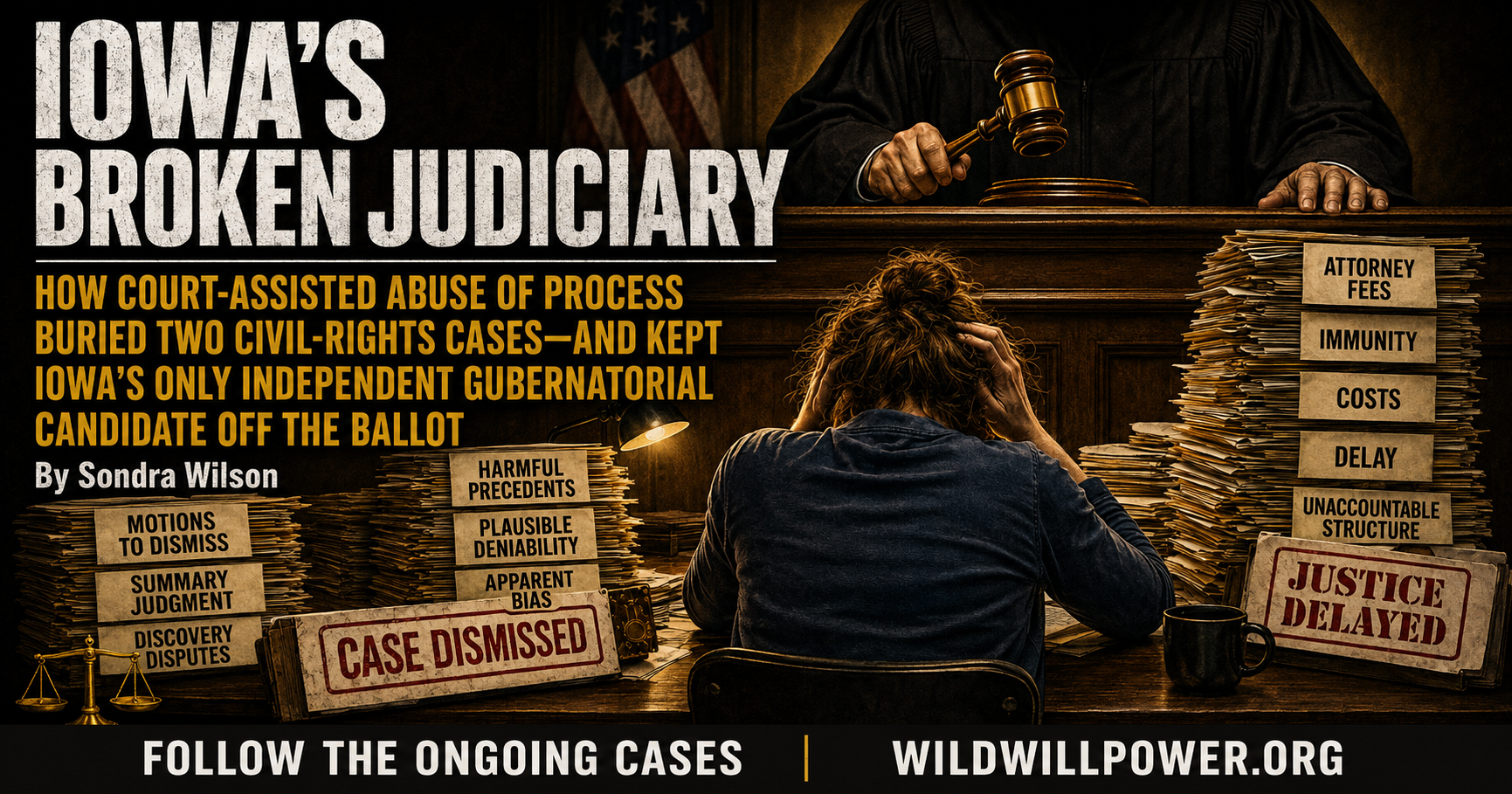
Four Cases. One Interlocking Legal Conflict
This series documents four separate but interrelated legal cases—two still being litigated, and two that ended in judgments I believe warrant reopening.
These cases are legally distinct, but they are not narratively separate.
Two of the underlying civil-rights cases were filed in close succession not because I wanted simultaneous litigation, but because the applicable limitations periods and procedural deadlines did not permit me to wait and litigate them one at a time. Wilson v. Reliable Street Inc., et al. was filed on December 5, 2023; Wilson v. State of Iowa and Kim Reynolds for Iowa followed on February 8, 2024.
Their deadlines, hearings, motions, appeals, discovery obligations, and procedural disputes increasingly overlapped. As one case demanded more time and resources, it reduced what I had available to respond in the others. That timing became one of the forces that produced the procedural compression documented throughout this series.
That collision matters because the underlying disputes involved civil rights, governmental accountability, serious accusations preserved in official records, access to medical care, and eventually my ability to qualify for Iowa’s 2026 gubernatorial ballot.
I represented myself through much of this litigation while opposing parties were represented by attorneys and institutional resources. The resulting record exposed problems that reach far beyond my own cases: inaccessible procedure, difficulty obtaining evidence, the cost of representation, doctrines that can prevent courts from reaching disputed facts, and the difficulty of obtaining meaningful relief when government itself is involved.
This series does not end with criticism. The experiences documented in these cases became the foundation for a series of justice reforms within my gubernatorial platform—proposals designed to address the specific procedural, accessibility, civil-rights, attorney-client accountability, and governmental-accountability problems exposed by this record.
Those reforms are collected in Justice Across Iowa, my comprehensive plan to make Iowa’s justice system understandable, accessible, transparent, and accountable to the people.
This series reconstructs what happened using the filings, orders, exhibits, correspondence, administrative records, and appellate materials themselves—so readers can examine the record and decide whether my criticism is justified.
The four cases are summarized below.
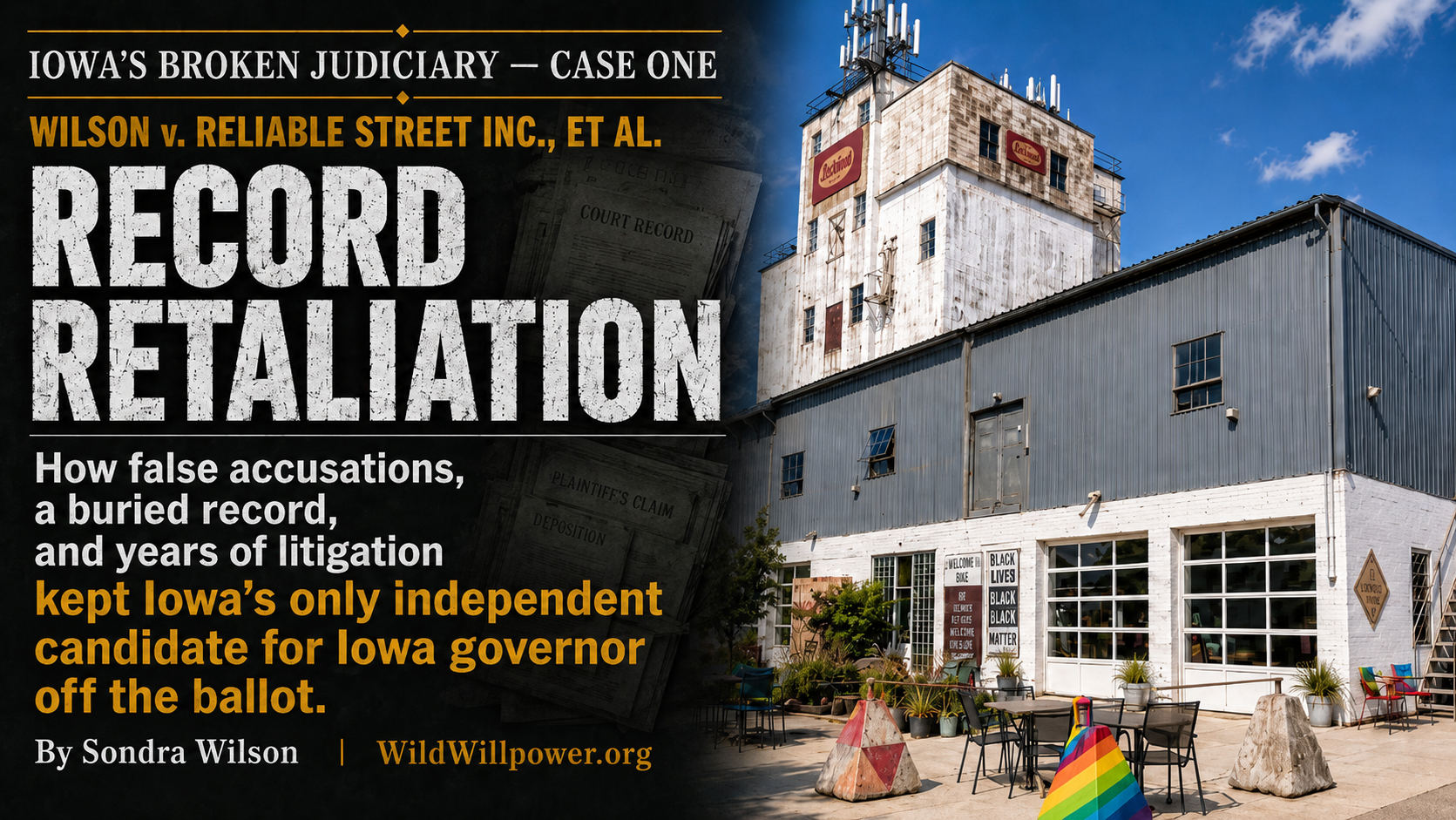
Case One—Wilson v. Reliable Street Inc., et al.
Case no. LACV053674 in Story Cty. (formerly LACL157381 in Polk Cty.)
This case began after a community collaboration involving friendship, volunteer work, artistic events, and approved garden and prairie projects ended under serious accusations that were not meaningfully explained to me. After an unsuccessful request for mediation, I filed a complaint with the Iowa Civil Rights Commission. Respondents submitted statements and materials that I allege contained false accusations, materially misleading representations, and evidence removed from context. The Commission closed the complaint without investigation and initially withheld the complete underlying file. When I finally received it, only fifty-five days remained to examine the evidence, identify possible claims, seek counsel, and file suit.
I filed the lawsuit in Polk County on December 5, 2023. The defendants responded with coordinated procedural challenges seeking transfer, dismissal, recasting, greater factual specificity, and other relief before discovery. I contemporaneously warned the court that the procedural demands were preventing the case from reaching the evidence. Judge Samantha Gronewald denied my recusal request and transferred the case to Story County. When the record moved, the separate Polk County filings were compressed into a single 144-page docket entry, while several disputes remained unresolved.
The case was then inherited by Judge Bethany Currie in May 2024. The court initially established a process under which evidence could be presented; I organized approximately seventy sub-exhibits in reliance on those directions. That process was later withdrawn, the hearing was limited to legal argument, and on October 4 most claims were dismissed with prejudice before discovery and without consideration of the referenced exhibits.
On December 4, 2024, Judge Angela Doyle became the third judge to inherit the case. By then, the record contained the transferred Polk County proceedings, overlapping motions, stayed deadlines, a withdrawn evidentiary process, partially dismissed claims, and one surviving libel claim. As the procedural history became harder to reconstruct, defendants increasingly characterized my attempts to amend, obtain time, and complete the record as delay or “obfuscation.” I contend that this growing informational imbalance allowed procedural complexity itself to be used as a litigation advantage.
By 2026, the surviving claim had returned to an active discovery-and-trial track, but additional amendment disputes, discovery conflicts, summary-judgment proceedings, and two July 15 orders ended the case before the disputed discovery was produced or a jury heard the facts.
The Reliable Street series documents why I came to allege that procedural advocacy crossed into abuse of process—and why I contend judicial rulings repeatedly enabled that strategy instead of bringing the underlying factual dispute to a hearing on the merits.
This case is not only about my campaign. It is about what happens when serious accusations enter official records, remain unresolved, and can later be searched, quoted, leaked, or used to shape public opinion.
During an election, that danger becomes especially acute. A false narrative can spread before voters ever see the underlying evidence. Allegations preserved in government records alongside misleading or altered materials can affect a person’s reputation, livelihood, safety, and political participation for years.
That is why the systems involved are larger than one candidate, one case, or one election.
Read the Reliable Street series →
Click the below image to follow the case.
Case Two—Wilson v. State of Iowa and Kim Reynolds for Iowa
Polk Cty. case no. LACL157953
This case was my broader attempt to hold the State of Iowa accountable for a chain of alleged injuries spanning many years. The amended petition brought together claims involving earlier arrests and prosecutions, Medicaid-related harms, civil-rights enforcement failures, governmental accountability, and the later administrative processes through which I had attempted to obtain redress.
Before filing suit, I submitted a formal tort claim to the State of Iowa. The State Appeal Board received it, assigned Claim No. T240135, referred it to the Attorney General’s Office for investigation, and told me that I would be notified of the claim’s final disposition. No final disposition arrived before I filed the lawsuit on February 8, 2024.
The State later argued that, because no final disposition had been issued, Iowa law required me to send a separate written notice “withdrawing” the still-pending claim before bringing suit. I had not done so because I was not abandoning the claim; I was attempting to obtain judicial redress for it. I argued that any missing procedural step should be allowed to be corrected, or at minimum should not result in permanent dismissal. The district court nevertheless dismissed the claims against the State with prejudice and denied reconsideration without further hearing.
The case against Kim Reynolds for Iowa was separately dismissed on service grounds. I appealed, but the appeal was dismissed after I did not receive the State’s motion asking the Iowa Supreme Court to dismiss it. When I sought reconsideration, the Supreme Court acknowledged that I had not been served with that motion, but still declined to reinstate the appeal.
There was no discovery, no trial, no jury, and no factual adjudication determining that the harms described in the petition were false. The case ended through threshold procedural defenses instead.
I am still reconstructing this record in full. The Case Two series will examine the underlying alleged harms, the State’s civil-rights and Medicaid policies, the Iowa Civil Rights Commission process, the tort-claim exhaustion dispute, the State’s immunity and procedural defenses, the dismissal with prejudice, and the appellate notice problem.
Read: Wilson v. State of Iowa and Kim Reynolds for Iowa →
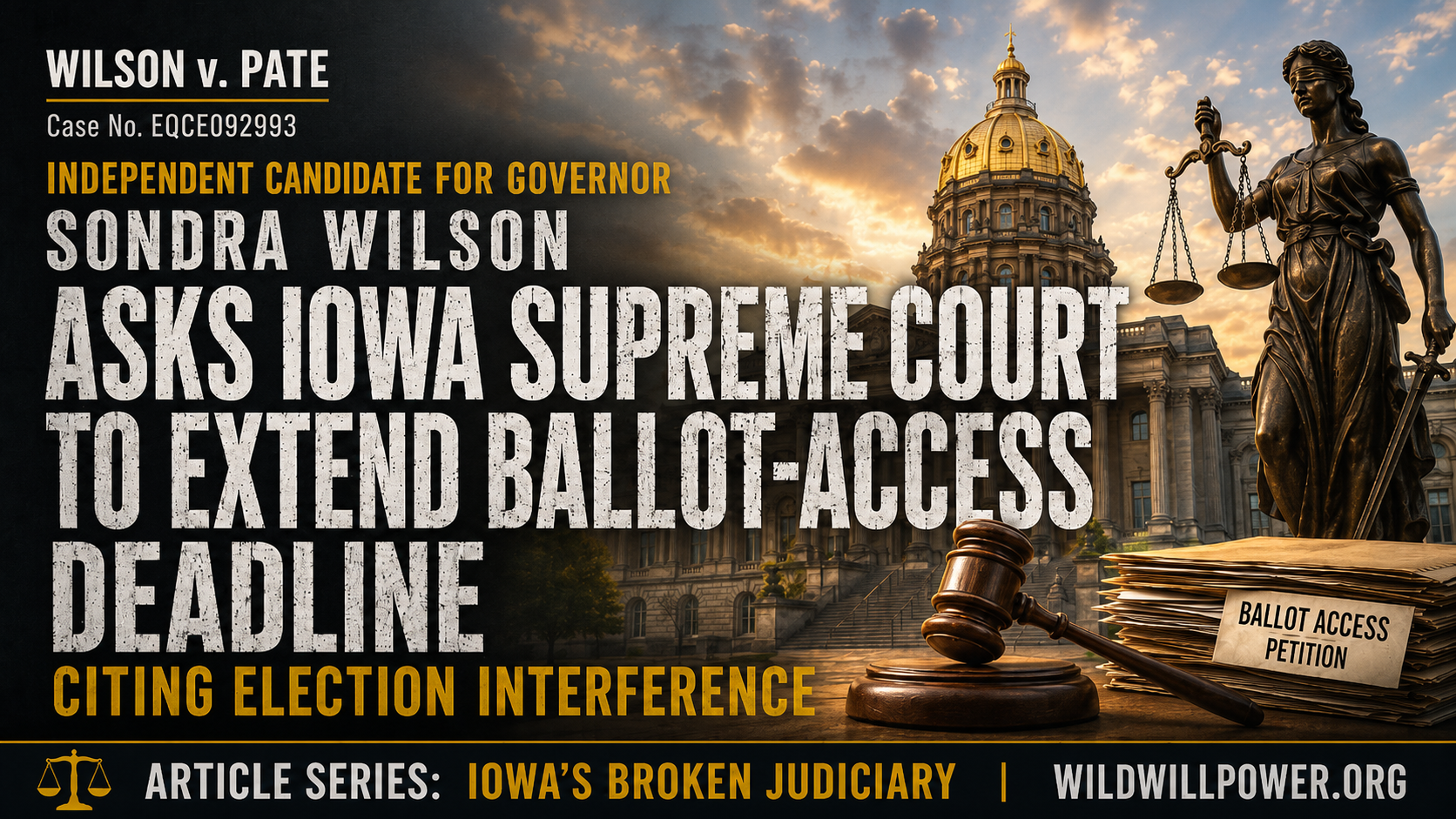
Case Three—Wilson v. Paul D. Pate
Case no. EQCE092993 | Iowa Supreme Court No. 26-1268
Status: Active — Currently Before the Iowa Supreme Court
Wilson v. Pate is a separate ballot-access case, but it arose directly from the litigation burden imposed by Wilson v. Reliable Street Inc., et al. For that reason, the Reliable Street series includes an Election Interference installment explaining that causal relationship, while the dedicated Wilson v. Pate page follows the ballot-access case and appeal itself.
During Iowa’s 2026 ballot-access period, the Reliable Street case returned to an active litigation track involving amendment, discovery, summary judgment, hearings, exhibit preparation, and repeated court deadlines. Those obligations overlapped with the same weeks in which I was required to collect 3,500 signatures to qualify for the gubernatorial ballot. The Reliable Street record documents that the litigation continued to intensify even after I filed the ballot-access action.
I asked the district court for a limited equitable extension of the ballot deadline. I did not ask to waive or reduce the signature requirement; I asked for additional time to collect the same number of signatures required by law. The court denied relief and later characterized the underlying litigation burden as “self-created” because I had initiated the civil-rights lawsuit.
I dispute that characterization because the Reliable Street litigation arose from my attempt to examine and challenge serious accusations that had entered a government civil-rights record and that I believed posed an ongoing threat to my reputation and statewide campaign. In my view, treating the resulting court obligations as merely a voluntary distraction ignores why the lawsuit existed and what abandoning it would have meant.
The practical result was that the litigation arising from Case One consumed time required for ballot qualification, the requested extension was denied, and my candidacy did not reach the ballot. That is why the Reliable Street series treats this phase as Election Interference, while the separate Wilson v. Pate page follows the ballot-access litigation and appeal itself.
Follow Wilson v. Paul D. Pate →
Click the below image to follow the case.
Related Federal Action—Wilson et al. v. Trump et al.
U.S. District Court for the Southern District of Iowa
Case No. 4:25-cv-00116-SHL-WPK
The underlying governmental, Medicaid, and civil-rights disputes did not end with the dismissal of the 2024 State case.
As Iowa continued changing its civil-rights and Medicaid policies affecting transgender adults, I joined three other plaintiffs in filing a separate federal action on March 31, 2025. The complaint challenged what we alleged was a broader course of governmental conduct involving medically necessary Medicaid care, removal of civil-rights protections, and alleged deprivations of federally protected rights.
The federal court dismissed the case at initial screening, before any defendant was served or answered. Among other things, the court concluded that self-represented plaintiffs could not litigate claims on behalf of other people or a class; that the complaint had not adequately pleaded a concrete personal injury sufficient for Article III standing; that private citizens could not themselves prosecute federal criminal statutes; and that certain defendants were protected by judicial or legislative immunity.
The dismissal therefore did not follow discovery, testimony, service upon the defendants, or development of an adversarial factual record. The federal-case page distinguishes what the court actually ruled from the broader factual record and identifies the pleading and jurisdictional issues that any future action would have to address.
Related federal record: Wilson et al. v. Trump et al. →
Click the below image to read what happened, and where these cases currently stand.
Where the Cases Stand Now
Reliable Street: District-court proceedings concluded in July 2026; appellate review is being pursued.
State of Iowa / Kim Reynolds for Iowa: Dismissed; I believe the judgment warrants reopening and am continuing to reconstruct the record.
Wilson v. Paul D. Pate: Active before the Iowa Supreme Court, No. 26-1268.
Wilson et al. v. Trump et al.: Federal action dismissed at initial screening; the related page explains what was decided and what was not.
Two matters remain active. Two others ended in judgments I contend warrant renewed judicial examination.
A Rare Glimpse From the "Underbelly of the Beast"
These cases also provide a perspective rarely visible in political debates about transgender people: what those conflicts can look like in the life of an ordinary person living through their consequences.
I began seeking medical care and transitioning in 2003, long before transgender issues became a central subject of national political campaigns and media conflict. After years of instability and homelessness, I returned to Iowa in 2018 and eventually found myself navigating civil-rights disputes, interrupted medical care, administrative systems, and multiple court cases during a period of rapidly intensifying political controversy.
But this series is not primarily an argument about transgender politics.
It is about what happened after a person experiencing serious alleged harms turned to government agencies and courts for protection and redress—and what can happen when someone without substantial money, institutional backing, a legal team, or sustained media attention must navigate multiple complicated proceedings at once.
If you want to support transgender rights—or civil rights generally—show up to these cases. Read the filings. Examine the evidence. Listen.
These cases would remain important even if they had nothing whatsoever to do with my being transgender. The larger issue is whether ordinary people can obtain meaningful redress when they allege serious wrongdoing—and what happens when procedural complexity, financial barriers, overlapping litigation, and court rulings make reaching the merits extraordinarily difficult.
"With Prejudice" Does Not Necessarily Mean "Beyond Challenge"
Several claims were ultimately dismissed with prejudice.
That is a serious legal designation. Ordinarily, it means that the same claim cannot simply be filed again as though the prior judgment never occurred.
But it does not necessarily mean that the judgment is permanently immune from challenge.
Depending upon the procedural history and applicable law, final judgments may still be challenged through reconsideration, appeal, petitions or motions to vacate, relief based upon procedural irregularity or unavoidable casualty, newly discovered evidence, fraud, extraordinary circumstances, constitutional due-process principles, and other recognized forms of post-judgment relief.
I believe the records in the two dismissed cases warrant renewed judicial examination, and I intend to continue pursuing every legally available avenue to obtain it. Whether a court ultimately agrees is a legal question that remains to be decided.
This series therefore documents an ongoing legal conflict—not merely a closed chapter.
Two cases remain active. Two others ended in judgments I believe should be reopened.
And across all four, one of the central questions is not merely what the courts ultimately decided, but something more fundamental:
Did these disputes ever receive a genuine opportunity to be fully heard?
When I describe Iowa’s judiciary as broken, I am not alleging that judges and attorneys entered into a secret agreement. I am describing a system whose complexity, cost, procedural barriers, and professional imbalance can make meaningful access to justice extraordinarily difficult for ordinary people.
What These Cases Reveal About the System
This series begins with one civil-rights complaint, but the record exposes broader questions about how Iowa’s justice system functions when an ordinary person cannot afford counsel. It shows how simultaneous procedural challenges can bury the underlying facts, how evidence can remain inaccessible before claims are dismissed, how efforts to amend can become years of additional litigation, and how a sweeping privilege doctrine can end a case without deciding whether the disputed statements were true.
Those problems are not unique to transgender litigants or civil-rights cases. They can affect any Iowan who enters court against a represented institution, business, government agency, or better-financed opponent.
Do Not Take My Word for It—Examine the Record
I understand that some readers—especially those who skim only the opening—may instinctively defer to the defendants or assume that the courts handled this case fairly. I am from Iowa, and I understand that cultural tendency. That is one reason I am publishing the complete procedural record: readers can examine the filings themselves and decide whether my criticism of Iowa’s judiciary is supported by the evidence.
These problems are not merely theoretical. They affect Iowans whose stories never reach the news and those who cannot afford an attorney after they have been harmed.
I also know that prejudice against me as a transgender woman will cause some readers to ridicule me rather than examine the record honestly. The comments below, posted within twenty-four hours of my writing this section, offer only a snapshot of hostility I have faced for decades—hostility that has noticeably intensified as transgender people have increasingly been treated as political targets rather than as individuals.
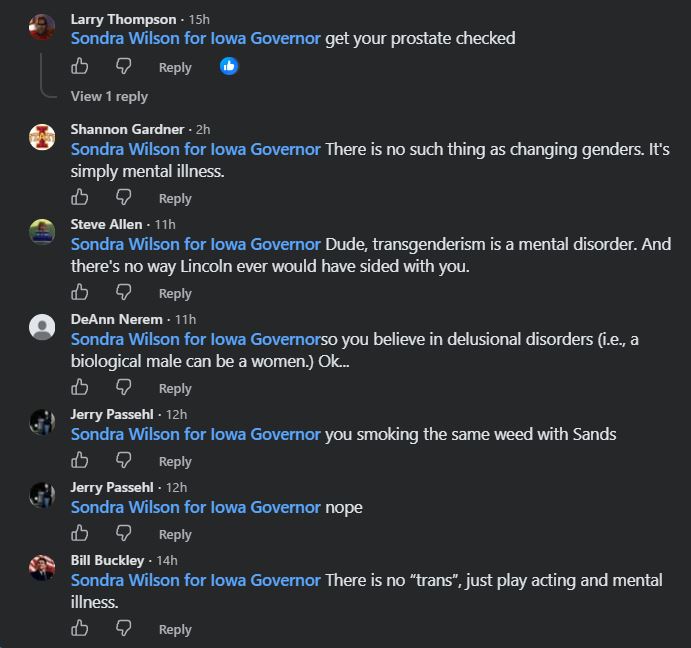
Above: A snapshot of the hostility I routinely encounter online. These comments were posted within twenty-four hours of my writing this section of the article.
Historical Context: Before the Culture Wars
I cannot yet know how many Iowans have experienced comparable institutional harm. Many cases never become public; some disappear into administrative files, plea records, fragmented dockets, institutional records, or procedural rulings that few people outside the legal system ever examine.
Iowa also has a documented history of using criminal law, psychiatry, eugenics, confinement, and civil-rights exclusions against people whose bodies, relationships, or gender expression fell outside accepted social norms.
That history does not prove that the events documented in these cases arose from the same causes. But it provides important context for understanding why institutional records, classifications, access to remedies, and public accountability matter.
Read the historical prologue: Before the Culture War: Iowa's Dark History of Persecuting LGBT+ People, 1838-2006 →
For the personal history that preceded these cases, read Intersex in Iowa →, which now forms part of the larger Wilson v. State of Iowa and Kim Reynolds for Iowa → record.
Click the below image to learn the history.

Public Scrutiny Creates Accountability for Everyone
I cannot know how any court would rule if no one were watching. I do know that public visibility creates accountability. It allows readers to compare later descriptions of the case with the actual filings, discourages quiet distortion of a fragmented record, and gives me some protection against serious allegations being detached from their context.
Publishing the record also requires accountability from me. Readers can examine my claims, compare them with the actual filings, and decide for themselves whether my criticism is supported by the record.
Reliable Street Is Moving Toward Appeal
The district-court proceedings have reached a critical stage, and I am preparing to seek appellate review. I am currently seeking qualified counsel, financial assistance that will allow me to continue working on the case, and attorneys, civil-rights organizations, or public-interest advocates who may be interested in reviewing the record or participating through an amicus brief.
Part Four: Dangerous Precedent will contain the current appellate posture, significant developments, and specific requests for legal or public-interest assistance.
From This Record to Reform
The justice reforms in my gubernatorial platform did not arise from abstract theory. They developed through years of navigating Iowa’s courts and administrative agencies firsthand.
They respond to the barriers documented throughout this series: incomprehensible procedure, unaffordable representation, delayed access to government records, inadequate support for self-represented litigants, opaque civil-rights processes, attorney-client accountability problems, sweeping immunity doctrines, and cases decided without the disputed conduct ever being examined on the merits.
This series documents the problems. Justice Across Iowa presents my proposed solutions.
Explore Justice Across Iowa →
Click the image below to read the full justice-reform plan.

With Gratitude
Special thanks to the Alexander Clark Foundation for their assistance in locating and preserving the historic filings from Clark v. Board of Directors (1868). Their dedication to Iowa’s civil‑rights legacy continues to illuminate the path toward equality today.
I also wish to extend heartfelt appreciation to the developers, researchers, and teams behind the modern tools that supported the reconstruction of this record and the writing of this series:
-
ChatGPT (OpenAI) — https://openai.com
-
Microsoft Copilot — https://copilot.microsoft.com
-
Google Gemini — https://gemini.google.com
-
Anthropic Claude — https://www.anthropic.com/claude
Their tools helped organize thousands of pages of filings, historical documents, and procedural records into a format the public can meaningfully examine.
Thank you to the legal scholars, archivists, educators, and historians across Iowa whose publicly available research, commentary, and historical materials supported this work. I am equally grateful to the developers and maintainers of open‑access legal resources, including the volunteers who sustain Wikipedia, and the creators of public legal‑information platforms whose tools made this research possible.
To advocacy organizations whose work strengthens civil rights in Iowa: • One Iowa — https://oneiowa.org • ACLU of Iowa — https://www.aclu-ia.org
Your efforts to protect constitutional liberties and human dignity have helped countless Iowans navigate systems not built with them in mind.
To my medical providers, counselors, and care teams, thank you for your professionalism, compassion, and support through years of litigation pressure, discrimination, and medical uncertainty.
To protestors, activists, and community members, thank you for standing for equality, fairness, and human rights in Iowa and across the nation.
To my professors, advisors, and past teachers at Nevada High School, and Des Moines Area Community College (DMACC), thank you for the knowledge, patience, and understanding you offered — and for the deadline extensions that allowed me to balance full‑time coursework with the demands of this litigation. Your guidance shaped both my education and my resilience.
To my supporters, friends, and family, your encouragement made survival possible during circumstances that often felt insurmountable. You stood with me when the system did not.
To public officials—past and present—who have sworn oaths to uphold the Iowa and United States Constitutions. Even in difficult political climates, your commitment to maintaining institutions where a transgender woman can assert her rights, challenge injustice, and participate in democratic life is profoundly meaningful. Whatever disagreements exist in our era, the continued existence of constitutional pathways for redress is itself a testament to your service.
To veterans and active‑duty service members, whose sacrifices have preserved a nation where constitutional rights can be invoked, defended, and expanded. Your service makes possible the freedoms that allow cases like this to be brought at all.
And finally, to Jesus, whose teachings on compassion, forgiveness, courage, and discernment — “wise as serpents and harmless as doves” — carried me through the darkest periods of this journey. The simple command to treat others as you would want to be treated remains the moral foundation beneath every effort toward justice.
To my pastors, past and present, and to the churches that kept His story alive, thank you for passing down a message of hope, mercy, and steadfast love through generations. Your faithfulness helped sustain me when the world felt unbearably heavy.
And to the musicians and artists whose work inspired me to persevere, to imagine a better future, and to keep fighting for humanity and for the natural world we share — your creativity helped me hold onto the belief that beauty, justice, and compassion are still possible.
Endnotes
1. Wilson v. Reliable Street Inc., et al., Iowa District Court for Story County, Case No. LACV053674. The case originated in Polk County as Case No. LACL157381 and was later transferred to Story County. The pleadings, motions, orders, exhibits, and related administrative record form the principal documentary basis for Case One of this series.
2. Wilson v. State of Iowa and Kim Reynolds for Iowa, Iowa District Court, Case No. LACL157953. The pleadings, motions, orders, and administrative records in that action form the principal documentary basis for Case Two of this series.
3. Wilson v. Pate, Iowa District Court for Polk County, Case No. EQCE092993. The action arose from Wilson’s request for additional time to complete Iowa’s ballot-access signature requirement after litigation obligations in Wilson v. Reliable Street Inc., et al. overlapped with the statutory petition period. The district court denied relief; the resulting proceedings and appellate filings form the documentary basis for Case Three of this series. The landing page presently describes that collision and the court’s characterization of the litigation burden as “self-created.”
4. Wilson et al. v. Trump et al., U.S. District Court for the Southern District of Iowa, Case No. 4:25-cv-00116-SHL-WPK. The federal pleadings and orders form the principal documentary basis for Case Four of this series.
5. A dismissal with prejudice ordinarily operates as a final adjudication barring the same claim from simply being refiled. It does not necessarily foreclose every recognized form of direct or collateral post-judgment relief. Depending upon the governing law and procedural circumstances, possible avenues may include appeal, reconsideration, motions to vacate or set aside a judgment, relief based on fraud or newly discovered evidence, or other authorized post-judgment procedures. The availability and requirements of any particular remedy depend upon the individual case. This note supports the explanation at the beginning of the series concerning why two dismissed cases remain part of an ongoing legal dispute.
6. The descriptions of Wilson v. Reliable Street Inc., et al. on this landing page are summaries of the underlying administrative and judicial records. The complete series provides the cited filings, orders, exhibits, correspondence, and other materials so that readers can examine the record rather than relying upon the author’s characterization alone. The landing page summarizes, among other things, the administrative closure, later receipt of the complaint file, subsequent litigation, and the district court’s privilege ruling.
Image credit: Original concept, art direction, quotation selection, and presentation by Sondra Wilson for Wild Willpower; generated with assistance from ChatGPT by OpenAI. Human-authored elements and arrangement © 2026 Wild Willpower. All rights reserved.