Behind the Headlines:
How Nicholas Gluba Was Kept Off the 2026 Gubernatorial Ballot
After Two Ballot Fights in Three Years, Gluba Tells His Side of the Story
By Sondra Wilson | Updated September 17, 2026
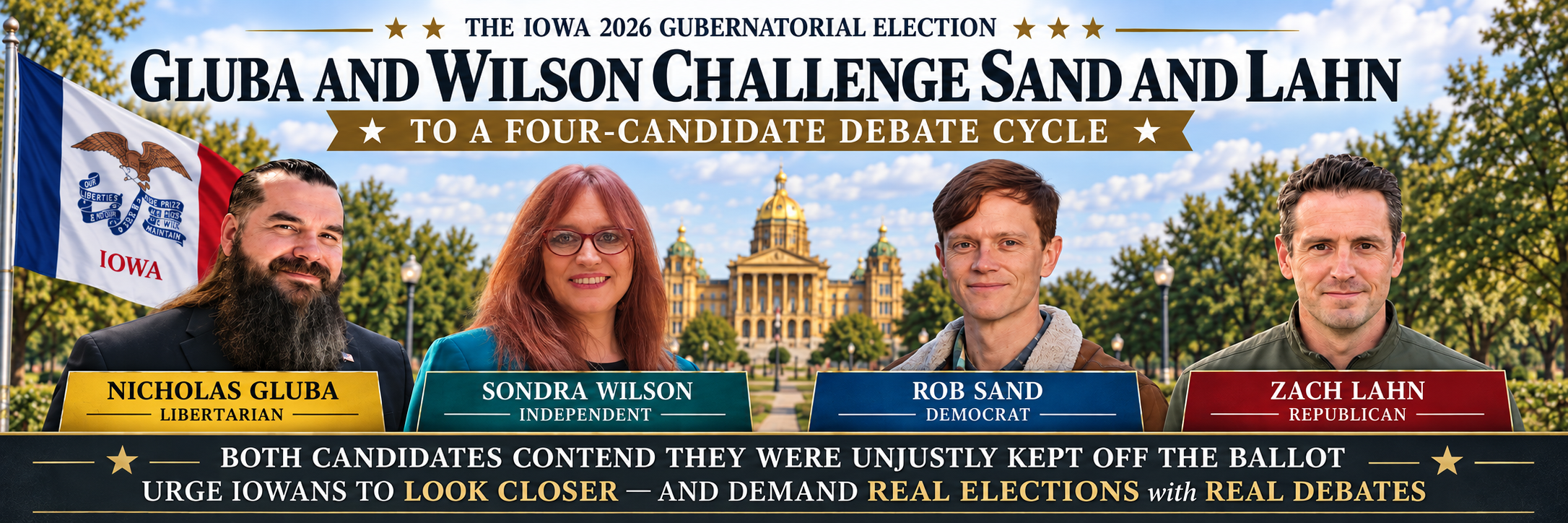
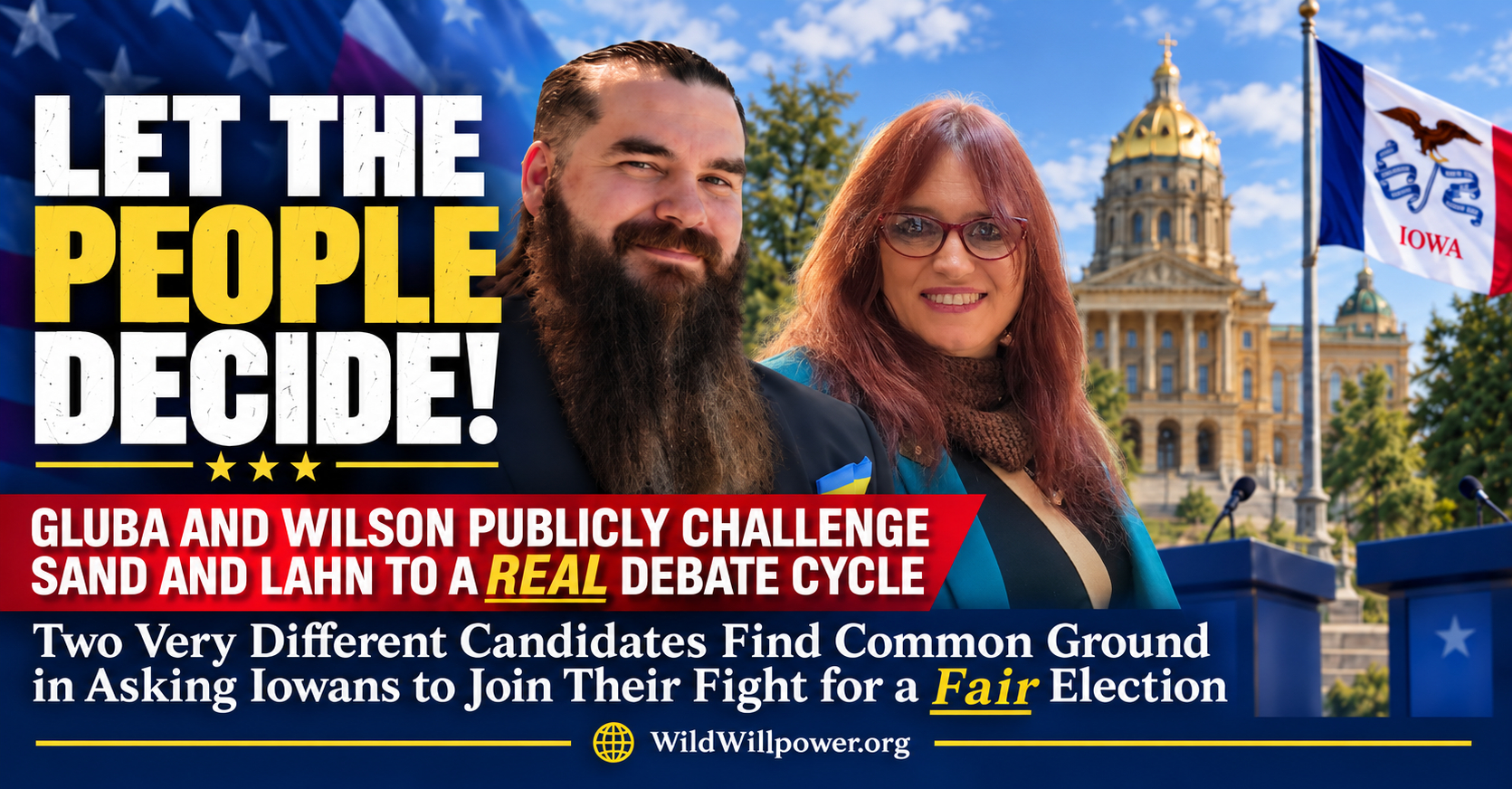
This article was released as part of a joint-statement by Nicholas Gluba and Sondra Wilson's campaigns exposing how Iowa's current statutorily-regulated election structure provides little to no safeguards against outside campaign interference, even when deliberate sabotage remains apparent. On September 17, 2026 Gluba and Wilson asked Rob Sand and Zach Lahn's campaigns to join us in solidarity in demanding a four-person debate cycle. This challenge is accompanied by an online petition we are asking Iowans to sign to demand a fair election with all the candidates. To read the statement and sign the petition, visit the LET THE PEOPLE DECIDE.
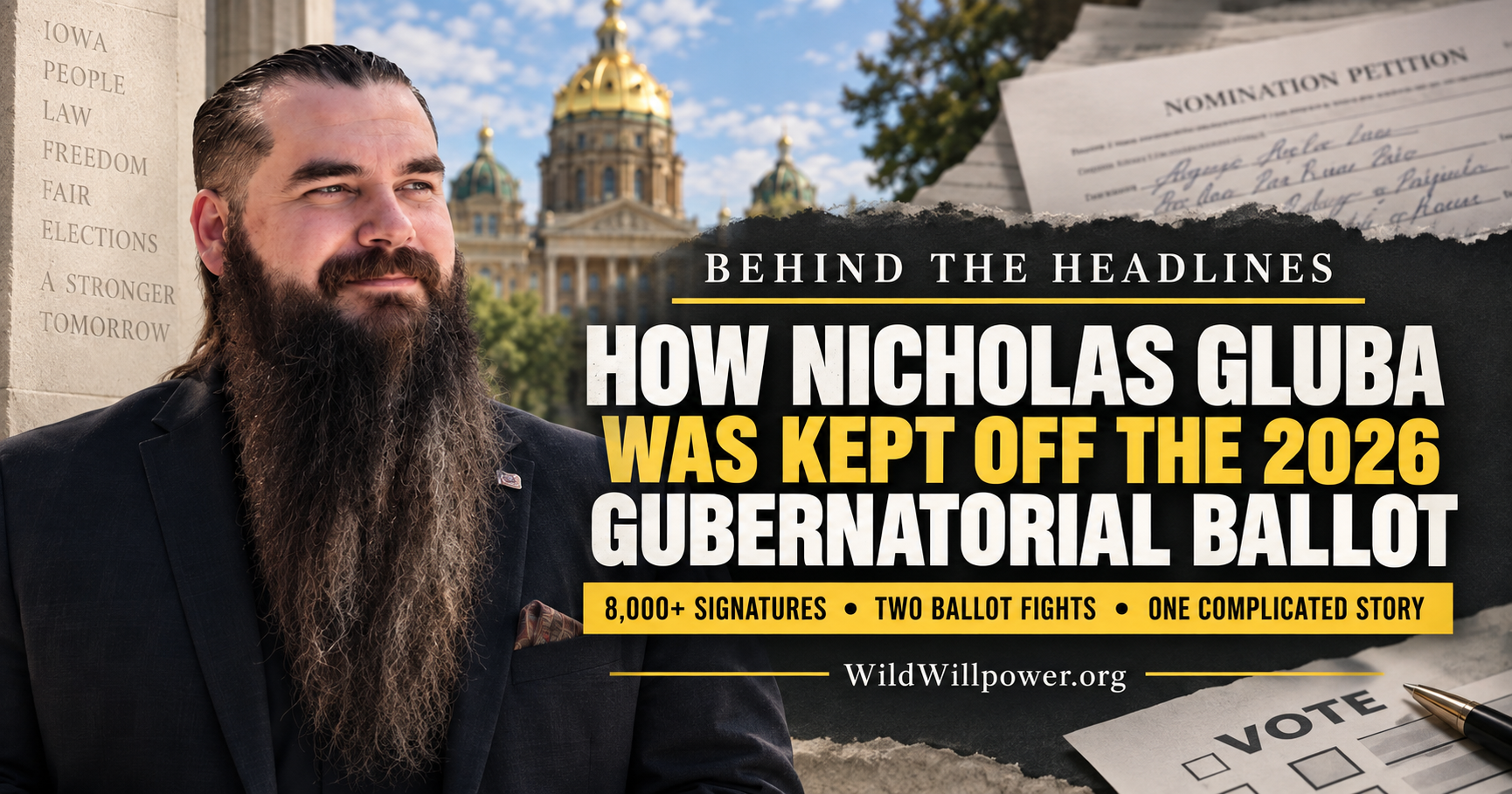
Nicholas Gluba is a lifelong Iowan, United States Marine Corps veteran, and Libertarian candidate for Iowa Governor.
Raised on a cattle ranch near Williamsburg, Nicholas is focused on a what he calls a "logical system of government that is small enough it cannot dictate the lives of citizens." He is a heavy supporter of individual rights and property rights and seeks to remove the power of eminent domain from the state, improve Iowa's education system, and remove AI systems that violate Fourth Amendment rights.
Whether you agree or disagree with his priorities, Gluba's story brings Iowa's election integrity into question.
Gluba: "The Old Guard Candidates Work Together..."

On September 15, Gluba's campaign provided the following statement to Wild Willpower PAC about what he believes is the larger problem facing third-party and independent candidates:
“The old guard candidates work together to make sure third party and independent candidates cannot gain access to the ballots.
They claim they want to make the election process easier for those that do not conform to the standard R and D parties, but they block them [from being on the ballot] before they can even get a chance to get out to the people of Iowa through corrupt last minute rule changes and using obscure laws from antiquity.”
Someone Appears to Be Lying; the Footage is Missing —
But State Officials Backed Their Employee Instead of the Veteran
This year, Iowa required 3,500 signatures for a statewide candidate to make the ballot. Gluba submitted more than 8,000—over twice the requirement. [1] The Secretary of State’s candidate list initially confirmed his filing on June 2. Yet less than two weeks later, the Gluba–Cutler ticket was removed, not because of signatures, but because the State Objection Panel concluded that Cutler’s affidavit of candidacy had not been filed on June 2. [2]-[3]
Such an affidavit is required on the same day the petitions are turned in.
Cutler maintained that she had the affidavit with her when she accompanied Gluba to the Secretary of State's office on June 2. According to Cutler and attorney Jacob Heard, Cutler attempted to submit it to elections support specialist Dani Phillips but was told that the affidavit was "not needed" for the lieutenant-governor candidate. [4]
During my initial interview with Mr. Gluba, he went further, informing me that he and Cutler repeatedly tried to file the affidavit of candidacy because they knew the requirements, but Phillips would not allow them to file it.
At the June 15 State Objection Panel hearing, Phillips said Cutler had not offered her an affidavit and that Phillips had not told Cutler the document was unnecessary.
But Phillips testified that she could not remember whether Cutler had even been present when Gluba submitted the campaign's nomination materials. [5]
As shown in the State Objection Panel footage by Bleeding Heartland, Cutler requested lobby‑camera footage to confirm her presence during the filing, but was told the cameras only livestream and do not record. As a result, the State maintained no objective record capable of resolving the conflicting accounts—even though the interaction determined whether a statewide ticket would appear on the ballot. [6]
This raises a basic question of governmental accountability:
When an unrecorded interaction with a government employee can determine whether a statewide ticket appears on the ballot, who bears the risk when the State maintains no reliable record of what occurred?
Should citizens be expected to arrive at government offices carrying their own cameras simply to protect themselves against a later factual dispute?
What about buildings where government policy doesn't allow Citizens to film?
The Republican-Controlled Objection Panel Sided With Their Employee —
Who Conveniently Couldn't Remember Whether Cutler Was Present
Because Democratic State Auditor Rob Sand was running against Gluba for governor, Sand recused himself from deciding Gluba's challenge. Iowa Secretary of Agriculture Mike Naig replaced him on the three-member panel, joining Secretary of State Paul Pate and Attorney General Brenna Bird. [8]
The panel—all members of the Republican Party of Iowa—accepted the objection and unanimously removed the Gluba-Cutler ticket from the ballot. [7]
When there was a conflicting account between the candidates and the employee, officials gave the benefit of the doubt to their employee. Iowans, as a result, were robbed of a real election where all the candidates were heard and allowed to present their policies and platform positions.
With a Conflicting Account, The Court Remained Hamstrung
On June 23, Gluba and Cutler filed a petition for judicial review in Polk County District Court seeking reinstatement to the November ballot. [9]
After an evidentiary hearing, District Judge Joseph Seidlin did not endorse the State Objection Panel's factual determination about the affidavit.
Instead, he wrote:
“The court disagrees with the Panel's finding that Cutler never offered and Phillips never declined or refused to receive Cutler's affidavit of candidacy.” [10]
The judge described the evidence as being, “at best,” in equipoise—legal terminology meaning essentially evenly balanced. [11]
That is an important distinction.
The court did not find that Cutler's account had been disproven. Nor did it find that Phillips's version was unquestionably correct.
Rather, Judge Seidlin concluded that enough evidence existed in the administrative record to support the panel's decision under the deferential standard governing judicial review. He explained that Phillips had unequivocally denied being offered the affidavit and that her job was ordinarily to receive and process election filings. Because of that standard, he concluded that the court could not simply replace the panel's factual findings with its own—even though he himself viewed the evidence differently. [12]
That distinction matters because a finding that an agency decision survives deferential judicial review is not the same thing as a finding that the government's account was actually true.
With no recording of the filing interaction and conflicting testimony from Cutler and Phillips, the panel credited the employee’s account. Judge Seidlin later made clear that he disagreed with that factual finding but was bound by the deferential standard of review. [4]–[6], [10]–[12]
Taken together, those circumstances give substantial reason to conclude that the State's version of the story does not add up—and that Gluba and Cutler should not have been removed from the ballot.
The court did not find that Phillips intentionally lied. But neither did it find that Cutler's account was false. Instead, the decision survived because the applicable standard required substantial evidence supporting the Panel's finding—not because the judge independently concluded that the State's version was more credible.
And this brings a separate concern about the courts: Iowans are led to believe that their purpose is centered on creating justice. This situation shows that apparently their purpose is to enforce statutes and standards even when those statutes and standards amplify injustice and cause additional harm.
This raises an obvious set of questions:
If courts are independent, then why are they forced to adhere strictly to unjust standards put in place by the other two branches? Where were the checks and balances in this situation?
Due to a “Deferential Standard” Under the Iowa Administrative Procedure Act,
the Court Was Required to Give the Panel’s Finding "Substantial Deference"
The deferential standard that constrained the district court was not written into Iowa's Constitution. Its modern statutory foundation comes from Iowa's Administrative Procedure Act, adopted by the General Assembly in 1974 and subsequently amended and interpreted by Iowa courts.
Judge Seidlin expressly disagreed with the State Objection Panel's finding that Jules Cutler never offered her affidavit and that the Secretary of State's employee never refused it. He described the competing evidence as, “at best,” in equipoise—essentially evenly balanced.
Yet because judicial review was deferential under the Administrative Procedure Act, the court could not simply substitute its own factual determination for the Panel's so long as the Panel's finding remained supported by substantial evidence.
This brings us to the question of justice. Is the purpose of the court to help create justice from unjust situations, or is the purpose of the court to enforce statutes even when the enforcement of those statutes produces or exacerbates injustice as a result?
Iowa's own Judicial Branch says its mission is to provide “independent” forums while “administering justice under law equally to all persons.”
But this case exposes that what taxpayers are being told is not the same as the outcome we are being given:
When a statute enacted through the legislative process and approved by the Executive can force the court to cause injustice to Citizens and prevent free and fair elections from taking place, is Iowa's judiciary truly independent?
Or is it merely a taskmaster designed to enforce statutes even when those statutes create injustice and harm citizens?
If this is the case, then perhaps we should take "liberty and justice for all" out of the Pledge of Allegiance, and instead of lying to students by teaching them about "separation of powers", we should tell them the truth, and let them know that the Legislature and the Governor are merely overseers who enforce their will and abuse us through the courts.
Let's be honest: such a framework does not reveal an independent judiciary when the court is required to defer to a decision it expressly disagrees with.
It exposes a judiciary whose ability to correct injustice can be anchored to statutory standards imposed by the political branches—and therefore can be constrained by those branches when those standards govern what the court is permitted to do.
Iowa's Administrative Procedure Act expressly requires judicial review to occur under the standards established by statute and places the burden of demonstrating invalidity on the party challenging the agency action.
That tension becomes even more serious when the legislative and executive branches are controlled by the same political party. The constitutional separation of powers is supposed to divide governmental authority among separate branches; yet here, the reviewing court expressly disagreed with the administrative body's central factual finding while a legislatively created standard constrained the court's ability to substitute its own determination.
While Gluba and I disagree on several issues, we strongly agree that Iowa's current governmental structure, as it is presently operating, cannot be reconciled with what the framers of the Iowa or U.S. Constitutions intended.
And this is exactly why more voices matter in Iowa's elections. If the major-party candidates do not challenge a structure that independent and third-party candidates contend is shutting them out, then excluding those additional candidates from the political conversation only reinforces the very system being challenged. The heart of the law cannot be reduced to technical compliance alone; the deeper constitutional questions are justice, fairness, accountability, and whether the "letter of the law" is serving the people it governs. It is not.
An Important Hypothetical to Ponder
The problem becomes especially serious when the disputed event occurred during a brief, unrecorded interaction between a citizen and a government employee.
If a government employee knowingly gave a false account of an unrecorded interaction, the absence of footage or witnesses can make the falsehood practically impossible to disprove. Under Iowa’s deferential judicial‑review structure, such a scenario apparently produces the same outcome as an innocent mistake: removal from the ballot. The system does not need to assume sabotage occurred in this case to reveal a structural vulnerability that could allow it to succeed undetected.
The fact that the current structure allows intentional sabotage to remain indistinguishable from innocent mistake brings into question the integrity of Iowa elections.
A more protective election system would not have to presume that the employee was lying—or presume that the candidate was lying.
It could instead recognize the unresolved factual uncertainty and provide a reasonable opportunity to cure the disputed defect instead of imposing an extraordinary injustice upon the candidate.
If Gluba and Cutler's account is true, then they were severely harmed by Iowa's reckless deferential standard that enabled and exacerbated the injustice.
The Iowa Tort Claims Act Protects the State and Its Employees From Liability
Even When a State Employee Abuses Discretion, Misrepresents Facts, or Engages in Deceit
If such a form of malice or sabotage were to exist, could Gluba and Cutler—or the Libertarian Party—sue the State of Iowa?
Under the Iowa Tort Claims Act, as it is currently written, the State ordinarily accepts some liability for negligent or wrongful acts committed by state employees acting within the scope of their employment. But the law contains sweeping exceptions.
For example, Iowa Code § 669.14(1) preserves immunity for certain governmental discretionary functions
“whether or not the discretion be abused.”
Even more strikingly, § 669.14(4) excludes claims arising from several forms of alleged wrongdoing, including abuse of process, misrepresentation, and even "deceit".
Iowa Code § 669.23 takes it a step further:
“Employees of the state are not personally liable for any claim which is exempted under section 669.14.”
If a state official or employee were knowledgeable that these statutes exist, and if they knew about the deferential standard, then they could know that claims arising from abused discretion, misrepresentation, or deceit are expressly excluded from liability under Iowa's Tort Claims Act—and that state employees are not personally liable for claims falling within those exemptions.
That is not a structure that prevents corruption. It is a structure that enables it.
"Justice" Required a Reasonable Remedy:
If Not Justice, What is the Purpose of the Court?
Iowa could have provided a meaningful opportunity to cure the defect.
Gluba gathered more than 8,000 signatures. Gluba and Cutler maintain that they repeatedly attempted to file the affidavit, but that Phillips wouldn't allow it. If the State nevertheless concluded the affidavit was missing, Iowa law could have provided a short cure period allowing the campaign to submit another copy rather than making ballot exclusion the consequence of the unresolved filing dispute.
As a result of forcing strict compliance over reasonable remedy, the court itself created and exacerbated injustice instead of creating justice from an apparently unjust situation. A reasonable cure period would have allowed the State to err on the side of preserving ballot access instead of enabling the reasonable possibility of malice, caprice, or negligence to cause severe harm to the candidates and Iowa's 2026 gubernatorial election.
Is the purpose of the court to create justice from unjust situations, or is the purpose of the court to enforce statutes, even when the enforcement of those statutes, to the "letter of the law", creates injustice?
Iowa Code § 43.123 provides that Democratic and Republican lieutenant-governor nominees are selected at their parties' state conventions. This year, both parties nominated their lieutenant-governor candidates on June 13—eleven days after the June 2 filing deadline that was used to permanently remove Gluba and Cutler from the ticket.
If one class of gubernatorial candidates may finalize its lieutenant-governor nomination after June 2, while another ticket can be eliminated under unusual and contested circumstances, Iowans can reasonably ask if these lopsided standards—put in place by members of the Republican and Democratic Parties—help administer fair elections, or if they tilt elections in favor of party establishments.
The Fight Didn't End With Cutler — The Libertarians Tried a Replacement Candidate
Gluba and Cutler had also asked the district court whether Gluba could remain a gubernatorial candidate with a replacement lieutenant-governor nominee if Cutler could not remain on the ticket. Judge Seidlin treated that as a separate issue and declined to issue an advisory ruling on whether a replacement could ultimately qualify. [13]–[14]
After Cutler withdrew, the Libertarian Party of Iowa nominated Charles Aldrich as Gluba's replacement candidate for lieutenant governor. [15] Aldrich had himself been one of the Libertarian congressional candidates removed from Iowa's ballot in the separate 2024 controversy discussed below.
But the replacement effort produced another statutory dispute. The State argued that the party had not followed the procedures required to place replacement nominees on the ballot, and Judge Seidlin later agreed that the replacement-nomination process had not been properly conducted. [16]–[18] Gluba nevertheless continued publicly campaigning with Aldrich and appeared at the Iowa State Fair Political Soapbox in August. [19]
This was a different legal issue from the original Cutler-affidavit dispute. But it added another chapter to the same broader ballot-access controversy: after the original ticket was removed, the Libertarians attempted another statutory route to preserve Gluba's candidacy, and that effort also ended without his name on the ballot.
Why Didn't Gluba and Cutler Demand a Trial by Jury?
This would have been the logical choice. After all,
Article I, Section 9 of the Iowa Constitution explicitly states:
"The right of trial by jury shall remain inviolate."
However, Iowa courts—for some reason—generally do not provide a right to a jury trial in proceedings that are equitable in nature. Judicial review of administrative action operates under its own statutory framework.
It kind of makes you wonder how and why things changed, and whether this was the exact type of situation that the framers of the Iowa Constitution had in mind when they wrote that particular clause.

This Wasn't Gluba's First Ballot Fight —
Rob Sand Previously Stood Up for Him
There is an important piece of history behind the 2026 controversy.
In 2024, Nicholas Gluba was the Libertarian candidate for Congress in Iowa's First Congressional District. He and two other Libertarian congressional candidates were challenged over whether the Libertarian Party had complied with Iowa's statutory convention procedures. [20]
The State Objection Panel voted 2–1 to remove the three candidates. Secretary of State Paul Pate and Attorney General Brenna Bird voted for removal.
State Auditor Rob Sand voted to keep them on the ballot. Iowa Public Radio reported that Sand argued the panel should favor inclusiveness rather than exclusion in resolving ballot challenges. Iowa Capital Dispatch reported that Sand disputed whether the statute authorized the panel to examine the Libertarian Party's internal convention process in the manner requested by the challengers. [21]
Sand also questioned whether the process was being used to enforce a two-party system and limit voter choice. [22]
The courts ultimately upheld the candidates' removal. The Iowa Supreme Court concluded that the Libertarian Party had failed to comply with Iowa's statutory nomination requirements, required strict rather than substantial compliance with the relevant convention rule, and rejected the candidates' First Amendment challenge. [23]
Two years later, Gluba took a different route to the ballot.
He gathered more than 8,000 signatures. [1]
Yet his gubernatorial ticket was again removed—this time because the State Objection Panel concluded that lieutenant-governor candidate Jules Cutler had not timely filed the required affidavit of candidacy. Cutler disputed the State's account and testified that she had attempted to submit it. A district court later upheld the panel's decision. [3]–[5], [10]–[12]
The two cases are legally different.
But together, they explain why Gluba argues that his 2026 absence from the ballot should not be understood simply as a candidate failing to make a serious effort to qualify.
Gluba Says the Larger Issue is Ballot Access
The 2026 dispute is why Gluba frames his experience as part of a broader problem with Iowa's ballot-access system. As he stated at the beginning of this article, he believes procedural and statutory barriers disproportionately restrict third-party and independent candidates.
Others—including election officials and the courts—have emphasized that candidates and parties must comply with statutory ballot requirements. In the 2024 case, the Iowa Supreme Court held that the relevant convention provision required strict rather than substantial compliance.
From the Ballot Fight to the Debate Challenge
Nicholas Gluba's name may not presently appear on Iowa's printed gubernatorial ballot.
But he has not stopped campaigning.
He has a gubernatorial platform, remains publicly engaged in the race, and is now joining Independent candidate Sondra Wilson in asking Democratic candidate Rob Sand and Republican candidate Zach Lahn to participate in a four-candidate debate cycle.
Gluba and Wilson reached this point through very different circumstances and hold substantially different political views. Their common position is narrower: Iowans should have an opportunity to hear all four campaigns directly, ask questions, and compare their proposals themselves.
Return to "Let the People Decide!" — Read the Joint Debate Challenge, Download and Share the Flyers, and Sign the Petition →
Endnotes
[1] Libertarian Party of Iowa, “Libertarian Gubernatorial Ticket Appeals Ballot Removal,” June 24, 2026. The party stated that the Gluba-Cutler campaign collected more than 8,000 signatures statewide, more than twice Iowa’s 3,500-signature requirement for the gubernatorial nomination petition.
[2] Iowa Secretary of State, Candidate List: November 3, 2026 General Election, last updated June 3, 2026, listing Nicholas Gluba as the Libertarian candidate for governor and showing a June 2, 2026 filing date.
[3] Robin Opsahl, “State Objection Panel takes two Libertarian candidates off November ballot,” Iowa Capital Dispatch, June 15, 2026. The panel sustained the objection to the Gluba-Cutler ticket because Cutler’s affidavit of candidacy for lieutenant governor was not on file by the June 2 filing deadline.
[4] Isabella Luu, “Libertarian candidates for governor remain off ballot following court ruling,” Iowa Public Radio, July 29, 2026, updated July 30, 2026. Cutler testified that she offered her affidavit of candidacy to elections official Dani Phillips and was told it was “not needed.”
[5] Ibid. Phillips disputed Cutler’s account, denied being offered the affidavit, and testified concerning her recollection of the June 2 filing interaction.
[6] Robin Opsahl, “State Objection Panel takes two Libertarian candidates off November ballot,” Iowa Capital Dispatch, June 15, 2026. Cutler raised the Secretary of State office’s surveillance footage as potential evidence concerning her presence and the filing interaction.
[7] Natalie Krebs, “State panel votes to remove 3 Libertarian candidates from ballot,” Iowa Public Radio, June 16, 2026. The State Objection Panel sustained the objection to the Gluba-Cutler gubernatorial ticket.
[8] Krebs, “State panel votes to remove 3 Libertarian candidates from ballot.” Because State Auditor Rob Sand was himself a Democratic candidate for governor against Gluba, he did not participate in the Gluba-Cutler objection; Iowa Secretary of Agriculture Mike Naig participated in his place.
[9] Robin Opsahl, “Libertarian candidates ask court to put them back on 2026 ballot,” Iowa Capital Dispatch, June 25, 2026. Gluba and Cutler filed their petition for judicial review in Polk County District Court on June 23, challenging the State Objection Panel’s June 15 decision.
[10] Isabella Luu, “Libertarian candidates for governor remain off ballot following court ruling,” Iowa Public Radio, July 29, 2026, updated July 30, 2026. District Judge Joseph Seidlin wrote: “The court disagrees with the Panel’s finding that Cutler never offered and Phillips never declined or refused to receive Cutler’s affidavit of candidacy.”
[11] Ibid. Seidlin characterized the evidence on whether Cutler offered the affidavit and Phillips refused it as, “at best,” being in equipoise.
[12] Ibid. Although Seidlin disagreed with the panel’s factual finding, he concluded that the administrative record contained substantial evidence supporting the panel’s determination and that the applicable judicial-review standard did not allow the court simply to substitute its own factual finding for that of the panel.
[13] Ibid. Gluba and Cutler asked that Gluba be permitted to remain on the ballot and nominate a different lieutenant-governor candidate if Cutler could not remain on the ticket.
[14] Ibid. Seidlin concluded that filling a candidate vacancy, if available, presented an issue distinct from the objection proceeding before the court and declined to issue an advisory ruling on that separate question.
[15] Robin Opsahl, “Iowa Libertarians nominate new candidates for lt. governor, 3rd District,” Iowa Capital Dispatch, Aug. 12, 2026. After Cutler withdrew, the Libertarian Party of Iowa’s State Central Committee selected Charles Aldrich as Gluba’s replacement candidate for lieutenant governor. Aldrich had been the party’s 2024 candidate for Iowa’s 4th Congressional District and one of the three congressional candidates removed from that year’s ballot.
[16] Robin Opsahl, “Judge rules Iowa Libertarians did not correctly replace 3rd District, lieutenant governor candidates,” Iowa Capital Dispatch, Aug. 27, 2026. The State argued that because the original candidates had qualified through nomination petitions rather than the major-party convention process, the Libertarian Party had not satisfied the statutory procedures necessary to place replacement nominees on the ballot.
[17] Ibid. Polk County District Judge Joseph Seidlin ruled that the Libertarian Party of Iowa had not properly conducted the replacement-nomination process required by Iowa law when it selected Charles Aldrich as the replacement lieutenant-governor candidate.
[18] Ibid. Seidlin stated that the court took “no joy” in the result as it concerned the Libertarian Party and Iowa voters, but applied Iowa precedent requiring compliance with statutory ballot-qualification procedures and rejected the attempted replacement nominations.
[19] Brooklyn Draisey, “Nicholas Gluba ‘confident’ Libertarians will be allowed on election ballots,” Iowa Capital Dispatch, Aug. 20, 2026. Gluba appeared at the Des Moines Register Political Soapbox at the Iowa State Fair with Charles Aldrich as his lieutenant-governor candidate and told reporters he was “very confident” Libertarian candidates would ultimately appear on the ballot. The article also reported his remarks on election integrity, property taxes, eminent domain, education, and water quality.
[20] Katarina Sostaric, “State panel kicks Iowa’s Libertarian congressional candidates off ballot,” Iowa Public Radio, Aug. 28, 2024; Gluba v. State Objection Panel, No. 24-1426, Iowa Supreme Court, filed Sept. 11, 2024, amended Nov. 4, 2024. The 2024 controversy involved Libertarian congressional candidates Nicholas Gluba, Marco Battaglia, and Charles Aldrich and the Libertarian Party's compliance with Iowa's statutory caucus-and-convention nomination procedures. Iowa law provided that county-convention delegates' terms began on the day after their election at precinct caucuses; the party had held its caucuses and county conventions on the same day.
[21] Katarina Sostaric, “State panel kicks Iowa’s Libertarian congressional candidates off ballot,” Iowa Public Radio, Aug. 28, 2024; Robin Opsahl, “Panel votes to remove Libertarian congressional candidates from ballot,” Iowa Capital Dispatch, Aug. 28, 2024. Secretary of State Paul Pate and Attorney General Brenna Bird voted to remove the three Libertarian congressional candidates; State Auditor Rob Sand voted to keep them on the ballot. Sand argued that ballot disputes should be resolved with an emphasis on inclusion and questioned whether Iowa law authorized the panel to examine internal party convention procedures in the manner requested by the challengers.
[22] Radio Iowa, “Libertarian Congressional candidates removed from ballot by state panel,” Aug. 28, 2024. Radio Iowa reported Sand's question during the proceeding about whether the process was being used “to enforce a two-party system, divide Iowans and limit their choices.”
[23] Gluba v. State Objection Panel, No. 24-1426, Iowa Supreme Court, filed Sept. 11, 2024, amended Nov. 4, 2024. The Iowa Supreme Court affirmed the removal of Gluba, Battaglia, and Aldrich. The Court held that the relevant statutory convention requirement demanded strict rather than substantial compliance and rejected the candidates' First Amendment challenge. The Court also discussed petition-based nomination as an alternative means of ballot access.
Illustration: AI-generated editorial artwork created with ChatGPT/OpenAI for Wild Willpower. Created for news reporting, political commentary, and public-interest discussion concerning Iowa ballot access and the 2026 gubernatorial election. Any third-party visual reference material remains the property of its respective copyright holder and is used only for identification, commentary, and transformative editorial purposes under applicable fair-use principles.