
Wilson v. Reliable Street Inc., et al.—Prologue
Record Retaliation
How false accusations, a buried record, and years of litigation kept Iowa's only independent candidate for Iowa Governor off the ballot.
By Sondra Wilson | Updated August 5, 2026
This article is part of the Iowa's Broken Judiciary series.
Notice: This page was formerly Iowa's Civil-Rights Trap, which has been moved here so that the two separate cases are easier to follow. This page is currently being reworked, and should be in order soon. 8/5/2026.
This article explains the central events that led me to file Wilson v. Reliable Street Inc., et al. (case no. LACV053674) and why I concluded that litigation had become the only remaining way to obtain the evidence, challenge the disputed record, and clear my name.
It explains:
1. How mistreatment during a community collaboration led me to file a complaint with the Iowa Civil Rights Commission;
2. How respondents submitted serious accusations and materials that I allege were false, materially misleading, altered, or presented outside their original context;
3. How the Commission closed the complaint without investigation and initially withheld the underlying submissions from me;
4. How the process placed damaging allegations into a government record while denying me a meaningful opportunity to examine and answer the complete evidence; and
5. How administrative failure, lack of counsel, and overlapping limitations periods left me only fifty-five days to review the file, identify possible claims, and commence litigation without an attorney.
Why I Am Publishing This Record
Documentary and Procedural Notice
This article concerns active litigation. It contains contemporaneous communications, photographs, public records, court filings, and my firsthand account of the events. Allegations are identified as allegations, disputed matters are identified as disputed, and appellate issues are not presented as finally resolved. Nothing published here is intended to encourage contact with or harassment of any party, witness, attorney, judicial officer, or organization.
Some consequential discussions occurred through confidential settlement procedures rather than through publicly reviewable filings. Because I am respecting confidentiality obligations that govern those proceedings, this article does not disclose protected communications. It instead documents the positions, events, and consequences that can be established through the public docket, admissible records, contemporaneous evidence, and my lawful public statements.
Table of Contents
I. The Community Relationship That Would Later Become Reframed
A Collaboration Built Through Friendship and Trust
The Open-Mic Arrangement
The Garden and Prairie Agreements
Public Values and Private Process
II. The Sudden Rupture
March 31, 2022 — The Community Relationship Ends
Punishment Before Explanation
The Social and Reputational Harm
The Messages Did Not Show a Growing Conflict
I Asked for Mediation Before Turning to Government
III. Accusations of Crimes Entered Into the Government Record
Why I Filed With the Iowa Civil Rights Commission
The Complaint I Actually Filed
The Preliminary Case Review
Approved Work Recast as Intrusion
Friendship Recast as Harassment
Accusations Without Identifiable Sources
The Layering Problem
IV. The Record I Was Not Allowed to See
- What I Knew—and What I Did Not Know
- Why the Underlying Submissions Mattered
- The File Remained Hidden
- October 11, 2023 — I Finally Received the Record
V. What the Complete File Revealed
- The Open-Mic Flier
- The Garden and Prairie Projects
- The Communications With Willa Colville
- Statements, Screenshots, and Missing Context
- Firsthand Accounts and Layered Hearsay
- Why I Alleged the Record Was False or Materially Misleading
VI. Why the Lawsuit Became Necessary
- Fifty-Five Days to Investigate and File
- The Claims the Record Produced
- Why Correcting the Record Mattered
- What Happened Next: Procedural Bombardment
III. The File I Had to Enter Court to Obtain
- The Evidence Remained Hidden
- October 11, 2023 — I Finally Received the Complete File
- What the File Revealed
- Fifty-Five Days to Investigate and File Suit
- Why Wilson v. Reliable Street Inc., et al. Became Necessary
This is where you can organize the major alleged contradictions by subject:
- the open-mic flier;
- your role in the garden;
- the prairie agreement and seed purchase;
- whether your work was authorized;
- Willa’s contemporaneous communications;
- allegations concerning stalking, harassment, or boundaries;
- statements attributed to employees or patrons;
- whether screenshots were complete, reordered, altered, or stripped of context;
- who allegedly made each accusation;
- which allegations were firsthand and which were layered hearsay.
That is the evidentiary heart of The Record They Built Against Me.
V. Before the Judicial Phase Begins
Why Correcting the Record Mattered
How the Unresolved Record Later Collided With Ballot Access
From Administrative Failure to Reform
What Happened Next
- the March 31, 2022 exclusion;
- the April 22, 2022 ICRC complaint;
- the August 3, 2022 closure;
- the refusal to release the complete file;
- the September 8, 2023 right-to-sue request;
- the October 11, 2023 file receipt;
- the December 5, 2023 lawsuit.
What the defendants allegedly did, what the records showed, and why the complete file produced litigation.
A Note About the Scope of This Prologue
This prologue explains the central chain of events that forced Wilson v. Reliable Street Inc., et al. into court: the community relationship that preceded the dispute, the accusations and materials submitted during the Iowa Civil Rights Commission process, the Commission’s closure of the complaint without investigation, the withholding of the complete agency file, the unsuccessful effort to obtain representation or administrative assistance, and the fifty-five-day period in which I ultimately had to review the record and file suit without an attorney.
I also sought assistance from other state and federal offices after concluding that false or materially misleading information may have been knowingly placed into government records. That broader record involves additional correspondence, legal theories, agency limitations, and questions concerning governmental responsibility that cannot be responsibly compressed into this prologue.
Rather than delay publication of the central record, I am presenting here the evidence necessary to explain why litigation became unavoidable. Additional documents concerning those later requests for government assistance will be added in a separately identified documentary supplement. Where the facts or intent of particular people remain disputed, I identify that uncertainty rather than claiming that the record has already resolved it.
It also shows how finding legal representation for such matters can feel hopeless, especially when upholding civil rights for transgender individuals has become politically unpopular. Regardless of your stance on this topic, however, I hope that by reading this article, you will agree that we need to do much better as a state, morally, ethically, administratively, and within our overly-complex courts, whose processes can exacerbate and amplify harm to Iowans earnestly seeking redress in good faith.
But do not take my word for this alone. I have collected and organized the evidence throughout this article so you can see for yourself, because no Iowan should ever have to go through what I have been through.
This article is not only about what happened to me. It is about what my case reveals about Iowa’s civil‑rights system itself — a system that failed at every stage, amplified harm, obscured evidence, and ultimately forced me into litigation simply to correct the record. What began as a community collaboration became a civil‑rights complaint, then an administrative failure, then a procedural trap, and finally a lawsuit. This exposé follows that chain step by step so readers can see how the system actually works — and why it is failing the very people it was designed to protect.
I. The Community Relationship That Would Later Become Reframed
The Reliable Street and Lockwood Café case did not begin with conflict. It began with months of friendship, trust, collaborative work, and project arrangements that were openly discussed, approved, and carried out with the knowledge of people responsible for the property.
That history mattered to me for reasons extending far beyond the projects themselves.
As described in my Intersex in Iowa series, I had spent years experiencing homelessness, displacement, harassment, sexual assault, violence, robbery, and other severely traumatic experiences—including being held at gunpoint—as well as public humiliation, arrests, and fear connected to being transgender in Iowa. For much of my adult life, safety and belonging had felt temporary—something that could disappear as soon as another person learned who I was or decided that I did not belong.
Reliable Street and Lockwood Café initially seemed different. They presented themselves as LGBT+-inclusive, community-centered spaces, and the relationships I formed there appeared to confirm that promise. After everything I had survived during the years I was homeless and displaced, it meant more than I can easily express to find what seemed to be a real community back in Iowa.
I was not merely visiting a café or volunteering occasionally. I was performing music, developing projects, contributing physical labor, sharing knowledge, forming friendships, and gradually becoming part of a community in which I felt safe, appreciated, and useful.
That experience was deeply healing. After years in which I had often felt unwanted, endangered, precarious, or forced to survive without a stable community, I finally believed I had found a place where my presence was welcomed and where I had a meaningful role.
That is why the sudden reversal was so devastating. I did not experience March 31 merely as the loss of access to a property or the cancellation of volunteer projects. I experienced it as the destruction of a community I had trusted, followed by the retroactive rewriting of the very relationships and contributions that had helped me begin to heal. The people and organizations I believed had accepted me became the source of accusations portraying my friendship, work, and participation as threatening or intrusive.
The longer history that made this rupture so consequential is documented in my Intersex in Iowa series.
It ended abruptly on March 31, 2022, when those relationships and arrangements were terminated based upon accusations that were not meaningfully explained to me. Those accusations later expanded, entered an Iowa civil-rights record, and became the foundation of litigation that remains unresolved.
The case involves Reliable Street Inc., Lockwood Café, the property owner Love Club LLC, and several people connected to those organizations. One of the central figures is Lyndsay Nissen, who served as president of Reliable Street Inc. and was a co-owner of Love Club LLC. She communicated with me directly, requested or approved work, represented my role to others, and later submitted a statement to the Iowa Civil Rights Commission that portrayed much of that same conduct as unwanted or unauthorized.
I understand that some readers may be uncomfortable seeing local businesses and individuals named publicly, especially businesses associated with progressive, artistic, or community-oriented values. I did not want this relationship to end in litigation or public accusation. But the parties are named because the administrative record names them, the court case names them, and the contradiction between the contemporaneous communications and the later allegations cannot be understood without identifying who said and did what.
This is not about whether readers personally like or dislike these businesses. It is about whether months of approved collaboration can later be rewritten as intrusive misconduct, whether that rewritten account can enter a government record without meaningful investigation, and whether procedural doctrines can then prevent the underlying truth from being examined through discovery and trial.
A Collaboration Documented in Real Time
I was not an outsider forcing myself into someone else’s organization. I lived only a few blocks away and regularly visited Lockwood Café with my boyfriend. We knew the staff by name, and they knew us. During slower afternoons, we often had long, friendly conversations with the people working there. Staff members sometimes wrote kind messages on our takeout packaging, which I saved because they reflected the warmth of the relationship.
I also performed as a singer-songwriter at Reliable Street’s open mic events. At one of the first events I attended, Lyndsay asked whether anyone could help set up and tear down future open mics. I volunteered, and she gave me her telephone number so we could coordinate.
For approximately six months, I regularly arrived early to help prepare the space and stayed afterward to help restore it. When Lyndsay could not attend, she sometimes asked other volunteers and me to help run the event in her absence.
By February 2022, this had progressed beyond informal assistance. Lyndsay expressly entrusted Willa and me with responsibility for the open mic when she could not attend and thanked us for “always being so amazing and helpful!!!” Afterward, when I offered suggestions for improving future events, she responded positively and expressed gratitude rather than indicating that my involvement was intrusive or unwanted.
The tone remained warm through the final days of the relationship. On March 22, I apologized because I had not had time to help clean up after the open mic. Lyndsay responded with three heart emojis—nine days before she barred me from the property.
The communications preserved in the court exhibits are not merely polite exchanges between strangers. They contain gratitude, encouragement, heart symbols, approvals, requests for assistance, and messages that reasonably conveyed friendship and trust.
When attendance at the open mic was low, I offered to create a promotional flier. Lyndsay responded, “Awesome!” and discussed teaching me how to operate the event when she was unavailable. I sent her the first draft, requested feedback, and made the specific correction she requested—changing the event identification from Lockwood Café to Reliable Street. Reliable Street then published the flier through its official Facebook page. Lyndsay later requested pull tabs, approved the revised version by stating, “It looks great,” and responded “Awesome!” when I told her that I had distributed copies around Ames.
She also thanked me for “continuously affirming that we’re gonna make this amazing,” adding that it was “so nice to have another person who believes.”
That history matters because Lyndsay later portrayed the flier to the Commission as an unsolicited responsibility I had taken upon myself without asking whether it was wanted. The contemporaneous messages tell a very different story: the proposal was welcomed, the design was reviewed, corrections were requested, the final product was approved, and Reliable Street used it.
The Garden and Prairie Agreements
The collaboration extended beyond the open mic.
The property contained a neglected community garden and an outdoor area surrounded by very tall weeds. People connected to the businesses knew that I had experience with gardening, ethnobotany, native plants, and land stewardship.
After I offered to help, Sharon Stewart approached me and explained that she had spoken with Lyndsay. I was asked to assist with restoring and managing the community garden alongside Students Helping to End Poverty and Hunger, or SHEPH. Lyndsay subsequently confirmed the arrangement.
Her later communications confirmed not merely that I was permitted to help, but that I had been assigned a leadership role. On January 20, 2022, Lyndsay told another participant that I was “taking the lead on the community garden this upcoming season.” On February 18, she stated that the SHEPH president and I were “in charge of the garden this year.”
I also attempted to ensure that my communications remained welcome. When I sent Lyndsay a progress update, I expressly offered to stop sending updates if she did not want them. She did not ask me to stop. She responded positively and thanked me.
A second project involved restoring native tallgrass prairie around the garden. I discussed the idea with staff members and other people involved with the property. Willa Colville expressed enthusiasm and offered to help research and review the proposal. After reviewing it, she responded that it looked good.
The prairie project also involved shared financial commitment. On March 17—only two weeks before I was barred—Willa and I each sent Lyndsay $100 toward the prairie seed purchase. Willa responded to the accompanying exchange with “Love you <3.” The project was therefore not merely an idea I was independently pursuing. It had been reviewed, approved, measured, collaboratively funded, and actively coordinated with people connected to the property.
Sharon also requested that I prepare signage for the shared garden project and approved the result with “Perfect!!” Austin Stewart communicated with me concerning the discount promised under the garden arrangement and thanked me for the work I was performing. These communications came from multiple people connected to the organizations—not only from me and not only from one isolated conversation.
I then submitted the proposal to Lyndsay. On October 27, 2021, she gave me permission to proceed and sent older project plans so measurements could be taken. Willa and I measured the area together.
The work that followed was visible, organized, and collaborative. I contacted the Ames Fire Department and prairie-restoration specialists regarding safety and maintenance. I coordinated volunteers, documented progress in a shared project record, created an online task system, helped arrange materials, and assisted with hauling and installing approximately six truckloads of mulch. Other volunteers participated, including people connected to SHEPH and members of the Reliable Street and Lockwood community.
The amended petition describes two oral arrangements: one concerning the garden and another concerning the prairie. Both were expected to continue through the 2022 growing season, with the possibility that the relationship could continue beyond that period.
These were not isolated favors performed without anyone’s knowledge. They involved proposals, approval, planning, measurements, volunteer coordination, physical labor, continuing communication, and visible improvements to the property.
The businesses and community accepted the benefit of that work.
Public Values and Private Process
Reliable Street presented itself as an arts and community-improvement organization. The combined space hosted musicians, artists, open mics, gallery events, and community gatherings. It publicly cultivated an atmosphere associated with creativity, cooperation, LGBT+ inclusion, and social justice.
That public identity shaped my expectations. I believed I was participating in a space where concerns would be discussed openly, where misunderstandings could be addressed fairly, and where people who presented themselves as committed to inclusion would not impose punishment based upon undisclosed accusations.
The projects I joined were not foreign to that environment. A community garden, native prairie restoration, local music, public art, volunteerism, and educational collaboration fit the identity the space presented to the public.
For months, my participation was not merely tolerated. It was encouraged, relied upon, and incorporated into the organizations’ activities.
And then, without warning, everything changed.
March 31, 2022 — The Community Relationship Ends
On March 31, 2022, after approximately six months of volunteer labor and project coordination, Lyndsay and Sharon informed me that I was no longer permitted on the property.
I was not presented with a written complaint. I was not told the specific conduct being alleged. I was not given an opportunity to speak with the person who had complained, explain what had happened, correct any misunderstanding, or respond before the decision was imposed.
I was told only that I had “violated a woman’s space.”
That phrase carried a meaning far more serious than ordinary interpersonal discomfort. As a transgender woman, I understood it against a political and cultural background in which transgender women are routinely portrayed as men intruding upon women or threatening women’s safety. The phrase suggested sexual or predatory misconduct while providing me no concrete act to answer.
I told Lyndsay and Sharon that I did not understand what they were referring to and that the decision was unfair. My perspective did not alter the outcome. The garden and prairie arrangements were terminated, my volunteer role ended, and I was barred from the property based upon accusations that remained largely unspecified. The amended petition alleges that both project arrangements were terminated that day despite having been expected to continue through the growing season.
The punitive action came first. Explanation, investigation, and meaningful dialogue never followed.
The Social and Reputational Harm Began Immediately
I left the property crying.
I still did not know what I had supposedly done. During the meeting, I repeatedly asked Lyndsay and Sharon to tell me the conduct I had been accused of. They said they could not disclose it because doing so might identify the person who had complained.
I explained that I did not need to know the person’s identity merely to understand the accusation. I asked whether they could at least tell me what conduct I should avoid in the future so that I would not unknowingly cause the same problem somewhere else.
They still did not tell me.
Afterward, I repeatedly searched my memory for an interaction that could explain what had happened. I considered my conversations, messages, work on the garden and prairie, participation in the open mic, and relationships with people connected to the space. I could not identify any conduct resembling the serious implication that I had violated a woman’s personal space.
The exclusion was also publicly noticeable even if nobody explained it aloud. For months, people had seen me helping with open mics, coordinating the garden, developing the prairie project, and serving in a visible leadership role. Then I suddenly disappeared and was no longer permitted to enter the property.
In a community-oriented arts space, that kind of abrupt exclusion carries its own implication. People who are publicly welcomed, entrusted with responsibility, and then suddenly barred are naturally assumed to have done something serious. Silence does not eliminate the reputational message. It can make the message more ominous because other people are left to imagine what must have happened.
I contacted several friends and acquaintances connected to the space. I told them that I did not understand what I had been accused of, but that the accusation appeared serious and they might hear something damaging about me. I told them that I had appreciated getting to know them and asked them to contact me if they heard anything so that I could understand and respond.
Over time, nearly all of those relationships disappeared.
The response of SHEPH president Emily Poag showed how abrupt and unexpected the decision appeared outside Reliable Street’s management. She expressed surprise, stated that the student leaders had appreciated my expertise, and asked whether the exclusion meant that I could not even return to assist with spring planting.
Her reaction was inconsistent with the later suggestion that my participation had been broadly experienced as unwanted, disruptive, or harmful. It reflected the reality visible before March 31: I had been treated as someone helping lead the work, not as an intruder imposing herself upon it.
During my effort to understand what had happened, Willa Colville informed me that she was the person who had complained. She stated that I had been violating her space for months.
That accusation radically altered the meaning of our previous communications.
Only days earlier, Willa had participated in the prairie project, contributed money toward the seed purchase, and written “Love you <3.” Over the preceding months, she had expressly called me a friend, invited me to gatherings, asked me to continue communicating, expressed appreciation, and voluntarily participated in lengthy personal conversations.
I initially turned the accusation inward. I sat with it and tried to determine whether I had unknowingly misunderstood the relationship or crossed a boundary that had never been communicated to me. I reviewed our interactions and messages repeatedly.
After several days, however, I concluded that the accusation could not fairly be reconciled with the relationship Willa had actively presented to me. That did not mean she was required to remain my friend or continue communicating with me. Anyone may end a friendship or establish a new boundary.
But ending a relationship is different from retroactively portraying months of welcomed friendship and collaboration as a continuing violation of personal space—especially when that portrayal had already caused me to be expelled from a public community space without notice or an opportunity to respond.
I increasingly felt that I was being made to distrust my own memory despite possessing contemporaneous messages that documented what had actually been communicated to me.
The harm was therefore not confined to losing access to a building. I lost ongoing work, community relationships, artistic opportunities, friendships, and the reputation associated with a visible leadership role. I was left beneath a cloud of unspecified misconduct while being denied the information necessary to defend myself.
The Contemporaneous Messages Did Not Show a Growing Conflict
The friendship I believed I had with Willa was not based solely upon my own inference. On November 22, 2021, she expressly wrote, “I consider us friends.” She invited me to Friendsgiving at Lockwood Café, later asked to purchase my artwork, voluntarily participated in extended personal conversations, and continued initiating or warmly engaging in communication through March 2022.
On February 16, she asked me to continue sending messages and ended the exchange with “Super appreciate you.” On February 22, she wrote, “I appreciate you so much.” On March 8, she asked me to record my performance at Reliable Street Inc.'s open-mic. On March 16, she wrote, “I appreciate you a lot.” On March 17—fourteen days before I was barred—she responded, “Love you <3,” during our coordination of the shared prairie-seed purchase.
That does not necessarily prove that she never experienced discomfort. People can conceal feelings or struggle to communicate boundaries. But it does establish the central contradiction: I was given no contemporaneous warning that my conduct was being experienced as stalking, harassment, or a months-long violation of someone’s space.
Had anyone told me directly that I was causing discomfort, I would have stopped and attempted to address the concern respectfully.
Instead, I continued receiving warm messages and participating in approved projects until the relationship was suddenly terminated through executive action.
From Unexplained Removal to an Unresolved Record
At the time I was barred, I did not know the complete allegations or who had made them. I knew only that serious claims had been communicated to people with authority over the space and that those claims had been accepted without first hearing from me.
The later civil-rights record would greatly expand the narrative. Conduct that had been approved and appreciated would be portrayed as unsolicited. Volunteer leadership would be reframed as intrusion. Friendship and frequent communication would be recast as stalking or harassment. Private conversations would later be presented as evidence of racism, anti-LGBT+ hostility, and other misconduct fundamentally inconsistent with my values and my recollection of events.
But none of that was meaningfully explained to me on March 31.
I was punished first and left to discover the accusations later.
April 12–18, 2022 — I Asked for Mediation Before Turning to Government
I did not initially seek litigation—or even government intervention.
On April 12, 2022, I sent Reliable Street and Lockwood Café a detailed written request for mediation. The letter described the work I had performed, the abrupt decision to bar me, the complaint Willa had identified as the cause, the communications that appeared inconsistent with that complaint, and the reputational harm already unfolding.
I did not merely ask the businesses to reverse their decision. I proposed that a neutral third party help us determine what had happened. I also asked them to adopt a fair process for addressing future complaints so that another person would not be punished through undisclosed allegations without an opportunity to respond.
They did not answer.
On April 18, I sent a final follow-up message to Lyndsay. That message also received no response.
This chronology matters. Before filing with the Iowa Civil Rights Commission, I attempted to resolve the dispute privately, requested neutral mediation, explained the evidence I believed contradicted the accusations, and proposed a constructive policy change. I turned to the Commission only after the people with authority to address the situation declined to engage.
When I later learned that ICRC complaints frequently lead to mediation, that seemed like the least adversarial remaining path. I was still seeking the conversation I had requested from the beginning.
What happened instead transformed an unexplained private exclusion into a permanent government-record crisis.
II. Criminal Accusations Entered Into the Government Record
Why I Filed With the Iowa Civil Rights Commission
I did not immediately conclude that I had been discriminated against.
At first, I questioned myself. I repeatedly searched my memory for something I might have said or done without recognizing that it made another person uncomfortable. After Willa Colville told me that she was the person who had complained and that I had supposedly been violating her space for months, I reviewed our communications and interactions again.
The accusation did not resemble the relationship she had communicated to me.
Willa had expressly described us as friends. She had invited me to gatherings, requested continued communication, participated in personal conversations, worked with me on the prairie project, contributed money toward the seed purchase, repeatedly expressed appreciation, and written “Love you <3” only two weeks before I was barred.
People may change their minds about a friendship. They may withdraw consent to continued contact or communicate a new boundary. But I had received no such boundary before March 31. Instead, I had continued receiving warmth, encouragement, and active participation until the relationship was suddenly recharacterized as a months-long violation of her space.
After sitting with the accusation for several days, I saw two possible explanations.
One was discrimination: a nontransgender woman accused a transgender woman of violating her space, the accusation was accepted without meaningful examination, and the transgender woman was immediately punished without being told what she had allegedly done or given an opportunity to respond.
The other was that the stated accusation concealed some different reason for removing me—that the people controlling the space no longer wanted me within their social circle or organization and used an undisclosed allegation as a pretext.
I could not know which explanation was correct because the people who made the decision refused to identify the alleged conduct or participate in a fair discussion.
The discrimination concern was especially serious because of the accusation’s wording. Transgender women are routinely portrayed as men intruding upon women’s spaces, disregarding women’s boundaries, or posing a threat to women’s safety. Saying that a transgender woman had “violated a woman’s space” carried implications far beyond an ordinary friendship ending. It placed me within one of the most damaging stereotypes used against transgender women.
The process reinforced that concern. Stewart and Nissen accepted the accusation before hearing my account. They imposed the maximum practical punishment available to them—barring me from the property, ending my work, and severing my community relationships—without telling me the conduct alleged, examining the contemporaneous communications with me, or allowing me to answer.
They initially described the decision as resulting from a complaint by one person. Their later account stated that more than one person had complained. That change created additional questions: Who had complained before March 31? What did each person actually say? When were additional complaints received? Did the broader narrative exist before I was expelled, or did it develop after I challenged the decision?
I did not initially respond by filing a government complaint.
I wrote to Reliable Street and Lockwood Café. I included screenshots showing why the accusation made no sense to me. I explained the reputational and emotional harm caused by being publicly removed under an unspecified allegation. I requested mediation with a neutral third party so that everyone could explain what had happened, correct misunderstandings, and develop a fairer protocol for handling future complaints.
I still wanted the businesses and the community to succeed. Reliable Street and Lockwood Café were relatively new organizations serving artists, musicians, gardeners, volunteers, and the surrounding community. I believed that a constructive conversation could produce an apology, a clearer complaint procedure, and a resolution that allowed everyone to move forward.
I also believed compensation was appropriate. I had contributed months of labor, planning, organizing, physical work, and personal funds in reliance upon arrangements expected to continue through the growing season. I would not have performed that work had I known that the organizations intended to accept its benefits and then abruptly bar me from the property under damaging accusations without warning or fair process.
My mediation request received no response.
I then sought outside guidance. I contacted the Better Business Bureau and was advised to contact the Iowa Civil Rights Commission. I also contacted several attorneys concerning the possible defamation and reputational harm. They likewise directed me toward the civil-rights process.
When I contacted the Commission, the receptionist explained that complaints of this kind commonly resulted in mediation and some form of settlement.
That was honestly what I wanted.
I did not want to sue. I wanted to sit down with the people involved, learn what had actually happened, explain the documentary record, obtain an apology or other appropriate resolution, address compensation for the work and harm involved, and encourage the businesses to adopt a fair process for future complaints.
I filed with the Iowa Civil Rights Commission because my private request for mediation had been ignored, outside sources directed me there, and the Commission appeared to offer the neutral process I had been seeking from the beginning.
I believed I was entering a system designed to investigate discrimination, facilitate communication, and help resolve an unresolved factual conflict.
Instead, the respondents were permitted to submit an expanded and devastating narrative that I would not be allowed to examine before the Commission closed the complaint.
April 22, 2022 — The Complaint I Filed
My April 22, 2022 complaint largely carried forward the concerns I had already raised in my unanswered mediation request. I described the months of labor and collaboration, the sudden decision to bar me, the absence of a meaningful explanation, the reputational consequences, and my concern that transgender bias had affected how the complaint against me was received and acted upon.
At that time, I did not possess the respondents’ later statements to the Commission. I did not know the full narrative they would present, which individuals would contribute to it, or what documents would be offered as support.
I believed I was asking a civil-rights agency to help investigate an unresolved factual conflict.
Instead, the respondents were permitted to answer my complaint through submissions I would not be allowed to examine before the Commission decided whether the case should proceed.
August 3, 2022 — The Preliminary Case Review and Administrative Closure
On August 3, 2022, the ICRC issued a Notice of Administrative Closure and a Preliminary Case Review. The notice informed me that the complaint had been closed and that the Commission would take no further action unless I successfully requested reconsideration within thirty days.
The Preliminary Case Review was far more devastating than the closure itself.
For the first time, I learned that the respondents had presented a broad narrative portraying my months of participation at Reliable Street and Lockwood Café as intrusive, unauthorized, obsessive, and harmful.
Work I remembered as openly discussed and approved was described as though I had simply imposed myself upon the organizations. The open-mic flier that had been reviewed, revised, approved, and publicly posted was summarized as an example of my assuming unwanted responsibility. My involvement in the garden and prairie projects was presented as excessive, controlling, or insufficiently coordinated.
The narrative then escalated far beyond disagreement over volunteer work or communication style.
The review referred to allegations that I had stalked and harassed a woman, ignored boundaries, overwhelmed employees, made racist comments, made inappropriate statements concerning sexual identity, and engaged in other behavior fundamentally inconsistent with my values and recollection of events. The record shows that the review referenced statements, text messages, employee accounts, and patron accounts that had been submitted to the Commission, but I had not been given those underlying materials.
I Could See the Accusations—but Not Their Sources
The Preliminary Case Review gave me enough information to understand that extremely damaging allegations had been submitted against me. But it did not give me enough information to determine exactly who had said what.
Some statements appeared to be attributed directly to respondents. Others appeared to relay what employees, patrons, or unnamed individuals had allegedly reported. The agency’s summary moved between speakers and layers of retelling without providing the original submissions necessary to distinguish:
- firsthand testimony from hearsay;
- a respondent’s own allegation from something repeated by an employee;
- an employee’s original words from management’s interpretation;
- or a complete communication from an excerpt selected to support a particular narrative.
At that point, I could identify several accusations as false because they concerned conduct I knew I had not performed. I could also recognize that the agency’s summary conflicted sharply with the contemporaneous messages, approvals, and project records already in my possession.
But without the respondents’ underlying submissions, I could not yet determine how the narrative had been assembled or who was responsible for each part of it.
I did not know whether particular screenshots had been submitted in full or in excerpts. I did not know whether dates, sequence, or context had been preserved. I did not know who had prepared the supporting materials or whether every person whose alleged experiences appeared in the summary had actually described them in the way the review suggested.
Those questions would remain unanswered for more than a year.
The Layering Problem
The structure of the Preliminary Case Review created a serious fairness problem.
A government agency had summarized severe accusations about me while denying me the underlying statements and documents necessary to test them. The agency then relied upon that layered account to close the complaint without investigation.
The review therefore operated in two directions at once.
It treated the respondents’ narrative as sufficiently credible to justify closure, while telling me so little about the actual submissions that I could not meaningfully rebut them. It transformed disputed accusations into an official agency summary without determining whether the accusations were true.
Because the case was closed at screening, there was no investigation through which witnesses could be questioned, contradictions examined, or original communications compared against the respondents’ descriptions.
The conflict was not resolved.
It was preserved in a government record.
August–September 2022 — The Thirty-Day Appeal Began Before I Could See the Evidence
The closure notice gave me thirty days to request reconsideration. But the Commission had not provided the materials upon which its decision relied.
I was therefore expected to appeal an agency decision while unable to see the respondents’ actual statements, the submitted screenshots, or the supporting documents referenced in the review.
Exhibit A describes the practical disadvantage this created. Before filing my appeal, I requested access to the underlying statements and documentary evidence. The Commission denied that request under its policy of withholding the complete file until a right-to-sue letter had issued. My appeal was consequently limited to challenging the hearsay and summaries contained in the agency’s review rather than directly answering the evidence itself.
I was being asked to defend my name against evidence I was not allowed to examine.
What I Knew—and What I Did Not Yet Know
By August 2022, I knew several things.
I knew that serious accusations had been submitted to the Iowa Civil Rights Commission. I knew that the allegations contradicted my experience and the contemporaneous communications in my possession. I knew that approved participation was being reframed as unwanted intrusion. I knew that accusations of stalking, harassment, racism, and anti-LGBT+ conduct had entered the agency’s analysis. And I knew that the Commission had closed the case without investigating those factual disputes.
But I did not yet possess the respondents’ actual statements.
I had not yet seen the complete screenshots or supporting documents.
I could not yet determine the precise role played by Lyndsay Nissen, Sharon Stewart, Willa Colville, Denise Martinez, Charlie Esker, or any unnamed participants in constructing the narrative summarized by the agency.
I also could not yet know whether the original communications had been presented accurately, selectively, out of sequence, or without their surrounding context.
The Preliminary Case Review showed me the accusations.
It did not show me how they had been built.
That distinction is essential to understanding what followed.
The Broader Political Meaning I Perceived
The Preliminary Case Review appeared beneath the authority of an executive branch led by Governor Kim Reynolds.
Seeing her name prominently associated with the agency document intensified my concern that this failure was not occurring in a politically neutral environment.
By that time, transgender Iowans had already experienced widespread defamatory attacks against our reputations, civil rights violations covered up in news articles under euphemisms such as "rollbacks" or "amendments" to existing law, and Medicaid rights violations. Here in Iowa, Kim Reynolds has remained a central figure in using defamatory language to turn public sentiment against transgender and gender nonconforming people.
Against that background, an agency’s decision to close a transgender woman’s complaint without investigation—while preserving severe accusations made against her—felt like part of a larger failure of protection.
I could not prove from the closure document alone that Governor Reynolds or any political appointee had influenced the handling of my individual complaint. I do not claim that the document established such direct involvement.
What it did establish for me was the institutional context: serious accusations against a transgender complainant had been accepted into an executive-branch record, the discrimination complaint had been closed without investigation, and the person accused had not been given the underlying materials needed to answer them.
That was the moment the matter became larger than an exclusion from one local community space.
A damaging narrative now existed within a government record. It had not been tested, resolved, or corrected. And I had no way of knowing where that record might later travel, who might obtain it, or how it might be used against my reputation, work, publications, or future political activity.
The Record I Was Not Yet Allowed to See
At that stage, I could only compare the agency’s summary against the communications already in my possession.
Those communications documented approvals, delegated responsibilities, shared expenditures, project coordination, affectionate messages, and continuing collaboration in the weeks immediately preceding March 31. They gave me strong reason to dispute the narrative appearing in the Preliminary Case Review.
But the central evidence remained hidden.
I would not receive the complete ICRC file until October 11, 2023. Only then would I be able to read the respondents’ statements in their own words and compare the documents they submitted with the original records in my possession.
The Preliminary Case Review showed me the outline of what had happened.
The complete file would later show me how it had been done.
IV. Every Remaining Door Pointed Somewhere Else
Why Litigation Became the Only Remaining Option
After the Commission closed my complaint and denied reopening, I did not immediately file suit.
I spent more than a year attempting to find some other institution, attorney, agency, or official willing and able to examine what had happened.
I was not trying to manufacture litigation. I was trying to avoid it.
I wanted someone with legal authority or professional expertise to compare the allegations with the contemporaneous record, determine whether false or misleading information had been used to defeat a civil-rights complaint, and identify a lawful way to correct the resulting government record.
Instead, every path led to another referral, another jurisdictional limitation, or another deadline.
Directed to Private Counsel I Could Not Afford
The Commission repeatedly advised me to locate a private attorney.
I contacted more than fifty attorneys and law firms concerning discrimination, civil rights, defamation, fraud, and related claims. Some did not practice in the relevant areas. Some were unavailable. Some believed the matter would be too complicated or expensive. Others required fees far beyond anything I could pay.
The least expensive concrete quote I documented was $5,000 in advance and $275 per hour.
For a person still recovering from years of poverty and housing instability, that was not meaningful access to representation. It was a price of admission I could not pay.
The advice to “find a private attorney” also ignored the evidence problem the Commission itself had created. Attorneys assessing a difficult case generally need the underlying record. But I still could not obtain that record without requesting a right-to-sue letter and beginning the ninety-day litigation deadline.
I was being directed toward professional help while denied the file needed to meaningfully seek it.
Referred to Legal Aid That could Not Take the Case
When I informed the Commission that private representation was unaffordable, an intake specialist provided a list of legal-aid organizations serving low-income Iowans.
I contacted the organizations.
The recurring response was that they did not accept “fee-generating cases” of this kind. Many legal-aid programs concentrate their limited resources on matters such as housing, custody, divorce, public benefits, or other designated areas. That work is essential, but it did not provide representation for the complex civil-rights, reputational, fraud-related, and business claims I was attempting to present.
One university clinic was not accepting new cases because of a staffing transition. Other organizations could not take the matter because of subject-matter or funding limitations.
The referral therefore led to another circle:
The civil-rights agency told a low-income complainant to seek private representation she could not afford.
When she explained that she could not afford it, the agency referred her to organizations that generally could not handle the type of case the agency was telling her to pursue.
The State petition described this as a situation in which “the left hand doesn’t know what the right hand is doing.” Whether caused by institutional fragmentation or a lack of suitable resources, the result was the same: the referral system did not produce legal assistance.
This PDF documents, in part, my extensive attempt to find legal assistance. The only reason I documented all of this so thoroughly is because I have been through the ringer more than once, and been sent on this sort of runaround. As a transgender woman, I have faced my share of shitty adverse situations, and this time I wanted to show the public what it looks like from "down here"—near the bottom of the human rights barrel.
Iowa had civil-rights agencies, law schools, courts, legal-aid organizations, prosecutors, and private attorneys—but no accessible route through which I could obtain the record, secure representation, and have the underlying accusations examined. It felt like “water, water, everywhere, and not a drop to drink.”
Law Enforcement Pointed Across Jurisdictional Lines
I also contacted law enforcement because I believed Iowa Code section 714.8(4), concerning knowingly making a false entry in public records or certain organizational records, might be relevant to the information submitted during the Commission process.
I was not asking officers to accept my legal conclusion without investigation. I was asking where a complaint involving allegedly false information submitted into a state-agency record should be made and whether the matter could be examined.
Ames Police communicated with the Story County Attorney’s Office and told me that the matter was viewed as belonging outside Ames or Story County because the submissions had been made to the Commission in Polk County.
When I contacted Des Moines Police, the officer, whose name I am not disclosing at this time, told me that I should begin with Ames Police and that the matter could be transferred if jurisdiction lay elsewhere.
I returned to Ames Police with that information. I was then told that there was nowhere further to direct me. I also understood that the Story County Attorney’s Office had advised both that the matter was outside local jurisdiction and that it would not be prosecuted even if jurisdiction existed.
The result was not a determination that the underlying materials were accurate.
It was a jurisdictional loop in which no office undertook the factual review I was seeking.
This distinction matters. A decision not to investigate or prosecute does not establish that the disputed statements were true. It means only that the law-enforcement path did not produce a forum for resolving them.
September 20, 2022–January 9, 2023 —The EEOC Appeared to Do Nothing Except for Reducing the Limitations Period for Filing a Federal Suit
My complaint was also dual-filed with the United States Equal Employment Opportunity Commission under a work-sharing arrangement with the Iowa Civil Rights Commission.
The original dual-filing notice explained that the EEOC would not act while the Iowa Commission processed the charge. It instructed me to cooperate with the Iowa agency and stated that, after the ICRC completed its proceedings, I could request what the notice called a “Substantial Weight Review” of the state agency’s final finding. That request would have to be made within fifteen days after I received the ICRC’s final decision; otherwise, the EEOC would generally adopt the state finding.
This meant the federal process did not operate as a parallel investigation while the state proceeding remained open. The EEOC waited for the Iowa process to conclude.
On August 3, 2022, the ICRC closed my complaint without investigation. I requested reconsideration, attempting to challenge the closure while still being denied the respondents’ underlying submissions. Only after the state appeal process had ended did the EEOC send its September 20, 2022 notice titled “Your Right to a Review by the EEOC.”
That notice gave me fifteen days from the date of the letter to request federal review. It also expressly stated:
“NO ADDITIONAL INFORMATION may be added to the record.”
The EEOC explained that its review would be limited to the information the Iowa agency possessed when it made its decision. It further warned that, unless I requested review within fifteen days, the EEOC would generally affirm the state agency’s action and issue a dismissal and right-to-sue notice.
That limitation was crucial. The central problem with the state process was that I had not been allowed to see the respondents’ complete statements and supporting documents before the ICRC closed the complaint or before I prepared my appeal. The EEOC then offered federal review only after that appeal had ended—but prohibited me from supplementing the record.
I therefore could not give the federal agency the respondents’ complete submissions because the ICRC still had not released them to me. I could not compare the submitted screenshots with the originals, identify omitted context, explain the chronology problems I had not yet discovered, or present the evidence that would later become central to the litigation.
I timely wrote to the EEOC and requested review of the ICRC’s determination. My request identified the state and federal charge numbers and asked the EEOC to examine the state agency’s decision.
But the review did not produce an independent investigation of the disputed facts.
The EEOC issued its determination on November 14, 2022, but I did not receive it until January 9, 2023. The ninety-day federal filing period began upon receipt, so the mailing delay did not formally reduce that period. But the delay illustrates how distant and impersonal the process had become: a standardized determination was issued in November, reached me nearly two months later, and then required immediate action in federal court.
By then, I was still unrepresented, still unable to afford counsel, and still did not possess the complete ICRC file. The EEOC had prohibited me from adding evidence during its review, adopted the state agency’s findings without providing case-specific reasoning, and then gave me ninety days to file a federal lawsuit.
Ninety days may appear sufficient on paper. In practice, finding an attorney willing to evaluate and accept a complex federal civil-rights case—particularly one involving disputed records, multiple respondents, state and federal administrative proceedings, and a transgender complainant with no ability to pay a substantial retainer—was extraordinarily unlikely. An attorney would need time to review the administrative history, examine the evidence, determine which federal claims remained viable, assess jurisdiction and exhaustion, and prepare a complaint before the deadline expired.
I was therefore placed in another procedural trap. The federal agency did not investigate the factual disputes, did not allow me to supplement the incomplete state record, and did not provide counsel. It adopted the ICRC’s result and then told me that, if I wanted the allegations examined further, I had ninety days to enter federal court on my own.
The problem was not that the EEOC formally shortened the ninety-day period. The problem was that the system treated ninety days as meaningful access to justice for a person who lacked counsel, lacked money, and still lacked the complete evidence.
Once again, the remedy existed on paper.
In practical terms, it was nearly unreachable.
This is how civil-rights claims are lost without anyone ever deciding whether the discrimination occurred. An agency closes the matter without investigating, another agency adopts that result without individualized explanation, the evidence remains unavailable, and the complainant is handed a short court deadline she is expected to navigate without counsel.
On November 14, 2022, the EEOC issued its JDetermination and Notice of Rights.” The agency stated that it would not proceed further with its investigation and that it could not determine whether further investigation would establish a statutory violation. It expressly clarified that this did not mean my claims lacked merit and did not certify that the respondents had complied with the law. The notice then stated that the EEOC had adopted the findings of the state or local agency that had investigated the charge.
The notice appeared to be a standardized form letter rather than a case-specific explanation. It did not discuss the factual conflicts, identify any evidence it had examined, address the contemporaneous communications I had submitted, or explain why the ICRC’s determination should be adopted. It simply stated that the EEOC would not proceed further and had adopted the state agency’s findings.
From my perspective, the letter looked rubber-stamped—like a notice that could have been sent in substantially the same form in many cases. I cannot know from the face of the document what internal review, if any, occurred. What I can say is that the decision provided no individualized reasoning showing that the central factual disputes in my case had been independently examined.
I received that notice on January 9, 2023.
The notice created another impractical deadline. It informed me that any lawsuit under the federal laws addressed by the charge had to be filed within ninety days after I received it. Its accompanying instructions again advised me to consult an attorney promptly and explained that a request for the EEOC charge file should also be submitted quickly enough to allow the agency to respond before the ninety-day litigation period expired.
The federal process therefore did not correct the underlying state-record problem. Instead, it appeared to just rubber stamp it.
The Iowa Commission closed my complaint without investigation and withheld the evidence used during screening. The EEOC waited until the state proceedings had concluded, gave me fifteen days to request review, prohibited me from adding evidence, and reviewed only the record the Iowa agency had possessed when it made its decision. It then adopted the state findings without independently resolving the factual disputes and issued another right-to-sue deadline.
Once again, no agency determined whether the accusations were true.
The state process had preserved the allegations without investigating them. The federal process reviewed that same incomplete record without allowing me to supplement it. The practical remedy offered at the end was not factual resolution, correction of the record, or representation.
It was ninety days to go to court.
November 2, 2022 — The Civil-Rights Record Reopened an Older Court Record
The Reliable Street dispute also forced me to reopen a much older chapter of my life.
Two days before I was barred from Reliable Street, I had described the traumatic experiences I had back in 2006 and 2009 with the Ames police and courts during an open-mic performance. After reading the accusations later summarized by the Iowa Civil Rights Commission, I became concerned that the criminal record resulting from those events might be used to reinforce the new portrayal of me as threatening, intrusive, or prone to harassment.
That concern led me, in November 2022, to obtain copies of the old court dockets.
For years, I had believed that the attorney who assisted me after the 2006 arrests had secured an apology from the City of Ames, obtained a $1,500 payment, and helped establish a precedent protecting transgender people. That was what I distinctly remember that he told me, because it became an important part of my memory of this extraordinarily painful experience.
The court records caused me to understand the matter very differently. I discovered filings indicating that my not-guilty pleas had been changed to guilty pleas through an agreement I did not authorize and had never been shown. I also found that the filings identified me under my former name and as male. The records requests I later submitted to the City of Ames and Story County did not locate an official copy of the apology letter or documentation establishing that the payment and letter had been incorporated into the court record as the precedent I believed had been created.
After discovering this, I filed a complaint with the Iowa Supreme Court Attorney Disciplinary Board. The attorney maintained that I had verbally consented to the plea changes—something I would not have done, and I certainly was never told about. The Board acknowledged that the better practice would have been to obtain my signature or retain written documentation of the conversation and consent. But because the matters were approximately seventeen years old, the attorney no longer had the file, and the Board believed memories could fade or change, it concluded that it could not independently verify what had occurred and dismissed the complaint.
The attorney maintained that I had verbally consented to the plea changes. That is not what happened. I remember the agreement clearly: I agreed to accept an apology letter, a $1,500 payment, and what I was told would help establish a precedent. I did not authorize guilty pleas, and I was never told that my not-guilty pleas would be changed. I learned years later that the filings did not reflect the agreement as it had been represented to me.
The Attorney Disciplinary Board did not determine that the attorney’s account was true. It concluded that, because approximately seventeen years had passed, the attorney no longer retained the file, and there was no written documentation of my consent, it could not meet its burden of proving misconduct. The result was that the dispute became my word against his—not because my memory was uncertain, but because the safeguards that could have documented the truth had never been used.
That experience became part of the reform requested in my later lawsuit against the State of Iowa and Kim Reynolds for Iowa. I argued that clients should have a protected right to review material filings made on their behalf and that attorneys should be required to obtain documented client approval before changing a plea, settling a matter, or making other decisions that belong to the client. My petition described this as a proposed “right to review,” intended to prevent future disputes from becoming unverifiable contests between an attorney’s memory and a former client’s memory.
2022–2023 — Two Limitations Periods Were Closing at Once
The discovery created a second and uncertain limitations problem.
I am not an attorney. I was a low-income, self-represented person attempting to determine which Iowa laws applied to conduct I alleged had been concealed from me for approximately sixteen years. In researching the issue, I found Iowa Code section 802.5, which provides an additional period following discovery when fraud or breach of fiduciary obligation is an element of an offense. I understood that provision to mean that I could not safely wait longer than one year after discovering what had occurred.
Section 802.5 appears within Iowa’s criminal-procedure laws and governs the time allowed for commencing a prosecution, rather than directly establishing the filing period for a private civil action. I did not understand that distinction when I prepared my petition without counsel. Iowa’s civil discovery rules, tolling doctrines, and claim-specific limitations periods presented separate and considerably more complicated questions that I was not professionally trained to resolve.
What mattered practically was that I had discovered the plea changes on November 2, 2022, and could not responsibly assume that Iowa law would allow me unlimited additional time to act. I therefore treated the approaching one-year anniversary as a deadline I could not safely disregard. Before filing suit, I attempted to pursue the available administrative remedies, including a complaint to the Attorney Disciplinary Board and a claim through the Iowa State Appeal Board.
In my later petition, I argued that the filing periods should not have expired before I had a reasonable opportunity to discover the concealed conduct and act upon it. I relied upon discovery-based rules and equitable doctrines, but the court never resolved which limitations periods or tolling principles properly governed each claim.
This was not a situation in which a represented litigant knowingly selected among clearly explained legal rules. It was an unrepresented person trying in good faith to preserve potentially expiring claims while navigating multiple statutes, administrative prerequisites, and overlapping cases without access to affordable legal counsel.
At the same time, deadlines governing the Reliable Street dispute were also approaching. The broader two-year period for claims involving injury to my person or reputation continued to run, and requesting the right-to-sue letter would trigger a separate ninety-day deadline for filing the civil-rights action. I was therefore attempting to preserve one case arising from evidence I had only recently discovered while preparing another case whose complete administrative record the Iowa Civil Rights Commission had still not released.
This is why the two cases overlapped. The Reliable Street accusations prompted me to investigate the old record. The old record revealed an additional dispute requiring administrative complaints, records requests, legal research, and eventually separate litigation.
While I was trying to obtain and understand the Reliable Street file, I was also trying to preserve claims arising from the newly discovered court record. Deadlines associated with both matters were moving toward me at the same time.
That is why I ultimately filed both Wilson v. Reliable Street Inc., et al. and Wilson v. State of Iowa and Kim Reynolds for Iowa within the same period.
July 6, 2023–February 8, 2024 — The State Tort-Claim Process Did Not Produce a Timely Answer
My efforts eventually extended beyond the underlying Reliable Street dispute to what I believed were broader failures by Iowa institutions.
On July 6, 2023, I filed a claim through the Iowa State Appeal Board under the Iowa Tort Claims Act. The Board informed me that the claim would be referred to the Attorney General’s Office for investigation and that I would be notified of the final disposition.
According to the later State petition, I did not receive a substantive investigation request or final determination before filing the related lawsuit. I also did not understand that, if no final disposition was made within six months, a separate written withdrawal step was required before beginning suit under the Iowa Tort Claims Act. The State later relied upon that omitted procedural step in seeking dismissal.
That experience reinforced the same pattern: even when I attempted to use a formal administrative remedy in good faith, an unrecognized procedural requirement could prevent the underlying substance from being heard.
The State case combined numerous claims and theories far broader than the ICRC issue. Its dismissal did not adjudicate whether the Commission’s process was fair, whether the respondents’ submissions were truthful, or whether the institutional reforms I proposed were warranted.
One door after another pointed somewhere else: ask the Commission, ask an attorney, ask legal aid, ask the Ombudsman, ask the EEOC, ask law enforcement, or go to court. None of those paths examined and corrected the underlying record.
I did not need help merely coping with the accusations. I needed a meaningful opportunity to clear my name.
Eventually, I understood that I had only two choices: attempt to represent myself or leave the allegations unresolved in government records where they could be used against me later.
September 8, 2023 — Why I Finally Requested the Right-to-Sue Letter
By September 2023, I had spent more than a year attempting to obtain counsel and assistance.
The Commission had directed me toward private attorneys. Private counsel remained unaffordable or unavailable. Legal-aid organizations could not take the case. The Ombudsman could examine procedure but not decide the disputed facts. Law enforcement did not undertake the requested investigation. The EEOC did not independently resolve the allegations. Other government contacts did not correct the record.
I eventually faced a choice:
Continue searching indefinitely while the underlying file remained hidden, or request the right-to-sue letter, begin the ninety-day deadline, and finally obtain the documents necessary to understand what had been submitted.
On September 8, 2023, I requested the right-to-sue letter and immediately requested the complete case file.
The petition records that sequence as the step I took only after contacting more than fifty attorneys, legal-aid organizations, law-enforcement offices, the Attorney General’s Office, the Ombudsman, and the EEOC.
October 11–December 5, 2023 — Fifty-Five Days to Examine the File and File Suit
The events that initially gave rise to my claims occurred on March 31, 2022.
Iowa Code 614.1(2) generally allows two years to bring actions involving injury to a person or reputation. Based upon that provision, the outside deadline for claims governed by that limitations period appeared to be March 31, 2024.
On paper, two years may sound like ample time.
But I did not possess the respondents’ underlying submissions for most of that period.
The Commission had closed my complaint in August 2022, yet it would not provide the complete case file unless I first requested a right-to-sue letter. That step ended the Commission’s involvement and imposed a separate ninety-day deadline for commencing the civil-rights action.
I delayed taking that step because the Commission itself had warned me to consult an attorney first. I spent the intervening period attempting to obtain representation, appeal the closure, seek review from the Ombudsman, contact legal-aid organizations, pursue the EEOC process, and determine whether any government office or law-enforcement agency could examine the allegedly false information.
None of those efforts gave me access to the complete record or produced representation.
Eventually, I had to choose between continuing to search for help without seeing the evidence or requesting the right-to-sue letter, ending the administrative process, and beginning the ninety-day litigation deadline.
I requested the letter in September 2023 and immediately sought the complete file.
The Commission did not provide the complete case file until October 11, 2023.
By then, the right-to-sue deadline required me to commence the civil action by December 5, 2023.
Although approximately eighteen months had passed since March 31, 2022, I had possessed the underlying evidence for none of that time.
Once the file finally arrived, only fifty-five days remained before I had to sue.
For the first time, I could read the respondents’ submissions in their own words and compare the supporting materials with the original communications in my possession.
I allege that the file revealed:
- mutually reinforcing narratives from multiple people;
- approved work later characterized as unauthorized or intrusive;
- excerpts presented without their complete surrounding context;
- communications involving Willa Colville presented in a manner that distorted their chronology;
- private messages involving Denise Martinez used to support allegations of racism and anti-LGBT+ hostility;
- and statements from Charlie Esker describing conduct Esker claimed to have personally witnessed despite earlier communications suggesting limited involvement.
Readers can examine the respondents’ submissions alongside the original communications in Part Four, Dangerous Precedent, which presents the principal court exhibits and explains the alterations, omissions, chronology disputes, and contradictory accounts I later sought to plead in greater detail.
Those factual allegations were never adjudicated on their merits.
Important questions of responsibility also remained unresolved. The file did not conclusively establish whether Sharon Stewart knowingly transmitted a misleading account or relied upon information supplied by others. Nor did it establish whether Willa Colville altered the disputed message presentation before providing it to Stewart, whether Stewart altered it afterward, or whether both understood how the materials had been presented. Those were among the questions I expected discovery to help answer.
But receiving the file fundamentally changed what I knew.
The Preliminary Case Review had shown me the accusations.
The complete file showed me the underlying submissions and allowed me, for the first time, to examine how those accusations had been constructed and supported.
But receiving the file did not mean that the evidence was suddenly organized, fully understood, or ready to plead.
The case involved seven defendants, communications across multiple platforms, several organizations, competing versions of documents, disputed chronology, questions of authorship and alteration, two judicial venues, and eventually three judges. The complete evidentiary record would grow to include more than seventy exhibits, each of which had to be located, preserved, compared with the respondents’ submissions, placed into chronological order, and explained in relation to an increasingly complex set of claims.
That work could not be completed within fifty-five days. In reality, reconstructing the record would take years.
During those years, I was not working on the evidence under stable conditions. I was completing demanding academic obligations while responding to continuing litigation pressure, managing overlapping cases, researching unfamiliar procedural rules, and attempting to meet limitations periods affecting both Wilson v. Reliable Street Inc., et al. and Wilson v. State of Iowa and Kim Reynolds for Iowa. Later, I was also developing and conducting a statewide gubernatorial campaign.
At the same time, I was living through the consequences of continuing state-level civil-rights and Medicaid disputes affecting transgender Iowans, including interruptions to medically necessary care. The emotional pain associated with those losses existed within a broader national and political climate in which transgender people were repeatedly portrayed as threats by public figures and media personalities. That rhetoric did not remain abstract. It contributed to public harassment and to the continuing fear that ordinary activities—including entering a restroom—could lead to confrontation or arrest.
The result was a pressure cooker. I was expected to reconstruct a concealed and disputed record, identify viable claims, litigate without counsel, remain academically functional, protect my medical and civil rights, and prepare for public office—while mandatory deadlines continued to run.
I therefore could not wait until every exhibit had been fully assembled, every contradiction mapped, every question of authorship resolved, and every legal theory developed. Limitations periods required me to preserve the claims first and continue building the record afterward.
The Iowa Civil Rights Commission had consumed most of the broader two-year period while withholding the materials necessary to understand the case. Then, once I took the procedural step required to obtain those materials, the right-to-sue process imposed its own ninety-day deadline.
By the time the evidence was actually delivered, I had fifty-five days.
During those fifty-five days, I had to:
- review and organize hundreds of messages and records involving seven defendants;
- compare the original communications with the statements and documents submitted to the Commission;
- determine who may have authored, altered, transmitted, or relied upon particular materials;
- identify potentially applicable claims involving discrimination, retaliation, defamation, fraud, breached agreements, and related conduct;
- teach myself how to draft and file a civil petition;
- prepare original notices;
- understand the rules governing service upon seven defendants;
- and preserve the case before the right-to-sue deadline expired.
I had no attorney.
I therefore filed a two-page petition on December 5, 2023, to preserve the action before the right-to-sue deadline expired—even though the evidentiary reconstruction had only just begun.
Iowa Rule of Civil Procedure 1.403(1) requires a petition to contain a “short and plain statement” showing that the plaintiff is entitled to relief. It does not require the opening petition to prove every allegation or include every supporting exhibit.
It was not intended to contain every exhibit, resolve every question of authorship, or prove the entire case. It was a good-faith attempt to preserve the action before the deadline expired under Iowa’s notice-pleading system.
Filing the petition did not create the time needed to complete the evidentiary reconstruction. Almost immediately, the case shifted into disputes over service, venue, pleading sufficiency, recasting, dismissal, and other procedural issues. The time I needed to finish organizing the exhibits and develop the petition was repeatedly redirected toward preventing the case from being dismissed before discovery.
That cycle continued for years. I was never given a quiet period in which I could simply sit down with the complete record, follow every evidentiary thread, and draft the fullest possible petition with access to all necessary information. The case remained under procedural pressure while key evidence concerning authorship, transmission, intent, and coordination remained within the defendants’ control.
That history is part of why the Revised Second Amended Petition I sought leave to file in 2026 includes an abuse-of-process claim. The coming installments explain how the complexity grew, why discovery became essential, and how procedural demands repeatedly displaced the work needed to reach the merits.
The practical effect of the administrative process was extraordinary.
A limitations period that appeared to provide two years for claims involving injury to my person or reputation did not give me two years with the evidence. The Commission retained the underlying submissions while I appealed, sought counsel, and exhausted other possible avenues. When it finally provided the materials, only fifty-five days remained before the litigation deadline the right-to-sue process had triggered.
That is the civil-rights trap described in the title of this article.
The process did not merely fail to resolve my complaint.
It consumed nearly the entire period in which I could prepare to litigate what the process itself had allowed into the record.
That is how litigation became unavoidable.
Not because I rushed toward court.
Because the evidence required to understand and plead the case was withheld until the final fifty-five days.
The administrative process withheld the evidence needed to secure representation and consumed all but fifty-five days of the period available to prepare and file suit.
V. Before the Judicial Phase Begins
Why Correcting the Record Mattered
The underlying case is not merely about hurt feelings or a private disagreement.
The materials I eventually obtained from the Iowa Civil Rights Commission revealed a broad portrayal of me as harassing, stalking, racist, discriminatory, obsessive, invasive, and dishonest—a portrayal I allege was false and supported through misleading or distorted submissions.
No court has adjudicated the truth or falsity of that overall portrayal. The district court later granted summary judgment under an absolute-privilege theory rather than deciding the truth, falsity, context, or presentation of the challenged submissions.
An unresolved narrative of that kind can affect employment, education, relationships, advocacy, publishing, public service, political participation, personal safety, and a person’s long-term reputation.
That was why I could not simply walk away.
I was not seeking years of litigation. I was seeking a forum in which the underlying communications, chronology, authorship, and context could finally be examined.
How the Unresolved Record Later Collided With Ballot Access
The danger did not end when I filed suit. The case continued for years while I attempted to compile the evidence, meet mandatory court deadlines, complete my education, manage related litigation, and run for Governor without counsel or institutional support.
The unresolved record eventually became inseparable from my campaign. I could not responsibly seek statewide office while serious accusations remained in official records without adjudication. Yet the litigation required to challenge those accusations consumed the same period Iowa law gave me to gather signatures for ballot access.
That collision became the basis of Wilson v. Pate.
Click the image below to read how the civil-rights litigation burden interfered with ballot access and why I am asking the Iowa Supreme Court for relief.
From Administrative Failure to Reform
The difficulty I faced—appealing without the underlying file, navigating a thirty-day reconsideration period while traumatized and unrepresented, searching unsuccessfully for counsel, and finally receiving the evidence only fifty-five days before suit had to be filed—is why I now advocate for structural reform of Iowa’s civil-rights process.
My statewide plan includes:
- extending the reconsideration period from thirty to sixty days;
- providing complainants timely access to the statements and materials used during screening;
- clearly identifying the source of each material allegation;
- adopting trauma-informed procedures;
- improving referrals for low-income complainants;
- and ensuring that serious factual conflicts are not resolved through undisclosed evidence and layered summaries.
These reforms are not abstract proposals developed from a distance. They arise directly from the documented process described in this article.
Read my plan to repair the Iowa civil-rights process.
What Happened Next
The administrative process did not correct the record.
It forced me into court.
On December 5, 2023, I filed a two-page petition in Wilson v. Reliable Street Inc., et al. I expected that Iowa’s notice-pleading system would allow the factual record to be developed through amendment and discovery.
Instead, before discovery began, seven defendants responded with coordinated challenges to service, venue, pleading form, and every claim I had attempted to preserve.
From that point forward, much of the time I needed to finish compiling the evidence was redirected into surviving procedural disputes, researching unfamiliar legal rules, responding to motions, meeting court deadlines, and attempting to prevent dismissal before discovery could reveal the remaining facts.
Those events form part of why the Revised Second Amended Petition I sought leave to file in 2026 includes an abuse-of-process claim. They are documented in the installments that follow.
That is where the civil-rights trap became a judicial one.
Continue to Part One: Procedural Bombardment
The Case Record: How a Civil-Rights Complaint Became Years of Litigation
Wilson v. Reliable Street began after false accusations and misleadingly presented records entered an Iowa civil-rights file following my discrimination complaint against three businesses: Lockwood Café, Reliable Street Inc., and Love Club LLC.
The case also concerns agreements I allege were breached and later misleadingly reframed in submissions respondents sent to the Iowa Civil Rights Commission.
The prologue and four articles below reconstruct the administrative and judicial record in chronological order—from the evidence-withholding trap that forced the lawsuit to the rulings now requiring appellate review.
Read the Article: Prologue: Iowa's Civil Rights Trap
Iowa’s Civil-Rights Trap explains how a community collaboration involving months of authorized work, agreements, friendship, and trust abruptly became a discrimination complaint—and then an administrative trap. After respondents submitted statements and documents that I allege contained false accusations and misleadingly arranged evidence, the Iowa Civil Rights Commission closed the complaint without an investigation, incorporated the allegations into government records, and withheld the underlying submissions while the time available to obtain counsel and file suit continued to run. The prologue shows how the agency process left me with only fifty-five days of the two-year limitations period, forcing me into court without representation simply to obtain the complete record, challenge the accusations, and clear my name.
Click the image below to read the full article.
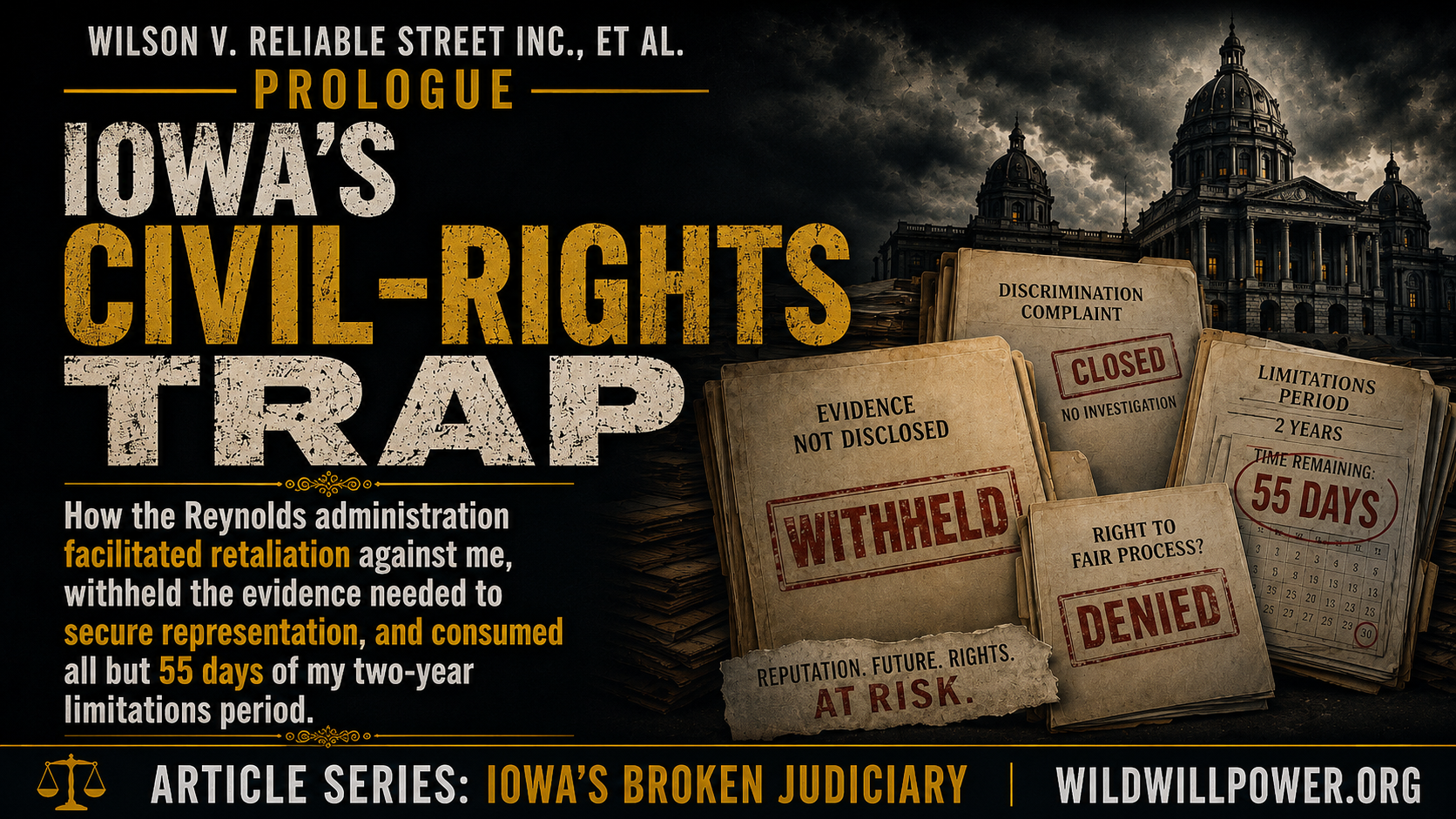
Read the Article: Part One: Procedural Bombardment
Procedural Bombardment documents how seven defendants answered my two-page petition with twenty-seven pages of coordinated procedural demands while I was participating in DMACC’s London Abroad program. In two filings submitted five minutes apart, they challenged service, sought transfer to Story County, demanded dismissal of every claim before discovery, alternatively demanded that I recast and substantially expand the petition, and repeated the same accusations I had sued to correct. The article follows my attempt to answer those attacks, the denial of my recusal request, the transfer ruling based upon what I contend was a materially misleading venue argument, the added financial burden, and the compression of the entire Polk County history into a single 144-page Story County docket entry—creating the fragmented record that the Story County judges would later inherit.
Click the image below to read the full article.
Read the Article: Part Two: Sudden Reversal
Sudden Reversal reconstructs how the Story County court invited the parties to identify and present evidence, leading me to organize approximately seventy sub-exhibits, but later withdrew that opportunity, declined to consider the referenced record, and dismissed nearly every claim “with prejudice” before meaningful discovery.
The dismissal became more consequential the following year, when Iowa removed gender identity from major portions of the Iowa Civil Rights Act. That later development gave renewed importance to the constitutional equality claim the court had dismissed before discovery.
The installment also explains why the discrimination claim may still become an important Iowa civil-rights case. After Republican lawmakers, acting under color of authority, removed “gender identity” from the Iowa Civil Rights Act, I began invoking article I, section 6 of the Iowa Constitution and Iowa’s historic equality tradition exemplified by Clark v. Board of Directors, 24 Iowa 266, 277 (1868), which rejected racial segregation in Iowa schools eighty-six years before Brown v. Board of Education. That constitutional theory was not fully developed in the operative petition because the pressured procedural and academic circumstances documented throughout this series did not provide a meaningful opportunity to complete the amended pleading.
As covered in Part Four, I am now asking the court to reconsider the rulings that prevented the case from developing through amendment, discovery, and trial. The central argument is that Iowa’s constitutional promise of equality cannot depend entirely upon whether a temporary legislative majority chooses to retain a protected class within an ordinary statute—an increasingly urgent question amid what I allege are widespread defamation, discrimination, and rights violations against transgender Iowans under the Trump and Reynolds administrations.
Click the image below to read the full article.
Read the Article: Part Three: Plausible Deniability
Plausible Deniability examines how a newly assigned judge inherited a fragmented docket, initially failed to account for orders that had stayed and restarted the reconsideration deadline, and then encountered defendants’ characterization of the case as a “yearslong pattern of delay and obfuscation.”
Defendants also continued carrying forward a false harassment narrative that created leverage through the threat of a retaliatory counterclaim—an accusation I could not safely leave unanswered. Reconstructing the procedural history, rebutting that narrative, and correcting misleading descriptions of the proceedings consumed much of the limited time I had been granted to amend the petition and seek reconsideration of the October 4 dismissals.
The litigation pressure did not occur in isolation. In February 2025, Iowa removed gender identity from major portions of the Iowa Civil Rights Act, and my medically necessary surgery was canceled again. I was simultaneously attending Iowa State University full-time, attempting to preserve discrimination claims already dismissed before discovery, and searching for legal assistance concerning what I believed was a broader pattern of governmental action depriving transgender Iowans of protected rights.
Unable to find meaningful institutional assistance with that broader legal framework, I began preparing my own federal civil-rights filings and organizing a public Government Accountability Call to Action for Transgender Day of Visibility.
On March 18, I privately emailed defendants’ counsel under the subject line “A request for grace.” I explained that I was preparing a criminal civil-rights complaint, a related federal civil petition, and the March 31 public action. I told him that I intended to request a continuance until after the semester and asked his clients not to resist, because responding to another contested filing would divert time from both the public action and the Reliable Street filings.
I made that request in part because Reliable Street and Lockwood Café had repeatedly portrayed themselves as LGBTQ-supportive and inclusive organizations. I hoped they might recognize that the removal of civil-rights protections and disruption of medically necessary care affected far more people than the parties to this one lawsuit, and that a limited accommodation would allow me to address that broader crisis without abandoning the Reliable Street case.
Defendants did not respond to the private request.
On March 28, I filed the formal motion to continue, asking the court to extend the reconsideration deadline until at least fifteen days after the end of the Iowa State semester. I again asked defendants not to resist. I also documented the March 31 action through flyers, photographs, and communications sent to law-enforcement agencies, public officials, attorneys, organizations, and media. The motion explained that the crisis had caused severe fear, distress, trauma, and loss of sleep, and that the pressure had already caused me to drop one course.
On March 31, I submitted a criminal civil-rights complaint to the U.S. Attorney’s Office and filed the related federal civil action now known as Wilson v. Trump et al., case no. 4:25-cv-00116-SHL-WPK. The filings invoked federal color-of-law and civil-rights provisions that I had been unable to find meaningful institutional assistance in pursuing.
On April 4, defendants filed a formal resistance to my continuance motion. They characterized it as my “seventh Motion to Continue,” described the requested period as “another long extension,” called my prosecution of the case “dilatory,” and asked the court to deny the request—or, alternatively, to grant no more than fifteen additional days and prohibit any further extensions.
The court formally granted my motion but rejected the accommodation I had requested. Rather than placing the deadline at least fifteen days after the semester, the court selected April 29—fifteen days after its order and immediately before final examinations. It also stated that no further extensions would be granted.
That ruling triggered another series of filings as the pressure intensified. The combined burden of the Reliable Street litigation, the broader federal civil-rights matter, the cancellation of medically necessary care, the removal of legal protections, and full-time coursework contributed to my withdrawal from two classes and acceptance of a reduced grade in another.
Meanwhile, the claims dismissed before discovery remained intact and unresolved.
Click the image below to read the full article.
Read the Article: Part Four: Dangerous Precedent
Dangerous Precedent examines the district court’s ruling that statements submitted during an Iowa Civil Rights Commission investigation were absolutely privileged—even if allegedly false, malicious, or materially misleading.
I contend that even if the Iowa Office of Civil Rights performs some quasi-judicial functions, absolute privilege should not automatically extend to its preliminary investigative process, particularly where a complainant lacks access to the complete submissions or a meaningful opportunity to challenge them.
The article also argues that alleged document modification, coordinated acts of civil conspiracy, and other misconduct occurring before the final submission should not be collapsed into a single defamation claim or immunized merely because the resulting materials later entered an agency proceeding.
If allowed to stand, the ruling could undermine the purpose of the Iowa Civil Rights Act itself by turning the complaint process into a retaliatory mechanism—one that permits respondents to permanently lodge defamatory statements, false accusations, and misleadingly arranged evidence into government records that may later be searched, quoted, leaked, or used against the discrimination victim. That danger makes the case far larger than my own: it raises whether Iowa’s civil-rights system will protect complainants from retaliation or instead create an official record-making process that can deepen the harm they sought the government’s help to remedy.
Click the image below to read the full article.

Current status: Wilson v. Reliable Street is moving toward appeal. Part Four, Dangerous Precedent, will track the latest rulings and appellate developments.
A Note About the Published Record
These materials are provided so readers can examine the public record directly. They are not published to invite harassment, threats, or personal contact with any party. The names appear because they are part of the court record and are necessary to explain the litigation. Readers should evaluate the evidence and legal issues without targeting the individuals involved.