
Wild Willpower's Justice Reform Plan:
Second Reform—Teach Practical Law to High-School Seniors
By Sondra Wilson | Updated August 4, 2026
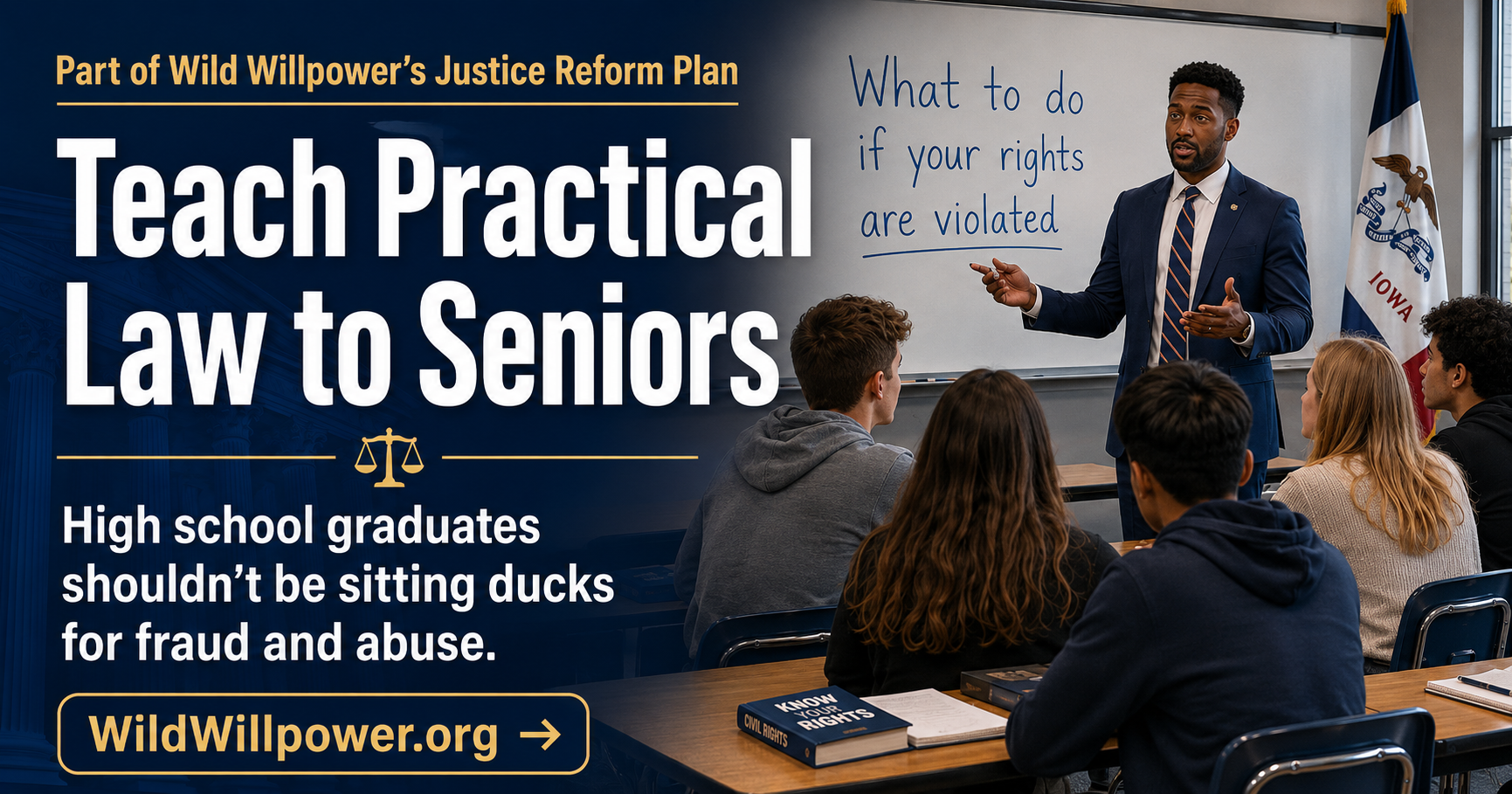
This reform directly overlaps with Wild Willpower's Education Plan. The need for it is further documented throughout Iowa's Broken Judiciary and on Wild Willpower's main justice reform page. It also works hand-in-hand with the Justice Accessibility Act, because access to justice begins with understanding how the legal system works before a crisis occurs.
Teach Practical Law to High-School Seniors
History teaches students how our institutions developed. Civics teaches how government is structured. Practical law should complete that education by teaching young people how those institutions, rules, rights, and responsibilities operate in everyday life.
Most students graduate from high school without knowing:
- the difference between civil and criminal law;
- how contracts and legal documents operate;
- how to preserve evidence;
- how to identify a legal deadline;
- how to file an effective complaint or petition;
- how to communicate clearly with police officers, agencies, courts, employers, landlords, and other institutions;
- or what practical steps to take when fraud, abuse, discrimination, or governmental misconduct occurs.
That needs to change.
Wild Willpower proposes a practical-law curriculum for every Iowa high-school senior, developed in partnership with schools, teachers, attorneys, judges, law professors, law librarians, paralegals, court personnel, civil-rights advocates, and other qualified professionals from across the state.
This should not be a watered-down business-law course limited primarily to contracts, commerce, and personal finance. Those subjects are important, but students also need practical instruction in civil law, criminal law, constitutional law, administrative law, court procedure, governmental authority, and the means by which people seek redress when something goes wrong.
The purpose is not merely to tell students that they possess rights.
It is to teach them what those rights mean in practice, how they may be preserved, and what a person can do when they are violated.
What Students Should Learn
The curriculum should introduce students to:
- business, civil, criminal, constitutional, and administrative law;
- constitutional and statutory rights;
- contracts, leases, employment agreements, waivers, releases, and other legal documents;
- employment, housing, consumer, and civil-rights protections;
- fraud, coercion, identity theft, scams, and financial exploitation;
- police encounters, arrests, charges, pleas, trials, and court records;
- administrative agencies and complaint procedures;
- statutes of limitation and other legal deadlines;
- evidence preservation, recordkeeping, and public-records requests;
- how to write a clear factual chronology;
- how to organize documents and identify supporting evidence;
- how to prepare and file an effective complaint, petition, appeal, or request for review;
- how to communicate effectively and respectfully with officers, agencies, courts, employers, and other public institutions;
- governmental authority and its legal limits;
- civil-rights violations committed under color of law;
- how to document and report government misconduct;
- internal complaints, administrative remedies, judicial review, and civil litigation;
- the practical barriers created by immunity doctrines and other limitations upon governmental liability; and
- how to locate trustworthy statutes, rules, forms, court decisions, and public legal resources.
This instruction should be practical rather than purely theoretical. Students should work through realistic examples: reading a lease, identifying misleading contract language, documenting workplace misconduct, responding to an improper charge, requesting public records, preparing an administrative complaint, preserving text messages and photographs, determining whether a deadline may be running, and explaining a dispute in a clear and usable form.
Legal literacy includes knowing how to describe what happened.
A person who can identify the relevant dates, parties, documents, witnesses, promises, injuries, and governmental actions will be better able to communicate with police officers, public officials, agencies, courts, attorneys, employers, and community organizations. Better-informed citizens can also help public servants understand complaints more quickly and distinguish genuine legal issues from confusion or incomplete information.
Rights Are Not Self-Enforcing
Students should understand that constitutional and statutory rights do not automatically enforce themselves.
When misconduct occurs, obtaining redress may depend upon:
- preserving evidence;
- creating a reliable written record;
- identifying the correct agency or court;
- filing within a strict deadline;
- exhausting required administrative procedures;
- naming the proper parties;
- stating the facts clearly;
- requesting an available remedy;
- preserving objections and issues for later review; and
- complying with procedural rules that may be unfamiliar even to educated adults.
A person may possess a valid legal right and still lose the opportunity to enforce it because the wrong form was used, the wrong institution was contacted, a deadline expired, evidence disappeared, or a necessary issue was never properly raised.
That is not meaningful public access to justice.
Students should also be taught honestly that the law does not presently provide an effective remedy for every wrong. Existing immunity doctrines and related precedent can prevent injured people from obtaining relief even when serious governmental misconduct is alleged. Wild Willpower addresses that structural problem more fully in Fifth Reform—Abolish Government Immunity Doctrines.
This course should not promise students that every complaint will succeed. It should teach them how to recognize a legal problem, document it properly, use the remedies that do exist, and understand when the present system may prevent meaningful redress.
Legal Literacy Can Reduce Conflict With Government
Citizens should not be taught that the only time to defend a right is during the confrontation itself.
They should know how to remain safe, document what occurred, preserve evidence, identify the appropriate complaint or investigative body, and pursue civil, criminal, administrative, or judicial remedies afterward.
That is especially important during encounters with police officers and other public officials. A person who understands both governmental authority and its legal limits is better positioned to distinguish between a lawful instruction, a disputed legal question, and conduct that may need to be challenged afterward through an appropriate process.
Practical legal education can therefore teach a safer sequence:
Know your rights. Understand the officer’s lawful authority. Remain safe. Document what happened. Preserve evidence. Use complaint procedures. Seek legal advice when needed. Pursue administrative, civil, criminal, or judicial remedies when appropriate.
Peaceful protest remains an essential constitutional safeguard and a legitimate means of petitioning government for redress.
But protest should not be the only avenue an ordinary person understands when government acts unlawfully.
A functioning republic should also provide understandable access to:
- complaints and internal review;
- independent investigations;
- public records;
- administrative remedies;
- judicial review;
- civil litigation;
- criminal referrals where warranted;
- and other lawful means of seeking redress.
Teaching those mechanisms can strengthen accountability while reducing unnecessary confrontation.
It can also improve trust between citizens and public officials. Citizens who understand what officers and agencies may lawfully do are less likely to mistake lawful authority for abuse. At the same time, citizens who understand how to document and challenge genuine misconduct are less likely to feel powerless when government exceeds its authority.
Legal literacy does not teach people to distrust government. It gives them lawful tools for dealing with government—whether the government is acting properly or not.
Why This is Justice Reform
Practical legal education is not merely an academic enrichment program. It is preventive justice.
People can suffer severe and lasting harm before they understand that evidence must be preserved, that a legal or administrative deadline is already running, that an agency complaint may affect later court rights, or that signing a document may permanently alter their legal position.
When representation is unavailable or unaffordable, an injured person may be forced to navigate those requirements alone. The person may enter a legal process seeking relief from one injustice and emerge carrying several more: a dismissed claim, an expired deadline, damaging statements preserved in an official record, financial loss, retaliatory proceedings, or an order requiring payment of the opposing party’s expenses.
The experiences documented in Iowa’s Broken Judiciary show how procedural complexity can prevent courts from reaching the facts, how self-represented people may be held to professional standards without professional training, and how rights that appear strong on paper can become extraordinarily difficult to enforce in practice.
Practical legal education would not eliminate every structural barrier. It would give young people a foundation they presently do not receive: the ability to recognize legal danger, preserve evidence, communicate effectively, prepare an intelligible complaint or petition, and act before preventable mistakes close the door.
The purpose is not to turn every student into a lawyer.
It is to prevent high-school graduates from entering adulthood as sitting ducks for fraud and abuse.
The Natural Completion of a Public Education
Practical legal education is the natural culmination of the education students already receive:
- Reading and writing provide the language.
- Comprehension teaches students how to interpret it.
- History shows how institutions developed.
- Civics explains how government is structured.
- Practical law teaches students how to function within those institutions and protect themselves when problems arise.
Students should not graduate after learning that they possess constitutional rights without also learning how those rights are asserted, documented, preserved, challenged, and sometimes lost through procedure.
They should learn not only what government is authorized to do, but also what may occur when officials exceed that authority—and how a citizen can respond effectively, lawfully, and with an organized factual record.
High-school seniors should not complete years of required coursework without understanding the legal realities they will encounter while:
- renting an apartment;
- accepting a job;
- purchasing a vehicle;
- opening a bank account;
- obtaining insurance;
- signing a contract;
- starting a business;
- interacting with police;
- reporting discrimination;
- challenging an agency decision;
- responding to fraud;
- or seeking redress from a government institution.
These are not obscure professional matters.
They are ordinary parts of adult life.
Bringing Legal Professionals Into Iowa's Classrooms
This proposal would also create a broader public role for Iowa’s legal profession.
Attorneys and other legal professionals should not be limited to helping people after serious harm has already occurred. Their knowledge should also be used preventively—inside schools, libraries, community institutions, and public workshops—before confusion becomes injury and before injury becomes litigation.
Wild Willpower proposes bringing legal professionals out from behind their desks and into classrooms, where their training can help prepare the next generation of Iowans for the real world.
Teachers would remain central to the program. Legal professionals would contribute subject-matter expertise, realistic examples, current legal knowledge, and firsthand understanding of how courts, agencies, contracts, evidence, and procedural deadlines operate. Teachers would provide the educational structure, continuity, and knowledge of how students learn.
That partnership could also create stronger connections between Iowa’s schools, public institutions, and professional communities. Attorneys who work alongside educators may develop a deeper understanding of the pressures facing teachers, students, and public schools—and become influential advocates for the civic infrastructure upon which a functioning legal system depends.
A healthy legal profession should not depend upon public confusion. Its highest purpose should include helping people understand, preserve, and enforce their rights.
The goal is not to diminish the legal profession.
It is to place its knowledge where Iowa needs it most.
Special Guest Speakers
The program should also encourage guest appearances from experienced legal professionals whose public service can bring the law to life. Federal and state judges, Iowa Supreme Court justices, prosecutors, public defenders, civil-rights attorneys, investigators, law professors, veterans of public service, and other qualified professionals could speak with students about how the legal system actually operates, the responsibilities attached to public authority, and the importance of evidence, due process, professional ethics, and lawful disagreement.
Not every school would host the same speakers, and participation would necessarily depend upon availability, ethics rules, security considerations, and the speaker’s professional responsibilities. But even occasional visits could create memorable educational experiences for Iowa seniors and help students see the legal system as something made up of real people, real duties, and real consequences.
A student may forget a worksheet. She is far less likely to forget the day a justice, judge, prosecutor, public defender, or investigator stood in her classroom and explained how the law actually works.
Who Makes This Work?
Schools and educators would remain responsible for teaching the course and providing the educational structure students need.
The Public Intelligence Agency would support statewide implementation, contribute specialized expertise in public integrity, fraud prevention, evidence preservation, governmental accountability, and complaint systems, and help keep public-facing legal education connected to problems actually emerging across Iowa.
Attorneys affiliated with traditional bar associations and the American Accreditation Registrar—along with law professors, paralegals, law librarians, supervised law students, judges and other qualified legal professionals— could help teach, mentor, review instructional materials, and provide independent subject-matter expertise.
The Legislature would establish the public mandate and safeguards.
No single institution should control how Iowa teaches its young people about the power—and limits—of government.
A More Legally Literate Iowa
A legally literate public would benefit more than individual students.
Citizens who understand how to organize facts, preserve records, identify the correct institution, and communicate a complaint clearly can interact more effectively with:
- law-enforcement officers;
- public employees;
- school officials;
- administrative agencies;
- courts;
- employers;
- landlords;
- businesses;
- and elected representatives.
That can reduce confusion, improve the quality of complaints, make public processes more efficient, and help government officials respond to legitimate concerns with better information.
It can also improve democratic accountability. People who understand statutes, administrative processes, constitutional limits, and available remedies are better equipped to evaluate public officials, identify misuse of authority, participate in public hearings, and petition government for redress.
The result would not be a population attempting to act as attorneys.
It would be a population better prepared to participate in a constitutional republic.
See how this fits into "Upskilling Iowa'—Wild Willpower’s Education Plan.