Wild Willpower's Justice Reform Plan:
The Public Intelligence Agency
Intelligence for the public—not intelligence about the public.
By Sondra Wilson | Updated August 10, 2026
Part of Wild Willpower's We the People Platform to rebuild Iowa's Infrastructure, Education, Healthcare, and Justice systems.
Government Oversight • Anti-Corruption Investigations
Scam Prevention & Cybersecurity • Public Legal Education
Iowa has courts. It has prosecutors. It has police departments. It has a State Auditor, Attorney General, administrative agencies, professional boards, and civil-rights institutions.
Each serves a different purpose.
But that division of responsibility also creates gaps.
What happens when the problem does not fit neatly into one office?
What happens when a citizen has evidence of serious misconduct but does not know whether it is criminal, civil, administrative, regulatory, or all four?
What happens when one agency sees one complaint, another agency sees another, and nobody is responsible for asking whether the same failure is happening repeatedly across Iowa?
And perhaps most importantly:
What happens when the institution that is supposed to correct the problem may itself be part of the problem?
The proposed Public Intelligence Agency (PIA) would be designed to fill those gaps.
It would not replace the courts, State Auditor, Attorney General, prosecutors, police, schools, civil-rights agencies, or Legislature. Its purpose would be to create a statewide public institution capable of receiving serious complaints, investigating qualifying allegations, connecting information across governmental boundaries, detecting recurring patterns, preserving evidence, protecting Iowans from sophisticated fraud, and helping people understand what lawful remedies actually exist.
The guiding principle is simple:
Transparent enforcement accountable to the people.
An institution created to demand accountability from others must itself be accountable.
Page Contents
Citizen Complaints & Investigations
Give Iowans somewhere to bring serious evidence and identify where a problem belongs.
Government Oversight & Anti-Corruption
Investigate abuse of authority, retaliation, obstruction, recurring administrative misconduct, and public-integrity failures.
Scam Prevention & Cybersecurity
Build statewide capacity to detect sophisticated fraud, preserve evidence, coordinate with financial institutions, and pursue scammers.
Public Legal Education & Prevention
Use lessons from investigations to help Iowans understand fraud, rights, evidence, governmental authority, and lawful avenues for redress.
Officer & Public-Official Training
Prevent misconduct before it occurs through better training, clearer standards, and recurring lessons drawn from statewide complaints.
G.I. Joe & Veteran Public Service
Connect veterans and peace officers with students through practical safety education and civic mentorship.
Public Records & Pattern Detection
Identify recurring problems across agencies without creating secret dossiers on ordinary citizens.
Financial Integrity
Support investigation and referral of deliberate tax evasion, concealed assets, shell entities, and related schemes.
Transparency & Safeguards
Define what the PIA may—and may not—do, including oversight of the agency itself.
How the PIA Becomes Law
Publicly design its jurisdiction, investigative authority, due-process safeguards, and relationship to existing institutions.
I. Give Iowans Somewhere to Go
One of the PIA's most important functions would also be one of its simplest:
Give people somewhere to bring the evidence.
An Iowan who believes she has evidence of corruption, abuse of governmental authority, fraud, retaliation, recurring administrative misconduct, destruction or concealment of evidence, a sophisticated scam, or another qualifying public-integrity problem should not first have to become an expert in the organizational structure of state government.
The PIA would establish a centralized intake and triage system for serious complaints.
Its investigators could ask:
- What happened?
- What evidence exists?
- Does anything need to be preserved immediately?
- What law, rule, governmental duty, or public institution may be implicated?
- Does the PIA have jurisdiction?
- Does another institution have primary jurisdiction?
- Does the evidence suggest a possible crime, civil violation, administrative violation, professional violation, audit issue, or some combination?
- Has anyone else reported substantially the same problem?
- Does this apparently isolated complaint reveal a broader pattern?
The PIA would not guarantee that every allegation is true. Nor would filing a complaint entitle someone dissatisfied with a court ruling to a second trial before an executive agency.
It means something narrower—and important:
Someone examines the problem and determines where it belongs.
That alone would distinguish the PIA from a passive complaint repository.
The FBI's Internet Crime Complaint Center provides a useful structural comparison. IC3 receives information from the public, analyzes it, identifies relationships among reports, and may refer complaints to federal, state, local, or international authorities. But IC3 also warns that it cannot personally respond to every submission. The PIA would build an Iowa-specific system around that general intelligence-and-referral concept while giving the Legislature the ability to establish broader state-level jurisdiction over Iowa governmental and consumer-protection problems.
II. Government Oversight and Anti-Corruption Investigations
The PIA would investigate qualifying allegations involving:
- corruption;
- abuse of governmental authority;
- retaliation;
- conflicts of interest;
- interference with lawful oversight;
- deliberate concealment or destruction of public evidence;
- obstruction of legally required processes;
- serious recurring administrative misconduct;
- misconduct involving public contractors or vendors;
- and other public-integrity matters placed within its jurisdiction by statute.
This is broader than discrimination law.
A person should not have to belong to a particular protected class before government misconduct becomes worthy of investigation.
A parent dealing with DHS, a person trying to obtain public benefits, a contractor dealing with an agency, an individual alleging police abuse, a whistleblower reporting corruption, a person with a disability confronting administrative obstruction, or an ordinary citizen whose evidence keeps being bounced between agencies may present entirely different legal questions.
The PIA would not pre-decide those cases.
It would provide an institution capable of looking.
The Individual Complaint Can Reveal the Systemic Problem
One agency might receive five complaints and regard each as unrelated.
The PIA could lawfully analyze patterns across:
- complaints;
- administrative closures;
- audit findings;
- public records;
- settlements;
- contractors and vendors;
- agency policies;
- recurring procedural barriers;
- disciplinary findings;
- and other lawfully available information.
That concept is already central to the PIA proposal.
If twenty-seven people in five counties report substantially the same administrative barrier, that fact may matter.
If several agencies interpret the same statutory command differently, that may matter.
If complaints repeatedly disappear at the same procedural stage, that may matter.
The PIA would be designed to see the forest as well as the individual trees.
III. Strengthening the State Auditor—Not Replacing It
The PIA should not become Iowa's second State Auditor.
Financial auditing is a specialized and independently important function.
Instead, this proposal incorporates the central purpose behind my earlier Watchdog Act: governmental watchdogs must have meaningful access to the information necessary to perform their duties, and public officials should not be able to frustrate legitimate oversight simply because an investigation is politically inconvenient.
The PIA could investigate alleged obstruction or retaliation within its jurisdiction, preserve relevant evidence, identify cross-agency patterns, and refer financial-audit matters to the State Auditor.
The institutional principle is:
The PIA investigates accountability failures. It does not absorb every institution responsible for correcting them.
Iowa law would expressly establish the boundary.
IV. Scam Prevention, Fraud Investigation, and Cybersecurity
This may become the PIA function that ordinary Iowans encounter most frequently.
Fraud has changed.
The scammer of the twenty-first century may never set foot in Iowa.
A fraudulent caller can impersonate a bank. A text message can mimic a government agency. A fraudulent website can imitate a legitimate business. A criminal can persuade someone to transfer money, surrender account credentials, purchase cryptocurrency, or disclose an authentication code—all while hiding behind telecommunications and internet infrastructure.
The scale is enormous.
The FBI's Internet Crime Complaint Center received 1,008,597 complaints in 2025, and reported cyber-enabled losses approached $21 billion. Roughly 453,000 complaints involved cyber-enabled fraud, with reported losses exceeding $17.7 billion. Phishing and spoofing remained among the most frequently reported categories.[1]
FTC data tell a similarly troubling story. Consumers reported approximately $16 billion in total fraud losses in 2025. Imposter scams alone accounted for about $3.5 billion in reported losses, and nearly one out of every three fraud reports concerned impersonation. Reported losses to business impersonators approached $1 billion, with bank impersonators accounting for the largest reported share within that category.[2]
Bank-account attacks are not theoretical. The FBI reported more than 5,100 account-takeover complaints and over $262 million in reported losses since January 2025 in one financial-institution impersonation category alone.[3]
Iowa is part of this problem. In just one very specific subset of fraud—fraud involving cryptocurrency kiosks—the FBI recorded 90 Iowa complaints and approximately $2.9 million in adjusted reported losses during 2025.[4]
Those are not numbers Iowa should simply accept.
Scammers Beware! — Make Iowa a Hard Place to Victimize
The PIA would absorb the substance of the earlier Scammers Beware! proposal.
Its objective would not merely be to post warnings telling Iowans to be careful.
The objective is to make Iowa an increasingly difficult place in which to profit from victimizing people.
The PIA's anti-fraud operation could include:
One Iowa Fraud Portal. A simple statewide system for reporting suspicious calls, texts, websites, bank impersonations, phishing attempts, fraudulent businesses, cryptocurrency schemes, online marketplace fraud, and related evidence.
Rapid Evidence Preservation. A person who has just been scammed should be told immediately what to save: telephone numbers, messages, headers, emails, screenshots, transaction identifiers, bank information, wallet addresses, domains, receipts, usernames, dates, and a detailed chronology.
Financial-Institution Coordination. Develop rapid-response relationships with banks, credit unions, payment providers, and other lawful partners so potentially recoverable funds can be identified as quickly as possible.
Telecommunications Coordination. Work with carriers, traceback organizations, regulators, and lawful process to identify abusive telecommunications infrastructure and recurring sources of fraudulent calls.
Cyber Investigation. Where legally authorized, use digital-forensics and cyber-investigative expertise to develop evidence about domains, accounts, devices, infrastructure, and other digital identifiers.
Interstate and Federal Partnerships. Criminal networks do not respect state lines. Evidence should rapidly reach the FCC, FTC, FBI/IC3, federal prosecutors, sister states, or international partners when those institutions possess the necessary jurisdiction.
Victim Feedback. People who take the time to report serious fraud should not have their information disappear into a black hole. Even when investigative confidentiality prevents disclosure of details, the system should explain what happened to the report and where possible provide a case or tracking number.
Your existing proposal already identifies evidence preservation, bank and telecom coordination, referrals, cybersecurity partnerships, and victim feedback as core elements.
V. Caller-ID Spoofing: Go After the Fraud, Not the Technology
Caller-ID spoofing requires careful legal wording.
Not every alteration or blocking of caller identification is illegal. But federal law prohibits knowingly transmitting misleading or inaccurate caller-identification information with intent to defraud, cause harm, or wrongfully obtain something of value. Federal law also reaches persons outside the United States where the recipient is inside the United States.[5]
Meanwhile, Americans continue to report unwanted calls on a massive scale. The FTC received more than 2.6 million Do Not Call complaints in fiscal year 2025, with robocalls constituting most reported violations; imposters remained one of the leading subjects of unwanted calls.[6]
The PIA proposal therefore should not say simply:
“We will make spoofing illegal.”
Much malicious spoofing already is.
The stronger proposal is:
We will build Iowa's capacity to identify and pursue the people using telecommunications technology to defraud Iowans.
That could include seeking legislation authorizing appropriate civil investigative demands or subpoenas, obtaining records through lawful process, coordinating with telecommunications providers and federal traceback mechanisms, and pursuing civil remedies when Iowa possesses personal and subject-matter jurisdiction.
What About Iowa's Long-Arm Jurisdiction?
Iowa can potentially exercise jurisdiction over certain out-of-state actors whose conduct creates constitutionally sufficient contacts with Iowa. But “long-arm jurisdiction” is fundamentally a doctrine governing a court's personal jurisdiction over an out-of-state defendant; it is not itself authority to identify an IP address, subpoena an internet provider, seize an account, or impose a fine.[7]
Those investigative and enforcement powers should be expressly created by statute and exercised subject to due process.
That makes the proposal stronger, not weaker.
The goal is enforcement that survives judicial review.
VI. Turn Iowa's Cybersecurity Talent Toward Protecting Iowans
Iowa does not have to build this capacity from nothing.
Iowa State University offers a Bachelor of Science in Cyber Security Engineering through its Department of Electrical and Computer Engineering. The program includes cybersecurity fundamentals, concepts and tools, cryptography, operating systems, and legal, professional, and ethical issues in cyber systems.[8]
The University of Northern Iowa offers a B.S. in Cybersecurity and System Administration.[9]
DMACC offers cybersecurity associate-degree, diploma, and certificate pathways and also teaches digital forensic analysis.[10]
Kirkwood Community College offers a Cybersecurity and Compliance program incorporating threat detection, incident response, risk management, ethical hacking, and computer forensics.[11]
That creates an extraordinary opportunity.
The PIA could partner with Iowa colleges and universities to create:
- paid internships;
- cybersecurity fellowships;
- digital-forensics positions;
- fraud-analysis careers;
- entry-level investigator pathways;
- research partnerships;
- supervised student projects;
- data-analysis positions;
- and eventual full-time public-service careers.
Instead of watching talented Iowa students graduate into a field designed primarily to protect corporate networks, Iowa could give some of them the opportunity to apply those same skills to protecting Iowans themselves.
That is job creation with a direct public purpose.
VII. Enforcement Should Recover Money—But Should Not Become a Quota System
Successful fraud enforcement can produce restitution, civil penalties, judgments, and other recoveries.
Federal experience demonstrates that enforcement can return substantial money to consumers. Since adopting its government-and-business impersonation rule, for example, the FTC reported a dozen enforcement actions producing more than $70 million in consumer redress as of June 2026.[12]
Iowa could design its own lawful civil-enforcement provisions so that appropriate penalties help support anti-fraud work and consumer education.
But I would place an important safeguard in the PIA legislation:
Investigators should never be evaluated according to how much fine revenue they generate.
Justice must not become a quota.
The first objective is preventing loss.
The second is recovering money for victims where possible.
The third is imposing lawful consequences strong enough to deter future misconduct.
If penalty revenue exceeds enforcement costs, the Legislature could direct those funds toward consumer restitution, cybersecurity, scam prevention, public legal education, or another public purpose.
The scammer—not the victim—should bear as much of the cost of enforcement as the law permits.
VIII. Public Legal Education—Turning Investigation Into Prevention
The PIA would have a specialized public-education role, but it would not replace the Department of Education, local schools, teachers, or the Legislature.
The Legislature would establish the educational mandate. Schools and educators would remain responsible for teaching. The PIA would contribute specialized expertise drawn from its work in fraud prevention, public integrity, evidence preservation, governmental accountability, complaint systems, and recurring statewide investigations.
That creates an important feedback loop:
What Iowa learns through investigation should be returned to Iowans through education.
If the PIA identifies a new bank-impersonation scam, that information can become a public fraud warning. If investigators repeatedly see citizens losing rights because they fail to preserve evidence or misunderstand an administrative notice, those lessons can inform practical-law instruction. If statewide complaints reveal recurring confusion about lawful police authority or complaint procedures, those subjects can be strengthened in public education.
The PIA could also help ensure that practical-law instruction remains substantive rather than becoming a watered-down civics course. Students should encounter not only contracts and personal finance, but also the difference between civil and criminal law, evidence preservation, fraud, governmental authority and its limits, complaint procedures, color-of-law violations, and the lawful remedies available when abuse occurs.
The goal is not to tell students what to think about government. It is to ensure that young people understand how government works, what rights and responsibilities they possess, and what lawful avenues exist when something goes wrong.
For the full curriculum, implementation model, role of attorneys and guest speakers, and the ways legal literacy can reduce conflict between citizens and public officials, see:
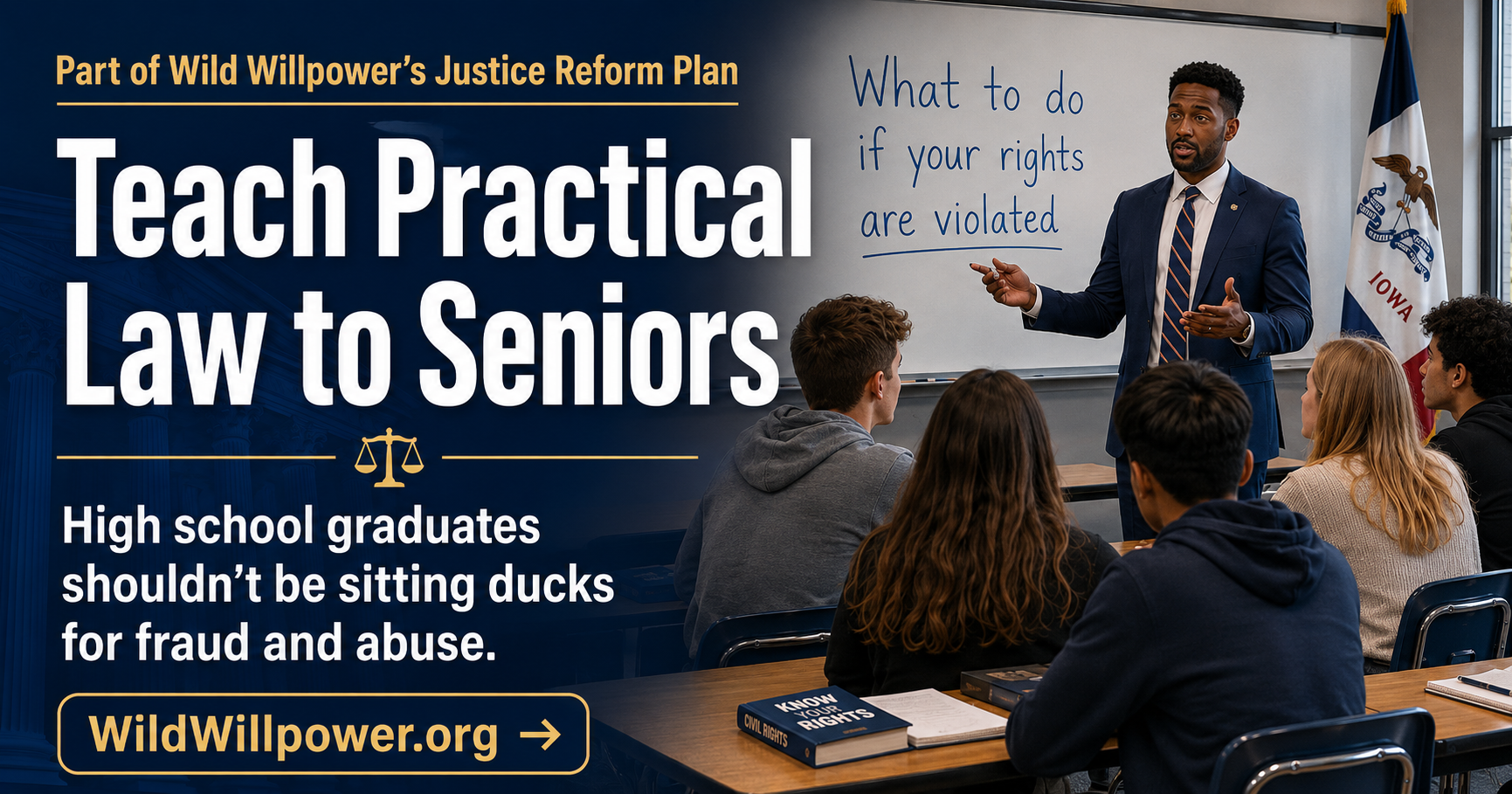
Read the Plan: Teach Practical Law to High-School Seniors →
Click the below image to read this proposal.
IX. Teach the Difficult Parts Too
Practical-law education should not teach only the parts of law that government finds comfortable to discuss.
If students learn about constitutional rights, they should learn what remedies may exist when those rights are violated.
If students learn about police authority, they should learn both what officers may lawfully require and what officers may not lawfully do.
If students learn that private citizens can commit crimes, they should understand that officials can commit crimes.
If students learn about private-sector fraud, they should also understand public corruption.
If students learn how to complain about another citizen, they should understand how to file a lawful complaint against an institution.
The purpose is to produce informed citizens—not compliant subjects.
But there is an equally important safeguard:
The classroom must not become partisan political instruction.
Students should be taught to distinguish:
- statutes;
- constitutional provisions;
- administrative rules;
- judicial holdings;
- allegations;
- disputed legal interpretations;
- policy proposals;
- and political opinions.
The objective is not to tell students what to think about government.
It is to teach them how government actually works and what lawful tools are available when they believe it has failed.
X. Going After Corruption Should Not Mean
Waiting Until Misconduct Occurs and Then Punishing it
A major part of public integrity is prevention: clear standards, strong training, understandable complaint procedures, and ensuring that both citizens and public officials understand the lawful limits of governmental authority.
The PIA could use lessons emerging from complaints and investigations to identify recurring points of conflict, recommend improvements in training, and support specialized instruction for officers and other public employees on constitutional limits, evidence preservation, retaliation, public-record obligations, complaint handling, disability awareness, de-escalation, and other recurring public-integrity concerns.
At the same time, Iowa's practical-law curriculum would teach citizens how to remain safe during difficult encounters, preserve evidence, understand lawful authority, and pursue civil, criminal, administrative, or judicial remedies afterward.
The objective is not simply to investigate misconduct after the fact. It is to reduce the conditions that allow misconduct and unnecessary conflict to occur in the first place.
Teach citizens what government may lawfully do.
Teach government what citizens may lawfully demand.
XI. Teach Citizens What Government May Do—And Government What Citizens Demand
The educational obligation should be reciprocal.
If Iowa expects citizens to understand governmental authority, Iowa should expect officers and other public employees to receive continuing education concerning its limits.
The PIA could support or coordinate specialized training—without displacing the agencies legally responsible for certification—concerning:
- constitutional limitations;
- civil and criminal color-of-law violations;
- evidence preservation;
- retaliation;
- conflicts of interest;
- public-record responsibilities;
- disability awareness;
- de-escalation;
- complaint handling;
- identifying corruption;
- and lessons emerging from recurring statewide complaints.
The principle is:
Teach citizens what government may lawfully do.
Teach government what citizens may lawfully demand.
That kind of shared legal literacy can build trust much more effectively than demanding trust without accountability.
XII. The "G.I. Joe" Program — Rights-Intact Gun Legislation
One example of a specialized prevention program the PIA could help administer is Wild Willpower's proposed G.I. Joe Gun-Safety Program, part of a broader approach I call rights-intact gun legislation.
The idea is not to begin with confiscation or criminalization.
It begins with education, responsibility, and culture.
Around fifth grade—while children are old enough to absorb serious safety principles but still young enough that many look to veterans, peace officers, teachers, and other adults as role models—trained veterans and peace officers would visit classrooms for age-appropriate gun-safety education.
The emphasis would be simple:
A firearm is not a toy.
A firearm is not a symbol of toughness.
A firearm carries extraordinary responsibility.
Human life comes first.
The existing education plan envisions veterans and officers teaching fifth graders principles of safety, responsibility, rights, respect, and protection before entertainment becomes their primary source of information about guns.
For a ten- or eleven-year-old, hearing that message from a real veteran who served the country—or an officer who serves the community—may carry a meaning no worksheet can reproduce.
It also gives young people an opportunity to encounter law-enforcement officers in a calm classroom environment rather than for the first time during an emergency.
XIII. A New Civic Role for Veterans
There is another reason I believe the G.I. Joe program is worth pursuing.
Military service provides structure, mission, responsibility, teamwork, identity, and community. The transition back into civilian life can be difficult for some veterans.
The Department of Veterans Affairs reported 6,398 veteran suicides in 2023—an average of about 17.5 each day. Sixty-one percent of veterans who died by suicide that year had not received VA health care during the preceding year.[13]
Those numbers do not prove that a classroom volunteer program would prevent suicide, and the proposal should never make that claim.
But the underlying protective factors matter.
The VA has emphasized that transition from military service can involve loss of structure, identity, belonging, and purpose, and specifically identifies social connection and opportunities to build a meaningful civilian life as important supports. CDC likewise identifies feeling connected to others and to community institutions as suicide-protective factors.[14]
So the G.I. Joe program could create another door into community life.
A veteran might spend one morning each month visiting a local school.
Students get to meet someone who served.
The veteran gets to be recognized not merely as a person who once served, but as someone whose experience still has something valuable to teach the next generation.
For some veterans, that may simply be enjoyable.
For others, it might provide connection, purpose, mentorship, and another reason to feel rooted in civilian community life.
That is worth building even without overstating what it can accomplish.
We should not merely thank veterans for their service. We should create meaningful opportunities for their service, experience, discipline, and wisdom to remain valuable to the communities they came home to.
XIV. Public Records and Pattern Detection
Records analysis should not be a separate PIA bureaucracy.
It should be a tool used throughout the agency.
Investigators should be able, within lawful limits, to connect:
- recurring complaints;
- public documents;
- audit findings;
- agency outcomes;
- settlements;
- contractor relationships;
- fraud reports;
- administrative failures;
- and other relevant information.
But there must be a bright line.
Public-interest pattern analysis—not secret dossiers on ordinary Iowans.
The PIA should publish aggregate findings whenever possible.
Its intelligence function is supposed to illuminate government and public problems, not construct a domestic surveillance apparatus. That distinction is already at the heart of the proposal.
XV. Financial Integrity and Deliberate Tax Evasion
The PIA could also provide analytical support in complex financial-integrity matters involving:
- shell entities;
- concealed beneficial ownership;
- offshore structures;
- fraudulent transfers;
- concealed taxable assets;
- and similar mechanisms.
The PIA would not assess taxes or prosecute tax crimes unless the Legislature expressly assigned such authority.
Its role could instead include research, data analysis, investigative leads, records analysis, and referrals to the Iowa Department of Revenue, Attorney General, federal agencies, or another competent authority.
The principle is straightforward:
People who honestly pay Iowa taxes should not subsidize people who deliberately conceal taxable wealth.
A defined voluntary-disclosure program could also be considered before enhanced enforcement begins, allowing taxpayers to correct undisclosed liabilities before stronger investigative and penalty provisions take effect. That structure is already contained in the working PIA proposal.
XVI. What the Public Intelligence Agency Would Not Be
The PIA would not be a secret police force.
It would not exist to monitor the political beliefs, lawful associations, lawful speech, protests, religious activity, or private lives of Iowans.
It would not conduct warrantless surveillance.
It would not arrest people merely because an investigator believes they did something wrong.
It would not adjudicate guilt.
It would not sentence people.
It would not replace Iowa's courts.
It would not replace prosecutors.
It would not replace the State Auditor.
It would not replace ordinary law enforcement.
It would not replace education authorities.
And it would not become a mechanism through which an administration spies upon political opponents.
Its purpose would be almost the exact opposite of secret government:
to make information relevant to public accountability easier to report, preserve, connect, investigate, understand, and place before the people and institutions lawfully empowered to act upon it.
That distinction is already embedded in the PIA concept and should remain non-negotiable.
XVII. Transparent Enforcement Requires Transparent Government
The PIA's own records cannot simply become another black box.
Its enabling legislation should include strong safeguards such as:
- publicly defined jurisdiction;
- published investigative procedures;
- written dispositions of qualifying complaints;
- public statistics on complaints and outcomes;
- annual public reports;
- strong open-record requirements;
- carefully limited exceptions for active investigations, victims, minors, protected information, and genuine security interests;
- conflict-of-interest rules;
- mandatory recusals;
- whistleblower protections;
- independent investigation of alleged PIA misconduct;
- penalties for deliberate abuse of investigative authority;
- auditable access to investigative databases;
- legislative oversight;
- judicial review of coercive investigative powers;
- and periodic statutory review of extraordinary authorities.
The PIA should also maintain a publicly accessible explanation of what happens after someone files a complaint.
That is an area in which even existing national systems demonstrate the challenge. IC3 expressly informs filers that any investigation is discretionary and that IC3 will not necessarily contact the person who submitted the report.
Iowa should strive to do better at the state level where feasible.
An accountability agency should never demand from the public a level of trust that it refuses to earn through transparency.
That is what Fulfilling the Promise means.
XVIII. The PIA Does Not Replace the Legislature
The Legislature writes the law.
That remains true.
The Legislature would define:
- the PIA's jurisdiction;
- investigative authority;
- subpoena or civil-demand authority;
- administrative enforcement powers, if any;
- penalties;
- privacy restrictions;
- due-process protections;
- relationships with other agencies;
- funding;
- appointment and removal procedures;
- public-reporting obligations;
- and avenues for judicial review.
The PIA could then identify problems and develop evidence.
If its investigations show that twenty-five agencies are struggling with the same statutory ambiguity, it can report that fact.
If a complaint system repeatedly fails at the same point, it can document the pattern.
If a particular scam repeatedly exploits the same weakness, it can recommend legislation.
But:
The PIA identifies the problem, develops the evidence, and recommends solutions. The institution possessing lawful authority decides whether and how to implement them.
That is how the PIA can help reform government without becoming the Legislature.
XIX. The PIA Does Not Replace the State Auditor, Attorney General, or Police
The same principle applies across government.
The State Auditor retains independent auditing responsibility.
The Attorney General and prosecutors retain the civil and criminal enforcement powers the law assigns them.
Courts adjudicate cases and interpret law.
Law-enforcement agencies perform ordinary criminal investigations and arrests.
Education authorities administer Iowa's schools.
Civil-rights institutions administer laws placed within their jurisdiction.
The PIA's job is different.
It receives.
It connects.
It investigates within its jurisdiction.
It preserves.
It detects patterns.
It educates.
It develops evidence.
It enforces only where Iowa law expressly gives it enforcement authority.
And where someone else possesses the lawful power to finish the job:
it hands them a developed record instead of sending the citizen away empty-handed.
XX. How the Public Intelligence Agency Becomes Law
The PIA should not be created casually through an executive announcement.
An institution with investigative authority needs a carefully drafted enabling statute.
Before introduction, I would convene a Public Intelligence Agency Drafting Commission containing people who understand both the need for governmental investigation and the danger of unchecked investigative power:
lawyers, prosecutors, defense attorneys, judges or former judges, civil-liberties advocates, peace officers, auditors, cybersecurity specialists, educators, fraud investigators, state employees, whistleblowers, veterans, disability advocates, victims of scams, people who have navigated government complaint systems, and ordinary Iowans.
The drafting process should answer difficult questions publicly:
What can investigators compel?
When is a subpoena appropriate?
Who approves it?
What evidence remains confidential?
What must eventually become public?
Who investigates the PIA?
What happens if the agency refuses a complaint?
When can a complainant appeal?
How are knowingly false complaints handled?
How are accused people protected from public accusation before findings are made?
What safeguards apply to political activity?
How long may data be retained?
When must identifying information be destroyed?
Those are not reasons to abandon the idea.
They are reasons to design it carefully.
Build the institution publicly before asking the public to trust it.
Conclusion — Intelligence for the Public
The Public Intelligence Agency begins with a simple idea:
People should not need money, political connections, specialized legal knowledge, or public outrage before government takes credible evidence seriously.
Iowans should have somewhere to bring serious allegations.
Government agencies should know that repeated misconduct can be detected across institutional boundaries.
Scammers should know Iowa is developing people and technology capable of finding them.
Students should graduate knowing both their rights and their responsibilities.
Officers and public officials should be trained within the same constitutional framework citizens are taught.
Veterans should have meaningful opportunities to continue serving their communities and teaching the next generation.
And when government does something wrong, Iowans should have more options than confusion, resignation, confrontation, or protest alone.
They should have evidence.
They should have records.
They should have procedures.
They should have investigators.
They should have lawful avenues for redress.
And they should be able to see how the institution entrusted with demanding accountability is itself held accountable.
Transparent enforcement.
Accountable to the people.
That is the Public Intelligence Agency.
Endnotes
[1] FBI Internet Crime Complaint Center, 2025 Internet Crime Report. IC3 reported 1,008,597 complaints in 2025, nearly $21 billion in cyber-enabled losses, and more than $17.7 billion associated with approximately 453,000 cyber-enabled fraud complaints. Phishing/spoofing, extortion, and investment schemes were among the most frequently reported categories.
[2] Federal Trade Commission, 2025 fraud and impersonation data. The FTC reported approximately $16 billion in total fraud losses and $3.5 billion in reported imposter-scam losses in 2025; nearly one in three fraud reports concerned impersonation.
[3] FBI Internet Crime Complaint Center, Account Takeover Fraud via Impersonation of Financial Institution Support. IC3 reported more than 5,100 complaints and over $262 million in losses associated with the described account-takeover schemes since January 2025.
[4] FBI Internet Crime Complaint Center, 2025 Cryptocurrency Kiosk Complaint Data by State. Iowa accounted for 90 reported cryptocurrency-kiosk complaints and $2,895,158 in adjusted reported losses.
[5] Communications Act / Truth in Caller ID framework. Federal law prohibits knowingly transmitting misleading or inaccurate caller-identification information with intent to defraud, cause harm, or wrongfully obtain something of value and extends the prohibition to certain persons outside the United States where the recipient is in the United States.
[6] Federal Trade Commission, National Do Not Call Registry Data Book, FY 2025. The FTC received more than 2.6 million Do Not Call complaints during FY 2025; robocalls made up most reported violations, while impersonation remained a leading subject of unwanted calls.
[7] Long-arm jurisdiction. Long-arm statutes permit courts, subject to constitutional due-process requirements, to exercise personal jurisdiction over certain out-of-state defendants based upon sufficient connections with the forum. They do not themselves constitute investigative authority to identify anonymous internet users or obtain provider records.
[8] Iowa State University, Cyber Security Engineering. ISU offers an ABET-accredited B.S. program administered by Electrical and Computer Engineering, with coursework in cybersecurity fundamentals, tools, cryptography, operating systems, and legal and ethical issues.
[9] University of Northern Iowa, Cybersecurity and System Administration B.S. UNI currently offers a 120-credit bachelor's program in cybersecurity and system administration.
[10] Des Moines Area Community College, Cybersecurity. DMACC currently offers Cybersecurity A.A.S., diploma, and certificate programs and coursework including digital forensic analysis.
[11] Kirkwood Community College, Cybersecurity and Compliance. Kirkwood's two-year program covers cybersecurity, governance and compliance, incident response, threat detection, ethical hacking, and computer forensic practices.
[12] Federal Trade Commission, Impersonation Rule enforcement. As of June 2026, the FTC reported a dozen enforcement actions under its government-and-business impersonation rule that had produced more than $70 million in consumer redress.
[13] U.S. Department of Veterans Affairs, National Veteran Suicide Prevention Annual Report. VA reported 6,398 veteran suicide deaths in 2023, approximately 17.5 per day; 61 percent of veterans who died by suicide had not received VA health care during the preceding year.
[14] U.S. Department of Veterans Affairs and Centers for Disease Control and Prevention, social connectedness and suicide prevention. VA identifies connection, belonging, purpose, and community integration as important supports during transition from military to civilian life. CDC identifies social and community connectedness as protective factors associated with lower suicide risk. This supports—but does not prove a suicide-prevention effect from—the proposed veteran classroom program.
[15] Federal Trade Commission, Consumer Fraud Data. Consumers reported more than $12.5 billion in fraud losses in 2024, increasing to roughly $16 billion in 2025. The growth reinforces the need for enforcement systems able to adapt to rapidly changing fraud methods.
[16] FBI Internet Crime Complaint Center, Business Email Compromise. FBI data compiled through 2023 documented approximately $55.5 billion in exposed domestic and international losses associated with business-email-compromise incidents since 2013, illustrating the scale of digitally enabled financial deception.
[17] Iowa Code, consumer and computer-fraud framework. Iowa law already contains statutory provisions addressing consumer fraud, identity-theft remedies, telecommunications-provider fraud, computer malware and ransomware, and false claims. The PIA proposal would therefore need to be drafted in relation to existing enforcement authorities rather than assuming an entirely empty statutory field.
[18] FBI Internet Crime Complaint Center, complaint and referral model. IC3 analyzes public complaints and may refer them to federal, state, local, or international law-enforcement partners, illustrating how centralized intake and intelligence analysis can support rather than replace agencies possessing ultimate investigative or prosecutorial jurisdiction.