
In loving memory...
Frank Schiavo, M.M.L. (1939-2010)
The Environmental Studies Professor who changed the world
by Sondra "Distance" Wilson. July 14, 2025.
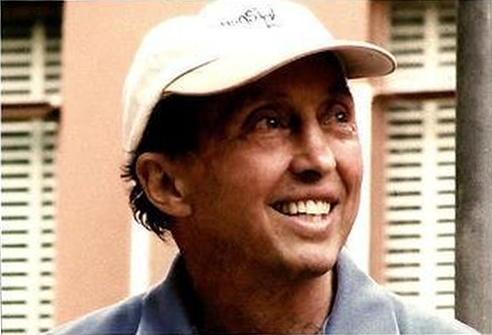
One of the most impactful moments of my life is when my best friend, Frank, died on my birthday in 2010.
Although it is definitely accurate to say he was my best friend, I certainly am not alone in saying that. There are many, many people who would say the same thing, as Frank was certainly a dear friend to many. He not only impacted a great number of of lives, he seemed to achieve the impossible, inspiring thousands of people in the middle of San Jose, California, a city with nearly a million people excluding surrounding suburbs, to change their way of life — not just for humanity, but also for nature and wildlife and Wildlife as well. His impact on people's lives is painfully evident within the comments on his obituary (Legacy.com 2025). Here are just a few:


From Racecar Driver to Environmental Pioneer
The Story of Frank, the Redwood Forest, and the first Earth Day
On Earth Day, April 22, 2010, Frank's legacy was celebrated by hundreds of people at San Jose State University ("SJSU"), as shown on the front page of the Spartan Daily on February 22, 2020:
Above image by Spartan Daily utilized for First Amendment purposes in accordance with the U.S. Copyright Office’s Fair Use Policy and the Fair Use Doctrine. See References at the bottom of the page.
The school’s Environmental Studies Department, one of the oldest in the country, was founded in 1970 by internationally recognized renewable energy expert and architect Donald Aitken (1936-2022). That was the same year Gaylord Anton Nelson (1916–2005), an American politician from Wisconsin who served as a United States senator and governor, and also a graduate of SJSU, founded Earth Day (SJSU 2014).
Frank told me many stories about his life, one of which is how he went from being an avid racecar driver, to a "radical environmentalist" who helped spearhead SJSU's environmental studies program.
Frank was raised in a machine shop back when the Silicon Valley was still full of orchards — back before the Silicon Valley Rush transformed it into the sprawled metropolitan area we know today. His family had come over with one of the the waves of Italian immigrants (Bengiveno 2025). The climate there was very similar to the Mediterranean, so many of them had a hand in establishing the orchards. His twin brother Karl, who passed just before he and I met, were all about driving racecars. That was their passion.
One day Frank was speeding around on a backroad, when he saw a construction vehicle with a sign on the back that said not to follow it into construction zones. Frank — never one to blindly obey — followed it into a large stand of the great redwood trees.
Image temporarily unavailable
Above image by Cruise America utilized for First Amendment purposes in accordance with the U.S. Copyright Office’s Fair Use Policy and the Fair Use Doctrine. See References below.

Above image by Cruise America utilized for First Amendment purposes in accordance with the U.S. Copyright Office’s Fair Use Policy and the Fair Use Doctrine.
After Frank followed the construction vehicle past the initial line of trees, what he saw next mortified him, and changed his life forever: redwood tree stumps, clear-cut as far as the eye could see:

Above image by PBS SoCal utilized for First Amendment purposes in accordance with the U.S. Copyright Office’s Fair Use Policy and the Fair Use Doctrine (Farmer 2017).
Now, all this happened in Frank's younger days, and he was a few months short of 71 when he died. Although I am unsure how he went about helping to establish SJSU's Environmental Studies program, I do know he had a significant hand in it, and was one of the original faculty members within the program. Although I am unsure who took the photograph, here is a photo of Frank helping to lead SJSU's recycling program, back in its early days:
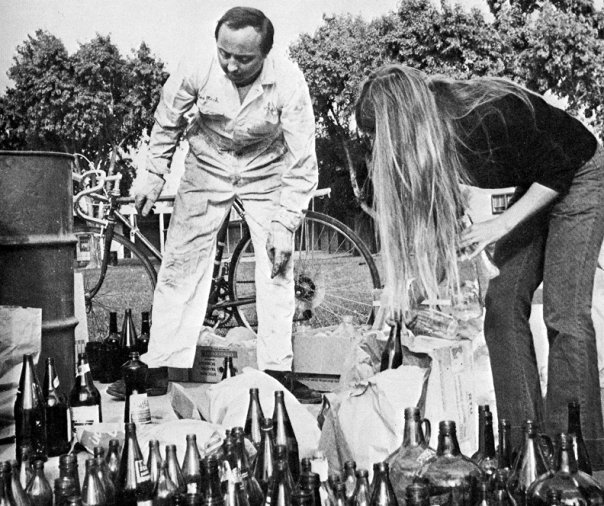
Image source unknown.
A Student of his Students
How Frank became "The Professor who Walked the Walk"
Over the years, as he was teaching, students would often point out hypocrisy they saw in Frank, "Well, you're creating garbage too," they'd say, or, "The energy your house uses runs on fossil fuels,", or "Your car uses gas," and so on. Frank took these critiques constructively, and began transforming his home at 1186 Bayard Drive into a model for sustainable design.
"Frank's average energy bill, in the dead of winter, was only $11! He achieved this via making simple, incremental, affordable home improvements to what eventually turned into his renown 'nearly-off-the-grid' home.
The techniques Frank used are the exact type of improvements Civilian Restoration Corps' 'Housing Helpers™' and 'Solar Solvers™' teams will install onto Iowa homes and businesses, thus reducing energy bills for all Iowans.
Through CRC, we are going to model a replicable state-funded program that Iowa will lease to other states, once we have finished troubleshooting it here. Either that or you'll elect me President, and we'll make it national. Either way, the products we use within the CRC Voucher Program will be a surefire bet in the stock market, and Iowans will have first dibs."
Below you will find a list of his environmental commitments, legal battles which ensued, teachings, and how he and I crossed paths and began teaching together.
Passive solar design
One of the most famous transformations Frank made to his house was the passive solar design retrofit that he and his friend and business partner, Sigmund Beck, devised and built. It was modeled after the ingenuity found in the Mesa Verde cliff dwellings of the ancestral Puebloan people (formerly and incorrectly called Anasazi):

Above photo by Lorax utilized for First Amendment purposes in accordance with the U.S. Copyright Office’s Fair Use Policy and the Fair Use Doctrine (Lea 2010).
Frank's home therefore became the first modern passive solar design home in California — and perhaps the world. Soon, however, The City of San Jose was up his arse, arguing that it did not meet the local fire safety code. Before we get into that story, here is a video of some of Frank's friends, Tadas and Sigmund Beck, teaching about how passive solar design can be retrofitted for modern homes to reduce peoples' energy bills:
Frank and Sigmund built Frank's "sun room", as he called it, via the following steps, essentially:
1.They knocked out the bottom half of the south-facing wall of his house. Here is what the south wall looked like before they knocked it out (unless otherwise indicated, photographers for the below photos are unknown):

2. They built a well-insulated hallway onto the exterior of the wall, with double-pane windows, presumably infused with argon gas, for insulation:

The brick flooring serves as a thermal mass, thereby collecting heat from the sun in winter. The heat then gets trapped inside insulated hallway.

3. They installed black metal cans, filled with water, all along the bottom half of the wall, as shown:

Did you notice the retractable reflective panels on the ground? Here's a better angle:

Above image from East Bay Times utilized for First Amendment purposes in accordance with the U.S. Copyright Office’s Fair Use Policy and the Fair Use Doctrine (Green 2017).
Frank unscrewing one of the panels to open it:

To understand the purpose of these retractable panels, first we must look to this diagram, which shows how the sun appears high in the sky during summer months, but then lower in the horizon during the winter (Smithsonian 2025):
In summer months, the panels remain closed, and the metal cans remain hidden. This causes the water-filled tanks to remain cool, and the house stay insulated. Sunlight doesn't enter directly into the passive solar room during the summer because that is the time of year when the sun remains high in the sky.
In winter months the panels are opened during the day. The sunlight then bounces off the reflective panels and onto the water tanks, which heat up. Due to the process of convection, warm air that is created then rises, and naturally flows toward the the coldest part of the house — the far north side. This is why the sliding door that leads into the house is kept open during the winter, to allow the warm air to enter. Once the warm air cools down at the north end of the house, it falls to the ground, then is pushed by the air behind it back toward the sun room, where it heats up again, and continues to circulate in this same manner. This process is called convection:

Here you can see what Frank's "sun room" looked like during the winter:

4. A slight overhang was kept above the windows to ensure the sunlight did not directly enter during the summer, as Frank is pointing out here:

Before describing several more ingenious ways Frank reduced his energy bills, first:
Battle with the Bureaucrats
Part 1: Frank v. The Fire Safety Code
After Frank and Sigmund retrofitted his home, the City of San Jose informed Frank that he was in violation of the fire safety code. Frank knew this was preposterous, and began speaking in front of City Council. A meeting was scheduled with what he called a group of "bureaucrats", who alleged his retrofit was unsafe.
One of them asked him, "What if there was a fire? How would you get out?"
Well, Frank replied, "I would walk out the south door that used to lead outside, and then I'd open one of the new doors that leads outside, and walk out."
Another bureaucrat replied, "What if that door was blocked by fire?"
"Well, I'd open up the large window in my bedroom, exit through the window into the sun room, then open up one of the sliding glass doors which leads outside, then exit," Frank responded.
Seemingly agitated, and like they'd finally caught him, the bureaucrat retorted, "Well then what if you were overtaken by smoke and couldn't get out?"
Frank loved telling this story. He said there was a deafening pause, as the man realized what a dumb question he had just asked. Frank let it simmer for just a moment, "Well then, I guess whether I have a sun room or not — I'd be dead!"
Frank: 1 City of San Jose: 0
The Cool Roof
Next, Frank painted his roof white using elastomeric paint. Elastomeric paint is a flexible, high-build coating that is commonly used for residential and commercial stucco or concrete block painting projects. It is specifically designed to withstand the stresses of expansion and contraction caused by temperature fluctuations and weather conditions (A New Leaf Painting 2025).


I like the smirk on his face in this one:
Battle with the Bureaucrats
Part 2: Frank v. The "Arbitrary and Capricious" Palette Code
Now the City came after him again, stating that City Code only allows for certain palettes to be used on the exterior of residential buildings. Specifically, roofs must be what they referred to as "earth tones" — black, brown, grey, or other standard colors typically used on roofs. White was not allowed.
Frank challenged this provision within the Code, referring to it as "arbitrary and capricious" (this is an example of how Frank, unbeknownst to me at the time, was arming me with knowledge of the law).
The City, realizing that if it went to federal court, he would likely win, backed down.
He then measured the temperature of his loft space with his neighbor's loft space, and found that his house remained eleven degrees cooler during the summer, with no change in temperature during the winter. He pointed out that every house on the block had the same "cookie cutter" design, so his cool roof was certainly the only factor.
Frank: 2 City of San Jose: 0
Solar Panels, and Solar Heated Hot Water
After the cool roof was painted on, Frank installed solar panels and a solar-heated hot water system.
Frank giving a tour of his home:

He also show students the electric meter outside his house, and have them look closely, "Notice how the dials on the meter are moving backwards:"

Above image by Kristoferb utilized for First Amendment purposes in accordance with the U.S. Copyright Office’s Fair Use Policy and the Fair Use Doctrine (Green 2017).
He explained how during the day, when the panels are producing energy, his house used less energy than the panels produced, causing the dials to move counterclockwise. This was energy that was sold back to the city, thereby counterbalancing the energy he used at night. Again, his average energy bill in the deep of winter was only $11!
Frank informed students that there was a rumor floating about that solar panels lost their integrity over time, but that he had his panels tested after ten years of use, and they actually put out more energy than they were recorded to put out at the time of manufacturing. "It was probably misinformation put out by the fossil fuel industry," he'd say.
Here Frank displays a demonstration solar panel used during the famous tours:

"No moving parts; nothing to break down — kind of looks like a picture frame," he would say.
To the right of Frank in the above photo, there is a hot water heater, which has a very small pump in it that uses about the same amount of energy as a low-watt light bulb. The pump forces water to travel very slowly into the black pipes at the top of the hot water heater, which lead up to the roof, where the water is heated by the sun. The water is then pumped back into the same heater. All the water in Frank's house was heated by the sun through this innovative, low-cost solar hot water heater.
Page in making - please check back shortly - July 14
Thermal Curtains
Every window had insulated "thermal curtains" over them, which affixed firmly to the frames when they were lowered via magnetic strips you can see in the foreground of the following image:

Above image by East Bay Times utilized for First Amendment purposes in accordance with the U.S. Copyright Office’s Fair Use Policy and the Fair Use Doctrine.

The Blue Bomber


Organic Gardening
The Zero Trash Commitment
For more than twenty years, Professor "Frank" Schiavo maintained and campaigned "The Zero-Trash Commitment". Frank is San Jose, California's renown trailblazer of the Earth Conscious- or "Environmental" movement.
Frank would purchase fresh organic produce as well as reuse bags for the bulk section over and over again (including twist ties) for over 30 years in the middle of one of the United States' largest cities,
Besides adamantly reusing bags, he also composted & recycled everything! After about a week, he would have about a handful of garbage, which he would crumple up & put into the city garbage can. "I pay taxes too!" he would say. Here's an old yearbook picture of Frank teaching about recycling "before it was cool":
From
The Professor who refused to pay his $15/month garbage bill
After maintaining a "zero trash home" for over 20 years, The City of San Jose passed a new ordinance which required residents to pay the same amount "whether they filled "one trash bag or nine". He refused to pay his $15/month garbage bill because he wasn't producing garbage.! Frank argued "because the people did not vote on it, the garbage service cannot be considered a tax- its not a user service I require.
Frank on World News Tonight:
Frank on CNN:
Eventually after he gained more public exposure, & stayed his ground, the City of San Jose realized he was correct, and Frank won! Because he was recycling, re-using bags at the bulk section, purchasing fresh organic produce, gardening, AND composting, he freed himself from ever having to pay for his garbage bill again! Frank truly had
A Teacher and Inspiration for Many, a Friend to All
He used to open each semester by telling his students, "Jesus of Nazareth is recorded to have publicly taught and ministered for a total of 3 or 4 years. Buddha — also known as Siddhartha — taught for about 45 years. . He is still commemorated today by the Frank Schiavo Environmental Scholarship, offered to SJSU students in the Environmental Studies department (SJSU 2025).
Inventor and Mentor
Frank Schiavo, M.M.L.
He never earned many of the higher credentials many of the other professors at San Jose State University ("SJSU").
He is still commemorated today by the Frank Schiavo Environmental Scholarship, offered to SJSU students in the Environmental Studies department (SJSU 2025).
Wild Willpower would not be what it is today without many lessons and insights Frank imparted to me between 2005 and 2010.
from San Jose State University's Professor Frank Schiavo (1939-2010).
"Frank" (as he preferred to be called) helped change & evolve Silicon Valley's environmental standards after living an inspiring & dedicated life- the Environmental Studies professor was known for "walking the walk" for several reasons:
He educated students for over 30 years, & gave tours of his "nearly off the grid house" to around 90 students per week from various schools & organizations for many years before his passing on January 26th, 2010.
How Frank and I met
When Frank & Distance (Wild Willpower's founder) first met, both had been upholding a "Zero-Trash Commitment" for several years - one of the many ecological commitments they would share in common. He invited her to teach alongside him as a guest speaker at both San Jose State University & De Anza College, & for the last 4 years of his life, the two of them would give tours to about 90 students/week of his revolutionary home at 1186 Bayard Drive. Here's a video of him giving a tour of his amazing environmentally friendly home:
Touring an eco friendly home with Frank Schiavo by smtvfreevideos
The Story of "The Zero Trash Commitment":

One of Frank's Favorite Songs, very fitting:
Some things Frank taught:
The definition of an "extractive industry" is any industry which requires perpetual extractions of resources in order to operate (ie gas, coal, natural gas, nuclear).
The opposite of "extractive industries" are "single extraction energy generators" , which require only one single extraction from the Earth, such as solar panels, wind turbines, tidal turbines, & so on.
Weak, frail bags, styrofoam, & plasticware all all examples of "extractive industry packaging".
REMEMBER - don't come down on yourself for not doing good enough, but just do the very best you can considering your circumstances.
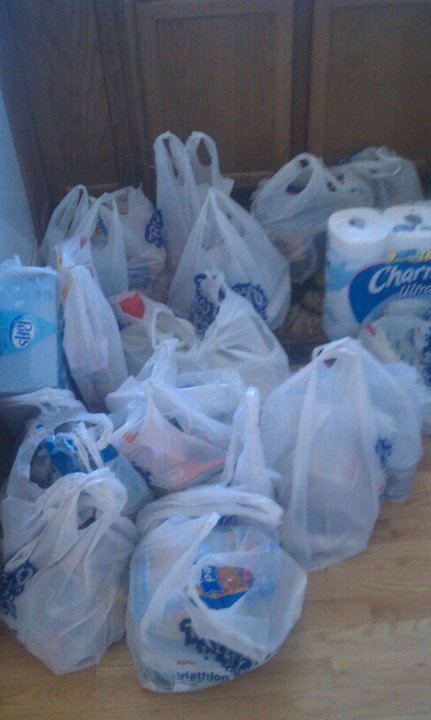
Rather than selling everything wrapped in garbage, companies are now switching to bulk sections in order to eliminate waste on the consumer level! Here's a photo from the beautiful, clean bulk sections @ Casa de Fruta; just west from I-5 on the 152 toward San Jose about 10 miles on the left.
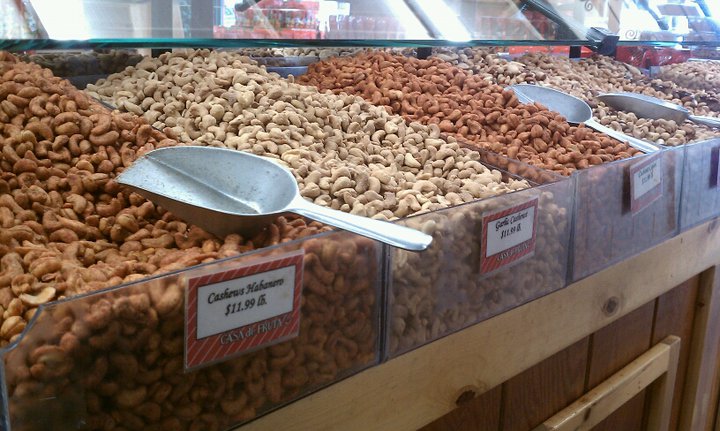 By re-using durable bags in bulk sections, one can eliminate waste on the consumer level!
If your company is seeking bulk suppliers or if you are a bulk supplier who would like to promote via our online store, please contact adwilson8@dmacc.edu.
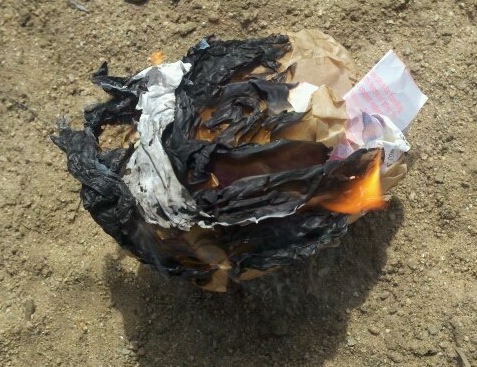
If you are looking @ 2 products, & one has plastic, styrofoam, or metal packaging, & the other packaging is made from paper; go with paper whenever possible! Paper scraps can be burned, which means using less trash bags.
HELPFUL GREEN TIP!
Sometimes there ISN'T a water button at the soft drink dispenser in the gas station for fast food restaurant, etc.; IN THAT CASE, fill your container with ice & then use the hot water button on the coffee dispenser to get cold water.
Please consider purchasing a reusable canteen:

"Package management jobs" (i.e. creation of packaging, mining of products to create packaging, garbage services, etc.) create a negative-value on our economy, as they cause more work for less product. They are like resistors in electronics, & de-value our currency, creating a negative-value on every product by paying the "resistor job" of package creation & removal.
"Odin'" by Distance Everheart recorded by James Heyser @ Lighthouse Recording Studio (listen close to verse 2)- Frank is the "rock":
Want more help? Here's a great video from one of our favorite stores, Rainbow Grocery Cooperative in San Francisco:
Articles about Frank:
Thorough article on SanJoseGreenHome.com by Tadas
Article about his passing by Lisa Fernandez
Thorough article with words from students by Isaiah Gunzman in The Spartan Daily
Really nice memoire in the Contra Costa Times by Lisa Fernandez
Sierra Club article by Glen Martin highlighting the passive solar design structure of Frank's home
"San Jose Loses 2 Heroes"; Honourable Mention of Frank by The San Jose Peace & Justice Center
References
A New Leaf Painting. (retrieved July 14, 2025). The Pros & Cons of Elastomeric House Paint. https://www.anewleafpainting.com/blog/2020/the-pros-cons-of-elastomeric-house-paint.
Bengiveno, Dr. Teri Ann. (retrieved July 14, 2025). California Italian American Project. https://www.aiha-wrc.org/CIAP/san_jose/san_jose.html.
Farmer, Jared. (Oct. 24, 2017).Old-Growth Infrastructure: Redwood in Los Angeles. PBS SoCal. https://www.pbssocal.org/shows/lost-la/old-growth-infrastructure-redwood-in-los-angeles
Green, Jason. (Dec. 23, 2017). San Jose’s first green home back on the market. East Bay Times. https://www.eastbaytimes.com/2017/12/23/san-joses-first-green-home-back-on-the-market/.
Lea, Keya. (April 11, 2010). Mesa Verde Cliff Dwellings. Green Passive Solar Magazine. https://greenpassivesolar.com/2010/04/mesa-verde-cliff-dwellings/.
Legacy.com. (2025). Frank Schiavo. https://www.legacy.com/obituaries/name/frank-schiavo-obituary
Cruise America. (retrieved July 14, 2025). Revel in the Redwoods: Best Places to See Redwoods in California. https://www.cruiseamerica.com/media/1r5i41z1/9f414f14-9c3e-40d6-97d4-86ad194fe3fe.jpg.
SJSU. (Archived from the original on October 28, 2014. Retrieved June 7, 2014). "Distinguished Alumni". SJSU. Archived from the original on October 28, 2014. Retrieved June 7, 2014.
SJSU. (Retrieved July 14, 2025). Environmental Studies Department Scholarships. https://www.sjsu.edu/envs/student-resources/scholarship/envs-department-scholarships.php.
Smithsonian. (retrieved July 14, 2025). What is the Winter Solstice? Science and Technology Concepts Middle School. https://ssec.si.edu/stemvisions-blog/what-winter-solstice.
Spartan Daily. (Feb. 22, 2010). https://issuu.com/spartandaily/docs/spartandaily-02-22-10