
Wild Willpower's Justice Reform Plan:
First Reform—The Justice Accessibility Act
Making Iowa’s Courts Understandable, Usable, and Accessible to the People.
By Sondra Wilson | Updated August 10, 2026
Part of Wild Willpower's We the People Platform to rebuild Iowa's Infrastructure, Education, Healthcare, and Justice systems.

Iowa’s courts belong to the people.
Article I, section 2 of the Iowa Constitution declares:
“All political power is inherent in the people. Government is instituted for the protection, security, and benefit of the people, and they have the right, at all times, to alter or reform the same, whenever the public good may require it.” [1]
That promise means more than permitting a person to enter a courthouse or create an electronic filing account. A justice system is not meaningfully accessible when ordinary citizens cannot determine which rules apply, locate the decisions that bind the court, understand the consequences of a notice, or correct a harmless mistake before an important right is permanently lost.
I developed the Justice Accessibility Act after years of attempting to navigate Iowa’s courts and administrative systems without counsel.
In two civil-rights cases, represented defendants invoked precedent stating that laypeople who represent themselves must act with the “equal competence” of attorneys and proceed “at their own risk.” I was expected to research pleading, jurisdiction, service, venue, administrative exhaustion, discovery, privilege, preservation, amendment, finality, and appellate procedure while also investigating facts, organizing evidence, meeting deadlines, attending school, and conducting a statewide campaign.
The problem was not simply that I lacked a lawyer. The public system itself did not provide a usable map.
The Justice Accessibility Act would address that failure through four principal commitments:
- a plain-English, publicly organized map of Iowa procedure;
- a comprehensive searchable archive of the Iowa decisions and United States Supreme Court rulings that bind Iowa courts;
- clear notice, standardized assistance, and reasonable opportunities to correct harmless errors before rights are permanently lost; and
- practical human and technological assistance for people who must use the courts without counsel.
The Act would not eliminate attorneys, excuse bad faith, weaken legitimate procedural protections, or require judges to favor self-represented litigants. It would make the governing law easier to locate, the procedural path easier to follow, and adjudication more likely to turn upon the merits rather than preventable confusion.
On This Page
Part I — Why This Reform Exists
Part II — The Structural Problem
Part III — Why Procedure Must Serve Justice
Part IV — What the Justice Accessibility Act Would Do
Priority One — Create a Public Map of Iowa Procedure
Priority Two — Create a Public Archive of Controlling Law
Priority Three — Make Self-Representation a Real Right
Priority Four — Provide Human and Technological Access
Part V — What This Reform Is—and Is Not
Part VI — From Experience to Policy
Part VII — How This Becomes Law
Part VIII — Related Justice Reforms
Part IX — Conclusion
PART I — WHY THIS REFORM EXISTS
A. When the Promise of Justice Meets the Machinery of Law
Many people enter court believing that “liberty and justice for all” means the evidence will be examined and the truth will prevail. They assume that even if they do not understand every rule, the system will help guide the dispute toward a fair resolution.
Instead, they encounter doctrines and precedents only after opposing counsel deploys them in a dismissal filing: that self‑represented citizens are expected to perform with professional‑level competence; that statements may be absolutely privileged even when alleged to be false or malicious; that procedural mistakes can prevent central evidence from ever being reached; and that immunity may foreclose a remedy even where misconduct is alleged.
The financial danger is equally real. A person who turns to the courts after being harmed can be buried beneath motions, deadlines, discovery disputes, fee requests, sanctions arguments, and counterclaims long before the underlying facts are ever decided. Attorney‑fee demands are not rare. They are a familiar litigation weapon—one that can leave a self‑represented person without justice, and forced to help finance the legal representation of the parties that harmed them.
Retaliatory litigation compounds the danger. When accusations are serious and reputational stakes are high, the threat of a counterclaim becomes another pressure point: withdraw, remain silent, or risk having the original harm multiplied through additional claims, additional expense, and additional damaging material placed into an official record.
Procedural complexity is not just inconvenient — it is dangerous. It can bury the merits, exhaust the person seeking relief, preserve disputed accusations inside government records, and arm opposing parties with doctrines that prevent the underlying truth from ever being reached. A person may enter court seeking relief from one injustice and emerge carrying several more.
A right is not always lost because the law provides no protection. Sometimes it is lost through the machinery used to administer it.
The problem becomes even more serious when the person seeking relief cannot afford professional representation. At that point, procedural complexity is no longer merely a question of inconvenience. It becomes an access-to-justice problem.
B. The Justice Gap
The Legal Services Corporation’s 2022 Justice Gap Study reported that low-income Americans received no legal assistance, or insufficient assistance, for 92 percent of the civil legal problems that substantially affected them. [2] According to Clio’s 2025 legal-billing data, the average hourly rate for an attorney in Iowa was $252. [3] Meanwhile, the U.S. Census Bureau reported median annual earnings of $57,545 for full-time, year-round workers in Iowa—approximately $27.67 per hour based on a forty-hour workweek. [4]
One hour of an average Iowa attorney’s time therefore represented more than nine hours of a median full-time Iowa worker’s earnings. [5]
When a person cannot afford counsel, the underlying problem does not disappear. Eviction, discrimination, debt, custody disputes, insurance denials, contractual claims, and injuries caused by governmental action still carry deadlines and procedural requirements. Many people must either abandon potentially valid rights or enter court alone.
Iowa already provides official forms for some proceedings, guided interviews in selected areas, and access to court navigators who can assist with forms and basic information. [4] Those resources are valuable. The Justice Accessibility Act would build upon them and extend meaningful assistance across a far broader range of civil proceedings.
I could not afford an attorney. The legal-aid organizations I contacted could not take the case, in part because their funding restrictions generally prevent them from handling fee-generating litigation.
I therefore had to represent myself.
When representation is financially out of reach, the right to represent oneself becomes critically important. But that right has limited practical value if the person must reconstruct the legal system while simultaneously litigating the case.
C. Building My Own Map Through the Rules
I relied on knowledge I had developed through years of legal research and through transcribing legal definitions for ReUniteTheStates.org. I began translating Iowa’s extraordinarily complicated Rules of Civil Procedure into step-by-step instructions that I could follow. To make that material easier to understand and navigate, I also organized the rules into labeled folders in Wild Willpower's public Google Drive, where they remain available as part of the organization’s broader justice-reform and public-legal-education work. [6] Even then, as a pre-law college student who had already spent years studying law, I had no understanding of what I was about to face.
I filed this lawsuit because I needed a court to examine the actual record: the communications, exhibits, timelines, contradictions, and altered presentations. I needed a judicial determination concerning allegations that had already entered administrative and judicial records. I needed an opportunity to clear my name before those records could be weaponized against me during a statewide campaign.
For me, pursuing the case was not optional. It was a matter of survival.
I did not anticipate that the litigation would continue for years and remain unresolved in 2026. Nor could I have anticipated how thoroughly it would consume the same time and resources that Iowa law required me to devote to gathering thousands of signatures for ballot access.
PART II — THE STRUCTURAL PROBLEM
The first structural problem was the enormous imbalance between navigating this system alone and confronting represented parties backed by professional legal infrastructure.
When I entered this case without an attorney, I was not simply opposing seven defendants. I was facing experienced counsel from an established law firm, supported by the professional knowledge, research resources, staffing, and institutional familiarity that come with legal practice.
The contrast matters. A self-represented litigant must learn the rules while simultaneously investigating the facts, organizing evidence, drafting filings, monitoring deadlines, responding to motions, and surviving financially. A law firm can distribute those tasks among attorneys and staff who already know the system.
That imbalance becomes especially troubling when procedural maneuvering is treated within the profession as ordinary advocacy—or even as “tricks of the trade”—although its practical effect may be to increase costs, obscure the record, exhaust an opposing party, and prevent the merits from ever being reached.
Lawyers have a duty to represent their clients zealously within the law. But the justice system should not depend upon one side’s ability to exploit complexity more effectively than the other. When procedure rewards resources, specialization, and endurance over factual truth, access to justice begins to depend less upon the merits of a claim than upon who can afford the machinery surrounding it.

Bradley & Riley’s name appears prominently on The Chauncey building in Iowa City, where the firm lists its Iowa City office. The image illustrates the structural imbalance at the center of this case: one self-represented Iowan attempting to investigate, finance, and litigate a complex case alone while facing experienced counsel backed by an established firm. Photo by Annie Smith Barkalow, Corridor Business Journal.
That power imbalance matters. A self-represented person can be buried under motions, deadlines, discovery disputes, fee requests, and dismissal arguments long before the court reaches the underlying facts. That is the position in which I found myself.
A. No Justice, No Mercy for Pro Se Litigants
Iowa’s procedural system becomes especially harsh when courts demand professional-level competence from people proceeding pro se—without an attorney.
In both Wilson v. State of Iowa and Kim Reynolds for Iowa and Wilson v. Reliable Street Inc., et al., opposing counsel invoked substantially the same body of pro se doctrine while seeking dismissal. They did not cite precisely the same cases, but they relied on the same underlying rule: a self-represented litigant may receive limited flexibility in the wording of a pleading, yet remains responsible for complying with the procedural standards expected of trained attorneys.
In the opening dismissal motion filed in Wilson v. Reliable Street, attorney Paul Esker first acknowledged the limited accommodation Iowa law provides:
“When a pleading is filed pro se, ‘some leeway must be accorded from precision in draftsmanship.’”
He cited Knight v. Knight, 525 N.W.2d 841, 843 (Iowa 1994), and Munz v. State, 382 N.W.2d 693, 697 (Iowa Ct. App. 1985), which stated that a pro se applicant is entitled to a liberal construction of the pleadings.
But the filing immediately narrowed the significance of that leeway:
Pro se litigants are not “excused from complying with requirements with which represented parties must comply. In short, the challenges to pro se pleading do not entitle Plaintiff to special leniency with regard to standards of pleading.”
For that proposition, the defendants relied on Pickens v. Zeien, No. LACV089735, 2018 WL 7863488 (Iowa Dist. Ct. May 14, 2018), and Debruin v. State, 779 N.W.2d 494 (Iowa Ct. App. 2010), quoting the familiar rule:
“The law does not judge by two standards, one for lawyers and the other for lay persons. Rather, all are expected to act with equal competence. If lay persons choose to proceed pro se, they do so at their own risk.” [8]
Thus, even the authorities recognizing that an untrained citizen may lack precision were used only as a brief preface to the more consequential rule: no special leniency in meeting the standards on which dismissal may depend.
Assistant Attorney General Christopher Deist invoked the same principle in the State’s motion to dismiss my amended petition in Wilson v. State of Iowa and Kim Reynolds for Iowa. In the first footnote of the filing, the State said it was “sympathetic” to the fact that I was proceeding pro se, but argued that Iowa courts consistently refuse to hold self-represented people to a lower procedural standard than attorneys. The State cited Kubik v. Burk, 540 N.W.2d 60, 63 (Iowa Ct. App. 1995):
“The law does not judge by two standards, one for lawyers and another for lay persons. Rather all are expected to act with equal competence.”
Later in the same motion, while arguing that my tort claims should be dismissed for failure to exhaust administrative remedies, the State returned to the point:
“Nor do Iowa courts ‘utilize a deferential standard when persons choose to represent themselves.’”
The State again cited Kubik and then relied on Metropolitan Jacobsen Development Venture v. Board of Review of Des Moines, 476 N.W.2d 726, 729 (Iowa Ct. App. 1991):
“If lay persons choose to proceed pro se, they do so at their own risk.” [9]
In each case, counsel used this doctrine while seeking dismissal: limited drafting leeway did not reduce the professional procedural standards imposed upon me.
Across different attorneys, defendants, and cases, the institutional message remained the same:
You may enter the courthouse without an attorney — but you will be expected to navigate it as though you were one.
Which raises a fundamental democratic question:
Would Iowa voters knowingly choose a court system in which citizens are permitted to represent themselves, yet expected to navigate it with the competence of trained attorneys?
B. Equal Standards Do Not Create Equal Access
On paper, requiring lawyers and self-represented citizens to meet the same standards is described as equal treatment. In practice, it can create profound inequality.
A self-represented student, laborer, parent, tenant, patient, small-business owner, or crime victim does not enter court with the same resources as an attorney. The citizen may lack subscription research databases, specialized treatises, clerical support, litigation experience, established templates, and years of training in jurisdiction, pleading standards, issue preservation, discovery, evidence, motion practice, and appellate procedure. The opposing attorney begins with that professional infrastructure already in place.
Yet the citizen is told to perform with “equal competence”—and to bear the consequences alone when they cannot.
Formal equality between people with radically unequal training and resources is not meaningful equality; it is a structural fiction that masks the reality that only those with professional legal training can meaningfully participate in the system.
That inequality becomes even clearer when the training required of attorneys is compared with what courts demand from ordinary citizens.
C. Citizens Are Judged by Standards That Require Years to Learn
Becoming an attorney ordinarily requires a bachelor’s degree or its equivalent, three years at an accredited law school, passage of a state bar examination, and a character-and-fitness review. [11]
The financial investment is substantial. At the University of Iowa College of Law, tuition and mandatory fees for the 2025–2026 academic year totaled $33,489 for Iowa residents and $54,736 for nonresidents [12]—approximately $100,467 to $164,208 over three years at unchanged rates, before undergraduate tuition, books, housing, transportation, bar-examination expenses, or student-loan interest are included. [13]
That education has value because law is difficult. Attorneys spend years studying jurisdiction, pleading, discovery, evidence, statutory interpretation, precedent, motion practice, issue preservation, appellate procedure, legal research, and professional responsibility.
A court cannot recognize that professional competence ordinarily requires years of specialized education and then treat a tenant, laborer, parent, student, patient, crime victim, or small-business owner as though that person acquired equivalent knowledge merely by entering an appearance without counsel.
To permit self-representation while demanding professional-level competence transforms a legal right into a procedural trap: the courthouse door is technically open, but meaningful entry depends upon knowledge that society ordinarily requires years of education and enormous financial investment to obtain.
These barriers were not theoretical. They shaped how my cases were pleaded, how deadlines were interpreted, how evidence was treated, and how procedural doctrines were deployed before the underlying facts were reached.
D. More Than 1,100 Rules—and Thousands of Sub-Rules
By my count, the Iowa Rules of Civil Procedure contain 370 rules and 1,982 sub‑rules; [14] the Rules of Evidence add 110 rules; [15] the Rules of Criminal Procedure add 146; [16] and the Rules of Appellate Procedure add 501 [17]—more than 1,100 rules and over 6,300 sub‑rules across the core procedural chapters. No working Iowan can reasonably master this architecture, especially when courts insist that pro se litigants must perform with “equal competence” to trained attorneys.
The number alone does not establish that every rule is unnecessary. It does show why merely telling an unrepresented person to “follow the rules” is not meaningful guidance. The rules must be organized, explained, cross-referenced, and presented through a usable public system. The Justice Accessibility Act sets out that proposal.
That is not meaningful equality. It effectively imposes a professional-qualification standard without providing the education, resources, licensing preparation, or institutional support ordinarily required to satisfy it.
To permit self-representation while conditioning meaningful participation upon knowledge society ordinarily expects people to acquire through years of specialized education transforms an open courthouse door into a procedural trap.
These structural barriers were not theoretical. They shaped how my case was handled, how evidence was excluded, how deadlines were interpreted, and how procedural doctrines were deployed to prevent the underlying facts from ever being reached.
No functioning democracy should accept that arrangement as inevitable.
The problem is therefore not simply that Iowa has many rules. The deeper problem is that ordinary people are expected to navigate an interconnected professional system without the training, research infrastructure, or procedural map normally used by attorneys.
E. The Courthouse Door is Open—But the Map Is Missing
Self-represented litigants are generally expected to comply with procedural rules that were written for and are routinely applied by legally trained professionals.
The difficulty is not merely the number of rules. It is the way those rules interact.
A person must determine:
- which court has jurisdiction;
- what cause of action applies;
- what must be alleged in the petition;
- where venue is proper;
- how each defendant must be served;
- which deadlines govern;
- what evidence may be considered;
- how discovery is requested;
- which objections preserve an issue;
- when amendment is permitted;
- whether administrative exhaustion is required;
- what orders are final and appealable;
- and how an issue must be presented to avoid waiver.
A single dispute can require research across statutes, procedural rules, evidence rules, court decisions, local practices, administrative regulations, and filing-system instructions.
No working parent, student, farmer, laborer, senior, tenant, patient, crime victim, or small-business owner should have to reconstruct that entire system from scattered legal materials merely to understand how to ask a court for relief.
PART III — WHY PROCEDURE MUST SERVE JUSTICE
A. Procedure Must Serve Justice—Not Replace It
Procedural rules are necessary. They provide order, notice, consistency, and protection against unfair surprise. But procedure ceases to serve justice when ordinary people cannot determine what the rules require, when harmless mistakes permanently extinguish potentially valid claims, or when the machinery prevents a court from ever reaching the central evidence.
My cases demonstrated the practical consequences. I was not merely required to explain what happened. I had to identify the correct causes of action, plead each defendant’s connection to them, navigate service and venue disputes, understand administrative exhaustion, preserve constitutional questions, seek discovery, respond to privilege doctrines, distinguish interlocutory from final orders, and protect appellate rights—all without counsel.
Those experiences produced a concrete reform proposal rather than a generalized demand for leniency. The Justice Accessibility Act would reorganize and explain Iowa’s procedural system, expand usable forms and notices, create a comprehensive public case-law archive, and establish reasonable opportunities to correct harmless errors before substantive rights are permanently lost.
Most importantly, the Act begins from a simple principle: procedure should help courts reach legally cognizable disputes fairly. It should not become the principal reason those disputes are never heard.
Alexander Hamilton expressed the deeper principle in 1775:
“The sacred rights of [human]kind are not to be rummaged for, among old parchments, or musty records. They are written, as with a sun beam, in the whole volume of human nature, by the hand of the divinity itself; and can never be erased or obscured by mortal power.”
— Alexander Hamilton, The Farmer Refuted, February 23, 1775 [18]

Hamilton was not arguing that written constitutions and laws are unimportant. He was arguing that fundamental human rights do not exist merely because officials discover words supporting them in an old document. Legitimate law derives its authority from principles of human liberty and dignity that government was created to protect.
That warning remains relevant when courts treat layers of precedent, technical procedure, and professionally inaccessible legal research as more important than the human beings whose rights those doctrines are supposed to secure. Justice cannot depend upon whether an injured person possesses the education, money, vocabulary, subscriptions, and procedural instincts necessary to locate the correct passage among the modern equivalent of “old parchments or musty records.”
The law should preserve rights—not bury them.
If Iowa’s courts are to function as institutions genuinely open to the public, the system must be rebuilt so that legal knowledge is not confined to those who can afford professional training.
The Justice Accessibility Act translates that principle into twelve concrete reforms organized around four priorities.
PART IV — WHAT THE JUSTICE ACCESSIBILITY ACT WOULD DO
Priority One — Create a Public Map of Iowa Procedure
1. Review and Simplify Unnecessarily Complex Procedures
The Iowa Supreme Court possesses statutory authority to prescribe rules governing judicial administration, courts, judges, and attorneys. [16] A governor therefore cannot rewrite judicial rules by executive order, and the Justice Accessibility Act would respect the separation of powers.
My administration would work with the General Assembly and Judicial Branch to fund a formal review of Iowa’s procedural system and identify rules that are unnecessarily fragmented, duplicative, difficult to locate, or written in language inaccessible to the public.
Simplification would not mean eliminating procedures needed to provide notice, preserve jurisdiction, protect evidence, prevent unfair surprise, or secure the opposing party’s rights. It would mean asking whether the same legitimate purpose can be achieved through rules that are shorter, clearer, better organized, and easier to follow.
The review should give particular attention to procedures governing:
- commencement of an action;
- jurisdiction and venue;
- service;
- amendment;
- discovery;
- administrative exhaustion;
- preservation of objections and constitutional questions;
- reconsideration;
- finality and appeal;
- and dismissal based upon curable defects.
2. Publish Plain-English Procedural Maps
For common categories of cases, Iowa should provide step-by-step public guides explaining:
- what the proceeding addresses;
- who may file;
- where and how it is filed;
- what facts and documents are ordinarily needed;
- how service works;
- which deadlines govern;
- what happens after filing;
- what discovery may be available;
- how hearings and trials operate;
- how objections and appellate rights are preserved;
- which errors may cause dismissal or permanent loss of a claim; and
- where qualified legal help may be found.
For every major procedural rule, the public system should display:
- the authoritative rule;
- a plain-language explanation;
- linked definitions;
- related rules;
- commonly encountered examples;
- applicable forms;
- deadlines and warnings;
- and controlling authority interpreting the rule.
The official text would remain authoritative. The explanation would provide the public map that is presently missing.
3. Expand Official Forms and Guided Interviews
The Iowa Judicial Branch already provides free official forms and interactive resources in selected areas. [16] The Act would expand that model to additional recurring filings suitable for standardized assistance, including appropriate forms for:
- general civil petitions and answers;
- motions to amend;
- requests for extensions;
- discovery requests and responses;
- administrative judicial-review petitions;
- preservation of constitutional issues;
- fee deferral;
- motions to reconsider;
- and notices of appeal.
Each guided process should explain what the filing does, when it may be appropriate, what information is required, what deadlines may apply, and what the form cannot accomplish.
4. Give Clear Notice Before Rights Are Lost
A governmental notice should not merely announce a decision when the recipient must take an additional procedural step to preserve judicial review.
Where a withdrawal requirement, appeal deadline, exhaustion rule, service requirement, or other technical step may prevent a person from reaching court, the notice should explain in plain language:
- what must be done;
- who must receive it;
- when it is due;
- where it must be filed or sent;
- what may happen if it is missed;
- and where the correct form or further guidance can be found.
This reform grew directly from my experience with the Iowa Tort Claims Act. I submitted a written claim, received notice that the Attorney General’s Office would investigate it, waited for a final disposition, and later learned that a separate written withdrawal step carried legal significance. A government that knows a procedural requirement may determine whether a citizen ever reaches court should disclose that requirement clearly.
5. Allow Reasonable Correction of Harmless Errors
Not every procedural error is harmless. Some failures prejudice another party, impair jurisdiction, destroy evidence, or make fair adjudication impossible.
But where a good-faith mistake causes no material prejudice and can reasonably be corrected, courts should ordinarily consider:
- identifying the deficiency;
- allowing amendment;
- establishing a cure period;
- staying proceedings while a required administrative step is completed;
- or dismissing without prejudice rather than permanently extinguishing the claim.
The purpose is not special treatment. It is proportionality.
A curable technical defect should not carry the same consequence as bad faith, repeated defiance, evidence destruction, or conduct that prevents another party from receiving a fair hearing.
These first five reforms address the procedural map itself: how rules are written, explained, communicated, and corrected. But even a clearer procedural system will remain incomplete if the law interpreting those rules is still difficult for the public to find.
Legal Research Remains a Barrier Even After the Rules Are Explained
Public legal education would reduce this imbalance, but it would not eliminate another major obstacle: legal research itself can become almost insurmountable for a self-represented person. A litigant must identify the correct legal issue, discover the controlling terminology, locate binding authority, distinguish unfavorable cases, determine whether decisions remain valid, preserve each issue correctly, and present the result in the form the court expects.
A person may possess compelling evidence and a legally recognizable injury yet lose because they did not know the procedural language required to place that injury before the court.
Meanwhile, experienced attorneys can draw from an established body of pro se precedent and place it near the beginning of a dismissal filing. Before the evidence is examined, the citizen’s lack of professional training has already been reframed as a risk the citizen voluntarily assumed.
That gives the represented party an enormous structural advantage.
That is why procedural reform must be paired with public access to the decisions that actually interpret and control those procedures.
Priority Two — Create a Comprehensive Public Archive of Controlling law
6. Build a Searchable Iowa and United States Supreme Court Case-Law Database
Rules cannot be understood in isolation. Courts interpret them through judicial decisions, and those decisions determine what the law means in practice.
The Iowa Judicial Branch publishes recent Supreme Court opinions and provides access to archived opinions. [19] Iowa still lacks a comprehensive, historically deep public research system designed to show ordinary users which decisions bind Iowa courts and whether those decisions remain controlling.
The Act would support a publicly owned database containing:
- Iowa Supreme Court decisions;
- Iowa Court of Appeals decisions;
- historically significant Iowa territorial and appellate decisions;
- and United States Supreme Court decisions binding upon Iowa courts.
Users should be able to search and browse by:
- legal topic;
- constitutional provision;
- statute;
- court rule;
- cause of action;
- procedural posture;
- court;
- date;
- cited authority;
- and later treatment.
Each decision should display:
- the official opinion;
- the court and date;
- the legal questions presented;
- the disposition;
- the principal authorities relied upon;
- a neutral plain-language synopsis;
- and subsequent history showing whether later decisions followed, distinguished, limited, criticized, or overruled it.
The summaries must be neutral, professionally reviewed, and linked directly to the complete controlling text. They would be educational aids—not replacements for reading the opinions themselves.
7. Make Iowa's Legal History Publicly Reachable
Iowa law did not begin with the cases presently easiest to find online.
Older decisions continue to shape constitutional rights, property, contracts, public institutions, civil procedure, criminal law, and statutory interpretation. Yet finding and tracing those decisions may require commercial databases, specialized libraries, or substantial prior knowledge.
The public archive should progressively digitize, index, cross-reference, and summarize Iowa’s older appellate decisions.
Public law should not become practically private merely because the easiest research tools require costly subscriptions.
8. Connect Cases, Rules, Statutes, and Definitions
A person reading a procedural rule should be able to reach the cases interpreting it. A person reading a judicial opinion should be able to reach the cited statute, constitutional provision, related form, and current procedural guidance.
The public portal should therefore connect:
- cases to later treatment;
- rules to interpretive decisions;
- statutes to relevant cases;
- unfamiliar terms to accurate definitions;
- forms to governing rules;
- and procedural steps to applicable deadlines.
Legal research should not require a person to reconstruct the law from disconnected documents scattered across multiple systems.
Better rules and better research tools solve only part of the problem. Iowa must also confront the deeper contradiction created when self-represented people are allowed into court but judged as though they already possess the professional competence those tools are intended to provide.
Priority Three — Make Self-Representation a Real Right
9. Confront the "Equal Competence" Contradiction
Iowa precedent states that the law does not judge lawyers and laypeople by two different standards and that people who proceed without counsel do so “at their own risk.”
Equal substantive obligations may be necessary. A court cannot excuse fraud, bad faith, deliberate noncompliance, or material prejudice merely because a litigant lacks an attorney.
But Iowa should confront the contradiction between allowing self-representation and demanding attorney-level procedural competence while withholding the education, research systems, forms, explanatory materials, and institutional support through which attorneys acquire and exercise that competence.
The Act would not create a separate body of substantive law for self-represented people. It would require Iowa to make reasonable public tools available before treating the inability to navigate professionally designed procedures as a risk the citizen voluntarily assumed.
Equal standards do not create meaningful equality when access to the knowledge needed to satisfy those standards remains radically unequal.
A Profession Judging Those Outside the Profession
Because judges and practicing attorneys emerge from the same profession and operate within the same institutional culture, the system carries an inherent risk of professional insularity: procedures that appear ordinary from inside the profession can function as nearly impassable barriers to the public outside it.
This does not require a secret agreement among judges and attorneys. The problem is structural. The legal profession largely develops and transmits the language, arguments, precedents, and procedural expectations by which citizens are judged, while legislatures and courts formally enact or adopt many of the governing rules. Judges drawn from that same profession then decide whether people outside it have navigated those requirements competently enough to have their claims heard.
Practices that appear obstructive, financially ruinous, or fundamentally unfair to an ordinary citizen may appear routine to people who have spent their careers inside an adversarial system. Procedural attacks may be normalized as advocacy. Complexity may be treated as inevitable. The inability of an unrepresented person to comply may be characterized as personal failure rather than evidence that the institution has become inaccessible.
The courthouse may be publicly funded, but meaningful access to it increasingly depends upon purchasing the services of the profession that controls its language and procedures.
That is the conflict Iowa must confront—not a secret agreement among individual lawyers and judges, but a structural alignment in which the profession creates, interprets, and administers a system whose complexity makes the public increasingly dependent upon that same profession.
When Professional Insularity Becomes Concentrated Power
James Madison, principal architect of the Constitution and fourth president of the United States, warned that tyranny does not depend upon whether concentrated power is held by one person, several people, or even elected officials. The danger lies in the accumulation itself:
“The accumulation of all powers, legislative, executive, and judiciary, in the same hands, whether of one, a few, or many, and whether hereditary, self-appointed, or elective, may justly be pronounced the very definition of tyranny.”
— James Madison, Federalist No. 47, February 1, 1788 [20]
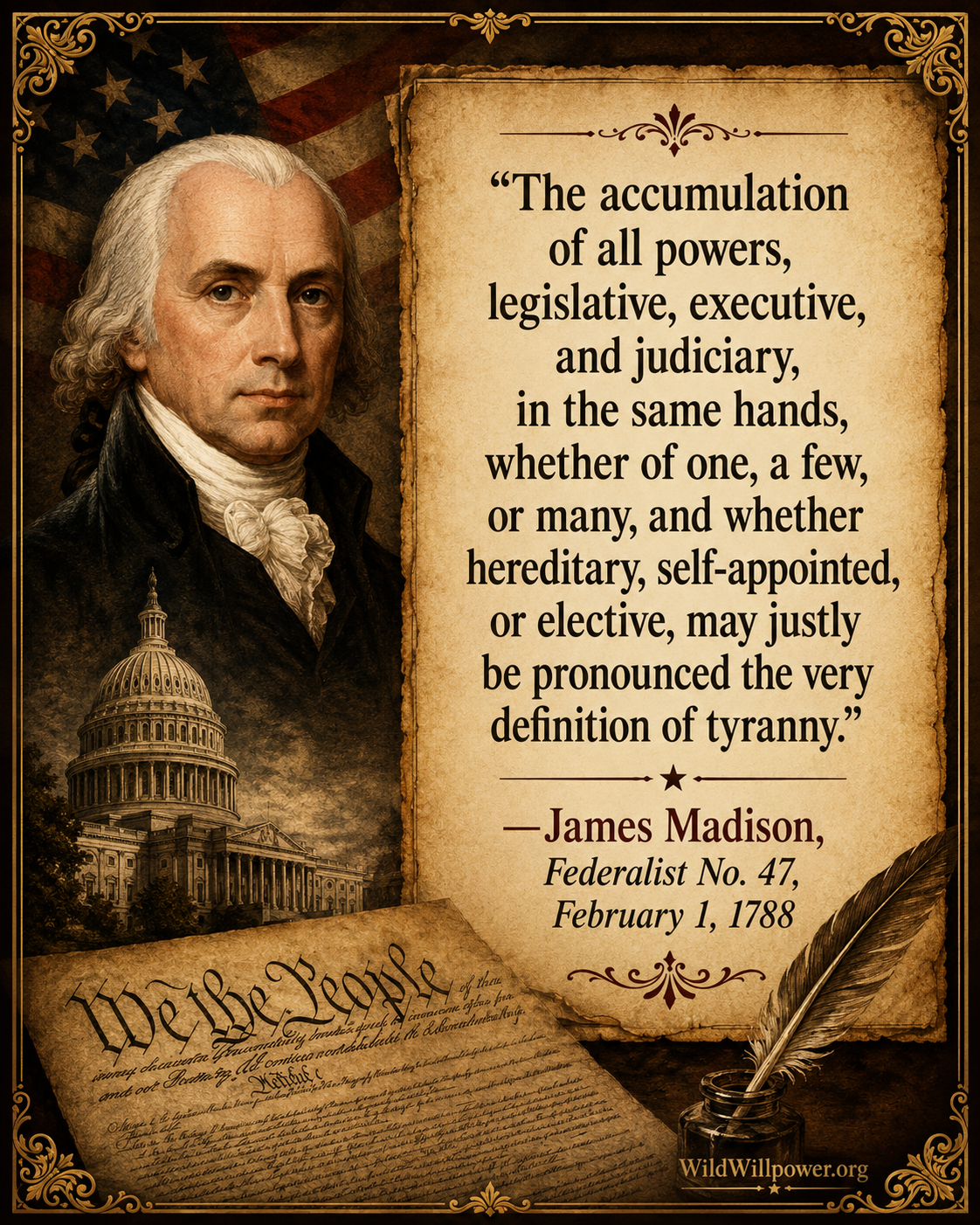
Iowa’s legal system does not formally place all three branches in the hands of one institution. But Madison’s warning remains relevant whenever lawmaking, rulemaking, professional regulation, precedent, and adjudication become concentrated within a closely connected institutional culture that is difficult for the public to enter, understand, or meaningfully challenge.
When courts preserve precedents declaring that citizens proceed “at their own risk,” without also ensuring that rules are comprehensible, records are accessible, legal research is realistically available, and meritorious claims are not lost through technical error, the judiciary is not merely applying neutral standards. The practical effect can be a professional barrier to entry.
Liberty and justice cannot truthfully be described as “for all” when only those with legal training—or enough money to purchase it—have a realistic chance of navigating the system.
Making self-representation meaningful requires more than changing doctrine. People also need practical assistance in using the system.
Priority Four — Provide Human and Technological Access
10. Expand Navigators and Public Law-Library Assistance
Iowa’s court-navigator program provides assistance with forms and basic information for self-represented civil litigants. [18] The Act would expand that support geographically and substantively.
Navigators must not provide individualized legal advice without authorization. They can nevertheless help people:
- locate official resources;
- understand filing mechanics;
- identify forms;
- use electronic filing systems;
- locate publicly stated deadlines;
- find courthouse services;
- distinguish legal information from legal advice;
- and connect with qualified counsel when individualized advice is necessary.
Iowa should also expand access to public law librarians, research assistance, courthouse computer terminals, printers, scanners, and reliable remote assistance throughout the state.
11. Design for Disability, Language, Rural, and Technology Access
Court information should be usable by people who:
- have visual, hearing, cognitive, or mobility disabilities;
- use assistive technology;
- speak limited English;
- lack reliable broadband;
- do not own a computer;
- possess limited digital literacy;
- or cannot easily travel to a courthouse.
Forms, guides, and databases should be evaluated for:
- plain-language comprehension;
- screen-reader compatibility;
- mobile and print use;
- translation quality;
- captioning;
- color contrast;
- and cognitive load.
A system is not accessible merely because information technically exists online.
12. Require Public Testing and Continuing Review
New procedural maps, databases, forms, and assistance programs should be tested by the people who will use and administer them, including:
- self-represented litigants;
- attorneys;
- clerks;
- judges;
- legal-aid providers;
- law librarians;
- rural residents;
- people with disabilities;
- seniors;
- working parents;
- and people with limited English proficiency.
The State should publish regular reports concerning usage, recurring filing defects, abandonment points, navigator demand, accessibility complaints, and proposed improvements.
The Justice Accessibility Act should create durable public infrastructure—not a website launched once and forgotten.
PART V — WHAT THIS REFORM IS, AND IS NOT
What the Act Would Not Do
The Justice Accessibility Act would not:
- guarantee that every claim succeeds;
- permit judges to disregard statutes or controlling precedent;
- provide legal advice through automated summaries;
- eliminate attorneys;
- excuse bad faith;
- erase legitimate filing deadlines;
- or force courts to overlook mistakes that materially prejudice another party.
It would make the rules easier to find, understand, and follow.
That benefits everyone.
Represented parties receive clearer filings.
Clerks spend less time correcting avoidable defects.
Judges receive better-organized records.
Attorneys encounter fewer preventable disputes.
Litigants understand the process earlier.
Cases are more likely to be resolved on the actual legal and factual questions presented.
The purpose is therefore not to diminish legal expertise. It is to use that expertise to make public institutions more usable by the public.
A Reform That Creates Public-Service Opportunities for Lawyers
This proposal is not an attack upon the legal profession.
Law is difficult. Attorneys spend years developing knowledge of jurisdiction, pleading, evidence, discovery, trial practice, statutory interpretation, research, negotiation, and professional responsibility.
That expertise should remain valued.
The Act would create meaningful public-service and employment opportunities for:
- attorneys;
- law professors;
- law librarians;
- paralegals;
- mediators;
- court administrators;
- legal technologists;
- translators;
- accessibility specialists;
- educators;
- and law students working under appropriate supervision.
The objective is not to replace lawyers with forms.
It is to prevent the public’s lack of legal training from becoming the principal obstacle between an injury and a hearing.
PART VI — FROM EXPERIENCE TO POLICY
I developed this proposal after years of legal self-education and firsthand experience attempting to navigate Iowa’s courts without counsel.
In Wilson v. Reliable Street Inc., et al. and Wilson v. State of Iowa and Kim Reynolds for Iowa, represented parties invoked procedural doctrines while seeking dismissal of claims I was attempting to develop without professional assistance.
Those experiences became the factual foundation for the Justice Accessibility Act.
Read the documented case record behind this reform: Iowa’s Broken Judiciary →

PART VII — HOW THIS BECOMES LAW
Because authority over Iowa’s justice system is divided among the people, General Assembly, Judicial Branch, executive agencies, counties, and constitutional officers, no governor can implement this entire proposal alone.
As governor, I would:
1. Introduce legislation and budget proposals;
2. Convene a bipartisan Justice Accessibility Commission;
3. Request formal Judicial Branch cooperation and rule review;
4. Fund pilot projects, public testing, and statewide access;
5. Publish recommendations and place unresolved structural questions before the General Assembly and the people.
Popular sovereignty does not mean one official controls every branch.
It means public institutions must remain answerable to the people they were created to serve.
PART VIII — RELATED REFORMS
The Justice Accessibility Act is one part of a larger justice-reform plan. Each reform grew from concrete problems I encountered while navigating Iowa’s legal and administrative systems.
Reform Two—Teach Practical Law to High School Seniors
Teaching young people how contracts, rights, evidence, legal records, and government procedures affect their lives.
Click the below image to view this reform.

Reform Three — The Client Right to Review
Requiring informed client authorization for pleas, settlements, material admissions, waivers, and other decisions capable of permanently altering legal rights.

Reform Four — Strengthen Civil-Rights Protections
Reforming file access, closure notices, appeal procedures, retaliation safeguards, and transparency within Iowa’s civil-rights system.
Related article: Iowa's Civil-Rights Trap.
Click the below image to view this reform.

Reform Five — Abolish Government Immunity Doctrines
Replacing doctrines that categorically shield government from otherwise actionable wrongdoing with a system of direct governmental accountability under law, while preserving legitimate protections for good-faith official decision-making. We must become, in the words of John Adams, "A government of laws, not of men."
Click the below image to view this reform.

PART IX — CONCLUSION
We teach Iowa’s children to pledge allegiance to “liberty and justice for all.”
Those words become hollow when justice is available in theory but unreachable in practice.
A democratic court system should not require ordinary people to purchase a professional interpreter before they can understand how to preserve a right, answer an accusation, submit evidence, or request relief.
The law should not become easier to weaponize than to understand.
Justice must be understandable, accessible, and accountable to the people.
From Vision to Victory
How You Can Help Make This Plan Happen
Wild Willpower PAC exists to help translate lived experience, legal research, and public testimony into practical democratic reform.
Your contribution helps support endorsed candidates—including my campaign and future candidates committed to Wild Willpower’s principles—while funding the continued development of WildWillpower.org, public-policy research, educational materials, outreach, and upcoming publications.
The ongoing court record explains why many of these reforms are necessary. Documenting that history, developing the proposals, and making the information publicly accessible have become full-time work. PAC contributions support the lawful political and educational work of carrying those lessons into the public arena.
Learn more about Wild Willpower PAC.
Support the work by donating below.

Follow and Share the Campaign
Follow Sondra Wilson on Facebook, Instagram, BlueSky, X (formerly Twitter), and LinkedIn accounts— See a post you like? Please share it with a few words of why you believe in it, write #Sondra4Governor and #WildWillpower to help spread the word faster. This is a grassroots campaign: if every Iowan who wants a better future is posting this, they can’t ignore us! Please help my campaign bust through and get noticed.
#Sondra4Governor | #WildWillpower
Explore Wild Willpower's Legal Self-Help Library
Browse legal definitions, procedural materials, and public educational resources developed through ReUniteTheStates.org.

Endnotes
1. Iowa Constitution, article I, section 2. The provision declares that political power is inherent in the people and recognizes their right to alter or reform government whenever the public good may require it.
2. Legal Services Corporation, The Justice Gap: The Unmet Civil Legal Needs of Low-Income Americans 7–8 (2022), reporting that low-income Americans received no legal help, or insufficient legal help, for 92 percent of the civil legal problems that substantially affected them.
3. Clio, How Much Should I Charge as a Lawyer in Iowa? (2025 data), reporting an average hourly lawyer rate in Iowa of approximately $252. This is billing-platform data and should not be understood as a universal Iowa legal-fee schedule.
4. U.S. Census Bureau, Earnings in the Past 12 Months: Iowa, 2024 American Community Survey 1-Year Estimates, table S2001, reporting median annual earnings of $57,545 for full-time, year-round Iowa workers with earnings.
5. Author’s calculations. Dividing $57,545 by 2,080 annual work hours produces an hourly equivalent of approximately $27.67. Dividing the reported $252 average attorney rate by $27.67 produces approximately 9.11 hours of median-worker earnings.
6. Iowa Judicial Branch, Representing Yourself. The Judicial Branch provides official self-help materials, court forms, and access to court navigators who can assist self-represented litigants with forms and basic procedural information but do not substitute for individualized legal representation.
7. Wild Willpower, Iowa Court Rules and Public Legal-Education Materials, public Google Drive folder. The folder reflects the author’s effort to organize Iowa procedural materials into a more accessible public research structure.
8. Defendants’ opening dismissal filing in Wilson v. Reliable Street Inc., et al., relying upon, among other authorities, Knight v. Knight, 525 N.W.2d 841, 843 (Iowa 1994); Munz v. State, 382 N.W.2d 693, 697 (Iowa Ct. App. 1985); Pickens v. Zeien, No. LACV089735, 2018 WL 7863488 (Iowa Dist. Ct. May 14, 2018); and Debruin v. State, 779 N.W.2d 494 (Iowa Ct. App. 2010). The quotations reproduced in the text are taken from the defendants’ filing and the authorities cited there.
9. State’s motion to dismiss the amended petition in Wilson v. State of Iowa and Kim Reynolds for Iowa, relying in part upon Kubik v. Burk, 540 N.W.2d 60, 63 (Iowa Ct. App. 1995), and Metropolitan Jacobsen Development Venture v. Board of Review of Des Moines, 476 N.W.2d 726, 729 (Iowa Ct. App. 1991), for the procedural standards applicable to self-represented litigants.
10. Abraham Lincoln, Notes for Speeches at Columbus and Cincinnati, September 16–17, 1859, Abraham Lincoln Papers, Library of Congress. The surviving notes contain Lincoln’s statement that the people are the rightful masters of Congresses and courts, not to overthrow the Constitution, but those who pervert it.
11. American Bar Association, When You Need a Lawyer: Lawyer Requirements, explaining the ordinary educational, examination, and character-and-fitness requirements associated with admission to the legal profession.
12. University of Iowa College of Law, Financial Aid: J.D. 2025–26 Tuition and Mandatory Fees, reporting annual tuition and mandatory fees of $33,489 for Iowa residents and $54,736 for nonresidents.
13. Author’s calculations. Multiplying the University of Iowa College of Law’s published 2025–2026 tuition and mandatory-fee figures by three produces estimated three-year totals of $100,467 for an Iowa resident and $164,208 for a nonresident, assuming unchanged rates and excluding scholarships, undergraduate expenses, living expenses, bar-related expenses, and interest.
14. Iowa Judicial Branch, Iowa Rules of Civil Procedure, Iowa Court Rules chapter 1. The counts stated in this article reflect the author’s count of separately numbered rules and subordinate provisions using the organizational method described in Wild Willpower’s public research materials.
15. Iowa Judicial Branch, Iowa Rules of Evidence, Iowa Court Rules chapter 5. The count stated in this article reflects the author’s count using the same organizational method.
16. Iowa Judicial Branch, Iowa Rules of Criminal Procedure, Iowa Court Rules chapter 2. The count stated in this article reflects the author’s count using the same organizational method.
17. Iowa Judicial Branch, Iowa Rules of Appellate Procedure, Iowa Court Rules chapter 6. The count stated in this article reflects the author’s count using the same organizational method.
18. Alexander Hamilton, The Farmer Refuted (Feb. 23, 1775), reproduced in Founders Online, National Archives. Hamilton wrote that the “sacred rights of mankind” are not dependent upon old parchments or records but arise from human nature itself.
19. Iowa Code §§ 602.1204–602.1206. These provisions concern the Iowa Supreme Court’s authority and responsibilities relating to judicial administration and court rules. The Justice Accessibility Act therefore contemplates legislative funding and cooperation with the Judicial Branch rather than unilateral gubernatorial alteration of court rules.
20. Iowa Judicial Branch, Court Forms. Iowa currently provides official forms and interactive resources in selected categories of proceedings.
21. Iowa Judicial Branch, Supreme Court Opinions. The Judicial Branch publishes current opinions and provides access to archived opinions. The Justice Accessibility Act proposes a broader historically deep, searchable public research system with topic organization, neutral summaries, cross-references, and later-treatment information.
22. James Madison, The Federalist No. 47 (1788), discussing the danger created by accumulation of legislative, executive, and judicial powers in the same hands.
Saving these for another page:
1. Iowa Constitution, article I, section 2. The provision states that political power is inherent in the people and recognizes their right to alter or reform government whenever the public good may require it.
2. Legal Services Corporation, The Justice Gap: The Unmet Civil Legal Needs of Low-Income Americans (2022). LSC reported that low-income Americans received no legal help, or insufficient help, for 92 percent of their substantial civil legal problems.
3. Clio, “How Much Should I Charge as a Lawyer in Iowa?” Clio reports that, as of its 2025 data, Iowa lawyers averaged approximately $252 per hour, while rates varied significantly by practice area. This is billing-platform data, not a universal legal-fee schedule.
4. Iowa Judicial Branch, “Representing Yourself.” The Judicial Branch provides forms, selected self-help resources, and appointment access to court navigators for basic form and process assistance.
5. Iowa Code §§ 602.1204–602.1206. These provisions assign the Iowa Supreme Court responsibility for judicial-branch procedures, court administration, and rules supervising judges and attorneys.
6. Iowa Judicial Branch, “Court Forms.” Iowa currently provides free official forms and interactive resources in selected areas.
7. Iowa Judicial Branch, “Supreme Court Opinions.” The Judicial Branch publishes recent opinions and links to archived opinions; the proposal described here would add deeper historical coverage, topic organization, neutral summaries, and citator-like subsequent-history information.
8. Iowa Judicial Branch, “Representing Yourself.” Court navigators may assist with forms and basic information but do not replace individualized legal representation.
Endnotes
[1]: Legal Services Corporation, The Justice Gap: The Unmet Civil Legal Needs of Low-Income Americans 7–8 (2022), https://justicegap.lsc.gov/ (reporting that low-income Americans received no or insufficient legal help for 92 percent of the civil legal problems that substantially affected them).
[2]: Clio, How Much Should I Charge as a Lawyer in Iowa?, https://www.clio.com/resources/legal-trends/compare-lawyer-rates/ia/ (last visited July 30, 2026) (reporting that the average Iowa lawyer’s hourly rate was $252 in 2025).
[3]: U.S. Census Bureau, Earnings in the Past 12 Months: Iowa, 2024 American Community Survey 1-Year Estimates, tbl. S2001, https://data.census.gov/table/ACSST1Y2024.S2001?g=040XX00US19 (reporting median annual earnings of $57,545 for full-time, year-round Iowa workers with earnings).
[4]: Author’s calculations. Dividing $57,545 by 2,080 annual work hours produces an hourly equivalent of approximately $27.67. Dividing the reported $252 average attorney rate by $27.67 produces approximately 9.11 hours of median-worker earnings.
[5]: Abraham Lincoln, Notes for Speeches at Columbus and Cincinnati, September 16–17, 1859, Abraham Lincoln Papers, Library of Congress. The surviving notes contain the statement that the people are the rightful masters of Congresses and courts, not to overthrow the Constitution, but those who pervert it. The quotation has also been reproduced in a Library of Congress print bearing substantially the same language.
[6]: American Bar Association, When You Need a Lawyer: Lawyer Requirements, https://www.americanbar.org/groups/public_education/resources/law_issues_for_consumers/lawyer_requirements/ (explaining that prospective attorneys ordinarily must possess a bachelor’s degree or its equivalent, complete three years at an accredited law school, pass a state bar examination, and satisfy a character-and-fitness review).
[7]: University of Iowa College of Law, Financial Aid: J.D. 2025–26 Tuition and Mandatory Fees, https://law.uiowa.edu/current-students/financial-aid (reporting annual tuition and mandatory fees totaling $33,489 for Iowa residents and $54,736 for nonresidents and separately identifying books, housing and food, transportation, and personal expenses).
[8]: Author’s calculations. Multiplying the University of Iowa College of Law’s published 2025–2026 tuition and mandatory-fee totals by three produces an estimated three-year total of $100,467 for an Iowa resident and $164,208 for a nonresident. These calculations assume that tuition and fees remain unchanged and do not account for scholarships, financial aid, undergraduate expenses, living expenses, bar-related costs, or interest.
[9]: Wild Willpower, Iowa Court Rules and Public Legal-Education Materials, public Google Drive folder, https://drive.google.com/drive/folders/1ZpEnOZYImPQ0mLg0YajiQehfYYndGInY?usp=drive_link (last visited July 31, 2026). The folder reflects the author’s effort to organize Iowa’s procedural rules into a more accessible, publicly available research structure.
[10]: Iowa Judicial Branch, Iowa Rules of Civil Procedure, Iowa Court Rules ch. 1. The totals stated in the article reflect the author’s count of separately numbered rules and subordinate provisions as organized in Wild Willpower’s public research folders.
[11]: Iowa Judicial Branch, Iowa Rules of Evidence, Iowa Court Rules ch. 5. The total stated in the article reflects the author’s count using the same organizational method.
[12]: Iowa Judicial Branch, Iowa Rules of Criminal Procedure, Iowa Court Rules ch. 2. The total stated in the article reflects the author’s count using the same organizational method.
[13]: Iowa Judicial Branch, Iowa Rules of Appellate Procedure, Iowa Court Rules ch. 6. The total stated in the article reflects the author’s count using the same organizational method.
[14]: Alexander Hamilton, The Farmer Refuted (Feb. 23, 1775), in Founders Online, National Archives, https://founders.archives.gov/documents/Hamilton/01-01-02-0057 (“The sacred rights of mankind are not to be rummaged for, among old parchments, or musty records. They are written, as with a sun beam, in the whole volume of human nature, by the hand of the divinity itself; and can never be erased or obscured by mortal power.”).
[15]: James Madison, The Federalist No. 47 (1788) (“The accumulation of all powers, legislative, executive, and judiciary, in the same hands, whether of one, a few, or many, and whether hereditary, self-appointed, or elective, may justly be pronounced the very definition of tyranny.”). The quotation is reproduced in the Constitution Annotated’s discussion of the separation of powers.
[16]: Thomas Jefferson to William Charles Jarvis, Sept. 28, 1820, The Papers of Thomas Jefferson, reproduced by the Thomas Jefferson Foundation. In the same letter, Jefferson warned against treating judges as the ultimate arbiters of every constitutional question and emphasized the people as the safest repository of ultimate governmental power.
[17] U.S. Const. amend. I (“Congress shall make no law … abridging … the right of the people peaceably to assemble, and to petition the Government for a redress of grievances.”), reproduced in Constitution Annotated, Library of Congress.
[18] The Declaration of Independence para. 30 (U.S. 1776) (“In every stage of these Oppressions We have Petitioned for Redress in the most humble terms: Our repeated Petitions have been answered only by repeated injury.”), reproduced by the National Archives.
[21] Respondeat superior, Black’s Law Dictionary (10th ed.) (defining the doctrine as holding an employer or principal liable for wrongful acts committed by an employee or agent within the scope of employment or agency); see also Plaintiff’s Request to Submit Amended Motion to Reconsider, filed Sept. 7, 2024, D0047, pp. 1–2.
[22] Plaintiff’s Omnibus Resistance and Motions, filed Aug. 5, 2024, D0032, pp. 1–2.
[23] 18 U.S.C. § 241, Conspiracy Against Rights; 18 U.S.C. § 242, Deprivation of Rights Under Color of Law, Office of the Law Revision Counsel, U.S. House of Representatives.
[24] 42 U.S.C. § 1983, Civil Action for Deprivation of Rights; 42 U.S.C. § 1985, Conspiracy to Interfere with Civil Rights; 42 U.S.C. § 1986, Action for Neglect to Prevent, Office of the Law Revision Counsel, U.S. House of Representatives.
[25] Good v. Iowa Department of Human Services, 924 N.W.2d 853, 862–63 (Iowa 2019).
[26] Vasquez v. Iowa Department of Human Services, Polk County No. CVCV061729, ruling by District Court Judge William P. Kelly (Nov. 19, 2021); Clark Kauffman, “Reynolds ‘Disappointed’ in Ruling on Transgender Medicaid Coverage,” Iowa Capital Dispatch, Nov. 22, 2021; Katarina Sostaric, “Judge Says Iowa Can’t Ban Medicaid Coverage of Transition-Related Surgery,” Iowa Public Radio, Nov. 22, 2021.
[27] Governor Kim Reynolds, statement upon signing Senate File 418 (Feb. 28, 2025) (stating that gender-identity protection in the Iowa Civil Rights Act had “forced Iowa taxpayers to pay for gender reassignment surgeries” and that this was unacceptable to her and, in her view, to most Iowans).
[28] Robin Opsahl, Reynolds’ Campaign Collects an Additional $1.2 Million in Contributions, Iowa Capital Dispatch (May 19, 2022) (reporting that the Reynolds campaign had raised more than $6 million); Robin Opsahl, Reynolds’ Campaign Has $2.5 Million Headed into November; DeJear’s Has $366K, Iowa Capital Dispatch (Oct. 20, 2022) (reporting approximately $2.5 million available and more than $5 million spent during the reporting quarter).
[29] Plaintiff’s Amended Petition, Wilson v. State of Iowa and Kim Reynolds for Iowa, No. LACL157953, D0030, ¶¶ 73–75, pp. 54–56, filed July 23, 2024.
[30] Petition and Motion for Leave to Amend, Wilson v. Trump et al., No. 4:25-cv-00116-SHL-WPK, pp. 9–13, filed Mar. 31, 2025.
[31] Mass. Const. pt. I, art. XXX (“a government of laws and not of men”); Marbury v. Madison, 5 U.S. (1 Cranch) 137, 163 (1803) (“The government of the United States has been emphatically termed a government of laws, and not of men,” and explaining that government ceases to deserve that title if the laws furnish no remedy for violation of a vested legal right).
Image credit: Original concept, art direction, quotation selection, and presentation by Sondra Wilson for Wild Willpower; generated with assistance from ChatGPT by OpenAI. Human-authored elements and arrangement © 2026 Wild Willpower. All rights reserved.