About the Wild Willpower Seal
A Public Symbol of Ethics, Stewardship, and Trust
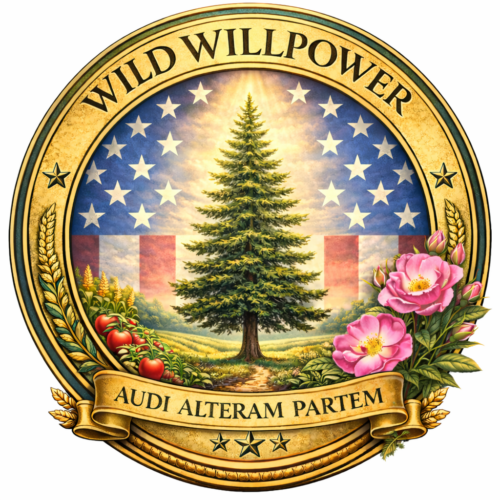
The official Wild Willpower seal. Its white pine represents peace through law, resistance to unaccountable power, and the restoration of meaningful justice. The garden reflects sustainability and stewardship, while Audi alteram partem means “Hear the other side.”
The Wild Willpower seal represents a public commitment to ethical leadership, sustainable living, human rights, civic responsibility, and fair accountability.
It is more than a logo.
Authorized use signifies that a candidate or participating organization has voluntarily taken the applicable Wild Willpower pledge and received an expressly acknowledged endorsement or affiliation.
When the public sees the seal, it should communicate:
This candidate or organization has made a public ethical commitment and has invited the people to hold them accountable to it.
✦ The White Pine: Justice, Peace, and the Restoration of Right
The white pine stands at the center of the seal because it represents peace established through law, resistance to unaccountable power, and the responsibility to restore justice when institutions no longer fulfill the purposes for which they were created.
One of the earliest banners of the American Revolution was not a banner of conquest. It was a demand for justice.
During the opening stages of the Revolution, a white flag bearing a green pine tree and the words “An Appeal to Heaven” became associated with American resistance to arbitrary British authority.
The phrase drew upon the political philosophy of John Locke, whose writings on natural rights, limited government, and the right of resistance profoundly influenced the American founding generation.
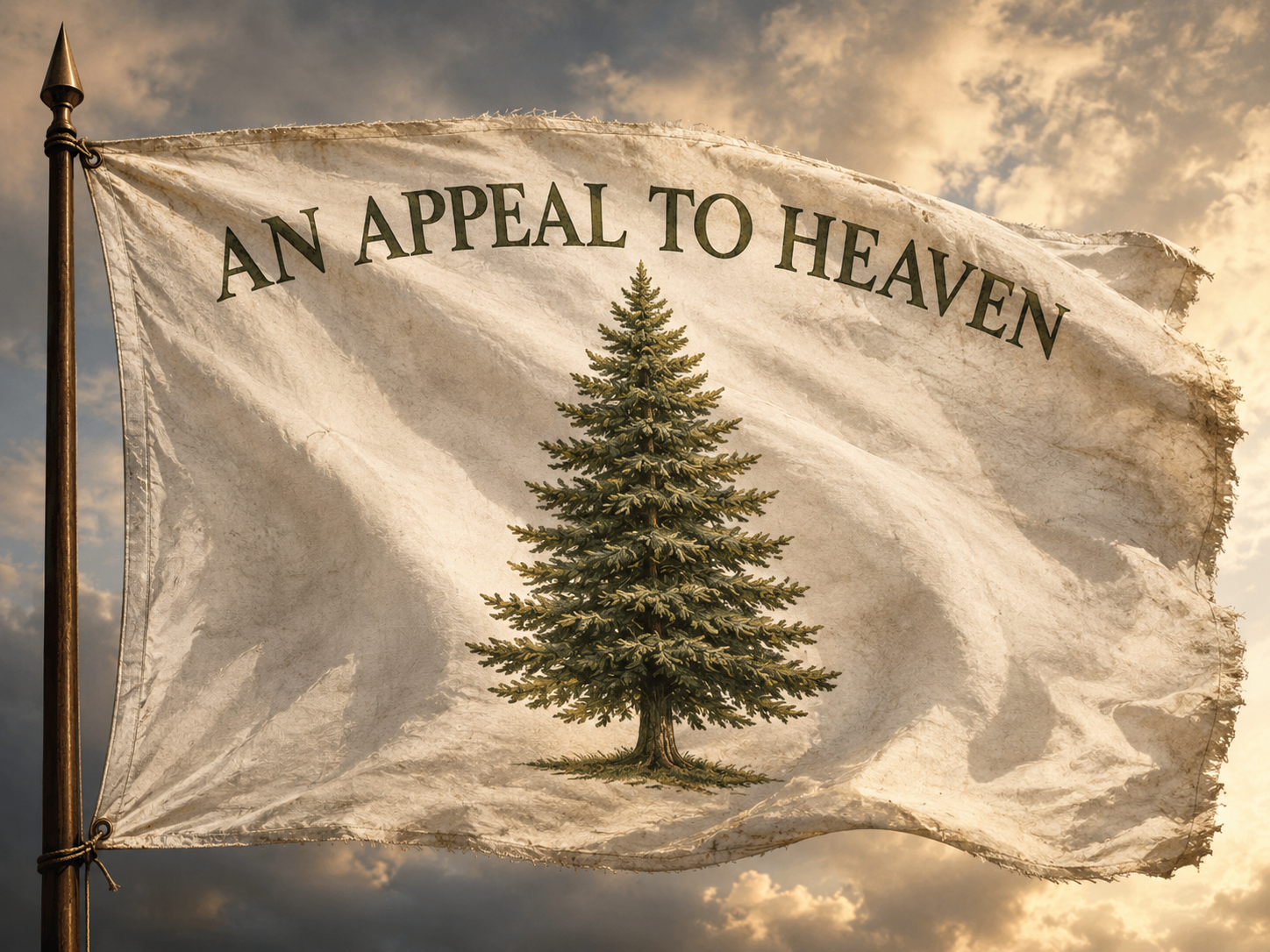
A modern artistic interpretation of the Pine Tree Flag, using the white pine represented in the Wild Willpower seal. This image is not presented as a definitive reconstruction of any surviving eighteenth-century flag.
Locke asked what remedy remains when a person is deprived of rights and no effective judge or appeal remains on earth. In §168 of the Second Treatise of Government, he described the resulting liberty to “appeal to heaven” when power is exercised without right and earthly remedies have failed.
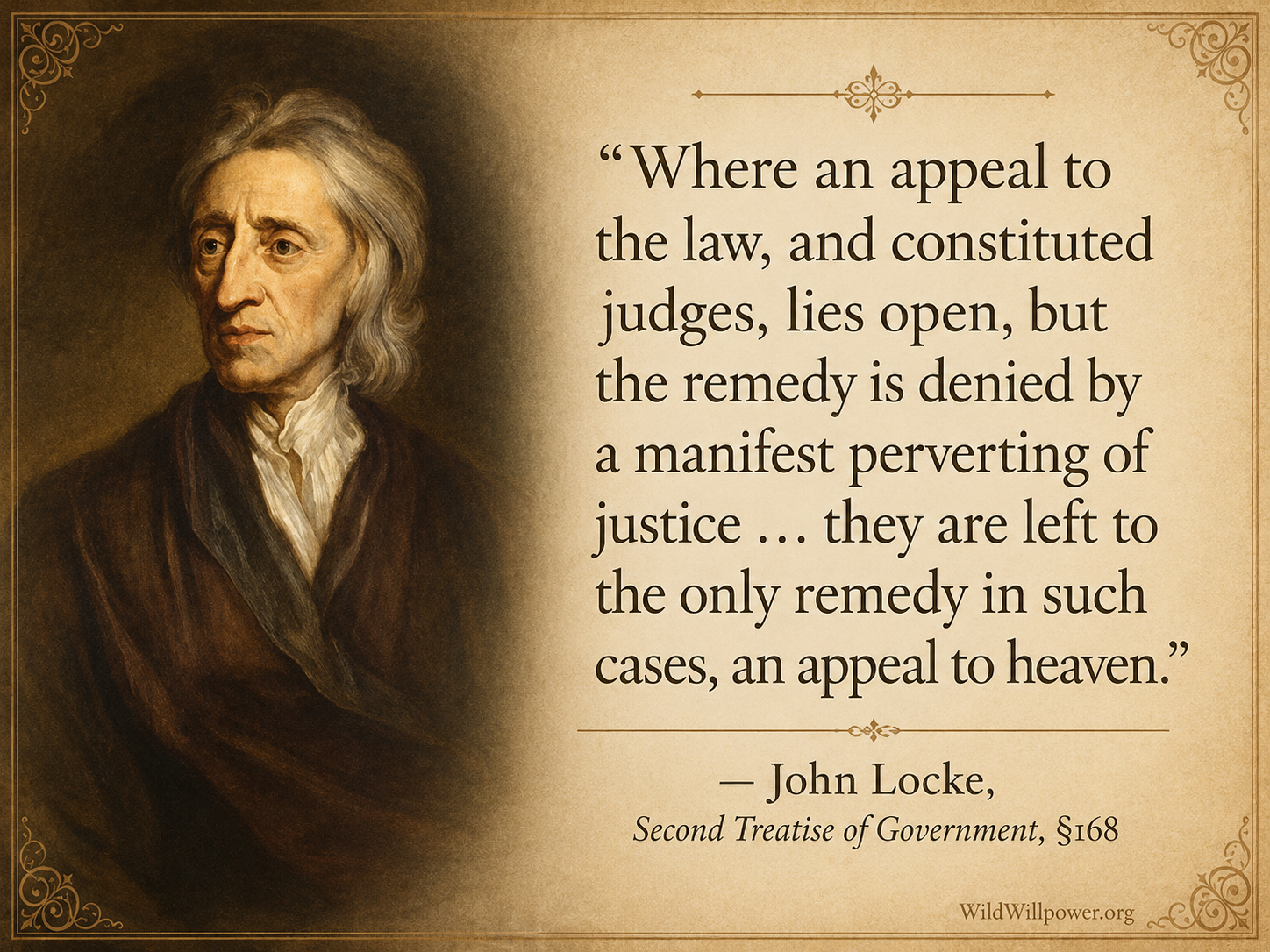
John Locke on the failure of lawful redress. When courts remain available in name but justice is denied in practice, government jeopardizes the legitimacy upon which its authority depends.
For Locke, an appeal to heaven was not casual rebellion or permission for chaos. It was a warning about the constitutional crisis created when government closes every meaningful path to lawful remedy.
The pine therefore represents more than patriotism. It represents the principle that:
Government cannot remain the final judge of its own alleged abuses when the institutions entrusted with justice refuse to provide meaningful redress.
Wild Willpower sees a modern echo of that problem when legal complexity, prohibitive cost, institutional favoritism, or immunity doctrines prevent courts from reaching serious claims on their merits.
Rights that cannot be meaningfully enforced become promises without remedies.
Wild Willpower therefore supports lawful justice reform intended to make courts more accessible, restore public accountability, and ensure that public authority remains subject to law.
[Read Wild Willpower’s Justice-Reform Plan →]
✦ The Great Tree of Peace
The white pine also carries an older meaning in North America.
Long before the founding of the United States, the Haudenosaunee Confederacy united distinct nations under the Great Law of Peace. Haudenosaunee accounts identify the white pine as the Great Tree of Peace, symbolizing the unity of the original Five Nations. Its clusters of five needles represent those nations, while its broad branches offer shelter.
The Peacemaker directed the chiefs to gather beneath the tree, where matters concerning the Confederacy could be discussed and deliberated.
Haudenosaunee tradition also associates the tree with the burial of weapons beneath a shared order of peace—an idea commonly expressed in English through the phrase “burying the hatchet.”
The Great Tree of Peace therefore represents peace not through silence, submission, or concealment of wrongdoing, but through:
- lawful union;
- public deliberation;
- disciplined judgment;
- reconciliation;
- protection of the people;
- unity without erasing difference;
- and the replacement of retaliation with a shared legal order.
Together, the Great Tree of Peace and the Pine Tree Flag express a single principle:
Peace requires accountability.
The Pine Tree Flag represents the demand for redress when power becomes unaccountable.
The Great Tree of Peace represents the creation of an order in which disputes can be resolved through law, deliberation, and responsibility rather than continuing cycles of retaliation.
The white pine is therefore both the Tree of Appeal and the Tree of Peace.
It reminds us that justice without peace can become vengeance, while peace without justice can become enforced silence.
✦ Honor, Memory, and Restoration
Wild Willpower believes that honoring the United States requires more than celebrating its ideals.
It also requires remembering where the nation has failed to honor them—including injustices committed against American Indian nations—and accepting a present responsibility to act with greater truth, respect, and care.
The past cannot be changed, but its consequences continue into the present.
Honor is not restored by forgetting injury. It is restored by acknowledging it and creating a better relationship going forward.
Wild Willpower’s long-term vision includes:
- respecting the histories, sovereignty, and living traditions of American Indian nations;
- supporting teachers who preserve traditional ecological and survival knowledge;
- caring responsibly for land and water;
- treating treaties as continuing commitments rather than forgotten artifacts;
- and helping future generations recover practical skills for living sustainably with the earth.
Wild Willpower was founded after years of study and collaboration by Sondra Wilson alongside Richard Lonewolf, whose teachings concerning history, wilderness skills, traditional knowledge, and care for the natural world helped shape the organization’s development.
Initiatives such as Gardens Across Iowa reflect this broader ethic of restoration:
to care for the land, strengthen communities, preserve knowledge, and leave future generations something better than we inherited.
✦ The Wild Rose and the Garden
The pink flowers represented in the seal honor Iowa’s official state flower: the wild rose.
The Iowa General Assembly designated the wild rose as the state flower in 1897.
The rose symbolizes dignity, renewal, beauty, and the courage required to confront injustice.
The cultivated garden represents Wild Willpower’s Prime Directive:
To help people live sustainably and work toward the advancement and respect of human rights.
The vegetables, grain, productive land, and surrounding plant life symbolize:
- food security;
- environmental stewardship;
- local resilience;
- productive labor;
- practical education;
- access to land;
- and responsibility to future generations.
Political freedom is stronger when people and communities can meet basic needs, care for the land, and participate meaningfully in shaping their own future.
[Read Our Prime Directive →]
[Explore Gardens Across Iowa →]
✦ Audi Alteram Partem — “Hear the Other Side”
The banner across the seal reads:
Audi alteram partem
The Latin phrase means:
“Hear the other side,”
or
“Let the other side be heard.”
It expresses both a legal tradition and an ethical obligation.
Before reaching a consequential judgment:
- hear the allegation;
- examine the evidence;
- hear the response;
- seek relevant context;
- distinguish verified fact from allegation, inference, and opinion;
- and consider the whole record as fairly as possible.
Wild Willpower rejects two opposite failures:
- treating accusation as guilt;
- and protecting favored people regardless of credible evidence.
Our purpose is neither automatic condemnation nor automatic protection.
It is responsible judgment.
[Read Our Accountability Standard →]
Authorized Use of the Seal
The Wild Willpower seal may be displayed only by candidates or organizations that:
- have taken the applicable Wild Willpower pledge;
- have received an expressly acknowledged endorsement or affiliation;
- remain authorized to display the seal;
- and use it consistently with the authorization granted.
Authorized use means that Wild Willpower has placed public trust in the candidate or organization based upon the commitments made and the information reasonably available at the time.
It does not mean that the authorized user is perfect, incapable of error, or guaranteed always to act consistently with the pledge.
It means that the user has made a public commitment and accepted that the public may evaluate whether that commitment is being honored.
What the Seal Does Not Confer
The Wild Willpower seal does not confer:
- governmental certification;
- professional licensure;
- political-party recognition;
- nomination or ballot qualification;
- employment or agency status;
- authority over an elected official;
- ownership or control of an independent organization;
- or a guarantee concerning every future act of the authorized user.
Endorsed candidates remain responsible for their own campaigns, committees, filings, fundraising, communications, decisions, and official conduct.
Participating organizations retain their own legal identities, leadership, responsibilities, and decision-making authority.
The seal represents endorsement, affiliation, and ethical commitment—not ownership or control.
Review, Suspension, and Withdrawal
Permission to display the seal remains connected to the endorsement or relationship upon which authorization was granted.
If credible concerns arise that an authorized user has departed from the commitments represented by the seal, Wild Willpower may review the matter under its Accountability Standard.
Before reaching a final decision, Wild Willpower ordinarily:
- identifies the specific conduct or pledged commitment at issue;
- seeks reasonably available evidence and context;
- distinguishes allegation, inference, disputed fact, and verified fact;
- gives the authorized user a meaningful opportunity to respond;
- considers possible harm to affected people and the public;
- and explains its reasoning when public explanation is appropriate.
Where credible information suggests an immediate risk of harm, Wild Willpower may temporarily suspend an endorsement or authorization to display the seal while review is conducted.
A temporary suspension is a precautionary measure. It is not itself a final finding.
Following review, authorization may be continued, restored, limited, suspended, or withdrawn.
Unauthorized or Misleading Use
The Wild Willpower seal is proprietary organizational branding.
It may not be used in a manner that falsely represents:
- endorsement;
- affiliation;
- authorization;
- approval;
- certification;
- or continuing permission to display the seal.
The seal may not be altered, distorted, combined with misleading claims, or displayed after authorization has ended in a manner suggesting that Wild Willpower’s endorsement remains active.
Permission to display the seal ends when the underlying endorsement or affiliation ends, unless Wild Willpower expressly provides otherwise.
A Public Promise
The Wild Willpower seal is intended to make political and civic trust visible.
It represents a promise:
- to act honestly;
- to accept accountability;
- to serve justice fairly;
- to respect human dignity and rights;
- to act as a responsible steward of the land;
- to work toward the common good;
- and to hear both evidence and response before consequential judgments are made.
When you see the Wild Willpower seal, it means that a candidate or participating organization has made a public ethical commitment—voluntarily, openly, and in good faith.