
Wild Willpower's Fifth Justice Reform:
Disrecognize Government Immunity and Privilege Doctrines
Where They Would Otherwise Displace Rights
"A Government of Laws, Not of Men."
By Sondra Wilson | Updated August 17, 2026
Case Study: The discussion that follows arises from Wilson v. State of Iowa and Kim Reynolds for Iowa, Polk County Case No. LACL157953. The underlying factual allegations and documentary record are collected on the case landing page. Companion articles examine individual dismissal arguments in greater depth, including A Truly Dizzying Intellect (§ 1983 personhood) and Strain Out a Gnat (Iowa Tort Claims Act exhaustion), and Behind Closed Doors (First Amendment rights violation in court).
Premise of This Reform
Wild Willpower proposes disrecognizing Iowa-controlled government-immunity and privilege doctrines where their application would otherwise displace superior constitutional rights, due process, meaningful adjudication, or redress.
By ‘disrecognize,’ I do not mean pretending these doctrines have never been enforced. I mean withdrawing recognition from them as legitimate controlling authority where their claimed authority cannot be reconciled with superior constitutional law.
Government should not be permitted to exercise power through its officials, accept the benefits of their actions, and then disappear behind immunity when that power causes unlawful harm. In a constitutional republic, governmental authority carries governmental responsibility.
The replacement principle is straightforward:
When a person acting through governmental authority causes unlawful harm, the injured citizen must have a clear, affordable path to sue the responsible governmental body, identify the individual actors involved, and obtain a decision upon the facts and law.
Immunity should not end the case before the evidence is heard.
It should not replace factual review.
It should not prevent a jury from determining what happened merely because the alleged wrongdoer exercised governmental power.
I. America's Forgotten Founding Principle:
The Government is Not Above the Law
As the United States marks 250 years since the Declaration of Independence, it is worth revisiting a part of the Revolution that is often overshadowed by taxation, tea, and battlefields.
It was also a struggle over a more fundamental question:
When government causes injury, who has the authority to judge the government?
The colonists did not merely object to taxes. They objected to governmental power being placed beyond local courts, beyond juries, beyond meaningful petition, and ultimately beyond accountability. [1]
The Declaration of Independence catalogued those grievances in remarkably legal terms. It accused the Crown of obstructing “the Administration of Justice,” making judges dependent upon royal will, rendering the military independent of civil authority, depriving colonists of jury trials, subjecting them to foreign jurisdictions, and protecting government agents from punishment for killings committed against inhabitants of the colonies. [2]
One grievance stated it with particular force:
“For protecting them, by a mock Trial, from punishment for any Murders which they should commit on the Inhabitants of these States.” [3]
That language did not emerge from abstraction.
The Boston Massacre Demonstrated What Accountability Could Look Like
Accountability does not require predetermined guilt. It requires answerability to law.
On March 5, 1770, British soldiers fired into a crowd in Boston, killing five people. The event became one of the most politically explosive episodes preceding independence.
Yet the colonial response is important for what it did not do.
The soldiers were not presumed guilty merely because they represented an occupying power. They were arrested and tried in Massachusetts courts. [4]
Patriot attorney John Adams agreed to defend them despite the political danger to himself. Adams believed that even deeply unpopular defendants were entitled to counsel and a fair proceeding. Captain Thomas Preston was acquitted. Six of the eight soldiers tried afterward were also acquitted; two were convicted of manslaughter.[5]
The British soldiers were required to stand before a court.
Evidence was presented.
Witnesses were examined.
A jury decided what had been proven.
Some defendants won.
Others were convicted.
That is accountability operating through due process—not vengeance.
The Boston Massacre trials therefore demonstrate that the Revolutionary principle was not that government officials must always lose. It was that official status did not itself remove the controversy from adjudication.
John Adams later became one of the foremost architects of the new republican system. His willingness to defend British soldiers and his opposition to British governmental abuses were not contradictory positions. They rested on the same premise:
Law must govern both the accused and the accuser.
Four Years Later, Parliament Changed the Rules
In 1774, following mounting colonial resistance and the Boston Tea Party, Parliament enacted the Administration of Justice Act, one of the measures Americans came to call the Intolerable Acts. [6]
The statute addressed prosecutions of royal officials—including magistrates, customs officers, and soldiers—accused of acts committed while enforcing imperial authority. Where the royal governor concluded that an impartial trial could not be obtained in Massachusetts, the prosecution could be transferred to another colony or to Great Britain. [7]
Formally, Parliament described the measure as protection against prejudiced local proceedings.
To the colonists, however, it raised a far more serious problem:
What happens when government controls not only the official who allegedly caused the injury, but also whether that official can be judged by the community where the injury occurred?
The contrast with the Boston Massacre was striking.
In 1770, British soldiers accused of killing colonists had stood trial before Massachusetts courts, received capable counsel, presented defenses, and in most instances were acquitted.
Four years later, Parliament created a mechanism by which government officials accused of serious offenses committed while exercising governmental authority could have their trials removed from Massachusetts altogether.
The distinction was not lost on the colonists.
George Washington condemned the legislation while the crisis was unfolding. Writing in July 1774, he specifically objected to transporting accused officials to another colony or Great Britain for trial, arguing that justice there could be practically impossible to obtain. [8]
The Fairfax County Resolves, adopted that same month with Washington serving as chairman, went further. They condemned measures ordering criminal defendants to be tried outside the country where the alleged conduct occurred and described the proposed protections for officials in Massachusetts as providing for the
“protection and Encouragement of Murderers.”[9]
Washington's alarm was therefore not directed at the proposition that accused officials deserved fair trials.
The Boston Massacre defendants had received fair trials.
The objection was to government placing its own agents beyond the ordinary jurisdiction of the people they governed.
My forthcoming Unjust Iowa: Third Treatise of Civil Government describes the structural problem this way:
“The Revolution did not begin when shots were fired. It began when law stopped answering.”[10]
The Administration of Justice Act supplies a concrete example of what that means.
Government could still enact law.
Government could still enforce law.
Courts could still exist.
Officials could still exercise governmental authority.
Yet if the legal system could remove those officials from the effective jurisdiction of the people injured by their actions, the machinery of law could continue operating while accountability disappeared.
The Declaration Remembered the Injury
Two years later, the Declaration of Independence did not describe the conflict merely as a disagreement over taxation.
Its grievances repeatedly returned to jurisdiction, adjudication, accountability, and redress.
Among other things, it charged the Crown with obstructing the administration of justice, making judges dependent upon royal will, depriving colonists of jury trials, transporting people elsewhere for trial, protecting government agents from punishment, and subjecting Americans to jurisdictions “foreign to our constitution.”
And after recounting those injuries, the Declaration described what happened when the colonists attempted to obtain relief through lawful petition:
“In every stage of these Oppressions We have Petitioned for Redress in the most humble terms: Our repeated Petitions have been answered only by repeated injury.” [18]
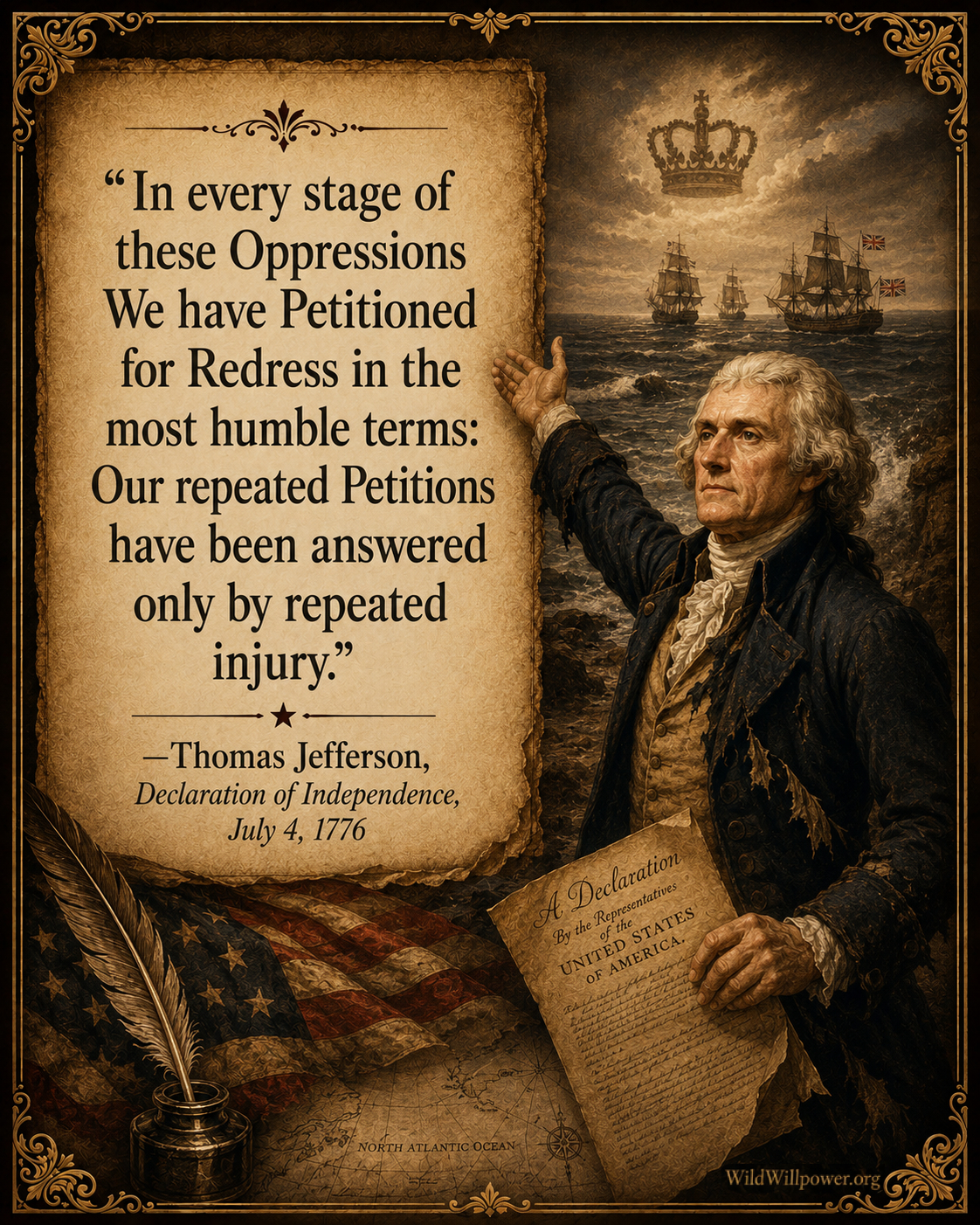
The grievance was not merely that government had made bad decisions. It was that government possessed the power to injure while the people's efforts to obtain meaningful correction repeatedly failed.
A government capable of inflicting injury while insulating itself from redress presents precisely the accountability problem this reform addresses.
That history matters to the modern immunity debate.
The question is not whether every eighteenth-century governmental actor faced unlimited personal liability. They did not. Nor does this history establish that every modern procedural protection is illegitimate.
The more fundamental principle is simpler:
The American constitutional tradition emerged from resistance to governmental power becoming insulated from meaningful judgment.
Government officials could be defended.
They could be acquitted.
They could prove that their actions were lawful.
But the increasingly objectionable imperial premise was that governmental status itself could help remove the official—and therefore the alleged governmental wrongdoing—from meaningful adjudication.
That distinction is essential to understanding what followed.
The American Revolution did not merely change who governed.
It changed the claimed source of governmental authority.
The sovereign was no longer to be an unaccountable Crown standing above the governed.
Sovereignty would be relocated to the people.
And that brings us to two terms that sound deceptively similar, but describe fundamentally different ideas:
popular sovereignty and sovereign immunity.
II. I Did What the First Amendment Says to Do:
I Petitioned My Government for Redress of Grievances
The history described above is not abstract to me.
When I believed the State of Iowa and people exercising governmental authority had violated my rights and caused serious injuries, I did not take the law into my own hands. I did not seek vengeance.
I did something elementary to American constitutional government:
I petitioned my government for redress.
I filed Wilson v. State of Iowa and Kim Reynolds for Iowa and asked Iowa's judicial system to hear my claims, examine the evidence, determine what law governed the conduct, and provide appropriate relief.
The lawsuit was not something I undertook lightly.
In my July 23, 2024 Amended Petition, I explained why I had filed it without an attorney:
“[F]iling this suit was a ‘need’ and not a mere ‘want’. I felt absolutely no choice but to file because I am in desperate need of relief so I can be made whole and recover from the numerous injuries I have sustained due to numerous and varying injurious acts performed by the Defendants.”
— Plaintiff's Amended Petition, ¶ 6, p. 9.
At the beginning of that same filing, I expressly stated that I was not seeking relief only for myself:
“I do not file this lawsuit frivolously. I love my home state, but needed to file this because I require and am due justice and to be made whole. I pray the outcome of this lawsuit that Iowans may live more cohesively and with care toward one another so that no one is ever harmed in the same and/or similar manners in which I have been....”
— Plaintiff's Amended Petition, Affidavit, p. 2.
The petition specifically requested injunctive relief:
“to prevent others from being harmed in the same and/or similar manners in which I have been.”
Id., p. 2.
In other words, I was doing precisely what the constitutional language of redress contemplates: alleging injury, identifying the governmental conduct I believed caused it, submitting the controversy to law, and asking government to provide a remedy.
When discussing the Iowa Tort Claims Act, I stated the principle plainly:
“The spirit of the ITCA is to provide Citizens an avenue for redress for when our rights are violated by STATE OF IOWA employees; the purpose is not to deny redress due to minor, harmless procedural errors....”
— Plaintiff's Amended Petition, ¶ 8, p. 13.
This Was Not a Case Against One Isolated Official
My petition did not concern one employee in one government office.
It alleged a long series of injuries involving numerous exercises of state and local governmental authority. The allegations included earlier encounters with public officials in Story County; Medicaid-related governmental action; statements I alleged were defamatory; procedures of the Iowa Civil Rights Commission; events I had discovered years later in earlier court proceedings; and other conduct that I alleged violated my rights.
I summarized the actors this way:
“Injurious acts described in this Amended Petition were performed by:
a.) Employees of the STATE OF IOWA;
b.) Individuals whose actions were enabled and/or aided and abetted by the State of Iowa; and
c.) KIM REYNOLDS FOR IOWA....”
— Plaintiff's Amended Petition, ¶ 11, p. 14.
The breadth of the petition is visible from its own table of contents. It included allegations concerning Story County public officials, Medicaid and HF 766, alleged defamation, the Iowa Civil Rights Commission, previously undiscovered events connected with older proceedings, and requests for prospective injunctive relief.
I was also explicit that some remedies were intended to improve government going forward:
“This lawsuit seeks to shine much-needed light on areas in which the state has been failing, so that things can be improved for all Iowans moving forward.”
— Plaintiff's Amended Petition, ¶ 7, p. 10.
That produced a question most citizens never have reason to confront:
If alleged governmental wrongdoing involves many different public actors operating through an interconnected governmental system, must an ordinary citizen locate, sue, serve, and litigate against every officer, employee, agency, and official individually—or may the government through which those actors exercised authority be required to answer?
That question would later become central to this reform.
But before the underlying allegations could reach trial or factual adjudication, the State answered my petition with something else:
immunity.
The State Answered With Sovereign Immunity
Assistant Attorney General Christopher J. Deist moved to dismiss the Amended Petition on behalf of the State of Iowa.
One section of the State's motion was titled:
“Plaintiff's defamation, fraudulent misrepresentation, and due process claims are barred by the doctrine of sovereign immunity.”
— Defendant State of Iowa's Motion to Dismiss Amended Petition, p. 12.
The State relied first upon Iowa Code § 669.14(4), under which the Iowa Tort Claims Act excludes claims arising from such matters as libel, slander, misrepresentation, and deceit.
Then came the judicial precedent.
The State cited Segura v. State, 889 N.W.2d 215, 220 (Iowa 2017), for this proposition:
“Where the State retains its sovereign immunity, the Court lacks subject matter jurisdiction over such claims.”
— State's Motion to Dismiss, p. 12.
That is worth understanding in ordinary language.
The doctrine was not merely being offered as a defense the State could present after the evidence was heard.
The State's position was that the court lacked authority even to adjudicate certain claims against it.
The motion then addressed my due-process claim.
Relying on Iowa Code § 669.26 and the Iowa Supreme Court's 2023 decision in Burnett v. Smith, 990 N.W.2d 289 (Iowa 2023), the State argued that the Iowa Constitution does not itself provide a direct constitutional tort claim and therefore:
“to the extent Plaintiff's claim lies in the Iowa Constitution, the State has retained its sovereign immunity, and her claim must be dismissed.”
— Id., pp. 12–13.
Think about the sequence.
I alleged a violation of constitutional rights.
The State did not merely deny that the violation occurred.
It invoked statutes and judicial precedent to argue that the claim itself could not proceed against the State.
That distinction matters.
Court Was Not My First Attempt at Accountability
Before filing Wilson v. State of Iowa and Kim Reynolds for Iowa, Case No. LACL157953, I had already attempted to use an existing judicial-accountability mechanism.
On July 17, 2023, I filed a complaint concerning Judge Steven Van Marel with the Iowa Judicial Qualifications Commission.
The article Falsely Accused of Assault, within my backstory, explains why. In summary, I alleged that Judge Van Marel had been required to recuse for reasons that were unknown to me at the time and that his handling of the earlier proceeding constituted an abuse of discretion.
Following an officer's warning that I should leave Iowa for my safety, I remained homeless and afraid to return to my home state for years. During that period, I endured violence, sexual assault, harassment, and repeated theft. Those experiences are documented more fully elsewhere in this series.
They matter here because I eventually turned to Iowa's courts believing they might provide the accountability and redress that other institutions had not provided.
Filing this lawsuit was therefore not my first attempt at accountability. It came after I had already tried other institutional avenues.
The State Responded With a Legal Arsenal Designed to Prevent the Claims From Reaching Adjudication
Assistant Attorney General Christopher J. Deist did not merely dispute my allegations. The State moved to dismiss them before trial using a collection of threshold doctrines, procedural barriers, statutes, and judicial precedents.
Those arguments attacked different routes to redress from different directions.
The State argued, among other things, that:
— under 42 U.S.C. § 1983, Iowa was not a statutory “person” who could be sued for damages;
— under the Iowa Tort Claims Act, I had not completed the required administrative-exhaustion process because I had not formally “withdrawn” an unresolved claim;
— under the public-duty doctrine, some duties owed by government to the public generally were not individually enforceable;
— under sovereign immunity, specified claims could not proceed against Iowa;
— under modern Iowa precedent, certain direct constitutional damages remedies were unavailable; and
— under judicial-process immunity, conduct connected with the judicial process could receive sweeping protection.
These were different doctrines with different histories and different stated purposes.
But I encountered them cumulatively.
A claim could be blocked because of the forum.
Another because of the defendant.
Another because of the statutory vehicle.
Another because of an administrative prerequisite.
Another because of immunity.
Another because the law said no individually enforceable duty existed at all.
That is why I now ask a question that goes to the heart of this reform:
Why should the right to governmental redress depend upon a citizen successfully solving this doctrinal maze before the facts can even be developed?
Several of those barriers now have their own documented case studies.
In A Truly Dizzying Intellect, I examine the State's argument that Iowa could not be sued under § 1983 as a “person”—including my response, the Supreme Court's divided decision in Will v. Michigan Department of State Police, and Justice William Brennan's historical argument that a State is a “body politic and corporate.”
In Strain Out a Gnat, I examine how the State acknowledged that I had filed an administrative tort claim, yet relied upon my failure to separately “withdraw” that still-unresolved claim before filing suit.
And in Behind Closed Doors, I document how I asked to film the proceedings and provide remote access before the State's dismissal arguments were heard—and how both requests were denied without further hearing.
The broader point here is not that all of these doctrines are identical.
They are not.
The point is that one closed door did not necessarily reveal an open one. Another legal barrier could be waiting behind it.
For purposes of this reform, however, one part of the State's motion deserves closer examination here because it exposes the immunity problem in perhaps its starkest form:
What happens when the individual government actor is immune—and the State then argues that it is immune too?
Then Came Judicial Immunity
The State devoted another section to my allegations involving a judge:
“Plaintiff's abuse of power claim is barred by judicial process immunity.”
— State's Motion to Dismiss, p. 13.
Here, the State relied upon a series of Iowa decisions that most Iowans will probably never encounter unless they find themselves attempting to sue government.
In Venckus v. City of Iowa City, 930 N.W.2d 792, 803 (Iowa 2019), the Iowa Supreme Court stated that government officials are:
“absolutely immune from suit and damages with respect to any claim arising out of the performance of any function intimately related to the judicial phase of the criminal process whether the claim arises at common law or under the state constitution.”
— quoted in State's Motion to Dismiss, p. 13.
The State also quoted Venckus for the proposition that judicial-process immunity:
“immunizes conduct without regard to the substantive source of the legal claim.”
— Id.
Then it cited Blanton v. Barrick, 258 N.W.2d 306, 308 (Iowa 1977):
“Few doctrines have been more well settled than the absolute immunity of judges from damages for acts committed within their judicial jurisdiction.”
— quoted in State's Motion to Dismiss, p. 13.
But the next sentence is even more important.
The State quoted Blanton for the rule that immunity applies:
“even when the judge is accused of acting maliciously and corruptly because as a matter of policy it is in the public best interest that judges should exercise function without fear of consequences and with independence.”
— Id.; citing also Muzingo v. St. Luke's Hospital, 518 N.W.2d 776, 777 (Iowa 1994).
That is not my characterization of Iowa immunity law.
That is the authority the State of Iowa cited against me.
The State further stated that even if my allegations were reframed as federal constitutional claims, absolute judicial immunity would still apply, citing Mireles v. Waco, 502 U.S. 9, 11 (1991), and Robinson v. Freeze, 15 F.3d 107, 108 (8th Cir. 1994).
I include these cases because I believe Iowans should be able to see the actual legal architecture presently being invoked in their name.
The question is not whether readers agree with my allegations against any particular official.
The more fundamental question is whether they agree with a system in which an allegation of malicious or corrupt governmental conduct can encounter absolute immunity before a jury ever determines what happened.
Then the State Went One Step Further:
"By Virtue, the State" Was Immune Too
The State did not stop at arguing that the individual judge was immune.
At the end of its judicial-immunity argument, it stated:
“Based on the contents of Plaintiff's Amended Petition and as a matter of law, Judge Van Marel—and, by virtue, the State—is absolutely immune from Plaintiff's claims.”
— Defendant State of Iowa's Motion to Dismiss Amended Petition, p. 14.
Read that carefully:
the individual judge was immune—and “by virtue” of that immunity, the State said it was immune too.
If accepted without a replacement remedy, the structure becomes circular:
The official cannot answer because the official is immune.
The government cannot answer because, “by virtue,” the official is immune.
And the injured citizen is left asking:
Who does answer?
That is precisely the accountability vacuum this reform seeks to eliminate.
There is nothing virtuous about immunity flowing in every direction while accountability disappears.
Immunity may sometimes serve a legitimate function by protecting an individual official from personal liability. But when that occurs, the law must preserve an effective means of holding the responsible governmental body answerable for unlawful governmental injury.
Otherwise, immunity ceases to allocate responsibility and instead extinguishes it.
I Answered With the History You Just Read
What makes this sequence particularly important to me today is that I did not invent the Founding argument years after losing the case.
I made it while the case was pending.
In my August 5, 2024 resistance, I argued that the State's sovereign-immunity position did not survive historical or constitutional scrutiny.
I began with John Locke's discussion of what happens when a legal remedy nominally exists but justice is nevertheless denied. I quoted Locke's warning concerning circumstances in which there is an “appeal to the law, and constituted judges,” yet:
“the remedy is denied by a manifest perverting of justice, and a barefaced wresting of the laws to protect or indemnify the violence or injuries of some men....”
— Plaintiff's Resistance, ¶ 62, pp. 30–31, quoting John Locke, Second Treatise of Government § 20.
I then addressed sovereign immunity itself.
Drawing from constitutional scholar Erwin Chemerinsky's Against Sovereign Immunity, I argued that a doctrine associated historically with the proposition that “the King can do no wrong” did not belong comfortably within a constitutional republic founded on governmental accountability.
My resistance stated:
“Sovereign immunity is inconsistent with a central maxim of American government: no one, not even the government, is above the law.”
— Plaintiff's Resistance, ¶ 63, p. 32.
And:
“The effect of sovereign immunity is to place the government above the law and to ensure that some individuals who have suffered egregious harms ... will be unable to receive redress for their injuries.”
— Id.
I connected that directly to Marbury v. Madison and its description of civil liberty as including the right to claim the protection of law when an injury occurs.
Then I turned to the Eleventh Amendment.
I pointed out that its text addresses suits against a State brought by citizens of another State or by foreign citizens or subjects and argued that the text does not itself say that citizens cannot sue their own State.
That is the same textual problem we will examine later in this article through Hans v. Louisiana.
But I did not stop there.
I turned directly to the Declaration of Independence.
I quoted the grievance you just read in the preceding section:
“In every stage of these Oppressions We have Petitioned for Redress in the most humble terms: Our repeated Petitions have been answered only by repeated injury.”
— Plaintiff's Resistance, ¶ 64, pp. 33–34.
Then I quoted Alexander Hamilton:
“The sacred rights of mankind are not to be rummaged for among old parchments or musty records. They are written, as with a sunbeam, in the whole volume of human nature ... and can never be erased or obscured by mortal power.”
— Plaintiff's Resistance, ¶ 65, p. 34, quoting Alexander Hamilton, The Farmer Refuted.
And I brought the argument back to popular sovereignty:
“[I]t is ‘the people’ from whom all authority invested in the State first derives, for it is not the State which gives itself authority.”
— Plaintiff's Resistance, ¶ 66, p. 35.
Those were not quotations added to a campaign article after the fact.
They were arguments submitted to an Iowa court while I was asking that court to hear my case.
I Answered the State's "By Virtue" Argument Directly
I also answered the State's judicial-immunity argument in the same filing.
After reproducing the authorities the State had cited—including Venckus and Blanton—I wrote:
“While judges in fact have been granted absolute immunity by the state, the State is not, as the State argued, ‘by virtue’, also immune. If the State grants immunity to Judges – even for malicious acts, the State in such cases thereby assumes liability for such malicious acts....”
— Plaintiff's Resistance, ¶ 67, pp. 35–36.
And then:
“In fact, ‘by virtue’ the state is liable, for it would be without virtue to deny redress to individuals who are harmed by rights violations and crimes performed by judges.”
— Id.
That argument has since developed into a broader reform proposal.
If Iowa concludes that decisional independence requires protecting a judge or another public official from personal liability in defined circumstances, then government should not be allowed to make liability disappear altogether.
Someone must remain answerable.
That is where respondeat superior and governmental responsibility enter the picture.
Governmental Authority Should Carry Governmental Responsibility
After the case was dismissed, I made that solution explicit in my September 7 motion to reconsider.
I wrote:
“Although § 1983 claims are typically filed against the county, city, and/or government official(s), due to the unique nature of this suit, wherein crimes and torts were performed by a wide variety of both state and local officials, the state appears to be the most appropriate party for this suit according to the longstanding, fundamental legal doctrine of respondeat superior.”
— Plaintiff's Motion to Reconsider, ¶ 2, p. 1.
I described the relationship this way:
“The state is the principle [sic], and ... officials are the state's agents.”
— Id.
The terminology can be refined. The underlying principle is simple:
Government acts through people. Government should not be permitted to accept the authority exercised through those people while disclaiming responsibility when that authority unlawfully causes harm.
That is why this reform proposes a far clearer system.
A citizen should be able to bring the governmental claim against the responsible governmental body.
The court can then determine—under rules established beforehand—whether the conduct was governmental, whether it fell within the proper scope of public duties, whether an individual official should bear personal responsibility, whether the governmental body should bear responsibility, or whether no legal violation occurred at all.
Immunity should allocate responsibility where legitimate protections are required. It should not erase responsibility.
For Me, This Was Also About Personal Safety
There was another reason I resisted the idea of being required to pursue a maze of public officials individually.
Safety.
In my motion to reconsider, I asked the court:
“I humbly request the court to consider the potential dangers members of vulnerable classes who are protected by the Iowa Civil Rights Act may potentially face in retaliation for filing directly against local officials and/or agencies....”
— Plaintiff's Motion to Reconsider, ¶ 3, p. 2.
I explained:
“Due to the fact that local authorities had shown prejudice and discrimination, and performed rights violations to me, I would not have felt safe filing locally. I felt much safer coming to the state's capitol to file, (hopefully) away from immediate danger.”
— Id.
That concern was tied to allegations already in my Amended Petition, including my account of a police officer privately warning me after a 2009 proceeding that, based on what he said he was hearing “behind the scenes,” I should leave Iowa for my safety.
A meaningful system of redress should not require a citizen alleging serious local governmental misconduct to personally pursue dozens of officials through the very local institutions she says caused the harm before government itself can be required to answer.
That is not merely a question of convenience.
For some citizens, it can be a question of access, money, vulnerability—and safety.
How the Court Characterized My Founding-Era Argument
On August 21, 2024, the district court issued its ruling.
The court accurately recognized that I had argued, among other things, that sovereign immunity was inconsistent with historical sources and that:
“the state should assume the liability of judicial officers who are immune from civil liability.”
— Ruling on Defendant State of Iowa's Motion to Dismiss Amended Petition, p. 5.
But its treatment of the historical argument is worth reading directly.
The court described my position as relying upon:
“the doctrine of sovereign immunity [being] inconsistent with a number of treatises, including the Bible, the Declaration of Independence and the writings of John Locke and Alexander Hamilton....”
— Id., pp. 4–5.
Then it said:
“Those remedies must be based on theories that are supported by controlling precedent and not by passages in a treatise that appear to support some loosely-based concept of equity.”
— Id., p. 5.
And then:
“It would unnecessarily lengthen this ruling by addressing each one of the defendant's positions as expressed in its motion point by point. It is sufficient to say that all of the defendant's arguments are properly supported by appropriate legal authority and none of the plaintiff's arguments are.”
— Id., p. 5.
I think readers should see those words for themselves.
The historical argument I had presented included the Declaration of Independence, Locke, Hamilton, Marbury, the text of the Eleventh Amendment, constitutional supremacy, and the proposition that political authority derives from the people.
The court did not work through those arguments and explain why each failed.
Instead, it treated the State's cited precedent as controlling and concluded that my arguments were unsupported by contrary controlling precedent.
That distinction goes directly to the thesis of this article.
What happens when the argument is that the controlling precedent itself lacks legitimate constitutional authority?
Saying that precedent controls answers the institutional question.
It does not necessarily answer the antecedent constitutional one.
The Case Was Dismissed With Prejudice
The court then ordered:
“IT IS THEREFORE ORDERED that the motion to dismiss filed by the defendant, State of Iowa, is granted. The plaintiff's claims against this defendant are dismissed with prejudice at the cost of the plaintiff.”
— Id., p. 6.
This occurred on a pre-answer motion to dismiss. The ruling itself acknowledged that pre-answer motions to dismiss are disfavored, but concluded that this was an appropriate case for one.
The factual allegations therefore never proceeded to a trial on the merits.
No jury determined whether the underlying allegations were true.
No jury weighed witnesses.
No jury evaluated the documentary record.
No jury decided what injuries resulted or who caused them.
That does not mean every allegation in my petition was thereby proven.
It means the opposite:
They were never adjudicated by a jury at all.
Many people who know that I lost Wilson v. State of Iowa may reasonably have assumed that a court heard the evidence and found that I had no case.
That is not what happened.
The case ended at the pleading stage through threshold legal doctrines.
I Petitioned Again
I then filed a motion asking the court to reconsider.
I again emphasized the problem of redress:
“The fact that the State performed these actions and then (thus far) denied redress for harms done represents a current and ongoing threat to protected classes of Iowans....”
— Plaintiff's Motion to Reconsider, ¶ 6, p. 3.
On September 9, 2024, the court's response was brief:
“Plaintiff's motion and supplemental motion to reconsider ... are all denied without further hearing.”
— Order, Sept. 9, 2024, p. 1.
And there the sequence ended.
I petitioned the government for redress.
The State answered with sovereign immunity.
It invoked Segura and Burnett.
It invoked judicial-process immunity.
It invoked Venckus, Blanton, Muzingo, Mireles, and Robinson.
It argued that the judge was absolutely immune—and that, “by virtue,” the State was immune too.
I responded with Locke, Hamilton, the Declaration of Independence, Marbury v. Madison, the text of the Eleventh Amendment, popular sovereignty, constitutional supremacy, and the principle that government is not above law.
The court held that the State's arguments were supported by controlling legal authority.
It declined to address the arguments point by point.
It dismissed my claims against the State with prejudice.
I petitioned again.
The court denied reconsideration without further hearing.
A jury never heard the evidence.
“Our Repeated Petitions Have Been Answered Only by Repeated Injury”
That is where the Declaration's words cease to feel like something confined to 1776:
“In every stage of these Oppressions We have Petitioned for Redress in the most humble terms: Our repeated Petitions have been answered only by repeated injury.”
I am not equating my lawsuit with the totality of grievances that caused the American Revolution.
The point is narrower—and, I believe, more important.
The Founding generation understood that the ability to petition government means little if government can injure and then place meaningful redress beyond reach.
My experience showed me how that problem can operate today through doctrines most citizens will never hear about until those doctrines are invoked against them.
Segura. Burnett. Venckus. Blanton. Muzingo.
These are not dusty abstractions.
They are part of the body of law the State of Iowa presently invokes when citizens seek to hold government accountable.
Some of those doctrines may have legitimate purposes.
Judges require independence.
Government officials cannot perform their duties if every disappointed citizen can impose personal liability merely because government made a lawful decision the citizen dislikes.
But protecting good-faith public service is not the same thing as extinguishing accountability.
And the quotation Iowa relied upon in my own case exposes the problem especially clearly:
immunity applies “even when the judge is accused of acting maliciously and corruptly.”
Then the State argued that “by virtue” of the judge's immunity, the State was immune too.
That is the accountability vacuum this reform rejects.
The individual actor may be protected.
The government may claim derivative immunity.
The factual dispute may never reach adjudication.
Protection from personal liability should not become disappearance of governmental responsibility.
And that brings us back to the constitutional distinction upon which everything that follows depends:
Who is sovereign in Iowa—the government, or the people from whom government's authority derives?
That requires us to distinguish two terms that sound superficially similar but point in very different directions:
III. "Popular Sovereignty" and "Sovereign Immunity" —
Key Terms That Are Important to Differentiate
To someone who has never studied constitutional law, popular sovereignty and sovereign immunity can sound like different expressions of the same idea. They are not. In important respects, they point in opposite directions.
The word sovereign appears in both, but it is doing very different work.
Popular sovereignty asks:
Where does legitimate governmental power come from?
In the American constitutional tradition, the answer is the people.
Sovereign immunity, by contrast, asks:
When may the government itself be sued or subjected to judicial process?
Understanding that distinction is essential to understanding the reform proposed on this page. One doctrine concerns the source of governmental authority. The other concerns whether the government exercising that authority may be called into court when someone alleges that it violated the law.
Put simply:
Popular sovereignty means that governmental authority comes from the people. Sovereign immunity restricts when the government exercising that authority may be sued.
Those concepts should not be confused—and neither should popular sovereignty be confused with unlimited majority rule.
Popular Sovereignty —
"The majority may govern. It may not violate."
Popular sovereignty is the foundational idea that legitimate governmental authority originates with the people—not with a king, court, legislature, governor, president, or other governmental institution.
The Iowa Constitution states that principle expressly:
“All political power is inherent in the people.”
— that Government exists for the people’s
“protection, security, and benefit,”
and the people retain the right
“at all times, to alter or reform the same, whenever the public good may require it.”
Iowa Const. art. I, § 2. [1]
In the American constitutional tradition, the Declaration of Independence answers similarly, describing governments as deriving
“their just powers from the consent of the governed,”
The Declaration also recognized the right of the people to alter or abolish a form of government that becomes destructive toward the rights government was instituted to secure. [2]
One of the earliest Supreme Court decisions made the distinction remarkably explicit. In Chisholm v. Georgia, 2 U.S. (2 Dall.) 419 (1793), decided in 1793 while members of the Founding generation still occupied the Court, Justice James Wilson wrote that, after the Revolution,
“the sovereignty devolved on the people.”
First Chief Justice of the United States, John Jay, similarly described the American people as
“the sovereign of this country.” [3]
That promise is not decorative.
Iowa’s governmental institutions are not the permanent property of judges, attorneys, political parties, agencies, or officeholders. They are public structures created to serve the people. When doctrines developed within those institutions prevent government from answering for unlawful exercises of governmental power, the people possess the constitutional authority to reform the system.
That is why Iowa does not have to remain resigned to a system in which government creates the injury, controls the records, supplies the defense, invokes immunity, and leaves the injured citizen without a meaningful remedy.
Through popular sovereignty, Iowans can establish a clear rule:
Governmental power carries governmental responsibility.
Sovereign Immunity —
"The Revolution did not replace a king with a majority. It placed both under law."
Sovereign immunity presents a fundamentally different question:
May the government itself be sued or called before a court without its consent?
The doctrine has historical roots in English concepts of sovereignty, including the common-law maxim traditionally expressed as “the King can do no wrong.” That concept should not be confused with the theological doctrine of the Divine Right of Kings, although the two developed within the same older world of monarchical sovereignty. Divine-right theory claimed that royal authority ultimately came from God rather than from the governed; sovereign-immunity principles insulated the sovereign, to varying degrees, from being subjected to ordinary judicial process.[4]
The American Revolution decisively rejected the first proposition: governmental authority no longer descended from an unaccountable Crown. Legitimate political authority proceeded from the people. But it would be too broad to say that every possible form of governmental immunity disappeared at the Founding. The scope of immunity in the new republic was disputed almost immediately. Chisholm held that Georgia could be sued in federal court by a citizen of another State; the Eleventh Amendment, ratified soon afterward, withdrew federal judicial power over specified suits against States.[5]
Nearly a century later, Hans v. Louisiana, 134 U.S. 1 (1890) extended state sovereign immunity beyond the Amendment's literal text to suits brought against a State by its own citizens—a development examined below.[6]
That history makes the distinction important:
Popular sovereignty means that the people are the source of governmental authority. Sovereign immunity is a doctrine restricting when the government that exercises that authority may be called into court.
And popular sovereignty does not mean unlimited majority rule.
A constitutional republic permits majorities to choose representatives and enact laws, but the Constitution places some matters beyond the power of an ordinary political majority. A legislature may have the votes to enact a law; voters may strongly support it; and the law may nevertheless violate the constitutional rights of one person.
My forthcoming manuscript, Unjust Iowa: Third Treatise of Civil Government, describes the distinction this way:
“The majority may govern. It may not violate.”
And, even more succinctly:
“The Revolution did not replace a king with a majority. It placed both under law.”[7]
The Supreme Court's modern Second Amendment cases provide unusually clear examples.
In District of Columbia v. Heller, the District of Columbia had enacted one of the nation's strictest handgun laws. Dick Anthony Heller challenged the law as an individual citizen. The Supreme Court held that the Second Amendment protects an individual right to possess a firearm for lawful purposes such as self-defense and held the District's handgun prohibition unconstitutional.[8]
Two years later, in McDonald v. City of Chicago, individual residents challenged handgun restrictions enacted by Chicago and Oak Park. The Court held that the Second Amendment right recognized in Heller applies against state and local governments through the Fourteenth Amendment.[9]
And in New York State Rifle & Pistol Association, Inc. v. Bruen, two individual applicants challenged New York's requirement that they demonstrate a special need before receiving licenses to carry handguns publicly for self-defense. The Supreme Court held that the requirement violated the Constitution. The Court emphasized that the exercise of a constitutional right could not be conditioned upon an individual's proving some extraordinary need to government officials.[10]
These cases are useful here regardless of one's personal views about firearms or gun regulation. Their significance to this discussion is structural:
A constitutional right does not become unenforceable merely because a political majority favors the law that infringes it.
That is the difference between popular sovereignty and simple majoritarianism. The people collectively establish the government and authorize its powers. But through the Constitution, the people also place limits upon those powers—including limits protecting individual citizens from the government itself.
The sovereign in an American republic is therefore not a king, a governor, a legislature, a court, or even a temporary electoral majority.
The sovereign is the people operating through a constitutional order—and that constitutional order protects the individual as well as the majority.
IV. From Judicial Doctrine to Legal Architecture
The modern architecture of governmental immunity was not deposited into the Constitution by the Founders as an express grant of governmental power. It developed over time through judicial decisions, common-law reasoning, legal scholarship, professional advocacy, legal education, statutory interaction, and—most importantly—the cumulative authority of precedent.[11]
That distinction matters because there is more than one way for something to acquire the appearance and practical force of law.
A constitutional provision obtains its authority through the constitutional process itself. A statute obtains its authority through legislation enacted pursuant to constitutional power. Judicial doctrine develops differently: a court announces a rule, later courts encounter that rule as precedent, lawyers cite it, treatises explain it, professors teach it, students learn it, litigants organize arguments around it, and judges apply it under principles of stare decisis.
The next generation begins not where the first generation began, but where the preceding generation left off.
Over decades—and then generations—repetition becomes inheritance.
A proposition that originally entered American law through judicial reasoning may eventually cease to look like a proposition requiring justification at all. It becomes part of the background architecture of the profession: something found in case reporters, legal databases, treatises, briefs, motions, judicial opinions, law-school courses, bar preparation, government litigation manuals, and eventually, in some circumstances, statutes or statutory remedial systems developed around the doctrine.
The result can be extraordinary institutional permanence.
But institutional permanence is not constitutional ratification.
A rule does not acquire a previously nonexistent constitutional pedigree merely because one court announced it, another court repeated it, lawyers learned to rely upon it, and generations of later courts inherited it as settled doctrine.
That is the distinction at the center of this reform.
My forthcoming Unjust Iowa: Third Treatise of Civil Government approaches the problem historically and structurally because legal doctrines do not emerge in isolation. Institutions can change slowly even when political systems change rapidly; doctrines can survive changes in government, become embedded within professional systems, and eventually appear inseparable from institutions that long predated them.[12]
The book therefore asks readers to distinguish between what an institution presently recognizes and the source from which that institution obtained authority to recognize it in the first place.
That distinction is especially important in a constitutional republic.
The Constitution is not merely another source in the hierarchy of authorities available to judges. It is the source that determines the lawful authority of the institutions beneath it. As Chief Justice John Marshall explained in Marbury v. Madison, a written Constitution is “fundamental and paramount law,” and an enactment contrary to it is void.[13]
Marshall expressed the same principle in language particularly relevant to governmental immunity:
“The government of the United States has been emphatically termed a government of laws, and not of men.”
He immediately connected that principle to remedy, warning that government would cease to deserve that description if the law supplied no remedy for violation of a vested legal right.[14]
That is why the question presented here cannot end with:
What do the cases presently say?
The prior question is:
By what lawful authority did the cases obtain the power to say it?
And beneath that lies an even more fundamental question:
Can judicial repetition transform a doctrine into legitimate constitutional authority if the doctrine itself cannot be reconciled with the superior constitutional structure from which judicial power derives?
That is where the motto on the Justice Across Iowa seal becomes important:
Lex iniusta non est lex.
An unjust law is not law.
The maxim belongs to the natural-law tradition and is commonly associated with Augustine and Thomas Aquinas. Aquinas treated profoundly unjust enactments not as law in the fullest sense, but as a corruption or perversion of law.[15]
I do not invoke that maxim to suggest that citizens may disregard any rule they personally regard as unjust. Courts presently recognize and enforce governmental-immunity precedents. Attorneys practicing within the existing system must confront them. Litigants may lose cases because of them. Governments organize their conduct and defenses around them.
Their practical force is real.
The question is whether practical force proves constitutional legitimacy.
American constitutional law supplies its own, narrower analogue to the ancient maxim. Marbury did not hold that a person may disregard whatever law she considers immoral. It held something structurally different and indispensable to written constitutional government:
An exercise of governmental authority repugnant to the superior Constitution cannot become valid merely because government exercised it.[16]
That distinction is central to what I mean by disrecognize.
I am not arguing that governmental-immunity doctrines were never written into case law, never enforced, or never capable of producing legal consequences. The historical record demonstrates the opposite. Their consequences have been profound.
I am asking a different question:
How did they acquire the authority they now possess?
Hans v. Louisiana provides a particularly important example of this process. In 1890, the Supreme Court confronted a suit that the text of the Eleventh Amendment did not expressly prohibit and nevertheless recognized a broader rule of state sovereign immunity.[17]
How the Court reached that result matters as much as the result itself. The next section therefore examines Hans closely—not merely for what modern lawyers understand it to hold, but for how the opinion moved from constitutional text to an immunity doctrine found nowhere in that text.
My forthcoming treatise frames the broader problem this way:
“The existence of a law does not settle its legitimacy. Its conformity to rights does.”[18]
And it reaches an equally important conclusion about the constitutional transformation accomplished by the Revolution:
“The Revolution did not replace a king with a majority. It placed both under law.”[19]
Those propositions apply to courts as well.
Judicial power is constitutional power. It therefore derives from the constitutional order; it does not stand outside or above that order.
A court possesses enormous authority to interpret law. But the existence of judicial authority cannot logically answer every question concerning the limits of judicial authority. Otherwise, constitutional review becomes circular:
The doctrine is lawful because courts recognize it; courts may recognize it because the doctrine is lawful.
Repetition then becomes its own justification.
That is precisely why historical examination matters.
The purpose of this article—and, much more extensively, Unjust Iowa: Third Treatise of Civil Government—is to break that circle by tracing the chain of claimed authority backward.
From modern immunity doctrines—
to the precedents relied upon to justify them—
to the earlier precedents relied upon by those courts—
to the legal and professional institutions through which those doctrines were preserved and transmitted—
and ultimately back to the constitutional order from which every American governmental institution derives its legitimate authority.
My manuscript describes that constitutional transformation in simple terms:
“In Europe, the sovereignty is generally ascribed to the prince; here, it rests with the people. There, they are subjects; here, they are citizens.”[20]
That was Justice James Wilson's explanation in Chisholm v. Georgia only four years after the Constitution took effect.
The constitutional question, therefore, is not merely whether immunity doctrine has become deeply embedded in American case law. It plainly has.
The question is whether institutional entrenchment can substitute for constitutional authorization.
The historical question is how these doctrines entered American law.
The institutional question is how they were preserved, taught, invoked, expanded, and normalized.
The constitutional question is whether the government created by the people may recognize an immunity that defeats the rights of those same people without identifying lawful constitutional authority for doing so.
And the democratic question is whether one generation's judicial inference becomes permanently binding upon every generation that follows merely because legal institutions learned to treat it as settled.
Institutional reproduction is not constitutional ratification.
That principle does not require pretending that immunity doctrine lacks present practical power.
It requires recognizing the difference between power and authority.
A doctrine may be cited like law.
It may be taught like law.
It may be enforced like law.
It may be carried forward through generations of case law until nearly everyone trained within the system experiences it simply as the law.
But none of those facts, standing alone, answers the antecedent constitutional question:
Where did the authority come from?
If examination of that chain ultimately reveals legitimate constitutional authority, the historical record should demonstrate it.
But if the chain instead terminates in judicial inference, followed by precedent, professional transmission, institutional repetition, and further precedent—without a corresponding constitutional grant—then Iowa must confront a possibility that is very different from ordinary legislative repeal:
What courts have long recognized and enforced as law is something that the Iowa Constitution and foundational principles of our nation authorizes our citizenry to disrecognize as legitimate constitutional authority.
The premise that government officials may be placed beyond accountability under law is precisely what I invite my fellow Iowans, through this reform, to reject.
But rejecting that premise in public discourse is not the same as displacing it with the force of law.
Courts presently enforce immunity doctrines. Governments presently invoke them. Lawyers presently treat them as binding precedent. If Iowans conclude that those doctrines are incompatible with the constitutional principles examined here, the next task is not merely to say so—it is to carry that conclusion into lawful institutional reform.
That constitutional judgment must be carried into law.
That means legislation where legislation is sufficient, constitutional reform where constitutional reform is required, and a clear statement of rights and governmental duties capable of binding the institutions that exercise public power.
Before we reach that point—and before the conclusion of this article and the petition I invite you to sign—there is still crucial history to unpack.
If Iowans are going to organize around this reform and see it through, we should do so with enough historical and constitutional knowledge to foresee and dispense with the arguments that will inevitably be raised in defense of immunity. We must be equipped with the knowledge to answer them accurately.
The most important of those arguments begins with a Supreme Court decision from 1890.
It is the case through which a broader conception of sovereign immunity—not stated in the text of the Eleventh Amendment—became embedded in our state and federal judiciaries.
That case is Hans v. Louisiana.
V. Hans v. Louisiana (1890):
When the Court Exceeded Its Constitutional Authority
By Perverting the Meaning of the Eleventh Amendment,
And Turned Citizens to Subjects Instead of Citizens
Almost a century after Chisholm v. Georgia and the ratification of the Eleventh Amendment, the Supreme Court decided the case that would fundamentally reshape the meaning of state sovereign immunity in American law:
Hans v. Louisiana, 134 U.S. 1 (1890). [21]
To understand what Hans did, it is necessary to read three things separately and in chronological order:
First, what Chisholm held in 1793.
Second, what Congress actually wrote—and the States actually ratified—in the Eleventh Amendment.
Third, what the Supreme Court said those words meant ninety-five years later in Hans.
The difference between the second and third is the constitutional problem.
Hans also provides a concrete demonstration of the process described in the preceding section. A proposition not stated in constitutional text entered American law through judicial interpretation; once recognized by the Supreme Court, that proposition became precedent from which later generations of lawyers and judges would begin.
What the Eleventh Amendment Actually Says
After Chisholm v. Georgia permitted a South Carolina citizen to sue the State of Georgia in federal court, Congress proposed the Eleventh Amendment in 1794. Ratification was completed in 1795. [22]
Its operative language is remarkably specific:
“The Judicial power of the United States shall not be construed to extend to any suit in law or equity, commenced or prosecuted against one of the United States by Citizens of another State, or by Citizens or Subjects of any Foreign State.” [23]
The Amendment identifies the plaintiffs whose suits are affected:
Citizens of another State
and
Citizens or Subjects of any Foreign State.
It does not say:
“No State shall be sued without its consent.”
It does not say:
“The States retain sovereign immunity.”
And it does not say:
“A citizen may not sue his or her own State.”
That distinction is central.
Whatever broader political ideas individual Americans may have held about state sovereignty in the 1790s, the constitutional amendment actually proposed by Congress and ratified by the States used narrower words.
The States ratified those words through the Article V amendment process.
Hans Presented the Question the Amendment Did Not Address
John Hans was a citizen of Louisiana.
He sued Louisiana.
He therefore did not fall within either category expressly named in the Eleventh Amendment. He was not a
“Citizen[s] of another State.”
He was not a citizen or subject of a foreign state.
Hans accordingly argued that his federal constitutional claim fell within Article III's federal-question jurisdiction and outside the textual prohibition created by the Eleventh Amendment.[24]
Justice Joseph P. Bradley, writing for the Supreme Court, described the question precisely:
“The question is presented, whether a State can be sued in a Circuit Court of the United States by one of its own citizens upon a suggestion that the case is one that arises under the Constitution or laws of the United States.” [25]
The Court then described Hans's argument:
“[T]he plaintiff in error contends that he, being a citizen of Louisiana, is not embarrassed by the obstacle of the Eleventh Amendment, inasmuch as that amendment only prohibits suits against a State which are brought by the citizens of another State, or by citizens or subjects of a foreign State.” [26]
And then comes one of the most important sentences in the entire opinion:
“It is true, the amendment does so read.” [27]
That sentence should not be passed over.
The Supreme Court expressly acknowledged that Hans had correctly described what the Eleventh Amendment literally says.
The Amendment said what Hans said it said.
The question was therefore no longer what the constitutional text provided.
The question became whether the Court would recognize a broader immunity not contained in that text.
From Constitutional Text to "Anomalous Result"
After conceding the Amendment's wording, the Court did not identify additional language prohibiting Louisiana citizens from suing Louisiana.
Instead, it reasoned that following the text would produce what it considered an anomalous consequence: a State could be sued in federal court by its own citizen even though the Eleventh Amendment prevented comparable suits by citizens of other States or foreign citizens. [28]
The Court wrote that, if this were the necessary consequence of the constitutional language, the result would be
“startling and unexpected.” [29]
That is a critical shift in methodology.
The inquiry moved from:
What does the constitutional text prohibit?
to:
Would the consequence of applying that text seem anomalous, surprising, or historically implausible to the Court?
Those are not the same inquiry.
The Court Reinterpreted the Political Reaction to Chisholm
The Hans Court then looked backward to Chisholm.
It characterized the decision as producing such a “shock of surprise throughout the country” that the Eleventh Amendment was quickly proposed and ratified. [30]
The Court reasoned that this reaction demonstrated something broader than the Amendment's actual words: that Chisholm itself had misunderstood the sovereign status of the States.
The opinion declared that the Eleventh Amendment represented the judgment of
“the ultimate sovereignty of the whole country”
and said that it had
“actually reversed the decision of the Supreme Court.” [31]
But here an important distinction must be preserved.
The Amendment certainly altered the constitutional rule applicable to the category of suit at issue in Chisholm: a citizen of one State suing another State.
That does not by itself establish that the Amendment also prohibited a categorically different suit that its text did not mention: a citizen suing his or her own State.
That additional proposition required another step.
Hans supplied it.
The Majority in Chisholm Became the Error;
Iredell's Dissent Became the Foundation
This may be the most consequential interpretive move in the opinion.
In Chisholm, the Court's majority had already resolved the case against Georgia's claim of immunity, while Justice James Iredell took the contrary position in dissent. Justice James Wilson explained that the American Revolution fundamentally altered where sovereignty resided:
“In Europe, the sovereignty is generally ascribed to the prince; here, it rests with the people. There, they are subjects; here, they are citizens.” [32]
Chief Justice John Jay similarly treated the people—not the governments they established—as the sovereign.
Justice James Iredell dissented.
Nearly a century later, Hans effectively elevated Iredell's conception over the Chisholm majority's.
The Hans Court expressly said that the adoption of the Eleventh Amendment showed that the country's “highest authority” had been “in accord rather with the minority than with the majority” in Chisholm. [33]
It then criticized the Chisholm majority for adhering too closely to the Constitution's words:
“The other justices were more swayed by a close observance of the letter of the Constitution, without regard to former experience and usage.” [34]
That sentence deserves particular attention.
The majority opinions of Founding-era Justices were discounted in Hans because they had followed what the 1890 Court described as a “close observance of the letter of the Constitution.”
Hans instead preferred a broader historical conception of sovereignty associated with the dissent.
The modern doctrine of state sovereign immunity thus did not arise simply by reading the Eleventh Amendment.
It arose by reading beyond it.
Hamilton Was Then Used to Supply What the Amendment Did Not Say
The Hans Court next turned to Alexander Hamilton's Federalist No. 81.
Hamilton had argued during the ratification controversy that States would retain immunity from individual suits absent surrender of that immunity in the constitutional plan. [35]
Hans treated those comments as powerful evidence that Chisholm had been mistaken and that the Eleventh Amendment restored the understanding Hamilton had defended.
The Court also relied upon comments by Madison and Marshall during the Virginia ratifying convention expressing skepticism that States could be involuntarily made defendants in federal court. [36]
These materials are historically important.
But they are not themselves the Eleventh Amendment.
Hamilton's essay was not the constitutional language Congress later proposed.
Madison's convention statement was not the language submitted to the States.
Marshall's prediction was not the language ratified by the States.
And Justice Iredell's dissent was not the judgment of the Court in Chisholm.
Each may illuminate Founding-era disagreement. None can silently add words to a constitutional amendment.
This distinction is particularly important because Chisholm itself proves that Founding-era opinion on the question was not uniform.
The Supreme Court divided on precisely this issue.
The Eleventh Amendment Settled One Dispute—But Hans Treated It as Settling Another
Congress could have proposed an amendment saying:
No State shall be sued by any individual without its consent.
It did not.
Congress could have included:
“by citizens of that State.”
It did not.
The States could have ratified a generalized constitutional declaration of sovereign immunity.
They did not.
Instead, the States ratified language directed specifically toward suits brought against one State by citizens of another State or by foreign citizens or subjects. [37]
That textual choice matters.
My forthcoming Unjust Iowa: Third Treatise of Civil Government describes the distinction this way:
“The Eleventh Amendment's text leaves suits by a state's own citizens untouched.” [38]
The constitutional foundation of Hans, therefore, “rests not on textual command but on judicial inference.” [39]
That is precisely what the opinion itself reveals.
The Hypothetical Amendment That Was Never Ratified
Perhaps the clearest demonstration of what Hans did appears on page 15 of the opinion.
The Court asked readers to imagine that Congress had added a proviso to the Eleventh Amendment expressly preserving suits by citizens against their own States. It then asked rhetorically whether the States would ever have ratified such an amendment, concluding that the proposition was almost absurd.[40]
But this reasoning reverses the normal constitutional question.
The question should not be:
What additional language might the States have rejected if Congress had proposed it?
The question should be:
What language did Congress actually propose, and what did the States actually ratify?
The Constitution is amended through text submitted and ratified according to Article V—not through judicial speculation, ninety-five years later, about what hypothetical language earlier States might have rejected.
Then Came the Declaration
After moving through history, common-law assumptions, Hamilton, Madison, Marshall, Iredell's dissent, and its own understanding of what the ratifying States probably would have intended, the Hans Court announced the rule:
“The suability of a State without its consent was a thing unknown to the law.” [41]
And later:
“It is enough for us to declare its existence.” [42]
Those statements are the doctrinal hinge.
The Constitution did not declare that immunity in those terms.
The Eleventh Amendment did not declare it.
Hans did.
From an Amendment's Text to Judicial Command
The distinction can therefore be stated plainly.
The Eleventh Amendment established this rule:
Federal judicial power shall not extend to specified suits against States brought by citizens of another State or by foreign citizens or subjects.
Hans established a broader rule:
A State generally possesses immunity from suit by individuals, including its own citizens, absent consent.
The first proposition appears in constitutional text.
The second does not.
Modern Supreme Court doctrine recognizes this distinction. Congress's own Constitution Annotated explains that Hans “adopted Justice James Iredell's position in Chisholm” and acknowledges that the Court extended immunity to suits by a State's own citizens even though the Eleventh Amendment “on its face” addressed different plaintiffs. [43]
That does not mean modern doctrine considers Hans invalid. It does not.
It means that the historical origin of the broader rule can be identified with unusual clarity.
The broader rule is a judicial doctrine built through interpretation of constitutional structure and background sovereignty—not a sentence contained in the Eleventh Amendment.
The Constitutional Question Hans Leaves Behind
That brings this article back to the distinction established in the previous section:
Institutional reproduction is not constitutional ratification.
Hans has been cited as law for more than a century.
Its doctrine has been incorporated into American jurisprudence.
Lawyers learn it.
Governments invoke it.
Courts enforce it.
Later cases begin with it as an inherited premise.
But none of that changes the historical sequence:
1793 — Chisholm interpreted the new constitutional order.
1794 — Congress proposed a specific textual response.
1795 — the States ratified that specific language.
1890 — Hans recognized that the Amendment did not literally prohibit Hans's suit, then supplied a broader rule through judicial interpretation.
That chronology presents the constitutional question this reform asks Iowans—and eventually the nation—to confront:
Can a judicial inference acquire authority equivalent to constitutional text merely because courts have repeated it long enough?
My answer is no.
And that is why Hans v. Louisiana occupies such a central place in this reform.
It illustrates the difference between a Constitution ratified by the people and a constitutional doctrine recognized by courts.
If those two sources of authority conflict, the question is not whether the judicial doctrine has been enforced.
The question is which one governs the other.
VI. From Hans to the Modern Wall of Immunity:
Different Doctrines, One Cumulative Barrier
The wall was not built from a single case, and its bricks do not all share a single doctrinal lineage.
Judicial immunity existed before Hans. Sovereign immunity, judicial-process immunity, qualified immunity, public-duty rules, statutory tort-claim exceptions, § 1983 personhood doctrine, and modern restrictions upon state constitutional remedies developed at different times, through different courts and legislatures, and for different stated purposes.
But a citizen encounters them cumulatively.
That is the important point.
A doctrine need not descend directly from Hans to occupy another position in the same architecture of governmental insulation.
One rule may govern where the citizen can sue.
Another determines whom the citizen can sue.
Another determines which cause of action exists.
Another determines whether the government has consented to be sued at all.
Another determines whether a particular duty is legally enforceable by an individual.
Another protects the individual governmental actor.
And the cumulative result can be that the underlying question—what actually happened?—is never reached.
My own case provides a useful way to see how that architecture accumulated over time.
1872 — Bradley v. Fisher, 80 U.S. (13 Wall.) 335 (1872): the Supreme Court articulated a broad form of absolute judicial immunity for judicial acts within jurisdiction.
1890 — Hans v. Louisiana, 134 U.S. 1 (1890): the Court recognized state sovereign immunity extending beyond the literal plaintiff categories named in the Eleventh Amendment.
1977 — Blanton v. Barrick, 258 N.W.2d 306, 308 (Iowa 1977): Iowa reaffirmed absolute judicial immunity even where a judge is alleged to have acted “maliciously and corruptly.”
1989 — Will v. Michigan Department of State Police, 491 U.S. 58, 64–71 (1989): the Supreme Court held that a State is not a “person” for purposes of a § 1983 damages action.
1990 — Harrington v. Schossow, 457 N.W.2d 583, 586 (Iowa 1990): Iowa acknowledged that the Eleventh Amendment itself does not apply in state court while applying Will's separate § 1983 personhood rule there.
2016 — Estate of McFarlin v. State, 881 N.W.2d 51, 58, 60 (Iowa 2016): Iowa continued applying the public-duty doctrine.
2017 — Segura v. State, 889 N.W.2d 215, 220 (Iowa 2017): where the State retains sovereign immunity, Iowa treats the resulting limitation as jurisdictional—the authority the State later invoked against me.
2019 — Venckus v. City of Iowa City, 930 N.W.2d 792, 801–03 (Iowa 2019): judicial-process immunity protects functions intimately associated with the judicial phase and operates regardless of the substantive source of the claim.
2023 — Burnett v. Smith, 990 N.W.2d 289 (Iowa 2023): the Iowa Supreme Court overruled Godfrey v. State and ended the judicially recognized standalone damages action under the Iowa Constitution absent another legal source authorizing it.
2024 — Wilson v. State of Iowa: Assistant Attorney General Christopher J. Deist invoked multiple components of that accumulated architecture in a single motion to dismiss.
None of these cases, standing alone, created the entire modern accountability problem.
Their cumulative operation is the story.
By 2024, the State did not need to invent a new legal theory to prevent my claims from reaching factual adjudication.
Its attorney could open an already-stocked legal arsenal.
The State was not a § 1983 “person.”
Some tort claims fell outside Iowa's waiver of sovereign immunity.
Other claims faced administrative-exhaustion requirements.
A negligence claim encountered the public-duty doctrine.
Constitutional claims encountered modern restrictions upon direct damages remedies.
Claims involving judicial conduct encountered judicial-process immunity.
And when I argued that the State should remain responsible where the individual judge was protected, the State answered that “by virtue” of the judge's immunity, the State was immune too.
The wall was not theoretical. I encountered it.
VII. Professional Insulation and Judicial Accountability
The importance of Hans extends beyond the particular dispute between John Hans and Louisiana. Once an immunity principle becomes established as precedent, later courts need not reconstruct its constitutional genealogy every time it is invoked. They may begin with the inherited doctrine and ask how it applies. As immunity doctrines accumulated across different areas of government, the practical question increasingly became not whether immunity itself possessed legitimate constitutional authority, but which immunity applied to which governmental actor.
The Unaccountability Problem
Legal authorities describe an “abuse of discretion” as decision-making that may be legally unsound, unreasonable, arbitrary, unsupported by the record, or directed toward an end not justified by reason and evidence. The term does not necessarily establish intentional misconduct. But it recognizes that judicial discretion can be exercised so improperly that it produces a practical denial of justice.
That distinction raises a larger institutional question: What happens when a judicial officer knows that even an intentionally abusive exercise of authority may produce no personal civil liability, no meaningful remedy for the injured person, and little prospect of discipline?
Judicial independence is necessary. Judges cannot decide cases fairly if every unpopular ruling exposes them to personal retaliation. But independence is not the same as immunity from meaningful accountability. In a highly political atmosphere, a structure that protects good-faith decision-making while leaving almost no effective remedy for deliberate abuse creates too much room for power to be exercised through whim, bias, institutional loyalty, or improper purpose.
What Happened When I Sought Accountability Through the Existing System
To exhaust my administrative remedies, on July 17, 2023, I filed a complaint against Judge Steven Van Marel with the Iowa Judicial Qualifications Commission before filing Wilson v. State of Iowa and Kim Reynolds for Iowa, Case No. LACL157953.
The article Falsely Accused of Assault, within my backstory, explains why. In summary, I alleged that Judge Van Marel was required to recuse for reasons unknown to me at the time and that he committed an abuse of discretion.
Following the officers’ warning that I should leave Iowa for my safety, I remained homeless and afraid to return to my home state for years. During that period, I endured violence, sexual assault, harassment, and repeated theft. Those experiences are discussed more fully elsewhere in this series. They matter here because I eventually turned to Iowa’s courts believing they might provide the accountability and relief that other institutions had denied me.
The concentration of judicial authority behind such sweeping immunity doctrines brings to mind a warning from Thomas Jefferson, the principal author of the Declaration of Independence and third president of the United States:
“You seem . . . to consider the judges as the ultimate arbiters of all constitutional questions; a very dangerous doctrine indeed, and one which would place us under the despotism of an oligarchy. Our judges are as honest as other men, a
nd not more so. They have, with others, the same passions for party, for power, and the privilege of the ir corps. . . . Their power [is] the more dangerous, as they are in office for life, and no t responsible, as the other functionaries are, to the elective control.”
— Thomas Jefferson to William Charles Jarvis, September 28, 1820 [16]
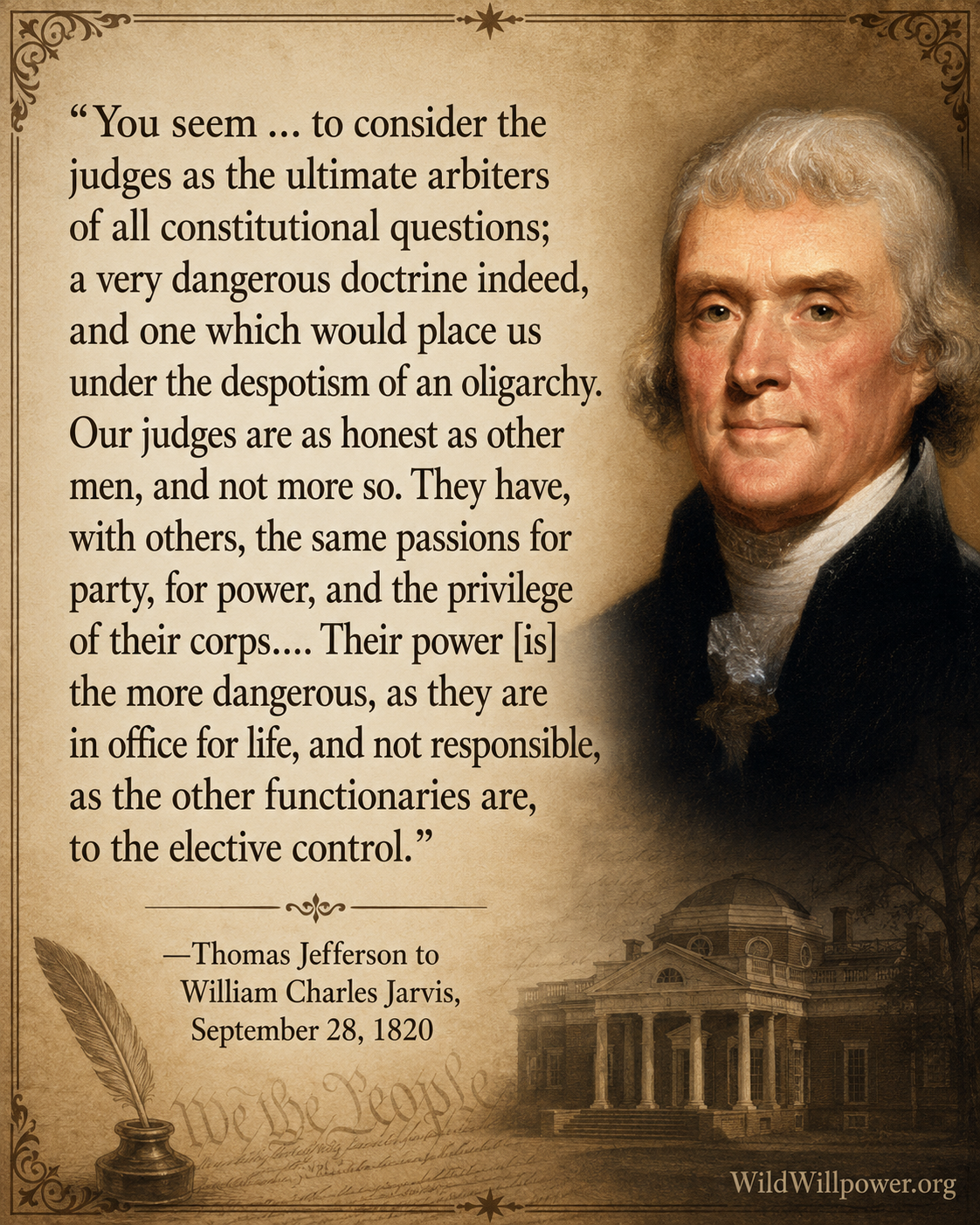
Jefferson’s warning was not that judges are uniquely dishonest. It was that judges are human and subject to the same institutional loyalties, ambitions, and desires for power as everyone else. Judicial independence is essential—but independence without meaningful accountability can become insulation.
When immunity applies even where malicious or corrupt conduct is alleged, the public is entitled to ask a basic question: What meaningful remedy remains for the person who was harmed?
When Judicial Independence Becomes Institutional Insulation
The danger is not simply that a judge may make an erroneous decision. Human beings make errors, and appellate courts exist in part to correct them. The deeper danger is institutional: broad immunity can protect not only good-faith legal error, but conduct alleged to be malicious, corrupt, arbitrary, or deliberately abusive—while leaving the injured citizen without a realistic remedy.
Historically, courts have called certain grossly unsound or arbitrary decisions “abuses of discretion.” The phrase itself recognizes that discretion is not unlimited. Judicial authority must be exercised honestly, legally, reasonably, and for purposes supported by the evidence. Discretion exercised through whim, caprice, bad motive, or an end unsupported by reason ceases to serve justice.
Yet precedents developed and preserved by the judiciary have created broad immunity doctrines that can prevent allegations of intentional wrongdoing from ever producing civil accountability. The institution thereby defines the scope of its own authority, interprets the limits of that authority, and develops doctrines protecting those who exercise it. Even where those doctrines began with legitimate concerns about judicial independence, their cumulative effect can become a level of professional insulation fundamentally incompatible with government accountable to the people.
Immunity does not automatically prove misconduct, and removing all protection from judges would create dangers of its own. Judges must be protected from personal retaliation, harassment, and lawsuits filed merely because one party disliked a lawful ruling. But protection from harassment should not become protection for deliberate injustice. Iowa needs reasonable guardrails that preserve decisional independence while distinguishing good-faith legal error from knowing, malicious, corrupt, or constitutionally forbidden conduct.
When the law provides no meaningful distinction, the public is asked to trust that power will not be intentionally abused simply because those exercising it are judges.
The founders of this country did not design republican government around unquestioning trust in any office. They divided power because every human institution is capable of error, ambition, faction, and abuse.
Professional Doctrine Is Not the Same as Public Consent
Most Iowans do not have the time, legal education, subscription databases, or financial resources required to trace the origins of immunity doctrines through generations of judicial opinions. They are working, farming, raising families, caring for relatives, running businesses, serving their communities, and trying to survive. Many will never know these doctrines exist until they enter a courtroom seeking help and opposing counsel invokes them as a reason the alleged misconduct cannot produce a remedy.
That creates a profound democratic imbalance. The legal profession develops, interprets, teaches, and repeatedly invokes doctrines that ordinary citizens may never have heard of, while the people who bear their consequences are effectively expected to research and challenge them one case at a time.
Attorneys can locate these precedents at will, deploy them in dismissal motions, and bill for the work. The person whose claim is defeated may leave court without relief, without a clear understanding of what happened, and sometimes facing demands that they pay part of the opposing side’s legal expense.
I am not neutral about that arrangement. A doctrine does not become just merely because it has been repeated for decades, embedded in precedent, or accepted within a profession whose members possess the specialized knowledge required to invoke and navigate it. When a body of law protects governmental actors from accountability while remaining practically invisible to the public, the answer cannot be to tell ordinary Iowans that they should have understood the machinery before entering it.
Nor should Iowa depend exclusively upon the legal profession to volunteer reforms to doctrines that give that profession extraordinary control over access, interpretation, procedure, and remedy.
Professional familiarity with a doctrine is not public consent to it.
Judges and attorneys possess indispensable knowledge and must be part of the discussion, but they cannot be the only participants.
A Remedy That Exists Only at Prohibitive Cost Is Not Meaningfully Accessible
Some may respond that an injured person should simply sue every government official individually.
Consider what that means in practice. A case challenging coordinated action by dozens of officials may require identifying every proper defendant, preparing an original notice for each, arranging service across multiple counties, paying service fees, tracking returns, addressing failures of service, and responding to separate appearances and defenses. Each official may be represented separately or through publicly funded legal resources, while the injured citizen must finance service and manage the multiplying litigation alone.
In litigation involving approximately one hundred officials, service costs alone could reach thousands of dollars before the court considers a single underlying fact. That does not include filing fees, records, transcripts, copying, travel, discovery, expert assistance, or the time required to litigate against scores of represented defendants.
A nominal cause of action is not meaningfully accessible when invoking it requires resources far beyond those possessed by the people most likely to need its protection.
Respondeat superior and governmental liability are therefore not merely abstract doctrines. They address a practical question: when government acts collectively through many officials, must the injured citizen chase every individual actor through a maze of separate proceedings—or may the government itself be required to answer for the exercise of governmental power?
The Right to Petition Becomes Hollow Without a Meaningful Path to Redress
The American system was founded upon opposition to government power that denied accountability and redress.
The First Amendment protects
“the right of the people peaceably to assemble, and to petition the Government for a redress of grievances.” [17]
Section I traced how the failure of meaningful redress became one of the grievances leading to American independence. The Constitution later expressly protected the people's right to petition government for redress.
But the practical promise of that right becomes dangerously hollow if government may receive a grievance and then invoke sovereign, judicial, or absolute immunity to prevent any institution from examining the alleged wrongdoing or providing an effective remedy.
The right to petition for redress means considerably less if the legal system forecloses the redress being sought before the facts can be heard.
The Present System Creates Layered Confusion
Under the present system, an injured person may be expected to determine:
whether the proper defendant is the State, a county, a city, an agency, or an individual official;
whether the official must be sued in an official capacity, an individual capacity, or both;
whether the person is technically an employee, officer, agent, contractor, appointee, or some other governmental actor;
whether the alleged conduct occurred within the scope of governmental duties;
whether a special notice or administrative claim is required;
where and how each defendant must be served;
which immunity doctrine may be asserted;
and whether a remedy survives after those doctrines are applied.
Those distinctions may be familiar to attorneys. They are not reasonably understandable to most citizens encountering the justice system for the first time.
A person may know exactly who caused the harm and still lose the case because the wrong legal capacity was written after a defendant’s name, the incorrect governmental entity was selected, or every individual actor was not separately served.
That is not meaningful access to justice.
It is layered procedural confusion standing between an injury and a remedy.
One Government Claim — Not a Maze of Defendants
Wild Willpower proposes a simpler and more accountable structure.
When unlawful harm is allegedly caused through governmental authority, the injured person should be able to:
1.) name the responsible State or governmental body as a defendant;
2.) identify the officials, employees, agents, contractors, appointees, or other governmental actors whose conduct is at
issue;
3.) serve process through a designated governmental office;
4.) obtain the relevant government records through discovery;
5.) present evidence concerning what occurred;
6.) and receive a judicial or jury determination of responsibility.
The citizen should not be required to finance separate service upon numerous officials merely to preserve the possibility that one of several complicated capacity classifications may later prove correct.
This would substantially reduce the cost of beginning a case. It would also prevent government from defeating potentially valid claims through technical arguments about which public actor was sued in which capacity before the underlying evidence has been examined.
The courthouse should not function like a guessing game in which an injured citizen must select the correct defendant, capacity, doctrine, and service method before being allowed to ask what the government did.
Government Responsibility Through Respondeat Superior
The reform would apply a clear form of governmental responsibility based upon the principle of respondeat superior: when people act through a larger institution and within the work entrusted to them, the institution answers for the resulting conduct.
Iowa law already recognizes respondeat-superior principles in other settings, including statutory provisions addressing employer liability for conduct occurring within the course and scope of employment.
Government should not receive a broader escape from responsibility than private institutions receive.
Under Wild Willpower’s proposal:
— conduct undertaken within the lawful or apparent scope of governmental work would create a path to liability against the
responsible governmental body;
— the government could identify whether it contends that an actor departed from assigned duties or lawful authority;
— the parties could obtain evidence concerning training, supervision, policies, instructions, authority, and scope of duties;
— and the court or jury could determine where legal responsibility belongs.
The government should not be permitted to use an official’s authority when it benefits the State, then characterize the same person as legally disconnected from the State when that authority causes harm.
If the government contends that the person acted outside the scope of official authority, that should be a question resolved through evidence—not an immunity label imposed before meaningful factual development.
Service Through the Government
Service of process should be simple, centralized, and affordable.
A citizen alleging harm by numerous government actors should not have to locate and separately serve every official, employee, agent, contractor, or officeholder before obtaining access to the facts.
Under this proposal, service upon the designated governmental office would provide notice to the governmental body and to the identified actors whose conduct is challenged. The government would then be responsible for notifying those persons, preserving relevant records, identifying their employment or agency relationships, and disclosing which actors it contends were acting within or outside the scope of governmental authority.
This would accomplish the legitimate purpose of service—fair notice—without turning service expenses and technical classifications into barriers to redress.
Government already possesses the employment files, organizational records, addresses, chains of command, contracts, and internal information needed to identify its own personnel.
The injured citizen should not bear the cost of reconstructing the government’s internal structure merely to enter the courthouse.
Due Process Before Immunity
The first question in a government-misconduct case should not be:
“How can the government avoid being sued?”
It should be:
“What happened, what law governed the conduct, and who is responsible?”
Immunity doctrines can presently prevent a case from reaching those questions. A judge may dismiss the action before discovery, before witnesses testify, before disputed records are examined, and before a jury hears the evidence.
The result is not a finding that the alleged misconduct did not occur.
It is a ruling that, even if legally sufficient allegations were made, the selected immunity doctrine prevents the requested remedy.
Wild Willpower’s proposal would reverse that order of priorities.
Evidence should come before insulation.
Responsibility should come before immunity.
Due process should come before dismissal.
The Right to Trial by Jury Shall Remain Inviolate
Iowa Const. art. I, § 9 of the Iowa Constitution states:
“The right of trial by jury shall remain inviolate.”
It also provides that
"No person shall be deprived of life, liberty, or property without due process of law."
A jury is not entitled to disregard governing law. But the General Assembly and the people of Iowa can change Iowa law so that immunity no longer prevents juries from reaching factual disputes that would otherwise be triable.
When material facts are genuinely disputed—what an official did, why it was done, what authority existed, what records were created, whether instructions were followed, and what injuries resulted—those questions should not disappear behind a doctrine that ends the case before factual adjudication.
A legal system cannot call the right to jury trial “inviolate” while preserving state doctrines that make the jury unreachable whenever government is accused of serious wrongdoing.
The jury belongs to the people.
It is one of the principal institutions through which ordinary citizens participate directly in the administration of justice.
When government protects an individual actor from personal liability for conduct performed through governmental authority, the responsible governmental body must remain answerable for the injury.
Responsibility Creates Prevention
Governmental liability would do more than compensate people after they are harmed. It would create an institutional incentive to prevent harm before it occurs.
When the State bears legal and financial responsibility for misconduct performed through governmental authority, it has stronger reasons to:
- hire qualified personnel;
- provide accurate legal and constitutional training;
- supervise employees and agents;
- preserve records;
- investigate credible complaints;
- correct unlawful practices;
- remove officials who repeatedly abuse authority;
- and establish safeguards against foreseeable violations.
Under broad immunity, the cost of misconduct may fall almost entirely upon the injured citizen.
Under governmental responsibility, the institution that selected, trained, empowered, supervised, and retained the actor has an incentive to prevent the injury.
Government should not be rewarded for inadequate training, negligent supervision, institutional indifference, or the preservation of abusive practices.
Good-Faith Public Service Does Not Require Government Impunity
Disrecognizing immunity doctrines where they would otherwise displace rights does not mean that every disagreement with a government decision becomes a successful lawsuit.
A plaintiff would still have to establish:
- a legally recognized duty or right;
- actionable conduct;
- causation;
- injury;
- jurisdiction;
- compliance with applicable procedural requirements;
- and entitlement to a lawful remedy.
Government defendants would still be able to contest the allegations, present evidence, dispute causation, assert that the conduct was lawful, challenge damages, and seek judgment when the evidence is legally insufficient.
Judges would still decide questions of law.
Juries would still decide appropriate disputed questions of fact.
Appellate courts would still review legal error.
What would change is the availability of immunity as a threshold escape from factual and legal accountability.
The government would win when the law and evidence support the government—not merely because the identity of the defendant triggers a doctrine that prevents the case from being heard.
Public officials exercise powers ordinary citizens do not possess. Greater power should therefore bring greater—not lesser—accountability.
The legality of governmental conduct should be determined by law and evidence—not by the status, title, profession, or institutional protection of the person who exercised the power.
Enact the Remedy in Law
This reform should not end with a commission report or a recommendation that courts voluntarily reconsider doctrines they created and preserved.
The proposal is to enact a clear statutory remedy—and, where necessary, pursue constitutional reform—directing Iowa courts to disrecognize Iowa-controlled immunity and privilege doctrines where their application would otherwise displace protected rights, meaningful adjudication, or redress.
The legislation should:
1.) create an express cause of action against the State and other Iowa governmental bodies for unlawful harm caused through governmental authority;
2.) permit plaintiffs to identify responsible individuals without requiring separate individual-capacity lawsuits as the only possible route to relief;
3.) establish centralized and affordable service through the responsible governmental body;
4.) apply governmental responsibility and respondeat-superior principles to employees, officials, officers, agents, contractors, appointees, and others exercising delegated public authority;
5.) require government to disclose whether it contends each identified actor acted within or outside the scope of governmental authority;
6.) prevent Iowa-controlled immunity doctrines from defeating the cause of action before appropriate factual development;
7.) preserve access to discovery, judicial review, and jury trial where legally triable factual disputes exist;
8.) provide effective damages, declaratory relief, injunctive relief, correction of government records, and other remedies appropriate to the injury;
9.) require preservation of relevant government records once misconduct is reported or litigation is reasonably foreseeable; and
10.) prohibit the government from using immunity to leave an injured person without any responsible defendant.
Once such a law is validly enacted, the legal question changes.
A court would no longer ask whether an older Iowa immunity doctrine extinguishes the claim. It would apply the remedy created by the people’s elected representatives.
The rule would be written.
The cause of action would exist.
The proper governmental defendant would be identified.
Service would be simplified.
The evidence could be obtained.
Due process could proceed.
Iowa is still a relatively young state within a relatively young nation. This is not the time to fall asleep at the wheel or surrender to the belief that institutional injustice is too entrenched to repair. Iowa is a state of farmers, builders, engineers, veterans, service members, innovators, and working people accustomed to confronting difficult problems. Generations before us preserved an opportunity for self-government that many people throughout history never possessed—and for which many sacrificed their lives.
The question is therefore not whether Iowans should act when a public institution becomes inaccessible or unaccountable. The question is how we will act responsibly, constitutionally, and effectively.
That principle is one reason justice reform became central to my gubernatorial platform.
A Public Process for Putting the Reform Into Law
As governor, I will convene an open, evidence-based process to determine how Iowa can most effectively implement this reform through legislation, court-rule changes where appropriate, and constitutional amendment where necessary.
That review would examine not only judicial immunity, but judicial-process immunity, absolute privilege, procedural precedents, barriers confronting self-represented litigants, and accountability mechanisms that may no longer serve the public good. It would invite testimony from judges and attorneys—but also from self-represented litigants, crime victims, civil-rights complainants, constitutional scholars, veterans, workers, farmers, small-business owners, and other Iowans whose experience with the justice system rarely becomes part of the rulemaking record.
The purpose would not be to place pending cases before a political tribunal or subject judges to retaliation whenever someone dislikes a ruling. It would be to place the doctrines themselves before the public: where they came from, whom they protect, what harms they prevent, what harms they permit, and whether their present scope is compatible with the constitutional promise that government exists for the people’s protection, security, and benefit.
The review should identify which protections are genuinely necessary for decisional independence and which doctrines have grown so broad that they deny remedies even where malicious, corrupt, or knowingly unconstitutional conduct is alleged. Its recommendations could be submitted to the General Assembly for prospective legislation, referred to the judiciary for court-rule reform, or—where constitutional limitations require it—developed into a proposed constitutional amendment for consideration by the people.
The process would examine the practical operation of judicial immunity, judicial-process immunity, absolute privilege, procedural precedents, and related barriers in order to determine how replacement rules should be structured. It should identify the protections necessary for good-faith decisional independence, the remedies necessary when governmental power causes unlawful harm, the appropriate standards of proof, and the statutory or constitutional changes necessary to give those principles force of law.
Accountability Without Destroying Judicial Independence
Reform need not mean imposing personal liability every time a judge is reversed. Ordinary legal error, good-faith interpretation, and unpopular but lawful decisions require substantial protection. A carefully designed system could use demanding evidentiary thresholds, independent screening, declaratory or equitable relief, transparent disciplinary reporting, and narrowly defined remedies for conduct proven to be malicious, corrupt, knowingly unconstitutional, deliberately abusive, or wholly outside legitimate judicial authority.
But reform cannot leave the injured citizen without any remedy at all.
In Wilson v. State of Iowa and Kim Reynolds for Iowa, I invoked the doctrine of respondeat superior. Black’s Law Dictionary defines it as the doctrine holding an employer or principal liable for wrongful acts committed by an employee or agent within the scope of employment or agency. [21] My later motion to reconsider described the State as the principal and the officials exercising state authority as its agents.
The doctrine does not mean that an employer is responsible for every private act of an employee. “Scope of employment” generally concerns conduct undertaken in furtherance of the employer’s business or within the duties assigned to the employee. Conduct entirely outside that scope ordinarily presents a different question.
The State nevertheless argued that judicial immunity extended beyond the individual judge:
“Based on the contents of Plaintiff’s Amended Petition and as a matter of law, Judge Van Marel—and, by virtue, the State—is absolutely immune from Plaintiff’s claims.”
Defendant State of Iowa’s Motion to Dismiss Amended Petition, filed July 26, 2024; D0031, p. 14.
I answered that argument directly:
“While judges in fact have been granted absolute immunity by the state, the State is not, as the State argued, ‘by virtue’, also immune. If the State grants immunity to Judges—even for malicious acts, the State in such cases thereby assumes liability for such malicious acts…. In fact, ‘by virtue’ the state is liable, for it would be without virtue to deny redress to individuals who are harmed by rights violations and crimes performed by judges.”
Plaintiff’s Omnibus Resistance and Motions, filed August 5, 2024; D0032, pp. 35–36.
The district court later characterized one of my positions as the argument that “the state should assume the liability of judicial officers who are immune from civil liability,” but concluded that the State’s immunity arguments were supported by legal authority and dismissed the claims with prejudice.
Central factual questions remained disputed, but the claims were dismissed on threshold legal grounds before any jury could examine the underlying record.
That sequence matters democratically. When judicially developed doctrines prevent due process from ever taking place, the doctrines themselves may remain practically invisible to the public. There is no public trial, little media attention, and no real verdict—only a ruling that uses court-produced case law -made law to deny citizens due process, a fair trial, or opportunity for redress.
The question is not whether judges should disregard law. It is whether Iowa’s law has become so protective of governmental authority that citizens are systematically prevented from examining serious allegations through the institution the Iowa Constitution describes as inviolate.
This leaves a fundamental problem. If the judge is immune because Iowa has chosen to protect decisional independence, and the State is then declared immune “by virtue” of the judge’s immunity, the person allegedly harmed can be left without any defendant from whom redress may be obtained.
There is nothing virtuous about immunity flowing in every direction while accountability disappears.
Iowa should adopt a clear principle:
when the law forecloses personal liability against the official exercising governmental power, it must preserve an effective remedy against the governmental body responsible for that exercise of power.
Moreover:
a judge shall not deny claims "with prejudice" when when a citizen alleges a potential claim.
Such a denial, made by one individual (a judge) against the rights of another, when the citizen could easily be afforded reasonable time and instruction to re-draft their petition in a manner more suitable to the court, is a violation of the citizen, by the judge.
Since the court, legislature, and governors created a labyrinth of case law and procedure—most of which was developed long before anyone alive today was born, the least they could do is be helpful and at least show they care about the rights of citizens to make just rulings, instead of hiding behind an arsenal of case law used to deny citizens redress for harms caused by state actors.
Government must obey the law. Government must answer when it violates the law. And no person harmed through governmental power should be denied a meaningful path to redress merely because the wrongdoer served the government.
Petition to Enact This Reform
I know that earlier in the article I promised a petition, and I do intend to add one here. However, to my knowledge that is no online platform that allows me to embed a petition on this website, which would only be able to be signed by Iowans. Although some platforms, such as MoveOn.org, for example, do allow such petitions, those platforms are open for citizens from any state to sign.
Therefore Wild Willpower PAC is currently seeking a developer to assist in creating such a platform. It must be designed so that Iowans may scan their ID, their voter status may be verified, and they are then able to log in to the platform and sign petitions created by and for Iowans.
If elected for Governor of Iowa, I will commission the development of such a platform, so that it may be directly connected to the Iowa Secretary of State's Office, so that voter registration can directly be connected. That would be the most efficient way to make real reform possible, however at this time I am instead performing my work through Wild Willpower. If you appreciate the many years of time and energy it took to build this website, please consider offering a campaign contribution.
Because Republican actors recently removed gender identity from the Iowa Civil Rights Act, and because I am now fully aware that the Iowa Civil Rights Commission aids and abets businesses who discriminate against protected classes, the work I am doing through this site, and the private donations I may receive (which have been meager), are my only means of survival.
I am 44 years old, have no money put away, have endured more than two decades of homelessness and suffering as a result of actions performed by government officials here in the state, and as of today, I still have not found justice or been afforded any sign of remorse or compassion by state officials.
May my work here help us to improve and fix our broken judiciary and state, that no Iowan endures this level of suffering ever again.
Endnotes
[1] See generally The Declaration of Independence paras. 2, 12–30 (U.S. 1776); George Washington and Fairfax County citizens, Fairfax County Resolves (July 18, 1774).
[2] The Declaration of Independence paras. 12–30 (U.S. 1776).
[3] Id. (grievance concerning protection of government forces from punishment for killings committed against inhabitants of the colonies).
[4] National Park Service, Boston Massacre Trial (describing the prosecutions of Capt. Thomas Preston and the British soldiers following the March 5, 1770 shootings).
[5] Id. Captain Preston was acquitted. In the subsequent trial of eight soldiers, six were acquitted and Hugh Montgomery and Matthew Kilroy were convicted of manslaughter. See also John Adams, closing argument in the Boston Massacre trial proceedings (1770).
[6] Administration of Justice Act, 14 Geo. III c. 39 (1774). The statute was one of Parliament's Coercive Acts enacted following the Boston Tea Party.
[7] Id. § 1. The Act authorized removal of certain prosecutions involving magistrates, customs officers, soldiers, and others acting in suppression of riots or enforcement of revenue laws where the governor concluded an impartial trial could not be obtained in Massachusetts.
[8] George Washington to Bryan Fairfax, July 4, 1774, in The Papers of George Washington, Colonial Series, vol. 10, discussing legislation permitting trials to be removed to another colony or Great Britain and questioning the possibility of obtaining justice under such circumstances.
[9] Fairfax County Resolves, no. 10 (July 18, 1774), in The Papers of George Washington, Colonial Series, vol. 10, describing legislation concerning Massachusetts as providing for the “protection and Encouragement of Murderers.”
[10] Sondra Wilson, Unjust Iowa: Third Treatise of Civil Government (forthcoming 2026), discussion of the Administration of Justice Act and the collapse of meaningful jurisdiction and redress.
[11] The Declaration of Independence paras. 12–30 (U.S. 1776).
[1] The Declaration of Independence para. 2 (U.S. 1776) (“Governments are instituted among Men, deriving their just powers from the consent of the governed” and recognizing the people's right to “alter or to abolish” government destructive of those ends).
[2] Iowa Const. art. I, § 2 (“All political power is inherent in the people. Government is instituted for the protection, security, and benefit of the people, and they have the right, at all times, to alter or reform the same, whenever the public good may require it.”).
[3] Chisholm v. Georgia, 2 U.S. (2 Dall.) 419, 454–55, 471–72 (1793) (opinions of Wilson, J., and Jay, C.J.). Chisholm held that Article III permitted a citizen of one State to sue another State in federal court. The decision's jurisdictional result was subsequently altered by ratification of the Eleventh Amendment.
[4] See generally William Blackstone, Commentaries on the Laws of England; James VI & I, The True Law of Free Monarchies (1598). The concepts of royal immunity and divine-right monarchy are historically related but analytically distinct: the former concerns the sovereign's legal amenability to suit and judgment; the latter concerns the asserted source and legitimacy of royal authority.
[5] Chisholm v. Georgia, 2 U.S. (2 Dall.) 419 (1793); U.S. Const. amend. XI. The Eleventh Amendment provides that federal judicial power shall not extend to certain suits against a State brought by citizens of another State or by citizens or subjects of a foreign state.
[6] Hans v. Louisiana, 134 U.S. 1 (1890).
[7] Sondra Wilson, Unjust Iowa: Third Treatise of Civil Government (forthcoming 2026), § 110 and accompanying discussion of majority rule, individual rights, and popular sovereignty.
[8] District of Columbia v. Heller, 554 U.S. 570, 595, 628–36 (2008).
[9] McDonald v. City of Chicago, 561 U.S. 742, 750, 767–91 (2010).
[10] New York State Rifle & Pistol Ass'n, Inc. v. Bruen, 597 U.S. 1, 8–11, 17–31, 70–71 (2022).
[11] Sondra Wilson, Unjust Iowa: Third Treatise of Civil Government (forthcoming 2026), “Method and Scope: What This Book Does—and Does Not Do,” explaining the work's examination of how “legal doctrines, professional institutions, and administrative systems develop across generations” and how doctrines governing authority and accountability “emerge, persist, and transform.”
[12] Id. The manuscript distinguishes rapid changes in political authority from the gradual evolution and persistence of institutional structures and legal doctrines and traces the historical development of sovereignty, immunity, and accountability across institutional systems.
[13] Marbury v. Madison, 5 U.S. (1 Cranch) 137, 176–80 (1803) (explaining the supremacy of a written constitution over ordinary governmental acts and holding that an enactment repugnant to the Constitution is void).
[14] Marbury v. Madison, 5 U.S. (1 Cranch) 137, 163 (1803) (“The government of the United States has been emphatically termed a government of laws, and not of men” and explaining that the appellation fails where the laws furnish no remedy for violation of a vested legal right).
[15] Thomas Aquinas, Summa Theologiae, I–II, q. 96, art. 4; see also Augustine, De Libero Arbitrio, bk. I. The maxim lex iniusta non est lex—“an unjust law is not law”—is commonly associated with the Augustinian and Thomistic natural-law tradition. Aquinas's formulation is more nuanced: profoundly unjust enactments are treated as perversions of law rather than law in its fullest or unqualified sense.
[16] See Marbury, 5 U.S. (1 Cranch) at 177–80. The proposition stated in the text is a paraphrase of Marbury's constitutional-supremacy reasoning, not a quotation from the Court.
[17] Hans v. Louisiana, 134 U.S. 1, 10–21 (1890). The Eleventh Amendment expressly refers to suits against a State by citizens of another State and by citizens or subjects of foreign states. Hans applied state sovereign immunity to a suit brought by a State's own citizen. See U.S. Const. amend. XI.
[18] Wilson, Unjust Iowa, § 109–110 and accompanying discussion: “The existence of a law does not settle its legitimacy. Its conformity to rights does.”
[19] Id.: “The Revolution did not replace a king with a majority. It placed both under law.”
[20] Chisholm v. Georgia, 2 U.S. (2 Dall.) 419, 454 (1793) (Wilson, J.); see also Wilson, Unjust Iowa, ch. 1, §§ 1–2 (discussing the Founding-era relocation of sovereignty from rulers to the people).
[21] Hans v. Louisiana, 134 U.S. 1 (1890).
[22] U.S. Const. amend. XI. Congress approved the proposed amendment on March 4, 1794; ratification was completed February 7, 1795, when North Carolina became the twelfth of the then-fifteen States to ratify. President John Adams formally announced in 1798 that the amendment had obtained the constitutionally required ratifications and “may now be deemed to be a part of the Constitution.” The President's approval was not constitutionally required. See U.S. Const. art. V.
[23] U.S. Const. amend. XI.
[24] Hans, 134 U.S. at 9–11.
[25] Id. at 9.
[26] Id. at 10.
[27] Id. at 10–11 (“It is true, the amendment does so read.”).
[28] Id. at 10–11.
[29] Id. at 11.
[30] Id. at 11.
[31] Id. at 11–12.
[32] Chisholm v. Georgia, 2 U.S. (2 Dall.) 419, 454 (1793) (Wilson, J.).
[33] Hans, 134 U.S. at 12.
[34] Id. at 12.
[35] Alexander Hamilton, The Federalist No. 81 (1788), quoted in Hans, 134 U.S. at 12–14.
[36] 3 Jonathan Elliot, The Debates in the Several State Conventions on the Adoption of the Federal Constitution 533, 555 (2d ed. 1836), quoted in Hans, 134 U.S. at 14–15.
[37] U.S. Const. amend. XI.
[38] Sondra Wilson, Unjust Iowa: Third Treatise of Civil Government (forthcoming 2026), ch. 1, § 5, “Overturning Hans: Framework for Restoring Constitutional Redress.”
[39] Id. (“Because the Eleventh Amendment's text leaves suits by a state's own citizens untouched, the constitutional foundation of Hans rests not on textual command but on judicial inference.”).
[40] Hans, 134 U.S. at 15.
[41] Id. at 16.
[42] Id. at 21.
[43] Congressional Research Service, Constitution of the United States of America: Analysis and Interpretation, U.S. Const. amend. XI, “General Scope of State Sovereign Immunity” (explaining that Hans adopted Justice Iredell's position in Chisholm and extended sovereign immunity beyond the plaintiffs expressly identified in the Eleventh Amendment).