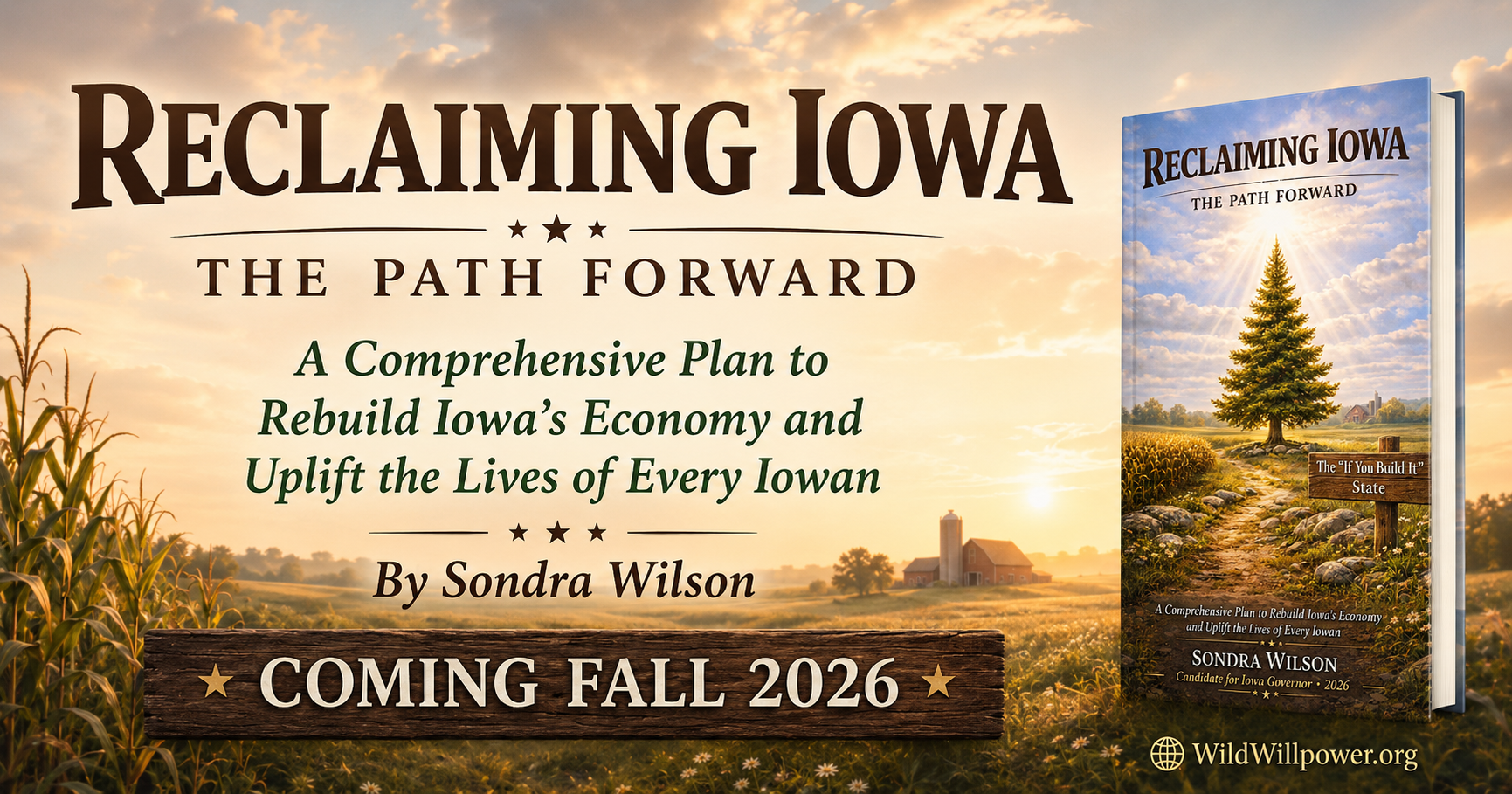
By Sondra Wilson
Anticipated release: October 2026
Iowa does not lack hardworking people, valuable land, natural resources, technical knowledge, or community spirit.
What Iowa lacks is an integrated plan capable of connecting those strengths and directing them toward a shared future.
Reclaiming Iowa: The Path Forward is an in-depth examination of how Iowa can restore public capacity, rebuild local economies, strengthen rural and urban communities, expand access to healthcare and justice, and create durable systems designed to serve ordinary people rather than concentrated private interests.
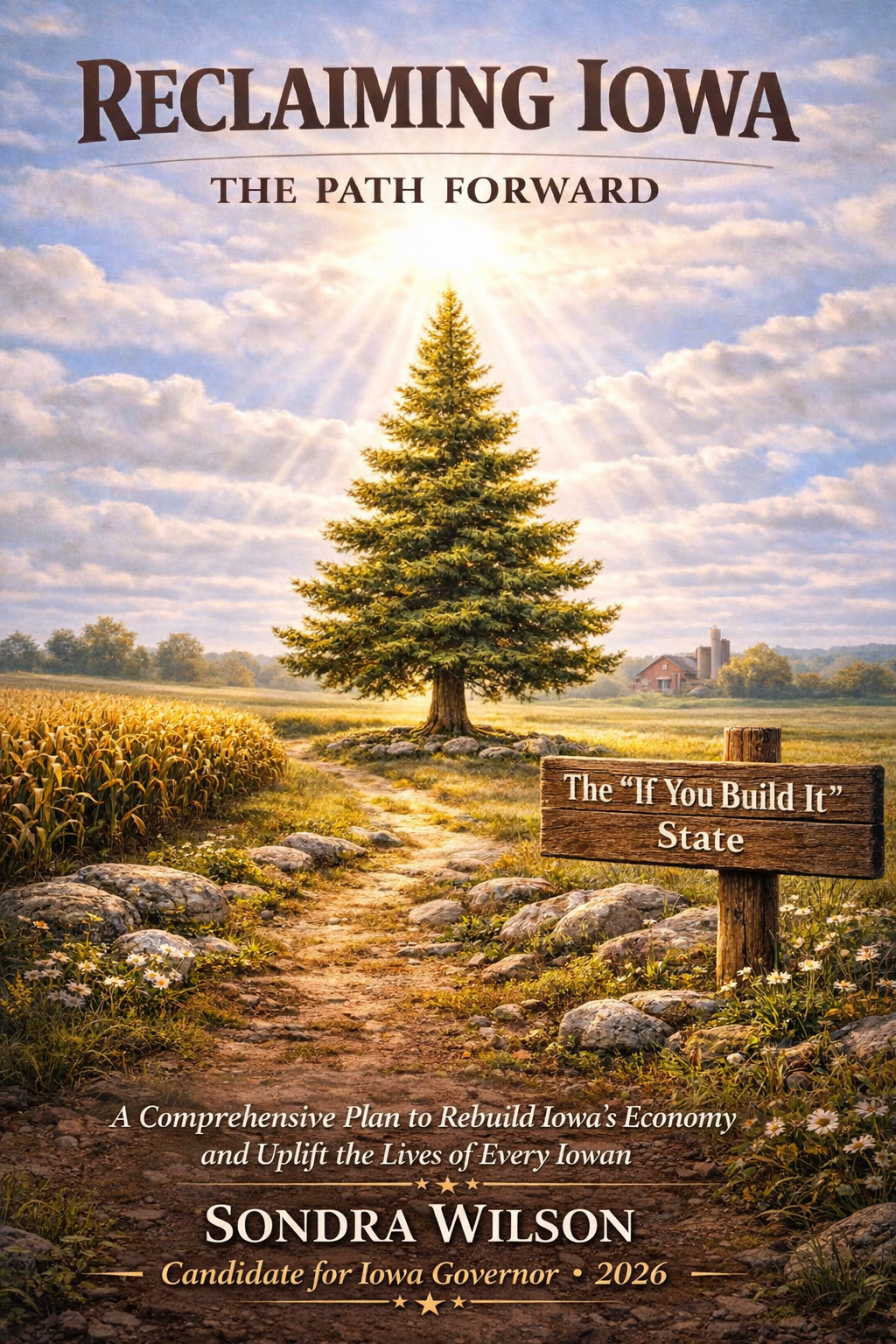
Reclaiming Iowa: The Path Forward presents a comprehensive policy framework for rebuilding Iowa’s economy, public institutions, communities, and systems of democratic accountability.
This is not a collection of campaign slogans or disconnected policy proposals. It is a comprehensive governing framework built around the principle that Iowa’s problems are interconnected—and that its solutions must be interconnected as well.
The current manuscript is several hundred pages long and continues to expand as its legal, economic, environmental, and administrative foundations are developed and reviewed.
From Diagnosis to Reconstruction
Reclaiming Iowa is the constructive sequel to Unjust Iowa: Third Treatise of Civil Government.
The two books examine different sides of the same problem.
Unjust Iowa investigates institutional failure, civil-rights violations, barriers to justice, government accountability, and the ways legal and administrative systems can become detached from the people they are supposed to serve.
Reclaiming Iowa asks what should replace those failures.
Where Unjust Iowa documents what has gone wrong, Reclaiming Iowa develops a path forward: a detailed framework for rebuilding Iowa’s institutions, economy, infrastructure, and public trust.
The two works are intended to be released near the same time and read together:
- Unjust Iowa examines the breakdown.
- Reclaiming Iowa presents the reconstruction.
Together, they form an extensive study of Iowa’s present conditions and a proposal for what the state could become.
A Pretty Big Deal
The central policy framework in Reclaiming Iowa is called A Pretty Big Deal.
The name draws from the historical traditions of Theodore Roosevelt’s Square Deal and Franklin Roosevelt’s New Deal. Those programs responded to periods when concentrated private power, economic instability, failing infrastructure, and diminished public trust required more than minor adjustments.
A Pretty Big Deal is built around three principles:
Reclaim. Restore. Reimagine.
The book argues that government should not merely manage decline or temporarily relieve hardship. It should create durable systems that restore productive capacity, broaden opportunity, protect shared resources, and make public institutions understandable and accountable.
The manuscript describes the proposal not as a set of isolated promises, but as a governing architecture in which each part reinforces the others.
The Four Pillars
The framework is organized around four interconnected pillars.
Civilian Restoration Corps
The proposed Civilian Restoration Corps, or CRC, is a statewide employment, infrastructure, and ecological-restoration framework inspired by the Civilian Conservation Corps and redesigned for modern Iowa.
The CRC would connect public investment with skilled work, local businesses, worker ownership, environmental restoration, housing repair, agriculture, renewable energy, and rural revitalization.
Programs developed within the CRC framework include:
- FarmHire™;
- Trail Trimmers™;
- Pothole Patrol™;
- MycoFuel Engineers™;
- SolarBerry Brigade™;
- Union Energy Works™;
- Iowa FryerForce™;
- Biofuel Mechanics™;
- Gardens Across Iowa™;
- Housing Helpers™; and
- additional statewide restoration and reinvestment initiatives.
These programs are designed to operate as parts of one coordinated system rather than as unrelated agencies or temporary grants. The manuscript explains their proposed legislative authority, governance, workforce structures, and pathways toward long-term local ownership.
Healthcare and Economic Security
The book proposes a two-tiered healthcare framework intended to guarantee essential care while preserving space for private insurance, employer-supported coverage, expanded care, and innovation.
It examines healthcare not only as a moral and medical issue, but as a question of labor, business stability, rural survival, caregiver compensation, and economic resilience.
Education and Civic Capacity
Reclaiming Iowa proposes rebuilding public education as civic infrastructure.
The framework includes legal and civic education, practical skills, environmental stewardship, accessibility, gardening and food-system education, expanded student participation, and new approaches to preparing young Iowans for public and economic life.
Justice as Civic Infrastructure
The fourth pillar addresses access to courts, civil-rights enforcement, legal education, public accountability, corruption, consumer fraud, government transparency, and the structural barriers that prevent ordinary people from effectively asserting their rights.
The book treats justice as infrastructure: something every Iowan should be able to understand, access, and rely upon.
Built as a System
Many political platforms consist of individual promises that compete for funding, attention, and administrative capacity.
Reclaiming Iowa takes a different approach.
Its programs are designed to share infrastructure, circulate resources within Iowa, create pathways into skilled work and ownership, and strengthen one another over time.
Housing policy affects healthcare. Transportation affects employment. Land access affects food security. Legal access affects every other right. Environmental restoration affects public health, agriculture, and local economic stability.
The book is built around the recognition that these systems cannot be repaired separately.
Research, Testing, and Public Accountability
Not every proposal in Reclaiming Iowa is presented as an immediately proven statewide solution.
Some initiatives—particularly those involving emerging technologies, new cooperative structures, biological remediation, alternative fuels, or large-scale administrative reforms—would begin through research programs, phased pilots, independent testing, and transparent public review.
The goal is not to pretend that every detail is already settled. It is to build a framework capable of testing ideas honestly, measuring outcomes, correcting failures, and expanding what works.
Public experimentation should not mean unaccountable experimentation. It should mean clearly defined objectives, public reporting, independent evaluation, safety protections, and a willingness to revise programs when the evidence requires it.
Why the Release Has Been Delayed
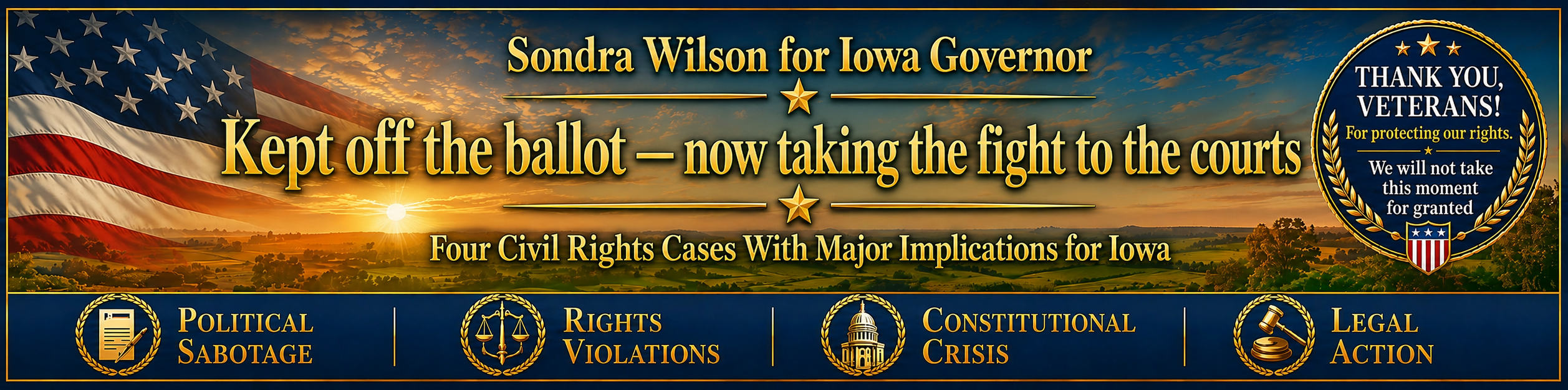
The manuscript has developed alongside ongoing civil-rights litigation and related legal proceedings.
Those cases have required extensive research, briefing, filing, record review, and appellate preparation. Because many of the issues raised in that litigation concern access to justice, government accountability, administrative power, and civil-rights enforcement, they also directly inform the broader institutional analysis underlying both Unjust Iowa and Reclaiming Iowa.
The legal work must presently take priority when court deadlines require it.
Once the immediate filing obligations are brought under control, work on the final manuscript, citations, editing, and publication will resume.
The current anticipated release window is September or October 2026, although the date may change if litigation deadlines or necessary revisions require additional time.
[INSERT LINKS TO CURRENT CIVIL-RIGHTS CASES HERE]
Suggested introductory line above the case links:
Readers who wish to understand the ongoing legal work affecting the publication schedule may review the current case materials and public updates below.
The Companion Volume: Unjust Iowa
[OPTIONAL: INSERT UNJUST IOWA COVER OR PREVIEW IMAGE HERE]
Unjust Iowa: Third Treatise of Civil Government is the companion volume to Reclaiming Iowa.
It examines civil-rights enforcement, access to justice, legal inequality, administrative misconduct, institutional self-protection, and the practical consequences of a system in which rights may exist on paper but remain inaccessible in practice.
While Reclaiming Iowa is oriented toward public reconstruction, Unjust Iowa is investigative and diagnostic.
Both books are comprehensive works, each approaching approximately 500 pages as research, documentation, and supporting materials are completed.
They are intended to serve not merely as political books, but as reference works for Iowans, journalists, advocates, educators, policymakers, attorneys, students, and anyone seeking to understand how public systems fail—and how they might be rebuilt.
A Living Public Framework
Although the book is written by Sondra Wilson, the ideas within it are not intended to remain the property of one candidate, campaign, organization, or election cycle.
The broader goal is to give Iowans a detailed framework they can examine, challenge, improve, adapt, and ultimately make their own.
Reclaiming Iowa does not ask readers to accept every proposal without question. It asks them to engage with a complete model rather than settle for another election defined by slogans, personalities, and isolated promises.
The future of Iowa should not be designed behind closed doors and presented to the public after the important decisions have already been made.
It should be built openly.
It should be debated honestly.
And it should belong to the people who will live with the results.
Publication Updates
This page will be updated as the manuscript moves through final research, factual review, citation checking, editing, layout, and publication.
Anticipated release: September or October 2026
[OPTIONAL BUTTON: Receive Publication Updates]
[OPTIONAL BUTTON: Read the Current Wild Willpower Platform]
[OPTIONAL BUTTON: Review the Civilian Restoration Corps Framework]