
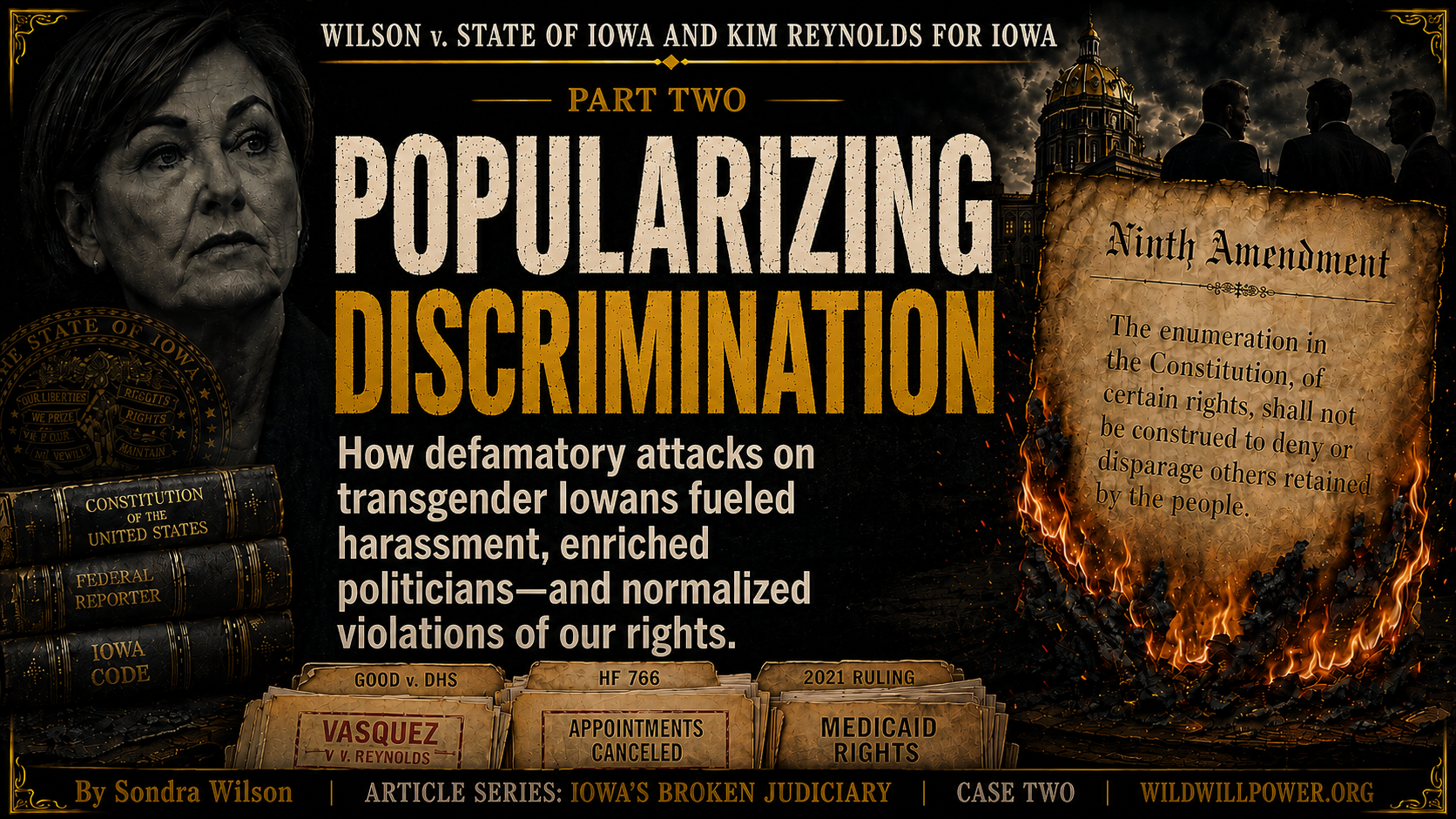
Wilson v. State of Iowa and Kim Reynolds for Iowa:
Popularizing Discrimination
How defamatory attacks against transgender Iowans fueled harassment, enriched politicians—and normalized rights violations of our rights.
By Sondra Wilson | Updated August 8, 2026
This article is part of the Iowa's Broken Judiciary series.
It is also Part Two of Wilson v. State of Iowa and Kim Reynolds for Iowa.
I. The Human Context
Before anyone calls gender-affirming surgery “elective,” I want them to understand what that word sounds like to someone who spent much of her adult life trying simply to survive.
I did not choose to be intersex.
I did not choose to develop female secondary sex characteristics during puberty.
I did not choose the gender dysphoria that followed.
And when, as a young adult, I finally sought medical treatment, I had no idea how much of the rest of my life would be shaped by other people’s reactions to that decision.
The preceding Intersex in Iowa series documents only part of what followed: arrests I contend were made under false pretenses, prosecutions I contend were malicious, a conviction entered despite exculpatory testimony, and an off-the-record warning from a police officer that caused me to leave Iowa because I feared for my safety.
What I have not yet written in full are all the years between those events and this lawsuit.
The violence.
The verbal abuse.
The menacing looks.
The street harassment.
The assaults.
The theft of the few possessions I had while homeless.
The instability.
The workplace treatment.
The experience of having almost nothing while knowing that even ordinary employment could mean entering another environment where someone might decide that my body, my identity, or my medical history made me fair game for ridicule or mistreatment.
The experience of meeting a man who might genuinely like me—but might also be terrified of what his family or friends would think if they knew.
And the experience of hearing people say:
“If you want surgery, pay for it yourself.”
That statement assumes society first gives a person a fair opportunity to earn and save the money.
Seventeen Years of Homelessness Changes the Meaning of the Word "Elective"
My amended petition told the court that I endured homelessness for approximately seventeen years.
Seventeen years.
There were periods when survival itself was an accomplishment.
People who have never experienced gender dysphoria can speak about gender-affirming surgery as though it were a cosmetic upgrade—a frivolous desire comparable to changing one’s appearance for vanity.
They do not inhabit the body.
They do not experience the dysphoria.
They do not know what it is like to look toward adulthood and wonder whether you will ever be able to live comfortably enough in your own body to experience ordinary love, intimacy, employment, safety, belonging, or peace.
And they often overlook something else:
“Pay for it yourself” assumes society first allows you a fair opportunity to earn and save the money.
If a person is pushed out of employment, harassed in public, denied housing, estranged from family, impoverished, assaulted, repeatedly destabilized, or left without meaningful protection from discrimination, then pointing to the poverty produced by those conditions and saying “See? You cannot afford treatment” becomes viciously circular.
First make ordinary life harder.
Then make medical care financially inaccessible.
Then call the care “elective.”
Then blame the patient for being unable to afford it.
That was the trap I had spent much of my adult life inside.
Then came 2019.
II. The Legal Turning Point: Good v. Department of Human Services
I had returned to Iowa hoping to start again—hoping things had blown over since the officer's warning to leave the state back in 2009.
After years of homelessness, violence, harassment, robbery, estrangement, and instability, I had come home hoping that the hostility I remembered from earlier years had finally subsided.
Then the Iowa Supreme Court decided Good v. Iowa Dep't of Hum. Servs., 924 N.W.2d 853 (Iowa 2019).
For many Iowans, it was a ruling people groaned at—that they were angry with, "I don't want to have pay for other peoples' sex changes! Pay for it yourself!"
For me, I was brought to tears. Private tears for the severe pain I had been carrying for so long, about a very private part of my life.
In Good, the Iowa Supreme Court rejected Iowa Medicaid’s categorical exclusion of medically necessary gender-affirming surgery, stating that the Iowa Civil Rights Act did not allow for exclusion.
For the first time, I could realistically imagine receiving the surgeries I genuinely needed.
Less Than Two Months Later, Republicans Passed HF 766
The relief lasted less than two months.
After Good, Republican legislators and Governor Kim Reynolds enacted HF 766, Division XX.
including a provision specifically permitting Iowa to deny transgender Medicaid coverage.
This article is being assembled. Please check back soon. 8/9/2026
III. Medicaid Rights at the Time I Filed My Case in 2024
Before getting to what my petition said, what the State argued, or how the district court disposed of the case without addressing any of the content, one question must be answered first:
Was I simply inventing the idea that federal medical law protected rights?
No.
The statutes, federal materials, and then-existing Supreme Court precedent all have to be read together.
A. Violating Rights Secured by the Constitution or "laws of the United States" is a Crime
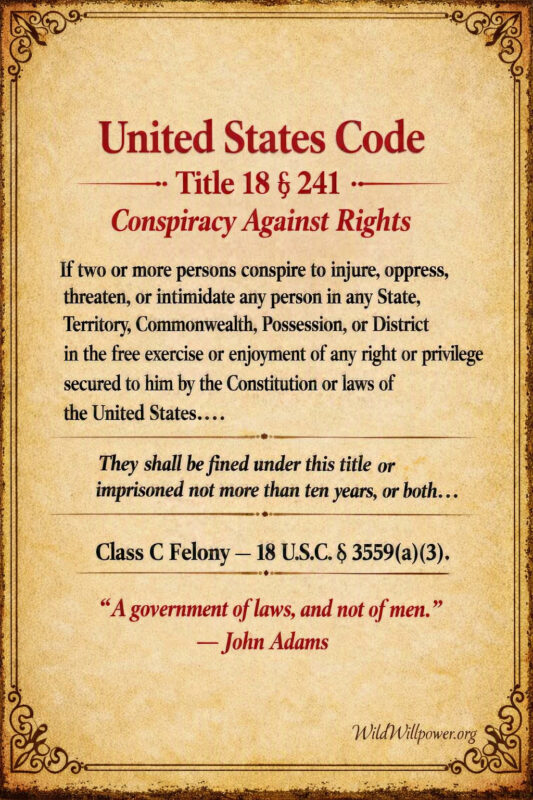
Title 18 of the United States Code ("U.S.C.") is the main federal body of law covering Crimes and Criminal Procedure. 18 U.S.C. §241—Conspiracy against rights sets forth, "
"If two or more persons conspire to injure, oppress, threaten, or intimidate any person in any State, Territory, Commonwealth, Possession, or District in the free exercise or enjoyment of any right or privilege secured to him by the Constitution or laws of the United States.... They shall be fined under this title or imprisoned not more than ten years, or both." [1]
B. "Injury" in Law Does Not Mean Only Physical Injury
18 U.S.C. §241 uses an important word:
“injure.”
In everyday conversation, many people hear “injury” and picture a broken bone, a wound, or some other physical harm.
That is not the only meaning of injury in law.
Black’s Law Dictionary defines legal injury as:
“Violation of a legal right.”

Ballentine’s Law Dictionary likewise defines legal injury as
"An invasion of a legal right; a wrong from which the law imports damage. Allen v Stowell, 145 Cal 666, 79 P 371. An injury for the redress whereof an action will lie."
Ballantine's Law Dictionary, 3rd Ed.
That distinction is essential.
The violation of a legal right is itself a legal injury.
A person therefore does not have to be physically struck before the law can recognize that an injury has occurred.
C. The Social Security Act, and Medicare and Medicaid Acts Included, are "Laws of the United States"
18 U.S.C. §241 also mentions,
"laws of the United States".
This is crucial because when we hear about "Medicaid rights", we are not speaking loosely. Medicaid rights are secured to the American people through a set of "laws of the United States" codified into federal law.
Congress created Medicaid through Title XIX of the Social Security Act as part of the Social Security Amendments of 1965
As the Supreme Court plainly observed in Wilder v. Virginia Hospital Association, 496 U.S. 498 (1990):
"Medicaid is a cooperative federal-state program through which the Federal Government provides financial assistance to States... Although participation in the program is voluntary, participating States must comply with certain requirements imposed by the Medicaid Act and regulations..."
That structural reality provides the vital link in this legal chain: the requirements governing Iowa's Medicaid operations do not originate merely in state policy
They are, quite literally, “laws of the United States.”
That exact phrase matters because Congress used it to define the reach of federal civil-rights enforcement
-
The Civil Action (42 U.S.C. § 1983): Section 1983 provides a civil remedy for the deprivation of rights secured by the Constitution and "laws... of the United States."
-
The Criminal Prohibition (18 U.S.C. § 241): Section 241 relies on that same statutory threshold, criminalizing conspiracies to injure, oppress, threaten, or intimidate any person in the free exercise of rights secured by the Constitution or "laws of the United States."
If a right is secured by an enforceable provision of Title XIX of the Social Security Act—such as the statutory command that eligible individuals obtain covered care from a qualified provider—its federal character does not vanish simply because Iowa acts as the local administrator
It is a legal injury to a right secured under the Social Security Act: a law of the United States
Thus, conspiring to violate an enforceable Medicaid right secured under the Social Security Act is an offense against a right secured by a 'law of the United States' under 18 U.S.C. § 241.
But is a Medicaid right an actual right?
D. The U.S. Supreme Court Has Recognized Medicaid Rights for Decades
Decades before my 2024 case, the United States Supreme Court itself used rights language when discussing Medicaid.
In O’Bannon v. Town Court Nursing Center, 447 U.S. 773 (1980), the Court explained that §1396a(a)(23) gives Medicaid recipients a right to choose among qualified providers without government interference.
That was not language from my petition.
It was not terminology invented by Medicare.gov.
It was the Supreme Court of the United States describing a protection created by federal Medicaid law as a right.
The particular right litigated in O’Bannon was provider choice, not gender-affirming surgery. But the legal proposition matters:
Federal Medicaid law can create rights belonging to Medicaid beneficiaries.
E. Wilder Held That Medicaid Law Created a Substantive Federal Right Enforceable Under §1983
Then came Wilder v. Virginia Hospital Association, 496 U.S. 498 (1990).
There, the Supreme Court considered another provision of the Medicaid Act.
The State argued that the Medicaid provision did not create a right enforceable through §1983.
The Supreme Court rejected that argument.
It held that the Boren Amendment imposed a binding obligation upon participating States and created a substantive federal right enforceable through §1983.
The Court did not say:
Medicaid is merely a funding arrangement, so private federal rights are impossible.
It held the opposite with respect to the provision before it.
Again, Wilder concerned reimbursement rights of health-care providers, not my particular medical treatment.
But when I filed in 2024, it stood as Supreme Court precedent demonstrating an important proposition:
The Medicaid Act could create substantive federal rights enforceable through §1983.
F. The Supreme Court Reaffirmed the Principle Again in 2023
And the year before I filed my Iowa lawsuit, the Supreme Court decided Health & Hospital Corp. of Marion County v. Talevski, 599 U.S. 166 (2023).
Talevski involved rights created by the Federal Nursing Home Reform Act, another federal Spending Clause enactment embedded within the federal Medicaid framework.
The Court held that the provisions before it unambiguously conferred individual rights and permitted the §1983 action to proceed.
That was the federal legal landscape when I filed in February 2024.
Not decades earlier.
2023.
One year before my case.
Thus, at the time I went into an Iowa courtroom, Supreme Court law included:
O’Bannon: federal Medicaid law can give recipients rights against governmental interference.
Wilder: a Medicaid provision can create a substantive federal right enforceable through §1983.
Talevski: Spending Clause legislation can confer individual federal rights enforceable under §1983.
That matters when evaluating what happened next.
F. The Federal Government Was Publicly Calling Medical Access a “Right”
The evidence did not stop at case law.
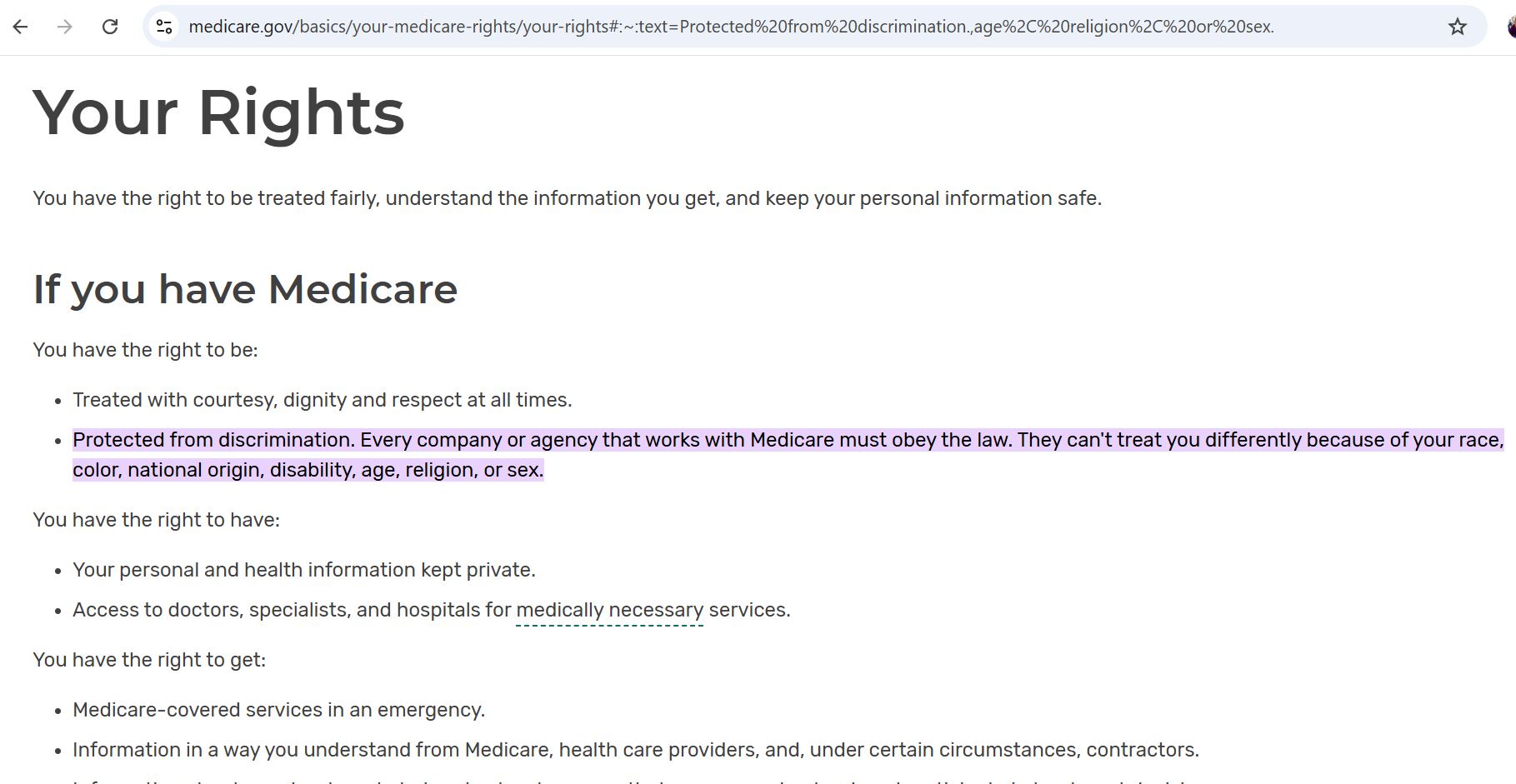
At the time, Medicare.gov maintained a public page titled:
“Your Rights”
It told beneficiaries:
“You have the right to be: Protected from discrimination.”
And:
“You have the right to have: Access to doctors, specialists, and hospitals for medically necessary services.”
I preserved that federal webpage.
The screenshot is not my characterization of federal policy.
It is what the federal government itself was telling beneficiaries.
My preserved copy dates from February 2025, shortly before I filed Wilson v. Trump et al. The public-facing Medicare page was later changed and no longer presents that particular language in the same form. I will return to that chronology in the next article.
For present purposes, the important fact is simpler:
The federal government publicly described medical access as a right.
G. The Ninth Amendment
Then read the Ninth Amendment itself:
“The enumeration in the Constitution, of certain rights, shall not be construed to deny or disparage others retained by the people.”
The Amendment does not say that only rights expressly itemized in the Constitution may exist.
It expressly warns against using the enumeration of certain rights to deny or disparage others retained by the people.
That mattered because the State could not answer the entire federal-rights problem simply by saying:
“Show us where gender-affirming surgery appears word-for-word in the Constitution.”
The Constitution itself rejects the premise that enumeration is exhaustive.
H. Then Read 18 U.S.C. §241
Now put that background beside the federal criminal civil-rights statute.
Section 241 is titled:
Conspiracy Against Rights
Congress made it a federal offense when two or more persons:
“conspire to injure, oppress, threaten, or intimidate any person”
in the free exercise or enjoyment of:
“any right or privilege”
secured by:
“the Constitution or laws of the United States.”
Read those words slowly.
Injure.
A legal injury includes violation of a legal right.
Any right or privilege.
Not merely some narrow list selected by a State.
And then Congress identified the sources:
“the Constitution or laws of the United States.”
Medicaid is federal law.
Federal case law had already recognized enforceable rights arising from Medicaid and other Spending Clause legislation.
The federal government itself was publicly using the language of rights to describe access to medically necessary medical services.
And the Ninth Amendment expressly prohibited construing the Constitution’s enumeration of certain rights to deny or disparage others retained by the people.
That was the legal chain.
Legal right → legal injury → federal law → retained constitutional rights → federal prohibition against conspiracy to interfere with federally secured rights.
This is why my claim cannot fairly be reduced to:
“Plaintiff personally thinks she had a right.”
The word right existed throughout the legal landscape before I ever walked into court.
My amended petition alleged:
“Less than two months after the Supreme Court announced the ruling, Republican Legislators and Governor Reynolds, acting on behalf of the State of Iowa, passed HF766,”
IV. Then Look at What Actually Happened to the Right
The legal framework matters because the injury was not hypothetical.
The Medicaid Exclusion Was Struck Down Again
In November 2021, Polk County District Judge William Kelly struck down the HF 766 provision.
As my amended petition recorded it, the court found the provision:
“discriminatory and unconstitutional”
and concluded that it violated the Iowa Constitution and Iowa Civil Rights Act.
That was the second major judicial ruling against the exclusion.
First came Good.
Then the Legislature and Governor enacted HF 766.
Then another Iowa court struck the resulting exclusion down as discriminatory and unconstitutional.
And still the litigation continued.
My Appointments Were Canceled
My amended petition described the human result:
“My doctor was emotionally shaken up and hurting as she informed me that my surgery consultations had to be canceled as we awaited the Supreme Court’s much anticipated ruling in May 2023.”
Amended Petition ¶48.
The legal vocabulary can make this sound abstract.
It was not.
My medical appointments were canceled.
Years passed.
I remained unable to obtain care.
My petition further stated that I had been barred from scheduling appointments during the period at issue and characterized that as a continuing injury.
I was not studying a hypothetical problem in a law-school classroom.
I was the patient waiting for treatment.
V. At the Same Time, Transgender People Became Politically Profitable Targets
My amended petition named two defendants for a reason.
One was the State of Iowa.
The other was Kim Reynolds for Iowa, Governor Reynolds’ campaign committee.
The State possessed governmental power.
The campaign sought money, votes, political momentum, and reelection.
My petition alleged that those activities did not occur in separate universes.
Governmental efforts restricting transgender rights and political messaging attacking transgender people moved in the same direction.
“Iowans Still Know Boys from Girls”
On October 31, 2022—days before the gubernatorial election—Kim Reynolds for Iowa told voters:
“Iowans still know boys from girls.”
My petition alleged libel per quod.
Libel per quod concerns defamatory meaning supplied by surrounding facts and context rather than necessarily appearing from the isolated sentence alone.
Context therefore mattered.
The statement appeared while transgender identity had become a national political target, while Iowa was litigating restrictions upon transgender medical care, and while political candidates increasingly used transgender people to mobilize voters.
My amended petition stated the implication directly: that the message portrayed transgender women as not women and transgender men as not men.
This was not simply political insult detached from government.
Political degradation was occurring alongside governmental deprivation.
Discrimination Became Politically Profitable
My unjust-enrichment claim went further.
My amended petition alleged that Kim Reynolds for Iowa raised at least $2.5 million for Reynolds’ 2022 reelection and that the campaign used attacks upon transgender rights and identity to generate political support.
My claim was not merely:
Kim Reynolds said something offensive.
It was:
Discrimination had become politically profitable.
The campaign gained money, political attention, electoral support, and reelection.
Transgender Iowans received stigma, hostility, canceled medical care, and an escalating attack upon legal protections.
Then, in April 2023, Reynolds promoted novelty Bud Light cans using the term “real women” during the backlash surrounding transgender influencer Dylan Mulvaney.
My petition alleged another instance of libel per quod: the political message worked only if the audience understood which women supposedly were not “real.”
The political messaging and governmental action reinforced one another:
Teach the public that transgender people are illegitimate.
Then make taking their rights away politically popular.
That is why this article is called Popularizing Discrimination.
My amended petition described what that meant:
“The fact that I would now be able to finally receive surgery and move forward in life without suffering from this was one of the biggest reliefs in life I had ever experienced.”
Amended Petition ¶ 38.
After everything I had survived, I thought I had finally reached the light at the end of the tunnel.
I did not know Iowa’s political branches were about to close the door again.
VI. The State Answered a Different Question
Once the right, injury, chronology, and political context are laid out, what happened in court becomes much easier to understand.
The State did not primarily answer:
Did governmental conduct interfere with federally protected rights?
Instead, it shifted the litigation toward procedural and remedial questions.
One of those was:
Can a private plaintiff bring an independent civil cause of action directly under 18 U.S.C. §§241 and 242?
The State cited precedent saying those federal criminal statutes themselves do not independently create a private civil damages action.
But that is a different question.
Question One: Does federal law prohibit qualifying conspiracy against federally secured rights and willful deprivation of federally protected rights under color of law?
Yes. Congress enacted §§241 and 242.
Question Two: Can a private citizen personally prosecute the federal crimes or recover damages directly under those criminal statutes themselves?
That concerns the remedy and enforcement mechanism.
Resolving Question Two does not erase Question One.
A limitation upon who prosecutes a federal crime is not a factual finding that the prohibited conduct never occurred.
Yet that distinction disappeared into the dismissal.
VII. Section 242 Made the Use of Governmental Power Even More Important
Section 242 is titled:
Deprivation of Rights Under Color of Law
Congress expressly addressed deprivation occurring:
“under color of any law, statute, ordinance, regulation, or custom.”
HF 766 was a statute.
The Medicaid exclusion operated through state law.
That means the fact that Iowa acted legislatively was not an answer to what I alleged.
It was part of what I alleged.
My claim was never:
Passing a law is criminal.
It was:
Government cannot use legislation as the instrument for violating protected rights.
A legislature obviously possesses authority to legislate.
But legislative authority is not unlimited authority.
Otherwise, there could be no unconstitutional statutes.
That should be elementary.
“But the Legislature Has the Power to Pass Laws”
The State wrote:
“The Legislature amending a statute is not an indictable offense under Iowa law—it is, in fact, squarely within the constitutional authority of the Legislature.”
Of course legislatures possess authority to legislate.
That was never the dispute.
In my resistance, I compared the argument to saying that pointing and firing a gun falls within a police officer’s authority.
Police officers are authorized to carry firearms.
That does not mean every police shooting is lawful.
Likewise:
The power to legislate is not the power to violate rights.
And Iowa was not acting upon a blank slate.
Good had already been decided.
HF 766 followed.
Judge Kelly later struck down the exclusion as discriminatory and unconstitutional.
The State continued fighting.
My medical appointments were canceled.
That sequence deserved adjudication on the merits.
It never received one.
VIII. I Also Invoked the Civil Remedy Congress Actually Enacted: §1983
My pleading did not simply quote federal criminal statutes and stop.
I expressly invoked 42 U.S.C. §1983.
Section 1983 provides a civil action against qualifying persons who, under color of state law, deprive another person of federal rights.
And remember the legal landscape when I filed:
O’Bannon had described a Medicaid protection as a right against governmental interference.
Wilder had held that a Medicaid provision created a substantive right enforceable through §1983.
Talevski had reaffirmed just one year earlier that federal Spending Clause legislation could confer individual rights enforceable through §1983.
My amended petition invoked §1983 and sought damages, declaratory relief, and injunctions.
The State's response again turned to a different doorway:
The State itself is not a “person” for §1983 damages purposes.
And so the question moved from:
Were protected rights deliberately deprived under governmental authority?
to:
Did a pro se plaintiff name precisely the defendant approved by existing remedial doctrine, under exactly the right vehicle and in exactly the right capacity?
Those are not the same question.
A ruling on the second does not determine the factual answer to the first.
IX. Iowa’s Ongoing Criminal Conduct Act Supplied a Civil Remedy
The federal civil-rights statutes were not the end of the pleading.
I also invoked Iowa Code Chapter 706A—the Ongoing Criminal Conduct Act.
My amended petition alleged:
“Through continuous acts of misconduct, harassment of transgender persons in general, and malicious behavioral patterns”
including rights violations and defamation, the defendants had violated Iowa’s Ongoing Criminal Conduct Act.
The alleged pattern included:
- rights violations;
- discriminatory governmental action;
- political defamation;
- harassment;
- financial gain;
- governmental activity;
- political activity;
- and related conduct occurring over time.
And here something especially important happened.
The State itself acknowledged:
“Though generally criminal provisions, both chapters do afford civil remedies for victims against violators.”
Exactly.
Chapter 706A is not merely a criminal-prosecution statute.
Section 706A.3 expressly provides for civil proceedings and remedies by qualifying aggrieved persons.
For qualifying injury to business or property, the statute also provides for threefold damages together with specified costs.
So the case could not accurately be reduced to:
“She cited criminal statutes in a civil lawsuit.”
I was seeking civil redress under a statutory structure that expressly included civil remedies for qualifying ongoing unlawful conduct.
X. The Pattern Was the Claim
The State repeatedly isolated individual governmental acts.
Passing legislation, standing alone, is lawful governmental activity.
Taking an appeal, standing alone, is lawful governmental activity.
Running a political campaign, standing alone, is lawful political activity.
Viewed separately, stripped of motive, chronology, surrounding statements, consequences, and relationships, each can sound harmless.
But isolation destroyed the point of the pleading.
My petition alleged a pattern.
Governmental authority was repeatedly used against the same protected population.
Political messaging simultaneously stigmatized that population.
That messaging generated political support.
The campaign obtained financial and electoral benefit.
Governmental restrictions continued.
Medical injury followed.
And additional legal protections remained under attack.
My amended petition described:
“Multiple acts of defamation ... alongside a coordinated and successful political campaign designed to institute a rights violation”
against a class protected by Iowa civil-rights law.
The pattern was the point.
Whether I could prove every statutory element should have been determined through adjudication.
Instead, the claim died at the threshold.
XI. What I Wanted Most Was Protection
Money was never the most important remedy.
Protection was.
By July 2024, I could see where Iowa politics was headed.
My amended petition contained an entire section warning that the State was continuing efforts to violate transgender rights and erode statutory protections, and it expressly requested:
“URGENT INJUNCTIVE RELIEF”
I documented efforts to redefine sex in Iowa law, efforts to remove gender identity from the Iowa Civil Rights Act, changes affecting the Civil Rights Commission, continuing political rhetoric, and the earlier Medicaid fight.
I asked the court:
“to cease and desist all continued attempts to strip legal protections from transgender Iowans in any way, shape, or form.”
The remedies section requested an order stopping continued efforts to violate rights or remove protections.
And my resistance put the purpose in one sentence:
“I am requesting a protective order for transgender Iowans from being knowingly and willingly maliciously harmed by Iowa’s Legislative and Executive Branches again. This is checks and balances.”
August 5 Resistance ¶52.
That request was not peripheral to the case.
It was the reason the case mattered urgently.
I was asking the Judicial Branch to stop the next injury.
XII. The State Never Defeated the Core Allegations on Their Factual Merits
This distinction must not disappear.
The State did not win a trial proving that my appointments had never been canceled.
It did not obtain a merits judgment establishing that HF 766 was constitutional.
It did not prove that Good never recognized civil-rights protection.
It did not put the contextual defamation allegations before a factfinder and obtain a finding in its favor.
It did not try the unjust-enrichment claim and prove that the campaign received no benefit.
It did not put the alleged ongoing pattern before a jury and obtain a verdict rejecting it.
Instead, the motion assembled threshold doctrines:
§§241 and 242 do not themselves create private federal civil causes of action.
The State is not a §1983 “person.”
The Chapter 706A allegations fail as pleaded.
The Tort Claims Act bars other claims.
The public-duty doctrine bars another.
Sovereign immunity bars others.
Judicial immunity bars another.
Each doctrine addressed a doorway.
Together they prevented the courtroom from reaching what was behind the doors.
XIII. The Court Accepted the Sidestep
The dismissal order itself acknowledged that Iowa’s standards governing a pre-answer dismissal motion ordinarily require allegations to be treated as true and doubts resolved in the claimant’s favor.
It nevertheless dismissed the case.
Then the court wrote:
“It would unnecessarily lengthen this ruling by addressing each one of the defendant’s positions ... point by point.”
It followed that statement with the categorical conclusion that the defendant’s arguments were supported by legal authority and mine were not.
Then it dismissed my claims against the State with prejudice.
That sequence matters.
The court expressly declined to address the competing arguments point by point.
Then it permanently dismissed the case.
Iowa never heard this civil-rights case on its factual merits.
XIV. My Constitutional Arguments Were Reduced Rather Than Answered
The court characterized part of my response as reliance upon:
“passages in a treatise that appear to support some loosely-based concept of equity.”
And it later summarized my immunity challenge by referring to the Bible, Declaration of Independence, John Locke, and Alexander Hamilton.
But those sources were not decorative quotations.
I cited them to address the constitutional structure beneath doctrines of governmental immunity:
Who is sovereign in the United States—the government, or the people?
I invoked the Declaration’s complaint that petitions for redress had been answered by repeated injury.
I invoked Hamilton’s understanding of rights.
I invoked Lincoln’s statement that the people are the “rightful masters” of courts and Congress.
I invoked popular sovereignty because I was challenging the proposition that a government created by the people may injure those people and then insulate itself from judicial redress.
The argument was not:
Hamilton said something inspiring, therefore I win.
It was:
A government deriving its authority from the people cannot coherently claim unlimited immunity from the people it harms.
If existing precedent conflicts with the constitutional structure being challenged, answering only “precedent says so” assumes the very proposition under dispute.
XV. I Asked the Court to Reconsider
I challenged the dismissal.
I told the court that its broad summaries did not accurately reflect crucial portions of my arguments.
I reiterated that even where a particular statute did not provide the selected remedy, the deeper right to redress governmental injury remained at issue.
The reconsideration motions were denied without another hearing.
XVI. I Do Not Call That Meaningful Due Process
Due process must mean more than being permitted to file papers at a courthouse.
I identified the rights.
I identified the alleged injuries.
I identified the chronology.
I identified the governmental acts.
I identified the political statements.
I identified the campaign’s alleged financial benefit.
I invoked federal civil-rights law.
I invoked §1983.
I invoked Iowa’s civil remedy for qualifying ongoing criminal conduct.
I sought discovery.
I sought adjudication.
I sought damages and restitution.
And, most importantly, I sought preventive relief.
The State predominantly responded with reasons why the court should not reach the underlying questions.
The court then said it would unnecessarily lengthen its ruling to address the positions point by point.
The case was dismissed with prejudice.
Reconsideration was denied without another hearing.
I do not call that meaningful due process.
XVII. Why I Used the Term “Extrinsic Fraud”
In reconsideration, I used an even stronger term:
extrinsic fraud.
I quoted the legal concept as I understood it: conduct that prevents a person from obtaining a trial, presenting the whole case, or obtaining a fair submission of the controversy.
I then wrote that denial of the rights to a fair trial, due process, redress, and recovery amounted to extrinsic fraud by the State.
No court entered a judgment finding:
“Extrinsic fraud occurred.”
The point is almost the opposite.
The underlying controversy never reached that kind of factual adjudication.
When layers of doctrine prevent an injured citizen from placing the underlying governmental conduct before a factfinder at all, the process begins to resemble insulation from adjudication rather than adjudication of the controversy.
XVIII. The Warning I Gave the Court Was About What Came Next
This is where the chronology becomes especially important.
I was not asking the judiciary to protect transgender Iowans from an imaginary future.
I expressly requested urgent injunctive relief against continued efforts to erode transgender rights.
I asked for a cease-and-desist order.
I told the court:
“This is checks and balances.”
The court did not grant that protection.
It dismissed the case.
The story did not end there.
Events continued.
Federal policy changed.
I filed Wilson v. Trump et al.
And shortly thereafter, the legal landscape surrounding private enforcement of Medicaid protections changed again.
That later development deserves its own article because it raises another question entirely:
What happens when courts narrow the mechanisms citizens can use to enforce rights after government action has already injured them?
That is where Part Three will begin.
XIX. This Was Never Merely About Medicaid
The Medicaid exclusion was the beginning of this part of the case.
It was not the end.
The larger pattern was:
A marginalized population is stigmatized.
The stigma creates political support.
Political support produces governmental action against the population.
Those governmental acts normalize the stigma further.
The political campaign benefits.
Additional rights become vulnerable.
That is what I mean by:
Popularizing Discrimination.
It is also why unjust enrichment belongs beside the civil-rights claims rather than being treated as some unrelated dispute.
My amended petition alleged that a successful political campaign had been built, in part, through defamatory messaging accompanying a concerted effort to erode the rights of transgender citizens and sought restitution for that alleged benefit.
XX. The Question Iowa Still Has Not Answered
Strip away every procedural term for a moment.
Forget “sovereign immunity.”
Forget “proper defendant.”
Forget “private right of action.”
Forget “public-duty doctrine.”
Forget “exhaustion.”
Read the chronology.
Read Good.
Read Judge Kelly’s ruling.
Read what happened to my appointments.
Read what the campaign was saying.
Read what the campaign raised.
Then read the federal legal landscape that existed when I filed.
O’Bannon: Medicaid law was described by the Supreme Court as giving recipients a right against governmental interference in provider choice.
Wilder: a Medicaid provision created a substantive federal right enforceable through §1983.
Talevski: Spending Clause legislation could confer individual federal rights enforceable through §1983.
Then read Congress:
18 U.S.C. §241: qualifying conspiracies to injure or oppress people in exercising rights secured by the Constitution or federal law are federal crimes.
18 U.S.C. §242: qualifying willful deprivation of federally protected rights under color of governmental law is a federal crime.
Then read Iowa’s own statute:
Chapter 706A: qualifying ongoing unlawful conduct can support civil proceedings and remedies.
These statutes are not written in a dead language.
They are written in English.
The legal system has surrounded them with an enormous architecture governing which plaintiff may sue which defendant, under which vehicle, in which capacity, after satisfying which prerequisite, and subject to which immunity.
But none of that changes the fundamental principle:
Government power is not a license to violate rights.
I brought a civil-rights case asking Iowa’s Judicial Branch to enforce that principle.
I also asked the judiciary to prevent the next injury.
Instead, the State invoked doctrine after doctrine explaining why the claims should not reach a factfinder.
The court accepted those defenses, expressly declined to address the competing arguments point by point, dismissed the case with prejudice, and denied reconsideration without another hearing.
So the record remains:
The medical appointments were canceled.
Courts had already struck Iowa’s transgender Medicaid exclusion down.
Federal law recognized that Medicaid provisions could create enforceable rights.
Government acted through law.
A political campaign benefited while transgender people were being turned into political targets.
I asked the Judicial Branch to stop further harm.
No jury ever heard the evidence.
And the central question remains:
When government knowingly uses its power against the rights of the people, who will hold the government accountable?
That question is still unanswered.
Revised Endnotes
1. Good v. Iowa Department of Human Services, 924 N.W.2d 853 (Iowa 2019). The Iowa Supreme Court addressed Iowa Medicaid’s categorical exclusion of gender-affirming surgery and upheld relief under the Iowa Civil Rights Act. Your amended petition relied upon Good as the beginning of the relevant chronology.
2. HF 766. Your amended petition alleged that Republican legislators and Governor Reynolds enacted HF 766 less than two months after Good and included a provision permitting exclusion of transgender Medicaid coverage.
3. O’Bannon v. Town Court Nursing Center, 447 U.S. 773 (1980). In explaining the scope of §1396a(a)(23), the Supreme Court described Medicaid recipients as possessing a right to choose among qualified providers without government interference. The Court rejected a broader claimed right to remain in a facility after decertification, but its recognition of the underlying provider-choice right is explicit.
4. Wilder v. Virginia Hospital Association, 496 U.S. 498 (1990). The Supreme Court held that the Medicaid Boren Amendment created a substantive federal right enforceable under §1983. The particular right concerned provider reimbursement, but the decision squarely established that Medicaid provisions could create substantive rights enforceable through §1983.
5. Health & Hospital Corp. of Marion County v. Talevski, 599 U.S. 166 (2023). One year before this case was filed, the Supreme Court held that provisions of federal Spending Clause legislation unambiguously conferred individual rights enforceable through §1983 and rejected a categorical rule excluding Spending Clause statutes from §1983 enforcement.
6. Medicare.gov historical “Your Rights” page. Your preserved February 2025 screenshot states that Medicare beneficiaries had the right to be protected from discrimination and to access doctors, specialists, and hospitals for medically necessary services. The present article can reproduce the screenshot and its contemporaneous wording while reserving subsequent changes to the page for the discussion of Wilson v. Trump et al.
7. Legal injury. Black’s Law Dictionary, 10th ed., defines “legal injury” as a violation of a legal right. Ballentine’s Law Dictionary similarly defines legal injury as an invasion or violation of a legal right. This distinction explains why “injure” in a legal context need not be confined to bodily harm.
8. 18 U.S.C. §§241–242. Section 241 addresses qualifying conspiracies against rights secured by the Constitution or laws of the United States. Section 242 addresses qualifying willful deprivation of federally secured rights under color of law.
9. Actual medical injury. Your amended petition alleged that the State’s continuing litigation interrupted coverage and caused cancellation of your medical appointments.
10. 42 U.S.C. §1983. Your amended petition separately invoked §1983 as a civil remedy. At the time of filing, O’Bannon, Wilder, and Talevski formed important parts of the existing Supreme Court landscape concerning federal statutory rights and §1983.
11. Iowa Code Chapter 706A. Your article records that Iowa’s Ongoing Criminal Conduct Act expressly contains civil remedies and that the State itself acknowledged that the relevant Iowa chapters “do afford civil remedies for victims against violators.”
12. Protective relief. Your amended petition expressly requested urgent injunctive protection against further efforts to strip transgender Iowans of legal protections. Your resistance described the requested intervention as an exercise of judicial checks and balances.
13. Dismissal. The court stated that addressing the State’s positions point by point would unnecessarily lengthen its ruling, then dismissed the State claims with prejudice.
14. Reconsideration and extrinsic fraud. Your reconsideration filings objected that crucial arguments had been reduced or omitted and invoked extrinsic fraud as a description of a process that prevented the underlying controversy from receiving full adjudication. The district court did not make a factual finding that extrinsic fraud occurred.
This Is Not an Abstract Debate About Healthcare
My petition did not treat medically necessary care as a political preference.
I invoked the Ninth Amendment:
“The enumeration in the Constitution, of certain rights, shall not be construed to deny or disparage others retained by the people.”
I also identified federally stated medical rights—including protection from discrimination and access to doctors, specialists, hospitals, and medically necessary services.
At the time I brought my claim, Medicare.gov itself expressly told beneficiaries, under the heading “Your Rights,” that they had “Access to doctors, specialists, and hospitals for medically necessary services.” The federal government was not merely describing this as a benefit; it was publicly describing it as a right.
I preserved the Medicare.gov page at the time. The screenshot below is not my characterization of federal policy. It is what the federal government's own Medicare website told beneficiaries. In part, it reads:
“You have the right to be:
— Treated with courtesy, dignity, and respect at all times.
— Protected from discrimination.
You have the right to have:
— Access to doctors, specialists, and hospitals for medically necessary services.”
************************************************
************************************************
I preserved the above screenshot in February 2025, shortly before filing Wilson v. Trump. Medicare.gov has since changed the page, and the current site no longer presents this particular statement in the same “Your Rights” format.
My argument was straightforward:
Government does not acquire permission to destroy a right simply because politicians disapprove of the people exercising it.
And the injury was not hypothetical.
My petition stated:
“I was barred from scheduling appointments during this time, despite having the right to do so under the Medicare and Medicaid Act. This constituted a continuing injury, or ‘an injury still in the process of being committed.’”
Amended Petition ¶ 42.
I was not observing this litigation from a law-school classroom.
I was the patient waiting for care.
The Co-Conspirators Lost Again
In November 2021, Polk County District Judge William Kelly struck down the HF 766 provision.
As my amended petition recorded the ruling, the court found the provision:
“discriminatory and unconstitutional”
and found that it:
“violates the Iowa Constitution and the Iowa Civil Rights Act.”
Amended Petition ¶ 44.
That was the second judicial warning.
First came Good.
Then the Legislature and Governor responded with HF 766.
Then another Iowa court struck the new exclusion down as discriminatory and unconstitutional.
And still the State continued fighting.
Iowa Appealed—and My Medical Appointments Were Canceled
Instead, I learned that the fight was not over.
My petition describes what happened:
“My doctor was emotionally shaken up and hurting as she informed me that my surgery consultations had to be canceled as we awaited the Supreme Court's much anticipated ruling in May 2023.”
Amended Petition ¶ 48.
The petition's chronology expressly identifies the State's appeal, renewed halt in coverage, cancellation of my appointments, and resulting emotional suffering.
That is the human reality behind the legal vocabulary.
My appointments were canceled.
Years passed.
I remained unable to obtain care.
And while Iowa's government continued fighting transgender medical rights, transgender people were simultaneously being turned into a political campaign weapon.
The State Was Fighting Our Rights While a Political Campaign Was Profiting From Attacking Us
My amended petition named two defendants for a reason.
One was the State of Iowa.
The other was Kim Reynolds for Iowa, Governor Reynolds' campaign committee.
The State possessed governmental power.
The campaign raised money and votes.
My petition alleged that these activities were not occurring in separate universes. The governmental attacks on transgender rights and the campaign's political attacks on transgender people moved in the same direction.
On October 31, 2022—days before the gubernatorial election—Reynolds' campaign told Iowa voters:
“Iowans still know boys from girls.”
My petition alleged that this constituted libel per quod.
What Is Libel Per Quod?
Libel per quod refers to defamation whose defamatory meaning becomes apparent through surrounding facts and context rather than necessarily appearing from the isolated words alone.
That distinction matters here.
Taken outside its political setting, someone might pretend that “Iowans still know boys from girls” was merely an observation about sex.
But context supplies meaning.
The statement appeared amid a national political campaign portraying transgender people as deceptive, illegitimate, dangerous, or absurd; while Iowa's government was fighting to restrict transgender health-care rights; and as candidates increasingly used transgender people to mobilize voters.
My amended petition stated the implication directly:
Reynolds' statement was used to imply that “transgender women are not women, and transgender men are not men.”
Amended Petition ¶ 73.
This was not simply an insult disconnected from governmental action.
Political degradation was occurring alongside governmental deprivation.
Kim Reynolds for Iowa Raised at Least $2.5 Million
That relationship formed the basis of my unjust-enrichment claim.
My petition alleged:
“KIM REYNOLDS FOR IOWA earned at least $2.5 million for her re-election in 2022.”
It continued:
“Her campaign unjustly enriched itself off Kim's repeated attempts and promises to interfere with the rights of transgender Citizens.”
And:
“Her defamatory political jabs were used to garner popular support toward eroding legal protections currently in place for transgender persons.”
Amended Petition ¶ 74.
I relied upon Iowa's law of unjust enrichment: a party should not be permitted to retain a benefit unjustly obtained at another's expense, and restitution is the equitable remedy.
My petition sought exactly that:
“KIM REYNOLDS FOR IOWA is liable for unjustly enriching themselves at the expense of transgender Iowans. Restitution ought be paid to transgender Iowans, who have been harmed by KIM REYNOLDS FOR IOWA's harmful statement in her campaign ad.”
Amended Petition ¶ 74.
My claim therefore went considerably beyond: Kim Reynolds said something offensive.
I alleged that discrimination had become politically profitable.
The campaign received money, votes, political momentum, publicity, and ultimately reelection.
Transgender Iowans received stigma, hostility, canceled medical care, and an increasingly aggressive campaign against our legal protections.
Then Came Kim Reynolds' "Real Women" Defamation
The campaign advertisement was not the final incident.
On April 26, 2023, Reynolds promoted novelty Bud Light cans using the phrase “real women” during the political backlash surrounding transgender influencer Dylan Mulvaney.
My amended petition alleged another instance of libel per quod:
Governor Reynolds promoted “‘real women’ fake Bud Light cans in order to blatantly imply that transgender women are not ‘real women.’”
Amended Petition ¶ 76.
Again, context was everything.
The entire political stunt depended upon the audience understanding who supposedly was not a “real woman.”
And again, the political messaging and governmental conduct were reinforcing one another.
Teach the public that transgender people are illegitimate, then make stripping transgender people's rights politically popular.
That is why I titled this article Popularizing Discrimination.
Read the Federal Civil-Rights Laws for Yourself
Here is where readers should stop relying upon anyone else's characterization of my claim—including the State's—and read the federal government's own words.
Some legal questions are complicated.
These words are not.
Read
18 U.S.C. §241 — Conspiracy Against Rights
Congress made it a federal crime when two or more persons:
“conspire to injure, oppress, threaten, or intimidate any person”
in the free exercise or enjoyment of:
“any right or privilege”
secured by:
“the Constitution or laws of the United States.”
Those words went directly to what happened in my case.
Section 241 does not limit itself to rights expressly enumerated in the Constitution.
Congress wrote:
“any right or privilege”
and then identified two sources:
“the Constitution or laws of the United States.”
That distinction matters.
Earlier in this article, I showed the Medicare.gov page I preserved while these issues were being litigated. Under the federal government's own heading “Your Rights,” Medicare beneficiaries were told:
“You have the right to be: Protected from discrimination.”
and:
“You have the right to have: Access to doctors, specialists, and hospitals for medically necessary services.”
That was not terminology I invented for litigation.
That was how the federal government itself publicly described the rights of Medicare beneficiaries. I preserved that page in February 2025, before Medicare.gov later changed the presentation.
Now put the statutes and facts beside one another.
The federal government publicly described access to doctors, specialists, and hospitals for medically necessary services as a right.
Medicare and Medicaid are federal programs governed by federal law.
Section 241 expressly protects the exercise and enjoyment of “any right or privilege” secured by the Constitution or laws of the United States.
My amended petition alleged that Iowa deliberately interfered with my ability to obtain medically necessary care and expressly stated that I was barred from scheduling appointments during the period at issue.
That is the connection the court was being asked to confront.
This was not a situation in which I simply announced that I personally regarded something as a right.
The federal government's own website called it a right.
Federal law governed the program.
Federal civil-rights law addressed interference with federally secured rights.
And I alleged governmental conduct that prevented me from exercising the medical right I was attempting to use.
That is why I objected when the State reduced the issue to something existing merely “according to Plaintiff.”
My resistance stated:
“The State incorrectly wrote ‘According to the Plaintiff’. It is not according to me; it is according to what is clearly and concisely written in the statutes themselves.”
August 5 Resistance ¶ 47.
My filing specifically identified federal Medicaid law as part of the federal law whose protections were being interfered with.
The Ninth Amendment Was Part of the Same Rights Claim
The Ninth Amendment was not an unrelated constitutional argument sitting beside the Medicare and Medicaid claim.
It addressed the same question:
Can government deny a right merely because that right is not expressly listed word-for-word in the Constitution?
The Ninth Amendment answers:
“The enumeration in the Constitution, of certain rights, shall not be construed to deny or disparage others retained by the people.”
That language mattered directly to the medical-rights claim.
The federal government was publicly describing access to medically necessary services as a right.
The Ninth Amendment expressly warns that the Constitution's enumeration of certain rights must not be used to “deny or disparage others retained by the people.”
And §241 expressly protects “any right or privilege” secured either by:
the Constitution
or
the laws of the United States.
Those provisions fit together.
The claim was not that the Ninth Amendment, Medicare law, and §241 existed in isolated legal compartments.
The same right was implicated through multiple sources of federal protection.
The federal medical program identified the right.
The Ninth Amendment protected against denying or disparaging retained rights merely because they were not enumerated among a finite constitutional list.
And §241 prohibited qualifying conspiracies to injure or oppress a person in the exercise or enjoyment of rights secured by the Constitution or federal law.
That is why changing state law did not answer the constitutional problem I put before the court.
A legislature has power to amend statutes.
It does not follow that a legislature may use that power to extinguish rights protected by superior law.
Otherwise, constitutional review itself would make no sense.
If the answer to every constitutional challenge were simply:
“The Legislature passed a law,”
then no statute could ever be unconstitutional.
But statutes are struck down as unconstitutional precisely because:
Legislative power is not unlimited power.
And that leads directly to the next federal statute.
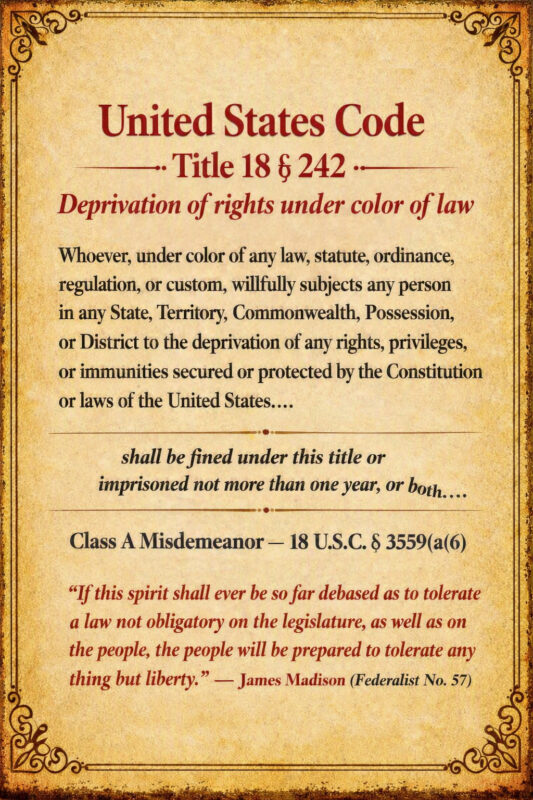
18 U.S.C. §242 — Deprivation of Rights Under Color of Law
Section 242 does not merely address interference with rights in the abstract.
It addresses the use of governmental authority itself.
Congress wrote:
“Whoever, under color of any law, statute, ordinance, regulation, or custom”
willfully subjects a person to deprivation of federally secured rights commits a federal offense.
The words that mattered to my case were:
“under color of any law, statute, ordinance, regulation, or custom.”
HF 766 was a statute.
The Medicaid exclusion operated through state law.
So the fact that Iowa acted legislatively did not remove the conduct from the scope of my allegation.
It was part of the allegation.
My claim was never:
Passing legislation is itself a crime.
My claim was:
Government cannot use legislation as the instrument for violating protected rights.
That is precisely why the words “under color of any law [or] statute” matter.
A statute can be the vehicle through which governmental power is exercised.
And governmental power can be exercised unlawfully.
Your existing §242 section already makes that point clearly: HF 766 was a statute, the Medicaid exclusion was enforced through governmental law, and legislative authority is not authority to violate rights.
This Was One Continuous Legal Chain
The laws I invoked were not random statutes gathered together after the fact.
They addressed different parts of the same conduct.
Medicare.gov:
The federal government publicly told beneficiaries they had a right to access doctors, specialists, and hospitals for medically necessary services.
The Ninth Amendment:
Enumerating certain constitutional rights cannot be used to deny or disparage other rights retained by the people.
18 U.S.C. §241:
Federal law prohibits qualifying conspiracies to interfere with “any right or privilege” secured by the Constitution or federal law.
18 U.S.C. §242:
Federal law prohibits qualifying willful deprivation of federally protected rights “under color of any law [or] statute.”
Iowa Code Chapter 706A:
Iowa law provides civil proceedings and remedies for qualifying ongoing unlawful conduct.
These provisions addressed different pieces of the same pattern I put before the court.
The medical right existed.
The right was being exercised through a federal program.
Governmental power was used through state law.
The deprivation was not isolated; I alleged an ongoing pattern.
And Iowa law itself supplied civil remedies for qualifying continuing unlawful conduct. Your article later explains that Chapter 706A expressly contains civil remedies and that even the State acknowledged that the relevant Iowa chapters can afford civil remedies to victims.
That is the legal chain.
Not:
“Plaintiff thinks something unfair happened.”
But:
**A federally stated right.
A constitutional protection against denying retained rights.
A federal prohibition against conspiracy to interfere with federally secured rights.
A federal prohibition against deprivation of rights under color of law.
A state statute providing civil remedies for qualifying ongoing unlawful conduct.**
And then the factual allegation:
Iowa used governmental power—including legislation—to interfere with access to medically necessary care that the federal government itself had publicly described as a right.
Whether every required element could ultimately be proven was a question for adjudication.
That is exactly what makes what happened next so important.
The case did not proceed to a trial in which the evidence was heard and the alleged pattern was rejected.
The underlying conduct was never adjudicated that way.
“But the Legislature Has the Power to Pass Laws”
The State answered by saying:
“The Legislature amending a statute is not an indictable offense under Iowa law—it is, in fact, squarely within the constitutional authority of the Legislature.”
Of course the Legislature can pass laws.
That was never the issue.
A police officer is authorized to carry and use a firearm.
That does not mean every shooting by a police officer is lawful.
That is why my response stated:
“This argument by the State [is] like arguing, ‘Pointing a gun and shooting is squarely within the authority of a police officer.’ Of course it is, however it is not within a police officer's authority to load and then shoot a gun at an innocent Citizen without probable cause!”
August 5 Resistance ¶ 51.
The principle is elementary:
The power to legislate is not the power to violate rights.
Otherwise, there could be no such thing as unconstitutional legislation.
And here the political branches were not operating upon a blank slate.
Good had already been decided.
Then HF 766 was enacted.
Then Judge Kelly struck the provision down as discriminatory and unconstitutional.
Then the State continued litigating.
Then my appointments were canceled.
That sequence deserved a merits determination.
It never received one.
The State Answered a Different Question
Instead of confronting whether the conduct fit the plain language of §§241 and 242, the State moved to another question:
Can an individual plaintiff bring an independent private civil cause of action directly under those criminal statutes?
The State cited federal precedent saying no.
But those are two different questions.
Question One: Does federal law prohibit conspiracy against federally secured rights and willful deprivation of federally protected rights under color of law?
Yes. Congress wrote those prohibitions into federal law.
Question Two: May a private citizen personally prosecute those crimes or obtain damages directly under §§241 and 242 themselves?
The State relied upon precedent saying no.
Resolving the second question does not make the first question vanish.
A rule governing who prosecutes a crime is not a finding that the prohibited conduct did not occur.
That distinction was swallowed by the dismissal.
I Also Invoked a Civil Federal Remedy
My pleading did not simply cite federal crimes and stop.
I expressly invoked 42 U.S.C. §1983.
The statute provides that a qualifying person who, under color of state law, causes another person to be deprived of federal rights:
“shall be liable to the party injured in an action at law, suit in equity, or other proper proceeding for redress.”
My amended petition quoted that language and requested damages, declaratory relief, and injunctions.
Again, however, the dispute was diverted away from the deprivation itself.
The State relied upon precedent holding that the State itself is not a “person” subject to a §1983 damages claim. My reconsideration filing directly contested what I believed that doctrine meant for the right to redress.
Look at what happened.
The question moved from:
Did government officials deliberately deprive transgender Iowans of protected rights?
to:
Did a pro se plaintiff name precisely the legally approved defendant, under precisely the correct remedial vehicle, in precisely the required capacity?
Those are not the same question.
And no procedural ruling answering the second question determines the factual answer to the first.
Iowa's Ongoing Criminal Conduct Act Had a Civil Side—The State Admitted It
This brings us to one of the most important omissions from simplistic retellings of my case.
I invoked Iowa Code Chapter 706A—the Ongoing Criminal Conduct Act.
My amended petition alleged:
“Through continuous acts of misconduct, harassment of transgender persons in general, and malicious behavioral patterns which adversely impact transgender Iowans particularly—rights violations and defamation—the STATE OF IOWA and KIM REYNOLDS FOR IOWA are in violation of Iowa's Ongoing Criminal Conduct Act.”
Amended Petition ¶ 83.
I alleged a continuing pattern involving:
- rights violations;
- discrimination;
- harassment;
- defamation;
- financial gain;
- governmental activity;
- political activity;
- and related conduct occurring over time.
The State tried to defeat the statutory claim.
But its own motion conceded an extremely important point:
“Though generally criminal provisions, both chapters do afford civil remedies for victims against violators.”
Exactly.
Iowa's Ongoing Criminal Conduct Act is not merely a criminal-prosecution statute.
The current Iowa Code still contains a provision explicitly titled “Civil remedies — actions.”
Section 706A.3 allows an aggrieved person to institute civil proceedings and authorizes courts to prevent, restrain, or remedy qualifying violations.
That matters.
Iowa Law Also Provides Threefold Damages
Chapter 706A goes considerably further.
For a qualifying injury to business or property caused by a Chapter 706A violation, the statute provides for recovery of threefold the actual damages sustained, together with qualifying litigation and investigation costs.
So when my lawsuit was characterized as improperly importing criminal statutes into a civil case, an essential fact was being lost:
Iowa's own Ongoing Criminal Conduct Act expressly creates civil proceedings and civil remedies.
It was drafted that way.
The civil and criminal consequences are not mutually exclusive.
That is why I resisted the State's attempt to reduce everything to: These are criminal statutes; therefore the civil case ends.
My resistance explained that the case was also, in part, a penal action—a civil proceeding seeking monetary consequences based upon statutory wrongdoing.
Whatever one ultimately thinks of every legal route I identified, I was not confused about whether I had filed a civil lawsuit.
I was seeking civil redress for conduct I alleged also violated criminal law.
American law does that in many contexts.
Iowa Chapter 706A expressly does it.
The Pattern Was the Point
The State answered the Chapter 706A claim by isolating individual governmental acts.
It argued that passing legislation is lawful governmental activity.
It argued that appealing a judgment is lawful governmental activity.
Viewed separately and stripped of motive, context, consequences, and surrounding conduct, those descriptions sound harmless.
But that was precisely what I challenged.
My petition was not alleging:
Passing legislation is a crime.
It alleged a pattern in which governmental authority was repeatedly used against the same protected population, while political messaging simultaneously stigmatized that population and generated support for additional restrictions.
My amended petition described:
“Multiple acts of defamation ... alongside a coordinated and successful political campaign designed to institute a rights violation against a class of persons who are explicitly protected by the Iowa Civil Rights Act”
and alleged that the conduct was intended to deny access to medically necessary procedures while enabling further harassment and erosion of legal protections.
Whether I could ultimately prove the statutory elements should have been decided through adjudication of the claim.
Instead, the claim died at the threshold.
The Protective Order Was Not an Afterthought
Money was never the most important thing I requested.
Protection was.
By July 2024, I could see where Iowa politics was headed.
My amended petition contained an entire section titled:
“THE STATE IS STILL ACTIVELY CONSPIRING TO VIOLATE TRANSGENDER PEOPLES' RIGHTS AND ERODE LEGAL PROTECTIONS FOR ALL DEMOGRAPHICS WHICH ARE PROTECTED BY THE IOWA CIVIL RIGHTS ACT; URGENT INJUNCTIVE RELIEF REQUESTED IN ORDER TO HALT THIS CONSPIRACY...”
I documented efforts to redefine sex in Iowa law, efforts to remove gender identity from the Civil Rights Act, changes affecting the Iowa Civil Rights Commission, continuing political rhetoric, and the earlier Medicaid fight.
I asked the court:
“to cease and desist all continued attempts to strip legal protections from transgender Iowans in any way, shape, or form.”
And in the formal remedies section:
“The Defendants must cease and desist any and all continued efforts to violate rights and/or strip legal protections for transgender Iowans.”
I also requested that Reynolds—both in governmental office and through political campaigns—be ordered to stop making what I alleged were defamatory statements concerning transgender people.
Then, in my resistance, I put the purpose into one sentence:
“I am requesting a protective order for transgender Iowans from being knowingly and willingly maliciously harmed by Iowa's Legislative and Executive Branches again. This is checks and balances.”
August 5 Resistance ¶ 52.
That was the heart of the case.
I was asking the Judicial Branch to stop the next injury.
The State Never Confronted the Rights Violations Themselves
This is the most important fact for readers to understand.
The core rights violations I alleged were never adjudicated on their factual merits.
The State did not defeat my case by proving that my appointments were never canceled.
It did not prove that HF 766 was constitutional.
It did not prove that Good had never established civil-rights protection.
It did not prove that the campaign statements had no defamatory contextual meaning.
It did not disprove financial benefit to Kim Reynolds for Iowa.
It did not try the unjust-enrichment claim before a factfinder.
It did not submit the Ongoing Criminal Conduct allegations to a jury and win.
Instead, its motion assembled a collection of threshold defenses:
§§241 and 242 do not themselves create private federal civil actions.
The State is not a §1983 “person.”
The Chapter 706A and 729A allegations fail as pleaded.
The Tort Claims Act bars other claims.
The public-duty doctrine bars another.
Sovereign immunity bars others.
Judicial immunity bars another.
That is how the case disappeared.
Each doctrine addressed a legal doorway.
Together, they prevented the courtroom from ever reaching the room behind the doors.
The Court Adopted the Sidestep
The dismissal order itself acknowledged that Iowa's standards for a pre-answer motion ordinarily require allegations to be treated as true and doubts resolved in the claimant's favor.
It nevertheless dismissed the case.
And the language it used when disposing of my responses deserves public scrutiny.
The court wrote that my requested remedies had to rest upon controlling precedent rather than:
“passages in a treatise that appear to support some loosely-based concept of equity.”
Then it wrote:
“It would unnecessarily lengthen this ruling by addressing each one of the defendant's positions as expressed in its motion point by point.”
And:
“It is sufficient to say that all of the defendant's arguments are properly supported by appropriate legal authority and none of the plaintiff's arguments are.”
Then my claims against the State were dismissed with prejudice.
Think about that.
The court expressly declined to address the positions point by point.
Then it permanently dismissed the case.
That is a major reason I say:
Iowa never heard this civil-rights case on its merits.
The Founders Were Not “Random Historical Quotes”
I also reject the court's treatment of my constitutional argument as some loosely based appeal to old writings.
I cited Locke, Jefferson, Hamilton, Lincoln, the Declaration of Independence, popular sovereignty, judicial review, and the right to redress because I was challenging the legitimacy of governmental immunity itself.
That is a constitutional argument.
My resistance quoted the Declaration's complaint:
“In every stage of these Oppressions We have Petitioned for Redress in the most humble terms: Our repeated Petitions have been answered only by repeated injury.”
August 5 Resistance ¶ 64.
I quoted Hamilton:
“The sacred rights of mankind are not to be rummaged for among old parchments or musty records.”
And then I wrote:
“This includes, irrevocably, the right to redress. I ought not be made to scour centuries of texts in order to be able to find access to the right to redress and the right to recovery.”
August 5 Resistance ¶ 65.
I invoked Lincoln's famous statement that the people are the:
“rightful masters” of the courts and congress.
August 5 Resistance ¶ 66.
Those citations were not decorative.
They addressed the question beneath every immunity doctrine:
Who is sovereign in the United States—the government, or the people?
If government derives its authority from the people, I do not accept that government may knowingly harm those people and then place itself beyond redress through doctrines inherited or created by the legal profession.
The court may disagree.
But disagreement does not convert the Declaration of Independence, Locke's theory of government, Hamilton's understanding of natural rights, Lincoln's popular sovereignty, or the constitutional right to petition for redress into irrelevant curiosities.
My Argument Was Reduced Rather Than Answered
The court summarized my sovereign-immunity challenge as relying upon:
“a number of treatises, including the Bible, the Declaration of Independence and the writings of John Locke and Alexander Hamilton.”
That characterization stripped away the argument those sources were being used to support.
I was not saying:
Hamilton said something inspiring, therefore I win.
I was saying:
A government created by the people cannot coherently place itself above the people and then use immunity to prevent judicial redress for governmental wrongdoing.
If precedent has developed in a direction inconsistent with the constitutional structure and foundational values of the republic, then merely answering “precedent says so” does not resolve the challenge.
It assumes the very premise being contested.
I Asked the Court to Reconsider
I challenged the dismissal.
Among other things, I objected that the ruling said I had not responded with contrary controlling precedent when I believed I had.
I wrote that the court's summaries:
“did not accurately reflect some of the most crucial parts of my arguments.”
Motion to Reconsider ¶ 9.
And I reiterated something even more fundamental:
“Even if a statute does not provide a right of recovery, Citizens still have a natural right of recovery to the various injuries which harmed me.”
Motion to Reconsider ¶ 11.
The reconsideration motions were denied without further hearing.
I Do Not Consider That Due Process
Due process is supposed to mean something more than access to a courthouse door.
It is supposed to provide a meaningful opportunity to have a controversy heard.
I alleged that government officials violated rights.
I identified the laws.
I identified the injuries.
I identified the chronology.
I identified the political statements.
I identified the campaign's financial benefit.
I requested discovery, adjudication, damages, restitution, statutory remedies, and preventive relief.
The State responded predominantly with defenses explaining why the court should not reach those questions.
The court then said addressing everything point by point would unnecessarily lengthen its ruling.
The case was dismissed with prejudice.
My reconsideration request was denied without another hearing.
I do not call that meaningful due process.
I Called It Extrinsic Fraud
In my reconsideration filing, I used an even stronger term:
extrinsic fraud.
I quoted the definition I was relying upon: fraud that prevents a person from obtaining a trial, from presenting the whole case, or otherwise affects the proceeding so that the controversy never receives a fair submission to the court.
Then I wrote:
“These denials of our rights to a fair trial, to due process rights, to the right to redress, and to the right of recovery amounts to extrinsic fraud performed by the State.”
I continued:
“If a standing ruling(s) is being used to deny Citizens redress, justice demands such rulings be overturned.”
That remains my perspective.
I am not saying a court entered a judgment formally declaring “extrinsic fraud occurred.”
Quite the opposite.
My complaint is that the underlying controversy was never allowed to reach that kind of factual adjudication.
From where I stand, when layers of legal doctrine prevent an injured citizen from ever putting the underlying governmental conduct before a factfinder, the process ceases to look like adjudication of the controversy and begins to look like insulation from it.
Rights Were Still Violated Under Color of Law
At the end of all the procedural arguments, one fact remains unchanged:
HF 766 existed.
It was law.
It was enacted after Good.
Its transgender Medicaid provision was later found discriminatory and unconstitutional.
The State appealed.
Coverage was interrupted.
My appointments were canceled.
Political leaders continued attacking transgender people.
Kim Reynolds for Iowa raised at least $2.5 million during the campaign I alleged had used transgender people as a political target.
The protections I asked the judiciary to preserve remained under political attack.
None of those events ceased to exist because the State was declared the wrong §1983 defendant.
None ceased to exist because §§241 and 242 are prosecuted criminally by the federal government.
None ceased to exist because sovereign immunity barred another doorway.
None ceased to exist because the Tort Claims Act contained another procedural requirement.
And the words of §242 remained exactly where Congress put them:
“under color of any law, statute, ordinance, regulation, or custom.”
That describes the governmental mechanism I was challenging.
So my conclusion remains the same:
Rights were deprived under color of law.
I alleged that those deprivations were not isolated but part of a continuing pattern involving discriminatory governmental action, political defamation, harassment, financial benefit, and repeated efforts to erode legal protections.
That is why I invoked Iowa's Ongoing Criminal Conduct Act.
That is why I sought its civil remedies.
That is why I sought injunctive protection.
And that is why I continue to maintain that the statute should have been applied to the conduct instead of the conduct disappearing behind threshold doctrines.
The Court Never Decided Whether My Evidence Proved the Pattern
This distinction must not be lost.
The court did not conduct a trial and find:
No rights were violated.
It did not find after hearing evidence:
Kim Reynolds' statements were not defamatory in context.
It did not find:
Kim Reynolds for Iowa was not enriched.
It did not find:
No continuing pattern existed.
It did not find:
My medical appointments were not canceled.
It did not find:
No unlawful conduct occurred under color of law.
And it did not put the evidence before a jury and obtain a verdict rejecting my allegations.
The case ended before that.
That matters.
A procedural dismissal is not proof that the underlying conduct was righteous.
An immunity doctrine is not an acquittal.
A proper-party doctrine is not a finding that no injury occurred.
A private-right-of-action doctrine does not erase the criminal prohibition Congress enacted.
And an exhaustion requirement does not transform discrimination into lawful conduct.
The Legal Maze Became the Defense
That is what this case ultimately exposed to me.
One law says government may not deprive people of protected rights.
Another doctrine says this particular statute cannot be privately enforced.
Another says this particular governmental defendant is not a “person.”
Another says sovereign immunity.
Another says public-duty doctrine.
Another says judicial immunity.
Another says administrative exhaustion.
Another distinguishes criminal from civil enforcement.
Another asks whether the official was sued personally or officially.
Another asks whether the right remedy was requested against the right entity at the right moment.
And somewhere inside all of that, the original question disappears:
What did the government actually do to the citizen?
That is the question courts exist to answer.
And in my case, I do not believe Iowa ever answered it.
The Warning I Gave the Court Was Not Hypothetical
Perhaps the most disturbing part is that I was not asking the judiciary to protect transgender Iowans from some imaginary future.
My amended petition documented what was already happening.
It expressly sought:
“URGENT INJUNCTIVE RELIEF”
to stop continued efforts to erode transgender rights and protections.
I wrote:
“The Defendants must cease and desist any and all continued efforts to violate rights and/or strip legal protections for transgender Iowans.”
And I told the court:
“I am requesting a protective order for transgender Iowans from being knowingly and willingly maliciously harmed by Iowa's Legislative and Executive Branches again. This is checks and balances.”
The court did not grant the protection.
It dismissed the case instead.
This Was Never Merely About Medicaid
The Medicaid exclusion was the beginning of this part of the case, not the end.
The larger allegation was that Iowa had entered a dangerous political cycle:
A marginalized population is stigmatized.
The stigma produces political support.
Political support produces governmental action against the population.
Those governmental acts further normalize the stigma.
The campaign benefits.
More rights become politically vulnerable.
That is what I meant by Popularizing Discrimination.
And it is why the unjust-enrichment allegation belongs beside the civil-rights allegations rather than being treated as some unrelated claim.
My amended petition said it plainly:
“A successful political campaign, wherein the candidate was elected for office, at the expense of transgender Citizens who were defamed as part of a concerted effort to violate our rights, is a case of unjust enrichment.”
It then asked for restitution and a public acknowledgment of wrongdoing.
The Question Iowa Still Has Not Answered
Strip away every procedural term.
Forget “sovereign immunity” for a moment.
Forget “proper defendant.”
Forget “private right of action.”
Forget “public-duty doctrine.”
Forget “exhaustion.”
Read the chronology.
Read Good.
Read the Kelly ruling.
Read what happened to my appointments.
Read the campaign statements.
Read the campaign fundraising.
Then read Congress:
18 U.S.C. §241: do not conspire to injure or oppress people in exercising federally protected rights.
18 U.S.C. §242: do not use governmental authority “under color of any law [or] statute” to willfully deprive people of federally protected rights.
Then read Iowa's own statute:
Chapter 706A: qualifying continuing unlawful conduct can produce civil proceedings, injunctive relief, and threefold damages.
These statutes are not written in a dead language.
They are written in English.
The legal profession has surrounded them with an enormous architecture of precedent governing who can sue whom, for what, through which statute, in which capacity, under which immunity, and only after satisfying which procedural prerequisites.
But none of that changes the basic principle:
Government power is not a license to violate rights.
I brought a civil-rights case asking Iowa's judiciary to enforce that principle.
Instead, the State invoked doctrine after doctrine explaining why my claims should never reach a factfinder.
The court accepted those defenses, expressly declined to address everything point by point, dismissed the case with prejudice, and denied reconsideration without another hearing.
So this is where I remain:
The injuries occurred.
The rights existed.
Government acted under color of law.
The political campaign benefited while transgender Iowans bore the consequences.
I asked the Judicial Branch to stop further harm.
No jury ever heard the evidence.
And, in my view, no court ever adjudicated the central merits of what I was trying to put before the State of Iowa:
When government knowingly uses its power against the rights of the people, who will hold the government accountable?
That question is still unanswered.
Endnotes
1. Good v. Iowa Department of Human Services, 924 N.W.2d 853 (Iowa 2019). The Iowa Supreme Court's March 8, 2019 decision concerned Iowa Medicaid's categorical exclusion of gender-affirming surgery and upheld relief against the exclusion under the Iowa Civil Rights Act.
2. The HF 766 chronology. My amended petition alleged that Republican legislators and Governor Reynolds responded to Good less than two months later by enacting HF 766, Division XX, to permit exclusion of transgender Medicaid coverage. The petition later recorded Judge William Kelly's ruling finding the provision “discriminatory and unconstitutional” and contrary to the Iowa Constitution and Civil Rights Act.
3. Actual medical injury. My petition expressly alleged that the State's appeal halted coverage again and caused cancellation of my appointments.
4. 18 U.S.C. §§241–242. Section 241 prohibits qualifying conspiracies against rights secured by the Constitution or federal law. Section 242 prohibits qualifying willful deprivation of federally secured rights under color of any law, statute, ordinance, regulation, or custom.
5. §242 and legislation. My argument was not that legislation itself is criminal. It was that governmental conduct does not become immune from civil-rights scrutiny merely because a statute supplies its vehicle. Section 242's text expressly contemplates rights deprivation occurring “under color” of law or statute.
6. The State's private-right-of-action defense. The State cited precedent holding that §§241 and 242 do not independently create private civil causes of action. It therefore sought dismissal rather than a factual determination of whether the alleged conduct fit the statutes' substantive prohibitions.
7. 42 U.S.C. §1983. My amended petition separately invoked §1983 as a civil remedy and expressly sought damages, declaratory relief, and injunctions. The State answered with precedent concerning whether a State itself qualifies as a §1983 “person,” rather than with a merits determination that no rights deprivation occurred.
8. Iowa Code Chapter 706A. Iowa currently titles §706A.3 “Civil remedies — actions.” It authorizes qualifying civil proceedings by an aggrieved person and provides substantial remedial authority. The State itself acknowledged in its dismissal motion that Chapters 706A and 729A “do afford civil remedies for victims against violators.”
9. Threefold damages. Section 706A.3 provides threefold actual damages for qualifying injury to business or property, together with specified costs and expenses. Thus Chapter 706A cannot accurately be described as having only criminal consequences.
10. Kim Reynolds for Iowa and unjust enrichment. My amended petition alleged that Kim Reynolds for Iowa raised at least $2.5 million for Reynolds' 2022 reelection, that anti-transgender political messaging helped generate political support for erosion of transgender protections, and that the campaign was unjustly enriched at transgender Iowans' expense.
11. Defamation/libel per quod. My petition identified both the “Iowans still know boys from girls” campaign advertisement and the later “real women” Bud Light promotion and alleged that their defamatory meaning arose through their surrounding anti-transgender political context.
12. Protective relief. The petition expressly framed Part Four as a request for urgent injunctive relief to halt continuing erosion of transgender rights and protections. My August 5 resistance described the requested order as protection against further malicious harm by Iowa's Legislative and Executive Branches: “This is checks and balances.”
13. The dismissal order. The court said it would “unnecessarily lengthen” the ruling to address the defendant's positions point by point, collectively concluded that the State's positions were appropriately supported, and dismissed the State claims with prejudice.
14. Founding principles and sovereign immunity. My resistance did not invoke Locke, Jefferson, Hamilton, Lincoln, and the Declaration merely as inspirational quotations. I used them to contest the legitimacy of governmental immunity against the constitutional principles of popular sovereignty, accountability, and redress.
15. Extrinsic fraud. In reconsideration, I expressly argued that denial of a fair trial, due process, redress, and recovery amounted to extrinsic fraud and quoted a definition focused upon preventing a party from obtaining a trial or fairly submitting the controversy. This article states that as my conclusion and criticism of the proceedings; the district court did not enter a finding that extrinsic fraud occurred.
16. Reconsideration. I objected that the dismissal ruling's broad summaries omitted crucial portions of my responses and asserted that I had cited controlling precedent the ruling did not meaningfully address. The court denied reconsideration without further hearing.