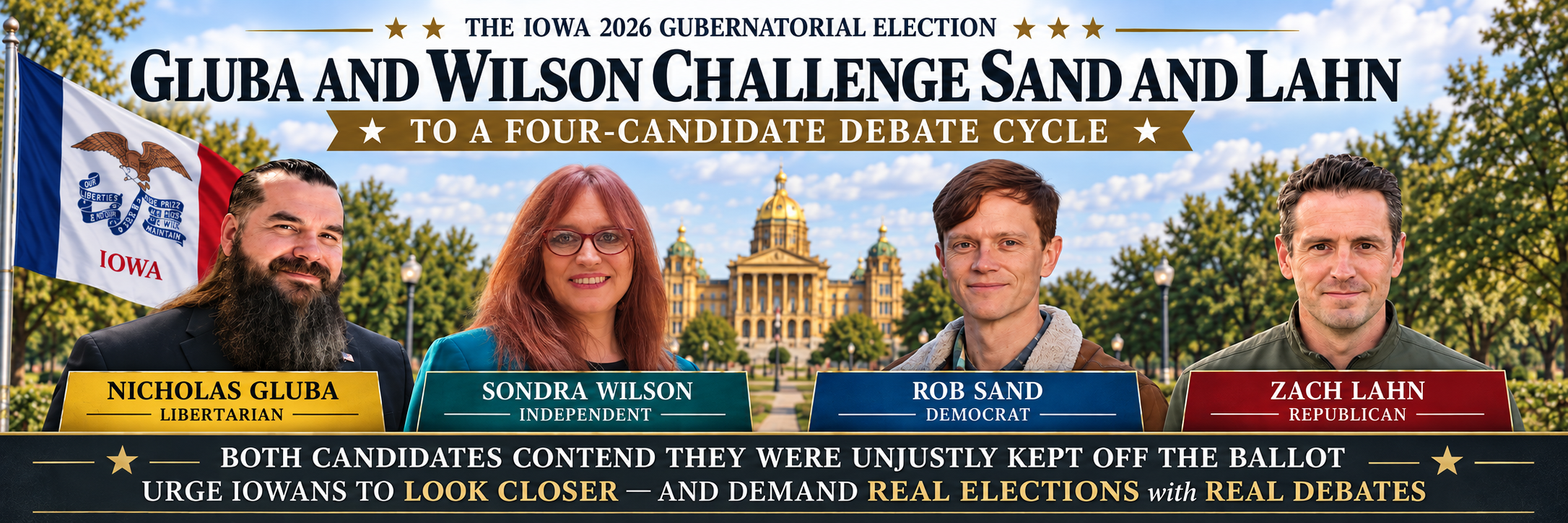
The Other Democracy: Pilot Episode
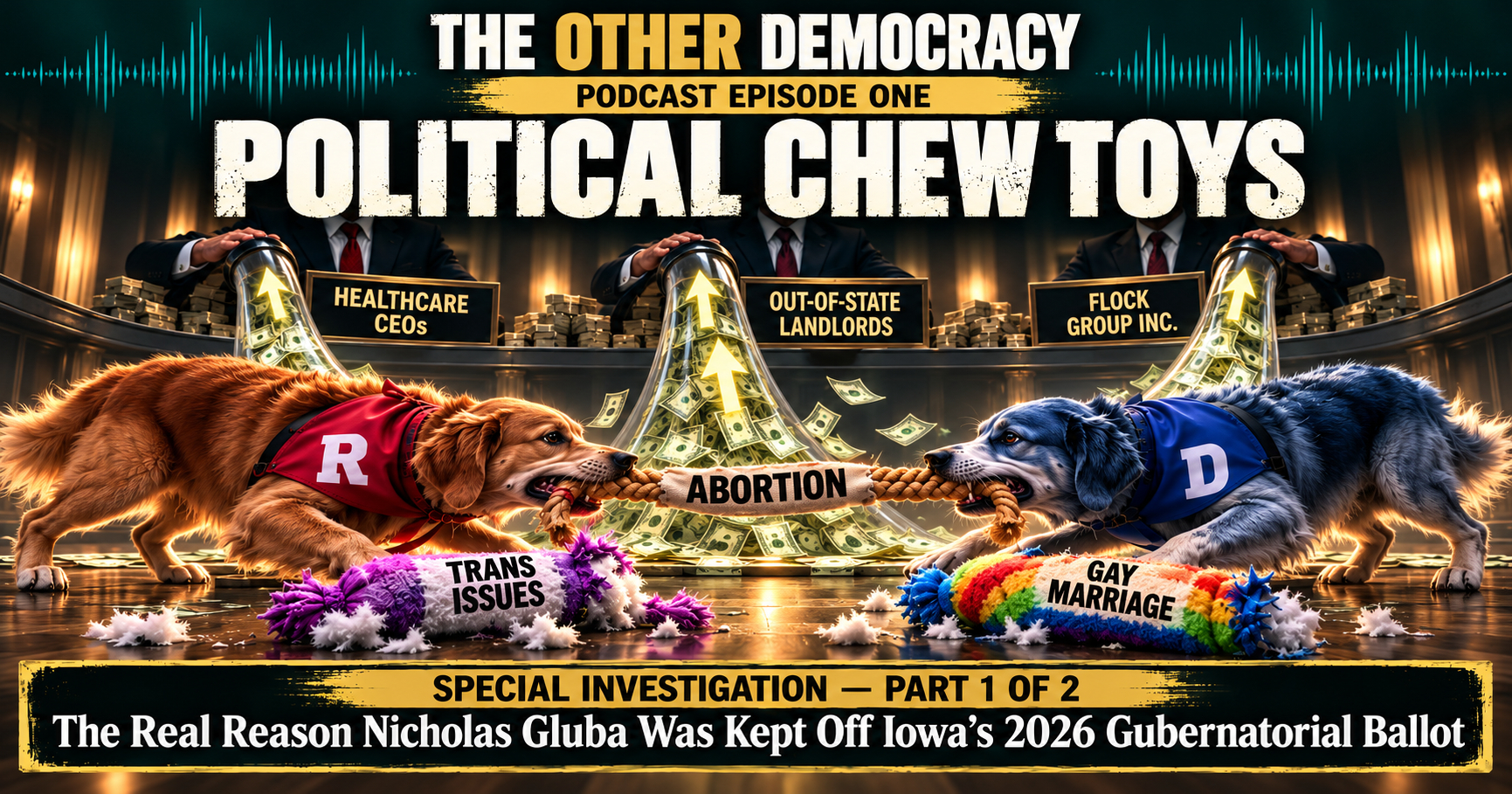
Political Chew Toys
How are political wedge issues distracting Iowans from the problems unfolding right under our noses?
Hosted by Sondra Wilson | October 9, 2026
On This Page
01 Episode Overview
02 Special Investigation: Nicholas Gluba
03 Hearing Video & Related Articles
04 Supporting Research & Rental-Income Estimate
05 Sources & Media Acknowledgments
06 Episode Chapter Guide
While Republicans and Democrats Fight Each Other,
Where is Our Money Going?
The central question of The Other Democracy:
What are we not paying attention to while we're busy fighting each other?
Beyond the Political Debate
We also consider the growing influence of money in Iowa's gubernatorial election and the exclusion of candidates whose perspectives voters might otherwise have heard.
Because sometimes the problem isn't simply which political party wins an election.
It's the institutional rules governing the election, the government, and the courts themselves.
Special Investigation, Part One of Two
The Real Story Behind How Nicholas Gluba Was Kept Off Iowa's Ballot
On September 17 Gluba and my campaign teamed up to release a joint statement and petition sent to Rob Sand and Zach Lahn's campaigns, asking them to stand with us and demand a real debate cycle. This Special Investigation Series in the podcast is the follow-up.
In the final portion of Episode One, we turn to the 2026 gubernatorial candidacy of Nicholas Gluba, a Libertarian candidate and U.S. Marine Corps veteran who collected thousands of petition signatures but was ultimately excluded from Iowa's general-election ballot.
What actually happened?
Here, we listen to excerpts from the state objection-panel proceedings, originally recorded by Bleeding Heartland, and examine the disputes surrounding the candidacy of Nicholas Gluba and his running mate, Jules Cutler.
Among the questions raised:
-
Why was Cutler's affidavit of candidacy not accepted?
-
What did the election employee tell the candidates when they submitted their paperwork?
-
Why did Attorney General Brenna Bird decline a request to place the employee under oath during the proceedings?
-
Were the filing problems legally correctable, or did they require exclusion from the ballot?
-
What role did judicial review play in the ultimate outcome?
The episode introduces these disputes and examines their implications for election integrity and public accountability.
Watch the Gluba-Cutler Ballot Objection Proceedings
See and hear what happened during the state objection-panel proceedings.
Episode One features selected audio excerpts from the proceedings concerning Nicholas Gluba and his running mate, Jules Cutler.
For listeners who want to examine more of the discussion, the approximately 18-minute video below provides an extended edited version of the proceedings, drawn from the original recording by Bleeding Heartland.
The video includes arguments concerning the candidates' filing documents, testimony and statements from election personnel, and the panel's consideration of the objections.

The podcast presents a shorter selection of excerpts with additional commentary. Viewers are encouraged to consult the original, unedited recording for the fuller context of the proceedings.
Special Investigation — Further Reading and Related Action
The following two articles provide additional information not found in the podcast.
Article #1:
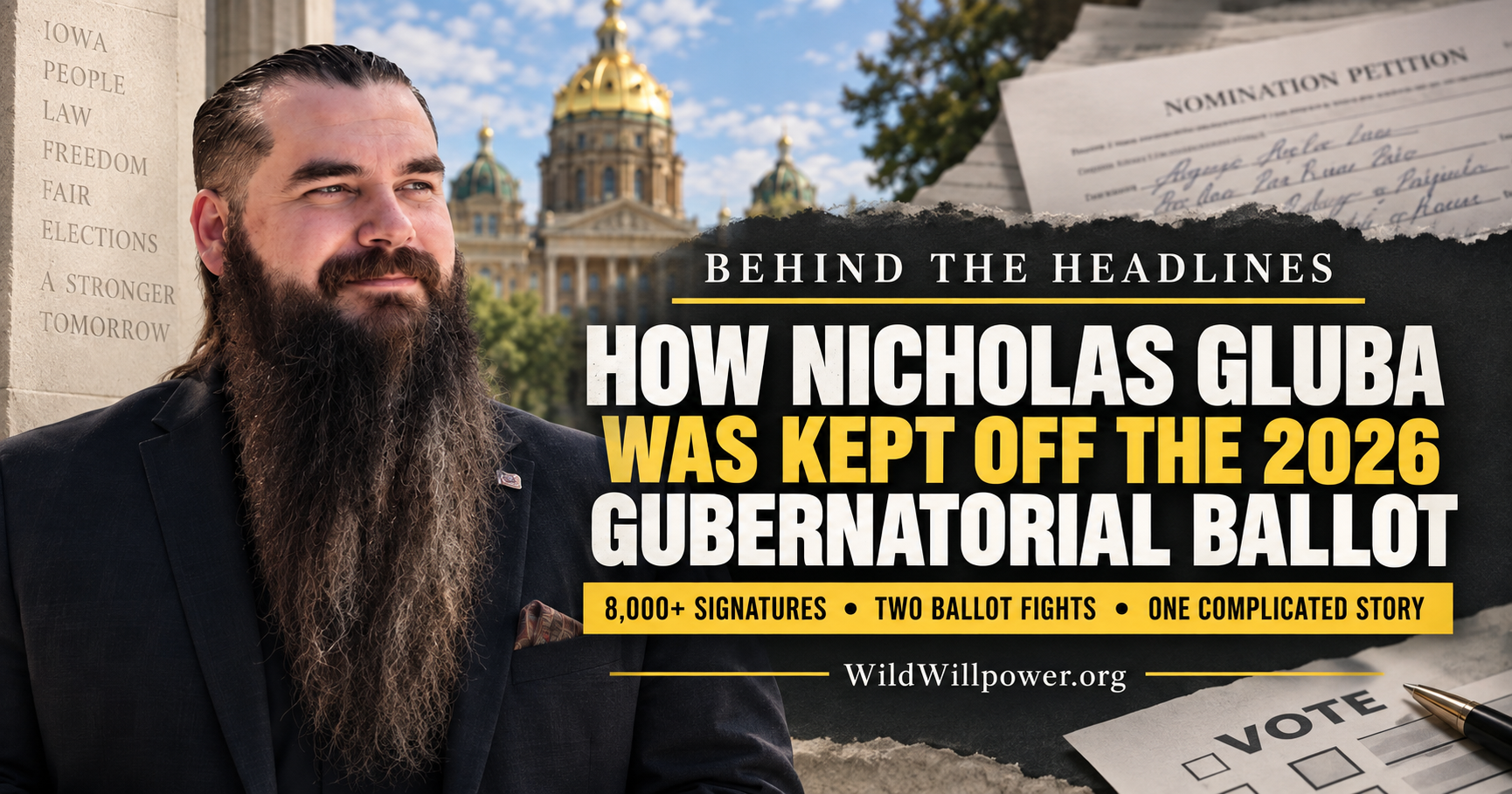
The Untold Story on How Nicholas Gluba Was Kept Off the Ballot
How did a gubernatorial candidate who submitted more than 8,000 petition signatures end up excluded from the ballot?
Read my detailed investigation into the disputed filing of Jules Cutler's affidavit of candidacy, the conflicting accounts presented to Iowa's State Objection Panel, and the court's subsequent ruling. I examine why I believe Gluba and Cutler were wrongfully excluded and what their experience reveals about Iowa's election laws.
Read The Untold Story on How Nicholas Gluba Was kept Off the 2026 Gubernatorial Ballot
Article #2:
Let the People Decide — A Joint Challenge for a Four-Candidate Debate Cycle
Our September 17 joint statement explains why we believe Iowa's election system deserves greater scrutiny and why we are calling for a broader public debate.
The premise? A handful of gatekeepers can quietly keep us off the ballot, but Iowans have the power to read the real story and demand actual debates so that the people can hear the ideas and make their own decision — even if that means writing us in.

Episode Two: Nicholas Gluba — The Candidate Iowans Never Got to Hear
Scheduled for Monday, October 12, 2026.
Supporting Research, Sources, and Further Investigation
Political Chew Toys raises several questions about economic power, government accountability, political influence, and the information available to ordinary citizens.
-
Out-of-state landlords: A preliminary estimate of approximately $2.5 billion in annual residential and agricultural rental payments potentially reaching nonresident property owners, including the underlying calculations, assumptions, and limitations.
-
Flock Group Inc.: Political contributions made by the Atlanta, Georgia-based surveillance technology company to organizations affiliated with both major political parties, and questions about the relationship between political funding, public procurement, and surveillance policy.
-
Government accountability: Iowa statutes and judicial decisions concerning government immunity and the legal remedies available to people alleging official wrongdoing.
-
Iowa's gubernatorial election: Original hearing recordings, court proceedings, and related investigations concerning Nicholas Gluba's exclusion from the 2026 ballot.
These materials distinguish documented findings from preliminary estimates, allegations, and interpretations. Where evidence is incomplete, the remaining research questions are identified.
Readers are encouraged to examine the underlying sources and reach their own conclusions.
How Much Money Leaves Iowa Through Rent?
One question raised in Episode One is how much residential and agricultural rental income may ultimately flow to out-of-state property owners each year.
Because Iowa property records do not always reveal the ultimate beneficial owners of LLCs and other entities, obtaining a precise statewide figure is difficult. I have not identified a comprehensive study answering this question.
As a starting point, I developed a preliminary estimate using publicly available housing, agricultural, and rental-rate data. Under the assumptions described below, the estimate suggests roughly $2.5 billion per year may flow to out-of-state property owners.
The complete methodology, assumptions, limitations, and source materials are available for independent review.
Estimated Annual Rental Payments to Out-of-State Landlords
Based on a preliminary model using available housing and agricultural data, I estimate that approximately $2.5 billion annually may flow from Iowa residents and farmers to out-of-state property owners.
Because complete beneficial-ownership data is not publicly available, this estimate should be viewed as a starting point for further research rather than a definitive measurement.
How the Estimate Was Calculated
1. Residential Rental Properties
The original model used the following assumptions:
-
Approximately 360,000 renter-occupied housing units in Iowa.
-
Estimated median gross rent of $850 per month, or $10,200 annually.
-
Estimated out-of-state landlord ownership share of 35%.
Calculation:
360,000 rental households × $10,200 annually = $3.672 billion in estimated annual residential rent.
$3.672 billion × 35% = $1.285 billion potentially paid to out-of-state residential landlords annually.
Sources used in the original model: U.S. Census Bureau, 2023 American Community Survey; Des Moines Register (2023); Iowa Housing Partnership (2024).
2. Agricultural Farmland Rentals
The original model used the following assumptions:
-
Approximately 85,000 farms in Iowa.
-
An estimated 50% involving rented farmland, modeled as 42,500 farms.
-
Average farm size of approximately 350 acres.
-
Average cash rent of approximately $271 per acre annually.
-
Estimated out-of-state ownership share of 30%.
Calculation:
42,500 farms × 350 acres × $271 per acre = $4.031 billion in estimated annual farmland rent.
$4.031 billion × 30% = $1.209 billion potentially paid to out-of-state farmland owners annually.
Sources used in the original model: Iowa State University Extension and Outreach, Cash Rental Rates for Iowa Survey (2025); agricultural ownership research attributed to Renshaw, Chandio, and Tidgren (2024).
The farmland arithmetic has been corrected from the original 2025 calculation. The underlying assumptions have not yet been independently validated.
Combined Annual Estimate
| Rental category | Estimated annual payments to out-of-state owners |
|---|---|
| Residential rental properties | $1.285 billion |
| Agricultural farmland rentals | $1.209 billion |
| Combined preliminary estimate | $2.494 billion |
Under the original model's assumptions, the combined estimate is approximately $2.5 billion annually.
Methodological Limitations
This is a preliminary economic estimate, not an independently verified measurement of actual interstate financial transfers.
Several underlying assumptions require additional research.
In particular, statewide ownership percentages must be verified using data that distinguish Iowa residents from nonresident property owners. Non-operator farmland owners, corporations, trusts, and out-of-state owners are not interchangeable categories.
The farmland calculation also requires refinement using the actual number of rented farmland acres rather than an approximation based on farm counts and average farm size.
Similarly, median residential rent provides a useful starting point but does not necessarily equal average rent for purposes of calculating statewide rental receipts.
Finally, gross rental payments made to nonresident owners should not be confused with net wealth leaving Iowa. Some of that money may remain in the state through property taxes, maintenance, repairs, local management, and other expenses.
These distinctions are important to establishing an accurate picture of Iowa's rental economy.
Invitation for Independent Research
I welcome independent research into the amount of residential and agricultural rental income flowing from Iowa to out-of-state property owners.
Economists, housing researchers, agricultural economists, university faculty, students, investigative journalists, and other interested researchers are invited to examine the underlying assumptions and develop independently verifiable estimates.
Research that confirms, refines, or challenges the original calculations is welcome.
Of particular interest are reliable statewide data concerning nonresident property ownership, actual farmland rental acreage, residential rental expenditures, and the proportion of rental revenue that ultimately leaves Iowa.
Please send research findings, supporting calculations, source materials, or inquiries to TheOtherDemocracy@gmail.com.
The objective is to establish the most accurate possible understanding of how rental income moves through Iowa's economy, how much reaches nonresident property owners, and what these financial arrangements mean for Iowa's communities.
Original Research and Sources
-
Sondra Wilson, Sensible Housing Act (2025): Original rental-income model and calculations.
-
Sondra Wilson, Reclaiming Iowa: The Path Forward (2026): Chapter Seven, Right to Homestead Act, pages 148–149.
-
U.S. Census Bureau — American Community Survey: Iowa rental housing and rent data.
-
Iowa State University Extension and Outreach — Cash Rental Rates for Iowa Survey (2025): Agricultural cash rental estimates.
-
Iowa State University — Corporate and Foreign Land Ownership in Iowa (2024): Agricultural ownership research.
The source references above identify materials used or cited in developing the original model. They should not be interpreted as independent confirmation of the estimated $2.5 billion outflow.
Some External Media Used for First Amendment Purposes
Episode One of The Other Democracy also incorporates selected excerpts from Bleeding Heartland's recording of the 2026 Iowa State Objection Panel proceedings concerning Libertarian gubernatorial candidate Nicholas Gluba and his running mate, Jules Cutler.
I believe Nicholas Gluba and Jules Cutler were wrongfully kept off Iowa's 2026 gubernatorial ballot, and I believe the public deserves to hear firsthand how that decision was reached.
The purpose of presenting these excerpts is not simply to reproduce another publication's recording. It is to examine the actual proceedings, scrutinize the actions and reasoning of public officials, identify what I believe to be serious procedural injustices, and encourage Iowans to independently evaluate whether their election laws and institutions are serving the public.
Selected portions are accompanied by my commentary and analysis. An approximately 18-minute edited video is also provided, along with access to the original Bleeding Heartland recording so listeners can examine the proceedings in greater context.
I believe this use serves important First Amendment purposes and warrants protection under the fair-use provisions of 17 U.S.C. §107.
Original hearing recording credited to Bleeding Heartland. The excerpts and accompanying commentary are presented as part of an independent investigation by The Other Democracy.
Episode One — Chapter Guide
| Timestamp | Subject |
|---|---|
| 00:21 | Introducing The Other Democracy: The government we're taught about versus the institutions we encounter |
| 02:48 | Out-of-state landlords and an estimated $2.5 billion in annual wealth extraction |
| 03:37 | Political chew toys: Abortion, gay marriage, transgender issues, and political division |
| 05:02 | Healthcare CEO compensation and the cost of healthcare |
| 06:46 | Looking beyond political parties: Where is our money going? |
| 07:54 | Flock-style surveillance and contributions to Democratic and Republican political organizations |
| 08:37 | Rob Sand, Zach Lahn, and the expansion of license-plate surveillance |
| 09:31 | Wrongful accusations involving Flock camera evidence |
| 11:12 | The financial burden of challenging government accusations |
| 12:40 | Government immunity doctrines: What happens when officials cause harm? |
| 13:20 | Venckus v. City of Iowa City and absolute judicial-process immunity |
| 14:44 | Iowa's Tort Claims Act: Statutory exceptions and restrictions on government liability |
| 16:06 | Reforming unjust laws and the proposal for a new Iowa Constitution |
| 16:53 | Surveillance expansion versus government accountability |
| 17:40 | Campaign funding, political influence, and out-of-state interests |
| 19:31 | Ballot access: The exclusion of Nicholas Gluba and Sondra Wilson |
| 21:39 | Special Investigation, Part One: Introducing the Gluba objection proceedings |
| 23:48 | Four ballot objections and the dispute over correctable filing problems |
| 25:32 | Objection-panel recording: The four grounds for challenging the Gluba–Cutler candidacy |
| 26:51 | Objector's attorney explains the missing affidavit objection |
| 27:36 | Gluba's attorney disputes the claim that Cutler failed to submit her affidavit |
| 28:45 | Attorney General Brenna Bird declines a request to place an election employee under oath |