
The Last Ongoing Transgender Civil Rights Case in Iowa
With Unprecedented Questions Now On Appeal
Wilson v. Reliable Street Inc., et al.
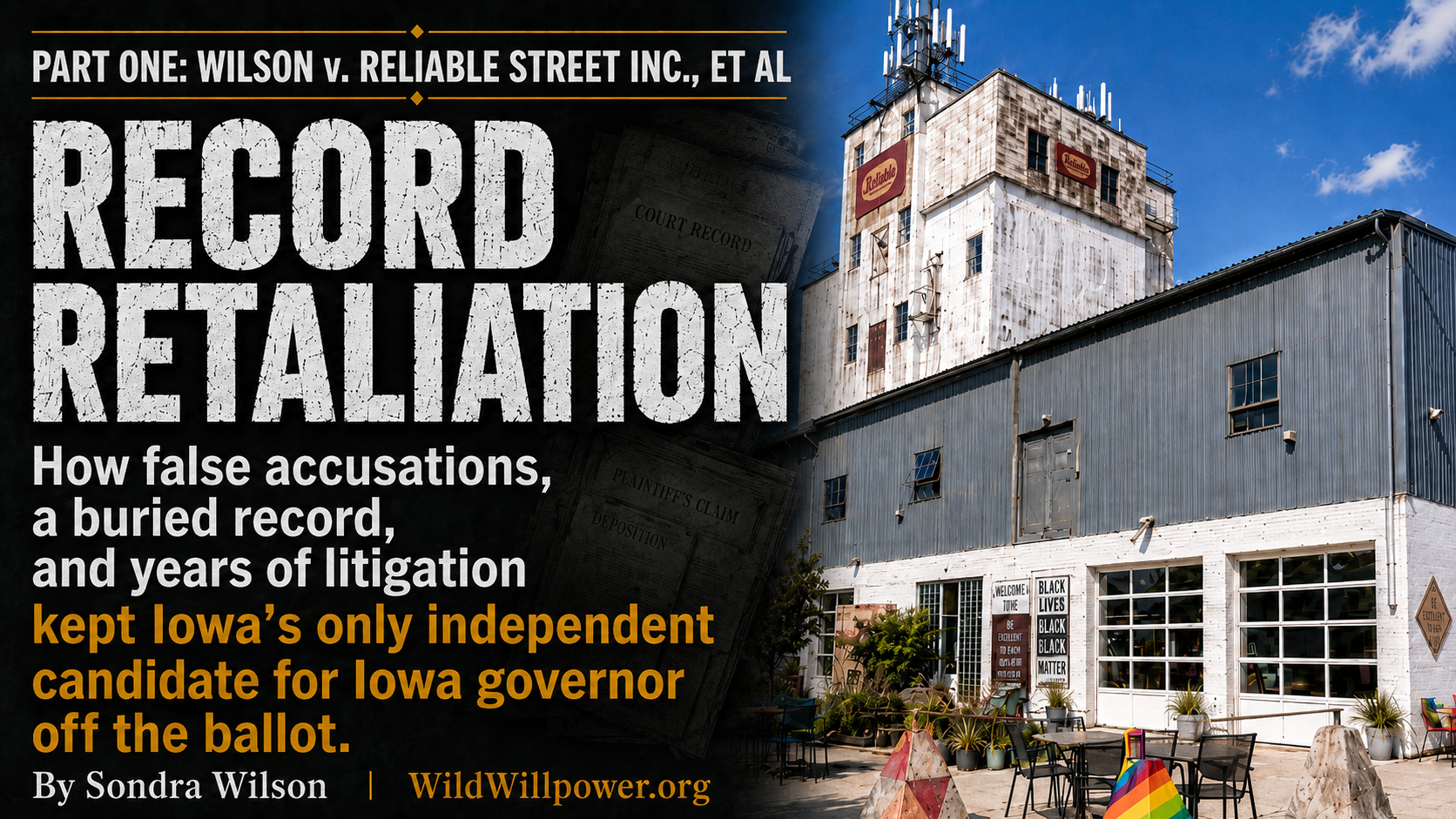
This eight-part series documents the backstory and ongoing proceedings involving Wilson v. Reliable Street Inc., et al., Polk County No. LACL157381; transferred to Story County as No. LACV053674.
The Dangerous Precedent Now on Appeal
Defendants argued that even if discovery revealed false or malicious statements submitted to the Iowa Civil Rights Commission, those facts could not defeat absolute privilege:
“No matter what discovery might reveal about the content of Defendants’ statements or Defendants’ subjective state of mind, those facts cannot defeat an absolute privilege.”
The district court accepted that legal theory and held that the privilege turns:
“not on the content or truth of those statements.”
The court also acknowledged that:
“No Iowa appellate court has directly addressed whether statements made in direct response to an ICRC investigation, as opposed to statements made in formal ICRC contested case hearings, are absolutely privileged.”
That is now one of the central questions on appeal.
If the ruling stands, qualifying statements made during the investigative stage of an Iowa civil-rights complaint could be protected from defamation liability even where falsity, actual malice, and serious harm are alleged or proved.

This Landing Page for This Case Has Moved
This is the old landing page for this case. The new landing page is here.
This page will be reworked on a later date.
Following Years of Litigation, My Case Was Getting Buried;
After the Court Accepted This Dangerous Argument, It Had to Come Public
The following links will take you into each article within this eight-part series.
Part of the reason I am making this public is because I am not sure if I will receive a fair trial by jury otherwise.
As you read the series and see how the proceedings unfolded, you will likely understand my concern.
The series exposes what it can look like when a regular Iowan goes to court to seek justice, while up against a professional attorney who appears indifferent to whether this case produces a just outcome.
It shows how the courts themselves can work to undermine due process, and how procedural complexity in Iowa courts appears to undermine our due process rights, or any sense of the word justice.
I do not believe this has been a fair proceeding, however the record speaks for itself. Read the series and examine the linked documents to make your own determination: is this what justice looks like?
This is the story of what can happen when an ordinary Iowan faces serious injustice, cannot afford an attorney, and must try to navigate a complex legal system against popular businesses who can afford professional counsel.
If you come to the same conclusion as I did in living through these experiences, we will then be in agreement that our justice system is in desperate need of reform.
Parts One-Three:
Before the Lawsuit
Fall 2021-August 3, 2022
Before Wilson v. Reliable Street Inc., et al. was filed, the underlying dispute moved through three distinct stages: the breakdown of relationships at Reliable Street and Lockwood Café; the Iowa Civil Rights Commission process that revealed serious allegations while withholding the underlying file; and the eventual release of that file, which exposed fraud, coordination, and political sabotage by the defendants. I filed suit to clear my name to prevent the modified and misleading documentation, and statements that were built around it, from being used to destroy my reputation and take down my political campaign.
Explore Before the Lawsuit →
This page is getting reworked. Please check back soon. 9/22/2026.
Table of Contents
I. What This Case Is About—and Why I Could Not Simply Walk Away
Government-record accusations, Exhibit D-3, the subpoena risk, and why discovery matters.
II. Why I Am Publishing the Record
The legal and public purposes of this documentary series.
III. The Dangerous Precedent Now on Appeal—and Why It Matters Statewide
A first-impression absolute-privilege ruling that could determine what accountability exists for false or malicious statements submitted during an Iowa civil-rights investigation.
IV. Before the Lawsuit: What Happened at Reliable Street and Lockwood Café
The relationships, agreements, exclusion, discrimination complaint, and why I initially sought mediation.
V. The Discrimination Claim Was Broader Than Employment
VI. Iowa's Equality Tradition Is Older Than the Iowa Civil Rights Act
Public accommodations, contractor and volunteer relationships, Clark, Coger, and discrimination questions the district court never reached.
VII. Factual Questions a Remand and Discovery Could Finally Answer
What was said, who made the exclusion decision, how disputed materials were created, what defendants knew, and what discovery could finally establish.
VIII. What This Series Is Really About
Access to justice for ordinary people without professional legal training or substantial money.
IX. Primary Questions for the Appellate Court
Recusal, venue, dismissal, amendment, discovery, discrimination, and absolute privilege.
X. For Attorneys, Journalists, Researchers, Civil-Rights Organizations—and How to Help
Source documents, appellate counsel, independent forensic review, public-interest examination, and ways to support the work.
Endnotes
I. What This Case is About —
and Why I Could Not Simply Walk Away
This case did not begin because somebody merely said something hurtful about me.
It concerns accusations of crimes and other serious, actionable misconduct placed into an official Iowa Civil Rights Commission record after I reported discrimination. The record portrayed me as stalking and harassing another woman, violating boundaries, engaging in racist and anti-LGBT+ conduct, behaving obsessively, and committing other serious misconduct that I know did not occur.
Those accusations were not harmless gossip.
They were placed into a government record. Although ICRC records receive confidentiality protections, Iowa’s administrative rules expressly allowed confidential records to be disclosed without my consent:
“in response to a court order or subpoena.”
That meant confidentiality did not guarantee permanent containment: the accusations could potentially be drawn into later civil, criminal, governmental, or other legal proceedings.
For me, that made the danger immediate. My primary life’s work is public and political. I had already spent years building Wild Willpower and a public reputation around civic work. A government file portraying me as a stalker, harasser, racist, and danger to others was capable of threatening my reputation, livelihood, political future, personal safety, and the life’s work I intended to leave behind.
I did not experience that as a theoretical possibility that might someday become inconvenient. I understood an unchallenged government record containing false allegations of criminal and serious civil misconduct as existing leverage that could be used against me.
My life was on the line.
What the Documents Establish —
and What Discovery Still Needs to Answer
Demonstrable from the documents:
My message was sent April 4, 2022. Colville's explicit boundary-setting response followed on April 7. The version later submitted to the ICRC placed an April 7 date above my earlier message and added a caption representing it as though it followed Colville's stop-contact communication. The words of my message were unchanged; its apparent chronology was not.
Still unresolved because discovery never occurred:
Who created the presentation and added the date and caption?
Who directed, reviewed, or approved it?
Who knew the actual chronology when it was submitted?
What communications accompanied its preparation—and why was it presented that way?
The Same Questions Extend Beyond D-3
D-3 was not submitted in isolation. .The complete ICRC file, as revealed in Part Three, contains multiple respondent statements and supporting materials that reinforce the same recurring portrayal of me as obsessive, intrusive, harassing, racist, controlling, and boundary-violating.
But discovery never answered the underlying questions: Who communicated with whom before the submissions were prepared? Who supplied particular accusations or documents? Did the respondents review one another's accounts? Who knew about contradictory contemporaneous records? What did each participant personally know, and what information was merely repeated from someone else?
The existing record can support obvious inferences about coordination. Discovery was needed to determine its actual scope, participants, knowledge, and purpose. It was also needed to articulate my claims accurately, without presuming guilt where knowledge hidden from me could not be accurately alleged in my pleadings.
These issues matter because the surrounding narrative was already portraying me as obsessive, boundary-violating, stalking, and harassing. The contemporaneous record shows that only weeks earlier Colville was still communicating warmly with me—including “Love you <3” on March 17 (understood to me, as in the friendship sense)—and contains numerous earlier friendly exchanges.
Other exhibits create similarly direct factual conflicts. For example, Nissen later portrayed garden and prairie work as unwanted, unauthorized, and obsessive, while contemporaneous records include statements that I was “taking the lead on the community garden,” that I and another participant were “in charge of the garden this year,” and communications documenting approval, planning, and performance.
Where authenticated contemporaneous records establish facts inconsistent with later accusations, this is not simply a dispute over feelings or interpretation. Those records can prove particular factual assertions false.
The importance of that discovery became explicit in 2026.
Defendants moved for summary judgment and argued, in the alternative, that their ICRC statements were true. Their memorandum stated:
“The record establishes the truthfulness of Defendants’ ICRC statements.”
I have maintained the opposite throughout this litigation, and the exhibits published in this series contain the contemporaneous records I rely upon.
Both factual accounts cannot be true where they make mutually exclusive factual claims.
Defendants also argued that if only a qualified privilege applied, I would need evidence of actual malice—knowledge of falsity or reckless disregard for truth. Yet discovery into precisely that question never occurred.
Judge Doyle’s own summary-judgment order records my argument that metadata was necessary to establish “authorship, sequencing, and Defendants’ state of mind,” including whether statements were made with knowledge of falsity or reckless disregard for truth.
Instead, defendants prevailed on a different argument: absolute privilege. Their memorandum told the court:
“No matter what discovery might reveal about the content of Defendants’ statements or Defendants’ subjective state of mind, those facts cannot defeat an absolute privilege.”
Judge Doyle accepted that legal theory and ultimately held that the privilege turned “not on the content or truth of those statements.”
That is the conflict at the center of this appeal: I went to court because serious accusations had been lodged into a government record and I sought the factual process necessary to prove what happened. Most claims were dismissed before discovery; the surviving libel claim was then dismissed under a rule that made the truth of the accusations legally irrelevant.
The Central Question Running Through the Series
Could I get the evidence before a court and prove what happened?
I did not go to court because I was uncertain whether I had stalked, harassed, threatened, or knowingly violated anyone's boundaries. I knew I had not. I went to court because serious false accusations had entered a government record, and proving the full scope of what had happened required access to evidence outside my possession—including defendants' private communications, document history, knowledge, and respective roles.
The series documents how increasingly complex procedural questions repeatedly came between that evidentiary process and ordinary factual adjudication.
II. Why I Am Publishing This Record
This series serves two related purposes.
The first is legal: to preserve, organize, and explain a documentary record relevant to ongoing litigation.
The second is public: to show Iowans what can happen when a complicated factual dispute moves through administrative and judicial systems before the underlying evidence is fully tested.
Not every fact documented here will necessarily control a particular motion or appeal. Some remain important because they help explain the human, factual, and institutional consequences of what occurred.
Throughout the series, I distinguish among documentary facts, firsthand testimony, allegations, evidentiary inferences, and matters that remain unresolved because discovery did not occur. Readers can examine the linked source documents themselves.
III. The Dangerous Precedent Now On Appeal—
and Why This Matters Statewide
Notice of Appeal: September 9, 2026
One of the most consequential rulings in this case came in July 2026, when the district court dismissed the final surviving libel claim under absolute litigation privilege.
The issue is unusually important because the district court itself acknowledged:
“No Iowa appellate court has directly addressed whether statements made in direct response to an ICRC investigation, as opposed to statements made in formal ICRC contested case hearings, are absolutely privileged.”
The court nevertheless held that statements submitted during an ICRC investigation are absolutely privileged and explained that the protection turns:
“not on the content or truth of those statements.”
That means the rule adopted below does not depend upon whether a qualifying statement was accurate, made in good faith, or even knowingly false and malicious.
That consequence is especially serious in this case because the underlying dispute concerns accusations of stalking, harassment, racism, and other misconduct placed into a government civil-rights record, along with disputed documentary materials whose authorship, preparation, knowledge, and metadata were never examined through discovery.
Defendants themselves argued that:
“No matter what discovery might reveal about the content of Defendants’ statements or Defendants’ subjective state of mind, those facts cannot defeat an absolute privilege.”
The appellate question is therefore not merely whether defendants ultimately prevail in my particular defamation claim. It is whether Iowa will recognize an absolute shield against defamation liability for qualifying statements made during the investigative stage of a civil-rights complaint—even where falsity, actual malice, and serious harm are alleged or proved.
That rule could affect anyone who uses Iowa's civil-rights system. If affirmed, it could establish that a respondent's investigative-stage statements cannot support a defamation action even when knowingly false or malicious. If reversed or limited, the appellate decision could instead establish a boundary between protecting candid, good-faith participation in civil-rights investigations and preserving accountability for deliberate falsehoods.
Part Seven, Dangerous Precedent, reconstructs the complete chronology and legal arguments: my attempts to obtain discovery, defendants' assertion of absolute privilege, the competing qualified-privilege and truth arguments, my motion to compel, the July 15 ruling, and the issues now heading into appellate review.
Two Different Questions
Factual question: Were defendants' accusations true or false, and what did they know when they made them?
Privilege question: Even if particular statements were false and knowingly or recklessly made, does Iowa law completely bar defamation liability because they were submitted during an ICRC investigation?
The district court ultimately decided the second question without a trial on the first.
Why the Ruling Matters Beyond This Case
If affirmed, the district court's rule could establish that qualifying statements submitted during the investigative stage of an Iowa civil-rights complaint are insulated from defamation liability even when falsity or malice is alleged or proved. If reversed or limited, the appellate decision could instead define a boundary between protecting candid participation in civil-rights investigations and preserving accountability for knowingly false or malicious factual accusations.
In short, this would enable businesses to retaliate against victims of discrimination via allowing them to lodge false statements and materially-altered documents into ICRC files, thus creating a real and foreseeable danger to the complainant. Then they could simply plead "absolute privilege", cite Wilson v. Reliable Street Inc., et al., and the not be held liable. That is why I must win this appeal. It isn't just about my safety any more. This case is for all of us.
That question could affect anyone who uses Iowa's civil-rights system.
Historical Significance for Iowa —
Is This the Last Transgender Civil Rights Case Since the Removal of Legal Protections?
The case carries an additional historical significance for transgender Iowans. My underlying discrimination complaint arose while gender identity was still expressly protected by the Iowa Civil Rights Act. Iowa removed gender identity as a protected basis effective July 1, 2025, while providing for qualifying complaints arising before that date to continue under the prior law. [5]
This case may very well be among the last—or possibly the last—still-active Iowa civil-rights case brought by a transgender Iowan under that former statutory protection. I am not aware of another ongoing case in that posture, although I cannot claim to have identified every pending case statewide.
Whatever its precise place in that history ultimately proves to be, Wilson arises directly from an era of Iowa civil-rights law that no longer exists in the same form.
IV. Before the Lawsuit:
What Happened at Reliable Street and Lockwood Café
The lawsuit arose from relationships and project arrangements that began in 2021 at Reliable Street and Lockwood Café in Ames.
For approximately six months, I participated in the open mic, worked on the community garden and prairie projects, and developed friendships and collaborative relationships documented through contemporaneous messages. On March 31, 2022, I was unexpectedly barred from the property after being told that one or more women had complained about me, but I was not told what specific conduct I had supposedly committed.
I initially questioned myself, reviewed my communications, sought outside advice, requested mediation, and eventually filed a discrimination complaint with the Iowa Civil Rights Commission on April 22, 2022. I did not initially seek litigation.
On August 3, 2022, the ICRC's Preliminary Case Review revealed that the respondents' account had escalated into allegations of stalking, harassment, racism, obsessive behavior, inappropriate comments, and other serious misconduct. I still could not see the respondents' complete statements or supporting materials.
Part One, Record Retaliation, reconstructs those events from the contemporaneous record—including the relationships, agreements, March 31 exclusion, my immediate attempts to understand what I had been accused of, the mediation request, the discrimination complaint, and the August 3 escalation.
V. The Discrimination Claim Was Broader Than Employment
My Actual Relationship With the Defendants,
As It Pertains to My Discrimination Claim
I was a customer, volunteer, project participant, and a person performing substantial work pursuant to express agreements reflected in contemporaneous communications. The legal consequences of those agreements are separately disputed.
Reliable Street operated a nonprofit art gallery and community space, while Lockwood Café was open to the public. Judge Currie's own October 4 order described me as a former Lockwood customer and volunteer for both entities.
The truest formulation, however, relies on the oral agreements that are preserved in writing. I relied upon those agreements and performed substantial work over approximately six months, in good faith that those arrangements and the mutual respect and trust they were built on would continue to be honored. There is an offer, consideration, acceptance, reliance, performance, and breach involved in the two primary agreements, although the third agreement—the open mic and flier agreement—was also reframed as never existing within defendants' filings with the ICRC. See section II in Record Retaliation and Exhibit C and further analysis in Political Sabotage for additional context.
The record therefore raises a relationship that cannot be reduced simply to “employee” or “nonemployee.” I was a customer, volunteer and project participant, and I contend that I was also performing substantial work pursuant to express agreements reflected in contemporaneous communications—or, alternatively, contractual or reliance-based arrangements recognized under Iowa law.
That matters because different legal protections attach to different relationships. The district court addressed the discrimination claim as an employment claim, but the record also raised public-accommodation, contractual, agency, reliance, sex-discrimination, gender-identity-discrimination, and constitutional-equality questions.
Volunteer, Employee, Contractor — or Something Else?
One difficulty throughout this case is that my relationship with Reliable Street and Lockwood Café did not fit neatly into a single conventional employment category.
I repeatedly used the word “volunteer” because I was not receiving a wage or salary. But that did not mean every activity I performed was unilateral, unauthorized, or legally relationship-free. The contemporaneous record documents repeated requests, approvals, delegated responsibilities, project-specific arrangements, and—in connection with the garden—a 50% Lockwood Café discount that I alleged was offered in exchange for my participation.
The word “volunteer” also does not mean that I simply appeared and performed whatever work I wished. The record reflects a continuing course of requested, authorized, and coordinated activity. Individual tasks were repeatedly proposed, discussed, approved, modified, delegated, or accepted.
Whether those communications created one continuing agreement, several project-specific agreements, enforceable promises, reliance interests, or some combination of them is itself a legal question—not something resolved simply by attaching the label “volunteer.”
I Did Not Enter the ICRC Process Already Knowing Which Legal Label Applied
I should also make clear how I arrived at the Iowa Civil Rights Commission in the first place.
I had not read and analyzed the entire Iowa Civil Rights Act before filing my complaint. I was not an attorney, and I did not begin this process by deciding that my relationship fit neatly into the statutory category of “employee.”
I filed because I had been discriminated against and initially wanted mediation rather than litigation. After receiving no response to my own effort to resolve the matter, I followed the advice I had received from the Better Business Bureau, local attorneys, and an ICRC receptionist and filed a complaint in hopes of accessing the Commission's mediation process.
I learned only later, as the dispute became litigation and I began studying the law myself, how much could turn on whether my relationship was characterized as employee, volunteer, customer, contractor, project participant, promisee—or some combination of those roles.
I was genuinely surprised to learn that an unpaid volunteer may fall outside ordinary employment-discrimination protections. That discovery is part of why I believe the classification problem itself deserves public and appellate attention.
The Threshold Remuneration Question
In my amended petition, I raised what federal courts have called the Threshold Remuneration Test for Volunteers. Under that approach, a court first asks whether an unpaid worker nevertheless received sufficiently significant direct or indirect benefits in exchange for services; if so, additional common-law factors may be considered in determining whether the relationship qualifies for employment protections.
Defendants responded that Iowa appellate courts had never adopted that test. Judge Currie considered federal volunteer cases but concluded that the café discount I received was not sufficiently significant to make my relationship employment under the ICRA.
That ruling answers one possible classification. It does not necessarily answer every legally relevant relationship reflected in the record. I was also a Lockwood Café customer, a participant in Reliable Street's programs, and a person performing substantial work pursuant to arrangements that formed the basis of my contractual and reliance claims.
And the threshold-remuneration issue raises a broader question that I believe deserves examination:
which direct or indirect benefits should count when assessing whether an ostensibly unpaid relationship has sufficient economic substance to warrant employment-law protection?
A volunteer may receive no salary while nevertheless gaining professional experience, portfolio work, references, training, leadership experience, social and professional networks, community standing, access to opportunities, and a record of demonstrated responsibility. Those benefits can carry substantial real-world value even though they do not appear on a paycheck.
That was important in my circumstances. I was not occasionally performing isolated tasks. I invested months of labor into projects I had been asked or authorized to help manage, expecting that the completed garden, prairie, Open Mic work, promotional materials, and related projects would become part of my experience, portfolio, reputation, and future opportunities.
That raises a question I do not believe should be dismissed merely by observing that I did not receive a conventional salary: when substantial volunteer work produces delegated responsibility, professional experience, community standing, portfolio value, and future opportunity, what significance—if any—should those forms of remuneration have when determining the legal nature of the relationship?
The Garden and Prairie Claims Raised Separate Contract and Equitable Questions
My relationship with Reliable Street and Lockwood Café also involved months of requested or authorized work on the garden and prairie projects. Those facts supported separate theories involving promissory estoppel, contract, and unjust enrichment—questions distinct from whether my unpaid role qualified as employment under the ICRA.
Judge Currie dismissed the promissory-estoppel and unjust-enrichment claims with prejudice before discovery and without examining the contemporaneous Garden and Prairie exhibits I had organized for the court.
Part Three, Political Sabotage, now reconstructs that record exhibit-by-exhibit. Exhibit C compares Nissen's later characterization of the work as unsolicited and “obsessive” with the contemporaneous records of authorization, delegated responsibility, project leadership, reliance, expenditures, and accepted benefits. It also examines the court's promissory-estoppel and unjust-enrichment rulings and the factual questions I am asking to have reopened.
For the underlying evidence and full analysis, see Exhibit C in Political Sabotage.
A Question Many Volunteers May Never Realize Exists
How many Iowans who volunteer for a nonprofit know that the word “volunteer” may leave them outside ordinary employment-discrimination protections?
Volunteers help sustain community organizations, churches, charities, festivals, museums, advocacy groups, food programs, shelters, political organizations, schools, and civic projects throughout Iowa.
Their labor has value to the organizations that receive it.
Their time has value to them.
And discrimination can inflict real economic, professional, reputational, and personal harm even when the person discriminated against never received a paycheck.
Whether existing Iowa law adequately protects every such relationship is a legal question. Whether the law should treat their labor or resulting injuries as legally insignificant merely because the work was unpaid is also an important question of public policy.
My case presents an additional complication because there was no free-floating or unauthorized volunteer relationship. The contemporaneous record shows that the work at issue was repeatedly requested, authorized, coordinated, or performed pursuant to express agreements. The detailed documentary history of those agreements is presented elsewhere in this series; the point here is that the word “volunteer” did not describe the whole relationship.
One Label Should Not Necessarily Decide Every Legal Question
The problem may therefore have been the assumption that one label had to do all the legal work.
Different aspects of the same relationship can carry different legal consequences. Legal classifications are functional: the same relationship can implicate different doctrines for different purposes. Calling me a “volunteer” for one purpose does not necessarily determine:
— whether particular promises were enforceable through promissory estoppel;
— whether defendants received benefits at my expense for purposes of unjust enrichment;
— whether the work was requested or authorized;
— whether contractual or reliance interests existed;
— whether I was independently a customer of a public accommodation;
— whether indirect remuneration had significance under an employment analysis; or
— whether discrimination affected other legally protected interests.
The deeper question is therefore not merely which single label applied to me. It is whether overlapping legal relationships should be examined on their own terms—or whether the word “volunteer” can effectively extinguish contractual, reliance, unjust-enrichment, public-accommodation, discrimination, and other potentially cognizable interests without separately analyzing them.
That leads to the broader equality question:
Does Iowa's constitutional equality tradition have legal significance when discrimination affects contractual rights, public access, or other legally protected relationships outside conventional employment?
That is where Iowa's much older equality tradition becomes relevant.
VI. Iowa's Equality Tradition Is Older Than the Iowa Civil Rights Act
Even if a court ultimately concludes that the Iowa Civil Rights Act did not provide a statutory remedy under these particular circumstances, the broader principle of equality remains fundamental. Article I, section 6 of the Iowa Constitution—often called Iowa's equality clause—provides that laws of a general nature must operate uniformly and that the General Assembly may not grant privileges or immunities to one class of citizens that do not equally belong to all citizens on the same terms.
Clark Shows That Iowa's Equality Principle Predates—and Is Broader Than—
the Modern Iowa Civil Rights Act
To understand why the classification questions discussed above matter, it helps to return to one of the proudest civil-rights decisions in Iowa history: Clark v. Board of School Directors, 24 Iowa 266, 277 (1868).
Alexander and Susan Clark challenged the exclusion of their daughter Susan from a public school in Muscatine because she was Black. Their victory came 97 years before enactment of the modern Iowa Civil Rights Act in 1965.
It also came 86 years before the United States Supreme Court decided Brown v. Board of Education, 347 U.S. 483 (1954).
That is a remarkable part of Iowa's history. Nearly a century before Iowa created its modern statutory civil-rights system—and generations before Brown declared segregated public schools unconstitutional nationwide—the Iowa Supreme Court had already rejected racial exclusion from Iowa's public schools on the basis of equality. The Clark family's victory belongs first to the history of Black Iowans who fought discrimination, but the constitutional principle they established belongs to every Iowan: equality before the law.
For those unfamiliar with Alexander Clark and his family's contribution to Iowa history, the short documentary below, courtesy of the Alexander Clark Foundation, provides an excellent introduction:
The timeline is striking:
1868 — Clark v. Board of School Directors
Iowa's Supreme Court rejects racial exclusion from public schools on principles of equality.
1954 — Brown v. Board of Education
The United States Supreme Court holds racial segregation in public schools unconstitutional nationwide.
1965 — Iowa Civil Rights Act
Iowa creates its modern statutory civil-rights framework.
What makes Clark especially important here, however, is how the Iowa Supreme Court reached its decision.
The Court did not reason from a modern statutory list of protected classes. No Iowa Civil Rights Act yet existed. Instead, it reasoned from equality itself.
The Court explained that governmental discretion was:
“limited by the line which fixes the equality of right”
and declared:
“No discretion which disturbs that equality can be exercised.”
Its reasoning was not confined narrowly to race. The Court explained that the same principle would forbid separating Irish children from German children, Catholic children from Protestant children, or poorly clothed children from well-dressed children merely because local preference favored such distinctions.
Justice Cole wrote:
“The board cannot, in their discretion, or otherwise, deny a youth admission to any particular school because of his or her nationality, religion, color, clothing or the like.” [6]
And the Court concluded:
“all the youths are equal before the law.”
That breadth matters.
Some of the distinctions the Clark Court used to illustrate unconstitutional inequality—such as clothing—would not later appear as independently enumerated protected categories in the Iowa Civil Rights Act. Clark therefore provides powerful historical evidence that Iowa's constitutional conception of equality did not originate with Chapter 216 and was not expressed as a closed legislative checklist.
The modern Iowa Civil Rights Act later created specific statutory causes of action, protected classifications, administrative procedures, and remedies. But those statutory categories came almost a century after Clark. They therefore cannot themselves define the historical scope of the constitutional equality principle that already existed before Chapter 216 was enacted.
A Statute Does Not Automatically Replace the Law That Came Before It
For readers without legal training, there is an important distinction here between statutory law and common law.
Statutory law is enacted by the legislature—the Iowa Civil Rights Act is one example. Common law develops through judicial decisions applying legal principles to disputes that arise over time. Constitutional law stands above ordinary legislation because the legislature cannot amend the Iowa Constitution simply by passing an ordinary statute.
These bodies of law do not ordinarily operate as mutually exclusive systems. A statute can create new procedures, define particular rights and remedies, and sometimes replace preexisting common-law rules. But Iowa courts do not presume that enactment of a statute silently erased the law that already existed.
In Collins v. King, 545 N.W.2d 310, 312 (Iowa 1996), the Iowa Supreme Court stated:
“statutes will not be construed as taking away common law rights existing at the time of enactment unless that result is ‘imperatively’ required by the language of the statute.”
That quotation is exact and appears in the Court's statutory-construction analysis.
The Court later applied the same principle in Freeman v. Grain Processing Corp., 848 N.W.2d 58 (Iowa 2014). There, landowners brought common-law nuisance, negligence, and trespass claims alongside environmental statutory law. Addressing whether Iowa Code chapter 455B implicitly displaced the common law, the Court stated:
“absent express statutory language, a party seeking to demonstrate that a statute impliedly overrides common law must show that this result is ‘imperatively required.’”
In plain English: when Iowa's legislature passes a statute, courts do not ordinarily assume that every preexisting common-law right touching the same subject disappeared. Unless the statute expressly says so, displacement must be strongly compelled by the statutory scheme.
The Court expressly cited Collins v. King for that proposition.
That matters here because Chapter 216 did not create Iowa's principle of equality. Clark v. Board of School Directors, 24 Iowa 266 (1868) had already articulated that principle nearly a century earlier. The Iowa Civil Rights Act later supplied a detailed statutory framework—identifying particular discriminatory practices, protected classifications, administrative procedures, and remedies—but enactment of that framework does not by itself establish that every other source of law touching the same conduct ceased to exist.
The enactment of the ICRA did not automatically erase every independent common-law right or cause of action merely because the same events also involved discrimination. Iowa's own civil-rights cases illustrate that distinction. The ICRA can preempt another claim when that claim is merely another legal route for proving the same discrimination. But it does not automatically preempt every independent claim arising from the same events.
In Greenland v. Fairtron Corp., 500 N.W.2d 36 (Iowa 1993), the Iowa Supreme Court held that the plaintiff's emotional-distress claim was preempted because it depended upon proving the alleged discrimination. Her assault and battery claims were different: they survived because they were:
“complete without any reference to discrimination.”
The Court later summarized the rule in Godfrey v. State, 898 N.W.2d 844 (Iowa 2017):
“We have held that the Iowa Civil Rights Act preempts some, but not all, common law claims based on discrimination.”
The question is therefore not simply whether several claims arose from the same events. It is whether each claim depends upon discrimination for its legal existence, or instead rests upon an independent right, duty, promise, injury, or cause of action. That distinction matters here because my promissory-estoppel, unjust-enrichment, contractual, and defamation theories were not simply different names for an employment-discrimination claim; each implicated legal elements and interests of its own.
The significance of Clark is not exhausted by the later enactment of Chapter 216. It establishes that Iowa's constitutional principle of equality existed independently of the modern Civil Rights Act and was articulated in broader terms than the classifications later enumerated by statute.
What follows from that constitutional principle in a modern case—including how it interacts with private contractual relationships, public accommodations, available causes of action, and remedies—is a legal question Iowa's appellate courts should analyze rather than assume away.
When several legally significant relationships overlap—customer, volunteer, contractual participant, recipient of public-facing services—should Iowa's equality tradition be understood solely through the employment category of a later statute, or do Iowa's older equality principles remain relevant to how those rights and relationships are understood?
Judge Currie's Own Order Identified a Public-Accommodation Issue —
But Did Not Decide It
Clark does not itself decide whether Reliable Street or Lockwood Café violated the modern Iowa Civil Rights Act. But it helps explain why I do not believe the discrimination analysis should have ended with the conclusion that I was not an employee.
One separate statutory route was public-accommodation discrimination.
Judge Currie's October 4 order expressly acknowledged that both sides had briefed that issue:
“The Defendants’ Motion to Dismiss and Sondra’s Resistance thereto address a possible public accommodation discrimination claim but the Amended Petition does not allege any facts or claims based upon public accommodation. The Court only addresses Sondra’s ICRA discrimination claim in the context of employment just as she did in the Amended Petition.”
— Order Granting in Part and Denying in Part Defendants' Motion to Dismiss, D0036, p. 20 n.53.
That distinction matters because it identifies a potentially different legal relationship—not merely a different argument about employment.
At the time of the events in this case, Iowa Code § 216.7 prohibited covered public accommodations from denying protected persons the accommodations, advantages, facilities, services, or privileges they offered on discriminatory grounds, including then-protected gender identity and sex.
That presents a legally distinct question from whether I qualified as an employee or compensated volunteer.
Iowa law defined a public accommodation broadly enough to include establishments and facilities offering goods, services, or facilities to nonmembers for a fee or charge and, under specified circumstances, facilities providing them gratuitously with governmental support or subsidy.
Reliable Street's nonprofit status did not, by itself, answer that question. Relevant facts could include what facilities or services it offered to the public, whether nonmembers were admitted, whether fees were charged, whether governmental support or subsidy existed, and which legal entity controlled the facilities and exclusion decision.
Lockwood Café presented a separate and more direct public-facing relationship because I was a customer and the café sold goods and services to the public.
The district court did not adjudicate those questions on their merits. It concluded that my amended petition had framed the ICRA discrimination claim as employment discrimination and therefore declined to decide the separately briefed public-accommodation theory.
That creates an amendment question as much as a discrimination question: the court itself recognized that the public-accommodation theory had been briefed, but declined to decide it because of how the amended petition was framed. Under those circumstances, should the discrimination claim have been dismissed with prejudice, or should I have been permitted to amend so that the distinct public-accommodation theory could be addressed on its merits?
The Exclusion Decision Itself Contains Facts Discovery Never Reached
Judge Currie's order says that Sharon Stewart and Lyndsay Nissen told me on March 31 that I was banned from the property. Even if the public-accommodation theory had been properly separated in the pleadings, important facts necessary to determine responsibility and discriminatory purpose were still unresolved.
But the fact that Nissen and Stewart communicated the ban does not itself establish:
— which legal entity made the decision;
— who possessed authority to make it;
— whether Reliable Street, Lockwood Café, Love Club LLC, or individual actors participated;
— what each decisionmaker was told;
— what factual allegations they understood themselves to be acting upon;
— whether those allegations were verified;
— or whether sex or gender-identity stereotypes affected how the complaint was interpreted.
Those are discoverable questions of agency, public-accommodation liability, contractual responsibility, causation, and discriminatory purpose.
Coger Carried Iowa's Equality Principle Into Contractual Rights
and Publicly Furnished Services
Five years later, in Coger v. Northwestern Union Packet Co., 37 Iowa 145 (1873), the Iowa Supreme Court confronted discrimination by a private common carrier.
Emma Coger had entered into a transportation contract but was denied accommodations equal to those provided to white passengers.
The court held:
“These rights and privileges rest upon the equality of all before the law, the very foundation principle of our government.”
The Court reasoned, in substance, that the same contract could not lawfully purchase inferior rights for one citizen because of race. It also looked back to Clark as resting upon a broad principle of equality rather than merely the particular classification involved there.
Coger therefore adds something that Clark alone does not. It connects equality with a contractual relationship and access to services furnished by a private enterprise serving the public.
Coger does not mechanically decide my case. It involved a common carrier, racial discrimination, and legal doctrines particular to that setting.
But the analogy is relevant to the questions I am raising: my case also involves alleged contractual or reliance-based relationships, access to publicly furnished goods, services, and facilities, and alleged differential treatment outside a conventional employer-employee relationship.
What significance, if any, should Iowa's historic treatment of equality in contractual and public-service relationships have when modern statutory classifications leave an overlapping relationship only partially addressed?
Bostock Raises a Separate Sex-Discrimination Question
There is also a modern question involving transgender discrimination.
In Bostock v. Clayton County, 590 U.S. 644 (2020), the United States Supreme Court held under Title VII that intentionally discriminating against a person because the person is transgender necessarily involves consideration of sex.
Bostock was an employment case, so it does not itself establish liability in my circumstances.
But its reasoning raises an important interpretive question:
Can discrimination against a transgender person be treated as wholly unrelated to sex simply because a particular statutory or constitutional provision does not separately use the words “gender identity”?
That interpretive question has become even more consequential in Iowa now that gender identity has been removed as an expressly enumerated protected basis from Chapter 216.
The Right, the Cause of Action, and the Remedy Are Three Different Questions
These issues should be kept separate.
One question is:
What does Iowa's constitutional guarantee of equality mean?
Another is:
Against whom, and under what circumstances, may that constitutional guarantee be enforced?
And a third is:
What remedy does current Iowa law authorize?
That final distinction became particularly important after Burnett v. Smith, where the Iowa Supreme Court overruled Godfrey and held that Iowa no longer recognizes a standalone cause of action for money damages directly under the Iowa Constitution unless such a remedy is authorized by common law, statute, or the express constitutional text.
Burnett concerns the availability of a particular damages remedy. It does not erase the Iowa Constitution or make its equality provisions meaningless.
For this appeal, the question is therefore not simply whether I chose the perfect statutory or constitutional label while representing myself.
It is whether the discrimination facts and theories I attempted to raise should have been dismissed with prejudice before discovery and before I was permitted to separate and amend the potentially distinct employment, public-accommodation, contractual, statutory, and constitutional questions.
These issues produce several distinct appellate questions concerning public accommodations, amendment, constitutional equality, available remedies, and dismissal with prejudice. I collect those questions together in Section IX below.
VII. Factual Questions a Remand and Discovery Could Finally Answer
The Slander Ruling Illustrates the Problem
The October 4 order identified three categories of oral communications alleged in my petition: Denise reportedly saying that she felt unheard, disrespected, and overwhelmed by communications from me; Willa reportedly “feeling harassed by Sondra”; and a later discussion among Lyndsay, Denise, Willa, and Sharon.
Judge Currie concluded that statements about feeling unheard, disrespected, or harassed were indefinite, ambiguous, incapable of objective proof or disproof, and therefore protected opinion.
But the factual problem is important:
The complete private conversations themselves had never been discovered.
The court therefore knew what my pleading said had been communicated. It did not possess deposition testimony, contemporaneous notes, recordings, internal messages, or discovery responses establishing the complete words used between Colville, Martinez, Stewart, and Nissen.
That matters because Iowa's own defamation standard distinguishes opinion from assertions that can reasonably be interpreted as alleging actual facts. The October 4 order itself stated that one factor is whether the statement is “objectively capable of proof or disproof,” together with its immediate and broader context.
Whether someone merely said “I feel uncomfortable” is materially different from whether she asserted, for example, that another person stalked her, repeatedly contacted her after being told to stop, entered spaces without permission, threatened her, or committed some other objectively verifiable act.
Discovery could have established which kind of communication actually occurred.
And the consequence of the dismissal was not temporary: the October 4 order dismissed every claim other than the surviving libel claim with prejudice, including slander and discrimination.
What Discovery Could Finally Determine
1. What was actually said before my exclusion?
What did Willa Colville communicate to Sharon Stewart? What did Denise Martinez say, to whom, and when? Were these only expressions of discomfort, or did they include objectively verifiable accusations of stalking, harassment, unauthorized contact, threats, or other misconduct?
2. Who made the exclusion decision—and on whose behalf?
Which person or entity actually authorized the ban? What information reached the decisionmaker? What evidence was relied upon? What reason did the decisionmaker believe they were acting upon?
3. Did discrimination or stereotype affect the response?
Was I treated differently because I was a transgender woman? Were accusations accepted without verification? Was I denied an opportunity to respond because of assumptions about sex, gender identity, or perceived threat?
4. Who created and approved the disputed ICRC materials?
Who created or modified Exhibit D-3? Who added the April 7 date and caption? Who reviewed or approved the presentation before submission?
5. Were defendants' ICRC submissions independently prepared or coordinated?
What communications occurred before the submissions were assembled? Were drafts, accusations, screenshots, or documents exchanged? What did each person personally know, and what was repeated from others?
6. What did each participant know about contradictory evidence?
For the factual statements shown to conflict with authenticated contemporaneous records, what did each participant know when the statements were made or repeated? Which participants knew the statements were false, yet acted with reckless disregard for their truth?
Electronic-Discovery Could Answer Questions the Existing Paper Record Cannot
Native files and metadata could potentially establish when disputed documents were created or modified, what earlier versions existed, who added dates or captions, what revision history survives, and what communications accompanied preparation and approval of the ICRC submissions.
Forensic comparison could also help determine whether original source files were preserved, when particular participants obtained underlying communications, and how acknowledged anomalies—such as the duplicated screenshot referenced in the record—arose.
Those are not questions an appellate court ordinarily resolves by taking new evidence. They illustrate why, if the relevant dismissals are reversed, remand for discovery could materially change the evidentiary record.
The case repeatedly required me to plead facts that were uniquely or primarily within defendants' private communications, knowledge, and records—while the claims were dismissed before the discovery process ordinarily used to obtain those facts.
The appellate question is not whether every allegation I made must ultimately prove true. It is whether claims dependent upon genuinely disputed and discoverable facts were terminated with prejudice before those facts could be tested.
VIII. What This Series is Really About
Every Iowan grows up with the promise of liberty and justice for all. I understood the courthouse to be the place where disputed evidence could finally be examined and factual claims tested.
I had been severely hurt and my reputation damaged in a community I cared about. I tried communication, mediation, administrative remedies, attorneys, and government agencies. Eventually, I went to court because I needed a legal forum where I could prove that the accusations against me were false and obtain the evidence necessary to determine who created them, how they were developed, and who was responsible.
Instead, I learned another rule I had never been taught: a self-represented person is generally expected to navigate the same procedural system as a trained attorney.
The defendants had professional counsel navigating dismissal motions, pleading standards, venue rules, discovery rules, privilege doctrines, amendment procedure, deadlines, and appellate rules. I was learning those mechanisms in real time while simultaneously preserving the evidence I already possessed and trying to obtain evidence that remained in other people's private communications and records.
I still believe in the promise of liberty and justice for all. That is precisely why I believe a system of justice must be capable of reaching the underlying facts—not merely deciding whether an unrepresented person understood every procedural mechanism required to get there.
That raises a question much larger than this lawsuit:
What is justice worth if access to factual adjudication depends upon whether an injured person already knows how to operate the machinery of the courthouse—or can afford thousands of dollars for someone who does?
A justice system should not make legal sophistication a substitute for truth. Procedure is necessary, but procedure should serve adjudication rather than prevent the underlying facts from ever being reached.
That is the inversion of justice this series documents: I went to court asking for the opportunity to prove what happened and obtain the evidence that remained outside my possession. Years later, much of the litigation has instead concerned whether I used the right label, followed the right procedural mechanism, pleaded the right elements, requested relief at the right moment, or responded correctly to increasingly complex filings—while most of the underlying evidence never reached ordinary discovery.
IX. Primary Questions for the Appellate Court
1. Recusal and venue
Were the relevant judges required to recuse, and was Polk County a legally proper original venue?
2. Dismissal before discovery
Was dismissal with prejudice appropriate where material factual questions remained unresolved and many relevant facts were within defendants' private communications and records?
3. Amendment
Should I have been permitted to amend claims after the court identified amendment as the available procedure and the legal distinctions became clearer?
4. Public accommodations
Did the court construe the discrimination claim too narrowly by treating employment as the only relevant relationship, despite my customer and public-facing relationships with defendants?
5. Volunteer classification and indirect remuneration
Did the court properly analyze whether the volunteer relationship carried legally significant direct or indirect benefits?
6. Promissory estoppel
Did the label “volunteer” improperly narrow the analysis of promises and detrimental reliance?
7. Unjust enrichment
Did the court adequately analyze the value defendants received from my labor and expenditures?
8. Discovery under Rule 1.981(6)
Was summary judgment premature where I identified evidence necessary to oppose the motion that could only be obtained through discovery?
9. Absolute litigation privilege
Does absolute litigation privilege extend to statements submitted during the investigative stage of an ICRC complaint before any contested-case hearing?
10. Pre-submission conduct
Can allegedly wrongful acts involved in creating, modifying, sequencing, or compiling documents be absorbed into privilege merely because the resulting material was later submitted to a government agency?
11. Qualified privilege and actual malice
If absolute privilege does not apply, should the case be remanded for discovery and factual development concerning truth, falsity, knowledge, reckless disregard, and damages?
12. Pleading the alleged agency deception
Where a self-represented litigant described allegedly deceptive submissions to a government agency using an imperfect legal label, should amendment have been permitted so the legally appropriate theory could be tested?
Questions Raised by the October 4 Dismissal
Could the court determine that the unknown oral statements were mere opinion without discovery into what was actually said?
Was dismissal with prejudice appropriate where the precise communications among Colville, Martinez, Stewart, and Nissen had never been obtained?
Were factual accusations embedded within expressions of subjective discomfort?
Did the court resolve questions that depended upon unknown facts rather than the legal sufficiency of known pleaded facts?
After the court instructed the parties to identify evidence and told them they could present whatever evidence they believed appropriate, did reversing that process after defendants learned the titles of my proposed exhibits—and then dismissing the claims without considering those exhibits—materially prejudice my rights?
The Common Thread:
Evidentiary Record Withheld From Plaintiff and Never Examined by the Court
-
Dismissal arguments based on allegedly insufficient factual support while critical evidence remained outside my access — Defendants repeatedly argued that my claims lacked sufficient factual allegations to establish particular elements. I repeatedly responded that some of those facts concerned private communications, internal decision-making, authorship, knowledge, and records that remained within defendants' knowledge, communications, possession, or control and could ordinarily be developed through discovery. My firsthand knowledge and the contemporaneous documentary record already establish substantial portions of the factual history. Discovery was necessary for a different reason: several remaining elements depended upon evidence held by defendants, including private communications, internal decisionmaking, authorship, knowledge, and state of mind.
-
Opposition to discovery — Defendants have opposed allowing the claims to proceed into discovery while arguing that the case should instead be dismissed for insufficient factual support.
-
Continued publication of the disputed narrative — At the same time, defendants’ filings repeatedly carried forward factual allegations and characterizations about me that repeated the false and reputation-damaging narrative at the center of the case. As the chronology will show, those statements did not simply defend against my claims; they also continued building a written record containing the same underlying narrative that had given rise to the dispute.
The court ultimately dismissed my claims with prejudice without allowing the discovery process I had repeatedly requested and without the case proceeding to trial on those claims. I intend to ask the Iowa Supreme Court to review the relevant rulings and, where legally appropriate, remand the claims for further proceedings, including discovery and trial.
A second, related pattern also appears throughout the record:
-
Procedural diversion — Defendants filed numerous motions and procedural requests that, in my view, diverted substantial time and resources away from developing and adjudicating the underlying claims on their merits. Each required a response, often while other filing deadlines remained pending.
-
Requests for costs and fees — Defendants repeatedly sought to have court costs and attorney fees assessed against me.
-
Procedural burdens — The court entered a number of orders that imposed additional procedural burdens on me or resolved disputed matters in defendants’ favor. I intend to ask the Iowa Supreme Court to review the appealable rulings and determine whether any involved legal error or an abuse of discretion.
The cumulative effect of the litigation materially interfered with Iowa’s 2026 gubernatorial election by consuming substantial portions of the statutory period in which I was required to gather 3,500 signatures for ballot access. The case also raises a broader civil-rights question: whether a plaintiff may be required to prove facts that remain within defendants’ exclusive knowledge and possession while simultaneously being denied the discovery process ordinarily used to obtain those facts.
XI. For Attorneys, Journalists, Researchers,
Civil-Rights Organizations — and Those Who Want to Help
Protect Our Rights — and Help Me Continue the Work
Share the record. Send this page to attorneys, civil-rights organizations, legal clinics, journalists, researchers, or others who may be able to examine the case.
Help locate qualified counsel or expert review. I am especially seeking appellate counsel and independent forensic review of the electronic evidence.
Do not contact the defendants or other participants. Public scrutiny should be directed toward the documentary record and legal issues—not toward harassment, retaliation, confrontation, or interference with anyone's business or personal life.
Support Wild Willpower PAC. Contributions to Wild Willpower PAC support eligible political, civic, campaign, research, outreach, publishing, and related activities consistent with Iowa campaign-finance law. If you want to support the public-interest, campaign, research, and outreach work behind this record, please contribute Wild Willpower PAC.
Help Me Survive While I Continue This Work
I am asking for help because this is literally a survival fund.
I am currently working with very limited personal resources while preparing the appeal, maintaining this record, and continuing my public-interest work.
I do not presently consider ordinary employment in Iowa safe for me. Iowa has removed gender-identity protections from its Civil Rights Act, and my own experience—including what happened at an LGBT+-friendly business and what followed when I sought help through the state's civil-rights system—has profoundly changed what I can reasonably regard as a safe employment environment.
I am therefore relying heavily upon support from people who understand that this fight is not only about me. I am trying to preserve and expose a record concerning civil rights, access to justice, government accountability, and legal doctrines that can affect other Iowans long after my own case ends.
If you want to help me stay housed, fed, connected, and able to continue this work, personal support can be sent through PayPal or Venmo below.
Personal survival assistance is separate from Wild Willpower PAC and is not deposited into or spent through PAC funds.
PayPal: Sondra.Wilson777@gmail.com
Venmo: @Sondra-Wilson-777
Endnotes
[1] Wilson v. Reliable Street Inc., et al., Story County No. LACV053674, Order Granting Defendants' Motion for Summary Judgment, D0111 (July 15, 2026), pp. 7, 9. The district court expressly stated: “No Iowa appellate court has directly addressed” whether investigative-stage ICRC statements are absolutely privileged, and subsequently held that such statements are absolutely privileged and that the question turns on the nature of the proceeding, “not on the content or truth of those statements.”
[2] Iowa Judicial Branch, Appellate Procedure Overview; Iowa's appellate-retention criteria recognize cases involving substantial constitutional questions, substantial issues not previously decided, and fundamental or urgent issues of broad public importance as candidates for Supreme Court retention.
[3] Iowa Civil Rights Commission, Annual Report 2023 (reporting more than 1,250 complaints investigated during FY2023); Iowa Office of Civil Rights, Annual Report 2024 (reporting more than 1,400 complaints investigated during FY2024). The agency's FY2025 performance report describes its work as serving the “thousands of parties that interact with the IOCR each year.”
[4] Iowa Judicial Branch, Appellate Procedure Overview. Iowa appellate courts may affirm a district-court judgment, reverse it, or remand the case to the district court with instructions. All Iowa appeals are initially filed with the Iowa Supreme Court, which determines whether to retain the case or transfer it to the Court of Appeals.
[5] Iowa Senate File 418, 91st General Assembly, effective July 1, 2025; Iowa Office of Civil Rights FAQ. The Office states: “As of July 1, 2025, gender identity is no longer a protected basis under Iowa Code chapter 216,” while explaining how complaints concerning pre-July 1, 2025 conduct continue under the transitional rules.
[6]: Clark v. Board of School Directors, 24 Iowa 266, 277 (1868) (Cole, J.) (“[T]he board cannot, in their discretion, or otherwise, deny a youth admission to any particular school because of his or her nationality, religion, color, clothing or the like.”). See also State Historical Society of Iowa, Alexander Clark: Iowa Supreme Court Rules on Equal Access.