
Wilson v. Pate, Iowa Supreme Court No. 26-1268
The Iowa Supreme Court's Rule 6 Escape Hatch
July 20-September 14, 2026
By Sondra Wilson | Updated September 24, 2026
This article explains what happened after the district court proceedings.
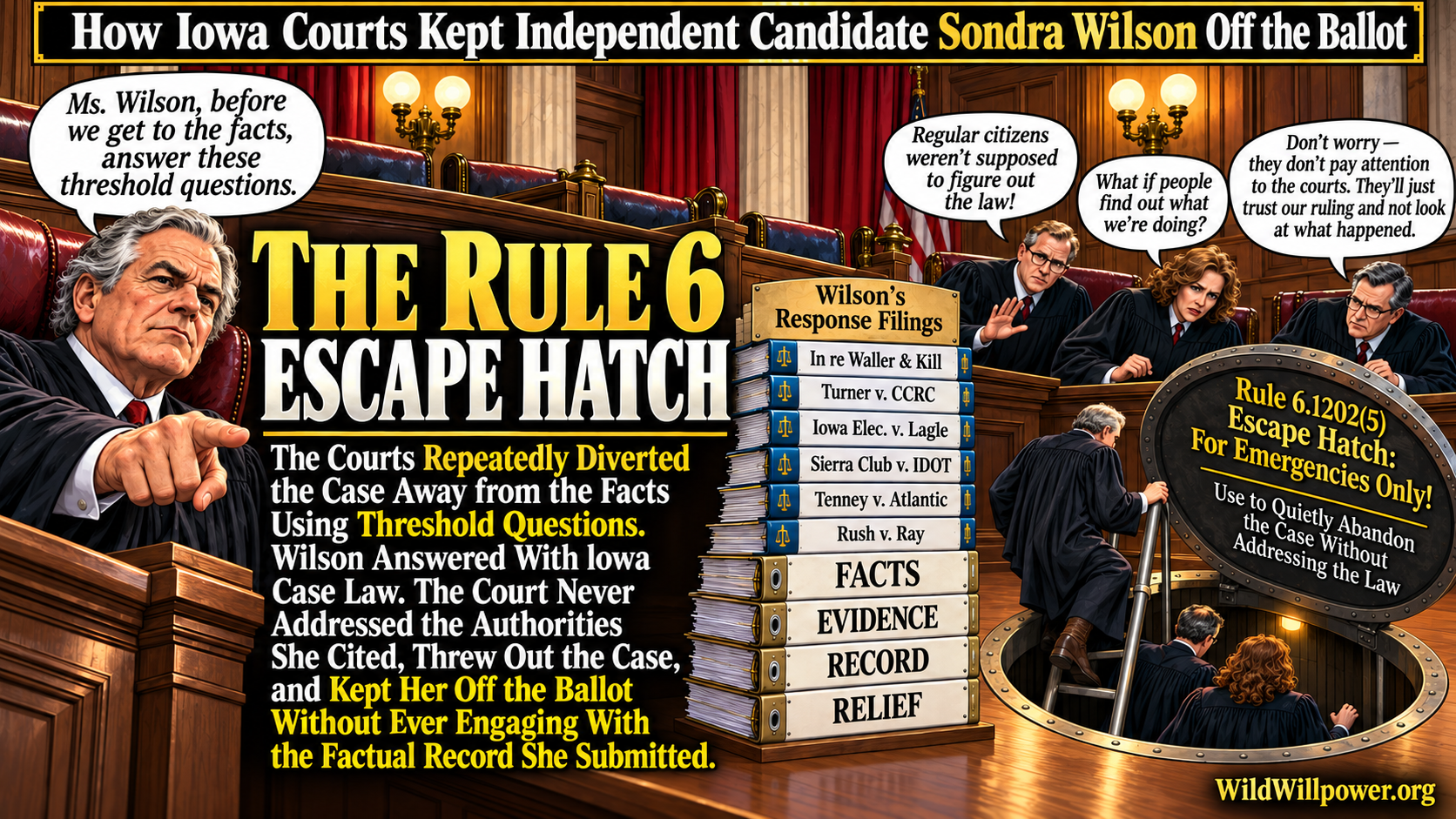
Iowans, We Need to Keep a Closer Eye on Our Courts
A court case can be reduced to a few words so easily that the public never learns what actually happened.
"Appeal dismissed as untimely."
For most people, that would end the story.
But before you accept that conclusion, consider one fact:
So why did the Iowa Supreme Court conclude that my appeal was late?
That question became the entire case.
The answer depends on a procedural rule that Iowa appellate courts use regularly but that most Iowans have never heard of: the modification rule.
The rule exists because judges sometimes issue a second ruling that changes, expands, or adds to what was decided in an earlier ruling. When that happens, Iowa law recognizes that the appeal deadline may run from the later ruling rather than the earlier one.
That wasn't an obscure argument I invented.
The rule appears in Iowa's procedural rules. Iowa courts have applied it. Iowa appellate decisions have explained it.
My appeal depended on that rule.
The district court's May 28 order expressly stated that it would not reach certain issues. The June 5 order then reached those issues and decided them against me. I challenged those new determinations on June 17. The court reconsidered them on June 22.
I therefore filed my appeal on July 20.
Twenty-eight days later.
Yet the Iowa Supreme Court dismissed the appeal as untimely.
Do not take my word for it.
Read the rules.
Read the cases.
Read the filings.
Then decide for yourself whether "appeal dismissed as untimely" tells the whole story.
Before We Get to the Supreme Court,
You Need to Understand the Modification Rule
Most people have never heard of Iowa's modification rule, but it is the reason the Iowa Supreme Court dismissed my appeal.
The rule addresses a simple problem. Sometimes a judge issues an initial ruling, then later issues another ruling that reaches new issues, adds new reasoning, or changes what the court has actually decided.
When that happens, Iowa law does not look only at whether the final result stayed the same. Courts look at what the later ruling actually did.
That matters because the appeal deadline may run from the later ruling rather than the earlier one.
My appeal depended on that principle.
The Four Dates That Matter
May 28, 2026
The district court denied relief at a threshold question and expressly stated that it would "not reach the remaining considerations."
June 5, 2026
The district court reached those previously undecided considerations and, for the first time, concluded that the litigation burdens were ordinary, foreseeable, and voluntarily undertaken.
June 17, 2026
I filed a motion directed specifically at that new determination and submitted an expanded factual record challenging it.
June 22, 2026
The district court stated that it had reviewed those materials, reconsidered the June 5 ruling, and left the result unchanged.
July 20, 2026
I filed my Notice of Appeal.
Twenty-eight days later.
If the June 5 ruling decided an issue that the May 28 ruling expressly declined to decide, did June 5 modify the earlier ruling under Iowa law?
That question became the central dispute in the appeal.
Iowa appellate precedent recognizes that courts examine the substance of a ruling, not merely whether it ended with the word "denied." My position was that the June 5 ruling reached and decided issues the May 28 ruling expressly left unresolved, making June 5 a modification under Iowa law and making my July 20 appeal timely.
July 20:
I Filed My Notice of Appeal
On July 20, 2026, I filed a Notice of Appeal from the district court's May 28, June 5, and June 22 orders. The Notice also appealed
"all adverse interlocutory rulings and orders subsumed in or affecting the final disposition of this action."
The Notice stated:
"Plaintiff Alexandra 'Sondra' Wilson, appearing self-represented, gives notice pursuant to Iowa Rules of Appellate Procedure 6.101 and 6.102 that she appeals to the Iowa Supreme Court from the following orders entered by the Iowa District Court for Polk County:
Order Denying Petition for Equitable Extension, filed May 28, 2026;
Order Denying Motion to Reconsider, filed June 5, 2026; and
Order Denying Second Motion to Reconsider, filed June 22, 2026."
The Notice of Appeal was filed twenty-eight days after the district court's June 22 ruling. Under Iowa Rule of Appellate Procedure 6.101(1)(b), a notice of appeal ordinarily must be filed within thirty days after the ruling that begins the appellate period.
The central dispute would soon become whether the June 22 ruling was the operative date, or whether the appeal clock instead began running from the district court's June 5 order.
July 24, 2026:
The Iowa Supreme Court Raised Timeliness and Mootness
Four days after the Notice of Appeal was filed, the Iowa Supreme Court did not dismiss the appeal.
Instead, it issued an order identifying two jurisdictional questions:
"This matter comes before the court on its own motion concerning two jurisdictional issues:
(1) whether petitioner's appeal is timely; and
(2) whether petitioner's appeal is moot."
The Court then summarized the procedural history and focused on the effect of my June 17 filing.
According to the Court:
"Rather than taking an appeal at that time, petitioner filed a second motion to reconsider which the court denied on June 22nd. Petitioner did not file her notice of appeal until July 20th."
The Court then identified the question that would dominate the next phase of the appeal:
"a successive motion to reconsider filed by the same party does not extend the time for taking an appeal where the district court's ruling on the first motion to reconsider did not modify the original order, ruling, judgment or decree."
The Court further explained:
"If petitioner's second motion to reconsider did not toll the time for taking an appeal, her deadline for filing the appeal was 30 days from the date of the June 5th order denying the first motion to reconsider."
And:
"Petitioner filed her appeal 14 days after this deadline."
The order also raised a separate question regarding mootness:
"The court notes the extended ballot-access deadline sought by petitioner has already passed."
The Court further noted:
"The petition itself acknowledges the matter may become moot because of election deadlines."
It therefore directed me to file a statement explaining why the appeal should not be dismissed.
By this point, the ballot-access dispute itself had largely been pushed into the background. The immediate fight was no longer whether equitable relief should be granted, but whether the Iowa Supreme Court would reach the merits at all.
July 31:
I Responded to the Supreme Court's Jurisdictional Questions
On July 31, I filed my Petitioner-Appellant's Statement Addressing Appellate Jurisdiction and Mootness, responding to both questions raised by the Iowa Supreme Court: whether my July 20 appeal was timely and whether meaningful ballot-access relief remained possible.
I began with my central position:
“The appeal should not be dismissed.”
I Articulated Why the Appeal Was Timely
I wrote:
“[T]he June 5 ruling materially modified the May 28 ruling by adjudicating a previously unreached and dispositive issue, and the June 17 motion was directed only at that intervening determination.”
The distinction was visible in the orders themselves.
The May 28 ruling stopped at what it called a threshold failure to identify sufficient legal authority and expressly stated:
“The Court does not reach the remaining considerations.”
The June 5 ruling then reached one of those considerations.
It found:
“The burdens Plaintiff identifies did not arise from any external condition imposed on her. They arose from litigation she herself initiated.”
It further characterized those burdens as:
“the ordinary and foreseeable demands of the litigation she chose to bring”
and concluded that equity did not exist:
“to relieve a party from the consequences of competing obligations she voluntarily undertook.”
My July 31 filing therefore argued:
“Those determinations were not contained in the May 28 order. The earlier ruling had expressly declined to reach them.”
And then stated the modification argument in one sentence:
“The operative denial remained in place, but the adjudicative basis of the ruling changed from a threshold absence-of-authority determination to a factual and equitable determination that the burdens were voluntary, foreseeable, and not external.”
That was the heart of my timeliness argument.
Why the Rule Exists
My timeliness argument was also occurring against the backdrop of rule amendments adopted after the Iowa Supreme Court itself identified confusion in this area of appellate practice. Iowa's current reconsideration and appellate-deadline rules were rewritten in part to reduce uncertainty over whether a post-ruling motion extends the time for appeal.
In 2016, the Court noted concerns about uncertainty surrounding post-ruling motions and appeal deadlines and proposed amendments intended to reduce disputes over whether a reconsideration motion extended the time for appeal.
The comment accompanying the current rule explains:
"To avoid controversies over whether a rule 1.904(2) motion tolls the time for appeal, rule 6.101 authorizes any timely rule 1.904(2) motion to extend the appeal deadline, subject to an exception for successive motions."
My appeal ultimately turned on the meaning of that exception.
That history matters because the Court itself had already identified uncertainty in this area. In 2016, when proposing amendments to Rules 1.904 and 6.101, the Iowa Supreme Court stated that it had “noted concerns about the existing state of the law in this area” and sought to “reduce controversies” over whether reconsideration motions toll the appeal deadline.
During public comment, Iowa attorney Mark A. Roeder separately warned that the proposed terminology still created “murkiness” in an area where clarity was especially important.
Ten years later, my appeal turned on the meaning of the very exception those amendments were intended to clarify.
Iowa Rule of Appellate Procedure 6.101(1)(c) provides an exception for a successive reconsideration motion when the court has modified its ruling and the later motion is “directed only at the modification.”
My filing argued that this was precisely what happened.
I also challenged the idea that the title or sequence of the June 17 filing resolved the issue. I wrote:
"The Court's show-cause order describes the June 17 filing as a 'second motion to reconsider.' That label accurately describes its sequence but does not fully describe its substance."
I then cited Iowa authority recognizing that courts examine the substance of a filing rather than relying solely on its caption. Among other authorities, I relied on Iowa Electric Light & Power Co. v. Lagle, Sierra Club Iowa Chapter v. Iowa Department of Transportation, Tenney v. Atlantic Associates, and Turner v. CCRC of Cedar Rapids, LLC. My point was that calling the June 17 filing a "second motion to reconsider" did not answer the question presented by Rules 1.904(4) and 6.101(1)(c): whether the motion was directed only at a modification introduced by the June 5 ruling.
Instead:
"It opened by identifying the intervening June 5 determination and then supplied the factual record bearing directly upon that determination."
I also distinguished Iowa cases involving genuinely repetitive motions and relied upon Turner v. CCRC of Cedar Rapids, LLC, where the later motion failed because it raised numerous issues and reasserted earlier requests.
I argued that my filing presented the opposite pattern:
“The June 17 motion began by identifying the precise June 5 conclusion it challenged and then directed its factual presentation to that conclusion.”
The District Court then stated on June 22 that it had reviewed the motion, affidavit, and attached materials and had “again reconsidered its prior ruling.”
I filed my Notice of Appeal on July 20.
Twenty-eight days later.
I Separately Explained Why the Underlying Litigation
Could Not Accurately Be Described as a Voluntary Personal Commitment
The filing also addressed why the June 5 characterization mattered.
I did not ask the Supreme Court, at the jurisdictional stage, to decide whether abuse of process or other wrongdoing had actually occurred.
I expressly stated:
“Appellant does not ask this Court to accept every underlying allegation as proven.”
The narrower point was:
“whether the burdens were genuinely self-created cannot be resolved merely from the fact that she was the named plaintiff.”
I explained that a person can initiate litigation while responding to circumstances she contends she did not create—including disputed government records, reputational harm, administrative failure, contested document preparation, defensive motion practice, withheld discovery, and court-imposed deadlines.
I also made clear that the continuing workload was not being offered as an excuse for an admittedly late appeal:
“Appellant does not rely upon workload, self-representation, exhaustion, or legal unfamiliarity as an independent basis to disregard a jurisdictional deadline. Nor does she concede that her notice of appeal was untimely and merely request that the delay be excused.”
My position remained that the appeal was timely under the modification rule.
I Argued the Case Was Not Moot
I then addressed the Supreme Court's second question.
My filing stated:
“Appellant’s objective has not expired. She continues to seek access to the November 2026 general-election ballot.”
The original petition had requested July 15. The amended petition later requested July 23.
But I argued:
“The passing of those requested dates does not necessarily eliminate the underlying controversy: whether a court may equitably adjust the ballot-access timetable when extraordinary circumstances prevent compliance despite diligence.”
I asked for reversal and remand so that, on an expedited basis and with consideration of actual election-administration requirements, a workable deadline could be established.
I also expressly clarified what I was not asking for:
“Appellant does not request elimination of the signature requirement, reduction of the required number of signatures, reduction of the county-distribution requirement, or automatic placement on the ballot without qualification.”
I continued to seek additional time to satisfy Iowa's existing requirements.
The filing further acknowledged that election administration matters:
“The Secretary of State remains free to identify concrete administrative deadlines, ballot-certification requirements, printing constraints, or other operational considerations.”
But I argued that those considerations could affect the timing or scope of relief without automatically establishing that no effective relief remained possible.
Alternatively, I Asked the Court to Apply Iowa's Public-Importance Exception
Even if the Court concluded that the particular dates I had originally requested had expired, I argued that the underlying legal question independently warranted review.
I identified the recurring issue as broader than my particular factual circumstances:
“The case concerns voter choice, independent and nonparty candidacy, the relationship between court-imposed burdens and statutory election deadlines, the judiciary’s equitable authority in extraordinary circumstances, the absence of an administrative extension mechanism, and whether candidates and voters can obtain meaningful appellate review before election deadlines expire.”
I also pointed to the structural timing problem:
“A candidate may file an emergency petition, receive an expedited district-court ruling, file a timely motion to reconsider, receive a second ruling, and pursue appellate review, yet still see the requested extension date pass before the appellate court can resolve the controversy.”
That was the problem I asked the Supreme Court to address.
If expiration of the particular date originally requested automatically ends appellate review, can Iowa courts ever establish what law governs an emergency ballot-extension request before the election calendar makes the question disappear?
I Also Submitted the Public Record I Had Been Building
Along with my July 31 jurisdictional statement, I submitted six public-facing articles as exhibits documenting the developing public record surrounding the litigation and ballot-access dispute. I expressly described those PDFs as fixed snapshots of the articles as they existed on July 31 and explained that they were offered to illustrate the public nature of the controversy, the affected political speech and reform work, and matters relevant to mootness—not as substitutes for the underlying court record or as independent proof of disputed allegations.
August 7:
The State Asked the Iowa Supreme Court to Dismiss the Appeal as Untimely and Moot
On August 7, Deputy Solicitor General Patrick C. Valencia entered an appearance on behalf of Secretary of State Paul Pate and filed the State's response to the Supreme Court's jurisdictional order.
The State stated its requested disposition immediately:
“Because Petitioner’s appeal is untimely and moot, the Court should dismiss the appeal.”
The State then attacked both parts of my July 31 argument.
The State Said June 5 Did Not Modify May 28
The State agreed that Iowa's rules contain an exception governing a successive reconsideration motion after a court modifies an earlier ruling.
It quoted the rule:
“[U]nless the court has modified its order, ruling, judgment, or decree and the subsequent motion is directed only at the modification.”
But the State contended that the exception did not apply because the June 5 order had not modified the May 28 ruling at all.
Its filing emphasized the formal disposition of the June 5 order:
“The court did not modify its May 28 order denying Wilson’s petition. Indeed, the June 5 order’s decretal language is unambiguous: ‘Plaintiff’s Motion to Reconsider under Iowa Rule of Civil Procedure 1.904 is DENIED.’”
The State characterized what happened on June 5 not as a new determination, but as additional explanation of the original ruling:
“The court then further explained the reasoning it provided in the initial order denying the petition and distinguished the new authorities that Wilson raised in the Rule 1.904(2) motion.”
And it argued that the issue I identified as newly decided had actually been present from the beginning:
“But that issue is the same issue Wilson pleaded in the emergency petition for equitable relief.”
The State's argument then became even more explicit.
According to its filing:
“Indeed, had the district court modified or enlarged its prior ruling then it would have granted Wilson’s Rule 1.904(2) motion to reconsider, enlarge, or amend then denied the petition anew. But it did not.”
Under that interpretation, the June 17 filing was a prohibited successive Rule 1.904(2) motion that did not extend the appeal period.
The State therefore calculated the appeal deadline from June 5:
“Wilson’s time to appeal began to run on June 5 when the district court denied Wilson’s first Rule 1.904(2) motion.”
And because I filed my Notice of Appeal on July 20, the State concluded:
“The appeal is therefore untimely.”
The competing positions were now unusually clear.
My position: what matters is the substance of what the June 5 ruling newly decided.
The State's position: June 5 did not legally modify May 28, and the fact that the reconsideration motion was formally denied was central to that conclusion.
That disagreement would become even more important the following day.
The State Also Argued That no Effective Ballot Relief Remained
The State separately argued that the case was moot.
Its argument began with the July 15 date contained in my original petition:
“Wilson seeks an ‘[e]quitable extension of the ballot-access deadline to July 15, 2026.’ But now that extended deadline has expired.”
Because I had not submitted completed nomination papers by July 15, the State argued that retroactively granting that particular extension would accomplish nothing:
“So even if this Court granted Wilson’s petition, that opinion would be of no effect as to Wilson because Wilson did not comply with that extended deadline.”
The State then addressed the different relief requested in my July 31 filing—a remand for establishment of a new workable deadline:
“Wilson’s statement to this Court revises the requested relief from what was pleaded, now asking the Court to ‘reverse and remand for establishment of a workable equitable deadline.’”
The State argued that I had not yet supplied sufficient facts demonstrating that such relief would still be practicable:
“Wilson fails to provide facts sufficient to allow a court to determine that any such amended equitable relief would not be futile.”
It also pointed to approaching state and federal election-administration deadlines and argued that I had therefore failed to establish that the Court could still provide effective relief.
The State Opposed the Public-Importance Exception Too
Finally, the State argued that the Supreme Court should not retain the case under Iowa's public-interest exception to mootness.
It acknowledged the four considerations Iowa courts use—including the public nature of the issue, the desirability of authoritative guidance, likelihood of recurrence, and likelihood that the issue will recur yet evade review—but argued that my circumstances were too fact-specific.
The State wrote:
“Given the unique nature of Wilson’s allegations, any future challenge to the statutory filing deadline will raise different facts, and thus will press different equitable grounds for relief.”
It characterized the underlying issue this way:
“[W]hether a prospective candidate is entitled to an equitable extension of a statutory deadline based on being busy with other litigation they themselves initiated—is a unique one.”
And it concluded:
“The Court should dismiss the appeal.”
By the end of August 7, the parties' disagreement was no longer difficult to identify.
The State said June 5 merely explained an existing denial, so the appeal clock began June 5.
I said June 5 decided a material issue May 28 expressly left unresolved, making the June 17 filing a response to that modification and June 22 the operative appellate date.
The State said July 15 had passed and I had not shown that another deadline could still provide effective relief.
I said July 15 was a proposed remedy, while the underlying controversy remained whether a workable path to the November ballot could still be established while requiring full compliance with Iowa's signature requirements.
The next filing would put an Iowa appellate decision directly against one of the State's central premises: that a ruling formally denying reconsideration could not nevertheless modify the earlier ruling.
August 8:
I filed a Supplemental Response and Supplemental Declaration
On August 8, I filed a Motion for Leave to File a Supplemental Response, a Proposed Supplemental Response, and a sworn Declaration Regarding Current Ballot-Access Feasibility.
The supplemental response focused on two questions:
"First, may a ruling formally denying a first Rule 1.904(2) motion nevertheless modify the prior ruling within the meaning of Iowa Rule of Appellate Procedure 6.101(1)(c)?
Second, if so, was Appellant's June 17 motion 'directed only at the modification'?"
I argued that a recent Iowa Court of Appeals decision, In re Marriage of Waller and Kill, answered the first question by instructing courts to examine the substance of a ruling rather than merely its label. The timing of Waller was notable. The day before, the State had argued that the June 5 ruling could not have modified the May 28 ruling because the district court had formally denied reconsideration rather than granting it.
My supplemental response argued that Waller rejected a purely label-based approach. As the Court of Appeals explained:
"But in determining whether there was a modification, we look at the content of the ruling."
My position was that the same analysis applied here. The dispositive question was not whether June 5 still ended with the word "denied." The question was whether June 5 decided an issue that May 28 had expressly declined to decide.
I also relied on Turner v. CCRC of Cedar Rapids, LLC, which examined whether a successive motion was actually directed only at the alleged modification.
My position remained straightforward:
"On May 28, the district court expressly refused to reach the remaining equitable considerations.
On June 5, it reached them."
And:
"The decretal result remained 'denied.' The adjudicative basis did not."
Separately, my sworn declaration stated that I remained willing to satisfy Iowa's ballot-access requirements, retained approximately 1,000 collected signatures, and continued to seek access to the November ballot.
The declaration also supplied the practical facts the State had said were missing. I estimated that approximately 2,500 additional signatures remained necessary to reach the statutory numerical threshold, before allowing for extra signatures that might be needed in the event of challenges. I stated that I had gathered approximately 60 signatures on at least one favorable day, was prepared to resume intensive petition circulation and recruit volunteers, and remained willing to comply with whatever accelerated verification, objection, or review procedures the Court deemed necessary.
In other words, the State argued on August 7 that I had not supplied enough facts to show that a new deadline could still matter. On August 8, I supplied those facts under oath.
August 12:
The Iowa Supreme Court Dismissed the Appeal as Untimely
On August 12, the Iowa Supreme Court dismissed my appeal, citing lack of jurisdiction. The Court stated that it had reviewed the parties' jurisdictional submissions, including my supplemental response, and concluded that my appeal was untimely. It further concluded that my June 17 motion did not extend the time for taking an appeal under Iowa Rules of Civil Procedure 1.904(4) and Iowa Rules of Appellate Procedure 6.101(1)(c). The Court expressly declined to decide mootness.
The Court wrote:
"Upon consideration of the statements filed by the parties in response to this court's prior order, including appellant's supplemental response, and without reaching the issue of whether the appeal is moot, the court concludes the appeal is untimely."
And:
"The appeal was not filed within 30 days of the district court's order denying petitioner's first motion to reconsider, and petitioner's second motion to reconsider did not extend the time for taking an appeal."
It did not state:
— whether the June 5 ruling failed to modify the May 28 ruling;
— whether the June 17 motion was not directed only at the alleged modification;
— whether the Court disagreed with my reading of Turner;
— whether the Court disagreed with my reading of Waller;
— whether the Court concluded that Waller was distinguishable from the circumstances presented here; or
— whether some other requirement of Rules 1.904(4) and 6.101(1)(c) was unsatisfied.
Instead, the order announced the conclusion that the appeal was untimely and that the June 17 motion did not extend the appeal period.
That absence of explanation was significant because, only four days earlier, I had specifically argued that In re Marriage of Waller and Kill required a content-based analysis of whether the June 5 ruling modified the May 28 ruling. My supplemental response argued that the relevant question was not whether June 5 formally said "denied," but whether June 5 reached and decided an issue that May 28 had expressly declined to decide.
Because the order did not explain its reasoning, I was unable to determine how the Court reconciled its conclusion with the content-based analysis discussed in Waller. The dismissal order did not explain why that argument failed, why Waller did not apply, or what legally material distinction the Court saw between Waller and the circumstances presented here.
The dismissal order did not explain why that argument failed.
August 14:
I Asked the Iowa Supreme Court to Set Aside the Dismissal and Reinstate the Appeal
On August 14, before procedendo issued, I filed a Motion to Set Aside the Aug. 12 Dismissal and Reinstate the Appeal Under Iowa Rule of Appellate Procedure 6.1208(1)(c).
Attachments included:
Exhibit A — Aug. 29, 2016 Iowa Supreme Court Order Requesting Public Comment on Proposed Amendments to Iowa Rule of Civil Procedure 1.904 and Iowa Rule of Appellate Procedure 6.101.
Exhibit B — Nov. 18, 2016 Order Adopting Amendments to Iowa Rule of Civil Procedure 1.904 and Iowa Rule of Appellate Procedure 6.101.
Exhibit C — Sept 5, 2016 Excerpt from Public Comments Regarding Proposed Amendments to Iowa Rule of Civil Procedure 1.904 and Iowa Rule of Appellate Procedure 6.101, by Mark A. Roeder of Roader Law Firm, located in in Manchester Iowa.
The motion focused on a question left unanswered by the Court's August 12 dismissal order. The Court concluded that my June 17 motion did not extend the appellate deadline, but did not explain which component of the modification analysis failed, if any.
I therefore asked the Court to determine that:
— the June 5 ruling modified the May 28 ruling;
— the June 17 motion was directed only at that modification;
— the June 22 ruling was the operative appellate date; and
— my July 20 Notice of Appeal was timely.
Alternatively, if the Court disagreed, I asked it to identify the legal basis upon which the modification exception did not apply.
The motion repeatedly returned to the same question:
"Did the Court conclude that the June 5 ruling did not modify the May 28 ruling at all; that a modification occurred but the June 17 motion was not directed only at it; or that some other requirement of Rules 1.904(4) and 6.101(1)(c) was unsatisfied?"
I also argued that the Iowa Supreme Court's own 2016 rulemaking history demonstrated that the current rules were adopted in part to reduce controversy and uncertainty surrounding appellate deadlines and reconsideration practice. To support that point, I attached materials from the Court's rulemaking proceedings and public-comment process.
The motion further identified another unresolved procedural issue: my June 1 Motion for Leave to Amend was never expressly granted or denied. I argued that the absence of an identifiable ruling created additional uncertainty concerning the procedural timeline and the operative disposition from which appellate deadlines should be measured.
The filing also requested prompt action. Because the Court had expressly declined to decide mootness, I argued that meaningful election relief had not yet been ruled out and that any remaining possibility of relief depended upon resolving the jurisdictional issue quickly.
In short, the August 14 motion asked the Court either to reinstate the appeal or to explain why Iowa's modification exception did not apply.
August 16:
I Supplemented the Reinstatement Request
Two days later, I filed a Motion for Leave to File Supplemental Memorandum and Supplemental Declaration.
Attachments included:
Exhibit A — Supplemental Memorandum in Support of Setting Aside the Dismissal and Reinstating the Appeal, and
Exhibit B — Declaration regarding current ballot-access feasibility.
The supplemental filings did not present a new jurisdictional theory. Instead, they expanded upon issues already raised in the August 14 motion.
The supplemental memorandum supplied additional Iowa authority concerning the unresolved June 1 Motion for Leave to Amend and further explained why the changing requested deadlines did not eliminate the underlying controversy.
The Supplemental Memorandum explained why the unresolved amendment motion mattered:
“Had the district court expressly ruled on that separately filed motion, Appellant would have known what pleading controlled and would have had an identifiable ruling from which to seek whatever timely reconsideration or appellate relief Iowa procedure permitted. Instead, no express ruling was entered.”
It also drew an important distinction between the dates I had proposed as remedies and the controversy itself:
“July 15 was a proposed remedy, not the controversy. July 23 was a later proposed remedy, not the controversy.”
The accompanying declaration updated the Court concerning ballot-access feasibility and explained that any remaining relief needed to provide a realistic and practically workable opportunity to complete Iowa's existing requirements—not merely the shortest mathematically conceivable period in which the remaining signatures could theoretically be collected. I continued to possess the petition sheets and signatures and remained willing to satisfy Iowa's requirements in full.
The supplemental filings therefore sought to strengthen the pending reinstatement request rather than replace it.
August 26:
Without Explanation, the Iowa Supreme Court Denied Reinstatement
On August 26, 2026, the Iowa Supreme Court denied my motion to set aside the dismissal, reinstate the appeal, and clarify the basis for its timeliness ruling. The Court also denied my supplemental filing.
The entire substantive portion of the order stated:
"Upon consideration of the documents filed, the court denies the motion to set aside dismissal and reinstate appeal and request for clarification."
The Court then cited Iowa Rule of Appellate Procedure 6.1006(1)(c). [8-26-2026...nstatement | PDF]
By that point, I had filed:
— a jurisdictional statement addressing timeliness and mootness;
— a supplemental response discussing Waller and Turner;
— a motion to set aside dismissal and reinstate the appeal;
— a request for clarification concerning the modification exception;
— a supplemental memorandum; and
— sworn declarations concerning continuing ballot-access feasibility.
Yet the Court still did not identify which component of the modification analysis failed.
The order did not explain:
— whether the June 5 ruling failed to modify the May 28 ruling;
— whether my June 17 motion was not directed only at the alleged modification;
— whether Waller was distinguishable;
— whether Turner was distinguishable; or
— whether some other requirement of Rules 1.904(4) and 6.101(1)(c) had not been satisfied.
The Court simply denied reinstatement and denied clarification.
The Iowa Supreme Court's Rule 6 Escape Hatch
This article is called The Iowa Supreme Court's Rule 6 Escape Hatch because Iowa's appellate rules permit the Court to dispose of certain matters through summary orders that do not require a detailed written explanation.
In my case, the Court raised timeliness on its own initiative, required briefing, received multiple rounds of argument, dismissed the appeal, received a motion to set aside the dismissal, received a request for clarification, and then denied both.
The Court was legally permitted to do that.
What it was not required to do was explain why my arguments failed.
That absence of explanation did not begin at the appellate level.
On June 22, the district court had already stated that it reviewed my expanded factual record and “again reconsidered” the June 5 ruling, yet did not explain why those materials failed to alter its characterization of the litigation burdens as ordinary, foreseeable, and voluntarily undertaken.
The same structural problem then repeated itself on appeal.
On August 12, the Supreme Court said it had considered my jurisdictional submissions but did not explain which component of the modification argument failed.
On August 26, after I expressly requested that clarification, the Court denied the request without providing it.
Three consequential rulings. Three opportunities to explain the decisive reasoning. In each instance, the result was stated while the central unanswered question remained unanswered.
As a result, the central question remains unanswered:
If the May 28 order expressly declined to reach an issue, and the June 5 order later decided that issue against me, why was the June 5 ruling not treated as a modification for purposes of Iowa's appellate rules?
I presented authorities such as Waller, Turner, Lagle, Sierra Club, and Tenney. I presented rule text, rule-comment history, public-comment history, supplemental briefing, and requests for clarification. The Court's orders never explained why those authorities did not alter the outcome.
Readers may ultimately agree or disagree with my legal position.
But the point of this article is different.
The issue is not whether I should have won.
The issue is that neither the August 12 dismissal nor the August 26 denial of reinstatement explained why I lost.
And because the appeal ended at the jurisdictional stage, the courts never addressed the larger questions that gave rise to the ballot-access dispute, including whether the litigation burdens I identified were truly "self-created," whether meaningful ballot relief remained possible, or whether extraordinary circumstances ever justified equitable relief.
That is why I describe Rule 6 as an escape hatch.
The rules allowed the Court to end the case without ever reaching those questions.
That Raises a Question Larger than Wilson v. Pate
Iowa's procedural rules impose demanding obligations on litigants to preserve issues, identify controlling authority, distinguish adverse cases, satisfy jurisdictional deadlines, and explain precisely why relief is legally available. But what happens when a litigant does all of that and a case-ending order does not identify why the argument nevertheless fails?
The problem is not that every judicial ruling must become a lengthy opinion. The problem is whether Iowa's rules provide adequate safeguards when a summary ruling ends a person's access to judicial review altogether—especially after the litigant identifies specific authority, requests clarification, and faces injuries that cannot later be repaired.
That is no longer merely a question about this appeal. It is a question about the design of Iowa's judicial system.
A separate installment will examine whether Iowa's procedural rules should require reasoned determinations in case-ending rulings, provide a meaningful right to clarification, and create expedited safeguards when delay itself can destroy the relief being sought.
Authorities Discussed in Above Article
In re Marriage of Waller and Kill, No. 25-0899 (Iowa Ct. App. June 10, 2026)
Turner v. CCRC of Cedar Rapids, LLC, No. 20-0973 (Iowa Ct. App. 2021)
Turner v. CCRC of Cedar Rapids, LLC, No. 20-0973 (Iowa Ct. App. July 21, 2021)
Iowa Electric Light & Power Co. v. Lagle, 430 N.W.2d 393 (Iowa 1988)
Sierra Club Iowa Chapter v. Iowa Department of Transportation, 832 N.W.2d 636 (Iowa 2013)
Authorities Cited in My Filings, Never Addressed by Court
Wingert v. Urban, 250 N.W.2d 731 (Iowa 1977)
Rush v. Ray, 332 N.W.2d 325 (Iowa 1983), explains that mootness is a doctrine of judicial restraint rather than simply a question of raw judicial power.
Riley Drive Entertainment I, Inc. v. Reynolds, 970 N.W.2d 289 (Iowa 2022), identifies factors for deciding whether an otherwise moot case should still be heard because it presents an important public question—including whether the issue is likely to recur and repeatedly escape appellate review.
And Board of Directors v. Green, 147 N.W.2d 854 (Iowa 1967), addressed the problem of disputes that are likely to become moot before ordinary appellate review can be completed. I argued that ballot-access cases create the same structural problem: the deadline being challenged can expire while the appeal is still being litigated.
OLD MATERIAL THAT MIGHT BE FOLDED IN:
The Jurisdictional Question Is Only the Gateway
The immediate dispute is procedural:
Was my appeal timely?
But that is not the larger question this case presents.
If a candidate timely presents a good-faith evidentiary showing creating a reasonable basis to infer that extraordinary interference beyond the candidate's control materially affected the candidate's ability to meet a ballot-access deadline, should the court promptly establish a fixed schedule for resolving the claim while meaningful relief remains possible?
If the answer is yes, then that—not the technical jurisdictional question now blocking review—is the larger issue in this case.
In my case, the alleged interference was not merely that litigation happened to consume time. I alleged that defendants had placed serious and damaging allegations into Iowa's civil-rights process, that those allegations created foreseeable risks to my reputation and statewide campaign, and that the resulting litigation was later prolonged and magnified through conduct I alleged constituted abuse of process.
In other words, my position was that the burden was not simply self-imposed campaign scheduling. I alleged a chain of outside conduct that created the need for litigation, expanded the litigation burden, and ultimately consumed substantial portions of the ballot-access period.
I went to court before the June 2 ballot-access deadline expired. I expressly told the court that those litigation obligations were interfering with my campaign and consuming the time available for signature gathering. I did not ask to be excused from Iowa's ballot-access requirements. I asked for additional time in which to satisfy the same requirements.
That larger question has never been adjudicated in this case.
If the record provides a reasonable basis to infer that interference materially affected a candidate's ability to qualify, but the process of obtaining judicial review consumes the remaining qualification period, the passage of time itself can become part of the injury.
A candidate should not lose the practical possibility of relief merely because she used the courts in good faith to seek that relief while time still mattered.
SAVE FOR REFORM ARTICLE
“The extraordinary amount of procedure has not produced a corresponding amount of substantive adjudication.”
“A jurisdictional deadline should not depend upon silently choosing among procedural events the district-court record itself never clearly identified.”
“When the process of obtaining judicial review consumes the remaining period in which relief is possible, the passage of time itself can become part of the injury.”
“If every ballot-access appeal becomes ‘too late’ before the appellate courts can decide it, when would Iowa's appellate courts ever get the opportunity to decide what the law requires?”
and:
“A system in which outside interference can consume the compliance period, while the passage of that same time prevents judicial review, risks leaving candidates and voters without any effective remedy.”
My appeal has two goals.
1. Restore a Path to the Ballot
Iowa voters deserve the opportunity to consider every candidate, especially where extraordinary circumstances interfered with the statutory process and where the requested relief was narrow: more time to gather the same signatures required of everyone else.
Political sabotage — or even the reasonable possibility of campaign interference — should not be rewarded by allowing the interference to succeed.
I am not the only gubernatorial candidate seeking relief related to ballot access. Nicholas Gluba and Jules Cutler also sought court intervention.
2. Establish a Precedent to Protect Future Candidates and Voters
When there is evidence or a reasonable inference of campaign interference — including defamation, administrative misconduct, altered documents, misleading submissions, or false allegations lodged into government records — courts should not automatically treat a candidate’s effort to clear her name as a voluntary personal choice.
They should look deeper.
They should ask why the lawsuit was filed. They should ask what was at stake. They should ask whether the litigation burden was mandatory. They should ask whether the candidate acted diligently. And they should ask whether a narrow equitable extension would protect voters’ ability to consider an independent candidate without undermining election administration.
If the Iowa Supreme Court reaches the merits, I hope this case helps establish a precedent ensuring that future candidates are not knocked off the ballot through extraordinary interference without meaningful judicial review.
FOR USE LATER:
Iowa Election Law Is Not As One-Sided as "Deadlines Are Deadlines"
"Iowa generally demands strict compliance with pre-election qualification requirements." Gluba v. State Objection Panel, 11 N.W.3d 459 (Iowa 2024), No. 24-1426. However, Wingert v. Urban, 250 N.W.2d 731 (Iowa 1977), shows that Iowa election law has recognized that exceptional circumstances can matter rather than treating every instance of noncompliance as categorically beyond equitable consideration.
And Gluba was relevant in another way: the Iowa Supreme Court had demonstrated that it can hear ballot-access disputes on an expedited schedule when an approaching election requires immediate resolution.
Taken together, my argument was not that election deadlines do not matter. It was that Iowa's rules expressly contemplate reconsideration after a ruling is modified; Iowa cases instruct courts to examine substance rather than labels; Iowa recognizes a public-importance exception for disputes likely to recur yet escape review; and Iowa courts have recognized both exceptional circumstances in election cases and expedited appellate review when election deadlines demand it.
I therefore asked the Supreme Court to find my appeal timely, reject mootness, and allow the ballot-access case to proceed on an expedited schedule.
REFORM ARTICLE:
Iowa Rule of Civil Procedure 1.451 Required a Ruling on My Motion for Leave to Amend
Iowa Rule of Civil Procedure 1.402(4) provides:
“Leave to amend, including leave to amend to conform to the proof, shall be freely given when justice so requires.”
And Rule 1.402(1) provides that Iowa's pleading rules are to be construed and enforced:
“to secure a just, speedy and inexpensive determination of all controversies on their merits.”
Iowa Rule of Civil Procedure 1.451, titled “Specific rulings required,” states:
“A motion, or other matter involving separate grounds or parts, shall be disposed of by separate ruling on each and not sustained generally.”
I do not read Rule 1.451 as establishing a particular number of days within which Judge Beattie had to decide my Motion for Leave. But the Rules certainly gave me reason to expect that a separately filed motion seeking leave to place a materially updated pleading before the court would receive an identifiable ruling.
The proposed pleading contained the updated July 23 requested deadline, additional constitutional ballot-access authority, additional Iowa equitable authority, and clarifying factual allegations addressing the very characterization Judge Beattie had now made.
And because Rule 1.402(4) provides that leave “shall be freely given when justice so requires,” my Motion for Leave had specifically explained why justice supported amendment: it directly cured the May 28 deficiency, was submitted in good faith, would not unduly prejudice the Secretary of State, and would assist resolution of the dispute on its merits and on a more complete legal record.
Yet the June 5 order said nothing about it.
And there was now another problem.
The May 28 order had stopped before reaching the factual and equitable circumstances. The June 5 order now reached those circumstances—but characterized the underlying litigation as an ordinary burden I had voluntarily chosen.
That new characterization required an answer.
I could not meaningfully challenge the June 5 ruling without showing the court why Reliable Street existed, what I was actually alleging had happened there, and why I contended the resulting litigation burden was neither ordinary nor voluntarily manufactured.
That is what led to my June 17 filing.
FOR BEHIND THE HEADLINES:
But this case did not begin with an appellate deadline. It did not even begin with ballot access.
It began years earlier, with what I contend was political sabotage connected to my work with Wild Willpower, before I ever decided to run for governor.
After I announced my candidacy, I filed Wilson v. Reliable Street Inc., et al. to clear my name from serious accusations and disputed government records that I believed threatened the work and reputation I had spent years building. The underlying record included accusations of stalking, harassment, racism, and other misconduct; when I eventually obtained the respondents' submissions, I concluded that communications had been rearranged and materially altered in ways that supported accusations I contended were false.
That case then dragged across two courthouses and three judges while the record became increasingly fragmented.
I contend the defendants repeatedly benefited from that fragmentation. Interlocutory rulings progressively narrowed the case before its underlying factual record was fully developed. A document I contend was materially altered was never substantively examined. Full discovery never occurred. The case received no meaningful media scrutiny, and I was unable to obtain legal representation while trying to litigate an increasingly complicated civil-rights dispute myself.
By 2026, Reliable Street had become a years-long proceeding involving venue disputes, service challenges, pleading disputes, amendment proceedings, discovery disputes, dispositive motions, and allegations of abuse of process. During the narrow period in which I was required to qualify for Iowa's gubernatorial ballot, it generated nine mandatory hearings and filing deadlines that directly competed with signature gathering.
Then that unresolved litigation collided with the ballot-access period.
By then I was not dealing with a fresh lawsuit I had casually chosen to pursue. I was still trying to resolve a years-old dispute that I believed directly affected my reputation, political work, and candidacy—and that had never received a full factual adjudication.
The case I filed to clear my name became the burden that interfered with my campaign.
Then the ballot-access court characterized that burden as “self-created” because I had been the person who filed the lawsuit.
I challenged that characterization with a 62-page revised pleading and approximately 209 pages of organized exhibits showing what the underlying litigation actually involved, why I believed judicial redress had been necessary, and why I contended the litigation itself had been unusually prolonged and magnified.
The court stated that it reviewed those materials.
It did not explain why they failed to change the “self-created” characterization.
And now, when I have attempted to obtain appellate review of that ruling, the Iowa Supreme Court has dismissed the appeal on a procedural timeliness issue without reaching whether the underlying characterization was correct.
So the present controversy is not simply about whether I missed a deadline.
It is about what happens when alleged political and administrative harm produces years of litigation; that litigation remains unresolved long enough to consume the qualification period of a statewide campaign; the burden is then labeled “self-created” because the injured person sought judicial redress; and appellate review is stopped by a technical rule before the underlying issue is ever decided.
Calling the burden “self-created” because I filed the lawsuit strips away the entire reason the lawsuit existed. I filed it to challenge records and accusations I believed were false, politically damaging, and necessary to confront before asking Iowans to trust me with statewide office.