
Before the Lawsuit
What Led Up to Wilson v. Reliable Street Inc., et al.
Parts One-Three: Fall 2021-December 2023
Updated September 23, 2026
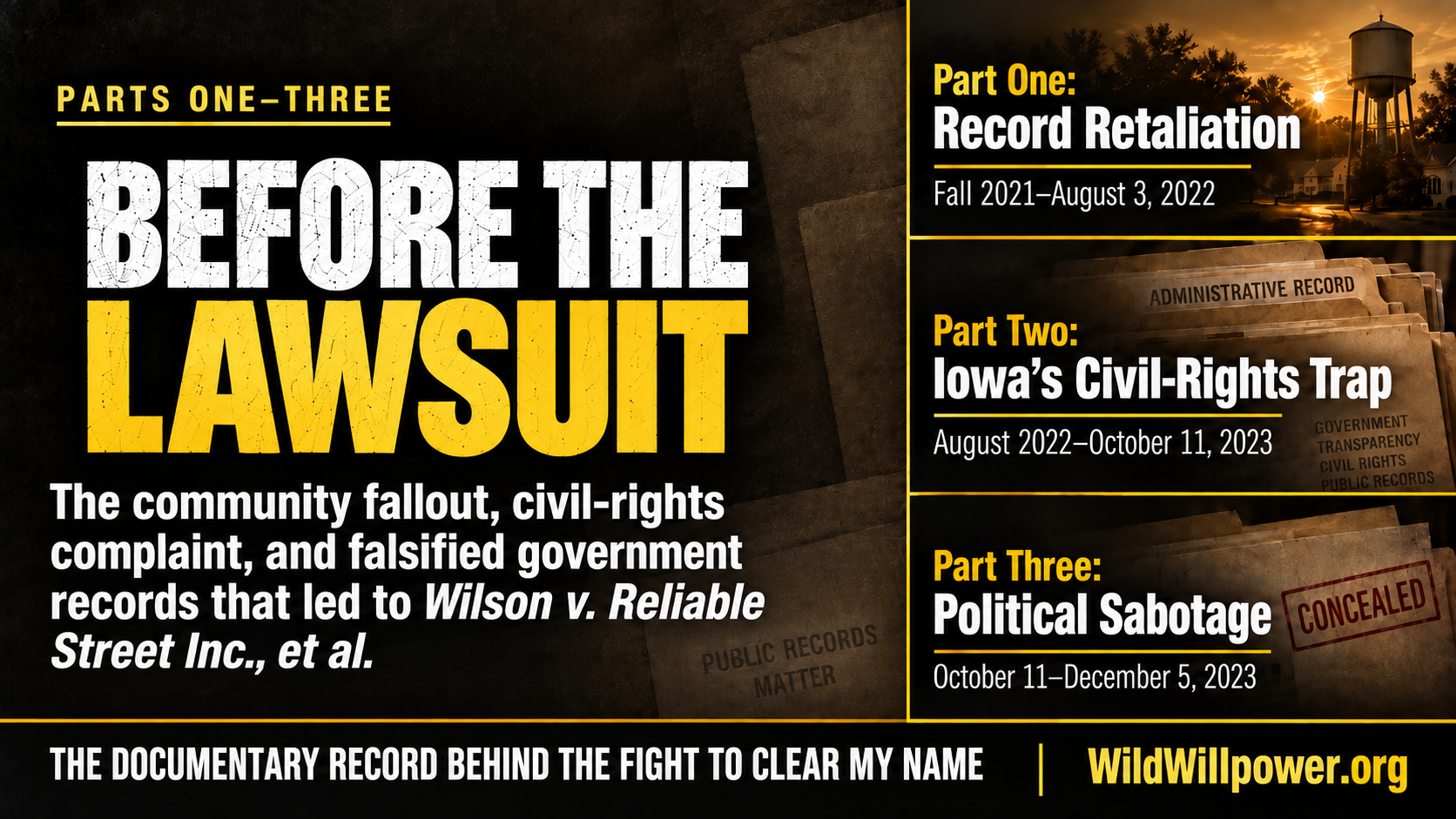
How the Dispute Reached the Courthouse
Before Wilson v. Reliable Street Inc., et al. became a years-long lawsuit, the underlying dispute developed through three distinct stages.
Part One, Record Retaliation, reconstructs the relationships, projects, communications, and sudden March 31, 2022 exclusion that led me to seek civil-rights review. Part Two, Iowa’s Civil-Rights Trap, documents what happened when I tried to challenge the resulting allegations while being denied access to the complete administrative record. Part Three, Political Sabotage, examines what I finally discovered when the complete ICRC file was released and its contents could be compared against the contemporaneous evidence.
Together, these three articles explain why I filed suit on December 5, 2023.
Read Part One — Record Retaliation →
How a cooperative community relationship became allegations of stalking, harassment, racism, and other misconduct in an Iowa government record.
Read Part Two — Iowa's Civil-Rights Trap →
How I spent more than a year trying to obtain the evidence behind those allegations while being urged to seek counsel without access to the complete file.
Part Three — Political Sabotage →
What the concealed ICRC file revealed when the respondents’ submissions were finally compared with the contemporaneous record.
Part One:
Record Retaliation
Fall 2021-August 3, 2022
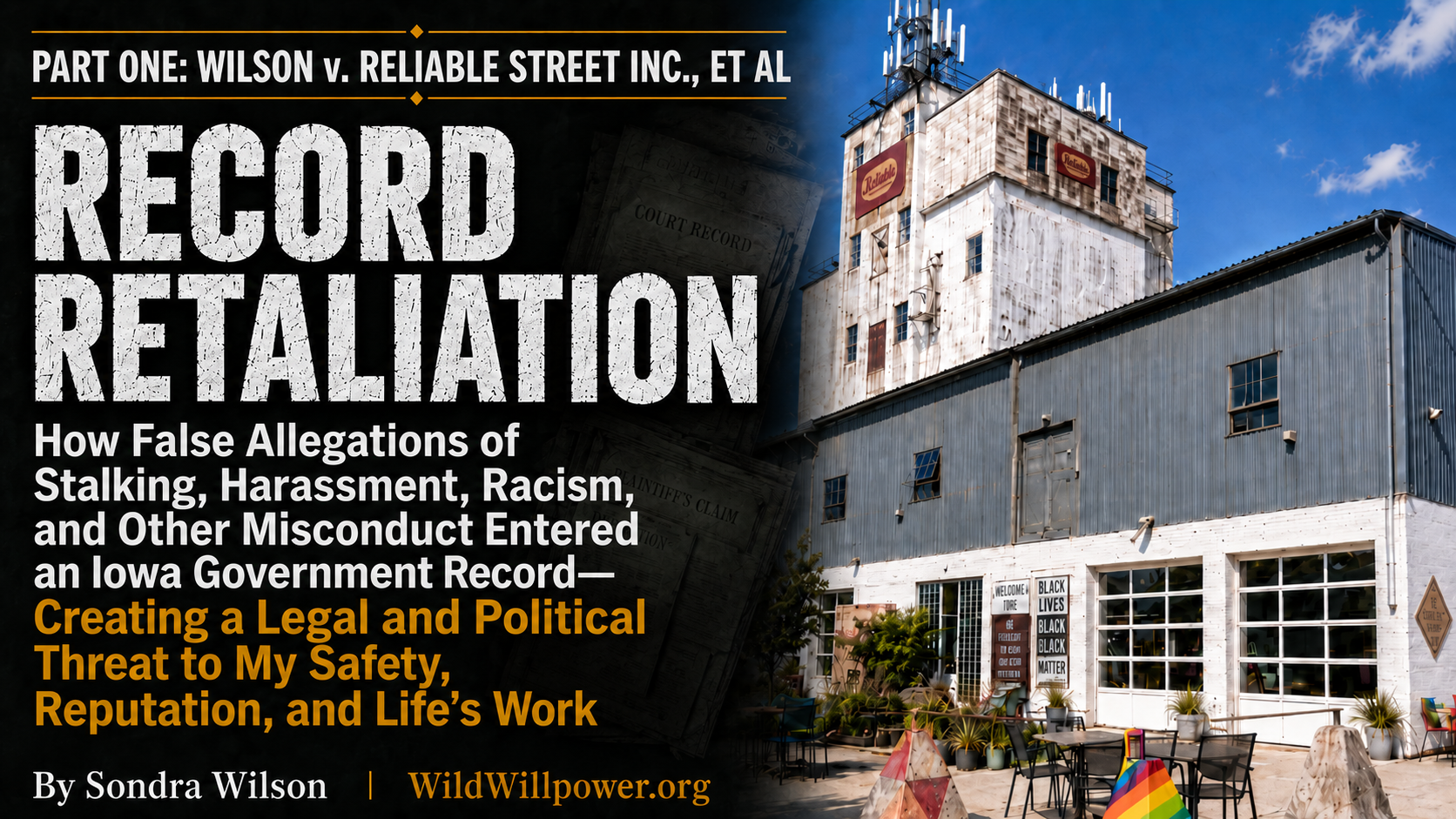
How a cooperative community relationship was later reframed into allegations of stalking, harassment, racism, obsessive behavior, and other serious misconduct
Record Retaliation is the factual beginning of Wilson v. Reliable Street Inc., et al.
For approximately six months, I participated in Reliable Street and Lockwood Café's open mic, garden, prairie, and community projects. The contemporaneous record presented in the article documents friendships, approval, delegated responsibilities, project agreements, and repeated cooperative communications with people who would later become defendants in the lawsuit.
That changed abruptly on March 31, 2022, when I was barred from Reliable Street and Lockwood Café after being told that women had complained about me, without being told what specific conduct I had supposedly committed. I initially questioned myself, reviewed my communications, sought explanations, and requested mediation rather than litigation.
When those efforts failed, I filed a discrimination complaint with the Iowa Civil Rights Commission on April 22, 2022.
On August 3, the ICRC administratively closed the complaint and issued its Preliminary Case Review. For the first time, I learned that the respondents' account had escalated far beyond what I had been told on March 31. The government record now included allegations involving stalking, harassment, racism, inappropriate comments, obsessive behavior, boundary violations, and other serious misconduct.
But I still could not see the respondents' actual statements or supporting documents. I could see only the Commission's summary, leaving basic questions unresolved—including who had made particular accusations and what evidence had supposedly supported them. The ICRC's withholding of that material becomes the subject of Part Two, Iowa's Civil-Rights Trap.
What Not to Miss
— The before-and-after contrast. The article places months of contemporaneous communications documenting friendship, cooperation, permission, delegated responsibility, and project planning beside the much darker characterization that emerged after March 31. The article itself identifies that contrast as central to the later defamation and related claims.
— March 31 was initially an unexplained exclusion—not a lawsuit. I was barred without being told the specific conduct I supposedly committed, then spent the following days trying to understand what had happened and requesting mediation.
— The allegations escalated inside the ICRC process. The August 3 Preliminary Case Review was when I first learned that the developing record included allegations of stalking, harassment, racism, obsessive behavior, and other serious misconduct.
— The underlying evidence was still hidden. Although the ICRC summary revealed the accusations, it did not disclose the respondents' complete statements or supporting materials. That information gap is what leads directly into Part Two.
Key Dates
March 31, 2022 — I was unexpectedly barred from Reliable Street and Lockwood Café.
April 1–12 — I tried to understand what I had been accused of, reviewed the record, and sought mediation.
April 22 — I filed an Iowa Civil Rights Commission complaint.
August 3 — The ICRC closed the complaint and issued the Preliminary Case Review revealing much more serious allegations.
Why Part One Matters
Part One establishes the baseline factual record against which everything that came afterward can be compared. It does not yet attempt to reconstruct the complete ICRC file—that comes later. Its purpose is to show what the relationships and projects looked like before the accusations were formalized, what happened when the relationship abruptly ruptured, and how the allegations first entered the official civil-rights record.
Read Part One — Record Retaliation →
Part Two:
Iowa's Civil-Rights Trap
August 2022-October 11, 2023
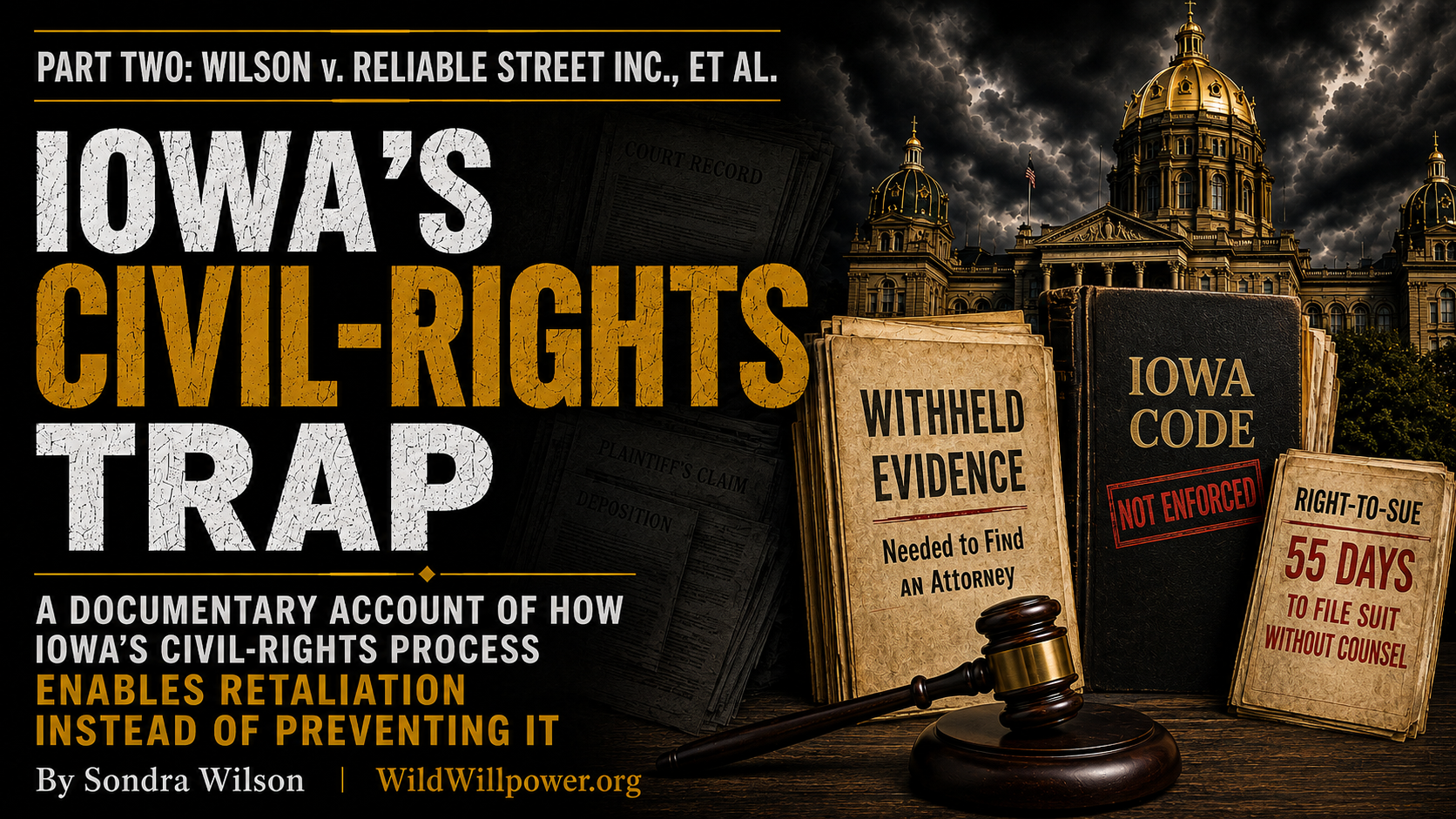
How an administrative closure became a year-long search for the evidence, legal assistance, and an institution willing to resolve the underlying factual dispute
Iowa’s Civil-Rights Trap begins where Record Retaliation ends.
On August 3, 2022, the Iowa Civil Rights Commission administratively closed my discrimination complaint after issuing a Preliminary Case Review that preserved serious allegations portraying me as stalking, harassing, obsessive, intrusive, racist, controlling, and unwilling to respect other people's boundaries.
I disputed those allegations and possessed contemporaneous communications that conflicted with important parts of the respondents’ account. But there was a fundamental problem: I could see the ICRC’s summary of what I was being accused of, while being denied access to the respondents’ complete statements and supporting documents themselves.
That created the central problem documented in this article. I needed to determine who had said what, examine the evidence being used against me, preserve the record, and obtain legal advice before the accusations acquired even greater institutional weight. Yet the harder I tried to obtain the underlying material, the more complicated the process became.
I appealed the administrative closure, searched extensively for private counsel and legal aid, pursued EEOC review, contacted the Iowa Office of Ombudsman, and attempted to obtain an investigation through law-enforcement and prosecutorial agencies concerning what I believed could implicate Iowa Code § 714.8(4), governing knowingly false entries or alterations in public, corporate, business, or nonprofit records. None of those routes resolved the underlying factual dispute.
Meanwhile, the ICRC process produced a striking Catch-22.
On September 30, 2022, I told the Commission that I wanted the complete file so I could “review that and show it to an attorney.” The ICRC responded that I could not obtain the complete file unless I requested a Right-to-Sue letter—but simultaneously warned that I “absolutely” should not request Right-to-Sue until I had spoken with an attorney.
That meant, in practical terms:
Get an attorney before requesting Right-to-Sue.
Give the attorney enough information to evaluate the case.
But the complete file needed for that evaluation would not be released until Right-to-Sue was requested.
And requesting Right-to-Sue would end the administrative process and start the clock toward litigation.
I spent the following year trying to find another path.
Eventually, in fall 2023, I requested the Right-to-Sue letter and obtained the complete ICRC file. It was released to me on October 11, 2023.
What I found inside substantially escalated the situation and becomes the subject of Part Three, Political Sabotage.
And by the time I finally possessed the evidence I had been trying to obtain, the remaining litigation deadline left me only 55 days to understand the newly revealed record, determine what legal claims it supported, and file suit without an attorney.
What Not to Miss
— The evidence-access Catch-22. The ICRC told me I needed to speak with an attorney before requesting Right-to-Sue, while also telling me that the complete file an attorney would reasonably want to examine would not be released unless I requested Right-to-Sue. The problem became concrete when an attorney actually asked me to provide the files before a consultation and I did not possess them.
— I was trying to appeal accusations without seeing the evidence behind them. My September 2022 appeal went allegation by allegation, but at one point I had to write, “I need more context (not sure what text this is)” because the ICRC had referenced material it had not provided to me.
— Even the appeal deadline became disputed. I asked the ICRC about the deadline before it expired, was told on September 2 that I could submit the appeal “by tomorrow,” filed it September 3, and then received an order denying it as one day late because the Commission said the actual deadline had been September 2. After I produced the earlier communication, the Commission agreed to revisit the matter.
— I did not go directly from administrative closure to filing a lawsuit. The article documents an extended search for attorneys, legal-aid organizations, agencies, officials, and other institutions capable of examining the evidence and resolving what had happened. The surviving record ultimately documented more than seventy numbered contacts or attempts, with additional contacts not included in that inventory.
Law-enforcement and prosecutorial referrals led in a circle. I attempted to report what I believed could constitute a violation of Iowa Code § 714.8(4), but was redirected among the Ames Police Department, Story County Attorney’s Office, Iowa Attorney General’s Office, and Des Moines Police without an agency ultimately investigating and resolving the underlying factual dispute.
— The process had already attracted independent criticism. A December 2022 report by the Iowa Advisory Committee to the U.S. Commission on Civil Rights examined concerns surrounding administrative closures, including whether complainants could see and respond to adverse evidence before closure. The committee recommended, among other things, that respondents’ asserted reasons and supporting documents be shared with complainants before administrative closure and that complainants receive an opportunity to respond.
Key Dates
August 3, 2022 — The ICRC administratively closes my discrimination complaint and issues the Preliminary Case Review.
September 2–3, 2022 — I ask the ICRC about the appeal deadline, am told I can submit it the following day, and file my appeal on September 3.
September 19, 2022 — The ICRC denies the appeal as one day late.
September 30, 2022 — I request the underlying evidence so I can show it to an attorney; the ICRC explains that the complete file will not be released without Right-to-Sue while warning me not to request Right-to-Sue before consulting an attorney.
Fall 2022–2023 — I continue searching for counsel and pursue the EEOC, Ombudsman, law enforcement, prosecutors, and other avenues.
October 11, 2023 — I finally receive the complete ICRC file, leaving approximately 55 days before the deadline to file suit.
Why Part Two Matters
Part One shows how the allegations first entered the government record.
Part Two explains why I could not simply examine that record, challenge it, and resolve the dispute through ordinary administrative channels. It documents the year-long gap between learning that serious accusations existed and finally obtaining the underlying submissions necessary to understand exactly what had been placed into the file.
That delay is the bridge between the original discrimination dispute and the lawsuit.
And when the complete file was finally released, what it contained made the situation substantially more serious.
That is where Part Three begins.
Read Part Two — Iowa's Civil-Rights Trap →
Part Three:
Political Sabotage
October 11-December 5, 2023 —
and the Evidentiary Record That Followed
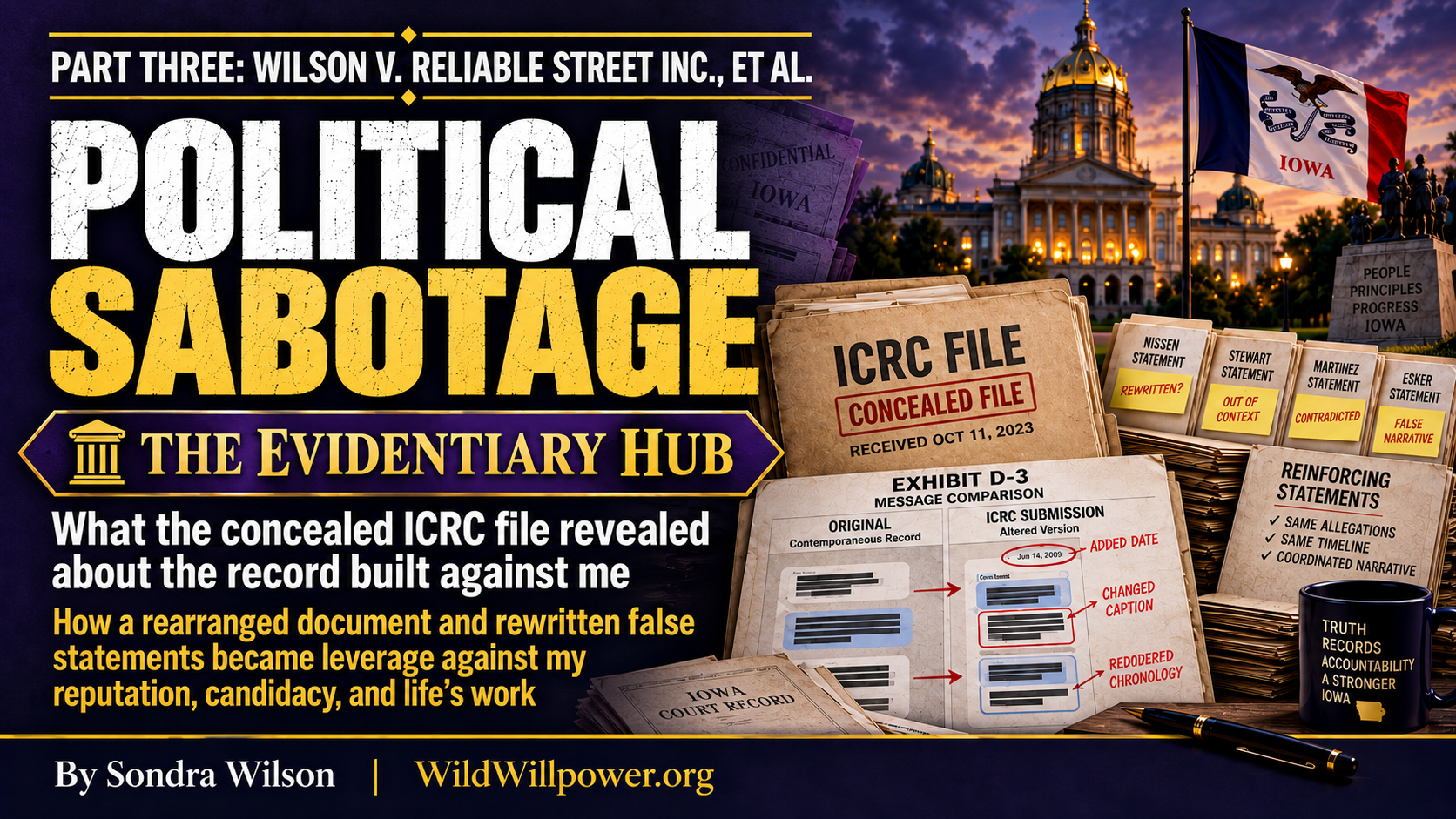
What the concealed ICRC file revealed when the respondents’ statements and supporting materials were finally placed beside the contemporaneous record
Political Sabotage begins on October 11, 2023, when I finally received the complete Iowa Civil Rights Commission file that I had spent more than a year trying to obtain.
For the first time, I could place the respondents’ actual statements and supporting materials beside the messages, photographs, agreements, project records, and other contemporaneous evidence I had preserved.
The comparison substantially escalated the situation.
I found multiple accounts reinforcing a common portrayal of me as obsessive, intrusive, harassing, racist, controlling, and unwilling to respect boundaries. Activities that contemporaneous communications showed had been requested, approved, coordinated, or encouraged were later characterized as unauthorized or invasive. Private communications had been selected and presented in ways that appeared materially different when restored to their original context.
Most significantly, the file contained Exhibit D-3, a document associated with the stalking-and-harassment allegations whose submitted presentation changed the apparent chronology of an exchange between Willa Colville and me.
The underlying chronology is straightforward. On April 4, 2022, I wrote to Colville asking what had happened, explaining that I had not known I was violating a boundary and asking her to help me understand. On April 7, she responded and, for the first time in that exchange, communicated that I had allegedly been violating her personal space.
But the version later submitted to the ICRC placed an April 7 date above my earlier April 4 message and added the caption:
“Communication where Willa asked for no further communication, followed by Sondra’s response.”
Presented that way, my earlier attempt to understand what had happened appeared to be a response sent after I had already been told to stop contacting her. The words of my message were unchanged; its apparent chronology was not.
The surviving document does not, by itself, establish who created that presentation, who inserted the date or caption, who reviewed it, or what each participant knew when it was submitted. Those are among the questions that required discovery.
That distinction is central to this article. Political Sabotage separates what the documents themselves establish, what I know firsthand, what I infer from comparing the records, and what remains unresolved because discovery never occurred.
The article therefore became more than the third chronological installment. It now serves as the evidentiary hub of the entire series, organizing Exhibits A through F so that readers can examine what was submitted to the ICRC, compare those materials with the contemporaneous record, and see which factual questions remain unresolved.
What Not to Miss
— This is where the hidden ICRC file finally becomes visible. Parts One and Two could reconstruct what I knew before receiving the complete submissions. Part Three shows what was actually inside them. As the article puts it: “Part One showed what happened. Part Two showed what happened when I tried to obtain help. Part Three shows what was actually inside the file.”
— Exhibits B and C compare allegedly “unsolicited” or “obsessive” conduct with contemporaneous records of authorization and delegated responsibility. The Open Mic materials document drafts being reviewed, corrected, approved, publicly used, and praised. The garden and prairie records include communications stating that I was “taking the lead on the community garden” and that the SHEPH president and I were “in charge of the garden this year.”
— Exhibit D-3 changes the apparent chronology of the central boundary dispute. My April 4 request for an explanation preceded Colville’s April 7 boundary-setting response, but the submitted presentation made the earlier message appear to have followed that boundary. The document establishes that the chronology was presented differently; discovery was needed to determine authorship, knowledge, transmission, and responsibility.
— The evidence does not assign the same role or knowledge to every participant. The article expressly avoids assuming that everyone knew the same facts or participated in the same way. That is one reason discovery into private communications, document history, and transmission pathways became necessary.
— Exhibit F raises a separate source-of-knowledge question. Charlie Esker’s statement crossed several otherwise distinct areas of the respondents’ narrative—including racism, alleged harassment, project leadership, spending, reimbursement, fundraising, and SHEPH—even though the documentary record does not show Esker participating in the Garden or Prairie projects. The existing record raises the question of how that information reached Esker, but does not itself answer it.
— The title “Political Sabotage” describes both an unresolved motive question and a documented effect. The article does not claim that the current record proves every participant acted from a political motive. Instead, it explains that the resulting government record created durable reputational leverage capable of damaging my existing civil-rights and political work and, later, my gubernatorial candidacy. The article expressly distinguishes the unresolved question of motive from the political leverage created by the record.
Key Dates
October 11, 2023 — I finally receive the complete ICRC file, allowing the respondents’ actual submissions to be compared with the contemporaneous record. Only 55 days remain before the filing deadline.
October–November 2023 — I begin reconstructing the file, comparing statements, communications, project records, screenshots, agreements, and other evidence while trying to determine what legal claims the newly revealed material might support.
December 5, 2023 — With the evidentiary reconstruction still underway and the Right-to-Sue deadline expiring, I file a short original petition in Wilson v. Reliable Street Inc., et al. to preserve the action.
Why Part Three Matters
Part One establishes the before-record: what the relationships, agreements, and communications looked like while they were actually occurring.
Part Two establishes the information gap: for more than a year, I knew serious allegations had entered an official record but could not see the complete submissions necessary to understand or challenge them.
Part Three closes that gap.
It places the administrative submissions beside the contemporaneous evidence and identifies both the contradictions that can be evaluated directly from the documents and the remaining questions that could only be answered through discovery.
That makes Political Sabotage the bridge between the pre-litigation story and the litigation itself.
By December 5, 2023, the question was no longer simply what had been said about me?
The questions had become: How was this record assembled? Who was responsible for which statements and materials? What did each participant know? And could I get the evidence before a court in time to determine what actually happened?
That is where the District Court Proceedings begin.
Part Three — Political Sabotage →
The District Court Proceedings
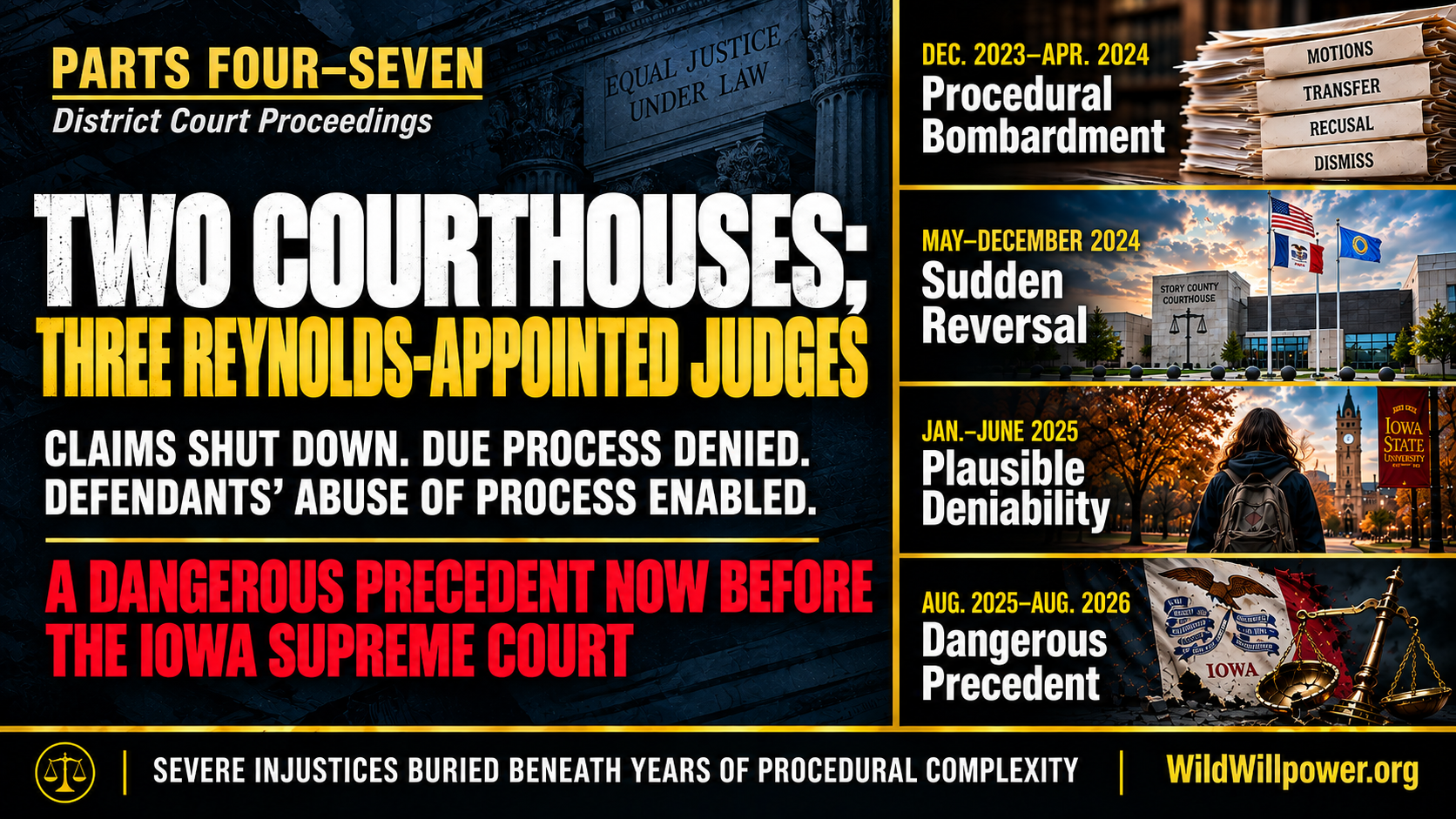
On December 5, 2023, I filed Wilson v. Reliable Street Inc., et al. The next four installments document what happened after the dispute entered the court system—from the first motions and venue dispute through dismissals, amendment attempts, discovery disputes, and the absolute-privilege ruling now on appeal.
Continue to Parts Four–Seven: The District Court Proceedings →
Explore the Rest of the Case
← Main Case Page: The Last Ongoing Transgender Civil Rights Case in Iowa

Sections incoming:
Election Impact → Wilson v. Pate and the 2026 ballot-access consequences
Issue Analyses → Standalone examinations of the major legal questions raised by the case