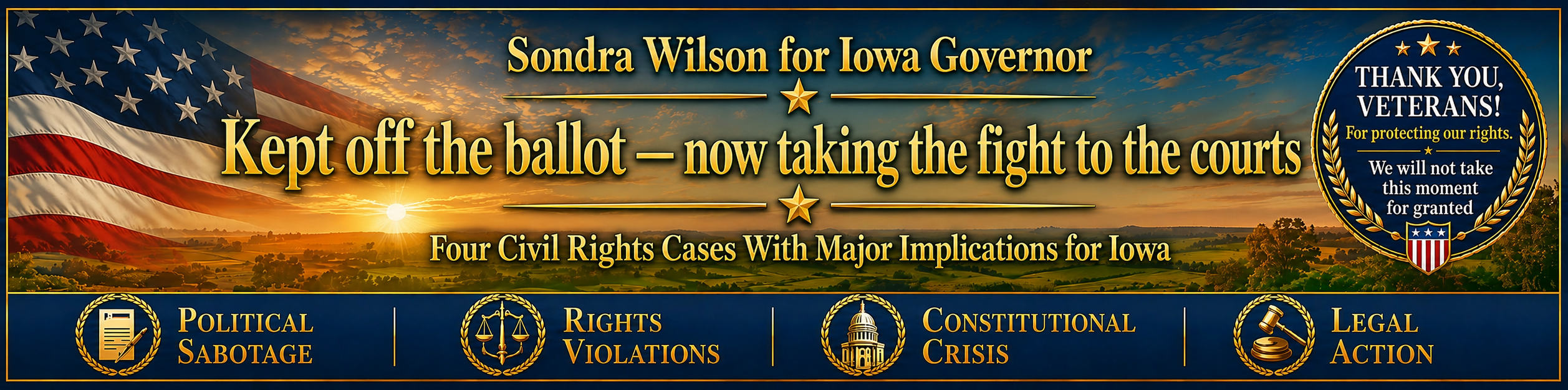
Ten Reason I’m Running for Iowa Governor
by Sondra Wilson. Written September 7, 2025.
Although these are not necessarily a “top ten”, the following presents ten strong reasons as to why I’m running for Governor.
1. Iowans Deserve the Right to Grow Food
Iowa has some of the richest soil in the world, yet city ordinances often prohibit residents—especially renters—from growing food. Even when ordinances don’t prevent, de facto circumstances (.e.g. yards and ornamentals maintained by landlords) manufacture circumstances where demographics who often face the most food insecurity, are the same classes adversely impacted by not being able to grow food. Feeding America reports that Iowans are experiencing record levels of food insecurity across all 99 counties [1]. This means families are forced to rely on costly groceries while the earth beneath their feet remains off-limits.
Local governments seem to endlessly approve new developments without any regard to sustainable development. Instead of zoning for community gardens or renter-friendly green space, they continue to greenlight projects that serve developers, not people. Meanwhile, politicians talk about “freedom” but never address the basic freedom to grow food.
The Gardens Across Iowa initiative I propose, as part of my platform, requires municipalities to zone to ensure community garden space whenever approving any new apartment development. Furthermore, it establishes a statewide land buyback program to create food- and medicine-growing spaces in every city and town. It reaffirms food gardening as a protected right under Iowa law, ensuring that even renters and the unhoused can access soil.
Why it matters: Historically, food and land access were understood as basic rights under Anglo-Saxon common law, later embedded in American constitutional thought through the Ninth Amendment [2]. The Homestead Act of 1862, inspired by the Free Soil Party, distributed 270 million acres of public land to citizens willing to cultivate it, though tragically at the expense of Indigenous peoples [3]. Today, Iowa can honor the principle without repeating the harm. Food sovereignty means healthier families, lower grocery costs, and restored dignity.
👉 Read the Gardens Across Iowa Plan
2. Renters Deserve Representation
The problem: Every year, more than $2.5 billion in rent is siphoned out of Iowa by absentee landlords [4]. This wealth extraction leaves families struggling with rising housing costs while denying them equity and stability. Renters are forced into dependency, with no soil to steward and no realistic path to homeownership.
Why politicians failed: Renters are unrepresented in Iowa politics. When asked about reducing rents, State Auditor Rob Sand suggested “building more apartments.” But more units don’t lower rents when ownership is concentrated in the hands of absentee developers. Instead, this enriches corporations while deepening renters’ dependence.
My plan: The Right to Homestead Act reclaims rental properties owned by absentee landlords and transitions them into tenant-owned housing. This modern adaptation of homesteading empowers renters with equity, reduces economic extraction, and strengthens communities [5]. Coupled with food-access reforms, it ensures housing is not just shelter—but a foundation for dignity.
Why it matters: John Locke’s “labor theory of property” held that land becomes yours when you mix your labor with it, provided enough is left for others [6]. Today, that principle is violated: nearly all land was purchased generations ago, leaving new families without access. By restoring the homesteading principle, Iowa can reduce poverty, empower renters, and keep wealth in local communities.
👉 Explore the Sensible Housing Act
3. Justice Must Be Accessible to All
The problem: Courts are too expensive, too slow, and too complex for ordinary Iowans. Meanwhile, government officials regularly violate state and federal law without consequence. Justice is supposed to be blind—but in Iowa, it often looks away when powerful interests are involved.
Why politicians failed: Neither party has prioritized making courts accessible. The American Bar Association has effectively monopolized legal practice, making it difficult for citizens to represent themselves or hold officials accountable [7]. Immunity doctrines shield public officials from responsibility, while ordinary people face fines, jail, or bankruptcy.
My plan: The Public Intelligence Agency™ restores transparency and accountability. It ensures accessible legal pathways, ends unconstitutional immunity doctrines, and makes justice affordable. This includes simplifying procedures, expanding public oversight, and requiring jury trials in cases where government officials are charged with misconduct.
Why it matters: Rights are meaningless if people can’t enforce them. Thomas Jefferson called jury trials “the only anchor by which a government can be held to its constitution” [8]. Iowa must restore that anchor. By giving citizens the tools to hold leaders accountable, we secure the rule of law for future generations.
👉 Read the Justice Reform Plan
4. Clean Water Without Scapegoating Farmers
The problem: Iowa’s water is polluted with nitrates, phosphorus, and agricultural runoff. Communities struggle with unsafe drinking water and algae-filled lakes [9]. Yet farmers feel vilified, while city residents feel neglected.
Why politicians failed: Democrats push punitive fines that alienate farmers, while Republicans largely do nothing. Both approaches fail: one divides, the other abdicates responsibility. Neither solves the crisis.
My plan: The MycoFuel Engineers Program uses fungi and bio-remediation to clean waterways while creating new jobs. Instead of pitting rural and urban Iowa against each other, it partners with farmers to restore soil and water health.
Why it matters: Clean water is a universal right. Instead of blame, we need solutions that work with farmers, not against them. Iowa can become a national leader in sustainable agriculture and water restoration.
5. Healthcare for All—Without Corporate Control
The problem: Healthcare costs are crushing families. Rural hospitals are closing, leaving communities without critical services [10]. Coverage gaps mean thousands go without care.
Why politicians failed: Democrats compromise with insurers, while Republicans oppose universal coverage. Both sides leave people at the mercy of corporations.
My plan: SondraCare provides universal healthcare while lowering costs. It emphasizes preventive care, fair wages for healthcare workers, and expanded rural access. It also ties healthcare to labor incentives, stimulating local economies.
Why it matters: Healthcare is not a privilege—it’s a right. By guaranteeing care for all, Iowa will have a healthier workforce, lower costs, and stronger communities.
6. Representing Trans Iowans With Truth and Courage
The problem: Transgender Iowans face harassment, scapegoating, and systemic misrepresentation. Politicians on the right spread fear, while those on the left avoid honest conversations.
Why politicians failed: Conservatives weaponize trans lives to divide voters. Progressives often silence nuanced debate, leaving families without guidance. This political exploitation harms children and fuels hostility.
My plan: As a transgender woman, I will bring honesty to the debate stage. I oppose puberty blockers for children, but I affirm dignity, safety, and respect for trans people. Policy must be guided by both scientific evidence and human dignity [11].
Why it matters: Iowans are tired of culture-war rhetoric. We can have respectful, science-based conversations while protecting vulnerable communities. Truth and courage—not cowardice and slander—must define our politics.
7. Protecting Rights and Reducing Gun Violence
The problem: Gun violence devastates communities, yet policy responses often miss the mark. Politicians blame “mental illness” while ignoring deeper causes like poverty and despair [12].
Why politicians failed: Democrats push bans that alienate gun owners. Republicans offer thoughts and prayers. Both approaches divide communities without solving the problem.
My plan: The Responsible Gun Ownership Act protects constitutional rights while strengthening safety training, accountability, and community education. Guns are tools—but with rights come responsibilities.
Why it matters: The Second Amendment exists to safeguard the people against tyranny, not just for hunting. Real safety comes from responsible ownership, not political scapegoating. Iowa can lead with balanced, constitutional solutions.
8. Ending Homelessness Through Dignity, Not Punishment
The problem: Iowa faces record homelessness, worsened by high rents and low wages. Politicians respond by criminalizing poverty—ticketing, fining, and jailing the unhoused.
Why politicians failed: Instead of addressing root causes, leaders rely on police crackdowns. This approach wastes taxpayer dollars while dehumanizing those most in need [13].
My plan: The Sustainable Villages Program creates safe, low-cost transitional housing, reducing pressure on shelters and volunteers. It gives people stability, dignity, and a path to reintegration.
Why it matters: Treating poverty as a crime is both cruel and expensive. By offering humane alternatives, we reduce crime, save money, and strengthen communities.
👉 See the Sustainable Villages Plan
9. Saving Family Farms and Healing Iowa’s Cultural Divide
The problem: Historic barns collapse, family farms vanish, and young people flee rural Iowa. Corporations buy up land while communities hollow out.
Why politicians failed: They ignored rural struggles and fueled the urban-rural divide. Cultural misunderstandings—amplified by talk radio and partisan media—have widened the gap.
My plan: The Civilian Restoration Corps – FarmHire Team restores barns, provides rural jobs, and creates opportunities for young people. It also fosters connections between rural and urban Iowa through shared labor and projects [14].
Why it matters: Strong farms mean strong cities. Healing the divide starts with practical cooperation—working together on meaningful projects. Iowa can be a model of unity.
👉 Read about the CRC FarmHire Team
10. Restoring Rule of Law and Accountability
The problem: Politicians routinely violate the law, protected by immunity doctrines and insider courts. Citizens lose faith as corruption goes unchecked.
Why politicians failed: Neither party holds its own accountable. The system shields itself instead of serving the people.
My plan: As Governor, I will empower Iowans to enforce accountability through citizen arrests, jury trials, and constitutional due process. My administration will ensure that no official is above the law.
Why it matters: Rule of law is the foundation of democracy. Without accountability, corruption thrives. Iowa must lead the way in restoring constitutional governance.
👉 Learn more about restoring accountability
References
[1]: Feeding America. (2025). Food insecurity in Iowa. Feeding America. https://www.feedingamerica.org
[2]: Legal Information Institute. (n.d.). Ninth Amendment. Cornell Law School. https://www.law.cornell.edu/constitution/ninth_amendment
[3]: Britannica. (n.d.). Homestead Act of 1862. Encyclopaedia Britannica. https://www.britannica.com/topic/Homestead-Act
[4]: Iowa Policy Project. (2023). The impact of absentee landlords on Iowa’s economy. Des Moines, IA.
[5]: Cliffe History. (n.d.). Anglo-Saxon land tenure and common law. University of Leeds.
[6]: Locke, J. (1690/1988). Two treatises of government (P. Laslett, Ed.). Cambridge University Press.
[7]: School of Philosophy. (2013). History of Anglo-American legal thought. University of London.
[8]: Jefferson, T. (1789/1999). Letter to Thomas Paine. In Merrill D. Peterson (Ed.), Thomas Jefferson: Writings. Library of America.
[9]: Iowa Department of Natural Resources. (2024). Annual water quality report. Des Moines, IA.
[10]: National Rural Health Association. (2024). Rural hospital closures and access challenges. Washington, DC.
[11]:: American Academy of Pediatrics. (2022). Standards of care for transgender and gender-diverse youth. Pediatrics, 150(3).
[12]: Centers for Disease Control and Prevention. (2024). Gun violence statistics. Atlanta, GA.
[13]: National Homelessness Law Center. (2023). Housing, not handcuffs: Ending the criminalization of homelessness. Washington, DC.
[14]: Freund, M. (2024). Rural economic decline and cooperative restoration models. Iowa State University Press.