
1803–1857
The Black Hawk War:
A Dark Chapter in Iowa's Founding
Indian Removal, Disputed Treaties, and the Taking of Indigenous Lands
Written by Sondra Wilson in loving memory of Miles and LaDonna Brave Bull Allard | Updated November 18, 2026
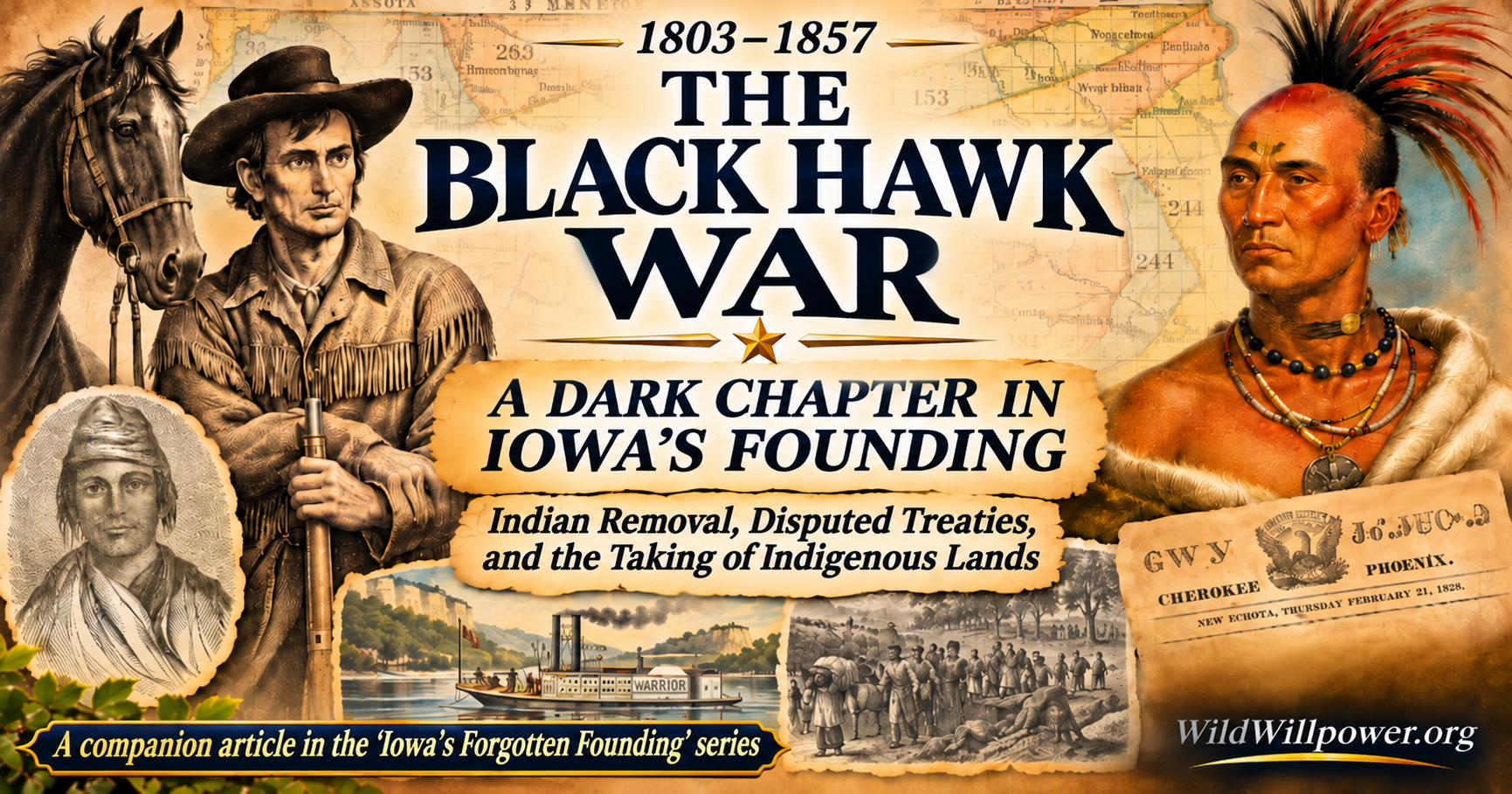
The history behind Iowa's familiar names, the Indigenous nations who lived here before statehood, and the treaties and military campaigns that transformed their homelands into American territory.
Iowa's history began long before its territorial government or constitutional conventions.
As explored in A History of Native Tallgrass Prairie: Iowa's Forgotten Treasure, the landscape that became Iowa was shaped over thousands of years by climate, fire, wildlife, and generations of Indigenous land stewardship.
But the transformation of this landscape involved more than the disappearance of native prairie. During the nineteenth century, the Indigenous nations who lived upon and managed these lands faced an expanding American government determined to obtain control of their territory.
The following history examines how that transformation occurred, the people who resisted it, and the political consequences that preceded Iowa's founding.
These were not empty lands waiting to be settled.
The prairies, forests, rivers, and valleys of the Upper Mississippi region supported Indigenous communities whose histories extended back generations, and whose ancestors had occupied parts of North America for thousands of years.
Yet the political boundaries we recognize today emerged through an often-violent history of American expansion, contested treaties, military campaigns, and the forced displacement of Native peoples.
Many Iowans recognize the names Black Hawk and Keokuk, two Sauk leaders; Wapello and Poweshiek, influential leaders associated with the Meskwaki; and James K. Polk, the American president for whom Polk County was named. Their names survive on Iowa's maps, county signs, streets, and communities.
But who were these people? Why were their names preserved? And what happened to the Indigenous nations whose lands became Iowa?
Understanding Iowa's founding requires confronting this history—including some of the most devastating events in the history of the United States.
The Indigenous Nations of Iowa
The land that became Iowa was connected to numerous Indigenous nations, each with distinct histories, languages, communities, and political traditions.
Their territories and relationships changed over time through migration, alliances, intertribal conflicts, diplomacy, and pressure from European colonial powers and the expanding United States.
Among the nations historically associated with Iowa were the following.
The Ioway (Báxoje)
The Ioway people gave Iowa its name. Their history is closely connected to the Missouri and Mississippi river regions, and their ancestors belonged to the broader cultural history of the Oneota peoples.
The Ioway were agriculturalists, hunters, traders, and participants in the political and economic networks of the central plains and river valleys.
Through nineteenth-century treaties and American expansion, the Ioway were displaced from lands that included much of present-day Iowa.
Today, their descendants maintain sovereign governments through the Iowa Tribe of Kansas and Nebraska and the Iowa Tribe of Oklahoma.
The Sauk (Sac)
The Sauk were closely associated with communities along the Mississippi and Rock Rivers, including the important village of Saukenuk near present-day Rock Island, Illinois.
They maintained villages, cultivated crops, hunted, and participated in regional trade and diplomacy.
Black Hawk and Keokuk were both Sauk leaders, although their differing responses to American expansion would place them on opposite sides of a defining political dispute.
Sauk descendants today belong to several federally recognized tribal nations, including the Sac and Fox Nation of Missouri in Kansas and Nebraska.
The Meskwaki (Fox)
The Meskwaki are a distinct Indigenous people, though American officials frequently treated them and the Sauk as a single political entity under the name "Sac and Fox."
After conflicts with French colonial authorities in the Great Lakes region, Meskwaki communities became closely allied with the Sauk and established strong connections throughout the Upper Mississippi Valley.
Their history is especially important because they did not permanently disappear from Iowa after the removal treaties.
In 1857, Meskwaki families purchased land in Tama County, establishing the foundation of the settlement that remains their home today.
The Meskwaki Nation — Sac & Fox Tribe of the Mississippi in Iowa continues as a sovereign Indigenous nation.
The Dakota
Dakota peoples have longstanding connections to northern Iowa, Minnesota, and the broader Upper Mississippi region.
Their communities developed extensive systems of kinship, diplomacy, agriculture, hunting, and trade. Dakota nations also experienced territorial displacement and forced removal during the nineteenth century.
Their history reminds us that Iowa's northern border did not represent an ancient cultural or political boundary.
The Ho-Chunk
The Ho-Chunk Nation has deep historical connections to Wisconsin and the Upper Mississippi region, including parts of northeastern Iowa.
Ho-Chunk communities played important diplomatic roles during the period of American expansion. Some individuals assisted Black Hawk's people, while others attempted to maintain neutrality or worked with American forces in hopes of protecting their own communities.
The Ho-Chunk Nation remains a sovereign government today.
The Otoe and Missouria
The Otoe and Missouria peoples, whose histories are closely connected, inhabited areas of the Missouri River Valley and southern portions of the Iowa region.
Their communities maintained distinct languages, traditions, political relationships, and agricultural practices. American territorial expansion and subsequent treaties eventually displaced them from much of their ancestral territory.
Today, the Otoe-Missouria Tribe maintains its sovereign government in Oklahoma.
Other nations with significant historical connections to Iowa include the Omaha, Osage, Potawatomi, and additional Indigenous peoples.
These histories cannot be reduced to a single account of one tribe or one war.
Nor should the names of modern counties be mistaken for evidence that the peoples who originally inhabited these lands willingly surrendered them.[1]
1803:
The Louisiana Purchase Did Not Transfer Indigenous Consent
In 1803, President Thomas Jefferson negotiated the Louisiana Purchase, through which the United States acquired France's territorial claims across an enormous portion of North America.
The purchase included the region that would eventually become Iowa.
But France did not possess the consent of the Indigenous nations inhabiting these lands to surrender their communities and territories to the United States.
The Louisiana Purchase transferred a European colonial claim. It did not automatically extinguish Indigenous land rights.
Nevertheless, American officials increasingly treated the region as territory available for expansion, negotiation, military occupation, and settlement.
Federal officials pursued treaties intended to obtain Indigenous lands, sometimes negotiating with leaders whose authority to surrender the territory was disputed.
One such treaty would become central to the Black Hawk War.
1804:
A Treaty Black Hawk Refused to Recognize
In November 1804, American officials concluded the Treaty of St. Louis with representatives of the Sauk and Meskwaki.
The United States interpreted this agreement as transferring extensive tribal territory, including the Sauk homeland along the Rock River in Illinois.
But the treaty's legitimacy was disputed—most notably by Black Hawk (Ma-ka-tai-me-she-kia-kiak), a prominent Sauk warrior and leader whose people lived at Saukenuk, near present-day Rock Island, Illinois.
Born around 1767, Black Hawk had become an influential military leader through his experience in warfare and his defense of Sauk interests. He was not a hereditary principal chief of the entire Sauk nation, but he commanded considerable respect among those who opposed surrendering their homeland.
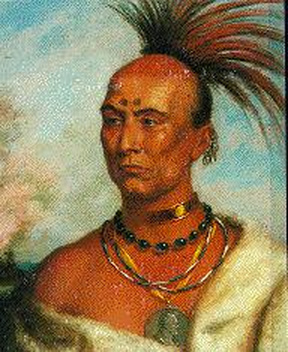
Black Hawk (Ma-ka-tai-me-she-kia-kiak), the Sauk leader who challenged the 1804 Treaty of St. Louis and resisted the loss of Saukenuk.
Black Hawk maintained that the Sauk delegation sent to St. Louis in 1804 had traveled primarily to seek the release of a Sauk man imprisoned by American authorities—not to negotiate away the nation's territory.
According to his later account, the delegates had no authority to surrender such extensive lands. Nevertheless, American officials treated the treaty as binding, creating a dispute that would endure for decades.[2]
The controversy was further complicated by a May 1816 treaty that reaffirmed the 1804 land cession. The treaty text lists a signatory identified as Black Sparrow Hawk, although historical accounts differ regarding Black Hawk's participation and acceptance of the agreement. In any event, Black Hawk continued to challenge the legitimacy of the original land cession and the American claim to Saukenuk. The disagreement therefore involved not only the authority of the original delegates but also competing understandings of subsequent treaty negotiations.[2]
The consequences became especially visible at Saukenuk, the Sauk village near the junction of the Rock and Mississippi Rivers.
Saukenuk was more than a collection of temporary encampments. It was a longstanding community containing homes, fields, cultivated crops, and places of deep cultural importance.
For generations, Sauk families maintained a seasonal pattern of life that included returning to Saukenuk to plant and harvest crops while traveling elsewhere for hunting during other parts of the year. The fact that families temporarily left the village did not mean they had abandoned it or surrendered their claim to their homeland.
As American settlers increasingly occupied the village and surrounding fields, this customary seasonal movement became a source of conflict. Land that Sauk families understood as their continuing home was being claimed by newcomers under a treaty whose legitimacy Black Hawk rejected.
For Black Hawk, the land was his people's homeland—not merely a tract whose ownership could be changed through a document signed by a handful of representatives.
As American settlement expanded, settlers increasingly occupied the surrounding territory, damaged fields, and asserted ownership under the disputed treaty.
Black Hawk refused to accept that the agreement justified dispossessing his people.[2]
Black Hawk and Keokuk:
Two Responses to American Expansion
Black Hawk was not the only influential Sauk leader confronting American expansion.
Keokuk, born around 1790, had risen to prominence through his leadership, diplomacy, and skill as an orator. Like Black Hawk, he had strong ties to Saukenuk, but he believed that open warfare against the United States threatened the survival of his people.
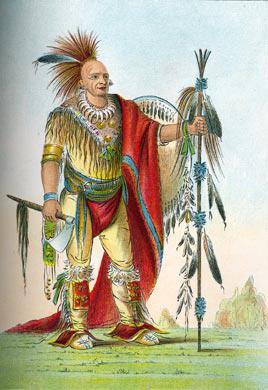
Keokuk, a Sauk leader who favored negotiation over military resistance to American expansion. Portrait by George Catlin, c. 1830s.
While Black Hawk continued resisting the loss of Saukenuk, Keokuk favored negotiation and accommodation, recognizing the enormous military advantage held by American forces.
Their disagreement reflected two different responses to the same crisis: whether to resist dispossession through armed opposition or seek to preserve their communities through diplomacy under increasingly unfavorable conditions.
The disagreement divided Sauk leadership and families at a moment when nearly every available choice carried enormous risks.
Keokuk ultimately declined to join Black Hawk's resistance, and many Sauk and Meskwaki families followed a different course from Black Hawk's band.
The United States increasingly favored Keokuk's leadership, particularly after the war.
Today, the city of Keokuk and Keokuk County preserve his name, while Black Hawk County preserves the name of the leader whose resistance American authorities defeated.
These names commemorate men who faced the same expansionist pressure but made dramatically different decisions about how to respond.[3]
Andrew Jackson and the Indian Removal Act of 1830
The conflict over Saukenuk occurred during a broader period of American expansion and forced Indigenous displacement.
Andrew Jackson, a former U.S. Army general who became the seventh president of the United States in 1829, was one of the principal architects of federal Indian removal policy.
Jackson was a founder and dominant early figure of the modern Democratic Party.
His supporters portrayed him as a champion of the ordinary white citizen against entrenched financial and political elites. Yet his administration also pursued policies that made additional Indigenous lands available for white settlement.
In May 1830, Congress narrowly passed the Indian Removal Act, which Jackson signed into law on May 28.
The legislation authorized the president to negotiate exchanges of Indigenous lands east of the Mississippi River for territory farther west.
Supporters presented removal as a supposedly beneficial or protective policy.
In practice, however, Native nations faced extraordinary pressure to surrender their lands, while military force, state legislation, treaty negotiations, and federal authority worked together to accelerate displacement.
The Cherokee, Choctaw, Chickasaw, Muscogee (Creek), and Seminole peoples experienced particularly devastating consequences.
The Cherokee Nation had already developed a written constitution in 1827, a government with separate branches, and a bilingual newspaper, the Cherokee Phoenix, using a writing system developed by Sequoyah, a Cherokee inventor who created a syllabary for writing the Cherokee language in the early nineteenth century.
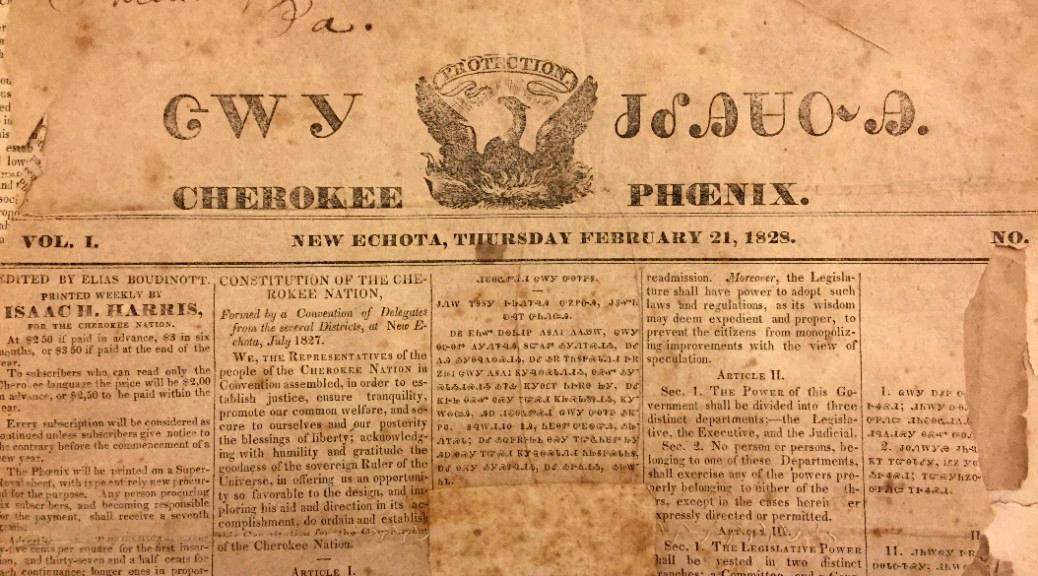
The Cherokee Phoenix, first published in 1828, printed in English and Cherokee using Sequoyah's syllabary. The newspaper reflected the Cherokee Nation's political institutions and efforts to preserve sovereignty.
These institutions demonstrated that Indigenous nations possessed established governments and sophisticated political systems.
Yet even those institutions did not protect the Cherokee from the expanding removal campaign.
In Worcester v. Georgia (1832), the United States Supreme Court recognized important limitations on Georgia's authority over Cherokee territory. Nevertheless, federal removal policy continued, culminating in the forced removal remembered as the Trail of Tears.
Indian removal was one of the gravest injustices of the Jacksonian period—and a central part of the early Democratic Party's history.
The Black Hawk War was not simply an application of the Indian Removal Act. It arose from its own disputed treaty, territorial conflicts, and decisions by American and Indigenous leaders. But it occurred within the same national expansionist climate, and its outcome further advanced the dispossession of Native peoples.[4]
A Familiar Iowa Name:
James K. Polk, "Young Hickory"
Many Iowans know Polk County as the home of Des Moines, the state capital.
Fewer know the political history of the man for whom it was named.
Polk County was named for President James K. Polk, the eleventh president of the United States, who served from 1845 to 1849.
Polk was a Jacksonian Democrat and political protégé of Andrew Jackson.
Jackson was known as "Old Hickory." Polk became known as "Young Hickory" because of his loyalty to Jackson's political movement and policies.
Polk later pursued an aggressive program of American territorial expansion, including overseeing Texas's admission to the Union and leading the United States during the Mexican-American War.
Thus, one of Iowa's most familiar county names connects directly to the political movement that shaped the era of Indian removal and westward expansion.
Polk County was named after the Black Hawk War, not during it. But the name illustrates how the expansionist politics of the Jacksonian era remained influential during Iowa's territorial development and early statehood.[5]
1831-1832:
Black Hawk Returns to His Homeland
By 1831, American authorities and Illinois settlers were determined to remove Black Hawk's people from Saukenuk.
After military pressure compelled his band to cross the Mississippi River, Black Hawk remained unwilling to accept the permanent loss of the ancestral village.
In April 1832, Black Hawk again crossed the Mississippi into Illinois with a following that included Sauk, Meskwaki, and Kickapoo people. He hoped to resist permanent displacement and find a place where his people could live, relying partly on assurances from Wabokieshiek (White Cloud), also known as the Prophet, an influential religious leader of Sauk and Ho-Chunk ancestry associated with Prophetstown on the Rock River.
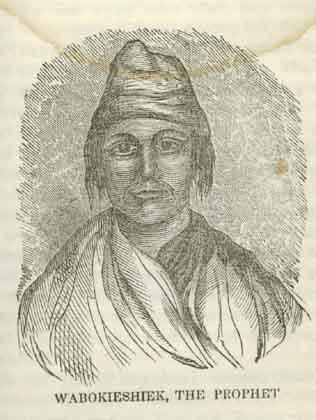
Wabokieshiek, also known as the Prophet, was an influential religious and political figure whose assurances of support helped shape Black Hawk's decisions before the war.
They were not simply an army of warriors.
The group also included women, children, older people, and families seeking to return to familiar lands or establish a place where they could live.
Black Hawk hoped to obtain assistance from neighboring Indigenous nations, particularly those whose leaders had indicated support. Some members of his following also expected British assistance if conflict developed.
Those expectations proved disastrously mistaken.
American officials interpreted the movement as a hostile incursion, mobilizing federal soldiers and the Illinois militia.
When Black Hawk eventually attempted to withdraw, the situation had already escalated.
In May 1832, Black Hawk attempted to open communication with approaching American militia forces near Old Man's Creek. Accounts describe representatives sent under a flag of peace, but the encounter broke down when militia members attacked or detained members of the delegation. The confrontation escalated into the engagement known as Stillman's Run, in which Black Hawk's warriors defeated a disorganized militia force.
The incident intensified American fears and helped turn a disputed migration and territorial confrontation into a wider military campaign. Federal soldiers and militia forces subsequently pursued Black Hawk's band through Illinois and into present-day Wisconsin.
What began as a dispute over land and a return to Saukenuk had become a military campaign that would end in catastrophe.[6]
A Young Abraham Lincoln Serves in the Black Hawk War
Abraham Lincoln, who would become the sixteenth president of the United States, was only twenty-three years old when he volunteered for the Illinois militia during the Black Hawk War in April 1832.
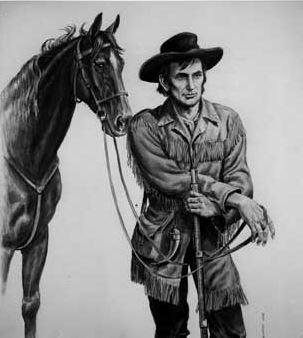
Abraham Lincoln served as an Illinois militia captain during the Black Hawk War of 1832, more than twenty years before becoming president.
He was elected captain of his militia company, an experience he later remembered with considerable pride.
Lincoln did not become famous through military victories in this conflict. His service involved marching, difficult conditions, and little direct combat.
Yet one incident from the war deserves particular attention.
According to later recollections preserved by Lincoln's biographers, a Native American man identified as Jack entered the militia camp carrying a letter of introduction from U.S. Secretary of War Lewis Cass. Some militiamen suspected him of spying and threatened to kill him, but Lincoln intervened to protect him.
William G. Greene, who knew Lincoln, later described the confrontation, recalling Lincoln's insistence that the man must not be killed.
The story survives principally through later recollections rather than a contemporary official military report, so its details should be understood with that qualification.
Nevertheless, it reflects an important historical account of Lincoln opposing violence against a vulnerable Native man even while serving in a military campaign against Black Hawk's people.
The episode is especially striking because Lincoln's own family history included the killing of his grandfather by a Native American man in Kentucky.
Lincoln's presence in the war did not make him an opponent of American expansion at the time. But the reported incident reminds us that individuals could resist an injustice even within a larger military campaign.
Long before the Civil War and the Emancipation Proclamation, Lincoln had already encountered the difficult moral questions surrounding American treatment of Indigenous peoples.[7]
The Pursuit Through Wisconsin:
A Retreat Becomes a Humanitarian Disaster
As American forces pursued Black Hawk's band northward through Wisconsin, conditions among the fleeing families deteriorated. Supplies dwindled, and many became sick, exhausted, or unable to continue. Children, elderly relatives, and wounded people struggled to keep pace as the American military closed in.
At Wisconsin Heights in July 1832, Black Hawk and other warriors fought a delaying action against a much larger American force, allowing many noncombatants to cross the Wisconsin River.
The survivors continued toward the Mississippi, hoping to reach the western bank and escape the pursuing army.
American troops followed.
Some Indigenous people died from hunger and exhaustion before ever reaching the river. Others were killed in engagements during the retreat.
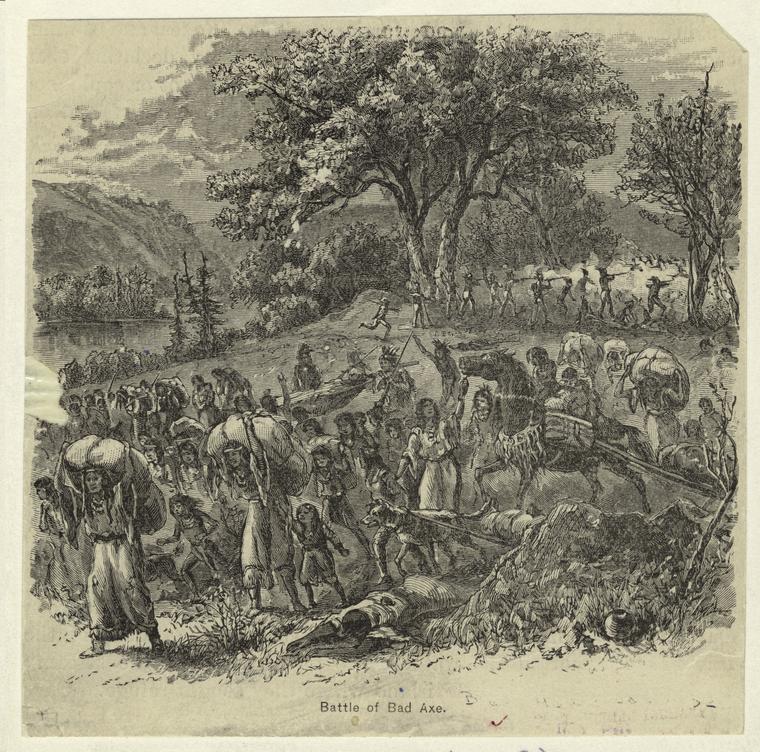
A later historical illustration depicting Native families attempting to cross the Mississippi during the violence at Bad Axe. Original artwork attributed to William de la Montagne Cary; engraved by Ernest Heinemann.
By the beginning of August, the survivors had reached the Mississippi near the mouth of the Bad Axe River.
What followed would become one of the most devastating episodes of the war.[8]
Aug. 1-2, 1832:
The Massacre at Bad Axe
At the Mississippi River, Black Hawk's remaining followers attempted to cross into the territory that would later become Iowa.
They were trapped between pursuing American forces and the river.
On August 1, the armed steamboat Warrior, commanded by its captain, Joseph Throckmorton, approached the Native people gathered near the riverbank.
Black Hawk later maintained that he raised a white flag in an attempt to surrender and protect his people.
The Americans did not accept the signal as a genuine offer of surrender.
The Warrior opened fire.
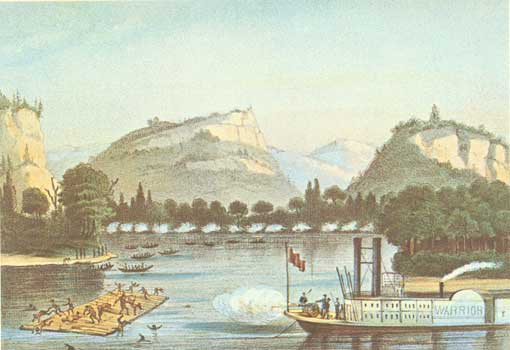
The steamboat Warrior firing during the Battle of Bad Axe, August 1832. Historical lithograph by Henry Lewis, published in The Valley of the Mississippi, Illustrated. A later artistic depiction of the conflict, not an eyewitness photograph.
The violence continued the following day as American soldiers attacked the remaining members of the band.
Men, women, and children were killed while trying to flee, cross the Mississippi, or escape the fighting.
Accounts differ concerning precise casualty figures, but hundreds of Indigenous people died during the final phase of the campaign.
The Wisconsin Historical Society describes the events at Bad Axe as a massacre, reflecting the killing of noncombatants and the overwhelming imbalance between the American forces and the fleeing Native families.
Some members of Black Hawk's band managed to escape across the Mississippi River, but reaching the western bank did not guarantee safety. Indigenous warriors allied with the United States, including Dakota forces, participated in efforts to intercept or attack survivors.
The participation of Native allies also illustrates the complexity of the war. Indigenous nations faced different political pressures, longstanding rivalries, and difficult decisions about whether cooperation with the United States might protect their own communities.
Nevertheless, the principal result at Bad Axe was unmistakable: hundreds of people from Black Hawk's fleeing band were killed, including noncombatants, while others were captured or scattered.[9]
The confrontation was remembered by American military authorities as the concluding victory of the Black Hawk War.
For the Indigenous families who suffered through it, it represented the destruction of a community attempting to survive and return to its homeland.
The distinction matters.
Calling Bad Axe simply a military victory leaves out what happened to the women, children, and older people who were trapped along the Mississippi River.
The war did not end merely with Black Hawk's military defeat. It ended with the killing, capture, displacement, and scattering of much of his community.[9]
Black Hawk's Surrender, Imprisonment, and Public Exhibition
Black Hawk survived the massacre.
After fleeing with a smaller group, he eventually surrendered in August 1832 near Prairie du Chien, Wisconsin.
He and other leaders were taken into American custody.
Black Hawk was imprisoned first in the Midwest and later at Fort Monroe, Virginia.
In 1833, American authorities arranged for Black Hawk and other Native prisoners to visit major eastern cities before returning home.
The men were displayed to large crowds and introduced to prominent officials. They were taken to public events, shown American military and industrial power, and became subjects of public fascination.
The tour was intended in part to demonstrate the strength of the United States and discourage further resistance.
Yet the public response was complicated.
Some Americans treated Black Hawk as a curiosity or symbol of a defeated people. Others admired him, expressed sympathy for his suffering, or regarded him as a courageous leader.
In some cities, crowds welcomed him enthusiastically. Elsewhere, hostility toward the Native prisoners remained evident.
The experience was nevertheless deeply unequal: a defeated Indigenous leader, taken far from his homeland under American military authority, was made into a public spectacle.
His people had lost lives, homes, and territory.
He was now being shown the power of the nation that defeated them.
Black Hawk later returned to the Mississippi Valley, where he lived under the political arrangements imposed after the war.
He died in 1838—the same year Iowa Territory was established.[10]
September 1832:
The Black Hawk Purchase and the Cost of War
The defeat of Black Hawk's band created an opportunity for American officials to demand additional land from the Sauk and Meskwaki.
On September 21, 1832, representatives of the United States and the Sauk and Meskwaki concluded the treaty commonly known as the Black Hawk Purchase.
Among the Indigenous representatives involved were Keokuk, the Sauk leader who had opposed Black Hawk's armed resistance, and Wapello (Wapella), an influential leader associated with the Meskwaki. Both played important roles in negotiations with American officials during this period.[11]
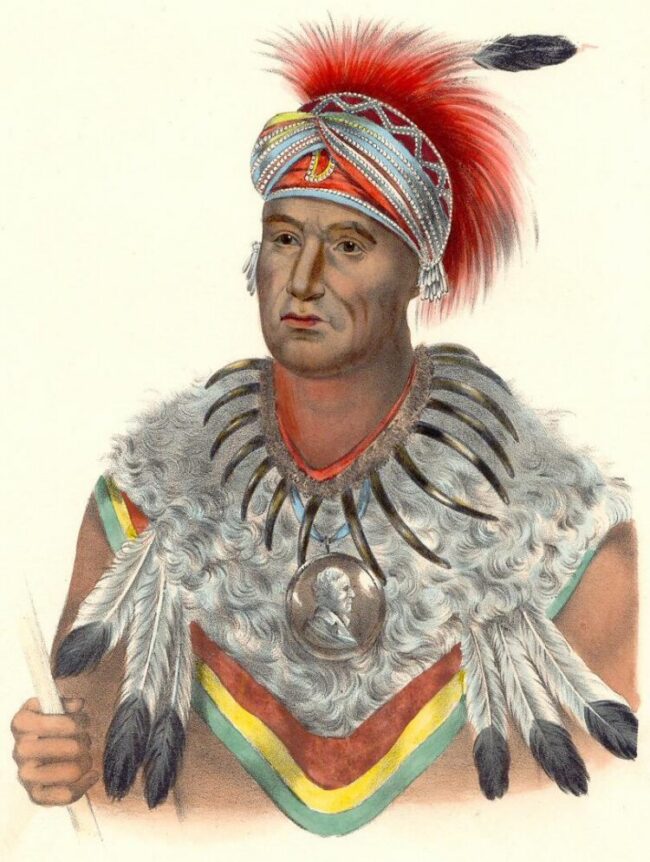
Wapello (Wapella), an influential Indigenous leader involved in treaty negotiations following the Black Hawk War. Nineteenth-century portrait associated with Charles Bird King and lithographer J. T. Bowen.
The agreement transferred approximately six million acres of eastern Iowa to the United States.
The land extended along the Mississippi River and opened a large portion of eastern Iowa to expanding American settlement.
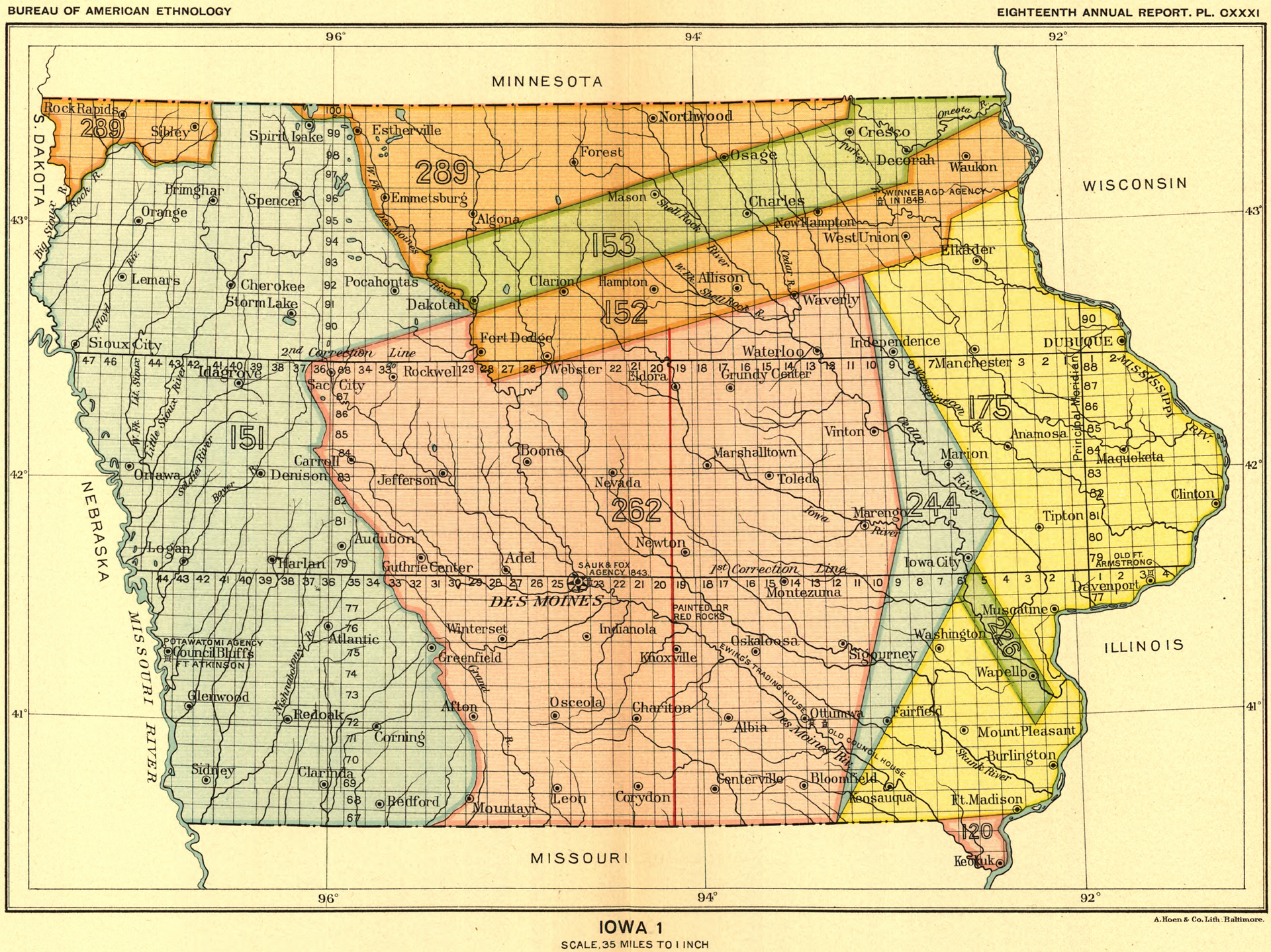
Map of Native land cessions in Iowa, including the 1832 Black Hawk Purchase in eastern Iowa. Created by Charles C. Royce, 1899, from Indian Land Cessions in the United States.
The circumstances of the agreement were extraordinary.
The treaty followed a devastating military defeat. Black Hawk and other leaders remained prisoners, and American officials used the consequences of the war to justify demands for land.
The treaty's own preamble declared that the cession was demanded partly as compensation for American expenses incurred during the conflict.
This was not merely a later historian's interpretation.
The American government explicitly treated Indigenous land as compensation for the costs of the war.
The agreement provided annual payments of $20,000 for thirty years, along with other provisions, including payments toward debts owed to traders.
It also established a reservation associated with Keokuk and provided for the continued detention of Black Hawk and several other Indigenous leaders as hostages subject to presidential authority.
The treaty thus did far more than transfer territory.
Article I required the Sauk and Meskwaki to leave the ceded lands by June 1, 1833. After that date, they were expressly prohibited from residing, planting crops, fishing, or hunting anywhere within the surrendered territory.
Article VII authorized the continued detention of Black Hawk, his sons, Wabokieshiek, and other leaders as hostages, to be held at the pleasure of the president as security for the future conduct of their followers.
Article VIII went further still. It prohibited the reestablishment of separate villages or bands under the leaders who had resisted American forces. Survivors were instead required to join other Sauk or Meskwaki communities.
These provisions reveal that the agreement was not simply a purchase of land.
It was also a mechanism for dismantling the political independence of Black Hawk's surviving followers, restricting their movements, and preventing the re-formation of their former communities.
The treaty also made the broader Sauk and Meskwaki nations bear consequences for the actions of Black Hawk's band—even though many tribal members had opposed the war or remained neutral.
The American government imposed those conditions while its military held defeated leaders in custody.
In addition to the cession, the treaty's provisions included annual payments, settlement of specified debts to American traders, and a reservation along the Iowa River that included Keokuk's village.
The agreement was concluded at Fort Armstrong on Rock Island, Illinois, on September 21, 1832, following the military defeat at Bad Axe.
This was one of the decisive steps through which the United States transformed Indigenous homelands into territory available for American settlement.[11]
More Treaties, More Land Cessions, and Forced Removal
The 1832 agreement was not the end of Indigenous land loss in Iowa.
Additional treaties followed in 1836, 1837, and 1842, progressively transferring more Sauk and Meskwaki territory to the United States.
Other Indigenous nations, including the Ho-Chunk, also faced treaty demands, territorial displacement, and removal pressures in the Upper Mississippi region.
American settlement expanded as the federal government opened additional lands.
The treaties frequently used the language of compensation, negotiation, and voluntary agreement.
But such terms did not erase the underlying conditions of military coercion, settlement pressure, and severe inequalities of power.
By the 1840s, most Sauk and Meskwaki people had been compelled to leave Iowa for lands farther west, including reservations in present-day Kansas.
The Ioway and other nations had also experienced the loss of ancestral territory through treaties and removal.
In some cases, territorial cessions were justified as necessary to maintain peace. In others, federal officials invoked debt, military expenses, or the alleged need to protect settlers.
The cumulative result was the transfer of most of the lands of present-day Iowa into American hands.
These land transfers preceded the creation of Iowa's state government.
They were part of the process that made its settlement, territorial administration, and eventual statehood possible.[12]
The Meskwaki Return:
Indigenous History Did Not End With Removal
There is another part of this history that deserves to be remembered.
Indigenous nations did not simply vanish from Iowa.
Some Meskwaki people remained in the region despite the removal campaigns. Others worked to return.
In the 1850s, Meskwaki families sought the opportunity to establish a permanent community in Iowa on land they would own.
In 1856, the Iowa legislature permitted them to remain in the state.
On July 13, 1857, Meskwaki families purchased the first eighty acres in Tama County that became the foundation of the Meskwaki Settlement.
Less than a month later, on August 3, 1857, Iowa voters approved the new state Constitution that remains in effect today, as amended.
The timing is remarkable: while Iowa was establishing its new constitutional framework, Meskwaki families were reestablishing a permanent land base within the state from which they had been displaced.
The Meskwaki Nation continues to commemorate July 13 as Proclamation Day, honoring the families whose determination established a lasting Indigenous land base in Iowa.
Unlike the conventional federal reservation system, the Meskwaki Settlement originated through a land purchase using the tribe's own resources.
The Meskwaki Nation continues to govern itself in Iowa today, preserving its language, community, culture, and political sovereignty.
Its survival is an essential part of Iowa history—not an afterthought to the story of removal.[13]
From Indigenous Homelands to Iowa Territory
In 1838, the federal government established Iowa Territory, separating it from Wisconsin Territory.
As American settlement expanded, the territorial population grew, and residents began debating the structure of their government and whether Iowa should become a state.
In 1844, delegates assembled to draft Iowa's first proposed state constitution.
The proposal failed to win ratification.
A second constitutional convention met in 1846, and that year Iowa became the twenty-ninth state.
In 1857, Iowans adopted a new constitution—the one that continues to govern the state, as amended, today. [14]
These events were part of a new chapter in Iowa's political history.
But they did not occur on an empty landscape.
They followed decades of American expansion, treaty disputes, warfare, land cessions, and forced removals.
The Indigenous nations whose homelands became Iowa possessed their own histories of political organization, diplomacy, law, and sovereignty long before American constitutional delegates assembled in Iowa City.
The new state was built upon lands whose earlier inhabitants had experienced extraordinary losses.
Recognizing that fact does not require assuming that every delegate to Iowa's constitutional conventions personally participated in those events or supported the actions of earlier federal and territorial officials.
Nor does it mean dismissing the constitutional principles the delegates established.
Their debates over political power, civil rights, elected officials, educational opportunity, and governmental accountability deserve to be examined on their own merits.
Yet those ideals must be understood alongside the history of the land upon which the government was founded.
Iowa's first constitutions also contained serious exclusions, including restrictions on voting rights based on race and sex. Later generations would struggle to expand protections and political participation.
The contradiction is difficult to overlook.
The American government had asserted its authority over Indigenous nations, imposed treaties following military defeat, restricted where Native people could live, and transferred their homelands to settlers.
Yet within a few years, the founders of Iowa would gather to debate the protection of individual liberty, limitations on governmental power, political equality, and the people's right to alter or reform their government.
Their Constitution would eventually preserve a remarkable declaration:
"All political power is inherent in the people. Government is instituted for the protection, security, and benefit of the people."
Those words expressed an important constitutional ideal.
But they also raise a question that cannot be ignored: Who was included among "the people," and whose rights were excluded or overridden?
Iowa's constitutional founders did not all share the same positions, and many were not responsible for the military campaigns and treaties that preceded statehood. Their debates nonetheless deserve to be studied alongside the history of the land upon which their government was established.
The next chapter examines the institutions they created, the principles they sought to protect, and the limitations of their original constitutional framework.
Understanding Iowa's founding requires recognizing both the injustices that preceded it and the ideals that subsequent generations would struggle to make more fully inclusive.
Continue Reading: Iowa's Forgotten Founding — Who Built Our Government, and What Did They Promise?
The next article examines Iowa's three constitutional conventions of 1844, 1846, and 1857, the people who helped establish the state government, and the principles they intended to protect.
Endnotes and Historical Sources
[1] State Historical Society of Iowa, Unit 1: Native Iowa; Iowa State University, Native Lands in Central Iowa. These sources discuss the Indigenous nations historically associated with Iowa, their distinct cultural histories, and the territorial changes preceding statehood.
https://isudiversityhistory.pubpub.org/pub/gevl9d38/release/1
[2] Wisconsin Historical Society, Black Hawk (1767–1838); The Black Hawk War. Discusses the disputed 1804 treaty, Saukenuk, and Black Hawk's resistance. See also Black Hawk's 1833 autobiography, a primary source reflecting his account of the treaty dispute.
https://legacy.wisconsinhistory.org/Records/Article/CS5493
https://legacy.wisconsinhistory.org/turningpoints/tp-012/?action=more_essay
See also Treaty with the Sauk, May 13, 1816, which reaffirmed the 1804 agreement and lists “Black Sparrow Hawk” among its signatories. Compare the University of Iowa's Biographical Dictionary of Iowa, entry on Black Hawk, for a differing historical account of his participation.
https://treaties.okstate.edu/treaties/treaty-with-the-sauk-1816-0126
https://uipress.lib.uiowa.edu/bdi/DetailsPage.aspx?id=31
[3] University of Iowa Libraries, The Biographical Dictionary of Iowa, entries on Black Hawk and Sauk-Meskwaki leadership. See also Patrick J. Jung, The Black Hawk War of 1832 (University of Oklahoma Press, 2007), and Roger L. Nichols, Black Hawk and the Warrior's Path (1992). The latter works are among the scholarly sources cited in the author's original research manuscript.
https://uipress.lib.uiowa.edu/bdi/DetailsPage.aspx?id=31
See also The Biographical Dictionary of Iowa, University of Iowa Press, entries on Keokuk and Poweshiek, discussing their leadership and different responses to American expansion.
https://uipress.lib.uiowa.edu/bdi/DetailsPage.aspx?id=205
https://uipress.lib.uiowa.edu/bdi/DetailsPage.aspx?id=309
[4] U.S. National Archives, Indian Removal Act (1830); National Park Service, Hidden in Plain View: Native Strategies of Resistance to Indian Removal. See also Worcester v. Georgia, 31 U.S. 515 (1832), and the Cherokee Nation's historical materials on removal and sovereignty.
https://www.archives.gov/milestone-documents/indian-removal-act
https://home.nps.gov/articles/hidden-in-plain-view.htm
See also Library of Congress, Cherokee Phoenix (New Echota, Georgia), 1828–1829, documenting the newspaper's first publication on February 21, 1828, and its use of Cherokee-language printing.
https://www.loc.gov/item/sn83020866/
[5] Iowa Legislature, Counties and County Names, documenting Polk County's naming for President James K. Polk; Library of Congress, James K. Polk Papers: Timeline, explaining Polk's association with Jackson and the nickname "Young Hickory."
https://www.legis.iowa.gov/docs/publications/RDBKI/1050315.pdf
https://www.loc.gov/collections/james-k-polk-papers/articles-and-essays/timeline/
[6] Wisconsin Historical Society, The Black Hawk War; National Park Service, Hidden in Plain View. See also John W. Hall, Uncommon Defense: Indian Allies in the Black Hawk War (Harvard University Press, 2009), and Kerry A. Trask, Black Hawk: The Battle for the Heart of America (Henry Holt, 2006), both cited in the author's original manuscript.
https://legacy.wisconsinhistory.org/turningpoints/tp-012/?action=more_essay
https://home.nps.gov/articles/hidden-in-plain-view.htm
See also Wisconsin Historical Society, Black Hawk, 1767–1838, discussing the influence of Wabokieshiek, also known as White Cloud or the Prophet, on Black Hawk's decision to return east of the Mississippi.
https://legacy.wisconsinhistory.org/Records/Article/CS5493
[7] National Park Service, Lincoln's New Salem, 1830–1837, confirming Lincoln's militia service; William H. Herndon and Jesse W. Weik, Herndon's Life of Lincoln, recounting Lincoln's protection of an older Native man threatened by militia members. The incident is preserved in later biographical recollections and should be distinguished from contemporary military records.
https://www.nps.gov/liho/learn/historyculture/newsalem.htm
https://www.gutenberg.org/ebooks/38483
[8] Wisconsin Historical Society, The Black Hawk War; Patrick J. Jung, The Black Hawk War of 1832, pp. 153–161; Kerry A. Trask, Black Hawk, pp. 268–279, as identified in the author's original research manuscript.
https://legacy.wisconsinhistory.org/turningpoints/tp-012/?action=more_essay
[9] Wisconsin Historical Society, Battle of Bad Axe and The Black Hawk War. Includes discussion of the August 1–2 events, the steamboat Warrior, fleeing families, and the killings that concluded the conflict. Black Hawk's own account also appears among the Society's historical materials.
https://legacy.wisconsinhistory.org/Records/Article/CS1604
https://legacy.wisconsinhistory.org/Records/Article/CS464
[10] Patrick J. Jung, The Black Hawk War of 1832, pp. 181–192; Kerry A. Trask, Black Hawk, pp. 294–304; Roger L. Nichols, Black Hawk and the Warrior's Path, pp. 147–148. These references are preserved in the author's original manuscript, particularly its discussion of Black Hawk's imprisonment and eastern tour.
[11] Treaty with the Sauk and Foxes, September 21, 1832, reproduced in United States Statutes at Large, vol. 7, pp. 374–377. The treaty contains the provisions addressing war indemnity, land cession, annuities, debts, Keokuk's reservation, and continued detention of Indigenous leaders. See also Iowa PBS, Black Hawk Treaty.
https://www.govinfo.gov/content/pkg/STATUTE-7/pdf/STATUTE-7-Pg374.pdf
https://www.iowapbs.org/iowapathways/artifact/2053/black-hawk-treaty
See also The Biographical Dictionary of Iowa, University of Iowa Press, entry on Wapello, discussing his leadership among the Meskwaki and his participation in Sauk and Meskwaki treaty politics.
https://uipress.lib.uiowa.edu/bdi/DetailsPage.aspx?id=394
[12] University of Iowa Libraries, The Biographical Dictionary of Iowa, historical entries on Sauk and Meskwaki leadership; Iowa PBS, The Meskwaki Nation's Story of Survival, Land and Sovereignty in Iowa. See also Jung, Nichols, and Trask, as cited in the author's original manuscript.
https://uipress.lib.uiowa.edu/bdi/DetailsPage.aspx?id=394
https://www.iowapbs.org/home/special/13969/meskwaki-nations-story-survival-land-and-sovereignty-iowa
[13] Meskwaki Nation, History, documenting the tribe's removal, persistence, return, and July 13, 1857 land purchase. See also State Historical Society of Iowa, Unit 1: Native Iowa.
https://www.meskwaki.org/history/
[14] State Historical Society of Iowa, Iowa Territory; Iowa Legislature, Iowa Constitution — Constitutional Conventions. These provide background for Iowa Territory's establishment in 1838, statehood in 1846, and the 1857 constitutional revision.
Historical Illustrations and Image Credits
[Image 1] Black Hawk. Historical portrait of the Sauk leader, reproduced in the author's original research manuscript, The Rise of the Jacksonian Democrats, Indian Removal, and Indian Rights, p. 377. Original image attributed there to Rutgers University, North American Indians educational materials. Original artist and reproduction rights require verification.
[Image 2] Keokuk. Portrait by George Catlin, c. 1830s. Reproduced in the author's original research manuscript, p. 378. Original repository and reproduction details to be confirmed.
[Image 3] Abraham Lincoln. Historical illustration reproduced in the author's original research manuscript, p. 379. Original artist, date, and source to be confirmed before publication.
[Image 4] Flight at the Battle of Bad Axe. Historical illustration attributed to William de la Montagne Cary (1840–1922), engraved by Ernest Heinemann (1848–1912). Reproduced in the author's original research manuscript, p. 383. A later artistic depiction, not an eyewitness image.
[Image 5] Wabokieshiek (the Prophet). Historical drawing published in 1848; original artist unidentified in the author's manuscript, p. 383. Original publication and reproduction details to be verified.
[Image 6] Wapello (Wapella). Nineteenth-century portrait associated with Charles Bird King and a lithograph by J. T. Bowen, Philadelphia, as credited in the author's original research manuscript, p. 385. Exact artwork and repository details to be confirmed.
[Image 7] The Cherokee Phoenix. Historical image of the newspaper's first issue, February 21, 1828. Reproduced in the author's original research manuscript, p. 357, with a source attribution to Duke University Libraries. Original digitized source and reuse terms should be confirmed.
[Image 8] The Steamboat Warrior at the Battle of Bad Axe. Historical lithograph by Henry Lewis (1819–1904), from The Valley of the Mississippi, Illustrated, published by Arnz & Company, Düsseldorf. The illustration depicts the armed steamboat during the August 1832 conflict at Bad Axe. Wikimedia Commons identifies the image as public domain in the United States.
Source: https://commons.wikimedia.org/wiki/File:1832_Battle_of_Bad_Axe_and_steamboat_Warrior.jpg
[Image 9] Iowa cessions map.
Map showing Native land cessions in Iowa, including the Black Hawk Purchase. Created by Charles C. Royce, 1899, from Indian Land Cessions in the United States, Library of Congress. Wikimedia Commons identifies the image as public domain in the United States.
Source: https://commons.wikimedia.org/wiki/File:Iowa_cessions_map.png