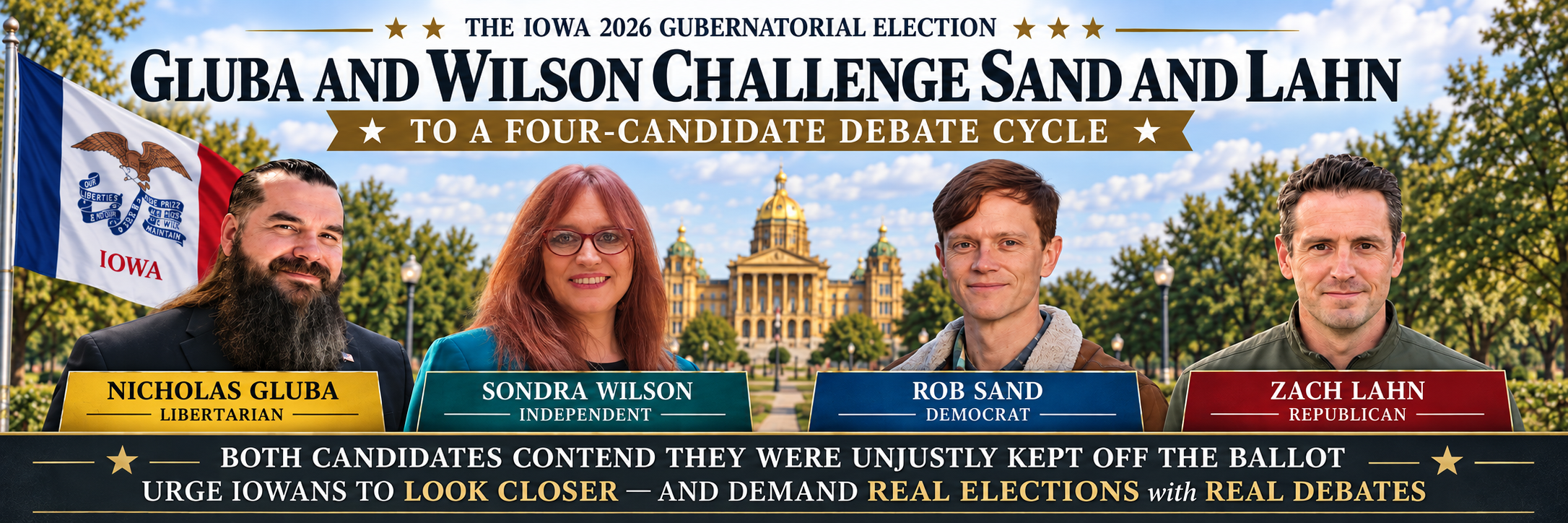
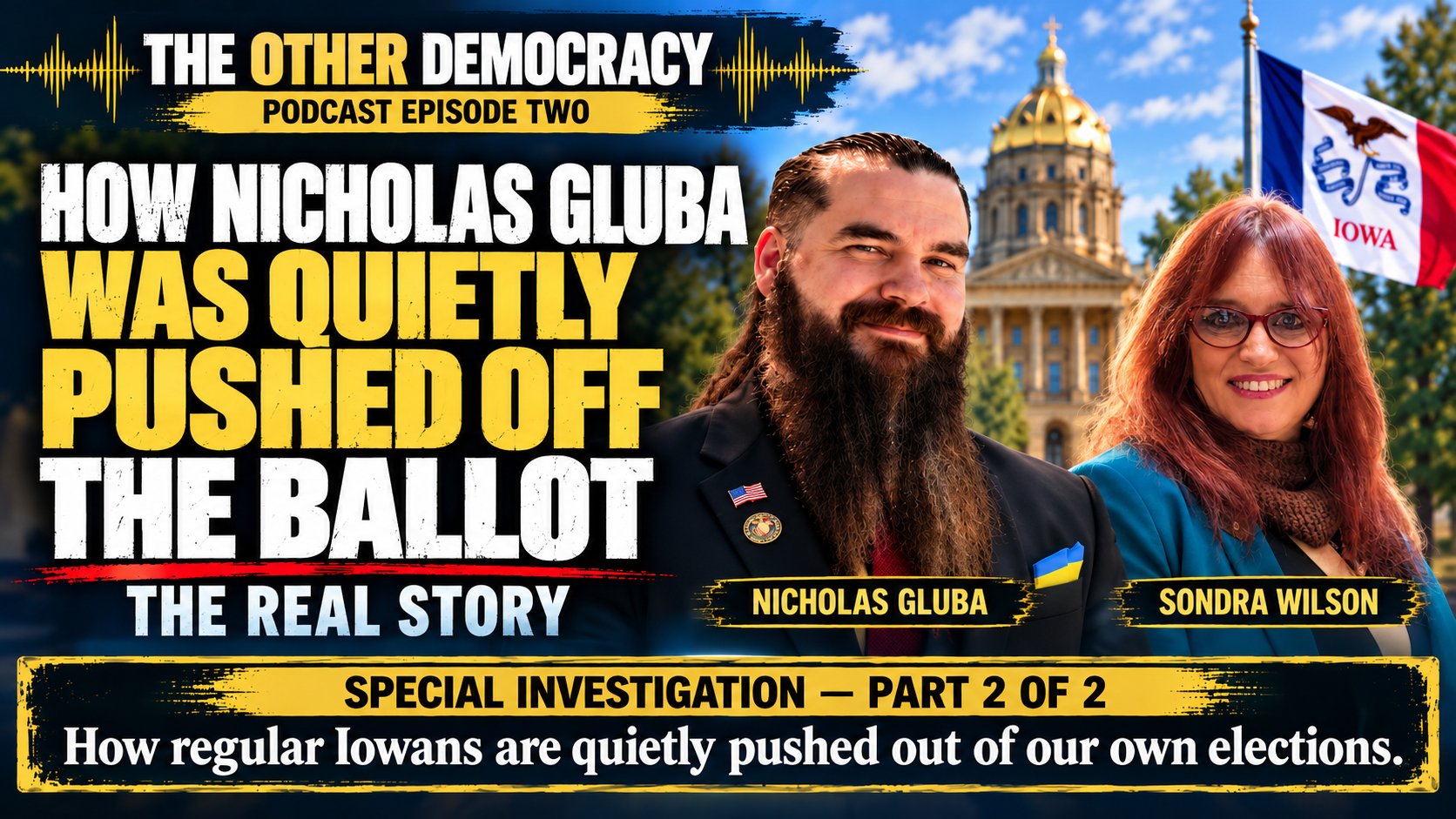
The Other Democracy: Episode Two
Nicholas Gluba — The Candidate Iowans Never Got to Hear
The Life, Platform, and Political Voice of Iowa's Excluded Libertarian Candidate
Hosted by Sondra Wilson | October 12, 2026
On This Page
01 — Episode Overview
02 — Meet Nicholas Gluba
03 — The Platform Iowans Didn't Hear
04 — The Ballot Controversy
05 — A New Iowa Constitution
06 — Related Investigations
07 — Chapter Guide
Episode Overview:
More Than 8,000 Signatures.
A Campaign Iowan's Never Got to Hear
Nicholas Gluba is an Iowa-born U.S. Marine Corps veteran, former logistics engineer, chef, and Libertarian candidate for governor.
Together with his running mate, Jules Cutler, Gluba collected more than 8,000 petition signatures in an effort to qualify for Iowa's 2026 gubernatorial ballot.
Despite that effort, their candidacy was excluded following disputed filing procedures, an objection-panel hearing, and judicial review.
In Episode One, we examined excerpts from the state objection-panel proceedings and raised questions about how the decision was reached.
But there was something missing from that investigation: the candidate himself.
Who is Nicholas Gluba? Why did he decide to run for governor? What would he have done differently? And what did he want to tell Iowans before his candidacy became consumed by a dispute over election paperwork?
In Episode Two, Gluba joins me to answer those questions.
We discuss his experiences growing up in Iowa, his military service in Iraq, his entry into politics, and the proposals he hoped to bring to the 2026 gubernatorial debates.
We also revisit the election controversy, the conduct of the state objection panel, and the court proceedings that left him off the ballot.
Regardless of whether you agree with Gluba's politics, shouldn't Iowa voters have the opportunity to hear his ideas and decide for themselves?
Meet Nicholas Gluba:
From an Iowa Cattle Ranch to the Marine Corps —
Then a Campaign for Governor
Before entering politics, Nicholas Gluba grew up in eastern Iowa, helping work on his family's cattle ranch near Parnell and Williamsburg.
Following the attacks of September 11, 2001, he decided to join the United States Marine Corps. During his military service, he deployed to Iraq, where he conducted patrols in areas west and south of Baghdad.
After returning home, he attended culinary school and later worked for approximately 15 years as a logistics engineer at Whirlpool. He eventually returned to professional cooking.
During our interview, Gluba was preparing food for Oktoberfest in the Amana Colonies.
His political involvement with the Libertarian Party became more active around 2016. What began as attending party meetings gradually evolved into taking on leadership responsibilities and, ultimately, seeking Iowa's highest executive office.
Gluba describes how discussions about a gubernatorial candidacy began around 2022, how his decision became firm in late 2024, and how his campaign spent months collecting signatures.
He recalls balancing full-time employment, additional work, family responsibilities, and weekend petition drives.
The result was a grassroots campaign that he says collected 8,341 signatures.
But instead of discussing his proposals in Iowa's gubernatorial debates, Gluba spent much of his campaign explaining why he believed he had been wrongfully excluded.
This episode gives him an opportunity to discuss the ideas that were overshadowed by that controversy.
The Political Platform Iowans Never Got to Hear
Property Tax Reform:
How to Stop the Constant Inflation
One of Gluba's central campaign proposals was a fundamental restructuring of Iowa's property-tax system.
Rather than basing property taxes primarily on periodically assessed market values, Gluba proposed using the actual purchase price of a property as the starting point for determining its taxable value.
During the interview, he explains how rising assessments can increase a homeowner's tax burden even when the homeowner has not sold the property or realized any financial gain from its increased estimated value.
His proposal draws inspiration from elements of California's acquisition-value property-tax system.
We discuss how such a system might affect homeowners, property prices, local government revenues, and people seeking to purchase homes in Iowa.
The conversation also raises an important question:
Can Iowa reform property taxation while maintaining adequate funding for the public services communities depend on?
Restoring Public Education and Ending Private-School Vouchers
Although Gluba advocates a smaller government, he does not propose eliminating the taxation necessary to maintain public services.
During the interview, he identifies public schools, police departments, fire departments, and road maintenance as services that still require public funding.
He also expresses strong opposition to using public tax dollars to subsidize private-school tuition.
This reveals an area of agreement between Gluba and me, despite our differing political affiliations and broader approaches to government.
We discuss the condition of Iowa's public education system, the appropriate role of private schools, and the question of whether taxpayer-funded private-school vouchers are consistent with the public purposes of education funding.
Gluba also argues that Iowa should listen directly to public-school teachers when developing education reforms.
Separation of Church and State
The discussion of education leads to another constitutional question: the relationship between religious institutions and government.
Gluba explains that Libertarians are not united on every question of church-state separation.
He personally believes that maintaining a separation between church and state is an essential part of constitutional government.
We discuss that principle in the context of religious private schools, publicly funded education, and the broader relationship between government and religion.
These are some of the questions and policy disagreements Iowa voters could have heard explored during a more inclusive gubernatorial debate cycle.
Special Investigation — Further Reading and Related Action
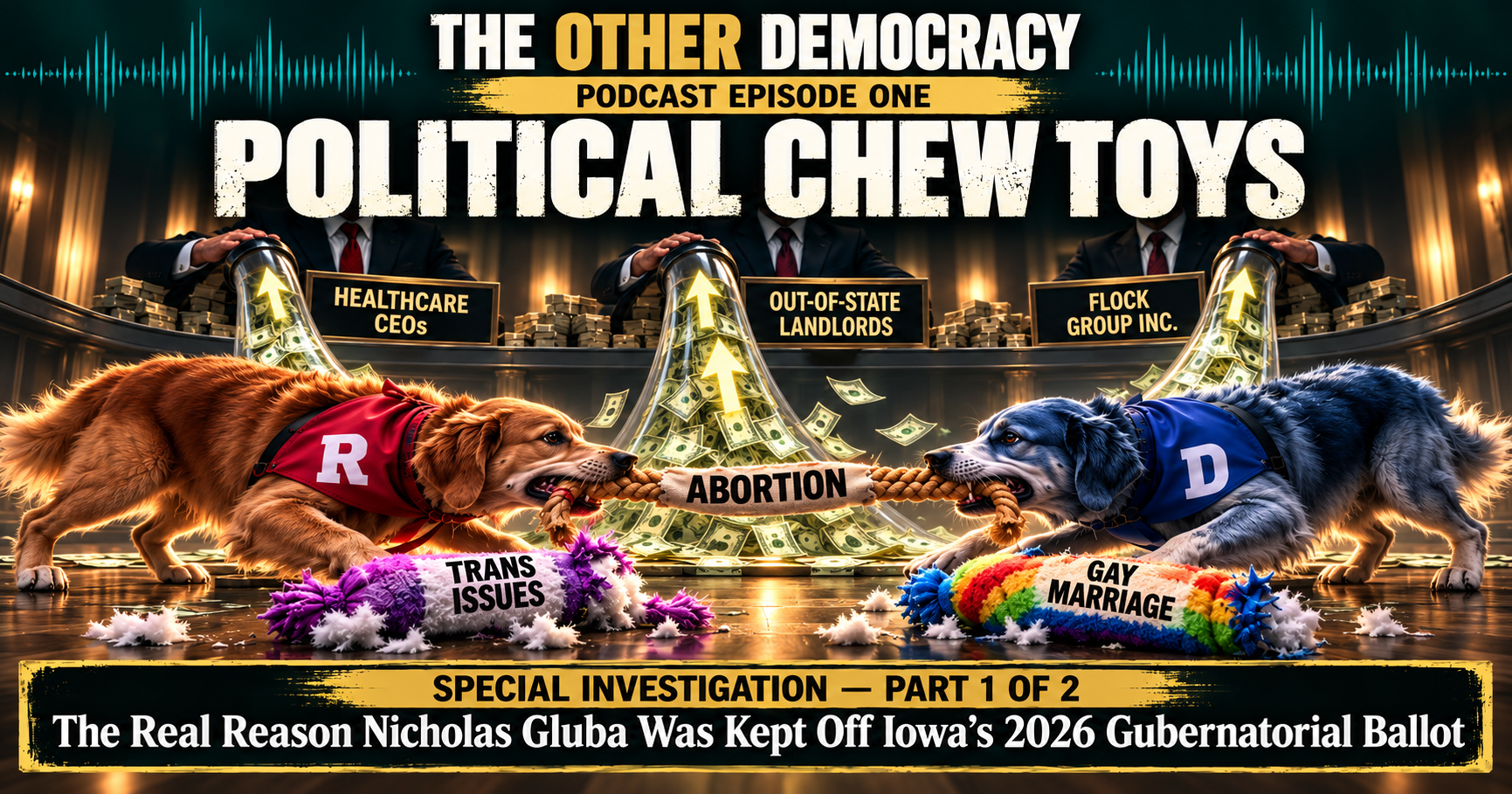
Episode One:
Political Chew Toys
How are political wedge issues distracting Iowans from the problems unfolding right under our noses?
How are political wedge issues distracting Iowans from the problems unfolding right under our noses?
In our premiere episode, we examine out-of-state rental income, healthcare executive compensation, the expansion of Flock-style surveillance cameras, political funding, and government immunity doctrines that can limit accountability when public officials cause harm.
We also begin our two-part investigation into the exclusion of Libertarian gubernatorial candidate Nicholas Gluba from Iowa's 2026 ballot, featuring audio excerpts from the actual state objection-panel proceedings.
Special Investigation — Part One of Two: The Real Story Behind How Nicholas Gluba Was Kept Off Iowa's 2026 Gubernatorial Ballot.
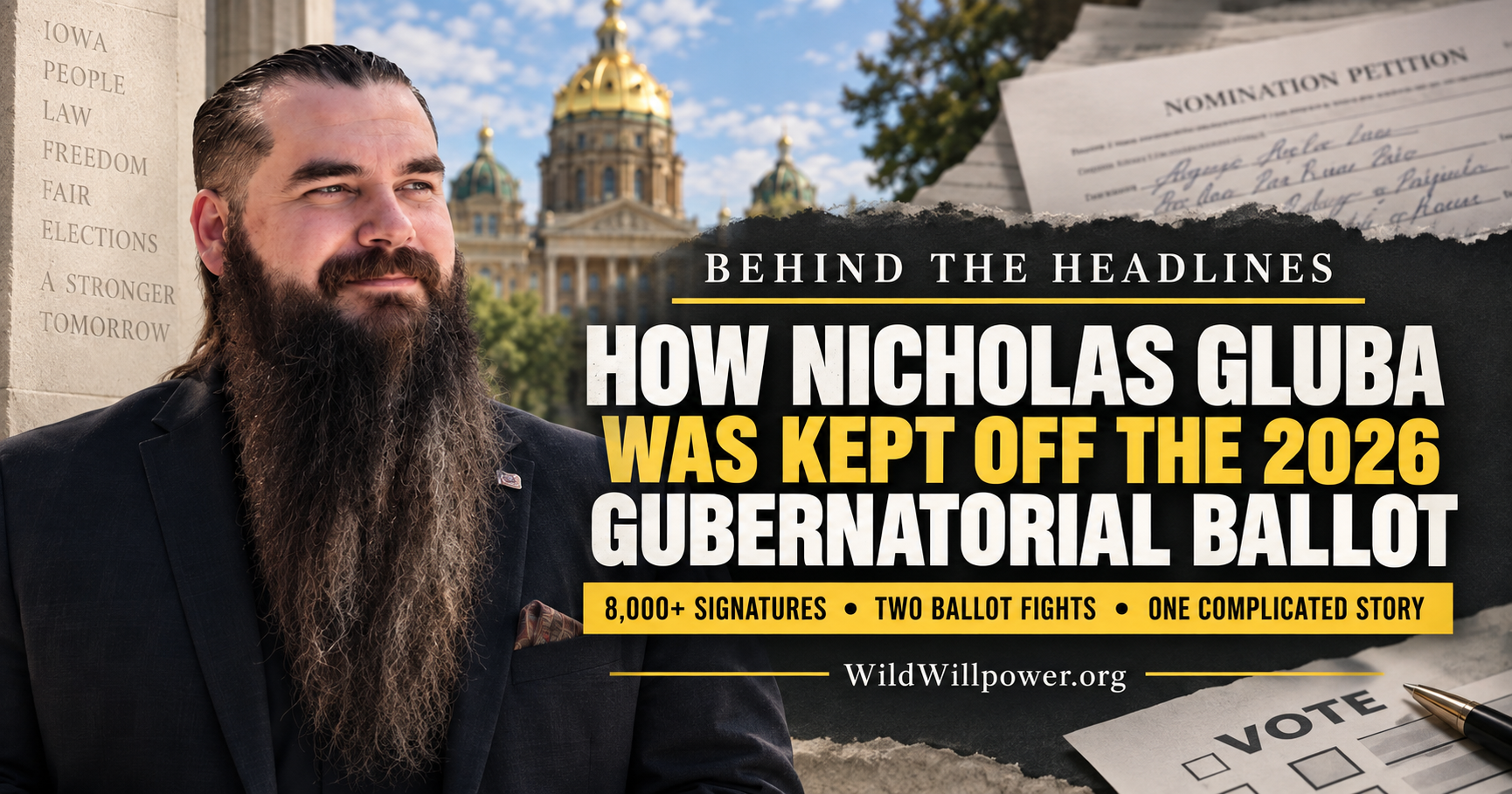
Article #1:
The Untold Story on How Nicholas Gluba Was Kept Off the Ballot
How did a gubernatorial candidate who submitted more than 8,000 petition signatures end up excluded from the ballot?
Read my detailed investigation into the disputed filing of Jules Cutler's affidavit of candidacy, the conflicting accounts presented to Iowa's State Objection Panel, and the court's subsequent ruling. I examine why I believe Gluba and Cutler were wrongfully excluded and what their experience reveals about Iowa's election laws.
Read The Untold Story on How Nicholas Gluba Was kept Off the 2026 Gubernatorial Ballot
Article #2:
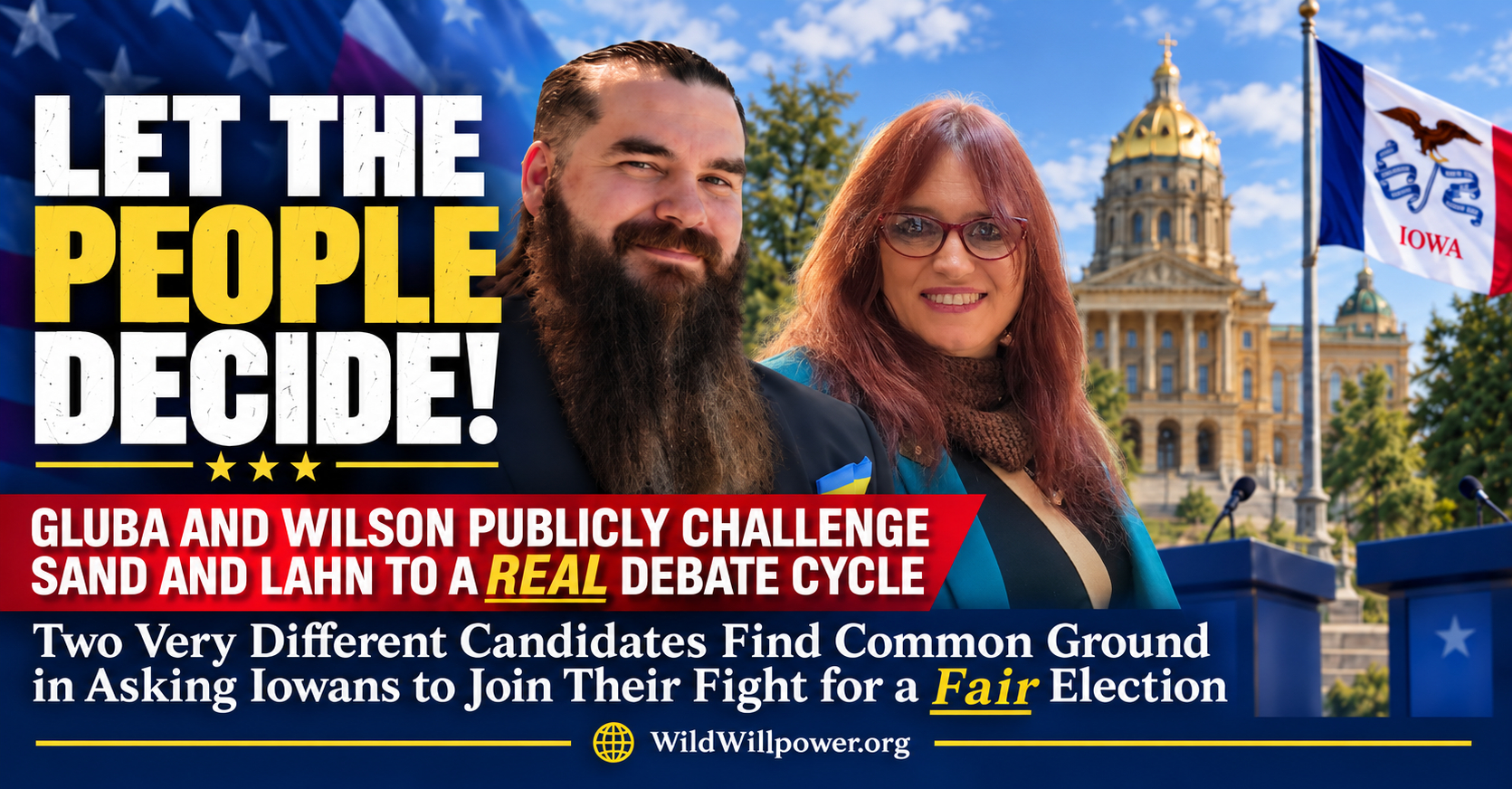
Let the People Decide — A Joint Challenge for a Four-Candidate Debate Cycle
Our September 17 joint statement explains why we believe Iowa's election system deserves greater scrutiny and why we are calling for a broader public debate.
The premise? A handful of gatekeepers can quietly keep us off the ballot, but Iowans have the power to read the real story and demand actual debates so that the people can hear the ideas and make their own decision — even if that means writing us in.
Episode Two — Chapter Guide
| Timestamp | Subject |
|---|---|
| 00:20 | Welcome back: Revisiting Political Chew Toys |
| 01:36 | Introducing Nicholas Gluba and the ballot controversy |
| 03:02 | Election integrity, debates, and the Marcus v. Iowa Public Television decision |
| 05:38 | Introducing the proposed new Iowa Constitution and Constitutional Reform Party |
| 06:55 | The Birth of a New Iowa Constitution and Iowa's 1920 convention controversy |
| 09:41 | Interview begins: Getting to know Nicholas Gluba |
| 10:56 | Growing up on an Iowa cattle ranch |
| 12:13 | Joining the Marine Corps, serving in Iraq, and returning to civilian life |
| 14:51 | Why Gluba became politically active |
| 16:09 | Libertarian philosophy and the role of government |
| 17:32 | Gluba's proposal for property-tax reform |
| 20:17 | Property assessments, taxation, and public-school funding |
| 23:05 | Private-school vouchers and funding public services |
| 24:25 | Building a campaign and collecting more than 8,000 signatures |
| 25:47 | The Gluba–Cutler campaign's policy priorities |
| 27:03 | California's property-tax model and implications for Iowa |
| 29:42 | Public education, teachers, and private-school vouchers |
| 30:57 | Religious schools and the separation of church and state |
| 32:14 | Revisiting the ballot objections and election-office procedures |
| 33:48 | The dispute over Jules Cutler's name |
| 35:12 | Media coverage, election paperwork, and the filing controversy |
| 36:45 | Disputed testimony and the Secretary of State's office |
| 38:02 | Gluba's allegations concerning election-office conduct |
| 39:20 | Objection-panel procedure and judicial review |
| 41:59 | Administrative deference and government immunity doctrines |
| 43:22 | Judicial appointments and concerns about institutional independence |
| 46:18 | Closing thoughts from Nicholas Gluba |
| 47:35 | Where to learn more about Gluba and his campaign |
| 49:09 | What's coming in Episode Three |
Chapter times are approximate and should be checked against the published audio before adding chapter links.
Join the Conversation
The Other Democracy is a reform-oriented investigative podcast examining institutional power, government accountability, and the ability of ordinary citizens to change the rules governing their lives.
If you have information, historical records, court documents, research, or firsthand experiences relevant to these investigations, I welcome your contributions.
Contact: TheOtherDemocracy@gmail.com
You can also support the research, production, and publication of future episodes through WildWillpower.org.
There's the democracy we're told about... then there's The Other Democracy.