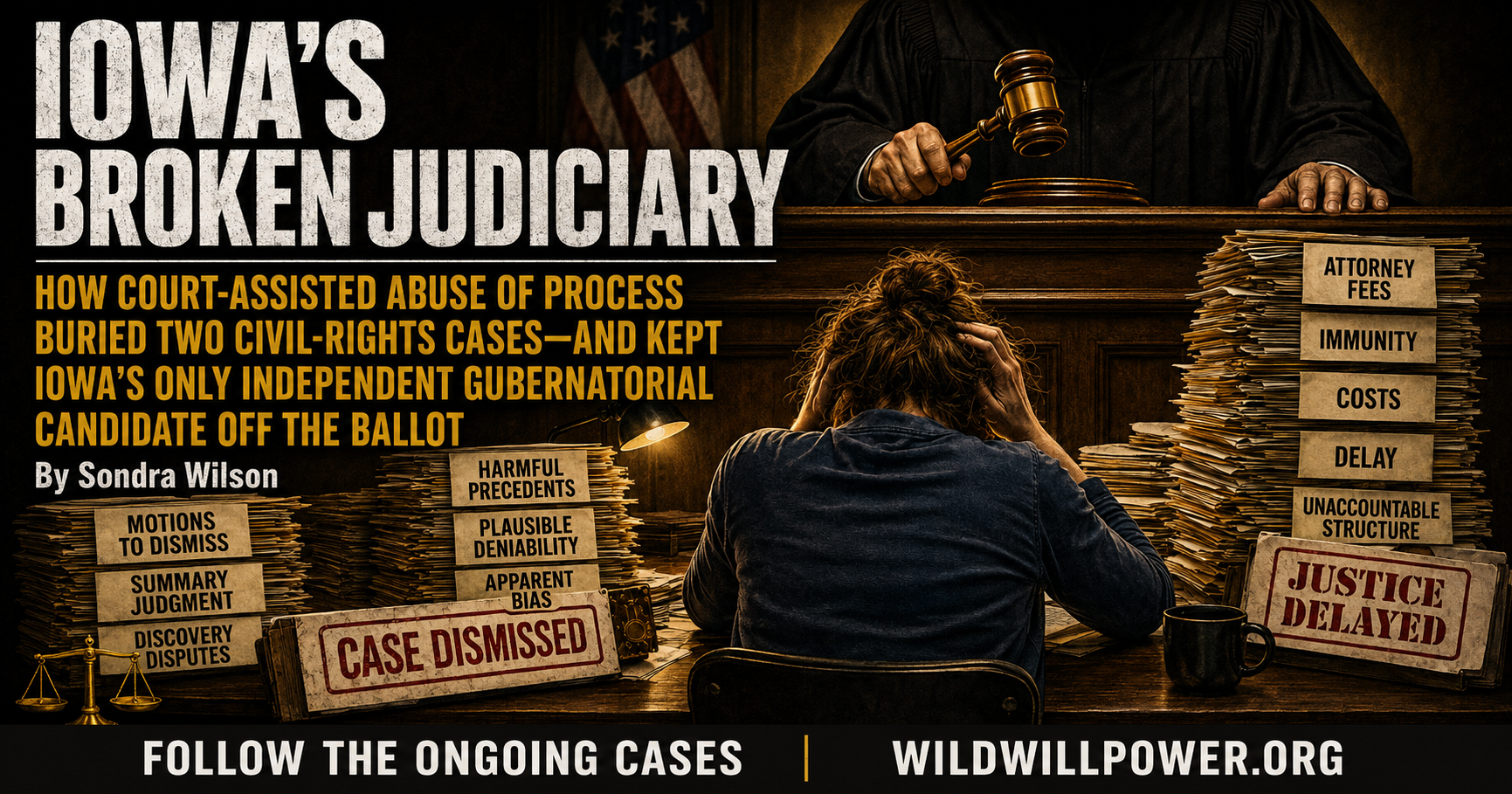
Companion Series to Iowa's Broken Judiciary:
Iowa's Unresolved Trauma
Confronting Iowa's History of Harm Against LGBT+ Citizens—
And Fulfilling the Promise of a Just, Accountable Government for All.
By Sondra Wilson | Updated August 4, 2026
My story did not arise in isolation.
Long before today’s political “culture wars,” Iowa used criminal law, psychiatry, eugenics, civil-rights exclusions, police power, and court procedure against people whose bodies, relationships, or gender expression departed from prevailing social norms.
Many people assume those harms belong entirely to the past. They do not.
The same institutional patterns—prejudice concealed as neutral administration, damaging classifications entered into official records, rights recognized without meaningful remedies, and procedural barriers that prevent injured people from being heard—continue to appear in modern Iowa.
This companion series documents that history and the personal experiences that followed from it.
It explains:
- how Iowa historically criminalized, confined, sterilized, excluded, and denied remedies to LGBT+ and gender-nonconforming people;
- how those institutional patterns entered my own life through records mismatches, arrests, criminal proceedings, homelessness, and later discoveries concerning the official record;
- how those unresolved injuries shaped the civil-rights cases I later filed; and
- why meaningful justice reform requires Iowa to confront both its public history and the quieter harms preserved within its agencies, institutions, and courts.
These articles provide the historical and personal foundation for Iowa’s Broken Judiciary, which documents what happened when I attempted to seek redress through Iowa’s administrative and judicial systems.
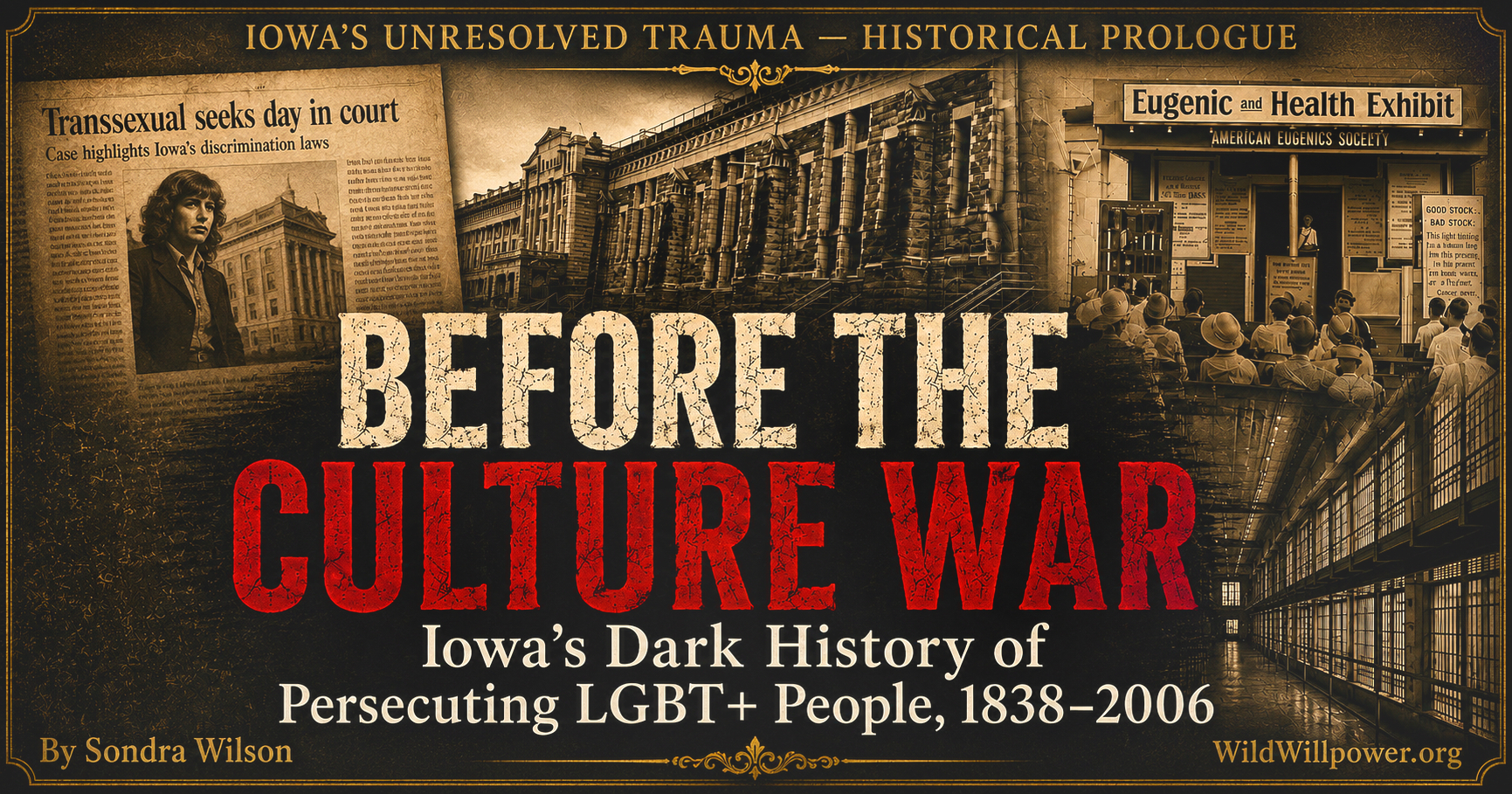
Historical Prologue
Before the Culture Wars
Iowa's Dark History of Persecuting LGBT+ people, 1838-2006
This article traces Iowa’s use of criminal law, psychiatry, eugenics, involuntary confinement, and civil-rights exclusions against people now understood as LGBT+, intersex, transgender, or gender-nonconforming.
From sodomy laws and forced sterilization to the 1955 Sioux City roundup and the Iowa Supreme Court’s refusal to extend civil-rights protection to Audra Sommers, the record shows how Iowa constructed systems capable of identifying disfavored people as immoral, diseased, dangerous, or legally undeserving of protection.
These were not isolated episodes. They created institutional habits, legal classifications, and official narratives whose consequences did not disappear when individual laws changed.
Read: Before the Culture War
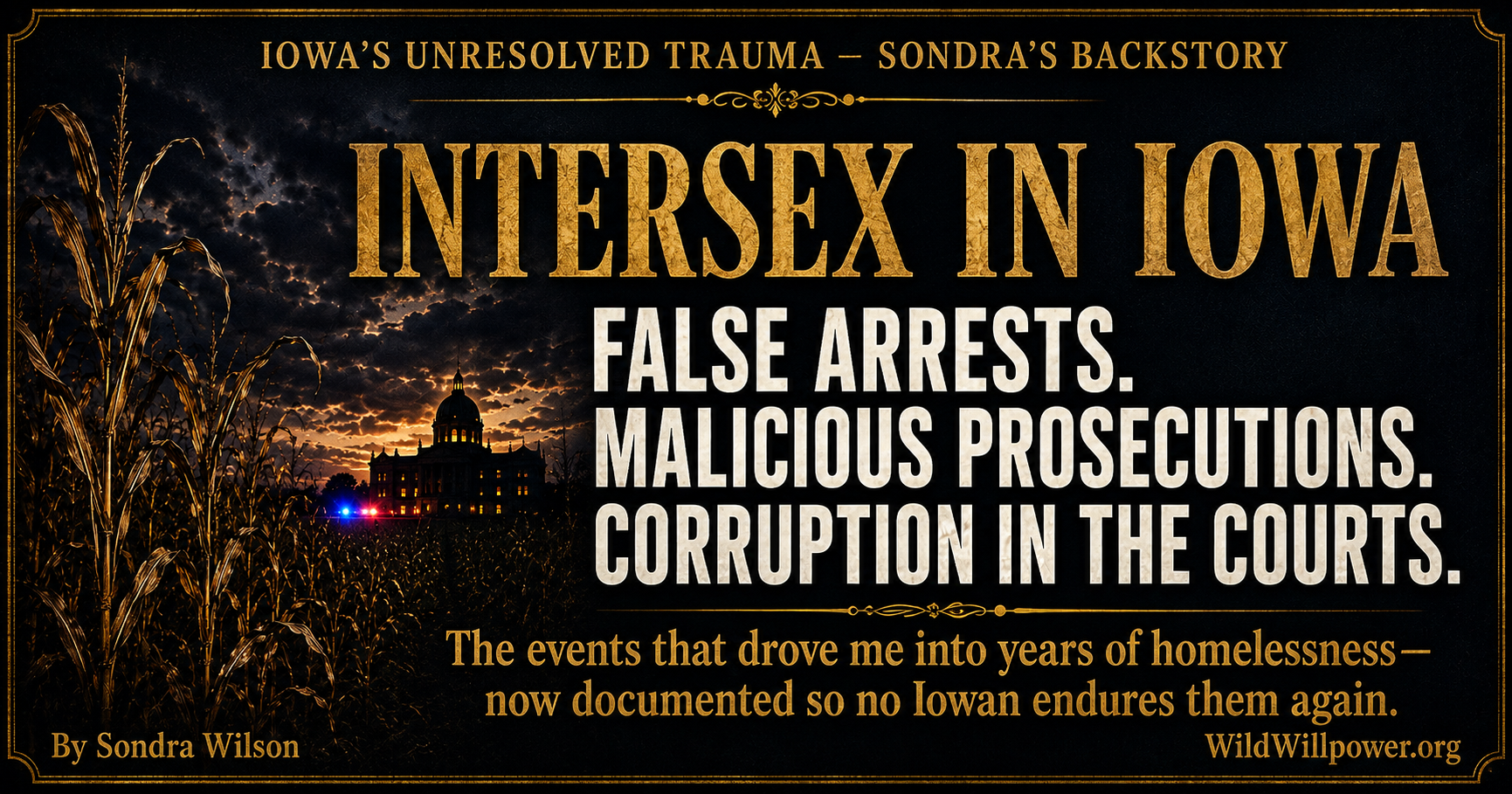
Sondra's Backstory
Intersex In Iowa
False Arrests, Malicious Prosecutions. Corruption in the Courts.
This series documents my personal backstory: growing up intersex without language to understand my body, leaving Iowa to seek medical care, returning with records that identified me differently, and encountering police, court, and institutional responses that profoundly altered the course of my life.
The articles examine:
- the May 22, 2006 arrest after officers discovered that my California and Iowa records did not match;
- the July 2006 arrest for using the women’s restroom;
- the 2009 prosecution and warning that contributed to my leaving Iowa;
- the years of homelessness and violence that followed;
- and the records I obtained in November 2022, which caused me to discover matters I allege had never been disclosed to me.
This is not presented as a complete autobiography. It is the portion of my history necessary to understand the legal claims, institutional failures, and need for reform documented in the companion series.
Read the Series: Intersex in Iowa
From Unresolved Trauma to Iowa's Broken Judiciary
Following Years of Homelessness, My False Criminal Record Forced Me Back Into Iowa's Courts
The injuries documented in this series did not end when the original proceedings concluded.
Official records remained. Criminal charges remained. Institutional narratives remained. The effects of homelessness, trauma, interrupted education, poverty, and reputational harm remained.
When I returned to Iowa and attempted to rebuild my life, later events caused those unresolved records to become relevant again. After severe accusations entered an Iowa Civil Rights Commission file in 2022, I became concerned that the older criminal record could be used to reinforce a false portrayal of me as dangerous, invasive, or predatory. That concern led me to obtain the earlier court dockets in November 2022.
The records raised new questions concerning the pleas entered by my attorney, Judge Steven Van Marel’s prior involvement, judicial disqualification, and the accuracy of the official record that had followed me for years.
I then sought review through the institutions I understood to be available, including the Attorney Disciplinary Board, the Judicial Qualifications Commission, the Iowa Civil Rights Commission, the Office of Ombudsman, law-enforcement and prosecutorial offices, and the State’s tort-claim process.
Those efforts did not produce a complete factual resolution.
Instead, I encountered administrative closure, withheld evidence, fragmented responsibility, procedural barriers, immunity doctrines, and dismissals entered before the underlying facts were fully developed.
The personal and historical record documented in Iowa’s Unresolved Trauma therefore became the foundation for the civil-rights cases examined in its companion series:
Series Exclusive:
Iowa's Broken Judiciary
How Court-Assisted Abuse of Process Buried Two Civil-Rights Cases—
and Kept Iowa's Only Independent Gubernatorial Candidate Off the Ballot
Iowa’s Broken Judiciary follows those cases through the administrative process, district-court litigation, continuing legal challenges, and the ballot-access dispute that followed.
Continue to Iowa’s Broken Judiciary