
Election Interference:
Independent Candidate for Iowa Governor Sondra Wilson Asks the Iowa Supreme Court to Restore Her Path to the Ballot After Litigation in Wilson v. Reliable Street Inc., et al. Derailed Her Campaign.
By Sondra Wilson | Updated August 12, 2026
This article is part of the Iowa's Broken Judiciary series and directly relates to the justice reforms I am proposing in my ongoing campaign for Iowa Governor. You can also read my full statewide platform here.
Notice—Updating Record: This article is part of an ongoing documentary series and is being updated as I continue organizing the court record, adding source documents, and documenting new developments. If you have visited this page before, please refresh your browser to ensure you are viewing the most current version.
Earlier PDF versions submitted in court filings remain fixed historical snapshots of what the articles contained on their filing dates.
August 12 Procedural Update —
A Challenge to the Dismissal Is Being Prepared
On August 12, the Iowa Supreme Court dismissed my appeal on the threshold issue of timeliness, without reaching mootness or the underlying ballot-access merits.
That dismissal is not yet procedurally final.
Iowa's appellate rules expressly allow a party to ask the Court to set aside a dismissal before procedendo issues. (Iowa R. App. P. 6.1208(1)(c)).
Procedendo is essentially the formal mandate that ends the Supreme Court's control of the appeal and sends jurisdiction back to the lower court.
I am preparing that filing now.
The Jurisdictional Question Is Only the Gateway
The immediate dispute is procedural:
Was my appeal timely?
But that is not the larger question this case presents.
If a candidate timely presents a good-faith evidentiary showing creating a reasonable basis to infer that extraordinary interference beyond the candidate's control materially affected the candidate's ability to meet a ballot-access deadline, should the court promptly establish a fixed schedule for resolving the claim while meaningful relief remains possible?
If the answer is yes, then that—not the technical jurisdictional question now blocking review—is the larger issue in this case.
In my case, the alleged interference was not merely that litigation happened to consume time. I alleged that defendants had placed serious and damaging allegations into Iowa's civil-rights process, that those allegations created foreseeable risks to my reputation and statewide campaign, and that the resulting litigation was later prolonged and magnified through conduct I alleged constituted abuse of process.
In other words, my position was that the burden was not simply self-imposed campaign scheduling. I alleged a chain of outside conduct that created the need for litigation, expanded the litigation burden, and ultimately consumed substantial portions of the ballot-access period.
I went to court before the June 2 ballot-access deadline expired. I expressly told the court that those litigation obligations were interfering with my campaign and consuming the time available for signature gathering. I did not ask to be excused from Iowa's ballot-access requirements. I asked for additional time in which to satisfy the same requirements.
That larger question has never been adjudicated in this case.
If the record provides a reasonable basis to infer that interference materially affected a candidate's ability to qualify, but the process of obtaining judicial review consumes the remaining qualification period, the passage of time itself can become part of the injury.
A candidate should not lose the practical possibility of relief merely because she used the courts in good faith to seek that relief while time still mattered.
But the Court Cannot Reach That Question Unless the Jurisdictional Dismissal Is Resolved First
That is why the procedural issue now matters so much.
The immediate question is narrower: was my July 20 appeal timely under Iowa's rules governing reconsideration and modification of a prior ruling?
My challenge will focus on a specific question the August 12 order does not explain: why the June 5 district-court ruling did not constitute a “modification” of the May 28 ruling under Iowa's appellate rules.
That question matters because the May 28 court stopped at lack of cited authority and expressly declined to reach the remaining considerations. On June 5, after I supplied additional authority, the court went further and determined for the first time that my litigation burden was nonexternal, ordinary, foreseeable, voluntarily undertaken, and effectively “self-created.”
A recent Iowa Court of Appeals decision, In re Marriage of Waller and Kill, No. 25-0899 (Iowa Ct. App. June 10, 2026), addressed the same procedural rule and held that whether a ruling was modified is determined by examining the content of the ruling, even where reconsideration was formally “denied.”
Earlier Iowa authority, including Turner v. CCRC of Cedar Rapids, LLC, No. 20-0973 (Iowa Ct. App. 2021), likewise recognized that a reconsideration ruling can modify an earlier ruling by adding grounds not contained in the original decision even though the ultimate result remains unchanged.
The Supreme Court had Waller and the related jurisdictional argument before it when it dismissed the appeal. The August 12 order expressly states that the Court considered my supplemental response, but it does not explain why the content-based analysis in Waller did not produce a different jurisdictional result here.
That leaves a specific unanswered question:
If May 28 expressly declined to reach an issue, and June 5 later decided that issue against me, why was June 5 not a “modification” for purposes of the appeal deadline?
That is the question my next filing will put directly before the Court.
May 28 Order: “lack of cited authority”; remaining considerations not reached.
June 5 Order: new determinations that the burden was nonexternal, ordinary, foreseeable, voluntary, and “self-created.”
In plain English: the question is not whether the June 5 order still ended with the word “DENIED.” The question is whether it decided something the May 28 order had not decided.
My forthcoming motion will ask the Supreme Court to apply the same content-based analysis, set aside the dismissal, and reinstate the appeal. If the Court concludes that Waller and related Iowa authority do not produce that result here, the motion will ask the Court to identify the legally material distinction.
If the appeal is reinstated, the Court can then confront the larger unresolved question:
When a candidate seeks relief before time runs out and presents a good-faith evidentiary showing creating a reasonable basis to infer that extraordinary interference beyond the candidate's control materially affected ballot qualification, what process and remedy does Iowa law provide while meaningful relief remains possible?
That is ultimately what this case is about.
The jurisdictional issue determines whether the Court will ever reach it.
I am completing the filing now and expect to submit it within the next 24 hours after final verification of the governing rules and authorities. This page will be fully updated once the motion is filed.
Page Contents
I. How Two Cases Collided — and My Campaign Was Forced Off the Ballot
How a civil-rights case I alleged had been prolonged and magnified through abuse of process collided with the signature-gathering period—and why I challenged the court's conclusion that those burdens were simply “self-created.”
II. District Court Timeline — Wilson v. Pate, May 28–June 22, 2026
How my emergency request developed from a question of judicial authority into a dispute over whether the underlying litigation burden was “self-created.”
III. Iowa Supreme Court Timeline — July 20–Current
How the appeal developed into a dispute over timeliness, mootness, and whether meaningful ballot relief remains possible.
IV. The Underlying Case Record — How Wilson v. Reliable Street Became the Burden at Issue
A chronological case map showing why I contend the underlying litigation cannot fairly be reduced to a lawsuit I simply chose to pursue.
V. Why My Burden Was Not “Self-Created”
Why damaging official records, foreseeable campaign harm, and the need to seek judicial redress made abandoning the dispute unrealistic.
VI. How Interference With My Campaign Became Interference With the Election
Why I describe the cumulative effect as election interference by effect.
VII. Why I Am Appealing — and What Is at Stake for Future Elections
The relief I seek and the precedent I hope will protect future candidates and voters.
VIII. From Administrative and Judicial Failure to Democratic Reform
Why the case raises broader questions about access to justice, political participation, and the ideas voters are allowed to consider.
I. How Two Cases Collided —
and My Campaign Was Forced Off the Ballot
I was not defeated by voters — I was removed from their consideration.
My campaign for Iowa Governor was not a last-minute undertaking. I had spent years developing a comprehensive platform for Iowa with fellow Iowans, organized around infrastructure and economic development, education, healthcare, and justice reform. I entered the 2026 election intending to bring those ideas before voters as an independent candidate.
But during the narrow period in which Iowa law required me to gather the signatures necessary to reach the ballot, two court cases collided.
The first was the civil-rights and false-records case, Wilson v. Reliable Street Inc., et al.. I brought that case after what I contend were false allegations and materially altered or misleadingly presented records entered Iowa's civil-rights process.
But the burden at issue in my ballot-access case was not simply the ordinary workload of a lawsuit I chose to file.
By 2026, Reliable Street had stretched across multiple years, two courthouses, and multiple judicial assignments, with extensive motion practice, venue and service disputes, amendment proceedings, discovery disputes, and dispositive motions. During the signature-gathering period alone, it generated nine mandatory hearings and filing deadlines that directly overlapped the time in which I was trying to qualify for the gubernatorial ballot.
I also alleged abuse of process within that litigation. In general terms, abuse of process means using otherwise valid legal process for a purpose or result for which that process was not designed. My allegation was not merely that the defendants filed many motions. I alleged that procedural devices—including venue proceedings, service challenges, fee requests, pleading disputes, discovery disputes, and other filings—were used in ways that substantially increased the litigation's duration, complexity, cost, and burden for purposes beyond good-faith resolution of the underlying dispute.
That distinction became directly relevant when the ballot-access court later characterized the litigation burden as “self-created” simply because I had been the person who originally filed Reliable Street.
I directly challenged that characterization. In my June 17 motion for reconsideration, I told the court that the burden on my campaign “did not arise merely from the existence of litigation,” that the case was not “discretionary, recreational, or analogous to an unrelated personal project,” and that the litigation was reasonably necessary to address serious allegations and governmental records that threatened my reputation and candidacy. I asked the court to reconsider its conclusion that the resulting burdens were “self-created.” The motion also submitted the completed Reliable Street pleadings and exhibits so the court could evaluate the nature, necessity, complexity, and scope of the underlying litigation from the record itself.
The attached materials went further. They included an abuse-of-process claim alleging that procedural conduct had substantially increased the cost, duration, complexity, and burden of the Reliable Street proceedings. Exhibit G laid out that procedural history in detail.
The June 22 order expressly states that the court reviewed my motion, affidavit, and attached materials. But it did not explain why that expanded record failed to alter the “self-created” characterization.
The second was the ballot-access case, Wilson v. Pate. That case arose because those mandatory litigation obligations consumed substantial portions of the signature-gathering period. I therefore asked the district court for a limited equitable extension of Iowa's ballot-access deadline.
I did not ask the court to waive, reduce, or excuse Iowa's ballot-access requirements. I asked for additional time to satisfy them.
The district court denied that relief after characterizing the underlying litigation burden as “self-created” because I had initiated Reliable Street. I dispute that characterization. My position is that whether a litigation burden was voluntary cannot fairly be determined simply by asking who filed the lawsuit. The court must also consider what caused the litigation, why it was pursued, what obligations followed, and whether abandoning it was realistically possible.
I contend Reliable Street arose from damaging allegations and disputed government records that created foreseeable consequences for my reputation, public work, and candidacy. Leaving those records unchallenged while running for statewide office was not, in my view, a realistic alternative.
The resulting chain was straightforward: disputed government records led to litigation; mandatory litigation obligations collided with the ballot-access period; I sought additional time to satisfy the existing requirements; the district court denied relief; and my name did not reach the ballot.
That dispute reached the Iowa Supreme Court, which dismissed the appeal on August 12 on the threshold issue of timeliness without reaching mootness or the underlying ballot-access merits. I am now asking the Court to set aside that dismissal.
If the appeal is reinstated, the larger question becomes whether extraordinary litigation burdens of this kind may justify equitable ballot-access relief—or whether they must automatically be treated as “self-created” whenever the affected candidate was the person who sought judicial redress.
But the two records answer different questions.
First, the timeline below follows Wilson v. Pate itself—what I asked the district court to do, how the court responded, why I sought reconsideration, and how the dispute reached the Iowa Supreme Court.
Then this page turns to the much larger underlying record in Wilson v. Reliable Street Inc., et al. because that history is necessary to understand the central factual dispute in the ballot-access case: whether the litigation burden that consumed my signature-gathering period was truly “self-created.”
That underlying history cannot fairly be reduced to the fact that I was the person who filed the lawsuit. To understand why, readers need to see what preceded the lawsuit, what happened after it was filed, how the record became increasingly fragmented, and why the litigation was still consuming enormous amounts of time during the 2026 election cycle.
The timelines come first. Then I will walk through that underlying case from beginning to end.
I Asked for More Time Before Time Ran Out.
The Court Process Then Consumed the Time I was Trying to Preserve.
When I first sought judicial relief in May, there was still time for relief to accomplish something meaningful.
Before filing suit, I contacted the Iowa Secretary of State's Office and asked whether any administrative extension, cure procedure, emergency review process, partial submission, or other mechanism existed to preserve ballot access under extraordinary circumstances. The Director of Elections responded that Iowa statute provided no such mechanism and that any departure from the Chapter 44 process “would come down to a court ruling instructing our office differently.”
So I went to court before the deadline passed.
I was not asking to be placed automatically on the ballot. I was not asking to waive Iowa's signature requirement or county-distribution requirement. I was asking for additional time to satisfy the same requirements after extraordinary litigation obligations had consumed much of the period in which I was supposed to gather signatures.
That timing matters.
I did not wait until the election calendar had run out and then ask the courts to rescue my campaign. I asked for relief while there was still time for that relief to work.
What happened next created a second problem.
The May 28 order denied relief because I had not supplied sufficient legal authority for an equitable extension. I then spent additional time during an election emergency researching that authority, filing a motion to reconsider, seeking leave to amend, and preparing an expanded petition.
After I supplied that authority, the June 5 order acknowledged that an important premise of my argument was “well-founded”: Iowa courts possess equitable and supervisory authority to address extraordinary roadblocks to the exercise of legal rights. But relief was denied again on a different ground. The court now characterized the underlying litigation burdens as ordinary, foreseeable, and effectively “self-created.”
That sequence matters because the first denial required me to spend more of the very time I was asking the court to preserve establishing authority that the court later acknowledged existed.
Then I had to respond to the new “self-created” determination.
Then I had to appeal.
Then I had to brief appellate jurisdiction and mootness.
Then I had to answer the State's arguments.
And now, in mid-August, the November election is approaching while I am still litigating whether I should have received additional time back in May.
The remedy has been shrinking while I have been trying to obtain it.
That is no longer merely an inconvenience. It is part of the injury.
The original Reliable Street litigation had already consumed substantial portions of my signature-gathering period. I contend that litigation itself grew out of serious failures in Iowa's civil-rights process: disputed allegations entered an official administrative record, I was unable to fully examine the respondents' submissions during preliminary screening, and I ultimately had to turn to the courts to try to adjudicate what had happened.
That underlying litigation then collided with my campaign.
When I asked the courts for a limited remedy to that collision, the effort to obtain the remedy became another major litigation obligation of its own.
So the chain is no longer simply:
Reliable Street litigation → lost campaign time.
It has become:
administrative failure → Reliable Street litigation → lost campaign time → emergency ballot-access case → additional motions and appeals → still more lost campaign time.
And election time is not interchangeable with ordinary time.
A week lost in May or June cannot simply be returned in October. Campaigns depend upon momentum, public appearances, media coverage, debates, voter contact, fundraising, volunteer recruitment, and repeated opportunities to introduce ideas to the public. Time spent litigating ballot access is time not spent participating meaningfully in the election for which ballot access was sought.
That is one of the harms that is becoming increasingly difficult to repair.
Iowans are choosing their next governor in November. Yet instead of spending this period primarily presenting my platform, speaking with voters, seeking interviews, participating in public forums, organizing supporters, and building a statewide campaign, I have had to devote enormous amounts of time to litigating whether I should have been given additional time to qualify for the ballot in the first place.
Even a later legal victory cannot fully recreate the campaign period that has already passed.
That is why this case presents a structural ballot-access problem extending beyond my own candidacy.
If extraordinary outside circumstances can substantially consume a candidate's qualification period, but obtaining judicial relief requires litigation that consumes the remaining period, the calendar itself can eventually defeat the remedy.
A candidate could ask for relief while relief is still useful, litigate diligently, and ultimately prevail only after the passage of time has made meaningful participation in the election far more difficult—or practically impossible.
Election law should not create incentives for interference by making delay more powerful than remedy.
If political, administrative, or legal interference can consume a candidate's qualification period while strict deadlines remain fixed and judicial review cannot occur quickly enough to repair the harm, then whoever causes the interference may benefit from the simple passage of time.
That creates an obvious danger.
A system designed to protect elections should not make sabotage effective simply because the courts cannot adjudicate its consequences quickly enough.
This is also why debates about election reform must begin one step earlier than questions about how votes are counted.
Ranked-choice voting, open competition, and other reforms may expand voter choice once candidates are on the ballot. But all of those reforms presuppose something more fundamental:
Candidates must first have a meaningful opportunity to reach the ballot.
Changing the method by which votes are counted cannot solve the threshold problem if extraordinary interference can prevent a candidate from qualifying and the judicial system cannot provide effective relief before the election calendar overtakes the dispute.
There is a broader access-to-justice problem here as well.
Legal rights become difficult to exercise in practice if an emergency request can be denied on one threshold ground, denied again on a newly introduced ground after that first deficiency is addressed, and then denied again after the factual record is expanded without an explanation of why that expanded showing failed to alter the analysis.
This case did not begin because I wanted another lawsuit.
It began because I asked for time.
I asked while time still mattered.
The chronology that follows shows how the process of deciding whether I was entitled to that time became another burden—and how, while that process continued, the election calendar kept moving forward.
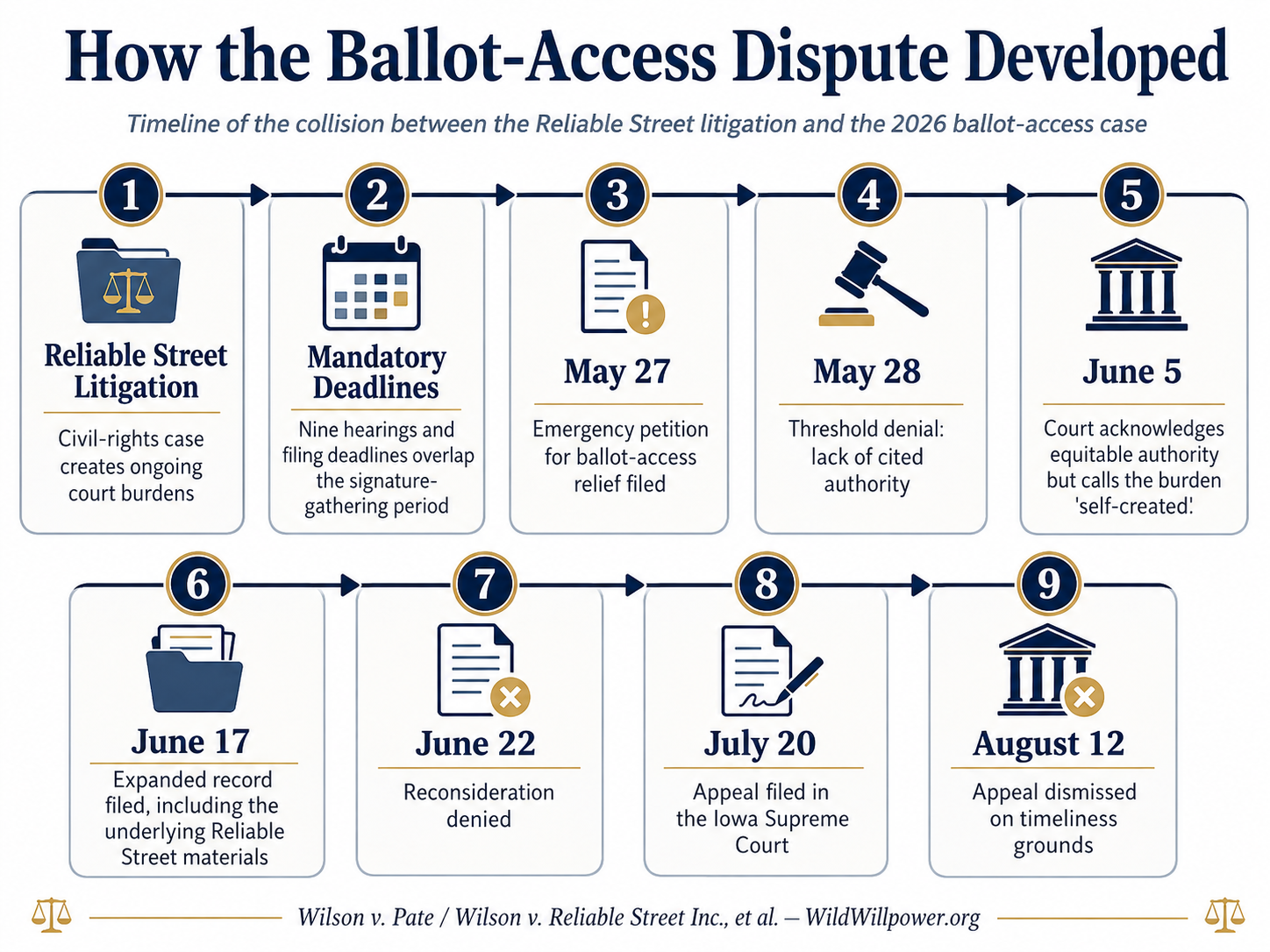
At a glance: How the Reliable Street litigation collided with the ballot-access period and developed into Wilson v. Pate and the Iowa Supreme Court appeal.
II. District Court Timeline —
Wilson v. Pate, May 28–June 22, 2026
The District Court proceedings took place from May 28 through June 22. The following timeline documents what happened, and what each of the filings were about. Then we'll get into the Iowa Supreme Court proceedings.
May 27-28, 2026:
Judge Beattie Denies My Request for an Extension to Obtain Ballot-Access Due to Extraordinary Circumstances — Cites "Lack of Cited Authority"
I filed an Emergency Petition for Equitable Extension of Ballot‑Access Deadline after Wilson v. Reliable imposed nine hearings and filing deadlines during Iowa’s signature‑gathering window for independent candidates.
In its first order, issued later that same day, the Court denied relief at the threshold, holding that I had not yet identified legal authority allowing a court to extend a statutory ballot‑access deadline. The Court did not reach the factual question of whether my burdens were extraordinary.
To address that concern, I filed a motion to amend my petition and a motion to reconsider.
June 1:
I Asked the Court to Reconsider—and Filed an Amended Petition Designed to Cure the Defect the Court Had Identified
On June 1, I did more than simply ask the district court to reconsider its May 28 ruling.
I filed three related documents: a Motion to Reconsider under Iowa Rule of Civil Procedure 1.904(2), a Motion for Leave to Amend under Rule 1.402(4), and a proposed Second Amended Petition for Equitable Extension of the Ballot-Access Deadline.
That distinction matters.
The May 28 order had denied my request at the threshold because I had not identified sufficient legal authority supporting an equitable extension. The court expressly declined to reach the remaining considerations.
My June 1 filings were designed to address that exact deficiency.
In my Motion for Leave to Amend, I explained that the proposed Second Amended Petition added Iowa authorities and clarifying allegations “directly addressing” the deficiency identified by the court and asked that the request be evaluated on a more complete legal record.
My Motion to Reconsider likewise asked the court to reconsider the May 28 order, permit filing of the attached Second Amended Petition, and then reconsider the requested equitable relief in light of the expanded legal framework.
The proposed Second Amended Petition cited seven judicial decisions addressing equitable authority, extraordinary circumstances, and constitutional ballot-access principles:
Rivas v. Brownell, 18 N.W.3d 211 (Iowa 2025).
In Rivas, the Iowa Supreme Court recognized judicial authority to address extraordinary roadblocks to the exercise of legal rights through tolling and reiterated that equitable exceptions to limitations statutes are common in Iowa.
Mormann v. Iowa Workforce Development, 913 N.W.2d 554 (Iowa 2018).
Mormann recognized the availability of equitable tolling principles in connection with a statutory filing period under the Iowa Civil Rights Act.
Anderson v. Celebrezze, 460 U.S. 780 (1983).
Anderson requires courts evaluating ballot-access restrictions to consider the character and magnitude of the burden on constitutional rights and weigh that burden against the State’s asserted interests.
Burdick v. Takushi, 504 U.S. 428 (1992).
Burdick further developed that constitutional balancing framework, requiring scrutiny of election regulations according to the severity of the burden imposed.
Esshaki v. Whitmer, 455 F. Supp. 3d 367 (E.D. Mich. 2020).
In Esshaki, a federal court granted ballot-access relief after extraordinary outside circumstances disrupted candidates’ ability to gather signatures, demonstrating that statutory ballot-access requirements are not invariably beyond judicial adjustment when constitutional burdens and extraordinary circumstances collide.
Moser v. Thorp Sales Corp., 312 N.W.2d 881 (Iowa 1981).
I cited Moser as additional Iowa authority concerning the exercise of equitable power to prevent unjust results.
In re Estate of Young, 273 N.W.2d 388 (Iowa 1978).
I likewise cited Young for Iowa’s longstanding recognition of equitable principles where strict application of legal rules would produce an excessively harsh result.
The amended petition also expressly invoked Anderson and Burdick to argue that ballot-access restrictions must be evaluated by weighing the burden imposed upon candidates and voters against the State interests asserted to justify that burden.
And I again made clear that I was not asking the court to waive Iowa’s signature requirements or permanently rewrite Iowa election law. I sought only a temporary extension allowing me additional time to satisfy the existing requirements.
June 5:
Court Acknowledges Equitable Authority, Calls My Burdens “Self-Created” —
and Does Not Expressly Rule on My Motion for Leave to Amend
On June 5, Judge Beattie entered an order titled “Order Denying Motion to Reconsider.”
The order expressly addressed my Rule 1.904(2) reconsideration motion and identified three authorities—Rivas, Mormann, and Esshaki—that I had presented after the May 28 ruling. The court acknowledged that an important premise of my motion was “well-founded”: Iowa courts possess equitable and supervisory authority to address extraordinary roadblocks to the exercise of legal rights.
But the court concluded that the authorities did not establish that equitable power should be extended to the particular statutory ballot-access deadline involved in my case.
Then the analysis went considerably further.
The May 28 order had stopped at the threshold legal-authority question and expressly declined to reach the remaining considerations. On June 5, however, the court reached the nature and cause of my litigation burden and concluded that it was not an extraordinary external circumstance because the deadlines and hearings arose from litigation I had initiated. The court described those obligations as the “ordinary and foreseeable demands” of litigation I chose to bring.
The court ultimately reduced my request to a claim that I had been “occupied with other matters” and characterized the competing obligations as voluntarily undertaken.
That was a new substantive determination that the May 28 order had not made.
There was also another unresolved procedural issue: the June 5 order expressly denied my Motion to Reconsider, but it did not expressly grant or deny the separate Motion for Leave to Amend or state that the proposed Second Amended Petition had become the operative pleading.
That matters because the proposed Second Amended Petition contained additional authorities and allegations beyond the three cases discussed in the June 5 order—including the U.S. Supreme Court’s Anderson–Burdick ballot-access framework and additional Iowa equitable authority.
So the June 5 ruling did two things at once: it moved beyond the threshold rationale of May 28 and decided a previously unresolved substantive issue, while leaving unclear the formal status of the amended pleading I had submitted to cure the original deficiency.
June 17:
I Challenged the “Self-Created” Finding With the Reliable Street Record —
and an Abuse-of-Process Allegation Showing Why This Was Not Ordinary Litigation
The June 5 ruling characterized the litigation burdens that interfered with my campaign as the ordinary and foreseeable consequences of litigation I had voluntarily chosen to bring.
On June 17, I filed a Motion to Reconsider Based Upon Subsequently Filed Evidence and Clarification of the Factual Record, directed specifically at that new determination.
My argument was not simply that Reliable Street had taken a lot of time.
It was that the court had characterized the burden as voluntary and ordinary without yet having before it the completed materials showing what the litigation actually concerned, why I believed judicial action had become necessary, and why the litigation itself had become unusually prolonged and complex.
At the time of the June 5 ruling, I was still completing filings that I had previously told the court were consuming substantial portions of the ballot-access period. By June 17, those materials were finished. I attached the 62-page Revised Second Amended Petition and seven organized evidentiary exhibits totaling approximately 209 pages so Judge Beattie could evaluate the nature of the underlying litigation from the record itself rather than from my description of work that was still unfinished.
Those exhibits documented several distinct parts of the dispute: the Iowa Civil Rights Commission proceedings; contemporaneous communications concerning the Open Mic, garden, and prairie projects; allegations of stalking and harassment compared with contemporaneous communications; allegations of racist and anti-LGBT conduct compared with surrounding communications; additional statements submitted to the ICRC; and the multi-year litigation history itself.
They were not submitted so the ballot-access court could decide the merits of the Reliable Street case. I expressly told the court that. Their purpose was narrower: to demonstrate the seriousness of the allegations I was attempting to adjudicate, the complexity of the record, and the amount and nature of the court-imposed work that had overlapped my signature-gathering period.
One Exhibit Was Particularly Important to the "Self-Created" Issue
One exhibit was particularly important to the “self-created” issue.
Exhibit G documented the factual basis for an abuse-of-process claim I was attempting to bring in Reliable Street. It laid out a chronology of litigation conduct that I alleged had unnecessarily expanded and prolonged the case—including overlapping pre-answer motions involving venue, dismissal, recasting, pleading demands, service challenges, costs, and attorney fees before discovery had even begun.
That did not require Judge Beattie to decide whether abuse of process had occurred. But it was directly relevant to the premise underlying his June 5 ruling.
If I was alleging that the litigation burden itself had been magnified through abuse of legal process, then the resulting workload could not fairly be dismissed merely by observing that I was the person who originally filed the lawsuit.
The Revised Second Amended Petition likewise alleged that the defendants had used filings, procedural challenges, venue and service disputes, fee requests, discovery disputes, and related proceedings for purposes other than good-faith resolution of the underlying factual dispute, substantially increasing the litigation's cost, duration, complexity, and burden.
That was the distinction I was trying to put before the ballot-access court:
The burden did not arise merely because I decided to spend my time suing someone. I contended that serious allegations had been placed into an official civil-rights record, that those allegations threatened my reputation and candidacy if left unresolved, and that the resulting effort to obtain judicial redress had itself developed into unusually complex litigation that I alleged included abuse of process.
Seeking judicial redress for serious allegations placed into a government record is not a voluntary hobby—and the resulting litigation burden does not become “self-created” merely because the injured person filed the lawsuit.
My June 17 motion therefore argued that the litigation was not “discretionary, recreational, or analogous to an unrelated personal project.” It arose from allegations I contended were false, defamatory, selectively excerpted, altered, or misleading, and which had entered an official administrative record.
A Clarification About the Administrative Record
My June 17 filing described administrative records broadly as publicly accessible. The Iowa Civil Rights Commission's historical rules were more restrictive. During the complaint process, personally identifiable investigative records were generally treated as confidential, and Rule 161—11.17 limited access to the case file. But the rule expressly allowed a party or the party's attorney to obtain access after issuance of a right-to-sue letter.
That distinction does not eliminate the concern I was trying to describe; it makes the sequence more precise. The disputed allegations first entered a confidential government administrative record that I could not fully inspect during preliminary screening. Once the administrative process ended and I was sent to court, those same allegations became relevant to public judicial litigation, where pleadings, motions, exhibits, and derivative filings could become part of the public record.
These Were Not Minor Accusations
The seriousness of those allegations was not merely my characterization. In Judge Currie's October 4, 2024 order (in the Reliable Street Case) addressing my defamation claim, she concluded that some of the statements were capable of defamatory meaning because they could impute crimes to me—most notably harassment and stalking—impair my ability to work, or expose me to hatred, contempt, or ridicule. The court therefore allowed the written-defamation claim to proceed.
The same order also held that, although the ICRC staff were required to keep the information confidential, submission of the statements to the ICRC investigator itself satisfied the publication element of defamation.
That is why I did not regard leaving the record unresolved as a harmless option during a statewide campaign. My concern was not simply that old accusations existed somewhere in an agency file. It was that serious allegations with potential criminal implications had entered an official government record, later became part of active litigation, and could foreseeably surface through the ordinary scrutiny applied to a candidate for governor.
The completed filings also showed the scale of the case: multiple defendants, multiple categories of alleged misconduct, extensive communications, administrative proceedings, and years of motion practice, venue disputes, service disputes, amendment proceedings, discovery disputes, and dispositive motions.
And by that point, the underlying burden was no longer hypothetical. During the signature-gathering period I had already been required to prepare major pleadings and exhibits, reply briefing, discovery, a motion to compel and resistance to summary judgment, and two hearings—including one on May 26, only days before the June 2 ballot deadline.
The issue was therefore not merely whether litigation consumed time. It was what caused the litigation, why I believed it could not responsibly be abandoned, what happened inside that litigation, and whether those resulting court-imposed burdens could fairly be labeled “self-created.”
June 22:
Judge Beattie Denied Reconsideration Without Explaining How the Expanded Record Changed—or Failed to Change—His Analysis
On June 22, Judge Beattie denied the motion in a a two-page order. The court stated that it had reviewed my motion, affidavit, and attached materials, had “again reconsidered” its prior ruling, and declined to alter it.
The order did not explain why the newly completed record failed to alter the “self-created” analysis. It did not address the distinction between voluntarily initiating litigation and allegedly being subjected to abuse of process within that litigation. It did not explain why the serious disputed allegations in governmental records, their foreseeable consequences for a statewide candidate, or the court-imposed obligations necessary to litigate them should be treated as equivalent to ordinary competing commitments.
It simply left the June 5 characterization in place.
The Abuse-of-Process Record from the Reliable Street Record—and How It Impacted My Campaign—
Was Only Beginning to Come Into View
At this point, the Reliable Street record had not yet been converted into the public documentary article series now available on this website. I was still attempting to keep up simultaneously with court filings, campaign obligations, and the work of reconstructing a fragmented multi-year record. The June 17 pleading and exhibits were the most complete organized presentation I had been able to assemble at that time. The later article series developed as the case's consequences became matters of broader public concern and allowed me to explain those records much more clearly to voters and the public.
III. Iowa Supreme Court Timeline —
Wilson v. Pate, July 20-Current
July 20:
I Filed My Notice of Appeal, Beginning the Appeal to the Iowa Supreme Court
On July 20, I formally appealed the district court’s rulings in Wilson v. Pate to the Iowa Supreme Court.
I treated Judge Beattie’s June 22 order as the ruling that started the 30-day appeal period because my June 17 motion (challenging the new “self-created” determination) had been directed specifically at a new determination introduced in the June 5 ruling: the conclusion that my litigation burdens were “self-created” because I had initiated the Reliable Street case.
Legal takeaway: The timeliness dispute turns on whether the June 5 ruling changed what the district court had actually decided—not merely on the fact that reconsideration was formally “denied.”
In plain English, my position is this:
The May 28 order (lack of cited authority) said I had not shown enough legal authority for an equitable extension and expressly declined to decide the remaining issues.
The June 5 order (“self-created” burden) went further and decided one of those previously unresolved issues against me—whether the litigation burdens were extraordinary or instead were obligations I had voluntarily created. I filed my June 17 motion to challenge that new determination.
The June 22 order (reconsideration denied) left that determination in place. I filed my Notice of Appeal 28 days later.
That is why I contend my July 20 appeal was timely.
July 24:
The Iowa Supreme Court Asked Whether It Could Hear the Appeal
Four days after my appeal was filed, the Iowa Supreme Court did not dismiss the case. Instead, it issued an order asking the parties to address two threshold questions before the Court decides whether to proceed with the appeal:
1. Was my appeal filed on time?
2. Is there still anything the Court can realistically do to help?
Those are threshold legal questions concerning appellate jurisdiction and mootness.
What “timeliness” means here
Normally, an appeal must be filed within 30 days of the ruling that starts the appeal period.
The Supreme Court noted that if my June 17 reconsideration motion did not extend that deadline, then the appeal period would have begun on June 5, making my July 20 notice of appeal 14 days late.
July 31:
I Responded to the Iowa Supreme Court — Arguing My Appeal Was Timely and the Ballot-Access Case Was Still Alive
On July 31, I filed my Statement Addressing Appellate Jurisdiction and Mootness in response to the Iowa Supreme Court's order.
I made two principal arguments.
First, I argued that my July 20 appeal was timely. My position was not that every second motion to reconsider automatically creates another 30 days to appeal. Iowa's appellate rules specifically say otherwise. My narrower argument was that the June 5 ruling materially modified the May 28 ruling by deciding an important issue that the first order had expressly left unresolved—and that my June 17 motion (challenging the new “self-created” determination) was directed specifically at that newly decided issue.
The difference can be seen by comparing the two rulings.
The May 28 order (lack of cited authority) stopped at a threshold question: I had not yet identified sufficient legal authority for an equitable extension, so the court expressly stated that it would “not reach the remaining considerations.” The June 5 ruling then reached one of those considerations for the first time, finding that my litigation burdens were voluntary, foreseeable, and “self-created.”
That distinction mattered because Iowa Rule of Appellate Procedure 6.101(1)(c) recognizes a circumstance in which a later reconsideration motion can affect the appeal deadline: when the court has modified its ruling and the later motion is directed only at that modification.
Why I Argued the June 5 Ruling Was a "Modification"
I cited Iowa cases showing that courts look at the substance of a ruling or motion, not merely the label placed on it.
Iowa Electric Light & Power Co. v. Lagle, 430 N.W.2d 393 (Iowa 1988). I cited Lagle for the principle that Iowa courts examine the actual content and nature of a filing rather than relying exclusively on its title. That supported my argument that calling June 17 a “second motion to reconsider” did not answer what legal effect it had.
Sierra Club Iowa Chapter v. Iowa Department of Transportation, 832 N.W.2d 636 (Iowa 2013). I cited Sierra Club in distinguishing a motion that merely repeats an old argument from one directed at matters the earlier ruling had left unresolved or unexplained.
Tenney v. Atlantic Associates, 594 N.W.2d 11 (Iowa 1999). I cited Tenney as additional support for examining the substance of what a post-ruling motion actually asks the court to decide.
Turner v. CCRC of Cedar Rapids, LLC, No. 20-0973 (Iowa Ct. App. 2021). Turner was especially useful because it dealt with the rule requiring a successive reconsideration motion to be “directed only at the modification.” In Turner, the later motion failed that test because it raised numerous issues and repeated earlier requests. I argued my June 17 filing presented the opposite situation: it identified the specific new June 5 determination and directed its factual presentation to that issue.
That allowed me to present the timeliness question to the Supreme Court in a much more precise way:
Did the June 5 ruling merely repeat the May 28 denial—or did it materially change the ruling by deciding, for the first time, that my litigation burdens were voluntary and “self-created”?
If it materially modified the earlier ruling, and my June 17 motion was directed only at that new determination, then I argued that the 30-day appeal period ran from the court's June 22 disposition of that motion. I filed my Notice of Appeal 28 days later.
I Also Argued That the Case Was Not Moot
The Supreme Court's second question was whether too much time had passed for any meaningful relief to remain available.
I argued that my objective had not expired. I was still seeking access to the November 2026 general-election ballot. I was not asking to have the signature requirement waived, reduced, or ignored. I asked the Supreme Court to reverse and remand so that a workable new deadline could be established while still requiring me to collect the same number and geographic distribution of signatures required by Iowa law.
This made the mootness question important for more than my own campaign.
If a candidate asks for emergency ballot-access relief but the requested date passes while the case is moving through the courts, does that automatically prevent an appellate court from ever deciding whether relief should have been granted?
I argued that it should not.
Iowa Law Also Recognizes Exceptions for Important Questions
That Recur Too Quickly for Courts to Decide Them
Even if the Supreme Court concluded that the exact July date I originally requested could no longer be granted, I argued that Iowa's public-importance exception to mootness provided an independent reason for the Court to hear the case.
I cited several Iowa decisions:
Rush v. Ray, 332 N.W.2d 325 (Iowa 1983), explains that mootness is a doctrine of judicial restraint rather than simply a question of raw judicial power.
Riley Drive Entertainment I, Inc. v. Reynolds, 970 N.W.2d 289 (Iowa 2022), identifies factors for deciding whether an otherwise moot case should still be heard because it presents an important public question—including whether the issue is likely to recur and repeatedly escape appellate review.
And Board of Directors v. Green, 147 N.W.2d 854 (Iowa 1967), addressed the problem of disputes that are likely to become moot before ordinary appellate review can be completed. I argued that ballot-access cases create the same structural problem: the deadline being challenged can expire while the appeal is still being litigated.
That produced another simple question for the public:
If every ballot-access appeal becomes “too late” before the appellate courts can decide it, when would Iowa's appellate courts ever get the opportunity to decide what the law requires?
But here is the more important issue:
A system in which outside interference can consume the compliance period, while the passage of that same time prevents judicial review, risks leaving candidates and voters without any effective remedy.
Iowa Election Law Is Not As One-Sided as "Deadlines Are Deadlines"
"Iowa generally demands strict compliance with pre-election qualification requirements." Gluba v. State Objection Panel, 11 N.W.3d 459 (Iowa 2024), No. 24-1426. However, Wingert v. Urban, 250 N.W.2d 731 (Iowa 1977), shows that Iowa election law has recognized that exceptional circumstances can matter rather than treating every instance of noncompliance as categorically beyond equitable consideration.
And Gluba was relevant in another way: the Iowa Supreme Court had demonstrated that it can hear ballot-access disputes on an expedited schedule when an approaching election requires immediate resolution.
Taken together, my argument was not that election deadlines do not matter. It was that Iowa's rules expressly contemplate reconsideration after a ruling is modified; Iowa cases instruct courts to examine substance rather than labels; Iowa recognizes a public-importance exception for disputes likely to recur yet escape review; and Iowa courts have recognized both exceptional circumstances in election cases and expedited appellate review when election deadlines demand it.
I therefore asked the Supreme Court to find my appeal timely, reject mootness, and allow the ballot-access case to proceed on an expedited schedule.
I Also Submitted the Public Record I Was Building for Iowans
Along with my July 31 jurisdictional statement, I submitted six public-facing articles as exhibits:
Exhibit A — Wilson v. Pate: The Ballot-Extension Case
Exhibit B — Iowa's Broken Judiciary
Exhibit C — Iowa's Civil-Rights Trap
Exhibit D — Procedural Bombardment
Exhibit F — Plausible Deniability
I identified those articles as publicly available through WildWillpower.org and described the attached PDFs as fixed snapshots of the articles as they existed on July 31, 2026.
I submitted them to help illustrate the public nature of the controversy, the electoral speech and reform proposals affected by the ballot-access dispute, and matters relevant to mootness. They were not offered as substitutes for the underlying court record or as independent proof of the disputed allegations.
The online versions have continued to develop as I organize additional documents and reconstruct the record. At the time of the July 31 filing, Dangerous Precedent—covering the later Reliable Street proceedings—was still identified as “in preparation” and therefore was not among the exhibits.
That's when the Iowa Attorney General's Office stepped in.
August 7:
The Iowa Attorney General's Office Asked the Iowa Supreme Court to Dismiss My Appeal as Untimely and Moot
On August 7, Secretary of State Paul Pate, represented by the Iowa Attorney General’s Office, filed his response to the Supreme Court’s jurisdictional order.
The State asked the Court to dismiss the appeal without reaching the underlying ballot-access question, arguing two things:
1. My appeal was filed too late.
2. Even if it was timely, the case is now moot because the particular extension date I originally requested has already passed.
The State's Timeliness Argument
The State disagreed with my argument that the June 5 reconsideration ruling materially modified the May 28 ruling.
Its position was that the June 5 ruling did not create a new appeal period because the district court formally denied my first motion to reconsider rather than granting it and entering a newly modified ruling.
The State argued that if Judge Beattie had actually modified or enlarged the May 28 ruling, he would have first granted my Rule 1.904(2) motion and then denied the underlying petition again on the expanded grounds. Because the order instead simply said reconsideration was denied, the State argued that no legal “modification” occurred.
Under that interpretation, my June 17 motion was a successive reconsideration motion that did not extend the time for appeal.
The State therefore calculated the appeal deadline from June 5, not June 22, and argued that my July 20 Notice of Appeal—filed 45 days after June 5—was untimely.
The dispute had now narrowed to a surprisingly important question: Does a court ruling “modify” an earlier ruling only when the judge formally says reconsideration is granted—or can the substance of the new ruling itself constitute a modification even though the final word still says “denied”?
The State's Mootness Argument
The State also argued that there was no longer any effective relief the Supreme Court could give me.
My original petition had requested an extension through July 15, 2026. Because July 15 had passed and I had not submitted nomination papers by that date, the State argued that granting that original requested relief now would accomplish nothing.
The State also objected to my July 31 request that the Court instead establish a new workable equitable deadline.
It characterized that as a revised form of relief and argued that I had not provided enough current facts to show that another extension would still be practically useful rather than futile.
The State pointed to approaching election-administration deadlines—including state deadlines and the federal deadline governing transmission of ballots to military and overseas voters—as reasons why the remaining window for relief was becoming increasingly constrained.
That raised a simple public-facing question:
Was July 15 merely the remedy I originally proposed—or was it the controversy itself?
If the real controversy is whether I can still qualify for the November ballot while satisfying Iowa’s full requirements, does the passing of one proposed extension date automatically make the entire case disappear?
The State Also Opposed the Public-Importance Exception
The State additionally argued that the Supreme Court should not hear the case under Iowa’s exception for important public questions that might otherwise become moot before appellate review can occur.
It acknowledged the factors courts consider—such as whether the issue is public in nature, whether authoritative guidance is desirable, whether the issue is likely to recur, and whether it is likely to recur yet evade review—but argued that my particular circumstances were too fact-specific to justify the exception.
The State also pointed to Gluba v. State Objection Panel as evidence that Iowa’s appellate courts can move quickly in election cases while relief remains available.
By August 7, the jurisdictional dispute was sharply defined.
The State’s position was:
June 5 started the appeal clock; July 20 was therefore too late. July 15 had already passed; no effective relief remained. And the circumstances were too unique to justify deciding the issue under the public-importance exception.
My position was the opposite:
June 5 materially changed the basis of the district court’s ruling; June 17 properly challenged that modification; June 22 therefore controlled the appeal deadline; and the controversy remained alive because the November election had not occurred and I continued to seek a workable way to satisfy—not evade—Iowa’s ballot-access requirements.
The State’s response also introduced a particularly important legal argument: that because the June 5 ruling formally said “denied,” it could not have modified the May 28 ruling. The next day, I filed a supplemental response identifying a very recent Iowa appellate decision addressing that exact issue.
August 8:
I Responded With New Iowa Authority—and Sworn Facts Showing That Ballot Relief Could Still Matter
The next day, August 8, I filed a Motion for Leave to File a Supplemental Response, a detailed Proposed Supplemental Response, and a sworn Declaration Regarding Current Ballot-Access Feasibility.
The filings directly answered the two arguments the State had made the day before.
First: A Recent Iowa Case Directly Addressed the State's "Denied Means No Modification" Argument
The State's August 7 position depended heavily on the fact that Judge Beattie's June 5 order (“self-created” burden) formally denied my first motion to reconsider.
The State argued that if the June 5 ruling had actually modified the May 28 ruling, the district court would have needed to first grant reconsideration and then deny my petition again.
But I found a very recent Iowa Court of Appeals decision that addressed essentially that question: In re Marriage of Waller and Kill, No. 25-0899 (Iowa Ct. App. June 10, 2026).
In Waller, the district court had also formally denied the first reconsideration motion. Nevertheless, the Court of Appeals held that the ruling had modified the earlier order.
The Court explained:
“But in determining whether there was a modification, we look at the content of the ruling.”
My August 8 filing therefore argued that the word “DENIED” cannot end the analysis. What matters is what the June 5 ruling actually did.
That produced a very simple comparison:
May 28: the court said my petition failed “at the threshold” and expressly declined to reach the remaining equitable considerations.
June 5: after I supplied additional authority, the court reached those previously unresolved considerations and determined for the first time that my litigation burdens were nonexternal, ordinary, foreseeable, voluntarily undertaken, and “self-created.”
In my filing, I summarized the distinction this way:
“The decretal result remained ‘denied.’ The adjudicative basis did not.”
Why Waller Matters
The takeaway from Waller, as I argued it, was:
The legal question is not simply what word appeared at the bottom of the June 5 order. The question is whether the substance of that order changed what the court had previously decided.
That is especially important because Iowa Rule of Appellate Procedure 6.101(1)(c) specifically contemplates a later reconsideration motion when the court has modified its ruling and the later motion is directed only at that modification.
My position remained that this is exactly what happened: May 28 left the “self-created” question undecided; June 5 decided it; June 17 challenged that new determination; and June 22 denied that challenge.
Second: I supplied the Current Facts the State Said Were Missing
The State had also argued that I had not supplied enough information to show that a new ballot-access deadline could still accomplish anything.
So I filed a sworn declaration addressing that issue directly.
I stated that:
— I remained a candidate seeking qualification for the November 3 ballot;
— I still possessed approximately 1,000 petition signatures;
— I retained the original petition sheets;
— I was not asking to waive or reduce the 3,500-signature or county-distribution requirements;
— approximately 2,500 additional signatures would be needed to reach the numerical threshold, before allowing extra signatures for possible challenges;
— I had demonstrated the ability on at least one favorable day to gather approximately 60 signatures;
— I was prepared to resume intensive petition circulation and recruit volunteers; and
— I remained willing to comply with whatever accelerated submission, objection, verification, or review procedures the Court deemed necessary.
That changed the mootness dispute from an abstract question—
“Could any relief possibly still matter?”
—to a concrete one:
“With approximately 1,000 signatures already collected, the November election still ahead, and a candidate prepared to satisfy every statutory qualification, has the State actually shown that no legally and administratively workable remedy remains?”
The Broader Question I Asked the Court to Address
I also emphasized that this case is not about whether a candidate should receive an extension merely because she chose to file a lawsuit.
The broader question is whether a court may consider the origin, necessity, timing, nature, foreseeable electoral consequences, and surrounding circumstances of the litigation when deciding whether the resulting burden was truly voluntary or “self-created.”
In my August 8 response, I framed the recurring issue this way: whether those circumstances may be considered in determining if a litigation burden is genuinely voluntary—and what evidentiary showing a candidate must make before such a burden can qualify as extraordinary or external.
That distinction is important in my case because I did not contend that I simply became too busy after voluntarily deciding to sue someone. I alleged a longer causal sequence: serious accusations and allegedly false or materially misleading records entered a government proceeding; those materials created foreseeable reputational and electoral consequences; I sought judicial redress; mandatory litigation obligations followed; and those obligations ultimately consumed much of the ballot-access period. My August 8 filing expressly argued that this sequence should not automatically be collapsed into the statement that I merely “chose to bring” litigation.
”Who filed the lawsuit” does not answer whether the resulting burden was truly self-created. The real question is what caused the litigation, why it became necessary, and what happened after it began.
I Did Not Ask the Court to Ignore Election Administration
My supplemental response expressly acknowledged that the approaching federal military-and-overseas ballot deadline creates a serious administrative constraint.
But I argued that a serious constraint is not necessarily the same thing as an absolute legal impossibility.
Rather than asking the Supreme Court to invent an arbitrary new date, I asked it—if I prevailed—to establish or remand for the latest legally and administratively workable deadline, while allowing the Secretary of State to identify the real election-administration requirements that would need to be preserved.
In other words:
I was still not asking for a shortcut. I was asking whether there remained any lawful path by which I could complete the same ballot-access requirements while preserving Iowa's verification, objection, and election-administration safeguards.
I Also Asked the Iowa Supreme Court to Move Quickly
Because every passing day affects whether meaningful election relief remains possible, I asked the Court to expedite the case.
I cited Iowa Rule of Appellate Procedure 6.901(9), which permits the Court to shorten briefing periods, and requested an expedited merits schedule if the Court retains jurisdiction.
So by August 8, the parties had squarely joined the threshold dispute.
The State argued that the appeal clock began June 5, that the July 20 appeal was too late, and that the passing of the originally requested extension date left no effective remedy.
I responded that recent Iowa authority instructs courts to examine the content of a reconsideration ruling rather than its label; that June 5 decided a matter May 28 had expressly left unresolved; that June 17 challenged that new determination; and that current sworn facts showed an ongoing effort to reach the November ballot while satisfying every statutory qualification.
On August 12, the Iowa Supreme Court dismissed the appeal on the threshold question of timeliness without reaching mootness or the underlying ballot-access merits. I am now preparing a motion under Iowa Rule of Appellate Procedure 6.1208(1)(c) asking the Court to set aside that dismissal before procedendo issues.
A Note About the Ames Community at the Center of the Underlying Case
Reliable Street and Lockwood Café are Ames community spaces connected to the underlying civil-rights litigation, Wilson v. Reliable Street Inc., et al., which later became central to my ballot-access case.
I recognize that these spaces are warmly regarded by many people in Ames. Many readers may have positive experiences there or personal relationships with people involved in this litigation. I had positive experiences there myself, which is part of what has made everything that followed so painful.
I am asking readers not to harass the defendants, confront anyone involved, protest these businesses, or pressure people to stop patronizing them. That is not the purpose of this article, nor do I want for it to happen in any way, shape, or form.
The conduct I document in this series is serious, and the consequences for me have been severe and ongoing. But this dispute has also grown far beyond the original conflict. The resulting litigation consumed substantial portions of the period in which I was required to qualify for the gubernatorial ballot, my campaign was ultimately derailed, and Wilson v. Pate is now before the Iowa Supreme Court.
That makes the factual history impossible to explain honestly to voters, supporters, journalists, attorneys, and the general public without identifying what happened and presenting the underlying record.
The case has also produced an absolute-privilege ruling with consequences that extend well beyond the people involved here. If statements and documentary submissions made during the preliminary stages of Iowa's civil-rights process can receive absolute protection from civil liability even when a complainant alleges they were knowingly false, defamatory, or materially altered, the danger to future civil-rights complainants is profound. People seeking protection from discrimination should not have to fear that the very process designed to protect them can become a vehicle for damaging allegations for which no meaningful remedy is available.
That issue potentially affects women, people of color, people with disabilities, religious minorities, LGBT people, and every other Iowan who may someday need to rely upon Iowa's civil-rights system.
A welcoming public identity and a serious private legal dispute can exist at the same time. Nothing in this article requires anyone to deny the good experiences they have had at Reliable Street or Lockwood Café. It asks readers to examine what happened in this particular case, what the litigation ultimately did to a statewide campaign, and what the resulting legal precedent could mean for people who have nothing whatsoever to do with the original dispute.
I did not want this conflict, and I did not want it to reach this point. But once its consequences reached a statewide election and raised questions about the protection available to future civil-rights complainants, remaining silent was no longer a responsible option.
IV. The Underlying Case Record —
How Wilson v. Reliable Street, et al. Became the Burden at Issue
The procedural history above explains what happened in Wilson v. Pate.
But it does not, by itself, answer the factual question at the center of the dispute:
Was the litigation burden that interfered with my campaign really “self-created” simply because I was the person who filed Wilson v. Reliable Street Inc., et al.?
That question cannot be answered by looking only at the caption of the lawsuit or asking who filed the first petition.
It requires looking at what happened before the lawsuit, what I was attempting to obtain through Iowa's civil-rights process, what records were created there, why I eventually went to court, what happened once the case entered the judicial system, how the record became increasingly fragmented, and why the case was still consuming extraordinary amounts of time during the exact months I was required to gather petition signatures.
That history is unusually complicated.
It spans several years, multiple judges, two courthouses, Iowa Civil Rights Commission proceedings, disputed communications and documentary exhibits, procedural challenges, attempted amendments, settlement discussions, discovery disputes, dismissed claims, renewed efforts to reconstruct the record, and ultimately a summary-judgment fight over whether statements submitted to the Commission were protected by absolute privilege.
I have documented those stages in separate articles because no single installment could responsibly contain the entire record.
But requiring readers to open every article and reconstruct the chronology themselves would recreate the very problem this series is trying to solve.
So before asking readers to decide whether this litigation was merely “self-created,” I want to walk through the entire sequence here.
The articles below remain available for anyone who wants to examine the underlying documents and fuller factual record. But this section is designed to stand on its own as a chronological map of what happened—and how a civil-rights dispute that began years earlier eventually collided with my campaign for Governor.
Understanding How the Reliable Street Case Collided With My Campaign
Over the course of Wilson v. Reliable Street Inc., et al., the record became distributed across Iowa Civil Rights Commission materials, communications, pleadings, exhibits, transferred docket filings, discovery disputes, court orders, post-ruling motions, and later summary-judgment proceedings.
I have therefore been reconstructing that history as a documentary series. Rather than asking readers simply to accept my characterization of what happened, the articles link to and reproduce underlying documents wherever possible so the record can be examined directly.
For readers trying to understand why I contend the litigation burden was not merely “self-created,” the chronology begins here.
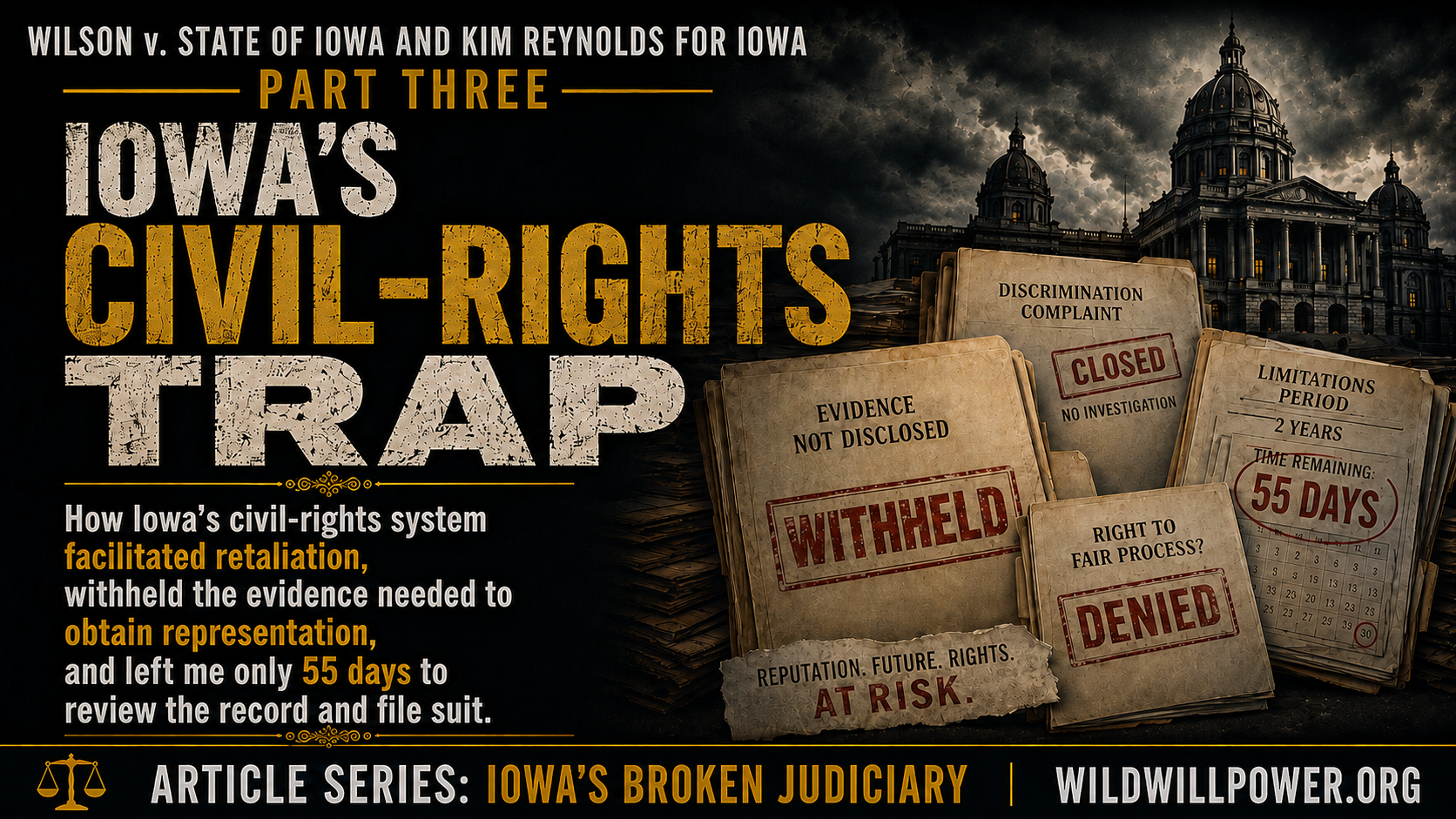
1. Iowa's Civil-Rights Trap:
How Iowa's administrative process created the conditions that forced the dispute into court.
This article explains what happened before Wilson v. Reliable Street was filed: why I sought help from the Iowa Civil Rights Commission, how the administrative process unfolded, when I was allowed to see the respondents' submissions, and how I was ultimately left with only a compressed period in which to understand the record, seek counsel, identify possible claims, and decide whether litigation was necessary.
This is where the judicial story begins—because it explains why the lawsuit was filed at all.
Click the below image to see what happened.
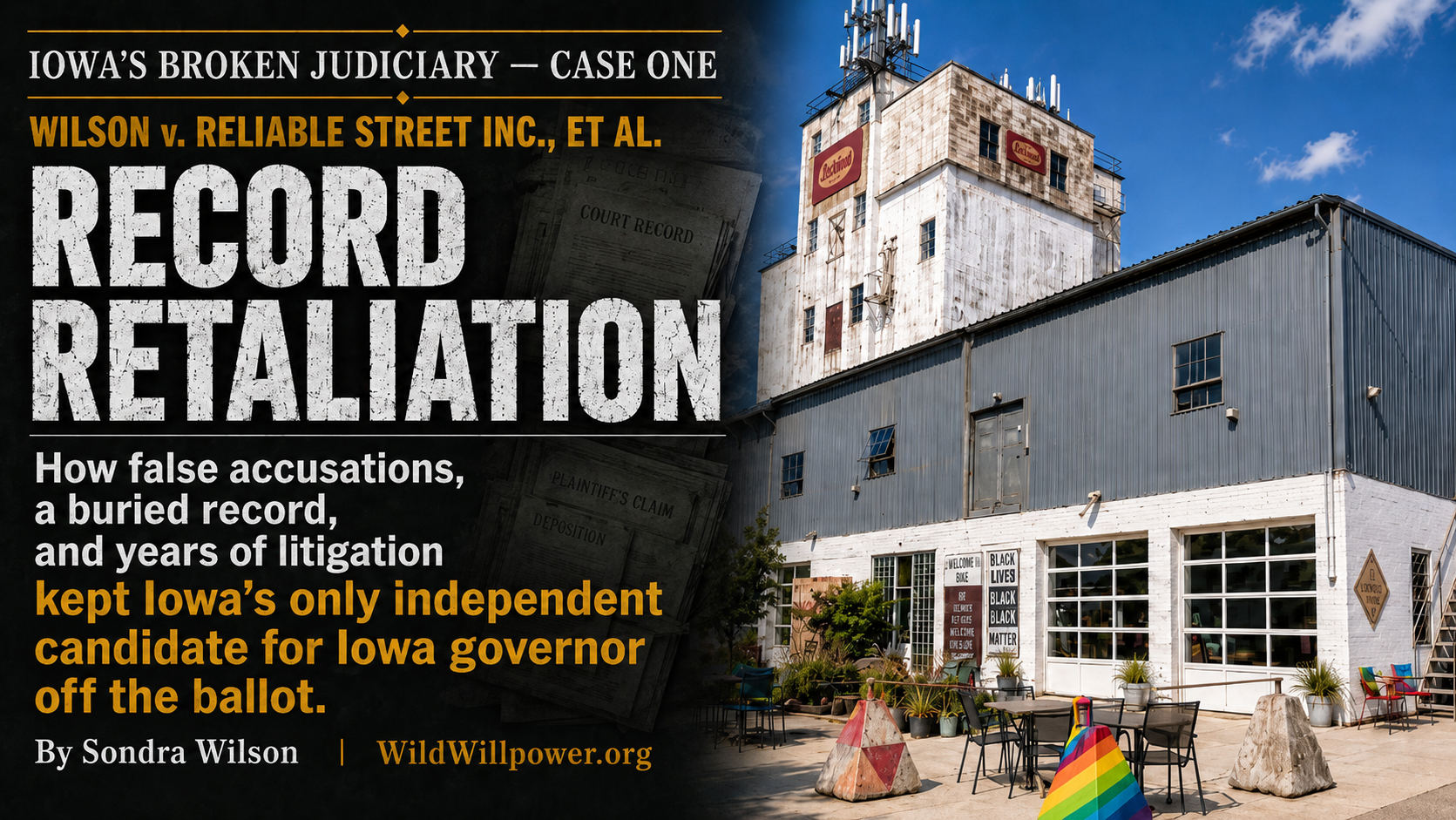
2. Record Retaliation:
The underlying factual dispute; what the contemporaneous record showed, what was later alleged about me, and how disputed documents entered the civil-rights record.
This installment reconstructs the events that led to the lawsuit itself.
After filing a complaint with the Iowa Civil Rights Commission in April 2022, that August the Commission sent me their Preliminary Case Review, which referenced—but did not show me—statements and text messages accusing me of stalking, harassment, racism, performing unauthorized work on the property, and other types of behavior which cast my reputation under a false light.
As an author and founder of Wild Willpower PAC, I was deeply concerned about how the defendants submissions—now lodged into a government record—might be used to attack my reputation and undermine my credibility in the future. This was not just about protecting my reputation, it was about protecting the legacy I have been working to build for years. In summary, they threatened my life's work.
Although the Commission's process withheld the defendants' actual submissions until late 2023, when I eventually received them, I saw firsthand how messages between myself and the defendants had been re-arranged and materially altered in a manner that effectively bolstered the false accusations against me that were included in the statements that were sent to the Commission.
I had no choice: either file suit to clear prove they had modified the documents, and show the court records I possessed which could prove their statements were false, or wait until these records became public in the future.
I will be adding the evidentiary record into this article before August 14. I am running for Governor, and I cannot afford to have doubt cast onto my character form this. I am attempting to clear my name still, and throughout this process have become extremely disappointed in Iowa's court system. My experiences documented throughout this series directly led to the justice reforms that are included in my gubernatorial platform.
This article explains what I was trying to clear my name from—and why simply abandoning the dispute was not a realistic option.
Click the image to learn what happened after I filed the lawsuit.
3. Procedural Bombardment:
How the defendants flooded the record with filings and persuaded the court to transfer the case to Story County, predicating their reasoning upon incorrect application of law.
This installment follows the opening months of Wilson v. Reliable Street, when my original petition was met with overlapping challenges involving venue, service, pleading sufficiency, dismissal, recasting, and other procedural demands while I was studying abroad.
I filed a motion to recuse because Judge Gronewald, who was assigned to this case, was also assigned to Wilson v. State of Iowa and Kim Reynolds for Iowa. This was important because Kim Reynolds appointed Judge Gronewald, and she and her husband are on record for donating to Republicans for years. This is important because I was very concerned about bias: Republicans, at the time, were already on record for performing acts of defamation per quod and rights violations against transgender Iowans for years—facts I explicitly pled in Wilson v. State of Iowa and Kim Reynolds for Iowa. I cited Iowa Code of Judicial Conduct, Rule 51:2.11, which states that:
"A judge shall disqualify himself or herself in any proceeding in which the judge's impartiality might reasonably be questioned."
The same day, she denied my motion and granted defendants' venue transfer to Story County. There is much more to this phase of the proceedings which further complicated the record and placed undue burdens upon me, however much of that record became compressed into a single PDF that the incoming Judge Currie would then have to parse through.
This part of the proceedings also adversely impacted my semester at DMACC: much of my timer during the London Abroad experience was consumed in trying to keep up with the procedural flooding, and misframing of the factual record by carrying the original defamatory statements I sued for, into the proceedings.
This is where the burden of litigating the case began expanding far beyond the underlying factual dispute, and instead turned into a constant burden for me to attempt to get the case back on track, while defendants continued to move the case away from the underlying dispute, and instead toward urgent dismissal without discovery.
Click the below image to read what happened during this part of the proceedings.
4. Sudden Reversal:
The court invited evidence at the upcoming hearing, allowed time for me to organize it, withdrew the opportunity to present it, then dismissed all but one of my claims as factually insufficient.
This installment follows the case after transfer to Story County. It documents the court's initial invitation to present evidence and allowance of time for me to amend my petition to respond to the defendants' challenges filed in Polk County. The court also allowed time for me to organize a a substantial exhibit record to prepare for the hearing.
After I filed my petition, which included named exhibits I informed the court I intended to present, Judge Currie instead ordered that no evidence could be presented at the forthcoming hearing.
Shortly thereafter, she dismissed my claims with prejudice, citing Rucker v. Taylor as the reason none of the exhibits were considered when evaluating the case.
This article helps explain why a substantial evidentiary record existed but was never developed through the ordinary discovery-and-trial process, and how the court's "sudden reversal" significantly compounded litigation burdens for me.
I firmly believe that my due process rights were violated by the dismissal of my claims.
Although I intended to file a motion to reconsider and an amended petition which included the exhibits the court did not consider, instead I agreed to enter confidential settlement negotiations with the defendants, on the condition that my response deadlines would be extended.
We will get into how that opportunity became foreclosed by an increasingly complicated record which continually moved the case away from the original factual dispute.
Click the below image to read what happened during this part of the proceedings.
5. Plausible Deniability:
How the increasingly fragmented record, coupled with a third Judge now overseeing the case, enabled defendants to bring further confusion and misinformation into the court record.
Judge Currie had extended the deadlines for me to respond to the dismissed claims, however the incoming Judge Doyle did not appear to be knowledgeable about the complex record that had traveled across two courthouses and two different judges before she inherited the case.
So, as I have continually had to do since before the lawsuit was filed, I reconstructed the previous procedural record for Judge Doyle as best I could, while alerting the court that I would not be able to keep up with filings later into my semester at Iowa State University.
Because I had earned a two-year scholarship that paid for my tuition, I had to either attend full-time or drop out and lose the scholarship.
The court granted an additional deadline extension, however the time I would have been working on my filings, I was instead consumed in responding to continuing filings by the defendants which were misleading the court about the procedural record, and wrongly casting me into a false light using the same narrative they had used in their filings to the Iowa Civil Rights Commission—the same filings.
This installment examines competing descriptions of the procedural history before the new judge, and my repeated efforts to reconstruct the docket and show why the procedural chronology was materially different from the narrative being presented against me.
This part of the case documents the beginning of where the case had now completely drifted away from the underlying cause of action, and instead sharply toward a battle of setting the record straight.
Simultaneous Crisis
It was also during this semester that members of the Republican Party of Iowa, acting under color of law, willfully deprived transgender Iowans of our Medicaid rights via removing "gender identity" from the Iowa Civil Rights Act. This is important to understand, because the repeated attacks against our reputations and healthcare coverage are the exact reason I requested a protective order in Wilson v. State of Iowa and Kim Reynolds for Iowa.
Although I strongly contend that my claims ought not to have been dismissed—see the article Strain Out a Gnat or my Abolish Government Immunity Doctrines justice reform proposal for examples of the types of legal defenses that were deployed by the state and used to violate my due process rights—the fact that they were, and that the protective order was not granted, enabled Republicans to do this.
That was, in large part, what led me to file Wilson v. Trump, et al., in the U.S. Court's Southern District while this phase of Wilson v. Reliable Street Inc., et al. was ongoing. I requested emergency injunctive relief from the federal court to prevent the removal of gender identity from the Iowa Civil Rights Act from going into effect later that year—relief that was ultimately denied. Although my claims in Wilson v. Trump, et al. were dismissed with prejudice, to my knowledge the underlying facts were never examined, and due process was barred for reasons described in the Wilson v. Trump, et al. article. I am currently seeking counsel to assist in reviving that case, which I could not keep up with while the Reliable Street case remained ongoing.
This political and legal crisis was unfolding at the same time the pressure inside Wilson v. Reliable Street was intensifying. As I struggled to keep up with these overlapping cases, my academic obligations, and the loss of civil-rights and healthcare protections, I contend the defendants continued increasing procedural pressure while using the fragmented record to portray the resulting difficulties as delay or misconduct on my part. That convergence is essential to understanding what happened next.
Compounding the Crisis
The compounding pressure of trying to keep up with academic obligations, filing deadlines, and the mental and emotional pain and anguish caused by what was going on at the state and federal levels politically, coupled with my upcoming surgery getting cancelled and being unable to find help with this increasingly out-of-control case, eventually led to me dropping from two classes, and taking a reduced grade in a third. One of the primary factors is that, although I filed a motion to continue until after the semester was over, Judge Doyle nominally granted my motion, but instead set the deadline for April 29—immediately before finals.
This part of the case details how defendants gained advantage through the fragmented record and the continual transfer of judges, causing me to miss the assigned deadline for responding to my dismissed claims.
6. Dangerous Precedent:
IHow an Absolute-Privilege Ruling Expanded a Private Civil-Rights Dispute
Into a Public Issue—and Collided With My Campaign
By the beginning of 2026, I had finally reconstructed enough of the fragmented record to renew my challenge to Judge Currie's October 4, 2024 dismissals, present a more focused libel claim supported by documentary exhibits, and raise additional claims including abuse of process.
At the same time, the case entered a new phase that would substantially increase both its legal stakes and the demands on my time.
This installment documents the 2025–26 proceedings that collided directly with the crucial signature-gathering period of my campaign for Iowa Governor.
In December 2025, Judge Doyle set trial for October 2026. On January 2, she entered a schedule under which discovery—something the defendants and I had previously agreed should occur—was to begin in early March.
In early January, I filed an amended petition supported by hundreds of pages of exhibits. I asked the court to reconsider the earlier dismissals and alleged, among other things, that abuse of process by the defendants had contributed to my missing the spring 2025 deadline for responding to those dismissals. I also sought to add claims arising from events that had occurred since the original petition was filed.
The court did not accept that amended petition as filed and identified defects that I would need to cure before submitting another version.
Meanwhile, I served my first set of discovery requests in early March. Rather than proceeding into the discovery process I was seeking, the defendants moved for summary judgment and argued that their submissions to the Iowa Civil Rights Commission were protected by absolute privilege because the Commission proceedings should be treated as quasi-judicial.
That distinction became enormously important.
The defendants did not admit that they had knowingly submitted false information or altered documents. Their argument, as I understood and opposed it, was that the privilege would protect their Commission submissions from civil liability even if I could ultimately prove the wrongdoing I alleged.
I argued that the preliminary—or Tier One—phase of the Iowa Civil Rights Commission's process should not receive that kind of absolute protection. At that stage, I had no discovery procedure through which to examine the respondents' submissions, no opportunity to cross-examine anyone, and no adjudicative hearing resembling an ordinary judicial proceeding.
When a Private Dispute Became a Public Civil-Rights Issue
That argument changed the significance of the case.
What had begun as a dispute over what I contend were false allegations and materially altered or misleadingly presented records was now raising a much broader question: what remedy does a civil-rights complainant have if materially false information is submitted against her during the preliminary administrative process and those submissions are then treated as absolutely privileged?
On July 15, the district court accepted the defendants’ absolute-privilege argument and granted summary judgment on my remaining claim. On August 11, Judge Doyle denied my motion asking the court to reconsider or amend that ruling. I strongly disagree with the result and am now preparing to challenge it on appeal.
My concern is that an overly broad rule of absolute privilege at this preliminary administrative stage could leave future civil-rights complainants without an effective remedy when materially false submissions are made against them. Such submissions can create lasting reputational harm—affecting a person's employment, public standing, professional work, political activity, and even the legacy she is trying to build.
And that danger is not limited to transgender people or to me.
The Iowa Civil Rights Commission is a taxpayer-funded institution intended to receive and process complaints alleging discrimination. People who turn to that system can include women, people of color, people with disabilities, religious minorities, LGBT people, and others protected by Iowa civil-rights law.
If the process permits damaging allegations to enter government records while giving the complainant little meaningful opportunity at that stage to test those allegations—and the resulting submissions are then absolutely protected from civil liability—the public has reason to ask whether the system contains adequate safeguards for the very people who turn to it for protection.
If a taxpayer-funded civil-rights system can operate this way, is it protecting complainants—or exposing them to another form of harm?
There have also been multiple opportunities over the years for this particular dispute to be resolved without reaching this point. Instead, the parties maintained opposing positions, the litigation continued, and the dispute eventually expanded into questions of absolute privilege, civil-rights accountability, ballot access, and ultimately a statewide election.
How This Legal Fight Collided With My Campaign
At the same time these legal questions were developing, Iowa's June 2 ballot-access deadline was approaching.
My time was divided among four simultaneous demands:
1.) Attempting to amend my petition again to cure defects identified by the court;
2.) Preparing filings and hearings concerning why I believed discovery remained necessary;
3.) Gathering petition signatures and promoting my campaign before the June 2 deadline; and
4.) Researching and preparing filings opposing what I believed would establish a dangerous civil-rights precedent.
This was therefore not simply a situation in which I happened to be involved in an unrelated lawsuit while running for office.
I was simultaneously trying to protect my own legal rights, obtain discovery into the allegations I had been attempting to challenge for years, prevent what I believed would become a dangerous rule for future civil-rights complainants, and gather thousands of signatures necessary to reach Iowa's gubernatorial ballot.
The same litigation in which I was fighting that broader civil-rights question was consuming the time I needed to reach voters.
That is the collision at the center of Wilson v. Pate.
Click the image below to examine the record from this phase of the case.

7. Wilson v. Pate — the ballot-extension case:
And this brings us to the ballot access issue: the events documented in Dangerous Precedent, and the stakes in that case, forced me into litigation I could not have avoided since the outset, and which spun out-of-control after I filed the case in Polk County. At this time, I am continually updating the above articles and this one to prepare for upcoming filings as we await the Iowa Supreme Court's decision which I will announce on this page as soon as soon as possible. The due date for my Notice of Appeal for the Reliable Street case is August 14, so I will be preparing filings and these articles through that. time. Thank you for your support!
V. Why My Burden Was Not "Self-Created" —
Filing Wilson v. Reliable Street Inc., et al. Was Necessary to Clear My Name
Why I Went to Court in the First Place
What led to the first lawsuit was not a misunderstanding, a private disagreement, or litigation I casually chose to initiate. It was the placement of false, extremely damaging allegations into official records — allegations I believe threatened my safety, reputation, campaign, publications, and future work.
Before going to court, I tried to use the civil‑rights process Iowa provides to people who report discrimination. That process is supposed to investigate disputed facts and help resolve disputes without requiring people to file lawsuits.
That did not happen here.
Instead, my complaint was closed without investigation, while false and damaging allegations remained in government records. Litigation became the only available path to obtain discovery, expose what happened, and clear the record.
That is why I reject the Court’s characterization of this burden as “self‑created.” I did not file suit because I wanted litigation to consume my campaign. I filed because allowing false records to remain unchallenged during a statewide campaign was not a real option.
There was no third option.
The Litigation Collided With the Ballot-Access Window
Beginning in January 2026, the Reliable/Lockwood case required continuous filings, briefing, discovery work, exhibit preparation, legal research, and responses to motions. These obligations directly overlapped with Iowa’s narrow signature‑gathering window.
I was not represented by counsel. I was pro se. Every filing, exhibit, timeline, legal argument, discovery dispute, and hearing preparation fell entirely on me — while I was also a full‑time student and running a statewide campaign.
I announced my candidacy in March 2023 and filed the Reliable/Lockwood lawsuit in December 2023 to clear my name from false allegations lodged into the administrative record. I did not expect the case to drag on for years. But it did. By spring 2025, the litigation burden interfered with my college classes so severely that I had to choose between dropping classes or losing the case. I dropped the classes.
The case then carried into 2026, where hearings, filing deadlines, discovery disputes, and summary‑judgment pressure collided directly with the narrow window Iowa gives independent candidates to gather signatures. I needed 3,500 signatures by June 2. I was gathering signatures and building the campaign when the litigation burden collided directly with the ballot-access window.
The lawsuit I filed to clear my name collided with the ballot‑access window and ultimately derailed my campaign, keeping me off the November ballot. I asked the court for a limited extension of the deadline. The court denied that request in a ruling that did not appear to engage with the factual record at all.
The false-records dispute did not merely disrupt my life; it triggered a cascade of litigation obligations that consumed the very weeks Iowa law required for ballot access. A ballot‑access deadline cannot be treated as neutral when the State’s own administrative failures create conditions that make compliance impossible.
This collision was not accidental. It was the predictable consequence of false allegations entering government records and remaining uncorrected.
To understand why that litigation was unavoidable, readers must understand what false records can do during a campaign.
Why False Records Become Campaign Weapons
Some people may ask why I could not simply ignore the lawsuit and move on. This is why: false records become weapons during campaigns.
But this was never only about one campaign.
Long before I ran for Governor, I had founded Wild Willpower PAC. I had already spent years writing, organizing, building public platforms, and trying to create a legacy rooted in civil rights, public accountability, democratic participation, Indigenous knowledge, environmental restoration, and social repair.
The allegations lodged into the Iowa Civil Rights Commission’s records did not merely threaten a future ballot-access effort. They threatened my life’s work.
They threatened my reputation as an author, advocate, organizer, role model, and public figure. They threatened the credibility of Wild Willpower PAC and the broader work I have done to challenge corruption, institutional abuse, civil-rights violations, and systemic failures in Iowa.
They also threatened work that does not belong only to me.
As an author and organizer, I have worked alongside people whose lives and contributions matter, including Richard Lonewolf, Professor Frank Schiavo, Ashawna Hailey, Bill Hill, and others whose teachings, stories, advocacy, and reputations became connected to projects I helped carry forward. Some are still alive. Others are no longer here to defend the meaning of their work.
That matters deeply to me.
When false allegations enter administrative records, they do not damage only the person named in them. They can contaminate the public understanding of everything that person has built. They cast suspicion over organizations, books, political work, educational projects, cultural work, public advocacy, and the people associated with them.
If Wild Willpower PAC is discredited by a false official record, years—or even decades—of work can be undermined by allegations that were never properly adjudicated. The harm becomes larger than personal reputation. It becomes historical. It affects how that work is remembered, how collaborators are perceived, and whether future readers, researchers, voters, supporters, and institutions consider it credible.
Everything I had worked to build was placed at risk by allegations lodged into administrative records—and therefore preserved within the historical record.
That is why I could not simply “move on.”
Reporters, bloggers, campaigns, opposition researchers, attorneys, government actors, employers, institutions, researchers, and members of the public review court records, administrative records, regulatory filings, and other official documents. When false allegations appear in those materials, they become searchable, quotable, and easily weaponized.
Most people will not read the full exhibits. Most will not ask whether documents were modified, rearranged, selectively excerpted, or taken out of context. They will see the accusation and judge.
That danger becomes even greater during an election. Public records—including court filings, administrative summaries, affidavits, exhibits, institutional emails, and derivative filings—can shape public perception of candidates before any court reaches a final determination. A document is surfaced, quoted, clipped, shared, and amplified. By the time the truth catches up, the political and historical damage may already be done.
This is why confidentiality did not protect me. Even when an administrative file is technically confidential, the narrative inside it can escape through leaks, indirect references, public court filings, summaries, public-records requests, informal circulation, or strategic political use. Civil-rights proceedings often generate secondary records — motions, affidavits, timelines, exhibits, emails, and summaries — that may not remain confidential once they appear elsewhere. Once a respondent repeats, paraphrases, or incorporates allegations from a confidential administrative file into a public filing, the confidentiality barrier begins to collapse.
Confidentiality also creates a one-sided danger. It can prevent the injured person from fully correcting the record publicly while still allowing the false narrative to circulate. A respondent can imply allegations outside the administrative process. A political opponent can hint at “concerns.” A journalist can reference derivative filings. A leak can circulate privately before becoming public. But the person harmed by the false allegations may be restricted from releasing the underlying evidence needed to rebut them. That asymmetry magnifies reputational harm. It does not prevent it.
If a public or semi-public record says a transgender woman, author, organizer, Wild Willpower PAC founder, and candidate for Governor stalked or harassed a female employee, the harm is immediate and severe. That harm is not hypothetical. It is foreseeable. As a transgender woman in a hostile political environment, I knew that false allegations of this kind could be misused to discredit me, dehumanize me, and undermine my campaign before voters ever reached the issues.
That is why I could not simply “move on.” Moving on would have meant allowing false-record allegations to remain unchallenged during a statewide campaign, available to be found, quoted, leaked, summarized, circulated, or used against my campaign and my life’s work. I was not willing to let that happen.
These unresolved records created the conditions that made litigation unavoidable. And that litigation consumed the very weeks Iowa law required for ballot access.
Recent Election Examples Show the Danger
This danger is not theoretical. In this election cycle, public records and allegations have already shaped public narratives around candidates.
One example occurred when Bleeding Heartland discussed court documents involving gubernatorial candidate Zach Lahn’s running mate, Derek Wulf, in a widely shared video. The reporting relied on court filings, not mere rumor. That is how campaign narratives form: a document is surfaced, quoted, and amplified before most voters have any realistic ability to evaluate the full record.
Another example is the allegation reported by CNN involving Maine candidate Graham Platner, who was accused of rape — an allegation he denies. Regardless of the final outcome, the existence of the allegation immediately became part of the political conversation. Voters, journalists, and opponents reacted to the record and the accusation before any final adjudication.
These examples show why unresolved allegations in official records cannot be treated as harmless during a campaign. Once a damaging narrative becomes attached to a candidate, the accusation itself can become the story.
That is the environment in which my ballot-access case unfolded.
VI. Interference With My Campaign
Became Interference With the Election
Why the Court's Denial Was Harmful
The court’s denial of my request for a limited extension did not simply maintain a deadline. It had the effect of deciding the election before voters ever had the chance to participate. The ruling did not appear to engage with the factual record I had submitted — including the litigation burdens, the mandatory nature of the deadlines, the public‑record harm, or the evidence showing that the Reliable/Lockwood case was not a voluntary personal project but a necessary effort to clear my name.
By treating the litigation burden as “self‑created,” the court effectively held that a candidate must absorb any amount of administrative or judicial harm — even when that harm arises from false records, altered documents, or unresolved allegations lodged into government files. The ruling rewarded interference, ignored the extraordinary circumstances, and left me without any meaningful path to comply with Iowa’s June 2 deadline.
A ballot‑access deadline cannot be treated as neutral when the State’s own administrative failures create the conditions that make compliance impossible. The denial did not preserve election integrity. It undermined it.
How Interference With a Campaign Became Interference With the Election
Election interference does not have to begin at the ballot box. When interference with a campaign prevents a candidate from reaching the ballot, it becomes interference with the election itself.
That is what happened here.
False public-record allegations, modified and out-of-context documents, unresolved administrative harm, overlapping court deadlines, discovery disputes, summary-judgment pressure, hearing preparation, and denied equitable relief combined to remove an independent transgender candidate from the ballot before voters could decide.
The result was not merely personal harm to me. Voters lost a choice.
I am not claiming every person involved shared the same private political intent. The point is the practical effect. A campaign can be derailed by process, delay, reputational threat, litigation burden, and institutional failure just as surely as it can be derailed by someone tearing up petitions or blocking access to voters.
That is how this kind of interference works. It often does not look dramatic from the outside. It can look like records being distorted, allegations being lodged into official files, years of self-representation, procedural burdens, hearings, briefing deadlines, discovery fights, and then a court treating the burden of defending oneself as if it were merely a voluntary scheduling conflict.
When that chain of events keeps a candidate off the ballot, the election has been affected. Voters are denied the opportunity to consider that candidate, the public debate is narrowed, and the statutory process becomes a barrier rather than a fair pathway to participation.
That is not a fair election environment.
The Political Environment That Made This Possible
The ballot‑access interference I experienced did not occur in isolation. It unfolded within a political environment where transgender Iowans had already lost fundamental protections. In 2025, Republican officials removed gender identity from the Iowa Civil Rights Act, eliminating state‑level protections in housing, employment, public accommodations, education, credit practices, and other areas of public life. Medicaid coverage for gender‑affirming care was also restricted, forcing low‑income transgender Iowans — including me — to postpone or cancel medically necessary treatment.
I am one of the people directly affected by these policies. My medical care has been delayed and canceled multiple times. My civil‑rights protections have been stripped away. My ability to work safely in Iowa has been undermined. And when I attempted to run for Governor as an independent candidate to challenge this system directly, I was not given a fair chance to reach the ballot.
The Republican option represents a party that has actively targeted transgender Iowans, stripped our civil‑rights protections, restricted Medicaid‑related care, and fueled rhetoric that makes our lives more dangerous. But the Democratic option does not resolve the problem either. When transgender issues became politically unpopular, they fell off the party’s platform priorities. And some of the party’s positions — particularly regarding minors and sports — helped create the wedge issue that ultimately led to the collapse of legal protections and healthcare for transgender adults in Iowa.
Transgender Iowans are not represented in Iowa’s political system right now. Democrats focus heavily on working‑class issues, but for many transgender Iowans, it is not safe to work. We are living without enforceable civil‑rights protections, without reliable access to medically necessary care, and without meaningful political representation.
Why the Democratic Silence Matters
This is why the Democratic silence matters.
VII. Why I Am Appealing —
and What Is at Stake for Future Elections
My appeal has two goals.
1. Restore a Path to the Ballot
Iowa voters deserve the opportunity to consider every candidate, especially where extraordinary circumstances interfered with the statutory process and where the requested relief was narrow: more time to gather the same signatures required of everyone else.
Political sabotage — or even the reasonable possibility of campaign interference — should not be rewarded by allowing the interference to succeed.
I am not the only gubernatorial candidate seeking relief related to ballot access. Nicholas Gluba and Jules Cutler also sought court intervention.
2. Establish a Precedent to Protect Future Candidates and Voters
When there is evidence or a reasonable inference of campaign interference — including defamation, administrative misconduct, altered documents, misleading submissions, or false allegations lodged into government records — courts should not automatically treat a candidate’s effort to clear her name as a voluntary personal choice.
They should look deeper.
They should ask why the lawsuit was filed. They should ask what was at stake. They should ask whether the litigation burden was mandatory. They should ask whether the candidate acted diligently. And they should ask whether a narrow equitable extension would protect voters’ ability to consider an independent candidate without undermining election administration.
If the Iowa Supreme Court reaches the merits, I hope this case helps establish a precedent ensuring that future candidates are not knocked off the ballot through extraordinary interference without meaningful judicial review.
VIII. From Administrative and Judicial Failure
to Democratic Reform
The Larger Irony
Two facts make this outcome especially ironic:
1. I am a transgender woman fighting a civil‑rights case pro se in a state that recently removed gender identity from the Iowa Civil Rights Act — and it was the state's own administrative failure that led to the lawsuit, and the state court that denied relief when the case interfered with my campaign.
2. I am the only gubernatorial candidate running with a comprehensive plan to make our courts more accessible and just — and yet, it was burdens imposed by our judicial system that knocked me off the ballot.
When Judicial Failure Interfered With Democratic Reform
I did not develop these reforms from a distance. I developed them while attempting to navigate the very system they are intended to repair.
I ran for Governor because Iowa does not have to accept inaccessible courts, unaffordable legal representation, professionally insulated procedures, sweeping immunity doctrines, and a public education system that sends young people into adulthood without the practical legal knowledge needed to protect themselves.
But bringing those reforms before Iowa voters required qualifying for the ballot. As an independent candidate, I was required to collect thousands of signatures during a narrow statutory period.
During that same period, Wilson v. Reliable Street Inc., et al. imposed repeated hearings, filing deadlines, discovery obligations, exhibit preparation, and legal research. I was representing myself. The litigation had arisen from my effort to challenge false accusations and misleadingly presented materials placed into an Iowa civil-rights record—materials I could not responsibly leave unresolved while running for statewide office.
When those mandatory litigation burdens collided with Iowa’s ballot-access deadline, I asked the court for limited equitable relief. I did not ask to avoid the signature requirement. I asked for additional time to collect the same number of signatures required by law.
The court denied that request and characterized the litigation burden as “self-created” because I had initiated the underlying case.
That reasoning exposes the democratic stakes of everything documented on this page. A citizen may be forced to enter an inaccessible legal system to protect her rights and reputation. The system may then consume the time and resources required for political participation. And when she seeks limited relief from that collision, the burden may be treated as nothing more than the consequence of her own decision to seek justice.
The result was larger than one missed deadline. Iowa voters were denied the opportunity to decide whether they wanted the justice reforms described throughout this website—or the broader governing platform of which those reforms were a part.
The practical loss is also visible in the campaign infrastructure that had already been built. I have a closet full of campaign shirts, along with posters, banners, yard signs, business cards, fliers, stickers, and other materials prepared for a statewide race. If I am ultimately kept off the ballot, much of that work and expense will never be used for the purpose for which it was created. Those materials are another reminder that this was not a hypothetical candidacy or a last-minute idea—it was an organized campaign that had already been put into motion.

This is only a small sample of the campaign materials I invested in for the 2026 race. With a very limited budget, I purchased multiple colors of men's and women's shirts, posters, yard signs, banners, business cards, fliers, and other materials while much of my time over the past several years was already being consumed by casework and school. If I remain off the ballot, much of what I sacrificed to build this campaign will now sit unused instead of reaching the Iowa voters it was created to reach.
The practical consequence extends beyond my exclusion as a candidate. These ideas—including public legal education, scrutiny of immunity doctrines, accountability for governmental rights violations, and protection against the use of religious majorities to remove minority rights—may now be absent from Iowa’s gubernatorial debates. Voters may hear only the more comfortable range of positions presented by the two major-party candidates unless the Iowa Supreme Court grants relief in Wilson v. Pate.
I am not alleging that every person involved formed an express agreement to censor these ideas. But Iowans know the familiar expression: if it looks like a duck and quacks like a duck...
Whatever label is placed upon the result, its democratic effect is the same: a candidate developed a distinct reform platform, mandatory court proceedings consumed the period available to qualify for the ballot, limited relief was denied, and the resulting debates may proceed without those reforms or the candidate advancing them.
Formal censorship is not the only way a political perspective can disappear from public consideration. Institutions can produce the same practical exclusion through burdens, deadlines, inaccessible procedures, and the denial of any meaningful remedy when those forces collide.
That is why this appeal concerns more than my individual candidacy. It concerns whether Iowa voters will receive the full range of ideas that a serious independent candidate attempted to place before them.
They were denied a full opportunity to consider the Civilian Restoration Corps, which would create tens of thousands of jobs rebuilding Iowa’s infrastructure and restoring its communities; the New Iowa Healthcare Compact, which would establish dependable access to essential healthcare; and Upskilling Iowa, an education plan that would bring innovative classes and practical programs into Iowa’s schools to strengthen the knowledge, skills, character, and well-being of future generations.
The opportunity to restore that democratic choice is not gone. That lost opportunity lies at the heart of Wilson v. Pate.
Why I Am Proceeding Under Protest
I am proceeding under protest.
That means I do not concede the legitimacy of a political system that strips civil‑rights protections from transgender people, cuts off medically necessary care, allows false public‑record allegations to threaten an independent candidacy, and then refuses to recognize the combined burden as a ballot‑access problem.
My campaign is shifting from candidacy to the courts.
I will continue appealing the ballot‑access ruling. I will continue pursuing the Reliable/Lockwood case to clear my name. I will continue seeking discovery, accountability, and adjudication of the truth or falsity of the allegations placed into the administrative and judicial record. I will continue preparing legal action concerning civil‑rights violations, color‑of‑law crimes, and state and federal law violations affecting transgender Iowans. I will continue calling for restitution for people whose rights have been violated, and whose medical care have been taken away.
What I Want Iowans to Understand
What I want Iowans to understand is that what happened to my campaign is only one symptom of a much larger problem. The ballot‑access interference was not an isolated event — it was part of a broader pattern in which civil‑rights protections, Medicaid rights, due‑process guarantees, and accountability laws are quietly becoming unenforceable for ordinary people. When systems fail at this scale, the harm does not stop with one candidate or one case. It affects every Iowan whose rights depend on laws that are supposed to protect them.
Iowans deserve a government where civil‑rights complaints are investigated, not ignored; where Medicaid rights are honored, not obstructed; where officials who violate the law under color of authority are held accountable, not shielded; and where ordinary citizens can seek redress without being buried under procedural traps that prevent cases from ever reaching the merits. You deserve systems that work for you — not only for those with institutional backing, political connections, or donor‑class resources.
I also want Iowans to understand that this work is not about abstract policy debates. It is about lived harm. My medically necessary care was canceled multiple times. My civil‑rights protections were stripped away. False records were placed into government files. And when I tried to enforce the laws that already exist, I discovered how easily a case can be deflected, delayed, or dismissed before any court ever addresses the truth. Many Iowans have experienced similar failures — quietly, without media coverage, and without meaningful recourse.
That is why this series exists. It is designed to teach the public how enforcement is supposed to work, how it is failing, and what tools of redress still remain. Each linked article breaks down a different part of the record: the ballot‑access interference, the civil‑rights case, the Medicaid‑rights violations, the color‑of‑law issues, and the structural barriers that prevent accountability. Together, they form a map — a way for ordinary Iowans to understand the laws that protect them and the remedies they are still entitled to pursue.
This is not just my story. It is a case study in how rights can be lost when enforcement collapses. And it is an invitation for Iowans to learn the law, understand the record, and stand together in demanding systems that tell the truth, protect the vulnerable, and uphold the rights that belong to all of us.
This article explains how my ballot-access campaign was forced off the ballot. But it does not end the campaign.
This page will continue to be updated as the appeal in Wilson v. Pate moves forward. I am appealing because Iowa voters deserved the opportunity to consider my candidacy, and because future candidates should not be knocked off the ballot when false records, administrative failure, mandatory litigation burdens, and procedural deadlines combine to make ballot access impossible.
The Reliable/Lockwood civil-rights case has now reached a district-court disposition and is moving toward appeal. On July 15, 2026, the district court denied my renewed request to file the Revised Second Amended Petition and later that day granted summary judgment, dismissing the remaining action with prejudice. I am now completing the documentary record and preparing to appeal those rulings.
That case remains essential to understanding Wilson v. Pate. The litigation burden that collided with my signature-gathering period did not arise from one isolated filing or hearing. It developed from years of attempting to reconstruct disputed civil-rights records, answer repeated procedural challenges, obtain discovery, reorganize a fragmented docket, and respond to arguments that ultimately culminated in an absolute-privilege ruling. The Reliable Street series documents that history in chronological order and shows why I contend the burden cannot fairly be reduced to litigation I simply “chose” to pursue.
The Question Now Belongs to Iowa
Wilson v. Pate is the point at which the institutional failures documented throughout this series crossed from the courthouse into the electoral process.
The question is no longer only whether one self-represented litigant received a fair opportunity to present her case. It is whether years of litigation burdens can consume the period in which an independent candidate must qualify for the ballot—and whether voters can then lose the opportunity to consider that candidate and the ideas she was attempting to place before them.
That is why the stakes extend beyond this lawsuit.
My experiences with Iowa's civil-rights and judicial systems directly helped shape Wild Willpower's Justice Reform Plan: practical legal education, greater access to justice, meaningful governmental accountability, stronger protections for the attorney-client relationship, and reforms designed to make the courts navigable by ordinary people.
But justice reform is only one part of what I was trying to bring before Iowa voters.
My We the People Platform presents a broader plan for Iowa's future—covering infrastructure and economic development, education, healthcare, and justice. It includes proposals such as the Civilian Restoration Corps, Upskilling Iowa, a new healthcare compact, and comprehensive reforms to institutions that I believe are no longer serving Iowans as they should.
Those are ideas Iowa voters should have been allowed to consider for themselves.
I am therefore continuing to pursue Wilson v. Pate, while also completing the documentary record in Wilson v. Reliable Street Inc., et al. and the larger Iowa's Broken Judiciary series. The electoral path may presently be blocked, but the work of documenting what happened, pursuing legal remedies, and presenting a different vision for Iowa continues.
Help Bring This Record to a Wider Audience
Much of what is documented on this page has developed in public court records, but the larger story has received very little outside attention. To date, I am not aware of any news organization having published an in-depth report examining the full sequence documented here—from the underlying civil-rights litigation, to the nine court obligations that collided with my signature-gathering period, to the ballot-access case now before the Iowa Supreme Court.
If you believe this record deserves independent examination, one meaningful way to help is simply to share this article with people and organizations that may be willing to investigate it: Iowa and national newsrooms, civil-rights organizations, election-law attorneys, bar and legal organizations, voting-rights groups, organizations such as the NAACP, public-interest law organizations, podcasts, radio programs, talk shows, and other journalists or advocates concerned with ballot access, civil rights, judicial accountability, or independent political participation.
You do not have to adopt my conclusions to ask someone to examine the record. I have linked the underlying filings, court orders, cases, and documentary materials throughout this page so that journalists, attorneys, organizations, and members of the public can evaluate them for themselves.
If you know someone who should see this, please send them this page.
To Everyone Who Has Stood With Me
I also want to thank the people who have continued supporting me during an extraordinarily difficult period.
This campaign has unfolded alongside years of litigation, enormous amounts of legal research and writing, disrupted education and medical care, financial strain, and the continued effort to reconstruct a record that became far more complicated than I ever expected when these cases began.
Your messages, encouragement, conversations, signatures, volunteer efforts, willingness to read these long records, and simple acts of kindness have mattered more than I can adequately express.
Thank you for continuing to believe that these issues are worth examining, these reforms are worth discussing, and Iowa's future is worth fighting for.
The next chapters of the record are now being completed.
Continue with the Iowa's Broken Judiciary series, explore Wild Willpower's Justice Reform Plan, or read my full We the People Platform.
Click the below image to read the Iowa's Broken Judiciary series.
Click the below image to read the justice reform section of my platform.

Click the below image to read my full plan. Some sections of the platform will continue to be expanded as time permits. I remain hopeful that the Iowa Supreme Court will preserve a lawful path for me to complete Iowa’s ballot-access requirements so that voters can decide for themselves whether this plan deserves their support.

Bibliography
Bleeding Heartland. Video discussing court documents involving gubernatorial candidate Zach Lahn’s running mate, Derek Wulf. Facebook Reel, published 2026. URL: https://www.facebook.com/reel/1039085135211031 (Accessed July 7, 2026.)
CNN. “Woman alleges Graham Platner raped her; Maine candidate denies accusation.” CNN Politics, July 6, 2026. URL: https://www.cnn.com/2026/07/06/us/graham-platner-racicot-allegation-maine-invs (Accessed July 7, 2026.)