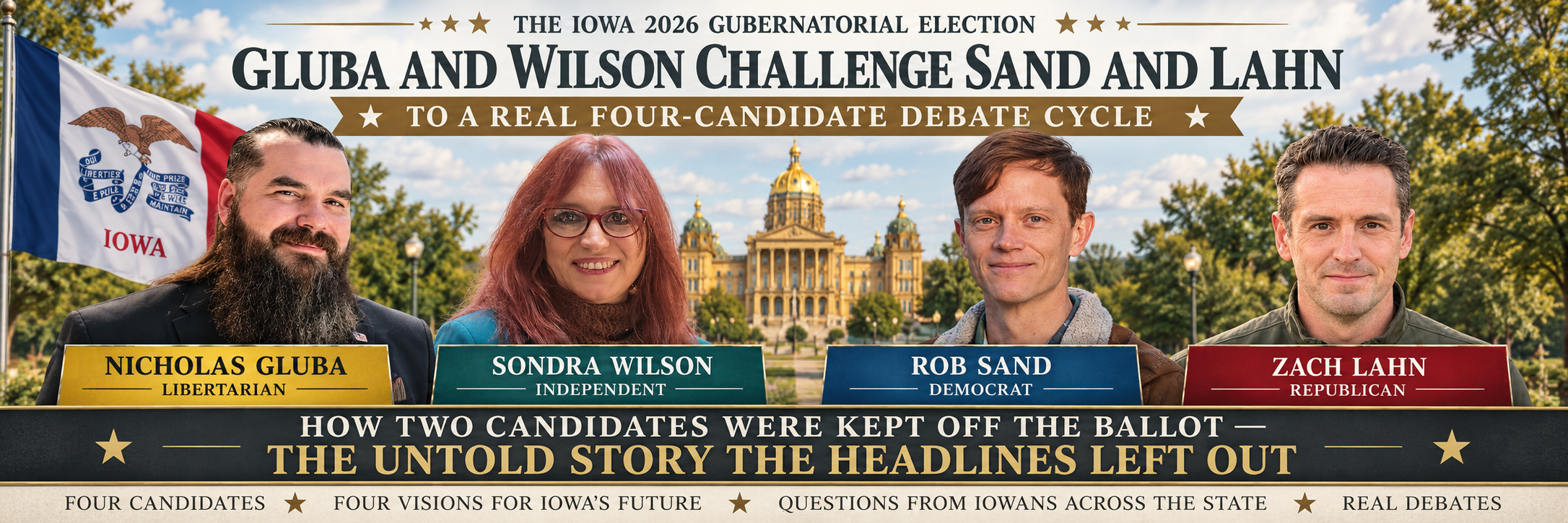
Behind the Headlines:
How Nicholas Gluba Was Kept Off the 2026 Gubernatorial Ballot
Updated September 15, 2026
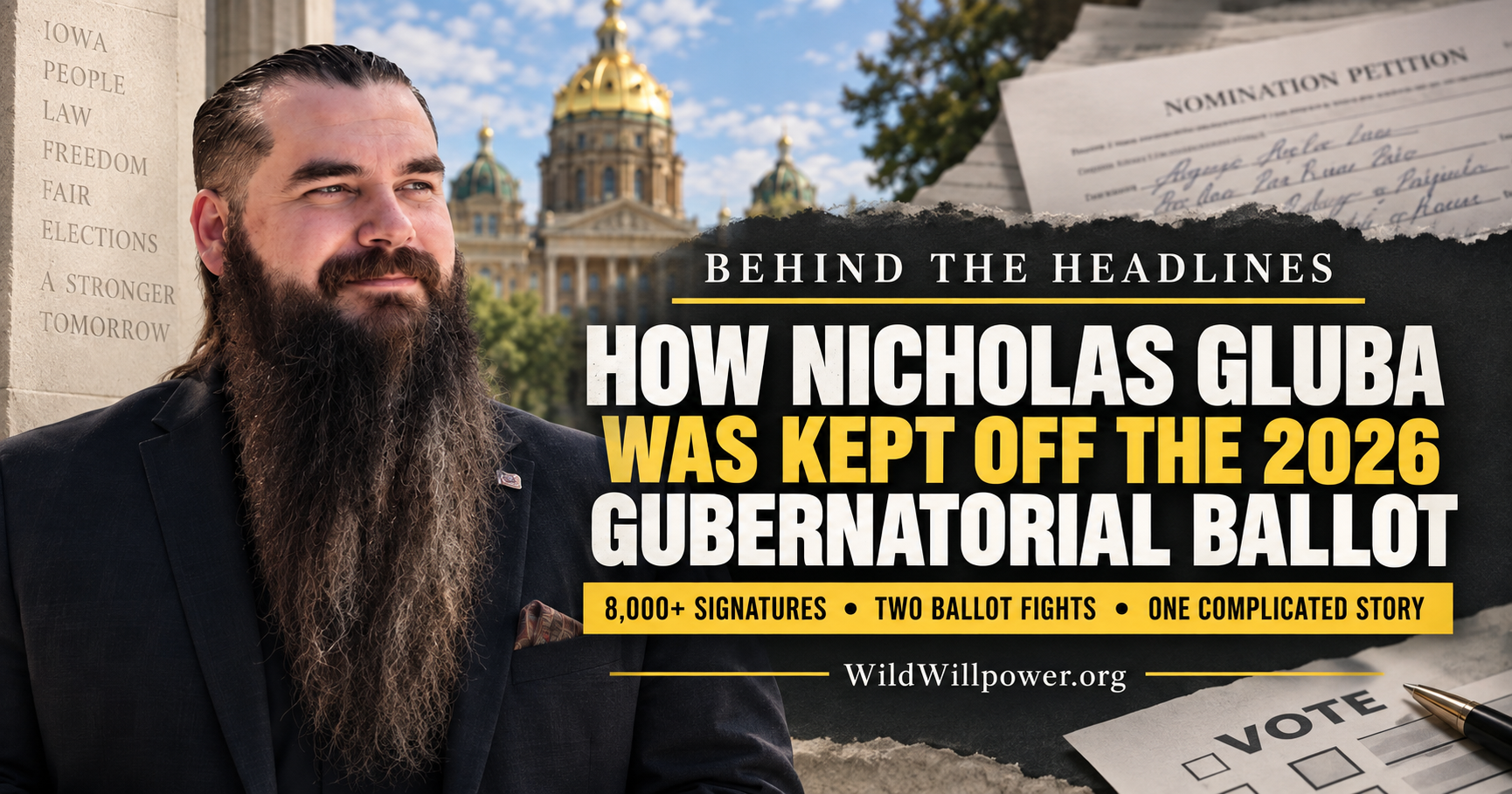
Nicholas Gluba did not come close to missing Iowa's signature requirement for governor.
After the Libertarian Party of Iowa lost major-party status following the 2024 election, its 2026 candidates could no longer rely on the caucus-and-convention nomination process available to recognized political parties. Gluba therefore had to qualify through nomination petitions. Iowa required 3,500 signatures for a statewide candidate. According to Gluba's campaign and contemporary reporting, he submitted more than 8,000—more than twice the statutory minimum. [1]
The Iowa Secretary of State's candidate list, published immediately after the June 2 filing deadline, initially listed Nicholas Gluba as the Libertarian candidate for governor and showed that his papers had been filed on June 2. [2]
Yet less than two weeks later, Gluba and his running mate, Jules Cutler, were removed from the November ballot.
The reason was not that Gluba lacked signatures.
It was not that thousands of his signatures had been invalidated.
And it was not a finding that Gluba himself was legally ineligible to serve as governor.
Instead, the ticket was removed because the State Objection Panel concluded that Cutler's separate affidavit of candidacy for lieutenant governor had not been filed by the June 2 deadline. [3]
That sounds simple. What happened inside the Secretary of State's office was not.
I. The Missing Affidavit:
Two Conflicting Accounts of What Happened
Cutler maintained that she had the affidavit with her when she accompanied Gluba to the Secretary of State's office on June 2. According to Cutler and attorney Jacob Heard, Cutler attempted to submit it to elections support specialist Dani Phillips but was told that the affidavit was "not needed" for the lieutenant-governor candidate. [4]
Phillips disputed that account.
At the June 15 State Objection Panel hearing, Phillips said Cutler had not offered her an affidavit and that Phillips had not told Cutler the document was unnecessary. But Phillips also testified that she could not remember whether Cutler had even been present when Gluba submitted the campaign's nomination materials. [5]
That conflict became the central factual question in the case.
Cutler also complained that she had not been provided surveillance footage from the Secretary of State's office lobby that she believed could at least have established her presence during the filing. [6]
The panel nevertheless accepted the objection and unanimously removed the Gluba-Cutler ticket from the ballot. [7]
Because Democratic State Auditor Rob Sand was himself running against Gluba for governor, Sand appropriately recused himself from deciding Gluba's challenge. Iowa Secretary of Agriculture Mike Naig replaced him on the three-member panel, joining Secretary of State Paul Pate and Attorney General Brenna Bird. [8]
That meant Sand—who two years earlier had voted against removing Gluba from the ballot—did not participate in the 2026 decision.
The Court Later Said the Evidence Was Essentially Even
Gluba and Cutler did not simply accept the panel's ruling. On June 23, they filed a petition for judicial review in Polk County District Court seeking reinstatement to the November ballot. [9]
The litigation produced an important detail that was easy to miss in shorter news coverage.
After an evidentiary hearing, District Judge Joseph Seidlin did not fully endorse the State Objection Panel's factual determination about the affidavit.
Instead, he wrote:
“The court disagrees with the Panel's finding that Cutler never offered and Phillips never declined or refused to receive Cutler's affidavit of candidacy.” [10]
The judge described the evidence as being, “at best,” in equipoise—legal terminology meaning essentially evenly balanced. [11]
That is an important distinction.
The court did not find that Cutler's account had been disproven. Nor did it find that Phillips's version was unquestionably correct.
Rather, Judge Seidlin concluded that enough evidence existed in the administrative record to support the panel's decision under the deferential standard governing judicial review. He explained that Phillips had unequivocally denied being offered the affidavit and that her job was ordinarily to receive and process election filings. Because of that standard, he concluded that the court could not simply replace the panel's factual findings with its own—even though he himself viewed the evidence differently. [12]
The distinction is subtle but consequential:
Gluba remained off the ballot not because a court affirmatively determined that Cutler never tried to file the affidavit, but because the court concluded there was legally sufficient evidence supporting the administrative panel's finding and that the court was not free to substitute its own finding.
Could Gluba Have Replaced His Running Mate? They Tried.
There was another unresolved question.
Gluba and the Libertarian Party argued that even if Cutler could not remain on the ticket, Gluba should be permitted to nominate a replacement lieutenant governor rather than lose his own place on the ballot. [13]
Judge Seidlin did not decide that question on the merits. He wrote that filling a vacancy was distinct from the objection proceeding before him and that the court should not issue an advisory opinion about a matter that was not properly before it.[14]
Thus, another important nuance disappeared in the shorthand description that "Gluba failed to qualify."
The litigation did not produce a judicial determination that Nicholas Gluba himself lacked enough voter support, signatures, qualifications, or a valid gubernatorial candidacy apart from the dispute involving his running mate's affidavit.
Gluba had gathered more than twice the required signatures. [15]
The obstacle was the paperwork controversy surrounding the lieutenant-governor candidate.
At that point, however, the question did not remain hypothetical.
After Cutler withdrew, the Libertarian Party of Iowa's State Central Committee met on August 12 and selected Charles Aldrich as Gluba's replacement lieutenant-governor candidate. Aldrich was no stranger to Iowa ballot-access disputes: he had been the Libertarian candidate for Iowa's 4th Congressional District in 2024 and was one of the three candidates removed from that year's ballot alongside Gluba and Marco Battaglia. [16]
The party believed Iowa law permitted it to fill the vacancy. Secretary of State Paul Pate disagreed. He argued that because Gluba and Cutler had qualified through nomination petitions rather than through a party convention, the Libertarian Party could not simply use the ordinary party-vacancy procedure without first complying with Iowa's separate statutory requirements governing how a party would fill such vacancies. The State argued that the party had not complied with the statutory requirements governing how a political organization establishes and uses procedures for filling candidate vacancies. [17]
On August 27, Judge Joseph Seidlin agreed that the party had not followed the statutory procedure necessary to substitute Aldrich onto the ticket. [18]
Seidlin wrote that the court took “no joy” in the result as it concerned either the Libertarian Party or Iowa voters, but concluded that Iowa Supreme Court precedent required strict compliance with election statutes. The attempted substitution therefore failed. [19]
While that dispute remained pending, Gluba continued publicly campaigning with Aldrich as his running mate. On August 20, he appeared at the Des Moines Register Political Soapbox at the Iowa State Fair with Charles Aldrich as his running mate and told reporters he was “very confident” Libertarian candidates would ultimately appear on the November ballot. He used the appearance to discuss election integrity, property taxes, eminent domain, education, and water quality. [20]
The result was striking: Gluba had gathered more than 8,000 signatures; his original ticket had been removed over a disputed filing interaction involving Cutler's affidavit; Cutler later withdrew; and when the Libertarian Party attempted to substitute Charles Aldrich, that effort was rejected on a separate procedural ground.
The August ruling therefore did not revisit whether Cutler had attempted to submit her affidavit. It concerned a different question altogether: whether the Libertarian Party had complied with Iowa law when it attempted to fill the resulting vacancy with Aldrich.
II. In a Separate 2024 Election Controversy,
Rob Sand Voted to Keep Gluba on the Ballot
The 2026 dispute becomes more significant when viewed against what happened to Gluba only two years earlier.
In 2024, Gluba was the Libertarian candidate for Congress in Iowa's First Congressional District. The Libertarian Party at that time had major-party status in Iowa, which allowed it to nominate candidates through the caucus-and-convention process rather than requiring every candidate to gather general-election petition signatures.[21]
The party held its precinct caucuses and county conventions on January 15, 2024.
In their later Supreme Court brief, the Libertarian candidates described the county conventions as having occurred just 181 minutes too early—a characterization meant to emphasize that the dispute turned on when the newly elected delegates' statutory terms officially began, not on whether the party had waited days or weeks to hold its conventions.[22]
That created the problem.
Iowa Code provided that the terms of county-convention delegates began the day after their election at the precinct caucuses. Because the Libertarians conducted the county conventions on the same day as the caucuses, the State Objection Panel concluded that the delegates technically had not yet acquired the legal authority to perform the acts that eventually led to the nomination of Gluba and two other congressional candidates, Marco Battaglia and Charles Aldrich.[23]
Republican voters challenged all three Libertarian candidacies.
According to the Libertarian candidates' later Supreme Court brief, the objections initially challenged whether the required county conventions had taken place at all. After the party produced records showing that county conventions had been conducted, the dispute focused on a different question: whether those conventions were legally valid because they had occurred immediately after the caucuses, before the delegates' statutory terms began the following day.[24]
The objectors disputed aspects of the Libertarians' account of what conventions had actually occurred and argued that, even assuming the January 15 gatherings qualified as county conventions in form, Iowa Code § 43.94 still rendered them invalid because the newly elected delegates' terms had not yet begun.[25]
On August 28, 2024, the State Objection Panel voted 2–1 to remove them from the ballot. Republican Secretary of State Paul Pate and Republican Attorney General Brenna Bird voted for removal.[26]
The dissenting vote came from Rob Sand.
Sand argued that problems involving a party's internal convention procedures were not a proper basis for the panel to remove the candidates and questioned whether the panel possessed authority to investigate that internal party process in the manner the challengers requested. [27]
Sand's position did not ultimately prevail. The district court and then the Iowa Supreme Court concluded that the statutory defect justified removing the candidates. But his dissent is important to the later political history because Sand—now one of Gluba's gubernatorial opponents—had previously taken the position that Gluba should remain before Iowa voters.
At the hearing, Sand questioned whether the proceeding was being used to restrict voter choice:
“Because they want to enforce a two-party system, divide Iowans and limit their choices?” [28]
Gluba and Sand don't appear to have had much interaction in the 2026 governor's race, but Gluba is hopeful Sand speaks up this cycle as well.
Judge Huppert Initially Saw a Potentially Winning Case
The Libertarian candidates immediately went to court.
On September 3, Polk County District Judge Michael Huppert temporarily blocked certification of Iowa's general-election ballot. In granting that temporary injunction, Huppert found there was
“a likelihood that the petitioners may prevail on the merits if afforded an opportunity for a full-blown presentation of the evidence and legal authorities.” [29]
Four days later, after fuller briefing and a contested hearing, Huppert reached the opposite ultimate conclusion.
He held that Iowa Code section 43.94 meant a delegate could not validly exercise convention authority on the same day the delegate was elected. Because the Libertarian Party had conducted its caucuses and county conventions on the same date, the court concluded the later nominations were invalid. [30]
Gluba and the other candidates immediately appealed.
With ballot-printing deadlines approaching, the Iowa Supreme Court heard arguments on September 10 and issued its decision the following day. [31]
But the Iowa Supreme Court Required "Strict Compliance"
The Iowa Supreme Court unanimously upheld the candidates' removal.
The court agreed that the convention requirement demanded strict compliance, rather than substantial compliance. It emphasized that the law said county-convention delegates' terms began on the following day and that the Libertarian Party had not followed that timing requirement. [32]
The justices rejected the argument that the error should be treated merely as a harmless technical defect.
They also rejected the candidates' First Amendment challenge, reasoning that Iowa provided other routes to ballot access, including qualification through petition signatures.
The Court characterized the required delay as a “modest burden,” reasoning that state law required the precinct caucus and county convention to be truly separate stages of the nomination process. [33]
That point would become striking two years later.
In rejecting the candidates' First Amendment argument, the Iowa Supreme Court pointed to nomination by petition as one of the alternative routes Iowa law provided for gaining ballot access.
In 2026, after his party lost major-party status, that is exactly what Gluba did.
He collected more than 8,000 signatures.
Yet he again ended up off the ballot—this time because of the disputed affidavit involving his running mate.
The two cases are legally different. They should not be conflated.
But together they tell an unusual story: in consecutive election cycles, Nicholas Gluba undertook two different statutory paths toward the Iowa general-election ballot, and in both cycles he was ultimately excluded after objections were filed.
The 2024 Removal May Have Mattered in One of America's Closest Congressional Races
There is another reason the 2024 episode is worth remembering.
After losing their court appeal, Gluba and the other Libertarian candidates continued as write-in candidates. But write-in campaigns ordinarily receive dramatically fewer votes than candidates whose names appear directly on the ballot. [34]
That difference became particularly significant in Iowa's First Congressional District.
Republican Mariannette Miller-Meeks ultimately defeated Democrat Christina Bohannan by 799 votes after the recount: 206,955 to 206,156. [35]
Only 967 write-in votes were recorded in the race. [36]
Bleeding Heartland's Laura Belin later examined prior Iowa congressional elections and observed that Libertarian candidates appearing by name on the ballot had typically received approximately 2 to 3 percent of the vote—far more than the write-in total in the 2024 First District contest. [37]
That does not establish which major-party candidate would have won had Gluba remained on the ballot. Voter behavior cannot simply be reconstructed by assigning all hypothetical Gluba voters to one candidate or another.
But it demonstrates something more basic: removing a third candidate from a close election is not necessarily inconsequential.
Gluba had campaigned openly, appeared at the Iowa State Fair's Political Soapbox, and discussed positions on gun rights, executive power, eminent domain, foreign military involvement, civil liberties, abortion, and limited government before his name was removed. [38]
When the two remaining candidates finished fewer than 800 votes apart, the absence of a named third option became part of the story of the election itself.
III. In 2026, Gluba Gathered More Than Twice the Required Signatures
By 2026, Gluba could no longer qualify through the same major-party convention process that had failed two years earlier, because the Libertarian Party had lost Iowa major-party status after the 2024 election. [39]
So this time, Gluba did what the 2024 Iowa Supreme Court had specifically identified as an alternative route to the ballot:
He gathered signatures.
Thousands of them.
More than twice the number required.
And yet his name again disappeared from the ballot.
The legal reason was different. The facts were different. The proceedings were different.
But for voters trying to understand why Iowa's 2026 gubernatorial ballot contains only the Democratic and Republican nominees despite another candidate demonstrating support from thousands of petition signers, those details matter.
They are the part of the story that cannot be captured by a headline saying merely that a Libertarian candidate “failed to meet election requirements.”
The frustrating irony was not that the same legal problem happened twice—it didn't. Rather, after losing his ballot position under the party-convention route in 2024, Gluba used the petition route in 2026 and encountered an entirely different ballot-access dispute.
Endnotes
[1] Libertarian Party of Iowa, “Libertarian Gubernatorial Ticket Appeals Ballot Removal,” June 24, 2026. The party stated that the Gluba-Cutler campaign collected more than 8,000 signatures statewide, more than twice Iowa’s 3,500-signature requirement for the gubernatorial nomination petition.
[2] Iowa Secretary of State, Candidate List: November 3, 2026 General Election, last updated June 3, 2026, listing Nicholas Gluba as the Libertarian candidate for governor and showing a June 2, 2026 filing date.
[3] Robin Opsahl, “State Objection Panel takes two Libertarian candidates off November ballot,” Iowa Capital Dispatch, June 15, 2026. The panel sustained the objection to the Gluba-Cutler ticket because Cutler’s affidavit of candidacy for lieutenant governor was not on file by the June 2 filing deadline.
[4] Isabella Luu, “Libertarian candidates for governor remain off ballot following court ruling,” Iowa Public Radio, July 29, 2026, updated July 30, 2026. Cutler testified that she offered her affidavit of candidacy to elections official Dani Phillips and was told it was “not needed.”
[5] Ibid. Phillips disputed Cutler’s account, denied being offered the affidavit, and testified concerning her recollection of the June 2 filing interaction.
[6] Robin Opsahl, “State Objection Panel takes two Libertarian candidates off November ballot,” Iowa Capital Dispatch, June 15, 2026. Cutler raised the Secretary of State office’s surveillance footage as potential evidence concerning her presence and the filing interaction.
[7] Natalie Krebs, “State panel votes to remove 3 Libertarian candidates from ballot,” Iowa Public Radio, June 16, 2026. The State Objection Panel sustained the objection to the Gluba-Cutler gubernatorial ticket.
[8] Krebs, “State panel votes to remove 3 Libertarian candidates from ballot.” Because State Auditor Rob Sand was himself a Democratic candidate for governor against Gluba, he did not participate in the Gluba-Cutler objection; Iowa Secretary of Agriculture Mike Naig participated in his place.
[9] Robin Opsahl, “Libertarian candidates ask court to put them back on 2026 ballot,” Iowa Capital Dispatch, June 25, 2026. Gluba and Cutler filed their petition for judicial review in Polk County District Court on June 23, challenging the State Objection Panel’s June 15 decision.
[10] Isabella Luu, “Libertarian candidates for governor remain off ballot following court ruling,” Iowa Public Radio, July 29, 2026, updated July 30, 2026. District Judge Joseph Seidlin wrote: “The court disagrees with the Panel’s finding that Cutler never offered and Phillips never declined or refused to receive Cutler’s affidavit of candidacy.”
[11] Ibid. Seidlin characterized the evidence on whether Cutler offered the affidavit and Phillips refused it as, “at best,” being in equipoise.
[12] Ibid. Although Seidlin disagreed with the panel’s factual finding, he concluded that the administrative record contained substantial evidence supporting the panel’s determination and that the applicable judicial-review standard did not allow the court simply to substitute its own factual finding for that of the panel.
[13] Ibid. Gluba and Cutler asked that Gluba be permitted to remain on the ballot and nominate a different lieutenant-governor candidate if Cutler could not remain on the ticket.
[14] Ibid. Seidlin concluded that filling a candidate vacancy, if available, presented an issue distinct from the objection proceeding before the court and declined to issue an advisory ruling on that separate question.
[15] Libertarian Party of Iowa, “Libertarian Gubernatorial Ticket Appeals Ballot Removal,” June 24, 2026. The party reported that the campaign had collected more than 8,000 petition signatures.
[16] Robin Opsahl, “Iowa Libertarians nominate new candidates for lt. governor, 3rd District,” Iowa Capital Dispatch, Aug. 12, 2026. After Cutler withdrew, the Libertarian Party of Iowa’s State Central Committee selected Charles Aldrich as Gluba’s replacement candidate for lieutenant governor. Aldrich had been the party’s 2024 candidate for Iowa’s 4th Congressional District and one of the three congressional candidates removed from that year’s ballot.
[17] Robin Opsahl, “Judge rules Iowa Libertarians did not correctly replace 3rd District, lieutenant governor candidates,” Iowa Capital Dispatch, Aug. 27, 2026. The State argued that because the original candidates had qualified through nomination petitions rather than the major-party convention process, the Libertarian Party had not satisfied the statutory procedures necessary to place replacement nominees on the ballot.
[18] Ibid. Polk County District Judge Joseph Seidlin ruled that the Libertarian Party of Iowa had not properly conducted the replacement-nomination process required by Iowa law when it selected Charles Aldrich as the replacement lieutenant-governor candidate.
[19] Ibid. Seidlin stated that the court took “no joy” in the result as it concerned the Libertarian Party and Iowa voters, but applied Iowa precedent requiring compliance with statutory ballot-qualification procedures and rejected the attempted replacement nominations.
[20] Brooklyn Draisey, “Nicholas Gluba ‘confident’ Libertarians will be allowed on election ballots,” Iowa Capital Dispatch, Aug. 20, 2026. Gluba appeared at the Des Moines Register Political Soapbox at the Iowa State Fair with Charles Aldrich as his lieutenant-governor candidate and told reporters he was “very confident” Libertarian candidates would ultimately appear on the ballot. The article also reported his remarks on election integrity, property taxes, eminent domain, education, and water quality.
[21] Laura Belin, “Iowa Libertarians for Congress discuss goals, key issues,” Bleeding Heartland, Aug. 1, 2024; see also Gluba v. State Objection Panel, No. 24-1426, Iowa Supreme Court, filed Sept. 11, 2024, amended Nov. 4, 2024. The Libertarian Party had qualified as an Iowa political party after its 2022 gubernatorial candidate received more than 2 percent of the vote and, during the 2024 cycle, used the statutory caucus-and-convention process to fill congressional ballot vacancies.
[22] Appellants’ Brief, Gluba v. State Objection Panel, Iowa Supreme Court No. 24-1426, Sept. 2024. The Libertarian candidates described the January 15 county conventions as occurring “181 minutes too early,” referring to the time remaining before the newly elected county-convention delegates’ terms legally began the following day.
[23] Gluba v. State Objection Panel, No. 24-1426, Iowa Supreme Court, filed Sept. 11, 2024, amended Nov. 4, 2024. Iowa Code § 43.94 provided that county-convention delegates’ terms began “on the day following their election at the precinct caucus.” The Court recounted that the Libertarian Party held precinct caucuses and county conventions on January 15, 2024, and subsequently nominated Gluba, Battaglia, and Aldrich for the First, Third, and Fourth Congressional Districts.
[24] Appellants’ Brief, Gluba v. State Objection Panel, Iowa Supreme Court No. 24-1426. The candidates argued that the objections initially focused on whether legally sufficient county conventions had occurred and that, after the Libertarian Party produced evidence concerning the January 15 gatherings, the dispute came to focus on whether those conventions were invalid because the delegates’ statutory terms had not yet begun.
[25] Gluba v. State Objection Panel, No. 24-1426, Iowa Supreme Court, filed Sept. 11, 2024, amended Nov. 4, 2024. The Court summarized the objectors’ arguments as including both the party’s failure to provide county auditors with delegate information required by Iowa law and the contention that January 15 county-convention delegates lacked authority because their terms did not begin until the following day.
[26] Katarina Sostaric, “State panel kicks Iowa’s Libertarian congressional candidates off ballot,” Iowa Public Radio, Aug. 28, 2024; Robin Opsahl, “Panel votes to remove Libertarian congressional candidates from ballot,” Iowa Capital Dispatch, Aug. 28, 2024. Secretary of State Paul Pate and Attorney General Brenna Bird voted to sustain the challenges; State Auditor Rob Sand voted against removal.
[27] Opsahl, “Panel votes to remove Libertarian congressional candidates from ballot.” Sand argued that Iowa Code § 43.24 did not authorize the panel to use disputes over a party’s internal convention procedures as a basis for removing the congressional nominees and filed a written dissent from the panel’s decision.
[28] Radio Iowa, “Libertarian Congressional candidates removed from ballot by state panel,” Aug. 28, 2024, reporting Sand’s remarks during the controversy, including his question whether the process was being used “to enforce a two-party system, divide Iowans and limit their choices.”
[29] Robin Opsahl, “Court grants Iowa Libertarians’ request to block ballot certification,” Iowa Capital Dispatch, Sept. 3, 2024. Polk County District Judge Michael Huppert granted a temporary injunction and wrote that there was “a likelihood that the petitioners may prevail on the merits if afforded an opportunity for a full-blown presentation of the evidence and legal authorities.”
[30] Gluba v. State Objection Panel, No. 24-1426, Iowa Supreme Court, filed Sept. 11, 2024, amended Nov. 4, 2024. The Supreme Court recounted that after a contested hearing, Judge Huppert dissolved the temporary injunction on Sept. 7 and affirmed the panel, concluding that actions taken by county-convention delegates before their statutory terms began were not valid exercises of delegate authority.
[31] Iowa Judicial Branch, “Case No. 24-1426: Nicholas Gluba, Charles Aldrich, and Marco Battaglia v. State Objections Panel,” Supreme Court Oral Argument Schedule. Oral argument occurred Sept. 10, 2024; the Iowa Supreme Court filed its decision the following day, Sept. 11, 2024.
[32] Gluba v. State Objection Panel, No. 24-1426, Iowa Supreme Court, filed Sept. 11, 2024, amended Nov. 4, 2024. The Court held that Iowa Code § 43.94 required strict rather than substantial compliance and affirmed the removal of Gluba, Battaglia, and Aldrich from the ballot.
[33] Ibid. In rejecting the candidates’ First Amendment arguments, the Court noted that they could have qualified through nomination petitions with the required signatures and characterized § 43.94’s requirement that caucuses and county conventions occur on separate days as a “modest burden” requiring genuinely separate stages of the nomination process.
[34] Laura Belin, “Iowa’s 2024 ballot now worst-case scenario for Libertarians,” Bleeding Heartland, Sept. 12, 2024; Laura Belin, “Excluding the Libertarian may have saved Miller-Meeks in IA-01,” Bleeding Heartland, Nov. 7, 2024, updated with certified results Dec. 2, 2024. Gluba, Battaglia, and Aldrich continued as write-in candidates after losing their ballot positions; subsequent results showed write-in voting at rates far below the percentages Libertarian congressional candidates had typically received when listed by name on Iowa ballots.
[35] Laura Belin, “Excluding the Libertarian may have saved Miller-Meeks in IA-01,” Bleeding Heartland, Nov. 7, 2024, updated with certified and recount results. Following the recount, Republican Mariannette Miller-Meeks received 206,955 votes and Democrat Christina Bohannan received 206,156, a margin of 799 votes.
[36] Ibid. The final First Congressional District results included 967 write-in votes.
[37] Ibid. Belin reported that Libertarian candidates appearing by name on Iowa congressional ballots in recent elections had typically received approximately 2 to 3 percent of the vote. The article expressly treated the possible effect of Gluba’s absence from the ballot as a counterfactual analysis rather than a demonstrable determination of who would otherwise have won the race.
[38] Laura Belin, “Iowa Libertarians for Congress discuss goals, key issues,” Bleeding Heartland, Aug. 1, 2024. Belin reported on Gluba’s campaign positions, including gun rights, limits on executive power, opposition to eminent-domain abuse, and reducing U.S. involvement in overseas conflicts. See also Belin, “Excluding the Libertarian may have saved Miller-Meeks in IA-01,” Nov. 7, 2024.
[39] Laura Belin, “Excluding the Libertarian may have saved Miller-Meeks in IA-01,” Bleeding Heartland, Nov. 7, 2024, updated Dec. 2, 2024. Libertarian presidential nominee Chase Oliver received 7,196 Iowa votes, approximately 0.43 percent, below the 2-percent threshold necessary for the Libertarian Party to retain Iowa major-party status; accordingly, the party could not use the same major-party caucus-and-convention route for the 2026 cycle. Iowa Public Radio likewise reported that the party lost major-party status after Oliver received approximately 0.4 percent of the 2024 Iowa presidential vote.
Illustration: AI-generated editorial artwork created with ChatGPT/OpenAI for Wild Willpower. Created for news reporting, political commentary, and public-interest discussion concerning Iowa ballot access and the 2026 gubernatorial election. Any third-party visual reference material remains the property of its respective copyright holder and is used only for identification, commentary, and transformative editorial purposes under applicable fair-use principles.