
Wilson v. Trump et al.
Medicaid and Civil-Rights Violations, Alleged Deprivations Under Color of Law,
and Successive Collateral Injuries Suffered by Transgender Adults in Iowa
United States District Court, Southern District of Iowa
Case No.: 4:25-cv-00116-SHL-WPK (look it up on Public Access to Court Electronic Records aka "PACER")
Filed: March 31, 2025
Dismissed with Prejudice: June 23, 2025
Judgment Entered: June 24, 2025
Presiding Judge: Hon. Stephen H. Locher
Referral Magistrate Judge: Hon. William P. Kelly
Page updated: 8-2-2026
Prepared by Sondra Wilson
Founder of Wild Willpower PAC
WildWillpowerPAC@gmail.com
This page is the public record and legal-research hub for Wilson v. Trump et al. It explains, in plain language:
1. What was filed on March 31, 2025;
2. What a federal court actually ruled and why;
3. What the underlying facts show about Iowa’s removal of “gender identity” from the Iowa Civil Rights Act (ICRA) after an Iowa Supreme Court merits ruling, a later district-court equal-protection ruling, and the subsequent Vasquez appeal;
4. What legal theories remain open for licensed counsel, prosecutors, and fellow Citizens to evaluate; and
5. What a properly pleaded future case would need to contain.
It is written to be readable by the public and precise enough to be useful to lawyers, journalists, and investigators.
A note on how this page is written. The first version of this case was filed propria persona (aka "pro se") — without a lawyer — during an emergency, and it was dismissed with prejudice by the federal court on the grounds explained in Part Two below.
Although I strongly overtly object to Judge Locher's judgment on this case, at the time of his ruling, I was:
1. Managing burdens imposed by academic obligations at Iowa State University;
2. Building my gubernatorial platform for Governor of the State of Iowa, and related tasks;
3. Conducting burdensome, time-consuming work associated with Wilson v. Reliable Street Inc. et al., while Iowa officials were removing “gender identity” from the Iowa Civil Rights Act and taking related actions that I contend caused ongoing civil-rights injuries and warrant evaluation under federal color-of-law statutes.
See Part Three: Plausible Deniability within the Iowa's Broken Judiciary article series for details regarding these intersecting burdens imposed at the time of the ruling. Such burdens rendered a responsible filing for reconsideration impossible for me to file a timely motion. Therefore, when the necessary record has been assembled, I intend to seek qualified legal review of whether relief from judgment is available under Federal Rule of Civil Procedure 60. Any such request would have to address the applicable time limits, the extraordinary-circumstances standard, the distinction between jurisdictional and merits-based rulings, and the evidence that was not adequately presented in the original pleadings.
Every statement below about what a court “held” or “ruled” is drawn from the court’s own written orders. I contend that the assembled record contains evidence sufficient to warrant investigation and further legal evaluation.
No court, jury, or prosecutor has found any person named in this document criminally or civilly liable for the conduct described here. The original federal action ended at initial screening, before service, discovery, testimony, or adversarial factual development. The court therefore ruled on the legal sufficiency of the pleadings, not upon a fully developed evidentiary record.
This article begins by describing the call to action I organized, which I named "Operation: Magna Carta II™". It explains:
I. The Factual Record — Adult Medicaid Rights and Civil-Rights Violations That Gave Rise to the Cause of Action
II. Operation: Magna Carta II — The March 31, 2025 "Transgender Day of Visibility" Call to Action
III. The Court Record — The Record of Filings Currently On the Docket
IV. The Developing Amended Petition —
V. The Criminal Prosecution
I. The Factual Record:
Adult Medicaid Rights and the Civil-Rights Violations that gave Rise to the Cause the Cause of Action
Scope
For many transgender adults, including myself, gender dysphoria is a diagnosable medical condition, and treatment for it — including gender-affirming surgery — is medically necessary care as that term is used in Medicaid law, not a cosmetic or elective procedure. That is the premise underlying two Iowa Supreme Court decisions and everything that follows.
Gender dysphoria is a recognized diagnosable medical condition associated with clinically significant distress or impairment. [1] For some transgender adults, including myself, accepted treatment may include counseling, hormone therapy, and gender-affirming surgery. [2] Surgery is not required by every person with gender dysphoria, but for a subset of patients, individualized medical evaluation establishes that it is necessary to treat the condition. [3] In those circumstances, gender-affirming surgery is medically necessary care—not merely a cosmetic or elective procedure—and must be evaluated as treatment for a diagnosed medical condition rather than categorically excluded because the patient is transgender. [4]
That distinction is central to the Iowa litigation. In Good v. Iowa Department of Human Services, the Iowa Supreme Court recognized the undisputed medical evidence that gender-affirming surgery relieves or eliminates gender dysphoria for some patients, that the petitioners’ healthcare providers had determined their surgeries were medically necessary, and that Iowa Medicaid generally covered medically necessary physician services subject to limited exclusions. [5] The court held that Iowa’s categorical rule excluding procedures related to “transsexualism” and “gender identity disorders” violated the Iowa Civil Rights Act’s prohibition against gender-identity discrimination. [6]
The later litigation in Vasquez v. Iowa Department of Human Services again concerned transgender adults who had been denied Medicaid preauthorization for physician-recommended gender-affirming surgery. [7] The district court ordered Medicaid coverage, and the Department ultimately agreed to pay for the surgeries. The Iowa Supreme Court therefore dismissed the Department’s merits appeal as moot rather than deciding the constitutionality of the legislature’s subsequent statutory amendment. [8] Accordingly, Vasquez does not establish a second statewide merits holding that all gender-affirming surgery must be covered, but it confirms that the dispute concerned access to medically indicated treatment through Iowa Medicaid—not a request for purely cosmetic services. [9]
This medical and legal framework underlies everything that follows.
Timeline — Defamation, Incitement of Harassment, and Rights Violations
2007 — Iowa Adds Gender Identity to the Iowa Civil Rights Act
In 2007, the Iowa General Assembly enacted Senate File 427, adding both “sexual orientation” and “gender identity” to the protected classifications in the Iowa Civil Rights Act. The amendments applied across the Act’s principal areas of protection, including employment, public accommodations, housing, education, and credit practices. The law took effect July 1, 2007.[10]
“Gender identity” was defined as a person’s gender-related identity, regardless of the person’s assigned sex at birth. For nearly eighteen years, transgender Iowans therefore possessed an express state-law right not to be denied employment, housing, education, credit, or access to public accommodations because of their gender identity.[11]
That protection later became decisive in litigation over Iowa Medicaid. When Iowa’s Medicaid program excluded surgery specifically because it treated “transsexualism” or a “gender identity disorder,” the Iowa Supreme Court concluded that the exclusion conflicted directly with the protection the General Assembly had added in 2007.[12]
March 8, 2019 — Good v. Iowa Department of Human Services
In Good v. Iowa Department of Human Services, the Iowa Supreme Court unanimously affirmed a district-court judgment invalidating Iowa Administrative Code rule 441—78.1(4), which excluded Medicaid coverage for surgical procedures related to “transsexualism” or “gender identity disorders.” The plaintiffs, EerieAnna Good and Carol Beal, were transgender women enrolled in Iowa Medicaid whose treating professionals had determined that gender-affirming surgery was medically necessary to treat their gender dysphoria.[13]
The Court held that the exclusion violated the Iowa Civil Rights Act’s prohibition against gender-identity discrimination. It emphasized that Iowa Medicaid paid for some cosmetic, reconstructive, and plastic surgeries serving physical or psychological purposes while categorically refusing comparable surgery when it treated gender dysphoria in a transgender patient. The exclusion therefore operated not as a neutral medical limitation, but as an express denial tied to the patient’s transgender status and the condition being treated.[14]
The Court also traced the exclusion’s history. After the Eighth Circuit rejected an earlier informal Iowa policy treating such surgery as merely cosmetic, DHS adopted language expressly excluding procedures connected to “sex reassignment” and “gender identity disorders.” The Iowa legislature later added gender identity to the Civil Rights Act. The Supreme Court concluded that the Medicaid rule could not survive that statutory change.[15]
The Court affirmed on statutory grounds and therefore did not decide the separate claim under the Iowa Constitution’s equal-protection clause. Even so, Good gave Iowa officials clear, authoritative notice that a categorical Medicaid exclusion directed specifically at medically necessary gender-affirming surgery violated the Iowa Civil Rights Act as it then existed.[16]
May 3, 2019 — Iowa Enacts House File 766 (Div. XX) in Response to Good
Less than two months after Good, the General Assembly inserted a new subsection into the Iowa Civil Rights Act through House File 766, a lengthy health-and-human-services appropriations measure. The new language stated that the Act did not require a state or local governmental unit or tax-supported district to provide “sex reassignment surgery” or other cosmetic, reconstructive, or plastic procedures related to “transsexualism,” “gender identity disorder,” or several other listed conditions. The division was designated to take effect immediately upon enactment.[17]
The timing and placement were significant. Rather than repeal gender identity as a protected classification at that time, the legislature created a specific governmental-funding exception after the Supreme Court had relied upon that protection to invalidate Iowa Medicaid’s categorical exclusion.
The new provision became Iowa Code section 216.7(3). Iowa officials then relied upon both that statute and the continuing Medicaid regulation to deny coverage to Aiden Vasquez and Mika Covington, two transgender adults whose medical providers had recommended gender-affirming surgery as medically necessary treatment.[18]
November 19, 2021 — Polk County District Court Again Rejects Iowa's Medicaid Exclusion
On November 19, 2021, Polk County District Court Judge William P. Kelly ruled in favor of Aiden Vasquez and Mika Covington after Iowa Medicaid denied preauthorization for their medically necessary surgeries. The administrative record showed that DHS had affirmed managed-care denials stating that gender-affirming surgery was not a covered Iowa Medicaid benefit.[19]
The district court concluded that Iowa’s Medicaid rule and the 2019 statutory amendment violated the equal-protection guarantee of the Iowa Constitution. It also concluded that Good remained controlling as to the discriminatory Medicaid regulation and ordered the State to reverse the individual coverage denials.[20]
This was not an abstract policy dispute. Vasquez and Covington had requested coverage for identified procedures; their healthcare professionals had documented medical necessity; Iowa Medicaid denied the requests; and they exhausted the administrative process before obtaining judicial relief. The State nevertheless appealed the ruling, prolonging the period in which the requested care remained dependent upon continued litigation.[21]
May 12, 2023 — Vasquez v. Iowa Department of Human Services
The Iowa Supreme Court did not issue a second merits ruling affirming or reversing the constitutional analysis in Vasquez. Instead, events during the appeal narrowed the case.
After losing in district court, DHS agreed to pay for Vasquez’s and Covington’s surgeries and declined to appeal the district court’s ruling invalidating the Medicaid regulation. DHS continued seeking review of the ruling that Iowa Code section 216.7(3) was unconstitutional, but the Supreme Court concluded that the State’s payment decision had eliminated the live controversy between these particular parties. It dismissed DHS’s direct appeal as moot and declined to issue what it described as an advisory opinion on the remaining constitutional question.[22]
The practical result was that the district court’s orders requiring coverage for Vasquez and Covington were not overturned. The Supreme Court’s decision did not declare the 2019 amendment constitutionally valid, nor did it reverse the district court’s equal-protection ruling. It left the broader constitutional issue for another case with a live controversy and a more fully developed record.[23]
The history is therefore more precise—and more consequential—than saying the Iowa Supreme Court twice reached the same merits holding:
- In Good, the Iowa Supreme Court definitively held that Iowa Medicaid’s categorical exclusion violated the Iowa Civil Rights Act.
- In 2021, the Polk County District Court held that the renewed exclusion and the 2019 statutory amendment violated the Iowa Constitution’s equal-protection guarantee and ordered coverage for Vasquez and Covington.
- In 2023, after DHS agreed to pay for their surgeries, the Iowa Supreme Court dismissed the State’s appeal as moot rather than deciding the broader constitutional question.[24]
By 2023 — Iowa Officials Had Repeated, Authoritative Notice
By 2023, Iowa officials had received repeated and authoritative legal notice that categorically excluding medically necessary gender-affirming surgery from Medicaid created serious statutory and constitutional violations.
The 2019 Iowa Supreme Court decision held that the Medicaid exclusion discriminated on the basis of gender identity in violation of the Iowa Civil Rights Act. The General Assembly then enacted a targeted governmental-funding exception. When Iowa relied upon that exception and the continuing Medicaid rule to deny coverage again, the Polk County District Court held that the renewed exclusion violated equal protection and ordered the State to reverse the denials. DHS ultimately agreed to pay for the surgeries rather than continue defending every aspect of the exclusion on appeal.[25]
This sequence does not, by itself, prove criminal intent, conspiracy, or liability by every official involved. It does establish something narrower and highly significant: later actions concerning the same category of care occurred after Iowa’s political branches had been repeatedly informed, through published judicial decisions and actual adverse judgments, that categorical exclusion discriminated against transgender Medicaid recipients and raised constitutional equal-protection problems.
The relevant question for any later civil or criminal inquiry is therefore not whether Iowa officials had ever encountered the legal objection. They had. The questions are what particular officials knew, what authority they exercised, what later acts they took, what reasons they gave, and whether those acts caused specific injuries after that notice.
March 3, 2022 — A Rigid State Definition of Sex Produces Harm Beyond Athletics
On March 3, 2022, Governor Kim Reynolds signed House File 2416. The Act required athletic teams sponsored or sanctioned by Iowa public schools, accredited nonpublic schools, community colleges, Regents institutions, and certain other colleges to be classified according to sex at birth. It defined sex as biological sex, permitted reliance upon the sex listed on a birth certificate issued at or near birth, and limited participation on teams designated for females, women, or girls to students classified as female under that definition.[26]
The law also created private causes of action for students allegedly harmed by noncompliance or retaliated against for reporting a violation, while requiring the State to provide legal representation and assume certain litigation expenses for institutions and officials complying with the law.[27]
HF 2416 did not itself govern adult Medicaid coverage or remove gender identity from the Iowa Civil Rights Act. Its relevance here is contextual. It marked an earlier stage in the State’s use of statutory definitions based upon sex assigned or recorded at birth, accompanied by public messaging portraying transgender inclusion as a threat to women and girls. That same framing later appeared in the debate over SF 418, although any legal claim must continue to distinguish the school-athletics law from later action affecting adult healthcare and civil-rights protection.
I do not oppose every sex-based distinction in athletic competition. Where physical differences materially affect fairness or safety, policymakers may have legitimate reasons to create limited eligibility rules.
My objection is to what happens when a classification adopted for one narrow purpose becomes a government-wide declaration about who transgender women are.
House File 2416 concerned school and college athletics. But it did more than regulate participation. It defined sex through birth classification and authorized government institutions to process transgender women according to that designation. In practice, such definitions do not remain confined to the athletic field. They influence identification records, administrative decisions, public language, institutional treatment, and the assumptions government employees and members of the public make about transgender women.
I experience that collateral harm directly. When a government official processes, identifies, or addresses me as a man, the injury is not abstract. It contradicts my lived identity, medical history, social existence, and understanding of myself. It also triggers severe post-traumatic stress associated with prior mistreatment, humiliation, and threats.
The broader social consequence is equally serious. When the State repeatedly defines transgender women as male and political leaders describe them as “men” entering women’s spaces, the government does more than announce an administrative category. It supplies the public with a framework for treating transgender women as deceptive, invasive, or dangerous.
That framework travels beyond sports. It enters businesses, schools, public offices, online forums, healthcare settings, and ordinary encounters with strangers. It teaches people to interpret the presence of a transgender woman as a violation of boundaries rather than the ordinary participation of a citizen in public life.
I allege that this political and governmental classification has contributed to concrete harm in my own life, including harassment in public and online forums, differential treatment, heightened suspicion, and repeated assumptions that I am deceptive, threatening, sexually improper, or entering places where I do not belong.
Although I experienced anti-transgender prejudice before HF 2416, the political culture has become noticeably more saturated with hostility toward transgender women, particularly transsexual women undergoing medical treatment. The repetition of official language matters because government speech carries authority. It does not merely reflect public attitudes; it can train and legitimize them.
My objection is therefore not that government may never use biological criteria for a narrowly defined regulatory purpose. It is that a limited classification should not be transformed into a totalizing judgment about a person’s identity, character, social status, or place in public life.
John Locke expressed the deeper limitation when he wrote that “the care of souls cannot belong to the civil magistrate.” Government may regulate outward conduct within constitutional limits, but it does not know my soul and has no rightful basis to declare that soul male. A birth designation may describe a physical condition recorded at one moment; it cannot exhaust the identity, conscience, personhood, or lived reality of the citizen whom government is supposed to serve.
My identity is not exhausted by a birth record, an anatomical classification, or a category selected for administrative convenience. The State may describe a physical characteristic for a specific legal purpose, but it should not convert that description into an official judgment about the whole person.
That is the collateral injury documented here: a law directed formally at athletics helped normalize a rigid governmental definition of transgender women that reaches far beyond athletics, affects how officials process and treat me, intensifies trauma, and encourages the public to regard transgender women as men intruding into places where they do not belong.
Whether any particular statement constitutes actionable defamation requires a separate, statement-specific legal analysis. But even where generalized political rhetoric does not independently satisfy every element of defamation, its cumulative effect remains relevant to reputational harm, discriminatory motive, class-based animus, foreseeability of harassment, and the differential treatment that follows.
February 28, 2025 — Senate File 418 Removes Gender Identity from the Iowa Civil Rights Act
February 28, 2025 — Senate File 418 Removes Gender Identity from the Iowa Civil Rights Act
On February 28, 2025, Governor Reynolds signed Senate File 418. The Act removed “gender identity” from the protected classifications in the Iowa Civil Rights Act, redefined “gender” for statutory purposes as a synonym for sex rather than gender identity or expression, restricted changes to certain vital records, and made related changes to education law. It took effect July 1, 2025.[28]
Iowa thereby became the first state in the nation to remove an existing gender-identity protection from its civil-rights code. The repeal ended the express state-law protection transgender Iowans had possessed since 2007 in employment, housing, education, credit, and public accommodations, although separate federal or constitutional protections could still apply in particular circumstances.[29]
Governor Reynolds’s official signing statement expressly connected the Civil Rights Act repeal to Medicaid-funded gender-affirming surgery. After stating that the previous Code “blurred the biological line between the sexes,” she said it had also “forced Iowa taxpayers to pay for gender reassignment surgeries” and called that result unacceptable.[30]
That statement is important because it connects two subjects that might otherwise be portrayed as independent: the removal of a protected civil-rights classification and the State’s continuing effort to prevent Medicaid reimbursement for gender-affirming care. It is evidence of the Governor’s publicly stated purpose and may be relevant to motive or legislative context. It is not, standing alone, proof that every legislator shared the same purpose or that the enactment establishes a conspiracy.
June 11, 2025 — House File 1049 Reinstates a Broad Medicaid Funding Restriction
On June 11, 2025, Governor Reynolds signed House File 1049, the health-and-human-services appropriations legislation for the coming fiscal year. The Act prohibited state general-fund money appropriated to the Medicaid program from being used to reimburse “sex reassignment surgery” or associated procedures, including hormone therapy and other interventions intended to alter primary or secondary sex characteristics when related to a gender-dysphoria diagnosis.[31]
The restriction was broader in operational effect than a prohibition limited to surgery. On June 30, 2025, Iowa Medicaid issued Informational Letter No. 2693 to all Medicaid medical providers, pharmacies, managed-care organizations, and fee-for-service providers. The letter directed that, beginning July 1:
- all claims for gender-transition surgery or associated procedures would be denied;
- the denial would include hormone therapy and other interventions connected to gender dysphoria;
- pharmacy claims could be rejected when the medication was deemed incongruent with the sex contained in the member’s enrollment file and no other medical necessity was documented; and
- Iowa Medicaid’s claims systems had been programmed to enforce the exclusions.[32]
The significance of HF 1049 therefore lies not only in the statutory language but in its administrative implementation. The law was converted into claims-processing rules directed to providers, pharmacies, managed-care plans, and Iowa Medicaid’s electronic systems.
July 1, 2025 — The Civil-Rights Repeal and Medicaid Exclusion Take Effect Together
On July 1, 2025, Senate File 418 and the operative Medicaid restrictions under House File 1049 took effect together.
That day produced two coordinated legal consequences:
1. “Gender identity” ceased to be an expressly protected classification under the Iowa Civil Rights Act; and
2. Iowa Medicaid began denying reimbursement for gender-affirming surgeries, associated procedures, hormone therapy, and other specified treatment connected to gender dysphoria.[33]
The timing matters. In Good, the 2007 inclusion of gender identity in the Civil Rights Act supplied the statutory basis for invalidating the discriminatory Medicaid rule. In 2025, Iowa removed that express protection and implemented a renewed Medicaid exclusion on the same effective date.
That sequence does not eliminate possible claims under federal Medicaid law, the federal Constitution, federal sex-discrimination law, or other remaining sources of law. It does show that the State simultaneously removed the particular state statutory protection that had defeated the earlier exclusion and began enforcing a new funding prohibition against the same category of care.
March 10, 2026 — Senate File 579 Preempts Broader Local Civil Rights Protection
On March 10, 2026, Governor Reynolds signed Senate File 579, and the Act took effect immediately. The law amended Iowa Code section 216.19 to provide that a city or local government may not enact a civil-rights ordinance containing broader protections or different protected categories than those contained in the Iowa Civil Rights Act.[34]
Because gender identity had already been removed from the state Act, SF 579 prevented cities and counties from preserving or newly adopting local nondiscrimination protections based upon gender identity. It therefore closed an important route through which local governments might otherwise have responded to the gap created by SF 418.[35]
The Act went further than category preemption. It made local civil-rights commissions optional rather than mandatory for larger cities, established procedures for transferring some local complaints to the state civil-rights office, and required referral to the state office when a political subdivision is a party.[36]
The sequence is again significant:
- SF 418 removed gender identity from statewide civil-rights protection;
- HF 1049 reinstated and administratively implemented a Medicaid exclusion affecting gender-dysphoria treatment; and
- SF 579 prevented local governments from maintaining broader protected categories than those recognized by state law.
Whether that sequence establishes unlawful coordination or liability requires evidence of agreement, intent, causation, and defendant-specific conduct. As a matter of public law, however, it documents a continuing progression from removing a state protection, to implementing a healthcare exclusion, to preempting local governments from restoring the removed protection.
My Collateral Injuries
In February 2025 — after Good, after the 2021 ruling, after Vasquez, and before SF 418 was signed — my own scheduled, medically necessary surgery was canceled on multiple occasions, and then barred from access for continuous, ongoing periods. Such periods, which I am in currently, are marked by profound mental and emotional suffering and anxiety. Euphemisms used to describe the so-called "rollback" to legal protections or an "amendment" to an existing law merely mask the the legal, personal, and real injuries in the lives of myself, and presumptively many other Iowans who have not studied law, nor succeeded in academic progression long enough, to compile and broadcast a document of this magnitude. That cancellation is what drove the March 31, 2025 filings. It is stated plainly here, and it is stated plainly in Part Two, that the original federal complaint did not adequately connect this personal injury to the legal claims — a drafting failure, not a factual one, and one that any amended or refiled complaint must correct.
The Political and Messaging Context
The legislative and administrative timeline above did not occur in a vacuum. Iowa’s Medicaid and civil-rights rollback was preceded and accompanied by a public messaging campaign that the original filings — and the underlying complaint here — treat as relevant context for intent, notice, and the political incentives behind the legislative acts, without claiming that campaign speech alone is independently unlawful. Examples documented in the public record include: campaign messaging from the 2022 Reynolds re-election campaign (“Iowans still know boys from girls”), gubernatorial participation in “Real Woman” merchandise following the 2023 Bud Light/Dylan Mulvaney controversy, the 2024 Republican National Committee platform’s express promise to restrict transgender healthcare and sports participation, and a series of January–February 2025 federal executive orders (discussed below) that used similar language. This messaging is offered here as context — evidence potentially relevant to motive, notice, and the political economy behind the legislative acts — not as a freestanding claim that political speech alone violates federal law. Ordinary political advocacy, even messaging that many find offensive, is protected speech. What matters legally is whether that messaging is tied to, and evidence of intent behind, actual governmental deprivations of rights — which is the theory developed in Part Three.
January 20, 2025 — Executive Order 14168, “Defending Women from Gender Ideology Extremism and Restoring Biological Truth to the Federal Government,” declared federal policy that recognizes only two sexes, not subject to change.
January 28, 2025 — Executive Order 14187, “Protecting Children from Chemical and Surgical Mutilation,” directed federal agencies to restrict gender-affirming care for people under nineteen.
February 5, 2025 — Executive Order 14201, “Keeping Men Out of Women’s Sports,” declared federal policy opposing transgender participation in women’s and girls’ sports and threatened federal funding for noncompliant institutions.
These orders targeted minors and school sports, not adult Medicaid coverage. They are included here because the original filings, and this record, treat them as part of the same public narrative — that transgender identity is illegitimate or dangerous — that Iowa officials invoked when justifying the adult-focused SF 418 and HF 1049. A future complaint should keep that distinction sharp: minors and sports are context for the political climate; the legal injury pleaded here belongs to transgender adults denied medically necessary care and civil-rights protection.
II. Operation: Magna Carta II:
The March 31, 2025 Transgender Day of Visibility Call to Action
This section describes the action that was planned, the constitutionally-protected activities that took place during the action, and the surrounding events and interactions, as they played out according to my firsthand account.


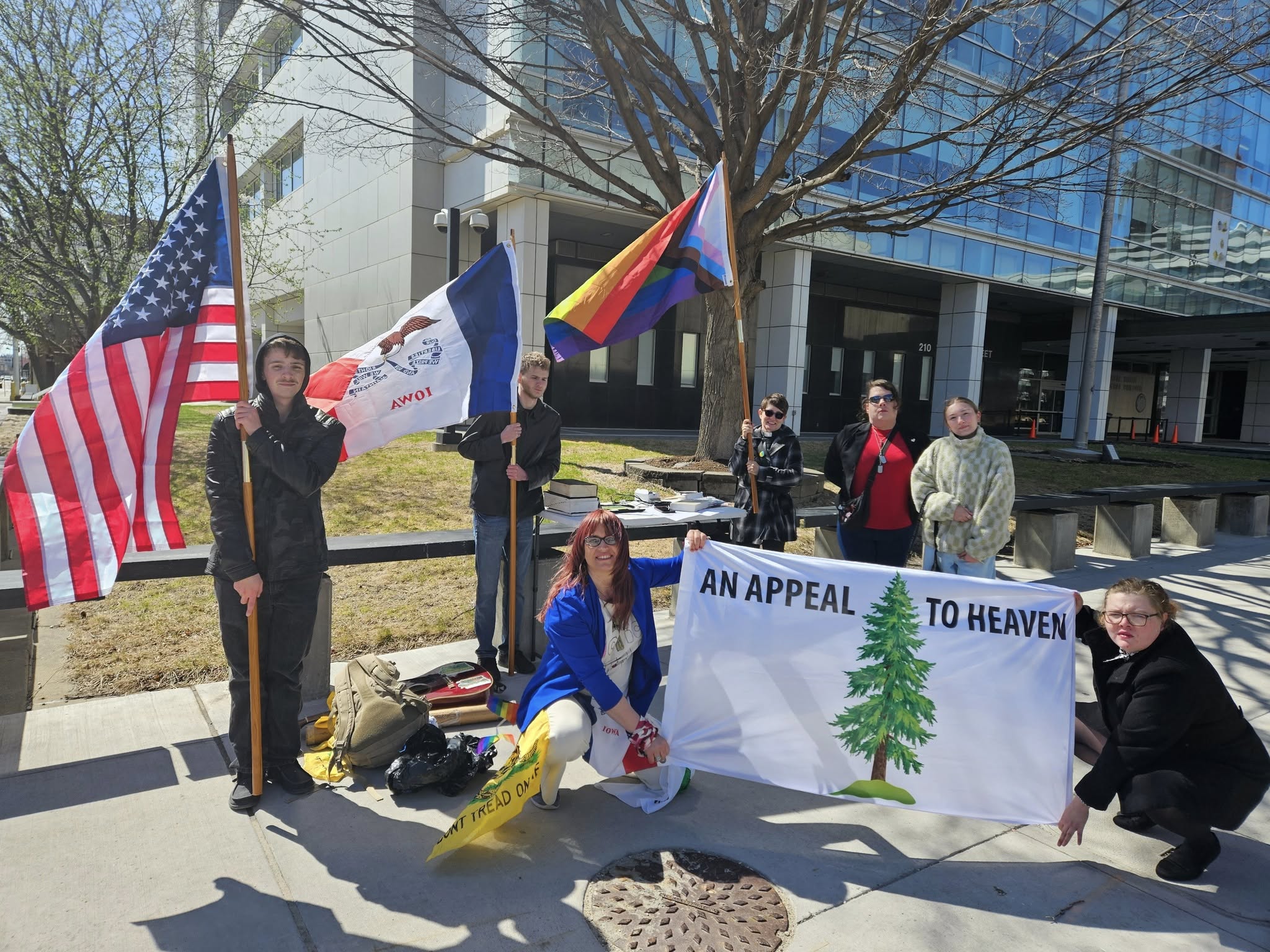
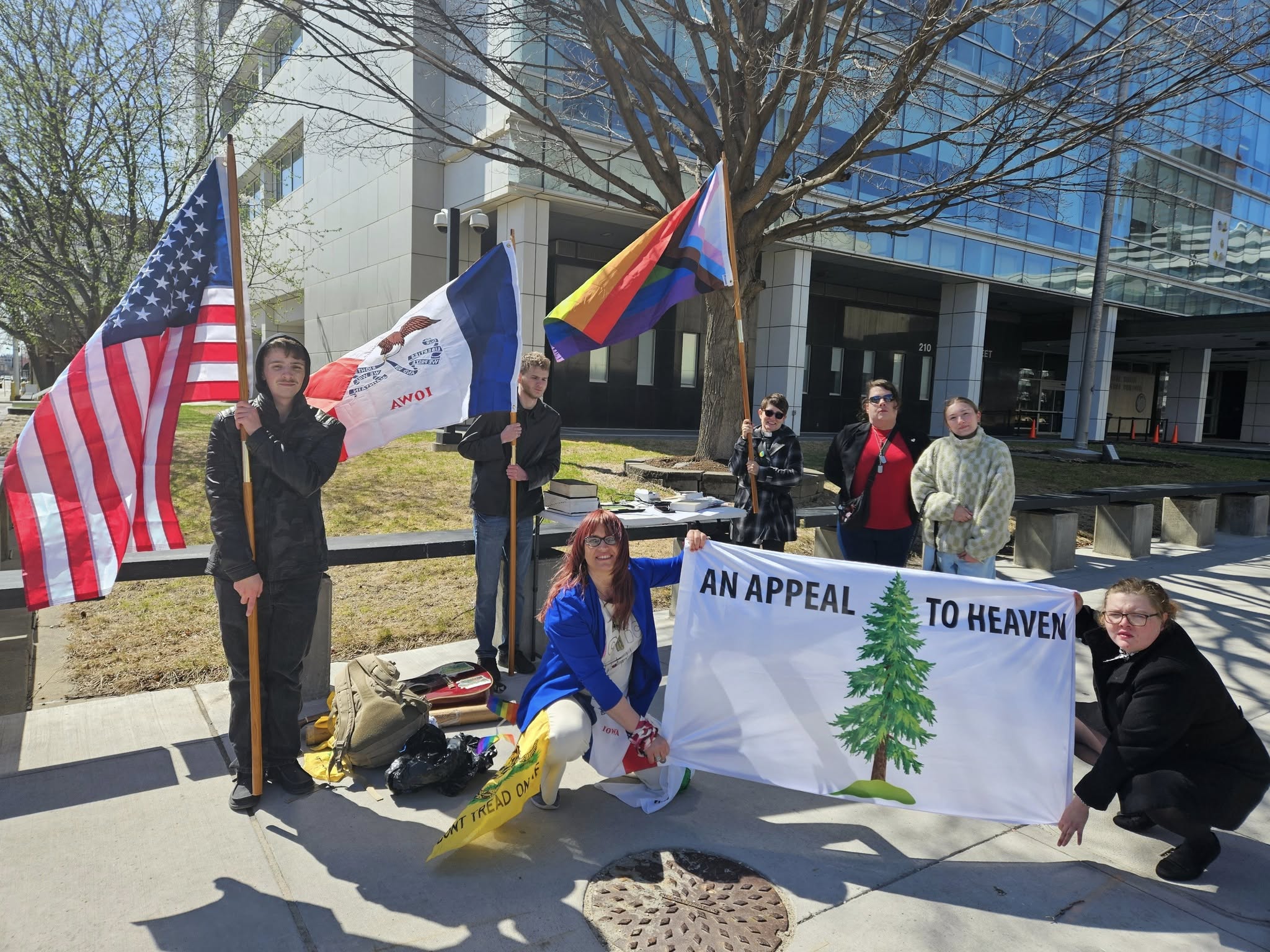
Above: March 31, 2025, outside the U.S. Attorney’s Office in Des Moines, immediately after the criminal civil-rights complaint was submitted and the related civil petition was filed.
Executive Summary
On March 31, 2025 — Transgender Day of Visibility — a small group of Iowans gathered outside the U.S. Attorney’s Office in Des Moines. Several participants signed and submitted a criminal civil-rights complaint asking federal authorities to investigate alleged violations of federal law. Four plaintiffs — Alexandra Distance Marie “Sondra” Wilson, Amelia Curell, Kaylara Hoadley, and Victoria Whitten — also filed a related civil petition in the United States District Court for the Southern District of Iowa, captioned Wilson et al. v. Trump et al., No. 4:25-cv-00116-SHL-WPK.
The filings concerned an alleged course of conduct involving obstruction of medically necessary Medicaid-funded care for transgender adults, removal of gender-identity protections from the Iowa Civil Rights Act, campaign messaging that the filings characterize as normalizing that removal, and state and federal action taken after Iowa courts had already placed the State on notice that categorical denial of that care was unlawful. The civil petition invoked 42 U.S.C. §§ 1985 and 1986 and the civil-remedy provision of the Racketeer Influenced and Corrupt Organizations Act, 18 U.S.C. § 1964(c) — statutes that expressly authorize private civil suits. The criminal complaint separately identified 18 U.S.C. §§ 241, 242, 371, and 1621, and the criminal RICO provisions, 18 U.S.C. §§ 1961–1968, and asked prosecuting authorities to investigate and, where the evidence supports it, to charge.
On June 23, 2025, the Honorable Stephen H. Locher dismissed the complaint and the criminal-complaint supplement at initial screening, before any defendant was served or answered. Judgment was entered against the plaintiffs on June 24, 2025. The court held, among other things, that a self-represented plaintiff cannot litigate claims on behalf of other people or a class; that the individual plaintiff had not pleaded a personal, concrete injury sufficient for Article III standing; that private citizens cannot bring criminal prosecutions or sue directly under criminal statutes that Congress did not equip with a private right of action; that several named defendants — a state judge and the legislators who voted for the challenged bill — are protected by absolute judicial and legislative immunity; and that amendment would be futile given those defects.
This page does not describe the original docket as active or as “ready to file.” It is closed, and the dismissal was with prejudice as to the claims and defendants actually presented. What this page does is (1) preserve the factual record accurately; (2) explain precisely what the court ruled and why, so the deficiencies are visible rather than glossed over; (3) separate — as the court itself insisted — the criminal-referral function (which belongs to prosecutors) from the civil-remedy function (which belongs to injured plaintiffs and their counsel); and (4) identify, narrowly and specifically, what a future filing would need to contain to survive the screening this one did not.
III. The Court Record:
The Record of Filings Currently on the Docket
This section is deliberately the most conservative section of this document. It states what the court said, in the court’s own terms, because an honest account of the ruling is the foundation for everything that follows — including any future filing. How the court responded to the filings, along with my responses to those filings. Actual docket entries are attached.
What Was Filed
The civil petition. On March 31, 2025, four plaintiffs — Alexandra Distance Marie “Sondra” Wilson, Amelia Curell, Kaylara Hoadley, and Victoria Whitten — filed a pro se civil petition captioned as a putative class action “for violations of Congressionally created rights secured by the Medicaid and Medicare Act and guaranteed under the Ninth Amendment.” The petition asserted claims for conspiracy to interfere with civil rights under 42 U.S.C. § 1985, neglect to prevent civil-rights violations under 42 U.S.C. § 1986, and civil RICO remedies under 18 U.S.C. § 1964. It named dozens of defendants: President Donald J. Trump; Governor Kim Reynolds; Attorney General Brenna Bird; a large number of individual Iowa legislators identified as having voted for the challenged legislation; the Republican Party of Iowa; the Republican National Committee; and John and Jane Doe defendants.
The criminal complaint. On April 14, 2025, the same plaintiffs filed a document styled as a “Criminal Complaint,” captioned in the name of “the United States government, under the Authority of We the People, Prosecutor,” and naming the same defendants plus Capitol Ministries. It listed five proposed charges: conspiracy against rights (18 U.S.C. § 241); deprivation of rights under color of law (18 U.S.C. § 242); conspiracy to commit an offense against or defraud the United States (18 U.S.C. § 371); perjury (18 U.S.C. § 1621), premised on the theory that voting for or signing the challenged legislation violated defendants’ oaths of office; and civil and criminal RICO (18 U.S.C. §§ 1961–1968). The court treated this filing as a supplement to the civil docket rather than as an independent criminal proceeding, because — as explained below — private citizens cannot open a federal criminal case by filing a document in a civil docket.
Emergency and procedural filings. Also on April 14, 2025, Wilson filed a document titled “Suit at Equity, Law, and Prosecution,” which the court construed as a motion for an extraordinary writ, seeking to notify defendants of the suit, requesting redaction of the complaint, and requesting leave to proceed in forma pauperis. On April 29, 2025, Wilson filed an “Omnibus Motion” seeking a preliminary injunction, a stay of a related state-court case pending in Story County, joinder of that state case with the federal action, access to victims’ services through the FBI, and leave to file electronically; this filing also purported to add an additional plaintiff and a large number of additional defendants grouped as “Sets of Defendants.”
The Court’s June 23, 2025 Initial Review Order
Because the plaintiffs sought to proceed without prepaying filing fees, the court was required by 28 U.S.C. § 1915(e)(2)(B) to screen the complaint before requiring any defendant to respond. That screening looks only at whether the complaint, read generously because the plaintiff was self-represented, states a legally viable claim — it is not a trial, and no defendant had yet appeared, answered, or been served. On June 23, 2025, Judge Locher dismissed the complaint and the criminal-complaint supplement. The court’s reasoning, accurately summarized, was as follows.
- A self-represented plaintiff cannot litigate on behalf of others. The court held that although Wilson could represent her own interests, she is not a licensed attorney and therefore cannot represent the other named plaintiffs or a class. Citing 28 U.S.C. § 1654 and Eighth Circuit authority holding that “pro se litigants can never represent the rights, claims and interests of other parties in a class action lawsuit (or otherwise),” the court limited its review to Wilson’s individual claims. This is a procedural rule of general application, not a ruling that transgender Iowans as a class lack a cause of action — it means that any class-wide claim requires a licensed attorney to bring it.
- The complaint did not adequately plead standing. To bring a federal claim, a plaintiff must plead (1) a concrete, particularized injury, (2) a causal connection between that injury and the defendants’ conduct, and (3) a likelihood that a favorable ruling would redress it. The court found that although the filings collectively made clear that Wilson is a transgender woman, the complaint itself did not allege that she personally had been denied Medicaid coverage, that a medically necessary procedure of hers had been canceled or delayed, or that she faced an imminent, particularized injury from SF 418 specifically — for example, the complaint did not allege that she had planned to seek a Medicaid-funded, gender-affirming procedure and was now barred from doing so. The requested relief — “an injunctive protective order to prevent any behind-the-scenes actions targeting transgender persons” — was, in the court’s words, “too vague and too broad” to be the kind of relief that can confer standing. This finding is significant for any future filing: the court did not hold that Wilson has no injury. It held that the complaint, as drafted, did not plead the injury that in fact exists — including the February 2025 cancellation of scheduled, medically necessary surgery described in Part One — with the specificity Article III requires.
- Claims tied to the state-court case failed for lack of authority and judicial immunity. Part of the federal complaint arose from a related Iowa District Court case (Polk County, No. LACL157953), which Wilson alleged had been wrongly dismissed. The court held that a federal district court does not have freestanding authority to review a state court’s rulings in this posture, and that to the extent the complaint targeted the state judge who presided over that case, he was entitled to absolute judicial immunity — an immunity not defeated by allegations of bad faith or malice, and subject only to two narrow exceptions (non-judicial acts, or acts taken in the complete absence of jurisdiction) that the court found did not apply.
- Legislative immunity barred claims against legislators and the party for the act of legislating. The court held that the individual legislator-defendants are entitled to common-law legislative immunity for their legislative acts — that is, for voting — and that the Republican Party of Iowa cannot be held liable under §§ 1985, 1986, or a RICO conspiracy theory merely for supporting legislation that was later enacted. This is an important, narrow holding: it forecloses suing a legislator for the act of casting a vote, or a party for backing a bill. It does not immunize non-legislative conduct — implementation, enforcement, administrative guidance, or executive action taken outside the legislative process — which is the distinction Part Three below is built around.
- Sections 1985, 1986, and civil RICO were not the correct vehicle for the relief sought. Even setting the standing and immunity problems aside, the court held that to the extent Wilson sought an injunction against the legislation itself, §§ 1985–1986 and civil RICO are not the appropriate legal vehicles for that specific relief.
- Private citizens cannot bring criminal prosecutions, and the criminal statutes cited do not create civil causes of action. As to the criminal-complaint supplement, the court held, first, that initiating a federal criminal prosecution is the prerogative of the Executive Branch, not of private citizens, and second, that even if the alleged conduct violated 18 U.S.C. §§ 241, 242, 371, or 1621, none of those statutes creates a private right to sue civilly — a point supported by a substantial and uniform body of Eighth Circuit and other federal authority. The supplement suffered from the same immunity defects as the civil complaint and was dismissed on that basis as well.
- The court could not stay, join, or review the related state case, compel FBI victims’ services, or dictate pardon decisions. The Omnibus Motion’s remaining requests — to stay and join the Story County state case, to obtain FBI victims’ services, and related relief — were denied because a federal district court has no freestanding authority to compel state judicial officers, no mechanism exists to “join” a state case with a federal one, principles of comity counsel against a federal court second-guessing pending state proceedings, and the court has no authority over Executive Branch charging, pardon, or victims’-services decisions.
- Leave to amend was denied as futile. Because the standing, immunity, wrong-vehicle, and representation problems went to the root of the case rather than to a curable drafting defect, the court denied leave to amend and dismissed the complaint and the criminal-complaint supplement with prejudice.
Judgment and Post-Judgment Filings
Judgment was entered for the defendants and against the plaintiffs on June 24, 2025. On June 27, 2025, Wilson filed an emergency motion seeking preliminary injunctive relief to stop SF 418 from taking effect on July 1, and requested service of the complaint by the U.S. Marshals Service and an extension of time to serve process. On June 30, 2025, the court denied all of that relief, explaining that because the underlying claims had already been dismissed with prejudice, the request for an injunction was moot, no new facts had been alleged that would change the standing analysis, and service was neither required nor appropriate on a dismissed complaint. The order also clarified that the earlier grant of in forma pauperis status excused Wilson from prepaying the filing fee — it did not mean she was permitted to proceed further with the lawsuit.
What the Court Did Not Decide
It matters, for accuracy, to be equally clear about what the court did not do. The court did not hold a trial. It did not receive discovery, live testimony, or an evidentiary hearing. It did not rule that the underlying facts alleged were false. It did not hold that transgender Iowans lack constitutional or statutory rights, that a properly represented class action could never be brought over this conduct, or that no prosecutor could ever investigate the facts described in the criminal complaint. It held that this complaint, filed by this pro se plaintiff, using these legal vehicles, against these defendants, requesting this relief, did not state a claim the court could allow to proceed past screening — and, separately, that private citizens cannot personally initiate a federal criminal prosecution. Those are precise, correctable, and in some respects narrow defects. The remainder of this document explains what filling them would require.
A Candid Assessment
The March 31 filings identified a serious body of law and an urgent sequence of alleged injuries, but they did not translate that record into the technical structure federal litigation requires.
They were assembled during an emergency, without counsel, while I was attending school full time and litigating other civil-rights matters. The civil and criminal frameworks were not separated clearly enough; the complaint named many defendants without sufficiently individualized allegations; my own medical injury was not pleaded with the specificity necessary to establish standing; and several forms of requested relief exceeded what the federal court could grant through that action.
Saying this plainly does not concede that the underlying injuries lacked merit. It identifies the gulf between recognizing a serious legal wrong and constructing a pleading capable of surviving federal screening.
A stronger filing would need to be narrower, identify fewer and more carefully selected defendants, plead each plaintiff’s injury and causation in detail, distinguish immune legislative acts from actionable implementation or enforcement, and keep any criminal referral separate from the civil complaint.
IV. The Developing Amended Petition — A stronger, developed filing designed to cure deficiencies defined by the court, followed by doctrines and case law assembled proving the case ought be re-opened, and fully considered on its merits, in light of all the facts now assembled. This section will continue to be developed asap, while I also balance managing litigations imposed by Wilson v. Reliable Street Inc., et al and Wilson v. Pate, and keeping up with life in general.
IV. The Developing Amended Petition:
The Following Section is Being Prepared for The Next Set of Filings
This section reconstructs the factual and legal record in response to the deficiencies identified by the court. The purpose is not merely to restate the original petition. It is to develop the case into the form that the original emergency filing did not yet possess: a complete chronology, individualized injuries, defendant-specific conduct, legally cognizable causes of action, evidence of causation, appropriate defendants, available remedies, and a clear separation between civil claims and requests for criminal investigation. I am currently balancing litigation duties imposed by Wilson v. Reliable Street Inc., et al and Wilson v. Pate, and trying to survive along the way.
I contend that the original petition arose from a substantial and legally serious grievance capable of supporting evaluation for class-wide relief. Its central weakness was not the absence of an underlying injury or governing law. It was that the petition did not translate the existing facts into the technical architecture federal litigation requires.
Among other deficiencies, the original filings did not adequately:
- connect each defendant to a specific act or omission;
- identify which conduct was legislative, executive, administrative, judicial, political, or private;
- connect each plaintiff’s individual injury to particular defendants;
- distinguish alleged criminal conduct from civil causes of action;
- plead standing, causation, and redressability with sufficient specificity;
- identify legally available remedies;
- address immunity defendant by defendant; or
- satisfy the procedural requirements governing proposed class litigation.
The court also held that, because I am not a licensed attorney, I could not represent the other named plaintiffs or absent members of a proposed class. Federal Rule of Civil Procedure 23 requires a certified class to be represented by appointed class counsel, and a self-represented litigant may litigate only her own claims—not the legal interests of other people.
I have nevertheless conducted extensive efforts to locate qualified representation. Those efforts have included contacting attorneys, civil-rights organizations, legal organizations, and other potential sources of assistance. To date, I have not secured counsel willing and able to undertake the matter.
The absence of representation does not establish that the underlying case lacks merit. Complex civil-rights litigation is expensive, time-consuming, professionally demanding, and politically sensitive. Some attorneys or organizations may lack the necessary resources, experience, institutional authority, or willingness to undertake litigation involving politically controversial claims, numerous governmental actors, unsettled legal questions, and potential class-wide relief.
I cannot know the private reasons every attorney or organization has declined or failed to respond. I can document, however, the extent of my efforts to obtain representation and the practical result: the people allegedly injured remain without counsel capable of presenting their claims in the form the federal court requires.
For that reason, the most urgent present task is to build and preserve the case.
That work includes:
- assembling the complete factual timeline;
- preserving medical and administrative records;
- documenting later and continuing injuries;
- identifying each potential plaintiff’s individual harm;
- tracing each injury to particular governmental or private conduct;
- separating immune legislative acts from potentially actionable implementation or enforcement;
- researching preclusion, limitation periods, standing, immunity, and available remedies;
- preserving evidence of efforts to obtain counsel; and
- preparing a record sufficiently organized that an attorney, court, journalist, investigator, or future plaintiff can evaluate it without beginning again from nothing.
If relief from judgment or another legally available proceeding is pursued, I intend to present the court with a documented record of my efforts to obtain counsel and request that the court exercise any available authority to assist in securing representation.
Under 28 U.S.C. § 1915(e)(1), a federal court may request an attorney to represent a person unable to afford counsel. That authority is discretionary, and the Supreme Court has held that it does not authorize a court to compel an unwilling attorney to accept a civil case. Any request for counsel would therefore need to explain the apparent merits and complexity of the claims, my inability to present class-wide claims without representation, the efforts already made to secure counsel independently, and why appointment or recruitment of volunteer counsel would materially assist the court and the administration of justice.
I also reserve the right to present a carefully developed access-to-justice argument concerning the practical effect of requiring counsel for class-wide relief where no qualified attorney is willing or able to accept a politically unpopular civil-rights case. That argument should not be confused with a claim that I presently possess authority to represent absent class members. Under existing federal procedure, I do not.
The immediate objective is therefore not to pretend that the representation barrier has already been overcome. It is to prevent that barrier from destroying the factual record before counsel can be found, requested, recruited, or otherwise lawfully secured.
The case must first be built.
The record must be preserved.
The efforts to obtain counsel must be documented.
When the procedural road is reached, the court should be presented not with another emergency filing assembled under impossible conditions, but with a developed record showing the injuries, the governing law, the deficiencies previously identified, the steps taken to cure them, and the practical impossibility of obtaining representation despite sustained good-faith efforts.
How to read this Part. Everything below is analysis — a mapping of the facts in Part One onto the elements of recognized civil causes of action — prepared for licensed counsel to evaluate, test, and, where warranted, plead. It is not a complaint, it is not a finding by any court, and it does not accuse any named individual of civil liability that has been adjudicated. Where this Part says a defendant’s conduct “would need to satisfy” or “could support” a claim, that is because civil liability requires proof of every element before a fact-finder, and none of the elements discussed here has yet been tested in an adversarial proceeding. The value of laying the elements out this precisely is that it is the opposite of the conclusory pleading the court rejected in Part Two — it shows exactly what a properly pleaded complaint would have to allege and prove.
The Threshold Problem Any Refiled Case Must Solve
Part Two identified three structural defects that any future civil filing must solve before reaching the merits: (1) only a licensed attorney can bring class-wide claims; (2) the plaintiff must plead a personal, concrete, particularized injury — for example, a specific date on which a specific medically necessary procedure was denied, canceled, or delayed, tied to a specific administrative decision; and (3) legislative immunity protects the act of voting for a bill, and a political party is not liable merely for supporting legislation that passes. A viable theory therefore has to be built on non-legislative conduct: signing statements considered as evidence of purpose rather than as the immune legislative act itself; agency guidance implementing a Medicaid exclusion; administrative denial of a specific claim; and enforcement decisions made after the legislation took effect. Counsel evaluating this record should also expect defendants to argue that a governor’s act of signing a bill is itself “legislative” for immunity purposes in some circumstances, see Bogan v. Scott-Harris, 523 U.S. 44, 55 (1998) (signing and presenting a budget-related ordinance were entitled to legislative immunity as the final, integral step in the legislative process) — a real obstacle that the pleading must confront directly rather than assume away, most plausibly by focusing claims on the administrative implementation of HF 1049 (the Medicaid claim-denial guidance) rather than on the signing ceremony itself.
42 U.S.C. § 1983 — Deprivation of Rights Under Color of State Law
Section 1983 supplies a civil action against any “person” who, acting under color of state law, deprives another of a right secured by the Constitution or federal statutes.[^p3-1983text] It reaches individual state and local officials sued in their personal capacity for damages, Hafer v. Melo, 502 U.S. 21, 27–31 (1991); municipalities and other local governmental bodies for their own policies or customs, Monell v. Dep’t of Soc. Servs., 436 U.S. 658, 690–91 (1978) (no respondeat superior liability); and private actors performing a state function in concert with the state, West v. Atkins, 487 U.S. 42, 49–50 (1988); Lugar v. Edmondson Oil Co., 457 U.S. 922, 937 (1982). States and state agencies themselves are not “persons” subject to damages under § 1983 and are further protected by Eleventh Amendment immunity, Will v. Michigan Dep’t of State Police, 491 U.S. 58, 66, 71 (1989), though prospective injunctive relief against a state official in their official capacity remains available under Ex parte Young, 209 U.S. 123, 159–60 (1908).
Individual officials sued for damages may raise qualified immunity, which shields them unless they violated a constitutional right that was “clearly established” at the time. Harlow v. Fitzgerald, 457 U.S. 800, 818 (1982); Pearson v. Callahan, 555 U.S. 223, 231 (2009). This is precisely why Good (2019) and Vasquez (2023) matter beyond their role in the timeline: they are the clearest available evidence that, well before the 2025 conduct at issue, Iowa courts had already held that categorically denying Medicaid coverage for medically necessary gender-affirming care to transgender adults was unlawful, which supports an argument that continuing or renewed denial after that notice cannot credibly be called a good-faith mistake about unsettled law. Municipal-type defendants do not receive qualified immunity. Owen v. City of Independence, 445 U.S. 622, 638 (1980).
Application. A properly pleaded § 1983 claim would need to identify the specific Iowa HHS officials or agency decisionmakers who implemented the HF 1049 claim-denial guidance described in Part One, allege the plaintiff’s specific claim or scheduled procedure that was denied or delayed under that guidance, and connect that denial to the deprivation of a right — most directly, the equal-protection and due-process interests discussed below, and any surviving Medicaid statutory entitlement.
42 U.S.C. § 1985(3) and § 1986 — Civil-Rights Conspiracy and Failure to Prevent
Section 1985(3) creates a civil action against two or more persons who conspire to deprive a person or class of the equal protection of the laws, provided the conspiracy is motivated by class-based, invidiously discriminatory animus, an overt act is taken in furtherance of it, and it causes injury. Griffin v. Breckenridge, 403 U.S. 88, 102 (1971). Section 1986 creates derivative liability for anyone who knows a § 1985 conspiracy is underway, has the power to prevent or aid in preventing it, and neglects to do so; it carries only a one-year limitations period and cannot exist without a viable § 1985 claim. 42 U.S.C. § 1986.
Two cautionary limits from Supreme Court precedent must be squarely addressed by any pleading built on § 1985(3), because they were exactly the kind of thing the court in Part Two found missing: (1) the “class-based animus” element is demanding — the Court has rejected theories resting on categories not tethered to equal-protection principles, United Bhd. of Carpenters & Joiners v. Scott, 463 U.S. 825, 837 (1983); and (2) opposition to a policy is not automatically equivalent to animus against the class it affects — in Bray v. Alexandria Women’s Health Clinic, 506 U.S. 263, 269–70 (1993), the Court held that opposition to abortion did not by itself establish animus against women as a class. Any § 1985(3) theory here must therefore rest on more than disagreement with SF 418 as policy; it must plead facts — the Good and Vasquez notice, the timing of SF 418’s signing statement tying the repeal to Medicaid cost, and the sequenced enactment of SF 418, HF 1049, and SF 579 — showing the conspiracy was actually directed at transgender people as a class, not merely at a healthcare-funding line item.
Equal Protection, Sex-Based Discrimination, and Bostock
Bostock v. Clayton County, 590 U.S. 644, 660–62 (2020), held that an employer who fires an employee for being transgender necessarily takes that action “in part” because of sex, and therefore discriminates “because of sex” within the meaning of Title VII. While Bostock was a Title VII case, its reasoning — that discrimination against a person for failing to conform to sex-linked expectations is a form of sex discrimination — is directly relevant to how an equal-protection claim under the Fourteenth Amendment should be framed here: not solely as “gender identity discrimination,” which after SF 418 is no longer an enumerated state-law category, but as sex-based discrimination and sex stereotyping, categories that remain subject to heightened scrutiny under the Equal Protection Clause regardless of what the ICRA currently says. Cf. United States v. Virginia, 518 U.S. 515, 532–33 (1996) (sex-based government classifications require an “exceedingly persuasive justification”); Glenn v. Brumby, 663 F.3d 1312, 1316–17, 1319 (11th Cir. 2011) (terminating a transgender employee for gender nonconformity violated the Equal Protection Clause as sex discrimination).
Defamation by Implication and Libel Per Quod
Iowa recognizes defamation by implication and libel per quod, where a statement’s defamatory meaning becomes clear through context, innuendo, or extrinsic facts even though no single sentence is a direct false accusation. Schlegel v. Ottumwa Courier, 585 N.W.2d 217, 224–25 (Iowa 1998); Kiesau v. Bantz, 686 N.W.2d 164, 175–76 (Iowa 2004), overruled on other grounds by Alcala v. Marriott Int’l, Inc., 880 N.W.2d 699 (Iowa 2016). Public officials and public figures asserting defamation claims about matters of public concern must additionally prove actual malice — that the statement was made with knowledge of its falsity or reckless disregard for the truth. New York Times Co. v. Sullivan, 376 U.S. 254, 279–80 (1964). This standard cuts both ways in this record: it is a real, elevated burden that a defamation theory here would have to clear (most campaign messaging, however offensive, is opinion or rhetorical hyperbole about a public controversy, and is protected), and it is also a standard the plaintiffs asserting a defamation claim — as private individuals, not public officials — would generally not have to meet themselves when suing over statements made about them. Any defamation theory in this record needs a specific, identifiable false statement of fact about a specific person (not a general political message about a group), evidence of falsity, and — for public-figure defendants’ liability — evidence of actual malice; counsel should treat this as the hardest claim in this framework to plead successfully, not the easiest.
Unjust Enrichment
Unjust enrichment requires that a defendant received a benefit, at the plaintiff’s expense, under circumstances making it unjust for the defendant to retain the benefit without paying for it. As applied here, a properly developed theory would need to trace specific financial or political benefits (campaign contributions, fundraising totals directly attributable to specific messaging) to specific conduct causing the plaintiffs’ injury — general assertions that a campaign “benefited” from controversy are not, by themselves, sufficient; this claim would require discovery into campaign-finance records that has not yet occurred, and counsel should treat it as a claim to develop through discovery in an already-viable case rather than as a stand-alone basis for filing.
Civil RICO — 18 U.S.C. § 1964(c)
Civil RICO authorizes a private suit for treble damages by anyone injured in their business or property by a violation of 18 U.S.C. § 1962. A plaintiff must plead: (1) conduct (2) of an enterprise (3) through a pattern (4) of racketeering activity, causing (5) injury to business or property that was (6) proximately caused by the racketeering acts. Sedima, S.P.R.L. v. Imrex Co., 473 U.S. 479, 496 (1985); Bridge v. Phoenix Bond & Indem. Co., 553 U.S. 639, 653–54 (2008). An enterprise may be a legal entity used for unlawful ends; no prior criminal conviction is required. United States v. Turkette, 452 U.S. 576, 580–81, 593 (1981). “Pattern” requires at least two related predicate acts posing a threat of continued criminal activity — either a closed period of repeated conduct or an open-ended threat of continuation. H.J. Inc. v. Nw. Bell Tel. Co., 492 U.S. 229, 239–43 (1989). Civil RICO’s private right of action is limited where the injury is suffered abroad, RJR Nabisco, Inc. v. European Cmty., 579 U.S. 325, 337, 346 (2016), and is restricted for claims premised on securities fraud absent a criminal conviction, 18 U.S.C. § 1964(c).
This was, on the current record, the weakest of the claims the original complaint asserted, and the court’s dismissal reflects that. Civil RICO requires the “racketeering activity” to consist of specific predicate offenses listed in 18 U.S.C. § 1961(1) — mail or wire fraud, extortion, bribery, and similar crimes — proven with particularity, not a general characterization of a political program as “racketeering.” A future filing that wants to preserve a RICO theory should identify specific predicate acts (for example, a specific instance of extortion or fraud tied to Medicaid administration, if the evidence supports one) rather than treating the statute as a synonym for coordinated wrongdoing.
Damages Against Federal Officials — the Narrow and Shrinking Path of Bivens
Bivens v. Six Unknown Named Agents, 403 U.S. 388, 397 (1971), recognized an implied damages remedy directly under the Constitution against individual federal officers, but only in the specific contexts the Supreme Court has recognized: Fourth Amendment search-and-seizure claims (Bivens itself); certain Fifth Amendment gender-discrimination claims by a congressional employee, Davis v. Passman, 442 U.S. 228, 248–49 (1979); and Eighth Amendment deliberate-indifference claims against federal prison officials, Carlson v. Green, 446 U.S. 14, 19 (1980). The Supreme Court has since described extending Bivens to any new context as a “disfavored” judicial activity and has declined to do so in a long line of cases. Ziglar v. Abbasi, 582 U.S. 120, 135 (2017); Hernandez v. Mesa, 589 U.S. 93, 102 (2020); Egbert v. Boule, 596 U.S. 482, 490–91, 502 (2022). Federal agencies cannot be sued for Bivens damages, FDIC v. Meyer, 510 U.S. 471, 484–86 (1994), nor can private entities performing federal functions, Correctional Servs. Corp. v. Malesko, 534 U.S. 61, 66, 74 (2001); Minneci v. Pollard, 565 U.S. 118, 120, 130 (2012). Counsel should treat any Bivens theory against a federal official named in this record as, at best, an uphill argument for extending the doctrine to a new context post-Egbert — not a reliable vehicle for relief. Prospective, non-damages relief against federal officials may be available through other equitable or statutory routes depending on the specific federal action challenged.
A Note on Naming Defendants: Capacity, Not Volume
The original complaint named dozens of individual legislators, largely without defendant-specific factual allegations connecting each one to a particular act beyond a recorded vote. That approach did real damage to the case: it invited — and received — legislative immunity as a blanket defense, and it obscured which defendants were even alleged to have done something beyond voting. A stronger filing narrows rather than widens the defendant list, and organizes each remaining defendant by the capacity in which they acted, since different capacities carry different immunities and different elements:
|
Actor / Capacity |
Type of Act |
Relevant Immunity or Limit |
Best-Fit Claim |
|
Governor, signing a bill |
Arguably legislative (Bogan) or executive |
Possible legislative immunity for the signing itself |
Signing statement as evidence of purpose; downstream administrative implementation as the actionable conduct |
|
State agency officials implementing Medicaid denial guidance |
Administrative/executive |
No legislative immunity; qualified immunity applies, tested against Good/Vasquez notice |
§ 1983; equal protection |
|
Individual legislators, floor vote |
Legislative |
Legislative immunity (near-absolute) |
Not independently actionable; relevant only as context/evidence |
|
Political party organizations |
Advocacy/financing |
Not liable merely for supporting enacted legislation (Part Two, Holding 4) |
Requires evidence of a role beyond advocacy — financing a specific unlawful act, not backing a bill |
|
Federal executive officials |
Executive order issuance/implementation |
Bivens severely limited post-Egbert; sovereign immunity for agencies |
Equitable/injunctive theories under the relevant order’s own framework, evaluated separately from this case |
This table is an organizing tool for counsel, not a finding. Placement in a column is not an allegation that the listed conduct is unlawful; it identifies the legal category the conduct would need to be litigated in.
IV. The Criminal Prosecution — Case in Development
How to read this Part. This is not a private prosecution, and it does not claim to be one. The court in Part Two was direct on this point, and it was correct: initiating a federal criminal case is the prerogative of the Department of Justice and other lawful prosecuting authorities, and private citizens cannot sue directly under criminal statutes that Congress did not equip with a civil remedy. What private citizens can do — and what this Part does — is document facts, identify the statutes those facts may implicate, and request that prosecutors and investigators exercise the discretion that belongs to them. Nothing in this Part should be read as asserting that any named person has been charged, indicted, or convicted of any crime, or that probable cause has been judicially found. It has not.
18 U.S.C. § 241 — Conspiracy Against Rights
Section 241 makes it a federal felony for two or more people to conspire to injure, oppress, threaten, or intimidate any person in the free exercise of a right secured by the Constitution or federal law. Unlike many conspiracy statutes, § 241 does not require proof of a separate overt act as an element, U.S. Dep’t of Just., Civil Rights Div., Statutes Enforced by the Criminal Section, though evidence of specific acts remains central to proving the agreement and its scope, see United States v. Price, 383 U.S. 787, 794, 806 (1966) (state actors who conspired with private individuals to violate civil rights could be prosecuted under § 241’s predecessor). The elements a prosecutor would need to establish are an agreement between two or more people, specific intent to interfere with a federally protected right, and that the right was in fact one secured by the Constitution or federal statute. For purposes of a request to investigate, the timeline in Part One — repeated judicial notice through Good and Vasquez, followed by SF 418, HF 1049, and SF 579 in sequence — is the kind of fact pattern that would need to be tested through subpoenas, communications discovery, and witness interviews to determine whether an agreement existed, as opposed to parallel but independent policymaking by multiple actors who share a political affiliation. That distinction is for investigators and, ultimately, a grand jury to resolve; it is not established by the public record alone.
18 U.S.C. § 242 — Deprivation of Rights Under Color of Law
Section 242 criminalizes the willful deprivation, by a person acting under color of law, of a right protected by the Constitution or federal statute. “Color of law” includes the misuse of power made possible only because the actor is clothed with governmental authority. Screws v. United States, 325 U.S. 91, 108–13 (1945) (requiring specific intent — willfulness — to deprive a person of a defined constitutional right); United States v. Lanier, 520 U.S. 259, 264–67, 271 (1997) (clarifying that the right violated must have been made specific enough, by then-existing law, that the defendant had fair warning). Section 242’s willfulness requirement is a real and demanding one: it is not satisfied merely by showing that an official enforced a law later held unconstitutional; it requires evidence the official knew, or was substantially certain, that the specific conduct violated a right the official had fair warning was protected. This is where the Good and Vasquez notice does the most work — it is the strongest available evidence that officials implementing the 2025 Medicaid exclusion had fair warning, from their own state’s highest court, that categorical denial of this specific coverage was unlawful discrimination.
The “Just Following Orders” and “Just Doing My Job” Defenses Do Not Exist in American Law
A recurring defense to color-of-law liability is some version of “I was following the law my office required me to follow” or “I was just doing my job.” American and international law have rejected obedience-to-authority as a defense to knowing participation in rights violations, and this doctrine is directly relevant here because several of the acts in Part One were implemented by officials and employees executing policy set by others. Mitchell v. Harmony, 54 U.S. (13 How.) 115, 134 (1851) (a military officer who executed a superior’s unlawful order was personally liable in damages; “the [officer] is bound to obey the order, if not palpably illegal” — but an order that is palpably illegal provides no shield); Little v. Barreme, 6 U.S. (2 Cranch) 170, 179 (1804) (a naval officer following presidential instructions that exceeded statutory authorization was nonetheless personally liable). The Nuremberg Tribunal applied the same principle to a categorically more severe set of facts and is cited here only for the general legal proposition it stands for — that superior orders do not excuse a subordinate who had a moral and legal choice to refuse — not as a comparison between the officials named in this record and war-crimes defendants, a comparison this document does not make and that would be both legally reckless and factually unsupported on this record. Relatedly, courts have rejected the argument that institutional policy insulates individual enforcement decisions from constitutional scrutiny. Floyd v. City of New York, 959 F. Supp. 2d 540, 660–62 (S.D.N.Y. 2013) (department policy did not excuse Fourth and Fourteenth Amendment violations by individual officers). The relevance here is narrow and specific: an agency employee who processes a Medicaid claim denial under HF 1049’s implementing guidance cannot, as a matter of law, point to the existence of the guidance alone as a complete defense to a § 242 claim if the willfulness element is otherwise satisfied — though, again, whether that element is satisfied on this record is a question for investigators, not an established fact.
The relevance here is narrow: an official directive does not, by itself, resolve whether implementing conduct violated federal law. The official’s authority, knowledge, intent, available choices, and the clarity of the protected right all remain material. Whether those requirements could be proven against any particular person is a question for lawful investigation and adjudication.
Mistake of Law Is Not Ordinarily a Defense
Related to the above, “ignorance of the law” or “mistake of law” is not generally a defense available to a public official who enforces a law later found unlawful, particularly where, as here, the illegality was not obscure but had already been the subject of two published state supreme court decisions. Jerman v. Carlisle, McNellie, Rini, Kramer & Ulrich LPA, 559 U.S. 573, 584–85 (2010) (rejecting a “mistake of law” defense for a licensed professional); Barlow v. United States, 32 U.S. (7 Pet.) 404, 411 (1833) (ignorance of statutory requirements does not excuse liability). The narrow exception recognized in Lambert v. California, 355 U.S. 225, 228–30 (1957), applies only to wholly passive, obscure regulatory duties (there, a registration requirement) and has no application to affirmative enforcement of a widely publicized statute against a backdrop of two published high-court rulings on the identical question.
18 U.S.C. §§ 1961–1968 — Criminal RICO
The elements of criminal RICO track civil RICO’s elements described in Part Three (an enterprise, a pattern of at least two related predicate acts within ten years, and participation in the enterprise’s affairs through that pattern), 18 U.S.C. §§ 1961(1), 1961(5), 1962; H.J. Inc. v. Nw. Bell Tel. Co., 492 U.S. 229, 239–43 (1989); United States v. Turkette, 452 U.S. 576, 580–81 (1981), but carries criminal rather than civil consequences, including imprisonment and forfeiture. 18 U.S.C. § 1963. As with the civil RICO discussion in Part Three, a prosecutable RICO theory requires specific, provable predicate offenses — not a characterization of a political program as racketeering. This is the weakest of the criminal theories on the current record and should be treated by any referral as the lowest priority unless specific predicate-act evidence (for example, a provable instance of extortion, mail fraud, or wire fraud connected to Medicaid administration) is developed.
18 U.S.C. § 371, § 1621, and § 4 — Ancillary Statutes
Section 371 (conspiracy to defraud the United States) and § 1621 (perjury) were both included in the original criminal complaint. The court correctly noted that the perjury theory — that voting for or signing legislation violates an oath of office — is not a legally cognizable perjury theory; perjury requires a knowingly false statement made under oath in a proceeding where an oath is legally administered, not a policy vote inconsistent with a general oath of office. That theory should not be carried forward in any future referral. Section 4 (misprision of felony) — a person who knows a federal felony has been committed and actively conceals it, rather than merely failing to report it — may become relevant only if a specific §§ 241/242 violation is independently established and a specific official is shown to have taken affirmative steps to conceal it, not merely to have declined to investigate.
Equal Enforcement and Prosecutorial Discretion
Prosecutors have broad, constitutionally recognized discretion over whether to investigate and charge, and nothing in this document claims that discretion should be exercised for or against any particular result. What this record does support is a request: that the facts in Part One — repeated judicial notice, followed by legislative and administrative action restricting the same coverage — receive the same investigative scrutiny that color-of-law complaints against less politically prominent defendants ordinarily receive. A request for equal enforcement is not an assertion that enforcement is guaranteed to follow, and it is not a substitute for the civil remedies discussed in Part Three, which remain available regardless of what any prosecutor decides.
VI. Lawful Citizen Action, Documentation, and Transparency
Civil and criminal litigation are not the only lawful means of holding public officials accountable, and they are often too slow to help someone facing an immediate denial of care or an employer or agency demanding silence. This Part collects tools that are lawful for any private citizen — including public employees — to use right now, without any physical confrontation, arrest, or detention of another person. Nothing in this Part authorizes a private citizen to detain, restrain, or physically apprehend a public official; Iowa’s citizen’s-arrest statute, discussed only briefly below for accuracy, has no application to legislative votes, bill signings, or administrative decisions made outside a private citizen’s direct presence, and this document does not suggest otherwise.
The Right to Record Public Officials
Courts have repeatedly and consistently held that the First Amendment protects the right of private citizens — not only journalists — to record public officials performing their official duties in public. Glik v. Cunniffe, 655 F.3d 78, 82–85 (1st Cir. 2011) (right to record police in public was “clearly established”); Fields v. City of Philadelphia, 862 F.3d 353, 355–56, 359–60 (3d Cir. 2017) (First Amendment protects recording by any member of the public, and retaliation for recording is actionable); Smith v. City of Cumming, 212 F.3d 1332, 1333 (11th Cir. 2000) (recognizing a First Amendment right to photograph and videotape police conduct, subject to reasonable time-place-manner regulation); Fordyce v. City of Seattle, 55 F.3d 436, 439 (9th Cir. 1995) (recording public demonstrations and police activity is protected First Amendment activity); ACLU v. Alvarez, 679 F.3d 583, 595, 606 (7th Cir. 2012) (striking down application of an eavesdropping statute to open recording of police); Iacobucci v. Boulter, 193 F.3d 14, 25 (1st Cir. 1999) (officials had no authority to stop a citizen from filming public officials at a public meeting). Documenting legislative sessions, public hearings, agency press conferences, and other public-facing official conduct — openly, without deception or trespass — is lawful, evidentiary, and often the single most useful thing a private citizen can do to build a record for the civil and criminal frameworks in Parts Three and Four.
Whistleblower and Anti-Retaliation Protections
State and federal employees, and in some circumstances private-sector employees, who report unlawful conduct by their employer or agency are protected from retaliation under multiple statutes:
- Iowa Code § 70A.28 protects Iowa public employees who disclose a violation of law, mismanagement, or abuse of authority from termination, demotion, or other retaliatory action, including retaliation affecting retirement benefits.
- Iowa Code § 91A.10 prohibits retaliation against employees who assert rights under Iowa’s wage-payment law and related employment protections.
- The Whistleblower Protection Act, 5 U.S.C. § 2302(b)(8), protects federal employees who disclose legal violations, gross mismanagement, or a substantial danger to public health or safety.
- The Sarbanes-Oxley Act and Dodd-Frank Act provide retaliation protections and, in some circumstances, financial incentives for private-sector whistleblowers reporting specified categories of fraud.
An employee — public or private — who is asked to implement a policy they believe is unlawful should document the request in writing, preserve copies of any written directives, and consult an employment attorney before either complying or refusing; these statutes protect the disclosure of unlawful conduct, and using them effectively is a legal skill worth paying for even when resources are limited.
Duress and Coercion as a Legal Defense — Not a Basis for Self-Help
Where an employee or official is genuinely coerced into unlawful conduct by an imminent, unavoidable threat, duress may excuse what would otherwise be unlawful conduct on their own part, or may render a contract voidable. Restatement (Second) of Contracts § 175 (Am. L. Inst. 1981); United States v. Bailey, 444 U.S. 394, 409–10 (1980) (duress requires an immediate threat, a well-grounded fear, and no reasonable opportunity to escape). This doctrine is included here for completeness and because it is genuinely useful to an employee facing pressure to violate someone else’s rights — it is not, and should not be read as, license for a private citizen to use force or self-help against a public official; duress is a shield available to a coerced person, not a sword available to someone seeking to coerce an official in turn.
Judicial Recusal and Bias
Where a litigant has a good-faith basis to believe a judge is biased, the correct remedy is a motion to disqualify under 28 U.S.C. §§ 144 and 455, not self-help. Recusal is required where the judge’s impartiality might reasonably be questioned, including where bias stems from an extrajudicial source or reflects deep-seated antagonism that would make fair judgment impossible; adverse rulings alone, without more, are not evidence of bias. Liteky v. United States, 510 U.S. 540, 555 (1994).
Public-Records and Transparency Tools
Iowa’s open-records law (Iowa Code ch. 22) and the federal Freedom of Information Act, 5 U.S.C. § 552, allow any person to request government records — legislative correspondence, agency guidance documents, internal communications about implementing HF 1049 — without needing to allege any wrongdoing first. Public-records requests, filed methodically and preserved, are frequently the single most productive way private citizens build the documentary record that civil counsel and, where appropriate, prosecutors ultimately rely on.
Glossary of Key Terms
Definitions below are drawn from standard legal reference sources (Black’s Law Dictionary, 11th ed. 2019; Ballentine’s Law Dictionary) and are provided so the legal analysis above is accessible without a law degree. They are general definitions, not case-specific conclusions.
Color of law. The appearance of legal authority, without necessarily the lawful substance of it — conduct made possible only because the actor holds, or appears to hold, government office or authority. Misuse of that appearance to violate someone’s rights can trigger liability under 18 U.S.C. § 242 and 42 U.S.C. § 1983.
Conspiracy. An agreement between two or more people to accomplish an unlawful act, or to accomplish a lawful act by unlawful means. In both civil and criminal law, conspiracy generally requires proof of an actual agreement and, for most but not all statutes, an overt act taken to advance it.
Injury (legal sense). The violation of a legally protected right, distinct from “damages,” which refers to the resulting loss, harm, or compensation. An injury can be reputational, financial, physical, or dignitary, and need not involve physical harm to be legally cognizable.
Person (legal sense). In law, “person” includes both natural persons (human beings) and juridical or artificial persons (corporations, political parties, government agencies) capable of suing and being sued. This is why organizations, not only individuals, can be named as defendants when the facts support it.
Probable cause. A reasonable basis, grounded in specific facts and circumstances rather than suspicion or rumor, for believing that a crime has been, is being, or will be committed, and that a specific person committed it. It is the standard required for an arrest or search warrant; it is a lower standard than “proof beyond a reasonable doubt” (required for a criminal conviction) or “preponderance of the evidence” (required to prevail on most civil claims).
Racketeering activity. Under 18 U.S.C. § 1961(1), a specific, enumerated list of federal and state crimes — including extortion, bribery, and mail and wire fraud — that can serve as “predicate acts” for a RICO claim. Not every act of official wrongdoing qualifies; the statute requires the specific predicate offenses to be proven.
Legislative immunity. A common-law and constitutional doctrine shielding legislators from civil liability for their legislative acts, most centrally voting, so that lawmakers can exercise independent judgment without fear of personal lawsuits over how they vote. It does not extend to conduct outside the legislative process.
Judicial immunity. A doctrine shielding judges from civil liability for acts taken in their judicial capacity and within their jurisdiction, even where a litigant alleges bad faith or malice, subject to narrow exceptions for non-judicial acts or acts taken in the total absence of jurisdiction.
Qualified immunity. A doctrine shielding individual government officials from civil damages liability unless they violated a constitutional right that was clearly established at the time of the conduct.
Standing. The constitutional requirement, under Article III, that a plaintiff show a concrete, particularized injury, caused by the defendant’s conduct, that a favorable court ruling would likely redress. Without standing, a federal court has no authority to hear the case at all, regardless of the underlying merits.
VII. Rebuilding the Record — What Comes Next
The Judgment Is Final as to What Was Pled, Not as to Every Future Claim
The June 24, 2025 judgment dismissed the specific complaint and criminal-complaint supplement with prejudice. That judgment ordinarily bars the plaintiffs from simply refiling the same claims against the same defendants based on the same operative facts, subject to the precise scope of claim preclusion, any available relief from judgment, and the treatment of claims the court dismissed for jurisdictional rather than merits-based reasons. It does not automatically foreclose:
- A properly pleaded new complaint naming a narrower set of defendants in their correct capacities, pleading the plaintiff’s specific personal injury (including the February 2025 surgery cancellation) with the particularity Article III requires, and confining §§ 1985/1986/RICO or § 1983 theories to non-legislative, non-judicial conduct;
- Claims arising from later or continuing acts — the July 1, 2025 effective dates, the HF 1049 Medicaid guidance, SF 579 in March 2026, and any specific claim denials occurring after judgment — which were not, and could not have been, adjudicated in a June 2025 judgment;
- A motion for relief from judgment under Federal Rule of Civil Procedure 60(b), which permits a court to relieve a party from a final judgment in narrow circumstances (for example, newly discovered evidence that could not have been discovered in time under Rule 60(b)(2), or “any other reason that justifies relief” under Rule 60(b)(6)); counsel should evaluate this option, but it is a high bar and is not a substitute for simply filing a new, properly pleaded case addressing later conduct; and
- Individual claims by the other three original plaintiffs (Curell, Hoadley, and Whitten), whose personal injuries — if any — were never independently pleaded in the dismissed complaint and were not separately evaluated by the court because Wilson, as a non-attorney, could not plead on their behalf.
What Licensed Counsel Would Need to Do
This document is not a substitute for representation, and it is written, in part, as a briefing document for the attorneys and organizations this record is directed to. A viable refiled case would require counsel to:
1. Interview each potential plaintiff and document, with dates, medical records, and administrative correspondence, the specific denial, cancellation, or delay of care each experienced;
2. Narrow the defendant list to individuals and entities whose non-legislative, non-judicial conduct is directly tied to a specific plaintiff’s injury;
3. Separate any criminal referral from the civil complaint entirely — filing them as genuinely distinct documents, sent to genuinely distinct audiences (prosecutors versus the civil docket);
4. Evaluate claim and issue preclusion carefully for any claim or defendant that could be read as already covered by the 2025 judgment, versus claims based on conduct occurring after June 24, 2025;
5. Evaluate Rule 60(b) relief as a supplemental option, not the primary strategy; and
6. If any class-wide claim is to be pursued, satisfy Federal Rule of Civil Procedure 23 — numerosity, commonality, typicality, and adequacy of representation — with a licensed class-counsel of record from the outset.
Seeking Qualified Counsel
Wild Willpower PAC is seeking licensed federal civil-rights, constitutional, Medicaid/healthcare, and class-action counsel willing to evaluate this record — the original pleadings, the June 2025 judgment, the underlying facts documented in Part One, and the frameworks in Parts Three and Four — and to advise on any of the paths described above. An inquiry from counsel does not imply agreement with any theory or legal characterization in this document; it is an invitation to independently evaluate the record.
Contact: WildWillpowerPAC@gmail.com
Support the Continuing Public-Record and Legal-Research Work
Judge Locher granted my request to proceed in forma pauperis in the original federal action.
Continuing litigation, public-record preservation, legal research, healthcare disruption, and related state and appellate matters have required substantial unpaid time and have materially limited my ability to return to regular employment.
Support for this work may be sent through:
Venmo: @Sondra-Wilson-777
PayPal: Sondra.Wilson.777@gmail.com
Thank you for helping preserve a public record that otherwise might disappear beneath procedural dismissal.
Filing and Court-Order Archive
The following filings and orders make up the public docket in Wilson v. Trump et al., No. 4:25-cv-00116-SHL-WPK (S.D. Iowa):
- March 31, 2025 — Civil Petition / Notice of Class Action Lawsuit (ECF 1)
- April 14, 2025 — Criminal Complaint, filed as Supplement to the civil docket (ECF 2)
- April 14, 2025 — Motion for Extraordinary Writ / “Suit at Equity, Law, and Prosecution” (ECF 3)
- April 14, 2025 — Motion for Leave to Proceed In Forma Pauperis (ECF 4) and Motion to Redact (ECF 5)
- April 29, 2025 — Omnibus Motion (preliminary injunction, stay, joinder, victims’ services, electronic filing) (ECF 7–10)
- June 23, 2025 — Initial Review Order dismissing the Complaint and Supplement with prejudice, denying leave to amend, and ruling on the pending motions (ECF 12)
- June 24, 2025 — Judgment for Defendants (ECF 13)
- June 27, 2025 — Post-judgment motion for emergency preliminary relief and for service by U.S. Marshals (ECF 14–16)
- June 30, 2025 — Order denying the June 27 motions as moot in light of the dismissal with prejudice (ECF 17)
Complete filings are available to the public through PACER (pacer.uscourts.gov) under Case No. 4:25-cv-00116-SHL-WPK, Southern District of Iowa.
A note on the record. This page describes an initial, pro se filing that did not survive screening — not a case that is currently pending, not a set of adjudicated findings against any named person, and not legal advice. It is offered so that the public, journalists, and counsel evaluating this matter can see exactly what was filed, exactly what a federal court held and why, and exactly what would need to be different in any future filing. The underlying facts about Iowa’s Medicaid and civil-rights history — Good, Vasquez, SF 418, HF 1049, SF 579 — are independent of the pleading’s fate and remain available for a properly built case to address.
Endnotes
[1]: Good v. Iowa Department of Human Services, 924 N.W.2d 853, 856–57 (Iowa 2019). The Iowa Supreme Court identified gender dysphoria as a diagnostic category in the Diagnostic and Statistical Manual of Mental Disorders, Fifth Edition, and reproduced the diagnostic requirement that the condition be associated with “clinically significant distress or impairment in social, occupational, or other important areas of functioning.”
[2]: Id. at 857. The evidentiary record described accepted treatment options as social transition, counseling, hormone therapy, and gender-affirming surgery intended to conform a patient’s sex characteristics to the patient’s gender identity. The State presented no contrary evidence in that proceeding.
[3]: Id. at 857–58. The court explained that only a subset of people seeking treatment for gender dysphoria require surgical intervention and that Good and Beal were among those whose physicians concluded surgery was necessary to treat their condition. Their providers had made individualized medical-necessity determinations rather than requesting surgery merely because the patients were transgender.
[4]: Id. at 858–59, 862–63. Iowa’s regulation defined cosmetic or reconstructive surgery principally by whether it improved appearance without materially improving bodily function, but then separately declared that surgeries for “sex reassignment” did not restore bodily function and categorically excluded procedures related to “transsexualism” and “gender identity disorders.” The supreme court concluded that the exclusion expressly denied transgender patients coverage because of gender identity.
[5]: Id. at 857–58. The court stated that the evidentiary record contained a substantial body of research showing that surgery can relieve or eliminate gender dysphoria. It also recorded that Good’s and Beal’s healthcare providers had determined surgery was medically necessary to treat their gender dysphoria. The court further explained that Iowa Medicaid generally provided coverage for medically necessary physician services and that participating managed-care organizations were required to provide, at minimum, all medically necessary benefits and services covered by their contracts with the agency.
[6]: Id. at 861–63. The court held that the Department of Human Services was a public accommodation under the then-existing Iowa Civil Rights Act and that the challenged regulation violated the Act’s prohibition against denying government services or benefits because of gender identity. The court affirmed on statutory grounds and did not decide the separate equal-protection claim under the Iowa Constitution.
[7]: Vasquez v. Iowa Department of Human Services, 990 N.W.2d 661, 663–66 (Iowa 2023). Vasquez and Covington were adult transgender Medicaid recipients whose physician recommended gender-affirming surgery. Their managed-care organization denied preauthorization under the longstanding administrative regulation and a 2019 amendment to the Iowa Civil Rights Act.
[8]: Id. at 663–64, 667–69. After the district court ordered Iowa Medicaid to pay for the surgeries, the Department agreed to provide coverage and declined to appeal the district court’s ruling invalidating the administrative regulation. The supreme court held that no live controversy remained over payment for the two petitioners’ surgeries and dismissed the Department’s direct appeal as moot. It expressly reserved the broader constitutional questions for a later case with a better-developed record.
[9]: Id. at 664–67. The district court characterized the underlying dispute as involving Iowa’s exclusion of “medically necessary gender-affirming surgical procedures.” The supreme court recounted that characterization but did not affirm it as a statewide constitutional merits holding because it dismissed the appeal as moot. The case therefore supports a careful description of the nature and procedural history of the dispute, but it should not be cited as definitively resolving the constitutional validity of all future Medicaid exclusions.
[11] 2007 Iowa Acts ch. 191, Senate File 427, “An Act relating to the Iowa Civil Rights Act and discrimination based upon a person’s sexual orientation or gender identity,” effective July 1, 2007.
[12] Senate File 427 added gender identity and sexual orientation to the Act’s protections governing employment, public accommodations, housing, education, and credit practices.
[13] Good v. Iowa Department of Human Services, 924 N.W.2d 853, 862–63 (Iowa 2019).
[14] Good, 924 N.W.2d at 856–60. The opinion describes the plaintiffs, their Medicaid requests, their diagnoses, and the administrative denials.
[15] Id. at 862–63. The Court explained that the rule covered some reconstructive or cosmetic procedures but expressly excluded comparable treatment when connected to gender dysphoria.
[16] Id. at 862–63; see also Pinneke v. Preisser, 623 F.2d 546 (8th Cir. 1980), discussed in Good.
[17] Good, 924 N.W.2d at 863. The Court affirmed under the ICRA and declined to reach the Iowa constitutional claim under constitutional-avoidance principles.
[18] 2019 Iowa Acts ch. 85, House File 766, div. XX, §§ 93–94, codified at Iowa Code § 216.7(3). The enacted language stated that the ICRA did not require governmental provision of specified surgeries and made that division effective upon enactment.
[19] Vasquez v. Iowa Department of Human Services, 990 N.W.2d 661, 664–66 (Iowa 2023); Polk County District Court order, Nov. 19, 2021.
[20] Vasquez & Covington v. Iowa Department of Human Services, Polk County Nos. CVCV061729 and CVCV062284, Findings of Fact, Conclusions of Law, and Ruling on Judicial Review, Nov. 19, 2021.
[21] Id.; see also Iowa Public Radio’s contemporaneous account of the judgment and ordered reversal of the coverage denials.
[22] Vasquez, 990 N.W.2d at 664–67.
[23] Id. at 667–68. DHS agreed to pay for both surgeries and did not appeal the ruling invalidating the Medicaid regulation; the Court dismissed the remaining direct appeal as moot.
[24] Id. The Court expressly declined to issue an advisory opinion and stated that the constitutional issues would be left for another case.
[25] Good, 924 N.W.2d 853; Polk County District Court order of Nov. 19, 2021; Vasquez, 990 N.W.2d 661.
[26] These conclusions concern legal notice and procedural history, not proof of individual intent. The underlying decisions are Good, the November 2021 district-court order, and Vasquez.
[27] 2022 Iowa Acts, House File 2416, §§ 1–2.
[28] Id. The Act created causes of action and provided state-supported legal defense and financial responsibility for certain complying institutions and officials.
[29] 2025 Iowa Acts, Senate File 418; Iowa Legislature bill history, effective July 1, 2025.
[30] Associated Press, “Iowa governor signs bill removing gender identity protections,” Feb. 28, 2025; Associated Press, “Iowa law removing gender identity protections takes effect,” July 1, 2025.
[31] Office of Governor Kim Reynolds, “Gov. Reynolds releases statement on signing SF 418,” Feb. 28, 2025.
[32] House File 1049, signed June 11, 2025; Iowa Legislature bill history and enrolled legislation.
[33] Iowa Medicaid, Informational Letter No. 2693 MC-FFS, “Implementation of House File 1049—Gender Transition Surgeries or Associated Procedures,” June 30, 2025, effective July 1, 2025.
[34] Senate File 418, effective July 1, 2025; Iowa Medicaid Informational Letter No. 2693, effective July 1, 2025.
[35] 2026 Iowa Acts, Senate File 579, § 1, effective upon enactment March 10, 2026.
[36] Associated Press, “New Iowa law prohibits local gender identity protections,” Mar. 11, 2026.
[37] Senate File 579, §§ 2–6.