
Wilson v. State of Iowa and Kim Reynolds for Iowa:
Iowa's Civil-Rights Trap
How the Reynolds administration facilitated retaliation against me, withheld the evidence needed to secure representation, and consumed all but 55 days of my two-year limitations period
By Sondra Wilson | Updated August 5, 2026
This article is part of the Iowa's Broken Judiciary series.
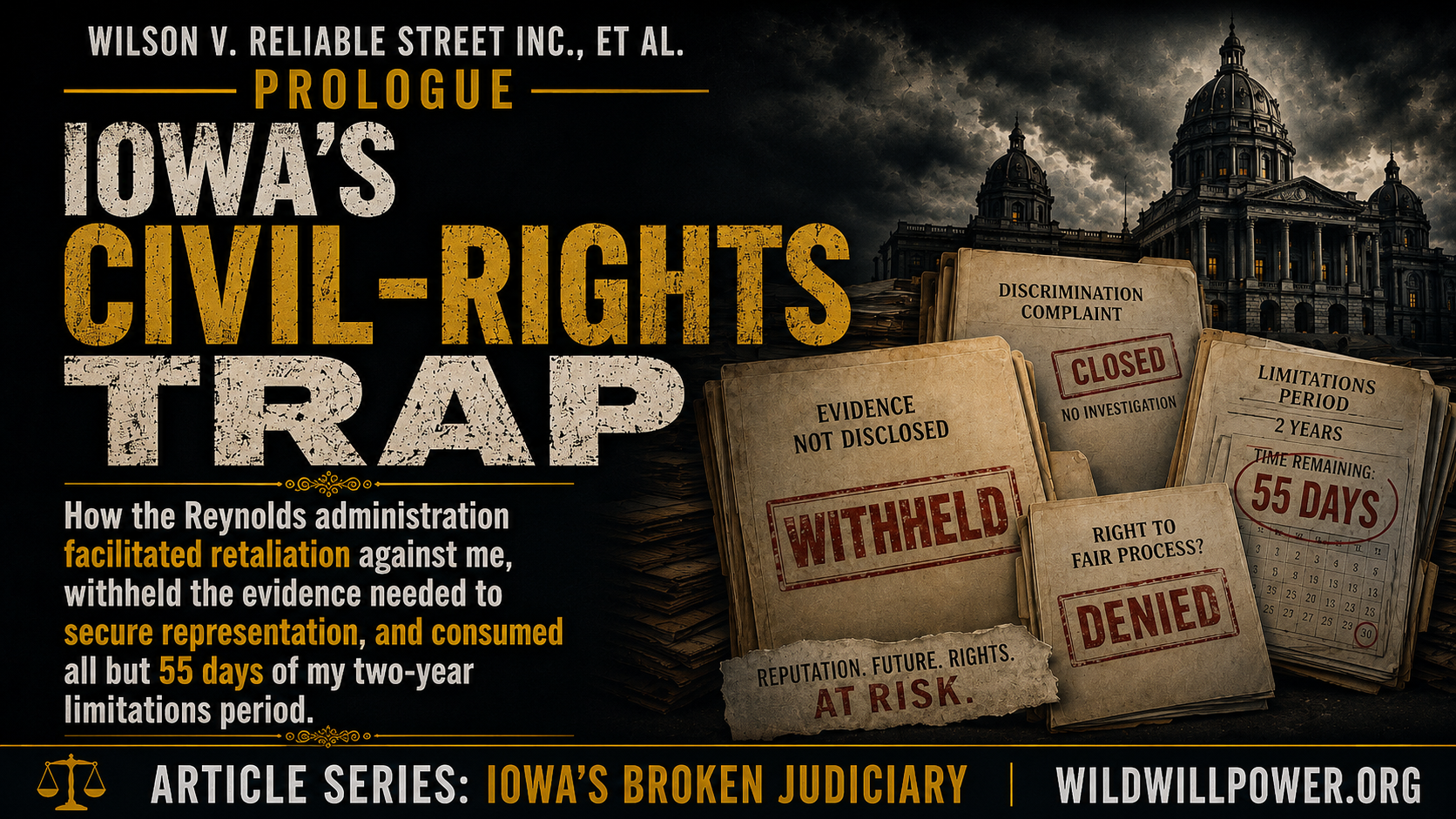
Notice: This article is currently being reworked. Please check back soon. Aug. 5, 2026.
(possible subtitle: How Iowa’s civil-rights and accountability institutions redirected, closed, or declined every avenue—until litigation without counsel became the only remaining option)
Wilson v. State of Iowa and Kim Reynolds for Iowa
Table of Contents
I. The Remedy Iowa Presented to the Public
What the Commission Led Me to Believe They Would Do
The Publicly Announced Screening Standard
Investigation, Mediation, and Reasonable Inferences
Why I Relied Upon Those Representations
II. The Trap Door Beneath the Public Standard
Closure Without Investigation
Appealing Without the Evidence
The Right-to-Sue Catch-22
What Estabrook Actually Permitted
The Disclosure Problem Identified in Estabrook
What Eilders Added
Public Promise and Legal Reality
III. The Ombudsman Revealed a Second Set of Laws the ICRC Actually Follows
What I Asked the Ombudsman to Examine
What the Office Could Not Decide
A Lawful Procedure Can Still Be Inaccessible
Why I Alleged Misrepresentation
IV. The Federal Process Adopted the ICRC's Findings Without Any Visible Examination
The Fifteen-Day Review Period
No Additional Evidence Allowed
Adoption of the State Result
Ninety Days to Enter Federal Court
A Remedy on Paper
V. Water, Water Everywhere But Not a Drop to Drink
V. Searching for Representation
More Than Fifty Attorneys and Firms
Retainers I Could Not Afford
Politically Unpopular Civil-Rights Litigation
Legal Aid and the “Fee-Generating Case” Exclusion
Law-School Clinics and Other Nonprofit Limitations
VI. Every Agency Pointed Somewhere Else
The Commission Pointed to Private Counsel
Legal Aid Could Not Take the Case
The Ombudsman Could Not Resolve the Facts
Law Enforcement Pointed Across Jurisdictions
The State Tort-Claim Process
No Institution Corrected the Record
VII. The Limitations Trap
The File Needed to Obtain Counsel
The File Withheld Until Right-to-Sue
The Ninety-Day Litigation Clock
The Two-Year Limitations Period
Fifty-Five Days Remaining
How Administrative Delay Became a Barrier to Court
VIII. What This Reveals About Civil-Rights Enforcement
A System That Assumes Representation
A System That Withholds the Information Needed to Obtain It
The Gap Between Formal Remedies and Meaningful Access
Proposed Reforms
I. The Administrative Trap
September 2022 — Trying to Appeal Without the Underlying Case File
September 30, 2022 — The Right-to-Sue Catch-22
Appealing a Summary Instead of the Evidence
November 15, 2022–January 18, 2023 — What the Ombudsman Revealed
What the Commission Broadcast to the Public
What Estabrook Said the Commission Was Actually Required to Do
Estabrook Also Described the Exact Disclosure Problem I Faced
What Eilders Added
The Contradiction the Ombudsman Exposed
Why I Alleged Fraudulent Misrepresentation
Why the Thirty-Day Appeal Was Not Meaningfully Accessible
II. Every Remaining Door Pointed Somewhere Else
Why Litigation Became the Only Remaining Option
Directed to Private Counsel I Could Not Afford
Referred to Legal Aid That Could Not Take the Case
Law Enforcement Pointed Across Jurisdictional Lines
September 20, 2022–January 9, 2023 — The EEOC Did Not Resolve the Facts
November 2, 2022 — The Civil-Rights Record Reopened an Older Court Record
2022–2023 — Two Limitations Periods Were Closing at Once
July 6, 2023–February 8, 2024 — The State Tort-Claim Process Did Not Produce a Timely Answer
September 8, 2023 — Why I Finally Requested the Right-to-Sue Letter
October 11–December 5, 2023 — Fifty-Five Days to Examine the File and File Suit
It is not merely that the ICRC made a poor decision. It is that there appears to be two different civil-rights systems: that Iowa taxpayers are unknowingly paying for, and that victims of discrimination enter into after placing their trust in the ICRC's public-facing website:
- the public-facing system described to complainants and taxpayers; and
- the legally permitted system revealed through Estabrook, Eilders, and the Ombudsman’s explanation.
A complainant enters through the public-facing promise of investigation, reasonable inferences, and no credibility determinations at screening—only to fall through a hidden trap door into case law permitting broad administrative selectivity, limited disclosure, no evidentiary hearing, and eventual redirection into private litigation.
- the March 31, 2022 exclusion;
- the April 22, 2022 ICRC complaint;
- the August 3, 2022 closure;
- the refusal to release the complete file;
- the September 8, 2023 right-to-sue request;
- the October 11, 2023 file receipt;
- the December 5, 2023 lawsuit.
But the emphasis should differ:
Why the institutions that supposedly existed to help did not supply investigation, evidence, representation, or an accessible remedy.
I. The Administrative Trap
September 2022 — Trying to Appeal Without the Underlying Case File
When the Iowa Civil Rights Commission closed my complaint, I knew I needed to challenge the decision. But I still did not possess the evidence upon which that decision had been based.
All I had was the Commission’s Preliminary Case Review—a condensed, secondhand account of what respondents, employees, patrons, and other people had allegedly said. I did not have the respondents’ complete statements. I did not have the screenshots and documents submitted alongside them. I could not determine precisely who had made each accusation, whether the agency had accurately characterized it, or whether the supporting communications had been presented with their full context and chronology.
The communications already in my possession sharply contradicted important parts of the agency’s summary. They documented invitations, approvals, delegated responsibilities, shared project expenses, affectionate messages, and continuing collaboration shortly before I was barred.
But those records could answer only what I already knew.
They could not tell me exactly what had been submitted behind the scenes.
The Preliminary Case Review therefore placed me in an extraordinary position: I could see that severe accusations had entered an official agency analysis, but I could not see the underlying materials necessary to determine how the narrative had been assembled or who was responsible for each part of it.
September 30, 2022 — The Right-to-Sue Catch-22
I contacted the Commission and asked for the complete case file—the respondents’ actual statements, screenshots, and supporting documents that had been used during screening.
I was told that I was not entitled to receive the complete file unless I requested a letter of right-to-sue. Yet the Commission also warned me that I “absolutely” should not request that letter before consulting an attorney.
The Commission's written instructions explained why that warning mattered. Once the letter issued:
- I would have only ninety days to file a civil action;
- I would have to obtain my own attorney or other representative;
- the Commission would take no further action;
- the administrative case would be closed;
- and there would be no opportunity to reopen it.
That created a circular procedural trap:
I needed the complete file to show an attorney what had happened and whether the case was viable.
I was warned to consult an attorney before requesting the right-to-sue letter.
But the complete file would not be released until I requested that letter—ending the agency process and beginning the ninety-day lawsuit deadline.
An attorney deciding whether to accept a complicated civil-rights, defamation, or fraud-related case would understandably want to inspect the actual statements and documents. But those were the very materials I could not obtain without first starting the litigation clock.
The process therefore assumed access to legal representation while withholding information that could be essential to obtaining it.
The problem was even more severe because the Commission had already closed my complaint at the screening stage. Its own public explanation of that process stated that a case would be screened in for further investigation when the information showed a “reasonable possibility” of probable cause or when the legal issues required development. It also stated that the Commission would draw rational and reasonable inferences in the complainant’s favor and would not evaluate credibility during screening.

The ICRC screening standard displayed on the Commission’s public website at the time. It stated that cases could be screened in when there was a reasonable possibility of probable cause or when the legal issues required development; that reasonable inferences would be drawn in the complainant’s favor; and that credibility would not be evaluated at screening.
My case presented precisely the kinds of unresolved conflicts that appeared to require further investigation: contemporaneous messages contradicted the respondents’ narrative; authorized work was being portrayed as unwanted; serious accusations depended upon statements and documents I had not been allowed to see; and the agency’s summary did not clearly identify who had firsthand knowledge of what.
The Commission did not need to decide at screening that I was right and the respondents were wrong. Under its publicly stated standard, it needed only to determine whether the conflicts, documentation, and undeveloped factual issues created a reasonable possibility that further investigation was warranted.
Instead, the Commission closed the complaint, preserved the respondents’ accusations in its records, and withheld the underlying submissions from me.
I was then left with two unacceptable choices:
Appeal the closure without access to the evidence used against me; or
terminate the administrative process, start a ninety-day court deadline, and attempt to obtain counsel while simultaneously preparing for litigation.
That was not simply a short deadline. It was a process that placed access to the evidence behind the very procedural step that made immediate legal representation most urgent.
The failure to investigate did not resolve the factual conflict.
It converted an unresolved civil-rights complaint into a race toward court.
Appealing a Summary Instead of the Evidence
The Commission gave me thirty days to request reconsideration and reopening.
That deadline began while the respondents’ underlying submissions remained unavailable to me. I was expected to challenge the closure using the agency’s summary of the evidence rather than the evidence itself.
I therefore appealed with what I had.
I disputed allegations that I had imposed myself upon the projects, acted without authorization, cornered or harassed people, ignored boundaries, solicited money improperly, or made racist or anti-LGBT+ comments. I explained that the open mic, flier, garden, and prairie work had been discussed and approved; that I had coordinated with management, employees, volunteers, and SHEPH; and that the contemporaneous communications did not resemble the hostile narrative summarized in the review.
But I could not directly answer statements I had not seen.
I could not compare submitted screenshots with the originals. I could not identify omitted messages. I could not determine whether communications had been presented in the correct order. I could not distinguish an employee’s actual words from management’s interpretation of them. And I could not know whether every person referenced in the agency summary had described events in the way the Commission suggested.
My appeal was therefore not merely written without counsel. It was written without access to the evidentiary record I was being asked to rebut.
That is not a meaningful opportunity to challenge an administrative decision. It is a person being asked to defend her name while the evidence used against her remains hidden.
November 15, 2022–January 18, 2023 — What the Ombudsman Revealed
After the Commission denied reopening, I sought review from the Iowa Office of Ombudsman.
On November 15, 2022, I filed a complaint with the Office of the Ombudsman, asking them to examine whether the ICRC had closed my complaint prematurely despite substantial factual contradictions. I explained that I had supplied evidence contradicting at least some of the statements summarized by the Commission. I asked the Ombudsman to review whether further investigation should have occurred and whether the allegedly false or tortious statements submitted during the process could be examined.
The Ombudsman did not determine whether the allegations against me were true.
In its January 18, 2023 response, the office explained that it was not part of the formal ICRC appeal process and lacked authority or specialized expertise to decide whether discrimination had occurred, whether the respondents’ statements were truthful, or whether the Commission had assigned appropriate weight to the evidence. Its review was largely confined to whether the Commission had followed the procedures the law allowed it to use.
The Ombudsman ultimately concluded that the ICRC had followed its administrative procedures and that my complaint against the agency could not be substantiated.
But the legal authorities cited in that response revealed something far more consequential than an ordinary procedural limitation.
What the Commission Broadcast to the Public
At the time, the Commission publicly described its screening process in concrete and reassuring terms.
Its website stated that a complaint would be screened in for further investigation if the collected information indicated a “reasonable possibility” of a probable-cause determination or if the legal issues required development.
It further stated that, during screening, the Commission would draw all rational, reasonable, and otherwise permissible inferences in the complainant’s favor.
Most importantly, it stated that the Commission did not evaluate credibility at the screening stage. Instead, it supposedly asked only whether the stated facts created a reasonable possibility of probable cause.
That description communicated an understandable promise to complainants and taxpayers:
When material facts conflict, when credibility must be assessed, when the evidence is incomplete, or when the legal issues require development, the case will proceed to investigation rather than being resolved against the complainant at screening.
My complaint presented exactly those circumstances.
The parties’ accounts sharply conflicted. Contemporaneous communications contradicted the respondents’ narrative. The Commission’s review depended upon layered statements and documents I had not been permitted to examine. Determining which account was accurate necessarily involved questions of credibility, context, authorship, and intent.
Yet the case was closed without investigation.
What Estabrook Said the Commission Was Actually Required to Do
The Ombudsman cited Estabrook v. Iowa Civil Rights Commission, 283 N.W.2d 306 (Iowa 1979).
In Estabrook, the Iowa Supreme Court held that the legislature did not intend to require the Commission to process every complaint that generated even a minimal prima facie case of discrimination. The Court said the Commission was intended to be selective in deciding which cases to process through the agency. It further held that a complainant had no property right to have a claim pursued through the Commission and therefore was not entitled to a due-process evidentiary hearing before a no-probable-cause decision. Estabrook, 283 N.W.2d at 310–11.
A prima facie case is not merely a vague suspicion. It generally means that the complainant has presented facts which, if accepted as true, are sufficient to establish the basic elements of a claim unless rebutted.
The distinction was therefore profound.
The Commission’s website appeared to tell the public that a case presenting a reasonable possibility of probable cause—or factual and legal issues needing development—would be screened in for investigation.
But Estabrook said the Commission was not legally required to process every complaint even when it presented a minimal prima facie case.
The public standard sounded like an evidentiary threshold.
The case law described broad administrative discretion.
Those are not the same thing.
Estabrook Also Described the Exact Disclosure Problem I Faced
The majority in Estabrook rejected a constitutional right to a full evidentiary hearing at the probable-cause stage. But the special concurrence identified the danger created when the complainant is not told what the opposing party submitted.
The concurring justices observed that the complainant in that case had not been informed of the employer’s version of events or the contents of the investigative file. They explained that a person in that position proceeds blindly because the person does not know what contentions must be rebutted. They suggested that even a simpler disclosure process—informing each party of the other’s version and allowing a response—could reduce the risk of error without requiring a full trial-like hearing.
That was almost exactly my situation.
The Commission summarized severe accusations against me, referenced statements and supporting communications, and then closed the case. But it did not provide the respondents’ actual submissions, identify clearly who was responsible for each statement, or allow me to compare the submitted materials with the originals before the screening decision was made.
I was expected to respond to an adverse narrative while being denied the record from which that narrative had been built.
The very risk recognized in the Estabrook concurrence had become the operating structure of my case.
What Eilders Added
The Ombudsman also cited Sun O. Eilders v. Iowa Civil Rights Commission and Dayco Products, Inc., No. 00-1277 (Iowa Ct. App. Apr. 10, 2002).
That case reinforced the distinction between the Commission’s preliminary process and a contested judicial proceeding. The Commission’s determination process was not treated as a full evidentiary trial in which witnesses are examined, credibility is formally resolved, and each side receives the complete procedural protections associated with court.
The practical effect was that the process presented to complainants as a civil-rights remedy did not necessarily provide the procedural mechanisms needed to determine whether serious accusations were true.
The fuller protections existed only after leaving the agency, obtaining a right-to-sue letter, securing counsel if possible, and commencing litigation.
But obtaining that right-to-sue letter simultaneously:
- ended the Commission’s involvement;
- permanently closed the administrative case;
- triggered a ninety-day court deadline;
- and was the prerequisite for obtaining the complete agency file.
The administrative remedy therefore pointed directly toward a court system that many complainants cannot afford to enter.
The Contradiction the Ombudsman Exposed
The Ombudsman’s response revealed that the Commission’s public description and its legally enforceable obligations were materially different.
The public-facing message was:
We screen in cases when there is a reasonable possibility of probable cause, when legal issues require development, and without deciding credibility against the complainant.
The legal framework described by the Ombudsman was:
The Commission may remain selective even when a complaint presents a prima facie case; the complainant has no property right to have the case processed through the agency; no full evidentiary hearing is required; and the unresolved claim may instead be carried into court.
That was not merely disappointing.
It fundamentally changed my understanding of what the State had represented the civil-rights process to be.
A reasonable complainant reading the Commission’s website could believe that serious factual disputes, contradictory evidence, and credibility questions would lead to investigation. A reasonable taxpayer could believe that the agency was funded and operated to examine potentially meritorious discrimination complaints under the standards it publicly announced.
But the authorities supplied by the Ombudsman showed that the Commission could close a case despite a prima facie showing and without providing the complainant a trial-like opportunity to confront the opposing evidence.
The website described a threshold for investigation.
The case law preserved discretion not to investigate.
Why I Alleged Fraudulent Misrepresentation
That discrepancy became the foundation of the fraudulent-misrepresentation theory I later pleaded in Wilson v. State of Iowa and Kim Reynolds for Iowa.
My position was not merely that the Commission reached the wrong conclusion in my individual case.
My position was that the State publicly represented the ICRC as a meaningful, evidence-sensitive civil-rights remedy while the governing legal framework allowed the Commission to:
- decline to process a complaint even when it presented a prima facie case;
- resolve screening without a full evidentiary hearing;
- withhold the respondents’ underlying submissions from the complainant;
- deny reconsideration before the complainant could inspect the evidence;
- and direct the complainant toward private litigation as the place where fuller procedural protections supposedly existed.
For an unrepresented, low-income complainant, that difference is not academic.
It changes whether filing with the Commission offers a genuine opportunity for investigation or merely consumes time before the person is forced into court.
In the State petition, I alleged that presenting the screening process publicly in one manner while relying upon a materially different legal reality misled both discrimination complainants and Iowa taxpayers. I argued that if the Commission was not obligated to screen in even a prima facie case, that limitation should have been disclosed plainly on the same public page that described the “reasonable possibility” standard.
The court did not adjudicate whether that theory was correct. The State case was dismissed on procedural grounds, and the merits of the fraudulent-misrepresentation allegation were never resolved.
But the contradiction that produced the claim remains:
The Commission told the public that unresolved evidence and undeveloped legal issues could warrant investigation.
The Ombudsman showed me case law saying the Commission could decline to process even a prima facie case.
The Commission then withheld the evidence, closed my complaint, and directed me toward litigation I could not afford.
The Ombudsman did not correct the administrative record.
It revealed why the administrative process might never correct it at all.
That was the deeper discovery: what had appeared to be an accidental failure in my individual case was supported by a legal structure that permitted the Commission to promise investigation publicly while retaining broad discretion not to provide it.
Why the Thirty-Day Appeal Was Not Meaningfully Accessible
The thirty-day reconsideration period was especially difficult because I was attempting to respond to severe and reputation-damaging accusations while experiencing significant emotional distress.
Every attempt to work through the appeal required me to revisit allegations that I believed were false, organize months of communications, reconstruct multiple projects and relationships, and answer a layered narrative without access to the submissions from which it had been created.
At times I could write only a sentence or two before becoming physically ill and needing to stop.
A short appeal period may look reasonable when viewed as a date on a form. It looks very different when the complainant is traumatized, unrepresented, denied the underlying file, and expected to reconstruct months of evidence while attempting to identify statements whose authors and context remain unclear.
That experience is why my proposed reforms call for:
- extending the reconsideration period to sixty days;
- providing complainants timely access to the materials used in screening;
- clearly identifying who made each material allegation;
- and adopting trauma-informed procedures for people attempting to challenge an administrative closure.
An appeal is not meaningful merely because a deadline and mailing address are provided. It must offer a realistic opportunity to understand and answer the grounds upon which the decision was made.
ICRC → private counsel → legal aid → Ombudsman → EEOC → police and prosecutors → Attorney General or State Appeal Board → court without counsel.
Every institution existed, but none supplied the combination I needed:
- access to the evidence;
- an investigation of the disputed facts;
- affordable representation;
- correction of the record;
- or a realistically accessible hearing.
After the civil-rights process failed, I attempted to invoke the State’s own tort-claim process. That process produced no timely substantive answer, and the State later relied upon a procedural withdrawal requirement to argue that I had not properly exhausted the remedy.
Iowa points people toward remedies and then uses the complexity of those remedies to prevent adjudication.