Wilson v. State of Iowa and Kim Reynolds for Iowa—Part One:
Intersex in Iowa
False Arrests. Malicious Prosecutions. Corruption in the Courts.
The events that drove me into years of homelessness—now documented so no Iowan endures them again.
By Sondra Wilson | Updated August 4, 2026
The events documented on this page eventually became part of Wilson v. State of Iowa and Kim Reynolds for Iowa, the civil-rights and state-accountability lawsuit I filed in 2024.
But they began almost eighteen years earlier.
When I returned to Iowa in 2006, I did not know that my experiences were unfolding against more than a century of state history in which LGBT+, gender-nonconforming, intersex, and other socially disfavored Iowans had been criminalized, confined, sterilized, excluded from legal protection, or denied meaningful remedies through Iowa’s institutions.
I knew none of that history at the time.
I did not know that Iowa had once authorized sterilization of people classified as “moral or sexual perverts.” I did not know about the 1955 Sioux City roundup, in which homosexual men were confined as supposed “sexual psychopaths” despite having no connection to the murders that triggered the panic. And I did not know that in 1983 the Iowa Supreme Court had expressly acknowledged discrimination against a transgender woman while nevertheless holding that Iowa’s Civil Rights Act gave her no remedy. That history is documented separately in Before the Culture War: Iowa’s Dark History of Persecuting LGBT+ People, 1838–2006.
Read the historical timeline: Before the Culture War

What happened to me beginning in 2006 therefore did not emerge from nowhere.
I was a young intersex Iowan. Intersex is a broad term for people born with physical sex characteristics—such as chromosomes, reproductive anatomy, hormones, or secondary sexual characteristics—that do not fit typical definitions of exclusively male or female bodies. In my case, I developed female secondary sex characteristics, including breasts, during puberty without medical intervention. A doctor later told me that he suspected I might have Klinefelter syndrome, a chromosomal variation commonly associated with an extra X chromosome, although I was never genetically tested to confirm that diagnosis.
By my early twenties, I was experiencing severe gender dysphoria and sought medical care as an adult to bring my body into greater alignment with my gender. In 2006, I was undergoing that treatment, but I had not yet legally changed my name or the sex designation on my records. When police encountered me, I provided the identifying information associated with those records and explained that I was transgender.
This occurred less than a year before Iowa added gender identity to the Iowa Civil Rights Act.
What followed included arrests I contend were made under false pretenses, prosecutions I contend were malicious, a conviction entered despite exculpatory testimony, years of fear and homelessness, and—unknown to me at the time—court records that I would not fully examine until 2022.
Those later discoveries changed my understanding of what had happened.
After accusations entered the Iowa Civil Rights Commission record in the Reliable Street matter, I reopened the old 2006–2009 dockets. I then discovered that an attorney I had trusted had entered guilty pleas I maintain I never authorized, and I found information showing that the judge who later convicted me in the 2009 assault case had previously been identified as someone whose involvement raised a recusal issue.
That discovery helped lead to the 2024 State case.
May 22, 2006 — Arrested Under False Pretenses in Ames, Iowa
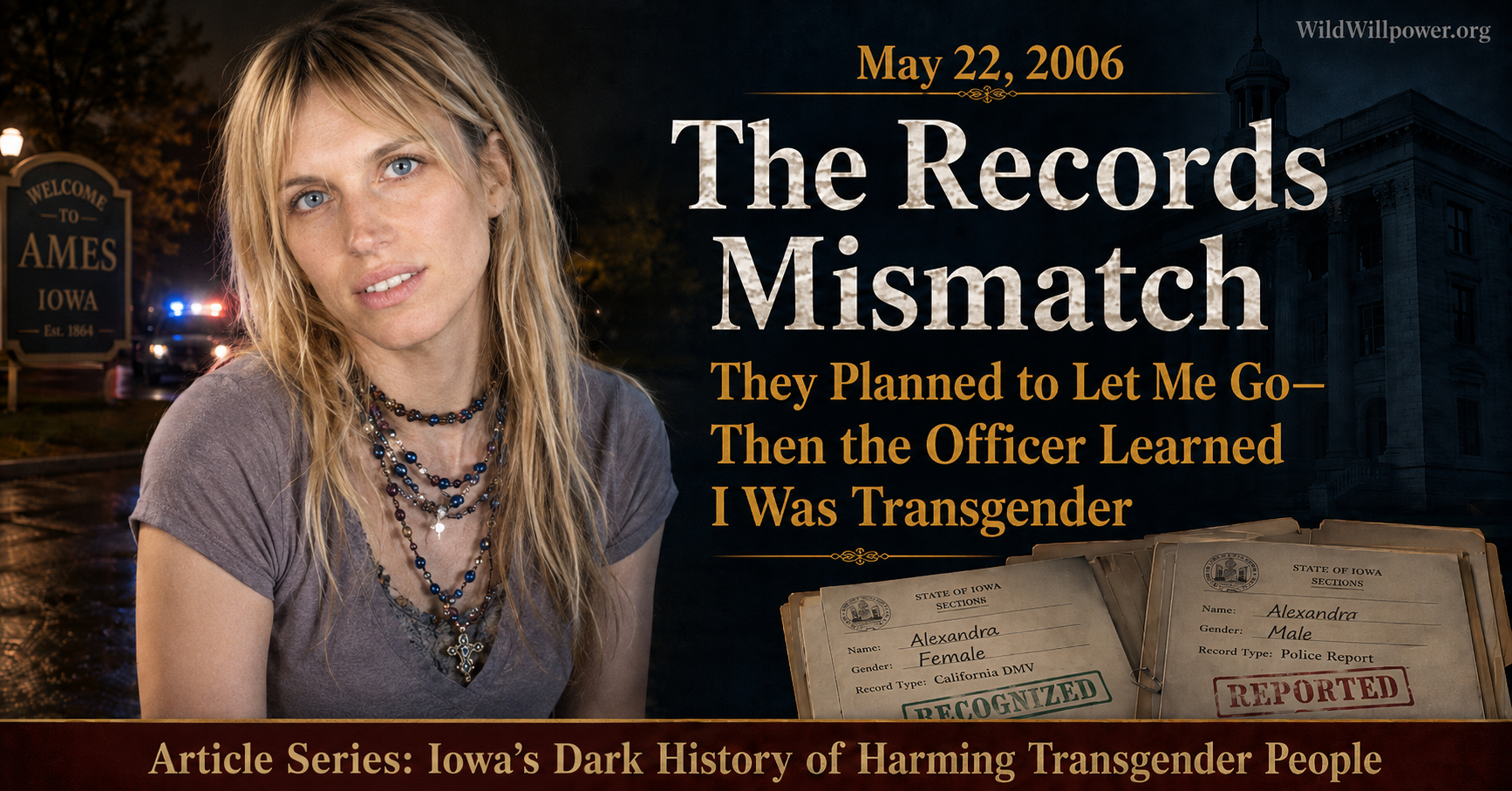
This brief article describes an incident outside a Kum & Go in west Ames, where I was playing guitar off to the side of the building. Two officers approached and asked for my ID. I didn't have it, so I gave them my name and social security number. The officers went to their vehicle and ran my name.
Upon returning, Officer Marshall's demeanor toward me was much more stern. He told me my name came up as "Alexander". I told him I was transgender, and was in the process of transitioning. He then informed me I was under arrest for trespassing.
His partner, Officer Rivera, drove me to the jail located in my home town, Nevada, Iowa. While driving, he told me that they don't normally arrest people for playing the guitar, and that this was his partner's idea.
At the jail, a female jailor asked why I was arrested, and I told her. She seemed upset, and said something to the effect of Officer Marshall being a jerk to anyone with an "alternative lifestyle". I distinctly remember her saying those words.
From jail, I pled "not guilty" to trespassing and interference with official acts via the on-screen arraignment, promising to appear for court on July 21. I did not know what the interference charge was for at the time I pled not guilty.
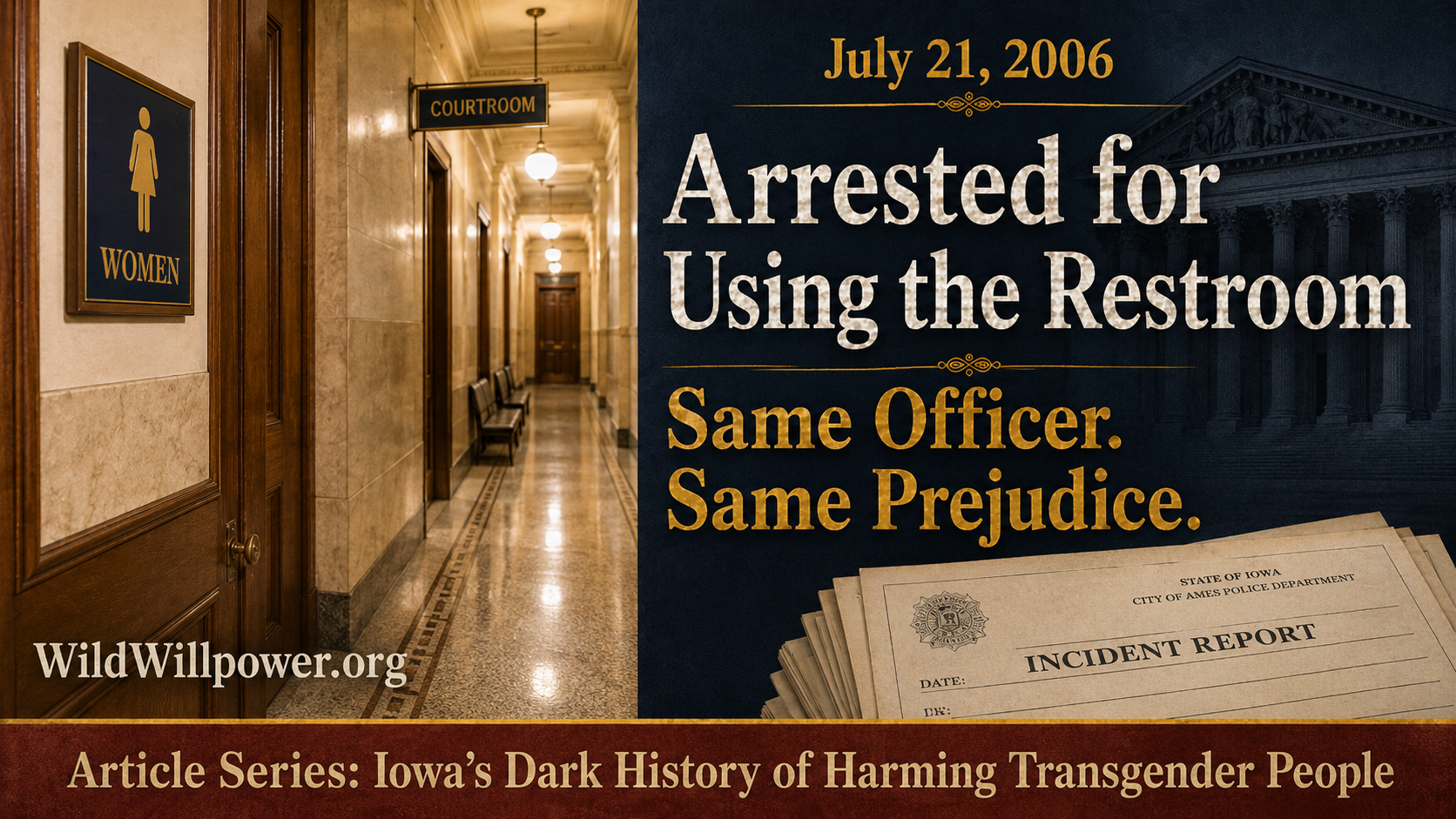
July 21, 2006 — Arrested for Using the Restroom: Same Officer. Same Prejudice.
Prior to entering the courtroom in Ames, Iowa, I used the restroom across the hall. I honestly didn't think anything of it, as it had never been an issue prior to this, while I was living and receiving medical treatment in California.
Upon exiting the restroom, Officer Marshall was waiting for me. He immediately informed me I was under arrest. I asked what for , and replied "Trespassing."
Under the impression he meant for the May 22 charge, I told him we hadn't even had the trial yet.
He informed me this was a separate charge—trespassing into the women's restroom. I wasn't prepared for and didn't expect this.
Soon after, an attorney whom I trusted came and met with me while I was in jail. He said that this was unprecedented, so I could not sue. Suing had not crossed my mind, as I didn't really know anything about law. I don't recall learning anything about law in high school, and this was only soon after.
He said that the City of Ames was willing to give me a letter of apology and $1500, and that this would help set a precedent. I accepted.
March 30, 2009 — The False Assault Charge That Drove Me Out of Iowa
Following the previous sequence of events, I left Iowa, and again visited in 2009.
While petitioning and street performing with my guitar around town, I stopped into the Culver's with a woman who seemed interested in my petition. While inside, her partner turned around and began yelling at me due to his political disagreement with the topic I was petitioning on.
I was young and rebellious, but good natured. I sat on a table behind me and began playing a song—not something I would do today, but frankly I had been through the ringer in life, and the lyrics of the song I played him were pertinent.
A manager came out and grabbed my guitar, and I pulled away, telling her I was going to finish the song and then I would leave, then strummed again.
She grabbed the guitar and I left. About a block away, an officer arrested me for allegedly "pushing and kicking her" after she asked me to leave. I never touched her.
In court, a witness she brought in testified that he saw the whole thing and I never touched her. Judge Van Marel found me guilty regardless.
Afterward, in the hallway, an officer warned me "off the record" to leave the state for my safety. He informed me that if I were hearing what he was "behind the scenes," I would leave the state for my safety. I took his word for it, and left my home state, afraid to return for years to come.

The Past Reopened in 2022—
How the Reliable Street Dispute Led Me Back to the Old Court Records
November 2022 — The Attorney who "helped" me in 2006 changed my pleas behind my back, and I discovered facts that showed Judge Van Marel was required to recuse in 2009
On Tuesday, March 29, I told an abridge version of what happened to me in 2006-2009 at Reliable Street Inc's open mic, then played the song I played at Culver's. I believed, at the time, that the community members in the space were friends based on the relationships within the space throughout the past year. Also, both Lockwood Café and Reliable Street presented themselves openly as LGBT+ friendly spaces, so I considered it a safe place to share my testimony.
Two days later, Sharon Stewart and Lyndsay Nissen barred me from the property, saying that I was accused of "violating a woman's space." However, this did not make sense and I was never informed about what I was actually accused of. This experience is documented in the Record Retaliation article within the Iowa's Broken Judiciary series.
After filing a complaint with the Iowa Civil Rights Commission in April, in August I learned about the false statements submitted to the Commission in response to my complaint. Because I remembered telling this story only two days before getting kicked out, it occurred to me what they appeared to be doing, that that they would likely bring up the criminal record I shouldn't have in order to bolster the false stalking and harassment allegations they had lodged into the government record. This was real leverage against me that put me at serious risk.
So, that November I ordered a copy of the dockets from the 2006-2009 arrests, and that is when I learned, for the first time, that the attorney who "helped" me had actually entered me into a plea agreement I was not told about. He changed my pleas from "not guilty" to "guilty" without my knowledge or consent, and framed me as a "man" within his court filings I was never shown!
But the attorney did do something right: he wrote about how Judge Van Marel ought to recuse himself from the 2009 case because apparently he directed Officer Marshall to arrest me, thus violating separation of powers.
This showed me that Judge Van Marel ought to have disqualified himself in the assault case—a fact I did not know in 2009 when he found me guilty despite the false accuser's own witness testifying the truth—that I never touched her.

The Question Iowans Should Ask
Some people may look back at 2006 and argue that, because Iowa had not yet added gender identity to its Civil Rights Act, the treatment I experienced was simply a product of the law as it existed at the time.
I do not believe that answers the deeper question.
I was an adult seeking medical care in an effort to live peacefully and honestly in my own body. I was not asking the State to approve of me. I was trying to pursue a life in which I could function, work, form relationships, and find some measure of happiness.
The Iowa Constitution begins from the principle that people possess inherent rights, including the right to pursue and obtain happiness and safety. The question is therefore not merely what protections had or had not yet been written into the Iowa Civil Rights Act.
The question is simpler:
Is this what we want to put a fellow citizen through?
A legal system can lag behind medicine, social understanding, and human experience. But the absence of an express statutory protection does not automatically make every act of humiliation, exclusion, arrest, prosecution, or institutional mistreatment morally justified.
Less than a year after these events began, Iowa added gender identity to its Civil Rights Act.
The law changed.
The injuries did not disappear.
I Came Back Hoping to Start Anew
After years of homelessness, I returned to Iowa around January 2019. My parents were getting older, and I hoped that whatever had been happening “behind the scenes” when an officer warned me in 2009 to leave Iowa for my safety had finally blown over.
By then, years of homelessness, violence, harassment, robbery, and instability had taken an enormous toll. I returned hoping to recover and rebuild my life.
For a brief moment, it seemed possible.
In March 2019, the Iowa Supreme Court ruled in Good v. Iowa Dep't of Human Servs., 924 N.W.2d 853 (Iowa 2019) that Iowa could not deny Medicaid coverage for medically necessary gender-affirming surgery through the discriminatory regulation then before the Court. After years of struggling to obtain appropriate medical care, that decision brought enormous relief.
But that relief did not last.
What followed became the next chapter of this case: renewed state efforts to restrict transgender medical care, political rhetoric and statements I allege were defamatory and helped normalize harassment, and eventually the Reliable Street dispute—where serious accusations were made against me and I once again found myself trying to clear my name.
That dispute also led me back to the old 2006–2009 court records, where I discovered information I had never known when those cases occurred.
Those events ultimately became part of Wilson v. State of Iowa and Kim Reynolds for Iowa, the civil-rights and state-accountability lawsuit I filed in 2024.
I did not receive a jury trial on that underlying factual record. Instead, the case was disposed of through procedural defenses, immunity doctrines, service issues, and other threshold rulings that I contend denied meaningful due process and prevented the underlying claims from being adjudicated on their merits.
And I remain actively litigating Wilson v. Reliable Street Inc., et al., where I am still seeking an opportunity to clear my name from accusations I contend were false.
The struggle therefore continues to be remarkably basic:
to obtain a meaningful opportunity to be heard.
I petitioned the government for redress because I believed the courts were where disputed facts could finally be examined fairly.
Instead of resolution, I have repeatedly been met with further injury.
Continue the Case
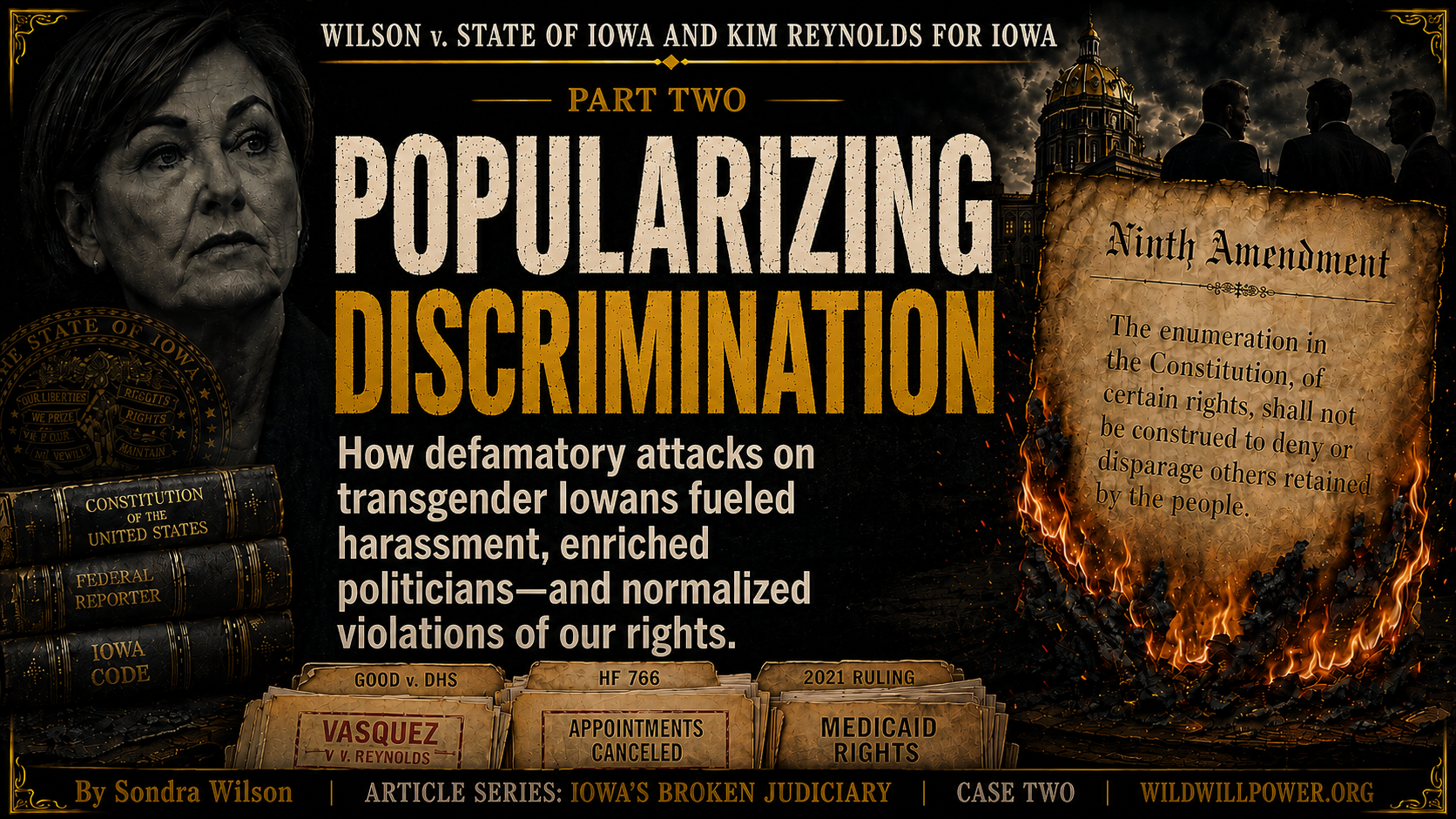
Read: Part Two—Popularizing Discrimination
How defamatory attacks on transgender Iowans fueled harassment, enriched politicians—and normalized violations of our rights.
Read the Full Case: Wilson v. State of Iowa and Kim Reynolds for Iowa
Related Case—Wilson v. Reliable Street Inc., et al.
The Reliable Street dispute is what led me back to discovering the old court records described above. That litigation became Case One of Iowa’s Broken Judiciary.
Read the Related Case: Part One: Record Retaliation