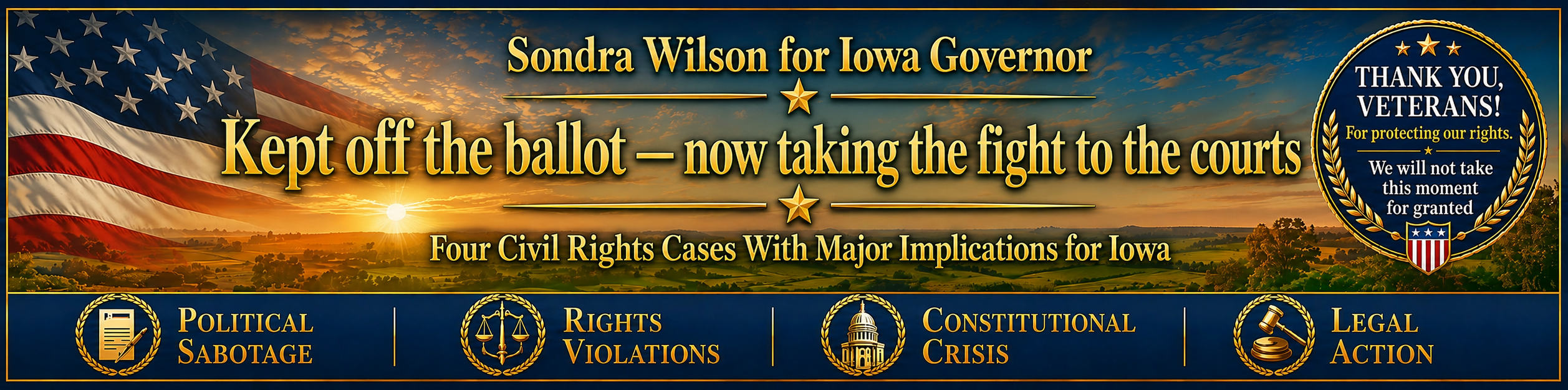
The Iowa Result
A People's Indictment and Demand for Arrests and Constitutional Redress
Written by Sondra Wilson on August 16, 2025.
This declaration, The Iowa Result, is issued in the tradition of The Essex Result, which once warned against unchecked power and laid the foundation for constitutional governance. Today, we face a crisis of equal or greater magnitude.
Under the regimes of Donald J. Trump and Iowa Governor Kim Reynolds, the United States is witnessing a rapid escalation of authoritarian infrastructure:
- Standing troops are being positioned in Washington, D.C., in violation of the Posse Comitatus Act and the spirit of civilian control over the military.
- Immigration detention centers—already operational—are expanding into a network of extrajudicial internment, targeting vulnerable populations under the guise of national security.
- Federal and state agencies are being purged and repopulated with loyalists, dismantling institutional checks and balances and enabling coordinated civil rights violations.
This is not speculative. It is unfolding in real time.
We assert that the judiciary must act immediately to:
- Cut off all funding to agencies and actors engaged in unlawful detention, surveillance, and militarization;
- Redirect resources toward lawful arrests of officials and officers who have violated constitutional and statutory protections;
- Enforce 42 U.S. Code § 1985, which prohibits conspiracies to interfere with civil rights, and
- Invoke 42 U.S. Code § 1986, which mandates arrest and prosecution of any official who had knowledge of such conspiracies and failed to prevent them.
The defense of “superior orders” shall not stand. Officers and agents who carry out unconstitutional directives are not shielded by hierarchy. They are liable under both federal and international law.
This indictment is not a symbolic gesture. It is a constitutional demand for intervention, a call for lawful arrests, and a mandate for restoration. The people of Iowa—and the United States—are entitled to protection, not persecution.
We declare that the time for neutrality has passed. The time for lawful resistance and systemic restoration has come.
📜 Preamble
We, the undersigned citizens of Iowa, in recognition of our unalienable rights and the constitutional guarantees afforded to all persons under both the Iowa and United States Constitutions, do hereby issue this declaration—The Iowa Result—as a reaffirmation of the principles laid out in The Essex Result of 1778 and as a direct challenge to the unconstitutional doctrines of sovereign and qualified immunity.
We assert that no government—state or federal—may operate above the law, nor may any officer or institution claim immunity from accountability when violating the rights of the governed. The legitimacy of government derives solely from the consent of the people, and that consent is void when the people are denied redress.
This declaration is not a symbolic rebuke. It is a constitutional demand for intervention, a call for lawful arrests, and a mandate for restoration. It is submitted in tandem with the amended petition in Wilson et al v. Trump et al, and serves as both a public record and a legal indictment.
📜 Article I: Declaration of Constitutional Crisis in the State of Iowa
We, the undersigned, declare that the State of Iowa is in a state of constitutional crisis. The government—executive, legislative, and judicial—has ceased to function as a representative republic and now operates as a self-protecting regime, hostile to the rights, dignity, and survival of its people.
This document, The Iowa Result, is not a manifesto. It is a formal indictment—a record of abuses, violations, and betrayals committed under color of law. It is a call to conscience, a demand for redress, and a blueprint for restoration.
Across every sector of governance, we observe a pattern of systemic oppression, fraudulent policy, and criminal neglect. These violations are not isolated—they are interlocking mechanisms of control, designed to suppress dissent, extract wealth, and deny redress. Each act described below constitutes a breach of federal law, a violation of constitutional guarantees, and a betrayal of public trust:
-
Removal of gender identity from the Iowa Civil Rights Act This legislative act constitutes a targeted exclusion of transgender Iowans from equal protection under the law. It violates 18 U.S. Code § 241 — Conspiracy Against Rights, originally enacted to combat Ku Klux Klan violence, and sets a precedent for state-sanctioned discrimination.
-
Criminalization of reproductive autonomy The denial of bodily autonomy and reproductive healthcare violates the Ninth Amendment and constitutes a color of law crime under 18 U.S. Code § 242 — Deprivation of Rights Under Color of Law. These policies are not merely ideological—they are coercive, punitive, and medically dangerous. See also Wilson et al. v. Trump et al., filed in the Southern District of Iowa.
-
Purging of Medicaid recipients The mass removal of vulnerable Iowans from life-saving benefits violates federal mandates and constitutes extortion under 18 U.S. Code § 872 — Extortion by Officers or Employees of the United States. These actions have resulted in preventable deaths and economic destabilization.
-
Criminalization of homelessness The bulldozing of encampments, ticketing of survival behaviors, and obstruction of humane alternatives violate the Fourth, Eighth, and Fourteenth Amendments. These acts mirror historical atrocities and constitute cruel and unusual punishment.
-
Voucher fraud and defunding of public education The redirection of public funds into private religious institutions through unconstitutional voucher schemes violates the Establishment Clause, the Iowa Constitution, and the public trust. These policies defraud students and families and undermine the foundation of civic education.
-
Detention and forced labor of immigrants The operation of corporate-run detention centers that extract labor from detainees violates the Thirteenth Amendment, the Trafficking Victims Protection Act (TVPA), and 18 U.S. Code § 1589 — Forced Labor. These facilities function as modern-day internment camps.
-
Silencing of journalists, whistleblowers, and legal advocates The coordinated exclusion, retaliation, and obstruction of those who speak out against these abuses violate First Amendment protections and constitute a conspiracy to interfere with civil rights under 42 U.S. Code § 1985 — Conspiracy to Interfere with Civil Rights.
-
Neglect by the legal community The failure of attorneys, judges, and bar associations to intervene or speak out against these violations constitutes a breach of professional duty and a violation of 42 U.S. Code § 1986 — Action for Neglect to Prevent. Silence in the face of known conspiracies is not neutrality—it is complicity.
-
Deployment of standing troops and federal purges The presence of federal agents and military-style enforcement against civilians—including surveillance, intimidation, and retaliatory purges—violates the Third Amendment and the Posse Comitatus Act. These actions constitute a domestic occupation and further erode constitutional protections.
Each Iowa legislator who signed away the rights of Iowans acted beyond their constitutional authority. These acts are not mere policy decisions—they are criminal abuses of office. They are enforceable under federal law and prosecutable under the statutes cited herein.
The invocation of sovereign immunity, the manipulation of judicial doctrine, and the weaponization of law enforcement have rendered the state unaccountable and unconstitutional. The appearance of impartiality among federal judges and Supreme Court justices has collapsed. As held in Offutt v. United States, 348 U.S. 11, 14 (1954), “Justice must satisfy the appearance of justice,” and this stringent rule may bar trial even by judges who have no actual bias but appear partial. The current judiciary fails this test.
We declare that:
-
The government of Iowa has violated its constitutional mandate and must be held to account.
-
The people of Iowa have the right and duty to seek redress, restore lawful governance, and protect one another.
-
The Iowa Result is a living document—an archive of truth, a tool for justice, and a rallying cry for systemic reform.
We call upon journalists, attorneys, educators, organizers, and everyday Iowans to read, share, and act. The time for silence has passed. The time for restoration has come.
If the Iowa State Bar Association’s neutrality or conflicts of interest prevent action, we call on attorneys to join the American Attorney Registry (AAR) and stand with the people.
⚖️ Article II: The Legal Fiction of Sovereign and Qualified Immunity
The doctrines of sovereign immunity and qualified immunity—as currently interpreted—constitute judicial fabrications that undermine the Constitution, deny equal protection, and obstruct redress for government abuses. These doctrines are not rooted in the text or intent of the Constitution. They are relics of monarchy and instruments of impunity.
🏛 Sovereign Immunity: A Monarchical Inheritance
The doctrine of sovereign immunity, as upheld in Hans v. Louisiana, 134 U.S. 1 (1890), is a judicial invention. It draws from English common law, where “the King can do no wrong,” rather than from any provision of the U.S. Constitution (Blackstone, 1765/1979). This precedent has been used to shield states from accountability, even when they violate federally protected rights.
In Iowa, the Iowa Tort Claims Act (ITCA) codifies this immunity, creating both procedural and substantive barriers to justice. The ITCA’s categorical exclusions—including immunity for false imprisonment, assault, and other intentional torts—violate the Iowa Constitution’s guarantees of liberty, due process, and equal protection (Iowa Const. art. I, §§ 1, 6, 9).
These exclusions deny meaningful remedies to victims of state violence, wrongful detention, and civil rights violations. They render constitutional protections hollow and embolden misconduct.
We declare that sovereign immunity is repugnant to a free republic and must be overturned through judicial, legislative, and civic action. No government should be immune from accountability when it violates the rights of its people.
🛡️ Qualified Immunity: An Unconstitutional Shield Against Justice
Qualified immunity is a judicially created doctrine that protects government officials from liability for constitutional violations unless a prior case has established the exact same violation under nearly identical circumstances. This standard, formalized in Harlow v. Fitzgerald, 457 U.S. 800 (1982), was not derived from constitutional text or legislative mandate—it was an activist ruling that departed from the Warren Court’s civil rights legacy and narrowed the scope of 42 U.S.C. § 1983 (Schwartz, 2017).
Rather than upholding constitutional protections, qualified immunity incentivizes novel abuses. Officials are rewarded for violating rights in ways that have not yet been litigated, while victims are denied redress unless precedent exists. This creates a jurisprudential paradox: rights exist, but they are unenforceable until someone else has already suffered the same harm.
This doctrine is inconsistent with the superior orders defense, which holds that unlawful directives do not absolve individuals of responsibility. That principle—affirmed at the Nuremberg Tribunals and codified in international law—establishes that obedience to authority is not a defense when constitutional or human rights are violated (United Nations, 1950).
Qualified immunity also violates Article III of the U.S. Constitution by forcing courts into issuing advisory opinions or avoiding constitutional rulings altogether (U.S. Const. art. III, § 2). It undermines the Equal Protection Clause by denying equal access to justice based on arbitrary precedent rather than principle (U.S. Const. amend. XIV, § 1).
In civil rights cases, this doctrine has become a barrier to enforcement rather than a tool of fairness. It distorts the intent of Reconstruction-era statutes, particularly 42 U.S.C. § 1983, which was enacted to provide remedies against state actors who violate federally protected rights (Foner, 1988).
We assert that qualified immunity is unconstitutional, unjust, and incompatible with democratic governance. It must be abolished to restore the rule of law and ensure that government officials are held to the same legal standards as the people they serve.
📚 Article III: On Historical Precedent and Civic Restoration
The foundation of constitutional governance is the enforceability of rights. As The Essex Result (1778) affirmed, “unalienable rights… ought to be clearly defined and ascertained in a BILL OF RIGHTS, previous to the ratification of any constitution” (Adams, 1778/1850, p. 230). This principle—rooted in natural law and republican theory—demands not only the articulation of rights but the availability of remedies when those rights are violated.
Iowa’s Constitution, like its federal counterpart, presupposes that remedies exist for every constitutional injury. Article I, Section 9 of the Iowa Constitution declares: “All courts shall be open, and every person… shall have remedy by due course of law” (Iowa Const. art. I, § 9). The retreat from these remedies—via doctrines such as qualified and sovereign immunity—is a retreat from republican government itself. It converts constitutional text into symbolic gesture, stripping it of enforceable meaning.
We invoke the legacy of Abraham Lincoln, who insisted that government must be “of the people, by the people, for the people” (Gettysburg Address, 1863); of Alexander Clark, whose victory in Clark v. Board of Directors (1868) desegregated Iowa schools nearly a century before Brown v. Board of Education (1954); and of the Radical Republicans of Reconstruction, who drafted the Fourteenth Amendment and 42 U.S.C. § 1983 to guarantee redress against state actors who violate federally protected rights (Foner, 1988).
These figures did not merely theorize justice—they institutionalized it. Their legacy demands a restoration of constitutional remedies and the dismantling of immunity doctrines that obstruct justice, shield unlawful conduct, and erode public trust.
To restore civic sovereignty, we must reaffirm that rights without remedies are no rights at all. Immunity doctrines must be abolished—not reformed, not narrowed, but dismantled—so that the Constitution may once again serve as a binding contract between the governed and those who govern.
🛠️ Article IV: Proposed Remedies
- Immediate repeal or amendment of ITCA provisions that bar suits for constitutional violations, especially those involving false imprisonment, assault, and abuse of power.
- Legislative recognition of constitutional torts under the Iowa Constitution, with full access to damages, injunctive relief, and punitive measures where appropriate.
- Judicial reconsideration of Hans v. Louisiana and its progeny, with amicus briefs and coordinated challenges from affected citizens and legal scholars.
- Public education campaigns to restore civic understanding of constitutional rights and the illegitimacy of immunity doctrines.
🚫 Article V: On the Removal of Gender Identity from the Iowa Civil Rights Act
We rebuke, in the strongest possible terms, the Iowa Legislature’s removal of gender identity from the Iowa Civil Rights Act—a deliberate act of exclusion that violates both the spirit and letter of constitutional law.
This removal is not a neutral policy decision. It is a targeted denial of equal protection, designed to strip transgender Iowans of legal recourse and shield the government from accountability. It is a betrayal of the very principles upon which this nation was founded.
We assert that this act constitutes a violation of 18 U.S. Code § 241, the federal statute titled Conspiracy Against Rights—originally enacted to combat Ku Klux Klan violence and government complicity. The statute makes it a federal crime for “two or more persons [to] conspire to injure, oppress, threaten, or intimidate any person in the free exercise or enjoyment of any right or privilege secured… by the Constitution or laws of the United States.”
The removal of gender identity protections is not merely discriminatory—it is a coordinated effort to suppress a class of citizens, deny them redress, and insulate the state from liability under unconstitutional doctrines of sovereign immunity.
This is precisely the behavior that the American Revolution sought to escape: a government that acts with impunity, denies remedies, and punishes dissent. In Wilson v. State of Iowa and Kim Reynolds for Iowa (2024), these violations are laid bare. The case documents how the Reynolds Administration and complicit judges have aided and abetted systemic abuses while shielding themselves from accountability.
We declare that:
- The removal of gender identity protections is unconstitutional under both the Iowa and U.S. Constitutions.
- The state’s invocation of sovereign immunity to avoid redress is a legal fiction that violates the separation of powers and the right to due process.
- The government of Iowa, in this matter, has ceased to function as a republic and now operates as a self-protecting regime.
We call upon the courts, the legislature, and the people of Iowa to restore civil rights protections, recognize the full humanity of transgender citizens, and dismantle the immunity doctrines that enable abuse.
⚖️ Article VI: On the Criminalization of Reproductive Rights
We condemn the State of Iowa’s efforts to criminalize abortion and strip reproductive autonomy from its citizens. These actions are not merely legislative—they are constitutional violations, color of law crimes, and acts of gender-based oppression.
The right to bodily autonomy is protected under the Ninth Amendment of the U.S. Constitution, which guarantees rights not specifically enumerated in the Bill of Rights. As articulated in Wilson et al v. Trump et al, the denial of reproductive freedom is both a crime and a tort, committed under the false appearance of law.
The Iowa Legislature’s abortion bans:
- Violate the Ninth Amendment’s protection of unenumerated rights.
- Contravene the Equal Protection Clause by disproportionately targeting women and gender-diverse individuals.
- Constitute color of law violations, wherein officials use the appearance of legal authority to suppress constitutionally protected freedoms.
As Benjamin Cardozo wrote in The Paradoxes of Legal Science (1928):
“Bills of rights give assurance to the individual of the preservation of his liberty. They do not define the liberty they promise.”
Liberty, in its fullest sense, includes the right to make decisions about one’s own body, health, and future. The criminalization of abortion is a state-sponsored act of coercion, designed to control and punish rather than protect.
We declare that:
- Reproductive rights are constitutionally protected and must be restored.
- The state’s abortion bans are unlawful and must be overturned.
- Violations of these rights under color of law are prosecutable offenses and must be addressed through federal and international legal mechanisms.
We call upon the people of Iowa, the federal judiciary, and international human rights bodies to recognize this crisis and act accordingly. The right to choose is not a privilege—it is a constitutional guarantee, and its denial is a crime against liberty.
🏥 Article VII: On the Violation of Medicaid Rights and Government Extortion
We denounce the State of Iowa’s systemic violation of Medicaid rights, which has placed hundreds of thousands of Iowans in harm’s way—including low-income families, children, pregnant women, seniors, and people with disabilities.
The recent purges from Medicaid eligibility, driven by budgetary motives and political agendas, have resulted in the reckless endangerment of approximately 11.8 million Americans nationwide, as documented in the July 2025 report by Annika Kim Constantino. These actions violate the Medicare and Medicaid Act, which guarantees access to essential healthcare services and due process protections.
We assert that these violations constitute extortion under color of law, as defined in 18 U.S. Code § 872:
“Whoever, being an officer or employee of the United States, takes or receives… any money or thing of value… under color of office… which is not due or authorized by law, shall be fined or imprisoned.”
By denying mandatory benefits—such as transportation to care, inpatient and outpatient services, family planning, and mental health support—while continuing to collect federal funds, Iowa officials have committed acts of extortion and fraud. These are not policy errors; they are criminal abuses of authority.
We declare that:
- The denial of Medicaid rights is a violation of federal law and constitutional protections under the Ninth Amendment.
- Government officials who perpetrate these violations are personally liable under federal criminal statutes and civil tort law.
- The state’s invocation of immunity to shield itself from accountability is unconstitutional and must be dismantled.
We call upon federal prosecutors, civil rights attorneys, and the people of Iowa to demand justice. Healthcare is not a privilege—it is a guaranteed right, and its denial is a crime against humanity.
🛑 Article VIII: On the Criminalization and Bulldozing of Iowa’s Homeless Population
We indict the Des Moines City Council, affiliated law enforcement officers, and private contractors for their coordinated campaign of terror against Iowa’s homeless population—acts which include ticketing, arresting, threatening, and bulldozing the property of unhoused residents, in violation of constitutional and statutory protections.
These abuses stem from the amendment to Ordinance 16,382, which added anti-camping provisions designed to criminalize survival. This ordinance has been weaponized to:
- Bulldoze tents and personal belongings without due process.
- Threaten jail time for sleeping outdoors.
- Block zoning approval for humane alternatives like Joppa’s Tiny Home Village.
These actions violate:
- The Fourth Amendment (unlawful seizure of property).
- The Eighth Amendment (cruel and unusual punishment).
- The Fourteenth Amendment (equal protection and due process).
- 18 U.S. Code § 872 – Extortion by officers or employees of the United States, for using public office to deprive citizens of property and safety under color of law.
We further indict Donald J. Trump, whose recent federal proposals to forcibly relocate homeless individuals into government-run encampments constitute a national policy of internment, echoing historical atrocities. These proposals criminalize poverty, violate international human rights standards, and mirror the very regimes the U.S. Constitution was designed to prevent.
We declare that:
- The bulldozing of homeless property is a crime, not a policy.
- Officers who signed citations and participated in these acts must be named, investigated, and held personally liable.
- Private companies contracted to carry out these bulldozings are complicit in civil rights violations and must face public and legal accountability.
We call upon journalists, legal advocates, and the people of Iowa to scour citations, contracts, and council records to identify perpetrators and demand justice. Homelessness is not a crime. The criminalization of survival is a moral and legal abomination, and those responsible must be held to account.
📚 Article IX: On the Unconstitutional School Voucher Program and the Siphoning of Public Funds
We indict the Iowa Legislature and Governor Kim Reynolds for enacting House File 68—the so-called “School Voucher Program”—which siphons $345 million annually from public coffers into private, overwhelmingly religious institutions. This act is a direct violation of the Establishment Clause, the Equal Protection Clause, and the state’s constitutional obligation to maintain a uniform system of public education.
Eighty-four percent of Iowa’s private schools are religious. The voucher program funnels taxpayer dollars into these institutions, effectively compelling citizens to fund religious indoctrination, in violation of the First Amendment. As Thomas Jefferson warned, this breaches the “wall of separation between Church and State.”
We assert that:
- The program violates the Iowa Constitution’s education clause, which mandates a uniform public school system.
- It constitutes fraudulent diversion of public funds, benefiting private interests at the expense of public infrastructure.
- It undermines the Fourteenth Amendment’s guarantee of equal protection by privileging families who can already afford private education.
Nationally, voucher programs have surged nearly 40% in one year, with over $6.3 billion spent on private school choice in 2023 alone. These programs disproportionately serve affluent families and destabilize public education, as documented by education policy expert Josh Cowen in The Privateers.
We declare that:
- Iowa’s voucher program is unconstitutional and must be repealed.
- Officials who enacted and administer this program are personally liable for the misappropriation of public funds.
- The redirection of tax dollars to private religious schools is a betrayal of democratic governance and a crime against civic equity.
We call upon educators, parents, and constitutional scholars to join in challenging this program in court and in public discourse. Education is a public trust—not a private commodity—and its sabotage must be met with organized resistance and legal remedy.
🧱 Article X: On the Enslavement of Immigrants Through Detention and Corporate Labor Schemes
We indict the federal government, private prison corporations, and complicit officials—including Donald J. Trump—for orchestrating a modern system of immigrant enslavement under the guise of civil detention.
Across the United States, over 50,000 immigrants are detained daily, most in privately run facilities operated by corporations like CoreCivic and GEO Group. These detainees—many of whom have committed no crime—are forced to work for as little as $1 per day, cleaning, cooking, and maintaining the very prisons that cage them.
This coerced labor is not voluntary. It is a violation of:
- The Thirteenth Amendment, which prohibits slavery and involuntary servitude.
- The Trafficking Victims Protection Act (TVPA), which criminalizes labor trafficking and coercion.
- 18 U.S. Code § 1589, which prohibits forced labor through threats, abuse, or legal coercion.
As documented in The Profitability of Inhumanity (Harvard Law School), this system is driven by corporate profit, government complicity, and white supremacist narratives that dehumanize immigrants and justify their exploitation.
We declare that:
- Immigrant detention centers operating forced labor programs are modern-day plantations, and their operators are traffickers under federal law.
- Officials who authorize, fund, or defend these programs—including Donald J. Trump—are personally liable for crimes against humanity.
- The Civilian Restoration Corps (CRC) will never participate in or benefit from immigrant slave labor, and will actively work to dismantle these systems.
We call upon legal scholars, human rights advocates, and the people of Iowa to reject this carceral economy and demand justice. No human being should be caged and rented out for profit. The CRC stands for restoration, not exploitation, and we will not be silent while slavery is rebranded as policy.
⚖️ Article XI: A Call to Iowa’s Legal Community—Where Are the Lawyers?
Iowa is home to two ABA-accredited law schools—Drake University Law School and the University of Iowa College of Law, ranked among the top 50 in the nation for Big Law placements. Each year, these institutions graduate hundreds of new attorneys, trained in constitutional law, civil rights, and the ethical duties of the profession.
Yet in the face of widespread abuses—against the homeless, immigrants, Medicaid recipients, transgender citizens, and reproductive autonomy—the silence from Iowa’s legal community has been deafening.
We ask: Where are the lawyers? Where are the firms, professors, and bar members willing to stand up for the oppressed?
If the Iowa State Bar Association’s position of neutrality, or its internal conflicts of interest, prevent attorneys from representing these classes of persons, then we call on them to join the American Attorney Registry (AAR) and work DBA (Doing Business As) until accreditation is established through the state.
As outlined in , the AAR exists to restore the legal profession’s integrity and independence. During the American Revolution, lawyers had to “jump ship” from Britain to join the cause of liberty. Today, we ask Iowa’s attorneys to do the same.
We declare that:
- The legal profession has a duty to defend the Constitution, not the institutions that violate it.
- Silence in the face of injustice is complicity, not professionalism.
- Wild Willpower PAC is actively seeking law firms, solo practitioners, legal scholars, and philanthropists willing to stand up and put their skills to work for justice.
We call upon Iowa’s legal community to rise. The time for neutrality has passed. The people of Iowa need defenders—not spectators. If the Bar will not stand with the people, then the people will build a new Bar.
✍️ Closing Declaration
Let it be known that The Iowa Result is not merely a legal document—it is a moral reckoning. We reject doctrines that elevate officials above the law and deny citizens their rightful remedies. We reclaim the Constitution as a living covenant, not a shield for the powerful. And we call upon every Iowan, every American, and every court of justice to heed this declaration and restore the rule of law.
References
42 U.S.C. § 1983 (1871).
Adams, J. (1778/1850). The Essex Result. In C. F. Adams (Ed.), The Works of John Adams, Vol. 4 (pp. 219–230). Little, Brown and Company.
Blackstone, W. (1979). Commentaries on the Laws of England (Vol. 1, original work published 1765). University of Chicago Press.
Brown v. Board of Education, 347 U.S. 483 (1954).
Clark v. Board of Directors, 24 Iowa 266 (1868).
Foner, E. (1988). Reconstruction: America's Unfinished Revolution, 1863–1877. Harper & Row.
Hans v. Louisiana, 134 U.S. 1 (1890).
Harlow v. Fitzgerald, 457 U.S. 800 (1982).
Iowa Const. art. I, §§ 1, 6, 9.
Lincoln, A. (1863). Gettysburg Address.
Schwartz, J. (2017). How Qualified Immunity Fails. Yale Law Journal, 127(1), 2–77.
United Nations. (1950). Principles of International Law Recognized in the Charter of the Nuremberg Tribunal and in the Judgment of the Tribunal.
U.S. Const. art. III, § 2.
U.S. Const. amend. XIV, § 1.
42 U.S.C. § 1983 (1871).