
Behind Closed Doors
The Court Denied My First Amendment Right to Film —
Keeping What It Was About to Do Out of the Public Eye.
By Sondra Wilson | Updated August 19, 2026

About the Case
This article is part of my documented series on Wilson v. State of Iowa and Kim Reynolds for Iowa, Polk County Case No. LACL157953.
The lawsuit sought redress for numerous injuries I alleged were caused or enabled through state and local governmental action. The underlying events are documented in substantially greater detail elsewhere in this series, including:
1. The horrible harms caused by local officials in Ames Iowa/Story County between 2006-2009, which led me to remaining homeless ever since;
2. Medicaid rights violations caused by color of law violations by Republican actors who unjustly enriched their campaigns for office via acts of defamation and promises of rights violations against transgender Iowans (using euphemisms and implications rather than directly stating it outright); and
3. The State's harmful civil-rights process that aids and abets discrimination against protected classes instead of following the process that was described on the Iowa Civil Rights Commission at the time I filed my complaint (their website was changed after
Even now, I am still homeless and suffering a great deal due to the ongoing harms that were caused at the state and local levels, as described in part throughout this series.
Thankfully, I am a guest at a woman's house whom I met at church. She is a seed that fell on fertile ground, as she has been gracious enough to provide me safety and a place to stay as I write these articles for the public to see, because my First Amendment right to film the proceedings was violated by Judge Huppert. In other words, the denial of my due process rights and keeping this case out of the public eye—or from ever seeing its day in court—was all done from behind closed doors.
My July 23, 2024 Amended Petition itself was 68 pages and requested both damages and injunctive relief intended to prevent similar future injuries. The petition expressly requested supplementary injunctive remedies “to prevent others from being harmed in the same and/or similar manners in which I have been.”
The articles in this series examine what happened when I attempted to bring those allegations into court—and the threshold legal doctrines the State invoked before the underlying factual disputes could be adjudicated.
Related: Disrecognize Government Immunity and Privilege Doctrines Where They Would Otherwise Displace Rights · A Truly Dizzying Intellect · · Strain Out a Gnat
I First Tried Iowa's Expanded News Media Process
On July 27, 2024, I contacted WHO 13 reporter and Expanded News Media Coordinator Jannay Towne on behalf of Wild Willpower PAC and requested Expanded News Media Coverage of the proceedings.
Towne replied:
“I do not believe a PAC qualifies as news media.”
She explained that she would not file the ENMC request, but expressly told me:
“You have the right to appeal the matter before a presiding Judge.”
I did exactly that.
Wild Willpower's "Request" Was Denied,
So I Notified the Court I Planned to Exercise My First Amendment Right
There is an important distinction between asking a court for a discretionary favor and notifying a court that one intends to exercise a constitutional right.
My August 5 filing did both kinds of things—but I did not characterize filming as merely discretionary.
The caption itself gave notice of a:
“RESERVATION OF RIGHT TO FILM THE PROCEEDINGS.”
and
“REQUEST FOR ALL IN-PERSON PROCEEDINGS TO BE ACCESSIBLE VIA ZOOM.”
At the beginning of the filing, I stated:
“I reserve my right to film these proceedings, a right guaranteed by the First, Ninth, and Fourteenth Amendments of the U.S. Constitution. This lawsuit is of both statewide and national interest.”
I explained why remote public access mattered:
“I request all in-person proceedings to be made available via Zoom or similar platform. There are elders in my congregation who want to attend the proceedings, as well as other interested supporters from my community and from across the state who want to attend but are unable to drive to Des Moines.”
— Plaintiff's Omnibus Resistance and Motions, Aug. 5, 2024, p. 2.
The First Amendment Authorities I Put Before the Court
I cited decisions from several federal courts of appeals.
In Glik v. Cunniffe, 655 F.3d 78, 85 (1st Cir. 2011), the First Circuit described a citizen's right to film government officials performing their duties in public as a well-established First Amendment liberty.
In Iacobucci v. Boulter, 193 F.3d 14 (1st Cir. 1999), the First Circuit held that officials lacked authority to stop peaceful recording of public officials at a town-hall proceeding where the recording violated no law.
In ACLU of Illinois v. Alvarez, 679 F.3d 583, 595 (7th Cir. 2012), the Seventh Circuit recognized audiovisual recording as necessarily connected to the First Amendment right to disseminate the resulting information.
I also cited Fordyce v. City of Seattle, 55 F.3d 436, 438 (9th Cir. 1995), and Smith v. City of Cumming, 212 F.3d 1332, 1333 (11th Cir. 2000), the latter recognizing First Amendment protection for gathering information about public officials and recording matters of public interest.
Then I stated my position unmistakably:
“Your Honor, with due respect to you and to the Court, I request [the] Court to take notice of the fact that I have a right to film the proceedings, and disseminate the footage, prior to our August 9 hearing, so that I am not hindered from doing so by any public official or anyone else during any of the upcoming proceedings.”
— Plaintiff's Omnibus Resistance and Motions, ¶ 70, p. 37.
I was not asking the court to invent a new constitutional principle for me. I was invoking First Amendment principles already recognized by federal appellate courts and asserting that those principles protected my gathering and dissemination of information concerning public officials performing governmental functions. The rulings clearly support it.
Near the conclusion of the same filing, I returned to the issue:
“Your Honor, I am honored to soon stand within the Polk County Historic Courthouse to present my case and finally have my day in court. It is my prayer that the outcome of this case—including the granting of the equitable remedies I have requested—to be of aid to all Iowans and to future generations.
There are elders within my community, and people from across the country who provided me aid during my years of homelessness, with whom I became friends and am ever grateful to, who would like to attend and show support during the proceedings. I respectfully request that all in-person proceedings also be made available to witness via Zoom....”
— Id., ¶ 71, p. 38.
I wanted witnesses.
I wanted a record.
I wanted the public to be able to see what the State argued, what I argued in response, and how the court handled a lawsuit alleging serious governmental rights violations.
Apparently, My Publicly Broadcast Proceedings Would Have Interfered
With the State's Political Agenda of Harming Transgender Iowans
As documented in the linked articles, the State’s filings, the timing of legislative actions, and the procedural anomalies in this case collectively demonstrate why transparency would have been politically inconvenient.
And there is very good reason for wanting this. I had filed the case back in February, and this filing was made in August. There were already numerous interlocutory orders on various issues that amounted to denials of justice.
At this point in the proceeding, I had already seen the State's motion to dismiss, wherein Asst. Atty. Gen Christopher Deist had put forth some highly-questionable defenses, and it had taken seven separate filings before the previous judge overseeing this case, Samantha Gronewald, finally recused. Those exchanges are posted in a separate article, Procedural Bombardment.
In other words, I could see the writing on the wall:
The court had no interest in adjudicating my case on its merits, especially when the political agenda in Iowa has been so sharply turned against transgender Iowans.
I felt, at this point in the proceedings, like I was being dealt with quietly from behind closed doors instead of having the serious harms alleged in my petition adjudicated on their merits (which they never were).
I Exercised My Rights Explicitly Because I Did Not Want to Have a "Request" Denied
In my filing, I acknowledged that Wild Willpower PAC might not qualify as “news media” for purposes of Iowa's ENMC rule.
But I made a separate constitutional argument.
I was not claiming that my First Amendment rights existed only if Iowa classified my organization as “news media.”
I argued that I possessed rights as a citizen to gather and disseminate information about governmental conduct.
The appellate cases primarily concern the recording of police and other public officials in public spaces and governmental meetings. They did not themselves decide whether a self-represented litigant has a constitutional film a proceedings for their own safety, and to inform fellow Citizens what is going on.
Although courtrooms have historically operated under additional rules governing photography, broadcasting, decorum, witness protection, fair-trial interests, and judicial administration, those rules are hard to reconcile when weighed against a constitutional right and public interest.
The First Amendment protects public access to judicial proceedings in important contexts, and public access exists in part so that citizens can observe and evaluate the operation of government. After all, "we the people" are literally the owners of our government. One need not look any further than the state or U.S. constitutions.
Further, the United States Supreme Court recognized that principle in Richmond Newspapers, Inc. v. Virginia, 448 U.S. 555, 573–81 (1980).
The Court's Entire Answer
On August 8—one day before the scheduled hearing in intended to film, the court entered its order.
It stated:
“The petitioner's request to film the proceedings currently scheduled for August 9, 2024 in this matter, as well as her request that all in-person proceedings be accessible, via Zoom are both denied without further hearing.”
That was the substantive explanation.
There was none.
The order did not discuss Glik.
It did not discuss Iacobucci.
It did not discuss Alvarez.
It did not discuss Fordyce.
It did not discuss Smith.
It did not distinguish the First Amendment principles those cases recognized from the courtroom setting before it.
It did not identify any concern about juror influence, witness intimidation, disruption, privacy, courtroom security, prejudice, or interference with a fair proceeding.
It did not explain why Zoom access could not be provided to people who could not travel to Des Moines.
It denied both requests without further hearing, and it did so only one day before the hearing.
Iowa Courts Use Their "Expanded News Media Coverage" Policy to Deprive Rights Under Color of Law
Iowa maintains specific court rules governing Expanded News Media Coverage, demonstrating that audiovisual coverage of judicial proceedings is not inherently incompatible with the administration of justice.
But that distinction did not authorize the court simply to substitute its policy for constitutional law.
18 U.S.C. § 242 "Deprivation of rights under color of law" is a federal statute that sets forth:
"Whoever, under color of any law, statute, ordinance, regulation, or custom, willfully subjects any person in any State, Territory, Commonwealth, Possession, or District to the deprivation of any rights, privileges, or immunities secured or protected by the Constitution or laws of the United States... shall be fined under this title or imprisoned not more than one year, or both...."
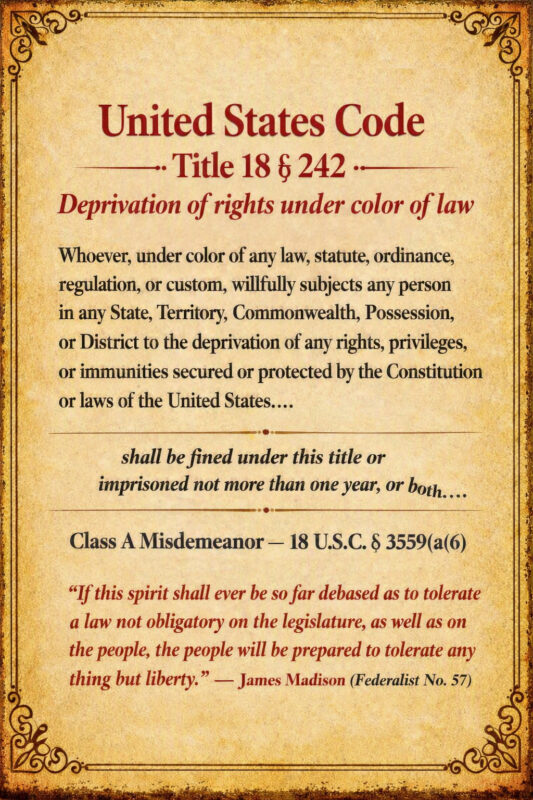
The Department of Justice expressly recognizes that the statute can apply not merely to police officers, but also to judges and other public officials, and that “under color of law” includes abuses committed while an official purports to exercise governmental authority.
I had already invoked § 242 elsewhere in my petition in reference to Iowa's Ongoing Criminal Conduct Act, so if Judge Huppert read my petition—which he presumably did—he was certainly aware the statute existed.
A court rule is not above the Constitution.
A judicial order is not above the Constitution.
And the judiciary does not acquire greater authority over constitutional rights merely because it is the institution assigned to interpret them.
My contention is straightforward:
I asserted a First Amendment right to record and disseminate information concerning public governmental proceedings.
I cited authority supporting the constitutional protection of recording governmental officials and matters of public interest.
Judge Huppert took his constitutional oath of office in 1999.
Yet, as Lord Acton famously professed, "absolute power power corrupts absolutely," and—as documented in Disrecognize—Iowa courts have granted themselves "absolute immunity" even when malicious and corrupt actions are alleged.
Judge Huppert exercised governmental authority to prevent me from exercising the right I had asserted, denied me due process and a fair trial, and dismissed my case "with prejudice" after making sure the world could not see what happened.
He didn't care. He didn't follow the law, and he denied me redress after reading about—and never mentioning once—the harms alleged and years of suffering at the hands of Iowa's employees and officials, which to this day I have not received a fair trial for.
You can read about some of the ridiculous defenses Asst. Atty. Gen. Deist put forth in the following articles.
Apparently, both Deist and Huppert thought these clever defenses were more noble than providing redress to an Iowan of lesser status, or the United States Veterans who fought and died, were wounded, and put their lives on the line to protect our rights.
A Truly Dizzying Intellect — Examines the State’s § 1983 argument that Iowa could not be sued as a “person,” even after acknowledging that the Eleventh Amendment itself does not apply in state court. The article follows the State’s reliance on Will v. Michigan Department of State Police, my contemporaneous “body politic” rebuttal, and Justice Brennan’s remarkably similar dissent in Will.
Strain Out a Gnat — Examines how Iowa’s Tort Claims Act exhaustion rules became a procedural barrier in Wilson v. State of Iowa and Kim Reynolds for Iowa, including the State’s acknowledgment that I had filed an administrative tort claim, but its argument that my failure to formally “withdraw” the still-unresolved claim barred the case from proceeding.
Disrecognize Government Immunity and Privilege Doctrines Where They Would Otherwise Displace Rights — The broader Justice Across Iowa reform article examining how doctrines such as absolute judicial immunity and state sovereign immunity can combine to prevent alleged government misconduct from ever reaching factual adjudication. It traces the history of these doctrines, including Hans v. Louisiana, and proposes replacing immunity that extinguishes redress with a system in which governmental authority carries governmental responsibility.