
Wilson v. State of Iowa and Kim Reynolds for Iowa (2024):
The State's Unconstitutional Defense of "Sovereign Immunity"
Preface on Binding Treatises to Restore Our Constitutional Republic
A Constitutional Challenge to Overturn Hans v. Louisiana (1890)
by Sondra Wilson. Posted 8/8/2024. Updated July 16, 2025.
If you have not yet, please begin by reading this legal self-help section, which should make it easier to follow this case.
In 2024 I filed a suit against the State of Iowa and against Kim Reynolds' candidate committee
On February 8, 2024 I filed a petition to commence a civil action, titled Wilson v. State of Iowa and KIM REYNOLDS FOR IOWA (case # LACL157953) in the Polk County District Court due to numerous personal injuries and continuing injuries I have suffered and continue to suffer as a direct result of:
1.) Crimes and torts committed, under color of authority, by public officials here in my home state of Iowa,
2.) Defamation by Kim Reynolds while not acting in her official capacity as Governor, but rather in her capacity as a candidate for her "candidate committee", called "Kim Reynolds for Iowa". These multiple acts of defamation were used as part of an ongoing conspiracy in order to turn the general populace against a small minority of Iowans, namely transgender and nonbinary persons, in particular, with the ultimate end goal of removing legal protections for transgender Iowans, and cutting off access to medically necessary services to such persons, through turning public sentiment against them.
Conspiracy as a Legal Term, Not a Theory
Many people, when they hear the term "conspiracy", roll their eyes, thinking that you're a "conspiracy theorist". Conspiracy, however, is an actionable legal term
- conspiracy – an agreement between two or more persons to accomplish together a criminal or unlawful act or to achieve by criminal or unlawful means an act not in itself criminal or unlawful. 16 Am J2d Consp § 1. Conspiracy is a criminal offense, a misdemeanor in some jurisdictions, a felony in others. 16 Am J2d Consp §§ 2, 3. Conspiracy is also a wrong which will constitute a cause for a civil action. 16 Am J2d Consp § 43. The cause of action is the damage suffered. it is the civil wrong resulting in damage, and not the conspiracy which constitutes the cause of action. Mox, Inc. v Woods, 202 Cal 675, 262 P 302 (Ballentine's Law Dictionary 3rd ed.).
A combination or confederacy between two or more persons formed for the purpose of committing, by their joint efforts, some unlawful or criminal act, or some act which is innocent in itself, but becomes unlawful when done by the concerted action of the conspirators, or for the purpose of using criminal or unlawful means to the commission of an act not in itself unlawful. Conspiracy is a consultation or agreement between two or more persons, either falsely to accuse another of a crime punishable by law; or wrongfully to injure or prejudice a third person, or any body of men, in any manner; or to commit any offense punishable by law; or to do any act with intent to prevent the course of justice; or to affect a legal purpose with a corrupt intent, or by improper means (Black’s Law Dictionary 2nd ed.).
An agreement by two or more persons to commit an unlawful act, coupled with an intent to achieve the agreement’s objective, and (in most states) action or conduct that furthers the agreement; a combination for an unlawful purpose. 18 USCA § 371. Conspiracy is a separate offense from the crime that is the object of the conspiracy. A conspiracy ends when the unlawful act has been committed or (in some states) when the agreement has been abandoned. A conspiracy does not automatically end if the conspiracy’s object is defeated. See Model Penal Code § 5.03(7); U.S. v. Jiminez Recio, 537 U.S. 270, 123 S. Ct. 819 (2003). — aka criminal conspiracy (Black’s Law Dictionary 10th Ed.).
conspirator – Someone who takes part in a conspiracy (Black’s Law Dictionary 10th Ed.).
co-conspirator – Someone who engages in a criminal conspiracy with another; a fellow conspirator. — aka coconspirator.
coconspirator’s exception – An exception to the hearsay rule whereby one conspirator’s acts and statements, if made during and in furtherance of the conspiracy, are admissible against a codefendant even if the statements are made in the codefendant’s absence. See Fed. R. Evid. 801(d)(2)(E). — aka coconspirator’s rule (Black’s Law Dictionary 10th Ed.).
The rule of evidence that statements made by a person involved in a conspiracy may be used as evidence of the guilt of all the conspirators (Ballentine's Law Dictionary Legal Asst. Ed.).
A Suit at Equity and Law
Throughout writings, you will see the term "suit" to describe the actions I filed.
Action at law
n action prosecuted in a law court, as distinguished from a suit in equity. An action, the purpose of which is the recovery of the sum of money or damages, or an action where the only relief obtainable or appropriate is a money judgment for damages. Royal indem. Co. v Sangor, 166 Wis 148, 164 NW 821, 9 ALR 397 (Ballanting 1969).
Suit in equity
Suit in equity An action that seeks equitable relief, such as an injunction or specific performance, as opposed to damages. An equitable remedy, usually a non-monetary one such as an injunction or specific performance, obtained when available legal remedies, usually monetary damages, cannot adequately redress the injury. * Historically, an equitable remedy was available only from a court of equity.
a court-ordered remedy that requires precise fulfillment of a legal or contractual obligation when monetary damages are inappropriate or inadequate, as when the sale of real estate or a rare article is involved. * Specific performance is an equitable remedy that lies within the court’s discretion to award whenever the common-law remedy is insufficient, either because damages would be inadequate or because the damages could not possibly be established. — aka specific relief
A judicial proceeding, either in law or in equity, to obtain relief at the hands of a court.
edia Illusion vs. Legal Reality
-
Symbolic Support: Political parties often highlight minority rights during campaigns—featuring diverse voices, quoting civil rights leaders, or promoting inclusive slogans.
-
Narrative Framing: Media outlets, especially those funded by business interests or political donors, amplify these messages to shape public perception. This creates a sense of moral alignment without scrutiny.
-
Selective Coverage: When real injustices occur—police brutality, housing discrimination, judicial bias—media may underreport, misframe, or bury the story to avoid disrupting the “community image” or alienating advertisers.
-
Legal Invisibility: Minority communities often face barriers to legal representation, especially in cases that challenge entrenched power. Even when laws exist, enforcement is weak or selectively applied.
-
Performative Politics: Elected officials may attend rallies or issue statements, but avoid policy reforms that would threaten donor interests or expose systemic failures.
A Four-Part Suit
The four-part suit had to do with the following:
- Remaining homeless and afraid to return to Iowa from 2009-2018 following multiple instances of harassment and false arrests from an Ames Police officer, and an off-the-record warning from a different officer to "leave the state for my safety:,
- Multiple acts of defamation and rights violations Kim Reynolds and numerous rights violations against transgender Iowans, including violating our "right to access medically-necessary procedures" secured by the Medicaid and Medicare Act, and guaranteed under the Ninth Amendment of the U.S. Constitution,
- Fraudulent misrepresentation by the Iowa Civil Rights Commission, and the State's lackadaisical response to businesses who defraud the agency and defame complainants in retaliation. The State aids and abets businesses who discriminate against minorities,
-
Amended Petition filed July 23
Although much happened throughout the proceedings, this article focuses on the state's unconstitutional defense of "sovereign immunity", which Asst. Atty. Gen. Christopher Deist falsely claimed was granted to the state under the Eleventh Amendment. So, without getting into what happened following my initial filing, on July 23 I filed this amended petition to commence a four-part suit at equity and law, which was also a penal action,
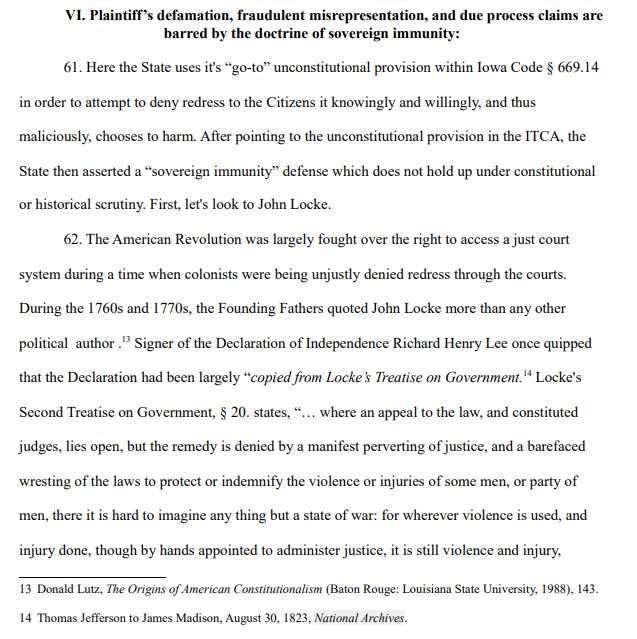
61. Here the State uses it's “go-to” unconstitutional provision within Iowa Code § 669.14
in order to attempt to deny redress to the Citizens it knowingly and willingly, and thus
maliciously, chooses to harm. After pointing to the unconstitutional provision in the ITCA, the
State then asserted a “sovereign immunity” defense which does not hold up under constitutional
or historical scrutiny. First, let's look to John Locke.
62. The American Revolution was largely fought over the right to access a just court
system during a time when colonists were being unjustly denied redress through the courts.
During the 1760s and 1770s, the Founding Fathers quoted John Locke more than any other
political author .1 Signer of the Declaration of Independence Richard Henry Lee once quipped
that the Declaration had been largely “copied from Locke’s Treatise on Government.2 Locke's
Second Treatise on Government, § 20. states, “… where an appeal to the law, and constituted
judges, lies open, but the remedy is denied by a manifest perverting of justice, and a barefaced
wresting of the laws to protect or indemnify the violence or injuries of some men, or party of
men, there it is hard to imagine any thing but a state of war: for wherever violence is used, and
injury done, though by hands appointed to administer justice, it is still violence and injury,
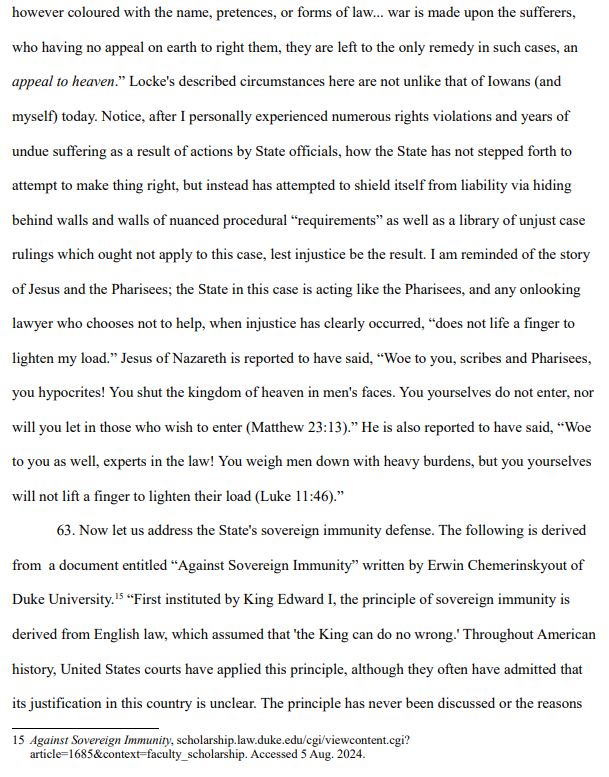
however coloured with the name, pretences, or forms of law... war is made upon the sufferers,
who having no appeal on earth to right them, they are left to the only remedy in such cases, an
appeal to heaven.” Locke's described circumstances here are not unlike that of Iowans (and
myself) today. Notice, after I personally experienced numerous rights violations and years of
undue suffering as a result of actions by State officials, how the State has not stepped forth to
attempt to make thing right, but instead has attempted to shield itself from liability via hiding
behind walls and walls of nuanced procedural “requirements” as well as a library of unjust case
rulings which ought not apply to this case, lest injustice be the result. I am reminded of the story
of Jesus and the Pharisees; the State in this case is acting like the Pharisees, and any onlooking
lawyer who chooses not to help, when injustice has clearly occurred, “does not life a finger to
lighten my load.” Jesus of Nazareth is reported to have said, “Woe to you, scribes and Pharisees,
you hypocrites! You shut the kingdom of heaven in men's faces. You yourselves do not enter, nor
will you let in those who wish to enter (Matthew 23:13).” He is also reported to have said, “Woe
to you as well, experts in the law! You weigh men down with heavy burdens, but you yourselves
will not lift a finger to lighten their load (Luke 11:46).”
63. Now let us address the State's sovereign immunity defense. The following is derived
from a document entitled “Against Sovereign Immunity” written by Erwin Chemerinskyout of
Duke University.3 “First instituted by King Edward I, the principle of sovereign immunity is
derived from English law, which assumed that 'the King can do no wrong.' Throughout American
history, United States courts have applied this principle, although they often have admitted that
its justification in this country is unclear. The principle has never been discussed or the reasons
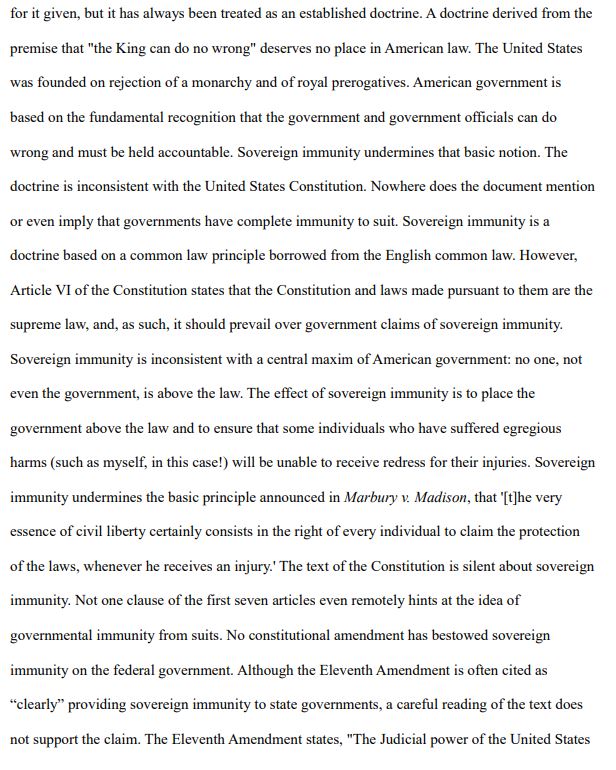
for it given, but it has always been treated as an established doctrine. A doctrine derived from the
premise that "the King can do no wrong" deserves no place in American law. The United States
was founded on rejection of a monarchy and of royal prerogatives. American government is
based on the fundamental recognition that the government and government officials can do
wrong and must be held accountable. Sovereign immunity undermines that basic notion. The
doctrine is inconsistent with the United States Constitution. Nowhere does the document mention
or even imply that governments have complete immunity to suit. Sovereign immunity is a
doctrine based on a common law principle borrowed from the English common law. However,
Article VI of the Constitution states that the Constitution and laws made pursuant to them are the
supreme law, and, as such, it should prevail over government claims of sovereign immunity.
Sovereign immunity is inconsistent with a central maxim of American government: no one, not
even the government, is above the law. The effect of sovereign immunity is to place the
government above the law and to ensure that some individuals who have suffered egregious
harms (such as myself, in this case!) will be unable to receive redress for their injuries. Sovereign
immunity undermines the basic principle announced in Marbury v. Madison, that '[t]he very
essence of civil liberty certainly consists in the right of every individual to claim the protection
of the laws, whenever he receives an injury.' The text of the Constitution is silent about sovereign
immunity. Not one clause of the first seven articles even remotely hints at the idea of
governmental immunity from suits. No constitutional amendment has bestowed sovereign
immunity on the federal government. Although the Eleventh Amendment is often cited as
“clearly” providing sovereign immunity to state governments, a careful reading of the text does
not support the claim. The Eleventh Amendment states, "The Judicial power of the United States
shall not be construed to extend to any suit in law or equity, commenced or prosecuted against
one of the United States by Citizens of another State, or by Citizens or Subjects of any
foreign state." the Eleventh Amendment only restricts suits against states that are based on
diversity of citizenship; it says that the federal judicial power does not extend to a suit against a
state by a citizen of another state or of a foreign country. Nothing within it bars a suit against a
state by its own citizens. The Constitution, of course, recognizes the existence of state
governments, but that does not give any indication of the scope of state power or the existence of
state immunity. There was no discussion of sovereign immunity at the Constitutional Convention
in Philadelphia in 1787. The issue did arise in the state ratifying conventions. The dispute was
over whether Article ill authorized suits against unconsenting states in federal court. Two of the
clauses of Article ill, § 2, specifically deal with suits against state governments. These provisions
permit suits "between a State and Citizens of another state" and "between a State … and
foreign ... Citizens." There is nothing in the text regarding immunity of states from suits by their
own Citizens!
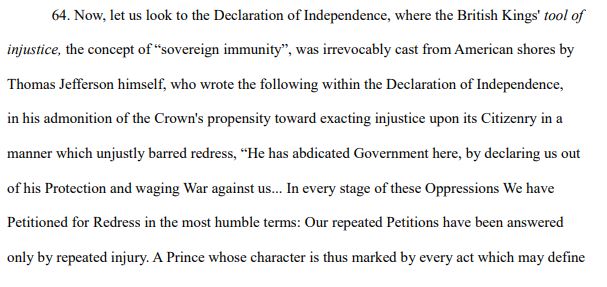
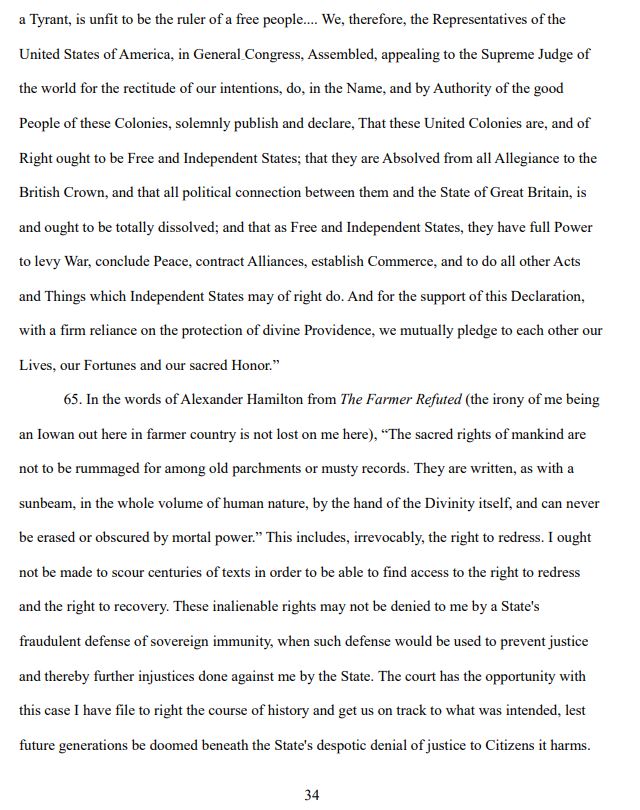
64. Now, let us look to the Declaration of Independence, where the British Kings' tool of
injustice, the concept of “sovereign immunity”, was irrevocably cast from American shores by
Thomas Jefferson himself, who wrote the following within the Declaration of Independence,
in his admonition of the Crown's propensity toward exacting injustice upon its Citizenry in a
manner which unjustly barred redress, “He has abdicated Government here, by declaring us out
of his Protection and waging War against us... In every stage of these Oppressions We have
Petitioned for Redress in the most humble terms: Our repeated Petitions have been answered
only by repeated injury. A Prince whose character is thus marked by every act which may define
a Tyrant, is unfit to be the ruler of a free people.... We, therefore, the Representatives of the
United States of America, in General Congress, Assembled, appealing to the Supreme Judge of
the world for the rectitude of our intentions, do, in the Name, and by Authority of the good
People of these Colonies, solemnly publish and declare, That these United Colonies are, and of
Right ought to be Free and Independent States; that they are Absolved from all Allegiance to the
British Crown, and that all political connection between them and the State of Great Britain, is
and ought to be totally dissolved; and that as Free and Independent States, they have full Power
to levy War, conclude Peace, contract Alliances, establish Commerce, and to do all other Acts
and Things which Independent States may of right do. And for the support of this Declaration,
with a firm reliance on the protection of divine Providence, we mutually pledge to each other our
Lives, our Fortunes and our sacred Honor.”
65. In the words of Alexander Hamilton from The Farmer Refuted (the irony of me being
an Iowan out here in farmer country is not lost on me here), “The sacred rights of mankind are
not to be rummaged for among old parchments or musty records. They are written, as with a
sunbeam, in the whole volume of human nature, by the hand of the Divinity itself, and can never
be erased or obscured by mortal power.” This includes, irrevocably, the right to redress. I ought
not be made to scour centuries of texts in order to be able to find access to the right to redress
and the right to recovery. These inalienable rights may not be denied to me by a State's
fraudulent defense of sovereign immunity, when such defense would be used to prevent justice
and thereby further injustices done against me by the State. The court has the opportunity with
this case I have file to right the course of history and get us on track to what was intended, lest
future generations be doomed beneath the State's despotic denial of justice to Citizens it harms.
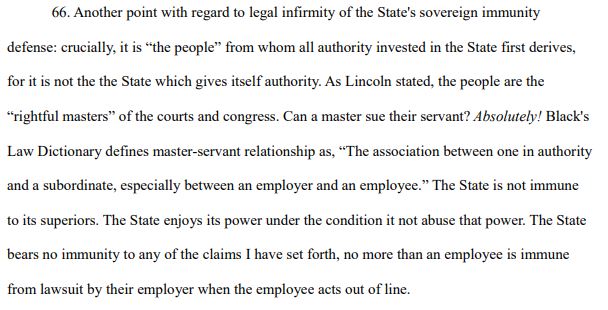
66. Another point with regard to legal infirmity of the State's sovereign immunity
defense: crucially, it is “the people” from whom all authority invested in the State first derives,
for it is not the the State which gives itself authority. As Lincoln stated, the people are the
“rightful masters” of the courts and congress. Can a master sue their servant? Absolutely! Black's
Law Dictionary defines master-servant relationship as, “The association between one in authority
and a subordinate, especially between an employer and an employee.” The State is not immune
to its superiors. The State enjoys its power under the condition it not abuse that power. The State
bears no immunity to any of the claims I have set forth, no more than an employee is immune
from lawsuit by their employer when the employee acts out of line.
1Donald Lutz, The Origins of American Constitutionalism (Baton Rouge: Louisiana State University, 1988), 143.
2Thomas Jefferson to James Madison, August 30, 1823, National Archives.
3Against Sovereign Immunity, scholarship.law.duke.edu/cgi/viewcontent.cgi?article=1685&context=faculty_scholarship. Accessed 5 Aug. 2024.
against the State of Iowa and "KIM REYNOLDS FOR IOWA" (her candidate committee, as registered with the Iowa Ethics and Campaign Disclosure Board). this amended petition Wilson v. State of Iowa and KIM REYNOLDS FOR IOWA n July 26, 2024 Christopher Deist, representing the State of Iowa, filed this motion to dismiss.
July 26 – The State filed a this motion to dismiss.
Aug. 5 – I filed this resistance to State’s motion.
Aug. 21 – Judge Huppert filed this order, dismissing my suit with prejudice. Judge Huppert wrote three false statements in this order thereby misrepresenting my position and omitting my most crucial arguments.
Sept 7 – I filed this motion to reconsider, adding numerous case rulings and arguments which ought to have led to Judge Huppert changing his ruling.
Sept 9 – Judge Huppert issued this one-sentence ruling dismissing my case. He did not address any of my arguments or case rulings. Soon I will file a complaint against him for violating Iowa Code of Judicial Conduct rules 51:1.1, 51:1.2, as well as suspected violation of 51:2.9 based on what he wrote in his Aug. 21 order, and his lack of response to line 10 within my motion to reconsider.
(page in making)
Latest Filings:
After originally filing a petition to commence the suit on February 8, on July 23 I filed this much more in-depth Amended Petition. On July 26 the State filed a this motion to dismiss, and on August 5 I filed this resistance. The next public hearing is in courtroom 310 on Friday, August 9 at the Polk County Historic Courthouse. This suit is both "at law and at equity"; in other words, I am seeking both money damages and "reasonable demands" (in the form of injunctions) as redress. The First Amendment of the US Constitution guarantees "The right of The People to Peaceably to Assemble... and to Petition the Government for a Redress of Grievances." Thank you, Veterans and Officers, for our safety and for protecting our First Amendment rights and our Fifth Amendment right to due process!!
On pages 30-35 I challenged the State's defense of "sovereign immunity" as unconstitutional. The doctrine of sovereign immunity was contrived by King Edward I and is not mentioned in the constitution. It derives from the concept that "the king can do no wrong", and its use has no place here on American shores. I quoted Thomas Jefferson, John Locke, and Alexander Hamilton in my rebuke, as their words prove unequivocally that the defense of "sovereign immunity" violates the core tenets of our government structure. Although some scholars point to the 11th Amendment as justification for sovereign immunity, there is no wording within the Amendment which supports this claim. The 11th Amendment has to do with Citizens of one state suing another state.
Here are some excerpts wherein I challenged their defense:
Now the Courts say we can't sue States in State Courts or Federal Courts — Will v. Mich. Dept. of State Police
Last year, I sued the State of Iowa and Kim Reynolds' candidate committee in Iowa's state courts, "KIM REYNOLDS FOR IOWA" (Wilson v. State of Iowa and Kim Reynolds for Iowa), due to numerous torts and crimes targeting transgender Iowans. The state argued that my case should not move forward because the state is not a “person” for the purposes of a claim brought pursuant to 42 U.S.C. §1983, relying on Will v. Mich. Dept. of State Police, 491 U.S. 58, 68-69 (1989); Quern v. Jordan, 440 U.S. 332, 345 (1979); Kruger v. Nebraska, 820 F.3d 295, 302 (8th Cir. 2016). In Will v. Mich. Dept. of State Police, the claims court ruled that respondents were persons for purposes of § 1983.
The Court of Appeals, however, vacated the judgment, holding that a State is not a person under § 1983. The Michigan Supreme Court granted discretionary review agreed that the State itself is not a person under § 1983, but held that a state official acting in his or her official capacity also is not such a person. The Michigan Supreme Court's recent (1979) rogue holding that a State is not a person under § 1983 conflicts with a number of state and federal court decisions to the contrary. Another activist ruling by a conservative, confederacy-minded court.
Previous to this, the courts in the following cases have taken the position that a State is a person under § 1983. See Della Grotta v. Rhode Island, 781 F. 2d 343, 349 (CA1 1986); Gay Student Services v. Texas A&M University, 612 F. 2d 160, 163-164 (CA5), cert. denied, 449 U. S. 1034 (1980); Uberoi v. University of Colorado, 713 P. 2d 894, 900-901 (Colo. 1986); Stanton v. Godfrey, 415 N. E. 2d 103, 107 (Ind. App. 1981); Gumbhir v. Kansas State Bd. of Pharmacy, 231 Kan. 507, 512-513, 646 P. 2d 1078, 1084 (1982), cert. denied, 459 U. S. 1103 (1983); Rahmah Navajo School Bd., Inc. v. Bureau of Revenue, 104 N. M. 302, 310, 720 P. 2d 1243, 1251 (App.), cert. denied, 479 U. S. 940 (1986). Between Hans and now these more recent rulings which I shall challenge to overturn within my federal case, the judiciary has effectively attempted to subvert our republic. The fact is that U.S. dollars are backed my more than gold: they are backed by rights, which are far more valuable than gold. If ancient Egypt can declare gold as the international standard for currency, then the U.S. can declare rights as the new standard, which I'm all for. Then that big ass debt suddenly turns into a battle scar, and we tell the world, "march for human rights!" Anyway, elect me President if you want that — let's get back to the history lesson and my proposal:
States are in fact a type of artificial person called a “body politic and corporate”:
- “The government of certain political subdivisions, including towns, cities, and counties,” (Black's Law Dictionary 10th).
- “A term often applied to a municipal corporation. A county is such a body. Waterbury v Board of Comrs. 10 Mont 515, 26 P 1002,” (Ballantine's Law Dictionary 3rd).
- “The term is particularly appropriate to a public corporation invested with powers and duties of government. It is often used... to designate the state or nation or sovereign power, or the government of a county or municipality, without distinctly connoting any express and individual corporate character. Munn v. Illinois, 94 U. S. 124, 24 L. Ed. 77; Coyle v. Mclntire, 7 Houst. (Del.) 44, 30 Atl. 728, 40 Am. St. Itep. 109; Warner v. Beers, 23 Wend. (N. Y.) 122; People v. Morris, 13 Wend. (N. Y.) 334.
Corporations are "persons": arguing otherwise is caused by lack of knowledge in the law which is causing more harm than good
First, I must reiterate in order to clarify that Wilson v. State of Iowa and Kim Reynolds for Iowa was filed in the state court last year, and should not be confused with the federal case that I and a handful of Iowans filed this year, Wilson et al v. Trump et al. Here is a summary of what this current suit entails. Although the Original Petition and corresponding Criminal Complaint only addressed the current conspiracy against transgender rights here in Iowa, after the defendants are served, I shall file an Amended Petition which includes actions and corresponding criminal charges due to the following government torts and federal crimes:


In Wilson v. State of Iowa and Kim Reynolds for Iowa, I did not list the name of every individual as a defendant, and instead sued the state as a "person" because, in law, it is in fact a type of artificial person called a body politic and corporate. Even though people all the time — especially when discussing the Citizens United ruling — argue vehemently that "corporations are not people", the court did not rule that corporations are "people", however: they ruled that they are "persons". This actually helps us in court! Remember when Ida Wells sued the big, bad railroad company during the time of Robber Barons and won in the trial court? The fact that one "person" harmed another "person" put she and the railroad on equal footing in court: it is designed to essentially makes David and Goliath the same size. We can use this to our advantage if we play our cards right! Even though Ida's case was overturned, she did not have public support. Imagine if she had a courthouse surrounded by concerned citizens, with news coverage, a group of justices who were in the spotlight, and an entire citizenry of people who are knowledgeable in the law tuned into the case — and yes, that is what I'm working to orchestrate here, because this is what we'll need when I go to court for the federal case to fight for us all. I'll keep updating the website, and it will be up to you to help spread the word!
Anyway: this is why I cited respondeat superior in Wilson v. State & Kim, which would have enabled me to sue the State as a "person" and then, under the doctrine of "let the master respond", I could have called state employees (including local officers, because local officials derive their power from the state, who derives its power from you and me) into court, via subpoenas, so we could have gotten to the bottom of it.
However, Judge Huppert, within his ruling, wrote three false pieces of information, then ruled upon what he wrote instead of what was written in the court filings. He also relied on and backed Asst. Atty. Gen. Christopher Deist's convenient and unconstitutional argument that the state was not a person for the purpose of civil rights violations, therefore I could not sue the state. When I appealed the decision, there were legal shenanigans from behind-the-scenes which I shall not get into here (it will be in my federal case!).
The point is that all this was done in order to deny my *inalienable right* to due process, and therefore it seems pretty obvious that the court is cock-blocking everyone from moving forward with civil rights cases - or at least anyone who doesn't fit a current political agenda (e.g. a transgender woman filing a class action against the State of Iowa pro se due to civil rights violations).
For those who might argue, "But the people voted for transgender people to have their rights violated," the fact is that we live in a democratic-republic. This means that when the majority harms the individual through the democratic majority, individual rights are still protected by rule of law under the republic! The democratic side of our government is supposed to be counterbalanced by our republic, and vice versa. However, when the vast majority of people have no clue what the hell a republic even is (including modern Republicans, seemingly!), we end up with this Frankenstein's Monster where apparently the majority can trample the rights of a minority, and justice seems nowhere to be found.
Had the State of Iowa courts honored the longstanding doctrine of respondeat superior instead of skirting the law, I would have been able to subpoena state officers and officials and cross-examined them on the stand so that together, a just court and I could have determined whether (a) the state is liable, or (b) the individuals acted outside the scope of their duties, and therefore were personally liable. If it had been determined the latter, the state ought to have filed a cross-claim for the civil part of my case and prosecuted them for having violated color of law crimes.
As Governor, these are the types of injustices I am going to help the State of Iowa untangle, so that Iowans today and tomorrow are never left harmed by the state, then left without redress. The first thing we need to do is throw the Iowa Tort Claims Act in the damn trash can, because it's corrupt as all sin! This article will be divided into several articles soon. For now, however, here is where some of the information is being moved to:

Moving on
The state is in fact a person, including in context with § 1983 claims, despite the fact that a few recent rogue rulings have attempted to warp this fact in order to unfairly shield states from liability for civil rights violations. If states want to avoid liability for civil rights violations, a better way is for governments and government officials to not violate the rights of Citizens. What is not acceptable is that we're living in a damn de facto confederacy here in the State of Iowa, and together, we can fix it!
The fact that the court undermined the Constitution by creating a de facto confederacy following the end of the Reconstruction Era, and then during the Civil Rights Era conveniently ruled that states are not "persons" so we can't sue them there either, while citing a British King's legal argument as their defense, proves the courts have a truly dizzying intellect:
Hans and these more recent rulings all must be overturned. It endangers minorities to expect them to have to sue and serve process against local corrupt officials, then hang out in their small town hoping they don't get a knock on their door from vigilantes. For civil rights violations, the state must help ensure safety via allowing people to sue the state so that employees may be brought before the court via respondeat superior. If it is determined that the employee acted outside the scope of their duty, the state needs to file the cross-claim and join the action, instead of putting minorities in such a vulnerable position which recklessly endangers us.
The various parts of the lawsuit:
i.Class Action for Transgender Iowans launched against the State and Kim Reynolds - for rights violations and defamation against the State, and for defamation and unjust enrichment against Kim Reynolds' campaign committee for earning more than $2.5 million dollars while using defamation and promises of rights violations against transgender Iowans to do so!
iii. Wilson alleges local officials caused her to remain homeless for 8 years
Latest Updates:
July 9: Following numerous filings, Judge Gronewald steps down
Aug. 5: I challenged sections of Iowa Code as unconstitutional; awaiting State's response
"I hope I'm helping to interrupt the other terrible agenda from that alternate timeline some people have been trying to make happen! In fact I hope that other timeline just doesn't exist at all anymore. Screw that timeline! All Iowans need this lawsuit whether they realize it or not! United We Stand!" - Sondra, with related GIF I totally feel:
Special thanks to TheLostSmiles, Marvel, Benedict Cumberpatch, and anyone who was part of this project for the amazing relevant GIF I am utilizing for First Amendment purposes in accordance with in accordance with the U.S. Copyright Office's Fair Use policy.
To Donate:
If you'd like to show support for the suits, please consider Donating to Wild Willpower PAC to help my continuing efforts.
To donate to my campaign for Iowa Governor in 2026, email SondraWilson4Governor@gmail.com because campaign contributions for that needs to go into a separate account. I am legally required, by the State of Iowa, to write "Paid for by Sondra Wilson for Iowa Governor" here.
Sondra standing by Robin Hood statue outside Nottingham Castle on February 23, 2024 during DMACC's London Abroad program: *

DISCLAIMER: Neither Des Moines Area Community College ("DMACC") nor DMACC's London Abroad program are in any way affiliated with Wild Willpower PAC or Sondra Wilson for Iowa Governor. Sondra graduated from DMACC with Honors in spring 2024, and transferred to ISU to earn her bachelor's in entrepreneurship in fall 2024.
References
Ballantine, James Arthur and Anderson, William S. (1969). Ballantine’s Law Dictionary with Pronunciations.
Third Edition. THE LAWYER’S CO-OPERATIVE PUBLISHING COMPANY. Library of Congress Catalog Card No. 68-30931.
[1]: Iowa ranked
U.S. Chamber Institute for Legal Reform. (2019). 2019 lawsuit climate survey: Ranking the states – A survey of the fairness and reasonableness of state liability systems. U.S. Chamber of Commerce.
https://instituteforlegalreform.com/wp-content/uploads/2020/10/2019_Lawsuit_Climate_Survey_-_Ranking_the_States.pdf.
Laffer, A. B., Moore, S., & Williams, J. (2025). Rich states, poor states: ALEC-Laffer state economic competitiveness index (2025 ed.). American Legislative Exchange Council.
https://www.richstatespoorstates.org/variables/state_liability_system_survey/.
Moreland, T. A. (2020). Tort reform in Iowa: Why a cap on noneconomic damages is the right policy at the right time. The Journal of Corporation Law, 45(4), 889–918.
https://jcl.law.uiowa.edu/sites/jcl.law.uiowa.edu/files/2025-03/Moreland_Final%20%281%29.pdf.