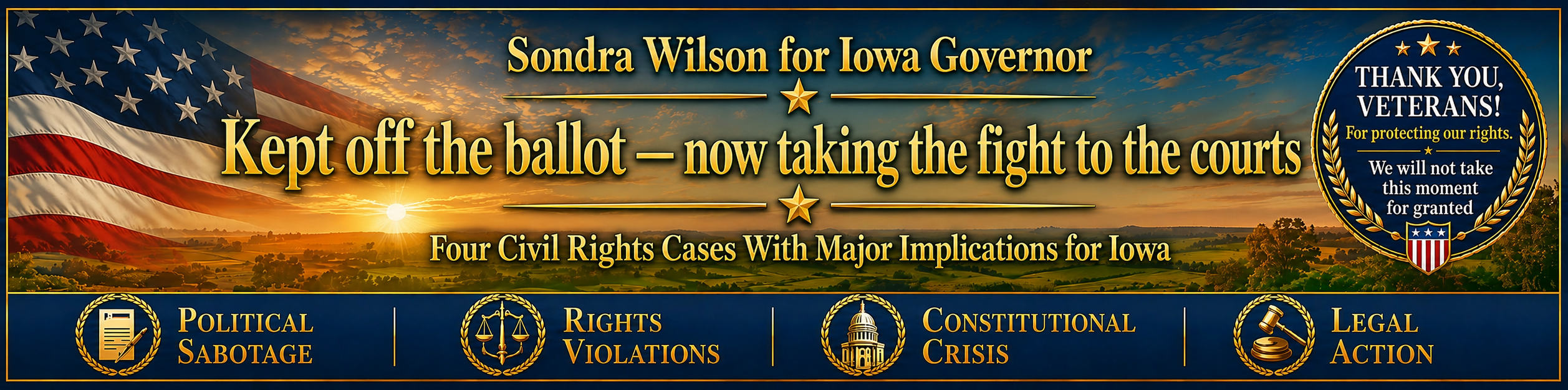
A Constitutional Challenge to Hans v. Louisiana (1890)
Four Treatises to End Sovereign Immunity
A British King's corrupt legal defense has no place on American shores
by Sondra Wilson. Updated July 16, 2025.
Additional treatises are incoming. Articles are being cinched together.
The History of the BAR Association (1234 CE-Present): First Treatise to End Sovereign Immunity
Explores the hidden history and controversial origins of the Bar Association, tracing its roots to British colonial legal systems and detailing how it evolved into a powerful, exclusive institution in the U.S. legal landscape. The Bar has systematically restricted public access to legal knowledge, concentrated power among licensed attorneys and judges, and shaped laws, built upon unconstitutional, anti-American case rulings, that often serve elite interests over justice: namely, the unconstitutional legal pseudo-doctrine of sovereign immunity. This alleged "doctrine", contrived under the rule of King Edward I and based on the premise that "a king can do no wrong", has no place within U.S. or state courts, and must be rooted out via overturning the Hans v. Louisiana 134 U.S. 1 (1890), a longstanding decision that has been sitting on the shelves collecting dust since the time it was decided; the prime example of judicial activism.... READ FULL ARTICLE.
The Pine Tree Flag; The First U.S. Flag (1603-1776): Second Treatise to End Sovereign Immunity
This piece explores the origin and significance of the Pine Tree Flag — also known as the Appeal to Heaven Flag — uncovering its deep roots, wherein John Locke defiantly refuted The Divine Rite of Kings and challenged the legitimacy and integrity of Britain's vice-admiralty kangaroo courts, which were stationed throughout the colonies. Within his Second Treatise of Government, Locke rallied the nation to war, lest their descendants be doomed to despotism beneath a false, unjust court system. Locke is the precise reason America still has our federal courts. Sondra calls Iowans, Americans, and persons in foreign nations to learn U.S. law, and fight injustices from within the system, both domestically and abroad, through U.S. embassies.... READ FULL ARTICLE.
The Gadsden Flag; The Second U.S. Flag (1754-1781): Third Treatise to End Sovereign Immunity
The article delves into the rich legacy of the Gadsden Flag, famously emblazoned with a coiled rattlesnake and the motto “Don’t Tread on Me.” With imagery inspired by Benjamin Franklin's "Join, or Die" political cartoon from 1754, and encrypted to evoke the "§" symbol found in law, the flag was created by Christopher Gadsden in 1775. The lesser known history of the flag deals in the origins of both the criminal and the civil law systems, two diametrically opposed, complimentary systems lodged today within the American legal system. After Britain's officers imposed unjust criminal law codes upon the colonists, early American Revolutionaries, including Gadsden, self-organized to form their own sets of civil officers and corresponding common law court system which was based on the Anglo-Saxon people's traditional procedural forms and customs. In 1780, British General Cornwallis and his cronies turned on and arrested Gadsden and 20 civil officers, then deported them to a prison in St. Augustine, Florida, promising "freedom of the town" if they gave up their paroles. Gadsden refused, stating that he could not give his word to a false system, and thus was detained for 42 weeks in solitary confinement. Upon his release in 1781, he returned to Yorktown and instructed the residents that South Carolina must not ratify the U.S. Constitution unless a Bill of Rights was attached. He went on to draft the first civil law code in the nation; although riddled with slave codes embedded into it at the time, civil law codes throughout the nation eventually disallowed such codes, and it may be safe to say we would not have a civil law system within the stubborn and bold refusals, and persistence of Gadsden.... READ FULL ARTICLE.
Re-Igniting Lincoln's Legacy by overturning Hans v. Louisiana (1863-1890): Fourth Treatise to End Sovereign Immunity
In this article, Sondra Wilson invokes Abraham Lincoln’s moral leadership and the foundational ideals of the Reconstruction Era — especially the ambitious efforts of Radical Republicans — to challenge modern curtailments of civil rights in Iowa. She recounts Lincoln’s presidency, the passage of the 13th–15th Amendments, and pivotal state actions like Alexander Clark’s 1868 Iowa school desegregation case, while condemning the retreat from Reconstruction marked by the Compromise of 1877. Wilson underscores the resurgence of white supremacist violence (e.g., the KKK), the rollback of federal enforcement, and the enduring consequences embodied in the Supreme Court’s Hans v. Louisiana decision. By calling for the case’s overturn, she urges Iowa Republicans to reclaim their party’s legacy and reignite a commitment to equal protection under the law.... READ FULL ARTICLE.
Please support the cause
Like these treatises? Want to help me finish writing them and get the next set of treatises edited and transcribed? All this has taken years of research and development. Every graphic design on this website, every citation, every quote: this has been my life's work, and I give it freely because I want a better future for humanity than the direction we otherwise see it going.
I would very much appreciate your support by either donating or ordering your very own, limited edition SondraCuffs DIY Citizen's Arrest Kits™:
