
Sondra Wilson Seeks to Break World Record with Garden that will End Iowa's Hunger Crisis
She's applying to model the garden at ISU, then scale it statewide through the Civilian Restoration Corps™
The initiative aims to end food insecurity in Iowa—then serve as a global blueprint to combat hunger worldwide
by Distance Everheart. Updated August 11, 2025.
I'm sure there are many different motivations behind attempts to set a world record; mine is a combination of humanitarian and political. The humanitarian aspect — central to the development of the Gardens Across Iowa!™ initiative — is deeply informed by political realities.
I intend to build my campaign and , I intend to fully launch my campaign for Iowa Governor. In the meantime, although students are often trained to write “scholarly articles” stripped of personal bias, I’ve lived long enough — and experienced enough injustice — to understand that political indifference and complicity in systemic harm are precisely what has gone wrong in our country. As a Citizen of a nation built on the principle of standing up against political tyranny, this article will not be the typical, detached academic piece you might expect.
What it is, however, is a solid plan — backed by new technology (Wild Willpower PAC, 2025a), moral integrity, and decades of hard work. While this article centers on the Model Garden I intend to spearhead to set a world record, the record itself will be among the least of its accomplishments, assuming all goes according to plan.
As you read, please understand that I am personally impacted by the fact that the defendants in the federal suit I filed — Wilson et al v. Trump et al (Wild Willpower PAC, 2025c) — chose to violate federal civil rights statutes, making it unsafe for transgender persons to work in Iowa. This is my home state. It’s not the first time I’ve suffered severe injustice due to color of law crimes (Wild Willpower PAC, 2025b), and I will continue pursuing justice through the courts and standing up for all Iowans against these oppressive regimes, while also trying to keep up with college.
I am doing everything I can to survive while managing a workload that should be handled by an office, not an individual. But if I don’t do it, no one else will — and it must be done.
If you would like to support this work — which goes beyond my campaign for Governor — the best way is through Venmo (@Sondra-Wilson-777) or PayPal (Sondra.Wilson777@gmail.com). This is a fulltime job plus overtime, with no regular ply, and I am doing the work for all of us. I'm not a nonprofit, so donations are not tax-deductible, but that also means I can perform important political work that will not be handled otherwise. I only hope it can all make a difference before it its too late, and please realize it will only make a difference if people are brave enough to stand and speak up with me.
Thank you for reading about this important garden I have designed, described below.
Table of Contents
I. Interconnected Crises the project seeks to address
II. Proven Gardening Models
III. Gardens Across Iowa!™ Proposal
IV. Guinness World Record Attempt
V. Maximizing Iowa's Economic Efficiency through Rural Farming and Urban Gardening
VI. Integrated Rollout Plan for Civilian Restoration Corps
VII. Help Bring Gardens Across Iowa!™ to Life
References
I. Interconnected Crises
this project seeks to address
This section showcases interconnected, ongoing crises Iowa is facing, which this project, once it is replicated, seeks to address.
1. Rising Grocery Prices and Food Insecurity
While grocery prices surging statewide, Iowans are facing record levels of food insecurity (Feeding America, 2025).
📊 Grocery Prices Are Climbing
🔺 6.4% Increase in grocery prices over the past 12 months → Iowa ranks among the top states for food inflation (ConsumerAffairs, 2025)
🛒 Tariff-driven price spikes hitting small grocers → Essentials like rice, coffee, and seafood up by $10 overnight (NBC Palm Springs, 2025)
⚠️ Stock-up warnings issued to Iowa shoppers → Canned goods, coffee, and produce expected to surge (Marks, 2025, K92.3 FM)
🍽️ Food Insecurity in Iowa: A Growing Crisis
📉 1 in 8 Iowans face food insecurity → That’s over 385,000 people, including 120,000 children (Feeding America, 2025)
📈 Rates rising statewide → Up from 7.3% in 2020 to 12% in 2023 → Child hunger surged from 11% to 16.6% (We Are Iowa, 2025)
⚠️ Racial disparities persist → Black Iowans: 30% food insecurity → Hispanic Iowans: 21% → White Iowans: 10% (Feeding America, 2025)
2. Out of State Landlords, Climbing Rents, Record Homelessness
Out-of-state investors are buying up rental properties around the state, driving up rental prices (River City Omaha, 2025) and contributing to a historic rise in homelessness.
🏢 Absentee Landlords Are Buying Up Iowa
📈 Corporate ownership rising → In some counties, 1 in 5 rental units now owned by out-of-state investors → Local families displaced from homes they once rented (River City Omaha, 2025)
🌐 Ownership consolidation → LLCs and REITs acquiring entire blocks of housing → Tenants face automated management, delayed repairs, and eviction threats (CitizenPortal.ai, 2025)
⚠️ Reduced accountability → Absentee landlords often bypass local ordinances → Harder for tenants to negotiate or report unsafe conditions (Iowa Landlord-Tenant Law, 2025)
💸 Rent Hikes Are Squeezing Iowans
📊 12.4% increase in Fair Market Rent (FMR) for 2BR units in 2024 (iPropertyManagement, 2025)
📍 Urban rent surges → Tenants report $200–$400 monthly increases in Des Moines, Cedar Rapids, and Iowa City → Driven by speculative buying and limited housing stock (LegalClarity, 2025)
📉 Wages lag behind → Rent up 5.57% in 2024, but wages rose only 3.48%
🛌 Homelessness Is Rising Across Iowa
📊 779 individuals counted in Polk County alone → Includes those in shelters, transitional housing, and outdoors → A 9% increase from 2024 (Homeward Iowa, 2025)
📉 Haitian refugees at risk → Loss of federal protections could lead to mass evictions → Many face homelessness or forced deportation (KIWA Radio, 2025)
🏘️ Affordable housing gap → Iowa Finance Authority calls housing for lowest-income residents “one of Iowa’s most urgent needs” → New supportive housing projects underway statewide (KSJC, 2025)
Solutions to Help the Homeless Proposed, Governments Choose Tyranny Instead
Although Joppa has raised enough money to buy land and build a sustainable village to help lift homeless Citizens off the streets, (Joppa, n.d.), the City of Des Moines chose a more tyrannical approach: passing an "anti-camping" ordinance in order to justify fines, jailtime, and even bulldozing their property (Des Moines Register, 2025; Housing Not Handcuffs, 2025).
🏘️ Joppa’s Homeless Village Faces City Pushback
🚧 Original site blocked → Joppa purchased 21 acres near the airport in 2024 → Plans scrapped after zoning resistance from Des Moines City Council (Iowa Public Radio, 2025)
📍 New site under negotiation → 5.5-acre Chesterfield School property now proposed → Council approved talks, but lease hinges on strict performance metrics (MSN News, 2025)
⚠️ Community division → Some neighbors welcome the project → Others fear crime, crowding, and property decline (WHO 13 News, 2025)
🚫 Des Moines Moves to Criminalize Homelessness
📜 Proposed camping ban → Would prohibit sleeping outdoors on public property → Includes parks, sidewalks, and underpasses (Des Moines Register, 2025)
⚖️ Legal concerns raised → Advocates warn it violates constitutional rights → Could lead to mass citations, arrests, and displacement (ACLU of Iowa, 2025)
🧍 Human impact → No guarantee of shelter beds or housing alternatives → Criminal records make future housing even harder to secure (Joppa Outreach, 2025)
⚖️ Punishment Over Solutions: A National Trend
🚜 Des Moines bulldozes homeless camps → City ordinance slashed notice period from 10 days to 3 → Belongings—including IDs and vital records—often destroyed (Our Community Now, 2024)
💼 Trump’s executive order escalates enforcement → Prioritizes funding for cities that ban camping, loitering, and squatting → Encourages involuntary institutionalization over housing-first models (White House, 2025)
📉 Federal shift away from Housing First → Redirects grants to programs requiring sobriety and treatment → Cuts support for harm reduction and mental health outreach (Boise State Public Radio, 2025)
📍 State-level crackdowns spreading → 16 states now restrict camping or loitering statewide (Housing Not Handcuffs, 2025)
II. Proven Gardening Models
I have developed a comprehensive plan — powered by the Gardens Across Iowa!™ App (Wild Willpower PAC, 2025) — that could radically transform Iowa's urban landscape in a way that, if supported, will end Iowa's food insecurity crisis and vastly improve Iowa's economy. If Iowa State University is willing to to work with me on this project via allowing me to install and test it alongside interested colleagues, the initiative aims to break the Guinness World Record for the most productive, low-maintenance garden in history (Rothman, 2022) while serving as a replicable blueprint for systemic transformation.
The Model Garden will integrate the following types of gardening practices in order to set the world record for "most productive, lowest maintenance garden":
1.) Urban gardening — proven to restore and uplift communities and kickstart local, production-based economies.
2.) High-density homesteading — one family grows 6000 lbs. on 1/10 acre annually.
3.) Permaculture —zone theory and companion planting with juxtapositioning are integrated into this plan.
4.) Innovative growing techniques — compiling brilliant gardening techniques from across the internet.
5.) Ethnobotany — near-zero maintenance native plants with edible, utility, and medicinal uses.
6.) Pharmacognosy — chemicals found in plants that are used to manufacture medicinal drugs.
7.) Native prairie buffering — beneficial for weed suppression, soil stabilization, water regulation, pollinator habitat, climate resilience.
8.) Other Techniques — trap crops, biodiversity boosters, root layering, and allelopathic and symbiotic pairings.
After garden is modeled This page will be updated as new information comes in. Contact WildWillpowerPAC@gmail.com to provide input and/or offer support.
1. Urban Gardening
The Model Garden draws inspiration from the Michigan Urban Farming Initiative (MUFI) and The Greening of Detroit (GoD). Both were catalysts for community-led recovery, especially in areas neglected by formal redevelopment efforts.
Following the 2008 collapse of the housing market and Detroit’s 2013 bankruptcy, the city faced:
- Massive property abandonment
- Food insecurity in underserved neighborhoods
- High unemployment and poverty rates (Urban Institute, 2018)
In response, residents and grassroots organizations began converting vacant lots into community gardens and urban farms, leading to:
- Local food production in areas classified as food deserts
- Job creation and youth engagement through gardening programs
- Environmental benefits like stormwater mitigation and biodiversity
- Community cohesion and public health improvements (Urban Gardening Guru, 2024; GMFUS, 2023)
The Greening of Detroit
GoD transformed over 1,400 vacant lots into productive green spaces, parks, and gardens. These efforts didn’t singlehandedly restore Detroit’s economy, but they contributed to neighborhood stabilization, civic pride, and a new model of post-industrial regeneration.

Image credit: McMahon 2018.
The Michigan Urban Farming Initiative in Detroit
Tyson Gersh and Darin McLeskey, then-students at the University of Michigan, founded MUFI in 2011 (Blum 2017), a 501c3 nonprofit that uses urban agriculture as a platform to solve social problems and develop a broader model for redevelopment for other urban communities (Michigan Urban Farming Initiative 2025).

Image: Gerard (2023).
Now, almost fifteen years later, their model sparked an "agrihood", or agricultural neighborhood, movement that spread throughout the city and beyond (Adams 2025).
2. High-Density Homesteading
The Model Garden also draws inspiration from the Dervaes family.
Family grows 6000 lbs. of food on 1/10th acre urban farm
According to a 2015 article by Tiny House Talk, the Dervaes family, Anais, Jordanne & Justin, consistently grow 6,000 pounds of food per year on their 1/10th acre urban farm near downtown Los Angeles. They grow over 400 species of plants, 4,300 pounds of vegetable food, 900 chicken and 1,000 duck eggs, 25 lbs of honey, plus seasonal fruits throughout the year.

A video about the Dervaes family by Urban Agroecology:
3. Permaculture
Zone Theory and Companion Planting
Permaculture is a design process based in observation of natural processes and systems thinking that helps people create ecologically and socially sustainable ways of living in place. The word permaculture is a contraction of permanent agriculture and culture, as cultures cannot survive long without a sustainable agricultural base and land use ethic (Occidental Arts & Ecology Center 2025).
Two techniques that will be integrated into my garden plan include permaculture zone theory and companion planting.
Zone Theory
Permaculture zone theory is a design system that divides a landscape into zones based on the frequency of human interaction and the intensity of management required. This system helps optimize resource use, minimize energy expenditure, and create a more sustainable and efficient system.
-
The center of activity, often the home or dwelling, where human needs are met and resources are managed.
-
The area closest to the home, requiring frequent attention and maintenance. It often includes vegetable gardens, herb gardens, and easily accessible plants.
-
A slightly less intensive zone with areas like fruit trees, berry bushes, and compost bins.
-
An area for larger-scale food production, like a field for crops or grazing animals, with less frequent maintenance.
-
A semi-wild area where natural processes are encouraged, such as foraging, wood collection, or minimal intervention.
-
A completely wild and unmanaged area, left to natural ecological processes.

Juxtapositioning
Juxtapositioning involves pairing plants with contrasting traits (e.g. root depth, growth rate, pest resistance) to optimize space and resources.
Example: Pair deep-rooted tomatoes with shallow-rooted lettuce to reduce competition and improve soil aeration.
Benefit: Enhances microclimates, reduces pest pressure, and improves nutrient cycling (Live to Plant 2023).
4. Innovative Growing Techniques
From Across the Internet
I am in the process of vacuuming innovative techniques from across the internet, and showcasing them here:
Double-Planter Technique for Potatoes
A clean, simple, portable way to grow potatoes, allowing gardeners to simply lift the inner pot to pluck potatoes. A great way to maximize space within your garden. To grow potatoes earlier in the season while there is still danger of frost, put a tarp over the ground to enjoy an earlier harvest.

Above image from A Piece of Rainbow's Facebook Page, used for First Amendment purposes in accordance with the U.S. Copyright Office's Fair Use Policy and the Fair Use Doctrine.
Cucumber Tipi
Vine cucumbers love to hang, allowing them to grow larger and longer, with stronger vines, and without yellowing and flattening on the underside. The large leaves grow up the tipi and provide shade to retain water within. Cucumbers like a lot of water, so this creates a perfect environment for the fruits to thrive.

Above photo by Transjardins, used for First Amendment purposes in accordance with the U.S. Copyright Office's Fair Use Policy and the Fair Use Doctrine.
Rain Gutter Hanging Strawberries
A semi-shady overhang to guard the plants beneath from direct sun doesn't get more gorgeous than this:

Above photo by HouseOfJoyNoiseBlog, used for First Amendment purposes in accordance with the U.S. Copyright Office's Fair Use Policy and the Fair Use Doctrine.
Edible Mushrooms
The hanging strawberries provide shade, and excess water drips onto the mushrooms, maximizing efficiency.

Above image from Grow Mushrooms Canada used for First Amendment purposes in accordance with the U.S. Copyright Office's Fair Use Policy and the Fair Use Doctrine.
Cold Frames
Cold frames can be used to grow root vegetables, winter greens, and salad greens year round, with snow adding insulation and trapping heat from the sun inside:

Above image by used for First Amendment purposes in accordance with the U.S. Copyright Office's Fair Use Policy and the Fair Use Doctrine.
"Shou Sugi Ban" Raised Beds
This ancient Japanese techniques prevents insects and weather from tearing apart raised beds, and without covering the wood in chemicals that leach into the soil.
Above video from James Brigioni used for First Amendment purposes in accordance with the U.S. Copyright Office's Fair Use Policy and the Fair Use Doctrine.
5. Ethnobotany
Edible, Utility, and Medicinal Uses of Wild Plants
Practiced Historically by People of Various Ethnicities
Ethnobotany is the study of how people of a particular culture and region make use of indigenous (native) plants. Plants provide food, medicine, shelter, dyes, fibers, oils, resins, gums, soaps, waxes, latex, tannins, and have many other uses. Each use is classified into edible, utility, or medicinal uses.. Many native peoples also use plants in ceremonial or spiritual rituals (U.S. Forest Service 2025; Richard Lonewolf Foundation 2025).
Disabled U.S. Army Veteran and Wilderness Survival Instructor Richard Lonewolf and I finished writing the following field guide in 2017:
More Valuable Than Gold

Some native plants which have practical, proven uses are included in this plan. A benefit of integrating the knowledge of ethnobotany into this plan is that they require very little to no maintenance aside from routine harvest. They take very easily to soil using very little to no care.
6. Pharmacognosy
Chemicals from Plants used in Modern Medicines
Pharmacognosy is the study of medicinal substances derived from natural sources—primarily plants, fungi, and marine organisms. It bridges traditional herbal knowledge with modern biomedical science, examining how bioactive compounds in nature can be used to prevent, treat, or manage disease. Long before synthetic pharmaceuticals, Indigenous cultures across the world—including those in North America—relied on pharmacognostic principles to develop complex healing systems using roots, leaves, barks, and resins. Today, many modern drugs—including aspirin (from willow bark), morphine (from poppy latex), and paclitaxel (from yew tree bark)—are derived from or inspired by plant-based compounds (Wink, 2015).
Pharmacognosy also plays a vital role in validating traditional medicine through rigorous chemical analysis, clinical trials, and safety profiling. It helps identify active constituents like alkaloids, flavonoids, terpenes, and glycosides, which have specific therapeutic actions such as anti-inflammatory, antimicrobial, or immune-modulating effects (Upton, 2013). As interest in herbal medicine and integrative health grows, pharmacognosy offers a scientific framework to support safe, effective, and culturally respectful use of botanical remedies. In the context of prairie restoration and food sovereignty, it empowers communities to reclaim ancestral knowledge while contributing to modern healthcare innovation.
7. Tallgrass Prairie Buffer
For Numerous Benefits and to Reduce Maitenance
First, if you are unfamiliar with the history of Iowa's "forgotten treasure" which gave us the rich soils we have today, here's an article I wrote in 2020.
Installing a native tallgrass prairie buffer around the perimeter of the Model Garden will be highly beneficial. Here's why:
- Weed Suppression: Deep root systems outcompete invasive shallow-rooted weeds
- Soil Stabilization: Prevents erosion and improves nutrient cycling
- Water Regulation: Enhances infiltration and reduces runoff
- Pollinator Habitat: Supports bees, butterflies, and ground-nesting birds
- Climate Resilience: Tolerates drought, frost, and extreme temperatures
Once established, tallgrass prairie is self-sustaining and requires minimal maintenance. It creates a living perimeter that will protect the garden and enhance its ecological integrity.
9. Other Techniques
to Maximize Efficiency
Trap crops, biodiversity boosters, root layering, and allelopathic and symbiotic pairings may be tested to optimize garden efficiency.
🪤 Trap Crops to Capture Pests
Trap cropping is a time-tested, eco-friendly strategy that uses sacrificial plants to lure pests away from high-value crops. These plants are selected based on pest preference and strategically placed to intercept infestations before they reach the main garden.
- Nasturtiums attract aphids, squash bugs, and whiteflies, protecting tomatoes, cucumbers, and peppers.
- Radishes lure flea beetles away from eggplants and brassicas.
- Blue Hubbard squash draws squash bugs and cucumber beetles from zucchini and melons.
- Mustard greens attract harlequin bugs and flea beetles from cabbage and broccoli.
Implementation Tips:
- Use perimeter trap cropping to surround main crops with attractant species.
- Plant trap crops 2–3 weeks earlier than main crops to intercept early pest waves.
- Monitor trap crops regularly and remove pests manually or introduce predators.
- Combine with beneficial insect attractors like dill, calendula, and buckwheat to boost natural pest control.
Trap cropping reduces pesticide use, supports biodiversity, and improves yield quality (Gardenia, 2025; Growing Fruits, 2025; Ahmed et al., 2025).
🦋 Biodiversity Boosters
Diverse plantings create resilient ecosystems that support pollinators, beneficial insects, and soil microbes. This reduces pest pressure and enhances nutrient cycling.
- Sweet Alyssum attracts hoverflies that prey on aphids and mealybugs.
- Bee Balm & Cosmos support bees, butterflies, and predatory wasps.
- Herb Spirals create vertical microclimates with varied sun and moisture zones, ideal for thyme, basil, and mint.
- Native wildflowers like coneflower, milkweed, and prairie clover provide nectar and larval habitat.
Design Enhancements:
- Add birdhouses, ponds, and rock piles to support vertebrate biodiversity.
- Include winter-blooming plants to extend pollinator support across seasons.
- Use layered plant heights to create canopy diversity and airflow.
Biodiverse gardens are more productive, pest-resistant, and climate-resilient (Missouri Botanical Garden, 2025; Jungle Hugger, 2025; Woodland Trust, 2023).
🌱 Root Layering for Soil Health
Root layering involves combining plants with contrasting root depths to optimize soil structure, nutrient access, and microbial diversity.
- Deep-rooted crops (e.g., carrots, daikon, tomatoes) break up compacted soil and access deep minerals.
- Shallow-rooted greens (e.g., spinach, arugula, lettuce) protect topsoil and reduce erosion.
- Legumes (e.g., peas, beans) fix nitrogen and improve fertility for neighboring crops.
Layering Techniques:
- Use raised beds with loamy soil and compost to support root development.
- Alternate rows of deep and shallow-rooted plants to prevent nutrient competition.
- Add biochar and aged manure to enhance microbial activity and water retention.
Root layering increases plant survival by up to 60% and improves long-term soil health (FarmstandApp, 2025; Live to Plant, 2025).
🌼 Allelopathic & Symbiotic Pairings
Plants communicate chemically through allelopathy (inhibition) and symbiosis (mutual benefit). Understanding these interactions allows gardeners to design naturally pest-resistant and nutrient-rich beds.
- Marigolds release thiophenes that suppress nematodes and aphids.
- Basil emits volatile oils that enhance tomato flavor and deter hornworms.
- Legumes form symbiotic relationships with rhizobia bacteria, converting atmospheric nitrogen into plant-available forms.
- Rosemary and sage encourage beneficial mycorrhizal fungi that improve nutrient uptake.
Design Improvements:
- Avoid planting allelopathic species like black walnut near sensitive crops.
- Use Three Sisters planting (corn, beans, squash) to demonstrate synergistic growth.
- Incorporate aromatic herbs to repel pests and attract pollinators.
These chemical interactions reduce the need for synthetic inputs and support ecological balance (Garden Insider, 2025; Kong et al., 2024; Live to Plant, 2025).
III. Gardens Across Iowa!™ Proposal
There does not appear to be an existing Guinness World Record specifically for the most productive, least maintenance garden. However, based on current records and related categories, several Guinness World Record achievements align closely with this concept:
🌱 Closest Guinness Categories to My Proposed Category
| Record Category | Description | Relevance to Your Goal |
|---|---|---|
| Most tomatoes on a single stem | Douglas Smith grew 1,269 cherry tomatoes on one stem, breaking his own previous record (Rothman, 2022). | Demonstrates productivity through plant yield. |
| Tallest sunflower | The current record is 30 feet, 1 inch, set in Germany in 2014. A recent U.S. contender reached 26 feet, 8 inches (UPI, 2025). | Focuses on plant growth and scale. |
| Largest vegetable (by type) | Includes records for heaviest pumpkin, potato, tomato, and more (Guinness World Records, 2025). | Highlights individual plant productivity. |
| Most productive garden (unofficial) | No official Guinness category yet exists for overall garden productivity. | Your concept could pioneer this category. |
| Most visits to a gardening game (Roblox) | Grow a Garden broke multiple platform records, including most visits in a day and highest concurrent players (Guinness World Records Wiki, 2025). | Reflects public interest in gardening, albeit virtually. |
✅ Measurable Criteria
| Metric | Definition | Verification Method |
|---|---|---|
| Yield per square foot | Total pounds of edible produce harvested divided by total garden area (sq. ft.) | Weighing produce with timestamped photos and third-party verification |
| Maintenance hours | Total hours spent on watering, weeding, pruning, pest control, and harvesting | Time logs signed by third-party observers or video documentation |
| Water efficiency | Gallons of water used per pound of produce | Water meter readings or irrigation system logs |
| Labor efficiency | Pounds of produce per labor hour | Calculated from above metrics |
| Automation ratio | % of tasks performed by automated systems (e.g., timers, soaker hoses, rain caches) | System schematics and operational logs |
IV. Guinness World Record Attempt
Step One: Patent the Gardens Across Iowa!™ App
The Gardens Across Iowa!™ App was first pitched at the Pappajohn Center for Entrepreneurship on October 15, 2024. It is a civic technology platform designed to democratize ecological knowledge and empower community-led food sovereignty. Key features include:
- Frost-date-based planting alerts tailored to Iowa’s microclimates
- Companion planting guidance based on ethnobotanical and permaculture principles
- GPS sponsor integration for civic transparency and donor recognition
- Civic mapping and volunteer coordination tools
- In-app purchases for Homesteading Starter Kits™ to support household resilience
Patent documentation is underway. Once secured, the app will be developed using AI-assisted tools and seed funding, with real-time data from the model garden feeding into its guidance system (FarmstandApp, 2023; Harvest Savvy, 2023).
Step Two: Finish Developing the App
A trained development team will build the app’s core features, integrating:
- Seasonal planting calendars based on USDA hardiness zones
- QR-linked signage overlays for public education
- Volunteer coordination dashboards
- Metrics for soil health, pollinator activity, and civic engagement
The app will serve as both a planting guide and a civic dashboard, enabling replication across Iowa and beyond.
Step Three: Prepare the Site
The flagship model garden will be installed northeast of Beardshear Hall, across Morrill Road, in collaboration with:
- Facilities Planning and Management
- College of Engineering
- Department of Horticulture
- Master Gardener Program
- Additional civic and academic partners
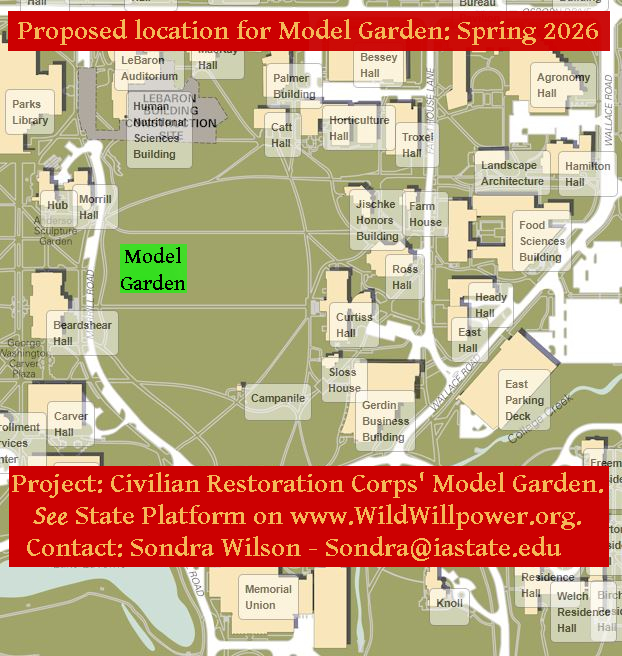
The site will be ADA-accessible, open-source, and equipped with multilingual signage inviting public participation. Each sign will include QR codes linking to app content, maintenance instructions, and harvesting guidance (Live to Plant, 2023).
Step Four: Install the Garden
1. Central Garden
The garden is called "central" because it is located in the center surrounded by a perimeter of native tallgrass prairie.
Plants which require more sunlight and less water are located on the south side of the garden (to get more sun), and plants and mushrooms which are more shade tolerant and require more water are located on the south side.
Plants are grouped alongside their companion plants, and every section of the garden is easily accessible via mulch pathways.
Open the the public, helpful signs direct visitors to "pitch in, and help themselves". The idea is to open source care for the garden via explaining on the signs the types of maintenance which may need done, and what to look for to know if it is time. Signs also explain when and how to harvest.
🔆 SOUTH SIDE: Full Sun, Low Water Crops
Purpose: To showcase drought-resilient crops and pollinator-attracting herbs, reflecting themes of self-reliance and climate adaptation.
🌿 Mediterranean & Heat-Tolerant Guild
| Primary Crops | Companion Plants | Notes | Structure |
|---|---|---|---|
| Rosemary | Sage, Thyme, Lavender | Aromatics deter pests and attract bees | Raised bed |
| Oregano | Marjoram, Basil | Basil enhances growth and flavor | Raised bed |
| Eggplant | Marigold, Tarragon | Marigold repels nematodes | Raised bed |
| Chili Peppers | Onions, Basil | Basil repels aphids; Onions deter beetles | Raised bed |
| Roma Tomatoes | Basil, Garlic, Marigold | Classic trio for pest control and flavor | Raised bed |
Enhancements:
- Herb spirals to create vertical microclimates and maximize space (FarmstandApp, 2023)
- Trap crops (e.g., nasturtiums) at perimeter to lure aphids and squash bugs
- Alyssum and calendula interplanted for pollinator support
🌶️ Southern Heritage Guild
Purpose: To honor Southern agricultural traditions and showcase culturally significant crops that thrive in Iowa’s summer heat.
| Primary Crops | Companion Plants | Notes | Structure |
|---|---|---|---|
| Okra | Basil, Peppers, Marigold | Heat-loving; attracts pollinators | Raised bed |
| Sweet Potatoes | Beans, Marigold | Suppresses weeds; nitrogen-fixing synergy | In-ground |
| Collards | Chamomile, Sage | Improves flavor; deters moths | Cold frame |
These crops reflect African-American and Southern foodways, connecting ecological design to cultural heritage (Carney, 2013).
🌽 CENTRAL ZONE: Three Sisters + Pollinator Corridor
Purpose: To demonstrate interdependence through Indigenous companion planting and pollinator support, this zone balances sun and moisture while supporting biodiversity.
🌾 Traditional Three Sisters Guild
| Primary Crops | Companion Plants | Notes | Structure |
|---|---|---|---|
| Corn | Pole Beans | Beans fix nitrogen and climb corn stalks | In-ground |
| Pole Beans | Squash (vining) | Squash shades soil and deters weeds | In-ground |
| Squash | Sunflowers, Dill | Sunflowers attract pollinators; Dill repels pests | In-ground |
Enhancements:
- Bee balm, cosmos, calendula for pollinator corridors
- Cucumber tipi adjacent to Three Sisters zone for vertical yield and child-friendly interaction
- Sunflowers double as trellises and pollinator magnets
This guild reflects Indigenous agricultural wisdom and ecological balance (Kimmerer, 2013).
🌳 NORTH SIDE: Shade-Loving, Moisture-Dependent Crops
Purpose: Cooler, wetter conditions support leafy greens, mushrooms, and shade-tolerant herbs.
🥬 Leafy Greens & Cold Frame Guild
| Primary Crops | Companion Plants | Notes | Structure |
|---|---|---|---|
| Lettuce | Radish, Chives, Dill | Radish breaks soil; Dill attracts ladybugs | Cold frame |
| Spinach | Strawberries, Cilantro | Strawberries shade soil; Cilantro repels pests | Cold frame |
| Kale | Nasturtium, Borage | Nasturtium traps pests; Borage adds minerals | Cold frame |
| Swiss Chard | Carrots, Parsley | Carrots loosen soil; Parsley attracts hoverflies | Raised bed |
| Arugula | Mint, Marigold | Mint deters aphids; Marigold repels nematodes | Cold frame |
Enhancements:
- Living mulch (e.g., clover) to retain moisture and fix nitrogen
- Fern guilds near mushroom beds for humidity regulation
- Wine cap mushrooms grown under leafy greens in straw mulch
❄️ WINTER GREENS & PERENNIALS
Purpose: To extend the growing season and build soil resilience through cold-hardy crops and long-term yield.
🌱 Cold Frame & Raised Bed Guild
| Primary Crops | Companion Plants | Notes | Structure |
|---|---|---|---|
| Mustard Greens | Dill, Garlic | Garlic repels pests; Dill attracts wasps | Cold frame |
| Collards | Chamomile, Sage | Chamomile improves flavor; Sage deters moths | Cold frame |
| Asparagus | Tomatoes, Basil, Marigold | Tomatoes repel beetles; Marigold deters nematodes | Raised bed |
| Rhubarb | Spinach, Nasturtium | Rhubarb deters aphids; Nasturtium traps pests | Raised bed |
| Carrots | Onions, Rosemary | Onions repel carrot flies; Rosemary deters pests | Raised bed |
Enhancements:
- Biochar and compost to improve root development and water retention (Garden Insider, 2023)
- Perennial zones marked with signage to educate on long-term yield and soil health
🍄 MUSHROOM & MOISTURE ZONE
Purpose: To support fungal allies and moisture-loving herbs in shaded microclimates.
🍂 Fungal Guild
| Primary Crops | Companion Elements | Notes | Structure |
|---|---|---|---|
| Wine Cap Mushrooms | Straw mulch, Leafy greens | Grows in mulch under greens | Shaded bed |
| Shiitake | Oak logs, Ferns | Requires hardwood logs | Log stacks |
| Oyster Mushrooms | Straw, Coffee grounds | Fast-growing; ideal for shaded bins | Bin culture |
Enhancements:
- Rain cache systems and mulch layering to maintain humidity
- Comfrey and buckwheat nearby to build biomass and attract pollinators
🌀Perimeter: Native & Perennial Edibles Zone
The Native & Perennial Edibles Zone is designed to honor Indigenous foodways and promote ecological resilience by incorporating native and perennial species that thrive in prairie ecosystems. This zone is strategically located along the perimeter and prairie edge, with selective integration into the Central Zone, particularly within the Three Sisters guild. Such placement supports biodiversity, soil health, and cultural education.
Placement Strategy
Primary placement along the prairie perimeter allows for optimal sun exposure and soil conditions suitable for drought-tolerant and prairie-adapted species (Dreeszen, 2009). Secondary integration into the Central Zone enables nitrogen-fixing vines such as Apios americana (groundnut) to enhance soil fertility and complement traditional companion planting systems (Moerman, 1998).
Ecological and Cultural Functions
Native and perennial edibles serve multiple functions:
- Biodiversity Support: These species attract pollinators, stabilize soil, and provide habitat for wildlife (Tallamy, 2007).
- Nutrient Cycling: Leguminous plants like groundnut contribute to nitrogen fixation, improving soil fertility (USDA NRCS, 2016).
- Cultural Significance: Many of these plants have been used for centuries by Indigenous communities for food, medicine, and ceremony (Moerman, 1998; Kimmerer, 2013).
Featured Species and Placement
| Species | Recommended Location | Ecological & Cultural Notes |
|---|---|---|
| Psoralea esculenta (Prairie Turnip) | Prairie Perimeter | Drought-tolerant; traditional Indigenous tuber crop |
| Apios americana (Groundnut) | Central Zone (Three Sisters) | Nitrogen fixer; edible tuber; climbs corn stalks |
| Sambucus canadensis (Elderberry) | Perimeter or North Edge | Moisture-tolerant; supports birds and pollinators |
| Helianthus tuberosus (Jerusalem Artichoke) | Prairie Edge | Tall perennial; edible tuber; attracts pollinators |
| Monarda fistulosa (Wild Bergamot) | Pollinator Corridors | Medicinal; attracts bees and butterflies |
This zone functions not only as a food-producing area but also as a living narrative of ecological stewardship and cultural continuity. It invites visitors to engage with the land through species that have sustained generations and continue to offer lessons in resilience and reciprocity.
🧠 ADVANCED STRATEGIES
🔁 Juxtapositioning
- Deep-rooted tomatoes with shallow-rooted lettuce
- Fast-growing radishes with slow-growing carrots
- Vertical climbers (e.g., beans, cucumbers) paired with low-spreading herbs
This technique reduces competition and optimizes resource use, enhancing yield and soil structure (Live to Plant, 2023).
🪤 Trap Crops
- Nasturtiums for aphids and squash bugs
- Radishes for flea beetles
- Mustard greens for harlequin bugs
Trap cropping is a regenerative pest management strategy that protects primary crops while supporting biodiversity (Harvest Savvy, 2023).
🌿 Biodiversity Corridors
- Alyssum, cosmos, bee balm, and native wildflowers interplanted throughout
- Seasonal rotation of plant families to prevent soil fatigue
- Birdhouses, insect hotels, and water features to support vertebrate biodiversity
These corridors create predator havens and pollinator pathways, enhancing ecological resilience and public engagement (Garden Insider, 2023).
🌍 Legacy Integration
All findings from the model garden will be:
- Integrated into the Gardens Across Iowa!™ App
- Used to finalize the patentable layout
- Replicated statewide by Civilian Restoration Corps™ teams
- Scaled nationally via Gardens Across America™ and globally via Gardens Across Earth™
The garden will serve as a living curriculum, a civic commons, and a replicable model for ecological justice and constitutional stewardship.
2. Prairie Buffer
Native Plants w/ Ethnobotany and Pharmacognosy Uses
🌿 Tallgrass Anchors
| Plant Name | Ethnobotanical Uses | Interesting Notes | Known Active Compounds | Medicinal Value / Action | Source (APA) |
|---|---|---|---|---|---|
| Big Bluestem (Andropogon gerardii) | Bedding, insulation, forage, ceremonial use | “Turkey Foot” seed head; deep roots | Silica, cellulose | Structural support; insulation | Moerman, 1998; USDA NRCS, 2023 |
| Indian Grass (Sorghastrum nutans) | Ceremonial bundles, forage, erosion control | Used in regalia; fire-adapted | Flavonoids | Antioxidant potential | Moerman, 1998 |
| Switchgrass (Panicum virgatum) | Basketry, thatching, biofuel, erosion control | Phytoremediation crop | Lignin, cellulose | Soil detoxification, carbon sequestration | USDA NRCS, 2023 |
| Eastern Gamagrass (Tripsacum dactyloides) | Mats, weaving, edible seeds, forage | Related to maize | Starch, phenolics | Nutritional; antioxidant | Moerman, 1998 |
| Prairie Cordgrass (Spartina pectinata) | Cordage, roofing, erosion control | Flood-tolerant | Silica, fiber | Structural; erosion control | USDA NRCS, 2023 |
🌱 Mid-Height Structural Plants
| Plant Name | Ethnobotanical Uses | Interesting Notes | Known Active Compounds | Medicinal Value / Action | Source (APA) |
|---|---|---|---|---|---|
| Little Bluestem (Schizachyrium scoparium) | Insulation, ceremonial fires, forage | Supports butterflies | Flavonoids | Antioxidant potential | Moerman, 1998 |
| Side-oats Grama (Bouteloua curtipendula) | Forage, porridge, erosion control | Seeds ground into flour | Carbohydrates, fiber | Nutritional; soil stabilization | Moerman, 1998 |
| Prairie Dropseed (Sporobolus heterolepis) | Flour from seeds, ceremonial use | Nutty aroma | Aromatic oils, starch | Nutritional; aromatic therapy | Moerman, 1998 |
| Canada Wild Rye (Elymus canadensis) | Flour, basketry, erosion control | Fast-growing | Silica, fiber | Structural; erosion control | USDA NRCS, 2023 |
🦋 Pollinator Magnets & Medicinal Blooms
| Plant Name | Ethnobotanical Uses | Interesting Notes | Known Active Compounds | Medicinal Value / Action | Source (APA) |
|---|---|---|---|---|---|
| Purple Coneflower (Echinacea purpurea) | Immune stimulant, wound poultice | Widely used today | Alkamides, echinacoside, polysaccharides | Immunomodulatory, anti-inflammatory | Moerman, 1998 |
| Butterfly Milkweed (Asclepias tuberosa) | Lung ailments, swelling, digestive aid | Monarch host plant | Cardiac glycosides (asclepiadin) | Expectorant; toxic in high doses | Moerman, 1998 |
| Swamp Milkweed (Asclepias incarnata) | Respiratory aid, digestive tonic | Wetland medicine bundles | Cardiac glycosides | Respiratory stimulant; caution advised | Moerman, 1998 |
| Prairie Clover (Dalea spp.) | Fever tea, digestive aid, forage | Nitrogen fixer | Flavonoids, tannins | Antioxidant; astringent | Moerman, 1998 |
| Wild Bergamot (Monarda fistulosa) | Cold/flu tea, antiseptic poultice | Contains thymol | Thymol, carvacrol | Antiseptic, antimicrobial, expectorant | Moerman, 1998 |
| Black-eyed Susan (Rudbeckia hirta) | Snakebite remedy, cold decoction | Cherokee use | Phenolics, tannins | Anti-inflammatory; immune support | Moerman, 1998 |
| Golden Alexanders (Zizia aurea) | Digestive stimulant, mild tonic | Spring nectar source | Coumarins | Mild stimulant; digestive aid | Moerman, 1998 |
🔥 Ceremonial & Spiritual Plants
| Plant Name | Ethnobotanical Uses | Interesting Notes | Known Active Compounds | Medicinal Value / Action | Source (APA) |
|---|---|---|---|---|---|
| Leadplant (Amorpha canescens) | Lung/digestive tea, ceremonial smoke | Nitrogen fixer | Amorfrutins, flavonoids | Anti-inflammatory; antioxidant | Moerman, 1998 |
| Pasque Flower (Anemone patens) | Pain relief, calming agent | Toxic fresh | Protoanemonin | Sedative; analgesic (used cautiously) | Moerman, 1998 |
| Prairie Smoke (Geum triflorum) | Sore throat tea, diarrhea remedy | Seed heads used in storytelling | Tannins, flavonoids | Astringent; anti-inflammatory | Moerman, 1998 |
🍓 Edible & Nutritive Plants
| Plant Name | Ethnobotanical Uses | Interesting Notes | Known Active Compounds | Medicinal Value / Action | Source (APA) |
|---|---|---|---|---|---|
| Ground Plum (Astragalus crassicarpus) | Edible pods, spring food | Nitrogen fixer | Saponins, flavonoids | Immune support; antioxidant | Moerman, 1998 |
| Wild Strawberry (Fragaria virginiana) | Fruit, leaf tea, ceremonial offering | Women’s medicine | Vitamin C, ellagic acid | Antioxidant; anti-inflammatory | Moerman, 1998 |
| New Jersey Tea (Ceanothus americanus) | Tea substitute, lung tonic | Revolutionary War use | Tannins, ceanothic acid | Astringent; expectorant | Moerman, 1998 |
| American Hazelnut (Corylus americana) | Nuts, oil, wildlife food | Winter survival caches | Fatty acids, vitamin E | Nutritional; antioxidant | Moerman, 1998 |
| Wild Plum (Prunus americana) | Fruit, bark tea, digestive aid | Used in feasts and ceremonies | Cyanogenic glycosides (in bark), vitamin C | Digestive aid; caution with bark | Moerman, 1998 |
🌳 Shrubs & Support Species
| Plant Name | Ethnobotanical Uses | Interesting Notes | Known Active Compounds | Medicinal Value / Action | Source (APA) |
|---|---|---|---|---|---|
| Gray Dogwood (Cornus racemosa) | Bark tea for fevers, berries for dye | Dyeing regalia | Anthocyanins, tannins | Antioxidant; febrifuge | Moerman, 1998 |
V. Integrated Rollout Plan
Once installed and optimized — using automated watering systems, rain caches, and companion planting — the model garden will be replicated in towns and cities across Iowa through Civilian Restoration Corps™. Priority will be given to high-density residential zones and school grounds, where students will learn to grow food through a hands-on curriculum. These gardens will help offset school lunch costs while restoring ecological and economic independence for everyday Iowans. In the process, students will gain lifelong skills in food production, environmental stewardship, and civic engagement — laying the foundation for a more resilient and equitable, production-based economy.

Above image by LiveKindly, posted on Facebook, used for First Amendment purposes in accordance with the U.S. Copyright Office's Fair Use Policy and the Fair Use Doctrine.
Phase 0: Patent Filing & Seed Funding (Current Stage)
- Patent the Gardens Across Iowa!™ App and model garden layout
- Seek seed funding to complete app development and build the flagship garden
- All royalties will feed Iowa’s Public Credit Union to fund SondraCare™, Housing Helpers™, and CRC teams
Phase I: App Development & Model Garden Launch
- App includes frost-date alerts, companion planting guidance, GPS sponsor integration, and civic mapping
- Model garden designed with Iowa State University, using permaculture, automation, and no synthetic inputs
- Transparent yield metrics and educational programming
Phase II: Zoning Reform & Statewide Replication
- Enact the Right to Homestead Act to ensure gardening access for renters and urban residents
- CRC teams install gardens in schools, neighborhoods, and sustainable villages for Iowa’s homeless population
- Homesteading Starter Kits™ distributed to empower self-sufficiency
Phase III: Opening the Iowa Stock Exchange (ICIX)
- Capped shares for Iowa residents; 1% Financial Transaction Tax feeds Iowa’s credit union
- Stocks available in CRC initiatives: Gardens Across Iowa!™, Public Intelligence Agency™, Inventor’s Guild™, and SondraCare™
- Early investors benefit as the app expands into Gardens Across America™ and Gardens Across Earth™
Phase IV: Inventor’s Guild™ & Innovation Economy
- Grants and patent attorney access for Iowa inventors
- Focus on automating grueling labor and uplifting marginalized communities
- Royalties from all future patents feed Iowa’s credit union and fund civil rights infrastructure
Phase V: Public Intelligence Agency™ & Legal Reform
- Demystify Iowa’s legal system and simplify access to courts
- Develop curriculum to teach jurisprudence in schools
- Track offshore accounts and enforce tax fairness to fund SondraCare™
Phase VI: Constitutional Counterpoint to Project 2025
- Gardens Across Iowa!™ fulfills the preamble:
- Counters authoritarian threats with community-rooted resilience, ecological restoration, and economic inclusion
Phase VII: National & International Expansion
- Launch Gardens Across America™ and Gardens Across Earth™
- Open ICIX to mission-aligned national investors
- Pass the Swords to Plowshares Act™ to help foreign nations adopt CRC models and redirect military resources toward humanitarian restoration
🌍 “Heal the Heartland; Heal the World!” — Iowa leads first, then shares its blueprint for peace, prosperity, and ecological restoration worldwide.
VI. Maximizing Iowa's Economic Efficiency
Through Rural Farming and Urban Gardening
Iowa’s soil is among the most fertile on Earth—an inheritance of glacial deposits, prairie ecology, and generations of stewardship. By integrating regenerative companion planting models into both urban and rural landscapes, Iowa can unlock unprecedented agricultural efficiency, ecological resilience, and economic growth.
Rather than positioning regenerative gardens in opposition to industrial monocropping, Gardens Across Iowa!™ complements existing agriculture by filling critical gaps: food sovereignty, herbal medicine production, biodiversity restoration, and urban economic inclusion. Together, these systems can maximize land productivity, diversify our agricultural portfolio, and ignite a new era of entrepreneurial innovation.
🌽 Rural Production: Crop Rotation & Monocropping
- Iowa’s rural farmland produces over 2.5 billion bushels of corn and 500 million bushels of soybeans annually
- Average gross value per acre: $800–$1,200
- Primary outputs: animal feed, ethanol, processed food ingredients
- Strengths: scale, efficiency, export value
- Limitations: low crop diversity, high input dependency, limited direct-to-consumer value
🌿 Urban Production: Gardens Across Iowa!™ Model
- Companion planting boosts yield per square foot and ecological resilience
- Estimated gross value per acre: $40,000–$60,000, including food and herbal medicine
- Primary outputs: fresh produce, culinary herbs, medicinal plants, educational value
- Strengths: reduces garbage and waste, biodiversity, civic engagement, entrepreneurial potential, food sovereignty
- Limitations: overheard funding, conflicts of interest for potential investors, possible political pushback
🚫 Why Urban Areas Must Avoid GM Crops and Synthetic Chemicals
Urban gardens are embedded in neighborhoods, schoolyards, parks, and rooftops—spaces where chemical drift and genetic contamination pose serious risks to public health and biodiversity. Here's why Gardens Across Iowa!™ excludes GM crops and synthetic inputs:
- Crop Drift Risk: Pollen from GM crops like Roundup Ready corn and soy can drift into heirloom gardens, potentially contaminating seed lines and reducing genetic integrity (Ecosystems United, n.d.).
- Terminator Seeds: Some GM technologies are designed to produce sterile seeds, preventing replanting and threatening seed sovereignty if cross-pollination occurs (FarmstandApp, 2025).
- Chemical Exposure: Glyphosate and other herbicides used in GM systems can drift into residential zones, affecting children, pollinators, and soil microbiomes (Live to Plant, 2025).
- Legal Vulnerability: Contaminated heirloom gardens may face patent infringement claims, even if cross-pollination was unintentional (Deep Roots, 2024).
🌱 Urban environments require clean, resilient, and community-safe systems—which is why Gardens Across Iowa!™ relies on open-pollinated, heirloom seeds and regenerative practice that will beautiful urban areas.
🌿 Companion Planting: A Regenerative Engine for Growth
Companion planting enhances Iowa’s agricultural output by:
- Boosting total yield per square foot through synergistic crop pairings
- Improving soil health via nitrogen-fixing legumes and diverse root systems
- Reducing pest pressure naturally via trap crops and pollinator attraction
- Maximizing sunlight, water, and nutrient use through strategic juxtapositioning
- Building resilience to climate variability and market shocks (Live to Plant, 2025; FarmstandApp, 2025)
📊 Studies show that well-managed intercropping systems can outperform monocultures in biomass and yield, especially in diversified food systems (FarmstandApp, 2025).
🏙️ Urban Food Sovereignty: A Scalable Economic Catalyst
Companion planting is already thriving in urban farms across the U.S. (Deep Roots, 2024). When applied to Iowa’s cities, towns, and schoolyards, it becomes a civic infrastructure model—one that feeds families, teaches skills, and generates income.
| Crop Type | Estimated Yield (per 1,000 sq ft) |
|---|---|
| Tomatoes | 100+ lbs |
| Leafy Greens | 50+ lbs |
| Root Vegetables | 30+ lbs |
| Squash & Beans | 20+ lbs |
| Herbs & Mushrooms | Bonus yield |
🧠 With education and preservation techniques (drying, fermenting, canning), this model could feed thousands while creating new markets for value-added goods.
💰 Gross Product per Acre: Unlocking Iowa’s True Potential
| Metric | Rural Monocropping (Corn/Soy) | Gardens Across Iowa!™ Model |
|---|---|---|
| Food Yield (lbs/acre) | ~10,000–15,000 | ~8,000–12,000 |
| Herbal Medicine Yield | Minimal | 500–1,500 lbs dried herbs |
| Gross Value ($/acre) | $800–$1,200 | $40,000–60,000 |
| Crop Diversity | 1–2 crops | 20–40+ crops |
| Ecological Services | Negative | Positive |
| Community Engagement | Low | High |
🌼 Medicinal herbs like echinacea, lavender, and holy basil can yield $15–30 per ounce dried, with total returns of $40,000–60,000 per acre when grown intensively in polyculture systems (NC State Extension, n.d.; Chestnut School of Herbal Medicine, 2024).
📊 Combined Economic Impact
| System | Estimated Acres | Gross Value/Acre | Total Gross Value |
|---|---|---|---|
| Rural Monocropping | ~25 million | $800–$1,200 | ~$20–30 billion annually |
| Gardens Across Iowa!™ | ~1 million (goal) | $40,000–$60,000 | ~$40–60 billion annually |
By activating underutilized urban land—schoolyards, rooftops, parks, vacant lots—Iowa could at least double its agricultural GDP, while creating thousands of new jobs, businesses, and educational opportunities.
💡 Strategic Framing
This isn’t a competition—it’s a collaborative transformation. Rural monocropping provides foundational outputs and export strength. Urban regenerative gardening adds nutritional diversity, economic inclusion, and civic infrastructure. Together, they position Iowa as a global leader in agricultural innovation and ecological stewardship.
🌱 Gardens Across Iowa!™ doesn’t replace rural farming—it completes it.
Vii. Help Bring Gardens Across Iowa™ to Life
🛠️ What’s Needed Now
- Volunteer Business Managers & Accountants To help oversee finances, filings, and investor relations for Gardens Across Iowa!™, CRC, and ICIX
- Seed Funders & Philanthropic Allies To help patent the app and model garden, launch the Iowa Stock Exchange, and build the first installations
- Legal & Patent Support To protect intellectual property and ensure royalties feed Iowa’s credit union and civil rights programs
- Campaign Infrastructure Including a Lt. Governor, signature gatherers, and media allies to break the blackout
💸 Join the Founding Circle: Help Build Iowa’s Future
Ways to Contribute:
- Volunteer as a business manager, accountant, or campaign strategist
- Provide seed funding ($5K–$50K) for app development and garden prototyping
- Offer in-kind donations (land, compost, tools, tech support)
- Sponsor local advertising, product placement, or Homesteading Starter Kits™
Contact: Reach out via or Sondra’s campaign site to express interest and help build Iowa’s future.
🛡️ Why This Matters
This isn’t just about gardening. It’s about:
- Restoring civil rights for transgender Iowans and marginalized communities
- Building infrastructure that feeds, heals, and protects everyday people
- Creating economic sovereignty through innovation, invention, and public ownership
- Defending democracy against authoritarian threats with constitutional countermeasures
🧬 A Living Will, Not Just a Platform
This is more than a campaign. It’s a legacy blueprint — a living will — authored by a transgender Iowan who has faced systemic erasure, economic hardship, and political exclusion, yet continues to fight for justice, dignity, and constitutional integrity.
“They erased transgender Iowans from the Civil Rights Act and it is not safe to work in Iowa, but I'm not leaving. This is my home state, and I won't be pushed out by political tyrants. I’m living in a basement on SNAP benefits, surviving on occasional donations (Venmo = @Sondra-Wilson-777, PayPal = Sondra.Wilson777@gmail.com). I don’t have the means or capacity to manage this alone — but I will not abandon the people or the vision. This is my living will.”
— Sondra Wilson
Wild Willpower is growing beyond one person. To succeed, it needs a team of principled business managers, accountants, and civic-minded allies who believe in building infrastructure that uplifts everyone — especially those most marginalized.
References
ACLU of Iowa. (2025, June 30). 2025 Iowa civil liberties legislation recap. Retrieved from
ACLU of Iowa. (2025, March 6). People would've been fined for sleeping outside under Iowa House bill. Des Moines Register.
Adams, B. (2025, May 13). From urban gardens to agrihoods: The rise of agricultural neighborhoods in Detroit. One Earth.
Ahmed, P., Das, K., Sarma, B., & Nath, R. K. (2025). Role of trap crops in pest management. Agrospheres, 6(5), 31–34.
Alex. (2015, March 27). Family grows 6000 lbs of food on 1/10th acre urban farm. Tiny House Talk.
Blum, Andrea (7 July 2017). "Dearborn Agency helps foster grant for urban farming". PressandGuide.com. Retrieved July 8, 2017.
Carney, J. A. (2013). In the shadow of slavery: Africa’s botanical legacy in the Atlantic world. University of California Press.
Chestnut School of Herbal Medicine. (2024). Medicinal herbs for urban gardens.
. (2025, March 26). Connecticut General Assembly proposes affordable housing investment trust and tax credit for landlords. Retrieved from
City of Ames. (2025a). Community solutions to addressing homelessness.
City of Ames. (2025b). Conversations on homelessness: Ames and Story County strategic plan 2025.
ConsumerAffairs. (2025, July 10). The rising cost of groceries by state. https://www.consumeraffairs.com/finance/cost-of-groceries-by-state.html
Cucumber tipI: Transjardins, 26 Oct. 2022, transjardins.org/vertical-culture-in-a-teepee-a-playful-and-practical-tool-at-the-jardin-de-la-traversine-villiot-paris/.
Deep Roots. (2024, April 20). Companion planting for urban food production.
Des Moines Register. (2024, September 11). Des Moines lowers fine for proposed homeless camping ban as vote nears. Retrieved from
Des Moines Register. (2024, August 5). 'I'm scared every time I lay down': Homeless Iowans fear Des Moines' proposed camping ban.
Des Moines Register. (2025). Proposed camping ban would prohibit sleeping outdoors on public property.
Double planter technique for potatoes: “A Piece of Rainbow” Facebook page: https://www.facebook.com/photo/?fbid=815541177286166&set=a.423622486478039
Dreeszen, C. (2009). Planning for sustainability: A guide for regional and local planners. Iowa State University Extension.
Ecosystems United. (n.d.). The difference between intercropping and companion planting.
FarmstandApp. (2025, May 27). 7 advantages of intercropping vs monoculture that boost farm resilience.
FarmstandApp. (2025). 7 soil layering techniques for better gardening.
FarmstandApp. (2023). Companion planting and vertical garden strategies. Retrieved from
FarmstandApp. (2023). Companion planting for enhanced biodiversity. Retrieved from
FarmstandApp. (2025). Niche crops for small-scale farmers.
Feeding America. (2025). Food insecurity in Iowa.
Feeding America. (2023). Map the Meal Gap: Hunger & Poverty in Iowa. https://map.feedingamerica.org/county/2017/overall/iowa
Food Bank of Iowa. https://foodbankiowa.org/news/map-the-meal-gap-iowas-hunger-problem-is-growing-worse/
Gerard, Michelle. (2023). The Michigan Urban Farming Initiative in Detroit. Reddit. https://www.reddit.com/r/CityPorn/comments/12ek3zn/the_michigan_urban_farming_initiative_in_detroit/.
Garden Insider. (2023). Companion planting science and soil layering. Retrieved from
Gardenia. (2025). Native plants of Iowa.
Gardenia. (2025). Trap cropping to control pests.
Garden Insider. (2023). Biochar, composting, and perennial resilience strategies. Retrieved from
Garden Insider. (2025). Companion planting: Science-backed methods for success.
GMFUS. (2023). Detroit: An Urban Laboratory for the Post-Industrial Era.
Grow Create Sip. (2024). Companion planting chart for herbs.
Growing Fruits. (2025). A guide to trap crops and trap cropping for pest control.
Grow Mushrooms Canada. (n.d.). Real talk from our real customers.
Guinness World Records. (2025). Guinness World Records. Retrieved from
Guinness World Records Wiki. (2025). Roblox records. Retrieved from
Harvest Savvy. (2023). Companion planting and trap crop strategies. Retrieved from
Harvest Savvy. (2023). Pollinator corridors and moisture retention techniques. Retrieved from
Homeward Iowa. (2025, January 26). Homeward releases 2025 Point-In-Time Count data. Retrieved from
Housing Not Handcuffs. (2025). State-level crackdowns on homelessness.
Iowa Department of Natural Resources. (2025). Native trees and shrubs of Iowa.
Iowa Legal Aid. (2025). Summary of Iowa landlord and tenant law. Retrieved from
Iowa Public Radio. (2025, January 22). Tiny village solution to homelessness in Des Moines will go before city council.
Iowa Public Radio. (2024, September 20). Des Moines plans to crack down on homeless encampments in public areas.
iPropertyManagement. (2025). Average rent by year [1940–2025]: Historical rental rates. Retrieved from
iPropertyManagement. (2024, August 26). Average rent increase per year (1916–2025): Historical data. Retrieved from
Joppa. (n.d.). The Joppa Village.
Jungle Hugger. (2025). 6 ways to promote biodiversity in your garden.
Kimmerer, R. W. (2013). Braiding sweetgrass: Indigenous wisdom, scientific knowledge, and the teachings of plants. Milkweed Editions.
KIWA Radio. (2025, August 3). Haitian refugees face homelessness. Retrieved from
Kong, C.-H., Li, Z., Li, F.-L., Xia, X.-X., & Wang, P. (2024). Chemically mediated plant–plant interactions: Allelopathy and allelobiosis. Plants, 13(5), 626.
KSCJ. (2025, July 27). Iowa teams set to create more affordable housing. Retrieved from
LegalClarity. (2025, January 8). Iowa rent increase laws and tenant protections. Retrieved from
LiveKindly. (June 28, 2024). Do you think gardening should be taught in schools? Facebook. https://www.facebook.com/livekindlyco/posts/do-you-think-gardening-should-be-taught-in-schools-/779994784330642/.
Live to Plant. (2023). Combining juxtapositioning with companion planting strategies. Retrieved from
Live to Plant. (2025, March 5). Companion planting techniques for urban farm success.
Live to Plant. (2025, July 17). Intercropping vs monocropping: Which is better?
Live to Plant. (2023). Juxtapositioning and trap crop methods for ecological gardens. Retrieved from
Live to Plant. (2025). Soil preparation tips for successful plant layering.
Live to Plant. (2025). Using native grasses to restore prairie wildlife habitats.
Neumann, T. (2021). The impact of entrepreneurship on economic, social and environmental welfare. Management Review Quarterly, 71(4), 553–584.
Marks, J. (2025, June 16). Iowa shoppers urged to stock up on these 5 items. K92.3 FM. https://k923.fm/iowa-tariff-food-costs/
McMahan, D. (2018, March 3). After being in the red, Detroit goes green! LinkedIn.
Michigan Urban Farming Initiative. (n.d.). Home.
Missouri Botanical Garden. (2025). 10 ways to add biodiversity to your garden.
Modern Day Self Reliance. (2024, March 4). The 6 permaculture zones and how to use them.
Moerman, D. E. (1998). Native American ethnobotany. Portland, OR: Timber Press.
Nabhan, G. P. (2002). Coming home to eat: The pleasures and politics of local foods. W. W. Norton & Company.
National Homelessness Law Center. (2025, June 28). Emergent threats: Homelessness criminalization tracking. Housing Not Handcuffs.
NBC Palm Springs. (2025, April 12). Iowa small grocers struggle as tariff-driven food prices climb. https://nbcpalmsprings.com/2025/07/23/iowa-small-grocers-struggle-as-tariffdriven-food-prices-climb
NC State Extension. (n.d.). Medicinal herb yield estimates.
Occidental Arts & Ecology Center. (n.d.). What is permaculture?
Positivebloom. (2024). 15 Iowa native plants that can spruce up your garden.
Rain gutter-planter hanging strawberries: Laura. “Gardening Fail: Growing Strawberry Plants in Rain Gutters.” House of Joyful Noise Blog, Farmhouse Style, 24 Jan. 2017, houseofjoyfulnoise.com/gardening-fail-growing-strawberry-plants-in-rain-gutters/.
Richard Lonewolf Foundation. (2025). www.RichardLonewolf.com
River City Omaha. (2025). Corporate ownership of Iowa rental properties.
River City Omaha. (2025, June 24). Residents of City View have until July 31 to leave their apartments. Retrieved from
Rothman, L. (2022, April 14). How one gardener broke his own Guinness World Record. Tasting Table. Retrieved from
Tallamy, D. W. (2007). Bringing nature home: How native plants sustain wildlife in our gardens. Timber Press.
Tallgrass Ontario. (2025). Grassland benefits.
The White House. (2025, July 24). Fact sheet: President Donald J. Trump takes action to end crime and disorder on America’s streets.
UPI. (2025, August 6). Indiana man's giant sunflower plant approaching world record. MSN. Retrieved from
Upton, R. (Ed.). (2013). American Herbal Pharmacopoeia: Botanical Monographs. American Herbal Pharmacopoeia.
Urban Gardening Guru. (2024). History of Urban Gardening in Detroit, MI: Origins, Evolution, and Future.
Urban Institute. (2018). Detroit, Michigan: Strong Cities, Strong Communities.
USDA Natural Resources Conservation Service. (2016). Plant guide: Apios americana.
USDA NRCS. (2023). Native grass and wildflower profiles. United States Department of Agriculture Natural Resources Conservation Service. Retrieved from
U.S. Forest Service. (n.d.). Ethnobotany.
Weaver, W. W. (2024, September 16). Three Sisters Native American gardening. Mother Earth News.
WebMD. (2023). Benefits of companion planting. Retrieved from
WebMD. (2023). Fern guilds and fungal allies in permaculture systems. Retrieved from
Wikipedia contributors. (2025). Guinness World Records. In Wikipedia. Retrieved from
Wild Willpower PAC. (2025a, July 30). The Gardens Across Iowa! App™ – Wild Willpower PAC.
Wild Willpower PAC. (2025b, July 16). My autobiography – Wild Willpower PAC.
Wild Willpower PAC. (2025c, April 14). “Wilson et al v. Trump et al” – Multiple class actions and federal criminal charges filed in Iowa.
Wink, M. (2015). Modes of action of herbal medicines and plant secondary metabolites. Medicines, 2(3), 251–286.
Woodland Trust. (2023). How to increase biodiversity in your garden.