Page being updated
please check back shortly (Sept 6, 2025).
Separation of Church & State
Iowa's School Voucher Program is Unconstitutional
by Sondra Wilson. Written September 9, 2025.
On January 24, 2023, Governor Kim Reynolds signed House File 68—an unconstitutional section of Iowa Code, designed to siphon roughly $345 million per year out of Iowa’s public schools and instead into private schools. [1] Approximately 84% of those schools religiously affiliated [2], thus violating a foundational principle of American governance: separation of church and state. Iowa’s voucher scheme resurrects the very union of religion and government that the founders of this nation fought to dismantle.
The Founders, Religious Tyranny, and the Separation of Church and State
Unified Religion and State in Ancient Rome
Long before Christianity became the official religion of Rome, the empire had already merged religious worship with political power through the imperial cult. This wasn’t mere flattery; it was a formal civic religion in which emperors were honored as divine or semi-divine figures. Citizens across the empire were expected to perform public rituals, offer sacrifices, and attend festivals for the emperor’s genius (spirit) or deified status. These rites were public affirmations of loyalty, not personal professions of faith. Roman religion prioritized orthopraxy (right practice) over orthodoxy (right belief).
Roman royals adopted control over their citizenry in this manner from earlier models of divine kingship:
• In Egypt, pharaohs were venerated as living gods—embodiments of Horus—unifying political and sacred rule.
• In the Hellenistic world after Alexander the Great, rulers adopted proskynēsis (court obeisance) and received divine honors, setting a precedent for sacral monarchy. [3–4]
Rome then institutionalized these traditions. After the assassination of Julius Caesar (44 BCE), a brilliant comet at his funeral games—the Sidus Iulium—was taken as a sign of his apotheosis (taking his place among the gods). Poets and historians memorialized the omen, and Augustus, his son, leveraged it to style himself divi filius (“son of a god”). [5–6] Under Augustus and his successors, temples, altars, priesthoods, and festivals dedicated to the emperor and the deified Caesar spread across cities and provinces; loyalty was performed in public rites, often with especially vigorous observance in the provinces. [7]
Crucially, these rites were tests of civic allegiance. Refusing to sacrifice before the emperor’s image was not just impious; it was tantamount to treason. Roman religion prioritized public conformity: the gods served the state, and the emperor stood at the center of that sacred order. [7]
Early Christian Rebellion
Early Christians refused to offer sacrifices to the emperor or acknowledge his divinity. As Pliny the Younger reports to Trajan, he tested suspected Christians by ordering them to invoke the gods and offer wine and incense to the emperor’s image; those who refused were punished. [8] Tacitus describes how Nero, after the Great Fire (64 CE), scapegoated Christians—subjecting them to crucifixions, burnings, and maulings by beasts. [9] Later coercion came episodically via imperial policy: Domitian punished “atheism” (refusal of Rome’s gods); Decius required universal sacrifice and libelli (certificates of compliance); Valerian targeted clergy and seized church property; and Diocletian’s edicts (303 CE) destroyed churches, burned scriptures, stripped legal rights, and demanded universal sacrifice on pain of torture or death. [10–12]
Christians framed their refusal in conscience and Jesus’s teaching. A saying preserved by Epiphanius from the Gospel of the Ebionites has Jesus declare he came “to abolish the sacrifices,” warning that unless they ceased, wrath would not cease—an early tradition reading his mission as ending temple sacrifice. [13] This coheres with canonical themes (“I desire mercy, and not sacrifice”; the casting down of the proud), privileging mercy and justice over ritual coercion. [14] A movement born to free worship from state cult was repeatedly compelled by the state to perform it—and punished when it refused.
From Persecuted to Establishment
In 380 CE, Theodosius I issued the Edict of Thessalonica, declaring Nicene Christianity the official faith of the empire. [15] Heresy was criminalized in imperial law; bishops gained political power; pagan temples closed; dissenters faced penalties—repurposing the machinery of conformity in Christian terms. The crucified rabbi who challenged empire was increasingly invoked to sanctify it.
This is precisely the legacy the founders rejected. They saw how any faith—Catholic or Protestant, ancient or modern—when wielded by the state becomes a tool of oppression. True faith cannot be coerced; the health of both church and state depends on their separation.
From Medieval Coercion to Reformation Limits
From 380 forward, imperial and ecclesiastical power often intertwined. Over centuries, legal regimes punished heresy, apostasy, and blasphemy as threats to public order. [16] By the high Middle Ages, inquisitorial procedures—authorized by the church, enforced by secular rulers—used torture, surveillance, confiscations, and executions to enforce orthodoxy. [17]
The Protestant Reformation (sixteenth century) challenged that order. Luther and Calvin elevated conscience and attacked corruption, yet confessional states still enforced orthodoxy (e.g., Calvin’s Geneva executing Servetus, Luther urging harshness toward Anabaptists). [18] The Acts of Supremacy made the English monarch head of the national church; the Peace of Augsburg (1555) entrenched cuius regio, eius religio—recognizing Lutheran and Catholic establishments (Reformed recognition came later with Westphalia 1648). [19] This was not liberty; it was state-controlled religion under different banners.
Europe then reeled through the Wars of Religion—the French Wars (1562–1598), English Civil Wars (1642–1651), and the Thirty Years’ War (1618–1648), which devastated the German lands. Religion served as justification and weapon in struggles that were also dynastic and territorial. [20]
Meanwhile, persecution stretched beyond battlefields. Between 1400 and 1775, more than 100,000 people were prosecuted for witchcraft across Europe and colonial America; 40,000–60,000 were executed. [21] The Malleus Maleficarum (1487) systematized accusations, legitimized torture, and demonized women. [22] In Scotland, James VI/I intensified hunts and published Daemonologie (1597); Janet Horne was burned in 1727. [23–24]
Heresy, Blasphemy, and the Criminalization of Dissent
For centuries, entire legal systems enforced orthodoxy through charges of heresy, blasphemy, and apostasy. In England, De heretico comburendo (1401) authorized burning at the stake—the first purely religious capital statute by Parliament. [25] Across Europe, Inquisition tribunals extracted confessions under torture and branded dissenters enemies of both church and state. [26] The Blasphemy Act (1697) criminalized denying the Trinity and barred offenders from office. [27] Even in the Enlightenment, Thomas Aikenhead (1697) was executed for blasphemy in Scotland. [28]
Colonial America and the Memory of Persecution
These tools crossed the Atlantic. Roger Williams was banished (1635) from Massachusetts Bay for challenging clerical authority and founded Rhode Island as a haven for dissent. [29] Mary Dyer was hanged on Boston Common (1660) after repeated banishments for “heresy” and illegal Quaker preaching. [30] Colonies such as Massachusetts and Virginia punished “blasphemous opinions” with whipping, banishment, and death; Connecticut and New York retained blasphemy statutes into the eighteenth century. [31–32] Thomas Jefferson later praised Williams as “the first legislator who had the courage to establish a principle of religious freedom” in America. [33] The founders’ push for disestablishment addressed not only Europe’s past but America’s fresh wounds.
Anglo-American Precursors and Founding Cornerstones
The trajectory bent toward liberty through concrete legal milestones: the Rhode Island Charter (1663) promised liberty of conscience; Pennsylvania’s Frame of Government (1682) protected toleration; and the English Toleration Act (1689) allowed dissenting worship. [34–36] In the revolutionary era, Madison’s Memorial and Remonstrance (1785) and Jefferson’s Virginia Statute for Religious Freedom (1786) crystallized the founders’ settlement. [40, 37] The U.S. Constitution’s Article VI, Clause 3 barred any religious test for federal office, and the First Amendment severed church from state. [38] Yet state establishments lingered (e.g., Massachusetts until 1833), underscoring the overall direction of travel toward separation. [39] Crucially, Baptist advocates like John Leland pressed Jefferson and Madison, arguing that only a government excluded from religion could keep faith free. [40]
Case Study: The Washington Family and Due Process
Local tradition and later secondary accounts hold that in Westmoreland County, Virginia, a woman accused of witchcraft was executed without a jury, and that John Washington (1633–1677)—George Washington’s grandfather and a local justice—was connected to the milieu of such cases. [41] While direct, contemporaneous court records tying him to a specific extrajudicial execution remain elusive, the story reflects a colonial impulse to re-assert jury trial and due process even amid religious panic. That legal prudence would mark George Washington’s own emphasis on the rule of law: no person should be deprived of life without lawful process.
Jefferson and the Usurpation of Law by Clergy and Judges
Thomas Jefferson attacked the claim that Christianity formed the basis of English common law. In 1814, writing to Thomas Cooper, he called it a “fiction … to give the clergy a monopoly of all legal learning,” noting that common law predated Christianity among pagan Anglo-Saxons:
“In truth, the decision was only an obiter dictum … a very gross one, to give the clergy a monopoly of all legal learning. For we know that the common law existed while the Anglo-Saxons were yet pagans …” [42]
He condemned the emerging judicial supremacy of his own day as well. To William Jarvis (1820), Jefferson warned against treating judges as “the ultimate arbiters of all constitutional questions,” which would place the nation “under the despotism of an oligarchy.” [43] For Jefferson, separating church and state was part of curbing usurpations—clerical and judicial.
In 1824, Jefferson praised the restoration of ancient rights after the fall of the Stuarts, insisting “force cannot change right,” and that the people never surrendered their claim to self-government. [44] Thus, the First Amendment’s religion clauses were not novelty but restoration.
It is in this context that he wrote:
“I contemplate with sovereign reverence that act of the whole American people which declared that their legislature should ‘make no law respecting an establishment of religion, or prohibiting the free exercise thereof,’ thus building a wall of separation between Church and State.” [45]
These were not casual remarks. They were constitutional convictions—born of bloodshed, refined by reason, and enshrined to protect liberty. In the next section, we’ll see how this settlement was later subverted by judicial capture.
References (ordered)
[1] Gruber-Miller, Stephen, and Katie Akin. “Jubilant Kim Reynolds signs Iowa’s seismic ‘school choice’ bill into law.” The Des Moines Register, January 25, 2023.
[2] Meyer, Virgil. “School funding plan compels government support of religion.” The Gazette (Letter), January 19, 2023.
[3] Arrian. Anabasis of Alexander 4.12 (on proskynēsis and divine honors).
[4] Plutarch. Life of Alexander 54 (on court proskynēsis and ruler cult).
[5] Ovid. Metamorphoses 15.745–851 (Caesar’s soul and the Sidus Iulium).
[6] Suetonius. Divus Julius 88 (comet at the ludi and Caesar’s apotheosis).
[7] Augustus. Res Gestae Divi Augusti (e.g., public honors to his numen/genius); see also municipal imperial-cult dedications.
[8] Pliny the Younger. Letters 10.96–97 (to Trajan) (tests of sacrifice before the emperor’s image).
[9] Tacitus. Annals 15.44 (Nero’s persecution after the Great Fire).
[10] “Domitian.” Encyclopaedia Britannica. Accessed September 9, 2025.
[11] “Decius.” Encyclopaedia Britannica. Accessed September 9, 2025; P. Oxy. 2601 (Decian libellus exemplar).
[12] Lactantius. On the Deaths of the Persecutors; “Diocletianic Persecution.” Encyclopaedia Britannica. Accessed September 9, 2025.
[13] Epiphanius of Salamis. Panarion 30.16.5 (on the Gospel of the Ebionites: “I came to abolish the sacrifices”).
[14] The Holy Bible: Matthew 9:13 (Hos 6:6), Matthew 5:3; Luke 1:52.
[15] “Edict of Thessalonica.” Encyclopaedia Britannica. Accessed September 9, 2025.
[16] Peters, Edward. Inquisition. Rev. ed. Berkeley: University of California Press, 1989.
[17] Ibid.
[18] MacCulloch, Diarmaid. The Reformation: A History. New York: Viking, 2004.
[19] “Erastianism”; “Act of Supremacy”; “Peace of Augsburg.” Encyclopaedia Britannica. Accessed September 9, 2025. (On recognition limits see “Treaty of Westphalia,” Britannica.)
[20] “History of Europe—Wars of Religion.” Encyclopaedia Britannica, last modified July 1, 2025.
[21] “Witch Trials in the Early Modern Period.” Wikipedia, last modified July 2025.
[22] Birks, Arran. “The ‘Hammer of Witches’: An Earthquake in the Early Witch Craze.” The Historian, January 24, 2020.
[23] “The Crime of Witchcraft & King James VI.” Mercat Tours Blog, March 25, 2025.
[24] “Janet Horne.” Encyclopaedia Britannica. Accessed September 9, 2025.
[25] “Statute of Heresy 1401.” In Statutes of the Realm: Volume 2, 1377–1504 (London, 1816), 2 Hen. IV c.15.
[26] Peters, Inquisition (procedures, tribunals, penalties).
[27] “Blasphemy Act 1697.” UK Statute Law Database.
[28] Hunter, Michael. The Last Heretic: Thomas Aikenhead and the End of the Scottish Witch-Hunt. New Haven: Yale University Press, 2022.
[29] Gaustad, Edwin S. Liberty of Conscience: Roger Williams in America. Grand Rapids: Eerdmans, 1991.
[30] Rogers, Horatio. Mary Dyer of Rhode Island: The Quaker Martyr That Was Hanged on Boston Common. Boston: B. B. Russell, 1896.
[31] Witte Jr., John. Religion and the American Constitutional Experiment. 4th ed. New York: Oxford University Press, 2016, 46–49.
[32] Levy, Leonard W. Blasphemy: Verbal Offense Against the Sacred, from Moses to Salman Rushdie. New York: Alfred A. Knopf, 1993, 146–55.
[33] Jefferson, Thomas, to James Madison, January 1786—quoted in Gaustad, Liberty of Conscience, 223.
[34] “Charter of Rhode Island and Providence Plantations—1663.” Avalon Project, Yale Law School.
[35] “Pennsylvania’s Frame of Government (1682).” Avalon Project, Yale Law School.
[36] “Toleration Act 1689,” 1 Will & Mary c. 18 (England). UK Legislation.
[37] Jefferson, Thomas. “Virginia Statute for Religious Freedom” (1786). Avalon Project / Virginia General Assembly.
[38] U.S. Constitution, Article VI, Clause 3 (“no religious Test”). National Archives.
[39] McConnell, Michael W. “Establishment and Disestablishment at the Founding.” William & Mary Law Review 44 (2003): 2105–2170.
[40] Leland, John. The Rights of Conscience Inalienable (1791).
[41] Newton, Michael. Discovering Washington’s Family: The Untold Story of America’s First Family. Bloomington: AuthorHouse, 2013, 27–34.
[42] Jefferson, Thomas, to Thomas Cooper, February 10, 1814—quoted in Warren Throckmorton, “Thomas Jefferson, Civil Government and Religion,” November 29, 2011.
[43] Jefferson, Thomas, to William Jarvis, September 28, 1820. Founders Online.
[44] Jefferson, Thomas, to John Cartwright, June 5, 1824. Founders Online.
[45] Jefferson, Thomas, to the Danbury Baptists, January 1, 1802. Founders Online.
[46] (Attributed/apocryphal)—commonly cited as Madison, c. 1803.
[47] Madison, James. Memorial and Remonstrance Against Religious Assessments (1785).
[48] Madison, James, to Edward Livingston, July 10, 1822. Founders Online.
[49] Washington, George, to the United Baptist Churches of Virginia, May 1789. Founders Online.
[50] Locke, John. A Letter Concerning Toleration. London, 1689.
-
Madison, Memorial and Remonstrance Against Religious Assessments (1785). [47]
-
Madison to Edward Livingston, July 10, 1822. Founders Online. [48]
-
Washington to the United Baptist Churches of Virginia, May 1789. Founders Online. [49]
-
Locke, A Letter Concerning Toleration (1689). [50]
private religious schools can discriminate against LGBT individuals because federal anti-discrimination laws like Title IX contain exemptions for religious organizations, which allow them to deny admission to or expel LGBT students and reject LGBT employees if doing so is consistent with the school's religious tenets.
But it's not just about separation of church and state. It is also about segregation. Following Brown v. Board of Education 347 U.S. 483 (1954), the landmark Supreme Court that ended segregation in schools, there was a surge in popularity of private schools. Since that time, a decades-long campaign has worked to erode the "wall of separation between church and state", which Jefferson described and
The purpose of this article is to show — beyond a reasonable doubt — that HF 68 is unconstitutional, and to expose the fact that recent rulings which allowed for this to happen, including
that overturned longstanding Plessy v. Ferguson | 163 U.S. 537 (1896).
A concise case line you can cite
Foundational separation (incorporation + strict limits)
-
Everson v. Board of Education (1947) – Applied the Establishment Clause to the states and announced the famous rule that “no tax in any amount… can be levied to support any religious activities or institutions.” The Court still upheld a neutral bus-fare reimbursement program as aid to parents/students, not religion. This set the rhetoric of strict separation but allowed limited, neutral aid. Justia
-
Lemon v. Kurtzman (1971) – Created the Lemon test (secular purpose; primary effect neither advances nor inhibits religion; no excessive entanglement). This test was used for decades to strike down many K–12 aid schemes to religious schools. CaseLaw
Voucher-style aid struck down (1970s)
-
Committee for Pub. Educ. & Religious Liberty v. Nyquist (1973) – Struck New York’s tuition reimbursements, maintenance grants, and tax benefits targeted to nonpublic (mostly religious) schools; unconstitutional advancement of religion.
-
Sloan v. Lemon (1973) – Struck Pennsylvania’s tuition reimbursements to parents of children in nonpublic schools; again an impermissible advancement of religion. CaseLaw
Doctrinal softening (1980s–1990s)
-
Mueller v. Allen (1983) – Upheld a general state income-tax deduction for educational expenses (available to public and private school families); neutrality and private choice emphasized. vLex
-
Agostini v. Felton (1997) – Allowed public-school remedial teachers to provide services in religious schools; signaled retreat from earlier strictness. (Context for the shift away from Lemon’s rigidity.)
Vouchers upheld under “private choice” (2000s) and Free-Exercise expansion (2010s–2020s)
-
Zelman v. Simmons-Harris (2002) – Pivotal voucher case. Upheld Cleveland’s voucher program because aid flowed to parents, who independently chose schools; program was neutral with respect to religion. This is the federal green light for K–12 vouchers. Justia Law
-
Trinity Lutheran v. Comer (2017) – State may not exclude a church from a neutral public benefit (playground resurfacing) solely because it’s religious (Free Exercise). (Context for the next two.)
-
Espinoza v. Montana Dep’t of Revenue (2020) – If a state offers scholarship/tax-credit aid to private schools, it cannot exclude schools because they are religious (“status” discrimination). Digital Commons
-
Carson v. Makin (2022) – Extended Espinoza: states can’t exclude schools that teach religion (“use” discrimination) from generally available tuition programs. Case Western Reserve University
Key state-constitutional pushback (you can cite to show an alternative path)
-
Bush v. Holmes (Fla. 2006) – Florida Supreme Court struck a statewide voucher program under the state constitution’s “uniform public schools” clause—even if federal law permits vouchers. ProPublica
-
Taxpayers for Public Educ. v. Douglas Cty. Sch. Dist. (Colo. 2015) – Colorado Supreme Court struck a local voucher plan under the state’s religion clause (later procedural developments didn’t revive the program). Southern Education Foundation
Bottom line: In the 1970s (Nyquist, Sloan) the Court treated tuition-aid schemes to religious schools as unconstitutional aid. Beginning in the 1980s and culminating in Zelman (2002) and the Espinoza/Carson (2020/2022) pair, the Court flipped to permit vouchers (and even require inclusion of religious schools) so long as programs are neutral and driven by parental choice. That federal shift does not stop Iowa from striking vouchers under Iowa’s own constitution (religion clause; “uniform system of common schools”), as Florida and Colorado did under theirs. ProPublicaSouthern Education Foundation
How segregation history and “judicial capture” fit your narrative
Segregation academies & private schooling after Brown
After Brown v. Board of Education (1954), large numbers of white families in the South exited public schools for private “segregation academies,” many with religious affiliations and indirect public support. That history is well-documented by the Southern Education Foundation and investigative outlets (e.g., ProPublica). The modern voucher push often maps onto that infrastructure, risking publicly subsidized separation today—now also including policies that exclude LGBTQ+ students or staff. EdChoice
Documented discrimination concerns in voucher-receiving schools
Contemporary reporting shows many voucher-eligible religious schools maintain codes that exclude LGBTQ+ students or families; Title IX religious exemptions can make such exclusions lawful while public money still flows. This is the civil-rights danger you’re flagging. AP NewsTIMETeen Vogue
Judicial-appointment strategy & the turn in doctrine
The shift from Nyquist/Sloan to Zelman/Espinoza/Carson coincides with a decades-long, highly effective conservative legal movement focused on judicial selection (from the Reagan era forward, later accelerated under Trump). Credible reporting documents the scale and speed of these confirmations; this is the factual backbone for your “judicial capture” framing. StudicataConnecticut General Assembly
How to use this in your piece
-
Say plainly: Under federal law today, vouchers can be legal (Zelman/Espinoza/Carson), but Iowa is free to ban or strike them under Iowa’s Constitution, as Florida and Colorado courts did under their own constitutions. That’s your litigation lane. ProPublicaSouthern Education Foundation
-
Show the arc: 1970s cases (Nyquist, Sloan) said tuition-aid schemes to religious schools violate the Establishment Clause; later cases reframed aid as “neutral/private choice,” culminating in today’s permissive posture. CaseLawJustia Law
-
Connect the stakes: Given the well-documented history of private-schooling as a segregation workaround post-Brown and present-day LGBTQ+ exclusion in voucher-receiving religious schools, public funds risk underwriting discrimination. AP NewsTIME
-
Offer Iowa’s remedy: Pledge a state-constitutional challenge (religion clause + “uniform common schools”) and, regardless of federal doctrine, restore ESA dollars to public schools unless private recipients meet public standards (nondiscrimination, transparency, due process).
I am currently preparing an amended petition to reopen Wilson et al v. Trump et al, thus challenging the constitutionality on HF 68 its face. Although I frequently hear how pointless my lawsuit might be due pointless amid the judicial capture of our state and nation, when partisan actors reshape courts to predetermine outcomes.
Therefore, I am currently taking the slow and steady route: "tearing up the floorboards" to overturn Hans v. Louisiana is 134 U.S. 1 (1890) and subsequent immunity doctrines, as this is the first step toward restoring our constitutional republic, which has long been subverted.
HF 68 is not only unconstitutional; it is a direct threat to civil rights protections across Iowa and the nation.
Whether through the erosion of reproductive rights via tax-funded religious doctrine, or the exclusion of LGBTQ+ students from publicly subsidized institutions, civil rights protections our state and nation are currently under siege. A legal guide for Christian schools, now circulates among Christian schools, advising how to shield themselves from lawsuits related to gender identity and sexual orientation. On its surface, it may seem benign. But young Christian students become Christian voters—and religious institutions, unlike human beings, do not age or die. They endure. And when those institutions reject civil rights protections, they carry that agenda forward long after our generation is gone.
Therefore, I’m taking the slow-and-steady route: “tearing up the floorboards” to overturn Hans v. Louisiana (1890) and the immunity doctrines built atop it. Restoring meaningful accountability is the first step back to our constitutional republic.
HF 68 is not only unconstitutional—it threatens civil-rights protections across Iowa and the nation. Whether through the erosion of reproductive rights via tax-funded religious doctrine, or the exclusion of LGBTQ+ students by publicly subsidized institutions, core guarantees are under siege. A growing cottage industry now circulates legal guides for Christian schools on how to shield against lawsuits tied to gender identity and sexual orientation. It may look benign; it isn’t. Young students become adult voters—and institutions don’t die. When they reject civil-rights protections, they carry that agenda forward long after any one generation is gone.
Furthermore, with our state and nation suffering from partisan judicial capture,
The Law: What HF 68 Does—And Why It Breaches Iowa’s Duties
HF 68 diverts hundreds of millions in tax dollars each year into private schools, most of them sectarian [1][2]. That money leaves the public system and is not conditioned on uniform public-school standards (open enrollment for all, nondiscrimination, transparency, and public governance). The result is a publicly funded, privately governed parallel system with different rules and less accountability.
-
Uniformity breached. Iowa’s Constitution mandates a system of common (public) schools. You cannot square a single, uniform, accountable public system with a second, publicly funded system that sets its own rules.
-
Establishment concerns. When public dollars underwrite religious instruction and governance, the state moves from neutral guarantor to financier of sectarian education—the very entanglement the founders warned against.
How Judicial Capture Manufactured a “Legal” Loophole (That Still Isn’t Constitutional)
For nearly a century, the Supreme Court read the Establishment Clause to mean what it says: public money may not support religious instruction (see Everson, Engel, Lemon) [9][10][11]. The recent shift didn’t arise from broad consensus; it came from partisan judicial engineering. Through a deliberate “build-the-bench” project, partisan actors narrowed church–state separation in Zelman (2002), then again in Espinoza (2020) and Carson (2022) [12][13][14].
Here’s the key: none of those cases requires a state to fund private schools at all. They say that if a state chooses to fund private schools, it may not exclude religious ones from that specific private-school subsidy. Iowa was not compelled to pass HF 68. This is a policy choice—and it collides with Iowa’s stricter, independent constitutional duties to maintain uniform, accountable public schools.
As the Court itself has said, “Justice must satisfy the appearance of justice.” When benches are stacked to produce ideologically favored outcomes, legitimacy erodes [15]. That’s why I’m running as an independent: partisan executives pick partisan judges, who then rewrite neutral rules to fit partisan goals. If we want courts that serve the Constitution, not parties, we must take parties out of the offices that appoint judges.
A Historical Pattern: Segregation Repackaged
What happened after Brown (1954). When the Supreme Court outlawed de jure segregation in public schools, large numbers of white families—especially in the South—moved their children into private “segregation academies.” Many of these schools were religiously affiliated, operated under private boards, and benefitted from indirect public support (tax credits, “tuition grants,” and later, charitable deductions). The effect, not just the intent, was to recreate a two-tier system: public schools required to serve every child under civil-rights rules, and private schools able to screen, exclude, or condition attendance through admissions codes and conduct policies.
Why that history matters now. Modern Education Savings Accounts (ESAs) and voucher schemes revive the same dynamics under new branding. Public dollars are routed into privately governed institutions—most of them religious—that can:
-
Select students using admissions criteria that public schools cannot use.
-
Enforce belief- or conduct-based codes that would be unlawful in public systems.
-
Operate beyond full public transparency, inspection, and elected governance.
In practice, ESAs shift risk and responsibility to the public system (which must remain open to all) while exporting public money to a parallel system free to teach sectarian doctrine—including rights-limiting ideologies about LGBTQ+ people, reproductive autonomy, and civic equality—under the shield of “religious freedom.” That is not “choice.” It is publicly subsidized separation, with the same long-term civic consequences Brown sought to dismantle: stratified opportunity, ideological sorting, and taxpayer-financed exclusion. [17]
Legal Posture (How We’ll Win Under Iowa Law)
We anchor the challenge in Iowa’s Constitution, which can—and often does—protect more than the federal floor. Our litigation strategy advances three independent state-law claims:
-
Establishment (Iowa religion clause).
HF 68 uses tax dollars to sustain sectarian schooling. The State is not merely tolerating religion; it is financing religious education and governance. Under Iowa’s religion clause, that is an establishment, not neutrality. We will document (a) the overwhelmingly religious composition of ESA recipients; (b) direct public payment mechanisms; and (c) the inevitable entanglement in subsidizing religious teaching and conduct codes. -
Common-Schools Duty (uniformity & public accountability).
Iowa’s Constitution charges the State with maintaining a uniform system of common (public) schools. HF 68 builds a second, publicly funded system that is not governed by elected boards, not bound to open enrollment, and not subject to full public transparency or due-process obligations. That fractures uniformity, drains resources, and evades the constitutional bargain that public money goes to public schools accountable to the public. -
Equal-Protection & Public-Funds Constraints.
Where ESA-funded schools exclude or penalize protected groups through admissions or conduct codes, Iowa equal-protection principles are implicated—especially when exclusion is financed with public money. We will pair impact evidence (who is denied; where the money goes) with a straightforward theory: public funds may not underwrite discrimination.
Context and why federal narrowing isn’t controlling.
Classic Establishment Clause cases—Everson (no taxes to support religion), Engel (no state-written prayers), Lemon (no advancement/entanglement)—express the traditional secular rule [9][10][11]. Later federal majorities narrowed the doctrine in voucher contexts (Zelman, Espinoza, Carson), but those decisions do not require states to fund private or religious schooling; they say only that if a state funds private schools, it may not exclude religious ones from that same private-school pot [12][13][14].
Crucially, state courts remain free to apply independent state clauses (religion; common schools; equal protection) that exceed federal minima. That’s our lane—and it is strong.
Public Money, Public Standards (If You Take ESA Dollars)
Until HF 68 is repealed or enjoined, every private school accepting ESA funds must meet public-interest guardrails or forfeit eligibility. Minimum statewide conditions:
1) Nondiscrimination.
-
Publish a plain-language Admissions & Conduct Policy covering—at minimum—race, color, national origin, creed, disability, sex, sexual orientation and gender identity (or whatever protected classes the legislature and courts determine under Iowa civil-rights law).
-
No exclusion, expulsion, or disparate discipline based on protected traits or protected family status.
-
Annual staff training on civil-rights obligations tied to ESA funding.
2) Transparency & Financial Integrity.
-
Annual independent audit of all ESA receipts and expenditures, posted online.
-
Public report cards covering enrollment, retention, discipline, graduation, and post-secondary placement—disaggregated by subgroup to detect disparate impact.
-
Prohibit related-party self-dealing and require conflict-of-interest disclosures.
3) Open Access & Due Process.
-
Reasonable accommodations for students with disabilities and English learners; participation in special-education service plans where appropriate.
-
Uniform, written due-process procedures (notice, hearing, appeal) before any denial of admission or removal; translated copies available upon request.
4) Independent Oversight & Remedies.
-
A statewide Education Ombuds with power to investigate, subpoena records tied to public dollars, and order corrective action.
-
A fast-track appeal path for families to state administrative law judges, with reinstatement or tuition reimbursement where violations are found.
This is the minimum to keep public dollars attached to public values. Schools that prefer broader autonomy remain free to operate—but without ESA money.
Fiscal Counterfactual: Where the $345M Should Go
Reversing HF 68 isn’t about “throwing money” at schools. It’s about precision investment in the public system that serves every child. A practical, Iowa-first allocation (illustrative):
-
40% — Teacher Pay & Retention (~$138M).
Tiered raises to close regional pay gaps, targeted rural stipends, student-loan assistance for hard-to-staff roles (STEM, special ed, mental-health professionals). -
25% — Special Education & Transportation (~$86M).
Fully fund IDEA-aligned services, modernize rural bus fleets (including winter safety and telematics), and stabilize districts with high-cost students. -
20% — Career & Technical Education (~$69M).
Build/refresh CTE labs (advanced manufacturing, ag-tech, health, energy), expand dual-credit and registered apprenticeships with Iowa employers. -
15% — Student Wellness (~$52M).
Fund school counselors, social workers, nurses, and contract tele-behavioral health; implement evidence-based literacy supports and attendance recovery.
These four buckets lift outcomes, safety, and workforce pipelines statewide—and put Iowa back on track toward the leadership standing we once held [16].
Historical Notes (Optional but Clarifying)
“America First” and nativism.
The “America First” banner has deep roots in exclusionary movements—from 1920s Klan parades to mid-century isolationist circles. Its modern revival often signals a politics that normalizes outsider-targeting rhetoric [18][19]. Public education funded by all should never be a platform for sectarian or nativist sorting.
“Old Man Trump.”
Folk legend Woody Guthrie wrote “Old Man Trump” condemning discriminatory housing practices linked to Fred Trump—later addressed by a 1975 federal consent decree following a civil-rights suit naming both Fred and Donald Trump [20][21]. The lesson is durable: when law and money are bent toward exclusion, civil society corrodes. That’s why church–state separation and civil-rights enforcement are non-negotiable.
My Administration’s Plan
1) File and fight under Iowa’s Constitution.
-
Seek an injunction halting ESA payments on religion-clause and common-schools grounds; pair with equal-protection claims where public dollars fund exclusion.
-
Build a record of facts (fund flows, school policies, student impact) that makes the constitutional breach undeniable.
2) If courts fail, restore the $345M by policy.
-
Submit an executive budget and priority legislation to reallocate ESA funds to the four precision buckets above.
-
Launch a 99-county listening tour with educators, families, and employers to fine-tune allocations by regional need.
3) Guardrails for any entity taking public dollars.
-
Enact the Public Money, Public Standards code described above; build a statewide ombuds and data transparency portal so Iowans can see where every ESA-tied dollar goes and what outcomes it buys.
4) De-partisan judicial selection.
-
Propose reforms to insulate judge selection from party machinery (strengthen merit components, diversify nominating commissions, require transparent criteria). The test is simple: restore the appearance—and reality—of justice. [15]
This is a constitutional course correction and a pro-Iowa investment strategy. It keeps public money in public schools, strengthens communities, and rejects a return to tax-funded separation.
Conclusion
Madison warned that establishment corrupts liberty. Jefferson insisted on a wall. Iowa’s Constitution adds a simple command: maintain a system of common schools. HF 68 violates each of these principles. Public money must serve public schools and the public interest—not sectarian systems. This is not neutrality. It is not liberty. It is a breach of Iowa’s constitutional order, and we will correct it.
References (APA 7th)
[3] Jefferson, T. (1802, Jan 1). Letter to the Danbury Baptist Association. In B. B. Oberg (Ed.), The Papers of Thomas Jefferson (Vol. 36, pp. 258–259). Princeton University Press.
[4] Library of Congress. (1998). Religion and the Founding of the American Republic (exhibit materials discussing Madison).
[5] Madison, J. (1785). Memorial and Remonstrance Against Religious Assessments.
[6] Madison, J. (1822, July 10). Letter to Edward Livingston.
[7] Washington, G. (1789, May). Letter to the United Baptist Churches of Virginia.
[8] Locke, J. (1689). A Letter Concerning Toleration (W. Popple, Trans.).
[9] Everson v. Board of Education, 330 U.S. 1 (1947).
[10] Engel v. Vitale, 370 U.S. 421 (1962).
[11] Lemon v. Kurtzman, 403 U.S. 602 (1971).
[12] Zelman v. Simmons-Harris, 536 U.S. 639 (2002).
[13] Espinoza v. Montana Department of Revenue, 591 U.S. ___ (2020).
[14] Carson v. Makin, 596 U.S. ___ (2022).
[15] Offutt v. United States, 348 U.S. 11 (1954).
[16] Rooker, A. (2022, Aug 22). Report card on Iowa schools: Data shows how Iowa compares to other states. KCCI 8.
[17] Southern Education Foundation. (n.d.). A history of private schools and race in the American South.
[18] KUTV. (2021, Mar 1). Utah candidate claims Trump’s ‘America First’ slogan is code for white supremacists.
[19] Wikipedia. (2025). Ku Klux Klan Act. https://en.wikipedia.org/wiki/Ku_Klux_Klan_Act
[20] WoodyGuthrie.org. (n.d.). Old Man Trump (lyrics). https://woodyguthrie.org
[21] Civil Rights Litigation Clearinghouse. (n.d.). United States v. Fred C. Trump, Donald Trump, & Trump Management, Inc. https://clearinghouse.net/case/15342/
Donald Trump, Kim Reynolds, and MAGA are not Republicans:
They're RINOS!
During the 2024 presidential campaign, Donald Trump accused Republicans who didn't back his political agenda as being "RINOs", or "Republican in name only" (USA Today). The truth is, however, once you take the masks off, MAGA's "America First" motto reveals who the real RINOs are:
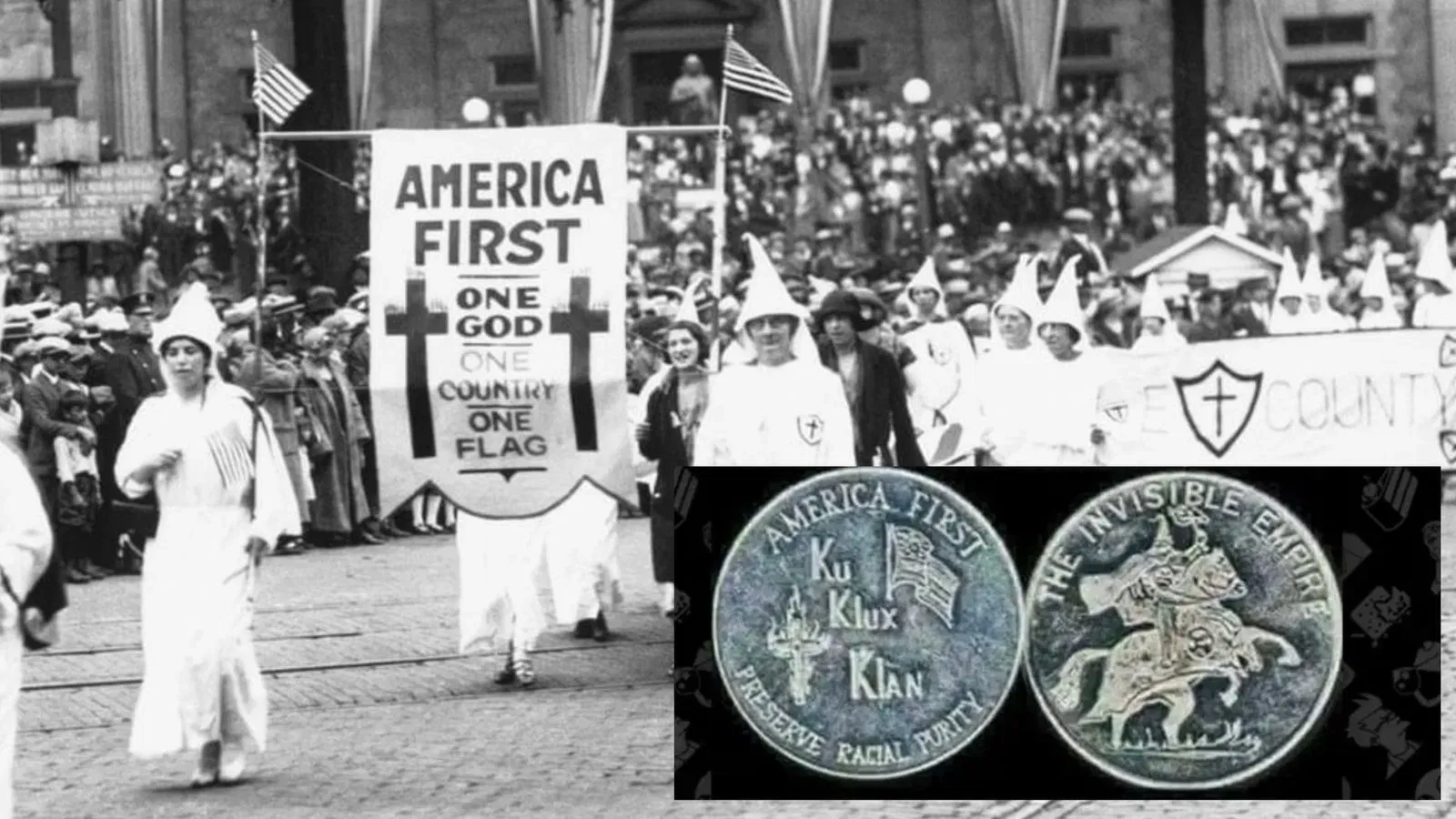
Binghamton, NY: Ku Klux Klan stages an 'America First' parade in Binghamton, NY. Photograph. 1920's. (Getty Images)
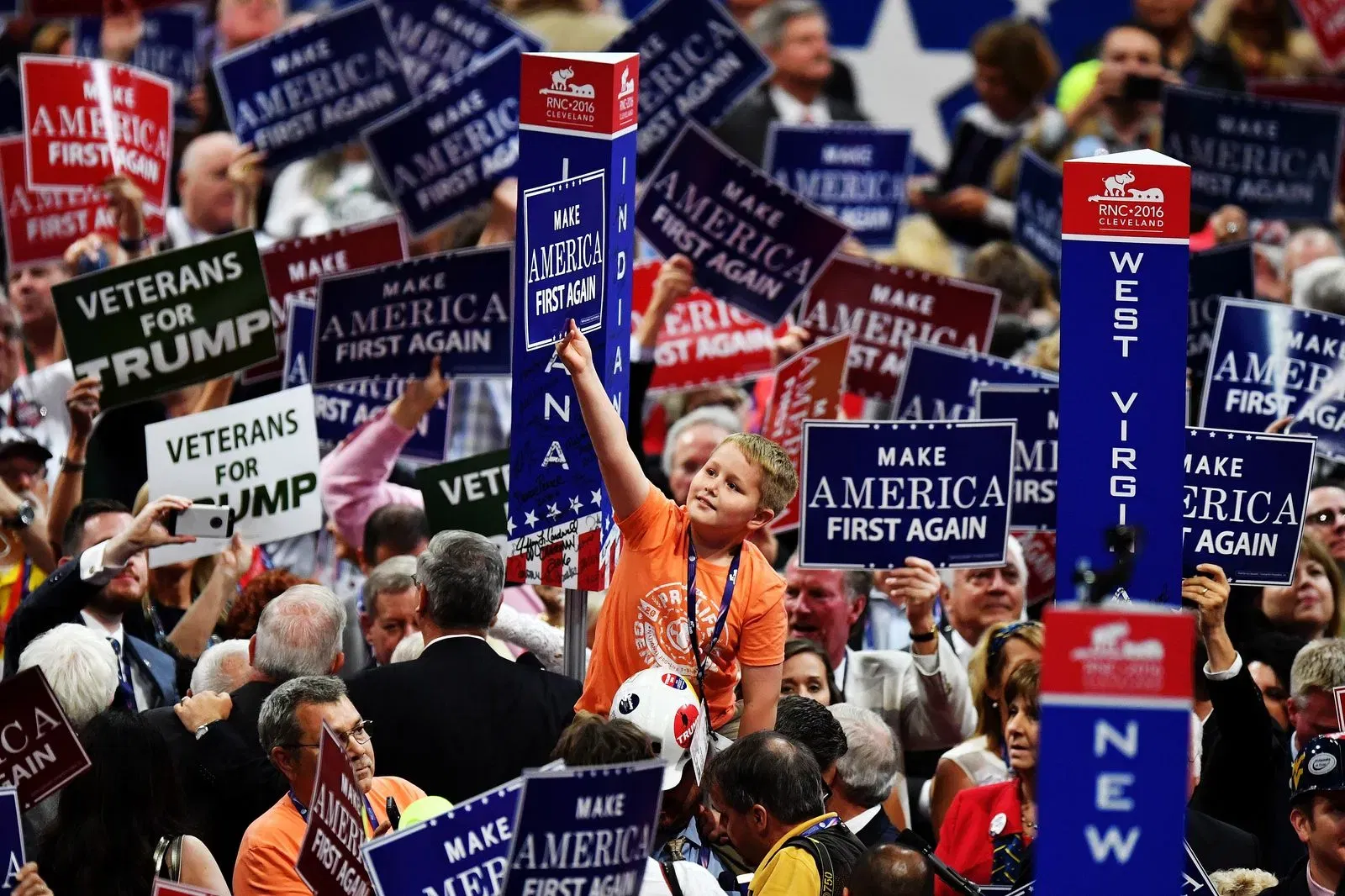
Above image from KUTV used for First Amendment purposes in accordance with the US Copyright Officer's Fair Use Policy and the Fair Use Doctrine (KUTV).
So now, when you hear Trump say, "America First", as he was on many, many occasions since he rose to power, let there be no question: he knows exactly what he is doing.
Here is an excerpt from a song by famous American folk singer Woodie Guthrie. It is about Donald Trump's father Fred, called "Old Man Trump":
I suppose that Old Man Trump knows just how much racial hate
He stirred up in that bloodpot of human hearts
When he drawed that color line
Here at his Beach Haven family project
Beach Haven ain't my home!
No, I just can't pay this rent!
My money's down the drain,
And my soul is badly bent!
Beach Haven is Trump’s Tower
Where no black folks come to roam,
No, no, Old Man Trump!
Old Beach Haven ain't my home! (WoodieGuthrie.org).
This case was brought against Fred and Donald Trump, and their real estate company, in 1973 in the U.S. District Court for the Eastern District of New York.
In October 1973, the Justice Department filed United States v. Fred C. Trump, Donald Trump, and Trump Management, Inc. in the U.S. District Court for the Eastern District of New York (federal court in Brooklyn).
The complaint alleged that the firm had committed systemic violations of the Fair Housing Act of 1968 in their many complexes--39 buildings, between them containing over 14,000 apartments. The allegations included evidence from black and white "testers" who had sought to rent apartments; the white testers were told of vacancies; the black testers were not, or were steered to apartment complexes with a higher proportion of racial minorities. The complaint also alleged that Trump employees had placed codes next to housing applicant names to indicate if they were black.
The Trumps retained Roy Cohn, former aide to Senator Joseph McCarthy, to defend them; they counter-claimed against the government, seeking $100 million in damages for defamation.
The case was assigned to District Judge Edward R. Neaher. He dismissed the counterclaim and allowed the Fair Housing Act suit to proceed.
After two years, the matter settled with a consent decree, signed June 10, 1975, which prohibited the Trumps from "discriminating against any person in the terms, conditions, or privileges of sale or rental of a dwelling." In addition to a general injunction against discrimination, the decree prohibits specific discriminatory practices, such as lying about the availability of apartments or interfering with individuals' enjoyment of their housing rights through threats or coercion. Fred and Donald Trump were ordered to "thoroughly acquaint themselves personally on a detailed basis" with the Fair Housing Act. The agreement also required the Trumps to place ads informing minorities they had an equal opportunity to seek housing at their properties (Civil Rights Litigation Clearinghouse).
Page in making. please check back soon! (June 17, 2025)
Although more will be added to my plan, of paramount importance is diverting the $345M being dumped into private schools — from the blatantly-unconstitutional school voucher program (House File 68) — into to public schools.
In the 1990s, Iowa was ranked in the top five states when it came to public education. Since then, our state has fallen to the middle of the pack.
"The education system in Iowa has always been something that Iowans have been proud of," said Leo Landis, state curator at the State Historical Society of Iowa. "Our history of education is really rich and it goes back to the 1850s. Iowa was pretty early in creating a system of free public schools," (Rooker 2022).
Divert $345M from School Voucher Program to Public Schools:
Lemon v. Kurtzman, Zelman v. Simmons-Harris
References
[3]: Jefferson, Thomas. Letter to the Danbury Baptist Association, January 1, 1802. In The Papers of Thomas Jefferson, Vol. 36: 1 October 1801 to 4 March 1802, ed. Barbara B. Oberg, 258–259. Princeton, NJ: Princeton University Press, 2009.
Belin, Laura. (March 23, 2025). Iowa House Republican Admits "Rookie Mistake" Over Extremist Handout. https://www.bleedingheartland.com/2025/03/23/iowa-house-republican-admits-rookie-mistake-over-extremist-handout/
Civil Rights Litigation Clearinghouse.Case: United States v. Fred C. Trump, Donald Trump, and Trump Management, Inc. https://clearinghouse.net/case/15342/.
Gruber-Miller, Stephen, and Katie Akin. “Jubilant Kim Reynolds Signs Iowa’s Seismic ‘school Choice’ Bill into Law. What It Means:” The Des Moines Register, Des Moines Register, 25 Jan. 2023, www.desmoinesregister.com/story/news/politics/2023/01/24/iowa-governor-kim-reynolds-signs-school-choice-scholarships-education-bill-into-law/69833074007/.
KUTV. (March 1, 2021). Utah candidate claims Trump's 'America First' slogan is 'code for white supremacists'. https://kutv.com/news/utah-legislature-2021/utah-candidate-trumps-america-first-slogan-is-kkk-code-for-white-supremacists.
Meyer, Virginia. “School Funding Plan Compels Government Support of Religion.” Log In, 19 Jan. 2023, www.thegazette.com/letters-to-the-editor/school-funding-plan-compels-government-support-of-religion/.
National Park Service. (Retrieved June 17 2025). Lincoln and the U.S. Constitution. https://www.nps.gov/liho/learn/historyculture/constitution.htm. Citing:
Eric Foner, Forever Free: The Story of Emancipation and Reconstruction (2006)
Michael Vorenberg, Final Freedom: The Civil War, The Abolition of Slavery, and the Thirteenth Amendment (2001)
Mary E. Neely, Jr., The Fate of Liberty: Abraham Lincoln and Civil Liberties (1992)
William Whiting, The War Powers of the President (1864), available on the Library of Congress website (www.loc.gov)
The National Constitution Center: www.constitutioncenter.org/lincoln
Rooker, Amanda. (August 22, 2022). Report card on Iowa schools: Data shows how Iowa compares to other states. KCCI Des Moines 8. https://www.kcci.com/article/report-card-on-iowa-schools-data-shows-how-iowa-compares-to-other-states/40961606.
USA Today. (May 23, 2024). What is a RINO? What to know about the weaponized term in GOP politics. Sam Woodward. https://www.usatoday.com/story/news/politics/elections/2024/05/23/what-is-a-rino-in-gop-politics/73817513007/.
Rookie Mistake: https://www.bleedingheartland.com/2025/03/23/iowa-house-republican-admits-rookie-mistake-over-extremist-handout/
WoodieGuthrie.org. https://woodyguthrie.org/Lyrics/Old_Man_Trump.htm.