
Written 4/25/2025 by Sondra Wilson.
On March 31, 2025 Wilson et al v. Trump et al was filed in the
§§ 1985 and 1964 Claims
42 USC § 1985 Conspiracy to interfere with civil rights provides a right of action to injured parties.
18 U.S.C. §1964(c) – Civil Remedies provides for treble damages.
SUCH PERSONS have in fact suffered a legal injury (injury to rights) and consequential injuries.
Case Facts
1. All named defendants, and likely some unnamed, are conspirators. All such conspirators may also be referred to as co-conspirators.
2. Co-conspirators conspired and continue to conspire in order to violate the rights of, and cause personal injuries to, a class of persons currently protected against discrimination by the Iowa Civil Rights Act (ICRA), Civil Rights Act (CRA), Equality Clause ( of the Iowa Constitution, Equal Protections Clause of the Fourteenth Amendment, and American Common Law.
3. The Iowa Civil Rights Act, modelled after the Civil Rights Act, is designed, in part, to provide remedies to civilians who may become adversely impacted via discriminatory acts: against discrimination in the areas of employment, housing, credit, education, and public accommodations. On March 8, 2019 the Iowa Supreme Court found, in Good and Beal v. Department of Human Services (2018), that (1) surgeries for transgender persons are in fact medically necessary, and (2) the Iowa Civil Rights Act prohibits discrimination against trangender persons from being able to receive access to Medicare or Medicaid. The Medicare and Medicaid Act guarantees that all US Citizens have the rights (1) to be treated with courtesy, dignity and respect at all times, (2) to be protected from discrimination, (3) to have personal and health information kept private, and (4) to have access to doctors, specialists, and hospitals for medically necessary services (Medicare.gov).
4. Co-conspirators have been working to violate all rights, deny access to all remedies at Law and Equity, and related Lawful Protections mentioned in ¶ 3; simultaneously, Defendants have actively worked to foster a political culture filled with fear and distrust of government throughout the State of Iowa, United States, and beyond which is hostile toward the protected class (victims). The REPUBLICAN PARTY OF IOWA, REPUBLICAN NATIONAL COMMITTEE, and STATE OF IOWA appear prima facie to be racketeering-influenced corrupt organizations (RICO Laws) used by co-conspirators to extort funds toward unlawful ends; all three organizations must be purged of any and all apparent and hidden infiltration, wherever it may lie. Special Elections may be required in order to fill necessary Governmental roles. There are likely other racketeering-influenced corrupt organizations involved whom prosecutors may become aware of during investigations; such organizations, and individuals involved, shall be added as defendants.
5. Shortly after the Good ruling, on May 3, 2019, numerous co-conspirators enacted HF 766, which included, on page 84, “Division XX”. This provision, subversively slipped into the lengthy bill, was devised to authorize the State of Iowa to deny medically-necessary services to the victims in this case, setting forth: “This section shall not require any state or local government unit or tax-supported district to provide for sex reassignment surgery or any other cosmetic, reconstructive, or plastic surgery procedure related to transsexualism, hermaphroditism, gender identity disorder, or body dysmorphic disorder.” Countless medically-necessary procedures for transgender Iowans were cancelled as a result. The enactment of HF 766/Div. XX, while knowingly and willingly violating the clearly-established rights of a class of persons via doing so, constituted a violation of the 18 U.S. Code §§ 241, 242; these unenumerated rights are facially secured by the Medicare and Medicaid Act and guaranteed by the Ninth Amendment.
6. In November 2021, Judge William Kelly struck down the HF766 provision, rightly pointing out that it was “discriminatory and unconstitutional”, and that it “violates the Iowa Constitution and the Iowa Civil Rights Act”. Following the Iowa District court’s 2018 ruling, Kim Reynolds’ spokesperson stated that Ms. Reynolds was “disappointed in today’s decision and disagrees with the district court’s ruling on Medicaid coverage for transgender reassignment surgeries,” and that were “reviewing the decision with our legal team and exploring all options [with regard to violating the rights of transgender Iowans] moving forward.” This statement, in conjunction with the repeated efforts toward the ends of violating the rights of transgender Iowans, indicates prejudice, discrimination, malice, premeditation, and animus by the various defendants, against their intended and de facto victims.
7. The ACLU of Iowa challenged HF 766/Div. XX in Vasquez and Covington v. Department of Human Services (2023). Meanwhile, transgender Iowans waited for the Court to rule a second time on the same issue, unable to schedule appointments for years as a result of continuing rights violations perpetrated by the defendants. In spring 2023 the Iowa Supreme Court declined to issue a ruling, however, pointing out that this issue had already been decided in Good, and that legal protections for persons based on their gender identity, as found in the Iowa Civil Rights Act, prevented the STATE OF IOWA from denying coverage.
8. On February 8, 2024, one of the victims in this case, Alexandra “Sondra” Wilson, filed a suit against the STATE OF IOWA and KIM REYNOLDS FOR IOWA, due to numerous acts of defamation, rights violations, and ongoing threats and conspiracy. See Attachment A – Amended Petition for case #LACL157953. Judge Huppert wrote incorrect information into the ruling, then ruled according to what he wrote instead of what Ms. Wilson wrote. Then the Iowa Supreme Court denied her right to appeal based upon legal shenanigans which may be explained in detail by this key witness.
9. After repeatedly slandering transgender persons, in collusion with numerous other parties who may be entered into this case as Defendants, after becoming elected, Donald Trump, acting under color of authority, greenlit tortious and illegal state actions which were then performed by numerous Defendants, also acting under color of authority, who became emboldened by Mr. Trump’s illegal, wrongful, collusive acts. Some, but not all, collusive acts, included the issuance of the following Executive Orders (EO) and political threats, nearly immediately following the Presidential inauguration:
- Jan. 20 EO, “Defending Women from Gender Ideology Extremism and Restoring Biological Truth to the Federal Government”, Trump falsely claimed that transgender women are “men who self-identify as women”. He then goes on to claim that his administration “[W]ill defend women’s rights and protect freedom of conscience” while in the same breath inciting sex and gender-based harassment against transgender women.
- Jan. 21 EO, “Ending Illegal Discrimination and Restoring Merit-Based Opportunity” rescinded President Truman’s landmark 1965 EO 11246, requiring affirmative action and forbidding federal contractors from discrimination on the basis of race, color, religion, sex, sexual orientation, gender identity, or national origin. Conflating “civil rights protections” with “DEI”, Donald Trump rescinded this landmark civil rights order under the false pretense of promoting “Diversity, Equity, and Inclusion”.
- Jan. 27 EO, “Prioritizing Military Excellent and Readiness”, President Trump tortiously defamed transgender people, accusing them of “[E]xpressing a false ‘gender identity’” and not living “[A]n honorable, truthful, and disciplined lifestyle.” He wrote, “A man’s assertion that he is a woman, and his requirement that others honor this falsehood.”
The Trump Admin also erased the “T” from LGBT+ related government websites, and scrawled harmful, defamatory language across the tops of HHS, CDC, and other federal websites, directed toward transgender people. Trump has similarly threatened to cut federal funding from universities who don’t comply with his ultimatums. He conflates and mislabels “civil rights protections” with “DEI” in his speeches, then eliminates civil rights protections and threatens safety while repeatedly slandering transgender Americans. The list goes on, and there is likely more behind the scenes which subpoenas may be used to locate and identify, including the identification of additional Defendants
10. Between February 24 and 28, State of Iowa officials rushed a bill through two subcommittees, the Iowa House and Senate, and, within 4 days, to the Governor’s desk. This bill, Iowa Senate File 418, was designed specifically to remove protections against discrimination from transgender people, leaving transgender Citizens without legal recourse, and opening the floodgates to allow open discrimination throughout the state. Upon signing the bill into law, and thus, committing extortion (thus violating 18 U.S.C. § 872), defendant Kim Reynolds, under color of authority, released a statement which clearly indicated the co-conspirators’ motive: to deny medically necessary services to transgender Iowans. Reynolds stated, “[Legal protections in the Iowa Civil Rights Act which prohibit discrimination against transgender Iowans] has… forced Iowa taxpayers to pay for gender reassignment surgeries. That is unacceptable to me, and it is unacceptable to most Iowans…. What this bill does accomplish is to strengthen protections for women and girls, and I believe that is the right thing to do.” Reynolds, under color of law, violated the rights of a vulnerable class of persons explicitly protected against such discrimination by the Iowa Civil Rights Act and Civil Rights Act.
11. The Court is requested to immediately issue an injunctive protective order to prevent any behind-the-scenes actions targeting trangsender persons; these are only some examples.
THEREFORE co-conspirators caused a legal injury to an entire class of persons. Plaintiffs in this suit object to the loss of this right, and demand restitution for injuries caused by the defendants.
LIMITATIONS PERIOD – Plaintiffs object to the loss of such rights within the four year limitations period set forth under 28 U.S. Code § 1658 of the Civil Rights Act.
2. Many cases in which abortions are needed, such as ectopic pregnancies, for example, are considered medically-necessary services. The Medicare and Medicaid Act secures the right to access medically-necessary services;
Usage of a “code” (e.g. Iowa Code) in order to deprive someone of their rights is a violation of 18 U.S.C. § 242 Deprivation of rights under color of law; since July 14, 2023, an unknown number of victims have been denied their right to abortion when in time of need;
Whether or not a person within the protected class was denied access to abortion-related medical services, all such persons within the protected class have experienced and are in fact still experiencing a continuing injury to their reproductive rights;
The Ninth Amendment of the U.S. Constitution guarantees that rights which are not enumerated within the Constitution, and which are retained by The People, may not be denied or disparaged;
Donald Trump was nominated and elected by the REPUBLICAN NATIONAL COMMITTEE (“RNC”), whose Members knowingly and willfully, in a premeditated manner, voted for him as the Presidential Candidate whilst aware that he intended to work toward violating the rights and safety of transgender Americans. Co-conspirators within the RNC, although a lawfully-created entity, worked in a collaborated effort toward the achievement of unlawful ends, including but not limited to violations of 18 U.S.C. § 241 Conspiracy against rights and 18 U.S.C. § 242 Deprivation of rights under color of law, THEREFORE (page in making)
18 USC § 1962 Civil racketeering
Defendants
Rep. Eddie Andrews (R-Johnston)
Rep. Brian Best (R-Glidden)
Rep. Brooke Boden (R-Indianola)
Rep. Jacob Bossman (R-Sioux City)
Rep. Steve Bradley (R-Cascade)
Rep. Taylor Collins (R-Mediapolis)
Rep. Dave Deyoe (R-Nevada)
Rep. Jon Dunwell (R-Newton)
Rep. Dean Fisher (R-Montour)
Rep. Joel Fry (R-Osceola)
Rep. Dan Gehlbach (R-Urbandale)
Rep. Tom Gerhold (R-Atkins)
Rep. Cindy Golding (R-Cedar Rapids), Rep. Martin Graber (R-Fort Madison), House Speaker Pat Grassley (R-New Hartford), Rep. Stan Gustafson (R-Norwalk), Rep. Bill Gustoff (R-Des Moines), Rep. Austin Harris (R-Moulton), Rep. Helena Hayes (R-New Sharon), Rep. Robert Henderson (R-Sioux City), Rep. Steven Holt (R-Denison), Rep. Heather Hora (R-Washington), Rep. Chad Ingels (R-Randalia), Rep. Tom Jeneary (R-Le Mars), Rep. Craig Johnson (R-Independence), Rep. Megan Jones (R-Sioux Rapids), Rep. Bobby Kaufmann (R-Wilton), Rep. Shannon Latham (R-Sheffield), Rep. Shannon Lundgren (R-Peosta), Rep. Josh Meggers (R-Grundy Center), Rep. Ann Meyer (R-Fort Dodge), Rep. Gary Mohr (R-Bettendorf), Rep. Norlin Mommsen (R-DeWitt), Rep. Tom Moore (R-Griswold), Rep. Carter Nordman (R-Panora), Rep. Anne Osmundson (R-Volga), Rep. Matthew Rinker (R-Burlington), Rep. Mike Sexton (R-Rockwell City), Rep. Brad Sherman (R-Williamsburg), Rep. Jeff Shipley (R-Birmingham), Rep. David Sieck (R-Glenwood), Rep. Brent Siegrist (R-Council Bluffs), Rep. Ray Sorensen (R-Greenfield), Rep. Luana Stoltenberg (R-Davenport), Rep. Henry Stone (R-Forest City), Rep. Mark Thompson (R-Clarion), Rep. Phil Thompson (R-Boone), Rep. Charley Thomson (R-Charles City), Rep. Mike Vondran (R-Davenport), Rep. Skyler Wheeler (R-Hull), Rep. John Wills (R-Spirit Lake), Rep. Hans Wilz (R-Ottumwa), Rep. Matt Windschitl (R-Missouri Valley), Rep. Devon Wood (R-New Market), Rep. Derek Wulf (R-Hudson), Rep. David Young (R-Van Meter).
Sen. Mike Bousselot (R-Ankeny), Sen. Waylon Brown (R-Osage), Sen. Mark Costello (R-Imogene), Sen. Chris Cournoyer (R-LeClaire), Sen. Dan Dawson (R-Council Bluffs), Sen. Rocky De Witt (R-Lawton), Sen. Adrian Dickey (R-Packwood), Sen. Dawn Driscoll (R-Williamsburg), Sen. Jeff Edler (R-State Center), Sen. Lynn Evans (R-Aurelia), Sen. Julian Garrett (R-Indianola), Sen. Jesse Green (R-Harcourt), Sen. Kerry Gruenhagen (R-Walcott), Sen. Dennis Guth (R-Klemme), Sen. Carrie Koelker (R-Dyersville), Sen. Tim Kraayenbrink (R-Fort Dodge), Sen. Mark Lofgren (R-Muscatine), Sen. Charlie McClintock (R-Alburnett), Sen. Jeff Reichman (R-Montrose), Sen. Dave Rowley (R-Spirit Lake), Sen. Ken Rozenboom (r-Pella), Sen. Sandy Salmon (R-Janesville), Sen. Jason Schultz (R-Schleswig), Sen. Tom Shipley (R-Nodaway), Sen. Amy Sinclair (R-Allerton), Sen. Annette Sweeney (R-Alden), Sen. Jeff Taylor (R-Sioux Center), Sen. Scott Webster (R-Bettendorf), Sen. Cherielynn Westrich (R-Ottumwa), Sen. Jack Whitver (R-Grimes), Sen. Brad Zaun (R-Urbandale), Sen. Dan Zumbach (R-Ryan).
Archives
What was planned, and how it got interrupted
The Iowa State University Chapter of Student Reformationists’ Official Web Page
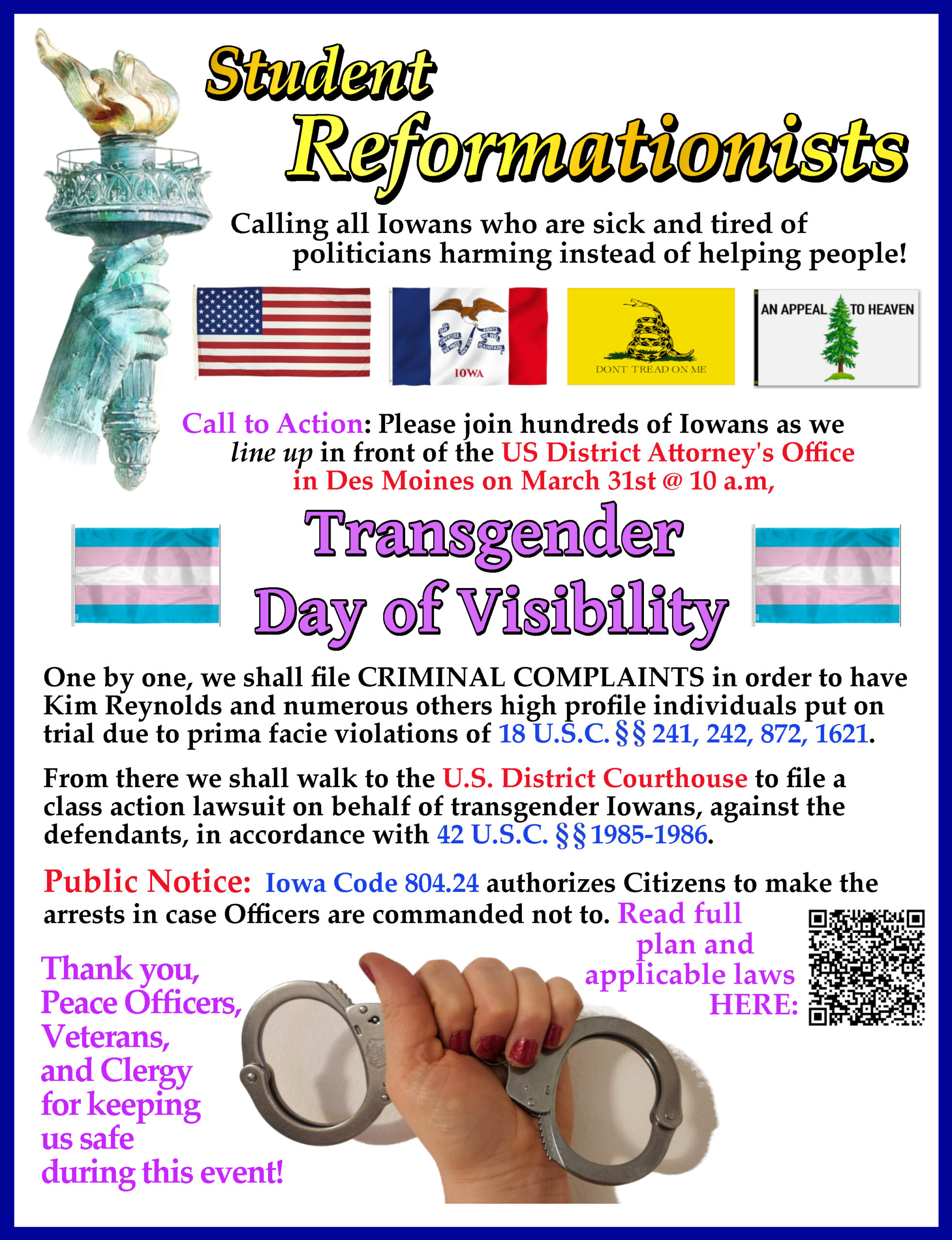
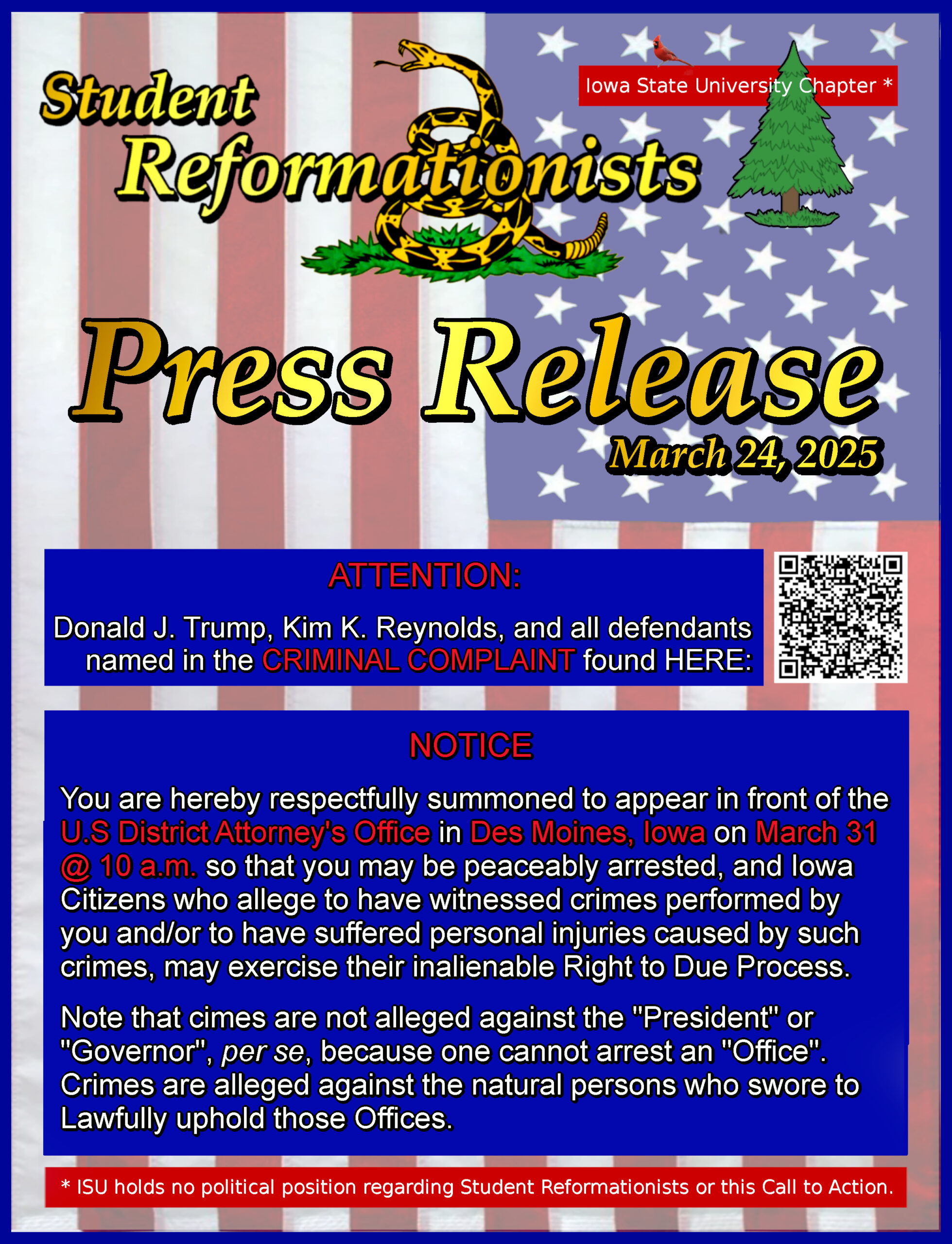
You may download PDFs for both event fliers HERE and HERE. Feel free to distribute them, and thank you for doing so!
FLAGS REQUESTED
Organizers request that those who wish to show support for safety and rights of all persons throughout the state on this day and all others, to respectfully bring and fly any and all of the six flags indicated within this FLAG REQUEST.
Please note that every statute referenced throughout the complaint and petition directly apply to women’s rights, which will be explained in full within the call to action soon. Note that the Respect for Women Act will be linked into Wild Willpower PAC’s state platform soon, which will likely alleviate concerns for a lot of people with regard to intersections between trans rights and women’s rights. Stay tuned.
Read the full “Government Accountability” Call to Action here.
Download the PDF here and please help disseminate it all throughout Iowa:
Student Reformationists March 31 flier
Mass Email to Law Enforcement redacted
Volunteers wear the Official Badge:

Photo of Badgey was found here, and is used in accordance with the Fair Use Doctrine. Unfortunately, due to mental health caused by Defendants in related Causes of Actions, Founder was unable to function well enough to focus on accrediting properly. Founder need more helpy-pooh.
Everything below here is just saved in case the Student Reformationists web page gets deleted somehow.
Meeting times: 5 pm Thursdays in The Center @ Memorial Union, 4th floor. Open to the public. Come join us.
PRESS RELEASE
HISTORIC EVENT:
“GOVERNMENT ACCOUNTABILITY” CALL TO ACTION.
MARCH 31, 2025, TRANSGENDER DAY OF VISIBILITY.
ALL IOWANS WHO CARE ABOUT HUMAN RIGHTS:
PLEASE COME!
NOTICE
The following content may be amended up until the time of the Event; please state tuned. Contact StudentReformationists@gmail.com with questions or concerns, and/or to collaborate.
Anyone who participates in this Call to Action shall henceforth be referred to as “Participant” and must agree and adhere to the OFFICIAL RULES (“Rules”). Disclaimer: Anyone who does not adhere to the Rules is not affiliated with anyone involved in this Call to Action.
This is not a typical protest. Before arriving, please read A Call for Peace between Officers and Civilians.
To make this action positive and effective (to prevent distraction from the laws we’re trying to get enforced), only bring posters or signs with THESE MESSAGES written on them. The reason for this is so we can educate the public about the laws that are being referenced within the Criminal Complaint and Class Action Lawsuit (see below for details). Signage with other messaging will not be affiliated with SR or this Event. Email StudentReformationists@gmail.com to request a similar sign idea.
Familiarize yourself with THESE LAWS and THESE GLOSSARY TERMS prior to arriving. Remember, SR will be editing and refining all content throughout this Call to Action up until the Event. When you come across unfinished material, know that it will be made clear soon.
LINE UP IN FRONT OF THE US DISTRICT ATTY’S OFFICE @10:00 am
Every Iowan interested in JUSTICE, GOVERNMENT ACCOUNTABILITY, and having OUR LAWS UPHELD, shall, in an orderly manner:
-
Respectfully line up in front of the U.S. District Attorney’s Office, located at 110 E Court Ave #286 in Des Moines, IA.
-
Bring your Photo ID.
Each Volunteer working with Student Reformationists (SR) will be accompanied by a certified Notary Public as they hand out finished versions of THIS CRIMINAL COMPLAINT to everyone in standing in line. Volunteers and Notaries will be wearing the official SR lanyard and nametag: accept no imposters!
SR is requesting three types of volunteers:
OFFICIAL REQUEST FOR VOLUNTEERS.
AFTER COMPLAINTS ARE FILED, WE WALK TO THE FEDERAL DISTRICT COURTHOUSE
After all Criminal Complaints have been filed, Participants, led by Officers of SR, will walk next door to the U.S. (federal) District Courthouse. This is where SR will file the CLASS ACTION LAWSUIT against the same persons who are Defendants in the Criminal Complaint. Basically, 18 US Code § 241 Conspiracy against rights is a criminal statute, and 42 USC § 1985 Conspiracy to interfere with civil rights provides a right of action for the recovery of damages. If you are unsure the difference between criminal and civil law, read this.
ATTN: ALL EXECUTIVE BRANCH PERSONNEL
In the event that Kim Reynolds, Donald Trump, and/or any Officer, of any agency abuses their Authority via commanding:
-
Any member of the Executive Branch to arrest and/or impede or obstruct, in any manner, from allowing Citizens access to our Due Process Rights (e.g. not allowing us to file the Complaints and/or Class Action), and/or denying Due Process based on some legal argument or case ruling (we will challenge any such ruling as facially unconstitutionally) or
-
The Executive Branch not to make the arrests related to our Complaint,
Please note that, if anyone were try attempt to prevent the execution of the laws cited in the criminal complaint, that person(s) could be tried with seditious conspiracy. 18 USCA § 2384.
SR formally requests any and all Executive Branch Personnel to protect civilians against any and all such tyranny. If a tyrannical and/or oppressive order is given to you from the top-down, please remember the words of Abraham Lincoln, “The people – the people – are the rightful masters of both congresses and courts – not to overthrow the Constitution, but to overthrow the men who pervert it.” We hereby pre-emptively respectfully thank you for your service, and humbly request your protection. The signing of the Magna Carta embedded the fact that neither King nor President is above a true Law.
The following flier (which may be downloaded here) will be sent to Kim Reynolds and Donald Trump on 3/24/2025 (best viewed on desktop computer):
IF OFFICERS ARE ORDERED NOT TO MAKE ARRESTS, SR’s PRESIDENT WILL INITIATE THE ARREST
Although the below flier explains that Iowa Code 804.24 authorizes Citizens to make a Citizen’s Arrest, Participants are strongly discouraged from doing so because we do not want anyone to feel threatened. If Officers are commanded not to make the arrests, SR requests any and all Officers to stand down, even if ordered to do otherwise, so that the President of SR may safely approach, unarmed, to make an arrest. Miranda Rights will be read, and the paperwork will be in order. SR respectfully requests safety and protection for all Civilians. Thank you, Officers!
FLAGS REQUESTED
Due to their meaning in relation to this particular action, the presence of THESE SPECIFIC FLAGS is requested. Please bring them, and treat them respectfully.
SOLIDARITY FOR WOMEN’S RIGHTS!
Every statute cited throughout the Complaint and the Petition, including 42 USC §§ 1985 and 1986, not only apply to trans rights, but also to women’s rights.
SR respectfully calls upon everyone reading this to have compassion and wisdom instead of turning against fellow Citizens. When politicians “divide and conquer”, we must remember: “united we stand, divided we fall.”
A SPECIAL MESSAGE FROM STUDENT REFORMATIONISTS
As Officers and Founding Members, we would like to share why we created this organization. Following numerous political attacks by high profile individuals against DEI initiatives, women’s rights, and transgender folk in recent years, Iowa State University’s Center for LGBTQIA+ Success was shut down due to what appears to be a 9 individuals who were appointed to the Iowa Board of Regents by Governor Kim Reynolds.
The Iowa Civil Rights Act protects various classes of persons who have historically been discriminated against. Today, as politicians do their same old story of divide and conquer, riling up malice toward LGBT+ folk and international students,
HELP SPREAD THE WORD
March 31 is almost here!!! This is an all-hands-on-deck, Paul Revere-level First Amendment moment!! Student Reformationists kindly requests everyone reading this to forward it, alongside supportive words telling them why you think it is important, to (1) one person and (2) one organization. If everyone forwards this web page to one person and to one organization, we can make this moment go anti-viral! Also, please DOWNLOAD BOTH EVENT FLIERS, and distribute them anywhere and everywhere. Thank you for doing so!
THANK YOU, MILITARY VETERANS!!
Thank you dearly, Military, Law Enforcement, and Veterans for protecting our First, Fifth, Ninth, and Fourteenth Amendment rights, and numerous other rights unmentioned. Thank you for our safety. Thank you to all government officials who feel like you work thanklessly for no reason, at times. As civilians, it seems easy to take these things for granted, and to feel resentment toward the government due to so many politicians and news media personnel, for example, saying terrible things about transgender people; we are in the news nearly every day, and often not with a positive light shining on our “community” (people we can relate to via having a shared experience, to a measure).
ABOUT STUDENT REFORMATIONISTS:
The Iowa State University Chapter of Student Reformatationists (SR) was established at the beginning of the spring 2025 semester, with the help of Wild Willpower PAC (WWP).
Student organization are in a unique position to be able to speak our minds and share our findings with the world.
We intend to become an intercollegiate student organization dedicated toward building lawsuits and performing respectful, effective activism in favor of the advancement of human rights and improvement of the general welfare of the American people and, in turn, people across the globe.
SR invites ISU’s pre-law students who have a strong sense of justice and a desire to use legal knowledge to make a positive impact in society to team up with artists, activists, speakers, graphic designers, concerned community members, and law students, paralegals, and interested scholars from colleges and universities in order to create winning, just lawsuits and public information campaigns to let the public know what is happening and offer feedback.
SR works toward educating fellow students, faculty and staff, and the general public on important issues of our times, and to work with integrity and toward humanity’s common good.
Search terms for SEO
Operation magna carta 2
operation magna carta two