
Iowa's Broken Judiciary — Case Two:
The 2024 Civil Rights Case Iowa Never Heard
Wilson v. State of Iowa and Kim Reynolds for Iowa, Case. No. LACL15795
“I Petitioned the Government for Redress of Grievances—Only to Be Met With Repeated Injury.”
By Sondra Wilson | Updated August 7, 2026

Notice: This page will be updated after I am done litigating Wilson v. Pate and Wilson v. Reliable Street Inc., et al.
To read the state's "seven questionable defenses", see the motion to dismiss filed 7/26/2024.
I Petitioned the Government for a Redress of Grievances
At its most fundamental level, that is what this case was about.
The First Amendment protects
“... the right of the people peaceably to assemble, and to petition the Government for a redress of grievances.” [1]
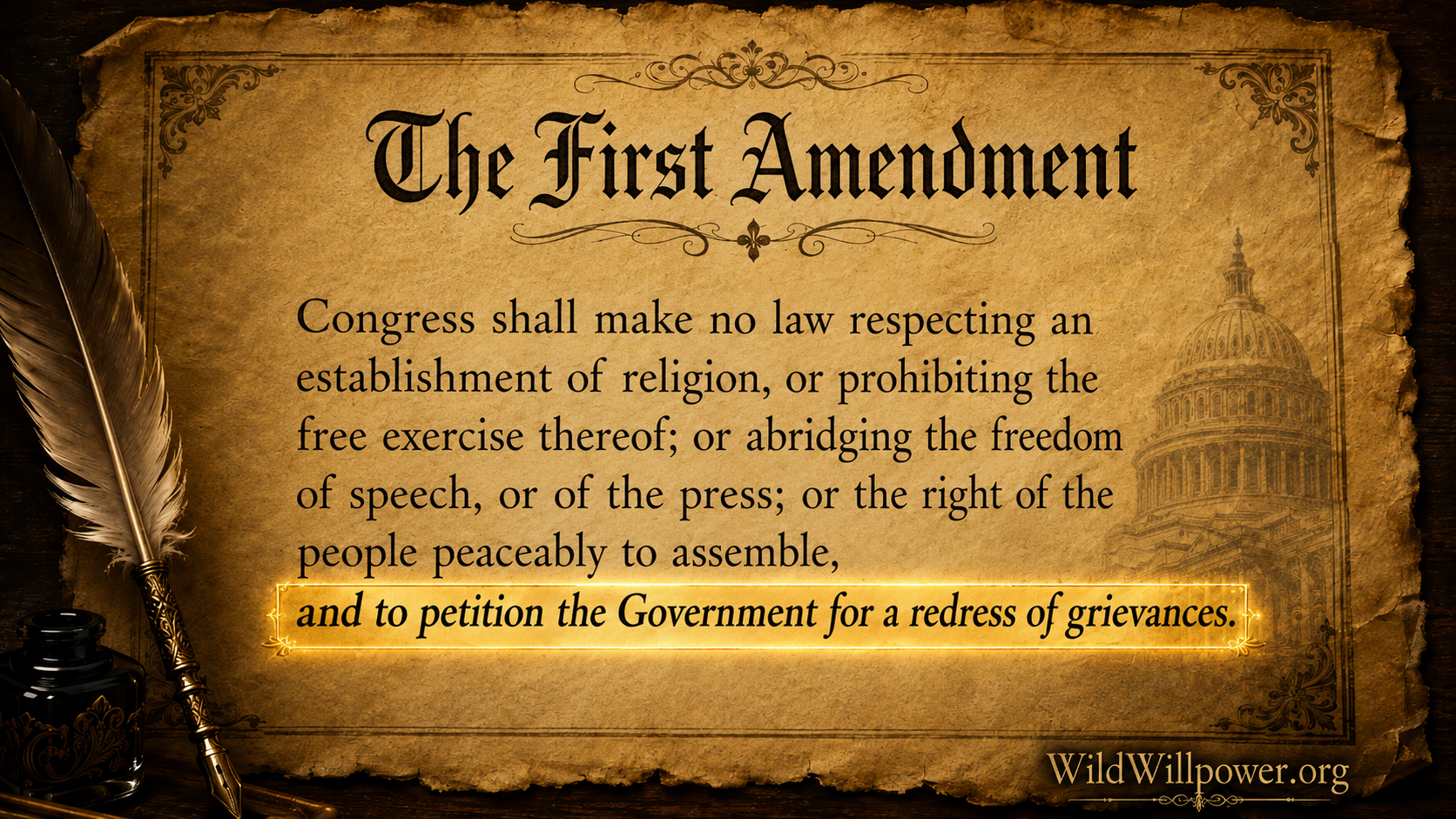
I did what Americans are taught to do when they believe government has injured them: I documented what happened, attempted to use the available administrative processes (as documented in Part Three: Iowa's Civil-Rights Trap), sought legal representation, and ultimately brought my grievances before a court, through a petition.
I was not just asking for money. My amended petition requested damages and multiple forms of equitable relief to prevent the type of harm that happened to me from happening to others.
My Rights to Due Process and Trial by Jury Were Violated
However, despite the constitutional oaths of office to uphold our state and U.S. constitutions, neither Attorney General's Office nor the court answered my petition in any meaningful manner. Instead of accepting responsibility for well-documented harms I brought forth, my petition was deflected through technical legal defenses I controverted, but instead of answering my grievances or my responses to the State's defenses, the court made promises it did not follow through with later in the proceedings before blindly accepting the State's defenses, as if through loyalty to an unspoken agenda while blowing off and never addressing my arguments whatsoever.
Ultimately, despite our state constitutions' guarantees to trial by jury and due process of law, including the Iowa Constitution's Art. I, § 9, "The right to trial by jury shall remain inviolate," no such trial took place. The case was thrown out. After I appealed the decision, in hopes that the Iowa Supreme Court would examine the facts and examine the case on its merits, instead I was not notified that the State responded to my appeal, and after receiving late notice of Judge Huppert's final ruling, the court used my untimely responses (which were filed on time according to when I received notice) as an excuse to attempt to permanently bar this case from ever being heard again.
My Case Was Not Dismissed On Its Merits,
But Through Evasion, Abuses of Discretion, and Extrinsic Fraud
I contend that the State violated fundamental values and guarantees embodied in both the Iowa and United States Constitutions, and that the rulings dismissing my claims “with prejudice” were neither fairly nor lawfully reached. I further contend that particular discretionary rulings constituted abuses of discretion, that the cumulative result amounted to a denial of justice, and that conduct which prevented me from receiving notice and fully presenting my case raises the doctrine of extrinsic fraud.
These are legal terms with specific meanings.
"With Prejudice" — A Purportedly Final Adjudication
A dismissal with prejudice is not merely an order closing a case. Ordinarily, it operates as a final adjudication on the merits and prevents the plaintiff from bringing the same claim again.
The Iowa Supreme Court has stated:
“A dismissal with prejudice is ordinarily an adjudication on the merits.”[2]
The consequence is severe. A court dismissing a claim with prejudice is not merely saying, “this pleading is deficient” or “try again after correcting the problem.” It is ordinarily declaring the controversy conclusively resolved against the plaintiff, subject to whatever rights of appeal, reconsideration, relief from judgment, or other review remain available.
That distinction is critical here because I contend that my claims were never actually subjected to the fair adjudication on their merits that the words “with prejudice” ordinarily imply.
"Abuse of Discretion" — Judicial Discretion Has Legal Limits
Judicial discretion is not unlimited authority to decide a matter however a judge wishes.
Under Iowa law, a court abuses its discretion when its grounds or reasons are “clearly untenable” or when the exercise of discretion is “clearly unreasonable.” A ground is untenable when it lacks substantial evidentiary support or rests upon an erroneous application of law. [3]
Accordingly, abuse of discretion means an exercise of judicial discretion beyond the lawful boundaries of reasoned decision-making. It includes discretionary decisions resting upon legally untenable grounds or reaching a result that is clearly unreasonable under the record and governing law.
This matters because judges possess discretion precisely so that they may administer justice according to law and the circumstances before them—not so that relevant arguments may be ignored, material facts disregarded, procedural promises abandoned, or one party’s position accepted without meaningful consideration of the other.
My contention is not simply that I disagree with the result. I contend that particular decisions in this case crossed the line between an adverse judicial ruling and an abuse of judicial discretion because the grounds asserted for those decisions cannot be reconciled with portions of the record, the arguments I actually presented, and the procedural circumstances under which the rulings were entered.
"Denial of Justice" — When the Process Fails to Deliver a Fair Adjudication
I use denial of justice here in its fundamental sense: the failure of a judicial process to provide the fair consideration and adjudication that justice requires.
It should not be confused with the narrower international-law doctrine that sometimes carries the same name, nor am I using the phrase as though “denial of justice” were itself a separately pleaded Iowa cause of action.
The constitutional principle underlying my use of the term is considerably older and more fundamental.
The United States Supreme Court has described a denial of due process as:
“the failure to observe that fundamental fairness essential to the very concept of justice.”[4]
Thus, when I describe what occurred as a denial of justice, I mean more than the fact that I lost a lawsuit. Losing after one's claims have been fairly heard is an ordinary consequence of litigation. What I allege occurred here is fundamentally different: material arguments went unanswered; procedural circumstances affecting my ability to respond were disregarded; notice failures interfered with my opportunity to participate; and the resulting judgments were nevertheless employed to close the courthouse door with prejudice.
A judicial system cannot meaningfully promise due process while denying a litigant the process necessary to obtain a fair adjudication.
Page in making. please check back shortly. 8/7/2026.
"Extrinsic Fraud" — Fraud That Prevents a Fair Submission of the Case
Extrinsic fraud is especially important because Iowa law distinguishes fraud concerning matters actually litigated from fraud that interferes with a person's ability to litigate them at all.
The Iowa Supreme Court has defined extrinsic fraud as:
“some act or conduct of the prevailing party which has prevented a fair submission of the controversy.”[6]
The Court has further described it as:
“that fraud which keeps a litigant from presenting the facts of his or her case and prevents an adjudication on the merits.”[7]
It can include conduct that lulls a party into a false sense of security or prevents the party from making a defense.[8]
That distinction goes directly to my allegations.
Intrinsic fraud generally concerns fraud within the controversy submitted to the court—for example, false testimony or fraudulent evidence offered concerning an issue the court actually had an opportunity to decide.
Extrinsic fraud, by contrast, attacks the integrity of the opportunity to be heard itself. It occurs outside or collateral to the actual adjudication and prevents a party from fully and fairly placing the controversy before the court.
That is precisely why notice matters.
If a litigant is not properly informed that an opposing party has made a filing requiring a response, and a court thereafter uses the resulting absence or lateness of that response against the litigant, the problem is not merely whether the opposing filing contained a true or false argument. The threshold question becomes whether the affected litigant was deprived of a fair opportunity to answer it at all.
I contend that this principle applies directly to what occurred during the appellate proceedings in this case. I was not notified that the State had responded to my appeal. I also received delayed notice of the district court's final ruling. Yet my resulting response dates were then used against me even though, according to the dates on which I actually received notice, I acted within the time available to me.
If established by the record, conduct that prevents a litigant from knowing that action is required, prevents a meaningful response, and then uses the resulting silence or delay to obtain finality is not merely a dispute about the merits of an argument. It goes to whether there was ever a fair submission of the controversy in the first place.
That is the very distinction embodied in Iowa's extrinsic-fraud doctrine.
I therefore contend that the procedural history must be examined not merely by asking whether the State eventually obtained favorable rulings, but by asking the more fundamental questions:
Was I given meaningful notice?
Was I given a fair opportunity to answer?
Were my arguments actually considered?
Were the State's assertions tested against my responses and the record?
And did the process genuinely produce an adjudication on the merits before attempting to permanently close the courthouse doors “with prejudice”?
Those questions lie at the heart of due process.
And they lie at the heart of this case.
I did not receive a jury trial on the underlying factual record in Wilson v. State of Iowa and Kim Reynolds for Iowa. The State instead sought dismissal through exhaustion requirements, immunity doctrines, pleading objections, service issues, and other threshold defenses. The district court ultimately dismissed the claims against the State with prejudice without a jury deciding the underlying factual allegations. I contend that the defenses and procedures used to produce that result raise fundamental questions about due process, access to the courts, the right to petition for redress, and Iowa’s constitutional protection of trial by jury.
The five installments below reconstruct what I brought before the court, what I asked the court to do, and how the case ended before the underlying controversy reached a jury.
Follow the Case
Part One: Intersex in Iowa
False Arrests. Malicious Prosecutions. Corruption in the Courts.
The case begins long before 2024.
Part One documents what I allege happened after I sought medical care as a young intersex Iowan: arrests beginning in 2006, subsequent prosecutions, a 2009 conviction despite exculpatory testimony, the warning I received to leave Iowa for my safety, the years of homelessness that followed, and what I discovered after reopening the old court records in 2022.
Those discoveries eventually became part of the State case.
Read: Part One — Intersex in Iowa

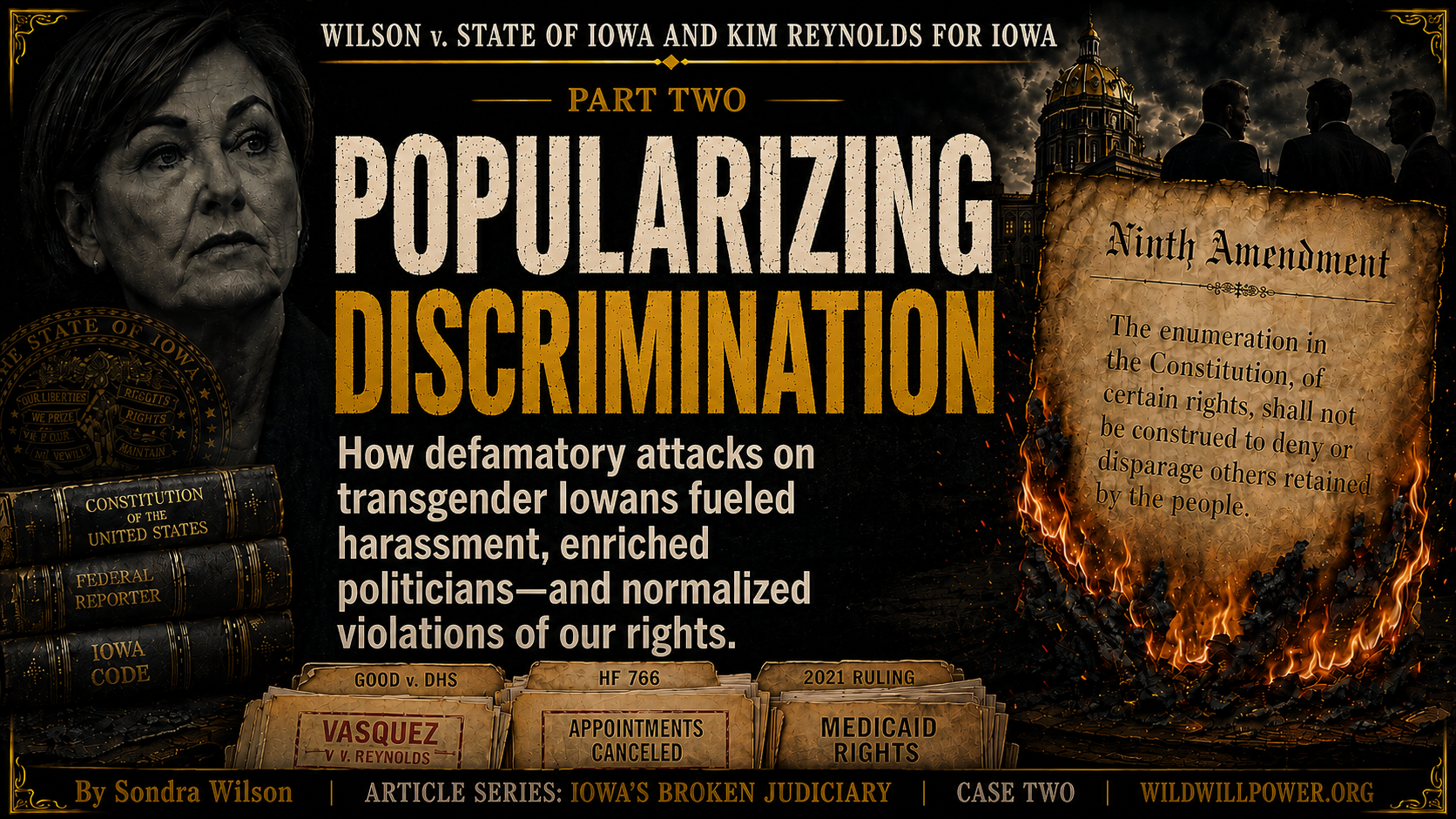
Part Two — Popularizing Discrimination
How defamatory attacks on transgender Iowans fueled harassment, enriched politicians—and normalized violations of our rights.
After years of homelessness, I returned to Iowa hoping to rebuild my life.
In 2019, the Iowa Supreme Court's decision in Good v. Iowa Department of Human Services brought hope that medically necessary transgender healthcare would finally receive equal treatment under Iowa law. What followed instead was another period of political and legal conflict over Medicaid coverage, adverse political messaging concerning transgender Iowans, canceled medical appointments, and conduct I alleged produced both civil-rights and personal injuries.⁴
Part Two reconstructs that history and the theories I attempted to bring before the court.
Read Part Two — Popularizing Discrimination
Part Three — Iowa’s Civil-Rights Trap
How Iowa’s civil-rights system facilitated retaliation, withheld the evidence needed to obtain representation, and left me only 55 days to review the record and file suit.
When the Reliable Street dispute occurred, I attempted to use Iowa's civil-rights system.
Instead, I encountered an administrative process in which I contend important evidence remained unavailable when I needed it to challenge the agency's decision and obtain counsel. By the time I received the complete file, the time remaining to investigate the record, identify viable legal claims, locate representation, and commence litigation had become critically short.
I contacted more than fifty attorneys and law firms. The lowest concrete quote I documented was $5,000 in advance plus $275 per hour—far beyond anything I could afford.
This representation problem followed me into the State case. I could not know the private reason every attorney declined or failed to take the matter. But I was trying to assemble an unusually complicated and politically sensitive civil-rights case involving government officials, transgender rights, old criminal records, Medicaid policy, alleged defamation, administrative failures, constitutional questions, and prospective relief. In my amended petition, I expressly raised my concern that representing such a politically divisive matter could carry reputational consequences for an attorney or law firm.⁵
I therefore entered court without counsel while the limitations periods I was trying to preserve continued to run.
Read Part Three — Iowa’s Civil-Rights Trap

Part Four — What I Asked Iowa to Fix
I did not ask the court only for damages. I asked Iowa to prevent the injuries from happening again.
This installment examines a part of the lawsuit that is easy to lose beneath the accusations and procedural history:
What was I actually asking the court to do?
I sought damages for injuries I alleged had already occurred. But the amended petition also sought multiple forms of equitable, declaratory, prospective, and structural relief.
I asked for relief concerning the old criminal records. I proposed an attorney-client “Right to Review,” intended to prevent attorneys from filing material representations or changing pleas without informed client authorization. I requested reforms to the Iowa Civil Rights Commission, including timely access to case files and a more realistic opportunity to challenge administrative decisions. I advocated greater public access to case law and practical legal education so that ordinary citizens would understand how to protect their rights. I also sought prospective protections intended to prevent what I believed were continuing civil-rights injuries.²
Some of those requests undoubtedly needed refinement. Some may have required legislative rather than judicial action. I was a pro se litigant attempting to translate years of injuries into legally available remedies while simultaneously learning the procedural architecture governing the case.
But the purpose was unmistakable:
I was asking government not merely to compensate past injury, but to stop the conditions that I believed were producing it.
Read Part Four — What I Asked Iowa to Fix
Part Five — The State’s Questionable Defenses
How procedural defenses, immunity doctrines, and court rulings prevented the underlying case from reaching a jury.
The final installment examines how the case ended.
The State invoked numerous grounds for dismissal rather than putting the underlying factual allegations before a jury. They included administrative exhaustion, sovereign and judicial-process immunity, pleading deficiencies, statutory limitations upon particular causes of action, the public-duty doctrine, and other threshold legal theories.
The litigation also became consumed by service disputes, amendment requirements, recusal proceedings, filing deadlines, questions concerning public access to the proceedings, and the practical burden of attempting to litigate an exceptionally complicated case alone.
I call these the State's questionable defenses because I intend to examine each one publicly and explain why I believe several conflict with deeper constitutional principles when applied to prevent any meaningful adjudication of alleged governmental wrongdoing.
The State and the courts may characterize those doctrines differently.
Readers should examine the record and decide for themselves.
The important procedural fact is that no jury heard the complete underlying factual controversy and returned a verdict rejecting my allegations on their merits.
Read Part Five — The State’s Questionable Defenses
Then I would place your existing Short Timeline of the 2024 Case here. It will make much more sense after readers understand the five subjects.
After the timeline, I would have one final major section.
My Petition Was Answered—But the Injuries Continued
This is where I think the landing page can become considerably stronger than it is now.
The 2024 petition did not look only backward.
I sought prospective relief because I believed the injuries affecting transgender Iowans were continuing and likely to worsen. The court did not grant that relief.
What happened afterward is therefore part of this history.
In February 2025, Iowa enacted Senate File 418, removing gender identity from the Iowa Civil Rights Act—the express statewide protection transgender Iowans had possessed since 2007. The Governor's signing statement explicitly connected that legislation to Medicaid-funded gender-affirming surgery.⁶
Later that year, House File 1049 imposed another Medicaid funding restriction affecting gender-transition surgery and associated treatment. On July 1, 2025, the removal of gender identity from the Iowa Civil Rights Act and the operative Medicaid restrictions took effect together.⁷
These developments were not abstract to me.
My own medically necessary surgery had again been canceled, and the subsequent restrictions continued interfering with my access to care.⁸
That sequence is one reason the language of the Declaration of Independence carries such weight for me:
I petitioned my government for redress.
I asked a court not merely to compensate injuries I believed had already occurred, but to intervene before further injuries followed.
I did not receive that relief.
And further injuries followed.
That does not, by itself, prove that every theory in my 2024 petition was legally correct. Nor does it prove that every later governmental act was caused by the dismissal of my case.
But it does establish why the request for prospective relief cannot fairly be dismissed as merely hypothetical.
The events I feared did not simply disappear when the courthouse doors closed.
They continued.
And eventually those later injuries became part of another case.
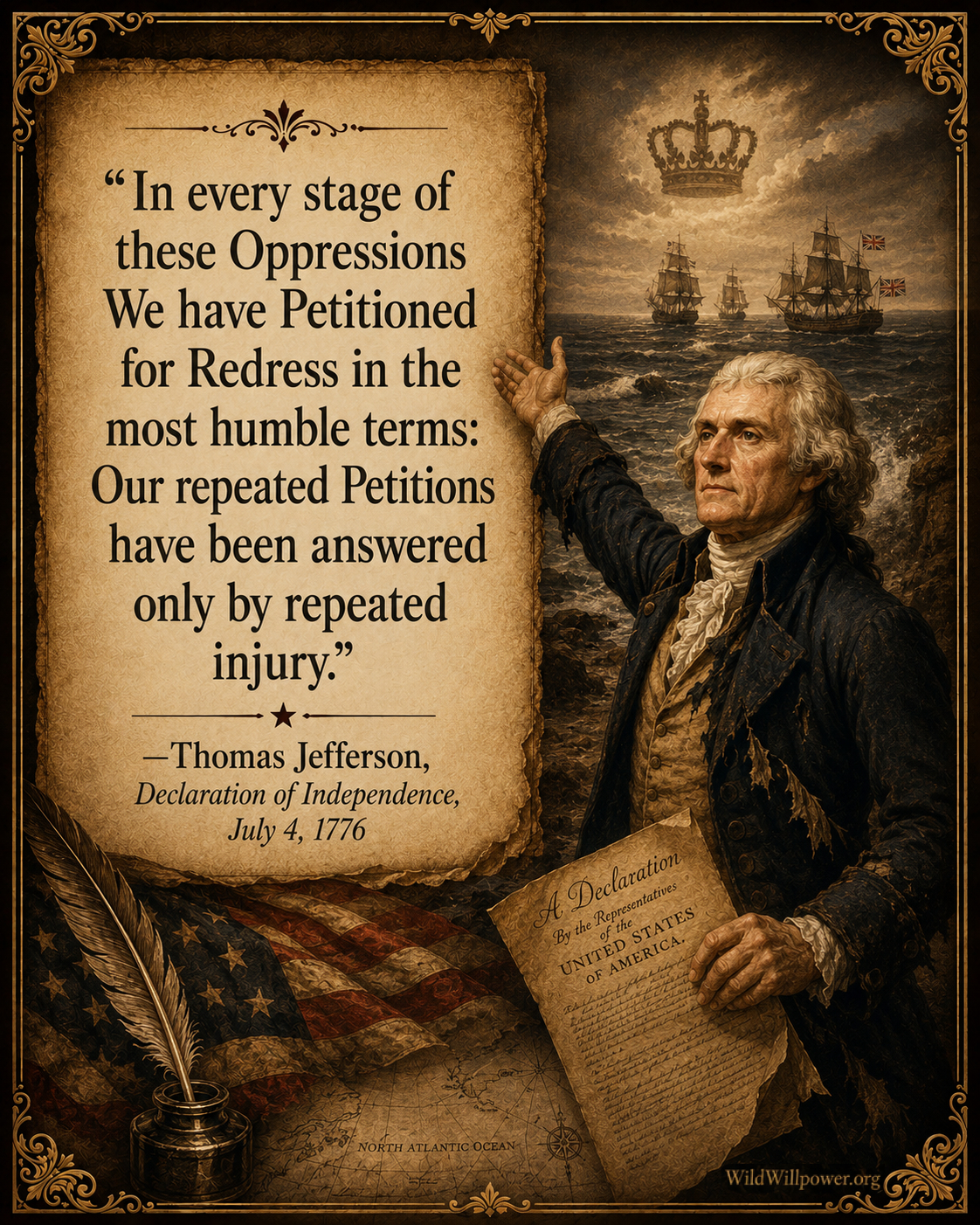
The Declaration of Independence described what happens when that process fails. In the document principally drafted by Thomas Jefferson, the colonists complained:
“In every stage of these Oppressions We have Petitioned for Redress in the most humble terms: Our repeated Petitions have been answered only by repeated injury.” [3]
March 31, 2025—Wilson v. Trump, et al.
The Injuries That Followed
Wilson v. Trump et al. documents the subsequent federal civil-rights dispute, including later changes to Iowa's civil-rights protections, renewed restrictions affecting Medicaid coverage, my own continuing medical injuries, and the larger federal constitutional and statutory questions I contend those events present.
Continue to Wilson v. Trump et al.
I would then close the page with something brief rather than another long argument:
Why I Am Publishing the Record
I understand that people may disagree with my legal theories, my characterization of the State's defenses, or the remedies I requested.
That is precisely why I am publishing the record.
I do not ask readers to accept my conclusions simply because I state them. I ask Iowans to examine the petitions, motions, administrative records, judicial rulings, and later events for themselves.
The constitutional question underlying this series is larger than any one litigant:
What does the right to petition government for redress mean if an ordinary citizen cannot obtain counsel, cannot realistically navigate the procedural machinery alone, and can have an alleged governmental injury dismissed without ever obtaining a jury determination of the underlying factual controversy?
That is a question worth asking regardless of whether the person seeking redress is transgender, conservative, liberal, religious, secular, wealthy, poor, or politically popular.
Because the right to petition government was never supposed to belong only to people whose grievances are easy, inexpensive, professionally convenient, or politically safe.
Endnotes
1. U.S. Const. amend. I (“Congress shall make no law … abridging … the right of the people peaceably to assemble, and to petition the Government for a redress of grievances.”), reproduced in Constitution Annotated, Library of Congress. Your existing Iowa’s Broken Judiciary draft uses this as endnote [17].
2. Plaintiff’s Amended Petition, Wilson v. State of Iowa and Kim Reynolds for Iowa, No. LACL157953, D0030, pp. 62–66 (filed July 23, 2024) (requesting damages and multiple forms of supplementary injunctive and prospective relief). The petition expressly stated that these remedies were sought to prevent others from being harmed in similar ways.
3. The Declaration of Independence para. 30 (U.S. 1776) (“In every stage of these Oppressions We have Petitioned for Redress in the most humble terms: Our repeated Petitions have been answered only by repeated injury.”), reproduced by the National Archives. This appears as endnote [18] in your existing Iowa’s Broken Judiciary draft.
4. Good v. Iowa Department of Human Services, 924 N.W.2d 853, 862–63 (Iowa 2019); Plaintiff’s Amended Petition, D0030, describing the subsequent Medicaid controversy and the cancellation of medical appointments alleged by the plaintiff. Your petition's table of contents expressly grouped Good, HF 766, the 2021 ruling, political statements, and the cancellation of your appointments within the second major part of the case.
5. Plaintiff’s Amended Petition, D0030, discussing efforts to obtain counsel and requesting class treatment. The petition stated that numerous lawyers and firms had been contacted and expressed the plaintiff's concern that representation in a politically divisive case could potentially damage an attorney's or firm's reputation. The petition separately documented that more than fifty attorneys had been contacted and that the lowest quoted representation cost was $5,000 in advance plus $275 per hour.
6. Governor Kim Reynolds, statement upon signing Senate File 418 (Feb. 28, 2025), as cited in the existing Iowa’s Broken Judiciary draft; see also the accompanying discussion of the legislation's removal of gender identity from the Iowa Civil Rights Act and its relationship to Medicaid-funded gender-affirming care.
7. House File 1049 (2025) and Iowa Medicaid Informational Letter No. 2693, as discussed in the developing Wilson v. Trump et al. record. The material describes the July 1, 2025 simultaneous operative effect of the civil-rights repeal and Medicaid restrictions.
8. Wilson v. Trump et al. developing factual record, “My Collateral Injuries,” documenting the plaintiff's allegation that scheduled medically necessary surgery was canceled on multiple occasions and access subsequently remained interrupted.
[1] U.S. Const. amend. I (“Congress shall make no law … abridging … the right of the people peaceably to assemble, and to petition the Government for a redress of grievances.”).
[2] Mensing v. Sturgeon, 250 Iowa 918, 927, 97 N.W.2d 145, 150 (1959) (recognizing the settled principle that a dismissal with prejudice ordinarily constitutes a final adjudication on the merits). See also Fed. R. Civ. P. 41(b) (providing, subject to specified exceptions, that an involuntary dismissal operates as an adjudication on the merits).
[3] Equity Control Assocs., Ltd. v. Root, 638 N.W.2d 664, 674 (Iowa 2001) (explaining that an abuse of discretion occurs when the court exercises discretion on clearly untenable grounds or to a clearly unreasonable extent, and that grounds are untenable when unsupported by substantial evidence or based upon an erroneous application of law); Graber v. City of Ankeny, 616 N.W.2d 633, 638 (Iowa 2000).
[4] Lisenba v. California, 314 U.S. 219, 236 (1941) (“As applied to a criminal trial, denial of due process is the failure to observe that fundamental fairness essential to the very concept of justice.”). Although Lisenba involved criminal proceedings, the quoted language expresses the Supreme Court's fundamental-fairness conception of due process; the precise requirements of procedural due process depend upon the nature of the proceeding and interests involved.
[5] Iowa Const. art. I, § 9 (“The right of trial by jury shall remain inviolate … but no person shall be deprived of life, liberty, or property, without due process of law.”); U.S. Const. amend. XIV, § 1 (“nor shall any State deprive any person of life, liberty, or property, without due process of law”).
[6] Stearns v. Stearns, 187 N.W.2d 733, 735 (Iowa 1971) (defining extrinsic fraud as an act or conduct of the prevailing party that prevents a fair submission of the controversy); see also In re Marriage of Hutchinson, 974 N.W.2d 466, 485–86 (Iowa 2022) (reaffirming Iowa's extrinsic-fraud doctrine).
[7] In re Marriage of Hutchinson, 974 N.W.2d 466, 486 (Iowa 2022) (quoting Mauer v. Rohde, 257 N.W.2d 489, 496 (Iowa 1977)); see also State ex rel. Iowa Dep't of Hum. Servs. v. Meyer, 381 N.W.2d 633, 634–35 (Iowa 1986).
[8] Costello v. McFadden, 553 N.W.2d 607, 612 (Iowa 1996); In re Adoption of B.J.H., 564 N.W.2d 387, 391 (Iowa 1997). Iowa cases identify classic forms of extrinsic fraud as conduct preventing a party from presenting a case or defense, including acts or promises that lull the affected party into false security. Hutchinson, 974 N.W.2d at 485–86.
Short timeline of the 2024 case
September 5, 2023: I signed and notarized a tort claim against the State of Iowa.
September 11, 2023: The State Appeal Board received the claim.
September 27, 2023: The State Appeal Board sent a letter assigning Claim No. T240135, identifying the claim as a personal-injury claim for $9,750,000, and stating that the claim was being referred to the Attorney General’s Office for investigation and report back to the Board.
February 8, 2024: I filed Wilson v. State of Iowa and Kim Reynolds for Iowa in Polk County District Court because I was preparing to leave for DMACC’s London Abroad program and did not want limitations periods to lapse while I was overseas.
May–July 2024: I attempted service on Kim Reynolds for Iowa through multiple routes, including sheriff’s service, campaign-disclosure information, campaign contacts, the Secretary of State’s Office, and publication.
July 23, 2024: I filed a much larger amended petition, attempting to organize years of injuries, administrative records, constitutional arguments, Medicaid harms, ICRC issues, and requested remedies.
July 26, 2024: The State moved to dismiss the amended petition.
August 9, 2024: The court held a hearing on the State’s motion to dismiss.
August 20, 2024: The court dismissed Kim Reynolds for Iowa without prejudice for lack of prosecution, finding service had not been completed.
August 21, 2024: I filed proof of publication showing notice was published on July 12, July 19, and July 26. The same day, the court denied reconsideration as to Kim Reynolds for Iowa and dismissed the case against the State with prejudice.
September 7, 2024: I moved to reconsider dismissal of the State case.
September 9, 2024: The court denied reconsideration without further hearing.
October 11, 2024: I filed a notice of appeal.
November 5, 2024: The Iowa Supreme Court dismissed the appeal.
December 13, 2024: The Iowa Supreme Court denied reconsideration, while acknowledging that I had argued I was never served with the State’s motion to dismiss the appeal and that the clerk’s office confirmed lack of service.
What This Article Will Show
This article explains three things:
1. What happened in the 2024 case — not as rumor or political spin, but as documented in court filings, service returns, judicial orders, and administrative records.
2. Why the case was dismissed without ever reaching the merits — because the State relied on doctrines that, when applied the way Iowa applied them here, violate core constitutional guarantees.
3. Why this matters beyond my case — because the same doctrines can be used to deny redress to any Iowan, regardless of politics, identity, or ideology. Constitutional rights do not disappear because the State invokes immunity, exhaustion, or “public duty.”
This is not just a personal story. It is a structural warning.
What the 2024 case alleged
The 2024 case was broad because the harms were interconnected. In the amended petition, I tried to place the larger timeline before the court.
2006–2009: Story County and Ames
I described what I alleged happened in Story County and Ames between 2006 and 2009: false arrest, malicious prosecution, discrimination, denied appellate opportunity, fear of returning to Iowa, and the years of homelessness that followed.
2019–2023: Medicaid and civil-rights harm
I described Medicaid-related and civil-rights harm after I returned to Iowa, including the State’s actions after Good v. Iowa Department of Human Services, the passage of HF766, the interruption of Medicaid coverage for medically necessary gender-affirming care, and the cancellation of my appointments after the State appealed related litigation.
One concrete example was medical. My amended petition alleged that after the State appealed litigation involving gender-affirming Medicaid coverage, my appointments were canceled. That was not abstract policy harm. It was my body, my medical care, my timeline, and my ability to recover being interrupted by state action.
2022–2023: The Iowa Civil Rights Commission process
I described what happened after I filed a discrimination complaint with the Iowa Civil Rights Commission: the closure of the case, lack of meaningful access to the full case file before closure, the practical impossibility of finding counsel, and the way false or misleading submissions could become part of an administrative record without meaningful rebuttal.
2024: State accountability, immunity, and redress
I argued that these were not isolated incidents. I alleged they reflected a larger pattern of rights-depriving conduct, state immunity barriers, lack of enforcement, and harm to transgender Iowans and other vulnerable people who depend on civil-rights systems to function.
The State did not respond by proving those harms were false.
The State responded by arguing that the case was legally defective, procedurally improper, barred by immunity doctrines, barred by exhaustion rules, or otherwise outside the court’s reach.
Even service became a procedural maze
The 2024 case also showed me how difficult it can be for an ordinary person to pursue accountability against powerful state actors.
After I filed the petition, I attempted service. The record shows multiple service attempts and returns. Service at the Attorney General’s office was initially rejected, with the return noting that service had to be made to the individual and not the campaign. Another return states that legal staff for the Governor advised that they did not accept service on behalf of Kim Reynolds for Iowa, the campaign, and that any service for the Governor needed to be served on the Attorney General on the Governor’s behalf.
Eventually, the State of Iowa was served through Deputy Attorney General Leif Olson. But service on Kim Reynolds for Iowa remained tangled. I tried the campaign address on file, contacted the campaign’s listed treasurer, emailed the campaign directly, contacted the Secretary of State’s Office, and ultimately pursued publication through the Des Moines Register.
That sequence matters because it shows the reality of what pro se litigants face. Before the substance of the harm is ever reached, there are procedural traps, service questions, technical distinctions between the State, the Governor, the Governor’s office, a campaign committee, the Attorney General, the Secretary of State, and campaign-disclosure records.
For a person already dealing with civil-rights injuries, medical disruption, school obligations, poverty, and another lawsuit, that kind of procedural maze is not a minor inconvenience.
It is part of the burden.
What the State argued
When the State moved to dismiss, it did not address the case as a moral emergency or civil-rights crisis. It treated the case as legally defective.
The State characterized my petition as “a winding and wide-reaching series of allegations” seeking redress for what it described as my perception of systematic oppression of transgender individuals in Iowa. The State argued that my claims failed for multiple procedural and legal reasons, including that federal criminal civil-rights statutes do not create a private civil cause of action, that I had not sufficiently pleaded claims under Iowa Code chapters 706A and 729A, that tort claims were barred because I had not exhausted administrative remedies under the Iowa Tort Claims Act, that negligence was barred by the public-duty doctrine, that some challenges belonged under the Iowa Administrative Procedure Act, that certain tort claims were barred by the Iowa Tort Claims Act, and that other claims were barred by judicial-process immunity.
In other words, the State’s position was not that everything I described was acceptable as a matter of justice.
The State’s position was that the courthouse doors were procedurally closed.
That distinction matters.
The case did not fail because Iowa actually fixed the harms.
It did not fail because transgender Iowans were made whole.
It did not fail because Medicaid-related injuries were repaired, civil-rights protections were restored, or public-record harms were corrected.
It failed because I was trying to bring a broad, complex, politically charged, legally difficult case without counsel, while the State responded with doctrines, immunities, exhaustion rules, and procedural barriers.
I also challenged the State’s immunity defenses
The 2024 case was not only about the injuries I personally suffered.
It was also about whether Iowa can harm its own citizens and then use immunity doctrines and statutory exceptions to block redress.
In my filings, I challenged parts of the Iowa Tort Claims Act and the State’s reliance on sovereign immunity. The Iowa Tort Claims Act generally says the State can be liable for certain claims “in the same manner, and to the same extent as a private individual under like circumstances.” But Iowa Code § 669.14 then carves out major exceptions, including claims arising from discretionary functions, false arrest, false imprisonment, malicious prosecution, abuse of process, libel, slander, misrepresentation, deceit, interference with contract rights, and other categories of harm.
Those exceptions matter because many of the injuries ordinary people suffer at the hands of government actors do not look like a simple car accident or a routine negligence claim. They often involve power: arrest, prosecution, public records, agency decisions, defamation, retaliation, abuse of process, denial of rights, and official discretion.
That was the constitutional issue I was trying to raise.
If the State can violate rights, damage reputations, mishandle civil-rights complaints, cut off medically necessary care, and then say the injured person cannot sue because the harm falls into an immunity exception, then the right to redress becomes hollow.
I argued that the State cannot have it both ways.
It cannot claim the authority to govern people, regulate people, prosecute people, deny benefits, process civil-rights complaints, and shape public records — while also claiming immunity when that power is abused.
That is why I challenged sovereign immunity. The doctrine comes from the old idea that “the king can do no wrong.” I do not believe that concept belongs in a republic built on the principle that government exists by consent of the people and must be accountable when it violates rights.
That argument was not fully heard.
The case was dismissed on procedural grounds before the constitutional challenge to those immunity barriers received the kind of public examination it deserved.
To understand why these defenses could not constitutionally bar my case, it is necessary to explain precisely how each doctrine the State invoked violates core constitutional guarantees when applied the way Iowa applied them here.
Why the State’s defenses matter
The State’s defenses were not just technicalities to me.
They were the mechanism by which the case was closed before the harms were ever meaningfully reached.
The State relied on doctrines including sovereign immunity, exhaustion, judicial immunity, and the public-duty doctrine. I believe those doctrines were applied in a way that denied meaningful access to the courts, violated the right to petition for redress, and allowed the State to avoid accountability for injuries caused by state action.
That is why this case matters beyond me.
If the State can harm a person and then say, “You cannot sue because we are the State,” “You cannot sue because the administrative process we control was not finished,” “You cannot sue because the harm involved public duties,” or “You cannot sue because immunity blocks the claim,” then constitutional rights become theoretical.
That issue should concern every Iowan.
It does not matter whether the person harmed is a transgender woman, a farmer, a veteran, a student, a gun owner, a parent, a business owner, or anyone else. If procedure can erase the right to redress, then no one’s rights are secure.
This article explains how that happened in my 2024 case. The next article will explain why I believe those defenses are unconstitutional and what I intend to do next.
The exhaustion problem
One of the strangest parts of the case involved exhaustion.
I filed a tort claim with the State of Iowa. The State Appeal Board received the claim on September 11, 2023. In a September 27 letter, the Board told me the claim was being referred to the Attorney General’s Office for investigation and that I would be notified “in due time” of the final disposition.
I did not receive a final disposition before filing suit.
I filed because I was trying to preserve claims before limitations periods became a problem, while also preparing to leave for DMACC’s London Abroad program and while already carrying the Reliable/Lockwood litigation.
The State later argued that my tort claims were barred because I had not exhausted administrative remedies under the Iowa Tort Claims Act.
That may sound technical. But from my perspective, it showed the same access-to-justice trap again.
I tried to use the administrative process. The State acknowledged the claim. The claim was referred to the Attorney General. I was told I would be notified “in due time.” No disposition came before I filed. Then, when I filed in court to preserve my rights, the State argued the courthouse door was closed because the administrative process was not complete.
That is not meaningful exhaustion.
That is a procedural dead end.
A process that cannot be completed cannot fairly be used as the reason a person is barred from court.
The case moved faster than I could realistically carry it alone
After the State moved to dismiss, I did not simply ignore the case.
I filed an omnibus motion asking for three things: recusal, help resolving service issues involving Kim Reynolds for Iowa, and a continuance. I explained that I was also involved in the Reliable/Lockwood case, that the two matters were related, and that I was overwhelmed trying to carry both lawsuits at the same time. I asked the court to postpone the State case until the Reliable/Lockwood case moved forward, or at least give me more time before I had to respond to the State’s motion to dismiss.
That request matters because it shows the burden in real time.
I was not represented by counsel. I was trying to litigate a state-accountability case involving civil rights, Medicaid, state tort claims, criminal civil-rights theories, agency failures, public-record harm, and constitutional issues. At the same time, I was also litigating the Reliable/Lockwood case, which involved the Iowa Civil Rights Commission record, alleged false statements, altered or misleading documents, discovery issues, and the need to clear my name.
The State resisted my request. It argued that I had not filed a substantive resistance to the motion to dismiss, described my petition as a “grab-bag” of claims, opposed recusal, opposed a continuance, and opposed requiring the Attorney General’s office to assist with service on Kim Reynolds for Iowa.
The court denied my request to stay the case until my other legal matters were resolved. It did, however, reset the hearing on the State’s motion to dismiss for a later date so the recusal and service issues could be addressed first.
That is the pattern I want the public to understand.
The system did not pause because I was pro se.
It did not pause because the case involved civil-rights injuries.
It did not pause because I was also trying to survive another lawsuit.
It did not pause because I was dealing with trauma, school, medical disruption, and the practical impossibility of finding counsel.
The case kept moving.
And I kept trying to keep up.
I tried to amend
After the State filed its motion to dismiss and resisted my request for more time, I moved to amend the petition.
I explained that the State had raised numerous arguments that could be addressed through an amended petition. I also explained that I needed time to number each paragraph and bring the petition closer to standard pleading format. I was trying to correct the procedural problems while also handling urgent deadlines in the Reliable/Lockwood case.
That same week, I was under pressure in the Story County case. I explained to the court that Judge Bethany Currie had ordered me to submit an amended petition in that case by Friday, June 14. I described that task as urgent, tedious, stressful, and trauma-reliving. I told the court I did not have time to work on both cases at the same time with overlapping due dates.
That is not an excuse.
That is the reality of pro se litigation.
A trained attorney with a law office can divide labor, assign drafting tasks, calendar deadlines, delegate research, and rely on staff. I had none of that. I had to absorb the State’s arguments, understand the procedural defects, revise pleadings, manage service issues, prepare for hearings, and continue litigating another active civil-rights-related case at the same time.
The amended petition did not solve the problem. The State moved to dismiss the amended petition the next day. It argued that the amended petition was still not organized into numbered paragraphs, still did not set out claims in clear counts, and was essentially identical to the original petition except for revising the service address for Kim Reynolds for Iowa.
That criticism may have been procedurally useful to the State.
But it also proves the point.
I was not failing because I had no injury.
I was failing because the legal system demanded technical compliance, speed, structure, and procedural knowledge that I was still learning in real time while carrying multiple lawsuits alone.
The State’s later motion to dismiss the amended petition confirmed the same problem. Even after I tried to amend, the State argued the amended petition remained unclear and legally defective. It listed the claims it believed I was trying to raise, then argued they failed for reasons including criminal statutes not creating private civil claims, the State not being a proper defendant under § 1983, insufficient pleading under Iowa statutes, sovereign immunity, exhaustion, and other procedural doctrines. In other words, the case still turned less on whether I had been harmed and more on whether I had found the correct procedural doorway.
Service, recusal, and the burden of procedure
The next phase of the case became even more procedural.
On June 13, I filed an affidavit explaining that personal service on Kim Reynolds for Iowa had not been possible, asking for an alternative method of service, and asking the court to stop the State from using dismissal motions in a way that I believed threatened my due-process rights, fair-trial rights, and right to recovery.
The court held a hearing. In its June 19 order, the court denied my request for recusal. It also denied my request to order the Attorney General to accept service for Kim Reynolds for Iowa or to order Kim Reynolds for Iowa to accept service, stating that the court lacked authority to grant those requests. The court denied alternative service at that time, but gave me until August 1, 2024 to serve Kim Reynolds for Iowa. It also allowed me until July 12 to file an amended petition, gave the State until July 22 to respond, and gave me until August 1 to file my response.
That order gave me a path forward, but it also shows how much of the case had become about procedure before any court ever reached the substance of the harm.
I still had to serve Kim Reynolds for Iowa.
I still had to amend the petition.
I still had to respond to the State.
I still had to prepare for a motion-to-dismiss hearing.
I still had to litigate the recusal issue.
And I still had another active lawsuit moving at the same time.
On July 1, I filed a motion to reconsider the denial of recusal, a notice that I believed service by publication was necessary, and a request for electronic service. I explained the history of my requests for recusal and the repeated difficulty serving Kim Reynolds for Iowa. I also explained that I had arranged to publish notice in the Des Moines Register for three consecutive weeks.
The State resisted my motion to reconsider. It argued that filing a complaint with the Iowa Judicial Qualifications Commission did not automatically require recusal, and that my argument based on the judge’s appointment by Governor Reynolds would disqualify large portions of Iowa’s judiciary.
Then, on July 9, Judge Gronewald recused herself from the case.
That sequence matters.
I had been told my recusal arguments did not justify disqualification. The State had resisted reconsideration. But after I continued pressing the issue, the judge recused and the case was reassigned.
I am not saying that resolved the underlying harm. It did not.
But it shows why I kept filing.
It shows why I did not simply accept the first “no.”
And it shows again how much time and energy a pro se litigant can spend just trying to get the case into a posture where the substance can be heard.
Publication and reassignment
After Judge Gronewald recused, I filed another motion to continue. I explained that because the recusal issue had remained unresolved until July 9, time I needed to work on the amended petition had been consumed by the motion to reconsider. I asked for a new amended-petition deadline of July 22.
I also informed the court that notice by publication to Kim Reynolds for Iowa had begun, with publication scheduled in the Des Moines Register.
On July 18, the case was reassigned from Judge Gronewald to Judge Huppert. That same day, the court granted me additional time to amend the petition, set the State’s response deadline for August 1, and kept the motion-to-dismiss hearing scheduled for August 9.
That is where this history becomes especially important.
The 2024 case was not a simple failure. It was a warning about what happens when a person without counsel tries to bring a state-accountability case involving civil rights, transgender medical care, public officials, agency failures, criminal-law theories, tort claims, service issues, recusal questions, and overlapping litigation.
The record became a map of what I needed to learn.
It showed me that the next filing cannot simply tell the whole story. It has to separate claims. It has to identify defendants precisely. It has to distinguish criminal complaints from civil causes of action. It has to address administrative exhaustion. It has to organize allegations into numbered paragraphs and clear counts. It has to anticipate immunity arguments, public-duty arguments, jurisdictional arguments, and service arguments.
That is what I mean when I say the campaign is moving from candidacy to the courts.
I am not starting from nothing.
I am starting from a record.
I kept trying to serve Kim Reynolds for Iowa
The service issue is one of the clearest examples of what happened in this case.
I did not ignore service.
I paid the Polk County Sheriff’s Office to attempt service. I tried to use the official information available in campaign-disclosure records. I contacted the campaign’s listed treasurer. I emailed Kim Reynolds for Iowa directly. I contacted the Secretary of State’s Office. I asked the court for guidance. I notified the court that service by publication was underway. I then completed publication through the Des Moines Register.
The affidavit of publication shows that notice was published on July 12, July 19, and July 26, 2024.
The court had been told publication was happening. I had already explained the service problem. I had asked for help. I had followed the paths I could find as a pro se litigant.
Then, on August 20, the court dismissed Kim Reynolds for Iowa without prejudice for lack of prosecution, stating that the defendant had not been served and that I had not filed an application for extension of time.
I moved to reconsider. I laid out the timeline again: the sheriff’s attempts, the rejected service, the campaign emails, the treasurer contact, the Secretary of State issue, the publication, and the fact that I had attempted service in every manner I had found possible.
The court denied reconsideration the same day. The order stated that the extension to August 1 had been conditioned on personal service and that alternative service such as publication had already been denied.
That is the problem.
I had asked for guidance. I had notified the court of publication. I had completed publication. I had tried to serve a politically powerful campaign committee through every available route I could identify. But instead of being told clearly, in time, what method would actually satisfy the court, the party was dismissed after the procedural deadline had already passed.
That is not how ordinary people imagine justice works.
That is how procedure swallows substance.
The amended petition became a public record of what I had been carrying
After the case was reassigned and I received additional time, I filed a much larger amended petition.
That amended petition was not perfect. I understand that now.
But it was serious.
It was an attempt to take years of injuries, records, agency failures, medical disruption, public statements, court experiences, ICRC process issues, and unanswered pleas for help, and put them into one record.
The amended petition laid out four broad areas of harm.
First, it described what I allege happened in Story County in 2006 and 2009: discriminatory treatment, false arrest, malicious prosecution, denied appellate opportunity, fear of returning to Iowa, and the years of homelessness that followed.
Second, it described the Medicaid and civil-rights harm I experienced after returning to Iowa, including the State’s efforts to block Medicaid coverage for medically necessary gender-affirming care, the emotional impact of canceled appointments, and statements by political actors that I believe defamed and endangered transgender people.
Third, it described my experience with the Iowa Civil Rights Commission after I brought the Reliable/Lockwood matter forward: the closure of my case, the difficulty obtaining the file, the way I was directed toward legal help that could not actually take the case, and the lack of meaningful enforcement for someone without money.
Fourth, it argued that these were not isolated incidents. I alleged a continuing pattern of rights-depriving conduct, political defamation, agency failure, lack of enforcement, and harm to transgender Iowans.
That amended petition also attached records supporting why I was trying so hard to be heard.
It attached the State Appeal Board materials showing that my claim against the State had been received and referred to the Attorney General’s Office. It attached the original petition. It attached documentation showing I had tried to get legal help and could not find affordable representation. It attached records from the Story County and Reliable/Lockwood matters. It attached the ICRC preliminary review.
Those attachments matter because they show that this was not just a political speech act.
It was a record-building effort.
I was trying to show the court the larger pattern: how civil-rights harm becomes legal harm, how legal harm becomes economic harm, how economic harm prevents representation, and how lack of representation allows state actors and institutions to avoid accountability through procedure.
The State moved to dismiss the amended petition too
After I filed the amended petition, the State again moved to dismiss.
The State argued that my amended petition was still legally defective. It said the amended petition was “somehow even less clear” than the original petition, described my allegations as “scattershot,” and argued that the filing still did not set out the legal claims in distinct, clear counts.
The State also moved to strike my July 23 amended filing, arguing that I had filed a corrected version after the July 22 deadline without separately moving for leave to amend. The State said its electronic comparison found nearly 400 changes between the July 22 and July 23 filings.
That is where the procedural burden became especially obvious.
From my side, I was trying to correct, clarify, organize, and preserve a complex case involving civil-rights injuries, state tort claims, Medicaid harm, Iowa Civil Rights Commission failures, public-record damage, old Story County court issues, constitutional questions, and ongoing political harm.
From the State’s side, the response was that the filing was still too unclear, still procedurally defective, and still subject to dismissal.
That is the trap.
A person without counsel is told the petition is too broad, too unclear, and too procedurally defective. So she tries to amend it. Then the amended version is attacked for not being amended in precisely the right way, not being clear enough, not being organized enough, and not satisfying rules she is still trying to learn while carrying multiple lawsuits alone.
That is why I say this case became a lesson in how procedure can swallow substance.
The State did not have to prove that the harms were repaired.
It did not have to prove that transgender Iowans were made whole.
It did not have to prove that the Iowa Civil Rights Commission process worked.
It did not have to prove that Medicaid-related injuries were fixed.
It only had to argue that the courthouse door should remain closed because I had not navigated the procedural maze correctly.
I tried to make the proceedings public and accessible
I also tried to make the case more transparent.
I contacted WHO 13 about Expanded News Media Coverage. I wanted Wild Willpower PAC to cover the case because the lawsuit involved statewide civil-rights issues, transgender rights, state accountability, and public concern. WHO 13 responded that it did not believe a PAC qualified as news media and said it would not file the request, while noting I had the right to bring the issue before the presiding judge.
So I raised the issue myself.
In my August 5 filing, I resisted the State’s motion to strike, moved for permission to allow the July 23 amended filing to stand, raised a constitutional question, reserved my right to film the proceedings, and requested that in-person proceedings be accessible by Zoom so elders in my congregation and other supporters from across Iowa could attend.
That request was denied.
On August 8, the court denied my request to film the August 9 proceedings and denied my request that in-person proceedings be accessible by Zoom.
After the hearing, I tried to obtain the transcript. The invoice was $168. I had just over $9 in my bank account. I requested a waiver so I could review the transcript and make sure the points I raised were accurately preserved.
That request was denied too.
That matters.
People often say, “Let the courts decide.” But courts are not automatically accessible. Courtrooms are physical places. Transcripts cost money. Recording is restricted. Remote access can be denied. Media coverage depends on whether a news organization decides to show up. And when a poor pro se litigant is trying to preserve a record against the State, even $168 can become a barrier.
This was not just a legal burden.
It was an access burden.
It was a public-record burden.
It was a poverty burden.
It was a transparency burden.
And I was carrying it while trying to explain harms that the political system had already failed to address.
That same week, I also had to deal with ordinary court costs. After the court denied the transcript waiver, I later received help from a concerned Iowan and was able to pay for the transcript. I also paid hearing-related court costs. That may sound small compared to the size of the case, but it shows the reality of pro se litigation: every transcript, every filing, every service attempt, every publication notice, and every hearing cost matters when the person bringing the case is poor.
The legal-help record matters
One of the most important attachments was my record of trying to find legal help.
After the Iowa Civil Rights Commission closed my case, I was told to find a private attorney. I contacted attorneys and organizations across Iowa. The lowest quote I received was $275 per hour and $5,000 up front. That was impossible for me.
I then contacted legal-aid organizations, only to learn that they generally did not take fee-generating discrimination cases. That meant the path I was told to follow did not actually exist for someone in my position.
That is a major part of the story.
People often say, “Get a lawyer,” as if that is a real option for everyone.
It was not a real option for me.
Not when I was poor.
Not when the case involved transgender civil-rights issues.
Not when the case required hundreds of hours of document review, legal research, pleadings, motions, exhibits, agency records, and court appearances.
Not when the institutions that exist in theory did not actually step in.
That is why I had to represent myself.
And that is why the procedural criticisms against me miss the larger point.
A legal system cannot tell injured people to get counsel, fail to provide any realistic path to counsel, and then treat their inability to draft like lawyers as proof that their injuries do not deserve to be heard.
The ICRC file shows the access-to-justice trap
The amended petition also attached the Iowa Civil Rights Commission preliminary review.
That review matters because it shows the ICRC had the basic framework of what I was alleging: that I had spent months managing or performing substantial work connected to garden and prairie projects; that I alleged I was asked to leave and not return; that I identified the matter as involving sex and gender identity; and that the Commission treated the adverse action as denied service rather than employment.
But the later file materials show why the ICRC process became part of the harm.
After the ICRC closed my case, I tried to obtain the case file and pursue the next available steps. I requested a right-to-sue letter in August 2023. I then requested scanned copies of the full case file in September 2023. The ICRC responded that the file request would be processed within thirty days. The file was later shared through Google Drive.
That may sound ordinary on paper. But a person trying to evaluate whether to sue, appeal, contact attorneys, understand what respondents submitted, and preserve claims needs the file quickly.
In my case, the full record I needed to understand, evaluate, challenge, and explain what had been submitted against me was not in my hands before the agency closed the case. I was left trying to find counsel, preserve claims, understand the respondents’ submissions, and decide what to do next without meaningful access to the complete record when it mattered most.
The case file also mattered because it contained the respondents’ submissions. Those submissions included the very statements and document presentations I later challenged as false, misleading, modified, selectively excerpted, and out of context.
This is one of the central reasons I say the ICRC process became part of the harm.
The agency process did not give me a meaningful opportunity to review and rebut the record before closure. Then, after closure, I was told to pursue private legal help or request right-to-sue relief while still trying to obtain and understand the file itself.
For someone with money and counsel, that might be inconvenient.
For a poor transgender Iowan trying to challenge discrimination alone, it can be case-ending.
The attachments also show that I did not sit still. I contacted the Attorney General’s victim-services system. I filed a complaint with the Ombudsman about the ICRC. I tried to pursue help through law enforcement after being told there may be jurisdictional issues between Ames, Story County, and Polk County. These were not perfect legal filings, but they show a clear pattern: I kept trying to find a door that would open.
That is the point.
The system kept telling me to go somewhere else.
Go to a private attorney.
Go to legal aid.
Go to the ICRC.
Request a right-to-sue letter.
Request the case file.
Go to law enforcement.
Go to the Ombudsman.
Go to court.
But every path required time, money, legal knowledge, emotional stamina, and procedural precision I was being forced to supply alone.
That is not meaningful civil-rights enforcement.
That is a maze.
I was not only asking for damages
The 2024 case was not only about money damages.
I was also asking the court to address the civil-rights enforcement system itself.
In my filings, I asked the court to halt the State’s plan to reduce or weaken the Iowa Civil Rights Commission and instead require reforms that would make the process more meaningful for people who file discrimination complaints.
Those reforms included basic procedural protections: sending each party the case file when the Commission makes its final determination; giving complainants more time to appeal after receiving the file; treating false statements to the Commission seriously; and making the Commission’s public materials accurately reflect what the process does and does not guarantee.
Those requests came from lived experience.
I had gone through the ICRC process. I had filed a discrimination complaint. I had not received the full case file before closure. I had been pushed toward private legal help I could not afford. I had discovered that respondents’ submissions contained statements and document presentations I later challenged as false, misleading, modified, selectively excerpted, and out of context.
So when I asked for ICRC reform, I was not speaking abstractly.
I was saying that civil-rights enforcement cannot be meaningful if a complainant is denied practical access to the record, denied a meaningful chance to rebut damaging submissions, pushed toward unaffordable counsel, and then left to navigate court alone.
That was part of the case Iowa never heard.
What this case shows
This case shows why access to justice cannot be measured only by whether a courthouse technically exists.
A courthouse door means very little if an injured person cannot afford counsel, cannot obtain the administrative file in time to meaningfully respond, cannot get clear guidance on service, cannot afford transcripts, cannot film or provide remote access to supporters, and must answer complex immunity and exhaustion arguments while carrying overlapping litigation alone.
It also shows how procedure can become the whole case.
The State did not have to prove that the harms were repaired.
It did not have to prove that the Iowa Civil Rights Commission process worked.
It did not have to prove that Medicaid-related injuries were fixed.
It did not have to prove that my allegations were false.
It only had to persuade the court that the case should not move forward because I had not reached the correct procedural doorway in the correct order at the correct time.
That is why this case matters to more than me.
Any Iowan can be harmed by a public agency, a government official, a court process, an administrative system, or a civil-rights failure. If the answer is always “wrong defendant,” “wrong procedure,” “wrong timing,” “wrong forum,” “immunity,” “exhaustion,” or “get a lawyer you cannot afford,” then the right to redress becomes theoretical.
That is not meaningful access to justice.
That is a maze.
How the 2024 case ended
By the end of the case, the pattern was clear.
I asked for more time to serve Kim Reynolds for Iowa after realizing there was another method of service I had not attempted. I explained that PTSD symptoms, overlapping litigation, school obligations, and the stress of trying to litigate alone had impaired my ability to navigate the rules perfectly.
That request was denied.
I moved to reconsider the dismissal of the State case. I asked the court to reconsider dismissal with prejudice, or at least change the dismissal to without prejudice so I could correct any remaining procedural issue and refile if necessary.
That request was denied too.
The order was only a few lines. It denied my motion and supplemental motion to reconsider without further hearing.
So I appealed.
The State moved to dismiss my appeal, arguing that it was untimely. I did not file a resistance because I did not receive notice of the State’s motion. The Iowa Supreme Court dismissed the appeal on November 5, 2024, stating that I had not filed a resistance or response.
I moved to reconsider the next day. I explained that I had never been served with the State’s motion to dismiss the appeal and therefore had not been given an opportunity to resist it. I also explained that I filed my notice of appeal within thirty days of when I received notice of the ruling.
On December 13, 2024, the Iowa Supreme Court denied reconsideration. The order acknowledged that I argued I had never been served with the State’s motion to dismiss the appeal — and stated that the clerk’s office confirmed this. But the court still refused to reinstate the appeal.
That is how the 2024 case ended.
I was not allowed to film the proceedings.
My request for Zoom access was denied.
My request for help obtaining the transcript was denied.
My case against Kim Reynolds for Iowa was dismissed on service grounds.
My case against the State was dismissed with prejudice on procedural grounds.
My motions to reconsider were denied without further hearing.
My appeal was dismissed after I did not receive notice of the State’s motion to dismiss it.
And when I pointed that out, the Iowa Supreme Court acknowledged the lack of service but still refused to reinstate the appeal.
There was no trial.
There was no discovery.
There was no jury.
There was no adjudication that the harms I described were false.
There was procedural closure.
That is why I say the 2024 case was quietly shut down behind procedural doors.
That is why this history matters.
And that is why the next legal action must be stronger.
What Comes Next
This article is the prequel — the part Iowa never saw, the part the courts never reached, the part buried under procedural doctrines that should never have been applied the way they were. My next article will move from the procedural failures of 2024 to the substantive constitutional questions Iowa has been avoiding for years: medical rights, civil‑rights enforcement, public‑record harm, and the State’s growing reliance on immunity doctrines to shield itself from accountability.
The next phase is not electoral. It is constitutional.
And it is only beginning.
The 2024 case is the record of what happened when I first tried to hold the State of Iowa accountable.
I filed the tort claim. I filed the lawsuit. I tried to serve the parties. I amended the petition. I sought public access. I asked for reconsideration. I appealed. And still, the case was closed without trial, discovery, a jury, or an adjudication that the harms I described were false.
That is why this history matters.
The next article explains the larger constitutional problem: how doctrines like sovereign immunity, exhaustion, judicial immunity, and the public-duty doctrine can be used to erase the right to redress before a court ever reaches the injury itself.
Read next: When Procedure Erases Rights: Why the State's Immunity Defenses Threaten Every Iowan.
Why the 2024 case matters
Before I was kept off the ballot, I had already tried to hold the State accountable.
In 2024, I filed Wilson v. State of Iowa and Kim Reynolds for Iowa. That case has not received the public attention it deserved.
I will be publishing a fuller article called:
Before the Campaign Shift: The 2024 Case Iowa Never Heard
That article will explain how I filed a tort claim, filed suit, attempted service, amended my petition, challenged the State’s dismissal arguments, appealed, and still never received a trial, discovery, jury, or meaningful adjudication of the harms I described.
The case was not rejected because a jury heard the facts and found against me.
It was dismissed through procedural defenses.
The State relied on doctrines such as sovereign immunity, exhaustion, public-duty doctrine, judicial-process immunity, and other procedural barriers.
In my view, those defenses were applied in a way that denied due process and prevented the merits from being heard.
That matters because if the State can injure people, strip rights, deny care, damage reputations, and then block redress through immunity and procedure, constitutional rights become theoretical.
A right without a remedy is not a real right.
A quick, important message:
At first reading the below content may seem overwhelming. There is a lot of information, especially if you are unfamiliar with legal terms or courtroom proceedings. I have done my best to to make things as simple as possible:
- The various sections of my petition are broken into separate articles.
- Legal terms and sections of the Iowa Code referenced throughout contain links so you can read the legal definition or read that section of the Code directly.
If anything below seems too technical, I recommend just keep reading and try to make your way through the article.
This historic suit is a very important for:
- All Iowans - I challenged parts of the Iowa Tort Claims Act ("ITCA") as unconstitutional. I also challenged the State's defense of sovereign immunity from suits against the state by its own Citizens as unconstitutional. You don't have to support any other part of this suit to realize how grossly unconstitutional parts of the ITCA are, or how anti-American their sovereign immunity claim is. Anyone who knows any amount of US history has every right to be pissed about both of these abuses of power by the State of Iowa. I am currently in the process of appealing my case to bring these issues to the attention of the Iowa Supreme Court.
- Minorities - My suit requests the court to halt the State's plan to shut down the Iowa Civil Rights Commission ("ICRC"). The ICRC is where Iowa's most vulnerable populations - those protected by the Iowa Civil Rights Act ("ICRA") - may go to report discrimination.
- Transgender people - I filed the suit as a class action in favor of transgender Iowans, a class of persons explicitly protected by the ICRA and the (federal) Civil Rights Act, due to:
- Multiple acts of defamation against transgender people by Governor Reynolds, in both her official and unofficial capacity,
- An ongoing rights violation against transgender Iowans wherein access to medically necessary services were cut off between 2018 and 2023.
- Numerous bills currently being considered and which have recently passed designed to enable discrimination against transgender Iowans and erase and/or subvert current legal protections on the books.
All key filings to date:
I filed suit on February 8, 2024. There are other filings I could post here, however only the most important filings are listed here. You can read all filings here.
July 23 - I filed this Amended Petition. This is a much more in-depth petition than the original one filed on Feb. 8.
July 26 - The State filed a this motion to dismiss.
Aug. 5 - I filed this resistance to State's motion.
Aug. 21 - Judge Huppert filed this order, dismissing my suit with prejudice. Judge Huppert wrote three false statements in this order thereby misrepresenting my position and omitting my most crucial arguments.
Sept 7 - I filed this motion to reconsider, adding numerous case rulings and arguments which ought to have led to Judge Huppert changing his ruling.
Sept 9 - Judge Huppert issued this one-sentence ruling dismissing my case. He did not address any of my arguments or case rulings. Soon I will file a complaint against him for violating Iowa Code of Judicial Conduct rules 51:1.1, 51:1.2, as well as suspected violation of 51:2.9 based on what he wrote in his Aug. 21 order, and his lack of response to line 10 within my motion to reconsider.
The Appeals Process:
Oct. 11 is the deadline for filing my appeal. Because I challenged various sections of the Iowa Tort Claims Act and the state's defense of sovereign immunity as unconstitutional, I suspect this will go in front of the Iowa Supreme Court. If the state denies redress and justice is nowhere to be found, my only option then will be to file against the state in federal court. I will provide an update as soon as the appeal is filed!
More about the suit - breakdowns:
A 4-part lawsuit and an adjacent suit:
1. 2006-2009: Story Cty. and Ames City officials caused me to remain homeless for 8 years - there are three parts to this story. I have not updated these in awhile. The third part is described, with links to legal term definitions that should help you quickly comprehend what the case is about.
-
- I was arrested in Ames for using the women's restroom in 2006, and still seek justice (2022)
- In 2009 an Ames Police Officer warned me to leave the state for my safety; I remained homeless for 8 years
- I discovered extrinsic fraud which occurred behind the scenes within the 2006 and 2009 cases.
2. 2018-2023: When I returned to Iowa, State officials defamed and enacted rights violations against transgender people - the State passed HF766 which included a last-minute provision added by Republicans in order to cut of access to medically-necessary procedures for transgender Iowans. Governor Reynolds performed multiple acts of defamation against transgender people, in both her official and unofficial capacity, throughout the duration the State fought to continue depriving transgender people from accessing healthcare. I have requested this part of the lawsuit to be certified as a class action on behalf of transgender Iowans. It includes allegations against Kim Reynolds' campaign committee, "KIM REYNOLDS FOR IOWA", due to defamation against transgender people used to promise Iowans, "I'm the candidate who will go after transgender people!" I allege unjust enrichment by Reynolds' campaign for earning more than $2.5 million dollars while using defamation and promises of rights violations against transgender Iowans in order to gain the wealth in a manner which harmed a vulnerable population who is explicitly protected by the Iowa Civil Rights Act.
3. 2021-2024: I sued two Ames, Iowa businesses for discrimination and fraud - This is a separate lawsuit which gave rise to several of the my claims against the state. After filing a discrimination complaint against the businesses within the Iowa Civil Rights Commission, respondents retaliated against me via submitting numerous false accusations against me alongside a falsified document in order to convince the Commission not to investigate, and to punish me for coming forward.
4. 2022-2024: The State's response to my civil rights complaint led to Wilson v STATE OF IOWA - I showed the Iowa Civil Rights Commission hard evidence respondents had lied to them, however still the Commission chose not to investigate. The Commission's website, under "outline of a complaint process page", says, "if there is a reasonable possibility of probable cause determination, the complaint will be 'screened in'", however in practice this does not appear to be remotely true - read their Google reviews and the Des Moines Register articles "Iowa should stop tilting the scales in civil rights cases" and "60% of Iowa workers' civil rights complaints aren't investigated". After the Commission closed my case and chose not to investigate, the Ames Police Department and Story County Atty's Office refused to allow me to file a complaint against the respondents for violation of Iowa Code §714.8(4), "[A]ny person who makes any entry in... any public records... knowing the same to be false," is guilty of fraud. (Records generated by the Iowa Civil Rights Commission are "public records" according to § 22.1.) I filed a complaint with the Office of the Ombudsman to review the Iowa Civil Rights Commission's determination, and they sent me Iowa Supreme Court 1979 ruling Estabrook v. Iowa Civil Rights Commission, which held that the Commission is under no obligation to screen in a case for investigation even when there is prima facie evidence of discrimination. My suit alleges fraudulent misrepresentation by the Iowa Civil Rights Commission: if they are under no obligation to screen in cases, write that on the website. Do not mislead Iowa's taxpayers and victims of discrimination who come to you for help via stating that "if there is a reasonable possibility of probable cause" you "will" investigate. There are other parts to this section of the suit with regard to the State's response which amounts to "aiding and abetting businesses who discriminate"; click the above title to read the unabridged version.
5. My suit seeks to halt State's Plan to close the Iowa Civil Rights Commission, and instead improve its process - approximately 2 months after I filed suit, alleging fraudulent misrepresentation by the Commission and requesting 5 reforms to make the manner they process complaints effective, the State eliminated the Commission altogether, turning it into a mere "advisory panel". Where will people of color and people with disabilities, women who experience sex-based discrimination, and LGBT+ go when they experience discrimination?? My suit alleges violations of 18 USC § 241 Conspiracy against rights and Iowa's Ongoing Criminal Conduct Act (racketeering) by the State of Iowa, and requests a cease and desist order from the State to prevent the State from attempting to undermine, eliminate and/or make ineffective the current civil rights laws that are in place.
Latest Updates:
July 9: Following numerous filings, Judge Gronewald steps down - Judge Gronewald is on record for donating to Republican candidates for years prior to being appointed by Governor Reynolds. Following 4 court filings and two complaints to the Iowa Judicial Qualifications Commission (who didn't do their job), Judge Gronewald stepped down. I threatened to sue the state for more if she didn't recuse, in violation of my "right to a fair trial".
Aug. 5: I challenged sections of Iowa Code as unconstitutional; awaiting the courts ruling - within my resistance, I challenged Iowa Code §669.14 as unconstitutional. The section denies redress to Citizens harmed by government officials or agencies in the following manner:
-
- violating rights via enforcing invalid (e.g. unconstitutional, abusive) statutes or regulations; abuse of discretion; assault; battery; false imprisonment; false arrest; malicious prosecution; abuse of process; libel; slander; misrepresentation; deceit; interference with contract rights; detention of any goods or merchandise; any claim filed by an inmate.
Aug. 5: I challenged the State of Iowa's legal defense of "sovereign immunity" as unconstitutional; awaiting ruling - originally implemented by King Edward I, the malicious defense of sovereign immunity was based on the premise that "a king can do no wrong". I quoted John Locke, Thomas Jefferson, Abraham Lincoln, and Alexander Hamilton in my filing, statements wherein they personally lambasted this unconstitutional, non-American abuse of state power. I also pointed out that the 11th Amendment has nothing written in it about sovereign immunity even though it is often cited on the internet as providing immunity from lawsuits to states.
When Procedure Erases Rights
Why Iowa’s Immunity Defenses Threaten Every Iowan
This article builds on the 2024 case I described in Before the Campaign Shift: The 2024 Case Iowa Never Heard.
That earlier article explained what happened procedurally: I filed a tort claim, filed suit against the State of Iowa and Kim Reynolds for Iowa, attempted service, amended my petition, challenged the State’s dismissal arguments, sought public access, appealed, and still never received a trial, discovery, jury, or adjudication of the harms I described.
This article explains why that matters constitutionally.
The problem is not only that my case was dismissed.
The problem is that the State relied on doctrines that can make constitutional rights impossible to enforce: sovereign immunity, exhaustion, judicial immunity, and the public-duty doctrine.
When those doctrines are applied in a way that blocks redress for state-caused injuries, the courthouse still exists on paper — but the right to be heard becomes hollow.
That should concern every Iowan.
This is not only about transgender rights. It is not only about Medicaid. It is not only about my personal history.
It is about whether any person harmed by the State can still meaningfully petition for redress when the State responds with immunity, procedure, and delay.
Why the State's Defenses Are Constitutionally Defective
The State’s defenses — sovereign immunity, exhaustion, judicial immunity, and the public‑duty doctrine — are not merely procedural rules. When applied as the State applied them in this case, they violate foundational constitutional guarantees:
- the First Amendment right to petition for redress,
- the Fourteenth Amendment rights to due process and equal protection,
- the Article IV right of access to courts,
- the Ninth Amendment’s protection of fundamental rights,
- and the Republican Form of Government Clause.
Why This Matters for Every Iowan
Some readers may think this case is only about transgender rights, Medicaid access, or my personal history. It isn’t. The doctrines Iowa used against me — sovereign immunity, exhaustion, judicial immunity, and the public‑duty doctrine — can be used against any Iowan.
If the State can violate someone’s rights and then claim:
- “You cannot sue us because we are the State,”
- “You cannot sue us because we harmed everyone,”
- “You cannot sue us because the administrative process we control never finished,”
- “You cannot sue us because the judge appointed by the defendant refused to recuse,”
then no constitutional right is safe.
This is not a transgender issue. This is not a Medicaid issue. This is not a partisan issue.
This is a rule‑of‑law issue.
If these doctrines stand, any Iowan — gun owner, farmer, parent, veteran, student, business owner — can be harmed by the State and then told they have no remedy because of “procedure.”
That is not a republic. That is not due process. That is not constitutional government.
Why Second Amendment Cases Matter Here
I compare civil‑rights and Medicaid‑rights violations to Second Amendment cases for one reason: the courts have already rejected the exact same defenses Iowa used against me. Cities tried to justify unconstitutional gun ordinances by claiming “public duty,” “public safety,” and procedural loopholes. Courts said no.
If government cannot violate a gun owner’s rights by claiming “public duty,” then it cannot violate a transgender person’s medical‑access rights by claiming “public duty.”
Constitutional rights are not popularity contests. They do not depend on ideology. They do not depend on whether the public understands the Ninth Amendment.
Veterans fought and died to protect the entire Bill of Rights — not just the amendments people personally prefer.
1. Sovereign Immunity Violates Multiple Constitutional Rights
First Amendment — Right to Petition Sovereign immunity nullifies the right to seek redress from the government when the government itself causes injury. A right that cannot be enforced is not a right.
Fourteenth Amendment — Due Process Due process requires a meaningful opportunity to be heard. Sovereign immunity eliminates the opportunity entirely, even when the State causes the harm.
Equal Protection If a private person commits libel, misrepresentation, or malicious prosecution, the victim may sue. If the State commits the same acts, the victim is barred. This is unequal treatment based solely on government status.
Ninth Amendment The Ninth Amendment protects unenumerated rights, including bodily autonomy, medical access, and freedom from arbitrary state interference. When the State cuts off medically necessary care and then invokes immunity to avoid accountability, it violates these rights.
Republican Form of Government Clause A republican government requires accountability. Sovereign immunity is a monarchical doctrine (“the king can do no wrong”) incompatible with republican principles.
2. The Exhaustion Requirement Is Unconstitutional When It Creates a Catch‑22
Due Process Exhaustion cannot be required when the administrative process is nonfunctional. Here, the State Appeal Board:
- acknowledged receipt of the claim,
- referred it to the Attorney General,
- never issued a disposition,
- and then argued the claim was barred for lack of disposition.
A process that cannot be completed cannot constitutionally be required.
Equal Protection Exhaustion disproportionately harms poor litigants who cannot pressure agencies or hire counsel. When exhaustion becomes a barrier rather than a pathway, it becomes discriminatory.
First Amendment — Right to Petition The State cannot create procedural rules that functionally eliminate the ability to seek redress.
3. Judicial Immunity Violates Constitutional Rights When Used to Shield Misconduct
Judicial immunity protects judicial independence — not discriminatory or improper conduct.
Due Process Due process requires an impartial judge. When a judge appointed by a named defendant refuses to recuse, then invokes immunity to avoid scrutiny, due process is violated.
Equal Protection Judges cannot be treated as a privileged class immune from accountability when they violate litigants’ rights.
First Amendment — Right to Petition If judicial misconduct cannot be challenged, the right to petition is meaningless.
4. The Public‑Duty Doctrine Is Constitutionally Defective
The public‑duty doctrine is not constitutional. It is a judicial invention.
Equal Protection The doctrine says:
- If the State harms everyone, no one can sue. But if a private actor harms everyone, everyone can sue. This is unequal treatment based solely on government status.
Due Process Due process requires a remedy for injuries caused by the State. The public‑duty doctrine eliminates remedies.
First Amendment — Right to Petition If the State can violate rights “to the public at large” without accountability, the right to petition is nullified.
Ninth Amendment The doctrine allows the State to violate fundamental rights — safety, bodily integrity, medical access — without consequence.
Republican Form of Government Clause A republican government cannot have unaccountable officials or doctrines that eliminate remedies.
5. The Combined Effect of These Doctrines Is Unconstitutional
Even if each doctrine were constitutional in isolation, their combined effect produced an unconstitutional outcome:
- I was harmed.
- I sought redress.
- I followed the rules.
- I attempted service.
- I filed motions.
- I amended my petition.
- I pursued administrative remedies.
- I pursued judicial remedies.
- And every door was closed.
A constitutional system cannot produce a situation where the State can injure a person and no remedy exists because every procedural doctrine blocks access to justice.
That is the definition of an unconstitutional system.
These constitutional defects are not abstract theories. They are the reason the 2024 case matters — not only for me, but for every Iowan whose rights can be violated and then procedurally erased.
Why Second Amendment Cases Matter Here
Some readers may wonder why I compare civil‑rights and Medicaid‑rights violations to Second Amendment cases. The reason is simple: courts have already rejected the exact same defenses Iowa used against me — sovereign immunity, public‑duty doctrine, and procedural traps — when municipalities tried to justify unconstitutional gun ordinances. If a city cannot violate one person’s Second Amendment rights by claiming “public duty,” then Iowa cannot violate one person’s Ninth Amendment medical‑access rights or civil‑rights protections by claiming “public duty.”
Constitutional rights do not depend on popularity. They do not depend on political identity. They do not depend on whether the public “understands” them.
Veterans fought and died to protect the entire Bill of Rights — not just the amendments people personally like.
How Iowa’s Defenses Mirror Unconstitutional Municipal Ordinances Struck Down Under the Second Amendment
The constitutional defects in Iowa’s defenses become even clearer when compared to how courts treat municipal ordinances that violate the Second Amendment. This comparison matters because it exposes a simple truth: constitutional rights do not disappear merely because a government actor claims “public duty,” “sovereign immunity,” or “discretionary function.” Courts have repeatedly rejected those arguments in the 2A context — and the same constitutional principles apply to civil‑rights and Medicaid‑rights violations.
1. Municipalities Cannot Hide Behind “Public Duty” When They Violate Constitutional Rights
When cities passed gun‑control ordinances that violated the Second Amendment, they often argued:
- “We acted for public safety.”
- “We acted for the public at large.”
- “Our duty is to the public, not to any individual.”
This is the same logic Iowa used against me.
But courts rejected it.
In District of Columbia v. Heller, 554 U.S. 570 (2008) and McDonald v. Chicago 561 US 742 (2010), the Supreme Court held that individual constitutional rights cannot be overridden by generalized claims of public duty or public safety. A constitutional right is a personal right — not a collective one.
If a city cannot violate one person’s Second Amendment rights by claiming “public duty,” then Iowa cannot violate one person’s Ninth Amendment medical‑access rights or civil‑rights protections by claiming “public duty.”
2. Constitutional Rights Do Not Depend on Popularity or Political Preference
Gun rights are politically popular in Iowa. Transgender rights and Medicaid rights are not.
But constitutional rights are not popularity contests.
Courts have repeatedly held that:
- Unpopular rights are still rights.
- Unpopular people are still protected.
- Unpopular minorities cannot be stripped of constitutional guarantees.
This is the same principle underlying West Virginia v. Barnette:
“Fundamental rights may not be submitted to vote; they depend on the outcome of no elections.”
Your framing is powerful:
Veterans fought and died to protect the entire Bill of Rights — not just the amendments people personally like.
3. The Ninth Amendment Protects Medical Access and Bodily Autonomy Just as the Second Amendment Protects Firearms Ownership
The Ninth Amendment protects unenumerated rights, including:
- bodily autonomy,
- medical access,
- freedom from arbitrary state interference,
- and the right to preserve one’s own health and safety.
These are not “lesser” rights.
They are foundational.
The State’s argument — that Ninth Amendment rights can be overridden by sovereign immunity, public‑duty doctrine, or discretionary‑function exceptions — is no more valid than a city claiming it can override the Second Amendment because “the public voted for it.”
Your analogy is legally sound:
If a city cannot ban firearms because voters approved it, Iowa cannot ban medically necessary care because legislators approved it.
4. Courts Reject Attempts to Use Procedure to Erase Constitutional Rights
Municipalities tried to use procedural defenses to avoid Second Amendment challenges:
- standing arguments,
- exhaustion arguments,
- jurisdictional technicalities,
- service‑of‑process gamesmanship.
Courts rejected those tactics because procedure cannot swallow substance when constitutional rights are at stake.
This is exactly what happened in your case:
- sovereign immunity,
- exhaustion,
- judicial immunity,
- public‑duty doctrine,
- service traps,
- and procedural technicalities.
All were used to prevent the court from ever reaching the constitutional question.
But constitutional law is clear:
The State cannot use procedural doctrines to eliminate substantive constitutional rights.
5. The Same Constitutional Logic That Protects Gun Owners Protects Transgender Iowans
This is the rhetorical bridge that reaches audiences who strongly value the Second Amendment:
Just because a person values the Second Amendment more than they value or understand rights guaranteed under the Ninth Amendment does not make those Ninth Amendment rights any less important or valid.
The Constitution protects all Iowans — not only the ones whose rights are politically popular.
If the State can violate one group’s rights with impunity, it can violate anyone’s rights with impunity.
This is how you build a coalition argument that resonates across ideological lines.
That is Why I Am Not Done
The 2024 Iowa case taught me how the State uses procedure, immunity, exhaustion, and technical barriers to avoid the substance of constitutional harm. The next phase must be stronger, clearer, and more precise.
That means separating criminal complaints from civil claims.
It means distinguishing state-court tort claims from federal constitutional claims.
It means identifying defendants, capacities, statutes, facts, injuries, remedies, and jurisdiction with much greater precision.
It means explaining how the 2024 case, the Reliable/Lockwood litigation, Medicaid-related harm, civil-rights enforcement failures, public-record damage, and the later federal case — Wilson v. Trump et al. — fit into the larger pattern.
The next article will explain what I filed last year, what I learned, and what I am preparing now as I move toward strengthened filings, including possible federal action.
The campaign did not end.
It changed forums.
And now the work continues.
Overturning Hans v. Louisiana
One of the doctrines I intend to challenge is sovereign immunity.
The modern version of state sovereign immunity is often traced to Hans v. Louisiana, a case that extended immunity beyond the plain text of the Eleventh Amendment.
I do not believe that doctrine belongs in a republic built on consent of the governed.
The Eleventh Amendment says what it says. It does not say that a state may violate constitutional rights and then hide from accountability whenever its own citizens seek redress.
In my view, Hans v. Louisiana was a gross misinterpretation that imported a monarchical idea into American constitutional law: the old notion that the sovereign cannot be sued without its consent.
That is the logic of kings.
It is not the logic of a constitutional republic.
My upcoming book, Unjust Iowa, will unpack this argument in full.
For now, the point is simple: Iowa should not be allowed to violate rights and then use immunity doctrines to prevent the injured people from being heard.
What color-of-law crimes are
The phrase “color of law” refers to government power being used, misused, or abused under the appearance of legal authority.
When a government official, public actor, or person acting with government authority uses that authority to willfully deprive someone of rights secured by the Constitution or federal law, that is not merely bad policy. It may become a federal civil-rights issue.
Federal law already recognizes this problem.
18 U.S.C. § 241 addresses conspiracies against rights. It exists because groups of people can coordinate to injure, threaten, intimidate, or oppress a person in the exercise of federally protected rights.
18 U.S.C. § 242 addresses deprivation of rights under color of law. It applies when someone acting under color of law willfully deprives a person of rights protected by the Constitution or laws of the United States.
42 U.S.C. § 1985 provides a civil cause of action for certain conspiracies to interfere with civil rights.
These laws exist because the United States is supposed to be a government of laws, not of men.
But having laws on paper is not the same as enforcing them.
That is the problem.
A government of laws requires enforcement
John Adams famously described the ideal of “a government of laws and not of men.” Chief Justice John Marshall later articulated the same basic principle in constitutional form: government power is limited by law, and courts exist to say what the law is.
But laws do not enforce themselves.
Civil-rights laws mean little if government officials can violate rights, hide behind immunity, rely on procedural traps, or depend on public confusion to avoid accountability.
That is what I am challenging now.
I am not simply arguing that Iowa made bad policy choices.
I am alleging that transgender Iowans have been targeted through a pattern of state action, public defamation, deprivation of civil-rights protections, deprivation of medically necessary care, and political incitement that helped create the conditions for those deprivations.
This is not abstract to me.
My Medicaid rights were harmed. My civil-rights protections were stripped. My medically necessary care was delayed and canceled. My name was placed next to false allegations in official records. My campaign was then forced to fight legal battles while trying to gather signatures for ballot access.
I am one person — but I am not the only person affected.
Many transgender Iowans have been harmed by the same political and legal environment.